2 Kings 16:12

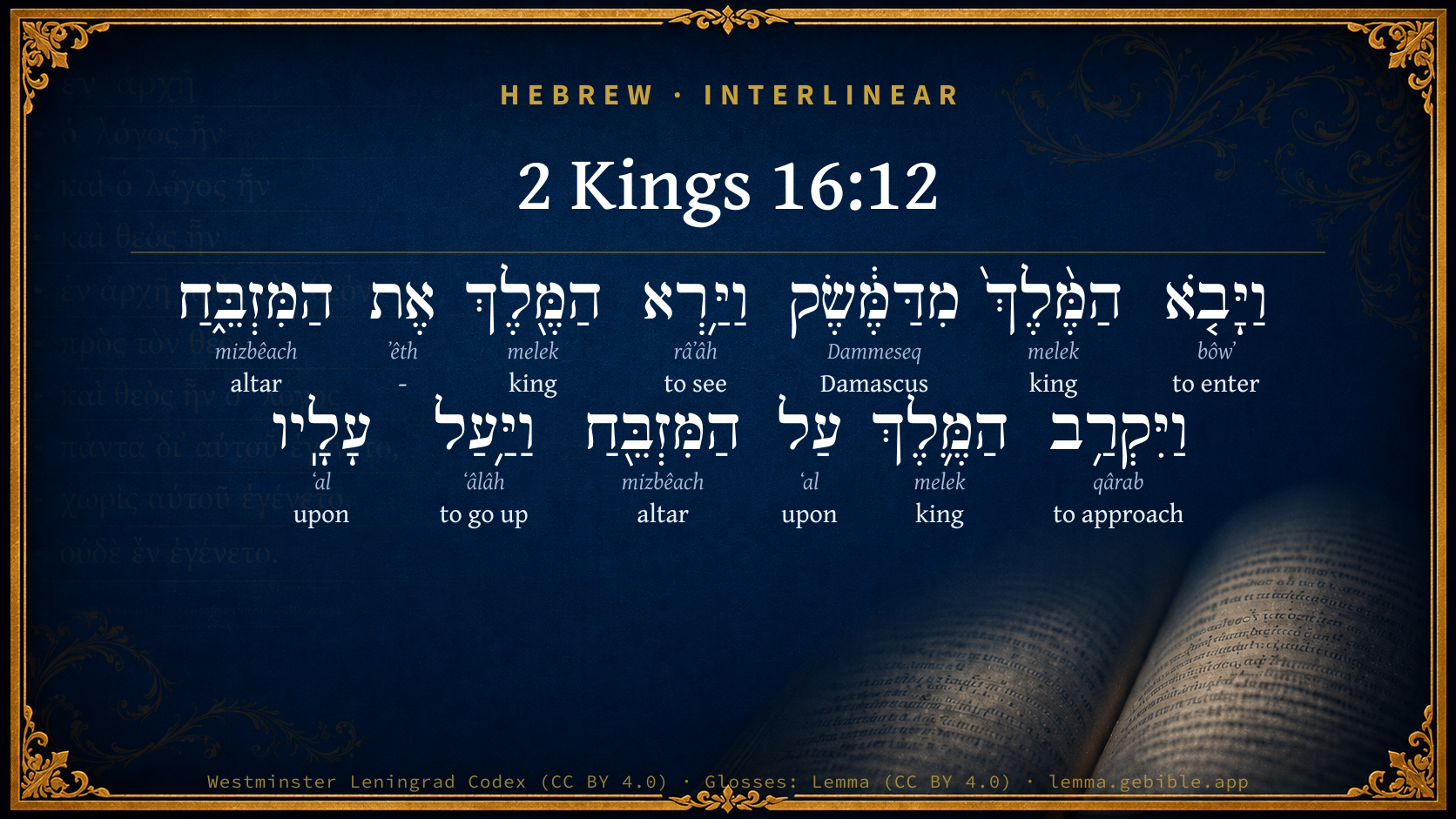
Hebrew (Westminster Leningrad Codex) 2 Kings 16:12 appears in the Hebrew Old Testament. The text above is from the Westminster Leningrad Codex. Each word links to its Strong’s number, a concise gloss, and parsing drawn from the Open Scriptures Hebrew Bible morphology. Click any word for its full Brown-Driver-Briggs (BDB) entry.
Download image
Cite this verse

2 Kings 16:12 (World English Bible). Public Domain. Lemma interlinear Bible study tool, https://lemma.gebible.app/v/2-kings/16/12.

Show BibTeX & RIS
BibTeX
RIS
English Translation
When the king was come from Damascus, the king saw the altar: and the king drew near to the altar, and offered thereon.
World English Bible · Public Domain
Download a study sheet

One document with this verse’s original text, its word-by-word gloss line, the meaning frame, cross-references with their text, attributed commentary, and full source and license credits — printable, and it pastes into notes with its structure intact.

This verse Autodidact and up

Study sheet (.html) Plain text (.txt)

A passage Seminary Student

Up to 50 verses in one chapter. A passage sheet keeps up to 6 commentary sources and 12 cross-references per verse, in the order this page ranks them, and says so on the sheet whenever that leaves anything out. Ask for a single verse and you get the Autodidact verse sheet above.

Everything on this page stays free to read, with no account — the sheet is a download of what is already on screen, not access to it.

Want to remove ads? Support Godless Engineer
Compare translations 3

The same verse in 3 English versions, stacked beneath the original-language interlinear above. Click any original word for its lexicon entry.

Each is an independent rendering of the whole verse — the interlinear is not word-aligned to these translations.

Highlighted words mark where these versions differ — a whole-verse word diff, not a word-by-word alignment.

  • World English Bible Public Domain
    When the king was come from Damascus, the king saw the altar: and the king drew near to the altar, and offered thereon.
  • King James Version Public Domain
    And when the king was come from Damascus, the king saw the altar: and the king approached to the altar, and offered thereon.
  • unfoldingWord Literal Text CC BY-SA 4.0
    And the king came from Damascus, and the king saw the altar. And the king drew near to the altar, and he offered on it.

unfoldingWord Literal Text — © unfoldingWord, licensed CC BY-SA 4.0. Word-aligned USFM3 via Door43 (git.door43.org/unfoldingWord/en_ult).

Versions to compare (up to 4)

3 of 4 selected

Show all 18 translations

Every available English version of this verse, each an independent rendering of the whole verse.

  • World English Bible Public Domain
    When the king was come from Damascus, the king saw the altar: and the king drew near to the altar, and offered thereon.
  • Berean Standard Bible Public Domain
    When the king came back from Damascus and saw the altar, he approached it and presented offerings on it.
  • Majority Standard Bible Public Domain
    When the king came back from Damascus and saw the altar, he approached it and presented offerings on it.
  • King James Version Public Domain
    And when the king was come from Damascus, the king saw the altar: and the king approached to the altar, and offered thereon.
  • American Standard Version (1901) Public Domain
    And when the king was come from Damascus, the king saw the altar: and the king drew near unto the altar, and offered thereon.
  • Revised Version (1885) Public Domain
    And when the king was come from Damascus, the king saw the altar: and the king drew near unto the altar, and offered thereon.
  • Geneva Bible (1599) Public Domain
    So when the King was come from Damascus, the King sawe the altar: and the King drewe neere to the altar and offered thereon.
  • Douay-Rheims (1899) Public Domain
    And when the king was come from Damascus, he saw the altar and worshipped it: and went up and offered holocausts, and his own sacrifice.
  • Young's Literal Translation Public Domain
    And the king cometh in from Damascus, and the king seeth the altar, and the king draweth near on the altar, and offereth on it,
  • Literal Standard Version CC BY-SA 4.0
    And the king comes in from Damascus, and the king sees the altar, and the king draws near on the altar, and offers on it,
  • Unlocked Literal Bible CC BY-SA 4.0
    When the king came from Damascus he saw the altar; the king approached the altar and made offerings on it.
  • unfoldingWord Literal Text CC BY-SA 4.0
    And the king came from Damascus, and the king saw the altar. And the king drew near to the altar, and he offered on it.
  • Darby Bible Public Domain
    And when the king came from Damascus, the king saw the altar; and the king approached to the altar, and offered upon it.
  • World Messianic Bible Public Domain
    When the king had come from Damascus, the king saw the altar; and the king came near to the altar, and offered on it.
  • Webster's Bible Public Domain
    And when the king had come from Damascus, the king saw the altar: and the king approached to the altar, and offered on it.
  • Free Bible Version CC BY-SA 4.0
    When the king came back from Damascus he saw the altar. He went over to it and made offerings on it.
  • Bible in Basic English Public Domain
    And when the king came from Damascus, he saw the altar; and he went up on it and made an offering on it.
  • JPS Tanakh (1917) Public Domain
    And when the king was come from Damascus, the king saw the altar; and the king drew near unto the altar, and offered thereon.

Literal Standard Version (2020), Covenant Press — licensed CC BY-SA 4.0. Text via the HelloAO Bible API (eBible.org). Unlocked Literal Bible (unfoldingWord) — licensed CC BY-SA 4.0. Text via the HelloAO Bible API (eBible.org). unfoldingWord Literal Text — © unfoldingWord, licensed CC BY-SA 4.0. Word-aligned USFM3 via Door43 (git.door43.org/unfoldingWord/en_ult). Free Bible Version, Dr. Jonathan Gallagher — licensed CC BY-SA 4.0. Text via the HelloAO Bible API (eBible.org).

Word by word

More ways to search: Search by grammar → Find every occurrence → Compare this word →

Practice this passage: Drill this verse → Learn its vocabulary →

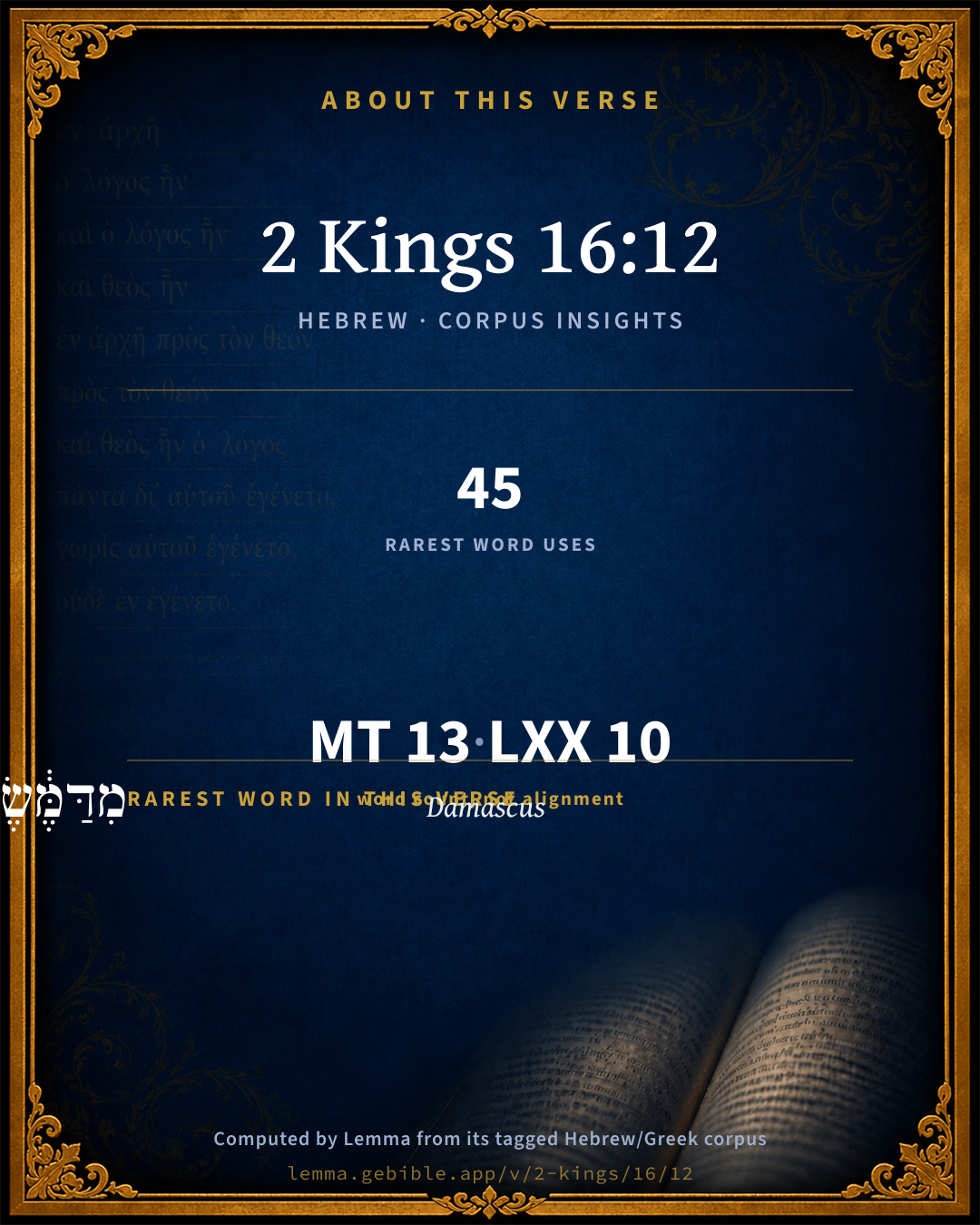
מִדַּמֶּ֔שֶׂק
Dammeseq
H1834
“from · Damascus”
Preposition + Noun, Proper
Part of Speech
Preposition + Noun
Type
Proper
Full BDB Definition

Origin: of foreign origin

TWOT: None

Damascus = "silent is the sackcloth weaver" - an ancient trading city, capital of Syria, located in the plain east of Hermon, 130 (205 kilometers) miles northeast of Jerusalem
  1. וַיָּבֹ֤א bôwʼ H935 “and · to enter” Conjunction + Verb, Qal, Sequential Imperfect, 3rd Person, Masculine, Singular
  2. הַמֶּ֨לֶךְ֙ melek H4428 “the · king” Particle, Definite Article + Noun, Common, Masculine, Singular, Absolute
  3. וַיַּ֥רְא râʼâh H7200 “and · to see” Conjunction + Verb, Qal, Sequential Imperfect, 3rd Person, Masculine, Singular
  4. הַמֶּ֖לֶךְ melek H4428 “the · king” Particle, Definite Article + Noun, Common, Masculine, Singular, Absolute
  5. אֶת ʼêth H853 “-” Particle, Direct Object
  6. הַמִּזְבֵּ֑חַ mizbêach H4196 “the · altar” Particle, Definite Article + Noun, Common, Masculine, Singular, Absolute
  7. וַיִּקְרַ֥ב qârab H7126 “and · to approach” Conjunction + Verb, Qal, Sequential Imperfect, 3rd Person, Masculine, Singular
  8. הַמֶּ֛לֶךְ melek H4428 “the · king” Particle, Definite Article + Noun, Common, Masculine, Singular, Absolute
  9. עַל ʻal H5921 “upon” Preposition
  10. הַמִּזְבֵּ֖חַ mizbêach H4196 “the · altar” Particle, Definite Article + Noun, Common, Masculine, Singular, Absolute
  11. וַיַּ֥עַל ʻâlâh H5927 “and · to go up” Conjunction + Verb, Hiphil, Sequential Imperfect, 3rd Person, Masculine, Singular
  12. עָלָֽיו ʻal H5921 “upon · him” Preposition + Suffix, Personal, 3rd Person, Masculine, Singular

About this verse

These counts appear in no published source. They are computed here, from the morphology-tagged text and Lemma’s own curated glosses. What Lemma adds →

13
words
9
distinct lemmas
Historical
section

Shared distinctive vocabulary

מִדַּמֶּ֔שֶׂק Damascus H1834 occurs in 40 verses of the Hebrew Bible. Also found in:

Grammatical profile

  • 4 verbs
  • 6 nouns
  • 2 prepositions
  • 1 particle

Verb forms

  • וַיָּבֹ֤א Qal · Sequential Imperfect
  • וַיַּ֥רְא Qal · Sequential Imperfect
  • וַיִּקְרַ֥ב Qal · Sequential Imperfect
  • וַיַּ֥עַל Hiphil · Sequential Imperfect

Repetition

Words recur within this verse — often emphatic in Hebrew:

  • הַמֶּ֨לֶךְ֙ king H4428 ×3
  • הַמִּזְבֵּ֑חַ altar H4196 ×2
  • עַל upon H5921 ×2

Hebrew & Septuagint length

In English translation the verse runs 23 words from the Hebrew and 11 from the Septuagint (LXX English) — the Septuagint runs noticeably shorter here. See the side-by-side →

A rough comparison of the two English renderings, which tokenize alike — not a word-level alignment.

Word counts can differ between the Hebrew and the Greek without any difference in meaning — e.g. the Hebrew direct-object marker אֵת has no separate Greek word, and Greek often adds the article ὁ.

In the original languages it is 13 Hebrew tokens and 10 Greek tokens — but the two are counted differently (Hebrew bundles its prefixes and suffixes into one token; the Greek is in lemma form), so that isn’t a like-for-like length.

Cross-references

5

Topical passages linked to 2 Kings 16:12 in the Treasury of Scripture Knowledge — connected by theme and wording, ordered by reader-vote popularity; previews shown in the World English Bible.

  • 2 Chronicles 26:16–19 But when he was strong, his heart was lifted up, so that he did corruptly, and he trespassed against Yahweh his God; for he went into the temple of Yahweh to burn incense on the altar of incense.
  • Numbers 18:4–7 They shall be joined to you, and keep the charge of the tent of meeting, for all the service of the Tent: and a stranger shall not come near to you.
  • 1 Kings 13:1 Behold, there came a man of God out of Judah by the word of Yahweh to Beth El: and Jeroboam was standing by the altar to burn incense.
  • 2 Chronicles 28:23 For he sacrificed to the gods of Damascus, which struck him; and he said, Because the gods of the kings of Syria helped them, [therefore] will I sacrifice to them, that they may help me. But they were the ruin of him, and of all Israel.
  • 2 Chronicles 28:25 In every city of Judah he made high places to burn incense to other gods, and provoked to anger Yahweh, the God of his fathers.

Cross-references courtesy of OpenBible.info (CC BY 4.0).

Hebrew and Greek witnesses Masoretic Hebrew ↔ Greek Septuagint

The same verse in the two great witnesses to the Old Testament, shown verse-for-verse.

Here the Septuagint runs noticeably shorter than the Hebrew — LXX2012 (modern English Septuagint) 11 words vs World English Bible 23. A rough length comparison of the two English translations, not a word-level alignment — read both below.

These are two independent witnesses, not word-aligned to each other, and the Septuagint is shown in lemma (dictionary) form.

Hebrew 2 Kings 16:12 Masoretic · Westminster Leningrad Codex

וַיָּבֹ֤א הַמֶּ֨לֶךְ֙ מִדַּמֶּ֔שֶׂק וַיַּ֥רְא הַמֶּ֖לֶךְ אֶת הַמִּזְבֵּ֑חַ וַיִּקְרַ֥ב הַמֶּ֛לֶךְ עַל הַמִּזְבֵּ֖חַ וַיַּ֥עַל עָלָֽיו

When the king was come from Damascus, the king saw the altar: and the king drew near to the altar, and offered thereon.

World English Bible · Public Domain

Greek LXX 2 Kings 16:12 Septuagint · lemma form

καί ὁράω ὁ βασιλεύς ὁ θυσιαστήριον καί ἀναβαίνω ἐπί αὐτός

And the king saw the altar, and went up to it,

LXX2012 (modern English Septuagint) · Public Domain

On this verse, The Cambridge Bible for Schools and Colleges discusses the Septuagint’s reading. Read the note in Commentary ↓

Hebrew: Westminster Leningrad Codex (CC BY 4.0). Greek: Septuagint (public domain); English from LXX2012 (modern English Septuagint) (Public Domain). How the Septuagint differs from the Hebrew →

Targum (Aramaic paraphrase)

1

The Targum is the ancient Jewish Aramaic paraphrase of the Hebrew Scriptures — an interpretive translation, not the Hebrew text itself. Onkelos (literal) and Pseudo-Jonathan (expansive) render the Torah, and Jonathan the Prophets. Coverage is partial: where no permissively-licensed English translation exists for a verse, only the Aramaic is shown. This is verse-level text, not a word-by-word alignment to the Hebrew.

  1. Targum Jonathan Prophets (Joshua–Malachi)
    וַאֲתָא מַלְכָּא מִדַמֶשֶׂק וַחֲזָא מַלְכָּא יַת מַדְבְּחָא וְקָרֵיב מַלְכָּא עַל מַדְבְּחָא וְאַסֵיק עֲלוֹהִי:

    (no public-domain English translation for this verse)

    Targum Jonathan — Aramaic: “Mikraot Gedolot” (public domain). English: “Sefaria Community Translation” (CC0 1.0 (public-domain dedication)); “London "Chaldee Paraphrase," 1871” (public domain). Text via Sefaria.

Commentary

Notes on 2 Kings 16:12 from classic Christian and Jewish commentators (each source and its license shown beneath its notes). The classic Christian expositions comment on the surrounding passage and are grouped to its opening verse, so a note may address several verses; the Jewish commentaries on the Tanakh (Rashi and others) are per-verse, so they appear only where the commentator wrote on this verse.

Lemma curates 59 commentaries, every one of them public domain or Creative Commons licensed, each selected and text-cleaned for this edition rather than reprinted as found. About our sources →

Trapp's Complete Commentary

John Trapp

2Ki 16:12 And when the king was come from Damascus, the king saw the altar: and the king approached to the altar, and offered thereon.

Ver. 12. And the king approached to the altar.] Urijah suffering him so to do; whereas that zealous priest Azariah would not endure his grandfather Uzziah, a far better man, to offer sacrifice. {2Ch 26:17-18}

John Trapp, A Commentary or Exposition upon All the Books of the Old and New Testament (1647–1656) — public domain. Text from a community e-Sword module.

Tyndale Open Study Notes

Tyndale Open Resources

16:12-13 The king initiated the new altar by making the traditional offerings upon it (see Lev 1–3; Num 15:1-10; 28:9-15, 24, 31; 2 Kgs 6:8-23; 7:11-20). Sadly, such offerings upon a pagan altar by a leader devoid of spiritual character constituted a mockery of their deep spiritual meaning.

Tyndale Open Study Notes — © Tyndale Open Resources, licensed CC BY-SA 4.0. Text via the HelloAO Bible API.

Geneva Bible (1599)

Geneva Bible translators

Either offerings for peace or prosperity, or thanksgiving, as Lev. 3:1, or else meaning the morning and evening offering, Exod. 29:38, Num. 28:3, and thus he contemned the means and the altar which God had commanded by Solomon, to serve God after his own fantasy.

Geneva Bible (1599) marginal notes — public domain. Text via Bolls.life.

Ellicott's Commentary for English Readers

(12) The king approached to the altar, and offered thereon.—So the Targum renders. But all the other versions: “The king approached to the altar, and went up thereon.” (Comp. 1Ki_12:32-33.) It thus appears that Ahaz, like Uzziah, personally exercised the priestly function of sacrifice.

A Bible Commentary for English Readers, edited by Charles John Ellicott (1878–1897) — public domain. Text from a community e-Sword module.

The Cambridge Bible for Schools and Colleges

gen. ed. J. J. S. Perowne

12. and the king approached to [R.V. drew near unto] the altar] The rendering adopted by R.V. is much the most frequent in A.V. Except in this verse ‘approach’ is not used of ‘drawing near’ to an altar, but always ‘come near’ or ‘draw near’.

and offered thereon] At such an altar he might be his own priest. The LXX. does not represent these words.

The Cambridge Bible for Schools and Colleges (gen. ed. J. J. S. Perowne; Cambridge University Press, 1878–1918) — public domain. Text from a community e-Sword module.

John Gill's Exposition

And he burnt his burnt offering, and his meat offering,.... Which went together according to the law of God, and was imitated by the Heathens:

and poured his drink offering; a libation of wine, as probably it was, like what they used according to the Levitical law:

and sprinkled the blood of his peace offerings upon the altar; as used according to the same law; for all sorts of sacrifices were offered by idolaters, as by the people of God, in imitation of them.

John Gill's Exposition of the Whole Bible (1746–1763) — public domain (CC PDM 1.0). Text via the HelloAO Bible API.

Haydock's Catholic Bible Commentary

And worshipped. Hebrew simply, "and the king approached to the altar, and offered on it (13) his holocaust and his meat (or flour) offering, and poured hid drink-offering, and the blood of his peace-offerings, upon the altar." (Haydock) --- He dedicated it with all sorts of sacrifices, forbidding any other to be used in the temple. But shortly after he shut up the temple entirely, 2 Paralipomenon xxviii. 24., and xxix. 3. He offered sacrifice to idols upon this altar, (Abulensis) while the priests made use of the same altar to sacrifice the true God, (ver. 15.; Menochius) unlawfully.

George Leo Haydock (1774–1849), Haydock's Catholic Family Bible and Commentary, 1859 edition — public domain. Excludes Psalms (Douay-Rheims chapter numbering differs from Protestant) and Deuterocanonical books (Catholic canon only).

Matthew Poole's English Annotations

To wit, a sacrifice, and that not unto God, but unto the Syrian idols, as appears from 2Ch 28:23,24, to whom that altar was appropriated. Whether he offered by himself, or by a priest, is not certain.

Matthew Poole's English Annotations on the Holy Bible (1683–1685) — public domain. Text from a community e-Sword/MySword module.

Whedon's Commentary on the Bible

Daniel D. Whedon

12. Saw the altar — That is, the new altar which Urijah had just completed, according to the pattern sent him from Damascus, and had erected, apparently, near the entrance into the court. This new altar is called emphatically the altar in this verse and the following, and in 2Ki_16:15, the great altar.

Daniel D. Whedon (gen. ed.), Commentary on the Old and New Testaments (1874–1909) — public domain. Text from a community e-Sword module.

The Pulpit Commentary

And when the king was come from Damascus, the king saw the altar: and the king approached to the altar, and offered thereon. It is not necessarily implied in these words that Ahaz, like Uzziah, usurped the priestly functions, though conceivably he may have done so, and Urijah may have stood tamely by. What the writer has it in his mind to record is that the king, on his return from Damascus, at once made use of the new" altar for his private sacrifices. If he had meant to tax Ahaz with so great a sin as that which brought the curse of leprosy upon Uzziah, he would almost certainly have made his meaning clearer.

The Pulpit Commentary (1880–1919), ed. H.D.M. Spence-Jones & Joseph S. Exell — public domain. Text from a community e-Sword module.

John Wesley's Explanatory Notes

Offered - A sacrifice, and that not to God, but to the Syrian idols, to whom that altar was appropriated.

John Wesley, Explanatory Notes Upon the Whole Bible (1754–1765) — public domain. Text via the GEBible commentary corpus.

Lesson kit

Teaching starters — assembled from the data on this page, not authored interpretation. Every prompt links to the verse data it draws on. Edit before teaching.

2 Kings, in the Historical, opens this verse with 13 words (9 distinct Hebrew lemmas). Its most distinctive word is Dammeseq (“Damascus”). The Greek Septuagint runs shorter here. A historical commentator’s framing appears above. Read the whole chapter for the surrounding context.

Discussion questions

  1. What does “Damascus” (Dammeseq) contribute to the verse as a whole?
  2. Genesis 14:15 shares the word «Damascus» with this verse. How do the two illuminate each other?
  3. “king” occurs 3× in this one verse. What is the effect of the repetition?
  4. Compared with the Hebrew, the Septuagint runs shorter here. What questions does that raise?
  5. These translations render this verse differently. What is at stake in choosing one wording over another?
  6. The verb «וַיָּבֹ֤א» is Qal Sequential Imperfect. How does its form color the action?
  7. Reading how Trapp's Complete Commentary and Tyndale Open Study Notes read this verse, where do the two commentators agree and where do they part?

Things to notice

Reading settings

Reading text

Shown beneath each verse's original-language words.

Old Testament
Old Testament edition

Read the OT as the Masoretic Hebrew (MT) or the Greek Septuagint (LXX).

English shown for the Greek Septuagint (in the Hebrew ↔ Greek comparison).

Comparing translations? Open the Compare panel on any verse page to stack up to four side by side.