
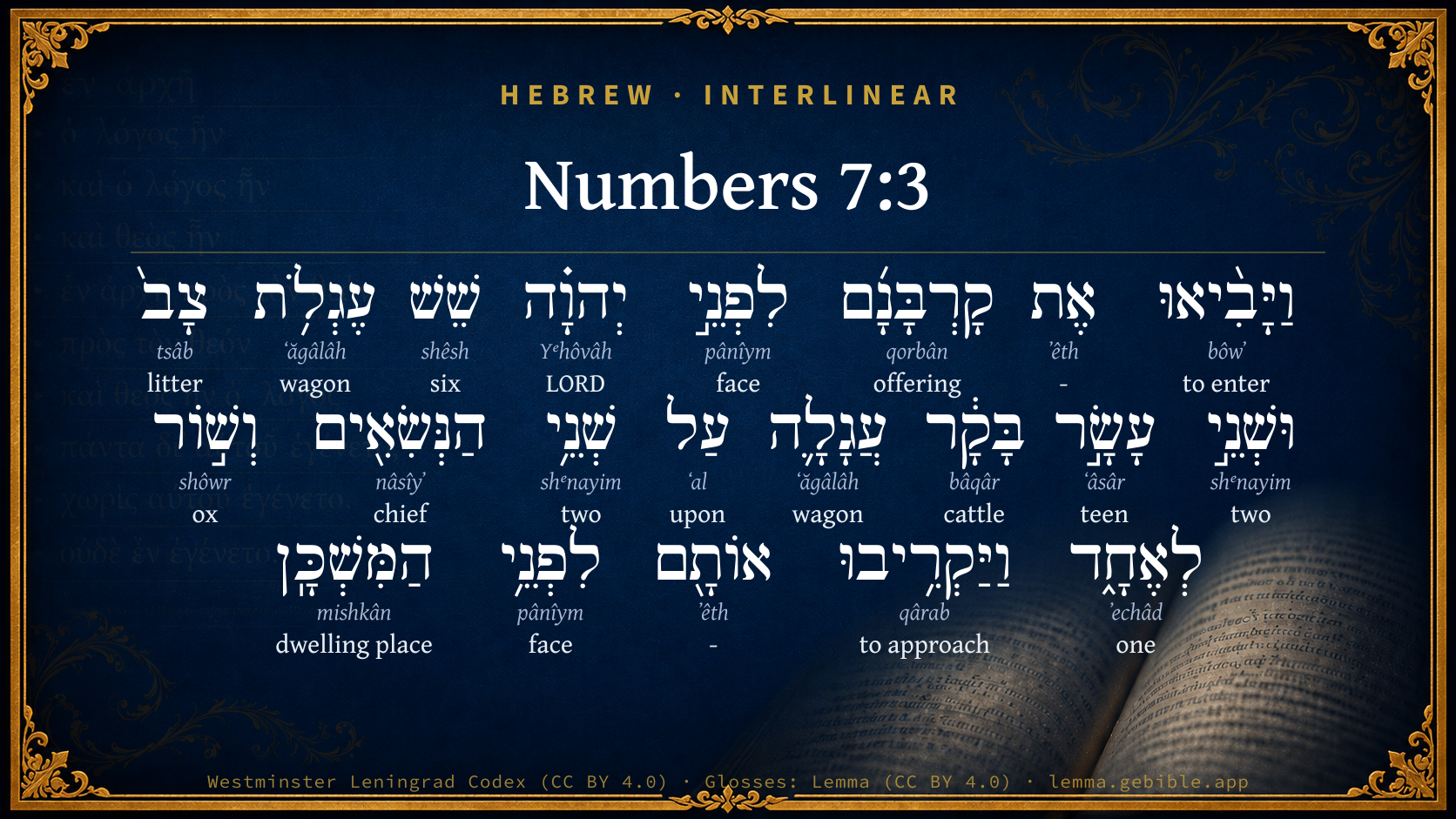
Numbers 7:3

Hebrew (Westminster Leningrad Codex) Numbers 7:3 appears in the Hebrew Old Testament. The text above is from the Westminster Leningrad Codex. Each word links to its Strong’s number, a concise gloss, and parsing drawn from the Open Scriptures Hebrew Bible morphology. Click any word for its full Brown-Driver-Briggs (BDB) entry.
Download image
Cite this verse

Numbers 7:3 (World English Bible). Public Domain. Lemma interlinear Bible study tool, https://lemma.gebible.app/v/numbers/7/3.

Show BibTeX & RIS
BibTeX
RIS
English Translation
and they brought their offering before Yahweh, six covered wagons, and twelve oxen; a wagon for every two of the princes, and for each one an ox: and they presented them before the tabernacle.
World English Bible · Public Domain
Download a study sheet

One document with this verse’s original text, its word-by-word gloss line, the meaning frame, cross-references with their text, attributed commentary, and full source and license credits — printable, and it pastes into notes with its structure intact.

This verse Autodidact and up

Study sheet (.html) Plain text (.txt)

A passage Seminary Student

Up to 50 verses in one chapter. A passage sheet keeps up to 6 commentary sources and 12 cross-references per verse, in the order this page ranks them, and says so on the sheet whenever that leaves anything out. Ask for a single verse and you get the Autodidact verse sheet above.

Everything on this page stays free to read, with no account — the sheet is a download of what is already on screen, not access to it.

Want to remove ads? Support Godless Engineer
Compare translations 3

The same verse in 3 English versions, stacked beneath the original-language interlinear above. Click any original word for its lexicon entry.

Each is an independent rendering of the whole verse — the interlinear is not word-aligned to these translations.

Highlighted words mark where these versions differ — a whole-verse word diff, not a word-by-word alignment.

  • World English Bible Public Domain
    and they brought their offering before Yahweh, six covered wagons, and twelve oxen; a wagon for every two of the princes, and for each one an ox: and they presented them before the tabernacle.
  • King James Version Public Domain
    And they brought their offering before the LORD, six covered wagons, and twelve oxen; a wagon for two of the princes, and for each one an ox: and they brought them before the tabernacle.
  • unfoldingWord Literal Text CC BY-SA 4.0
    And they brought their offering to the face of Yahweh, six covered wagons and 12 cattle, a wagon according to two of the leaders and an ox for one. And they presented them to the face of the Dwelling.

unfoldingWord Literal Text — © unfoldingWord, licensed CC BY-SA 4.0. Word-aligned USFM3 via Door43 (git.door43.org/unfoldingWord/en_ult).

Versions to compare (up to 4)

3 of 4 selected

Show all 18 translations

Every available English version of this verse, each an independent rendering of the whole verse.

  • World English Bible Public Domain
    and they brought their offering before Yahweh, six covered wagons, and twelve oxen; a wagon for every two of the princes, and for each one an ox: and they presented them before the tabernacle.
  • Berean Standard Bible Public Domain
    They brought as their offering before the LORD six covered carts and twelve oxen—an ox from each leader and a cart from every two leaders—and presented them before the tabernacle.
  • Majority Standard Bible Public Domain
    They brought as their offering before the LORD six covered carts and twelve oxen—an ox from each leader and a cart from every two leaders—and presented them before the tabernacle.
  • King James Version Public Domain
    And they brought their offering before the LORD, six covered wagons, and twelve oxen; a wagon for two of the princes, and for each one an ox: and they brought them before the tabernacle.
  • American Standard Version (1901) Public Domain
    and they brought their oblation before Jehovah, six covered wagons, and twelve oxen; a wagon for every two of the princes, and for each one an ox: and they presented them before the tabernacle.
  • Revised Version (1885) Public Domain
    and they brought their oblation before the LORD, six covered wagons, and twelve oxen; a wagon for every two of the princes, and for each one an ox: and they presented them before the tabernacle.
  • Geneva Bible (1599) Public Domain
    And brought their offring before the Lord, sixe couered charets, and twelue oxen: one charet for two princes, and for euery one an oxe, and they offred them before the Tabernacle.
  • Douay-Rheims (1899) Public Domain
    Their gifts before the Lord, six wagons covered, and twelve oxen. Two princes offered one wagon, and each one an ox, and they offered them before the tabernacle.
  • Young's Literal Translation Public Domain
    yea, they bring their offering before Jehovah, six waggons covered, and twelve oxen -- a waggon for two of the princes, and an ox for one -- and they bring them near before the tabernacle.
  • Literal Standard Version CC BY-SA 4.0
    indeed, they bring their offering before YHWH of six covered wagons and twelve oxen—a wagon for two of the princes, and an ox for one—and they bring them near before the Dwelling Place.
  • Unlocked Literal Bible CC BY-SA 4.0
    They brought their offerings before Yahweh. They brought six covered carts and twelve oxen. They brought one cart for every two leaders, and each leader brought one ox. They presented these things in front of the tabernacle.
  • unfoldingWord Literal Text CC BY-SA 4.0
    And they brought their offering to the face of Yahweh, six covered wagons and 12 cattle, a wagon according to two of the leaders and an ox for one. And they presented them to the face of the Dwelling.
  • Darby Bible Public Domain
    and they brought their offering before Jehovah, six covered waggons, and twelve oxen; a waggon for two princes, and an ox for each; and they presented them before the tabernacle.
  • World Messianic Bible Public Domain
    and they brought their offering before the LORD, six covered wagons and twelve oxen; a wagon for every two of the princes, and for each one an ox. They presented them before the tabernacle.
  • Webster's Bible Public Domain
    And they brought their offering before the LORD, six covered wagons, and twelve oxen; a wagon for two of the princes, and for each one an ox: and they brought them before the tabernacle.
  • Free Bible Version CC BY-SA 4.0
    They brought to the Lord an offering of six covered wagons and twelve oxen. Each leader gave an ox, and two leaders shared in giving a wagon. They presented them in front of the Tabernacle.
  • Bible in Basic English Public Domain
    And they came with their offerings before the Lord, six covered carts and twelve oxen; a cart for every two of the chiefs, and for every one an ox.
  • JPS Tanakh (1917) Public Domain
    And they brought their offering before the LORD, six covered wagons, and twelve oxen: a wagon for every two of the princes, and for each one an ox; and they presented them before the tabernacle.

Literal Standard Version (2020), Covenant Press — licensed CC BY-SA 4.0. Text via the HelloAO Bible API (eBible.org). Unlocked Literal Bible (unfoldingWord) — licensed CC BY-SA 4.0. Text via the HelloAO Bible API (eBible.org). unfoldingWord Literal Text — © unfoldingWord, licensed CC BY-SA 4.0. Word-aligned USFM3 via Door43 (git.door43.org/unfoldingWord/en_ult). Free Bible Version, Dr. Jonathan Gallagher — licensed CC BY-SA 4.0. Text via the HelloAO Bible API (eBible.org).

Word by word

More ways to search: Search by grammar → Find every occurrence → Compare this word →

Practice this passage: Drill this verse → Learn its vocabulary →

צָב֙
tsâb
H6632
“litter”
Noun, Common, Masculine, Singular, Absolute
Part of Speech
Noun
Type
Common
Gender
Masculine
Number
Singular
State
Absolute
Full BDB Definition

Origin: from an unused root meaning to establish

TWOT: 1866a , 1867a

a carrying vehicle, litter, covered wagon - an unclean lizard - perhaps a tortoise - perhaps an extinct animal, exact meaning unknown
  1. וַיָּבִ֨יאוּ bôwʼ H935 “and · to enter” Conjunction + Verb, Hiphil, Sequential Imperfect, 3rd Person, Masculine, Plural
  2. אֶת ʼêth H853 “-” Particle, Direct Object
  3. קָרְבָּנָ֜ם qorbân H7133 “offering · their” Noun, Common, Masculine, Singular, Construct + Suffix, Personal, 3rd Person, Masculine, Plural
  4. לִפְנֵ֣י pânîym H6440 “to/for · face(s) of” Preposition + Noun, Common, Both, Plural, Construct
  5. יְהוָ֗ה Yᵉhôvâh H3068 “LORD” Noun, Proper
  6. שֵׁשׁ shêsh H8337 “six” Adjective, Cardinal number, Feminine, Singular, Absolute
  7. עֶגְלֹ֥ת ʻăgâlâh H5699 “wagons of” Noun, Common, Feminine, Plural, Construct
  8. וּשְׁנֵ֣י shᵉnayim H8147 “and · two” Conjunction + Adjective, Cardinal number, Masculine, Dual, Construct
  9. עָשָׂ֣ר ʻâsâr H6240 “teen” Adjective, Cardinal number, Masculine, Singular, Absolute
  10. בָּקָ֔ר bâqâr H1241 “cattle” Noun, Common, Both, Singular, Absolute
  11. עֲגָלָ֛ה ʻăgâlâh H5699 “wagon” Noun, Common, Feminine, Singular, Absolute
  12. עַל ʻal H5921 “upon” Preposition
  13. שְׁנֵ֥י shᵉnayim H8147 “two” Adjective, Cardinal number, Masculine, Dual, Construct
  14. הַנְּשִׂאִ֖ים nâsîyʼ H5387 “the · chiefs” Particle, Definite Article + Noun, Common, Masculine, Plural, Absolute
  15. וְשׁ֣וֹר shôwr H7794 “and · ox” Conjunction + Noun, Common, Masculine, Singular, Absolute
  16. לְאֶחָ֑ד ʼechâd H259 “to/for · one” Preposition + Adjective, Cardinal number, Masculine, Singular, Absolute
  17. וַיַּקְרִ֥יבוּ qârab H7126 “and · to approach” Conjunction + Verb, Hiphil, Sequential Imperfect, 3rd Person, Masculine, Plural
  18. אוֹתָ֖ם ʼêth H853 “- · them” Particle, Direct Object + Suffix, Personal, 3rd Person, Masculine, Plural
  19. לִפְנֵ֥י pânîym H6440 “to/for · face(s) of” Preposition + Noun, Common, Both, Plural, Construct
  20. הַמִּשְׁכָּֽן mishkân H4908 “the · dwelling place” Particle, Definite Article + Noun, Common, Masculine, Singular, Absolute

About this verse

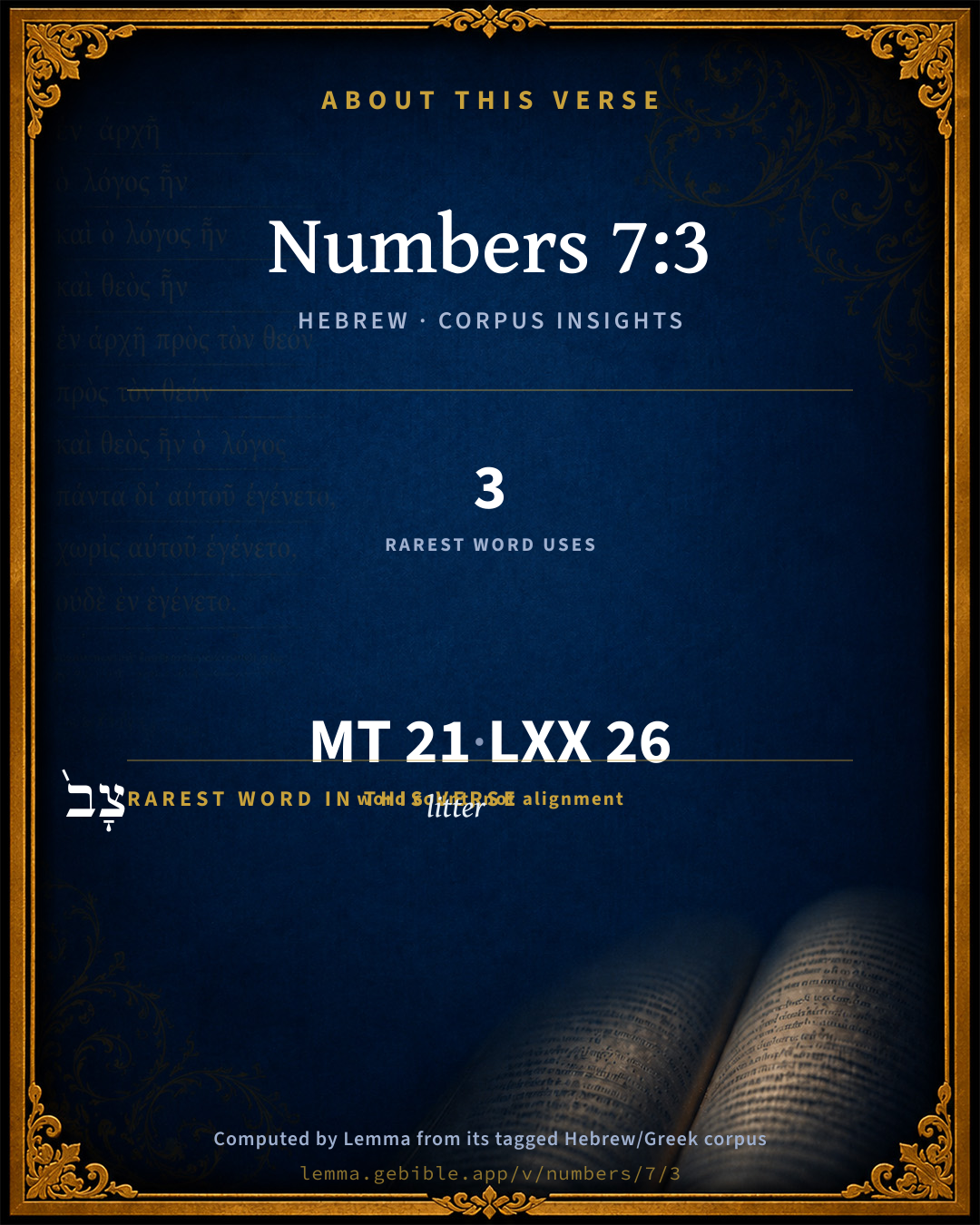
These counts appear in no published source. They are computed here, from the morphology-tagged text and Lemma’s own curated glosses. What Lemma adds →

21
words
17
distinct lemmas
Pentateuch
section

Notable vocabulary

The rarest word here is צָב֙ litter H6632 — appearing just 3 times in the whole Hebrew Bible.

Shared distinctive vocabulary

צָב֙ litter H6632 occurs in 3 verses of the Hebrew Bible. Also found in:

Grammatical profile

  • 2 verbs
  • 11 nouns
  • 5 adjectives
  • 1 preposition
  • 2 particles

Verb forms

  • וַיָּבִ֨יאוּ Hiphil · Sequential Imperfect
  • וַיַּקְרִ֥יבוּ Hiphil · Sequential Imperfect

Repetition

Words recur within this verse — often emphatic in Hebrew:

  • לִפְנֵ֣י face H6440 ×2
  • עֶגְלֹ֥ת wagon H5699 ×2
  • וּשְׁנֵ֣י two H8147 ×2

Hebrew & Septuagint length

In English translation the verse runs 34 words from the Hebrew and 31 from the Septuagint (LXX English) — closely comparable.

A rough comparison of the two English renderings, which tokenize alike — not a word-level alignment.

Word counts can differ between the Hebrew and the Greek without any difference in meaning — e.g. the Hebrew direct-object marker אֵת has no separate Greek word, and Greek often adds the article ὁ.

In the original languages it is 21 Hebrew tokens and 26 Greek tokens — but the two are counted differently (Hebrew bundles its prefixes and suffixes into one token; the Greek is in lemma form), so that isn’t a like-for-like length.

Hebrew and Greek witnesses Masoretic Hebrew ↔ Greek Septuagint

The same verse in the two great witnesses to the Old Testament, shown verse-for-verse.

These are two independent witnesses, not word-aligned to each other, and the Septuagint is shown in lemma (dictionary) form.

Hebrew Numbers 7:3 Masoretic · Westminster Leningrad Codex

וַיָּבִ֨יאוּ אֶת קָרְבָּנָ֜ם לִפְנֵ֣י יְהוָ֗ה שֵׁשׁ עֶגְלֹ֥ת צָב֙ וּשְׁנֵ֣י עָשָׂ֣ר בָּקָ֔ר עֲגָלָ֛ה עַל שְׁנֵ֥י הַנְּשִׂאִ֖ים וְשׁ֣וֹר לְאֶחָ֑ד וַיַּקְרִ֥יבוּ אוֹתָ֖ם לִפְנֵ֥י הַמִּשְׁכָּֽן

and they brought their offering before Yahweh, six covered wagons, and twelve oxen; a wagon for every two of the princes, and for each one an ox: and they presented them before the tabernacle.

World English Bible · Public Domain

Greek LXX Numbers 7:3 Septuagint · lemma form

καί φέρω ὁ δῶρον αὐτός ἔναντι κύριος ἕξ ἅμαξα λαμπηνικός καί δώδεκα βοῦς ἅμαξα παρά δύο ἄρχων καί μόσχος παρά ἕκαστος καί προςἄγω ἐναντίον ὁ σκηνή

And they brought their gift before the Lord, six covered wagons, and twelve oxen; a wagon from two princes, and a calf from each: and they brought them before the tabernacle.

LXX2012 (modern English Septuagint) · Public Domain

On this verse, Adam Clarke's Commentary discusses the Septuagint’s reading. Read the note in Commentary ↓

Hebrew: Westminster Leningrad Codex (CC BY 4.0). Greek: Septuagint (public domain); English from LXX2012 (modern English Septuagint) (Public Domain). How the Septuagint differs from the Hebrew →

Targum (Aramaic paraphrase)

2

The Targum is the ancient Jewish Aramaic paraphrase of the Hebrew Scriptures — an interpretive translation, not the Hebrew text itself. Onkelos (literal) and Pseudo-Jonathan (expansive) render the Torah, and Jonathan the Prophets. Coverage is partial: where no permissively-licensed English translation exists for a verse, only the Aramaic is shown. This is verse-level text, not a word-by-word alignment to the Hebrew.

  1. Targum Onkelos Torah (Genesis–Deuteronomy)
    וְאַיְתִיוּ יָת קֻרְבָּנֵיהוֹן קֳדָם יְיָ שִׁית עֶגְלָן כַּד מְחַפְיָן וּתְרֵי עֲשַׂר תּוֹרִין עֶגְלְתָא עַל תְּרֵין רַבְרְבַיָא וְתוֹר לְחַד וְקָרִיבוּ יָתְהוֹן לָקֳדָם מַשְׁכְּנָא

    (no public-domain English translation for this verse)

    Targum Onkelos — Aramaic: “Onkelos Genesis” (public domain); “Onkelos Exodus” (public domain); “Onkelos Leviticus” (public domain); “Onkelos Numbers” (public domain); “Onkelos Deuteronomy” (public domain). English: “Sefaria Community Translation” (CC0 1.0 (public-domain dedication)); “J.W. Etheridge. The Targums of Onkelos and Jonathan Ben Uzziel on the Pentateuch. London: Longmans, Green, 1862” (public domain). Text via Sefaria.

  2. Targum Pseudo-Jonathan Torah (Genesis–Deuteronomy)
    וְאַיְתִיוּ יַת קָרְבַּנְהוֹן קֳדָם יְיָ שִׁית עֶגְלָן כַּד מְחַפָּן וּמְטַקְסָן וּתְרֵיסַר תּוֹרִין עֶגְלָתָא בֵּינֵי תְרֵין אֲמַרְכְּלִין וְתוֹרָא לְחַד וְלָא צְבָא משֶׁה לְמִסַב מִנְהוֹן וּקְרִיבוּ יַתְהוֹן קֳדָם מַשְׁכְּנָא

    and they brought their offering before the Lord; six wagons covered and fitted up, and twelve oxen; one wagon for two princes and one ox for each. But Mosheh was not willing to receive them, and they brought them before the tabernacle.

    Targum Pseudo-Jonathan — Aramaic: “Targum Jonathan on Genesis” (public domain); “Targum Jonathan on Exodus” (public domain); “Targum Jonathan on Leviticus” (public domain); “Targum Jonathan on Numbers” (public domain); “Targum Jonathan on Deuteronomy” (public domain). English: “The Targum of Jonathan ben Uzziel, trans. J. W. Etheridge, London, 1862” (public domain). Text via Sefaria.

Commentary

Notes on Numbers 7:3 from classic Christian and Jewish commentators (each source and its license shown beneath its notes). The classic Christian expositions comment on the surrounding passage and are grouped to its opening verse, so a note may address several verses; the Jewish commentaries on the Tanakh (Rashi and others) are per-verse, so they appear only where the commentator wrote on this verse.

Lemma curates 59 commentaries, every one of them public domain or Creative Commons licensed, each selected and text-cleaned for this edition rather than reprinted as found. About our sources →

Whedon's Commentary on the Bible

Daniel D. Whedon

THE GIFT OF WAGONS AND OXEN, Num_7:3-9.

3. Six covered wagons — We cannot defend “litters” as the vehicles here intended, as argued by Gesenius and De Wette. The word עגלהetymologically signifies a rolling thing. This meaning is confirmed by its mention in connexion with yokes of oxen. Six times it is translated wagons, fifteen times cart, and once chariot. These covered wagons were probably constructed on Egyptian models. Herodotus mentions a four-wheeled Egyptian vehicle used for sacred purposes. Every two princes gave a wagon and each gave an ox. There is no record of any invitation given by Moses for the presentation of these, as there was in the case of the materials for the tabernacle. We have only a part of his sayings. See closing note on Leviticus 25.

Daniel D. Whedon (gen. ed.), Commentary on the Old and New Testaments (1874–1909) — public domain. Text from a community e-Sword module.

Geneva Bible (1599)

Geneva Bible translators

Like horse litters, to keep the things that were carried in them from weather.

Geneva Bible (1599) marginal notes — public domain. Text via Bolls.life.

Adam Clarke's Commentary

Verse 3. Six covered wagons] שש עגלת צב shesh egloth tsab, six tilted wagons, the Septuagint translate ἑξ ἁμαξας λαμπηνικας, with which the Coptic agrees; but what lampenic chariots were, no person pretends to know. Covered or tilted is probably the meaning of the original. The wagons were given for the more convenient exporting of the heavier parts of the tabernacle, which could not be conveniently carried on men's shoulders.

Adam Clarke's Commentary on the Bible (1810–1826) — public domain. Text from a community e-Sword/MySword module.

John Gill's Exposition

And they brought their offering before the Lord,.... Before the tabernacle, as it is afterwards explained, where he had now taken up his habitation:

six covered wagons, and twelve oxen; according to the number of the twelve tribes, of which they were princes, two oxen for each wagon, which were to carry the tabernacle, and its vessels, from place to place; and which wagons were covered, not only to hide the things to be put into them from the sight of the people, being sacred, but to preserve them from the rain and dust, and the like; and no doubt, but as they were made of the best materials, So they were covered with rich coverings for the honour of the vessels put into them, being the presents of princes, and in which they joined, and could not be ordinary carriages. The word is rendered "litters" in Isa 66:20; and by some, "coaches"; the Targum of Jonathan is,"six wagons yoked,''or drawn with a yoke of oxen; and Aben Ezra says, it signifies a kind of oxen which drew wagons; but the Targum of Jonathan, Jarchi, and Ben Gersom interpret it "covered", as we do:

a wagon for two of the princes, and for each one an ox; two princes joined in the present of one wagon, which shows it could not be a common wagon, but rich carriage, and ornamented, as the Targum of Jonathan adds; and each prince presented an ox, so that there was a yoke of them for each wagon:

and they brought them before the tabernacle; the Targum of Jonathan says, Moses would not receive them, and therefore they brought them before the tabernacle; and so, says Jarchi, Moses received them not at their hands, until it was declared to him by the mouth of the Lord what he should do, as follows.

John Gill's Exposition of the Whole Bible (1746–1763) — public domain (CC PDM 1.0). Text via the HelloAO Bible API.

Albert Barnes' Notes on the Bible

Covered wagons - Some prefer to render “litter Isa 66:20 wagons:” i. e. litters which were not on wheels, but borne by two oxen, one in front and one behind. Such conveyances would probably be more convenient than wheeled wagons in the rough country to be traversed.

Albert Barnes' Notes on the Bible (1834–1885) — public domain. Text from a community e-Sword/MySword module.

Haydock's Catholic Bible Commentary

Covered. Destined to carry some parts of the tabernacle. (Calmet) --- The Septuagint use a term which, according to Hesychius, denotes the chariots in which people of quality travelled, Lampenes. (Menochius)

George Leo Haydock (1774–1849), Haydock's Catholic Family Bible and Commentary, 1859 edition — public domain. Excludes Psalms (Douay-Rheims chapter numbering differs from Protestant) and Deuterocanonical books (Catholic canon only).

Matthew Poole's English Annotations

Covered wagons, for the more convenient and safe carriage of such things as were most cumbersome.

Matthew Poole's English Annotations on the Holy Bible (1683–1685) — public domain. Text from a community e-Sword/MySword module.

The Pulpit Commentary

They brought their offering before the Lord, i.e., probably to the entrance of the tabernacle. Six covered wagons. bx tlog. The meaning of the qualifying word bx is extremely doubtful. The Targums render it as the A.V On the other hand, Gesenius and. De Wette render it "litters," as the similar word in Isa_66:20 (where the Septuagint has en lamphnaiv hmionwn ). The reading of the Septuagint, amaxav lamphnikav , is equally doubtful. Lamphnh , itself probably a foreign word, is explained by the Scholiasts as amaxa basilikh , or as arma skepaston ; and Aquila has here amaxai skepastai , and the Vulgate plaustra tecta. But Euseb. Emis. understands it as meaning "two-wheeled vehicles." It is a matter of little importance, but the nature of the country itself and the small number of oxen to each carriage point to the probability that they had no wheels, and were carried by the oxen, one in front, and one behind, by means of shafts, as is still the case in parts of India.

The Pulpit Commentary (1880–1919), ed. H.D.M. Spence-Jones & Joseph S. Exell — public domain. Text from a community e-Sword module.

John Wesley's Explanatory Notes

Waggons - For the more convenient and safe carriage of such things as were most cumbersome.

John Wesley, Explanatory Notes Upon the Whole Bible (1754–1765) — public domain. Text via the GEBible commentary corpus.

Scofield Reference Notes

C. I. Scofield

they brought

It is beautiful to observe that, though the offerings of the princes were identical, each is separately recorded by the pen of inspiration. (Cf) Mar 12:41-44.

The Scofield Reference Bible (1917 edition), notes by C. I. Scofield — public domain. Text from a community e-Sword module.

Rashi

Rabbi Shlomo Yitzchaki (Rashi)

שש עגלת צב SIX COVERED WAGGONS — The word צב means “covered over”. Similar is, (Isaiah 66:20) “(And they shall bring all your brethren …] in covered wagons (בצבים) and upon mules”, where covered wagons are called צבים without the addition of a word denoting “wagons” (Sifrei Bamidbar 46 1).

ויקרבו אותם לפני המשכן AND THEY BROUGHT THEM BEFORE THE TABERNACLE — because Moses would not accept them (the gifts) at their (the princes’) hands until he was so bidden by the mouth of the Omnipresent (cf. v. 5). — Rabbi Nathan said: What reason had the princes to give their contributions here first of all the people, whereas at the work of the Tabernacle they were not the first but the last to contribute? But — he replied — the princes spoke thus: “Let the community in general contribute all they wish to give and then what will then be lacking we shall supply”. As soon as they saw that the community gave everything needed in its entirety (lit., that the community completed everything) — as it said, (Exodus 36:7) “For the stuff they had was enough [for all the work to make it]” — the princes asked, ‘What can we now do’? Therefore they brought the onyx stones, and stones for setting for the Ephod and for the breast plate. That is why they were here the first to contribute” (Sifrei Bamidbar 45 1).

Rashi on the Tanakh — English translations: “The Judaica Press complete Tanach with Rashi, translated by A. J. Rosenberg” (CC BY 4.0); “Pentateuch with Rashi's commentary by M. Rosenbaum and A.M. Silbermann, 1929-1934” (public domain); “The Metsudah Tanach series, Lakewood, N.J” (CC BY 4.0); and “The Book of Joshua, Metsudah Publications, 1997” (CC BY 4.0). Text via Sefaria.

Ramban (Nachmanides)

Rabbi Moshe ben Nachman (Ramban / Nachmanides)

AND THEY BROUGHT THEIR OFFERING BEFORE THE ETERNAL. Since the wagons [which the princes brought] were for the purpose of the offerings [i.e., for transporting the Tabernacle, where offerings are made before G-d] they are also called “offering.” Similarly, And we have brought the Eternal’s offering, what every man hath gotten, of jewels of gold, meaning “an offering” for the repairs of the Tabernacle. Now the princes thought that it would be impossible for the Levites to carry on their shoulders the boards of the Tabernacle and the sockets, which were very heavy, and therefore they brought the wagons of their own accord, for such is the way that all those who carry houses of kings and their palatial tents adopt, transporting them on wagons.We may also explain that the expression And they brought their offering before the Eternal, six wagons ‘tzov,’ means six large wagons bearing their offerings, and twelve oxen drawing the wagons. Thus they brought the wagons laden [with the offerings], and the oxen [drawing the wagons] before the Tabernacle. And G-d commanded Moses, Take all of it of them, and the wagons and the oxen which were not brought for offerings shall do the service of the Tent of Meeting. Afterwards the princes took their offerings down from the wagons and brought them before the Tabernacle, intending to offer them all up on that day since they had been given permission to offer them before Him, but G-d commanded, each prince on his day shall they bring their offerings. And because of this [i.e., since the wagons that the princes brought contained the animals that they intended to offer up] it was not necessary now that He should say to Moses “take it of them,” [as the original statement already implies G-d’s consent to the offerings as well]., the question arises: when the princes came back and brought the actual dedication-offerings, why did G-d likewise not tell Moses to take the offerings from them? Hence the second interpretation is to be preferred. And it is a linguistic expression [in the Sacred Language] to say “wagons” when referring to their contents, just like: those who eat ‘shulchan Izebel’ [literally: “Jezebel’s table,” which means “the food on Jezebel’s table”]. So also: for all ‘sha’ar ami’ do know [literally: for all “the gates of my people” do know, which means: “for all the people in the gates of my people do know”]. And [likewise we find] in the language of the Sages: “a hundred wagons of pitchers of wine and pitchers of oil, and of silver and golden vessels” [the meaning being “the amount of wine and oil and vessels that can be contained in a hundred wagons,” and not just wagons of pitchers of wine and oil]. It is possible that the word tzov [six wagons ‘tzov’] means “full,” and so also: ‘uvatzabim’ and upon mules, which means “in wagons full of people.” In that case six wagons ‘tzov’ [in the verse before us] means “six wagons laden full,” their load being the dedication-offerings which Scripture specifies further on.Now Scripture mentions the offerings of each of the princes individually and afterwards it includes them all in a general statement, saying, This was the dedication-offering of the altar, in the day when it was anointed, at the hands of the princes of Israel: twelve silver dishes, and Rashi wrote:, Verse 85. “This teaches you that the vessels of the Sanctuary were exactly equal in weight [as specified in the verses: one silver dish, the weight whereof was a hundred and thirty shekels etc.]. If one weighed each one separately and then weighed them all together, it was neither more nor less [than the total should have been]. This is based on [the explanations of] Rabbi Moshe the Preacher.” But I cannot understand what they mean in saying this. If we are to consider this a miracle, what benefit is there in the occurrence of this miracle? And if this is the natural result with all weights, why should Scripture specifically mention it? In the Sifre the Rabbis have clearly said: 54. “This is to teach you that the vessels of the Sanctuary refers both to the Tabernacle and to the Sanctuary. were not like ordinary vessels. In the case of ordinary vessels, if one weighs each separately and then weighs them all together, the total is sometimes more or less [than it should have been] etc.” And there [in the Sifre] the Rabbis further said: “Rabbi Nathan says: If one were to weigh all the vessels of the Sanctuary together refers both to the Tabernacle and to the Sanctuary. and then turn them into bullion, and again make vessels of it, they would be neither more nor less [than the original weight].” He means to say by this that [these vessels were made of] a very pure gold [or silver, as the case may be], so that even if one melted them down and turned them into bullion, they still remained at their original weight. This was not because a miracle happened to them, but because they were made of a very pure gold.The correct interpretation of the verse is that the Holy One, blessed be He, bestows honor upon those who fear Him, just as He said, for them that honor Me I will honor. Now all the princes brought this offering on the same day, because they all agreed to it simultaneously. But since it was impossible that one of them should not precede the others, He honored those who came first in [the position of] the standards to bring their offerings on the earlier days. He wanted, however, to mention them all by name and the details of their offerings, and to cite the day of each one, rather than honoring the first one by saying, This was the offering of Nachshon the son of Amminadab and then saying “and so did each of the princes offer on his day,” for that would have been a diminution of the honor of the others. Afterwards [i.e., after having listed them all separately] He included them all again in a general verse, in order to tell us that they were all equal before Him, blessed be He. And so did the Rabbis say in the Sifre: 53. “Scripture tells us that just as they were all equal in the thought [of bringing these offerings] so were they all alike in merit. Twelve silver dishes — these were the same ones that they donated, and nothing which would have invalidated them ). occurred to them.”There is another explanation of this [chapter] in the interpretations of the Rabbis, namely that each of the princes intended to bring a dedication-offering to the altar which would be of the amount [specified in the verses, each one of them intending to bring the same offerings], but Nachshon [prince of the tribe of Judah] had a particular reason for [bringing] this number [of offerings], and each of the other princes thought of an independent reason. Thus the Rabbis said that Nachshon thought he would bring a ka’arath keseph (a silver dish), since the numerical value of its [Hebrew] letters is nine hundred thirty, is 100; ayin 70; reish, 200; tav 400. Kaph is 20; samech 60; pei 80. The total is 930. corresponding to the years of the first man; and the weight thereof was a hundred and thirty shekels indicating the years when he [Adam] begot children [to maintain the existence of the world, i.e., when he begot Seth, Verse 3. from whom the world was founded] — and likewise the whole Midrash, as Rashi wrote it. Or [the offerings of each prince were,] according to another Midrash, [an allusion to] the tradition each tribe had from our father Jacob about all that would happen to it until the days of the Messiah. And so Nachshon [prince of the tribe of Judah] began by bringing his offerings with reference to royalty. The dish and the basin corresponded to the two kings who would be descended from him, who would rule over the sea and land, these being Solomon and the Messianic King. This was why Nachshon brought a ka’arah (silver round dish), to symbolize the ocean which covers the whole world and is like a [round] dish. [The weight of the dish was] a hundred and thirty shekels, since it was on the third day [of Creation] that the Holy One, blessed be He, gathered all seas together to one place and called them yamim, the numerical value of these letters being one hundred; is 10; mem 40; yod 10; mem 40 — totalling 100. and Solomon added one sea to the work of the Sanctuary, and a line of thirty cubits did compass it round about. Thus you have one hundred and thirty. One silver basin of seventy shekels corresponds to the world which is shaped like a sphere. The seventy shekels symbolize that they [Solomon and the Messiah] will rule over the seventy nations. Both of them full, for gifts will be brought to them from all peoples. ‘Soleth’ (fine flour) corresponds to these [two kings — as in the expression: the precious sons of Zion] ‘hamesulaim’ (who were comparable to) ‘fine’ gold. Mingled with oil — A good name is better than precious oil. Silver — as it is said, The tongue of the righteous is as choice silver. One golden pan of ten shekels, this corresponds to the ten generations from Peretz to David. Ten generations are listed there. who were all righteous men full of good deeds, [as pleasant] as the odor of the incense. One young bullock — in allusion to Abraham; (Genesis 18:7). one ram — in allusion to Isaac;, 22:13: and he [Abraham] took the ram — as a substitute for Isaac. one he-lamb — in allusion to Jacob., 30:40: And Jacob separated the lambs. One male of the goats for a sin-offering, to atone for the deed of Judah who brought Joseph’s coat to his father [dipped in the blood of a he-goat]. And for the sacrifice of peace-offerings, two oxen — alluding to David and Solomon, who began the royal line [of the House of David], and who were righteous men [during whose reigns] the kingdom was whole.. These are the two kings — David and Solomon — whose reigns were characterized by shelamim [“peace-offerings,” a term which also suggests “peace” and “completeness”]. Five rams, five he-goats, five he-lambs of the first year — in allusion to the fifteen monarchs from Rehoboam to Zedekiah, who were kings and sons of kings [and may be classified in three groups, just as the fifteen peace-offerings came in three groups], some completely righteous, some average, and some very wicked. This was what Nachshon thought [in bringing these offerings, which symbolized the history of his tribe].And Nethanel the son of Zuar [prince of the tribe of Issachar] also thought in his heart that he would bring a dedication-offering of this amount, but he had a different reason for it, bringing his offerings in allusion to the Torah, because the special merit of the tribe of Issachar was [in their knowledge] of the wisdom of the Torah., Note 117. A silver dish — referring to the Torah which is called “bread,” as it is said, Come, eat of my bread, and it is said of the showbread, And thou shalt make the dishes thereof. And [the prince of the tribe of] Zebulun brought his offerings in relation to commerce, which he engaged in and exerted himself in, and [from the profits of which he maintained [through his generosity the Torah-studying tribe of] Issachar, with whom he [equally] shared the reward [for the studying of the Torah]. The [round] dish was symbolic of the ocean, since he [Zebulun] dwelled at the shores of the sea. Similarly the Rabbis found in that Midrash a special reason for the offering of each and every tribe and for the amount of the offerings [in accordance with the subsequent history of the tribe]. It is for this reason that Scripture treated them all equally, giving the details of each one separately as if the others had not been mentioned, after which it mentioned them all together, to hint that at the same moment it occurred to each of them to bring the dedication-offering, and none of them preceded the other either in thought or in the actual bringing of the offerings to the Tabernacle. It is because of this Scripture mentioned them all in identical words.

Ramban (Nachmanides) on the Tanakh — English translation: “Commentary on the Torah by Ramban (Nachmanides). Translated and annotated by Charles B. Chavel. New York, Shilo Pub. House, 1971-1976” (CC BY 4.0). Text via Sefaria.

Lesson kit

Teaching starters — assembled from the data on this page, not authored interpretation. Every prompt links to the verse data it draws on. Edit before teaching.

Numbers, in the Pentateuch, opens this verse with 21 words (17 distinct Hebrew lemmas). Its most distinctive word is tsâb (“litter”). A historical commentator’s framing appears above. Read the whole chapter for the surrounding context.

Discussion questions

  1. How does “litter” (tsâb) shape what this verse is saying?
  2. Leviticus 11:29 shares the word «litter» with this verse. How do the two illuminate each other?
  3. “face” occurs 2× in this one verse. What is the effect of the repetition?
  4. The translations on this page render this verse differently — a whole-verse word diff, not a word-by-word alignment. What might account for the different wordings?
  5. The verb «וַיָּבִ֨יאוּ» is Hiphil Sequential Imperfect. How does its form color the action?
  6. Reading how Whedon's Commentary on the Bible and Geneva Bible (1599) read this verse, where do the two commentators agree and where do they part?

Things to notice

Reading settings

Reading text

Shown beneath each verse's original-language words.

Old Testament
Old Testament edition

Read the OT as the Masoretic Hebrew (MT) or the Greek Septuagint (LXX).

English shown for the Greek Septuagint (in the Hebrew ↔ Greek comparison).

Comparing translations? Open the Compare panel on any verse page to stack up to four side by side.