Leviticus 8:22

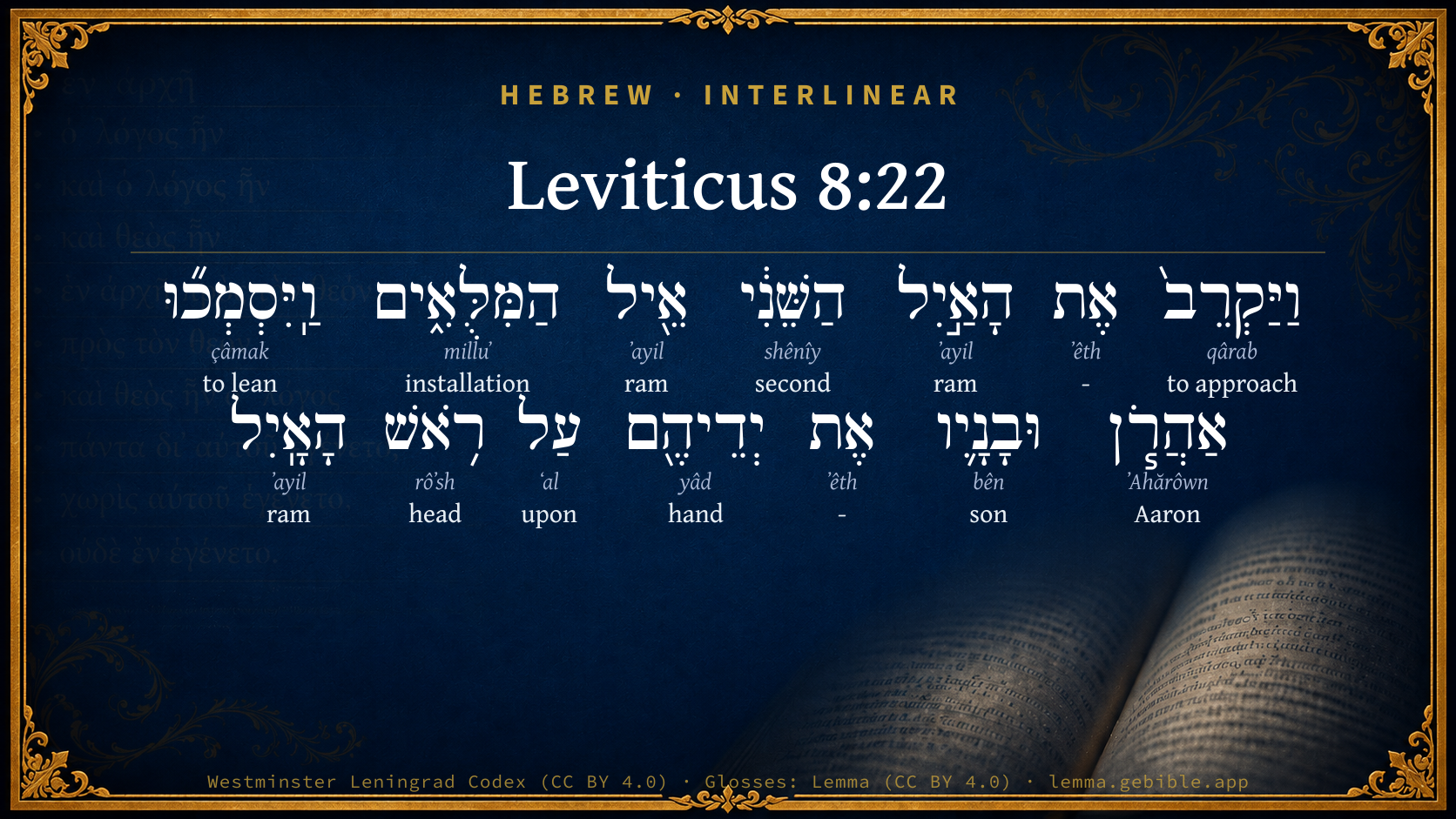
Hebrew (Westminster Leningrad Codex) Leviticus 8:22 appears in the Hebrew Old Testament. The text above is from the Westminster Leningrad Codex. Each word links to its Strong’s number, a concise gloss, and parsing drawn from the Open Scriptures Hebrew Bible morphology. Click any word for its full Brown-Driver-Briggs (BDB) entry.
Download image
Cite this verse

Leviticus 8:22 (World English Bible). Public Domain. Lemma interlinear Bible study tool, https://lemma.gebible.app/v/leviticus/8/22.

Show BibTeX & RIS
BibTeX
RIS
English Translation
He presented the other ram, the ram of consecration: and Aaron and his sons laid their hands on the head of the ram.
World English Bible · Public Domain
Download a study sheet

One document with this verse’s original text, its word-by-word gloss line, the meaning frame, cross-references with their text, attributed commentary, and full source and license credits — printable, and it pastes into notes with its structure intact.

This verse Autodidact and up

Study sheet (.html) Plain text (.txt)

A passage Seminary Student

Up to 50 verses in one chapter. A passage sheet keeps up to 6 commentary sources and 12 cross-references per verse, in the order this page ranks them, and says so on the sheet whenever that leaves anything out. Ask for a single verse and you get the Autodidact verse sheet above.

Everything on this page stays free to read, with no account — the sheet is a download of what is already on screen, not access to it.

Want to remove ads? Support Godless Engineer
Compare translations 3

The same verse in 3 English versions, stacked beneath the original-language interlinear above. Click any original word for its lexicon entry.

Each is an independent rendering of the whole verse — the interlinear is not word-aligned to these translations.

Highlighted words mark where these versions differ — a whole-verse word diff, not a word-by-word alignment.

  • World English Bible Public Domain
    He presented the other ram, the ram of consecration: and Aaron and his sons laid their hands on the head of the ram.
  • King James Version Public Domain
    And he brought the other ram, the ram of consecration: and Aaron and his sons laid their hands upon the head of the ram.
  • unfoldingWord Literal Text CC BY-SA 4.0
    And he presented the second ram, the ram of the ordination offering. And Aaron and his sons laid their hands on the head of the ram.

unfoldingWord Literal Text — © unfoldingWord, licensed CC BY-SA 4.0. Word-aligned USFM3 via Door43 (git.door43.org/unfoldingWord/en_ult).

Versions to compare (up to 4)

3 of 4 selected

Show all 18 translations

Every available English version of this verse, each an independent rendering of the whole verse.

  • World English Bible Public Domain
    He presented the other ram, the ram of consecration: and Aaron and his sons laid their hands on the head of the ram.
  • Berean Standard Bible Public Domain
    After that, Moses presented the other ram, the ram of ordination, and Aaron and his sons laid their hands on its head.
  • Majority Standard Bible Public Domain
    After that, Moses presented the other ram, the ram of ordination, and Aaron and his sons laid their hands on its head.
  • King James Version Public Domain
    And he brought the other ram, the ram of consecration: and Aaron and his sons laid their hands upon the head of the ram.
  • American Standard Version (1901) Public Domain
    And he presented the other ram, the ram of consecration: and Aaron and his sons laid their hands upon the head of the ram.
  • Revised Version (1885) Public Domain
    And he presented the other ram, the ram of consecration: and Aaron and his sons laid their hands upon the head of the ram.
  • Geneva Bible (1599) Public Domain
    After, he brought the other ram, the ram of consecrations, and Aaron and his sonnes layed their handes vpon the head of the ram,
  • Douay-Rheims (1899) Public Domain
    He offered also the second ram, in the consecration of priests: and Aaron, and his sons put their hands upon the head thereof:
  • Young's Literal Translation Public Domain
    And he bringeth near the second ram, a ram of the consecrations, and Aaron and his sons lay their hands on the head of the ram,
  • Literal Standard Version CC BY-SA 4.0
    And he brings the second ram near, a ram of the consecrations, and Aaron and his sons lay their hands on the head of the ram,
  • Unlocked Literal Bible CC BY-SA 4.0
    Then Moses presented the other ram, the ram of consecration, and Aaron and his sons laid their hands on the head of the ram.
  • unfoldingWord Literal Text CC BY-SA 4.0
    And he presented the second ram, the ram of the ordination offering. And Aaron and his sons laid their hands on the head of the ram.
  • Darby Bible Public Domain
    And he presented the second ram, the ram of consecration; and Aaron and his sons laid their hands on the head of the ram;
  • World Messianic Bible Public Domain
    He presented the other ram, the ram of consecration. Aaron and his sons laid their hands on the head of the ram.
  • Webster's Bible Public Domain
    And he brought the other ram, the ram of consecration: and Aaron and his sons laid their hands upon the head of the ram.
  • Free Bible Version CC BY-SA 4.0
    Moses brought the second ram, the ram of ordination, and Aaron and his sons put their hands on its head.
  • Bible in Basic English Public Domain
    And he put the other sheep before the Lord, the sheep with which they were made priests; and Aaron and his sons put their hands on the head of the sheep,
  • JPS Tanakh (1917) Public Domain
    And the other ram was presented, the ram of consecration, and Aaron and his sons laid their hands upon the head of the ram.

Literal Standard Version (2020), Covenant Press — licensed CC BY-SA 4.0. Text via the HelloAO Bible API (eBible.org). Unlocked Literal Bible (unfoldingWord) — licensed CC BY-SA 4.0. Text via the HelloAO Bible API (eBible.org). unfoldingWord Literal Text — © unfoldingWord, licensed CC BY-SA 4.0. Word-aligned USFM3 via Door43 (git.door43.org/unfoldingWord/en_ult). Free Bible Version, Dr. Jonathan Gallagher — licensed CC BY-SA 4.0. Text via the HelloAO Bible API (eBible.org).

Word by word

More ways to search: Search by grammar → Find every occurrence → Compare this word →

Practice this passage: Drill this verse → Learn its vocabulary →

הַמִּלֻּאִ֑ים
milluʼ
H4394
“the · installations”
Particle, Definite Article + Noun, Common, Masculine, Plural, Absolute
Part of Speech
Particle + Noun
Type
Common
Gender
Masculine
Number
Plural
State
Absolute
Full BDB Definition

Origin: from H4390

TWOT: 1195e

setting, installation - setting, stones for setting - installation (of priests)
  1. וַיַּקְרֵב֙ qârab H7126 “and · to approach” Conjunction + Verb, Hiphil, Sequential Imperfect, 3rd Person, Masculine, Singular
  2. אֶת ʼêth H853 “-” Particle, Direct Object
  3. הָאַ֣יִל ʼayil H352 “the · ram” Particle, Definite Article + Noun, Common, Masculine, Singular, Absolute
  4. הַשֵּׁנִ֔י shênîy H8145 “the · second” Particle, Definite Article + Adjective, Ordinal number, Masculine, Singular, Absolute
  5. אֵ֖יל ʼayil H352 “ram of” Noun, Common, Masculine, Singular, Construct
  6. וַֽיִּסְמְכ֞וּ çâmak H5564 “and · to lean” Conjunction + Verb, Qal, Sequential Imperfect, 3rd Person, Masculine, Plural
  7. אַהֲרֹ֧ן ʼAhărôwn H175 “Aaron” Noun, Proper
  8. וּבָנָ֛יו bên H1121 “and · sons · his” Conjunction + Noun, Common, Masculine, Plural, Construct + Suffix, Personal, 3rd Person, Masculine, Singular
  9. אֶת ʼêth H853 “-” Particle, Direct Object
  10. יְדֵיהֶ֖ם yâd H3027 “hands · their” Noun, Common, Both, Dual, Construct + Suffix, Personal, 3rd Person, Masculine, Plural
  11. עַל ʻal H5921 “upon” Preposition
  12. רֹ֥אשׁ rôʼsh H7218 “head of” Noun, Common, Masculine, Singular, Construct
  13. הָאָֽיִל ʼayil H352 “the · ram” Particle, Definite Article + Noun, Common, Masculine, Singular, Absolute

About this verse

These counts appear in no published source. They are computed here, from the morphology-tagged text and Lemma’s own curated glosses. What Lemma adds →

14
words
11
distinct lemmas
Pentateuch
section

Notable vocabulary

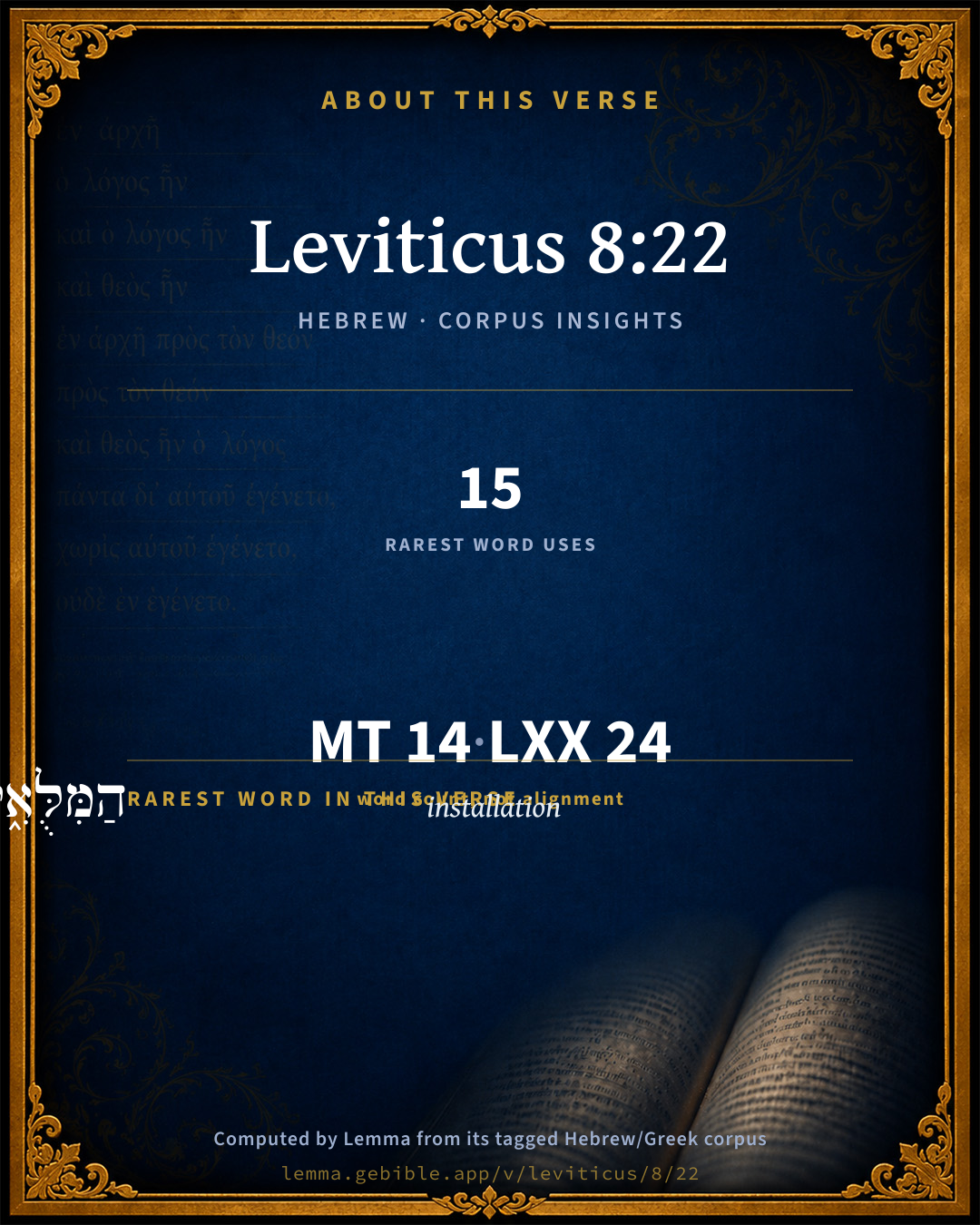
The rarest word here is הַמִּלֻּאִ֑ים installation H4394 — appearing just 15 times in the whole Hebrew Bible.

Shared distinctive vocabulary

הַמִּלֻּאִ֑ים installation H4394 occurs in 15 verses of the Hebrew Bible. Also found in:

Grammatical profile

  • 2 verbs
  • 8 nouns
  • 1 adjective
  • 1 preposition
  • 2 particles

Verb forms

  • וַיַּקְרֵב֙ Hiphil · Sequential Imperfect
  • וַֽיִּסְמְכ֞וּ Qal · Sequential Imperfect

Repetition

A word recurs within this verse — often emphatic in Hebrew:

  • הָאַ֣יִל ram H352 ×3

Hebrew & Septuagint length

In English translation the verse runs 23 words from the Hebrew and 33 from the Septuagint (LXX English) — the Septuagint runs noticeably longer here. See the side-by-side →

A rough comparison of the two English renderings, which tokenize alike — not a word-level alignment.

Word counts can differ between the Hebrew and the Greek without any difference in meaning — e.g. the Hebrew direct-object marker אֵת has no separate Greek word, and Greek often adds the article ὁ.

In the original languages it is 14 Hebrew tokens and 24 Greek tokens — but the two are counted differently (Hebrew bundles its prefixes and suffixes into one token; the Greek is in lemma form), so that isn’t a like-for-like length.

Cross-references

10

Topical passages linked to Leviticus 8:22 in the Treasury of Scripture Knowledge — connected by theme and wording, ordered by reader-vote popularity; previews shown in the World English Bible.

  • Leviticus 8:2 "Take Aaron and his sons with him, and the garments, and the anointing oil, and the bull of the sin offering, and the two rams, and the basket of unleavened bread;
  • Exodus 29:19–31 "You shall take the other ram; and Aaron and his sons shall lay their hands on the head of the ram.
  • Leviticus 7:37 This is the law of the burnt offering, of the meal offering, and of the sin offering, and of the trespass offering, and of the consecration, and of the sacrifice of peace offerings;
  • Leviticus 8:29 Moses took the breast, and waved it for a wave offering before Yahweh. It was Moses' portion of the ram of consecration, as Yahweh commanded Moses.
  • John 17:19 For their sakes I sanctify myself, that they themselves also may be sanctified in truth.
  • 1 Corinthians 1:30 But of him, you are in Christ Jesus, who was made to us wisdom from God, and righteousness and sanctification, and redemption:
  • 2 Corinthians 5:21 For him who knew no sin he made to be sin on our behalf; so that in him we might become the righteousness of God.
  • Ephesians 5:25 Husbands, love your wives, even as Christ also loved the assembly, and gave himself up for it;
  • Ephesians 5:27 that he might present the assembly to himself gloriously, not having spot or wrinkle or any such thing; but that it should be holy and without blemish.
  • Revelation 1:5–6 and from Jesus Christ, the faithful witness, the firstborn of the dead, and the ruler of the kings of the earth. To him who loves us, and washed us from our sins by his blood;

Cross-references courtesy of OpenBible.info (CC BY 4.0).

Hebrew and Greek witnesses Masoretic Hebrew ↔ Greek Septuagint

The same verse in the two great witnesses to the Old Testament, shown verse-for-verse.

Here the Septuagint runs noticeably longer than the Hebrew — LXX2012 (modern English Septuagint) 33 words vs World English Bible 23. A rough length comparison of the two English translations, not a word-level alignment — read both below.

These are two independent witnesses, not word-aligned to each other, and the Septuagint is shown in lemma (dictionary) form.

Hebrew Leviticus 8:22 Masoretic · Westminster Leningrad Codex

וַיַּקְרֵב֙ אֶת הָאַ֣יִל הַשֵּׁנִ֔י אֵ֖יל הַמִּלֻּאִ֑ים וַֽיִּסְמְכ֞וּ אַהֲרֹ֧ן וּבָנָ֛יו אֶת יְדֵיהֶ֖ם עַל רֹ֥אשׁ הָאָֽיִל

He presented the other ram, the ram of consecration: and Aaron and his sons laid their hands on the head of the ram.

World English Bible · Public Domain

Greek LXX Leviticus 8:22 Septuagint · lemma form

καί προςἄγω μωυσῆς ὁ κριός ὁ δεύτερος κριός τελείωσις καί ἐπιτίθημι ἀαρών καί ὁ υἱός αὐτός ὁ χείρ αὐτός ἐπί ὁ κεφαλή ὁ κριός

and Moses took of his blood, and put it upon the tip of Aaron's right ear, and on the thumb of his right hand, and on the great toe of his right foot.

LXX2012 (modern English Septuagint) · Public Domain

Hebrew: Westminster Leningrad Codex (CC BY 4.0). Greek: Septuagint (public domain); English from LXX2012 (modern English Septuagint) (Public Domain). How the Septuagint differs from the Hebrew →

Targum (Aramaic paraphrase)

2

The Targum is the ancient Jewish Aramaic paraphrase of the Hebrew Scriptures — an interpretive translation, not the Hebrew text itself. Onkelos (literal) and Pseudo-Jonathan (expansive) render the Torah, and Jonathan the Prophets. Coverage is partial: where no permissively-licensed English translation exists for a verse, only the Aramaic is shown. This is verse-level text, not a word-by-word alignment to the Hebrew.

  1. Targum Onkelos Torah (Genesis–Deuteronomy)
    וְקָרִיב יָת דִכְרָא תִנְיָנָא דְכַר קוּרְבָּנַיָא וּסְמָכוּ אַהֲרֹן וּבְנוֹהִי יָת יְדֵיהוֹן עַל רֵישׁ דִכְרָא

    (no public-domain English translation for this verse)

    Targum Onkelos — Aramaic: “Onkelos Genesis” (public domain); “Onkelos Exodus” (public domain); “Onkelos Leviticus” (public domain); “Onkelos Numbers” (public domain); “Onkelos Deuteronomy” (public domain). English: “Sefaria Community Translation” (CC0 1.0 (public-domain dedication)); “J.W. Etheridge. The Targums of Onkelos and Jonathan Ben Uzziel on the Pentateuch. London: Longmans, Green, 1862” (public domain). Text via Sefaria.

  2. Targum Pseudo-Jonathan Torah (Genesis–Deuteronomy)
    וּקְרֵיב יַת דִכְרָא תִּנְיָינָא דְכַר אַשְׁלָמוּתָא דִשְׁלִים בְּכוּלָא וּסְמָכוּ אַהֲרן וּבְנוֹי יַת יְדֵיהוֹן עַל רֵישׁ דִכְרָא

    And he brought the second ram, the ram of completion which completed all; and Aharon and his sons laid their hand upon the head of the ram.

    Targum Pseudo-Jonathan — Aramaic: “Targum Jonathan on Genesis” (public domain); “Targum Jonathan on Exodus” (public domain); “Targum Jonathan on Leviticus” (public domain); “Targum Jonathan on Numbers” (public domain); “Targum Jonathan on Deuteronomy” (public domain). English: “The Targum of Jonathan ben Uzziel, trans. J. W. Etheridge, London, 1862” (public domain). Text via Sefaria.

Commentary

Notes on Leviticus 8:22 from classic Christian and Jewish commentators (each source and its license shown beneath its notes). The classic Christian expositions comment on the surrounding passage and are grouped to its opening verse, so a note may address several verses; the Jewish commentaries on the Tanakh (Rashi and others) are per-verse, so they appear only where the commentator wrote on this verse.

Lemma curates 59 commentaries, every one of them public domain or Creative Commons licensed, each selected and text-cleaned for this edition rather than reprinted as found. About our sources →

The Biblical Illustrator

Joseph S. Exell

Lev_8:22-23

Moses took of the blood.

Consecration by blood

1. There is, first, the selection of the victim. Behold My servant whom I have chosen, is Gods message to us concerning Him; and again, He says, I have exalted one chosen out of the people; and, in the New Testament, He is called the Christ, the chosen of God (Luk_23:35)

. The Great Sacrifice, the propitiation for our sins, the lamb for the burnt-offering, is entirely of Gods selection. And in this of itself we have the blessed assurance of its suitableness and perfection.

2. There is the transfer of the sinners sin to this selected victim. Though in one sense this is done by God, through that same eternal purpose by which the victim was selected, yet in another sense, and as a thing brought about, or becoming a fact, in time, it is the sinner that does this when he accepts the sacrifice, and, putting his hand upon it, confesses his sin over it

3. There is the death of the victim. Without that shedding of blood, which is the means of death, and the evidence of its having taken place, is no remission.

4. There is the transfer of this death to the sinner by putting the blood upon him. The sinners death is first of all transferred to the Surety, who dies as the sinners substitute. Then the Suretys death is transferred back again to the sinner, and placed to his account as if it had been his own. In confession we transfer our death to the Surety. In believing we transfer His death to ourselves, so that, in the sight of God, it comes to be reckoned truly ours. This transference of the Suretys death to us is that which is set before us by the putting the blood upon us. For blood means death--or life taken away; and the putting of blood upon us is the intimation the death has passed upon us--and that death, none other than the death of the Surety. Put yourself in the position which God asks thee to do; that is, believe the Fathers testimony to the death of His Son. The moment that then believest, the blood is sprinkled, the death is transferred, thou art counted as one who hast died, and so paid the penalty--and thou art forgiven, accepted, clean!

5. There is the sinners new life thus received through death. Made partakers of Christs resurrection and Christs life, they go forth to do His will, in the strength of His risen life. It is as resurrection-men that they serve Him, and who are drawing from that resurrection-fountain daily treasures of life, wherewith to labour for Him who died for them and who rose again. If ye then be risen with Christ, seek those things that are above, and make use of your risen life for duty, for temptation, for battle, for trial, for suffering. It will be sufficient for every time of need.

6. There is the entire consecration of the whole man to God, in consequence of His having thus died and risen. That which proclaimed them dead, in consequence of the applied death of the sacrifice, sets them apart for holy purposes in Gods house. Thus it is that the death and resurrection of our true ram of consecration, our better sacrifice, operate upon us. They sanctify us, as the apostles expression is, in the Epistle to the Hebrews: Jesus also, that He might sanctify the people with His own blood, suffered without the gate. The whole man, from head to feet, becomes a sacred thing, dedicated to the service of the living God. (H. Bonar, D. D.)

The Biblical Illustrator, edited by Joseph S. Exell (c. 1880s–1900s) — public domain. Text from a community e-Sword module.

Joseph Benson's Commentary

Lev 8:22. He brought the ram of consecration — This was brought for a peace-offering, Exo 29:19; Exo 29:31-32. The order wherein these sacrifices were brought, was most rational; for first, a sacrifice for sin was offered, (Lev 8:14,) as an acknowledgment of their unworthiness; then followed the whole burnt-offering, (Lev 8:18,) which was a sign of their devoting themselves henceforth wholly to the service of God. After this followed the sacrifice of peace-offering, (Lev 8:31,) which betokened their being so far in favour with God as to hold communion with him, and partake of his sacred feast. The blood of this was, in part, put on the priests, their ears, thumbs, and toes; and, in part, sprinkled on the altar, signifying that they were (so to speak) married to the altar, and must all their days attend upon it.

Joseph Benson's Commentary on the Old and New Testaments (1811–1818) — public domain. Text from a community e-Sword module.

Tyndale Open Study Notes

Tyndale Open Resources

8:22 ram of ordination: See Exod 29:19-34.

Tyndale Open Study Notes — © Tyndale Open Resources, licensed CC BY-SA 4.0. Text via the HelloAO Bible API.

Jamieson, Fausset & Brown

Robert Jamieson, A. R. Fausset & David Brown

brought the other ram,--&c. After the sin offering and burnt offering had been presented on their behalf, this was their peace offering, by which they declared the pleasure which they felt in entering upon the service of God and being brought into close communion with Him as the ministers of His sanctuary, together with their confident reliance on His grace to help them in all their sacred duties.

Jamieson, Fausset & Brown — Commentary Critical and Explanatory on the Whole Bible (1871) — public domain (CC PDM 1.0). Text via the HelloAO Bible API.

Ellicott's Commentary for English Readers

(22) And he brought the other ram.—That is, the second of the two rams mentioned in Lev_8:2.

The ram of consecration.—That is, the sacrifice of consecration. This concluding sacrifice, which in form resembles the thank offering and the peace offering, was designed to express the gratitude which Aaron and his sons felt for having been chosen to the office of priests, and their peace and fellowship with God.

A Bible Commentary for English Readers, edited by Charles John Ellicott (1878–1897) — public domain. Text from a community e-Sword module.

The Cambridge Bible for Schools and Colleges

gen. ed. J. J. S. Perowne

(iii) The ram of consecration (22–36), cp. Exo_29:19-26

The last sacrifice is that of the ram of consecration. As some portions are consumed by the offerers (Lev_8:31) it resembles the Peace-Offerings, but special rites are added, indicating the character and duties of the priestly office. The blood of the ram is applied to the ear, hand, and foot of Aaron and his sons. The ear attentive to the commands of God, the hand ready to do His will, the foot prepared to walk in His ways are thus signified. The blood is also thrown (as enjoined in Lev_3:2) against the altar round about.

In Lev_8:23-24 the blood is put first on Aaron and afterwards on his sons; cp. Exo_29:20, where a separate bringing near of the sons is not enjoined.

The Cambridge Bible for Schools and Colleges (gen. ed. J. J. S. Perowne; Cambridge University Press, 1878–1918) — public domain. Text from a community e-Sword module.

John Gill's Exposition

And he brought the other ram, the ram of consecration,.... Or "filling" (b), or "fulnesses"; because, as Jarchi says, these filled and perfected the priests in their priesthood; this was the finishing and consummation of their consecration: what is said in this and the three following verses Lev 8:23 is the same as is ordered, Exo 29:19 and needs no further explanation; See Gill on Exo 29:19, Exo 29:20, Exo 29:21, Exo 29:22.

(b) "plenitudinum", Montanus; "impletionum, vel potius completionum", Drusius; Heb. "impletionum", Piscator.

John Gill's Exposition of the Whole Bible (1746–1763) — public domain (CC PDM 1.0). Text via the HelloAO Bible API.

Whedon's Commentary on the Bible

Daniel D. Whedon

22. Consecration — This literally signifies filling; as meeting all requirements. Lev_8:27-28; Num_3:3, note.

Daniel D. Whedon (gen. ed.), Commentary on the Old and New Testaments (1874–1909) — public domain. Text from a community e-Sword module.

The Pulpit Commentary

Vers. 22-29. The ram offered as a peace offering is called the ram of consecration, or literally, of filling, because one of the means by which the consecration was effected and exhibited was the filling the hands of those presented for consecration with the portion of the sacrifice destined for the altar, which they waved for a wave offering before the Lord, previous to its consumption by the fire. This portion consisted of the internal fat and tail, which was usually burnt, (Lev_7:31) and the heave offering of the right shoulder, or hind leg, which generally went to the officiating priest, (Lev_7:32) and one of each of the unleavened cakes. After this special ceremony of waving, peculiar to the rite of consecration, the usual wave offering (the breast) was waved by Moses and consumed by himself. Ordinarily it was for the priests in general. (Lev_7:31) The blood was poured on the side of the altar, as was done in all peace offerings, but in addition, on the present occasion, it was put upon the tip of the right ear, and upon the thumb of the right hand , and upon the great toe of the right foot of the priests who were being consecrated, symbolizing that their senses and active powers were being devoted to God"s service. The same ceremony is to be used in the restoration of the leper. (see Lev_14:14)

Vers. 22-36. The ram of consecration.

This and the ceremonies connected form the principal subject of the verses now recited. We notice

I THAT IT WAS A PEACE OFFERING.

1. The first ram was a burnt offering.

(1) It was wholly consumed upon the altar. It was regarded wholly as the "food of God". (chapter 3:11 21:6 Eze_44:7 Mal_1:7, Mal_1:12)

(2) In this sacrifice God is contemplated as a righteous Judge, whose justice claims everything we are and have, and who, until that justice is satisfied, can have no fellowship with man.

2. Burnt offerings were usually accompanied by peace offerings.

(1) Of these a portion was eaten by the worshipper. This was the expression of peace, reconciliation, fellowship. Constantly associated with the holocaust, the opportunity of ceremonially feasting with God was never wanting. In the peace offering faith discerns the sacrifice of Christ to have so completely met the claims of infinite justice, that we are now accepted into favour.

(2) As in the other sacrifices, the hands of Aaron and his sons were laid upon it to confess their sinfulness, their need of a Saviour, and their faith in the Redeemer of promise. It was slain accordingly, to foreshadow the death of Messiah. The fat and gall were burnt, to show how our evil passions, the old man, must be crucified with him, that the body of sin may be destroyed.

II THAT ITS BLOOD WAS USED IN A REMARKABLE WAY.

1. It was sprinkled upon Aaron.

(1) Upon his person.

(a) On the tip of his right ear, to express obedience. (Exo_21:6) And our Lord"s obedience was unto death. (Php_2:8)

(b) On the thumb of the right hand, to express the service of doing. Christ fulfilled all righteousness, and finished the work that was given him to do. (Joh_4:34 Joh_5:17 Joh_9:4 Joh_17:4 Heb_10:5-7)

(c) On the great toe of the right foot, to express the ways. All the ways of Jesus were infinitely pleasing to God. (Psa_1:6 Psa_18:20, 21 Act_10:38)

(d) The comprehensive teaching here is the complete consecration of all faculties and energies. (see 1Pe_1:15)

(2) Upon his garments. In this baptism oil also was used (verse 30). While in detail these garments represented moral qualities, collectively taken they expressed office. Hence from the earliest times a person introduced into office is said to be invested in it, from in, used intensitively, and vestio, I clothe. The office of the high priest was to minister in the very presence of God. (see Heb_8:1, Heb_8:2)

(3) Jesus, who was washed with water at the Jordan, and anointed with oil on the mount of transfiguration, received the final baptism of his consecration, that of his own blood, in Gethsemane and Calvary. As the voice of God accredited him in each of the earlier baptisms, so it accredited him again as he was about to enter into this. (comp. Mat_3:17 Mat_17:5 Joh_12:27-33)

2. It was sprinkled upon Aaron"s sons.

(1) Upon their persons (verse 24). The sons of Aaron were here treated in like manner as Aaron was, to show how in all these things Christians are called to be like Christ. (see Mat_20:22, Mat_20:23) This remark will be especially applicable to ministers, who should be "examples to the flock". (see Isa_66:21 1Co_9:13)

(2) Upon their garments (verse 30). The office of the priesthood was to minister in the presence of God in his tabernacle. So the spiritual priesthood have access to God in heaven. We must be anointed with the unction of the Holy One, and sprinkled with the blood of Christ, that we may enter into that most holy place. (Heb_10:19-22 1Jn_2:20, 1Jn_2:27)

III THAT IT FILLED THE HANDS OF AARON AND HIS SONS.

1. It was treated as a wave offering.

(1) The breast had the fat laid upon it. A bread offering also was laid upon it. The whole was then waved before the Lord. The shoulder also was heaved. (see Exo_29:27) Thus God was praised as the Creator and Dispenser of every good and perfect gift.

(2) Moses acted as priest in all this ceremony. He put these things upon the hands of Aaron and his sons, and waved and heaved them. From this action the ram of consecration took its name ( lm lya, eil milluim), the ram of filling up. Thus the essence of the consecration was the filling the hand with the oblation, or conferring the right to offer sacrifices to God. (see Eze_43:26, margin)

(3) The wave breast then came to the lot of Moses, and Aaron and his sons appear to have shared it with him as the feast upon the sacred food (see verse 31).

2. The ceremonies of the consecration lasted seven days.

(1) Seven is the numeral of perfection, so at the close of the seven days this was a perfect consecration, intimating that all the powers of the consecrated ones should be wholly given to God.

(2) They "kept the charge of the Lord," during these seven days, "at the door of the tabernacle." They were not as yet qualified to enter the holy place, and they must not leave the court of the priests on pain of death. (see 1Ki_19:19-21 Mat_8:21, 22 Luk_9:61, Luk_9:62)

(3) "Aaron and his sons did all things which the Lord commanded by the hand of Moses." Had Jesus failed in any point, his consecration would be imperfect; he could not have become our Saviour. J.A.M.

The Pulpit Commentary (1880–1919), ed. H.D.M. Spence-Jones & Joseph S. Exell — public domain. Text from a community e-Sword module.

unfoldingWord translationNotes

Door43 World Missions Community

the ram of consecration

The word "consecration" is an abstract noun. AT: "the ram for setting Aaron and his sons apart for service to God" (See: Abstract Nouns)

laid their hands on the head

This is a symbolic action that identifies Aaron and his sons with the animal they are offering. In this way the they are offering themselves to Yahweh through the animal. See how you translated this in Leviticus 1:4. (See: Symbolic Action)

Moses took some of its blood

It is implied that Moses caught the blood in a bowl as the blood drained out from the animal. The full meaning of this statement can be made explicit. (See: Assumed Knowledge and Implicit Information)

translationWords

Moses

ewe

consecrate

Aaron

son

blood

right hand

altar

unfoldingWord translationNotes — © Distant Shores Media and the Door43 World Missions Community, licensed CC BY-SA 4.0. Source: git.door43.org/Door43/en_tn.

Rashi

Rabbi Shlomo Yitzchaki (Rashi)

איל המלאים — This means the same as איל השלמים, for the word מלואים is synonymous with the word שלמים; this term is used to describe the ram because by means of it they set the priest fully (ממלאין) and completely (משלימין) in their priestly office (cf. Sifra, Tzav, Mechilta d'Miluim 1 20).

Rashi on the Tanakh — English translations: “The Judaica Press complete Tanach with Rashi, translated by A. J. Rosenberg” (CC BY 4.0); “Pentateuch with Rashi's commentary by M. Rosenbaum and A.M. Silbermann, 1929-1934” (public domain); “The Metsudah Tanach series, Lakewood, N.J” (CC BY 4.0); and “The Book of Joshua, Metsudah Publications, 1997” (CC BY 4.0). Text via Sefaria.

Ramban (Nachmanides)

Rabbi Moshe ben Nachman (Ramban / Nachmanides)

AND HE PRESENTED THE OTHER RAM, THE RAM OF ‘HAMILU’IM’ (CONSECRATION). I have already explained that the meaning of “consecration” is that the priests should be fully empowered to perform the Divine Service, and that this term is applied to both the altar itself and to those who perform the Service. Thus all these offerings [the bullock of the sin-offering, the ram of the burnt-offering, etc.,] were brought for the purpose of consecrating the priests, as it is written, And this is the thing that thou shalt do unto them to hallow them, to minister unto Me in the priest’s office: take one young bullock and two rams without blemish., 29:1. The second ram, however, is here called specifically the ram of consecration, because it was the last of these offerings, and it was after it that their consecration was completed and they ministered before Him, blessed be He, for all these offerings were indispensable in the matter.It is possible that the [purpose of the] sin-offering was to effect atonement for the altar and to sanctify it, for it is so written; and that the burnt-offering was to expiate for the priests, like the atonement effected by all freewill burnt-offerings, and the second ram which was the peace-offering, was a thanksgiving to G-d for having given them in His house and within His walls a monument and a memorial. Thus it was only the peace-offering which was brought for the purpose of consecration, and therefore it alone is here called “the ram of milu’im” (consecration). It is called milu’im [in the plural, although the offering for that purpose was, according to this interpretation, only one], because the fats and the thigh as well as the heave-offering of the bread were all burnt.

Ramban (Nachmanides) on the Tanakh — English translation: “Commentary on the Torah by Ramban (Nachmanides). Translated and annotated by Charles B. Chavel. New York, Shilo Pub. House, 1971-1976” (CC BY 4.0). Text via Sefaria.

Lesson kit

Teaching starters — assembled from the data on this page, not authored interpretation. Every prompt links to the verse data it draws on. Edit before teaching.

Leviticus, in the Pentateuch, opens this verse with 14 words (11 distinct Hebrew lemmas). Its most distinctive word is milluʼ (“installation”). The Greek Septuagint runs longer here. A historical commentator’s framing appears above. Read the whole chapter for the surrounding context.

Discussion questions

  1. The word milluʼ carries the sense “installation.” How does it shape the verse?
  2. Exodus 25:7 shares the word «installation» with this verse. How do the two illuminate each other?
  3. “ram” occurs 3× in this one verse. What is the effect of the repetition?
  4. Compared with the Hebrew, the Septuagint runs longer here. What questions does that raise?
  5. These translations render this verse differently; the difference is in the English rendering, not the original. What questions does that raise?
  6. The verb «וַיַּקְרֵב֙» is Hiphil Sequential Imperfect. How does its form color the action?
  7. Reading how The Biblical Illustrator and Joseph Benson's Commentary read this verse, where do the two commentators agree and where do they part?

Things to notice

Reading settings

Reading text

Shown beneath each verse's original-language words.

Old Testament
Old Testament edition

Read the OT as the Masoretic Hebrew (MT) or the Greek Septuagint (LXX).

English shown for the Greek Septuagint (in the Hebrew ↔ Greek comparison).

Comparing translations? Open the Compare panel on any verse page to stack up to four side by side.