Numbers 7:12

Hebrew (Westminster Leningrad Codex) Numbers 7:12 appears in the Hebrew Old Testament. The text above is from the Westminster Leningrad Codex. Each word links to its Strong’s number, a concise gloss, and parsing drawn from the Open Scriptures Hebrew Bible morphology. Click any word for its full Brown-Driver-Briggs (BDB) entry.
Download image
Cite this verse

Numbers 7:12 (World English Bible). Public Domain. Lemma interlinear Bible study tool, https://lemma.gebible.app/v/numbers/7/12.

Show BibTeX & RIS
BibTeX
RIS
English Translation
He who offered his offering the first day was Nahshon the son of Amminadab, of the tribe of Judah,
World English Bible · Public Domain
Download a study sheet

One document with this verse’s original text, its word-by-word gloss line, the meaning frame, cross-references with their text, attributed commentary, and full source and license credits — printable, and it pastes into notes with its structure intact.

This verse Autodidact and up

Study sheet (.html) Plain text (.txt)

A passage Seminary Student

Up to 50 verses in one chapter. A passage sheet keeps up to 6 commentary sources and 12 cross-references per verse, in the order this page ranks them, and says so on the sheet whenever that leaves anything out. Ask for a single verse and you get the Autodidact verse sheet above.

Everything on this page stays free to read, with no account — the sheet is a download of what is already on screen, not access to it.

Want to remove ads? Support Godless Engineer
Compare translations 3

The same verse in 3 English versions, stacked beneath the original-language interlinear above. Click any original word for its lexicon entry.

Each is an independent rendering of the whole verse — the interlinear is not word-aligned to these translations.

Highlighted words mark where these versions differ — a whole-verse word diff, not a word-by-word alignment.

  • World English Bible Public Domain
    He who offered his offering the first day was Nahshon the son of Amminadab, of the tribe of Judah,
  • King James Version Public Domain
    And he that offered his offering the first day was Nahshon the son of Amminadab, of the tribe of Judah:
  • unfoldingWord Literal Text CC BY-SA 4.0
    And the one presenting his offering on the first day was Nahshon, the son of Amminadab, for the tribe of Judah.

unfoldingWord Literal Text — © unfoldingWord, licensed CC BY-SA 4.0. Word-aligned USFM3 via Door43 (git.door43.org/unfoldingWord/en_ult).

Versions to compare (up to 4)

3 of 4 selected

Show all 18 translations

Every available English version of this verse, each an independent rendering of the whole verse.

  • World English Bible Public Domain
    He who offered his offering the first day was Nahshon the son of Amminadab, of the tribe of Judah,
  • Berean Standard Bible Public Domain
    On the first day Nahshon son of Amminadab from the tribe of Judah drew near with his offering.
  • Majority Standard Bible Public Domain
    On the first day Nahshon son of Amminadab from the tribe of Judah drew near with his offering.
  • King James Version Public Domain
    And he that offered his offering the first day was Nahshon the son of Amminadab, of the tribe of Judah:
  • American Standard Version (1901) Public Domain
    And he that offered his oblation the first day was Nahshon the son of Amminadab, of the tribe of Judah:
  • Revised Version (1885) Public Domain
    And he that offered his oblation the first day was Nahshon the son of Amminadab, of the tribe of Judah:
  • Geneva Bible (1599) Public Domain
    So then on the first day did Nahshon the sonne of Amminadab of ye tribe of Iudah offer his offring.
  • Douay-Rheims (1899) Public Domain
    But to the sons of Caath he gave no wagons or oxen: because they serve in the sanctuary and carry their burdens upon their own shoulders.
  • Young's Literal Translation Public Domain
    And he who is bringing near on the first day his offering is Nahshon son of Amminadab, of the tribe of Judah.
  • Literal Standard Version CC BY-SA 4.0
    And he who is bringing his offering near on the first day is Nahshon son of Amminadab, of the tribe of Judah.
  • Unlocked Literal Bible CC BY-SA 4.0
    On the first day, Nahshon son of Amminadab, of the tribe of Judah, offered his sacrifice.
  • unfoldingWord Literal Text CC BY-SA 4.0
    And the one presenting his offering on the first day was Nahshon, the son of Amminadab, for the tribe of Judah.
  • Darby Bible Public Domain
    And he that presented his offering the first day was Nahshon the son of Amminadab, of the tribe of Judah.
  • World Messianic Bible Public Domain
    He who offered his offering the first day was Nahshon the son of Amminadab, of the tribe of Judah,
  • Webster's Bible Public Domain
    And he that offered his offering the first day was Nahshon the son of Amminadab, of the tribe of Judah:
  • Free Bible Version CC BY-SA 4.0
    The first day Nahshon, son of Amminadab, of the tribe of Judah came forward with his offering.
  • Bible in Basic English Public Domain
    And he who made his offering on the first day was Nahshon, the son of Amminadab, of the tribe of Judah:
  • JPS Tanakh (1917) Public Domain
    And he that presented his offering the first day was Nahshon the son of Amminadab, of the tribe of Judah;

Literal Standard Version (2020), Covenant Press — licensed CC BY-SA 4.0. Text via the HelloAO Bible API (eBible.org). Unlocked Literal Bible (unfoldingWord) — licensed CC BY-SA 4.0. Text via the HelloAO Bible API (eBible.org). unfoldingWord Literal Text — © unfoldingWord, licensed CC BY-SA 4.0. Word-aligned USFM3 via Door43 (git.door43.org/unfoldingWord/en_ult). Free Bible Version, Dr. Jonathan Gallagher — licensed CC BY-SA 4.0. Text via the HelloAO Bible API (eBible.org).

Word by word

More ways to search: Search by grammar → Find every occurrence → Compare this word →

Practice this passage: Drill this verse → Learn its vocabulary →

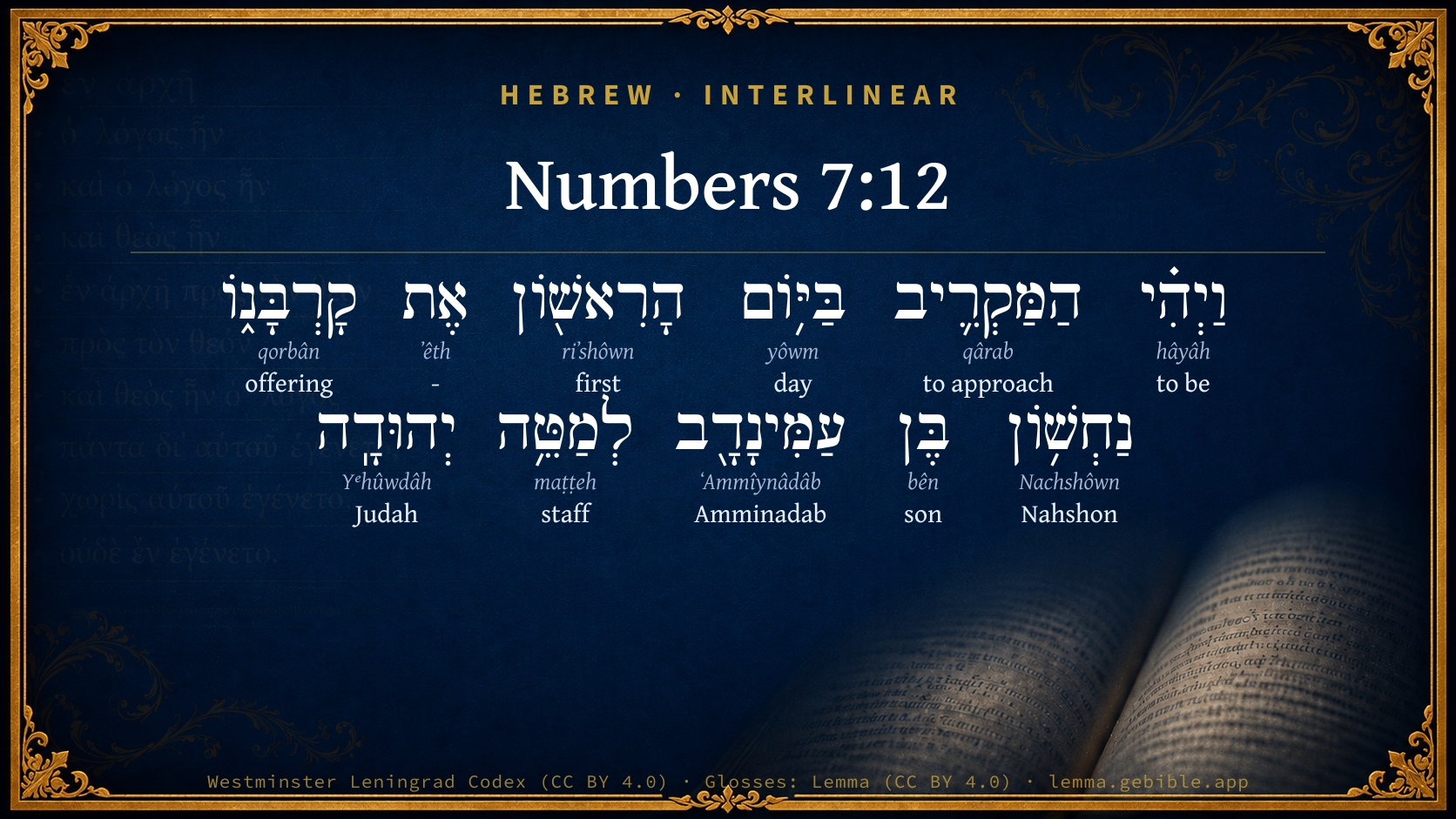
נַחְשׁ֥וֹן
Nachshôwn
H5177
“Nahshon”
Noun, Proper
Part of Speech
Noun
Type
Proper
Full BDB Definition

Origin: from H5172

TWOT: None

Nahshon = "enchanter" - son of Amminadab and prince of the Judah at the first numbering in the wilderness; 5th in descent from Judah in the genealogy of Christ
  1. וַיְהִ֗י hâyâh H1961 “and · to be” Conjunction + Verb, Qal, Sequential Imperfect, 3rd Person, Masculine, Singular
  2. הַמַּקְרִ֛יב qârab H7126 “the · approaching” Particle, Definite Article + Verb, Hiphil, Participle Active, Masculine, Singular, Absolute
  3. בַּיּ֥וֹם yôwm H3117 “in/at the · day” Preposition, Determined + Noun, Common, Masculine, Singular, Absolute
  4. הָרִאשׁ֖וֹן riʼshôwn H7223 “the · first” Particle, Definite Article + Adjective, Adjective, Masculine, Singular, Absolute
  5. אֶת ʼêth H853 “-” Particle, Direct Object
  6. קָרְבָּנ֑וֹ qorbân H7133 “offering · his” Noun, Common, Masculine, Singular, Construct + Suffix, Personal, 3rd Person, Masculine, Singular
  7. בֶּן bên H1121 “son of” Noun, Common, Masculine, Singular, Construct
  8. עַמִּינָדָ֖ב ʻAmmîynâdâb H5992 “Amminadab” Noun, Proper
  9. לְמַטֵּ֥ה maṭṭeh H4294 “to/for · staff of” Preposition + Noun, Common, Masculine, Singular, Construct
  10. יְהוּדָֽה Yᵉhûwdâh H3063 “Judah” Noun, Proper

About this verse

These counts appear in no published source. They are computed here, from the morphology-tagged text and Lemma’s own curated glosses. What Lemma adds →

11
words
11
distinct lemmas
Pentateuch
section

Notable vocabulary

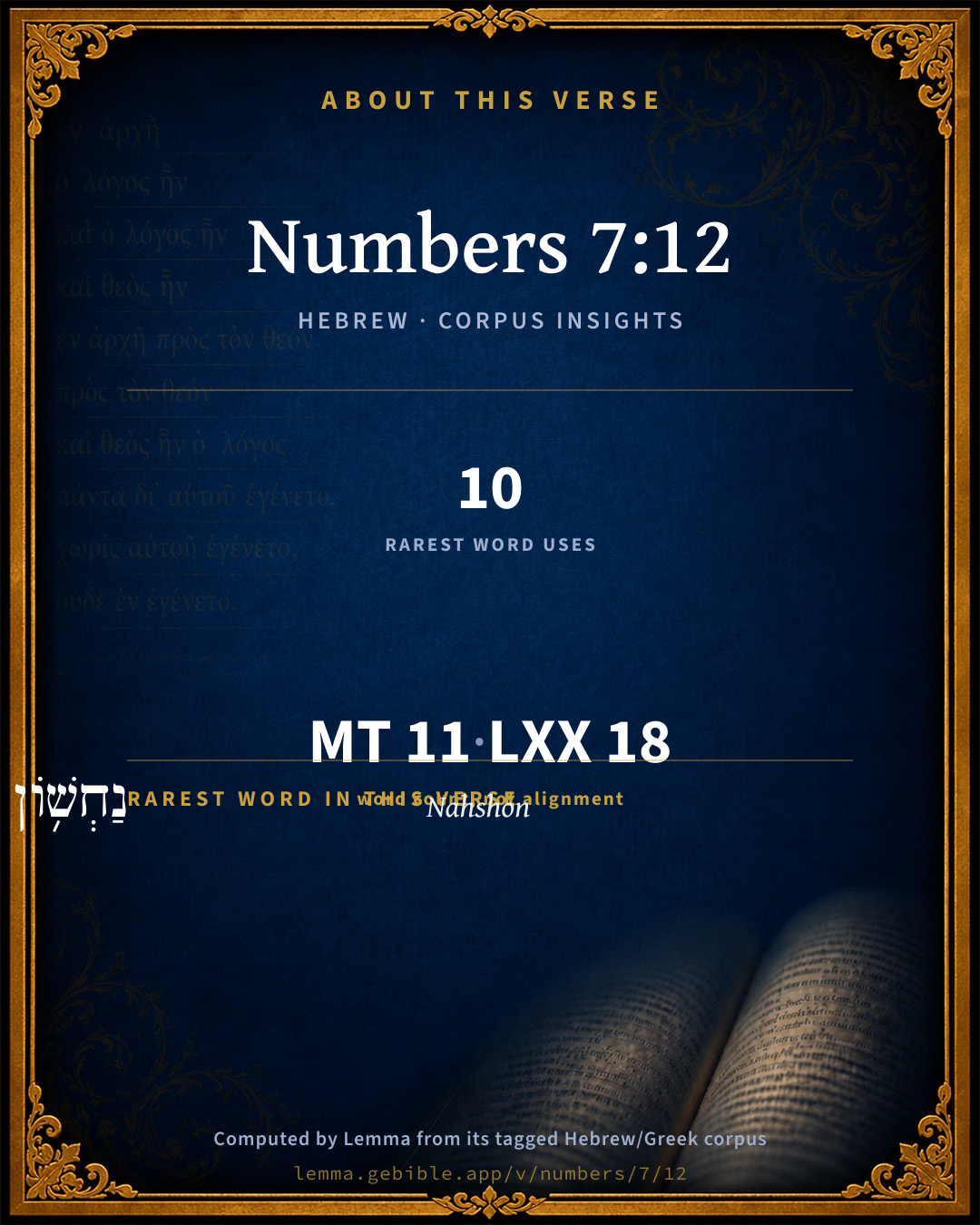
The rarest word here is נַחְשׁ֥וֹן Nahshon H5177 — appearing just 10 times in the whole Hebrew Bible.

Shared distinctive vocabulary

נַחְשׁ֥וֹן Nahshon H5177 occurs in 9 verses of the Hebrew Bible. Also found in:

Grammatical profile

  • 2 verbs
  • 7 nouns
  • 1 adjective
  • 1 particle

Verb forms

  • וַיְהִ֗י Qal · Sequential Imperfect
  • הַמַּקְרִ֛יב Hiphil · Participle Active

Hebrew & Septuagint length

In English translation the verse runs 19 words from the Hebrew and 22 from the Septuagint (LXX English) — closely comparable.

A rough comparison of the two English renderings, which tokenize alike — not a word-level alignment.

Word counts can differ between the Hebrew and the Greek without any difference in meaning — e.g. the Hebrew direct-object marker אֵת has no separate Greek word, and Greek often adds the article ὁ.

In the original languages it is 11 Hebrew tokens and 18 Greek tokens — but the two are counted differently (Hebrew bundles its prefixes and suffixes into one token; the Greek is in lemma form), so that isn’t a like-for-like length.

Cross-references

8

Topical passages linked to Numbers 7:12 in the Treasury of Scripture Knowledge — connected by theme and wording, ordered by reader-vote popularity; previews shown in the World English Bible.

  • Genesis 49:8 "Judah, your brothers will praise you: Your hand will be on the neck of your enemies; Your father's sons will bow down before you.
  • Genesis 49:10 The scepter will not depart from Judah, Nor the ruler's staff from between his feet, Until he comes to whom it belongs. To him will the obedience of the peoples be.
  • Numbers 1:7 Of Judah: Nahshon the son of Amminadab.
  • Numbers 2:3 Those who encamp on the east side toward the sunrise shall be of the standard of the camp of Judah, according to their divisions: and the prince of the children of Judah shall be Nahshon the son of Amminadab.
  • Numbers 10:14 In the first [place] the standard of the camp of the children of Judah set forward according to their hosts: and over his host was Nahshon the son of Amminadab.
  • Ruth 4:20 and Amminadab became the father of Nahshon, and Nahshon became the father of Salmon,
  • Matthew 1:4 Ram became the father of Amminadab. Amminadab became the father of Nahshon. Nahshon became the father of Salmon.
  • Luke 3:32 the son of Jesse, the son of Obed, the son of Boaz, the son of Salmon, the son of Nahshon,

Cross-references courtesy of OpenBible.info (CC BY 4.0).

Hebrew and Greek witnesses Masoretic Hebrew ↔ Greek Septuagint

The same verse in the two great witnesses to the Old Testament, shown verse-for-verse.

These are two independent witnesses, not word-aligned to each other, and the Septuagint is shown in lemma (dictionary) form.

Hebrew Numbers 7:12 Masoretic · Westminster Leningrad Codex

וַיְהִ֗י הַמַּקְרִ֛יב בַּיּ֥וֹם הָרִאשׁ֖וֹן אֶת קָרְבָּנ֑וֹ נַחְשׁ֥וֹן בֶּן עַמִּינָדָ֖ב לְמַטֵּ֥ה יְהוּדָֽה

He who offered his offering the first day was Nahshon the son of Amminadab, of the tribe of Judah,

World English Bible · Public Domain

Greek LXX Numbers 7:12 Septuagint · lemma form

καί εἰμί ὁ προςφέρω ὁ ἡμέρα ὁ πρῶτος ὁ δῶρον αὐτός ναασσων υἱός αμιναδαβ ἄρχων ὁ φυλή ιουδα

And he that offered his gift on the first day, was Naasson the son of Aminadab, prince of the tribe of Juda.

LXX2012 (modern English Septuagint) · Public Domain

Hebrew: Westminster Leningrad Codex (CC BY 4.0). Greek: Septuagint (public domain); English from LXX2012 (modern English Septuagint) (Public Domain). How the Septuagint differs from the Hebrew →

Targum (Aramaic paraphrase)

2

The Targum is the ancient Jewish Aramaic paraphrase of the Hebrew Scriptures — an interpretive translation, not the Hebrew text itself. Onkelos (literal) and Pseudo-Jonathan (expansive) render the Torah, and Jonathan the Prophets. Coverage is partial: where no permissively-licensed English translation exists for a verse, only the Aramaic is shown. This is verse-level text, not a word-by-word alignment to the Hebrew.

  1. Targum Onkelos Torah (Genesis–Deuteronomy)
    וַהֲוָה דִמְקָרַב בְּיוֹמָא קַדְמָאָה יָת קֻרְבָּנֵהּ נַחְשׁוֹן בַּר עַמִינָדָב לְשִׁבְטָא דִיהוּדָה

    (no public-domain English translation for this verse)

    Targum Onkelos — Aramaic: “Onkelos Genesis” (public domain); “Onkelos Exodus” (public domain); “Onkelos Leviticus” (public domain); “Onkelos Numbers” (public domain); “Onkelos Deuteronomy” (public domain). English: “Sefaria Community Translation” (CC0 1.0 (public-domain dedication)); “J.W. Etheridge. The Targums of Onkelos and Jonathan Ben Uzziel on the Pentateuch. London: Longmans, Green, 1862” (public domain). Text via Sefaria.

  2. Targum Pseudo-Jonathan Torah (Genesis–Deuteronomy)
    וַהֲוָה דִמְקָרֵב בְּיוֹמָא קַמָאָה יַת קוּרְבָּנֵיהּ נַחְשׁוֹן בַּר עַמִינָדָב רַב בֵּית אַבָּא לְשִׁבְטָא דִיהוּדָה

    He who on the first day presented his oblation was Nachshon bar Amminadab, prince of the house of the fathers of the tribe Jehudah:

    Targum Pseudo-Jonathan — Aramaic: “Targum Jonathan on Genesis” (public domain); “Targum Jonathan on Exodus” (public domain); “Targum Jonathan on Leviticus” (public domain); “Targum Jonathan on Numbers” (public domain); “Targum Jonathan on Deuteronomy” (public domain). English: “The Targum of Jonathan ben Uzziel, trans. J. W. Etheridge, London, 1862” (public domain). Text via Sefaria.

Commentary

Notes on Numbers 7:12 from classic Christian and Jewish commentators (each source and its license shown beneath its notes). The classic Christian expositions comment on the surrounding passage and are grouped to its opening verse, so a note may address several verses; the Jewish commentaries on the Tanakh (Rashi and others) are per-verse, so they appear only where the commentator wrote on this verse.

Lemma curates 59 commentaries, every one of them public domain or Creative Commons licensed, each selected and text-cleaned for this edition rather than reprinted as found. About our sources →

Trapp's Complete Commentary

John Trapp

Num 7:12 And he that offered his offering the first day was Nahshon the son of Amminadab, of the tribe of Judah:

Ver. 12. Of the tribe of Judah.] Ut ubique superemineat praerogativa Christi a Iuda oriundi.

John Trapp, A Commentary or Exposition upon All the Books of the Old and New Testament (1647–1656) — public domain. Text from a community e-Sword module.

Tyndale Open Study Notes

Tyndale Open Resources

7:12-83 One by one, the tribal leaders brought their dedicatory gifts and offerings until the entire Hebrew confederation had participated. The repetitious pattern of describing each tribal gift emphasizes the communal nature of this ceremony; all tribes played a role in consecrating their place of worship. The detailed listing might reflect the meticulous record keeping of an archive or ledger. As noted in the record for each tribe, the silver vessels contained grain offerings, and the gold vessels held incense. Every tribe also brought animals as a burnt offering, a sin offering, and a peace offering, as specified in Leviticus.

Tyndale Open Study Notes — © Tyndale Open Resources, licensed CC BY-SA 4.0. Text via the HelloAO Bible API.

Jamieson, Fausset & Brown

Robert Jamieson, A. R. Fausset & David Brown

He that offered his offering the first day was Nahshon . . . of the tribe of Judah, &c.--Judah having had the precedence assigned to it, the prince or head of that tribe was the first admitted to offer as its representative; and his offering, as well as that of the others, is thought, from its costliness, to have been furnished not from his own private means, but from the general contributions of each tribe. Some parts of the offering, as the animals for sacrifice, were for the ritual service of the day, the peace offerings being by much the most numerous, as the princes and some of the people joined with the priests afterwards in celebrating the occasion with festive rejoicing. Hence the feast of dedication became afterwards an anniversary festival. Other parts of the offering were intended for permanent use, as utensils necessary in the service of the sanctuary; such as an immense platter and bowl (Exo 25:29). Being of silver, they were to be employed at the altar of burnt offering, or in the court, not in the holy place, all the furniture of which was of solid or plated gold; and there was a golden spoon, the contents of which show its destination to have been the altar of incense. The word rendered "spoon" means a hollow cup, in the shape of a hand, with which the priests on ordinary occasions might lift a quantity from the incense-box to throw on the altar-fire, or into the censers; but on the ceremonial on the day of the annual atonement no instrument was allowed but the high priest's own hands (Lev 16:12).

Jamieson, Fausset & Brown — Commentary Critical and Explanatory on the Whole Bible (1871) — public domain (CC PDM 1.0). Text via the HelloAO Bible API.

John Gill's Exposition

And he that offered his offering on the first day,.... Was he whose standard was pitched first, at the east, to the rising sun: and this

was Nahshon the son of Amminadab, of the tribe of Judah; who was the prince and captain of that tribe, though the title is not here given him, as to the rest of the princes, this being left to be concluded from his offering first; for if they that offered after him were princes, he must needs be one; or it may be this title is omitted, because the chief prince, of the prince of the tribe of Judah, most peculiarly belongs to a greater Personage, even the Messiah, who was to spring, and did spring from that tribe, Ch1 5:2; and, as Baal Hatturim says, from Nahshon; and who also observes, that Ben Nahshon is the Messiah.

John Gill's Exposition of the Whole Bible (1746–1763) — public domain (CC PDM 1.0). Text via the HelloAO Bible API.

Albert Barnes' Notes on the Bible

The several princes make their offerings in the order assigned to the tribes Num. 2. It was doubtless the tribes themselves which presented these gifts through their chiefs. The twelve offerings are strictly alike, and were offered on twelve separate days.

Albert Barnes' Notes on the Bible (1834–1885) — public domain. Text from a community e-Sword/MySword module.

Matthew Poole's English Annotations

In whose name and behalf this offering was made, and so in the rest.

Matthew Poole's English Annotations on the Holy Bible (1683–1685) — public domain. Text from a community e-Sword/MySword module.

The Pulpit Commentary

Nahshon. The same appointed to act with Moses in the census, and to be captain of the children of Judah. (Num_1:7 Num_2:3) The names of the other princes are to be found in the same passages, and their order in presenting is their order for the march. This seems to show that their off, rings were actually made after the arrangement of the camps had been settled.

The Pulpit Commentary (1880–1919), ed. H.D.M. Spence-Jones & Joseph S. Exell — public domain. Text from a community e-Sword module.

Keil & Delitzsch

C. F. Keil & F. Delitzsch

All the princes brought the same gifts. The order in which the twelve princes, whose names have already been given at Num 1:5-15, made their presentation, corresponded to the order of the tribes in the camp (ch. 2), the tribe-prince of Judah taking the lead, and the prince of Naphtali coming last. In the statements as to the weight of the silver kearoth and the golden cappoth, the word shekel is invariably omitted, as in Gen 20:16, etc. - In Num 7:84-86, the dedication gifts are summed up, and the total weight given, viz., twelve silver dishes and twelve silver bowls, weighing together 2400 shekels, and twelve golden spoons, weighing 120 shekels in all. On the sacred shekel, see at Exo 30:13; and on the probable value of the shekel of gold, at Exo 38:24-25. The sacrificial animals are added together in the same way in Num 7:87, Num 7:88.

Keil & Delitzsch — Biblical Commentary on the Old Testament (1861–1891) — public domain (CC PDM 1.0). Text via the HelloAO Bible API. (Old Testament only.)

unfoldingWord translationNotes

Door43 World Missions Community

the first day

"day 1" or "day number 1" (See: Ordinal Numbers)

Nahshon son of Amminadab

These are the names of men. See how you translated these names in Numbers 1:7

weighing 130 shekels

"weighing one hundred and thirty shekels." If necessary, these weights can be written in modern measurements. AT: "weighing nearly one and a half kilograms" or "weighing one kilogram and 430 grams" (See: Numbers and Biblical Weight)

one silver bowl weighing seventy shekels

"one silver bowl weighing 70 shekels." If necessary, these weights can be written in modern measurements. AT: "one silver bowl weighing nearly eight tenths of a kilogram" or "one silver bowl weighting 770 grams" (See: Biblical Weight and Numbers)

by the standard weight of the sanctuary shekel

There were shekels of different weights. This is the one that people had to use in the sanctuary of the sacred tent. If you are converting the weights to modern measures, here is another way to translate this phrase. AT: "measured by the standard weights used in the sanctuary" (See: Biblical Weight)

fine flour mixed with oil

This can be stated in active form. AT: "fine flour that he had mixed with oil" (See: Active or Passive)

one gold dish that weighed ten shekels

If necessary, this can be written in modern measurements. AT: "one gold dish that weighed one tenth of a kilogram" or "one gold dish that weighed 110 grams" (See: Biblical Weight)

translationWords

tribe

Judah

silver

sanctuary

oil

grain offering

gold

incense

unfoldingWord translationNotes — © Distant Shores Media and the Door43 World Missions Community, licensed CC BY-SA 4.0. Source: git.door43.org/Door43/en_tn.

Rashi

Rabbi Shlomo Yitzchaki (Rashi)

ביום הראשון ON THE FIRST DAY — That day received ten crowns (was distinguished in ten different ways): it was the same day as was the first day of Creation, the first day on which the princes offered etc., as it is set forth in Seder Olam 7 (cf. Rashi on Leviticus 9:1 and Note 2 thereon).

למטה יהודה [NACHSHON THE SON OF AMINADAB,] OF THE TRIBE OF JUDAH — By these words Scripture merely states his genealogy after his tribe, and they do not mean that he collected the offerings from his tribe and offered them on their behalf. Or perhaps it does state למטה יהודה only to intimate that he collected the offerings from his tribe and then brought them? Scripture, however, states, (v. 17): this was the offering of Nachshon — he brought it of that which was his own (Sifrei Bamidbar 48).

Rashi on the Tanakh — English translations: “The Judaica Press complete Tanach with Rashi, translated by A. J. Rosenberg” (CC BY 4.0); “Pentateuch with Rashi's commentary by M. Rosenbaum and A.M. Silbermann, 1929-1934” (public domain); “The Metsudah Tanach series, Lakewood, N.J” (CC BY 4.0); and “The Book of Joshua, Metsudah Publications, 1997” (CC BY 4.0). Text via Sefaria.

Lesson kit

Teaching starters — assembled from the data on this page, not authored interpretation. Every prompt links to the verse data it draws on. Edit before teaching.

Numbers, in the Pentateuch, opens this verse with 11 words (11 distinct Hebrew lemmas). Its most distinctive word is Nachshôwn (“Nahshon”). A historical commentator’s framing appears above. Read the whole chapter for the surrounding context.

Discussion questions

  1. What does “Nahshon” (Nachshôwn) contribute to the verse as a whole?
  2. Exodus 6:23 shares the word «Nahshon» with this verse. How do the two illuminate each other?
  3. These translations render this verse differently. What is at stake in choosing one wording over another?
  4. The verb «וַיְהִ֗י» is Qal Sequential Imperfect. How does its form color the action?
  5. Reading how Trapp's Complete Commentary and Tyndale Open Study Notes read this verse, where do the two commentators agree and where do they part?

Things to notice

Reading settings

Reading text

Shown beneath each verse's original-language words.

Old Testament
Old Testament edition

Read the OT as the Masoretic Hebrew (MT) or the Greek Septuagint (LXX).

English shown for the Greek Septuagint (in the Hebrew ↔ Greek comparison).

Comparing translations? Open the Compare panel on any verse page to stack up to four side by side.