
Numbers 16:5

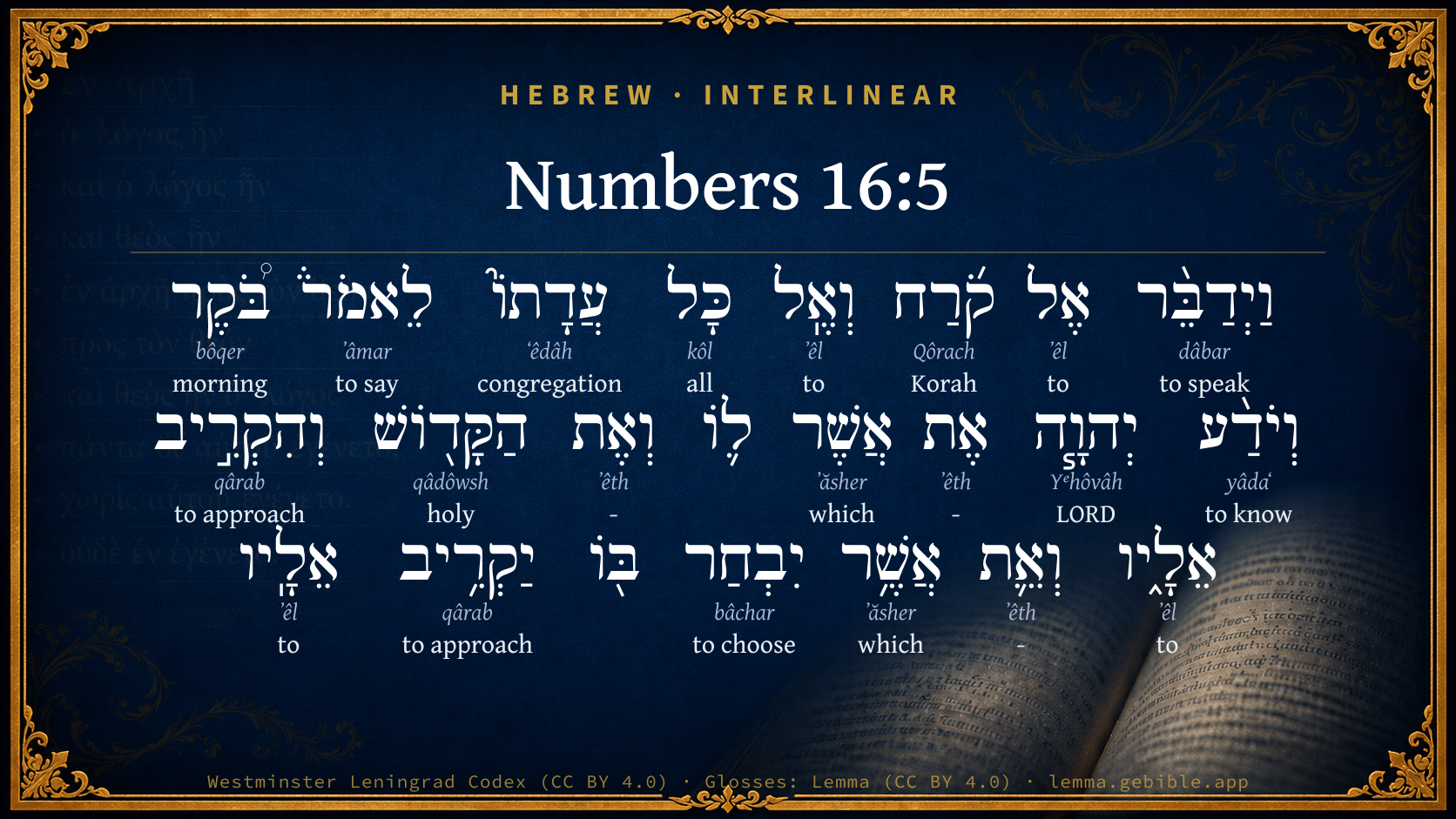
Hebrew (Westminster Leningrad Codex) Numbers 16:5 appears in the Hebrew Old Testament. The text above is from the Westminster Leningrad Codex. Each word links to its Strong’s number, a concise gloss, and parsing drawn from the Open Scriptures Hebrew Bible morphology. Click any word for its full Brown-Driver-Briggs (BDB) entry.
Download image
Cite this verse

Numbers 16:5 (World English Bible). Public Domain. Lemma interlinear Bible study tool, https://lemma.gebible.app/v/numbers/16/5.

Show BibTeX & RIS
BibTeX
RIS
English Translation
and he spoke to Korah and to all his company, saying, In the morning Yahweh will show who are his, and who is holy, and will cause him to come near to him: even him whom he shall choose will he cause to come near to him.
World English Bible · Public Domain
Download a study sheet

One document with this verse’s original text, its word-by-word gloss line, the meaning frame, cross-references with their text, attributed commentary, and full source and license credits — printable, and it pastes into notes with its structure intact.

This verse Autodidact and up

Study sheet (.html) Plain text (.txt)

A passage Seminary Student

Up to 50 verses in one chapter. A passage sheet keeps up to 6 commentary sources and 12 cross-references per verse, in the order this page ranks them, and says so on the sheet whenever that leaves anything out. Ask for a single verse and you get the Autodidact verse sheet above.

Everything on this page stays free to read, with no account — the sheet is a download of what is already on screen, not access to it.

Want to remove ads? Support Godless Engineer
Compare translations 3

The same verse in 3 English versions, stacked beneath the original-language interlinear above. Click any original word for its lexicon entry.

Each is an independent rendering of the whole verse — the interlinear is not word-aligned to these translations.

Highlighted words mark where these versions differ — a whole-verse word diff, not a word-by-word alignment.

  • World English Bible Public Domain
    and he spoke to Korah and to all his company, saying, In the morning Yahweh will show who are his, and who is holy, and will cause him to come near to him: even him whom he shall choose will he cause to come near to him.
  • King James Version Public Domain
    And he spake unto Korah and unto all his company, saying, Even to morrow the LORD will show who are his, and who is holy; and will cause him to come near unto him: even him whom he hath chosen will he cause to come near unto him.
  • unfoldingWord Literal Text CC BY-SA 4.0
    And he spoke to Korah and to all his congregation, saying, “Morning, and Yahweh will make known who to him and the holy one, and he will present to him, and whom he chooses he will present to him.

unfoldingWord Literal Text — © unfoldingWord, licensed CC BY-SA 4.0. Word-aligned USFM3 via Door43 (git.door43.org/unfoldingWord/en_ult).

Versions to compare (up to 4)

3 of 4 selected

Show all 18 translations

Every available English version of this verse, each an independent rendering of the whole verse.

  • World English Bible Public Domain
    and he spoke to Korah and to all his company, saying, In the morning Yahweh will show who are his, and who is holy, and will cause him to come near to him: even him whom he shall choose will he cause to come near to him.
  • Berean Standard Bible Public Domain
    Then he said to Korah and all his followers, “Tomorrow morning the LORD will reveal who belongs to Him and who is holy, and He will bring that person near to Himself. The one He chooses, He will bring near to Himself.
  • Majority Standard Bible Public Domain
    Then he said to Korah and all his followers, “Tomorrow morning the LORD will reveal who belongs to Him and who is holy, and He will bring that person near to Himself. The one He chooses He will bring near to Himself.
  • King James Version Public Domain
    And he spake unto Korah and unto all his company, saying, Even to morrow the LORD will show who are his, and who is holy; and will cause him to come near unto him: even him whom he hath chosen will he cause to come near unto him.
  • American Standard Version (1901) Public Domain
    and he spake unto Korah and unto all his company, saying, In the morning Jehovah will show who are his, and who is holy, and will cause him to come near unto him: even him whom he shall choose will he cause to come near unto him.
  • Revised Version (1885) Public Domain
    and he spake unto Korah and unto all his company, saying, In the morning the LORD will shew who are his, and who is holy, and will cause him to come near unto him: even him whom he shall choose will he cause to come near unto him.
  • Geneva Bible (1599) Public Domain
    And spake to Korah and vnto all his companie, saying, To morow the Lord will shew who is his, and who is holy, and who ought to approche neere vnto him: and whom he hath chosen, hee will cause to come neere to him.
  • Douay-Rheims (1899) Public Domain
    And speaking to Core and all the multitude, he said: In the morning the Lord will make known who belong to him, and the holy he will join to himself: and whom he shall choose, they shall approach to him.
  • Young's Literal Translation Public Domain
    and he speaketh unto Korah, and unto all his company, saying, `Morning! -- and Jehovah is knowing those who are his, and him who is holy, and hath brought near unto Him; even him whom He doth fix on He bringeth near unto Him.
  • Literal Standard Version CC BY-SA 4.0
    and he speaks to Korah and to all his congregation, saying, “Indeed, [in the] morning YHWH may cause [you] to know those who are His and him who is holy, and has brought [him] near to Him; even him whom He fixes on He brings near to Him.
  • Unlocked Literal Bible CC BY-SA 4.0
    He spoke to Korah and to all those with him, “In the morning Yahweh will make known who belongs to him and who is set apart to him. He will bring that person near to him. The one he chooses he will bring near to himself.
  • unfoldingWord Literal Text CC BY-SA 4.0
    And he spoke to Korah and to all his congregation, saying, “Morning, and Yahweh will make known who to him and the holy one, and he will present to him, and whom he chooses he will present to him.
  • Darby Bible Public Domain
    And he spoke to Korah and to all his band, saying, Even to-morrow will Jehovah make known who is his, and who is holy; and he will cause him to come near to him; and him whom he has chosen, him will he cause to come near to him.
  • World Messianic Bible Public Domain
    He said to Korah and to all his company, “In the morning, the LORD will show who are his, and who is holy, and will cause him to come near to him. Even him whom he shall choose, he will cause to come near to him.
  • Webster's Bible Public Domain
    And he spoke to Korah and to all his company, saying, Even to-morrow the LORD will show who are his, and who is holy; and will cause him to come near to him: even him whom he hath chosen will he cause to come near to him.
  • Free Bible Version CC BY-SA 4.0
    Then he told Korah and all those with him, “In the morning the Lord is going to make it clear who is his and who is holy, and allow that person to approach him. He will only allow whoever he chooses to approach him.
  • Bible in Basic English Public Domain
    And he said to Korah and his band, In the morning the Lord will make clear who are his, and who is holy, and who may come near him: the man of his selection will be caused to come near him.
  • JPS Tanakh (1917) Public Domain
    And he spoke unto Korah and unto all his company, saying: 'In the morning the LORD will show who are His, and who is holy, and will cause him to come near unto Him; even him whom He may choose will He cause to come near unto Him.

Literal Standard Version (2020), Covenant Press — licensed CC BY-SA 4.0. Text via the HelloAO Bible API (eBible.org). Unlocked Literal Bible (unfoldingWord) — licensed CC BY-SA 4.0. Text via the HelloAO Bible API (eBible.org). unfoldingWord Literal Text — © unfoldingWord, licensed CC BY-SA 4.0. Word-aligned USFM3 via Door43 (git.door43.org/unfoldingWord/en_ult). Free Bible Version, Dr. Jonathan Gallagher — licensed CC BY-SA 4.0. Text via the HelloAO Bible API (eBible.org).

Word by word

More ways to search: Search by grammar → Find every occurrence → Compare this word →

Practice this passage: Drill this verse → Learn its vocabulary →

קֹ֜רַח
Qôrach
H7141
“Korah”
Noun, Proper
Part of Speech
Noun
Type
Proper
Full BDB Definition

Origin: from H7139

TWOT: None

Korah = "bald" - son of Izhar, grandson of Kohath, great grandson of Levi and leader of the rebellion of the Israelites against Moses and Aaron while in the wilderness; punished and died by an earthquake and flames of fire - the 3rd son of Esau by Aholibamah and one of the dukes of Edom - son of Eliphaz by Adah, duke of Edom, and nephew of 1 - one of the 'sons' of Hebron
  1. וַיְדַבֵּ֨ר dâbar H1696 “and · to speak” Conjunction + Verb, Piel, Sequential Imperfect, 3rd Person, Masculine, Singular
  2. אֶל ʼêl H413 “to” Preposition
  3. וְאֶֽל ʼêl H413 “and · to” Conjunction + Preposition
  4. כָּל kôl H3605 “all of” Noun, Common, Masculine, Singular, Construct
  5. עֲדָתוֹ֮ ʻêdâh H5712 “congregation · his” Noun, Common, Feminine, Singular, Construct + Suffix, Personal, 3rd Person, Masculine, Singular
  6. לֵאמֹר֒ ʼâmar H559 “to say” Preposition + Verb, Qal, Infinitive Construct
  7. בֹּ֠קֶר bôqer H1242 “morning” Noun, Common, Masculine, Singular, Absolute
  8. וְיֹדַ֨ע yâdaʻ H3045 “and · to know” Conjunction + Verb, Hiphil, Jussive, 3rd Person, Masculine, Singular
  9. יְהוָ֧ה Yᵉhôvâh H3068 “LORD” Noun, Proper
  10. אֶת ʼêth H853 “-” Particle, Direct Object
  11. אֲשֶׁר ʼăsher H834 “which” Particle, Relative
  12. וְאֶת ʼêth H853 “and · -” Conjunction + Particle, Direct Object
  13. הַקָּד֖וֹשׁ qâdôwsh H6918 “the · holy” Particle, Definite Article + Adjective, Adjective, Masculine, Singular, Absolute
  14. וְהִקְרִ֣יב qârab H7126 “and · to approach” Conjunction + Verb, Hiphil, Sequential Perfect, 3rd Person, Masculine, Singular
  15. אֵלָ֑יו ʼêl H413 “to · him” Preposition + Suffix, Personal, 3rd Person, Masculine, Singular
  16. וְאֵ֛ת ʼêth H853 “and · -” Conjunction + Particle, Direct Object
  17. אֲשֶׁ֥ר ʼăsher H834 “which” Particle, Relative
  18. יִבְחַר bâchar H977 “to choose” Verb, Qal, Imperfect, 3rd Person, Masculine, Singular
  19. יַקְרִ֥יב qârab H7126 “to approach” Verb, Hiphil, Imperfect, 3rd Person, Masculine, Singular
  20. אֵלָֽיו ʼêl H413 “to · him” Preposition + Suffix, Personal, 3rd Person, Masculine, Singular

About this verse

These counts appear in no published source. They are computed here, from the morphology-tagged text and Lemma’s own curated glosses. What Lemma adds →

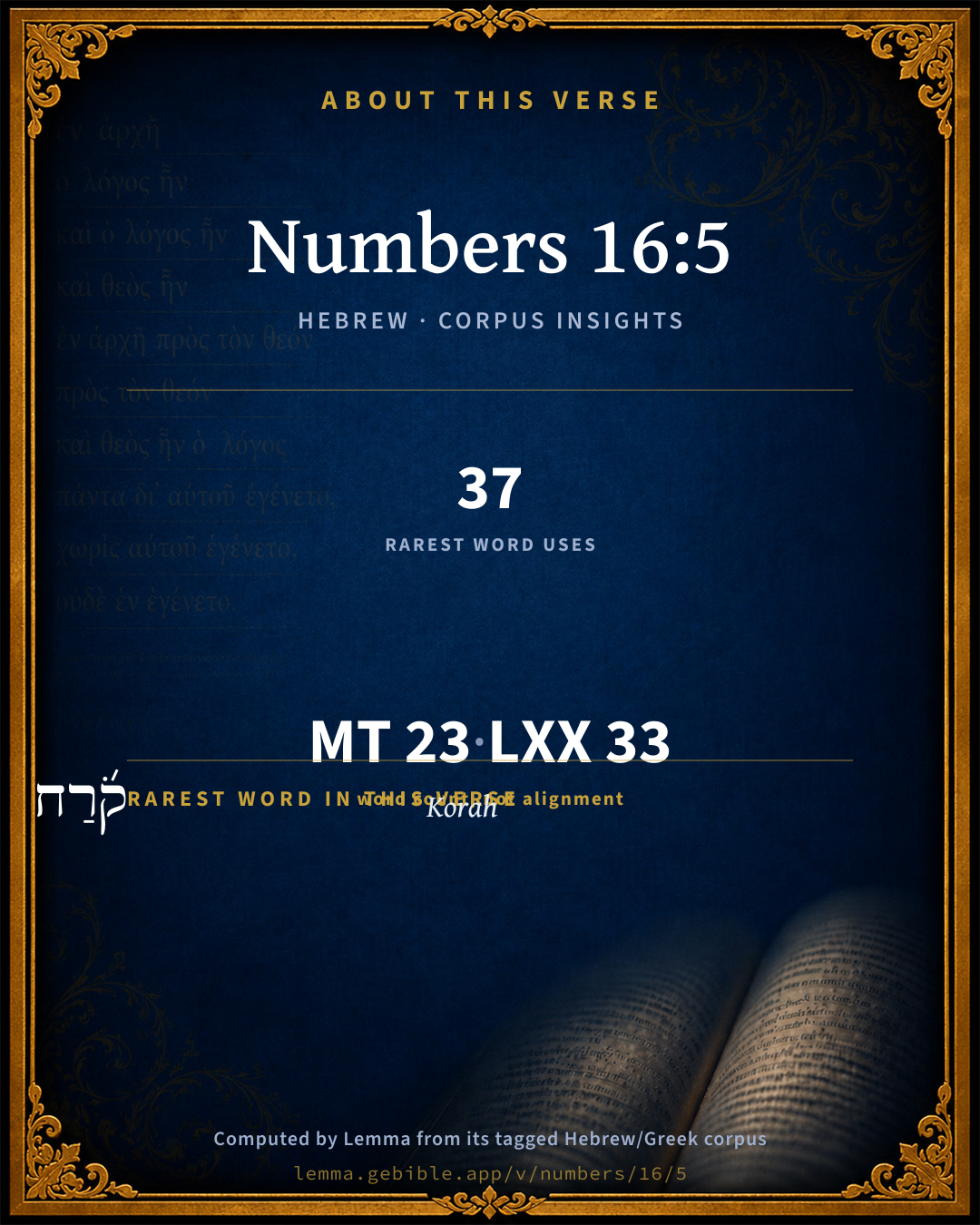
23
words
14
distinct lemmas
Pentateuch
section

Shared distinctive vocabulary

קֹ֜רַח Korah H7141 occurs in 37 verses of the Hebrew Bible. Also found in:

Grammatical profile

  • 6 verbs
  • 5 nouns
  • 1 adjective
  • 6 prepositions
  • 5 particles

Verb forms

  • וַיְדַבֵּ֨ר Piel · Sequential Imperfect
  • לֵאמֹר֒ Qal · Infinitive Construct
  • וְיֹדַ֨ע Hiphil · Jussive
  • וְהִקְרִ֣יב Hiphil · Sequential Perfect
  • יִבְחַר Qal · Imperfect
  • יַקְרִ֥יב Hiphil · Imperfect

Repetition

Words recur within this verse — often emphatic in Hebrew:

  • וְהִקְרִ֣יב to approach H7126 ×2
  • אֶל to H413 ×4
  • אֲשֶׁר which H834 ×2

Hebrew & Septuagint length

In English translation the verse runs 47 words from the Hebrew and 41 from the Septuagint (LXX English) — closely comparable.

A rough comparison of the two English renderings, which tokenize alike — not a word-level alignment.

Word counts can differ between the Hebrew and the Greek without any difference in meaning — e.g. the Hebrew direct-object marker אֵת has no separate Greek word, and Greek often adds the article ὁ.

In the original languages it is 23 Hebrew tokens and 33 Greek tokens — but the two are counted differently (Hebrew bundles its prefixes and suffixes into one token; the Greek is in lemma form), so that isn’t a like-for-like length.

Cross-references

29

Topical passages linked to Numbers 16:5 in the Treasury of Scripture Knowledge — connected by theme and wording, ordered by reader-vote popularity; previews shown in the World English Bible.

  • Psalms 65:4 Blessed is one whom you choose, and cause to come near, That he may live in your courts. We will be filled with the goodness of your house, Your holy temple.
  • Numbers 17:5 It shall happen, that the rod of the man whom I shall choose shall bud: and I will make to cease from me the murmurings of the children of Israel, which they murmur against you.
  • Leviticus 10:3 Then Moses said to Aaron, "This is what Yahweh spoke of, saying, "'I will show myself holy to those who come near me, And before all the people I will be glorified.'" Aaron held his peace.
  • 2 Timothy 2:19 However God's firm foundation stands, having this seal, "The Lord knows those who are his," and, "Let every one who names the name of the Lord depart from unrighteousness."
  • Numbers 16:3 and they assembled themselves together against Moses and against Aaron, and said to them, You take too much on you, seeing all the congregation are holy, everyone of them, and Yahweh is among them: why then lift yourselves up above the assembly of Yahweh?
  • Exodus 28:1 "Bring Aaron your brother, and his sons with him, near to you from among the children of Israel, that he may minister to me in the priest's office, even Aaron, Nadab and Abihu, Eleazar and Ithamar, Aaron's sons.
  • 1 Samuel 2:28 and did I choose him out of all the tribes of Israel to be my priest, to go up to my altar, to burn incense, to wear an ephod before me? and did I give to the house of your father all the offerings of the children of Israel made by fire?
  • Psalms 105:26 He sent Moses, his servant, And Aaron, whom he had chosen.
  • Ezekiel 40:46 and the chamber whose prospect is toward the north is for the priests, the keepers of the charge of the altar: these are the sons of Zadok, who from among the sons of Levi come near to Yahweh to minister to him.
  • Ezekiel 44:15–16 But the priests the Levites, the sons of Zadok, who kept the charge of my sanctuary when the children of Israel went astray from me, they shall come near to me to minister to me; and they shall stand before me to offer to me the fat and the blood, says the Lord Yahweh:
  • Malachi 3:18 Then you shall return and discern between the righteous and the wicked, between him who serves God and him who doesn't serve him.
  • John 15:16 You didn't choose me, but I chose you, and appointed you, that you should go and bear fruit, and that your fruit should remain; that whatever you will ask of the Father in my name, he may give it to you.
  • Acts 1:2 until the day in which he was received up, after he had given commandment through the Holy Spirit to the apostles whom he had chosen.
  • Acts 1:24 They prayed, and said, "You, Lord, who know the hearts of all men, show which one of these two you have chosen
  • Acts 13:2 As they served the Lord and fasted, the Holy Spirit said, "Separate Barnabas and Saul for me, for the work to which I have called them."
  • Acts 22:14 He said, 'The God of our fathers has appointed you to know his will, and to see the Righteous One, and to hear a voice from his mouth.
  • 2 Timothy 2:3–4 You therefore must endure hardship, as a good soldier of Christ Jesus.
  • Hebrews 10:19–22 Having therefore, brothers, boldness to enter into the holy place by the blood of Jesus,
  • 1 Peter 2:5–9 You also, as living stones, are built up as a spiritual house, to be a holy priesthood, to offer up spiritual sacrifices, acceptable to God through Jesus Christ.
  • Revelation 1:6 and he made us to be a Kingdom, priests to his God and Father; to him be the glory and the dominion forever and ever. Amen.
  • Revelation 5:9–10 They sang a new song, saying, "You are worthy to take the book, And to open its seals: For you were killed, And bought us for God with your blood, Out of every tribe, language, people, and nation,
  • Exodus 28:43 They shall be on Aaron, and on his sons, when they go in to the tent of meeting, or when they come near to the altar to minister in the holy place; that they don't bear iniquity, and die: it shall be a statute forever to him and to his descendants after him.
  • Leviticus 8:2 "Take Aaron and his sons with him, and the garments, and the anointing oil, and the bull of the sin offering, and the two rams, and the basket of unleavened bread;
  • Leviticus 21:6–8 They shall be holy to their God, and not profane the name of their God; for they offer the offerings of Yahweh made by fire, the bread of their God; therefore they shall be holy.
  • Leviticus 21:12–15 neither shall he go out of the sanctuary, nor profane the sanctuary of his God; for the crown of the anointing oil of his God is upon him. I am Yahweh.
  • Isaiah 61:5–6 Strangers shall stand and feed your flocks, and foreigners shall be your plowmen and your vine-dressers.
  • Acts 15:7 When there had been much discussion, Peter rose up and said to them, "Brothers, you know that a good while ago God made choice among you, that by my mouth the Gentiles should hear the word of the Gospel, and believe.
  • Ephesians 2:13 But now in Christ Jesus you who once were far off are made near in the blood of Christ.
  • Hebrews 12:14 Follow after peace with all men, and the sanctification without which no man will see the Lord,

Cross-references courtesy of OpenBible.info (CC BY 4.0).

Hebrew and Greek witnesses Masoretic Hebrew ↔ Greek Septuagint

The same verse in the two great witnesses to the Old Testament, shown verse-for-verse.

These are two independent witnesses, not word-aligned to each other, and the Septuagint is shown in lemma (dictionary) form.

Hebrew Numbers 16:5 Masoretic · Westminster Leningrad Codex

וַיְדַבֵּ֨ר אֶל קֹ֜רַח וְאֶֽל כָּל עֲדָתוֹ֮ לֵאמֹר֒ בֹּ֠קֶר וְיֹדַ֨ע יְהוָ֧ה אֶת אֲשֶׁר ל֛וֹ וְאֶת הַקָּד֖וֹשׁ וְהִקְרִ֣יב אֵלָ֑יו וְאֵ֛ת אֲשֶׁ֥ר יִבְחַר בּ֖וֹ יַקְרִ֥יב אֵלָֽיו

and he spoke to Korah and to all his company, saying, In the morning Yahweh will show who are his, and who is holy, and will cause him to come near to him: even him whom he shall choose will he cause to come near to him.

World English Bible · Public Domain

Greek LXX Numbers 16:5 Septuagint · lemma form

καί λαλέω πρός κορε καί πρός πᾶς αὐτός ὁ συναγωγή λέγω ἐπισκέπτω καί γιγνώσκω ὁ θεός ὁ εἰμί αὐτός καί ὁ ἅγιος καί προςἄγω πρός ἑαυτοῦ καί ὅς ἐκλέγω ἑαυτοῦ προςἄγω πρός ἑαυτοῦ

And he spoke to Core and all his assembly, saying, God has visited and known those that are his and who are holy, and has brought them to himself; and whom he has chosen for himself, he has brought to himself.

LXX2012 (modern English Septuagint) · Public Domain

On this verse, The Cambridge Bible for Schools and Colleges discusses the Septuagint’s reading. Read the note in Commentary ↓

Hebrew: Westminster Leningrad Codex (CC BY 4.0). Greek: Septuagint (public domain); English from LXX2012 (modern English Septuagint) (Public Domain). How the Septuagint differs from the Hebrew →

Targum (Aramaic paraphrase)

2

The Targum is the ancient Jewish Aramaic paraphrase of the Hebrew Scriptures — an interpretive translation, not the Hebrew text itself. Onkelos (literal) and Pseudo-Jonathan (expansive) render the Torah, and Jonathan the Prophets. Coverage is partial: where no permissively-licensed English translation exists for a verse, only the Aramaic is shown. This is verse-level text, not a word-by-word alignment to the Hebrew.

  1. Targum Onkelos Torah (Genesis–Deuteronomy)
    וּמַלִיל עִם קֹרַח וְעִם כָּל כְּנִשְׁתֵּהּ לְמֵימַר בְּצַפְרָא וִיהוֹדַע יְיָ יָת דְכָשַׁר לֵהּ וְיָת דְקַדִישׁ וִיקָרֵב לָקֳדָמוֹהִי וְיָת דִי יִתְרְעֵי בֵהּ יְקָרֵב לְשִׁמוּשֵׁהּ

    (no public-domain English translation for this verse)

    Targum Onkelos — Aramaic: “Onkelos Genesis” (public domain); “Onkelos Exodus” (public domain); “Onkelos Leviticus” (public domain); “Onkelos Numbers” (public domain); “Onkelos Deuteronomy” (public domain). English: “Sefaria Community Translation” (CC0 1.0 (public-domain dedication)); “J.W. Etheridge. The Targums of Onkelos and Jonathan Ben Uzziel on the Pentateuch. London: Longmans, Green, 1862” (public domain). Text via Sefaria.

  2. Targum Pseudo-Jonathan Torah (Genesis–Deuteronomy)
    וּמַלֵיל עִם קרַח וְעִם כְּנִישַׁת סַעֲדוֹי לְמֵימָר צַפְרָא וִיהוֹדַע יְיָ יַת דְכָשַׁר לֵיהּ וְיַת דְקַדִישׁ וְיִקְרַב לְפוּלְחָנֵיהּ וְיַת דְיִתְרְעֵי בֵיהּ יִקְרַב לְשַׁמוּשֵׁיהּ

    And he spake with Korach and all the company who supported him, saying: In the morning the Lord will make known him whom He hath approved, and hath consecrated to approach unto His service, and who it hath pleased Him should come nigh in ministering, unto Him.

    Targum Pseudo-Jonathan — Aramaic: “Targum Jonathan on Genesis” (public domain); “Targum Jonathan on Exodus” (public domain); “Targum Jonathan on Leviticus” (public domain); “Targum Jonathan on Numbers” (public domain); “Targum Jonathan on Deuteronomy” (public domain). English: “The Targum of Jonathan ben Uzziel, trans. J. W. Etheridge, London, 1862” (public domain). Text via Sefaria.

Commentary

Notes on Numbers 16:5 from classic Christian and Jewish commentators (each source and its license shown beneath its notes). The classic Christian expositions comment on the surrounding passage and are grouped to its opening verse, so a note may address several verses; the Jewish commentaries on the Tanakh (Rashi and others) are per-verse, so they appear only where the commentator wrote on this verse.

Lemma curates 59 commentaries, every one of them public domain or Creative Commons licensed, each selected and text-cleaned for this edition rather than reprinted as found. About our sources →

Trapp's Complete Commentary

John Trapp

Num 16:5 And he spake unto Korah and unto all his company, saying, Even to morrow the LORD will shew who [are] his, and [who is] holy; and will cause [him] to come near unto him: even [him] whom he hath chosen will he cause to come near unto him.

Ver. 5. And he spake unto Korah.] By the instinct of the Spirit, who had given into his heart a present answer to his prayer, and furnished him with this answer.

John Trapp, A Commentary or Exposition upon All the Books of the Old and New Testament (1647–1656) — public domain. Text from a community e-Sword module.

Joseph Benson's Commentary

Num 16:5. To-morrow — Hebrew, In the morning; the time appointed by men for administering justice, and chosen by God for that work. Some time is allowed, partly that Korah and his company might prepare themselves and their censers; and partly to give them space for consideration and repentance. He will cause him — He will, by some evident token, declare his approbation of him and his ministry.

Joseph Benson's Commentary on the Old and New Testaments (1811–1818) — public domain. Text from a community e-Sword module.

Geneva Bible (1599)

Geneva Bible translators

To be the Priest and to offer.

Geneva Bible (1599) marginal notes — public domain. Text via Bolls.life.

Jamieson, Fausset & Brown

Robert Jamieson, A. R. Fausset & David Brown

he spake unto Korah and unto all his company--They were first addressed, not only because they were a party headed by his own cousin and Moses might hope to have more influence in that quarter, but because they were stationed near the tabernacle; and especially because an expostulation was the more weighty coming from him who was a Levite himself, and who was excluded along with his family from the priesthood. But to bring the matter to an issue, he proposed a test which would afford a decisive evidence of the divine appointment.

Even to-morrow--literally, "in the morning," the usual time of meeting in the East for the settlement of public affairs.

the Lord will show who are his, . . . even him whom he hath chosen will he cause to come near unto him--that is, will bear attestation to his ministry by some visible or miraculous token of His approval.

Jamieson, Fausset & Brown — Commentary Critical and Explanatory on the Whole Bible (1871) — public domain (CC PDM 1.0). Text via the HelloAO Bible API.

Adam Clarke's Commentary

Verse 5. The Lord will show who are his] It is supposed that St. Paul refers to this place, 2Ti 2:19: The foundation of God - the whole sacrificial system, referring to Christ Jesus, the foundation of the salvation of men; standeth sure, notwithstanding the rebellions, intrusions, and false doctrines of men; having this seal - this stamp of its Divine authenticity, The Lord knoweth them that are his; εγνω Κυριος τους οντας αυτου, a literal translation of וידע יהוה את אשר לו veyoda Yehovah eth asher lo; and both signifying, The Lord approveth of his own; or, will own that which is of his own appointment. And let every one that nameth the name of Christ depart from iniquity, alluding to the exhortation of Moses, Nu 16:26: Depart, I pray you, from the tents of these wicked men.

Adam Clarke's Commentary on the Bible (1810–1826) — public domain. Text from a community e-Sword/MySword module.

Ellicott's Commentary for English Readers

(5) And he spake unto Korah and unto all his company.—The words seem to have been addressed only to Korah and his company, not to Dathan and Abiram, who do not appear to have been present on this occasion. (See Num_16:12, where Moses is represented as sending for Dathan and Abiram.)

Even to-morrow.—Literally, In the morning. It may be that On and also the sons of Korah profited by this suspension of the judgment which was about to overtake those who persisted in their rebellion.

A Bible Commentary for English Readers, edited by Charles John Ellicott (1878–1897) — public domain. Text from a community e-Sword module.

The Cambridge Bible for Schools and Colleges

gen. ed. J. J. S. Perowne

5. the Lord will shew who are his] LXX. ἔγνω ὁ Θεὸς τοὺς ὄντας αὐτοῦ (‘God knoweth those who are his’) is quoted in 2Ti_2:19, with the substitution of Κύριος for Θεός.

and will cause him &c.] R.V. marg. is less probable.

The Cambridge Bible for Schools and Colleges (gen. ed. J. J. S. Perowne; Cambridge University Press, 1878–1918) — public domain. Text from a community e-Sword module.

John Gill's Exposition

And he spake unto Korah, and unto all his company,.... The two hundred fifty princes that were with him; what follows was said to them apart from Dathan and Abiram, who seem not to be present at this time; and this was after Moses had finished his prayer to God, and had received instructions from him, by an impulse on his mind, what he should say unto them, and was now risen up from the earth he fell upon:

saying, even tomorrow the Lord will show who are his; his priests, whom he had chosen, and put into that office; this he would make known so clearly and plainly, that there would be no room left to doubt of it, and which was revealed to Moses while upon his face in prayer to God:

and who is holy; or whom he has separated to such an holy office and service:

and will cause him to come near unto him; and do his work as a priest, without fear of danger, and without any hurt, which is suggested would befall others; and they may expect it, who intrude themselves into such an office, and engage their hearts in a bold audacious manner, to draw nigh to God in it:

even him whom he hath chosen will he cause to come near unto him: meaning Aaron with his sons, whom the Lord would make to appear that he had chosen, and put into the office of priesthood, and that it was not what Moses did of himself.

John Gill's Exposition of the Whole Bible (1746–1763) — public domain (CC PDM 1.0). Text via the HelloAO Bible API.

Haydock's Catholic Bible Commentary

The holy ones, whom he has chosen for the high priesthood. The psalmist, speaking of this sedition, says, they provoked....Aaron, the holy one of the Lord, Psalm cv. 16. (Calmet) See 1 Timothy ii. 19. --- Only those who are chosen by God, can lawfully perform this sacred office, as the Almighty declares by a miracle. (Haydock)

George Leo Haydock (1774–1849), Haydock's Catholic Family Bible and Commentary, 1859 edition — public domain. Excludes Psalms (Douay-Rheims chapter numbering differs from Protestant) and Deuterocanonical books (Catholic canon only).

Matthew Poole's English Annotations

To-morrow, Heb. in the morning, the time appointed by men for administering justice, Psa 101:8; Jer 21:12; and chosen by God for that work, Psa 73:14; Isa 47:11; Zep 3:5. Some time is allowed, partly that Korah and his company might prepare themselves and their censers; and partly to give them space for consideration and repentance.

And will cause him, or, and whom he will cause. To come near unto him, i.e. he will by some evident and miraculous token declare his approbation of him and his ministry.

Matthew Poole's English Annotations on the Holy Bible (1683–1685) — public domain. Text from a community e-Sword/MySword module.

Whedon's Commentary on the Bible

Daniel D. Whedon

5. The Lord will show who are his — This calm appeal to the decision of Jehovah strikingly contrasts with the ambition of the insurgents. The rendering of the Septuagint is, “The Lord knoweth who are his.” See 2Ti_2:19, note.

To come near unto him — In the discharge of the priestly office.

Daniel D. Whedon (gen. ed.), Commentary on the Old and New Testaments (1874–1909) — public domain. Text from a community e-Sword module.

The Pulpit Commentary

He spake unto Korah. That Korah was the mainspring of the conspiracy is evident. (cf. verse 22; Num_27:3 Jud_1:11) It may well be that his position as a prominent Levite and a relation of Moses gave him great influence with men of other tribes, and earned him a great name for disinterestedness and liberality in advocating the rights of all Israel, and in denouncing the exclusive claims and privileges by which he himself (as a Levite) was benefited. It is often assumed that Korah was secretly aiming at the high-priesthood, but of this, again, there is not a shadow of proof; his error was great enough, and his punishment sore enough, without casting upon him these unfounded accusations. It would be more in accordance with human nature if we supposed that Korah was in his way sincere; that he had really convinced himself, by dint of trying to convince others, that Moses and Aaron were usurpers; that he began his agitation without thought of advantage of himself; that, having gained a considerable following and much popular applause, the pride of leadership and the excitement of conflict led him on to the last extremity. The Lord will show who are his. WlArvaAta, the meaning of which is defined by the following words, "whom he hath chosen." Moses refers the matter to the direct decision of the Lord; as that decision had originated the separate position of Aaron, that should also vindicate it.

The Pulpit Commentary (1880–1919), ed. H.D.M. Spence-Jones & Joseph S. Exell — public domain. Text from a community e-Sword module.

John Wesley's Explanatory Notes

Tomorrow - Hebrew. In the morning, the time appointed by men for administering justice, and chosen by God for that work. Some time is allowed, partly that Korah and his company might prepare themselves and their censers, and partly to give them space for consideration and repentance. He will cause him - He will by some evident token declare his approbation of him and his ministry.

John Wesley, Explanatory Notes Upon the Whole Bible (1754–1765) — public domain. Text via the GEBible commentary corpus.

Rashi

Rabbi Shlomo Yitzchaki (Rashi)

בקר וידע וגו׳ TOMORROW THE LORD WILL MAKE KNOWN [WHO ARE HIS] — “Now (this hour of the day)” — he meant — “is a time of excessive drinking, and it is therefore not proper to appear before Him”. But his real intention in postponing the matter was that perhaps they might repent (abandon their opposition) (Midrash Tanchuma, Korach 5).

'בקר וידע ה את אשר לו TOMORROW THE LORD WILL MAKE KNOWN WHO ARE TO BE HIS for the Levitical service,

ואת הקדוש AND HIM WHO IS HOLY enough for the priesthood,

והקריב AND HE WILL BRING them אליו UNTO HIM. The Targum proves that this is so (i.e. that Scripture alludes to two different matters), for it renders the first phrase by “He will bring near to Him”, and the second by “He will bring near to His service”. — A Midrashic explanation of the word בקר (instead of the more usual מחר) is the following: Moses said to him (Korah): “The Holy One, blessed be He, has assigned bounds in His world; can you, perhaps, change the morning into evening? Just as little, will you be able to make this (Aaron’s appointment as High Priest) of none effect, — as indeed it states, (Genesis 1:5) “and it was evening and it was morning… (Genesis 1:4) “and God separated (ויבדל) [light from darkness]”; and in the same sense (that the separation should be of a permanent character) it states, (I Chronicles 23:13) “and Aaron was separated (ויבדל) that he should be sanctified [as most holy … to minister unto him]” (Midrash Tanchuma, Korach 5).

Rashi on the Tanakh — English translations: “The Judaica Press complete Tanach with Rashi, translated by A. J. Rosenberg” (CC BY 4.0); “Pentateuch with Rashi's commentary by M. Rosenbaum and A.M. Silbermann, 1929-1934” (public domain); “The Metsudah Tanach series, Lakewood, N.J” (CC BY 4.0); and “The Book of Joshua, Metsudah Publications, 1997” (CC BY 4.0). Text via Sefaria.

Ramban (Nachmanides)

Rabbi Moshe ben Nachman (Ramban / Nachmanides)

IN THE MORNING THE ETERNAL WILL MAKE KNOWN WHO ARE HIS — “for the Levitical service. AND WHO IS HOLY — for the priesthood.” This is Rashi’s language. He has explained it well; and the verse is thus stating that G-d will make it known if the Levites are His, just as it is said, and the Levites shall be Mine, or whether the firstborns are still His, just as it is said, for all the firstborn are Mine, 3:13. so that He will not exchange them for the Levites. And who is holy, this refers to the priests who are sanctified for the Divine Service, just as it is said, and Aaron was separated, that he should be sanctified as most holy. [He mentioned the Levites] because Korach, in [his attempt] to rally all the people to his side, contested also the [position of the] Levites, and tried to restore the entire service [of the offerings] to the firstborns. And then when these firstborns were burnt up, it became clear that G-d did not choose them for the service, but when Aaron’s [burning of the] incense was accepted, it became known that he is the holy one [selected for the priesthood].

EVEN HIM WHOM HE HATH CHOSEN WILL HE CAUSE TO COME NEAR UNTO HIM. The meaning of this repetition [since the first half of this verse already says, and who is holy, He will cause him to come near unto Him] is that [at first Moses said] the Eternal will make known who are His, and who is holy, and will cause him to come near unto Him tomorrow, and He will have regard for his offering, whereas He will not turn to the others and to their offerings. Even him whom He hath chosen forever to stand to minister before Him, him and his seed forever, will He cause to come near unto Him tomorrow. Thus he is saying that this test will be a proof to them throughout their generations not to contest [the rights of] him who is chosen, nor those of his seed forever.Now Rabbeinu Chananel wrote that all these people who assembled [against Moses] were Levites, of the same tribe as Korach, this being the reason for the expressions [by Moses]: ye take too much upon you, ‘ye sons of Levi;’ Hear now, ‘ye sons of Levi.’, Verse 8. Perhaps they thought that their whole tribe had been chosen for the priesthood, and that it was Moses of his own accord who gave the honor to his brother. Thus far [are the words of Rabbeinu Chananel]. But G-d forbid that there should be in the tribe of the ministers of our G-d two hundred and fifty men — of the most distinguished [of the people], and princes — who were sons of rebellion, 17:25. rejecting their leader, the greatest of their tribe, and murmuring against G-d! And [furthermore], if these [rebels] were only of that tribe [of Levi, as Rabbeinu Chananel wrote], then all the tribes of Israel would not have murmured on the next day [after the rebels were killed] saying: ‘Ye have killed the people of the Eternal,’, Verse 6. since not one of their own tribe died, [and those who did die were] only of Moses’ and Aaron’s tribe. Similarly the sign of the rod, Verses 16-24. Each tribe had to deposit a rod with its name written on it in the Tent of Meeting, before the ark of the Testimony, and Moses placed another rod there with Aaron’s name written on it. G-d promised that he would make the rod of the one who was chosen bud miraculously. Thus the fact that each tribe had to put a rod there shows that the controversy embraced them all. also proves that the controversy embraced all tribes of Israel. In addition, Scripture expressly states, [and they rose up in the face of Moses,] with certain men ‘of the children of Israel,’ in order to point out that the men were from all the tribes, not only from the two tribes [previously] mentioned [Reuben and Levi]. But the reason why [Moses said] ye take too much upon you, ‘ye sons of Levi’ is that Korach won the tribes over to his side [by persuading them] that it was because of their honor that he wanted to restore the service [of the offerings] to their firstborns, as he said, seeing all the congregation are holy., Verse 3. But Moses in his wisdom laid bare the hidden motives of Korach’s heart to the whole people, namely that he was only protesting because of his own [failure to attain the] priesthood; therefore Moses said to him that he had sufficient [honor] in the honor bestowed upon his tribe, for “you have enough honor, you sons of Levi.” Then Moses continued and said, Hear now, ye sons of Levi., Verse 8. [This he said] to Korach their leader — as is shown by [the first part of] that verse, And Moses said unto Korach, Verse 8. — but he included in his words all the Levites, since Moses in his wisdom spoke conciliatory words to Korach and all his tribe, so that none of them should be drawn after him.Now it was Moses himself who thought of this procedure, and chose the burning of incense [as the test to show who was suitable for the priesthood] rather than any of the other offerings, because he had already seen in the case of Nadab and Abihu that when they offered strange incense before the Eternal they were burnt. Therefore he permitted Aaron to burn the incense, because of the special needs of the time, or maybe it was the [daily] incense of the morning which he used to burn when he kindled the lamps, according to the ordinance, and Moses trusted that G-d confirmeth the word of His servant, and performeth the counsel of His messengers. And some scholars say that [the meaning of the verse], And when Moses heard it, he fell upon his face, is [that he did so] in order to inquire of G-d to know what to do, and then he was told, In the morning the Eternal will make known etc.;. but it is mentioned only in Moses’ account to the people. I have already shown you that in many places Scripture will sometimes deal at length with the account of G-d’s communication to Moses, but mention [the matter] in brief in Moses’ narration thereof, and at other times it does the opposite. At other instances [still] it does not mention one of the communications at all, such as in the story of the children of Gad and the children of Reuben, where Scripture tells the event [only] with respect to Moses himself [that he gave them the land east of the Jordan as a conditional inheritance], and [this whole matter] was [in fact] done by the commandment of the Eternal, as they said, As the Eternal hath said unto thy servants, so will we do. And in [the Book of] Joshua it is written, [And the children of Reuben and the children of Gad and the half-tribe of Menasheh returned … to go] unto the land of Gilead, to the land of their possession, whereof they were possessed, ‘according to the commandment of the Eternal by the hand of Moses’. And if we say that [Moses in fact gave these lands to the tribes of Reuben, Gad, and the half-tribe of Menasheh on his own authority, and the above-mentioned verse which says that it was done according to the commandment of the Eternal] refers to G-d’s [subsequent] agreement to Moses’ action, similar to that which it says, This is the Land wherein ye shall receive inheritance by lot, which the Eternal hath commanded to give unto the nine tribes, and to the half-tribe, in which case this would be one of the occasions when Moses acted of his own accord and the Holy One, blessed be He, [later] approved his decision where Ramban cites cases, where man’s opinion coincided with that on High. There is a marked difference though between the cases of Moses and those mentioned above. Moses according to tradition acted on his own reasoning, and G-d subsequently approved. In the cases mentioned above [such as in the section about the impure people on Passover, etc.] inquiry was first made for Divine guidance, and it happened that the opinion of those seeking guidance coincided with that on High. — [this cannot be so because] it is not right [to say] that Moses would have done anything in connection with the division of the Land without [Divine] permission. For [in dividing the Land] he did everything at the command of G-d, as it is written, [And the Lord spoke unto Moses saying:] Unto these the Land shall be divided etc. clearly indicates that he acted originally on Divine instruction.My own opinion in this matter [of Moses’ command to Korach and his company to take censers and burn incense], and in that which he said to Aaron [during the outbreak of the plague], Take thy fire-pan, and put fire therein from off the altar, and lay incense thereon, 17:11. is that the hand of the Eternal was upon him in these matters, and it is this which is called Ruach Hakodesh, Note 63, and Ramban ibid. as happened with the books of David and Solomon which were written by Ruach Hakodesh, and as David said, The spirit of the Eternal spoke by me, and His word was upon my tongue. For Moses our teacher was trusted in all His house, and I have explained the matter of “the house”, Verse 6. and mentioned it many times; but since this was not in the usual course of Moses’ prophecy, Scripture did not mention G-d’s communication to him about these matters.Now I have seen in Onkelos’ translation that every time the word k’toreth (incense) appears in this section, he rendered it in his language [Aramaic also] as k’toreth and he did not translate it [as he does in all other places] as k’toreth busmin (aromatic incense), as he usually does. 30:8. — But note, however, that in our versions of Onkelos, the word k’toreth in this section is translated as k’toreth busmin (aromatic incense). In the opinion of the author of Minei Targima (Rabbi Yeshayah Pick), Ramban’s version of the text of Onkelos here is the correct one, and later copyists mistakenly amended the text. See my Hebrew commentary, p. 258. From this it would appear that he was of the opinion that this was not the aromatic incense used in the Sanctuary [i.e., Tabernacle], but it [consisted of] frankincense and similar ingredients which he [Moses] made them burn for the test. Onkelos translated likewise in the case of Aaron’s sons [Nadab and Abihu, who burnt the strange incense, for there too he did not render the Hebrew k’toreth as he usually does: k’toreth busmin, but as k’toreth]. (aromatic incense), which in the opinion of the author of Minei Targima is likewise a copyist’s mistake. But in the opinion of our Rabbis 5. it was the sacred incense, and this is the correct interpretation. Perhaps Onkelos [agrees that this was the sacred incense, but he] did not want to praise the incense by adding thereto the word busmin (aromatics), except when it [the incense] was used in performance of the [daily] commandment [to burn incense].

Ramban (Nachmanides) on the Tanakh — English translation: “Commentary on the Torah by Ramban (Nachmanides). Translated and annotated by Charles B. Chavel. New York, Shilo Pub. House, 1971-1976” (CC BY 4.0). Text via Sefaria.

Sforno

Rabbi Ovadia Sforno

He spoke to Korach. He informed them that he realized their deception and the connections they had formed.

Who is [qualified to be] His. The one who is really speaking for the honor of Hashem.

And who is holy, He will bring close to Him. Hashem will inform who is holy and worthy to bring the offerings before Him.

And whoever He chooses, He will bring near to Him. That person alone will Hashem bring near to Him, out of the upset of the remaining persons, as it says, “Separate yourselves from among this congregation”.

Sforno on the Tanakh — English translation: “Yalkut, Sifsei Chachomim Chumash, Metsudah Publications, 2009” (CC BY 4.0). Text via Sefaria.

Lesson kit

Teaching starters — assembled from the data on this page, not authored interpretation. Every prompt links to the verse data it draws on. Edit before teaching.

Numbers, in the Pentateuch, opens this verse with 23 words (14 distinct Hebrew lemmas). Its most distinctive word is Qôrach (“Korah”). A historical commentator’s framing appears above. Read the whole chapter for the surrounding context.

Discussion questions

  1. The word Qôrach carries the sense “Korah.” How does it shape the verse?
  2. Genesis 36:5 shares the word «Korah» with this verse. How do the two illuminate each other?
  3. “to approach” occurs 2× in this one verse. What is the effect of the repetition?
  4. These translations render this verse differently. What is at stake in choosing one wording over another?
  5. The verb «וַיְדַבֵּ֨ר» is Piel Sequential Imperfect. How does its form color the action?
  6. Reading how Trapp's Complete Commentary and Joseph Benson's Commentary read this verse, where do the two commentators agree and where do they part?

Things to notice

Reading settings

Reading text

Shown beneath each verse's original-language words.

Old Testament
Old Testament edition

Read the OT as the Masoretic Hebrew (MT) or the Greek Septuagint (LXX).

English shown for the Greek Septuagint (in the Hebrew ↔ Greek comparison).

Comparing translations? Open the Compare panel on any verse page to stack up to four side by side.