2 Samuel 20:16

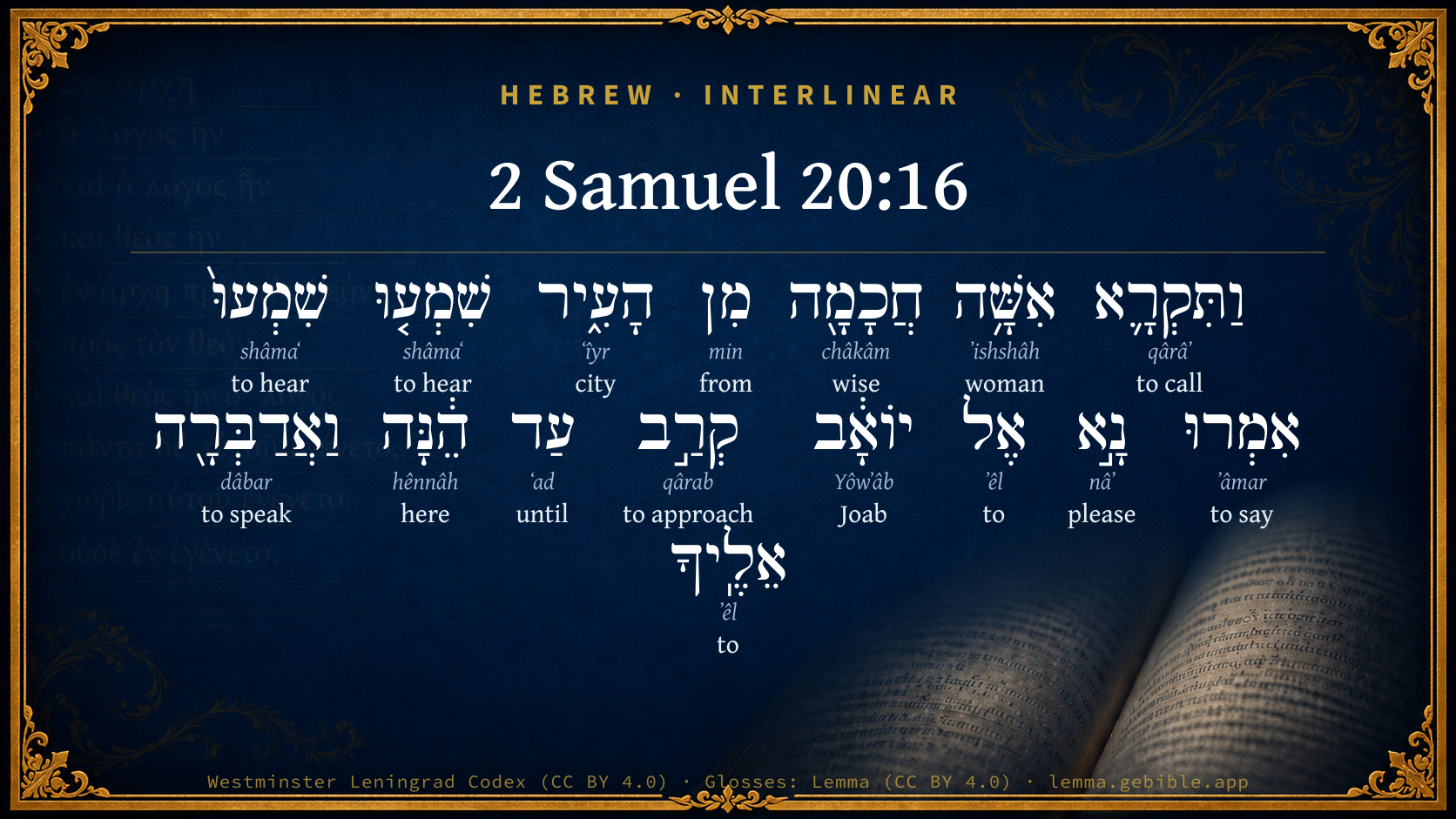
Hebrew (Westminster Leningrad Codex) 2 Samuel 20:16 appears in the Hebrew Old Testament. The text above is from the Westminster Leningrad Codex. Each word links to its Strong’s number, a concise gloss, and parsing drawn from the Open Scriptures Hebrew Bible morphology. Click any word for its full Brown-Driver-Briggs (BDB) entry.
Download image
Cite this verse

2 Samuel 20:16 (World English Bible). Public Domain. Lemma interlinear Bible study tool, https://lemma.gebible.app/v/2-samuel/20/16.

Show BibTeX & RIS
BibTeX
RIS
English Translation
Then cried a wise woman out of the city, "Hear, hear! Please say to Joab, 'Come near here, that I may speak with you.'"
World English Bible · Public Domain
Download a study sheet

One document with this verse’s original text, its word-by-word gloss line, the meaning frame, cross-references with their text, attributed commentary, and full source and license credits — printable, and it pastes into notes with its structure intact.

This verse Autodidact and up

Study sheet (.html) Plain text (.txt)

A passage Seminary Student

Up to 50 verses in one chapter. A passage sheet keeps up to 6 commentary sources and 12 cross-references per verse, in the order this page ranks them, and says so on the sheet whenever that leaves anything out. Ask for a single verse and you get the Autodidact verse sheet above.

Everything on this page stays free to read, with no account — the sheet is a download of what is already on screen, not access to it.

Want to remove ads? Support Godless Engineer
Compare translations 3

The same verse in 3 English versions, stacked beneath the original-language interlinear above. Click any original word for its lexicon entry.

Each is an independent rendering of the whole verse — the interlinear is not word-aligned to these translations.

Highlighted words mark where these versions differ — a whole-verse word diff, not a word-by-word alignment.

  • World English Bible Public Domain
    Then cried a wise woman out of the city, "Hear, hear! Please say to Joab, 'Come near here, that I may speak with you.'"
  • King James Version Public Domain
    Then cried a wise woman out of the city, Hear, hear; say, I pray you, unto Joab, Come near hither, that I may speak with thee.
  • unfoldingWord Literal Text CC BY-SA 4.0
    But a wise woman called from the city, “Listen, listen! Please say to Joab, ‘Approach to here, and let me speak to you.’”

unfoldingWord Literal Text — © unfoldingWord, licensed CC BY-SA 4.0. Word-aligned USFM3 via Door43 (git.door43.org/unfoldingWord/en_ult).

Versions to compare (up to 4)

3 of 4 selected

Show all 18 translations

Every available English version of this verse, each an independent rendering of the whole verse.

  • World English Bible Public Domain
    Then cried a wise woman out of the city, "Hear, hear! Please say to Joab, 'Come near here, that I may speak with you.'"
  • Berean Standard Bible Public Domain
    a wise woman called out from the city, “Listen! Listen! Please tell Joab to come here so that I may speak with him.”
  • Majority Standard Bible Public Domain
    a wise woman called out from the city, “Listen! Listen! Please tell Joab to come here so that I may speak with him.”
  • King James Version Public Domain
    Then cried a wise woman out of the city, Hear, hear; say, I pray you, unto Joab, Come near hither, that I may speak with thee.
  • American Standard Version (1901) Public Domain
    Then cried a wise woman out of the city, Hear, hear; say, I pray you, unto Joab, Come near hither, that I may speak with thee.
  • Revised Version (1885) Public Domain
    Then cried a wise woman out of the city, Hear, hear; say, I pray you, unto Joab, Come near hither, that I may speak with thee.
  • Geneva Bible (1599) Public Domain
    Then cried a wise woman out of the citie, Heare, heare, I pray you, say vnto Ioab, Come thou hither, that I may speake with thee.
  • Douay-Rheims (1899) Public Domain
    And a wise woman cried out from the city: Hear, hear, and say to Joab: Come near hither, and I will speak with thee.
  • Young's Literal Translation Public Domain
    And a wise woman calleth out of the city, `Hear, hear; say, I pray you, unto Joab, Come near hither, and I speak unto thee.'
  • Literal Standard Version CC BY-SA 4.0
    And a wise woman calls out of the city, “Hear! Hear! Please say to Joab, Come near here, and I speak to you.”
  • Unlocked Literal Bible CC BY-SA 4.0
    Then a wise woman cried out of the city, “Listen, please listen, Joab! Come near me so I may speak with you.”
  • unfoldingWord Literal Text CC BY-SA 4.0
    But a wise woman called from the city, “Listen, listen! Please say to Joab, ‘Approach to here, and let me speak to you.’”
  • Darby Bible Public Domain
    And a wise woman cried out of the city, Hear, hear: say, I pray you, unto Joab, Come near hither, that I may speak with thee.
  • World Messianic Bible Public Domain
    Then a wise woman cried out of the city, “Hear, hear! Please say to Joab, ‘Come near here, that I may speak with you.’”
  • Webster's Bible Public Domain
    Then cried a wise woman out of the city, Hear, hear; say, I pray you, to Joab, Come near hither, that I may speak with thee.
  • Free Bible Version CC BY-SA 4.0
    a wise woman from the town called out, “Listen! Please listen! Tell Joab, ‘Come over here so I can speak to you.’”
  • Bible in Basic English Public Domain
    Then a wise woman got up on the wall, and crying out from the town, said, Give ear, give ear; say now to Joab, Come near, so that I may have talk with you.
  • JPS Tanakh (1917) Public Domain
    Then cried a wise woman out of the city: 'Hear, hear; say, I pray you, unto Joab: Come near hither, that I may speak with thee.'

Literal Standard Version (2020), Covenant Press — licensed CC BY-SA 4.0. Text via the HelloAO Bible API (eBible.org). Unlocked Literal Bible (unfoldingWord) — licensed CC BY-SA 4.0. Text via the HelloAO Bible API (eBible.org). unfoldingWord Literal Text — © unfoldingWord, licensed CC BY-SA 4.0. Word-aligned USFM3 via Door43 (git.door43.org/unfoldingWord/en_ult). Free Bible Version, Dr. Jonathan Gallagher — licensed CC BY-SA 4.0. Text via the HelloAO Bible API (eBible.org).

Word by word

More ways to search: Search by grammar → Find every occurrence → Compare this word →

Practice this passage: Drill this verse → Learn its vocabulary →

הֵ֔נָּה
hênnâh
H2008
“here”
Adverb
Part of Speech
Adverb
Full BDB Definition

Origin: from H2004

TWOT: 510b

here, there, now, hither
  1. וַתִּקְרָ֛א qârâʼ H7121 “and · to call” Conjunction + Verb, Qal, Sequential Imperfect, 3rd Person, Feminine, Singular
  2. אִשָּׁ֥ה ʼishshâh H802 “woman” Noun, Common, Feminine, Singular, Absolute
  3. חֲכָמָ֖ה châkâm H2450 “wise” Adjective, Adjective, Feminine, Singular, Absolute
  4. מִן min H4480 “from” Preposition
  5. הָעִ֑יר ʻîyr H5892 “the · city” Particle, Definite Article + Noun, Common, Feminine, Singular, Absolute
  6. שִׁמְע֤וּ shâmaʻ H8085 “hear” Verb, Qal, Imperative, 2nd Person, Masculine, Plural
  7. שִׁמְעוּ֙ shâmaʻ H8085 “hear” Verb, Qal, Imperative, 2nd Person, Masculine, Plural
  8. אִמְרוּ ʼâmar H559 “say” Verb, Qal, Imperative, 2nd Person, Masculine, Plural
  9. נָ֣א nâʼ H4994 “please” Particle, Exhortation
  10. אֶל ʼêl H413 “to” Preposition
  11. יוֹאָ֔ב Yôwʼâb H3097 “Joab” Noun, Proper
  12. קְרַ֣ב qârab H7126 “approach” Verb, Qal, Imperative, 2nd Person, Masculine, Singular
  13. עַד ʻad H5704 “until” Preposition
  14. וַאֲדַבְּרָ֖ה dâbar H1696 “and · to speak” Conjunction + Verb, Piel, Cohortative, 1st Person, Common, Singular
  15. אֵלֶֽיךָ ʼêl H413 “to · you” Preposition + Suffix, Personal, 2nd Person, Masculine, Singular

About this verse

These counts appear in no published source. They are computed here, from the morphology-tagged text and Lemma’s own curated glosses. What Lemma adds →

16
words
14
distinct lemmas
Historical
section

Shared distinctive vocabulary

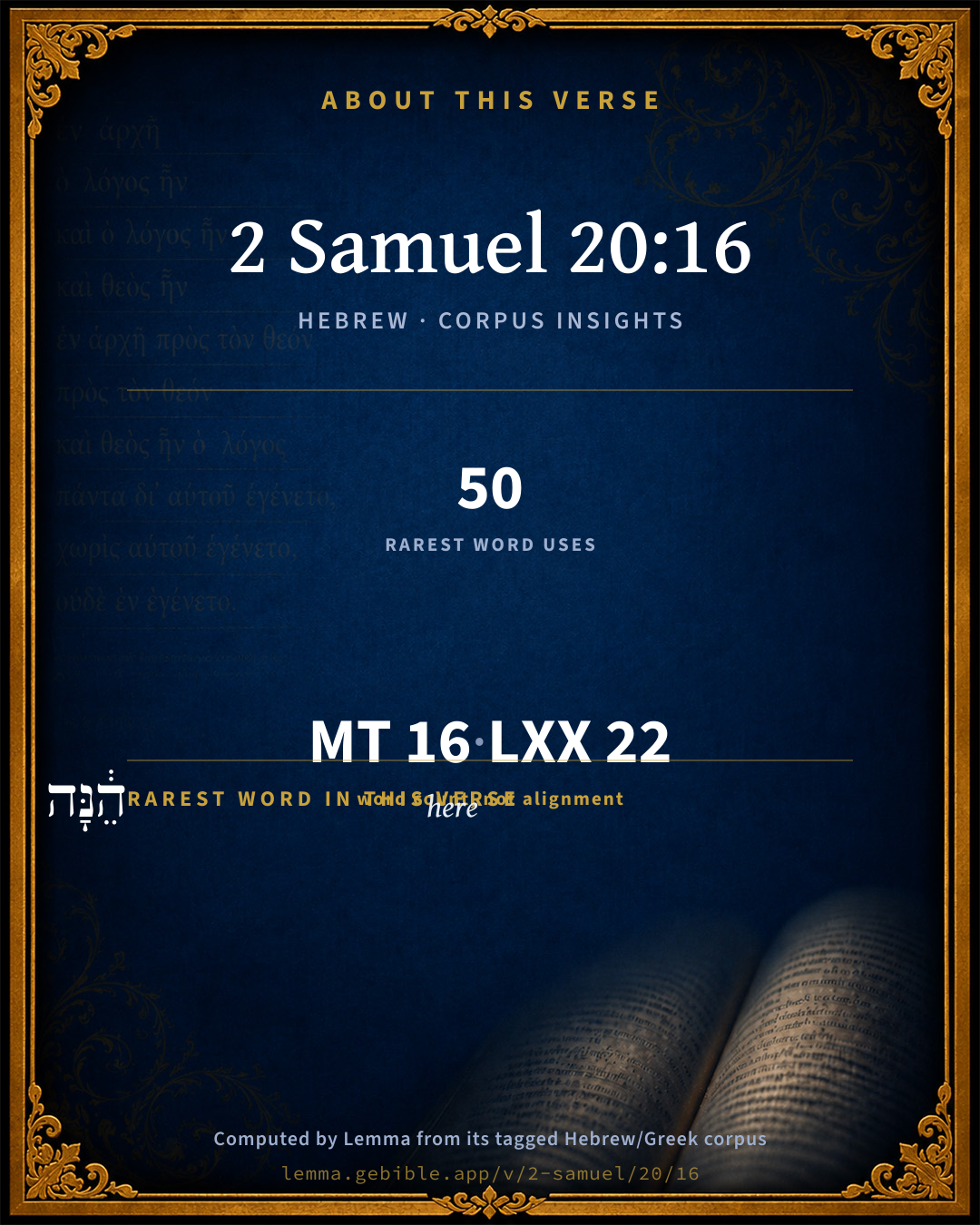
הֵ֔נָּה here H2008 occurs in 42 verses of the Hebrew Bible. Also found in:

Grammatical profile

  • 6 verbs
  • 3 nouns
  • 1 adjective
  • 4 prepositions
  • 1 adverb
  • 1 particle

Verb forms

  • וַתִּקְרָ֛א Qal · Sequential Imperfect
  • שִׁמְע֤וּ Qal · Imperative
  • שִׁמְעוּ֙ Qal · Imperative
  • אִמְרוּ Qal · Imperative
  • קְרַ֣ב Qal · Imperative
  • וַאֲדַבְּרָ֖ה Piel · Cohortative

Repetition

Words recur within this verse — often emphatic in Hebrew:

  • שִׁמְע֤וּ to hear H8085 ×2
  • אֶל to H413 ×2

Hebrew & Septuagint length

In English translation the verse runs 24 words from the Hebrew and 27 from the Septuagint (LXX English) — closely comparable.

A rough comparison of the two English renderings, which tokenize alike — not a word-level alignment.

Word counts can differ between the Hebrew and the Greek without any difference in meaning — e.g. the Hebrew direct-object marker אֵת has no separate Greek word, and Greek often adds the article ὁ.

In the original languages it is 16 Hebrew tokens and 22 Greek tokens — but the two are counted differently (Hebrew bundles its prefixes and suffixes into one token; the Greek is in lemma form), so that isn’t a like-for-like length.

Cross-references

4

Topical passages linked to 2 Samuel 20:16 in the Treasury of Scripture Knowledge — connected by theme and wording, ordered by reader-vote popularity; previews shown in the World English Bible.

  • 2 Samuel 14:2 Joab sent to Tekoa, and fetched there a wise woman, and said to her, please act like a mourner, and put on mourning clothing, Please, and don't anoint yourself with oil, but be as a woman who has a long time mourned for the dead:
  • Ecclesiastes 9:14–18 There was a little city, and few men within it; and a great king came against it, besieged it, and built great bulwarks against it.
  • 1 Samuel 25:3 Now the name of the man was Nabal; and the name of his wife Abigail; and the woman was of good understanding, and of a beautiful face: but the man was churlish and evil in his doings; and he was of the house of Caleb.
  • 1 Samuel 25:32–33 David said to Abigail, Blessed be Yahweh, the God of Israel, who sent you this day to meet me:

Cross-references courtesy of OpenBible.info (CC BY 4.0).

Hebrew and Greek witnesses Masoretic Hebrew ↔ Greek Septuagint

The same verse in the two great witnesses to the Old Testament, shown verse-for-verse.

These are two independent witnesses, not word-aligned to each other, and the Septuagint is shown in lemma (dictionary) form.

Hebrew 2 Samuel 20:16 Masoretic · Westminster Leningrad Codex

וַתִּקְרָ֛א אִשָּׁ֥ה חֲכָמָ֖ה מִן הָעִ֑יר שִׁמְע֤וּ שִׁמְעוּ֙ אִמְרוּ נָ֣א אֶל יוֹאָ֔ב קְרַ֣ב עַד הֵ֔נָּה וַאֲדַבְּרָ֖ה אֵלֶֽיךָ

Then cried a wise woman out of the city, "Hear, hear! Please say to Joab, 'Come near here, that I may speak with you.'"

World English Bible · Public Domain

Greek LXX 2 Samuel 20:16 Septuagint · lemma form

καί βοάω γυνή σοφός ἐκ ὁ τεῖχος καί εἶπον ἀκούω ἀκούω εἶπον δή πρός ιωαβ ἐγγίζω ἕως ὧδε καί λαλέω πρός αὐτός

And a wise woman cried from the wall, and said, Hear, hear; say, I pray you⌃, to Joab, Draw near hither, and I will speak to him.

LXX2012 (modern English Septuagint) · Public Domain

Hebrew: Westminster Leningrad Codex (CC BY 4.0). Greek: Septuagint (public domain); English from LXX2012 (modern English Septuagint) (Public Domain). How the Septuagint differs from the Hebrew →

Targum (Aramaic paraphrase)

1

The Targum is the ancient Jewish Aramaic paraphrase of the Hebrew Scriptures — an interpretive translation, not the Hebrew text itself. Onkelos (literal) and Pseudo-Jonathan (expansive) render the Torah, and Jonathan the Prophets. Coverage is partial: where no permissively-licensed English translation exists for a verse, only the Aramaic is shown. This is verse-level text, not a word-by-word alignment to the Hebrew.

  1. Targum Jonathan Prophets (Joshua–Malachi)
    וּקְרַת אִתְּתָא חַכִּימָתָא מִן קַרְתָּא שְׁמָעוּ שְׁמָעוּ אִמְרוּ כְעַן לְיוֹאָב קְרַב עַד הָכָא וַאֲמַלֵיל עִמָךְ:

    (no public-domain English translation for this verse)

    Targum Jonathan — Aramaic: “Mikraot Gedolot” (public domain). English: “Sefaria Community Translation” (CC0 1.0 (public-domain dedication)); “London "Chaldee Paraphrase," 1871” (public domain). Text via Sefaria.

Commentary

Notes on 2 Samuel 20:16 from classic Christian and Jewish commentators (each source and its license shown beneath its notes). The classic Christian expositions comment on the surrounding passage and are grouped to its opening verse, so a note may address several verses; the Jewish commentaries on the Tanakh (Rashi and others) are per-verse, so they appear only where the commentator wrote on this verse.

Lemma curates 59 commentaries, every one of them public domain or Creative Commons licensed, each selected and text-cleaned for this edition rather than reprinted as found. About our sources →

Jamieson, Fausset & Brown

Robert Jamieson, A. R. Fausset & David Brown

A WISE WOMAN SAVES THE CITY BY SHEBA'S HEAD. (Sa2 20:16-22)

Then cried a wise woman--The appeal of this woman, who, like Deborah, was probably a judge or governess of the place, was a strong one.

Jamieson, Fausset & Brown — Commentary Critical and Explanatory on the Whole Bible (1871) — public domain (CC PDM 1.0). Text via the HelloAO Bible API.

Trapp's Complete Commentary

John Trapp

2Sa 20:16 Then cried a wise woman out of the city, Hear, hear; say, I pray you, unto Joab, Come near hither, that I may speak with thee.

Ver. 16. Then cried a wise woman out of the city.] There are wise women, then, as well as men: souls have no sexes. It was a foolish speech of him -

“Mισω σοφην γαναικα”

God delighteth oft, by weak means, to effect great matters.

John Trapp, A Commentary or Exposition upon All the Books of the Old and New Testament (1647–1656) — public domain. Text from a community e-Sword module.

The Biblical Illustrator

Joseph S. Exell

2Sa_20:16-22

Then cried a wise woman out of the city.

Abels oracle; or prudence and peaceableness

I. The people in Abel of Bethmaachah are on the verge of ruin, for Joab is battering away at the walls. Soon his soldiers will be pouring into the city, and the sword will devour and destroy. Now if a man could do wrong and suffer alone it would be more tolerable. No man can, how, ever, suffer alone. We always suffer in greater or less degree by any sin committed by our fellows. We are all so co-related, interwoven. We may even, as one has said, sin in the persons of other men, for those who received an evil influence from us may go on sinning through that influence, and so suffer through their own sin and ours. Even when we have passed from this stage of existence our influence will still live. Being dead we speak, either for evil or for good. It is so hard to check evil once committed, much more to stop it altogether. Every day we meet with instances of similar suffering. A father has forged a cheque, and his children must suffer, although it is not their fault that they are his children. A mother is fretful and gloomy, and the whole household is made wretched. A brother defrauds another; or over-speculates with money entrusted to him, and his sisters are ruined; or a marriage just about to take place is checked, and the sisters hopes blighted. Sin is terrible. Its near and remote consequences are beyond our power of conception. The deed of folly and sin soaks into the lives of others, and breaks out or flows on in channels undreamt of. We can do nothing that shall have an end in ourselves. One sinner destroyeth much good. The rough, unskilled hand touching a picture, or attempting to repair the delicate mechanism of a watch, may do much greater damage than can be conceived. So one Sheba can imperil a city. So one hidden sin can endanger salvation--can ruin a soul.

II. But we see, on the other hand, that the power of an individual to bless may balance the evil wrought by the careless and selfish. While Joabs soldiers are battering the walls, above the din is heard the voice of a woman--Hear! listen! listen, I pray you! Deliver him up, and I will depart from the city. This was the concession the wise woman wanted, and soon Shebas head was thrown over the wall. Then Joab blew the trumpet of recall, and his soldiers dropped their arms and refrained from further attack. The city was saved.

1. We may learn that as no city is safe with a traitor in it, so no heart is safe where a single sin is cherished. We must pluck out or cut off the sin that besets or absorbs us.

2. We should in all circumstances seek to act in a commonsense manner. Wisdom is not merely extraordinary knowledge, but perception.

3. There was no sacrifice of principle in the action of the woman or of the citizens. Caiaphas in after ages suggested that it was better that Christ should die than that the whole nation should perish. Caiaphas cared not that Christ was innocent. Christ had not brought the evil Sheba had. It was better for a nation to suffer than to permit an innocent man to be condemned.

4. The wise woman chose a suitable time for ending the strife. Some good projects are marred through being inopportune, but it was not so in this ease. The woman had done all she could to save the city. Conclusion. In the matter of our salvation, we would say, let not the traitor of pride and procrastination be permitted to remain within the soul. Cast away self-will and pride, and seek peace. Law is terrible, so long as we are not in harmony with it, not when our sin is forgiven. Christ has come to make peace. He is our peace. He saw our danger. At the right moment he interposed. He allowed Himself to bear contumely and crucifixion that we might be delivered. He took, as it were, the place of Sheba. He was made sin for us, and permitted Himself to be case out, that we might be saved. He died in our place, for sin-enslaved, defiant, rebellious souls. He did it unasked. He did it from pure love. He saw not one man, but a whole world perishing, and He said, Better that I should die than that all these should perish. (F. Hastings.)

The Biblical Illustrator, edited by Joseph S. Exell (c. 1880s–1900s) — public domain. Text from a community e-Sword module.

Joseph Benson's Commentary

2Sa 20:16. Then cried a wise woman — A woman of great understanding, who also could speak well. Many such there were in Israel, as appears by the woman of Tekoah, by Abigail, and the mother of Lemuel. It seems none of all the men of Abel offered to treat with Joab: no, not when they were reduced to extremity; but one wise woman saved the city. Souls know no difference of sex: many a manly heart is lodged in a female breast. Nor is the treasure of wisdom the less valuable for being lodged in the weaker vessel.

Joseph Benson's Commentary on the Old and New Testaments (1811–1818) — public domain. Text from a community e-Sword module.

Tyndale Open Study Notes

Tyndale Open Resources

20:16 wise woman: Cp. 14:2.

Tyndale Open Study Notes — © Tyndale Open Resources, licensed CC BY-SA 4.0. Text via the HelloAO Bible API.

Adam Clarke's Commentary

Verse 16. A wise woman] She was probably governess.

Adam Clarke's Commentary on the Bible (1810–1826) — public domain. Text from a community e-Sword/MySword module.

The Cambridge Bible for Schools and Colleges

gen. ed. J. J. S. Perowne

16. a wise woman] Cp. ch. 2Sa_14:2.

out of the city] The Sept. reads “from the wall.”

The Cambridge Bible for Schools and Colleges (gen. ed. J. J. S. Perowne; Cambridge University Press, 1878–1918) — public domain. Text from a community e-Sword module.

John Gill's Exposition

Then cried a wise woman out of the city,.... And such an one as the woman of Tekoah, supposed by some to be the governess of the city; but whoever she was, she well deserved the character of a wise woman; her conduct in this affair shows it: she cried with a loud voice, upon the wall of the city, to Joab's men, who were underneath battering it:

hear, hear; which she repeated to make them hear:

say, I pray you, unto Joab, come near hither, that I may speak with thee; tell your general I desire to speak with him; which was wisely done, to have nothing to say but to the general himself.

John Gill's Exposition of the Whole Bible (1746–1763) — public domain (CC PDM 1.0). Text via the HelloAO Bible API.

Haydock's Catholic Bible Commentary

Say to Joab. This woman was noted for her prudence, and it was hoped that her words would have more influence to disarm Joab. She addresses those who were nearest the wall, that she may have an interview with the general, at the request of her fellow-citizens.

George Leo Haydock (1774–1849), Haydock's Catholic Family Bible and Commentary, 1859 edition — public domain. Excludes Psalms (Douay-Rheims chapter numbering differs from Protestant) and Deuterocanonical books (Catholic canon only).

Whedon's Commentary on the Bible

Daniel D. Whedon

16. A wise woman — And one that had great influence with the people, as the sequel shows. She may have been a prophetess, like Deborah. Jdg_4:4.

Daniel D. Whedon (gen. ed.), Commentary on the Old and New Testaments (1874–1909) — public domain. Text from a community e-Sword module.

John Wesley's Explanatory Notes

Then cried a wise woman - It seems none of all the men of Abel, offered to treat with Joab: no, not when they were reduced to extremity: but one wise woman saved the city. Souls know no difference of sex: many a manly heart is lodged in a female breast. Nor is the treasure of wisdom the less valuable, for being lodged in the weaker vessel.

John Wesley, Explanatory Notes Upon the Whole Bible (1754–1765) — public domain. Text via the GEBible commentary corpus.

Lesson kit

Teaching starters — assembled from the data on this page, not authored interpretation. Every prompt links to the verse data it draws on. Edit before teaching.

2 Samuel, in the Historical, opens this verse with 16 words (14 distinct Hebrew lemmas). Its most distinctive word is hênnâh (“here”). A historical commentator’s framing appears above. Read the whole chapter for the surrounding context.

Discussion questions

  1. How does “here” (hênnâh) shape what this verse is saying?
  2. Genesis 15:16 shares the word «here» with this verse. How do the two illuminate each other?
  3. “to hear” occurs 2× in this one verse. What is the effect of the repetition?
  4. These translations render this verse differently. What is at stake in choosing one wording over another?
  5. The verb «וַתִּקְרָ֛א» is Qal Sequential Imperfect. How does its form color the action?
  6. Reading how Jamieson, Fausset & Brown and Trapp's Complete Commentary read this verse, where do the two commentators agree and where do they part?

Things to notice

Reading settings

Reading text

Shown beneath each verse's original-language words.

Old Testament
Old Testament edition

Read the OT as the Masoretic Hebrew (MT) or the Greek Septuagint (LXX).

English shown for the Greek Septuagint (in the Hebrew ↔ Greek comparison).

Comparing translations? Open the Compare panel on any verse page to stack up to four side by side.