
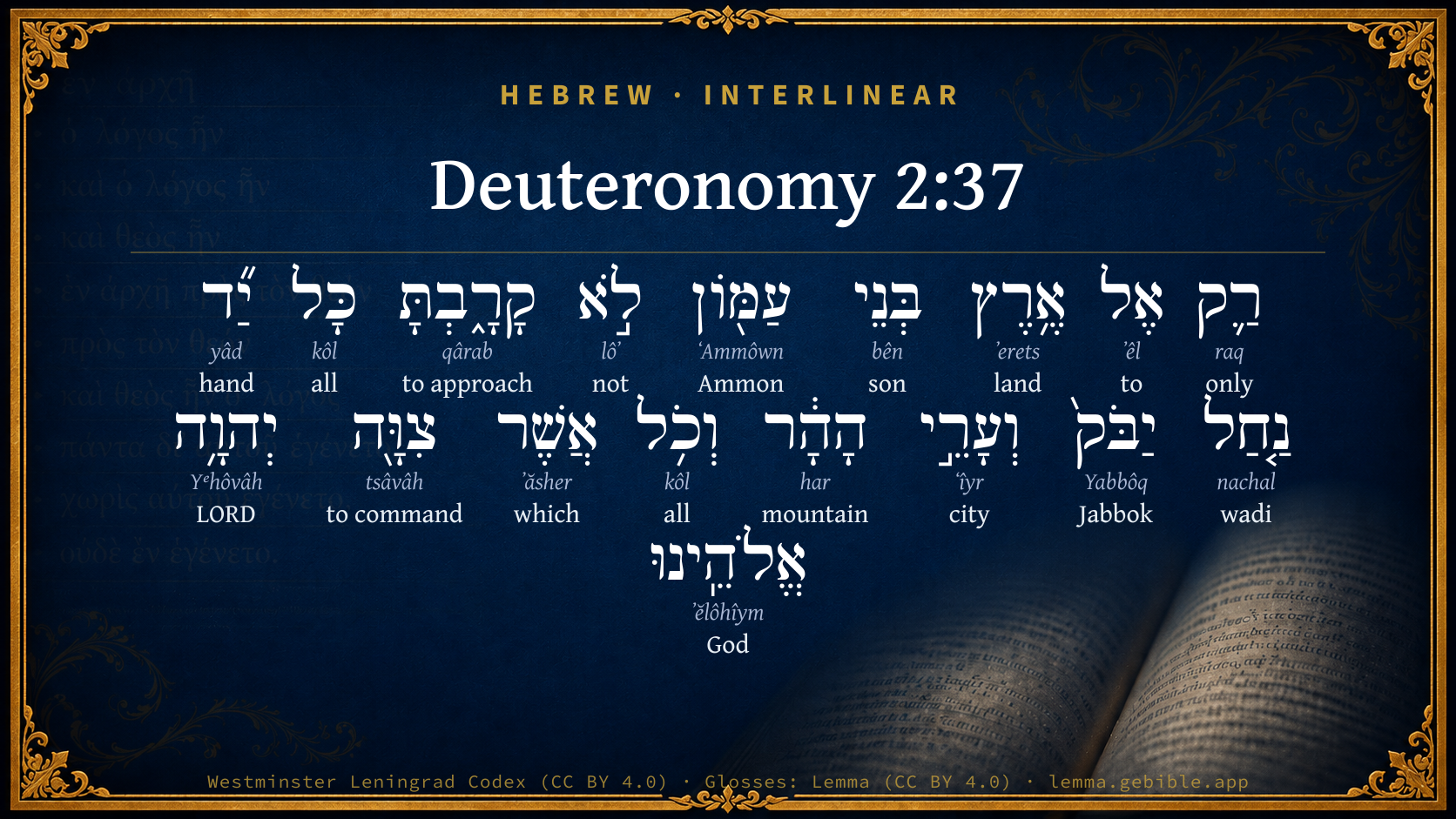
Deuteronomy 2:37

Hebrew (Westminster Leningrad Codex) Deuteronomy 2:37 appears in the Hebrew Old Testament. The text above is from the Westminster Leningrad Codex. Each word links to its Strong’s number, a concise gloss, and parsing drawn from the Open Scriptures Hebrew Bible morphology. Click any word for its full Brown-Driver-Briggs (BDB) entry.
Download image
Cite this verse

Deuteronomy 2:37 (World English Bible). Public Domain. Lemma interlinear Bible study tool, https://lemma.gebible.app/v/deuteronomy/2/37.

Show BibTeX & RIS
BibTeX
RIS
English Translation
only to the land of the children of Ammon you didn't come near; all the side of the river Jabbok, and the cities of the hill-country, and wherever Yahweh our God forbade us.
World English Bible · Public Domain
Download a study sheet

One document with this verse’s original text, its word-by-word gloss line, the meaning frame, cross-references with their text, attributed commentary, and full source and license credits — printable, and it pastes into notes with its structure intact.

This verse Autodidact and up

Study sheet (.html) Plain text (.txt)

A passage Seminary Student

Up to 50 verses in one chapter. A passage sheet keeps up to 6 commentary sources and 12 cross-references per verse, in the order this page ranks them, and says so on the sheet whenever that leaves anything out. Ask for a single verse and you get the Autodidact verse sheet above.

Everything on this page stays free to read, with no account — the sheet is a download of what is already on screen, not access to it.

Want to remove ads? Support Godless Engineer
Compare translations 3

The same verse in 3 English versions, stacked beneath the original-language interlinear above. Click any original word for its lexicon entry.

Each is an independent rendering of the whole verse — the interlinear is not word-aligned to these translations.

Highlighted words mark where these versions differ — a whole-verse word diff, not a word-by-word alignment.

  • World English Bible Public Domain
    only to the land of the children of Ammon you didn't come near; all the side of the river Jabbok, and the cities of the hill-country, and wherever Yahweh our God forbade us.
  • King James Version Public Domain
    Only unto the land of the children of Ammon thou camest not, nor unto any place of the river Jabbok, nor unto the cities in the mountains, nor unto whatsoever the LORD our God forbade us.
  • unfoldingWord Literal Text CC BY-SA 4.0
    only to the land of the sons of Ammon that you did not approach, all the hand of the wadi of Jabbok, and the cities of the hill, and all Yahweh our God had commanded.

unfoldingWord Literal Text — © unfoldingWord, licensed CC BY-SA 4.0. Word-aligned USFM3 via Door43 (git.door43.org/unfoldingWord/en_ult).

Versions to compare (up to 4)

3 of 4 selected

Show all 18 translations

Every available English version of this verse, each an independent rendering of the whole verse.

  • World English Bible Public Domain
    only to the land of the children of Ammon you didn't come near; all the side of the river Jabbok, and the cities of the hill-country, and wherever Yahweh our God forbade us.
  • Berean Standard Bible Public Domain
    But you did not go near the land of the Ammonites, or the land along the banks of the Jabbok River, or the cities of the hill country, or any place that the LORD our God had forbidden.
  • Majority Standard Bible Public Domain
    But you did not go near the land of the Ammonites, or the land along the banks of the Jabbok River, or the cities of the hill country, or any place that the LORD our God had forbidden.
  • King James Version Public Domain
    Only unto the land of the children of Ammon thou camest not, nor unto any place of the river Jabbok, nor unto the cities in the mountains, nor unto whatsoever the LORD our God forbade us.
  • American Standard Version (1901) Public Domain
    only to the land of the children of Ammon thou camest not near; all the side of the river Jabbok, and the cities of the hill-country, and wheresoever Jehovah our God forbade us.
  • Revised Version (1885) Public Domain
    only to the land of the children of Ammon thou camest not near; all the side of the river Jabbok, and the cities of the hill country, and wheresoever the LORD our God forbade us.
  • Geneva Bible (1599) Public Domain
    Onely vnto the land of the children of Ammon thou camest not, nor vnto any place of the riuer Iabbok, nor vnto the cities in the mountaines, nor vnto whatsoeuer the Lord our God forbade vs.
  • Douay-Rheims (1899) Public Domain
    Except the land of the children of Ammon, to which we approached not: and all that border upon the torrent Jeboc, and the cities in the mountains, and all the places which the Lord our God forbade us.
  • Young's Literal Translation Public Domain
    `Only, unto the land of the sons of Ammon thou hast not drawn near, any part of the brook Jabbok, and cities of the hill-country, and anything which Jehovah our God hath `not' commanded.
  • Literal Standard Version CC BY-SA 4.0
    Only, you have not drawn near to the land of the sons of Ammon—any part of the Brook of Jabbok, and cities of the hill-country, and anything which our God YHWH has [not] commanded.”
  • Unlocked Literal Bible CC BY-SA 4.0
    It was only to the land of the descendants of Ammon that you did not go, as well as all the side of the Jabbok River, and the cities of the hill country—wherever Yahweh our God had forbidden us to go.
  • unfoldingWord Literal Text CC BY-SA 4.0
    only to the land of the sons of Ammon that you did not approach, all the hand of the wadi of Jabbok, and the cities of the hill, and all Yahweh our God had commanded.
  • Darby Bible Public Domain
    Only thou didst not approach the land of the children of Ammon, the whole border of the river Jabbok, nor the cities of the mountain, nor to whatsoever Jehovah our God had forbidden us.
  • World Messianic Bible Public Domain
    Only to the land of the children of Ammon you didn’t come near: all the banks of the river Jabbok, and the cities of the hill country, and wherever the LORD our God forbade us.
  • Webster's Bible Public Domain
    Only to the land of the children of Ammon thou camest not, nor to any place of the river Jabbok, nor to the cities on the mountains, nor to whatever the LORD our God forbad us.
  • Free Bible Version CC BY-SA 4.0
    But you didn't go anywhere near the country of the Ammonites—the area that borders the Jabbok River or the towns of the hill country, or any other place that the Lord our God had placed off limits.
  • Bible in Basic English Public Domain
    But you did not go near the land of the children of Ammon, that is, all the side of the river Jabbok or the towns of the hill-country, wherever the Lord our God had said we were not to go.
  • JPS Tanakh (1917) Public Domain
    Only to the land of the children of Ammon thou camest not near; all the side of the river Jabbok, and the cities of the hill-country, and wheresoever the LORD our God forbade us.

Literal Standard Version (2020), Covenant Press — licensed CC BY-SA 4.0. Text via the HelloAO Bible API (eBible.org). Unlocked Literal Bible (unfoldingWord) — licensed CC BY-SA 4.0. Text via the HelloAO Bible API (eBible.org). unfoldingWord Literal Text — © unfoldingWord, licensed CC BY-SA 4.0. Word-aligned USFM3 via Door43 (git.door43.org/unfoldingWord/en_ult). Free Bible Version, Dr. Jonathan Gallagher — licensed CC BY-SA 4.0. Text via the HelloAO Bible API (eBible.org).

Word by word

More ways to search: Search by grammar → Find every occurrence → Compare this word →

Practice this passage: Drill this verse → Learn its vocabulary →

יַבֹּק֙
Yabbôq
H2999
“Jabbok”
Noun, Proper
Part of Speech
Noun
Type
Proper
Full BDB Definition

Origin: probably from H1238

TWOT: None

Jabbok = "emptying" - a stream which intersects the mountain range of Gilead, and falls into the Jordan on the east about midway between the Sea of Galilee and the Dead Sea
  1. רַ֛ק raq H7535 “only” Particle, Accusative
  2. אֶל ʼêl H413 “to” Preposition
  3. אֶ֥רֶץ ʼerets H776 “land of” Noun, Common, Both, Singular, Construct
  4. בְּנֵי bên H1121 “sons of” Noun, Common, Masculine, Plural, Construct
  5. עַמּ֖וֹן ʻAmmôwn H5983 “Ammon” Noun, Proper
  6. לֹ֣א lôʼ H3808 “not” Particle, Negative
  7. קָרָ֑בְתָּ qârab H7126 “to approach” Verb, Qal, Perfect, 2nd Person, Masculine, Singular
  8. כָּל kôl H3605 “all of” Noun, Common, Masculine, Singular, Construct
  9. יַ֞ד yâd H3027 “hand of” Noun, Common, Both, Singular, Construct
  10. נַ֤חַל nachal H5158 “wadi of” Noun, Common, Masculine, Singular, Construct
  11. וְעָרֵ֣י ʻîyr H5892 “and · cities of” Conjunction + Noun, Common, Feminine, Plural, Construct
  12. הָהָ֔ר har H2022 “the · mountain” Particle, Definite Article + Noun, Common, Masculine, Singular, Absolute
  13. וְכֹ֥ל kôl H3605 “and · all” Conjunction + Noun, Common, Masculine, Singular, Absolute
  14. אֲשֶׁר ʼăsher H834 “which” Particle, Relative
  15. צִוָּ֖ה tsâvâh H6680 “to command” Verb, Piel, Perfect, 3rd Person, Masculine, Singular
  16. יְהוָ֥ה Yᵉhôvâh H3068 “LORD” Noun, Proper
  17. אֱלֹהֵֽינוּ ʼĕlôhîym H430 “God(s) · our” Noun, Common, Masculine, Plural, Construct + Suffix, Personal, 1st Person, Common, Plural

About this verse

These counts appear in no published source. They are computed here, from the morphology-tagged text and Lemma’s own curated glosses. What Lemma adds →

18
words
17
distinct lemmas
Pentateuch
section

Notable vocabulary

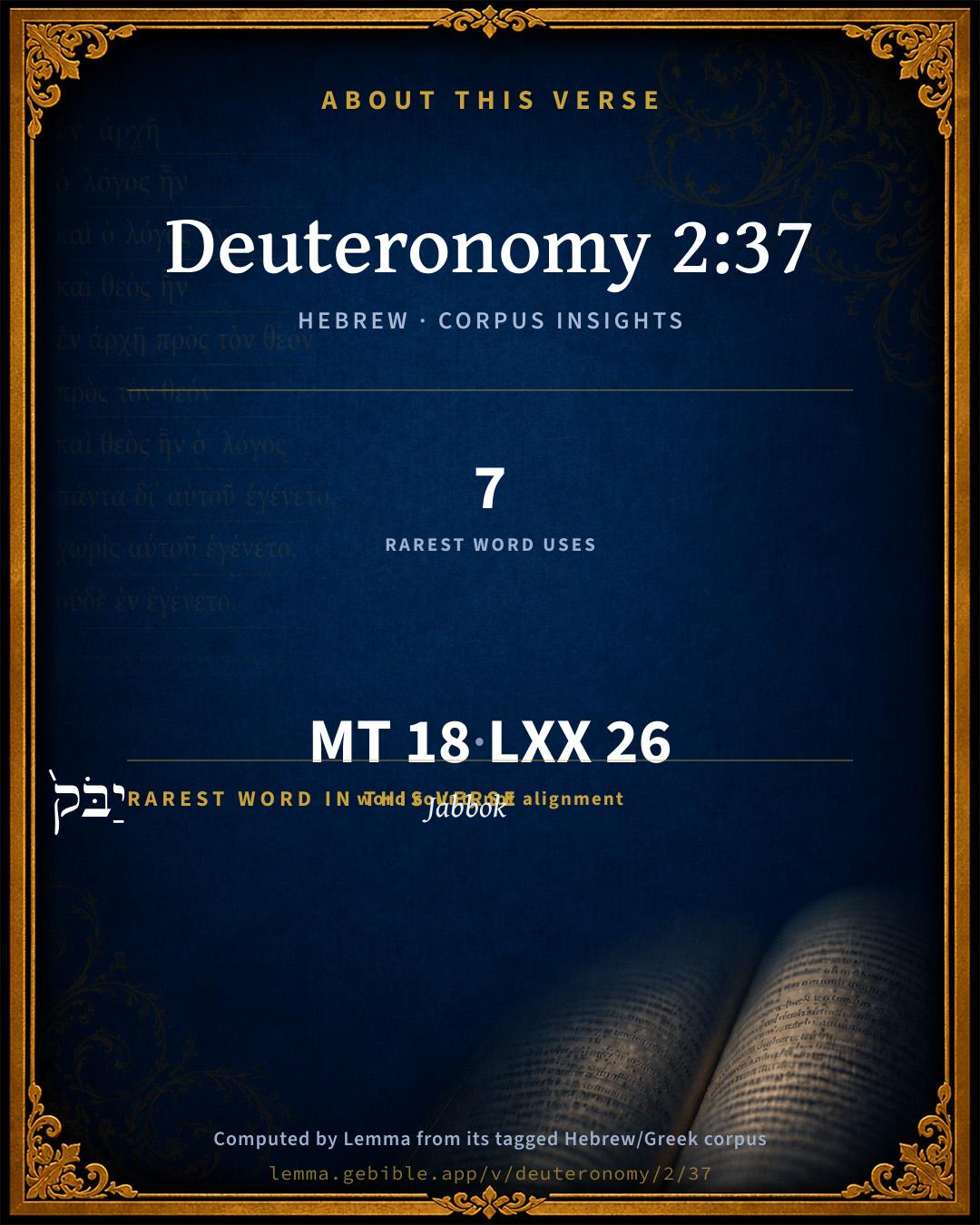
The rarest word here is יַבֹּק֙ Jabbok H2999 — appearing just 7 times in the whole Hebrew Bible.

Shared distinctive vocabulary

יַבֹּק֙ Jabbok H2999 occurs in 7 verses of the Hebrew Bible. Also found in:

Grammatical profile

  • 2 verbs
  • 12 nouns
  • 1 preposition
  • 3 particles

Verb forms

  • קָרָ֑בְתָּ Qal · Perfect
  • צִוָּ֖ה Piel · Perfect

Repetition

A word recurs within this verse — often emphatic in Hebrew:

Hebrew & Septuagint length

In English translation the verse runs 33 words from the Hebrew and 34 from the Septuagint (LXX English) — closely comparable.

A rough comparison of the two English renderings, which tokenize alike — not a word-level alignment.

Word counts can differ between the Hebrew and the Greek without any difference in meaning — e.g. the Hebrew direct-object marker אֵת has no separate Greek word, and Greek often adds the article ὁ.

In the original languages it is 18 Hebrew tokens and 26 Greek tokens — but the two are counted differently (Hebrew bundles its prefixes and suffixes into one token; the Greek is in lemma form), so that isn’t a like-for-like length.

Cross-references

8

Topical passages linked to Deuteronomy 2:37 in the Treasury of Scripture Knowledge — connected by theme and wording, ordered by reader-vote popularity; previews shown in the World English Bible.

  • Genesis 32:22 He rose up that night, and took his two wives, and his two handmaids, and his eleven sons, and passed over the ford of the Jabbok.
  • Numbers 21:24 Israel struck him with the edge of the sword, and possessed his land from the Arnon to the Jabbok, even to the children of Ammon; for the border of the children of Ammon was strong.
  • Deuteronomy 3:16 To the Reubenites and to the Gadites I gave from Gilead even to the valley of the Arnon, the middle of the valley, and the border [of it], even to the river Jabbok, which is the border of the children of Ammon;
  • Deuteronomy 2:19 and when you come near over against the children of Ammon, don't bother them, nor contend with them; for I will not give you of the land of the children of Ammon for a possession; because I have given it to the children of Lot for a possession.
  • Joshua 12:2 Sihon king of the Amorites, who lived in Heshbon, and ruled from Aroer, which is on the edge of the valley of the Arnon, and [the city that is in] the middle of the valley, and half Gilead, even to the river Jabbok, the border of the children of Ammon;
  • Deuteronomy 2:5 don't contend with them; for I will not give you of their land, no, not so much as for the sole of the foot to tread on; because I have given Mount Seir to Esau for a possession.
  • Deuteronomy 2:9 Yahweh said to me, Don't bother Moab, neither contend with them in battle; for I will not give you of his land for a possession; because I have given Ar to the children of Lot for a possession.
  • Judges 11:15 and he said to him, Thus says Jephthah: Israel didn't take away the land of Moab, nor the land of the children of Ammon,

Cross-references courtesy of OpenBible.info (CC BY 4.0).

Hebrew and Greek witnesses Masoretic Hebrew ↔ Greek Septuagint

The same verse in the two great witnesses to the Old Testament, shown verse-for-verse.

These are two independent witnesses, not word-aligned to each other, and the Septuagint is shown in lemma (dictionary) form.

Hebrew Deuteronomy 2:37 Masoretic · Westminster Leningrad Codex

רַ֛ק אֶל אֶ֥רֶץ בְּנֵי עַמּ֖וֹן לֹ֣א קָרָ֑בְתָּ כָּל יַ֞ד נַ֤חַל יַבֹּק֙ וְעָרֵ֣י הָהָ֔ר וְכֹ֥ל אֲשֶׁר צִוָּ֖ה יְהוָ֥ה אֱלֹהֵֽינוּ

only to the land of the children of Ammon you didn't come near; all the side of the river Jabbok, and the cities of the hill-country, and wherever Yahweh our God forbade us.

World English Bible · Public Domain

Greek LXX Deuteronomy 2:37 Septuagint · lemma form

πλήν εἰς γῆ υἱός αμμων οὐ προςἔρχομαι πᾶς ὁ συνκυρόω χειμάρρους ιαβοκ καί ὁ πόλις ὁ ἐν ὁ ὀρεινή καθότι ἐντέλλομαι ἐγώ κύριος ὁ θεός ἐγώ

Only we did not draw near to the children of Amman, even all the parts bordering on the brook Jaboc, and the cities in the mountain country, as the Lord our God charged us.

LXX2012 (modern English Septuagint) · Public Domain

On this verse, The Cambridge Bible for Schools and Colleges discusses the Septuagint’s reading. Read the note in Commentary ↓

Hebrew: Westminster Leningrad Codex (CC BY 4.0). Greek: Septuagint (public domain); English from LXX2012 (modern English Septuagint) (Public Domain). How the Septuagint differs from the Hebrew →

Targum (Aramaic paraphrase)

2

The Targum is the ancient Jewish Aramaic paraphrase of the Hebrew Scriptures — an interpretive translation, not the Hebrew text itself. Onkelos (literal) and Pseudo-Jonathan (expansive) render the Torah, and Jonathan the Prophets. Coverage is partial: where no permissively-licensed English translation exists for a verse, only the Aramaic is shown. This is verse-level text, not a word-by-word alignment to the Hebrew.

  1. Targum Onkelos Torah (Genesis–Deuteronomy)
    לְחוֹד לְאַרְעָא בְנֵי עַמוֹן לָא קְרֶבְתָּא כָּל כֵּיף נַחֲלָא יוּבְקָא וְקִרְוֵי טוּרָא וְכֹל דִי פַקִיד יְיָ אֱלָהָנָא

    (no public-domain English translation for this verse)

    Targum Onkelos — Aramaic: “Onkelos Genesis” (public domain); “Onkelos Exodus” (public domain); “Onkelos Leviticus” (public domain); “Onkelos Numbers” (public domain); “Onkelos Deuteronomy” (public domain). English: “Sefaria Community Translation” (CC0 1.0 (public-domain dedication)); “J.W. Etheridge. The Targums of Onkelos and Jonathan Ben Uzziel on the Pentateuch. London: Longmans, Green, 1862” (public domain). Text via Sefaria.

  2. Targum Pseudo-Jonathan Torah (Genesis–Deuteronomy)
    לְחוֹד לְאַרַע בְּנֵי עַמּוֹן לָא קָרֵבְתָּא כָּל אֲתַר נַחֲלָא יוּבְקָא וְקִרְוֵי טַוְורָא כְּכָל מַה דְּפַקֵּיד יְיָ אֱלָהָנָא

    Only to the land of the children of Ammon we went not nigh, nor to any place on the river Jobeka, nor to the cities of the mountain, according to all that the Lord our God had commanded us.

    Targum Pseudo-Jonathan — Aramaic: “Targum Jonathan on Genesis” (public domain); “Targum Jonathan on Exodus” (public domain); “Targum Jonathan on Leviticus” (public domain); “Targum Jonathan on Numbers” (public domain); “Targum Jonathan on Deuteronomy” (public domain). English: “The Targum of Jonathan ben Uzziel, trans. J. W. Etheridge, London, 1862” (public domain). Text via Sefaria.

Commentary

Notes on Deuteronomy 2:37 from classic Christian and Jewish commentators (each source and its license shown beneath its notes). The classic Christian expositions comment on the surrounding passage and are grouped to its opening verse, so a note may address several verses; the Jewish commentaries on the Tanakh (Rashi and others) are per-verse, so they appear only where the commentator wrote on this verse.

Lemma curates 59 commentaries, every one of them public domain or Creative Commons licensed, each selected and text-cleaned for this edition rather than reprinted as found. About our sources →

Trapp's Complete Commentary

John Trapp

Deu 2:37 Only unto the land of the children of Ammon thou camest not, [nor] unto any place of the river Jabbok, nor unto the cities in the mountains, nor unto whatsoever the LORD our God forbad us.

Ver. 37. Only unto the land.] This kindness these Ammonites, in after ages, very evil requited, {Amo 1:13 Jer 49:1} dealing by them as that monster Michael Balbus dealt by the Emperor Leo Armenius, whom he slew the same night that this prince had pardoned and released him.

John Trapp, A Commentary or Exposition upon All the Books of the Old and New Testament (1647–1656) — public domain. Text from a community e-Sword module.

Joseph Benson's Commentary

Deu 2:37. Of Jabbok — That is, beyond Jabbok; for that was the border of the Ammonites.

Joseph Benson's Commentary on the Old and New Testaments (1811–1818) — public domain. Text from a community e-Sword module.

Tyndale Open Study Notes

Tyndale Open Resources

2:37 Like the Moabites, the Ammonites were related to Israel and were thus to be left undisturbed (cp. 2:9). • The Jabbok River, a great tributary of the Jordan River, marked the border between Gilead to the north and the Amorite kingdom of Sihon to the south. The Ammonites lived east and south of the Jabbok (2:19). It was somewhere at the Jabbok that Jacob wrestled with the stranger at night (Gen 32:22-32).

Tyndale Open Study Notes — © Tyndale Open Resources, licensed CC BY-SA 4.0. Text via the HelloAO Bible API.

Geneva Bible (1599)

Geneva Bible translators

Or, ford.

Geneva Bible (1599) marginal notes — public domain. Text via Bolls.life.

Adam Clarke's Commentary

Verse 37. Only unto the land of the children of Ammon thou camest not] God gave them their commission; and those only were to be cut off, the cup of whose iniquity was full. Though the Moabites and Ammonites were thus spared, they requited good with evil, for they fought against the Israelites, and cast them out of their possessions, Jdg 11:4-5; 2Ch 20:1, c., and committed the most shocking cruelties see Am 1:13. Hence God enacted a law, that none of these people should enter into the congregation of the Lord even to their tenth generation: see De 23:3-6.

Adam Clarke's Commentary on the Bible (1810–1826) — public domain. Text from a community e-Sword/MySword module.

The Cambridge Bible for Schools and Colleges

gen. ed. J. J. S. Perowne

37. Change to the Sg. address. This, with the fact that the clause is a mere qualification not necessary to the context, has led some to take it for a later addition.

all the side of the river Jabboḳ, and the cities of the hill country] This defines the land of ‘Ammôn, which lay at that time on the upper stretch of Jabboḳ, where the stream runs from S.W. to N.E. before turning in its main course W. to Jordan; cp. JE, Num_21:24. The country there is hilly in contrast with the Mo‘ab plateau.

and wheresoever] So Sam.; LXX according to all that.

forbad us] Rather commanded us: suitable to the preceding reading of the LXX. Us is wanting in Heb. but is given by Sam. and LXX.

The Cambridge Bible for Schools and Colleges (gen. ed. J. J. S. Perowne; Cambridge University Press, 1878–1918) — public domain. Text from a community e-Sword module.

John Gill's Exposition

Only unto the land of the children of Ammon thou camest not,.... Which was then in their possession; otherwise what Sihon had took away from them, that the children of Israel came into and enjoyed, as before observed, Deu 2:19.

nor unto any place of the river Jabbok; any town or city situated on this river, which was the border of the children of Ammon, Deu 3:16; see Gill on Gen 32:22,

nor unto the cities in the mountains; much less did they penetrate into the innermost parts of their country, the mountainous part thereof, and the cities there:

nor unto whatsoever the Lord our God forbad us: whether in Edom, Moab, or Ammon, particularly the latter, of which he is more especially and peculiarly speaking.

Next: Deuteronomy Chapter 3

John Gill's Exposition of the Whole Bible (1746–1763) — public domain (CC PDM 1.0). Text via the HelloAO Bible API.

Haydock's Catholic Bible Commentary

Jeboc, towards its source: for both sides of the torrent were taken by the Hebrews from the kings Sehon and Og, who had already driven the Ammonites farther into the mountains, on the east. (Haydock) --- When these demanded the conquered country to be restored to them, Jephte shewed that their claim was inadmissible, Judges i. 13. (Calmet) --- They had lost possession when the Hebrews came; and, as God had authorized the latter to take the land from those kings, without enquiring who were the former proprietors, the Ammonites, who had themselves expelled the Zomzommim, came with a very bad grace to assert their title, after a lapse of near 300 years. God only forbids the Hebrews to molest the actual dominions of the sons of Ammon, Moab, and Esau, in consideration of their fathers, to whom they were so nearly related. (Haydock)

George Leo Haydock (1774–1849), Haydock's Catholic Family Bible and Commentary, 1859 edition — public domain. Excludes Psalms (Douay-Rheims chapter numbering differs from Protestant) and Deuterocanonical books (Catholic canon only).

Matthew Poole's English Annotations

Of the river Jabbok, i.e. beyond Jabbok; for that was the border of the Ammonites, Jos 12:2.

Object. Half the land of the Ammonites is said to be given to the tribe of Gad, Jos 13:25.

Answ. This is true of that half of it which the Amorites had taken from them, but not of the other half, which yet was in the possession of the Ammonites.

In the mountains; the mountainous country of the Ammonites.

Forbad us, Heb. commanded us: commanding is put for forbidding here, as Gen 2:16; 3:11; Lev 4:2; Deu 4:23. The words may be thus rendered, concerning

which the Lord gave us command or charge, to wit, that we should not meddle with them, as was said before. So it is only an ellipsis of the preposition, which is very frequent.

Matthew Poole's English Annotations on the Holy Bible (1683–1685) — public domain. Text from a community e-Sword/MySword module.

The Pulpit Commentary

In obedience to the Divine injunction, the Israelites left untouched the country of the Ammonites, situated on the eastern side of the Upper Jabbok. Cities in the mountains; the towns in the Ammonitish highlands. in Jos_13:25, half of the laud of the Ammonites is said to be assigned to the tribe of Gad; but that refers to the part of the land between the Arnon and the Jabbek, which had been taken from the Ammonites by the Amorites, and was in the possession of the latter at the time of the Israelitish invasion. (Jud_1:11:13, etc.) Whatsoever the Lord our God forbad us: Finally, all that Jehovah our God commanded not to come into.

The Pulpit Commentary (1880–1919), ed. H.D.M. Spence-Jones & Joseph S. Exell — public domain. Text from a community e-Sword module.

John Wesley's Explanatory Notes

Of Jabbok - That is, beyond Jabbok: for that was the border of the Ammomites.

John Wesley, Explanatory Notes Upon the Whole Bible (1754–1765) — public domain. Text via the GEBible commentary corpus.

Rashi

Rabbi Shlomo Yitzchaki (Rashi)

כל יד נחל יבק means, ALL THE DISTRICT BESIDE THE BROOK OF JABBOK.

וכל אשר צוה ה' אלהינו לנו — This means, AND ALL WHICH THE LORD OUR GOD COMMANDED US not to capture, we left.

Rashi on the Tanakh — English translations: “The Judaica Press complete Tanach with Rashi, translated by A. J. Rosenberg” (CC BY 4.0); “Pentateuch with Rashi's commentary by M. Rosenbaum and A.M. Silbermann, 1929-1934” (public domain); “The Metsudah Tanach series, Lakewood, N.J” (CC BY 4.0); and “The Book of Joshua, Metsudah Publications, 1997” (CC BY 4.0). Text via Sefaria.

Lesson kit

Teaching starters — assembled from the data on this page, not authored interpretation. Every prompt links to the verse data it draws on. Edit before teaching.

Deuteronomy, in the Pentateuch, opens this verse with 18 words (17 distinct Hebrew lemmas). Its most distinctive word is Yabbôq (“Jabbok”). A historical commentator’s framing appears above. Read the whole chapter for the surrounding context.

Discussion questions

  1. The word Yabbôq carries the sense “Jabbok.” How does it shape the verse?
  2. How does Genesis 32:22, which shares the word «Jabbok», read alongside this verse?
  3. What does the repetition of “all” (2× in this one verse) do in this verse?
  4. These translations render this verse differently; the difference is in the English rendering, not the original. What questions does that raise?
  5. «קָרָ֑בְתָּ» is a Qal Perfect verb. How does that grammatical form shape the action described?
  6. Compare how Trapp's Complete Commentary and Joseph Benson's Commentary read this verse. Where do they agree or differ?

Things to notice

Reading settings

Reading text

Shown beneath each verse's original-language words.

Old Testament
Old Testament edition

Read the OT as the Masoretic Hebrew (MT) or the Greek Septuagint (LXX).

English shown for the Greek Septuagint (in the Hebrew ↔ Greek comparison).

Comparing translations? Open the Compare panel on any verse page to stack up to four side by side.