Numbers 8:10

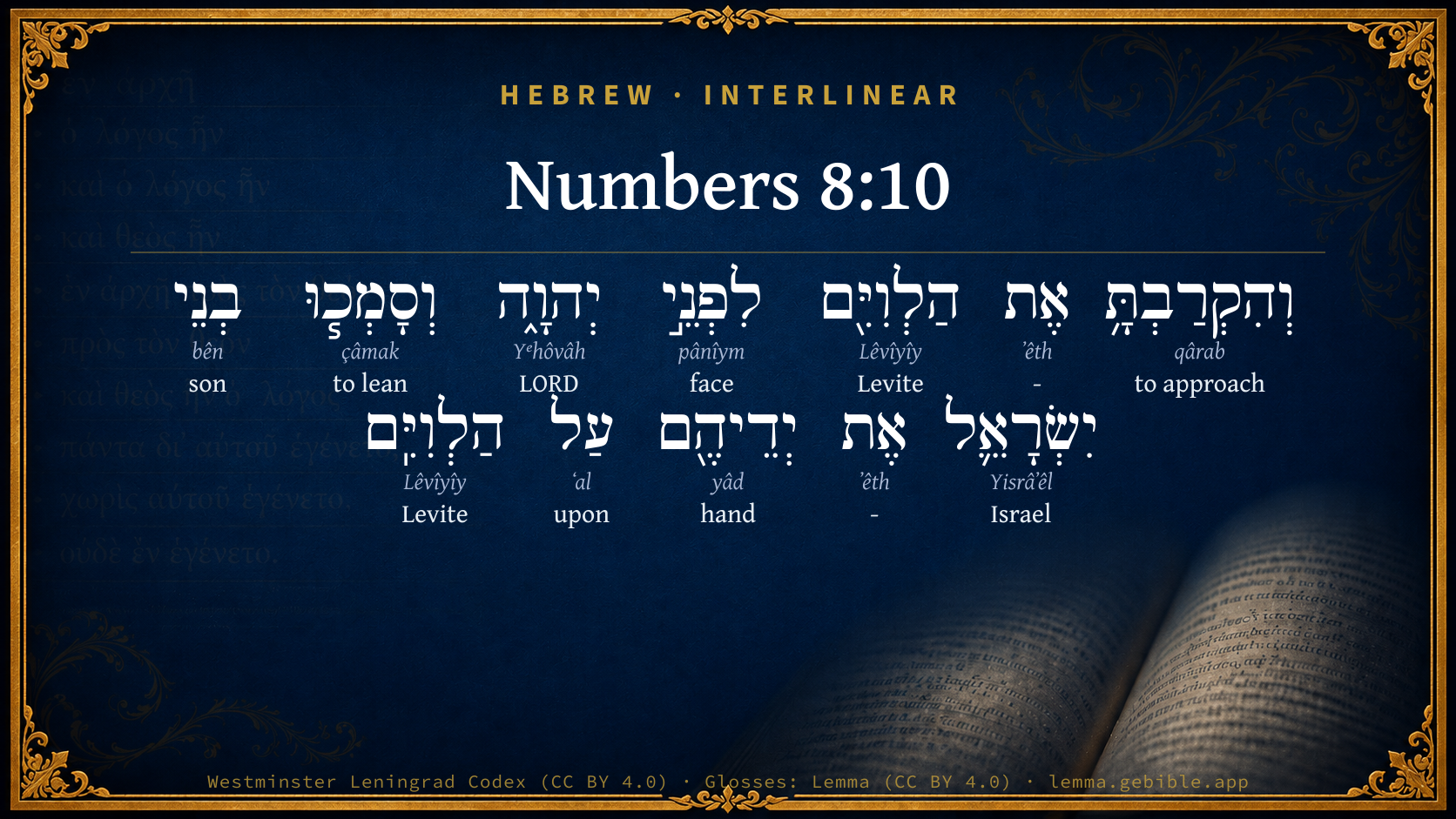
Hebrew (Westminster Leningrad Codex) Numbers 8:10 appears in the Hebrew Old Testament. The text above is from the Westminster Leningrad Codex. Each word links to its Strong’s number, a concise gloss, and parsing drawn from the Open Scriptures Hebrew Bible morphology. Click any word for its full Brown-Driver-Briggs (BDB) entry.
Download image
Cite this verse

Numbers 8:10 (World English Bible). Public Domain. Lemma interlinear Bible study tool, https://lemma.gebible.app/v/numbers/8/10.

Show BibTeX & RIS
BibTeX
RIS
English Translation
You shall present the Levites before Yahweh. The children of Israel shall lay their hands on the Levites,
World English Bible · Public Domain
Download a study sheet

One document with this verse’s original text, its word-by-word gloss line, the meaning frame, cross-references with their text, attributed commentary, and full source and license credits — printable, and it pastes into notes with its structure intact.

This verse Autodidact and up

Study sheet (.html) Plain text (.txt)

A passage Seminary Student

Up to 50 verses in one chapter. A passage sheet keeps up to 6 commentary sources and 12 cross-references per verse, in the order this page ranks them, and says so on the sheet whenever that leaves anything out. Ask for a single verse and you get the Autodidact verse sheet above.

Everything on this page stays free to read, with no account — the sheet is a download of what is already on screen, not access to it.

Want to remove ads? Support Godless Engineer
Compare translations 3

The same verse in 3 English versions, stacked beneath the original-language interlinear above. Click any original word for its lexicon entry.

Each is an independent rendering of the whole verse — the interlinear is not word-aligned to these translations.

Highlighted words mark where these versions differ — a whole-verse word diff, not a word-by-word alignment.

  • World English Bible Public Domain
    You shall present the Levites before Yahweh. The children of Israel shall lay their hands on the Levites,
  • King James Version Public Domain
    And thou shalt bring the Levites before the LORD: and the children of Israel shall put their hands upon the Levites:
  • unfoldingWord Literal Text CC BY-SA 4.0
    And you shall present the Levites to the face of Yahweh, and the sons of Israel shall lay their hands on the Levites.

unfoldingWord Literal Text — © unfoldingWord, licensed CC BY-SA 4.0. Word-aligned USFM3 via Door43 (git.door43.org/unfoldingWord/en_ult).

Versions to compare (up to 4)

3 of 4 selected

Show all 18 translations

Every available English version of this verse, each an independent rendering of the whole verse.

  • World English Bible Public Domain
    You shall present the Levites before Yahweh. The children of Israel shall lay their hands on the Levites,
  • Berean Standard Bible Public Domain
    You are to present the Levites before the LORD and have the Israelites lay their hands upon them.
  • Majority Standard Bible Public Domain
    You are to present the Levites before the LORD and have the Israelites lay their hands upon them.
  • King James Version Public Domain
    And thou shalt bring the Levites before the LORD: and the children of Israel shall put their hands upon the Levites:
  • American Standard Version (1901) Public Domain
    and thou shalt present the Levites before Jehovah. And the children of Israel shall lay their hands upon the Levites:
  • Revised Version (1885) Public Domain
    and thou shalt present the Levites before the LORD: and the children of Israel shall lay their hands upon the Levites:
  • Geneva Bible (1599) Public Domain
    Thou shalt bring the Leuites also before the Lord, and the children of Israel shall put their handes vpon the Leuites.
  • Douay-Rheims (1899) Public Domain
    And when the Levites are before the Lord, the children of Israel shall put their hands upon them:
  • Young's Literal Translation Public Domain
    and thou hast brought near the Levites before Jehovah, and the sons of Israel have laid their hands on the Levites,
  • Literal Standard Version CC BY-SA 4.0
    and you have brought the Levites near before YHWH, and the sons of Israel have laid their hands on the Levites,
  • Unlocked Literal Bible CC BY-SA 4.0
    When you bring the Levites before Yahweh, the people of Israel must lay their hands on the Levites.
  • unfoldingWord Literal Text CC BY-SA 4.0
    And you shall present the Levites to the face of Yahweh, and the sons of Israel shall lay their hands on the Levites.
  • Darby Bible Public Domain
    And thou shalt bring the Levites before Jehovah; and the children of Israel shall put their hands upon the Levites.
  • World Messianic Bible Public Domain
    You shall present the Levites before the LORD. The children of Israel shall lay their hands on the Levites,
  • Webster's Bible Public Domain
    And thou shalt bring the Levites before the LORD: and the children of Israel shall put their hands upon the Levites:
  • Free Bible Version CC BY-SA 4.0
    When you bring the Levites to the Lord the Israelites are to place their hands upon them.
  • Bible in Basic English Public Domain
    And you are to take the Levites before the Lord: and the children of Israel are to put their hands on them:
  • JPS Tanakh (1917) Public Domain
    And thou shalt present the Levites before the LORD; and the children of Israel shall lay their hands upon the Levites.

Literal Standard Version (2020), Covenant Press — licensed CC BY-SA 4.0. Text via the HelloAO Bible API (eBible.org). Unlocked Literal Bible (unfoldingWord) — licensed CC BY-SA 4.0. Text via the HelloAO Bible API (eBible.org). unfoldingWord Literal Text — © unfoldingWord, licensed CC BY-SA 4.0. Word-aligned USFM3 via Door43 (git.door43.org/unfoldingWord/en_ult). Free Bible Version, Dr. Jonathan Gallagher — licensed CC BY-SA 4.0. Text via the HelloAO Bible API (eBible.org).

Word by word

More ways to search: Search by grammar → Find every occurrence → Compare this word →

Practice this passage: Drill this verse → Learn its vocabulary →

וְסָמְכ֧וּ
çâmak
H5564
“and · to lean”
Conjunction + Verb, Qal, Sequential Perfect, 3rd Person, Common, Plural
Part of Speech
Conjunction + Verb
Stem
Qal
Form
Sequential Perfect
Person
3rd Person
Gender
Common
Number
Plural
Full BDB Definition

Origin: a primitive root

TWOT: 1514

to lean, lay, rest, support, put, uphold, lean upon - (Qal) - to lean or lay upon, rest upon, lean against - to support, uphold, sustain - (Niphal) to support or brace oneself - (Piel) to sustain, refresh, revive
  1. וְהִקְרַבְתָּ֥ qârab H7126 “and · to approach” Conjunction + Verb, Hiphil, Sequential Perfect, 2nd Person, Masculine, Singular
  2. אֶת ʼêth H853 “-” Particle, Direct Object
  3. הַלְוִיִּ֖ם Lêvîyîy H3881 “the · Levites” Particle, Definite Article + Noun, Gentilic, Masculine, Plural, Absolute
  4. לִפְנֵ֣י pânîym H6440 “to/for · face(s) of” Preposition + Noun, Common, Both, Plural, Construct
  5. יְהוָ֑ה Yᵉhôvâh H3068 “LORD” Noun, Proper
  6. בְנֵי bên H1121 “sons of” Noun, Common, Masculine, Plural, Construct
  7. יִשְׂרָאֵ֛ל Yisrâʼêl H3478 “Israel” Noun, Proper
  8. אֶת ʼêth H853 “-” Particle, Direct Object
  9. יְדֵיהֶ֖ם yâd H3027 “hands · their” Noun, Common, Both, Dual, Construct + Suffix, Personal, 3rd Person, Masculine, Plural
  10. עַל ʻal H5921 “upon” Preposition
  11. הַלְוִיִּֽם Lêvîyîy H3881 “the · Levites” Particle, Definite Article + Noun, Gentilic, Masculine, Plural, Absolute

About this verse

These counts appear in no published source. They are computed here, from the morphology-tagged text and Lemma’s own curated glosses. What Lemma adds →

12
words
10
distinct lemmas
Pentateuch
section

Shared distinctive vocabulary

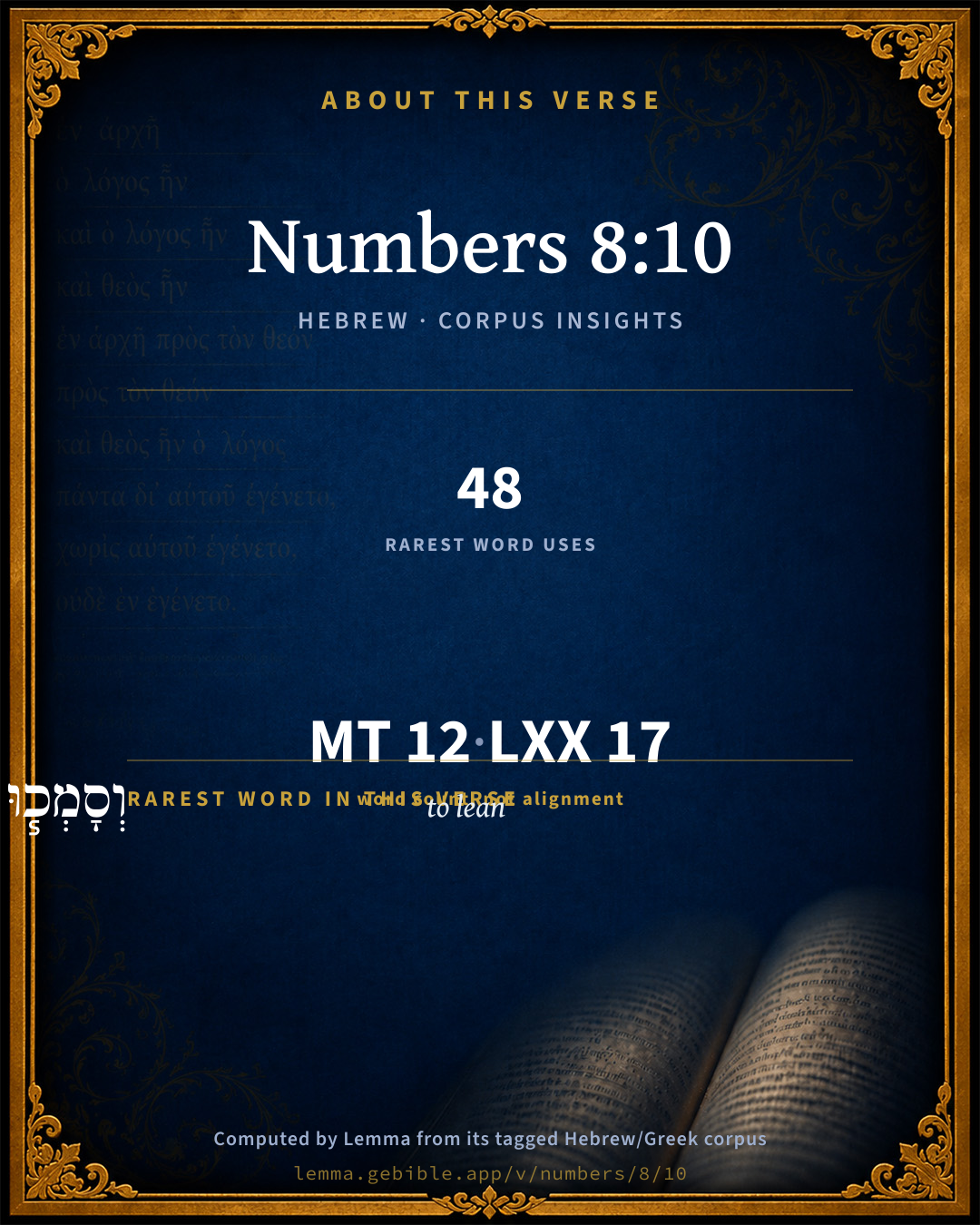
וְסָמְכ֧וּ to lean H5564 occurs in 47 verses of the Hebrew Bible. Also found in:

Grammatical profile

  • 2 verbs
  • 7 nouns
  • 1 preposition
  • 2 particles

Verb forms

  • וְהִקְרַבְתָּ֥ Hiphil · Sequential Perfect
  • וְסָמְכ֧וּ Qal · Sequential Perfect

Repetition

A word recurs within this verse — often emphatic in Hebrew:

  • הַלְוִיִּ֖ם Levite H3881 ×2

Hebrew & Septuagint length

In English translation the verse runs 18 words from the Hebrew and 21 from the Septuagint (LXX English) — closely comparable.

A rough comparison of the two English renderings, which tokenize alike — not a word-level alignment.

Word counts can differ between the Hebrew and the Greek without any difference in meaning — e.g. the Hebrew direct-object marker אֵת has no separate Greek word, and Greek often adds the article ὁ.

In the original languages it is 12 Hebrew tokens and 17 Greek tokens — but the two are counted differently (Hebrew bundles its prefixes and suffixes into one token; the Greek is in lemma form), so that isn’t a like-for-like length.

Cross-references

6

Topical passages linked to Numbers 8:10 in the Treasury of Scripture Knowledge — connected by theme and wording, ordered by reader-vote popularity; previews shown in the World English Bible.

  • Leviticus 1:4 He shall lay his hand on the head of the burnt offering, and it shall be accepted for him to make atonement for him.
  • Acts 6:6 whom they set before the apostles. When they had prayed, they laid their hands on them.
  • Numbers 3:45 "Take the Levites instead of all the firstborn among the children of Israel, and the cattle of the Levites instead of their cattle; and the Levites shall be mine. I am Yahweh.
  • Acts 13:2–3 As they served the Lord and fasted, the Holy Spirit said, "Separate Barnabas and Saul for me, for the work to which I have called them."
  • 1 Timothy 4:14 Don't neglect the gift that is in you, which was given to you by prophecy, with the laying on of the hands of the elders.
  • 1 Timothy 5:22 Lay hands hastily on no one, neither be a participant in other men's sins. Keep yourself pure.

Cross-references courtesy of OpenBible.info (CC BY 4.0).

Hebrew and Greek witnesses Masoretic Hebrew ↔ Greek Septuagint

The same verse in the two great witnesses to the Old Testament, shown verse-for-verse.

These are two independent witnesses, not word-aligned to each other, and the Septuagint is shown in lemma (dictionary) form.

Hebrew Numbers 8:10 Masoretic · Westminster Leningrad Codex

וְהִקְרַבְתָּ֥ אֶת הַלְוִיִּ֖ם לִפְנֵ֣י יְהוָ֑ה וְסָמְכ֧וּ בְנֵי יִשְׂרָאֵ֛ל אֶת יְדֵיהֶ֖ם עַל הַלְוִיִּֽם

You shall present the Levites before Yahweh. The children of Israel shall lay their hands on the Levites,

World English Bible · Public Domain

Greek LXX Numbers 8:10 Septuagint · lemma form

καί προςἄγω ὁ λευίτης ἔναντι κύριος καί ἐπιτίθημι ὁ υἱός ἰσραήλ ὁ χείρ αὐτός ἐπί ὁ λευίτης

And you shall bring the Levites before the Lord; and the sons of Israel shall lay their hands upon the Levites.

LXX2012 (modern English Septuagint) · Public Domain

Hebrew: Westminster Leningrad Codex (CC BY 4.0). Greek: Septuagint (public domain); English from LXX2012 (modern English Septuagint) (Public Domain). How the Septuagint differs from the Hebrew →

Targum (Aramaic paraphrase)

2

The Targum is the ancient Jewish Aramaic paraphrase of the Hebrew Scriptures — an interpretive translation, not the Hebrew text itself. Onkelos (literal) and Pseudo-Jonathan (expansive) render the Torah, and Jonathan the Prophets. Coverage is partial: where no permissively-licensed English translation exists for a verse, only the Aramaic is shown. This is verse-level text, not a word-by-word alignment to the Hebrew.

  1. Targum Onkelos Torah (Genesis–Deuteronomy)
    וּתְקָרֵב יָת לֵוָאֵי קֳדָם יְיָ וְיִסְמְכוּן בְּנֵי יִשְׂרָאֵל יָת יְדֵיהוֹן עַל לֵוָאֵי

    (no public-domain English translation for this verse)

    Targum Onkelos — Aramaic: “Onkelos Genesis” (public domain); “Onkelos Exodus” (public domain); “Onkelos Leviticus” (public domain); “Onkelos Numbers” (public domain); “Onkelos Deuteronomy” (public domain). English: “Sefaria Community Translation” (CC0 1.0 (public-domain dedication)); “J.W. Etheridge. The Targums of Onkelos and Jonathan Ben Uzziel on the Pentateuch. London: Longmans, Green, 1862” (public domain). Text via Sefaria.

  2. Targum Pseudo-Jonathan Torah (Genesis–Deuteronomy)
    וְתַקְרֵיב יַת לֵיוָאֵי קֳדָם יְיָ וְיִסְמְכוּן בְּנֵי יִשְרָאֵל יַת יְדֵיהוֹן עַל לֵיוָאֵי

    Thou shalt bring the Levites before the Lord, and the sons of Israel shall lay their hands upon the Levites.

    Targum Pseudo-Jonathan — Aramaic: “Targum Jonathan on Genesis” (public domain); “Targum Jonathan on Exodus” (public domain); “Targum Jonathan on Leviticus” (public domain); “Targum Jonathan on Numbers” (public domain); “Targum Jonathan on Deuteronomy” (public domain). English: “The Targum of Jonathan ben Uzziel, trans. J. W. Etheridge, London, 1862” (public domain). Text via Sefaria.

Commentary

Notes on Numbers 8:10 from classic Christian and Jewish commentators (each source and its license shown beneath its notes). The classic Christian expositions comment on the surrounding passage and are grouped to its opening verse, so a note may address several verses; the Jewish commentaries on the Tanakh (Rashi and others) are per-verse, so they appear only where the commentator wrote on this verse.

Lemma curates 59 commentaries, every one of them public domain or Creative Commons licensed, each selected and text-cleaned for this edition rather than reprinted as found. About our sources →

Trapp's Complete Commentary

John Trapp

Num 8:10 And thou shalt bring the Levites before the LORD: and the children of Israel shall put their hands upon the Levites:

Ver. 10. Shall put their hands.] Imposition of hands is an ancient rite at the ordination of ministers.

John Trapp, A Commentary or Exposition upon All the Books of the Old and New Testament (1647–1656) — public domain. Text from a community e-Sword module.

Joseph Benson's Commentary

Num 8:10. The children of Israel — Not all of them, which was impossible, but some in the name of all the princes or chiefs of each tribe, who used to transact things in the name of their tribes. Put their hands — Whereby they signified their transferring that right of ministering to God from the firstborn, in whose hands it formerly was, to the Levites, and their entire resignation and dedication of them to God’s service.

Joseph Benson's Commentary on the Old and New Testaments (1811–1818) — public domain. Text from a community e-Sword module.

Tyndale Open Study Notes

Tyndale Open Resources

8:10-11 By the laying on of hands, Israel recognized the Levites’ special status and offered them as their representatives before the Lord (8:16).

Tyndale Open Study Notes — © Tyndale Open Resources, licensed CC BY-SA 4.0. Text via the HelloAO Bible API.

Geneva Bible (1599)

Geneva Bible translators

Meaning, certain of them in the name of the whole.

Geneva Bible (1599) marginal notes — public domain. Text via Bolls.life.

Adam Clarke's Commentary

Verse 10. Shall put their hands upon the Levites] It has been argued from this that the congregation had a part in the appointment of their own ministers, and that this was done by the imposition of hands. However that may be, it appears that what was done on this occasion meant no more than that the people gave up this whole tribe to God in place of their firstborn; and that by this act they bound themselves to provide for them who, because of their sacred service, could follow no secular work. And surely it was right, that they who served the altar should live by the altar. The ministers of God perform offices for the people which the people cannot perform for themselves; and nothing can be more reasonable than that the people should give them the necessaries and comforts of life while they are thus employed in their behalf.

Adam Clarke's Commentary on the Bible (1810–1826) — public domain. Text from a community e-Sword/MySword module.

Ellicott's Commentary for English Readers

(10) Shall put their hands upon the Levites.—The same phrase is here used as in Num_8:12, and elsewhere, of the offerer who was required to lay his hand upon the victim which he offered in sacrifice. By this symbolical act the obligation which rested upon the whole nation in regard to the dedication of the firstborn was transferred to the Levites, who were thenceforth to be dedicated to the service of the Lord, and given over to the priests as the representatives of the Lord.

A Bible Commentary for English Readers, edited by Charles John Ellicott (1878–1897) — public domain. Text from a community e-Sword module.

The Cambridge Bible for Schools and Colleges

gen. ed. J. J. S. Perowne

10. shall lay their hands] Through their representatives (Num_1:4-16), to indicate that the whole community offered the Levites as their gift. Cf. the same action in the case of the burnt-offering (Lev_1:4).

The Cambridge Bible for Schools and Colleges (gen. ed. J. J. S. Perowne; Cambridge University Press, 1878–1918) — public domain. Text from a community e-Sword module.

John Gill's Exposition

And thou shalt bring the Levites before the Lord,.... From the door of the tabernacle, to the altar of burnt offering, where the Lord was in some sense present to accept the sacrifices offered to him:

and the children of Israel shall put their hands upon the Levites; as were used to be put upon sacrifices, for the Levites were themselves offered for an offering of the children of Israel, as is expressed in Num 8:11; by which rite they signified that they voluntarily parted with them, and gave them up to the Lord, and transferred their service to them, in which they were to serve in their room and stead; these, according to some Jewish writers, were the firstborn of Israel that laid their hands on the Levites, a type of the general assembly and church of the firstborn; or rather the princes and heads of the tribes, who represented the whole body. Some think by this rite is signified the consent of the people in the designation and appointment of the ministers of the word to their work and office; but what in the New Testament seems to answer to this is, the laying of the hands of the presbytery on ministers of the word, Ti1 4:14.

John Gill's Exposition of the Whole Bible (1746–1763) — public domain (CC PDM 1.0). Text via the HelloAO Bible API.

Haydock's Catholic Bible Commentary

Upon them. Some of the princes performed this ceremony, to testify that they gave up the Levites to serve God, (ver. 15,) and would not be answerable, if they were guilty of any irreverence or neglect. (Calmet) --- They offered them as a sort of sacrifice for the people, (Menochius) and gave their approbation to them, setting them at liberty, ver. 14., and 20. (Du Hamel)

George Leo Haydock (1774–1849), Haydock's Catholic Family Bible and Commentary, 1859 edition — public domain. Excludes Psalms (Douay-Rheims chapter numbering differs from Protestant) and Deuterocanonical books (Catholic canon only).

Matthew Poole's English Annotations

The children of Israel; not all of them, which was impossible, but some in the name and stead, and by the appointment of all, to wit, either the first-born, or rather the princes or chiefs of each tribe, who used to transact things in the name of their tribes.

Put their hands upon the Levites; whereby they signified their transferring of that right of ministering to God from the first-born, in whose hands it formerly was, unto the Levites, and their renouncing of their interest in the Levites, from whom they might otherwise have expected help by their persons or purses, as they did from other tribes, in their common concernments, and their entire resignation and dedication of them to God’s service; as the person offering, by laying his hand upon the head of his sacrifice, Lev 1:4, signified his translation of his guilt upon the beast, and his dedication of it unto God.

Matthew Poole's English Annotations on the Holy Bible (1683–1685) — public domain. Text from a community e-Sword/MySword module.

The Pulpit Commentary

Before the Lord. As in Num_5:16, either near the brazen altar, or more probably before the entrance of the tabernacle. And the children of Israel shall put their hands upon the Levites. Presumably by means of their representatives, probably the tribe princes. This laying on of hands signified that the obligation to assist personally in the service of the sanctuary was transferred from the whole congregation to the Levites.

The Pulpit Commentary (1880–1919), ed. H.D.M. Spence-Jones & Joseph S. Exell — public domain. Text from a community e-Sword module.

John Wesley's Explanatory Notes

The children of Israel - Not all of them, which was impossible, but some in the name of all the princes or chiefs of each tribe, who used to transact things in the name of their tribes. Put their hands - Whereby they signified their transferring that right of ministering to God from the first-born in whose hands it formerly was, to the Levites, and their entire resignation and dedication of them to God's service.

John Wesley, Explanatory Notes Upon the Whole Bible (1754–1765) — public domain. Text via the GEBible commentary corpus.

Keil & Delitzsch

C. F. Keil & F. Delitzsch

After this the Levites were to come before Jehovah, i.e., in front of the altar; and the children of Israel, i.e., the tribe-princes in the name of the Israelites, were to lay their hands upon them, not merely "as a sign that they released them from the possession of the nation, and assigned them and handed them over to Jehovah" (Knobel), but in order that by this symbolical act they might transfer to the Levites the obligation resting upon the whole nation to serve the Lord in the persons of its first-born sons, and might present them to the Lord as representatives of the first-born of Israel, to serve Him as living sacrifices.

Keil & Delitzsch — Biblical Commentary on the Old Testament (1861–1891) — public domain (CC PDM 1.0). Text via the HelloAO Bible API. (Old Testament only.)

Lesson kit

Teaching starters — assembled from the data on this page, not authored interpretation. Every prompt links to the verse data it draws on. Edit before teaching.

Numbers, in the Pentateuch, opens this verse with 12 words (10 distinct Hebrew lemmas). Its most distinctive word is çâmak (“to lean”). A historical commentator’s framing appears above. Read the whole chapter for the surrounding context.

Discussion questions

  1. The word çâmak carries the sense “to lean.” How does it shape the verse?
  2. How does Genesis 27:37, which shares the word «to lean», read alongside this verse?
  3. What does the repetition of “Levite” (2× in this one verse) do in this verse?
  4. These translations render this verse differently; the difference is in the English rendering, not the original. What questions does that raise?
  5. «וְהִקְרַבְתָּ֥» is a Hiphil Sequential Perfect verb. How does that grammatical form shape the action described?
  6. Compare how Trapp's Complete Commentary and Joseph Benson's Commentary read this verse. Where do they agree or differ?

Things to notice

Reading settings

Reading text

Shown beneath each verse's original-language words.

Old Testament
Old Testament edition

Read the OT as the Masoretic Hebrew (MT) or the Greek Septuagint (LXX).

English shown for the Greek Septuagint (in the Hebrew ↔ Greek comparison).

Comparing translations? Open the Compare panel on any verse page to stack up to four side by side.