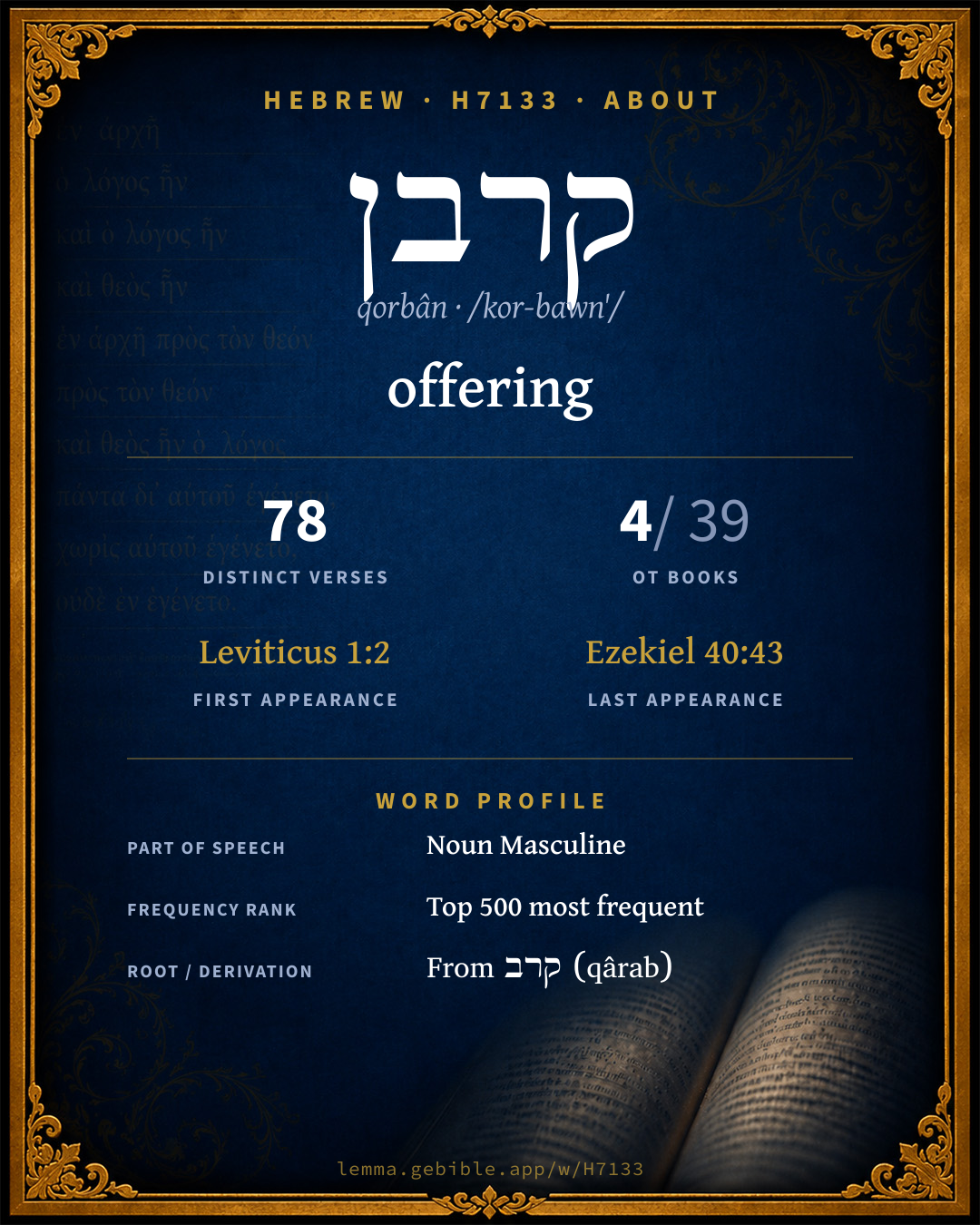
קרבן
offering
Full lexicon entry — Brown-Driver-Briggs (BDB)
From Brown-Driver-Briggs (BDB)
Where this word appears
See every Construct-state word in the Hebrew Bible →
Grammar key — what these labels mean
Part of speech
- Noun
- A naming word — a person, place, thing, or idea.
Noun type
- Common
- A common noun — a general class of person, place, or thing (“king,” “city,” “water”), not a specific name.
State
- Construct
- A noun bound to a following noun in a possessive / “of” relationship (the construct chain).
- Absolute
- The independent form of a noun, not bound to a following word.
Gender
- Masculine
- Grammatically masculine.
Number
- Singular
- One.
- Plural
- More than one (in Hebrew, generally three or more).
Grammatical forms
- Noun, Common, Masculine, Singular, Construct 75 times (91%)
- Noun, Common, Masculine, Singular, Absolute 6 times (7%)
- Noun, Common, Masculine, Plural, Construct 1 time (1%)
Parsed forms decoded from the imported morphology (morphhb / Westminster Leningrad Codex — WLC text public domain, morphhb tagging CC BY 4.0), counted across 82 parsed occurrences — not distinct verses.
Every verse where H7133 appears — 78 distinct verses across 4 books. Click any verse to open its interlinear word-by-word view. Verse text shown in the World English Bible for context — . Each verse’s Hebrew form is shown with its reference; the English is not keyword-highlighted, since the data carries no word-level English alignment. Use “Compare translations” on any verse to read it across multiple English versions. This concordance covers the Hebrew Bible; Septuagint (Greek Old Testament) occurrences are not indexed here.
Leviticus 36 verses
- Leviticus 1:2 קָרְבָּ֖ן קָרְבַּנְ/כֶֽם n c ms n c ms cs + sfx pers 2mp "Speak to the children of Israel, and tell them, 'When anyone of you offers an offering to Yahweh, you shall offer your offering of the cattle, from the herd and from the flock.
- Leviticus 1:3 קָרְבָּנ/וֹ֙ n c ms cs + sfx pers 3ms "'If his offering is a burnt offering from the herd, he shall offer a male without blemish. He shall offer it at the door of the Tent of Meeting, that he may be accepted before Yahweh.
- Leviticus 1:10 קָרְבָּנ֧/וֹ n c ms cs + sfx pers 3ms "'If his offering is from the flock, from the sheep, or from the goats, for a burnt offering, he shall offer a male without blemish.
- Leviticus 1:14 קָרְבָּנ֖/וֹ קָרְבָּנֽ/וֹ n c ms cs + sfx pers 3ms n c ms cs + sfx pers 3ms "'If his offering to Yahweh is a burnt offering of birds, then he shall offer his offering of turtledoves, or of young pigeons.
- Leviticus 2:1 קָרְבַּ֤ן קָרְבָּנ֑/וֹ n c ms cs n c ms cs + sfx pers 3ms "'When anyone offers an offering of a meal offering to Yahweh, his offering shall be of fine flour; and he shall pour oil on it, and put frankincense on it.
- Leviticus 2:4 קָרְבַּ֥ן n c ms cs "'When you offer an offering of a meal offering baked in the oven, it shall be unleavened cakes of fine flour mixed with oil, or unleavened wafers anointed with oil.
- Leviticus 2:5 קָרְבָּנֶ֑/ךָ n c ms cs + sfx pers 2ms If your offering is a meal offering of the baking pan, it shall be of unleavened fine flour, mixed with oil.
- Leviticus 2:7 קָרְבָּנֶ֑/ךָ n c ms cs + sfx pers 2ms If your offering is a meal offering of the frying pan, it shall be made of fine flour with oil.
- Leviticus 2:12 קָרְבַּ֥ן n c ms cs As an offering of firstfruits you shall offer them to Yahweh: but they shall not come up for a sweet savor on the altar.
- Leviticus 2:13 קָרְבַּ֣ן קָרְבָּנְ/ךָ֖ n c ms cs n c ms cs + sfx pers 2ms Every offering of your meal offering you shall season with salt; neither shall you allow the salt of the covenant of your God to be lacking from your meal offering. With all your offerings you shall offer salt.
- Leviticus 3:1 קָרְבָּנ֑/וֹ n c ms cs + sfx pers 3ms "'If his offering is a sacrifice of peace offerings; if he offers it from the herd, whether male or female, he shall offer it without blemish before Yahweh.
- Leviticus 3:2 קָרְבָּנ֔/וֹ n c ms cs + sfx pers 3ms He shall lay his hand on the head of his offering, and kill it at the door of the tent of meeting: and Aaron's sons the priests shall sprinkle the blood on the altar round about.
- Leviticus 3:6 קָרְבָּנ֛/וֹ n c ms cs + sfx pers 3ms "'If his offering for a sacrifice of peace offerings to Yahweh is from the flock; male or female, he shall offer it without blemish.
- Leviticus 3:7 קָרְבָּנ֑/וֹ n c ms cs + sfx pers 3ms If he offers a lamb for his offering, then he shall offer it before Yahweh;
- Leviticus 3:8 קָרְבָּנ֔/וֹ n c ms cs + sfx pers 3ms and he shall lay his hand on the head of his offering, and kill it before the tent of meeting: and Aaron's sons shall sprinkle its blood on the altar round about.
- Leviticus 3:12 קָרְבָּנ֑/וֹ n c ms cs + sfx pers 3ms "'If his offering is a goat, then he shall offer it before Yahweh:
- Leviticus 3:14 קָרְבָּנ֔/וֹ n c ms cs + sfx pers 3ms He shall offer from it as his offering, an offering made by fire to Yahweh; the fat that covers the innards, and all the fat that is on the innards,
- Leviticus 4:23 קָרְבָּנ֛/וֹ n c ms cs + sfx pers 3ms if his sin, in which he has sinned, is made known to him, he shall bring as his offering a goat, a male without blemish.
- Leviticus 4:28 קָרְבָּנ֜/וֹ n c ms cs + sfx pers 3ms if his sin, which he has sinned, is made known to him, then he shall bring for his offering a goat, a female without blemish, for his sin which he has sinned.
- Leviticus 4:32 קָרְבָּנ֖/וֹ n c ms cs + sfx pers 3ms "'If he brings a lamb as his offering for a sin offering, he shall bring a female without blemish.
- Leviticus 5:11 קָרְבָּנ֜/וֹ n c ms cs + sfx pers 3ms "'But if he can't afford two turtledoves, or two young pigeons, then he shall bring his offering for that in which he has sinned, the tenth part of an ephah of fine flour for a sin offering. He shall put no oil on it, neither shall he put any frankincense on it, for it is a sin offering.
- Leviticus 6:20 קָרְבַּן֩ n c ms cs "This is the offering of Aaron and of his sons, which they shall offer to Yahweh in the day when he is anointed: the tenth part of an ephah of fine flour for a meal offering perpetually, half of it in the morning, and half of it in the evening.
- Leviticus 7:13 קָרְבָּנ֑/וֹ n c ms cs + sfx pers 3ms With cakes of leavened bread he shall offer his offering with the sacrifice of his peace offerings for thanksgiving.
- Leviticus 7:14 קָרְבָּ֔ן n c ms Of it he shall offer one out of each offering for a heave offering to Yahweh. It shall be the priest's who sprinkles the blood of the peace offerings.
- Leviticus 7:15 קָרְבָּנ֖/וֹ n c ms cs + sfx pers 3ms The flesh of the sacrifice of his peace offerings for thanksgiving shall be eaten on the day of his offering. He shall not leave any of it until the morning.
- Leviticus 7:16 קָרְבָּנ֔/וֹ n c ms cs + sfx pers 3ms "'But if the sacrifice of his offering is a vow, or a freewill offering, it shall be eaten on the day that he offers his sacrifice; and on the next day what remains of it shall be eaten:
- Leviticus 7:29 קָרְבָּנ֛/וֹ n c ms cs + sfx pers 3ms "Speak to the children of Israel, saying, 'He who offers the sacrifice of his peace offerings to Yahweh shall bring his offering to Yahweh out of the sacrifice of his peace offerings.
- Leviticus 7:38 קָרְבְּנֵי/הֶ֛ם n c mp cs + sfx pers 3mp which Yahweh commanded Moses in Mount Sinai, in the day that he commanded the children of Israel to offer their offerings to Yahweh, in the wilderness of Sinai.
- Leviticus 9:7 קָרְבַּ֤ן n c ms cs Moses said to Aaron, "Draw near to the altar, and offer your sin offering, and your burnt offering, and make atonement for yourself, and for the people; and offer the offering of the people, and make atonement for them; as Yahweh commanded."
- Leviticus 9:15 קָרְבַּ֣ן n c ms cs He presented the people's offering, and took the goat of the sin offering which was for the people, and killed it, and offered it for sin, like the first.
- Leviticus 17:4 קָרְבָּן֙ n c ms and hasn't brought it to the door of the Tent of Meeting, to offer it as an offering to Yahweh before the tabernacle of Yahweh: blood shall be imputed to that man. He has shed blood; and that man shall be cut off from among his people.
- Leviticus 22:18 קָרְבָּנ/וֹ֙ n c ms cs + sfx pers 3ms "Speak to Aaron, and to his sons, and to all the children of Israel, and say to them, 'Whoever is of the house of Israel, or of the foreigners in Israel, who offers his offering, whether it be any of their vows, or any of their freewill offerings, which they offer to Yahweh for a burnt offering;
- Leviticus 22:27 לְ/קָרְבַּ֥ן prep + n c ms cs "When a bull, or a sheep, or a goat, is born, then it shall remain seven days with its mother; and from the eighth day and thenceforth it shall be accepted for the offering of an offering made by fire to Yahweh.
- Leviticus 23:14 קָרְבַּ֖ן n c ms cs You shall eat neither bread, nor roasted grain, nor fresh grain, until this same day, until you have brought the offering of your God. This is a statute forever throughout your generations in all your dwellings.
- Leviticus 27:9 קָרְבָּ֖ן n c ms "'If it is an animal, of which men offer an offering to Yahweh, all that any man gives of such to Yahweh becomes holy.
- Leviticus 27:11 קָרְבָּ֖ן n c ms If it is any unclean animal, of which they do not offer as an offering to Yahweh, then he shall set the animal before the priest;
Numbers 38 verses
- Numbers 5:15 קָרְבָּנָ/הּ֙ n c ms cs + sfx pers 3fs then the man shall bring his wife to the priest, and shall bring her offering for her: the tenth part of an ephah of barley meal. He shall pour no oil on it, nor put frankincense on it, for it is a meal offering of jealousy, a meal offering of memorial, bringing iniquity to memory.
- Numbers 6:14 קָרְבָּנ֣/וֹ n c ms cs + sfx pers 3ms and he shall offer his offering to Yahweh, one male lamb a year old without blemish for a burnt offering, and one ewe lamb a year old without blemish for a sin offering, and one ram without blemish for peace offerings,
- Numbers 6:21 קָרְבָּנ֤/וֹ n c ms cs + sfx pers 3ms "This is the law of the Nazirite who vows, and of his offering to Yahweh for his separation, besides that which he is able to get. According to his vow which he vows, so he must do after the law of his separation."
- Numbers 7:3 קָרְבָּנָ֜/ם n c ms cs + sfx pers 3mp and they brought their offering before Yahweh, six covered wagons, and twelve oxen; a wagon for every two of the princes, and for each one an ox: and they presented them before the tabernacle.
- Numbers 7:10 קָרְבָּנָ֖/ם n c ms cs + sfx pers 3mp The princes gave offerings for the dedication of the altar in the day that it was anointed, even the princes gave their offerings before the altar.
- Numbers 7:11 קָרְבָּנָ֔/ם n c ms cs + sfx pers 3mp Yahweh said to Moses, "They shall offer their offering, each prince on his day, for the dedication of the altar."
- Numbers 7:12 קָרְבָּנ֑/וֹ n c ms cs + sfx pers 3ms He who offered his offering the first day was Nahshon the son of Amminadab, of the tribe of Judah,
- Numbers 7:13 וְ/קָרְבָּנ֞/וֹ conj + n c ms cs + sfx pers 3ms and his offering was: one silver platter, the weight of which was one hundred thirty shekels, one silver bowl of seventy shekels, after the shekel of the sanctuary; both of them full of fine flour mixed with oil for a meal offering;
- Numbers 7:17 קָרְבַּ֥ן n c ms cs and for the sacrifice of peace offerings, two oxen, five rams, five male goats, and five male lambs a year old. This was the offering of Nahshon the son of Amminadab.
- Numbers 7:19 קָרְבָּנ֜/וֹ n c ms cs + sfx pers 3ms He offered for his offering: one silver platter, the weight of which was one hundred thirty shekels, one silver bowl of seventy shekels, after the shekel of the sanctuary; both of them full of fine flour mixed with oil for a meal offering;
- Numbers 7:23 קָרְבַּ֥ן n c ms cs and for the sacrifice of peace offerings, two oxen, five rams, five male goats, five male lambs a year old. This was the offering of Nethanel the son of Zuar.
- Numbers 7:25 קָרְבָּנ֞/וֹ n c ms cs + sfx pers 3ms gave his offering: one silver platter, the weight of which was a hundred and thirty shekels, one silver bowl of seventy shekels, after the shekel of the sanctuary; both of them full of fine flour mixed with oil for a meal offering;
- Numbers 7:29 קָרְבַּ֥ן n c ms cs and for the sacrifice of peace offerings, two oxen, five rams, five male goats, and five male lambs a year old. This was the offering of Eliab the son of Helon.
- Numbers 7:31 קָרְבָּנ֞/וֹ n c ms cs + sfx pers 3ms gave his offering: one silver platter, the weight of which was one hundred thirty shekels, one silver bowl of seventy shekels, after the shekel of the sanctuary; both of them full of fine flour mixed with oil for a meal offering;
- Numbers 7:35 קָרְבַּ֥ן n c ms cs and for the sacrifice of peace offerings, two oxen, five rams, five male goats, and five male lambs a year old. This was the offering of Elizur the son of Shedeur.
- Numbers 7:37 קָרְבָּנ֞/וֹ n c ms cs + sfx pers 3ms gave his offering: one silver platter, the weight of which was one hundred thirty shekels, one silver bowl of seventy shekels, after the shekel of the sanctuary; both of them full of fine flour mixed with oil for a meal offering;
- Numbers 7:41 קָרְבַּ֥ן n c ms cs and for the sacrifice of peace offerings, two oxen, five rams, five male goats, and five male lambs a year old: this was the offering of Shelumiel the son of Zurishaddai.
- Numbers 7:43 קָרְבָּנ֞/וֹ n c ms cs + sfx pers 3ms gave his offering: one silver platter, the weight of which was one hundred thirty shekels, one silver bowl of seventy shekels, after the shekel of the sanctuary; both of them full of fine flour mixed with oil for a meal offering;
- Numbers 7:47 קָרְבַּ֥ן n c ms cs and for the sacrifice of peace offerings, two oxen, five rams, five male goats, and five male lambs a year old. This was the offering of Eliasaph the son of Deuel.
- Numbers 7:49 קָרְבָּנ֞/וֹ n c ms cs + sfx pers 3ms gave his offering: one silver platter, the weight of which was one hundred thirty shekels, one silver bowl of seventy shekels, after the shekel of the sanctuary; both of them full of fine flour mixed with oil for a meal offering;
- Numbers 7:53 קָרְבַּ֥ן n c ms cs and for the sacrifice of peace offerings, two oxen, five rams, five male goats, and five male lambs a year old. This was the offering of Elishama the son of Ammihud.
- Numbers 7:55 קָרְבָּנ֞/וֹ n c ms cs + sfx pers 3ms gave his offering: one silver platter, the weight of which was one hundred thirty shekels, one silver bowl of seventy shekels, after the shekel of the sanctuary; both of them full of fine flour mixed with oil for a meal offering;
- Numbers 7:59 קָרְבַּ֥ן n c ms cs and for the sacrifice of peace offerings, two oxen, five rams, five male goats, and five male lambs a year old. This was the offering of Gamaliel the son of Pedahzur.
- Numbers 7:61 קָרְבָּנ֞/וֹ n c ms cs + sfx pers 3ms gave his offering: one silver platter, the weight of which was one hundred thirty shekels, one silver bowl of seventy shekels, after the shekel of the sanctuary; both of them full of fine flour mixed with oil for a meal offering;
- Numbers 7:65 קָרְבַּ֥ן n c ms cs and for the sacrifice of peace offerings, two oxen, five rams, five male goats, and five male lambs a year old. This was the offering of Abidan the son of Gideoni.
- Numbers 7:67 קָרְבָּנ֞/וֹ n c ms cs + sfx pers 3ms gave his offering: one silver platter, the weight of which was one hundred thirty shekels, one silver bowl of seventy shekels, after the shekel of the sanctuary; both of them full of fine flour mixed with oil for a meal offering;
- Numbers 7:71 קָרְבַּ֥ן n c ms cs and for the sacrifice of peace offerings, two oxen, five rams, five male goats, and five male lambs a year old. This was the offering of Ahiezer the son of Ammishaddai.
- Numbers 7:73 קָרְבָּנ֞/וֹ n c ms cs + sfx pers 3ms gave his offering: one silver platter, the weight of which was one hundred thirty shekels, one silver bowl of seventy shekels, after the shekel of the sanctuary; both of them full of fine flour mixed with oil for a meal offering;
- Numbers 7:77 קָרְבַּ֥ן n c ms cs and for the sacrifice of peace offerings, two oxen, five rams, five male goats, and five male lambs a year old. This was the offering of Pagiel the son of Ochran.
- Numbers 7:79 קָרְבָּנ֞/וֹ n c ms cs + sfx pers 3ms gave his offering: one silver platter, the weight of which was one hundred thirty shekels, one silver bowl of seventy shekels, after the shekel of the sanctuary; both of them full of fine flour mixed with oil for a meal offering;
- Numbers 7:83 קָרְבַּ֥ן n c ms cs and for the sacrifice of peace offerings, two oxen, five rams, five male goats, and five male lambs a year old. This was the offering of Ahira the son of Enan.
- Numbers 9:7 קָרְבַּ֤ן n c ms cs Those men said to him, "We are unclean because of the dead body of a man. Why are we kept back, that we may not offer the offering of Yahweh in its appointed season among the children of Israel?"
- Numbers 9:13 קָרְבַּ֣ן n c ms cs But the man who is clean, and is not on a journey, and fails to keep the Passover, that soul shall be cut off from his people. Because he didn't offer the offering of Yahweh in its appointed season, that man shall bear his sin.
- Numbers 15:4 קָרְבָּנ֖/וֹ n c ms cs + sfx pers 3ms then shall he who offers his offering offer to Yahweh a meal-offering of a tenth part [of an ephah] of fine flour mixed with the fourth part of a hin of oil:
- Numbers 15:25 קָרְבָּנָ֜/ם n c ms cs + sfx pers 3mp The priest shall make atonement for all the congregation of the children of Israel, and they shall be forgiven; for it was an error, and they have brought their offering, an offering made by fire to Yahweh, and their sin-offering before Yahweh, for their error:
- Numbers 18:9 קָ֠רְבָּנָ/ם n c ms cs + sfx pers 3mp This shall be your of the most holy things, [reserved] from the fire: every offering of theirs, even every meal-offering of theirs, and every sin-offering of theirs, and every trespass-offering of theirs, which they shall render to me, shall be most holy for you and for your sons.
- Numbers 28:2 קָרְבָּנִ֨/י n c ms cs + sfx pers 1cs Command the children of Israel, and tell them, My offering, my food for my offerings made by fire, of a sweet savor to me, shall you observe to offer to me in their due season.
- Numbers 31:50 קָרְבַּ֣ן n c ms cs We have brought Yahweh's offering, what every man has gotten, of jewels of gold, ankle-chains, and bracelets, signet-rings, ear-rings, and armlets, to make atonement for our souls before Yahweh.
Nehemiah 2 verses
- Nehemiah 10:34 קֻרְבַּ֣ן n c ms cs We cast lots, the priests, the Levites, and the people, for the wood-offering, to bring it into the house of our God, according to our fathers' houses, at times appointed, year by year, to burn on the altar of Yahweh our God, as it is written in the law;
- Nehemiah 13:31 וּ/לְ/קֻרְבַּ֧ן conj + prep + n c ms cs and for the wood-offering, at times appointed, and for the first fruits. Remember me, my God, for good.
Ezekiel 2 verses
- Ezekiel 20:28 קָרְבָּנָ֔/ם n c ms cs + sfx pers 3mp For when I had brought them into the land, which I swore to give to them, then they saw every high hill, and every thick tree, and they offered there their sacrifices, and there they presented the provocation of their offering; there also they made their sweet savor, and they poured out there their drink-offerings.
- Ezekiel 40:43 הַ/קָּרְבָֽן ptcl def.art + n c ms The hooks, a handbreadth long, were fastened within round about: and on the tables was the flesh of the offering.
About this entry
At a glance — auto-summarized from this page’s data, not written by a person. Every figure links to its source below. This summary describes the numbers; it doesn’t interpret them.
The Hebrew noun קרבן centers on the idea of “offering.” Its earliest occurrence is Leviticus 1:2. It turns up in 78 verses across 4 books, a moderately common footprint. The word gravitates to Numbers (49%), then Leviticus and Nehemiah. It shares a root with קרב, קרב and קרב. Dig into 78-verse concordance and the renderings breakdown below.
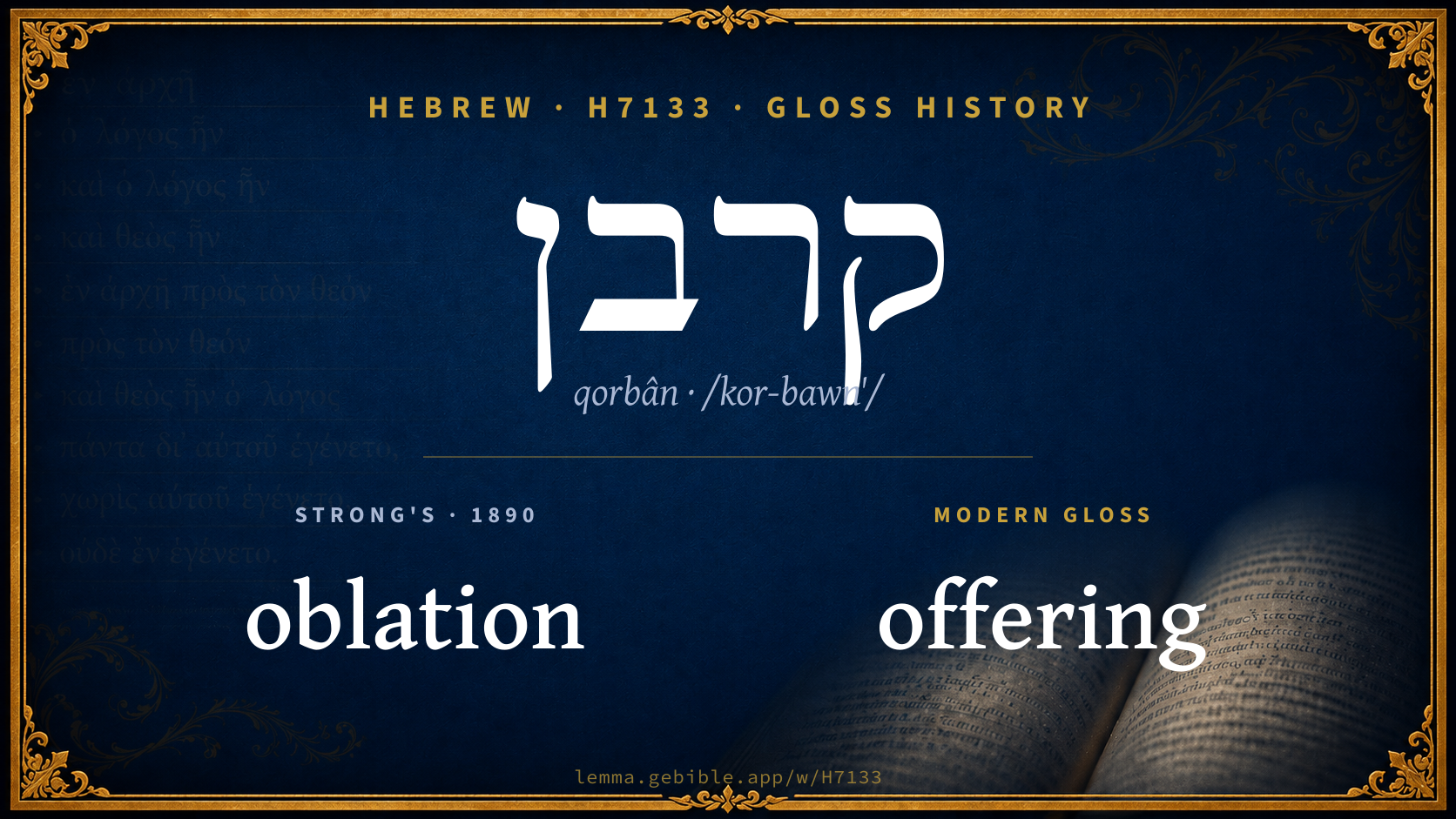
Gloss history
Strong's 1890 vs modern scholarship
About this word
Strong's H7133 catalogs a Hebrew word from the Hebrew Old Testament.
These counts are not copied from any lexicon or concordance. They are computed here, from the morphology-tagged Hebrew Old Testament. What Lemma adds →
- 78
- distinct verses
- The word appears in 78 distinct verses.
- 4 / 39
- OT books
- The word appears in 4 of 39 Old Testament books.
- #487
- by frequency
- Top 500 most frequent Hebrew words (rank 487 of 8,640 Hebrew words by occurrence).
View all 78 occurrences in the concordance →
By section of the Old Testament
By traditional corpus
Conventional, traditional groupings — biblical authorship is debated, so this is a traditional corpus grouping, not an authorship claim. Each share is this word’s portion of its verses in that division of the Hebrew canon. Each figure is a share of the word’s 78 distinct verses.
- Torah (Pentateuch) 74 verses · 95%
- Prophets (Nevi'im) 2 verses · 3%
- Writings (Ketuvim) 2 verses · 3%
How translations render this word
Counts come from each version’s own published word-to-Strong’s tagging or interlinear alignment — an approximate guide to how each version renders this word, not a word-level alignment the data otherwise carries. Because each total is that version’s own tagged count, the per-version totals vary from one another and need not match the appearance or distinct-verse counts above. These counts may also differ from a printed concordance because Lemma counts each distinctly tagged rendering and does not collapse phrase taggings into a single head-word total. This is a fixed set of word-tagged versions (KJV, ASV, BSB, ULT) and does not change with the reading translation you choose elsewhere. Each version’s license is shown beside its name below (and on Sources).
BDB lists this Strong’s number as 2 distinct words (homographs). Each count above pools all of them and is not split by sense — see the Senses section below. A low-frequency rendering may belong to a different one of those words, not the primary meaning.
- King James Version†: Offering 53×, Was the offering 12×, Oblation 8×
- American Standard Version†: Oblation 53×, Old 12×, 's oblation 2×
- Berean Standard Bible†: Offering 44×, Was the offering 12×, Offerings 5×
- unfoldingWord Literal Text†: Offering 51×, Offering of 23×, Offerings 4×
King James Version Public Domain
Renders H7133 across 82† tagged occurrences — most commonly:
Plus 7 renderings that appear only once — usually multi-word phrases or single function words the recovered tagging swept in, not distinct renderings.
American Standard Version Public Domain
Renders H7133 across 83† tagged occurrences — most commonly:
Plus 10 renderings that appear only once — usually multi-word phrases or single function words the recovered tagging swept in, not distinct renderings.
Berean Standard Bible Public Domain
Renders H7133 across 75† tagged occurrences — most commonly:
Plus 10 renderings that appear only once — usually multi-word phrases or single function words the recovered tagging swept in, not distinct renderings. Not rendered by a distinct English word in 4 further occurrences.
unfoldingWord Literal Text CC BY-SA 4.0
Renders H7133 across 82† tagged occurrences — most commonly:
Plus 4 renderings that appear only once — usually multi-word phrases or single function words the recovered tagging swept in, not distinct renderings.
Senses in BDB
The 1 sense BDB distinguishes for this word, in lexicon order (not ranked by frequency or importance). The full entry — with sub-senses — is in the Lexicon Entry tab.
- offering, oblation
Word origin
I. n.m. Lv 6:13 offering, oblation (Assyrian kurbannu, id., appar. always with כ, DlHWB 351);—abs. ק׳ Lv 1:2 +; cstr. קָרְבַּן 2:1 +; sf. קָרְבָּנִי Nu 28:2; pl. sf. קָרְבְּנֵיהֶם Lv 7:38;—offering, oblation, gen. term for all kinds of offering (only Ez Lv Nu [HP]): animal Lv 1:2, 3, 10 +, vegetable 2:1(×2), 5 +, articles of gold Nu 31:50, silver 7:13 +, etc.; as acc. cogn. after הִקְרִיב Lv 1:2(×2); 3:14 Nu 6:14 + (v. √ Hiph. 2 b (5)); cstr. ק׳ מִנְחָה Lv 2:1, 4, 13, ק׳ רֵאשִׁית v 12, ק׳ אִשֶּׁה 22:27; ק׳ י׳ Nu 9:7, 13 (cf. 31:50).
I. n.[m.] offering;—cstr. קֻרְבַּן הָעֵצִים wood-offering for second temple Ne 10:35; 13:31.
— Brown-Driver-Briggs (Oxford 1906, public domain), digitized via Sefaria, supplemented by the OpenScriptures HebrewLexicon (CC BY 4.0). See Sources.
Derived from קרב (qârab) (H7126) — to approach.
Jastrow Dictionary
A second Hebrew/Aramaic lexicon for comparison, covering Aramaic and post-biblical (Talmudic, Targumic, Midrashic) usage that the biblical-Hebrew BDB does not. Matched by lemma rather than by Strong’s number, so a lemma may carry more than one Jastrow headword (shown separately below), and the entries cover usage well beyond the Bible.
קָרְבָּן
- gift, offering, sacrifice. Ber. 15ᵃ מעלה … והקריב עליו ק׳ it is accredited to him, as if he had built an altar and offered a sacrifice on it; Succ. 45ᵃ. Sifra Vayikra, N’dab., ch. II, Par. 2 כל מקום שנאמר ק׳ אמור ביו"ד ה"א wherever in the Scriptures ‘sacrifice’ is used in connection with the divine name, the latter is written with Yod He (יהוה, never אלהים). Ned. I, 4 האומר ק׳ … שאני וכ׳ if one making a vow says, ḳorban … that I will (not) eat &c. Ib. 2 כינויין לק׳ substitutes for ḳorban. Ib. II, 5 בק׳ וכ׳ (נדר) if a man in making a vow uses the word ḳorban, and then says, I vowed only by the gifts to kings; a. fr.—Pl. קָרְבָּנוֹת. Ib. ק׳ של מלכים. Zeb. XIV, 10 קָרְבְּנוֹת הצבור congregational sacrifices, ק׳ היחיד sacrifices offered by individuals. Taan. 27ᵇ כבר תקנתי להם סדר ק׳ וכ׳ I have arranged the order of sacrifices for them (in the Torah), and when they read these sections, I will account it to them as if they offered them. Ex. R. s. 30 בקש הקב"ה … ועבודת ק׳ וכ׳ the Lord wanted to give them (the generation of the flood) four things (to purify them), the Law, sufferings, the sacrificial service, and prayer, but they refused; a. fr.
קָרְבַּן
- Targ. Hos. XII, 2. Targ. O. Gen. IV, 3 ed. Berl. (oth. ed. תקרבתא, v. Berl. Mass., p. 73); Y. ib. Ib. 4; a. fr.—Ḥull. 8ᵃ דקיימין לק׳ are designated to be sent as gifts. Zeb. 116ᵇ the mother of king Shabur שדרה ק׳ וכ׳ sent a sacrifice to Raba, sending word, ‘offer it to the Lord.’ Gitt. 56ᵃ שדר להו ק׳ וכ׳ send them a sacrifice and see whether they will offer it (in the Temple); a. fr.—Pl. קָרְבָּנִין, קָרְבָּנַיָּא, קוּרְ׳. Targ. Am. V, 22. Targ. Lev. VII, 35; a. fr.—Lam. R. to IV, 2 כל אילין ק׳ וכ׳ all those sacrifices which you send them, they eat themselves &c. Gen. R. s. 91; Y. Naz. V, end, 54ᵇ; a. fr.
A Dictionary of the Targumim, the Talmud Babli and Yerushalmi, and the Midrashic Literature (Marcus Jastrow; London, Luzac, 1903) — Public Domain. Digitized via Sefaria. Digitized via Sefaria. Full attribution on Sources.
Forms in the corpus
The 34 distinct written forms H7133 takes in the Hebrew Bible, most frequent first — each parse links to that state’s occurrences in the concordance. Hebrew forms include their vowel points and cantillation, so a single lemma takes many written forms.
Same root — word family
Other BDB entries built from the same root as H7133, grouped by Strong’s listed origin. These share a root / origin per the lexicon — not necessarily a shared meaning. Each links to that word’s own entry.
Derives from
Shares the same root
- קרב qᵉrêb H7127 to approach
- קרב qᵉrâb H7128 battle
- קרב qereb H7130 midst
- קרב qârêb H7131 near
- קרבה qᵉrâbâh H7132 approach
- קרוב qârôwb H7138 near
Compare all same-root words → Showing 4 of 8 — not the complete family. They share a root, not necessarily a meaning.
Septuagint verse parallels
This word appears in 76 verses that also exist in the Greek Old Testament (Septuagint), out of the 78 Hebrew verses it occurs in. You can read those verses in Greek by switching the Old Testament edition to the Septuagint.
Read these verses in the Septuagint
This is a verse-level parallel only — the same verses exist in both the Hebrew and Greek Old Testaments. No word-level Hebrew↔Greek correspondence is claimed: the data carries no such alignment, so no Greek word is shown as this Hebrew word’s translation. Coverage is not total — the Septuagint omits the deuterocanon and renumbers the Psalms, so some Hebrew verses have no direct Greek parallel.