
Leviticus 10:19

Hebrew (Westminster Leningrad Codex) Leviticus 10:19 appears in the Hebrew Old Testament. The text above is from the Westminster Leningrad Codex. Each word links to its Strong’s number, a concise gloss, and parsing drawn from the Open Scriptures Hebrew Bible morphology. Click any word for its full Brown-Driver-Briggs (BDB) entry.
Download image
Cite this verse

Leviticus 10:19 (World English Bible). Public Domain. Lemma interlinear Bible study tool, https://lemma.gebible.app/v/leviticus/10/19.

Show BibTeX & RIS
BibTeX
RIS
English Translation
Aaron spoke to Moses, "Behold, this day they have offered their sin offering and their burnt offering before Yahweh; and such things as these have happend to me: and if I had eaten the sin offering today, would it have been pleasing in the sight of Yahweh?"
World English Bible · Public Domain
Download a study sheet

One document with this verse’s original text, its word-by-word gloss line, the meaning frame, cross-references with their text, attributed commentary, and full source and license credits — printable, and it pastes into notes with its structure intact.

This verse Autodidact and up

Study sheet (.html) Plain text (.txt)

A passage Seminary Student

Up to 50 verses in one chapter. A passage sheet keeps up to 6 commentary sources and 12 cross-references per verse, in the order this page ranks them, and says so on the sheet whenever that leaves anything out. Ask for a single verse and you get the Autodidact verse sheet above.

Everything on this page stays free to read, with no account — the sheet is a download of what is already on screen, not access to it.

Want to remove ads? Support Godless Engineer
Compare translations 3

The same verse in 3 English versions, stacked beneath the original-language interlinear above. Click any original word for its lexicon entry.

Each is an independent rendering of the whole verse — the interlinear is not word-aligned to these translations.

Highlighted words mark where these versions differ — a whole-verse word diff, not a word-by-word alignment.

  • World English Bible Public Domain
    Aaron spoke to Moses, "Behold, this day they have offered their sin offering and their burnt offering before Yahweh; and such things as these have happend to me: and if I had eaten the sin offering today, would it have been pleasing in the sight of Yahweh?"
  • King James Version Public Domain
    And Aaron said unto Moses, Behold, this day have they offered their sin offering and their burnt offering before the LORD; and such things have befallen me: and if I had eaten the sin offering to day, should it have been accepted in the sight of the LORD?
  • unfoldingWord Literal Text CC BY-SA 4.0
    And Aaron spoke to Moses, “Behold, today they presented their sin offering and their burnt offering to the face of Yahweh, and it has happened to me according to these things. But I ate the sin offering today, would it have been good in the eyes of Yahweh?”

unfoldingWord Literal Text — © unfoldingWord, licensed CC BY-SA 4.0. Word-aligned USFM3 via Door43 (git.door43.org/unfoldingWord/en_ult).

Versions to compare (up to 4)

3 of 4 selected

Show all 18 translations

Every available English version of this verse, each an independent rendering of the whole verse.

  • World English Bible Public Domain
    Aaron spoke to Moses, "Behold, this day they have offered their sin offering and their burnt offering before Yahweh; and such things as these have happend to me: and if I had eaten the sin offering today, would it have been pleasing in the sight of Yahweh?"
  • Berean Standard Bible Public Domain
    But Aaron replied to Moses, “Behold, this very day they presented their sin offering and their burnt offering before the LORD. Since these things have happened to me, if I had eaten the sin offering today, would it have been acceptable in the sight of the LORD?”
  • Majority Standard Bible Public Domain
    But Aaron replied to Moses, “Behold, this very day they presented their sin offering and their burnt offering before the LORD. Since these things have happened to me, if I had eaten the sin offering today, would it have been acceptable in the sight of the LORD?”
  • King James Version Public Domain
    And Aaron said unto Moses, Behold, this day have they offered their sin offering and their burnt offering before the LORD; and such things have befallen me: and if I had eaten the sin offering to day, should it have been accepted in the sight of the LORD?
  • American Standard Version (1901) Public Domain
    And Aaron spake unto Moses, Behold, this day have they offered their sin-offering and their burnt-offering before Jehovah; and there have befallen me such things as these: and if I had eaten the sin-offering to-day, would it have been well-pleasing in the sight of Jehovah?
  • Revised Version (1885) Public Domain
    And Aaron spake unto Moses, Behold, this day have they offered their sin offering and their burnt offering before the LORD; and there have befallen me such things as these: and if I had eaten the sin offering today, would it have been well-pleasing in the sight of the LORD?
  • Geneva Bible (1599) Public Domain
    And Aaron said vnto Moses, Behold, this day haue they offred their sinne offring, and their burnt offring before the Lord, and such things as thou knowest are come vnto mee: If I had eaten the sinne offring to day, should it haue bene accepted in the sight of the Lord?
  • Douay-Rheims (1899) Public Domain
    Aaron answered: This day hath been offered the victim for sin, and the holocaust before the Lord: and to me what thou seest has happened: how could I eat it, or please the Lord in the ceremonies, having a sorrowful heart?
  • Young's Literal Translation Public Domain
    And Aaron speaketh unto Moses, `Lo, to-day they have brought near their sin-offering and their burnt-offering before Jehovah; and `things' like these meet me, yet I have eaten a sin-offering to-day; is it good in the eyes of Jehovah?'
  • Literal Standard Version CC BY-SA 4.0
    And Aaron speaks to Moses, “Behold, today they have brought their sin-offering and their burnt-offering near before YHWH; and [things] like these meet me, yet I have eaten a sin-offering today; is it good in the eyes of YHWH?”
  • Unlocked Literal Bible CC BY-SA 4.0
    Then Aaron answered Moses, “See, today they made their sin offering and burnt offering before Yahweh, and this thing has happened to me today. If I had eaten the sin offering today, would it have been pleasing in the sight of Yahweh?”
  • unfoldingWord Literal Text CC BY-SA 4.0
    And Aaron spoke to Moses, “Behold, today they presented their sin offering and their burnt offering to the face of Yahweh, and it has happened to me according to these things. But I ate the sin offering today, would it have been good in the eyes of Yahweh?”
  • Darby Bible Public Domain
    And Aaron said to Moses, Behold, to-day have they presented their sin-offering and their burnt-offering before Jehovah; and such things have befallen me; and had I to-day eaten the sin-offering, would it have been good in the sight of Jehovah?
  • World Messianic Bible Public Domain
    Aaron spoke to Moses, “Behold, today they have offered their sin offering and their burnt offering before the LORD; and such things as these have happened to me. If I had eaten the sin offering today, would it have been pleasing in the LORD’s sight?”
  • Webster's Bible Public Domain
    And Aaron said to Moses, Behold, this day have they offered their sin-offering, and their burnt-offering before the LORD; and such things have befallen me: and if I had eaten the sin-offering to day, would it have been accepted in the sight of the LORD?
  • Free Bible Version CC BY-SA 4.0
    So Aaron explained to Moses, “Look, it was today that they presented their sin offering and their burnt offering before the Lord. After all that's just happened to me, would the Lord have been pleased if I'd eaten the sin offering today?”
  • Bible in Basic English Public Domain
    And Aaron said to Moses, You have seen that today they have made their sin-offering and their burned offering before the Lord, and such things as these have come on me. If I had taken the sin-offering as food today, would it have been pleasing to the Lord?
  • JPS Tanakh (1917) Public Domain
    And Aaron spoke unto Moses: 'Behold, this day have they offered their sin-offering and their burnt-offering before the LORD, and there have befallen me such things as these; and if I had eaten the sin-offering to-day, would it have been well-pleasing in the sight of the LORD?

Literal Standard Version (2020), Covenant Press — licensed CC BY-SA 4.0. Text via the HelloAO Bible API (eBible.org). Unlocked Literal Bible (unfoldingWord) — licensed CC BY-SA 4.0. Text via the HelloAO Bible API (eBible.org). unfoldingWord Literal Text — © unfoldingWord, licensed CC BY-SA 4.0. Word-aligned USFM3 via Door43 (git.door43.org/unfoldingWord/en_ult). Free Bible Version, Dr. Jonathan Gallagher — licensed CC BY-SA 4.0. Text via the HelloAO Bible API (eBible.org).

Word by word

More ways to search: Search by grammar → Find every occurrence → Compare this word →

Practice this passage: Drill this verse → Learn its vocabulary →

וַתִּקְרֶ֥אנָה
qârâʼ
H7122
“and · to meet”
Conjunction + Verb, Qal, Sequential Imperfect, 3rd Person, Feminine, Plural
Part of Speech
Conjunction + Verb
Stem
Qal
Form
Sequential Imperfect
Person
3rd Person
Gender
Feminine
Number
Plural
Full BDB Definition

Origin: a primitive root, to encounter, whether accidentally or in a hostile manner

TWOT: 2064

to encounter, befall, meet - (Qal) - to meet, encounter - to befall (figuratively) - (Niphal) to meet, meet unexpectedly - (Hiphil) to cause to meet
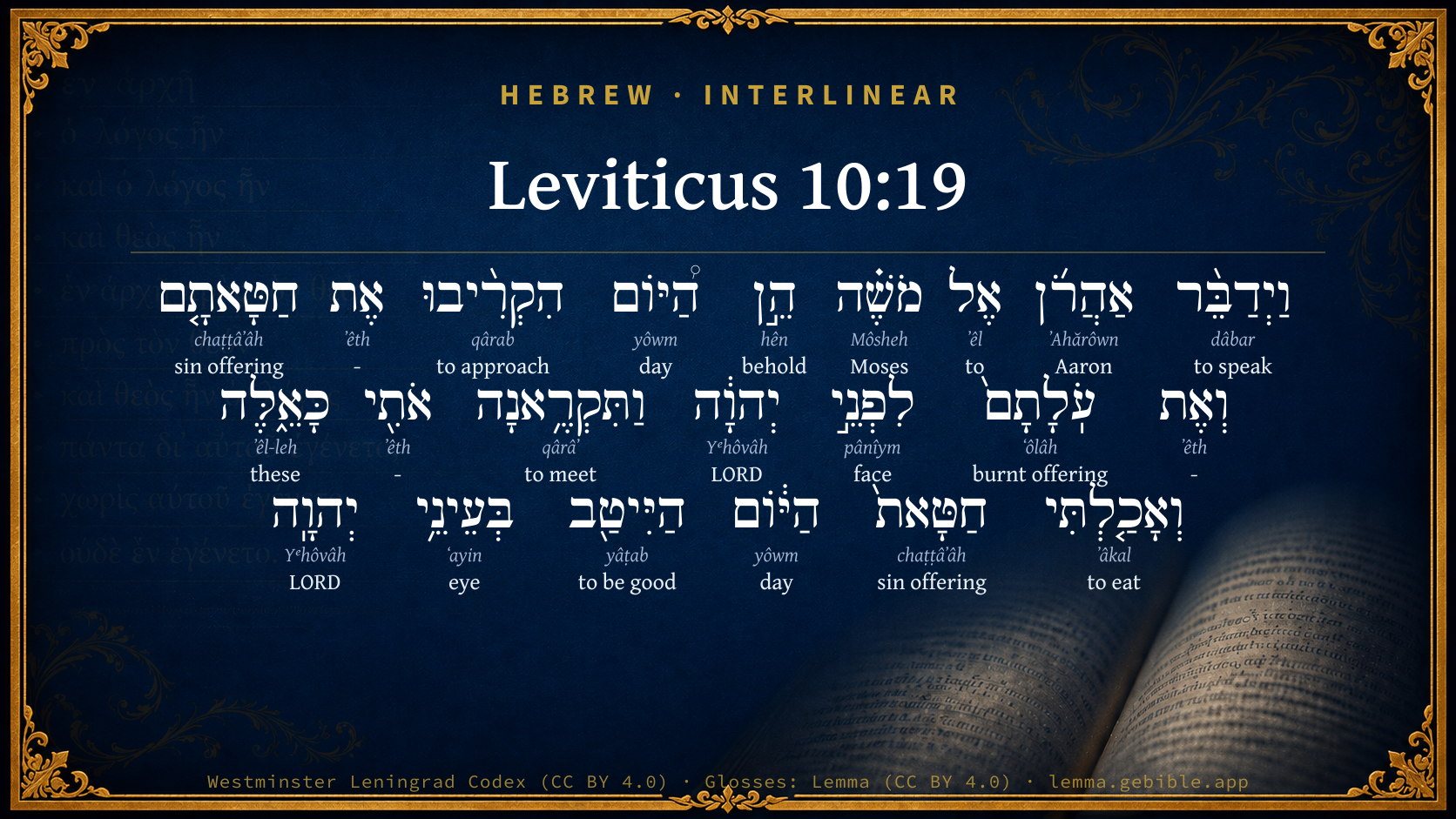
  1. וַיְדַבֵּ֨ר dâbar H1696 “and · to speak” Conjunction + Verb, Piel, Sequential Imperfect, 3rd Person, Masculine, Singular
  2. אַהֲרֹ֜ן ʼAhărôwn H175 “Aaron” Noun, Proper
  3. אֶל ʼêl H413 “to” Preposition
  4. מֹשֶׁ֗ה Môsheh H4872 “Moses” Noun, Proper
  5. הֵ֣ן hên H2005 “behold” Particle, Demonstrative
  6. הַ֠יּוֹם yôwm H3117 “the · day” Particle, Definite Article + Noun, Common, Masculine, Singular, Absolute
  7. הִקְרִ֨יבוּ qârab H7126 “to approach” Verb, Hiphil, Perfect, 3rd Person, Common, Plural
  8. אֶת ʼêth H853 “-” Particle, Direct Object
  9. חַטָּאתָ֤ם chaṭṭâʼâh H2403 “sin offering · their” Noun, Common, Feminine, Singular, Construct + Suffix, Personal, 3rd Person, Masculine, Plural
  10. וְאֶת ʼêth H853 “and · -” Conjunction + Particle, Direct Object
  11. עֹֽלָתָם֙ ʻôlâh H5930 “burnt offering · their” Noun, Common, Feminine, Singular, Construct + Suffix, Personal, 3rd Person, Masculine, Plural
  12. לִפְנֵ֣י pânîym H6440 “to/for · face(s) of” Preposition + Noun, Common, Both, Plural, Construct
  13. יְהוָ֔ה Yᵉhôvâh H3068 “LORD” Noun, Proper
  14. אֹתִ֖י ʼêth H853 “- · me” Particle, Direct Object + Suffix, Personal, 1st Person, Common, Singular
  15. כָּאֵ֑לֶּה ʼêl-leh H428 “like/as · these” Preposition + Pronoun, Demonstrative, Common, Plural
  16. וְאָכַ֤לְתִּי ʼâkal H398 “and · to eat” Conjunction + Verb, Qal, Sequential Perfect, 1st Person, Common, Singular
  17. חַטָּאת֙ chaṭṭâʼâh H2403 “sin offering” Noun, Common, Feminine, Singular, Absolute
  18. הַיּ֔וֹם yôwm H3117 “the · day” Particle, Definite Article + Noun, Common, Masculine, Singular, Absolute
  19. הַיִּיטַ֖ב yâṭab H3190 “to be good” Particle, Interrogative + Verb, Qal, Imperfect, 3rd Person, Masculine, Singular
  20. בְּעֵינֵ֥י ʻayin H5869 “in/at · eyes of” Preposition + Noun, Common, Both, Dual, Construct
  21. יְהוָֽה Yᵉhôvâh H3068 “LORD” Noun, Proper

About this verse

These counts appear in no published source. They are computed here, from the morphology-tagged text and Lemma’s own curated glosses. What Lemma adds →

22
words
17
distinct lemmas
Pentateuch
section

Shared distinctive vocabulary

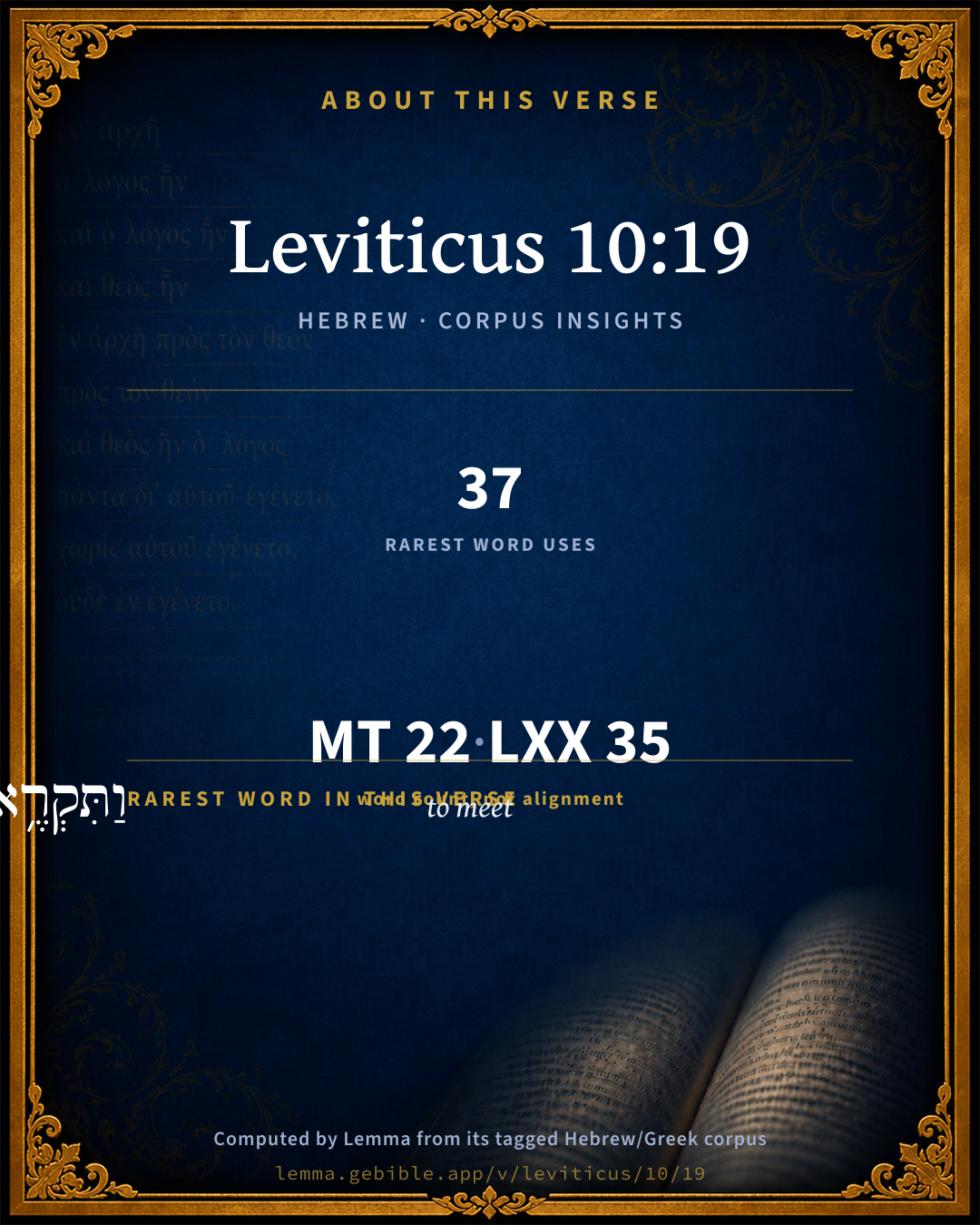
וַתִּקְרֶ֥אנָה to meet H7122 occurs in 35 verses of the Hebrew Bible. Also found in:

Grammatical profile

  • 5 verbs
  • 11 nouns
  • 1 pronoun
  • 1 preposition
  • 4 particles

Verb forms

  • וַיְדַבֵּ֨ר Piel · Sequential Imperfect
  • הִקְרִ֨יבוּ Hiphil · Perfect
  • וַתִּקְרֶ֥אנָה Qal · Sequential Imperfect
  • וְאָכַ֤לְתִּי Qal · Sequential Perfect
  • הַיִּיטַ֖ב Qal · Imperfect

Repetition

Words recur within this verse — often emphatic in Hebrew:

  • הַ֠יּוֹם day H3117 ×2
  • חַטָּאתָ֤ם sin offering H2403 ×2
  • יְהוָ֔ה LORD H3068 ×2

Hebrew & Septuagint length

In English translation the verse runs 47 words from the Hebrew and 45 from the Septuagint (LXX English) — closely comparable.

A rough comparison of the two English renderings, which tokenize alike — not a word-level alignment.

Word counts can differ between the Hebrew and the Greek without any difference in meaning — e.g. the Hebrew direct-object marker אֵת has no separate Greek word, and Greek often adds the article ὁ.

In the original languages it is 22 Hebrew tokens and 35 Greek tokens — but the two are counted differently (Hebrew bundles its prefixes and suffixes into one token; the Greek is in lemma form), so that isn’t a like-for-like length.

Cross-references

16

Topical passages linked to Leviticus 10:19 in the Treasury of Scripture Knowledge — connected by theme and wording, ordered by reader-vote popularity; previews shown in the World English Bible.

  • Leviticus 9:12 He killed the burnt offering; and Aaron's sons delivered the blood to him, and he sprinkled it on the altar round about.
  • Leviticus 9:8 So Aaron drew near to the altar, and killed the calf of the sin offering, which was for himself.
  • Isaiah 1:15 When you spread forth your hands, I will hide my eyes from you; Yes, when you make many prayers, I will not hear. Your hands are full of blood.
  • Jeremiah 6:20 To what purpose comes there to me frankincense from Sheba, and the sweet cane from a far country? your burnt offerings are not acceptable, nor your sacrifices pleasing to me.
  • Jeremiah 14:12 When they fast, I will not hear their cry; and when they offer burnt offering and meal-offering, I will not accept them; but I will consume them by the sword, and by the famine, and by the pestilence.
  • Hosea 9:4 They won't pour out wine offerings to Yahweh, Neither will they be pleasing to him. Their sacrifices will be to them like the bread of mourners; All who eat of it will be polluted; For their bread will be for their appetite. It will not come into the house of Yahweh.
  • Malachi 1:10 "Oh that there were one among you who would shut the doors, that you might not kindle fire on my altar in vain! I have no pleasure in you," says Yahweh of hosts, "neither will I accept an offering at your hand.
  • Malachi 1:13 You say also, 'Behold, what a weariness it is!' and you have sniffed at it," says Yahweh of Hosts; "and you have brought that which was taken by violence, the lame, and the sick; thus you bring the offering. Should I accept this at your hand?" says Yahweh.
  • Malachi 2:13 This again you do: you cover the altar of Yahweh with tears, with weeping, and with sighing, because he doesn't regard the offering any more, neither receives it with good will at your hand.
  • Deuteronomy 12:7 and there you shall eat before Yahweh your God, and you shall rejoice in all that you put your hand to, you and your households, in which Yahweh your God has blessed you.
  • Deuteronomy 26:14 I have not eaten of it in my mourning, neither have I put away of it, being unclean, nor given of it for the dead: I have listened to the voice of Yahweh my God; I have done according to all that you have commanded me.
  • 1 Samuel 1:7–8 [as] he did so year by year, when she went up to the house of Yahweh, so she provoked her; therefore she wept, and did not eat.
  • Isaiah 1:11 "What are the multitude of your sacrifices to me?," says Yahweh. "I have had enough of the burnt offerings of rams, And the fat of fed animals. I don't delight in the blood of bulls, Or of lambs, Or of male goats.
  • Philippians 4:4 Rejoice in the Lord always! Again I will say, Rejoice!
  • Hebrews 7:27 who doesn't need, like those high priests, to daily offer up sacrifices, first for his own sins, and then for the sins of the people. For this he did once for all, when he offered up himself.
  • Hebrews 9:8 The Holy Spirit is indicating this, that the way into the Holy Place wasn't yet revealed while the first tabernacle was still standing;

Cross-references courtesy of OpenBible.info (CC BY 4.0).

Hebrew and Greek witnesses Masoretic Hebrew ↔ Greek Septuagint

The same verse in the two great witnesses to the Old Testament, shown verse-for-verse.

These are two independent witnesses, not word-aligned to each other, and the Septuagint is shown in lemma (dictionary) form.

Hebrew Leviticus 10:19 Masoretic · Westminster Leningrad Codex

וַיְדַבֵּ֨ר אַהֲרֹ֜ן אֶל מֹשֶׁ֗ה הֵ֣ן הַ֠יּוֹם הִקְרִ֨יבוּ אֶת חַטָּאתָ֤ם וְאֶת עֹֽלָתָם֙ לִפְנֵ֣י יְהוָ֔ה וַתִּקְרֶ֥אנָה אֹתִ֖י כָּאֵ֑לֶּה וְאָכַ֤לְתִּי חַטָּאת֙ הַיּ֔וֹם הַיִּיטַ֖ב בְּעֵינֵ֥י יְהוָֽה

Aaron spoke to Moses, "Behold, this day they have offered their sin offering and their burnt offering before Yahweh; and such things as these have happend to me: and if I had eaten the sin offering today, would it have been pleasing in the sight of Yahweh?"

World English Bible · Public Domain

Greek LXX Leviticus 10:19 Septuagint · lemma form

καί λαλέω ἀαρών πρός μωυσῆς λέγω εἰ σήμερον προςἄγω ὁ περί ὁ ἁμαρτία αὐτός καί ὁ ὁλοκαύτωμα αὐτός ἔναντι κύριος καί συνβαίνω ἐγώ οὗτος καί ἐσθίω ὁ περί ὁ ἁμαρτία σήμερον μή ἀρεστός εἰμί κύριος

And Aaron spoke to Moses, saying, If they have brought near today their sin-offerings, and their whole burnt offerings before the Lord, and these events have happened to me, and yet I should eat today of the sin-offerings, would it be pleasing to the Lord?

LXX2012 (modern English Septuagint) · Public Domain

Hebrew: Westminster Leningrad Codex (CC BY 4.0). Greek: Septuagint (public domain); English from LXX2012 (modern English Septuagint) (Public Domain). How the Septuagint differs from the Hebrew →

Targum (Aramaic paraphrase)

2

The Targum is the ancient Jewish Aramaic paraphrase of the Hebrew Scriptures — an interpretive translation, not the Hebrew text itself. Onkelos (literal) and Pseudo-Jonathan (expansive) render the Torah, and Jonathan the Prophets. Coverage is partial: where no permissively-licensed English translation exists for a verse, only the Aramaic is shown. This is verse-level text, not a word-by-word alignment to the Hebrew.

  1. Targum Onkelos Torah (Genesis–Deuteronomy)
    וּמַלִיל אַהֲרֹן עִם מֹשֶׁה הָא יוֹמָא דֵין קְרִיבוּ יָת חַטָּאתְהוֹן וְיָת עֲלָתְהוֹן קֳדָם יְיָ וַעֲרָעָא יָתִי עָקָן כְּאִלֵין וְאִלוּפוֹן אֲכָלִית חַטָאתָא יוֹמָא דֵין הֲתַקֵן קֳדָם יְיָ

    (no public-domain English translation for this verse)

    Targum Onkelos — Aramaic: “Onkelos Genesis” (public domain); “Onkelos Exodus” (public domain); “Onkelos Leviticus” (public domain); “Onkelos Numbers” (public domain); “Onkelos Deuteronomy” (public domain). English: “Sefaria Community Translation” (CC0 1.0 (public-domain dedication)); “J.W. Etheridge. The Targums of Onkelos and Jonathan Ben Uzziel on the Pentateuch. London: Longmans, Green, 1862” (public domain). Text via Sefaria.

  2. Targum Pseudo-Jonathan Torah (Genesis–Deuteronomy)
    וּמַלֵיל אַהֲרן עִם משֶׁה הָא יוֹמָא דֵין קְרִיבוּ בְנֵי יִשְרָאֵל יַת קָרְבַּן חַטַאתְהוֹן וְעָלְוַותְהוֹן קֳדָם יְיָ וַאֲרַע יָתִי סִקוּל כְּאִילֵין בִּתְרֵין בְּנַי הֲלָא מַעֲשְרָא תִנְיָנָא אִתְפַּקֵיד דִי לָא לְמֵיכַל אָבִיל מִינֵיהּ כָּל דְכֵן קָרְבָּן חַטָאתָא וּמַה אִילוּ אִישְׁתְּלִיַית וַאֲכָלִית מִן קָרְבַּן חַטָאתָא יוֹמָא דֵין אוּף תְּרֵין בְּנַי דְאִשְׁתְּיָירוּ הֲוָה לְהוֹן מִן דִינָא דְיִתּוֹקְדוּן דְלֵית אֶפְשַׁר דִי שְׁפַר קֳדָם יְיָ

    And Aharon said to Mosheh, Behold, this day the sons of Israel have brought the oblation of their sin offering and their burnt sacrifice before the Lord; but a stroke hath befallen me, in those my two sons. Of the second tythe is it not commanded, Thou shalt not eat of it while mourning? How much more, then of the sin offering? If I had eaten of the sin offering this day with my two sons who are left, would it not have been all error, so that they too might have been burned by a judgment, for doing that which was not pleasing before the Lord?

    Targum Pseudo-Jonathan — Aramaic: “Targum Jonathan on Genesis” (public domain); “Targum Jonathan on Exodus” (public domain); “Targum Jonathan on Leviticus” (public domain); “Targum Jonathan on Numbers” (public domain); “Targum Jonathan on Deuteronomy” (public domain). English: “The Targum of Jonathan ben Uzziel, trans. J. W. Etheridge, London, 1862” (public domain). Text via Sefaria.

Commentary

Notes on Leviticus 10:19 from classic Christian and Jewish commentators (each source and its license shown beneath its notes). The classic Christian expositions comment on the surrounding passage and are grouped to its opening verse, so a note may address several verses; the Jewish commentaries on the Tanakh (Rashi and others) are per-verse, so they appear only where the commentator wrote on this verse.

Lemma curates 59 commentaries, every one of them public domain or Creative Commons licensed, each selected and text-cleaned for this edition rather than reprinted as found. About our sources →

Trapp's Complete Commentary

John Trapp

Lev 10:19 And Aaron said unto Moses, Behold, this day have they offered their sin offering and their burnt offering before the LORD; and such things have befallen me: and [if] I had eaten the sin offering to day, should it have been accepted in the sight of the LORD?

Ver. 19. Should it have been accepted.] God loves a cheerful server. {Deu 12:7; Deu 26:14} Mourners’ bread is polluted bread, {Hos 9:4} and those unkind husbands are blamed for causing their wives, when they should have been cheerful in God’s service, to cover the Lord’s altar with tears, with weeping and with crying out, so that he regarded not the offering any more. {Mal 2:13} This Aaron knew, and allegeth for himself.

John Trapp, A Commentary or Exposition upon All the Books of the Old and New Testament (1647–1656) — public domain. Text from a community e-Sword module.

Joseph Benson's Commentary

Lev 10:19. Aaron said unto Moses — Though Moses expostulates only with Eleazar and Ithamar, yet Aaron, taking the reproof to himself, makes an apology in his own and their behalf, the amount of which is, that he and his sons had performed the substance of their duty, offering the people’s sin- offering and burnt-offering in all respects according to the divine direction; only as to eating their share of the sin-offering, the death of his sons, happening at that juncture, had so overwhelmed him with grief, that he judged himself unfit for feasting at God’s table: Such things, says he, have befallen me; and if I had eaten the sin-offering to-day, should it have been accepted? — Would God have been pleased with me if, in such heaviness and dejection, I had eaten the sacrifice? My sorrows unfitted me for that service; it being the voice of nature as well as of religion, that men ought to celebrate feasts upon joyous occasions, and with a cheerful heart, (Deu 12:7,) and not eat holy things in their mourning, Deu 26:14.

Joseph Benson's Commentary on the Old and New Testaments (1811–1818) — public domain. Text from a community e-Sword module.

Tyndale Open Study Notes

Tyndale Open Resources

10:19 yet this tragedy has happened to me: Aaron was saying either that eating the goat of the sin offering would not have prevented the deaths of Nadab and Abihu or that it would not have been appropriate for him to eat it on the heels of such a grievous event.

Tyndale Open Study Notes — © Tyndale Open Resources, licensed CC BY-SA 4.0. Text via the HelloAO Bible API.

Geneva Bible (1599)

Geneva Bible translators

That is, Nadab and Abihu.

Geneva Bible (1599) marginal notes — public domain. Text via Bolls.life.

Adam Clarke's Commentary

Verse 19. And such things have befallen me, c.] The excuse which Aaron makes for not feasting on the sin-offering according to the law is at once appropriate and dignified as if he had said: "God certainly has commanded me to eat of the sin-offering; but when such things as these have happened unto me, could it be good in the sight of the Lord? Does he not expect that I should feel as a father under such afflicting circumstances?" With this spirited answer Moses was satisfied; and God, who knew his situation, took no notice of the irregularity which had taken place in the solemn service. To human nature God has given the privilege to weep in times of affliction and distress. In his infinite kindness he has ordained that tears, which are only external evidences of our grief, shall be the outlets to our sorrows, and tend to exhaust the cause from which they flow. See on "Le 10:3".

Adam Clarke's Commentary on the Bible (1810–1826) — public domain. Text from a community e-Sword/MySword module.

Ellicott's Commentary for English Readers

(19) And Aaron said.—Though, according to Lev_10:16, Moses only blamed Eleazar and Ithamar for this transgression of the law, yet there can hardly be any doubt that Aaron was included in this censure, and that the lawgiver abstained from expressing his anger against the pontiff because of the supreme dignity of his office, which he would not lower in the sight of the people. Aaron, however, was fully sensible of this, and hence replies to the charge brought against his sons.

They offered their sin offering.—Before proceeding to the transgression with which they are thus charged, Aaron adverts to the fact that all the other sacrificial duties in which he and his sons were engaged on the same day, prior to the great calamity, were performed in strict accordance with the prescribed ritual. His sons assisting him had offered “their”—i.e., the people’s—sin and burnt offerings (see Lev_9:15-16) thus far in due compliance with the requirements of the law, and hence could never have meant to transgress intentionally.

And such things have befallen me.—But whilst he, Eleazar, and Ithamar were thus duly performing the sacrificial rites, Nadab and Abihu, his other two sons, transgressed, and were suddenly struck down dead, thus overwhelming the survivors with sorrow, and rendering them unfit to partake of the sacrifices.

And if I had eaten.—Aaron submits that, unfitted as they thus were by mourning and the sense of their own sinfulness, if they had partaken of this solemn meal it would not have been acceptable to the Lord. In consequence of this declaration, the rule obtained during the second Temple, that when an ordinary priest heard of the death of a relative whilst on duty in the sanctuary, he had to cease from service, though he could not leave the precincts of the Temple otherwise he defiled the sacrifice; whilst the high priest, who could continue his sacred ministrations, was not allowed to partake of the sacrificial meal.

A Bible Commentary for English Readers, edited by Charles John Ellicott (1878–1897) — public domain. Text from a community e-Sword module.

The Cambridge Bible for Schools and Colleges

gen. ed. J. J. S. Perowne

19. Aaron in his reply admits that he should have eaten the Sin-Offering, but gives as a reason for not doing so ‘there have befallen me such things as these.’ This is explained as a reference to the death of his sons. Aaron, Eleazar, and Ithamar were forbidden to mourn for them; but Aaron considered their death as a sign that God was displeased and refrained from eating the Sin-Offering. The whole incident presents difficulties which have not been satisfactorily explained, one of which is that the sacrifice to which Moses refers belongs to that class of which the priests were not to eat. The direction in Lev_6:26, that the priest who offers a Sin-Offering ‘shall eat it’ is there limited in Lev_6:30, by forbidding that this shall be done when any of the blood has been brought into the tent of meeting to make atonement. In accordance with this restriction, the rebuke by Moses in Lev_10:18 is justified, but on the other hand it should be noted that no blood has yet been brought into the Holy place, not even that of the calf for Aaron’s Sin-Offering (Lev_9:8 ff.), and yet no objection against the burning of it was made by Moses.

For one who desired to defend the burning of all the parts the argument would be fairly obvious that the rules for the Sin-Offering of the priest as laid down in Lev_4:3 ff. direct this course. Aaron’s line of defence, however, is wholly different. Dillm. suggests that the section as it now stands has arisen through the expansion of an older and simpler narrative in P, in which was set forth the original disinclination of the priests to partake of the flesh of the Sin-Offering.

The most probable explanation of the passage is that it is an attempt to account for a discrepancy between the earlier and later ritual. That the priests should abstain, in the contemplated case, from eating the victim whose blood had not been brought into the sanctuary, was opposed to the later custom, and thus needed special circumstances to justify it, and the consequent sanction of Moses.

The Cambridge Bible for Schools and Colleges (gen. ed. J. J. S. Perowne; Cambridge University Press, 1878–1918) — public domain. Text from a community e-Sword module.

John Gill's Exposition

And when Moses heard that, he was content. He said no more, he did not proceed in blaming him and his sons, but was satisfied with the answer returned; he considered the grief and trouble of mind that attended Aaron, which might not only cause him to disregard food, but even to forget what was commanded to be done in this case; and besides he might observe, that there was some difficulty attending it; in some cases the flesh of the sin offering was to be eaten, and not burnt; in others, to be burnt, and not eaten; and this being the first time of offering one, the mistake might be the more easily made; and fearing one might be made, and especially when Aaron was in such circumstances, might be the reason Moses so diligently sought after the goat of the sin offering: moreover, what Aaron had done appeared to be not out of any wilful neglect of the command of God, but with a good design, as judging it would be unacceptable to him, should he have eaten of it in his circumstances. Moses upon the whole thought him excusable, at least insisted no more upon the blame. The Jewish writers make the mistake to lie on the side of Moses and not Aaron; and which the former acknowledged, according to the Targums of Jonathan and Jerusalem: see Deu 26:12.

Next: Leviticus Chapter 11

John Gill's Exposition of the Whole Bible (1746–1763) — public domain (CC PDM 1.0). Text via the HelloAO Bible API.

Albert Barnes' Notes on the Bible

That is: “Behold this very day, in which we have done our part in sacrificing sin-offerings and burnt-offerings to the Lord, this great calamity has befallen me. Could it have been well-pleasing to the Lord if those who have been so humbled as I and my sons have been by the sin of our relations and the divine judgment, had feasted on the most holy flesh of the sin-offering?”

Albert Barnes' Notes on the Bible (1834–1885) — public domain. Text from a community e-Sword/MySword module.

Haydock's Catholic Bible Commentary

How, &c. My children are slain. Hebrew, "and if I had eaten the sin-offering to-day, would it have been agreeable to the Lord?" (Haydock)

George Leo Haydock (1774–1849), Haydock's Catholic Family Bible and Commentary, 1859 edition — public domain. Excludes Psalms (Douay-Rheims chapter numbering differs from Protestant) and Deuterocanonical books (Catholic canon only).

Matthew Poole's English Annotations

This day have they offered; they have done the substance of the thing, though they have mistaken this one circumstance. Such things have befallen me; whereby, having been oppressed with grief, and almost bereft of my reason, it is not strange nor unpardonable if I have mistaken.

Should it have been accepted? because it was not to be eaten with sorrow, but with rejoicing and thanksgiving, as appears from Deu 12:7; 26:14; Hos 9:4; and I thought it fitter to burn it, as I did other sacred relics, than to profane it by eating it unworthily.

Matthew Poole's English Annotations on the Holy Bible (1683–1685) — public domain. Text from a community e-Sword/MySword module.

Whedon's Commentary on the Bible

Daniel D. Whedon

19. Such things have befallen me — “Aaron here supplies the ‘one touch of nature’ which ‘makes the whole world kin.’ The deeper laws assert themselves against the more superficial statutes and ordinances.” — Joseph Parker. Aaron, forbidden to mourn in public, could not restrain his grief. His bursting heart finds relief in this one sentence whispered in the ear of his irate brother as an apology for his own neglect to eat the sin offering. He had been deterred by his sense of unworthiness and by his fear of committing an impropriety which might call down still greater judgments. This soft answer turned away wrath, for when Moses heard… he was content. “They were all, in a sense, unclean, even though the anointing oil of the Lord was upon them. They might eat the meat offering which was their due, but could not make atonement for the sins of the people.” — Bib. Sac. It is far better to be real in our confession of failure than to put forth pretensions to spiritual power without foundation. This chapter opens with positive sin, and closes with negative failure, the former dishonouring God, and the latter forfeiting his blessing.

Daniel D. Whedon (gen. ed.), Commentary on the Old and New Testaments (1874–1909) — public domain. Text from a community e-Sword module.

John Wesley's Explanatory Notes

They have offered - They have done the substance of the thing, though they have mistaken this one circumstance. Such things - Whereby, haying been oppressed with grief, it is not strange nor unpardonable if I have mistaked. Should it have been accepted - Because it was not to be eaten with sorrow, but with rejoicing and thanksgiving.

John Wesley, Explanatory Notes Upon the Whole Bible (1754–1765) — public domain. Text via the GEBible commentary corpus.

Keil & Delitzsch

C. F. Keil & F. Delitzsch

Aaron excused his sons, however, by saying, "Behold, this day have they offered their sin-offering and their burnt-offering, and this has happened to me," i.e., the calamity recorded in Lev 10:1. has befallen me (קרא = קרה, as in Gen 42:4); "and if I had eaten the sin-offering to-day, would it have been well-pleasing to Jehovah?" וגו ואכלתּי is a conditional clause, as in Gen 33:13, cf. Ewald, 357. Moses rested satisfied with this answer. Aaron acknowledged that the flesh of the sin-offering ought to have been eaten by the priest in this instance (according to Lev 6:19), and simply adduced, as the reason why this had not been done, the calamity which had befallen his two eldest sons. And this might really be a sufficient reason, as regarded both himself and his remaining sons, why the eating of the sin-offering should be omitted. For the judgment in question was so solemn a warning, as to the sin which still adhered to them even after the presentation of their sin-offering, that they might properly feel "that they had not so strong and overpowering a holiness as was required for eating the general sin-offering" (M. Baumgarten). This is the correct view, though others find the reason in their grief at the death of their sons or brethren, which rendered it impossible to observe a joyous sacrificial meal. But this is not for a moment to be thought of, simply because the eating of the flesh of the sin-offering was not a joyous meal at all (see at Lev 6:19).

(Note: Upon this mistaken view of the excuse furnished by Aaron, Knobel has founded his assertion, that "this section did not emanate from the Elohist, because he could not have written in this way," an assertion which falls to the ground when the words are correctly explained.)

Keil & Delitzsch — Biblical Commentary on the Old Testament (1861–1891) — public domain (CC PDM 1.0). Text via the HelloAO Bible API. (Old Testament only.)

Kretzmann's Popular Commentary

Paul E. Kretzmann

Various Statutes

v. 19. Ye shall keep My statutes, those special precepts which applied particularly to the conditions under which the Jews lived. Thou shalt not let thy cattle gender with a diverse kind, for the production of hybrids. Thou shalt not sow thy field with mingled seed, for the same reason; neither shall a garment mingled of linen and woolen come upon thee.

v. 20. And whosoever lieth carnally with a woman that is a bondmaid, a slave, betrothed to an husband, probably after the manner spoken of Exo 21:7-11, and not at all redeemed, nor freedom given her, these being the two ways in which a slave could gain his liberty; she shall be scourged, or rather, there shall be a punishment of both guilty persons; they shall not be put to death, because she was not free and could not legally contract marriage.

v. 21. And he, the guilty man, shall bring his trespass-offering unto the Lord, unto the door of the Tabernacle of the Congregation, even a ram for a trespass-offering.

v. 22. And the priest shall make an atonement for him with the ram of the trespass-offering before the Lord for his sin which he hath done, in the manner prescribed by God, Lev 7:1-7; and the sin which he hath done shall be forgiven him.

v. 23. And when ye shall come in to the land, and shall have planted all manner of trees for food, fruit-trees and nut-trees,then ye shall count the fruit thereof as uncircumcised, and therefore not to be used;three years shall it be as uncircumcised unto you; it shall not be eaten of.

v. 24. But in the fourth year all the fruit thereof shall be holy to praise the Lord withal, hallowed to Jehovah, and fit to be used as an offering of first-fruits.

v. 25. And in the fifth year shall ye eat of the fruit thereof, that it may yield unto you the increase thereof through the blessing of the Lord. I am the Lord, your God. This manner of treating the trees incidentally increased the yield of the orchard.

v. 26. Ye shall not eat anything with the blood, flesh from which the blood had not thoroughly drained, Leviticus 17-10; neither shall ye use enchantment, any form of soothsaying, nor observe times, another form of witchcraft, that of using the evil eye.

v. 27. Ye shall not round the corners of your heads, cut or shave the hair in a circle from one temple to the other, neither shalt thou mar the corners of thy beard, crop or trim the ends. This seems to have reference to a custom followed by some heathen nations in honor of certain idols.

v. 28. Ye shall not make any cuttings in your flesh for the dead, such tattooing and such incisions as the Jews must have seen done among the Egyptians, nor print any marks upon you, in the form of pictures, letters, or figures. I am the Lord.

v. 29. Do not prostitute thy daughter, induce her to permit her body to he used for immoral purposes, to cause her to be a whore, a sin which profanes the body in the most specific and emphatic sense, lest the land fall to whoredom, and the land become full of wickedness, full of abominable deeds. The reference is probably to religious immorality, as it was joined with many idolatrous worships and is to this day, in which women voluntarily abandoned their chastity as priestesses of the idol.

v. 30. Ye shall keep My Sabbaths, all the prescribed festivals, and reverence My Sanctuary. I am the Lord. The entire social and domestic life of the Israelites was to be pervaded by the fear of God and characterized by chasteness and propriety.

v. 31. Regard not them that have familiar spirits, neither seek after wizards to be defiled by them; literally: "Do not turn to the spirits of the dead, and after the spirits of soothsaying do not follow. " I am the Lord, your God. All intercourse with conjurors of the dead and with wizards was equivalent to desecration of the holy relation with God, "The chief means used by both these classes of persons was the consulting with the spirits of the departed. While this furnishes an incidental testimony all along to the belief of the Israelites in the life beyond the grave, it is self-evident that all such attempts to secure knowledge which God has not put in the power of living man to acquire are a resistance to His will, and a chafing against the barriers He has imposed. It is remarkable that such attempts should have been persisted in through all ages and in all lands. " (Gardiner. )

v. 32. Thou shalt rise up before the hoary head, and honor the face of the old man, and fear thy God. I am the Lord. The respect for old age, coming under the Fourth Commandment, is here associated with the fear of God, who demands this showing of respect.

v. 33. And if a stranger sojourn with thee in your land, ye shall not vex, that is, oppress, him, make him feel that he is an outcast.

v. 34. But the stranger that dwelleth with you shall be unto you as one born among you, be treated with all kind regard, just as though he were an inhabitant of the land, and thou shalt love him as thyself; for ye were strangers in the land of Egypt, and the remembrance of the oppression suffered there was to have a wholesome influence in teaching them mercy, I am the Lord, your God.

v. 35. Ye shall do no unrighteousness in judgment, in any matter that is to be decided in court, in mete-yard, in measurements of length, in weight, or in measure, both dry and liquid measure being included.

v. 36. Just balances, for measures of weight, just weights, stones used as standards of weight, a just ephah, as a standard for dry measure, and a just hin, as the standard for liquid measure, shall ye have. I am the Lord, your God, which brought you out of the land of Egypt. It is clear that equity in the affairs of daily life is here made to rest upon the foundation of duty toward God.

v. 37. Therefore shall ye observe all My statutes and all My judgments, the precepts flowing out of the natural law inscribed in the hearts of all men as well as those given to the Jews in particular, and do them. I am the Lord, Love is still the fulfillment of the Law, the advantage which the Christians have consisting chiefly in this, that its application in the individual cases is left to the judgment of the believer, as a spur to his ingenuity.

Paul E. Kretzmann, Popular Commentary of the Bible (1921–1924) — public domain. Text from a community e-Sword module.

unfoldingWord translationNotes

Door43 World Missions Community

this thing has happened

Aaron is referring to the death of his two sons.

would it have been pleasing in the sight of Yahweh?

These sacrifices were to be eaten with joy and happiness. Aaron uses a question to emphasize that Yahweh would not be pleased for him to eat the sacrifices since he is sad because of his sons' deaths. This question may be translated as a statement. AT: "certainly, Yahweh would not have been pleased." (See: Rhetorical Question)

translationWords

Aaron

Moses

sin offering

burnt offering

Yahweh

unfoldingWord translationNotes — © Distant Shores Media and the Door43 World Missions Community, licensed CC BY-SA 4.0. Source: git.door43.org/Door43/en_tn.

Rashi

Rabbi Shlomo Yitzchaki (Rashi)

וידבר אהרן AND AARON SAID — The term “saying” used here denotes a harsh utterance, as it is said (Numbers 21:5) “And the people spake (וידבר) against Moses, etc.” — Is it likely that when Moses expressed his indignation with Eleazar and with Ithamar, Aaron should reply to him in such harsh language? You must consequently know (conclude) that it was only by way of respect that these remained silent. They thought, “It would not be right that our father (Aaron) should be sitting here (be present) and that we should speak in his presence, nor would it be right that a disciple should retort on his teacher (Moses)”. You might think, however, that Eleazar did not possess the ability to reply, and that on this account he was silent. This was not so for it is stated (Numbers 31:21) “And Eleazar the priest spake to the men of the army, etc.” — and so you see that when he wished to do so he did speak in the presence of Moses and in the presence of the princes (cf. Numbers v. 13). This I found in the ספרי של פנים שני (known under the name of מדרש פנים or ספרי זוטא) (see Yalkut Shimoni on Torah 785:40).

הן היום הקריבו BEHOLD, THIS DAY THEY HAVE OFFERED — What did he mean by this? It does not appear to be a reply to Moses rebuke! But Moses had said to them: “Perhaps you have sprinkled its blood whilst you were Onanim and have on that account burnt it, since it thereby became defiled!? — for the rule is that if an Onan does any sacrifical rite he thereby defiles the sacrifice. Aaron therefore said to him: “Did they then offer the sacrifice — they wo are ordinary priests? It was “I” that offered — I who am the High Priest and who may therefore offer when an Onan (Zevachim 101a).

ותקראנה אתי כאלה AND IF THINGS LIKE THESE HAD BEFALLEN ME — even if those who died were not my sons but other blood relatives for whom I am bound to mourn as an Onan, even as I am bound to mourn for these — for instance all those mentioned in the section regarding the priests (ch. 21) for whom the priest may of set purpose render himself unclean (Sifra, Shemini, Chapter 2 9).

ואכלתי חטאת then IF I HAD EATEN THE SIN-OFFERING, 'הייטב וגו‎, WOULD IT HAVE BEEN PLEASING etc.

היום THIS DAY (i. e. by day) — but in the case of the mourning of an Onan on the night following the death, the eating of an offering is permitted, for the laws regarding an Onan really (i. e. מן התורה) apply only to the day of burial which is also the day of death (cf. Sifra, Shemini, Chapter 2 11; Zevachim 100b).

'הייטב בעיני ה WOULD IT HAVE BEEN PLEASING IN THE EYES OF THE LORD? — If you have heard (been commanded; cf. v. 13) in the case of occasional holy offerings to which category the meal offering offered on the day of installation and that of Nachshon belonged that these may be eaten by Onanim (cf. vv. 12 and 13) you have no right to take a lenient view and to permit this also in the case of sacrifices that are obligatory on all generations, as this goat of the New Moon is! (Zevachim 101a).

Rashi on the Tanakh — English translations: “The Judaica Press complete Tanach with Rashi, translated by A. J. Rosenberg” (CC BY 4.0); “Pentateuch with Rashi's commentary by M. Rosenbaum and A.M. Silbermann, 1929-1934” (public domain); “The Metsudah Tanach series, Lakewood, N.J” (CC BY 4.0); and “The Book of Joshua, Metsudah Publications, 1997” (CC BY 4.0). Text via Sefaria.

Ramban (Nachmanides)

Rabbi Moshe ben Nachman (Ramban / Nachmanides)

AND AARON SPOKE UNTO MOSES: BEHOLD, THIS DAY HAVE THEY OFFERED. “What did Aaron mean to say by this? But [the explanation is]: Moses had said to them: ‘Perhaps you sprinkled the blood of [the sin-offering of the New Moon] whilst you were onenim, by law of the Torah is a mourner on the day of death of his relative whether before or after burial on that day. [On the night following he is an onen by law of the Rabbis. If burial has not taken place on the day of death he continues to be an onen by law of the Rabbis. When burial finally takes place he is an onen by law of the Rabbis even after burial, but at night he is no longer considered an onen at all.] An onen is to be distinguished from an avel who is a mourner for a period of seven or thirty days. The laws of mourning as affecting the Divine Service in the Tabernacle and its holy offerings relate to the priest when he is an onen. and an onen who performs the Service invalidates [the offering, and therefore you burnt it]?’ To this Aaron replied [that Moses should not be angry with his sons]: ‘Did they bring the offerings [on that day] — they who are ordinary priests? It was I that offered — and I, as High Priest, am permitted to offer when an onen.’” [such as the people’s sin-offering brought on that particular day, and the sin-offering of Nachshon, prince of the tribe of Judah — see Numbers 7:16] and offerings that are obligatory for all generations [such as the sin-offering of the New Moon]. “If you [Moses] have been commanded that the occasional offerings be eaten by the priests even while they are onenim, you cannot apply this leniency in the case of offerings that are obligatory for all generations.” As Verse 20 states, Moses was well-pleased with this answer, and as explained by Rashi, he was not ashamed to admit his error. This is Rashi’s language. So too is it found in the Gemara [of Tractate Zebachim], in the Chapter Tebul Yom:.” [Moses said to Aaron’s sons]: “But perhaps you offered it [while you were onenim] by law of the Torah is a mourner on the day of death of his relative whether before or after burial on that day. [On the night following he is an onen by law of the Rabbis. If burial has not taken place on the day of death he continues to be an onen by law of the Rabbis. When burial finally takes place he is an onen by law of the Rabbis even after burial, but at night he is no longer considered an onen at all.] An onen is to be distinguished from an avel who is a mourner for a period of seven or thirty days. The laws of mourning as affecting the Divine Service in the Tabernacle and its holy offerings relate to the priest when he is an onen. and thus you invalidated it.”But I wonder! For all the offerings were brought before they became mourners, as it is written, and he Aaron] came down from offering the sin-offering, and the burnt-offering, and the peace-offerings, and afterwards they entered the Tent of Meeting, Verse 23. and prayed, following which there came forth the fire [that consumed] the offerings, Verse 24. and only then did Nadab and Abihu offer up this incense! [So how could Moses have thought that Elazar and Ithamar had performed the Service while they were mourners because of the death of their brothers, since their death occurred only after the performing of the Service!] Perhaps Moses had not seen their acts, and was therefore afraid that they may have found the blood of this sin-offering [of the New Moon] which had not yet been sprinkled [upon the altar], and that they sprinkled it. So Aaron told Moses: “The sprinkling was to be done by me, and when it was [in fact] sprinkled, it was done by my hand and thus the offering did not become invalidated by mourning [since the High Priest may bring offerings even when an onen].” But the whole discussion [between Moses and Aaron] was theoretical, for nothing at all was done while they were in a state of mourning [since all the offerings had in fact been brought before the death of Nadab and Abihu].

Ramban (Nachmanides) on the Tanakh — English translation: “Commentary on the Torah by Ramban (Nachmanides). Translated and annotated by Charles B. Chavel. New York, Shilo Pub. House, 1971-1976” (CC BY 4.0). Text via Sefaria.

Lesson kit

Teaching starters — assembled from the data on this page, not authored interpretation. Every prompt links to the verse data it draws on. Edit before teaching.

Leviticus, in the Pentateuch, opens this verse with 22 words (17 distinct Hebrew lemmas). Its most distinctive word is qârâʼ (“to meet”). A historical commentator’s framing appears above. Read the whole chapter for the surrounding context.

Discussion questions

  1. How does “to meet” (qârâʼ) shape what this verse is saying?
  2. How does Genesis 42:4, which shares the word «to meet», read alongside this verse?
  3. What does the repetition of “day” (2× in this one verse) do in this verse?
  4. These translations render this verse differently; the difference is in the English rendering, not the original. What questions does that raise?
  5. «וַיְדַבֵּ֨ר» is a Piel Sequential Imperfect verb. How does that grammatical form shape the action described?
  6. Compare how Trapp's Complete Commentary and Joseph Benson's Commentary read this verse. Where do they agree or differ?

Things to notice

Reading settings

Reading text

Shown beneath each verse's original-language words.

Old Testament
Old Testament edition

Read the OT as the Masoretic Hebrew (MT) or the Greek Septuagint (LXX).

English shown for the Greek Septuagint (in the Hebrew ↔ Greek comparison).

Comparing translations? Open the Compare panel on any verse page to stack up to four side by side.