
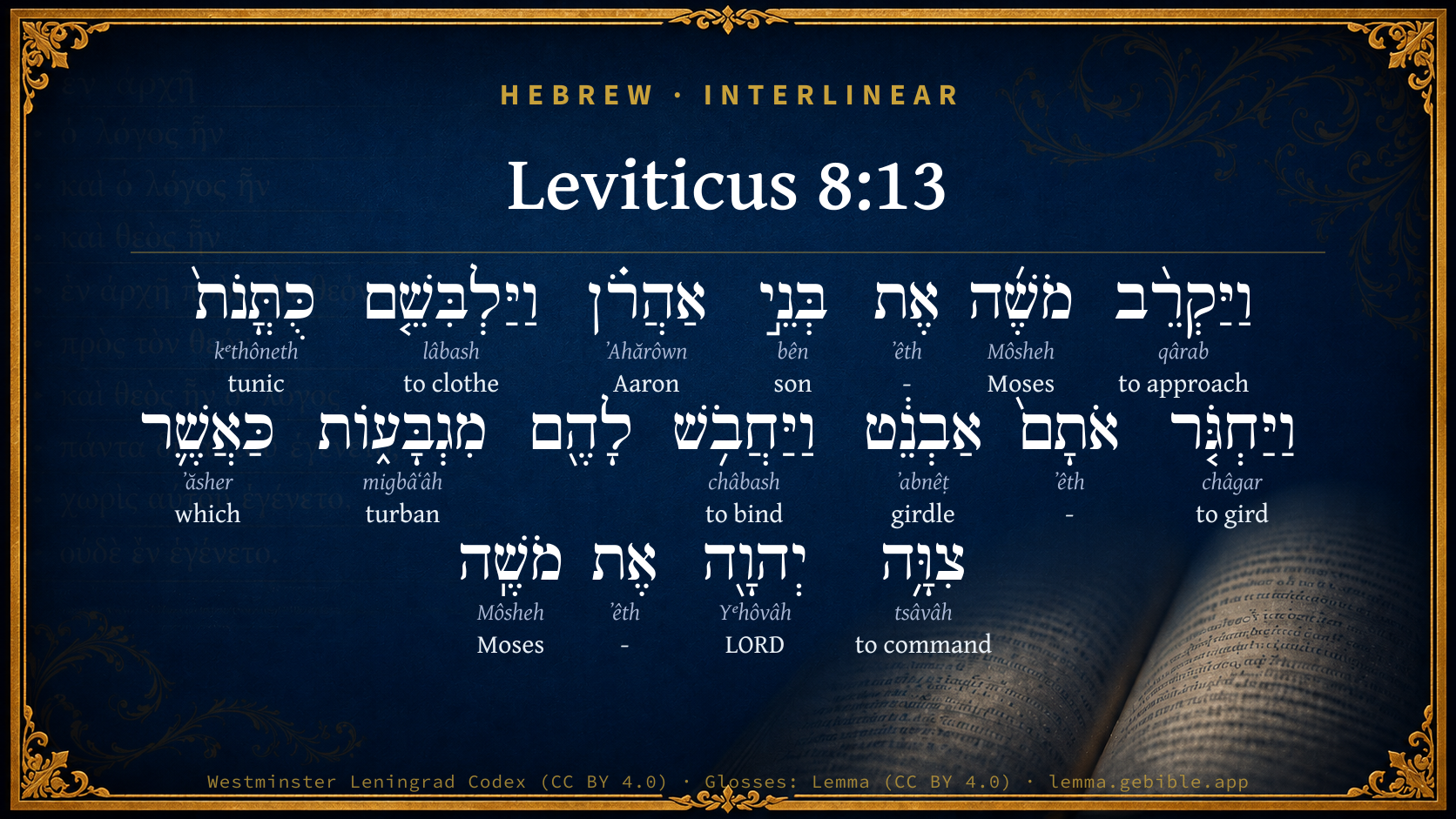
Leviticus 8:13

Hebrew (Westminster Leningrad Codex) Leviticus 8:13 appears in the Hebrew Old Testament. The text above is from the Westminster Leningrad Codex. Each word links to its Strong’s number, a concise gloss, and parsing drawn from the Open Scriptures Hebrew Bible morphology. Click any word for its full Brown-Driver-Briggs (BDB) entry.
Download image
Cite this verse

Leviticus 8:13 (World English Bible). Public Domain. Lemma interlinear Bible study tool, https://lemma.gebible.app/v/leviticus/8/13.

Show BibTeX & RIS
BibTeX
RIS
English Translation
Moses brought Aaron's sons, and clothed them with coats, and tied sashes on them, and put headbands on them; as Yahweh commanded Moses.
World English Bible · Public Domain
Download a study sheet

One document with this verse’s original text, its word-by-word gloss line, the meaning frame, cross-references with their text, attributed commentary, and full source and license credits — printable, and it pastes into notes with its structure intact.

This verse Autodidact and up

Study sheet (.html) Plain text (.txt)

A passage Seminary Student

Up to 50 verses in one chapter. A passage sheet keeps up to 6 commentary sources and 12 cross-references per verse, in the order this page ranks them, and says so on the sheet whenever that leaves anything out. Ask for a single verse and you get the Autodidact verse sheet above.

Everything on this page stays free to read, with no account — the sheet is a download of what is already on screen, not access to it.

Want to remove ads? Support Godless Engineer
Compare translations 3

The same verse in 3 English versions, stacked beneath the original-language interlinear above. Click any original word for its lexicon entry.

Each is an independent rendering of the whole verse — the interlinear is not word-aligned to these translations.

Highlighted words mark where these versions differ — a whole-verse word diff, not a word-by-word alignment.

  • World English Bible Public Domain
    Moses brought Aaron's sons, and clothed them with coats, and tied sashes on them, and put headbands on them; as Yahweh commanded Moses.
  • King James Version Public Domain
    And Moses brought Aaron's sons, and put coats upon them, and girded them with girdles, and put bonnets upon them; as the LORD commanded Moses.
  • unfoldingWord Literal Text CC BY-SA 4.0
    And Moses presented the sons of Aaron, and he clothed them tunics, and he wrapped them sashes, and he bound headbands on them, just as Yahweh commanded Moses.

unfoldingWord Literal Text — © unfoldingWord, licensed CC BY-SA 4.0. Word-aligned USFM3 via Door43 (git.door43.org/unfoldingWord/en_ult).

Versions to compare (up to 4)

3 of 4 selected

Show all 18 translations

Every available English version of this verse, each an independent rendering of the whole verse.

  • World English Bible Public Domain
    Moses brought Aaron's sons, and clothed them with coats, and tied sashes on them, and put headbands on them; as Yahweh commanded Moses.
  • Berean Standard Bible Public Domain
    Then Moses presented Aaron’s sons, put tunics on them, wrapped sashes around them, and tied headbands on them, just as the LORD had commanded him.
  • Majority Standard Bible Public Domain
    Then Moses presented Aaron’s sons, put tunics on them, wrapped sashes around them, and tied headbands on them, just as the LORD had commanded him.
  • King James Version Public Domain
    And Moses brought Aaron's sons, and put coats upon them, and girded them with girdles, and put bonnets upon them; as the LORD commanded Moses.
  • American Standard Version (1901) Public Domain
    And Moses brought Aaron's sons, and clothed them with coats, and girded them with girdles, and bound head-tires upon them; as Jehovah commanded Moses.
  • Revised Version (1885) Public Domain
    And Moses brought Aaron’s sons, and clothed them with coats, and girded them with girdles, and bound headtires upon them; as the LORD commanded Moses.
  • Geneva Bible (1599) Public Domain
    After, Moses brought Aarons sonnes, and put coates vpon them, and girded them with girdles, and put bonets vpon their heades, as the Lord had commanded Moses.
  • Douay-Rheims (1899) Public Domain
    And after he had offered his sons, he vested them with linen tunicks, and girded them with girdles, and put mitres on them as the Lord had commanded.
  • Young's Literal Translation Public Domain
    And Moses bringeth near the sons of Aaron, and doth clothe them `with' coats, and girdeth them `with' girdles, and bindeth for them turbans, as Jehovah hath commanded Moses.
  • Literal Standard Version CC BY-SA 4.0
    And Moses brings the sons of Aaron near, and clothes them [with] coats, and girds them [with] girdles, and binds caps to them, as YHWH has commanded Moses.
  • Unlocked Literal Bible CC BY-SA 4.0
    Moses brought Aaron's sons and clothed them with tunics. He tied sashes around their waists and wrapped linen cloth around their heads, as Yahweh had commanded him.
  • unfoldingWord Literal Text CC BY-SA 4.0
    And Moses presented the sons of Aaron, and he clothed them tunics, and he wrapped them sashes, and he bound headbands on them, just as Yahweh commanded Moses.
  • Darby Bible Public Domain
    And Moses brought Aaron's sons near and clothed them with the vests, and girded them with the girdles, and bound the high caps on them, as Jehovah had commanded Moses.
  • World Messianic Bible Public Domain
    Moses brought Aaron’s sons, and clothed them with tunics, and tied sashes on them, and put headbands on them, as the LORD commanded Moses.
  • Webster's Bible Public Domain
    And Moses brought Aaron's sons, and put coats upon them, and girded them with girdles, and put bonnets upon them; as the LORD commanded Moses.
  • Free Bible Version CC BY-SA 4.0
    Then Moses had Aaron's sons come forward. He dressed them in tunics, tied sashes around them, and wrapped headbands on them, as the Lord had ordered him to do.
  • Bible in Basic English Public Domain
    Then he took Aaron's sons, clothing them with the coats, and putting the bands round them, and the head-dresses on their heads, as the Lord had given him orders.
  • JPS Tanakh (1917) Public Domain
    And Moses brought Aaron's sons, and clothed them with tunics, and girded them with girdles, and bound head-tires upon them; as the LORD commanded Moses.

Literal Standard Version (2020), Covenant Press — licensed CC BY-SA 4.0. Text via the HelloAO Bible API (eBible.org). Unlocked Literal Bible (unfoldingWord) — licensed CC BY-SA 4.0. Text via the HelloAO Bible API (eBible.org). unfoldingWord Literal Text — © unfoldingWord, licensed CC BY-SA 4.0. Word-aligned USFM3 via Door43 (git.door43.org/unfoldingWord/en_ult). Free Bible Version, Dr. Jonathan Gallagher — licensed CC BY-SA 4.0. Text via the HelloAO Bible API (eBible.org).

Word by word

More ways to search: Search by grammar → Find every occurrence → Compare this word →

Practice this passage: Drill this verse → Learn its vocabulary →

מִגְבָּע֑וֹת
migbâʻâh
H4021
“turbans”
Noun, Common, Feminine, Plural, Absolute
Part of Speech
Noun
Type
Common
Gender
Feminine
Number
Plural
State
Absolute
Full BDB Definition

Origin: from the same as H1389

TWOT: 309c

turban, head-gear
  1. וַיַּקְרֵ֨ב qârab H7126 “and · to approach” Conjunction + Verb, Hiphil, Sequential Imperfect, 3rd Person, Masculine, Singular
  2. מֹשֶׁ֜ה Môsheh H4872 “Moses” Noun, Proper
  3. אֶת ʼêth H853 “-” Particle, Direct Object
  4. בְּנֵ֣י bên H1121 “sons of” Noun, Common, Masculine, Plural, Construct
  5. אַהֲרֹ֗ן ʼAhărôwn H175 “Aaron” Noun, Proper
  6. וַיַּלְבִּשֵׁ֤ם lâbash H3847 “and · to clothe · them” Conjunction + Verb, Hiphil, Sequential Imperfect, 3rd Person, Masculine, Singular + Suffix, Personal, 3rd Person, Masculine, Plural
  7. כֻּתֳּנֹת֙ kᵉthôneth H3801 “tunics” Noun, Common, Feminine, Plural, Absolute
  8. וַיַּחְגֹּ֤ר châgar H2296 “and · to gird” Conjunction + Verb, Qal, Sequential Imperfect, 3rd Person, Masculine, Singular
  9. אֹתָם֙ ʼêth H853 “- · them” Particle, Direct Object + Suffix, Personal, 3rd Person, Masculine, Plural
  10. אַבְנֵ֔ט ʼabnêṭ H73 “girdle” Noun, Common, Masculine, Singular, Absolute
  11. וַיַּחֲבֹ֥שׁ châbash H2280 “and · to bind” Conjunction + Verb, Qal, Sequential Imperfect, 3rd Person, Masculine, Singular
  12. כַּאֲשֶׁ֛ר ʼăsher H834 “like/as · which” Preposition + Particle, Relative
  13. צִוָּ֥ה tsâvâh H6680 “to command” Verb, Piel, Perfect, 3rd Person, Masculine, Singular
  14. יְהוָ֖ה Yᵉhôvâh H3068 “LORD” Noun, Proper
  15. אֶת ʼêth H853 “-” Particle, Direct Object
  16. מֹשֶֽׁה Môsheh H4872 “Moses” Noun, Proper

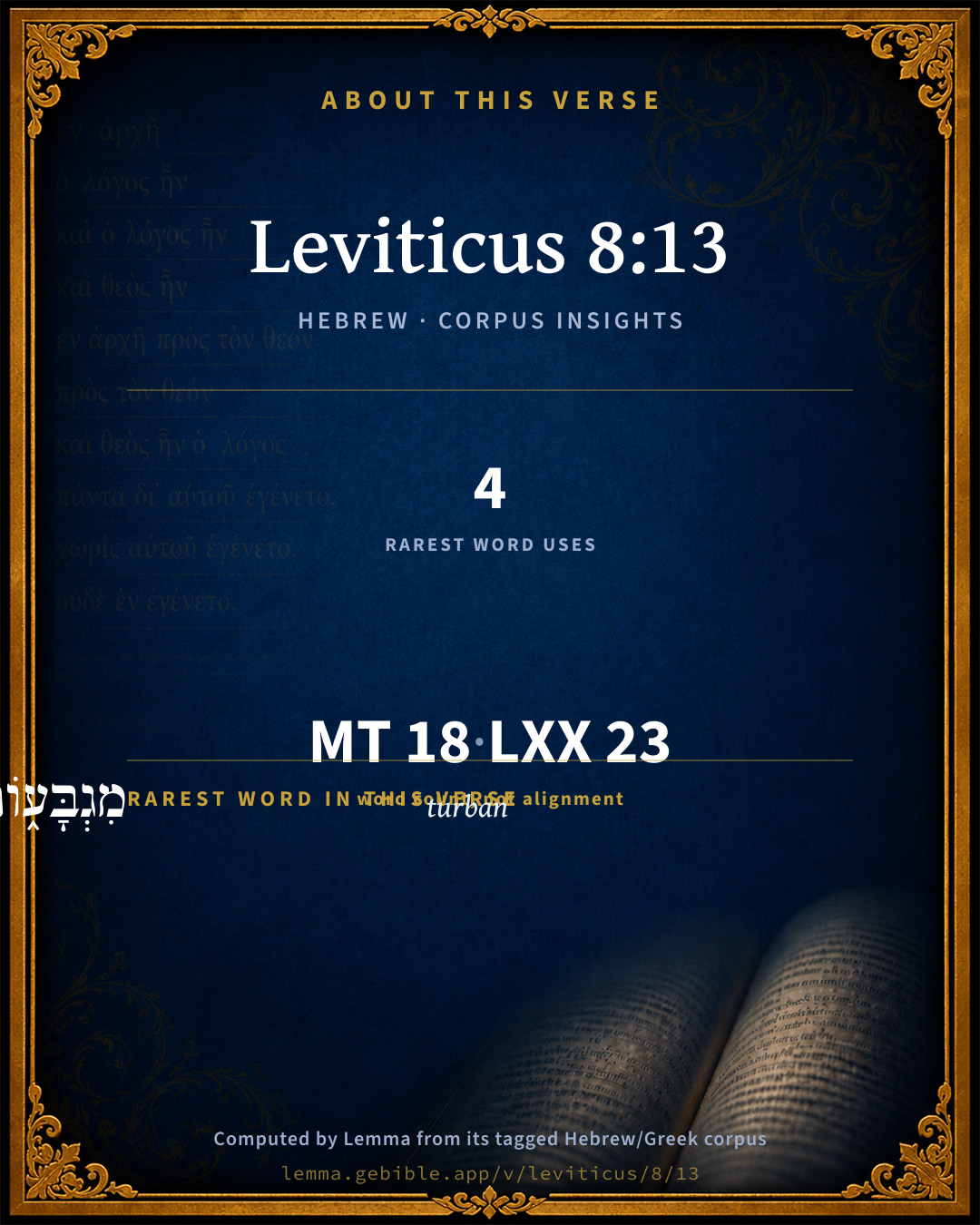
About this verse

These counts appear in no published source. They are computed here, from the morphology-tagged text and Lemma’s own curated glosses. What Lemma adds →

18
words
14
distinct lemmas
Pentateuch
section

Notable vocabulary

The rarest word here is מִגְבָּע֑וֹת turban H4021 — appearing just 4 times in the whole Hebrew Bible.

Shared distinctive vocabulary

מִגְבָּע֑וֹת turban H4021 occurs in 4 verses of the Hebrew Bible. Also found in:

Grammatical profile

  • 5 verbs
  • 8 nouns
  • 1 preposition
  • 4 particles

Verb forms

  • וַיַּקְרֵ֨ב Hiphil · Sequential Imperfect
  • וַיַּלְבִּשֵׁ֤ם Hiphil · Sequential Imperfect
  • וַיַּחְגֹּ֤ר Qal · Sequential Imperfect
  • וַיַּחֲבֹ֥שׁ Qal · Sequential Imperfect
  • צִוָּ֥ה Piel · Perfect

Repetition

A word recurs within this verse — often emphatic in Hebrew:

  • מֹשֶׁ֜ה Moses H4872 ×2

Hebrew & Septuagint length

In English translation the verse runs 23 words from the Hebrew and 28 from the Septuagint (LXX English) — closely comparable.

A rough comparison of the two English renderings, which tokenize alike — not a word-level alignment.

Word counts can differ between the Hebrew and the Greek without any difference in meaning — e.g. the Hebrew direct-object marker אֵת has no separate Greek word, and Greek often adds the article ὁ.

In the original languages it is 18 Hebrew tokens and 23 Greek tokens — but the two are counted differently (Hebrew bundles its prefixes and suffixes into one token; the Greek is in lemma form), so that isn’t a like-for-like length.

Cross-references

10

Topical passages linked to Leviticus 8:13 in the Treasury of Scripture Knowledge — connected by theme and wording, ordered by reader-vote popularity; previews shown in the World English Bible.

  • Exodus 29:8–9 You shall bring his sons, and put coats on them.
  • Exodus 28:40–41 "You shall make coats for Aaron's sons, and you shall make sashes for them and headbands shall you make for them, for glory and for beauty.
  • Exodus 40:14–15 You shall bring his sons, and put coats on them.
  • Psalms 132:9 Let your priest be clothed with righteousness. Let your saints shout for joy!"
  • Isaiah 61:6 But you shall be named the priests of Yahweh; men shall call you the ministers of our God: you shall eat the wealth of the nations, and in their glory shall you boast yourselves.
  • Isaiah 61:10 I will greatly rejoice in Yahweh, my soul shall be joyful in my God; for he has clothed me with the garments of salvation, he has covered me with the robe of righteousness, as a bridegroom decks himself with a garland, and as a bride adorns herself with her jewels.
  • 1 Peter 2:5 You also, as living stones, are built up as a spiritual house, to be a holy priesthood, to offer up spiritual sacrifices, acceptable to God through Jesus Christ.
  • 1 Peter 2:9 But you are a chosen race, a royal priesthood, a holy nation, a people for God's own possession, that you may show forth the excellencies of him who called you out of darkness into his marvelous light:
  • Revelation 1:6 and he made us to be a Kingdom, priests to his God and Father; to him be the glory and the dominion forever and ever. Amen.
  • Revelation 5:10 And made them kings and priests to our God, And they reign on earth."

Cross-references courtesy of OpenBible.info (CC BY 4.0).

Hebrew and Greek witnesses Masoretic Hebrew ↔ Greek Septuagint

The same verse in the two great witnesses to the Old Testament, shown verse-for-verse.

These are two independent witnesses, not word-aligned to each other, and the Septuagint is shown in lemma (dictionary) form.

Hebrew Leviticus 8:13 Masoretic · Westminster Leningrad Codex

וַיַּקְרֵ֨ב מֹשֶׁ֜ה אֶת בְּנֵ֣י אַהֲרֹ֗ן וַיַּלְבִּשֵׁ֤ם כֻּתֳּנֹת֙ וַיַּחְגֹּ֤ר אֹתָם֙ אַבְנֵ֔ט וַיַּחֲבֹ֥שׁ לָהֶ֖ם מִגְבָּע֑וֹת כַּאֲשֶׁ֛ר צִוָּ֥ה יְהוָ֖ה אֶת מֹשֶֽׁה

Moses brought Aaron's sons, and clothed them with coats, and tied sashes on them, and put headbands on them; as Yahweh commanded Moses.

World English Bible · Public Domain

Greek LXX Leviticus 8:13 Septuagint · lemma form

καί προςἄγω μωυσῆς ὁ υἱός ἀαρών καί ἐνδύω αὐτός χιτών καί ζωννύω αὐτός ζωνή καί περιτίθημι αὐτός κίδαρις καθάπερ συντάσσω κύριος ὁ μωυσῆς

And Moses brought the sons of Aaron near, and put on them coats and girded them with girdles, and put on them bonnets, as the Lord commanded Moses.

LXX2012 (modern English Septuagint) · Public Domain

Hebrew: Westminster Leningrad Codex (CC BY 4.0). Greek: Septuagint (public domain); English from LXX2012 (modern English Septuagint) (Public Domain). How the Septuagint differs from the Hebrew →

Targum (Aramaic paraphrase)

2

The Targum is the ancient Jewish Aramaic paraphrase of the Hebrew Scriptures — an interpretive translation, not the Hebrew text itself. Onkelos (literal) and Pseudo-Jonathan (expansive) render the Torah, and Jonathan the Prophets. Coverage is partial: where no permissively-licensed English translation exists for a verse, only the Aramaic is shown. This is verse-level text, not a word-by-word alignment to the Hebrew.

  1. Targum Onkelos Torah (Genesis–Deuteronomy)
    וְקָרִיב מֹשֶׁה יָת בְּנֵי אַהֲרֹן וְאַלְבֵּשִׁנוּן כִּתּוּנִין וְזָרֵז יָתְהוֹן הֶמְיָנִין וְאַתְקֵן לְהוֹן כּוֹבָעִין כְּמָא דִי פַקִיד יְיָ יָת מֹשֶׁה

    (no public-domain English translation for this verse)

    Targum Onkelos — Aramaic: “Onkelos Genesis” (public domain); “Onkelos Exodus” (public domain); “Onkelos Leviticus” (public domain); “Onkelos Numbers” (public domain); “Onkelos Deuteronomy” (public domain). English: “Sefaria Community Translation” (CC0 1.0 (public-domain dedication)); “J.W. Etheridge. The Targums of Onkelos and Jonathan Ben Uzziel on the Pentateuch. London: Longmans, Green, 1862” (public domain). Text via Sefaria.

  2. Targum Pseudo-Jonathan Torah (Genesis–Deuteronomy)
    וְקָרֵיב משֶׁה יַת אַהֲרן וְיַת בְּנוֹי וְאַלְבְּשִׁינוּן כִּתּוּנִין וְזָרִיז יַתְהוֹן קְמוּרִין וּחְבַשׁ לְהוֹן כּוֹבְעִין הֵיכְמָא דְפַקֵיד יְיָ יַת משֶׁה

    And Mosheh brought near Aharon and his sons, and clothed them with vestments, and girded them with girdles, and decked them with mitres, as the Lord commanded Mosheh.

    Targum Pseudo-Jonathan — Aramaic: “Targum Jonathan on Genesis” (public domain); “Targum Jonathan on Exodus” (public domain); “Targum Jonathan on Leviticus” (public domain); “Targum Jonathan on Numbers” (public domain); “Targum Jonathan on Deuteronomy” (public domain). English: “The Targum of Jonathan ben Uzziel, trans. J. W. Etheridge, London, 1862” (public domain). Text via Sefaria.

Commentary

Notes on Leviticus 8:13 from classic Christian and Jewish commentators (each source and its license shown beneath its notes). The classic Christian expositions comment on the surrounding passage and are grouped to its opening verse, so a note may address several verses; the Jewish commentaries on the Tanakh (Rashi and others) are per-verse, so they appear only where the commentator wrote on this verse.

Lemma curates 59 commentaries, every one of them public domain or Creative Commons licensed, each selected and text-cleaned for this edition rather than reprinted as found. About our sources →

Tyndale Open Study Notes

Tyndale Open Resources

8:13 For the attire of the common priests, see Exod 28:40-41.

Tyndale Open Study Notes — © Tyndale Open Resources, licensed CC BY-SA 4.0. Text via the HelloAO Bible API.

Ellicott's Commentary for English Readers

(13) And Moses brought Aaron’s sons.—Having consecrated the father as high priest, Moses now invests Aaron’s four sons, Nadab, Abihu, Eleazar, and Ithamar, with the visible signs of the priestly office by robing them in the sacerdotal garments. For these articles of dress see Exo_28:40-41; Exo_29:30; Exo_40:14.

A Bible Commentary for English Readers, edited by Charles John Ellicott (1878–1897) — public domain. Text from a community e-Sword module.

The Cambridge Bible for Schools and Colleges

gen. ed. J. J. S. Perowne

13. Aaron’s sons are clothed with tunics, sashes, and caps. The tunics and sashes are not described; whether they were less elaborate than those of the high priest does not appear, but is probable. The caps (headtires R.V., bonnets A.V.) were of fine linen (Exo_39:28), and the Heb. word is used only of the head-gear of the ordinary priests. The description of Josephus (Ant. iii. 7. 3) is not very clear. See on Lev_8:9, and the note on Exo_28:40.

The Cambridge Bible for Schools and Colleges (gen. ed. J. J. S. Perowne; Cambridge University Press, 1878–1918) — public domain. Text from a community e-Sword module.

John Gill's Exposition

And Moses brought Aaron's sons,.... His four sons, Nadab and Abihu, Eleazar and Ithamar, to the door of the tabernacle of the congregation; he ordered and directed them to come there, or sent proper persons to fetch them, or from one part of the court, where they were, he might accompany them thither:

and put coats upon them, and girded them with girdles: which were made of fine linen, Exo 39:27 and the coats being made long to reach down to the ankles, needed girdles, especially when in service, that they might perform it more expeditiously:

and put bonnets on them; which were made of fine linen also, and differed from the mitre of the high priest only in the manner of rolling up the linen:

as the Lord commanded Moses; as all the above things were made, so they were all put on, according to the directions Moses received of the Lord, who was faithful in his house, with respect to everything he enjoined him, Heb 3:2.

John Gill's Exposition of the Whole Bible (1746–1763) — public domain (CC PDM 1.0). Text via the HelloAO Bible API.

Albert Barnes' Notes on the Bible

Aaron’s sons - The common priests. Nothing is said here, or in Exo 29:7-9, of the anointing of the common priests, though it is expressly commanded in Exo 28:41; Exo 40:15, and is evidently implied as a fact in Lev 7:36; Lev 10:7; Num 3:3. It would seem that the anointing of the common priests consisted in some rite common to them and the high priest Exo 40:15, and this was the sprinkling mentioned in Lev 8:30. Compare further Lev 10:7 with Lev 21:12.

Albert Barnes' Notes on the Bible (1834–1885) — public domain. Text from a community e-Sword/MySword module.

Haydock's Catholic Bible Commentary

Linen. Aquila translates "inward." It was next to the skin. --- Mitres, caps, Exodus xxviii. 4. These were the garments of priests. Those of the Levites are not particularized. About six years before the destruction of the temple by Titus, the Levites obtained of Agrippa leave to wear the linen tunic, which was deemed a great innovation, seldom left unpunished. (Josephus, Antiquities xx. 8.)

George Leo Haydock (1774–1849), Haydock's Catholic Family Bible and Commentary, 1859 edition — public domain. Excludes Psalms (Douay-Rheims chapter numbering differs from Protestant) and Deuterocanonical books (Catholic canon only).

Whedon's Commentary on the Bible

Daniel D. Whedon

13. Bonnets — This word is still used by the Scotch to signify a cap for the head of a man. Hence Walter Scott sings, “And plaids and bonnets waving high.” But its general modern use is restricted to the head covering of a female. The Hebrew means hill shaped, suggesting the conical form of this linen cap. According to Josephus it was a helmet of linen, one wreath being plaited and folded over another, and a thin cap, suited to its shape, put over all to prevent its unfolding.

Daniel D. Whedon (gen. ed.), Commentary on the Old and New Testaments (1874–1909) — public domain. Text from a community e-Sword module.

The Pulpit Commentary

The investiture of Aaron"s sons Nadab, Abihu, Eleazar, Ithamar follows the consecration of their father. They are robed, according as the Lord commanded Moses in Exo_28:40, in the white tunic, the sash, and the cap. But there is no statement here of their being anointed, although their anointing is ordered in Exo_28:41, and still more imperatively in Exo_40:15. They are spoken of as "anointed" in Lev_7:36, and as having "the anointing oil of the Lord upon them" in Lev_10:7. On the other hand, the high priest is specially designated as "the priest that is anointed". (Lev_4:3) It is probable that the personal anointing of the ordinary priests was confined to their being sprinkled with oil, as described below in verse 30; but that they were regarded as virtually anointed in Aaron"s anointing. The Levites had no special dress until they obtained permission from Herod Agrippa I. to wear the priestly robes (Joseph., "Ant.," 20:9, 6).

Vers. 13-21. The vesting of the priests and the offerings for them.

In the order of the ceremonies at the consecration of the priests, after the anointing of Aaron, we have

I THE CLOTHING OF AARON"S SONS. (Verse 13)

1. They were types of Christians.

(1) The high priest, as we have seen, was a type of Christ. So were the priests in general types also of him, viz. in everything in which they acted as representatives of the high priest.

(2) But under usual conditions they should be viewed as emblems of Christians. This is evidently taught in such references as Exo_19:6 Heb_10:9-22 1Pe_2:9 Rev_1:6 Rev_5:10.

2. Their holy garments resembled some of Aaron"s.

(1) Aaron had some by which he was distinguished from his sons, and so has Christ unique qualities. In everything pertaining to his Divinity he stands alone. He claims the deepest reverence.

(2) The coats and girdles which Moses put upon the sons of Aaron were similar to those articles bearing the same name in which Aaron was clothed. In Aaron"s case, as we have seen, they denoted purity and truth; and so do they denote these qualities in relation to his sons. (see Eph_6:14 Rev_19:8)

(3) This identity suggests that Christians have their righteousness in virtue of their association with Christ. (see Jer_23:6 Rom_3:22 1Co_1:30 Php_3:9) This is otherwise shown in the fact that the claim of the Levitical priests to those holy garments was in virtue of their being sons of Aaron. Only the "seed" of Messiah, (Isa_53:10, Isa_53:11) are clothed in the "white linen which is the righteousness of the saints.

3. Moses also "put bonnets upon them.

a. These, like the coats, were made of white linen, and so, likewise, expressed purity. They were similar to the turban of Aaron, minus the "plate of the holy crown of pure gold," and its fastenings of lacework of blue. (Exo_39:30, Exo_39:31)

b. These bonnets were "for glory and for beauty". (Exo_28:40) For "glory," i.e. , honour, viz. as they served to distinguish the priests as the ministers of God. If a messenger be despised, his message may be brought into contempt. And for "beauty," viz. as they represented the "beauty of holiness." True Christian honour is evermore the associate of holiness.

II THE OFFERINGS FOR THE PRIESTS. In respect to these we observe:

1. The priests laid their hands upon the heads of the animals (verses 14, 18).

(1) This was the sign of the confession of sin. It was also the sign of the transfer of sin, so constituting the animal (in type) vicariously a sinner or sin-bearer, liable to suffer its penalty

(2) The next thing in order, therefore, was the bleeding of the animal, in consideration of which the offerer stands justified or released from the obligation to suffer.

(3) The reference in all this to the vicarious sacrifice of Christ and our justification through faith in him cannot be mistaken.

(4) But why did Aaron, the type of Christ, act thus? Christ had no sin of his own to confess, and needed no sacrifice for himself. The answer is that Aaron, in this, acted not as a type of Christ, but for himself as a sinful man, and representatively for the people. (see Heb_5:1-3) In this Aaron is contrasted with Jesus. (see Heb_7:26-28)

2. The altar was purified with the blood (verses 15, 19).

(1) The earth, as the altar upon which the great Antitype was offered, is purified by his blood.

(a) As respects its inhabitants.

(b) As respects itself. The inheritance of man is also redeemed by Christ from the curse of sin.

(c) The full effects of this will be seen "in the regeneration" or renewed state of the earth indicated in prophecy.

(2) The altar was purified with the typical blood "to make reconciliation upon it." So is this earth for the same purpose sanctified by the blood of Jesus. There is no other planet, at least so far as we are concerned, thus sanctified. Therefore if we be not here "reconciled to God through the death of his Son," there is no hope for reconciliation hereafter or elsewhere. (see Heb_10:26, Heb_10:27)

3. The offerings were presented upon the altar.

(1) In the case of the sin offering, the fat was burnt upon the altar, while the body of the beast was burnt without the camp (verses 16, 17). Not only was Christ offered up as a sacrifice for sin generally upon this earth, but more particularly "without the gate," viz. of Jerusalem. (comp. Heb_13:11, Heb_13:12)

(2) In the case of the burnt offering, the whole ram was burnt upon the altar. This holocaust showed how absolutely God claims us, and therefore how completely we should be devoted, and, so to speak, consumed, in his worship and service. J.A.M. (Psa_69:9 Joh_2:13-17)

Vers. 13-36. The sacrifices of consecration.

Aaron and his sons. Holy week of separation. "So Aaron and his sons did all things which the Lord commanded by the hand of Moses." Moses, the mediator of the covenant, consecrated those who should afterwards fulfill the functions of the sanctuary. The order of the sacrifices was:

1. The sin offering.

2. The burnt offering.

3. The peace offering. Or

a. expiation,

b. obedience,

c. acceptance

the three great facts of the covenant life of God"s people. That all these should be included in the consecration of the priesthood betokened the entire subordination of that mere temporary mediation to the fundamental relation between God and man. The priest was between the holiness of God and the sinfulness of men in any other sense than as a servant of that covenant which came out of the free grace of God. Here there is

I THE TRUE BASIS OF RELIGION set forth. It rests on

(1) the universal necessity of man, and

(2) the universality of Divine grace.

Illustrate from history of man"s religions how this basis has been ignored. Priesthood raised above people as though holy in themselves. Favouritism in heaven the exciting motive to sacrifices. Merit in man the measure of peace.

II The typical significance of the Mosaic economy pointing to the PERFECTION OF THE DIVINE PROVISION FOE HUMAN SALVATION. All the priests, Aaron and his sons, are sinful, and require sacrifices of atonement. Their confession of imperfection was itself an appeal to God to supply the sinless priest, the perfect service, the everlasting mediation. Jesus Christ the High Priest.

1. His official perfection, arising out of his personal dignity as Son of God, and yet able to sympathize with those for whom he intercedes as Son of man. Spotless purity and perfect obedience could alone satisfy the requirements of a perfect Law.

2. Our faith in Christ sees in him not only a priestly Person, but a Sacrifice actually offered. The true sacrificial work of Christ was not merely his humiliation in living a human life, but his death on the cross, which was supremely the offering up of his blood, his life, as a true substitution for man. The death of the victim was a necessary part of the ceremony. Thus our High Priest must enter the holiest with blood, and no blood but his own could represent the whole humanity of man offered up-no sufferings but his could express perfect fulfillment of the Father"s will.

3. The priesthood of Christ secures our acceptance, and makes our religious life liberty, not bondage. R.

The Pulpit Commentary (1880–1919), ed. H.D.M. Spence-Jones & Joseph S. Exell — public domain. Text from a community e-Sword module.

Rashi

Rabbi Shlomo Yitzchaki (Rashi)

ויחבש — This is a term meaning binding.

Rashi on the Tanakh — English translations: “The Judaica Press complete Tanach with Rashi, translated by A. J. Rosenberg” (CC BY 4.0); “Pentateuch with Rashi's commentary by M. Rosenbaum and A.M. Silbermann, 1929-1934” (public domain); “The Metsudah Tanach series, Lakewood, N.J” (CC BY 4.0); and “The Book of Joshua, Metsudah Publications, 1997” (CC BY 4.0). Text via Sefaria.

Lesson kit

Teaching starters — assembled from the data on this page, not authored interpretation. Every prompt links to the verse data it draws on. Edit before teaching.

Leviticus, in the Pentateuch, opens this verse with 18 words (14 distinct Hebrew lemmas). Its most distinctive word is migbâʻâh (“turban”). A historical commentator’s framing appears above. Read the whole chapter for the surrounding context.

Discussion questions

  1. The word migbâʻâh carries the sense “turban.” How does it shape the verse?
  2. Exodus 28:40 shares the word «turban» with this verse. How do the two illuminate each other?
  3. “Moses” occurs 2× in this one verse. What is the effect of the repetition?
  4. The translations on this page render this verse differently — a whole-verse word diff, not a word-by-word alignment. What might account for the different wordings?
  5. The verb «וַיַּקְרֵ֨ב» is Hiphil Sequential Imperfect. How does its form color the action?
  6. Reading how Tyndale Open Study Notes and Ellicott's Commentary for English Readers read this verse, where do the two commentators agree and where do they part?

Things to notice

Reading settings

Reading text

Shown beneath each verse's original-language words.

Old Testament
Old Testament edition

Read the OT as the Masoretic Hebrew (MT) or the Greek Septuagint (LXX).

English shown for the Greek Septuagint (in the Hebrew ↔ Greek comparison).

Comparing translations? Open the Compare panel on any verse page to stack up to four side by side.