
Leviticus 14:12

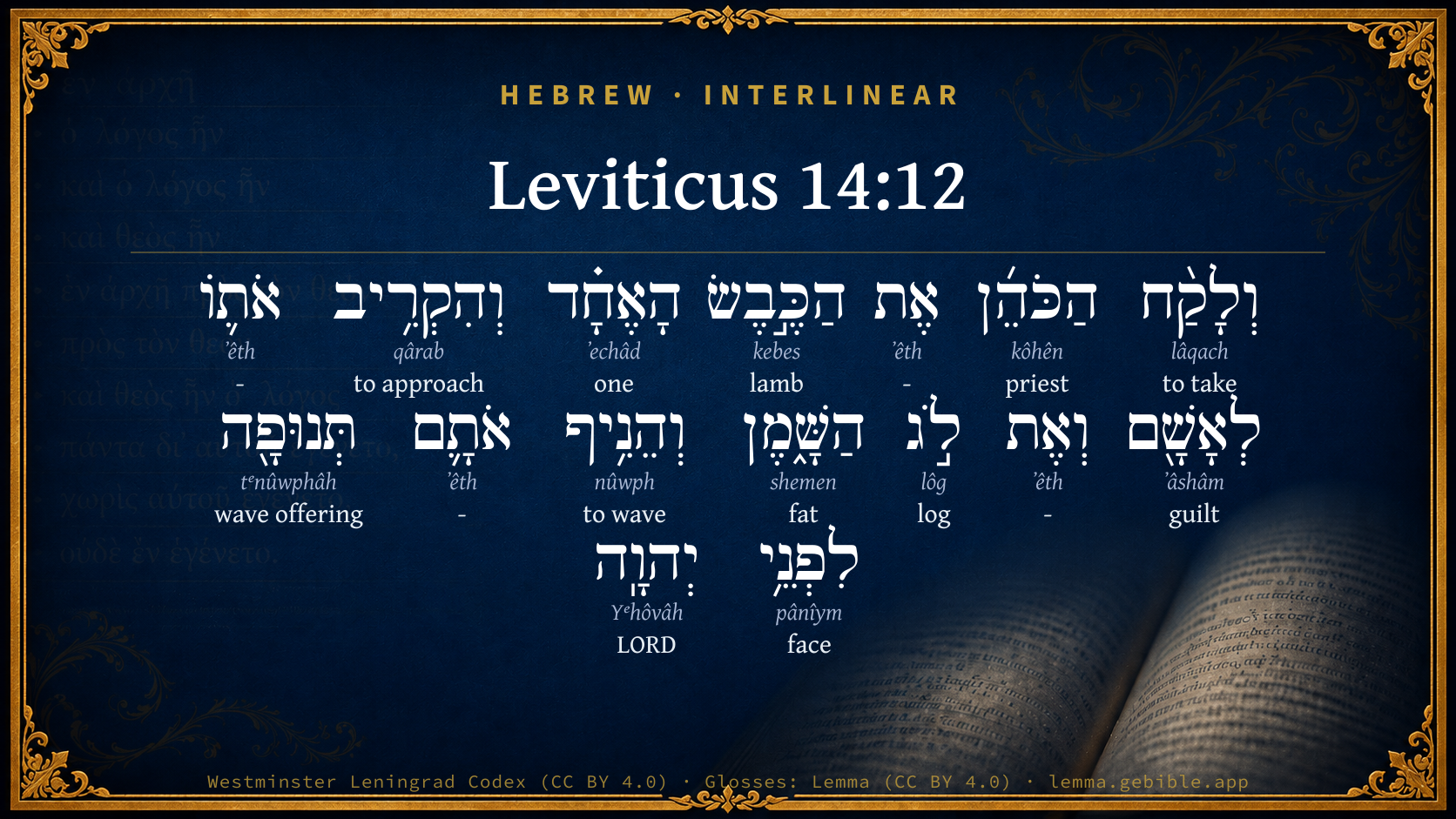
Hebrew (Westminster Leningrad Codex) Leviticus 14:12 appears in the Hebrew Old Testament. The text above is from the Westminster Leningrad Codex. Each word links to its Strong’s number, a concise gloss, and parsing drawn from the Open Scriptures Hebrew Bible morphology. Click any word for its full Brown-Driver-Briggs (BDB) entry.
Download image
Cite this verse

Leviticus 14:12 (World English Bible). Public Domain. Lemma interlinear Bible study tool, https://lemma.gebible.app/v/leviticus/14/12.

Show BibTeX & RIS
BibTeX
RIS
English Translation
"The priest shall take one of the male lambs, and offer him for a trespass offering, with the log of oil, and wave them for a wave offering before Yahweh.
World English Bible · Public Domain
Download a study sheet

One document with this verse’s original text, its word-by-word gloss line, the meaning frame, cross-references with their text, attributed commentary, and full source and license credits — printable, and it pastes into notes with its structure intact.

This verse Autodidact and up

Study sheet (.html) Plain text (.txt)

A passage Seminary Student

Up to 50 verses in one chapter. A passage sheet keeps up to 6 commentary sources and 12 cross-references per verse, in the order this page ranks them, and says so on the sheet whenever that leaves anything out. Ask for a single verse and you get the Autodidact verse sheet above.

Everything on this page stays free to read, with no account — the sheet is a download of what is already on screen, not access to it.

Want to remove ads? Support Godless Engineer
Compare translations 3

The same verse in 3 English versions, stacked beneath the original-language interlinear above. Click any original word for its lexicon entry.

Each is an independent rendering of the whole verse — the interlinear is not word-aligned to these translations.

Highlighted words mark where these versions differ — a whole-verse word diff, not a word-by-word alignment.

  • World English Bible Public Domain
    "The priest shall take one of the male lambs, and offer him for a trespass offering, with the log of oil, and wave them for a wave offering before Yahweh.
  • King James Version Public Domain
    And the priest shall take one he lamb, and offer him for a trespass offering, and the log of oil, and wave them for a wave offering before the LORD:
  • unfoldingWord Literal Text CC BY-SA 4.0
    And the priest shall take one lamb, and he shall present it as a guilt offering, and the log of oil. And he shall raise them a raised offering to the face of Yahweh.

unfoldingWord Literal Text — © unfoldingWord, licensed CC BY-SA 4.0. Word-aligned USFM3 via Door43 (git.door43.org/unfoldingWord/en_ult).

Versions to compare (up to 4)

3 of 4 selected

Show all 18 translations

Every available English version of this verse, each an independent rendering of the whole verse.

  • World English Bible Public Domain
    "The priest shall take one of the male lambs, and offer him for a trespass offering, with the log of oil, and wave them for a wave offering before Yahweh.
  • Berean Standard Bible Public Domain
    Then the priest is to take one of the male lambs and present it as a guilt offering, along with the log of olive oil; and he must wave them as a wave offering before the LORD.
  • Majority Standard Bible Public Domain
    Then the priest is to take one of the male lambs and present it as a guilt offering, along with the log of olive oil; and he must wave them as a wave offering before the LORD.
  • King James Version Public Domain
    And the priest shall take one he lamb, and offer him for a trespass offering, and the log of oil, and wave them for a wave offering before the LORD:
  • American Standard Version (1901) Public Domain
    And the priest shall take one of the he-lambs, and offer him for a trespass-offering, and the log of oil, and wave them for a wave-offering before Jehovah:
  • Revised Version (1885) Public Domain
    and the priest shall take one of the he-lambs, and offer him for a guilt offering, and the log of oil, and wave them for a wave offering before the LORD:
  • Geneva Bible (1599) Public Domain
    Then the Priest shall take one lambe, and offer him for a trespasse offering, and the pint of oyle, and shake the to and from before the Lord.
  • Douay-Rheims (1899) Public Domain
    He shall take a. lamb, and offer it for a trespass offering with the sextary of oil: and having offered all before the Lord,
  • Young's Literal Translation Public Domain
    and the priest hath taken the one he-lamb, and hath brought it near for a guilt-offering, also the log of oil, and hath waved them -- a wave offering before Jehovah.
  • Literal Standard Version CC BY-SA 4.0
    and the priest has taken one male lamb, and has brought it near for a guilt-offering, also the log of oil, and has waved them [as] a wave-offering before YHWH.
  • Unlocked Literal Bible CC BY-SA 4.0
    The priest will take one of the male lambs and offer it as a guilt offering, together with the log of oil; he will wave them for a wave offering before Yahweh.
  • unfoldingWord Literal Text CC BY-SA 4.0
    And the priest shall take one lamb, and he shall present it as a guilt offering, and the log of oil. And he shall raise them a raised offering to the face of Yahweh.
  • Darby Bible Public Domain
    And the priest shall take one he-lamb, and present it for a trespass-offering, and the log of oil, and wave them as a wave-offering before Jehovah.
  • World Messianic Bible Public Domain
    “The priest shall take one of the male lambs, and offer him for a trespass offering, with the log of oil, and wave them for a wave offering before the LORD.
  • Webster's Bible Public Domain
    And the priest shall take one he-lamb, and offer him for a trespass-offering, and the log of oil, and wave them for a wave-offering before the LORD.
  • Free Bible Version CC BY-SA 4.0
    The priest will take one of the male lambs and present it as a guilt offering, together with the log of olive oil; and he will wave them before the Lord as a wave offering.
  • Bible in Basic English Public Domain
    And the priest is to take one of the male lambs and give it as an offering for wrongdoing, and the log of oil, waving them for a wave offering before the Lord;
  • JPS Tanakh (1917) Public Domain
    And the priest shall take one of the he-lambs, and offer him for a guilt-offering, and the log of oil, and wave them for a wave-offering before the LORD.

Literal Standard Version (2020), Covenant Press — licensed CC BY-SA 4.0. Text via the HelloAO Bible API (eBible.org). Unlocked Literal Bible (unfoldingWord) — licensed CC BY-SA 4.0. Text via the HelloAO Bible API (eBible.org). unfoldingWord Literal Text — © unfoldingWord, licensed CC BY-SA 4.0. Word-aligned USFM3 via Door43 (git.door43.org/unfoldingWord/en_ult). Free Bible Version, Dr. Jonathan Gallagher — licensed CC BY-SA 4.0. Text via the HelloAO Bible API (eBible.org).

Word by word

More ways to search: Search by grammar → Find every occurrence → Compare this word →

Practice this passage: Drill this verse → Learn its vocabulary →

לֹ֣ג
lôg
H3849
“log of”
Noun, Common, Masculine, Singular, Construct
Part of Speech
Noun
Type
Common
Gender
Masculine
Number
Singular
State
Construct
Full BDB Definition

Origin: from an unused root apparently meaning to deepen or hollow [like H3537 ]

TWOT: 1076

log - a liquid measure equal to about one half litre
  1. וְלָקַ֨ח lâqach H3947 “and · to take” Conjunction + Verb, Qal, Sequential Perfect, 3rd Person, Masculine, Singular
  2. הַכֹּהֵ֜ן kôhên H3548 “the · priest” Particle, Definite Article + Noun, Common, Masculine, Singular, Absolute
  3. אֶת ʼêth H853 “-” Particle, Direct Object
  4. הַכֶּ֣בֶשׂ kebes H3532 “the · lamb” Particle, Definite Article + Noun, Common, Masculine, Singular, Absolute
  5. הָאֶחָ֗ד ʼechâd H259 “the · one” Particle, Definite Article + Adjective, Cardinal number, Masculine, Singular, Absolute
  6. וְהִקְרִ֥יב qârab H7126 “and · to approach” Conjunction + Verb, Hiphil, Sequential Perfect, 3rd Person, Masculine, Singular
  7. אֹת֛וֹ ʼêth H853 “- · him” Particle, Direct Object + Suffix, Personal, 3rd Person, Masculine, Singular
  8. לְאָשָׁ֖ם ʼâshâm H817 “to/for · guilt” Preposition + Noun, Common, Masculine, Singular, Absolute
  9. וְאֶת ʼêth H853 “and · -” Conjunction + Particle, Direct Object
  10. הַשָּׁ֑מֶן shemen H8081 “the · fat” Particle, Definite Article + Noun, Common, Masculine, Singular, Absolute
  11. וְהֵנִ֥יף nûwph H5130 “and · to wave” Conjunction + Verb, Hiphil, Sequential Perfect, 3rd Person, Masculine, Singular
  12. אֹתָ֛ם ʼêth H853 “- · them” Particle, Direct Object + Suffix, Personal, 3rd Person, Masculine, Plural
  13. תְּנוּפָ֖ה tᵉnûwphâh H8573 “wave offering” Noun, Common, Feminine, Singular, Absolute
  14. לִפְנֵ֥י pânîym H6440 “to/for · face(s) of” Preposition + Noun, Common, Both, Plural, Construct
  15. יְהוָֽה Yᵉhôvâh H3068 “LORD” Noun, Proper

About this verse

These counts appear in no published source. They are computed here, from the morphology-tagged text and Lemma’s own curated glosses. What Lemma adds →

16
words
13
distinct lemmas
Pentateuch
section

Notable vocabulary

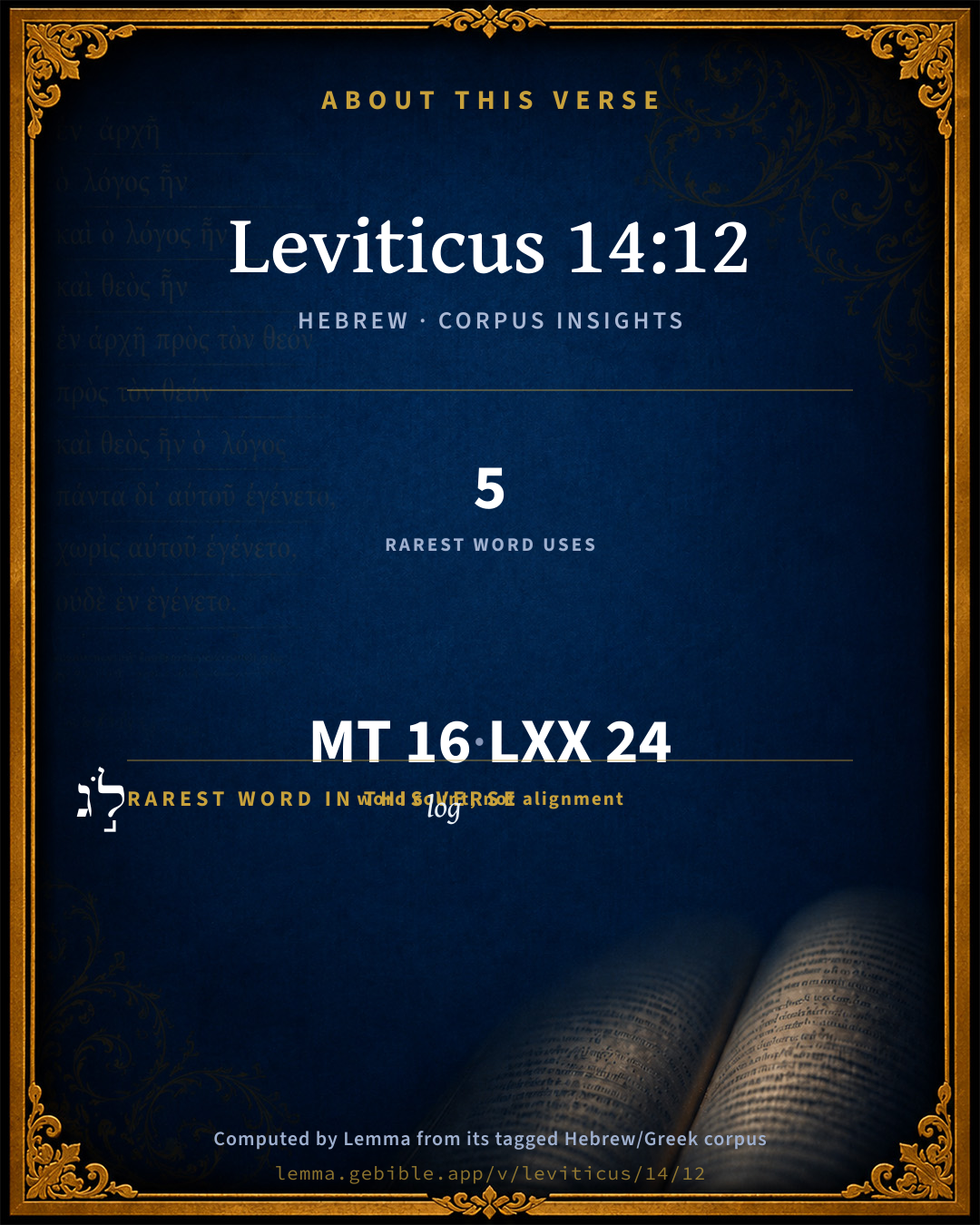
The rarest word here is לֹ֣ג log H3849 — appearing just 5 times in the whole Hebrew Bible.

Shared distinctive vocabulary

לֹ֣ג log H3849 occurs in 5 verses of the Hebrew Bible. Also found in:

Grammatical profile

  • 3 verbs
  • 8 nouns
  • 1 adjective
  • 4 particles

Verb forms

  • וְלָקַ֨ח Qal · Sequential Perfect
  • וְהִקְרִ֥יב Hiphil · Sequential Perfect
  • וְהֵנִ֥יף Hiphil · Sequential Perfect

Hebrew & Septuagint length

In English translation the verse runs 30 words from the Hebrew and 29 from the Septuagint (LXX English) — closely comparable.

A rough comparison of the two English renderings, which tokenize alike — not a word-level alignment.

Word counts can differ between the Hebrew and the Greek without any difference in meaning — e.g. the Hebrew direct-object marker אֵת has no separate Greek word, and Greek often adds the article ὁ.

In the original languages it is 16 Hebrew tokens and 24 Greek tokens — but the two are counted differently (Hebrew bundles its prefixes and suffixes into one token; the Greek is in lemma form), so that isn’t a like-for-like length.

Cross-references

7

Topical passages linked to Leviticus 14:12 in the Treasury of Scripture Knowledge — connected by theme and wording, ordered by reader-vote popularity; previews shown in the World English Bible.

  • Exodus 29:24 You shall put all of this in Aaron's hands, and in his sons' hands, and shall wave them for a wave-offering before Yahweh.
  • Leviticus 6:6–7 He shall bring his trespass offering to Yahweh, a ram without blemish from the flock, according to your estimation, for a trespass offering, to the priest.
  • Leviticus 5:2–3 "'Or if anyone touches any unclean thing, whether it is the carcass of an unclean animal, or the carcass of unclean cattle, or the carcass of unclean creeping things, and it is hidden from him, and he is unclean, then he shall be guilty.
  • Leviticus 5:6–7 and he shall bring his trespass offering to Yahweh for his sin which he has sinned, a female from the flock, a lamb or a goat, for a sin offering; and the priest shall make atonement for him concerning his sin.
  • Leviticus 5:18–19 He shall bring a ram without blemish from of the flock, according to your estimation, for a trespass offering, to the priest; and the priest shall make atonement for him concerning the thing in which he sinned and didn't know it, and he will be forgiven.
  • Leviticus 8:27–29 He put all these in Aaron's hands and in his sons' hands, and waved them for a wave offering before Yahweh.
  • Isaiah 53:10 Yet it pleased Yahweh to bruise him; he has put him to grief: when you shall make his soul an offering for sin, he shall see [his] seed, he shall prolong his days, and the pleasure of Yahweh shall prosper in his hand.

Cross-references courtesy of OpenBible.info (CC BY 4.0).

Hebrew and Greek witnesses Masoretic Hebrew ↔ Greek Septuagint

The same verse in the two great witnesses to the Old Testament, shown verse-for-verse.

These are two independent witnesses, not word-aligned to each other, and the Septuagint is shown in lemma (dictionary) form.

Hebrew Leviticus 14:12 Masoretic · Westminster Leningrad Codex

וְלָקַ֨ח הַכֹּהֵ֜ן אֶת הַכֶּ֣בֶשׂ הָאֶחָ֗ד וְהִקְרִ֥יב אֹת֛וֹ לְאָשָׁ֖ם וְאֶת לֹ֣ג הַשָּׁ֑מֶן וְהֵנִ֥יף אֹתָ֛ם תְּנוּפָ֖ה לִפְנֵ֥י יְהוָֽה

"The priest shall take one of the male lambs, and offer him for a trespass offering, with the log of oil, and wave them for a wave offering before Yahweh.

World English Bible · Public Domain

Greek LXX Leviticus 14:12 Septuagint · lemma form

καί λαμβάνω ὁ ἱερεύς ὁ ἀμνός ὁ εἷς καί προςἄγω αὐτός ὁ πλημμέλεια καί ὁ κοτύλη ὁ ἔλαιον καί ἀποὁρίζω αὐτός ἀφόρισμα ἔναντι κύριος

And the priest shall take one lamb, and offer him for a trespass-offering, and the cup of oil, and set them apart for a special offering before the Lord.

LXX2012 (modern English Septuagint) · Public Domain

Hebrew: Westminster Leningrad Codex (CC BY 4.0). Greek: Septuagint (public domain); English from LXX2012 (modern English Septuagint) (Public Domain). How the Septuagint differs from the Hebrew →

Targum (Aramaic paraphrase)

2

The Targum is the ancient Jewish Aramaic paraphrase of the Hebrew Scriptures — an interpretive translation, not the Hebrew text itself. Onkelos (literal) and Pseudo-Jonathan (expansive) render the Torah, and Jonathan the Prophets. Coverage is partial: where no permissively-licensed English translation exists for a verse, only the Aramaic is shown. This is verse-level text, not a word-by-word alignment to the Hebrew.

  1. Targum Onkelos Torah (Genesis–Deuteronomy)
    וְיִסַב כַּהֲנָא יָת אִמְרָא חֲדָא וִיקָרֵב יָתֵיהּ לַאֲשָּׁמָא וְיָת לֻגָא דְמִשְׁחָא וִירִים יָתְהוֹן אֲרָמָא קֳדָם יְיָ

    (no public-domain English translation for this verse)

    Targum Onkelos — Aramaic: “Onkelos Genesis” (public domain); “Onkelos Exodus” (public domain); “Onkelos Leviticus” (public domain); “Onkelos Numbers” (public domain); “Onkelos Deuteronomy” (public domain). English: “Sefaria Community Translation” (CC0 1.0 (public-domain dedication)); “J.W. Etheridge. The Targums of Onkelos and Jonathan Ben Uzziel on the Pentateuch. London: Longmans, Green, 1862” (public domain). Text via Sefaria.

  2. Targum Pseudo-Jonathan Torah (Genesis–Deuteronomy)
    וְיִסַב כַּהֲנָא יַת אִימְרָא חַד וִיקָרֵיב יָתֵיהּ לְקָרְבָּן אֲשָׁמָא וְיַת לוּגָא דְמִשְׁחָא וְיָרִים יַתְהוֹן אֲרָמָא קֳדָם יְיָ

    And the priest shall take one lamb, and offer him as an oblation for trespass, with the log of oil, and uplift them all elevation before the Lord.

    Targum Pseudo-Jonathan — Aramaic: “Targum Jonathan on Genesis” (public domain); “Targum Jonathan on Exodus” (public domain); “Targum Jonathan on Leviticus” (public domain); “Targum Jonathan on Numbers” (public domain); “Targum Jonathan on Deuteronomy” (public domain). English: “The Targum of Jonathan ben Uzziel, trans. J. W. Etheridge, London, 1862” (public domain). Text via Sefaria.

Commentary

Notes on Leviticus 14:12 from classic Christian and Jewish commentators (each source and its license shown beneath its notes). The classic Christian expositions comment on the surrounding passage and are grouped to its opening verse, so a note may address several verses; the Jewish commentaries on the Tanakh (Rashi and others) are per-verse, so they appear only where the commentator wrote on this verse.

Lemma curates 59 commentaries, every one of them public domain or Creative Commons licensed, each selected and text-cleaned for this edition rather than reprinted as found. About our sources →

Trapp's Complete Commentary

John Trapp

Lev 14:12 And the priest shall take one he lamb, and offer him for a trespass offering, and the log of oil, and wave them [for] a wave offering before the LORD:

Ver. 12. And wave them.] This may note, (1.) Christ’s extreme sufferings; (2.) The waving of Christ in the preaching of the gospel; (3.) The motion of the sinner’s lips in confession and supplication.

John Trapp, A Commentary or Exposition upon All the Books of the Old and New Testament (1647–1656) — public domain. Text from a community e-Sword module.

Joseph Benson's Commentary

Lev 14:12. A trespass-offering — This being the first time of the leper’s appearing in the assembly for God’s worship after his recovery, it was proper he should pay this public testimony of homage and gratitude to his deliverer, beginning with an act of humiliation for sin, which is the source of all those pains and diseases to which mankind are obnoxious.

Joseph Benson's Commentary on the Old and New Testaments (1811–1818) — public domain. Text from a community e-Sword module.

Tyndale Open Study Notes

Tyndale Open Resources

14:12 This guilt offering (sometimes called the “penalty offering” or “reparation offering”) was offered because the unclean person living outside the camp could not bring sacrifices, tithes, and offerings during the period of uncleanness (see 5:14-16).

Tyndale Open Study Notes — © Tyndale Open Resources, licensed CC BY-SA 4.0. Text via the HelloAO Bible API.

Adam Clarke's Commentary

Verse 12. Wave-offering] See Ex 29:27, and Le 7:38, where the reader will find an ample account of all the various offerings and sacrifices used among the Jews.

Adam Clarke's Commentary on the Bible (1810–1826) — public domain. Text from a community e-Sword/MySword module.

Ellicott's Commentary for English Readers

(12) And offer him for a trespass offering.—As leprosy was a Divine punishment for sin, the restored leper had to bring expiatory sacrifices. There is, however, a striking difference in the ritual of the leper’s trespass offering and the ordinary trespass offering described in Lev_5:6, &c. In the case before us, not-only did oil accompany it, but both the trespass offering and the oil were waved by the priest, which did not take place on any other occasion in connection with the trespass offering and sin offering. Indeed, in no other case was the entire victim waved before the Lord.

A Bible Commentary for English Readers, edited by Charles John Ellicott (1878–1897) — public domain. Text from a community e-Sword module.

The Cambridge Bible for Schools and Colleges

gen. ed. J. J. S. Perowne

12. and wave them for a wave offering before the Lord] The offerer usually took part in the waving; according to some, this act took place where the leper stood, and that he assisted in the ceremony; another view was that it took place before the altar, and the leper did not assist. See Appendix IV (Wave-Offering), pp. 183 ff.

The Cambridge Bible for Schools and Colleges (gen. ed. J. J. S. Perowne; Cambridge University Press, 1878–1918) — public domain. Text from a community e-Sword module.

John Gill's Exposition

And the priest shall take one he lamb,.... One of the he lambs brought by the leper for his offering:

and offer him for a trespass offering; for though the leprosy itself was a disorder or disease, and not sinful, yet the cause of it was sin, a trespass against God, and therefore a trespass offering must be offered: which was typical of Christ, whose soul was made a trespass offering, Isa 53:10; where the same word is used as here:

and the log of oil; See Gill on Lev 14:10,

and wave them for a wave offering before the Lord; heaving of them up and down, moving of them to and fro towards the several parts of the world, east, west, north, and south, even both the log of oil, and the he lamb for the trespass offering, and that alive, as Jarchi observes, and so says Maimonides (o).

(o) Hilchot Mechosre Capharah, c. 4. sect. 2.

John Gill's Exposition of the Whole Bible (1746–1763) — public domain (CC PDM 1.0). Text via the HelloAO Bible API.

Albert Barnes' Notes on the Bible

This trespass-offering, with its blood and the oil, must be regarded as the main feature in the ceremony: no alteration being permitted even in the case of the poor Lev 14:21-23. There appears to be no other case in which an entire victim was waved (see Lev 7:30) before Yahweh. The Levites are spoken of as “a wave offering,” Num 8:11-15 (see the margin). The man in this case, represented by his trespass-offering, was dedicated as a Wave-offering in like manner.

Albert Barnes' Notes on the Bible (1834–1885) — public domain. Text from a community e-Sword/MySword module.

Haydock's Catholic Bible Commentary

Offered. Hebrew, "elevated, or waved," as Exodus xxix. 24.

George Leo Haydock (1774–1849), Haydock's Catholic Family Bible and Commentary, 1859 edition — public domain. Excludes Psalms (Douay-Rheims chapter numbering differs from Protestant) and Deuterocanonical books (Catholic canon only).

Matthew Poole's English Annotations

For a trespass-offering, to teach them that sin was the cause of leprosy and of all diseases, and that these ceremonial observations had a further meaning, even to make them sensible of their spiritual diseases, their sins, and to fly to God in Christ for the cure of them.

Matthew Poole's English Annotations on the Holy Bible (1683–1685) — public domain. Text from a community e-Sword/MySword module.

Whedon's Commentary on the Bible

Daniel D. Whedon

12. Trespass offering — R.V., “guilt offering.” See chap. v, Introductory, also Lev_14:6, note. This offering was required, not as a payment of debts to Jehovah accumulated during the sickness, (Riem, Oehler, and Murphy,) but rather as a consecration offering, because this served as a restoration to all the rights of the priestly covenant nation, which had been suspended by the mortal ban of leprosy. This is shown by the fact that the asham, or trespass offering, was to be waved for a wave offering, an unusual ceremony in connexion with the asham, but used when persons are to be dedicated to the Lord, as were the Levites in Num_8:11-15, after their sin offering. For the manner and meaning of waving see Lev_7:30, note.

Most holy — Lev_2:3, note.

Daniel D. Whedon (gen. ed.), Commentary on the Old and New Testaments (1874–1909) — public domain. Text from a community e-Sword module.

The Pulpit Commentary

The log of oil, amounting to something more than half a pint, is waved by the priest, together with the lamb for the trespass offering, as a wave offering before the Lord, in order that a special consecration may be given them. They thus become qualified for the purposes for which they are presently used.

The Pulpit Commentary (1880–1919), ed. H.D.M. Spence-Jones & Joseph S. Exell — public domain. Text from a community e-Sword module.

John Wesley's Explanatory Notes

A trespass-offering - To teach them, that sin was the cause of leprosy, and of all diseases, and that these ceremonial observations had a farther meaning, to make them sensible of their spiritual diseases, that they might fly to God in Christ for the cure of them.

John Wesley, Explanatory Notes Upon the Whole Bible (1754–1765) — public domain. Text via the GEBible commentary corpus.

unfoldingWord translationNotes

Door43 World Missions Community

log

One log is 0.31 liters. (See: Biblical Volume)

in the area of the tabernacle

This phrase clarifies the previous phrase and further defines where the priest was to kill the lamb.

translationWords

priest

lamb

guilt offering

oil

Yahweh

sin offering

burnt offering

tabernacle

holy

unfoldingWord translationNotes — © Distant Shores Media and the Door43 World Missions Community, licensed CC BY-SA 4.0. Source: git.door43.org/Door43/en_tn.

Rashi

Rabbi Shlomo Yitzchaki (Rashi)

והקריב אתו לאשם AND HE SHALL BRING IT FOR A GUILT-OFFERING - This means: he shall bring it inside the court as a guilt-offering to wave it, for it required waving whilst alive (for it states that he shall bring it “and the log of oil” and the latter was not brought as a sacrifice; besides, the act of slaughtering is mentioned in v. 13) (Menachot 62b),

והניף אתם AND HE SHALL WAVE THEM — the guilt-offering and the log of oil.

Rashi on the Tanakh — English translations: “The Judaica Press complete Tanach with Rashi, translated by A. J. Rosenberg” (CC BY 4.0); “Pentateuch with Rashi's commentary by M. Rosenbaum and A.M. Silbermann, 1929-1934” (public domain); “The Metsudah Tanach series, Lakewood, N.J” (CC BY 4.0); and “The Book of Joshua, Metsudah Publications, 1997” (CC BY 4.0). Text via Sefaria.

Lesson kit

Teaching starters — assembled from the data on this page, not authored interpretation. Every prompt links to the verse data it draws on. Edit before teaching.

Leviticus, in the Pentateuch, opens this verse with 16 words (13 distinct Hebrew lemmas). Its most distinctive word is lôg (“log”). A historical commentator’s framing appears above. Read the whole chapter for the surrounding context.

Discussion questions

  1. What does “log” (lôg) contribute to the verse as a whole?
  2. Leviticus 14:10 shares the word «log» with this verse. How do the two illuminate each other?
  3. These translations render this verse differently. What is at stake in choosing one wording over another?
  4. The verb «וְלָקַ֨ח» is Qal Sequential Perfect. How does its form color the action?
  5. Reading how Trapp's Complete Commentary and Joseph Benson's Commentary read this verse, where do the two commentators agree and where do they part?

Things to notice

Reading settings

Reading text

Shown beneath each verse's original-language words.

Old Testament
Old Testament edition

Read the OT as the Masoretic Hebrew (MT) or the Greek Septuagint (LXX).

English shown for the Greek Septuagint (in the Hebrew ↔ Greek comparison).

Comparing translations? Open the Compare panel on any verse page to stack up to four side by side.