Judges 19:13

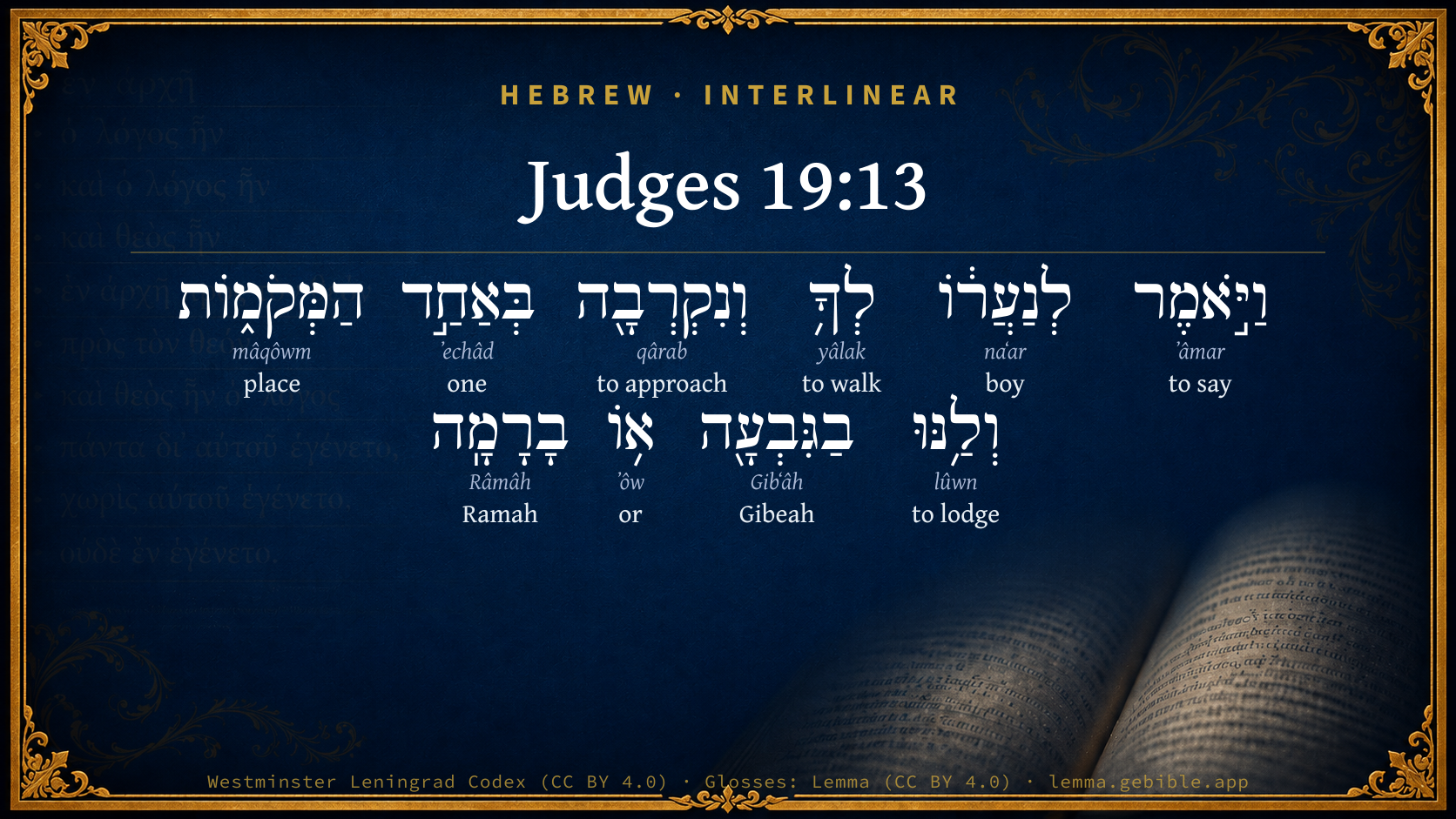
Hebrew (Westminster Leningrad Codex) Judges 19:13 appears in the Hebrew Old Testament. The text above is from the Westminster Leningrad Codex. Each word links to its Strong’s number, a concise gloss, and parsing drawn from the Open Scriptures Hebrew Bible morphology. Click any word for its full Brown-Driver-Briggs (BDB) entry.
Download image
Cite this verse

Judges 19:13 (World English Bible). Public Domain. Lemma interlinear Bible study tool, https://lemma.gebible.app/v/judges/19/13.

Show BibTeX & RIS
BibTeX
RIS
English Translation
He said to his servant, Come and let us draw near to one of these places; and we will lodge in Gibeah, or in Ramah.
World English Bible · Public Domain
Download a study sheet

One document with this verse’s original text, its word-by-word gloss line, the meaning frame, cross-references with their text, attributed commentary, and full source and license credits — printable, and it pastes into notes with its structure intact.

This verse Autodidact and up

Study sheet (.html) Plain text (.txt)

A passage Seminary Student

Up to 50 verses in one chapter. A passage sheet keeps up to 6 commentary sources and 12 cross-references per verse, in the order this page ranks them, and says so on the sheet whenever that leaves anything out. Ask for a single verse and you get the Autodidact verse sheet above.

Everything on this page stays free to read, with no account — the sheet is a download of what is already on screen, not access to it.

Want to remove ads? Support Godless Engineer
Compare translations 3

The same verse in 3 English versions, stacked beneath the original-language interlinear above. Click any original word for its lexicon entry.

Each is an independent rendering of the whole verse — the interlinear is not word-aligned to these translations.

Highlighted words mark where these versions differ — a whole-verse word diff, not a word-by-word alignment.

  • World English Bible Public Domain
    He said to his servant, Come and let us draw near to one of these places; and we will lodge in Gibeah, or in Ramah.
  • King James Version Public Domain
    And he said unto his servant, Come, and let us draw near to one of these places to lodge all night, in Gibeah, or in Ramah.
  • unfoldingWord Literal Text CC BY-SA 4.0
    And he said to his young man, “Come, and let us approach to one of the places, and we shall lodge in Gibeah or in Ramah.”

unfoldingWord Literal Text — © unfoldingWord, licensed CC BY-SA 4.0. Word-aligned USFM3 via Door43 (git.door43.org/unfoldingWord/en_ult).

Versions to compare (up to 4)

3 of 4 selected

Show all 18 translations

Every available English version of this verse, each an independent rendering of the whole verse.

  • World English Bible Public Domain
    He said to his servant, Come and let us draw near to one of these places; and we will lodge in Gibeah, or in Ramah.
  • Berean Standard Bible Public Domain
    He continued, “Come, let us try to reach one of these towns to spend the night in Gibeah or Ramah.”
  • Majority Standard Bible Public Domain
    He continued, “Come, let us try to reach one of these towns to spend the night in Gibeah or Ramah.”
  • King James Version Public Domain
    And he said unto his servant, Come, and let us draw near to one of these places to lodge all night, in Gibeah, or in Ramah.
  • American Standard Version (1901) Public Domain
    And he said unto his servant, Come and let us draw near to one of these places; and we will lodge in Gibeah, or in Ramah.
  • Revised Version (1885) Public Domain
    And he said unto his servant, Come and let us draw near to one of these places; and we will lodge in Gibeah, or in Ramah.
  • Geneva Bible (1599) Public Domain
    And he said vnto his seruant, Come, and let vs drawe neere to one of these places, that wee may lodge in Gibeah or in Ramah.
  • Douay-Rheims (1899) Public Domain
    And when I shall come thither, we will lodge there, or at least in the city of Rama.
  • Young's Literal Translation Public Domain
    And he saith to his young man, `Come, and we draw near to one of the places, and have lodged in Gibeah, or in Ramah.'
  • Literal Standard Version CC BY-SA 4.0
    And he says to his young man, “Come, and we draw near to one of the places, and have lodged in Gibeah, or in Ramah.”
  • Unlocked Literal Bible CC BY-SA 4.0
    The Levite said to his young man, “Come, let us go to one of those other places, and spend the night in Gibeah or Ramah.”
  • unfoldingWord Literal Text CC BY-SA 4.0
    And he said to his young man, “Come, and let us approach to one of the places, and we shall lodge in Gibeah or in Ramah.”
  • Darby Bible Public Domain
    And he said to his servant, "Come and let us draw near to one of these places, and spend the night at Gib'e-ah or at Ramah."
  • World Messianic Bible Public Domain
    He said to his servant, “Come and let’s draw near to one of these places; and we will lodge in Gibeah, or in Ramah.”
  • Webster's Bible Public Domain
    And he said to his servant, Come, and let us draw near to one of these places to lodge all night, in Gibeah, or in Ramah.
  • Free Bible Version CC BY-SA 4.0
    Then he told his servant, “Come on, let's try and get to Gibeah or Ramah and spend the night somewhere there.”
  • Bible in Basic English Public Domain
    And he said to his servant, Come, let us go on to one of these places, stopping for the night in Gibeah or Ramah.
  • JPS Tanakh (1917) Public Domain
    And he said unto his servant: 'Come and let us draw near to one of these places; and we will lodge in Gibeah, or in Ramah.'

Literal Standard Version (2020), Covenant Press — licensed CC BY-SA 4.0. Text via the HelloAO Bible API (eBible.org). Unlocked Literal Bible (unfoldingWord) — licensed CC BY-SA 4.0. Text via the HelloAO Bible API (eBible.org). unfoldingWord Literal Text — © unfoldingWord, licensed CC BY-SA 4.0. Word-aligned USFM3 via Door43 (git.door43.org/unfoldingWord/en_ult). Free Bible Version, Dr. Jonathan Gallagher — licensed CC BY-SA 4.0. Text via the HelloAO Bible API (eBible.org).

Word by word

More ways to search: Search by grammar → Find every occurrence → Compare this word →

Practice this passage: Drill this verse → Learn its vocabulary →

בָרָמָֽה
Râmâh
H7414
“in/at the · Ramah”
Preposition, Determined + Noun, Proper
Part of Speech
Preposition + Noun
Type
Proper
Full BDB Definition

Origin: the same as H7413

TWOT: None

Ramah = "hill" - a town in Benjamin on the border of Ephraim about 5 miles (8 kilometers) from Jerusalem and near to Gibeah - the home place of Samuel located in the hill country of Ephraim - a fortified city in Naphtali - landmark on the boundary of Asher, apparently between Tyre and Zidon - a place of battle between Israel and Syria - also 'Ramoth-gilead' - a place rehabited by the Benjamites after the return from captivity
  1. וַיֹּ֣אמֶר ʼâmar H559 “and · to say” Conjunction + Verb, Qal, Sequential Imperfect, 3rd Person, Masculine, Singular
  2. לְנַעֲר֔וֹ naʻar H5288 “to/for · boy · his” Preposition + Noun, Common, Masculine, Singular, Construct + Suffix, Personal, 3rd Person, Masculine, Singular
  3. לְךָ֥ yâlak H3212 “walk” Verb, Qal, Imperative, 2nd Person, Masculine, Singular
  4. וְנִקְרְבָ֖ה qârab H7126 “and · to approach” Conjunction + Verb, Qal, Cohortative, 1st Person, Common, Plural
  5. בְּאַחַ֣ד ʼechâd H259 “in/at · one” Preposition + Adjective, Cardinal number, Masculine, Singular, Construct
  6. הַמְּקֹמ֑וֹת mâqôwm H4725 “the · places” Particle, Definite Article + Noun, Common, Masculine, Plural, Absolute
  7. וְלַ֥נּוּ lûwn H3885 “and · to lodge” Conjunction + Verb, Qal, Sequential Perfect, 1st Person, Common, Plural
  8. בַגִּבְעָ֖ה Gibʻâh H1390 “in/at the · Gibeah” Preposition, Determined + Noun, Proper
  9. א֥וֹ ʼôw H176 “or” Conjunction

About this verse

These counts appear in no published source. They are computed here, from the morphology-tagged text and Lemma’s own curated glosses. What Lemma adds →

10
words
10
distinct lemmas
Historical
section

Shared distinctive vocabulary

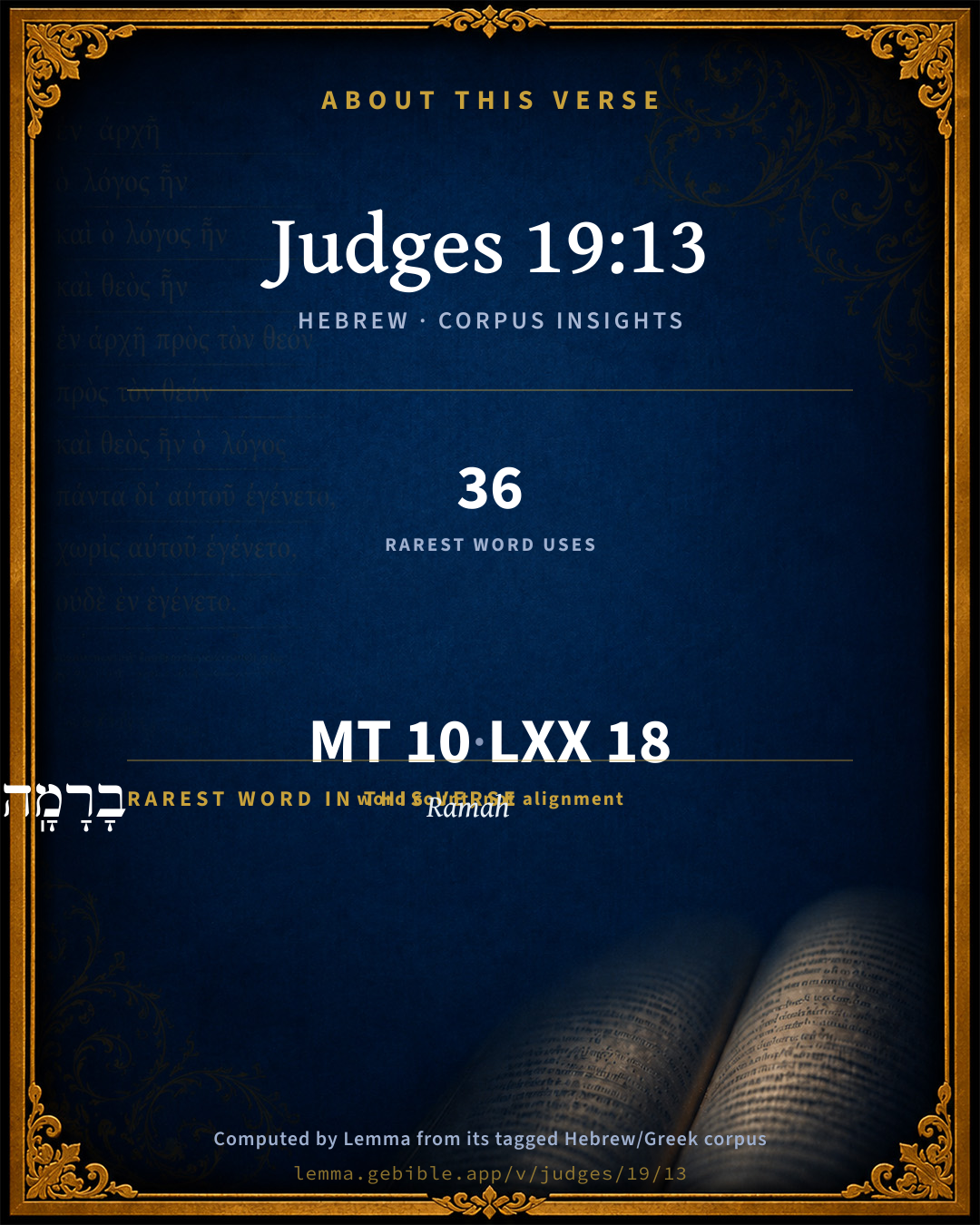
בָרָמָֽה Ramah H7414 occurs in 34 verses of the Hebrew Bible. Also found in:

Grammatical profile

  • 4 verbs
  • 4 nouns
  • 1 adjective
  • 1 conjunction

Verb forms

  • וַיֹּ֣אמֶר Qal · Sequential Imperfect
  • לְךָ֥ Qal · Imperative
  • וְנִקְרְבָ֖ה Qal · Cohortative
  • וְלַ֥נּוּ Qal · Sequential Perfect

Hebrew & Septuagint length

In English translation the verse runs 25 words from the Hebrew and 27 from the Septuagint (LXX English) — closely comparable.

A rough comparison of the two English renderings, which tokenize alike — not a word-level alignment.

Word counts can differ between the Hebrew and the Greek without any difference in meaning — e.g. the Hebrew direct-object marker אֵת has no separate Greek word, and Greek often adds the article ὁ.

In the original languages it is 10 Hebrew tokens and 18 Greek tokens — but the two are counted differently (Hebrew bundles its prefixes and suffixes into one token; the Greek is in lemma form), so that isn’t a like-for-like length.

Cross-references

5

Topical passages linked to Judges 19:13 in the Treasury of Scripture Knowledge — connected by theme and wording, ordered by reader-vote popularity; previews shown in the World English Bible.

  • Joshua 18:25–26 Gibeon, and Ramah, and Beeroth,
  • Joshua 18:28 and Zelah, Eleph, and the Jebusite (the same is Jerusalem), Gibeath, [and] Kiriath; fourteen cities with their villages. This is the inheritance of the children of Benjamin according to their families.
  • 1 Samuel 10:26 Saul also went to his house to Gibeah; and there went with him the host, whose hearts God had touched.
  • Isaiah 10:29 they are gone over the pass; they have taken up their lodging at Geba; Ramah trembles; Gibeah of Saul is fled.
  • Hosea 5:8 "Blow the cornet in Gibeah, And the trumpet in Ramah! Sound a battle cry at Beth Aven, behind you, Benjamin!

Cross-references courtesy of OpenBible.info (CC BY 4.0).

Hebrew and Greek witnesses Masoretic Hebrew ↔ Greek Septuagint

The same verse in the two great witnesses to the Old Testament, shown verse-for-verse.

These are two independent witnesses, not word-aligned to each other, and the Septuagint is shown in lemma (dictionary) form.

Hebrew Judges 19:13 Masoretic · Westminster Leningrad Codex

וַיֹּ֣אמֶר לְנַעֲר֔וֹ לְךָ֥ וְנִקְרְבָ֖ה בְּאַחַ֣ד הַמְּקֹמ֑וֹת וְלַ֥נּוּ בַגִּבְעָ֖ה א֥וֹ בָרָמָֽה

He said to his servant, Come and let us draw near to one of these places; and we will lodge in Gibeah, or in Ramah.

World English Bible · Public Domain

Greek LXX Judges 19:13 Septuagint · lemma form

καί εἶπον ὁ νεανίας αὐτός δεῦρο καί ἐγγίζω εἷς ὁ τόπος καί αὐλίζω ἐν γαβαα ἤ ἐν ραμα

And he said to his young man, Come, and let us draw near to one of the places, and we will lodge in Gabaa or in Rama.

LXX2012 (modern English Septuagint) · Public Domain

Hebrew: Westminster Leningrad Codex (CC BY 4.0). Greek: Septuagint (public domain); English from LXX2012 (modern English Septuagint) (Public Domain). How the Septuagint differs from the Hebrew →

Targum (Aramaic paraphrase)

1

The Targum is the ancient Jewish Aramaic paraphrase of the Hebrew Scriptures — an interpretive translation, not the Hebrew text itself. Onkelos (literal) and Pseudo-Jonathan (expansive) render the Torah, and Jonathan the Prophets. Coverage is partial: where no permissively-licensed English translation exists for a verse, only the Aramaic is shown. This is verse-level text, not a word-by-word alignment to the Hebrew.

  1. Targum Jonathan Prophets (Joshua–Malachi)
    וַאֲמַר לְעוּלֵימֵיהּ אִיתָא וּנְקָרֵיב בְּחַד מִן אַתְרַיָא וּנְבִית בְּגִבְעָתָא אוֹ בְרָמָתָא:

    (no public-domain English translation for this verse)

    Targum Jonathan — Aramaic: “Mikraot Gedolot” (public domain). English: “Sefaria Community Translation” (CC0 1.0 (public-domain dedication)); “London "Chaldee Paraphrase," 1871” (public domain). Text via Sefaria.

Commentary

Notes on Judges 19:13 from classic Christian and Jewish commentators (each source and its license shown beneath its notes). The classic Christian expositions comment on the surrounding passage and are grouped to its opening verse, so a note may address several verses; the Jewish commentaries on the Tanakh (Rashi and others) are per-verse, so they appear only where the commentator wrote on this verse.

Lemma curates 59 commentaries, every one of them public domain or Creative Commons licensed, each selected and text-cleaned for this edition rather than reprinted as found. About our sources →

Trapp's Complete Commentary

John Trapp

Jdg 19:13 And he said unto his servant, Come, and let us draw near to one of these places to lodge all night, in Gibeah, or in Ramah.

Ver. 13. In Gibeah, or in Ramah.] They took up at Gibeah, which is held to be the same with either Gibeon, or Geba, cities given to the Levites out of Benjamin’s lot, {Jos 21:17} but detained from them, belike, by the Benjamites; or if enjoyed by the Levites, the following wickedness there committed was so much the worse. {Isa 26:10}

John Trapp, A Commentary or Exposition upon All the Books of the Old and New Testament (1647–1656) — public domain. Text from a community e-Sword module.

Jamieson, Fausset & Brown

Robert Jamieson, A. R. Fausset & David Brown

in Gibeah, or in Ramah--The first of these places was five miles northeast, the other from four to five north of Jerusalem.

Jamieson, Fausset & Brown — Commentary Critical and Explanatory on the Whole Bible (1871) — public domain (CC PDM 1.0). Text via the HelloAO Bible API.

Ellicott's Commentary for English Readers

(13) Or in Ramah.—This town, now el-Ram, is only two miles beyond Gibeah. The two places are often mentioned together (Hos_5:8). The Levite is naturally anxious to push on homewards as fast as he can. Perhaps he knew that Gibeah did not bear a good character, and that it would be better to get as far as Ramah if possible. In countries where there are no public inns, each town and village gets a character of its own from the reports of travellers.

A Bible Commentary for English Readers, edited by Charles John Ellicott (1878–1897) — public domain. Text from a community e-Sword module.

The Cambridge Bible for Schools and Colleges

gen. ed. J. J. S. Perowne

13. Gibeah] Here, as in Isa_10:29 b, clearly south of Ramah, now er-Râm; it may well have occupied the ruined site called Tell el-Fûl, 2¾ miles N. of Jerusalem. This is the Gibeah of Saul mentioned in 1Sa_10:26; 1Sa_11:4; 1Sa_15:34, Is. l.c. (see Jos., Wars Jdg_19:2; Jdg_19:1), and known also as G. of Benjamin, 1Sa_13:2; 1Sa_13:15; 1Sa_14:16. It is to be distinguished from Geba, 1Sa_14:5, Isa_10:29 a etc., now Jeba‘, E. of er-Râm. The name = hill was a common one (e.g. Jos_15:57 in Judah, ib. Jos_24:33 RVm. in Ephraim), and easily leads to confusion.

The Cambridge Bible for Schools and Colleges (gen. ed. J. J. S. Perowne; Cambridge University Press, 1878–1918) — public domain. Text from a community e-Sword module.

John Gill's Exposition

And he said to his servant, come, and let us draw near,.... And get on as fast as we can:

to one of these places to lodge all night, in Gibeah, or in Ramah; which were both in the tribe of Benjamin, and he left it to his servant to go to either, to that which was most convenient, because of the time of the day, it being near sun setting; now, as before observed, Gibeah was not quite four miles from Jerusalem; whereas, according to Jerom (s), Ramah was six miles, and therefore we find they took up at Gibeah, as being nearest of these two places; See Gill on Jos 18:24, Jos 18:25, Hos 5:8.

(s) De loc. Heb. fol. 94. B.

John Gill's Exposition of the Whole Bible (1746–1763) — public domain (CC PDM 1.0). Text via the HelloAO Bible API.

Haydock's Catholic Bible Commentary

Rama was not so far as Gabaa; so that, if they could not travel to the latter place, they might turn to the former, and lodge all night. They held on their journey, however, till they came not very late, to Gabaa.

George Leo Haydock (1774–1849), Haydock's Catholic Family Bible and Commentary, 1859 edition — public domain. Excludes Psalms (Douay-Rheims chapter numbering differs from Protestant) and Deuterocanonical books (Catholic canon only).

Matthew Poole's English Annotations

Both which places lay in Benjamin’s portion, a little northward from Jerusalem, and in the road from Bethlehem-judah to Gibeah.

Matthew Poole's English Annotations on the Holy Bible (1683–1685) — public domain. Text from a community e-Sword/MySword module.

Whedon's Commentary on the Bible

Daniel D. Whedon

13. In Gibeah, or in Ramah — Cities of Benjamin lying northward from Jerusalem, one about an hour, the other two hours, or more, distant. See Jos_18:25; Jos_18:28.

Daniel D. Whedon (gen. ed.), Commentary on the Old and New Testaments (1874–1909) — public domain. Text from a community e-Sword module.

The Pulpit Commentary

Ramah (ha-Ramah, the height). Now er-Ram, less than an hour"s journey from Gibeah, both being about equi-distant from Jerusalem.

The Pulpit Commentary (1880–1919), ed. H.D.M. Spence-Jones & Joseph S. Exell — public domain. Text from a community e-Sword module.

Rashi

Rabbi Shlomo Yitzchaki (Rashi)

We will spend the night. As in וְלַנְנוּ. The period punctuating the נ serves as a replacement for a second נ.

Rashi on the Tanakh — English translations: “The Judaica Press complete Tanach with Rashi, translated by A. J. Rosenberg” (CC BY 4.0); “Pentateuch with Rashi's commentary by M. Rosenbaum and A.M. Silbermann, 1929-1934” (public domain); “The Metsudah Tanach series, Lakewood, N.J” (CC BY 4.0); and “The Book of Joshua, Metsudah Publications, 1997” (CC BY 4.0). Text via Sefaria.

Lesson kit

Teaching starters — assembled from the data on this page, not authored interpretation. Every prompt links to the verse data it draws on. Edit before teaching.

Judges, in the Historical, opens this verse with 10 words (10 distinct Hebrew lemmas). Its most distinctive word is Râmâh (“Ramah”). A historical commentator’s framing appears above. Read the whole chapter for the surrounding context.

Discussion questions

  1. The word Râmâh carries the sense “Ramah.” How does it shape the verse?
  2. Joshua 18:25 shares the word «Ramah» with this verse. How do the two illuminate each other?
  3. The translations on this page render this verse differently — a whole-verse word diff, not a word-by-word alignment. What might account for the different wordings?
  4. The verb «וַיֹּ֣אמֶר» is Qal Sequential Imperfect. How does its form color the action?
  5. Reading how Trapp's Complete Commentary and Jamieson, Fausset & Brown read this verse, where do the two commentators agree and where do they part?

Things to notice

Reading settings

Reading text

Shown beneath each verse's original-language words.

Old Testament
Old Testament edition

Read the OT as the Masoretic Hebrew (MT) or the Greek Septuagint (LXX).

English shown for the Greek Septuagint (in the Hebrew ↔ Greek comparison).

Comparing translations? Open the Compare panel on any verse page to stack up to four side by side.