
Numbers 28:3

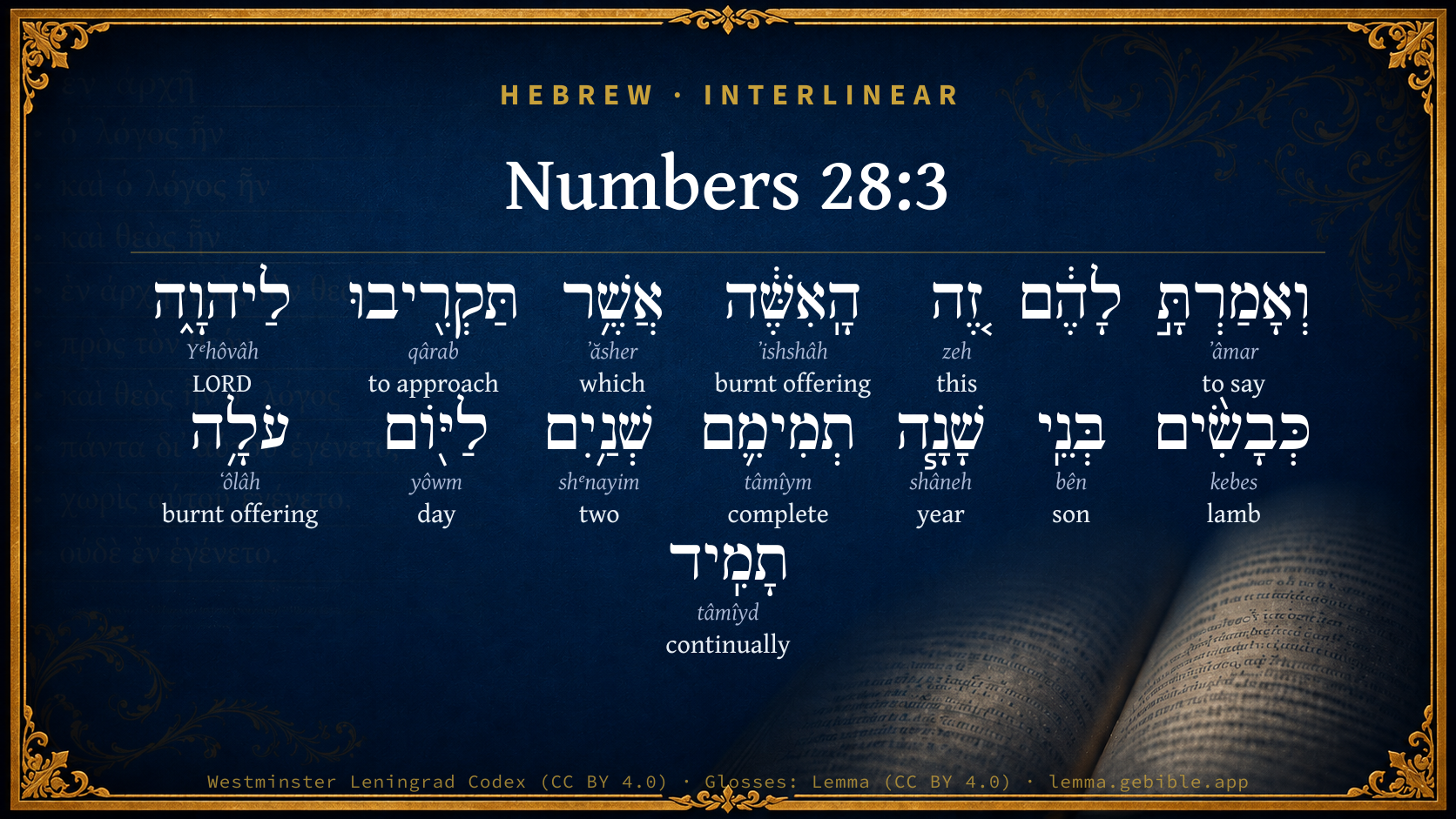
Hebrew (Westminster Leningrad Codex) Numbers 28:3 appears in the Hebrew Old Testament. The text above is from the Westminster Leningrad Codex. Each word links to its Strong’s number, a concise gloss, and parsing drawn from the Open Scriptures Hebrew Bible morphology. Click any word for its full Brown-Driver-Briggs (BDB) entry.
Download image
Cite this verse

Numbers 28:3 (World English Bible). Public Domain. Lemma interlinear Bible study tool, https://lemma.gebible.app/v/numbers/28/3.

Show BibTeX & RIS
BibTeX
RIS
English Translation
You shall tell them, This is the offering made by fire which you shall offer to Yahweh: he-lambs a year old without blemish, two day by day, for a continual burnt offering.
World English Bible · Public Domain
Download a study sheet

One document with this verse’s original text, its word-by-word gloss line, the meaning frame, cross-references with their text, attributed commentary, and full source and license credits — printable, and it pastes into notes with its structure intact.

This verse Autodidact and up

Study sheet (.html) Plain text (.txt)

A passage Seminary Student

Up to 50 verses in one chapter. A passage sheet keeps up to 6 commentary sources and 12 cross-references per verse, in the order this page ranks them, and says so on the sheet whenever that leaves anything out. Ask for a single verse and you get the Autodidact verse sheet above.

Everything on this page stays free to read, with no account — the sheet is a download of what is already on screen, not access to it.

Want to remove ads? Support Godless Engineer
Compare translations 3

The same verse in 3 English versions, stacked beneath the original-language interlinear above. Click any original word for its lexicon entry.

Each is an independent rendering of the whole verse — the interlinear is not word-aligned to these translations.

Highlighted words mark where these versions differ — a whole-verse word diff, not a word-by-word alignment.

  • World English Bible Public Domain
    You shall tell them, This is the offering made by fire which you shall offer to Yahweh: he-lambs a year old without blemish, two day by day, for a continual burnt offering.
  • King James Version Public Domain
    And thou shalt say unto them, This is the offering made by fire which ye shall offer unto the LORD; two lambs of the first year without spot day by day, for a continual burnt offering.
  • unfoldingWord Literal Text CC BY-SA 4.0
    And you shall say to them, ‘This is the offering made by fire that you shall offer to Yahweh: unblemished male lambs, sons of a year, two for the day, a burnt offering continually.

unfoldingWord Literal Text — © unfoldingWord, licensed CC BY-SA 4.0. Word-aligned USFM3 via Door43 (git.door43.org/unfoldingWord/en_ult).

Versions to compare (up to 4)

3 of 4 selected

Show all 18 translations

Every available English version of this verse, each an independent rendering of the whole verse.

  • World English Bible Public Domain
    You shall tell them, This is the offering made by fire which you shall offer to Yahweh: he-lambs a year old without blemish, two day by day, for a continual burnt offering.
  • Berean Standard Bible Public Domain
    And tell them that this is the offering made by fire you are to present to the LORD as a regular burnt offering each day: two unblemished year-old male lambs.
  • Majority Standard Bible Public Domain
    And tell them that this is the food offering you are to present to the LORD as a regular burnt offering each day: two unblemished year-old male lambs.
  • King James Version Public Domain
    And thou shalt say unto them, This is the offering made by fire which ye shall offer unto the LORD; two lambs of the first year without spot day by day, for a continual burnt offering.
  • American Standard Version (1901) Public Domain
    And thou shalt say unto them, This is the offering made by fire which ye shall offer unto Jehovah: he-lambs a year old without blemish, two day by day, for a continual burnt-offering.
  • Revised Version (1885) Public Domain
    And thou shalt say unto them, This is the offering made by fire which ye shall offer unto the LORD; he-lambs of the first year without blemish, two day by day, for a continual burnt offering.
  • Geneva Bible (1599) Public Domain
    Also thou shalt say vnto them, This is the offring made by fire which ye shall offer vnto the Lord, two lambes of a yeere olde without spot, daily, for a continuall burnt offring.
  • Douay-Rheims (1899) Public Domain
    These are the sacrifices which you shall offer: Two lambs of a year old without blemish every day for the perpetual holocaust:
  • Young's Literal Translation Public Domain
    `And thou hast said to them, This `is' the fire-offering which ye bring near to Jehovah: two lambs, sons of a year, perfect ones, daily, a continual burnt-offering;
  • Literal Standard Version CC BY-SA 4.0
    And you have said to them: This [is] the fire-offering which you bring near to YHWH: two lambs, sons of a year, perfect ones, daily, [for] a continual burnt-offering;
  • Unlocked Literal Bible CC BY-SA 4.0
    You must also say to them, 'This is the offering made by fire that you must offer to Yahweh—male lambs a year old without blemish, two each day, as a regular burnt offering.
  • unfoldingWord Literal Text CC BY-SA 4.0
    And you shall say to them, ‘This is the offering made by fire that you shall offer to Yahweh: unblemished male lambs, sons of a year, two for the day, a burnt offering continually.
  • Darby Bible Public Domain
    And say unto them, This is the offering by fire which ye shall present to Jehovah: two yearling lambs without blemish, day by day, as a continual burnt-offering.
  • World Messianic Bible Public Domain
    You shall tell them, ‘This is the offering made by fire which you shall offer to the LORD: male lambs a year old without defect, two day by day, for a continual burnt offering.
  • Webster's Bible Public Domain
    And thou shalt say to them, This is the offering made by fire which ye shall offer to the LORD; two lambs of the first year without spot day by day, for a continual burnt-offering.
  • Free Bible Version CC BY-SA 4.0
    Tell them you are to present to the Lord every day two male lambs a year old as a continual burnt offering.
  • Bible in Basic English Public Domain
    Say to them, This is the offering made by fire which you are to give to the Lord; he-lambs of the first year without any mark, two every day as a regular burned offering.
  • JPS Tanakh (1917) Public Domain
    And thou shalt say unto them: This is the offering made by fire which ye shall bring unto the LORD: he-lambs of the first year without blemish, two day by day, for a continual burnt-offering.

Literal Standard Version (2020), Covenant Press — licensed CC BY-SA 4.0. Text via the HelloAO Bible API (eBible.org). Unlocked Literal Bible (unfoldingWord) — licensed CC BY-SA 4.0. Text via the HelloAO Bible API (eBible.org). unfoldingWord Literal Text — © unfoldingWord, licensed CC BY-SA 4.0. Word-aligned USFM3 via Door43 (git.door43.org/unfoldingWord/en_ult). Free Bible Version, Dr. Jonathan Gallagher — licensed CC BY-SA 4.0. Text via the HelloAO Bible API (eBible.org).

Word by word

More ways to search: Search by grammar → Find every occurrence → Compare this word →

Practice this passage: Drill this verse → Learn its vocabulary →

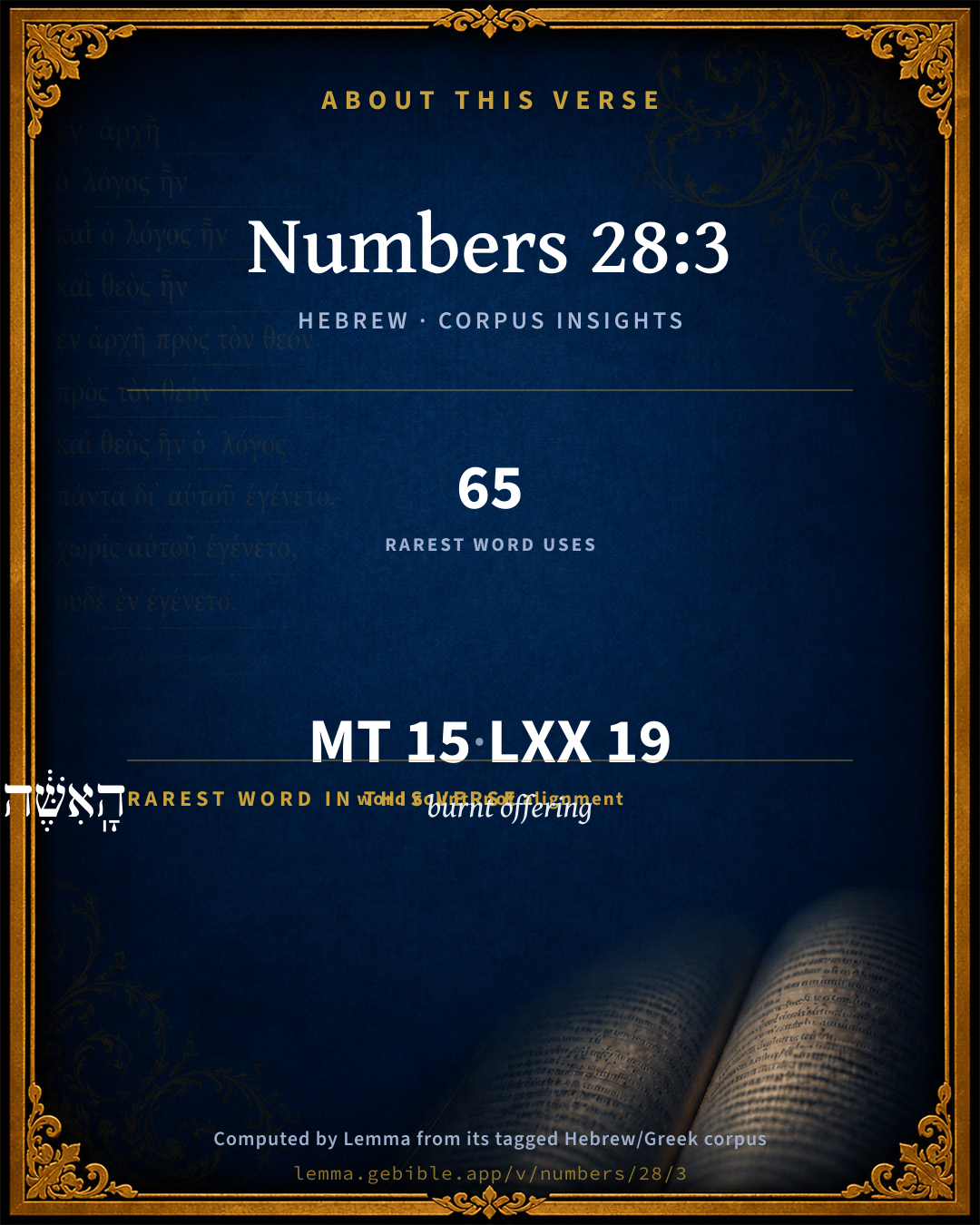
הָֽאִשֶּׁ֔ה
ʼishshâh
H801
“the · burnt offering”
Particle, Definite Article + Noun, Common, Masculine, Singular, Absolute
Part of Speech
Particle + Noun
Type
Common
Gender
Masculine
Number
Singular
State
Absolute
Full BDB Definition

Origin: the same as H800 , but used in a liturgical sense

TWOT: 172a

burnt-offering, offering made by fire, fire offering
  1. וְאָמַרְתָּ֣ ʼâmar H559 “and · to say” Conjunction + Verb, Qal, Sequential Perfect, 2nd Person, Masculine, Singular
  2. זֶ֚ה zeh H2088 “this” Pronoun, Demonstrative, Masculine, Singular
  3. אֲשֶׁ֥ר ʼăsher H834 “which” Particle, Relative
  4. תַּקְרִ֖יבוּ qârab H7126 “to approach” Verb, Hiphil, Imperfect, 2nd Person, Masculine, Plural
  5. לַיהוָ֑ה Yᵉhôvâh H3068 “to/for · LORD” Preposition + Noun, Proper
  6. כְּבָשִׂ֨ים kebes H3532 “lambs” Noun, Common, Masculine, Plural, Absolute
  7. בְּנֵֽי bên H1121 “sons of” Noun, Common, Masculine, Plural, Construct
  8. שָׁנָ֧ה shâneh H8141 “year” Noun, Common, Feminine, Singular, Absolute
  9. תְמִימִ֛ם tâmîym H8549 “complete” Adjective, Adjective, Masculine, Plural, Absolute
  10. שְׁנַ֥יִם shᵉnayim H8147 “two” Adjective, Cardinal number, Masculine, Dual, Absolute
  11. לַיּ֖וֹם yôwm H3117 “to/for the · day” Preposition, Determined + Noun, Common, Masculine, Singular, Absolute
  12. עֹלָ֥ה ʻôlâh H5930 “burnt offering” Noun, Common, Feminine, Singular, Absolute
  13. תָמִֽיד tâmîyd H8548 “continually” Noun, Common, Masculine, Singular, Absolute

About this verse

These counts appear in no published source. They are computed here, from the morphology-tagged text and Lemma’s own curated glosses. What Lemma adds →

15
words
14
distinct lemmas
Pentateuch
section

Grammatical profile

  • 2 verbs
  • 8 nouns
  • 2 adjectives
  • 1 pronoun
  • 1 preposition
  • 1 particle

Verb forms

  • וְאָמַרְתָּ֣ Qal · Sequential Perfect
  • תַּקְרִ֖יבוּ Hiphil · Imperfect

Hebrew & Septuagint length

In English translation the verse runs 32 words from the Hebrew and 34 from the Septuagint (LXX English) — closely comparable.

A rough comparison of the two English renderings, which tokenize alike — not a word-level alignment.

Word counts can differ between the Hebrew and the Greek without any difference in meaning — e.g. the Hebrew direct-object marker אֵת has no separate Greek word, and Greek often adds the article ὁ.

In the original languages it is 15 Hebrew tokens and 19 Greek tokens — but the two are counted differently (Hebrew bundles its prefixes and suffixes into one token; the Greek is in lemma form), so that isn’t a like-for-like length.

Cross-references

9

Topical passages linked to Numbers 28:3 in the Treasury of Scripture Knowledge — connected by theme and wording, ordered by reader-vote popularity; previews shown in the World English Bible.

  • Leviticus 6:9 "Command Aaron and his sons, saying, 'This is the law of the burnt offering: the burnt offering shall be on the hearth on the altar all night until the morning; and the fire of the altar shall be kept burning on it.
  • Exodus 29:38–42 "Now this is that which you shall offer on the altar: two lambs a year old day by day continually.
  • Ezekiel 46:13–15 You shall prepare a lamb a year old without blemish for a burnt offering to Yahweh daily: morning by morning shall you prepare it.
  • Daniel 8:13 Then I heard a holy one speaking; and another holy one said to that certain one who spoke, How long shall be the vision [concerning] the continual [burnt-offering], and the disobedience that makes desolate, to give both the sanctuary and the host to be trodden under foot?
  • Daniel 11:31 Forces shall stand on his part, and they shall profane the sanctuary, even the fortress, and shall take away the continual [burnt offering], and they shall set up the abomination that makes desolate.
  • Daniel 12:11 From the time that the continual [burnt offering] shall be taken away, and the abomination that makes desolate set up, there shall be one thousand two hundred ninety days.
  • John 1:29 The next day, he saw Jesus coming to him, and said, "Behold, the Lamb of God, who takes away the sin of the world!
  • 1 Peter 1:19–20 but with precious blood, as of a lamb without spot, the blood of Christ;
  • Revelation 13:8 All who dwell on the earth will worship him, everyone whose name has not been written from the foundation of the world in the book of life of the Lamb who has been killed.

Cross-references courtesy of OpenBible.info (CC BY 4.0).

Hebrew and Greek witnesses Masoretic Hebrew ↔ Greek Septuagint

The same verse in the two great witnesses to the Old Testament, shown verse-for-verse.

These are two independent witnesses, not word-aligned to each other, and the Septuagint is shown in lemma (dictionary) form.

Hebrew Numbers 28:3 Masoretic · Westminster Leningrad Codex

וְאָמַרְתָּ֣ לָהֶ֔ם זֶ֚ה הָֽאִשֶּׁ֔ה אֲשֶׁ֥ר תַּקְרִ֖יבוּ לַיהוָ֑ה כְּבָשִׂ֨ים בְּנֵֽי שָׁנָ֧ה תְמִימִ֛ם שְׁנַ֥יִם לַיּ֖וֹם עֹלָ֥ה תָמִֽיד

You shall tell them, This is the offering made by fire which you shall offer to Yahweh: he-lambs a year old without blemish, two day by day, for a continual burnt offering.

World English Bible · Public Domain

Greek LXX Numbers 28:3 Septuagint · lemma form

καί εἶπον πρός αὐτός οὗτος ὁ κάρπωμα ὅσος προςἄγω κύριος ἀμνός ἐνιαύσιος ἄμωμος δύο ὁ ἡμέρα εἰς ὁλοκαύτωσις ἐνδελεχῶς

And you shall say to them, These are the burnt offerings, all that you⌃ shall bring to the Lord; two lambs of a year old without blemish daily, for a whole burnt offering perpetually.

LXX2012 (modern English Septuagint) · Public Domain

On this verse, The Pulpit Commentary discusses the Septuagint’s reading. Read the note in Commentary ↓

Hebrew: Westminster Leningrad Codex (CC BY 4.0). Greek: Septuagint (public domain); English from LXX2012 (modern English Septuagint) (Public Domain). How the Septuagint differs from the Hebrew →

Targum (Aramaic paraphrase)

2

The Targum is the ancient Jewish Aramaic paraphrase of the Hebrew Scriptures — an interpretive translation, not the Hebrew text itself. Onkelos (literal) and Pseudo-Jonathan (expansive) render the Torah, and Jonathan the Prophets. Coverage is partial: where no permissively-licensed English translation exists for a verse, only the Aramaic is shown. This is verse-level text, not a word-by-word alignment to the Hebrew.

  1. Targum Onkelos Torah (Genesis–Deuteronomy)
    וְתֵימַר לְהוֹן דֵין קוּרְבָּנָא דִי תְקַרְבוּן קֳדָם יְיָ אִימְּרִין בְּנֵי שְׁנָא שַׁלְמִין תְּרֵין לְּיוֹמָא עֲלָתָא תְּדִירָא

    (no public-domain English translation for this verse)

    Targum Onkelos — Aramaic: “Onkelos Genesis” (public domain); “Onkelos Exodus” (public domain); “Onkelos Leviticus” (public domain); “Onkelos Numbers” (public domain); “Onkelos Deuteronomy” (public domain). English: “Sefaria Community Translation” (CC0 1.0 (public-domain dedication)); “J.W. Etheridge. The Targums of Onkelos and Jonathan Ben Uzziel on the Pentateuch. London: Longmans, Green, 1862” (public domain). Text via Sefaria.

  2. Targum Pseudo-Jonathan Torah (Genesis–Deuteronomy)
    וְתֵימַר לְהוֹן דֵין סֵדֶר קָרְבָּנַיָא דִי תְקַרְבוּן קֳדָם יְיָ אִמְרִין בְּנֵי שָׁנָה שַׁלְמִין תְּרֵין לְיוֹמָא עֲלָתָא תְּדִירָא

    And say to them: This is the order of the oblations you shall offer before the Lord; two lambs of the year, unblemished, daily, a perpetual burnt offering.

    Targum Pseudo-Jonathan — Aramaic: “Targum Jonathan on Genesis” (public domain); “Targum Jonathan on Exodus” (public domain); “Targum Jonathan on Leviticus” (public domain); “Targum Jonathan on Numbers” (public domain); “Targum Jonathan on Deuteronomy” (public domain). English: “The Targum of Jonathan ben Uzziel, trans. J. W. Etheridge, London, 1862” (public domain). Text via Sefaria.

Commentary

Notes on Numbers 28:3 from classic Christian and Jewish commentators (each source and its license shown beneath its notes). The classic Christian expositions comment on the surrounding passage and are grouped to its opening verse, so a note may address several verses; the Jewish commentaries on the Tanakh (Rashi and others) are per-verse, so they appear only where the commentator wrote on this verse.

Lemma curates 59 commentaries, every one of them public domain or Creative Commons licensed, each selected and text-cleaned for this edition rather than reprinted as found. About our sources →

Trapp's Complete Commentary

John Trapp

Num 28:3 And thou shalt say unto them, This [is] the offering made by fire which ye shall offer unto the LORD; two lambs of the first year without spot day by day, [for] a continual burnt offering.

Ver. 3. This is the offering.] {See Trapp on "Exo 29:38"} {See Trapp on "Exo 29:39"}

John Trapp, A Commentary or Exposition upon All the Books of the Old and New Testament (1647–1656) — public domain. Text from a community e-Sword module.

Joseph Benson's Commentary

Num 28:3. Two lambs day by day — This first national sacrifice was to be offered every day, morning and evening, throughout the whole year, Exo 12:5; Exo 29:38.

Joseph Benson's Commentary on the Old and New Testaments (1811–1818) — public domain. Text from a community e-Sword module.

Whedon's Commentary on the Bible

Daniel D. Whedon

THE DAILY BURNT OFFERING, Num_28:3-8.

This had already been instituted at Sinai, (Exo_29:38-42,) but it could not be performed amid the wilderness wanderings.

3. Without spot — Perfect and unblemished. This did not include spots or various colours in the wool or skin. The Mishna describes fifty blemishes: five in the ear, three in the eyelid, eight in the eye, three in the nose, six in the mouth, twelve in the genitals, six in the feet, four in any place of the body — as scabs and wens — and three besides over all the body — as trembling with old age, sickness, or foul with excrements. It was unlawful to offer a lamb less than eight days old, a hybrid, a monstrosity, if it had killed a man, or were the price of a dog or a harlot, or had been dedicated to idolatry, or was an hour over a year old when the law required it to be of the first year.

Day by day — The daily burnt offering was a perpetually repeated demonstration of the duty of consecrating body, soul, and spirit to God. It was a reiterated object-lesson, teaching the human side of entire sanctification, entire self-surrender to Jehovah. Lev_1:3, note.

A continual burnt offering — That the whole daily life of Israel might be consecrated unto the Lord it was to be offered every morning and evening, for all future time, at the door of the tabernacle, where Jehovah met his people and communed with them. The daily sacrifice ceased at the destruction of Jerusalem. It will not be renewed until the Jews regain possession of Mount Moriah, the last place chosen by the Lord for offering sacrifices. Lev_17:2-5, notes; comp. Deu_12:11-14, and 1Ki_8:29.

Daniel D. Whedon (gen. ed.), Commentary on the Old and New Testaments (1874–1909) — public domain. Text from a community e-Sword module.

Tyndale Open Study Notes

Tyndale Open Resources

28:3-8 The daily offering was the foundation of the sacrificial system. Its practice was instituted at Mount Sinai (see Exod 29:38-46). • alcoholic drink: Cp. Num 6:3; Lev 10:9; Deut 14:26.

Tyndale Open Study Notes — © Tyndale Open Resources, licensed CC BY-SA 4.0. Text via the HelloAO Bible API.

Ellicott's Commentary for English Readers

(3) Two lambs of the first year . . . —See Exo_29:38-42.

A continual burnt offering.—The morning and evening lamb offered as “a continual burnt offering” afforded a striking type of the Lamb of God offered once for all” (Heb_7:3; Heb_10:12; Heb_10:14).

A Bible Commentary for English Readers, edited by Charles John Ellicott (1878–1897) — public domain. Text from a community e-Sword module.

John Gill's Exposition

And thou shalt say unto them,.... Having directed Moses to command the people of Israel to observe to offer all the sacrifices of God in general, the Lord proceeds to order him to speak of them to them particularly and distinctly; this, according to Jarchi, is an admonition to the sanhedrim:

this is the offering made by fire, which ye shall offer unto the Lord; the daily burnt offering, which was wholly consumed by fire:

two lambs of the first year without spot, day by day for a continual burnt offering; this law was made before, and is directed to in Exo 29:38 where the same things are said as here, only, as a further descriptive character of the lambs, they are here said to be "without spot"; so all sacrifices were to be without blemish, whether expressed or not; and in this, as in other things, these lambs were typical of Christ, the Lamb of God, without spot and blemish; and are said to be a "continual" burnt offering, because they were offered every day in the week, without any intermission, on any account whatever, which is frequently observed in this chapter: and this was to continue, and did continue until the Messiah came, who put an end to it by the sacrifice of himself, as to any real use of it; and was in fact made to cease a few years after, by the utter destruction of Jerusalem, and was before that a little while interrupted in the times of Antiochus, Dan 8:11.

John Gill's Exposition of the Whole Bible (1746–1763) — public domain (CC PDM 1.0). Text via the HelloAO Bible API.

Haydock's Catholic Bible Commentary

Lambs. Kids would not suffice. See Exodus xxix. 38. The lambs must not be above a year old. But it is not clear whether they could be offered eight days after their birth, as on other occasions, Exodus xxiii. 19. (Calmet)

George Leo Haydock (1774–1849), Haydock's Catholic Family Bible and Commentary, 1859 edition — public domain. Excludes Psalms (Douay-Rheims chapter numbering differs from Protestant) and Deuterocanonical books (Catholic canon only).

The Pulpit Commentary

This is the offering made by fire. The daily offering prescribed at Exo_29:38-42, and which had presumably never been intermitted since, is specified again here because it formed the foundation of the whole sacrificial system. Whatever else was offered was in addition to it, not in lieu of it. The sabbath and festival use of the Jews was developed out of the ferial use, and rested upon it. Hence in a connected republication of the law of offering it could not be omitted. Without spot. Septuagint, anwmouv . This necessary qualification had not been expressed in the original ordinance, but in respect of other sacrifices had been continually required. (see on Exo_12:5 Lev_1:3 Num_19:2 Heb_9:14 1Pe_1:19)

HOMILIES BY E.S. PROUT Vers. 3-8. The lessons of the daily burnt offering.

In verses 1 and 2 we have a general statement respecting offerings to God, reminding us

(1) of the paramount claims of God (note repetition of "my" and "me"), and

(2) the promptness and punctuality needed in meeting those claims ("in their due season"). Then follow directions as to the most frequent of these offerings the daily burnt offering, which suggests lessons derived from

I ITS CHARACTER;

II ITS CONTINUANCE.

I It consisted of two parts:

(1) a lamb, a bleeding sacrifice;

(2) a meat and drink offering, flour, &c., bloodless; but the whole was to be burned before God.

We see here

1. Expiation. This we need every morning, for we awake and leave our beds sinful, and requiring an atonement that we may be able to present acceptable service during the day. And we need it every evening that daily sins may be forgiven, and that we may rest at peace with God, "clean every whir". (Joh_13:10)

2. Dedication. In the burnt offering, as distinguished from the trespass offering, expiation by blood-shedding is taken for granted, but the burning, as the symbol of entire surrender to God, is the culminating point. The various parts of the burnt offering may be regarded as typical of our surrender to God of all the varied powers and gifts he has bestowed. (Illustrate from Romans 12) As Christ presented himself in complete sacrifice to God, so should we. (Eph_5:2, &c.);

II "A continual burnt offering" (verse 3). So constant must the Christian"s self-surrender be. With each morning comes the summons "S ursum corda, and the appeal, Rom_12:1. Evening brings rest from earthly toil, but no cessation from a renewed, continual dedication to God. We should desire no exemption from this continual offering of ourselves when we remember the motives to it.

1. We ourselves and all we have are God"s.

2. We have enjoyed expiation through the perfect sacrifice of Christ. The law of the daily offering is urged because "ordained in Mount Sinai" (verse 6). The law of Christian self-sacrifice was published by deed, and not by word, at Calvary. (1Pe_2:24 1Pe_3:18)

3. Such sacrifice is pleasing, a sweet savour unto God "the Lord" (verse 6).

4. Such acts insure Divine manifestations. See Exo_29:38-43, which suggests that the neglect of the daily offering would interrupt communion with God.

5. Thus complete self-surrender brings us into the fullest sympathy with God, and thus into the most perfect liberty. P. (Psa_119:45 Joh_8:36, &c.);

The Pulpit Commentary (1880–1919), ed. H.D.M. Spence-Jones & Joseph S. Exell — public domain. Text from a community e-Sword module.

Keil & Delitzsch

C. F. Keil & F. Delitzsch

"The daily sacrifice: as it had already been instituted at Sinai (Exo 29:38-42).

Keil & Delitzsch — Biblical Commentary on the Old Testament (1861–1891) — public domain (CC PDM 1.0). Text via the HelloAO Bible API. (Old Testament only.)

unfoldingWord translationNotes

Door43 World Missions Community

General Information:

Yahweh continues telling Moses what the people must do.

the offering made by fire

This can be stated in active form. "the burnt offering" or "the offering you have burned by fire on the altar" (See: Active or Passive)

mixed with

This can be stated in active form. "which you have mixed with" (See: Active or Passive)

a tenth of an ephah

"A tenth" means one part out of ten equal parts. This can be written in modern measurements. AT: "2 liters" or "a tenth of an ephah (which is about 2 liters)" (See: Fractions and Biblical Volume)

one-fourth of a hin

"One-fourth" means one part out of four equal parts. This can be written in modern measurements. AT: "a liter" or "one-fourth of a hin (which is almost 1 liter)" (See: Fractions and Biblical Volume)

beaten oil

"pressed oil" or "pure olive oil." This refers to oil that has been pressed out of olives.

translationWords

burnt offering

lamb

year

blemish

day

tenth

grain offering

oil

unfoldingWord translationNotes — © Distant Shores Media and the Door43 World Missions Community, licensed CC BY-SA 4.0. Source: git.door43.org/Door43/en_tn.

Rashi

Rabbi Shlomo Yitzchaki (Rashi)

ואמרת להם AND THOU SHALT SAY TO THEM — This is an instruction to the Beth Din (Sifrei Bamidbar 142:3).

שנים ליום This may be understood according to its plain sense: TWO [LAMBS] FOR EACH DAY, But in the main it is intended to teach that they should be slaughtered at a spot opposite the day (i.e. the sun) — the morning continual offerings at the west and that of the evening at the east of the rings fixed in the ground and in which were inserted the animals feet (Sifrei Bamidbar 142:3; Yoma 62b).

Rashi on the Tanakh — English translations: “The Judaica Press complete Tanach with Rashi, translated by A. J. Rosenberg” (CC BY 4.0); “Pentateuch with Rashi's commentary by M. Rosenbaum and A.M. Silbermann, 1929-1934” (public domain); “The Metsudah Tanach series, Lakewood, N.J” (CC BY 4.0); and “The Book of Joshua, Metsudah Publications, 1997” (CC BY 4.0). Text via Sefaria.

Lesson kit

Teaching starters — assembled from the data on this page, not authored interpretation. Every prompt links to the verse data it draws on. Edit before teaching.

Numbers, in the Pentateuch, opens this verse with 15 words (14 distinct Hebrew lemmas). Its most distinctive word is ʼishshâh (“burnt offering”). A historical commentator’s framing appears above. Read the whole chapter for the surrounding context.

Discussion questions

  1. How does “burnt offering” (ʼishshâh) shape what this verse is saying?
  2. How does Leviticus 6:9, which shares this passage’s theme, read alongside this verse?
  3. The translations on this page render this verse differently — a whole-verse word diff, not a word-by-word alignment. What might account for the different wordings?
  4. «וְאָמַרְתָּ֣» is a Qal Sequential Perfect verb. How does that grammatical form shape the action described?
  5. Compare how Trapp's Complete Commentary and Joseph Benson's Commentary read this verse. Where do they agree or differ?

Things to notice

Reading settings

Reading text

Shown beneath each verse's original-language words.

Old Testament
Old Testament edition

Read the OT as the Masoretic Hebrew (MT) or the Greek Septuagint (LXX).

English shown for the Greek Septuagint (in the Hebrew ↔ Greek comparison).

Comparing translations? Open the Compare panel on any verse page to stack up to four side by side.