
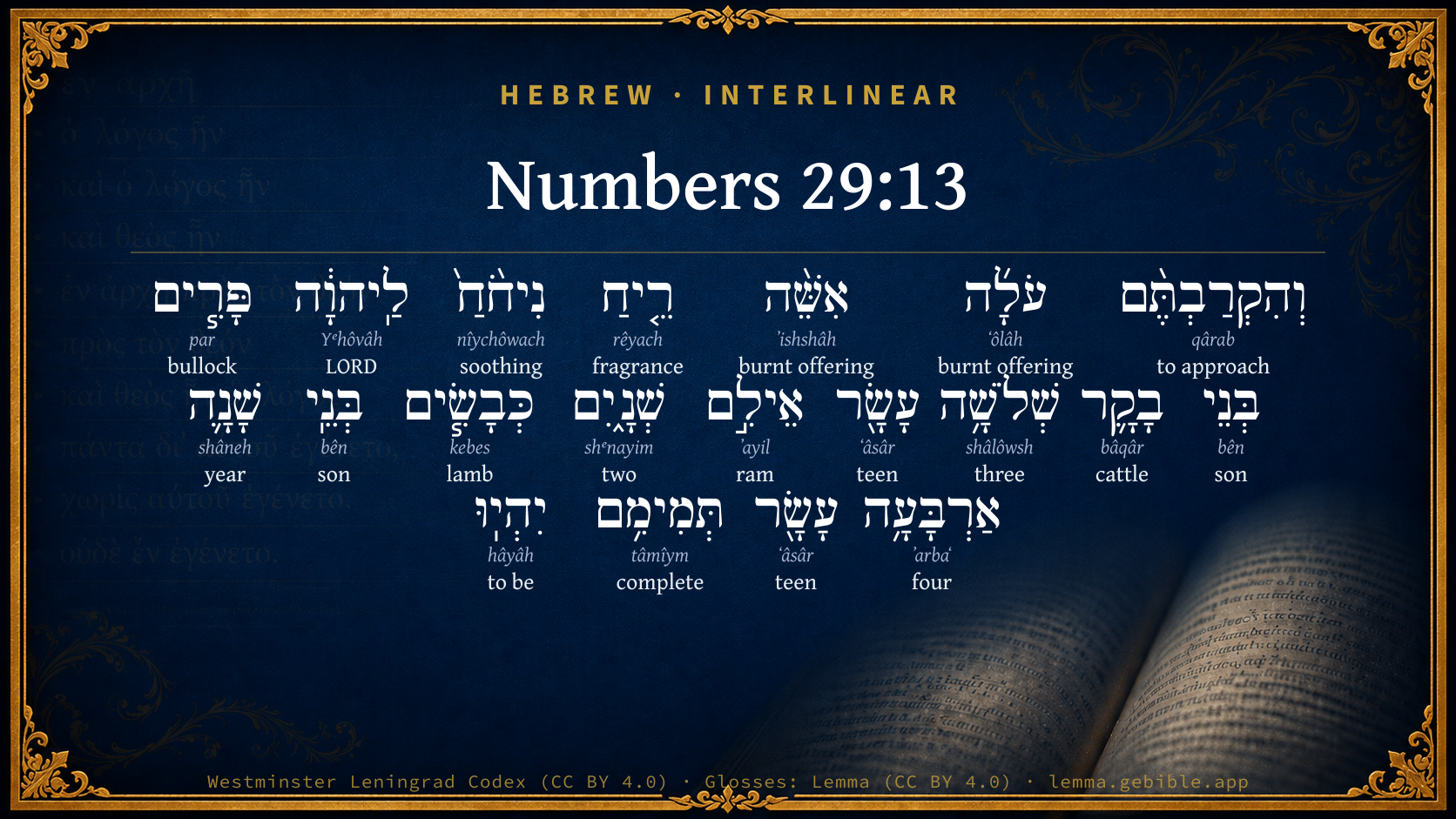
Numbers 29:13

Hebrew (Westminster Leningrad Codex) Numbers 29:13 appears in the Hebrew Old Testament. The text above is from the Westminster Leningrad Codex. Each word links to its Strong’s number, a concise gloss, and parsing drawn from the Open Scriptures Hebrew Bible morphology. Click any word for its full Brown-Driver-Briggs (BDB) entry.
Download image
Cite this verse

Numbers 29:13 (World English Bible). Public Domain. Lemma interlinear Bible study tool, https://lemma.gebible.app/v/numbers/29/13.

Show BibTeX & RIS
BibTeX
RIS
English Translation
and you shall offer a burnt offering, an offering made by fire, of a sweet savor to Yahweh; thirteen young bulls, two rams, fourteen he-lambs a year old; they shall be without blemish;
World English Bible · Public Domain
Download a study sheet

One document with this verse’s original text, its word-by-word gloss line, the meaning frame, cross-references with their text, attributed commentary, and full source and license credits — printable, and it pastes into notes with its structure intact.

This verse Autodidact and up

Study sheet (.html) Plain text (.txt)

A passage Seminary Student

Up to 50 verses in one chapter. A passage sheet keeps up to 6 commentary sources and 12 cross-references per verse, in the order this page ranks them, and says so on the sheet whenever that leaves anything out. Ask for a single verse and you get the Autodidact verse sheet above.

Everything on this page stays free to read, with no account — the sheet is a download of what is already on screen, not access to it.

Want to remove ads? Support Godless Engineer
Compare translations 3

The same verse in 3 English versions, stacked beneath the original-language interlinear above. Click any original word for its lexicon entry.

Each is an independent rendering of the whole verse — the interlinear is not word-aligned to these translations.

Highlighted words mark where these versions differ — a whole-verse word diff, not a word-by-word alignment.

  • World English Bible Public Domain
    and you shall offer a burnt offering, an offering made by fire, of a sweet savor to Yahweh; thirteen young bulls, two rams, fourteen he-lambs a year old; they shall be without blemish;
  • King James Version Public Domain
    And ye shall offer a burnt offering, a sacrifice made by fire, of a sweet savor unto the LORD; thirteen young bullocks, two rams, and fourteen lambs of the first year; they shall be without blemish:
  • unfoldingWord Literal Text CC BY-SA 4.0
    And you shall offer a burnt offering, a sacrifice made by fire, an aroma of soothing to Yahweh, 13 bulls, sons of cattle, two rams, 14 male lambs, sons of a year. They shall be unblemished.

unfoldingWord Literal Text — © unfoldingWord, licensed CC BY-SA 4.0. Word-aligned USFM3 via Door43 (git.door43.org/unfoldingWord/en_ult).

Versions to compare (up to 4)

3 of 4 selected

Show all 18 translations

Every available English version of this verse, each an independent rendering of the whole verse.

  • World English Bible Public Domain
    and you shall offer a burnt offering, an offering made by fire, of a sweet savor to Yahweh; thirteen young bulls, two rams, fourteen he-lambs a year old; they shall be without blemish;
  • Berean Standard Bible Public Domain
    As a pleasing aroma to the LORD, you are to present an offering made by fire, a burnt offering of thirteen young bulls, two rams, and fourteen male lambs a year old, all unblemished,
  • Majority Standard Bible Public Domain
    As a pleasing aroma to the LORD, you are to present a food offering, a burnt offering of thirteen young bulls, two rams, and fourteen male lambs a year old, all unblemished,
  • King James Version Public Domain
    And ye shall offer a burnt offering, a sacrifice made by fire, of a sweet savor unto the LORD; thirteen young bullocks, two rams, and fourteen lambs of the first year; they shall be without blemish:
  • American Standard Version (1901) Public Domain
    and ye shall offer a burnt-offering, an offering made by fire, of a sweet savor unto Jehovah; thirteen young bullocks, two rams, fourteen he-lambs a year old; they shall be without blemish;
  • Revised Version (1885) Public Domain
    and ye shall offer a burnt offering, an offering made by fire, of a sweet savour unto the LORD; thirteen young bullocks, two rams, fourteen he-lambs of the first year; they shall be without blemish:
  • Geneva Bible (1599) Public Domain
    And ye shall offer a burnt offring for a sacrifice made by fire of sweete sauour vnto the Lord, thirteene yong bullockes, two rammes, and fourtene lambes of a yeere olde: they shall bee without blemish.
  • Douay-Rheims (1899) Public Domain
    And you shall offer a holocaust for a most sweet odour to the Lord, thirteen calves of the herd, two rams, and fourteen lambs of a year old, without blemish:
  • Young's Literal Translation Public Domain
    and have brought near a burnt-offering, a fire-offering, a sweet fragrance, to Jehovah; thirteen bullocks, sons of the herd, two rams, fourteen lambs, sons of a year; perfect ones they are;
  • Literal Standard Version CC BY-SA 4.0
    and have brought a burnt-offering near, a fire-offering of refreshing fragrance, to YHWH: thirteen bullocks, sons of the herd, two rams, fourteen lambs, sons of a year; they are perfect ones;
  • Unlocked Literal Bible CC BY-SA 4.0
    You must offer a burnt offering, a sacrifice made by fire to produce a sweet aroma for Yahweh. You must offer thirteen young bulls, two rams, and fourteen male lambs a year old. Each must be without blemish.
  • unfoldingWord Literal Text CC BY-SA 4.0
    And you shall offer a burnt offering, a sacrifice made by fire, an aroma of soothing to Yahweh, 13 bulls, sons of cattle, two rams, 14 male lambs, sons of a year. They shall be unblemished.
  • Darby Bible Public Domain
    and ye shall present a burnt-offering, an offering by fire for a sweet odour to Jehovah: thirteen young bullocks, two rams, fourteen yearling lambs (they shall be without blemish);
  • World Messianic Bible Public Domain
    You shall offer a burnt offering, an offering made by fire, of a pleasant aroma to the LORD: thirteen young bulls, two rams, fourteen male lambs a year old, all without defect;
  • Webster's Bible Public Domain
    And ye shall offer a burnt-offering, a sacrifice made by fire, of a sweet savor to the LORD; thirteen young bullocks, two rams, and fourteen lambs of the first year; they shall be without blemish:
  • Free Bible Version CC BY-SA 4.0
    Present the following as a burnt offering acceptable to the Lord: thirteen young bulls, two rams, and fourteen male lambs a year old, all of them without defects.
  • Bible in Basic English Public Domain
    And give a burned offering, an offering made by fire of a sweet smell to the Lord, thirteen oxen, two male sheep, fourteen he-lambs of the first year, all without any mark on them;
  • JPS Tanakh (1917) Public Domain
    and ye shall present a burnt-offering, an offering made by fire, of a sweet savour unto the LORD: thirteen young bullocks, two rams, fourteen he-lambs of the first year; they shall be without blemish;

Literal Standard Version (2020), Covenant Press — licensed CC BY-SA 4.0. Text via the HelloAO Bible API (eBible.org). Unlocked Literal Bible (unfoldingWord) — licensed CC BY-SA 4.0. Text via the HelloAO Bible API (eBible.org). unfoldingWord Literal Text — © unfoldingWord, licensed CC BY-SA 4.0. Word-aligned USFM3 via Door43 (git.door43.org/unfoldingWord/en_ult). Free Bible Version, Dr. Jonathan Gallagher — licensed CC BY-SA 4.0. Text via the HelloAO Bible API (eBible.org).

Word by word

More ways to search: Search by grammar → Find every occurrence → Compare this word →

Practice this passage: Drill this verse → Learn its vocabulary →

נִיחֹ֨חַ֙
nîychôwach
H5207
“soothing”
Noun, Common, Masculine, Singular, Absolute
Part of Speech
Noun
Type
Common
Gender
Masculine
Number
Singular
State
Absolute
Full BDB Definition

Origin: from H5117

TWOT: 1323c

soothing, quieting, tranquillising
  1. וְהִקְרַבְתֶּ֨ם qârab H7126 “and · to approach” Conjunction + Verb, Hiphil, Sequential Perfect, 2nd Person, Masculine, Plural
  2. עֹלָ֜ה ʻôlâh H5930 “burnt offering” Noun, Common, Feminine, Singular, Absolute
  3. אִשֵּׁ֨ה ʼishshâh H801 “burnt offering of” Noun, Common, Masculine, Singular, Construct
  4. רֵ֤יחַ rêyach H7381 “fragrance of” Noun, Common, Masculine, Singular, Construct
  5. לַֽיהוָ֔ה Yᵉhôvâh H3068 “to/for · LORD” Preposition + Noun, Proper
  6. פָּרִ֧ים par H6499 “bullocks” Noun, Common, Masculine, Plural, Absolute
  7. בְּנֵי bên H1121 “sons of” Noun, Common, Masculine, Plural, Construct
  8. בָקָ֛ר bâqâr H1241 “cattle” Noun, Common, Both, Singular, Absolute
  9. שְׁלֹשָׁ֥ה shâlôwsh H7969 “three” Adjective, Cardinal number, Masculine, Singular, Absolute
  10. עָשָׂ֖ר ʻâsâr H6240 “teen” Adjective, Cardinal number, Masculine, Singular, Absolute
  11. אֵילִ֣ם ʼayil H352 “rams” Noun, Common, Masculine, Plural, Absolute
  12. שְׁנָ֑יִם shᵉnayim H8147 “two” Adjective, Cardinal number, Masculine, Dual, Absolute
  13. כְּבָשִׂ֧ים kebes H3532 “lambs” Noun, Common, Masculine, Plural, Absolute
  14. בְּנֵֽי bên H1121 “sons of” Noun, Common, Masculine, Plural, Construct
  15. שָׁנָ֛ה shâneh H8141 “year” Noun, Common, Feminine, Singular, Absolute
  16. אַרְבָּעָ֥ה ʼarbaʻ H702 “four” Adjective, Cardinal number, Masculine, Singular, Absolute
  17. עָשָׂ֖ר ʻâsâr H6240 “teen” Adjective, Cardinal number, Masculine, Singular, Absolute
  18. תְּמִימִ֥ם tâmîym H8549 “complete” Adjective, Adjective, Masculine, Plural, Absolute
  19. יִהְיֽוּ hâyâh H1961 “to be” Verb, Qal, Imperfect, 3rd Person, Masculine, Plural

About this verse

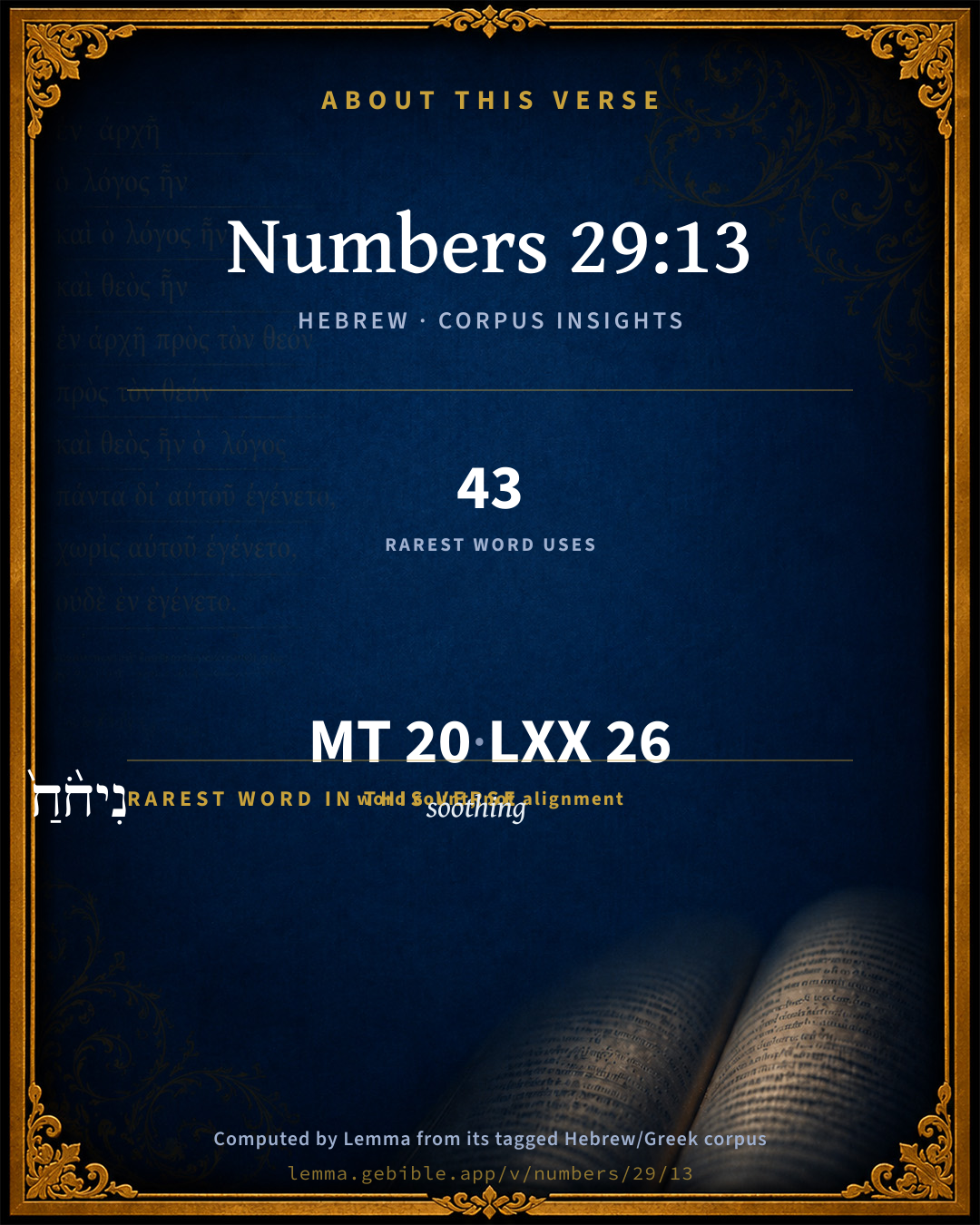
These counts appear in no published source. They are computed here, from the morphology-tagged text and Lemma’s own curated glosses. What Lemma adds →

20
words
18
distinct lemmas
Pentateuch
section

Shared distinctive vocabulary

נִיחֹ֨חַ֙ soothing H5207 occurs in 43 verses of the Hebrew Bible. Also found in:

Grammatical profile

  • 2 verbs
  • 12 nouns
  • 6 adjectives

Verb forms

  • וְהִקְרַבְתֶּ֨ם Hiphil · Sequential Perfect
  • יִהְיֽוּ Qal · Imperfect

Repetition

Words recur within this verse — often emphatic in Hebrew:

  • בְּנֵי son H1121 ×2
  • עָשָׂ֖ר teen H6240 ×2

Hebrew & Septuagint length

In English translation the verse runs 33 words from the Hebrew and 41 from the Septuagint (LXX English) — closely comparable.

A rough comparison of the two English renderings, which tokenize alike — not a word-level alignment.

Word counts can differ between the Hebrew and the Greek without any difference in meaning — e.g. the Hebrew direct-object marker אֵת has no separate Greek word, and Greek often adds the article ὁ.

In the original languages it is 20 Hebrew tokens and 26 Greek tokens — but the two are counted differently (Hebrew bundles its prefixes and suffixes into one token; the Greek is in lemma form), so that isn’t a like-for-like length.

Cross-references

8

Topical passages linked to Numbers 29:13 in the Treasury of Scripture Knowledge — connected by theme and wording, ordered by reader-vote popularity; previews shown in the World English Bible.

  • Numbers 28:11 In the beginnings of your months you shall offer a burnt offering to Yahweh: two young bulls, and one ram, seven he-lambs a year old without blemish;
  • Ezra 3:4 They kept the feast of tents, as it is written, and [offered] the daily burnt offerings by number, according to the ordinance, as the duty of every day required;
  • Numbers 28:19 but you shall offer an offering made by fire, a burnt offering to Yahweh: two young bulls, and one ram, and seven he-lambs a year old; they shall be to you without blemish;
  • Numbers 28:27 but you shall offer a burnt offering for a sweet savor to Yahweh: two young bulls, one ram, seven he-lambs a year old;
  • Numbers 29:2 You shall offer a burnt offering for a sweet savor to Yahweh: one young bull, one ram, seven he-lambs a year old without blemish;
  • Numbers 29:8 but you shall offer a burnt offering to Yahweh for a sweet savor: one young bull, one ram, seven he-lambs a year old; they shall be to you without blemish;
  • Romans 12:1 Therefore I urge you, brothers, by the mercies of God, to present your bodies a living sacrifice, holy, acceptable to God, which is your spiritual service.
  • Hebrews 10:12–14 but he, when he had offered one sacrifice for sins for ever, sat down on the right hand of God;

Cross-references courtesy of OpenBible.info (CC BY 4.0).

Hebrew and Greek witnesses Masoretic Hebrew ↔ Greek Septuagint

The same verse in the two great witnesses to the Old Testament, shown verse-for-verse.

These are two independent witnesses, not word-aligned to each other, and the Septuagint is shown in lemma (dictionary) form.

Hebrew Numbers 29:13 Masoretic · Westminster Leningrad Codex

וְהִקְרַבְתֶּ֨ם עֹלָ֜ה אִשֵּׁ֨ה רֵ֤יחַ נִיחֹ֨חַ֙ לַֽיהוָ֔ה פָּרִ֧ים בְּנֵי בָקָ֛ר שְׁלֹשָׁ֥ה עָשָׂ֖ר אֵילִ֣ם שְׁנָ֑יִם כְּבָשִׂ֧ים בְּנֵֽי שָׁנָ֛ה אַרְבָּעָ֥ה עָשָׂ֖ר תְּמִימִ֥ם יִהְיֽוּ

and you shall offer a burnt offering, an offering made by fire, of a sweet savor to Yahweh; thirteen young bulls, two rams, fourteen he-lambs a year old; they shall be without blemish;

World English Bible · Public Domain

Greek LXX Numbers 29:13 Septuagint · lemma form

καί προςἄγω ὁλοκαύτωμα κάρπωμα εἰς ὀσμή εὐωδία κύριος ὁ ἡμέρα ὁ πρῶτος μόσχος ἐκ βοῦς τρεῖς καί δέκα κριός δύο ἀμνός ἐνιαύσιος δέκα τέσσαρες ἄμωμος εἰμί

And you⌃ shall bring near whole burnt offerings, a sacrifice for a smell of sweet savor to the Lord, on the first day thirteen calves of the herd, two rams, fourteen lambs of a year old; they shall be without blemish.

LXX2012 (modern English Septuagint) · Public Domain

Hebrew: Westminster Leningrad Codex (CC BY 4.0). Greek: Septuagint (public domain); English from LXX2012 (modern English Septuagint) (Public Domain). How the Septuagint differs from the Hebrew →

Targum (Aramaic paraphrase)

2

The Targum is the ancient Jewish Aramaic paraphrase of the Hebrew Scriptures — an interpretive translation, not the Hebrew text itself. Onkelos (literal) and Pseudo-Jonathan (expansive) render the Torah, and Jonathan the Prophets. Coverage is partial: where no permissively-licensed English translation exists for a verse, only the Aramaic is shown. This is verse-level text, not a word-by-word alignment to the Hebrew.

  1. Targum Onkelos Torah (Genesis–Deuteronomy)
    וּתְקַרְבוּן עֲלָתָא קוּרְבַּן דְמִתְקַבֵּל בְּרַעֲוָא קֳדָם יְיָ תּוֹרִין בְּנֵי תוֹרֵי תְּלַת עֲשַׂר דִכְרִין תְּרֵין אִימְרִין בְּנֵי שְׁנָא אַרְבְּעָא עֲשַׂר שַׁלְמִין יְהוֹן

    (no public-domain English translation for this verse)

    Targum Onkelos — Aramaic: “Onkelos Genesis” (public domain); “Onkelos Exodus” (public domain); “Onkelos Leviticus” (public domain); “Onkelos Numbers” (public domain); “Onkelos Deuteronomy” (public domain). English: “Sefaria Community Translation” (CC0 1.0 (public-domain dedication)); “J.W. Etheridge. The Targums of Onkelos and Jonathan Ben Uzziel on the Pentateuch. London: Longmans, Green, 1862” (public domain). Text via Sefaria.

  2. Targum Pseudo-Jonathan Torah (Genesis–Deuteronomy)
    וּתְקַרְבוּן עֲלָתָא קֻרְבַּן דְמִתְקַבֵּל בְּרַעֲוָא קֳדָם יְיָ תּוֹרִין בְּנֵי תּוֹרֵי תַּלְתֵיסַר אָזְלִין כָּל יוֹמָא וְחַסְרִין סְכוּמְהוֹן שׁוּבְעִין עַל שׁוּבְעִין עַמְמִין וּמְקַרְבִין יַתְהוֹן תְּלֵיסַר מַטַרְתָּא דִכְרִין תְּרֵין דִמְקַרְבִין תְּרֵין מַטַרְתָּא אִמְרִין בְּנֵי שְׁנָא אַרְבֵּיסַר שַׁלְמִין דִמְקַרְבִין תַּמְנֵי מַטַרְתָּא שִׁיתָּא מִנְהוֹן מְקַרְבִין תְּרֵי תְּרֵי וּתְרֵין מִנְהוֹן חַד חַד שַׁלְמִין יְהוֹן

    and offer a sacrifice, an oblation to be received with favour before the Lord: thirteen young bullocks proceeding daily and diminishing their number, (in all) seventy for the seventy nations, and offering them by thirteen orders; two rams, which you shall offer by two orders; lambs of the year fourteen, unblemished, to be offered by eight orders, offering six of them, by two and two, and two of them one by one, they shall be perfect.

    Targum Pseudo-Jonathan — Aramaic: “Targum Jonathan on Genesis” (public domain); “Targum Jonathan on Exodus” (public domain); “Targum Jonathan on Leviticus” (public domain); “Targum Jonathan on Numbers” (public domain); “Targum Jonathan on Deuteronomy” (public domain). English: “The Targum of Jonathan ben Uzziel, trans. J. W. Etheridge, London, 1862” (public domain). Text via Sefaria.

Commentary

Notes on Numbers 29:13 from classic Christian and Jewish commentators (each source and its license shown beneath its notes). The classic Christian expositions comment on the surrounding passage and are grouped to its opening verse, so a note may address several verses; the Jewish commentaries on the Tanakh (Rashi and others) are per-verse, so they appear only where the commentator wrote on this verse.

Lemma curates 59 commentaries, every one of them public domain or Creative Commons licensed, each selected and text-cleaned for this edition rather than reprinted as found. About our sources →

Joseph Benson's Commentary

Num 29:13. Thirteen young bullocks — Thus they continued to be offered seven days successively, with the decrease only of one bullock every day, till on the seventh day only seven bullocks were offered, which in all made seventy bullocks. The rams also were in double proportion to what was usual. This was a vast charge, but more easy at this time of the year than at any other; for this was a time of leisure and plenty; now their barns were full, their wine-presses overflowed, and their hearts were enlarged with joy and gratitude to God for the blessings of the harvest. Yet this troublesome and expensive service made their religion a very grievous yoke, under which the best men among them groaned, longing for the coming of the Messiah, when their own doctors have said, no sacrifices shall remain but those of thanksgiving, praise, and prayer.

Joseph Benson's Commentary on the Old and New Testaments (1811–1818) — public domain. Text from a community e-Sword module.

John Gill's Exposition

But ye shall offer a burnt offering,.... Which was the same that was offered on the first and tenth days of this month, Num 29:2 and the meat and drink offerings for each of the creatures were the same, as often expressed; and on this day a goat for a sin offering was also offered, besides the daily sacrifice, and what went along with that.

and the meat and drink offerings for each of the creatures were the same, as often expressed; and on this day a goat for a sin offering was also offered, besides the daily sacrifice, and what went along with that.

Numbers 29:39

num 29:39

num 29:39

num 29:39These things ye shall do to the Lord, in your set feasts,.... Or rather in the times set and appointed to you, as the Jewish writers (o) interpret it; and so Jarchi interprets it of a fixed time, which seems better; since these were not all feast days, on which the above sacrifices were to be offered, for one of them was a fast, even the day of atonement:

besides your vows, and your freewill offerings: which might be offered up at any time, notwithstanding the above sacrifices, which were necessary and obligatory; but these were at their own option:

for your burnt offerings, and for your meat offerings, and your drink offerings, and for your peace offerings; of which see Lev 7:11.

(o) Maimon. & Bartenora in Misn. Pesach, c. 7. sect. 4.

John Gill's Exposition of the Whole Bible (1746–1763) — public domain (CC PDM 1.0). Text via the HelloAO Bible API.

Matthew Poole's English Annotations

Thirteen young bullocks; more sacrifices than at any other feast, partly because this feast was in the close of the year, when it was meet to supply the defects of the year past, and when they had gathered in all their fruits, Deu 16:13,15 and therefore ought to make the larger returns and acknowledgment to God; partly because it was God’s pleasure so to order it, for reasons known to himself, in whose will we ought to acquiesce. And the same reason holds why these sacrifices grew fewer and fewer every day.

Matthew Poole's English Annotations on the Holy Bible (1683–1685) — public domain. Text from a community e-Sword/MySword module.

The Pulpit Commentary

Ye shall offer a burnt offering. This also was ordered, but not prescribed, in Le 23. As it was the feast of the ingathering, when God had crowned the year with his goodness, and filled the hearts of men with food and gladness, so it was celebrated with the greatest profusion of burnt offerings, especially of the largest and costliest kind. Thirteen young bullocks. The number of bullocks was so arranged as to be one less each day, to be seven on the seventh and last day, and to make up seventy altogether. Thus the sacred number was studiously emphasized, and the slow fading of festal joy into the ordinary gladness of a grateful life was set forth. It seems quite fanciful to trace any connection with the waning of the moon. The observance of the heavenly bodies, although sanctioned in the case of the new moon feast, was not further encouraged for obvious reasons.

The Pulpit Commentary (1880–1919), ed. H.D.M. Spence-Jones & Joseph S. Exell — public domain. Text from a community e-Sword module.

Lesson kit

Teaching starters — assembled from the data on this page, not authored interpretation. Every prompt links to the verse data it draws on. Edit before teaching.

Numbers, in the Pentateuch, opens this verse with 20 words (18 distinct Hebrew lemmas). Its most distinctive word is nîychôwach (“soothing”). A historical commentator’s framing appears above. Read the whole chapter for the surrounding context.

Discussion questions

  1. How does “soothing” (nîychôwach) shape what this verse is saying?
  2. How does Genesis 8:21, which shares the word «soothing», read alongside this verse?
  3. What does the repetition of “son” (2× in this one verse) do in this verse?
  4. The translations on this page render this verse differently — a whole-verse word diff, not a word-by-word alignment. What might account for the different wordings?
  5. «וְהִקְרַבְתֶּ֨ם» is a Hiphil Sequential Perfect verb. How does that grammatical form shape the action described?
  6. Compare how Joseph Benson's Commentary and John Gill's Exposition read this verse. Where do they agree or differ?

Things to notice

Reading settings

Reading text

Shown beneath each verse's original-language words.

Old Testament
Old Testament edition

Read the OT as the Masoretic Hebrew (MT) or the Greek Septuagint (LXX).

English shown for the Greek Septuagint (in the Hebrew ↔ Greek comparison).

Comparing translations? Open the Compare panel on any verse page to stack up to four side by side.