Exodus 16:9

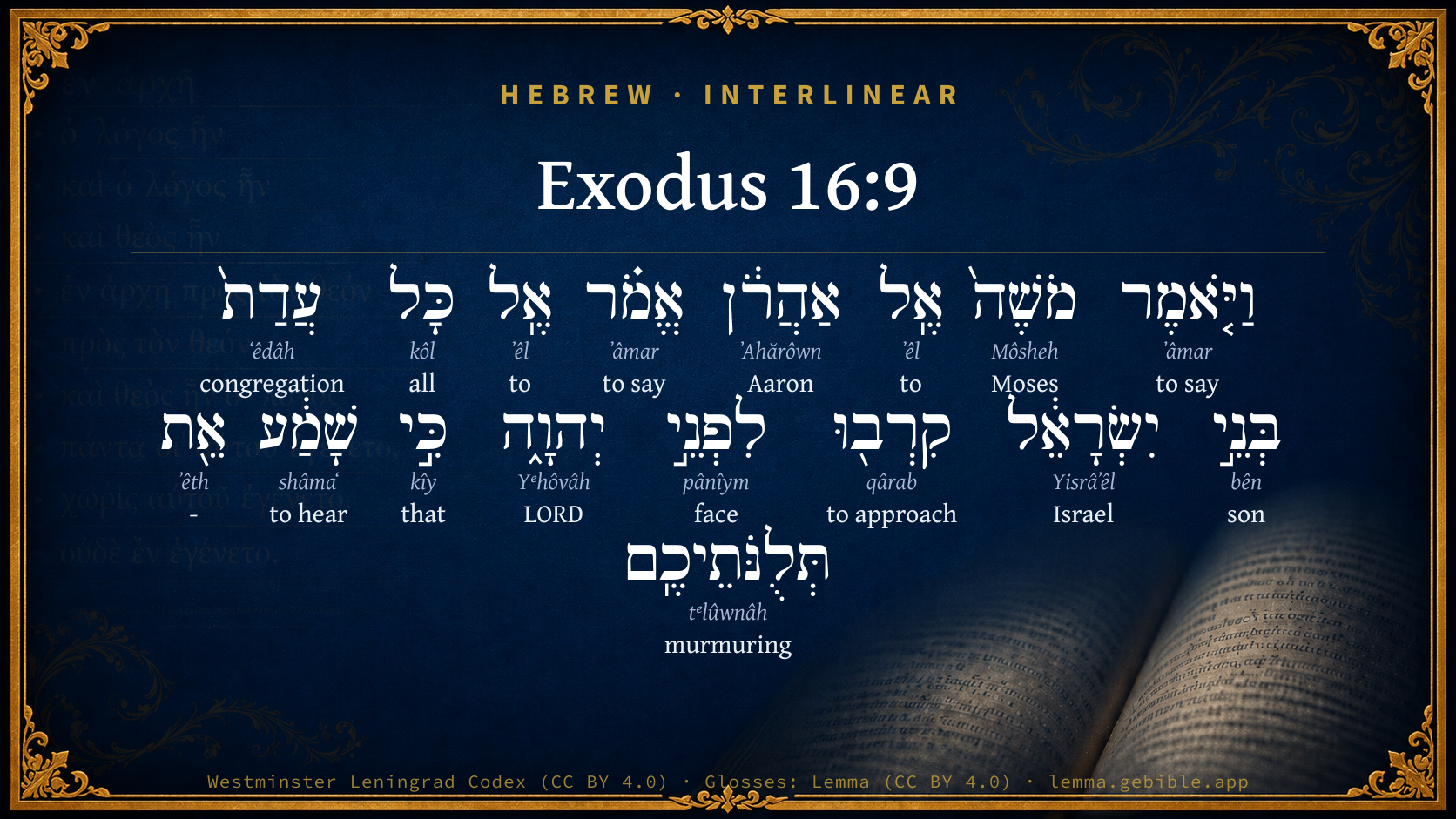
Hebrew (Westminster Leningrad Codex) Exodus 16:9 appears in the Hebrew Old Testament. The text above is from the Westminster Leningrad Codex. Each word links to its Strong’s number, a concise gloss, and parsing drawn from the Open Scriptures Hebrew Bible morphology. Click any word for its full Brown-Driver-Briggs (BDB) entry.
Download image
Cite this verse

Exodus 16:9 (World English Bible). Public Domain. Lemma interlinear Bible study tool, https://lemma.gebible.app/v/exodus/16/9.

Show BibTeX & RIS
BibTeX
RIS
English Translation
Moses said to Aaron, "Tell all the congregation of the children of Israel, 'Come near before Yahweh, for he has heard your murmurings.'"
World English Bible · Public Domain
Download a study sheet

One document with this verse’s original text, its word-by-word gloss line, the meaning frame, cross-references with their text, attributed commentary, and full source and license credits — printable, and it pastes into notes with its structure intact.

This verse Autodidact and up

Study sheet (.html) Plain text (.txt)

A passage Seminary Student

Up to 50 verses in one chapter. A passage sheet keeps up to 6 commentary sources and 12 cross-references per verse, in the order this page ranks them, and says so on the sheet whenever that leaves anything out. Ask for a single verse and you get the Autodidact verse sheet above.

Everything on this page stays free to read, with no account — the sheet is a download of what is already on screen, not access to it.

Want to remove ads? Support Godless Engineer
Compare translations 3

The same verse in 3 English versions, stacked beneath the original-language interlinear above. Click any original word for its lexicon entry.

Each is an independent rendering of the whole verse — the interlinear is not word-aligned to these translations.

Highlighted words mark where these versions differ — a whole-verse word diff, not a word-by-word alignment.

  • World English Bible Public Domain
    Moses said to Aaron, "Tell all the congregation of the children of Israel, 'Come near before Yahweh, for he has heard your murmurings.'"
  • King James Version Public Domain
    And Moses spake unto Aaron, Say unto all the congregation of the children of Israel, Come near before the LORD: for he hath heard your murmurings.
  • unfoldingWord Literal Text CC BY-SA 4.0
    And Moses said to Aaron, “Say to all of the congregation of the sons of Israel, ‘Approach the face of Yahweh, for he has heard your murmurings.’”

unfoldingWord Literal Text — © unfoldingWord, licensed CC BY-SA 4.0. Word-aligned USFM3 via Door43 (git.door43.org/unfoldingWord/en_ult).

Versions to compare (up to 4)

3 of 4 selected

Show all 18 translations

Every available English version of this verse, each an independent rendering of the whole verse.

  • World English Bible Public Domain
    Moses said to Aaron, "Tell all the congregation of the children of Israel, 'Come near before Yahweh, for he has heard your murmurings.'"
  • Berean Standard Bible Public Domain
    Then Moses said to Aaron, “Tell the whole congregation of Israel, ‘Come before the LORD, for He has heard your grumbling.’”
  • Majority Standard Bible Public Domain
    Then Moses said to Aaron, “Tell the whole congregation of Israel, ‘Come before the LORD, for He has heard your grumbling.’”
  • King James Version Public Domain
    And Moses spake unto Aaron, Say unto all the congregation of the children of Israel, Come near before the LORD: for he hath heard your murmurings.
  • American Standard Version (1901) Public Domain
    And Moses said unto Aaron, Say unto all the congregation of the children of Israel, Come near before Jehovah; for he hath heard your murmurings.
  • Revised Version (1885) Public Domain
    And Moses said unto Aaron, Say unto all the congregation of the children of Israel, Come near before the LORD: for he hath heard your murmurings.
  • Geneva Bible (1599) Public Domain
    And Moses sayd to Aaron, Say vnto all the Congregation of the children of Israel, Draw neere before the Lord: for he hath heard your murmurings.
  • Douay-Rheims (1899) Public Domain
    Moses also said to Aaron: Say to the whole congregation of the children of Israel: Come before the Lord: for he hath heard your murmuring.
  • Young's Literal Translation Public Domain
    And Moses saith unto Aaron, `Say unto all the company of the sons of Israel, Come ye near before Jehovah, for He hath heard your murmurings;'
  • Literal Standard Version CC BY-SA 4.0
    And Moses says to Aaron, “Say to all the congregation of the sons of Israel, Come near before YHWH, for He has heard your murmurings”;
  • Unlocked Literal Bible CC BY-SA 4.0
    Moses said to Aaron, “Say to all the community of the people of Israel, 'Come near before Yahweh, for he has heard your complaints.'”
  • unfoldingWord Literal Text CC BY-SA 4.0
    And Moses said to Aaron, “Say to all of the congregation of the sons of Israel, ‘Approach the face of Yahweh, for he has heard your murmurings.’”
  • Darby Bible Public Domain
    And Moses spoke to Aaron, Say to all the assembly of the children of Israel, Come near into the presence of Jehovah; for he has heard your murmurings.
  • World Messianic Bible Public Domain
    Moses said to Aaron, “Tell all the congregation of the children of Israel, ‘Come close to the LORD, for he has heard your murmurings.’”
  • Webster's Bible Public Domain
    And Moses spoke to Aaron, Say to all the congregation of the children of Israel, Come near before the LORD: for he hath heard your murmurings.
  • Free Bible Version CC BY-SA 4.0
    Then Moses said to Aaron, “Tell the whole Israelite community, ‘Present yourselves before the Lord, because he has heard your complaints.’”
  • Bible in Basic English Public Domain
    And Moses said to Aaron, Say to all the people of Israel, Come near before the Lord for he has given ear to your outcry.
  • JPS Tanakh (1917) Public Domain
    And Moses said unto Aaron: 'Say unto all the congregation of the children of Israel: Come near before the LORD; for He hath heard your murmurings.'

Literal Standard Version (2020), Covenant Press — licensed CC BY-SA 4.0. Text via the HelloAO Bible API (eBible.org). Unlocked Literal Bible (unfoldingWord) — licensed CC BY-SA 4.0. Text via the HelloAO Bible API (eBible.org). unfoldingWord Literal Text — © unfoldingWord, licensed CC BY-SA 4.0. Word-aligned USFM3 via Door43 (git.door43.org/unfoldingWord/en_ult). Free Bible Version, Dr. Jonathan Gallagher — licensed CC BY-SA 4.0. Text via the HelloAO Bible API (eBible.org).

Word by word

More ways to search: Search by grammar → Find every occurrence → Compare this word →

Practice this passage: Drill this verse → Learn its vocabulary →

תְּלֻנֹּתֵיכֶֽם
tᵉlûwnâh
H8519
“murmurings · your”
Noun, Common, Feminine, Plural, Construct + Suffix, Personal, 2nd Person, Masculine, Plural
Part of Speech
Noun
Type
Common
Gender
Feminine
Number
Plural
State
Construct
Full BDB Definition

Origin: from H3885 in the sense of obstinacy

TWOT: 1097a

murmuring
  1. וַיֹּ֤אמֶר ʼâmar H559 “and · to say” Conjunction + Verb, Qal, Sequential Imperfect, 3rd Person, Masculine, Singular
  2. מֹשֶׁה֙ Môsheh H4872 “Moses” Noun, Proper
  3. אֶֽל ʼêl H413 “to” Preposition
  4. אַהֲרֹ֔ן ʼAhărôwn H175 “Aaron” Noun, Proper
  5. אֱמֹ֗ר ʼâmar H559 “say” Verb, Qal, Imperative, 2nd Person, Masculine, Singular
  6. אֶֽל ʼêl H413 “to” Preposition
  7. כָּל kôl H3605 “all of” Noun, Common, Masculine, Singular, Construct
  8. עֲדַת֙ ʻêdâh H5712 “congregation of” Noun, Common, Feminine, Singular, Construct
  9. בְּנֵ֣י bên H1121 “sons of” Noun, Common, Masculine, Plural, Construct
  10. יִשְׂרָאֵ֔ל Yisrâʼêl H3478 “Israel” Noun, Proper
  11. קִרְב֖וּ qârab H7126 “approach” Verb, Qal, Imperative, 2nd Person, Masculine, Plural
  12. לִפְנֵ֣י pânîym H6440 “to/for · face(s) of” Preposition + Noun, Common, Both, Plural, Construct
  13. יְהוָ֑ה Yᵉhôvâh H3068 “LORD” Noun, Proper
  14. כִּ֣י kîy H3588 “that” Conjunction
  15. שָׁמַ֔ע shâmaʻ H8085 “to hear” Verb, Qal, Perfect, 3rd Person, Masculine, Singular
  16. אֵ֖ת ʼêth H853 “-” Particle, Direct Object

About this verse

These counts appear in no published source. They are computed here, from the morphology-tagged text and Lemma’s own curated glosses. What Lemma adds →

17
words
15
distinct lemmas
Pentateuch
section

Notable vocabulary

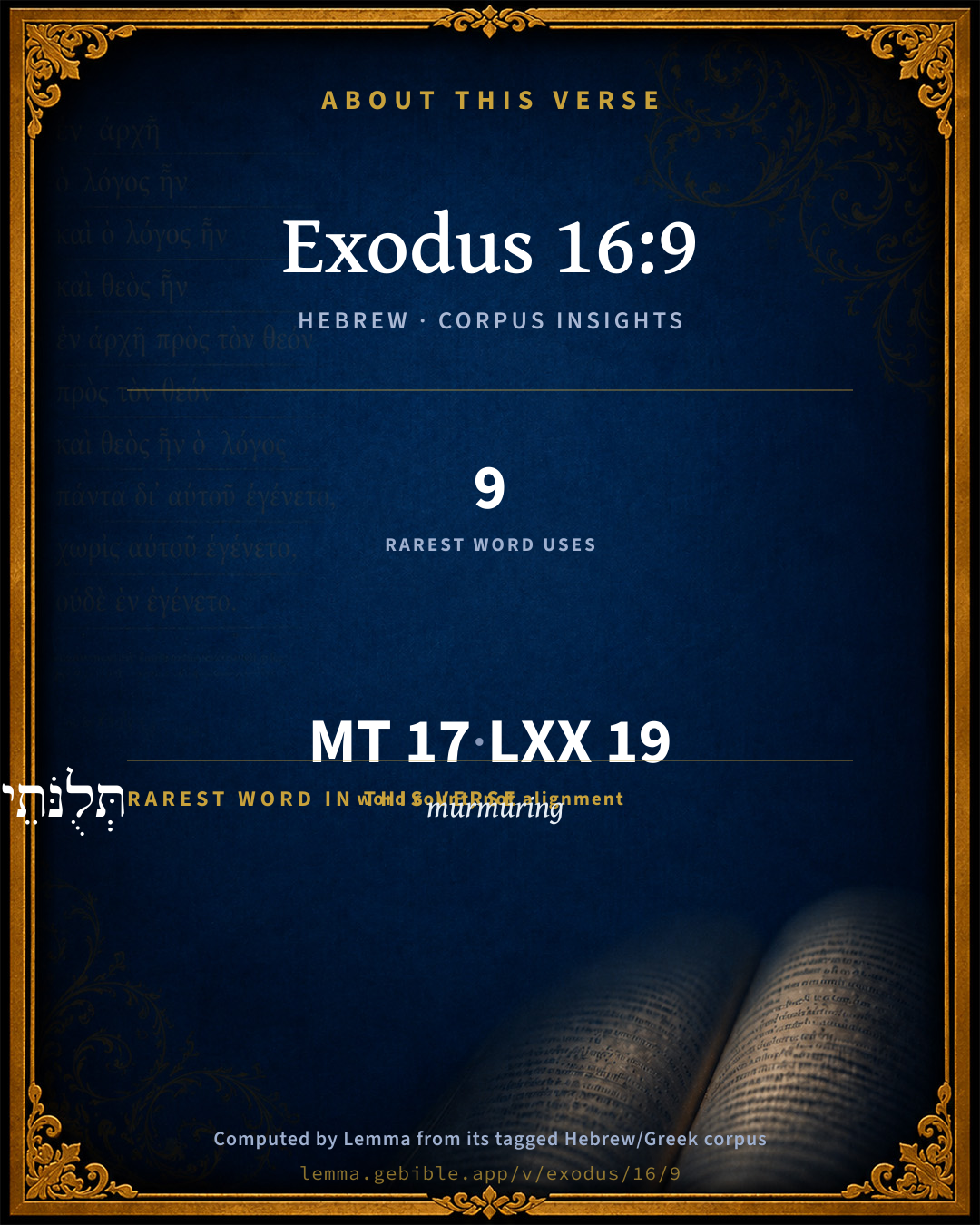
The rarest word here is תְּלֻנֹּתֵיכֶֽם murmuring H8519 — appearing just 9 times in the whole Hebrew Bible.

Shared distinctive vocabulary

תְּלֻנֹּתֵיכֶֽם murmuring H8519 occurs in 7 verses of the Hebrew Bible. Also found in:

Grammatical profile

  • 4 verbs
  • 9 nouns
  • 2 prepositions
  • 1 conjunction
  • 1 particle

Verb forms

  • וַיֹּ֤אמֶר Qal · Sequential Imperfect
  • אֱמֹ֗ר Qal · Imperative
  • קִרְב֖וּ Qal · Imperative
  • שָׁמַ֔ע Qal · Perfect

Repetition

Words recur within this verse — often emphatic in Hebrew:

  • וַיֹּ֤אמֶר to say H559 ×2
  • אֶֽל to H413 ×2

Hebrew & Septuagint length

In English translation the verse runs 23 words from the Hebrew and 25 from the Septuagint (LXX English) — closely comparable.

A rough comparison of the two English renderings, which tokenize alike — not a word-level alignment.

Word counts can differ between the Hebrew and the Greek without any difference in meaning — e.g. the Hebrew direct-object marker אֵת has no separate Greek word, and Greek often adds the article ὁ.

In the original languages it is 17 Hebrew tokens and 19 Greek tokens — but the two are counted differently (Hebrew bundles its prefixes and suffixes into one token; the Greek is in lemma form), so that isn’t a like-for-like length.

Cross-references

3

Topical passages linked to Exodus 16:9 in the Treasury of Scripture Knowledge — connected by theme and wording, ordered by reader-vote popularity; previews shown in the World English Bible.

  • Numbers 16:16 Moses said to Korah, You and all your company go before Yahweh, you, and they, and Aaron, tomorrow:
  • Exodus 16:2 The whole congregation of the children of Israel murmured against Moses and against Aaron in the wilderness;
  • Exodus 16:8 Moses said, "Now Yahweh shall give you meat to eat in the evening, and in the morning bread to satisfy you; because Yahweh hears your murmurings which you murmur against him. And who are we? Your murmurings are not against us, but against Yahweh."

Cross-references courtesy of OpenBible.info (CC BY 4.0).

Hebrew and Greek witnesses Masoretic Hebrew ↔ Greek Septuagint

The same verse in the two great witnesses to the Old Testament, shown verse-for-verse.

These are two independent witnesses, not word-aligned to each other, and the Septuagint is shown in lemma (dictionary) form.

Hebrew Exodus 16:9 Masoretic · Westminster Leningrad Codex

וַיֹּ֤אמֶר מֹשֶׁה֙ אֶֽל אַהֲרֹ֔ן אֱמֹ֗ר אֶֽל כָּל עֲדַת֙ בְּנֵ֣י יִשְׂרָאֵ֔ל קִרְב֖וּ לִפְנֵ֣י יְהוָ֑ה כִּ֣י שָׁמַ֔ע אֵ֖ת תְּלֻנֹּתֵיכֶֽם

Moses said to Aaron, "Tell all the congregation of the children of Israel, 'Come near before Yahweh, for he has heard your murmurings.'"

World English Bible · Public Domain

Greek LXX Exodus 16:9 Septuagint · lemma form

εἶπον δέ μωυσῆς πρός ααρων εἶπον πᾶς συναγωγή υἱός ἰσραήλ προςἔρχομαι ἐναντίον ὁ θεός εἰςἀκούω γάρ σύ ὁ γογγυσμός

And Moses said to Aaron, Say to all the congregation of the children of Israel, Come near before God; for he has heard your murmuring.

LXX2012 (modern English Septuagint) · Public Domain

Hebrew: Westminster Leningrad Codex (CC BY 4.0). Greek: Septuagint (public domain); English from LXX2012 (modern English Septuagint) (Public Domain). How the Septuagint differs from the Hebrew →

Targum (Aramaic paraphrase)

2

The Targum is the ancient Jewish Aramaic paraphrase of the Hebrew Scriptures — an interpretive translation, not the Hebrew text itself. Onkelos (literal) and Pseudo-Jonathan (expansive) render the Torah, and Jonathan the Prophets. Coverage is partial: where no permissively-licensed English translation exists for a verse, only the Aramaic is shown. This is verse-level text, not a word-by-word alignment to the Hebrew.

  1. Targum Onkelos Torah (Genesis–Deuteronomy)
    וַאֲמַר משֶׁה לְאַהֲרֹן אֱמַר לְכָל כְּנִשְׁתָּא דִבְנֵי יִשְׂרָאֵל קְרִיבוּ קֳדָם יְיָ אֲרֵי שְׁמִיעַן קֳדָמוֹהִי יָת תֻּרְעֲמוּתְכוֹן:

    (no public-domain English translation for this verse)

    Targum Onkelos — Aramaic: “Onkelos Genesis” (public domain); “Onkelos Exodus” (public domain); “Onkelos Leviticus” (public domain); “Onkelos Numbers” (public domain); “Onkelos Deuteronomy” (public domain). English: “Sefaria Community Translation” (CC0 1.0 (public-domain dedication)); “J.W. Etheridge. The Targums of Onkelos and Jonathan Ben Uzziel on the Pentateuch. London: Longmans, Green, 1862” (public domain). Text via Sefaria.

  2. Targum Pseudo-Jonathan Torah (Genesis–Deuteronomy)
    וַאֲמַר משֶׁה לְאַהֲרן אֵימַר לְכָל כְּנִישְׁתָּא דִבְנֵי יִשְרָאֵל קְרִיבוּ קֳדָם יְיָ אֲרוּם שְׁמִיעַן קֳדָמוֹי יַת תּוּרְעֲמוּתְכוֹן

    Mosheh said to Aharon, Bid all the congregation of the sons of Israel draw nigh before the Lord; for your murmuring are heard before Him.

    Targum Pseudo-Jonathan — Aramaic: “Targum Jonathan on Genesis” (public domain); “Targum Jonathan on Exodus” (public domain); “Targum Jonathan on Leviticus” (public domain); “Targum Jonathan on Numbers” (public domain); “Targum Jonathan on Deuteronomy” (public domain). English: “The Targum of Jonathan ben Uzziel, trans. J. W. Etheridge, London, 1862” (public domain). Text via Sefaria.

Commentary

Notes on Exodus 16:9 from classic Christian and Jewish commentators (each source and its license shown beneath its notes). The classic Christian expositions comment on the surrounding passage and are grouped to its opening verse, so a note may address several verses; the Jewish commentaries on the Tanakh (Rashi and others) are per-verse, so they appear only where the commentator wrote on this verse.

Lemma curates 59 commentaries, every one of them public domain or Creative Commons licensed, each selected and text-cleaned for this edition rather than reprinted as found. About our sources →

Trapp's Complete Commentary

John Trapp

Exo 16:9 And Moses spake unto Aaron, Say unto all the congregation of the children of Israel, Come near before the LORD: for he hath heard your murmurings.

Ver. 9. For he hath heard your murmurings.] Now then "what will you do, since God riseth up and since he visiteth, what will ye answer?" {Job 31:14}

John Trapp, A Commentary or Exposition upon All the Books of the Old and New Testament (1647–1656) — public domain. Text from a community e-Sword module.

Keil & Delitzsch

C. F. Keil & F. Delitzsch

But before Jehovah manifested Himself to the people in His glory, by relieving their distress, He gave them to behold His glory in the cloud, and by speaking out of the cloud, confirmed both the reproaches and promises of His servants. In the murmuring of the people, their unbelief in the actual presence of God had been clearly manifested. "It was a deep unbelief," says Luther, "that they had thus fallen back, letting go the word and promise of God, and forgetting His former miracles and aid." Even the pillar of cloud, this constant sign of the gracious guidance of God, had lost its meaning in the eyes of the people; so that it was needful to inspire the murmuring multitude with a salutary fear of the majesty of Jehovah, not only that their rebellion against the God who had watched them with a father's care might be brought to mind, but also that the fact might be deeply impressed upon their hearts, that the food about to be sent was a gift of His grace. "Coming near before Jehovah" (Exo 16:9), was coming out of the tents to the place where the cloud was standing. On thus coming out, "they turned towards the desert" (Exo 16:10), i.e., their faces were directed towards the desert of Sin; "and, behold, the glory of Jehovah appeared in the cloud," i.e., in a flash of light bursting forth from the cloud, and revealing the majesty of God. This extraordinary sign of the glory of God appeared in the desert, partly to show the estrangement of the murmuring nation from its God, but still more to show to the people, that God could glorify Himself by bestowing gifts upon His people even in the barren wilderness. For Jehovah spoke to Moses out of this sign, and confirmed to the people what Moses had promised them (Exo 16:11, Exo 16:12).

Keil & Delitzsch — Biblical Commentary on the Old Testament (1861–1891) — public domain (CC PDM 1.0). Text via the HelloAO Bible API. (Old Testament only.)

Adam Clarke's Commentary

Verse 9. Come near before the Lord] This has been supposed to refer to some particular place, where the Lord manifested his presence. The great tabernacle was not yet built, but there appears to have been a small tabernacle or tent called the Tabernacle of the Congregation, which, after the sin of the golden calf, was always placed without the camp; see Ex 33:7: And Moses took the Tabernacle and pitched it without the camp, afar off from the camp, and called it The Tabernacle of the Congregation; and it came to pass that every one that sought the Lord went out unto the Tabernacle of the Congregation, which was without the camp. This could not be that portable temple which is described Ex 26:1-37, c., and which was not set up till the first day of the first month of the second year, after their departure from Egypt, (Ex 40:1-2,) which was upwards of ten months after the time mentioned in this chapter and notwithstanding this, the Israelites are commanded (Ex 16:34) to lay up an omer of the manna before the testimony, which certainly refers to an ark, tabernacle, or some such portable shrine, already in existence. If the great tabernacle be intended, the whole account of laying up the manna must be introduced here by anticipation, Moses finishing the account of what was afterwards done, because the commencement of those circumstances which comprehended the reasons of the fact itself took place now. See Clarke on Ex 16:34.

But from the reasonings in the preceding verses it appears that much infidelity still reigned in the hearts of the people; and in order to convince them that it was God and not Moses that had brought them out of Egypt, he (Moses) desired them to come near, or pay particular attention to some extraordinary manifestation of the Lord. And we are told in the tenth verse, that "as Aaron spake unto them, they looked toward the wilderness, and behold the glory of the Lord appeared, and the Lord spake unto Moses," &c. Is not this passage explained by Ex 19:9, "And the Lord said unto Moses, Lo, I come unto thee in a thick cloud, that the people may hear, when I speak with thee, and believe thee for ever?" May we not conclude that Moses invited them to come near before the Lord, and so witness his glory, that they might be convinced it was God and not he that led them out of Egypt, and that they ought to submit to him, and cease from their murmurings? It is said, Ex 19:17, that Moses brought forth the people out of the camp to meet with God. And in this instance there might have been a similar though less awful manifestation of the Divine presence.

Adam Clarke's Commentary on the Bible (1810–1826) — public domain. Text from a community e-Sword/MySword module.

The Cambridge Bible for Schools and Colleges

gen. ed. J. J. S. Perowne

9. Come near] for the sacred purpose: cf. Exo_12:48, Exo_36:2.

before Jehovah] at the place where He manifests Himself. The expression commonly means, especially in P (e.g. v. 33, Exo_27:21, Num_16:7; Num_16:16-17), before the Ark or the Tent of Meeting; and if, as is probable from v. 33 f., P’s account of the manna once stood at a later point in his narrative, this will be the meaning here (so Di.).

9–12. The sequel to v. 3: the murmurings have been heard by Jehovah: the people are told to draw near to Him, while He gives His answer to them; and He communicates His reply to Moses.

The Cambridge Bible for Schools and Colleges (gen. ed. J. J. S. Perowne; Cambridge University Press, 1878–1918) — public domain. Text from a community e-Sword module.

John Gill's Exposition

And Moses spake unto Aaron,.... Who was his prophet and spokesman to the people:

say unto all the congregation of the children of Israel; to the heads of them, to as many as could conveniently hear him, and were to report what he said to the rest:

come near before the Lord; who was in the pillar of cloud, which from the first appearance of it never removed from them, nor the Lord from that; though some have thought, that before the tabernacle was built, there was some small tent or little tabernacle where the Shechinah was; but for this there is no foundation, there is for the other suggested:

for he hath heard your murmurings; which is repeated again and again, to observe to them the evil of it, and what notice the Lord took of it, though he indulged them in so gracious a manner he did.

John Gill's Exposition of the Whole Bible (1746–1763) — public domain (CC PDM 1.0). Text via the HelloAO Bible API.

Haydock's Catholic Bible Commentary

Before, to the place appointed for public worship, chap. xxxii. 7. (Calmet)

George Leo Haydock (1774–1849), Haydock's Catholic Family Bible and Commentary, 1859 edition — public domain. Excludes Psalms (Douay-Rheims chapter numbering differs from Protestant) and Deuterocanonical books (Catholic canon only).

Matthew Poole's English Annotations

Before the Lord; either before the cloudy pillar, where God was especially present; or in the place of God’s worship. For though the great tabernacle was not yet built, yet it seems from Exo 33:7 there was a little tabernacle. For as the solemn, and public, and sabbath worship was among them before the tabernacle was built, so it was necessary. there should be some place where they did assemble together, and perform that worship which was proper to those times, and there God was supposed to be present in a peculiar manner.

Matthew Poole's English Annotations on the Holy Bible (1683–1685) — public domain. Text from a community e-Sword/MySword module.

Whedon's Commentary on the Bible

Daniel D. Whedon

9-12. Moses directs Aaron to gather the people before the cloudy pillar from which flashed the Divine glory.

Ye shall know that I am the Lord (JEHOVAH) your God — This was the grand and worthy object of this wondrous miracle, as all its successive steps reveal; while at the same time Moses and Aaron, against whom they had murmured, were to be vindicated. First the people were made to deeply feel their want; then the Lord reveals his purpose to Moses, who had himself been so sorely tried by their distrust and rebellion; then Moses communicates it to Aaron, who gathers the people in solemn assembly before the Lord; and then Jehovah reveals himself in the mysterious Shekinah to Moses, and finally fulfils his promise by sending, first, quails in the evening, and then manna in the morning.

Daniel D. Whedon (gen. ed.), Commentary on the Old and New Testaments (1874–1909) — public domain. Text from a community e-Sword module.

The Pulpit Commentary

Vers. 9-21. THE PROMISE FULFILLED. Moses had made a double promise to the Israelites in God"s name. "The Lord shall give you," he had said," in the evening flesh to eat, and in the morning bread to the full" (ver. 8). And now the time for the fulfilment of the double promise approached. First, however, before they received the blessings, he required them to present themselves before the Lord. As they had rebelled in murmuring, an act of homage was proper; and as they had called in question the conduct of Moses and Aaron. some token that God approved the action of these his faithful servants, and would support them, was needed. Hence the appearance of the Lord to the congregation in the cloud (ver. 10). After this, when evening approached, the quails fell. A vast flight of this migratory bird, which often arrives in Arabia Petraea from the sea (Diod. Sic. 1:60), fell to the earth about the Hebrew camp, and, being quite exhausted, lay on the ground in a state which allowed of their being taken by the hand. The Israelites had thus abundant "flesh to eat" (ver. 8), for God "sent them meat enough". (Psa_78:26) The next morning, the remainder of the promise was fulfilled. When they awoke, they found that the vegetation about the camp was covered with a sort of dew, resembling hoar-frost, which was capable of easy detachment from the leaves, and which proved to be an edible substance. While they were in doubt about the phenomenon, Moses informed them that this was the "bread from heaven" which they had been promised (ver. 15). At the same time he instructed them as to the quantity which they should gather, which he fixed at an omer for each member of their family (ver. 16). In attempting to carry out these instructions, mistakes were not unnaturally made; some exceeded the set quantity, others fell short of it. But the result was found to be the same. Whatever the quantity gathered, when it was brought home and measured, the amount was by miracle made to be exactly an omer for each (ver. 18). Afterwards, Moses gave another order. The whole of the manna was to be consumed (ordinarily) on the day on which it was gathered. When some wilfully disobeyed this command, the reserved manna was found on the next day to have become bad it had bred worms, and gave out an offensive odour. This circumstance put a stop to the malpractice.

HOMILETICS.

Vers. 9-21. God and Nature.

I GOD IS THE MASTER OF NATURE, NOT NATURE"S SERVANT. A school of modern thought places nature above God, or at,any rate on a par with God. It is an absolute impossibility, we are told, that a law of nature should be broken or suspended. Miracles are incredible. But all this, it must be borne in mind, is mere assertion, and assertion without a tittle of proof. All that we can know is, that we ourselves have never witnessed a miracle. We may further believe, that none of our contemporaries have witnessed any. But that miracles have never taken place, we cannot know. There is abundant testimony in the records of humanity that they have. To say that they are impossible, is to assume that we know the exact relation of God to nature, and that that relation is such as to preclude any infraction or suspension of a natural law. This would only be the case,

1. If nature were entirely independent of God; or,

2. If God had bound himself never under any circumstances to interferewith the course of nature. But neither of these positions is true. So far from nature being independent of God, nature wholly proceeds from God, is his creation, and momentarily depends on him both for its existence and its laws. Its laws are simply the laws which he imposes on it; the rules which he sees fit under ordinary circumstances to lay down and maintain. And he has nowhere bound himself to maintain all his laws perpetually without change. He will not, we may be sure, capriciously or without grave cause, change or suspend a law, because he is himself immutable, and "without shadow of turning." But, like a wise monarch, or a wise master of a household, he will make exceptions under exceptional circumstances. And thus it was at this time. Israel was brought out of Egypt was promised Canaan but required a prolonged course of training to be rendered fit for its promised inheritance. Geographically, Canaan could only be reached through the wilderness; and so the wilderness was the necessary scene of Israel"s education. How then was the nation to be supported during the interval? Naturally the wilderness produced only a scanty subsistence for a few thousand nomads. How was it to support two millions of souls? There was no way but by miracle. Here then was a "dignus vindice nodus, a fitting occasion for the exertion of supernatural power and God gave by miracle the supply of which his people had need.

II GOD, EVEN WHEN PRODUCING EFFECTS THAT ARE BEYOND NATURE, WORKS TO A LARGE EXTENT THROUGH NATURE. The Israelites needed, or at any rate craved for flesh. God did not create for them new animals, as he might have done, (Gen_1:25) or even give them meat by any strange and unknown phenomenon. He brought a timely flight of quails a migratory bird, in the habit of visiting Arabia at the time of year and made them alight exactly where the camp was fixed, in too exhausted a condition to fly further a phenomenon not at all unusual at the particular season and in the particular country. The Israelites needed bread, or some substitute for it. God gave them manna not a wholly new and unknown substance, but a modification of known substance. He made previously existing nature his basis, altering and adding qualities, greatly augmenting the quantity, but not exerting more supernatural power than was necessary, or departing further from the established course of nature than the occasion required. The same "economy" is seen in the sweetening of the waters of Marah by the wood of a particular tree, (Exo_15:21) etc. The method of God"s supernatural working is to supplement, not contradict, nature.

The Pulpit Commentary (1880–1919), ed. H.D.M. Spence-Jones & Joseph S. Exell — public domain. Text from a community e-Sword module.

unfoldingWord translationNotes

Door43 World Missions Community

It came about

This phrase is used here to mark an important event in the story. The important event here is the people seeing Yahweh's glory. If your language has a way for doing this, you could consider using it here.

behold

The word "behold" here shows that the people saw something interesting.

bread

God speaks of the food that he will send as if it were bread. The Israelites would eat this food every day, just as they had eaten bread every day before this. See how you translated it in Exodus 16:4. AT: "food" or "food like bread" (See: Metaphor)

translationWords

Moses

Aaron

Yahweh

glory

know

God

unfoldingWord translationNotes — © Distant Shores Media and the Door43 World Missions Community, licensed CC BY-SA 4.0. Source: git.door43.org/Door43/en_tn.

Rashi

Rabbi Shlomo Yitzchaki (Rashi)

קרבו APPROACH [BEFORE THE LORD] — to the place where the cloud will descend.

Rashi on the Tanakh — English translations: “The Judaica Press complete Tanach with Rashi, translated by A. J. Rosenberg” (CC BY 4.0); “Pentateuch with Rashi's commentary by M. Rosenbaum and A.M. Silbermann, 1929-1934” (public domain); “The Metsudah Tanach series, Lakewood, N.J” (CC BY 4.0); and “The Book of Joshua, Metsudah Publications, 1997” (CC BY 4.0). Text via Sefaria.

Lesson kit

Teaching starters — assembled from the data on this page, not authored interpretation. Every prompt links to the verse data it draws on. Edit before teaching.

Exodus, in the Pentateuch, opens this verse with 17 words (15 distinct Hebrew lemmas). Its most distinctive word is tᵉlûwnâh (“murmuring”). A historical commentator’s framing appears above. Read the whole chapter for the surrounding context.

Discussion questions

  1. How does “murmuring” (tᵉlûwnâh) shape what this verse is saying?
  2. Exodus 16:7 shares the word «murmuring» with this verse. How do the two illuminate each other?
  3. “to say” occurs 2× in this one verse. What is the effect of the repetition?
  4. The translations on this page render this verse differently — a whole-verse word diff, not a word-by-word alignment. What might account for the different wordings?
  5. The verb «וַיֹּ֤אמֶר» is Qal Sequential Imperfect. How does its form color the action?
  6. Reading how Trapp's Complete Commentary and Keil & Delitzsch read this verse, where do the two commentators agree and where do they part?

Things to notice

Reading settings

Reading text

Shown beneath each verse's original-language words.

Old Testament
Old Testament edition

Read the OT as the Masoretic Hebrew (MT) or the Greek Septuagint (LXX).

English shown for the Greek Septuagint (in the Hebrew ↔ Greek comparison).

Comparing translations? Open the Compare panel on any verse page to stack up to four side by side.