Ezekiel 44:27

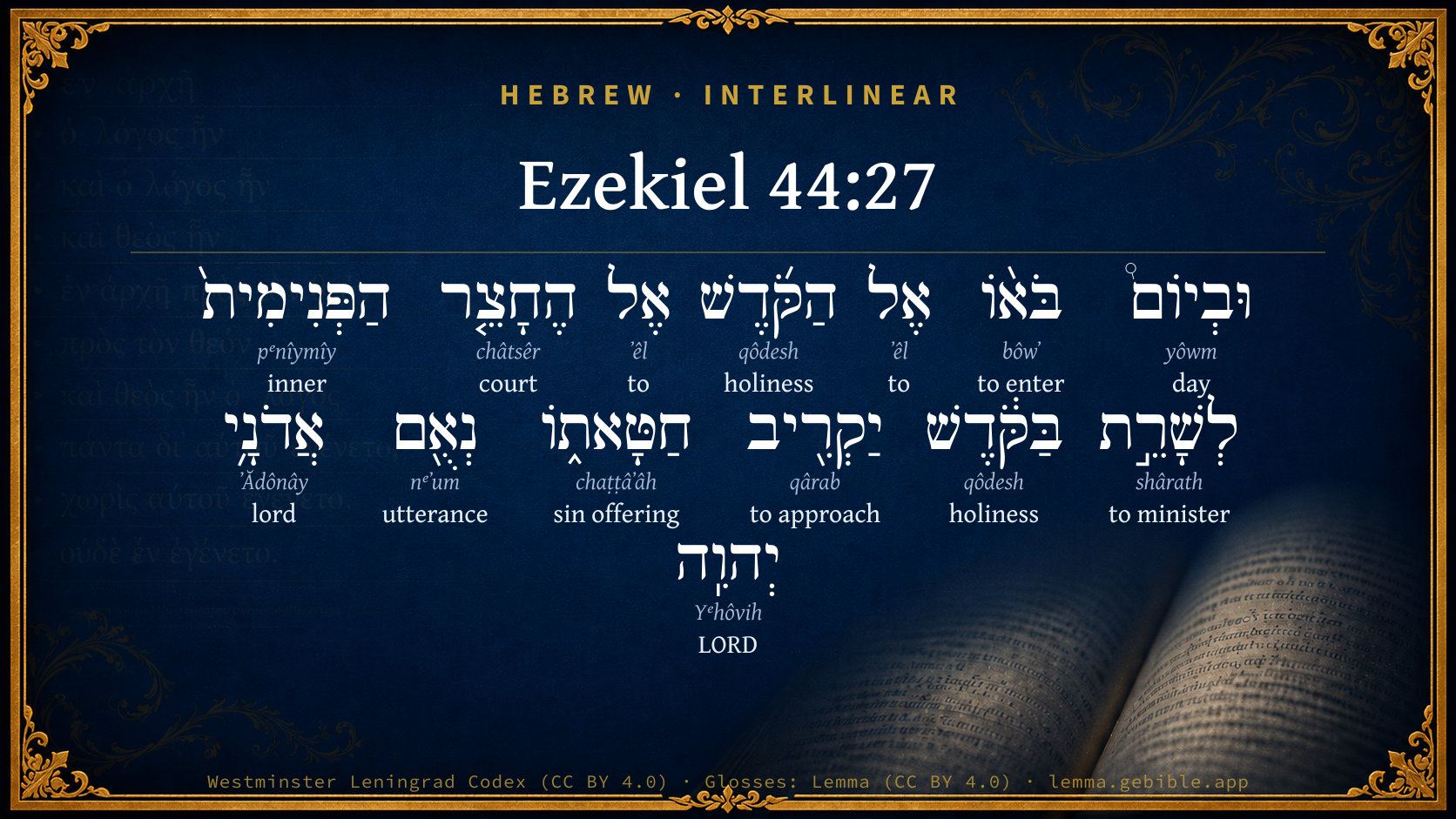
Hebrew (Westminster Leningrad Codex) Ezekiel 44:27 appears in the Hebrew Old Testament. The text above is from the Westminster Leningrad Codex. Each word links to its Strong’s number, a concise gloss, and parsing drawn from the Open Scriptures Hebrew Bible morphology. Click any word for its full Brown-Driver-Briggs (BDB) entry.
Download image
Cite this verse

Ezekiel 44:27 (World English Bible). Public Domain. Lemma interlinear Bible study tool, https://lemma.gebible.app/v/ezekiel/44/27.

Show BibTeX & RIS
BibTeX
RIS
English Translation
In the day that he goes into the sanctuary, into the inner court, to minister in the sanctuary, he shall offer his sin-offering, says the Lord Yahweh.
World English Bible · Public Domain
Download a study sheet

One document with this verse’s original text, its word-by-word gloss line, the meaning frame, cross-references with their text, attributed commentary, and full source and license credits — printable, and it pastes into notes with its structure intact.

This verse Autodidact and up

Study sheet (.html) Plain text (.txt)

A passage Seminary Student

Up to 50 verses in one chapter. A passage sheet keeps up to 6 commentary sources and 12 cross-references per verse, in the order this page ranks them, and says so on the sheet whenever that leaves anything out. Ask for a single verse and you get the Autodidact verse sheet above.

Everything on this page stays free to read, with no account — the sheet is a download of what is already on screen, not access to it.

Want to remove ads? Support Godless Engineer
Compare translations 3

The same verse in 3 English versions, stacked beneath the original-language interlinear above. Click any original word for its lexicon entry.

Each is an independent rendering of the whole verse — the interlinear is not word-aligned to these translations.

Highlighted words mark where these versions differ — a whole-verse word diff, not a word-by-word alignment.

  • World English Bible Public Domain
    In the day that he goes into the sanctuary, into the inner court, to minister in the sanctuary, he shall offer his sin-offering, says the Lord Yahweh.
  • King James Version Public Domain
    And in the day that he goeth into the sanctuary, unto the inner court, to minister in the sanctuary, he shall offer his sin offering, saith the Lord GOD.
  • unfoldingWord Literal Text CC BY-SA 4.0
    On the day he enters the holy place, into the inner courtyard to serve in the holy place, he must bring a sin offering for himself—this is the Lord Yahweh’s declaration.

unfoldingWord Literal Text — © unfoldingWord, licensed CC BY-SA 4.0. Word-aligned USFM3 via Door43 (git.door43.org/unfoldingWord/en_ult).

Versions to compare (up to 4)

3 of 4 selected

Show all 18 translations

Every available English version of this verse, each an independent rendering of the whole verse.

  • World English Bible Public Domain
    In the day that he goes into the sanctuary, into the inner court, to minister in the sanctuary, he shall offer his sin-offering, says the Lord Yahweh.
  • Berean Standard Bible Public Domain
    And on the day he goes into the sanctuary, into the inner court, to minister in the sanctuary, he must present his sin offering, declares the Lord GOD.
  • Majority Standard Bible Public Domain
    And on the day he goes into the sanctuary, into the inner court, to minister in the sanctuary, he must present his sin offering, declares the Lord GOD.
  • King James Version Public Domain
    And in the day that he goeth into the sanctuary, unto the inner court, to minister in the sanctuary, he shall offer his sin offering, saith the Lord GOD.
  • American Standard Version (1901) Public Domain
    And in the day that he goeth into the sanctuary, into the inner court, to minister in the sanctuary, he shall offer his sin-offering, saith the Lord Jehovah.
  • Revised Version (1885) Public Domain
    And in the day that he goeth into the sanctuary, into the inner court, to minister in the sanctuary, he shall offer his sin offering, saith the Lord GOD.
  • Geneva Bible (1599) Public Domain
    And when he goeth into ye Sanctuarie vnto the inner court to minister in the Sanctuarie, he shall offer his sinne offring, saith ye Lord God.
  • Douay-Rheims (1899) Public Domain
    And in the day that he goeth into the sanctuary, to the inner court, to minister unto me in the sanctuary, he shall offer for his sin, saith the Lord God.
  • Young's Literal Translation Public Domain
    And in the day of his coming in unto the sanctuary, unto the inner court, to minister in the sanctuary, he bringeth near his sin-offering -- an affirmation of the Lord Jehovah.
  • Literal Standard Version CC BY-SA 4.0
    And in the day of his coming into the sanctuary, into the inner court, to minister in the sanctuary, he brings his sin-offering near—a declaration of Lord YHWH.
  • Unlocked Literal Bible CC BY-SA 4.0
    On the day he enters the holy place, into the inner courtyard to serve in the holy place, he must bring a sin offering for himself—this is the Lord Yahweh's declaration.
  • unfoldingWord Literal Text CC BY-SA 4.0
    On the day he enters the holy place, into the inner courtyard to serve in the holy place, he must bring a sin offering for himself—this is the Lord Yahweh’s declaration.
  • Darby Bible Public Domain
    And on the day that he goeth into the sanctuary, unto the inner court, to minister in the sanctuary, he shall present his sin-offering, saith the Lord Jehovah.
  • World Messianic Bible Public Domain
    In the day that he goes into the sanctuary, into the inner court, to minister in the sanctuary, he shall offer his sin offering,” says the Lord GOD.
  • Webster's Bible Public Domain
    And in the day that he goeth into the sanctuary, to the inner court, to minister in the sanctuary, he shall offer his sin-offering, saith the Lord GOD.
  • Free Bible Version CC BY-SA 4.0
    Then when he enters the sanctuary, going into the inner courtyard and ministering there in the sanctuary, he has to present his sin offering, declares the Lord God.
  • Bible in Basic English Public Domain
    And on the day when he goes into the inner square, to do the work of the holy place, he is to make his sin-offering, says the Lord.
  • JPS Tanakh (1917) Public Domain
    And in the day that he goeth into the sanctuary, into the inner court, to minister in the sanctuary, he shall offer his sin-offering, saith the Lord GOD.

Literal Standard Version (2020), Covenant Press — licensed CC BY-SA 4.0. Text via the HelloAO Bible API (eBible.org). Unlocked Literal Bible (unfoldingWord) — licensed CC BY-SA 4.0. Text via the HelloAO Bible API (eBible.org). unfoldingWord Literal Text — © unfoldingWord, licensed CC BY-SA 4.0. Word-aligned USFM3 via Door43 (git.door43.org/unfoldingWord/en_ult). Free Bible Version, Dr. Jonathan Gallagher — licensed CC BY-SA 4.0. Text via the HelloAO Bible API (eBible.org).

Word by word

More ways to search: Search by grammar → Find every occurrence → Compare this word →

Practice this passage: Drill this verse → Learn its vocabulary →

הַפְּנִימִית֙
pᵉnîymîy
H6442
“the · inner”
Particle, Definite Article + Adjective, Adjective, Feminine, Singular, Absolute
Part of Speech
Particle + Adjective
Type
Adjective
Gender
Feminine
Number
Singular
State
Absolute
Full BDB Definition

Origin: from H6440

TWOT: 1782d

inner
  1. וּבְיוֹם֩ yôwm H3117 “and · in/at · day of” Conjunction + Preposition + Noun, Common, Masculine, Singular, Construct
  2. בֹּא֨וֹ bôwʼ H935 “to enter · him” Verb, Qal, Infinitive Construct + Suffix, Personal, 3rd Person, Masculine, Singular
  3. אֶל ʼêl H413 “to” Preposition
  4. הַקֹּ֜דֶשׁ qôdesh H6944 “the · holiness” Particle, Definite Article + Noun, Common, Masculine, Singular, Absolute
  5. אֶל ʼêl H413 “to” Preposition
  6. הֶחָצֵ֤ר châtsêr H2691 “the · court” Particle, Definite Article + Noun, Common, Both, Singular, Absolute
  7. לְשָׁרֵ֣ת shârath H8334 “to minister” Preposition + Verb, Piel, Infinitive Construct
  8. בַּקֹּ֔דֶשׁ qôdesh H6944 “in/at the · holiness” Preposition, Determined + Noun, Common, Masculine, Singular, Absolute
  9. יַקְרִ֖יב qârab H7126 “to approach” Verb, Hiphil, Imperfect, 3rd Person, Masculine, Singular
  10. חַטָּאת֑וֹ chaṭṭâʼâh H2403 “sin offering · his” Noun, Common, Feminine, Singular, Construct + Suffix, Personal, 3rd Person, Masculine, Singular
  11. נְאֻ֖ם nᵉʼum H5002 “utterance of” Noun, Common, Masculine, Singular, Construct
  12. אֲדֹנָ֥י ʼĂdônây H136 “Lord · my” Noun, Common, Masculine, Plural, Construct + Suffix, Personal, 1st Person, Common, Singular
  13. יְהוִֽה Yᵉhôvih H3069 “LORD” Noun, Proper

About this verse

These counts appear in no published source. They are computed here, from the morphology-tagged text and Lemma’s own curated glosses. What Lemma adds →

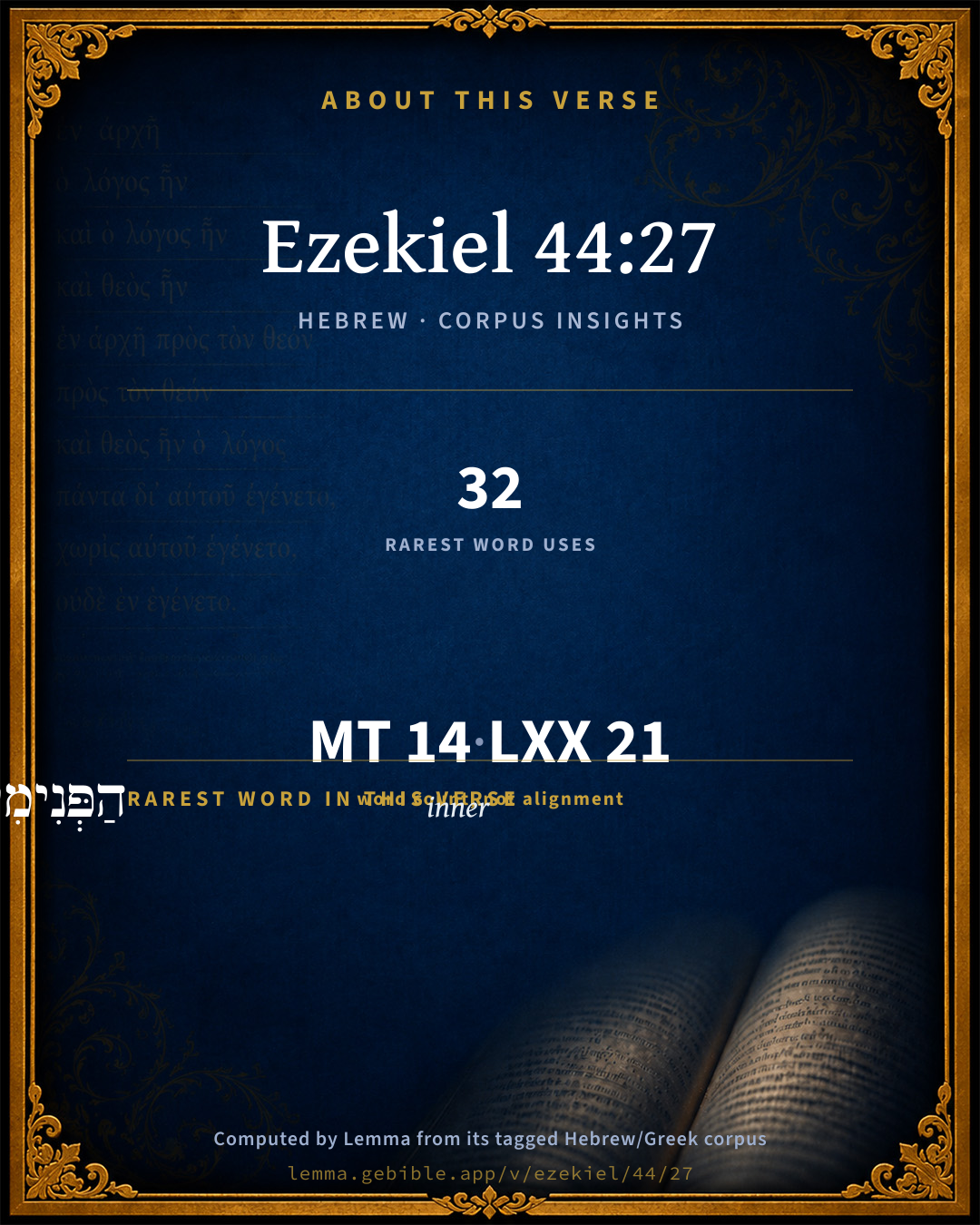
14
words
12
distinct lemmas
Prophets
section

Shared distinctive vocabulary

הַפְּנִימִית֙ inner H6442 occurs in 29 verses of the Hebrew Bible. Also found in:

Grammatical profile

  • 3 verbs
  • 8 nouns
  • 1 adjective
  • 2 prepositions

Verb forms

  • בֹּא֨וֹ Qal · Infinitive Construct
  • לְשָׁרֵ֣ת Piel · Infinitive Construct
  • יַקְרִ֖יב Hiphil · Imperfect

Repetition

Words recur within this verse — often emphatic in Hebrew:

  • הַקֹּ֜דֶשׁ holiness H6944 ×2
  • אֶל to H413 ×2

Hebrew & Septuagint length

In English translation the verse runs 27 words from the Hebrew and 26 from the Septuagint (LXX English) — closely comparable.

A rough comparison of the two English renderings, which tokenize alike — not a word-level alignment.

Word counts can differ between the Hebrew and the Greek without any difference in meaning — e.g. the Hebrew direct-object marker אֵת has no separate Greek word, and Greek often adds the article ὁ.

In the original languages it is 14 Hebrew tokens and 21 Greek tokens — but the two are counted differently (Hebrew bundles its prefixes and suffixes into one token; the Greek is in lemma form), so that isn’t a like-for-like length.

Cross-references

5

Topical passages linked to Ezekiel 44:27 in the Treasury of Scripture Knowledge — connected by theme and wording, ordered by reader-vote popularity; previews shown in the World English Bible.

  • Numbers 6:9–11 "If any man dies very suddenly beside him, and he defiles the head of his separation; then he shall shave his head in the day of his cleansing. On the seventh day he shall shave it.
  • Leviticus 4:3–35 if the anointed priest sins so as to bring guilt on the people, then let him offer for his sin, which he has sinned, a young bull without blemish to Yahweh for a sin offering.
  • Leviticus 8:14–36 He brought the bull of the sin offering, and Aaron and his sons laid their hands on the head of the bull of the sin offering.
  • Ezekiel 44:17 It shall be that, when they enter in at the gates of the inner court, they shall be clothed with linen garments; and no wool shall come on them, while they minister in the gates of the inner court, and within.
  • Hebrews 7:26–28 For such a high priest was fitting for us: holy, guiltless, undefiled, separated from sinners, and made higher than the heavens;

Cross-references courtesy of OpenBible.info (CC BY 4.0).

Hebrew and Greek witnesses Masoretic Hebrew ↔ Greek Septuagint

The same verse in the two great witnesses to the Old Testament, shown verse-for-verse.

These are two independent witnesses, not word-aligned to each other, and the Septuagint is shown in lemma (dictionary) form.

Hebrew Ezekiel 44:27 Masoretic · Westminster Leningrad Codex

וּבְיוֹם֩ בֹּא֨וֹ אֶל הַקֹּ֜דֶשׁ אֶל הֶחָצֵ֤ר הַפְּנִימִית֙ לְשָׁרֵ֣ת בַּקֹּ֔דֶשׁ יַקְרִ֖יב חַטָּאת֑וֹ נְאֻ֖ם אֲדֹנָ֥י יְהוִֽה

In the day that he goes into the sanctuary, into the inner court, to minister in the sanctuary, he shall offer his sin-offering, says the Lord Yahweh.

World English Bible · Public Domain

Greek LXX Ezekiel 44:27 Septuagint · lemma form

καί ὅς ἄν ἡμέρα εἰςπορεύομαι εἰς ὁ αὐλή ὁ ἐσώτερος ὁ λειτουργέω ἐν ὁ ἅγιος προςφέρω ἱλασμός λέγω κύριος ὁ θεός

And on whatever day they shall enter into the inner court to minister in the holy place, they shall bring a propitiation, says the Lord God.

LXX2012 (modern English Septuagint) · Public Domain

Hebrew: Westminster Leningrad Codex (CC BY 4.0). Greek: Septuagint (public domain); English from LXX2012 (modern English Septuagint) (Public Domain). How the Septuagint differs from the Hebrew →

Targum (Aramaic paraphrase)

1

The Targum is the ancient Jewish Aramaic paraphrase of the Hebrew Scriptures — an interpretive translation, not the Hebrew text itself. Onkelos (literal) and Pseudo-Jonathan (expansive) render the Torah, and Jonathan the Prophets. Coverage is partial: where no permissively-licensed English translation exists for a verse, only the Aramaic is shown. This is verse-level text, not a word-by-word alignment to the Hebrew.

  1. Targum Jonathan Prophets (Joshua–Malachi)
    וּבְיוֹם מֵיעֲלֵיהּ לְקוּדְשָׁא לְדַרְתָּא גַוַיְתָא לְשַׁמָשָׁא בְּקוּדְשָׁא יַקְרִיב חֲטָאתֵיהּ אֲמַר יְיָ אֱלֹהִים:

    (no public-domain English translation for this verse)

    Targum Jonathan — Aramaic: “Mikraot Gedolot” (public domain). English: “Sefaria Community Translation” (CC0 1.0 (public-domain dedication)); “London "Chaldee Paraphrase," 1871” (public domain). Text via Sefaria.

Commentary

Notes on Ezekiel 44:27 from classic Christian and Jewish commentators (each source and its license shown beneath its notes). The classic Christian expositions comment on the surrounding passage and are grouped to its opening verse, so a note may address several verses; the Jewish commentaries on the Tanakh (Rashi and others) are per-verse, so they appear only where the commentator wrote on this verse.

Lemma curates 59 commentaries, every one of them public domain or Creative Commons licensed, each selected and text-cleaned for this edition rather than reprinted as found. About our sources →

Trapp's Complete Commentary

John Trapp

Eze 44:27 And in the day that he goeth into the sanctuary, unto the inner court, to minister in the sanctuary, he shall offer his sin offering, saith the Lord GOD.

Ver. 27. He shall offer his sin offering.] Because we do easily overshoot ourselves in things permitted. Licitis perimus omnes. We perish in permitting all things.

John Trapp, A Commentary or Exposition upon All the Books of the Old and New Testament (1647–1656) — public domain. Text from a community e-Sword module.

The Cambridge Bible for Schools and Colleges

gen. ed. J. J. S. Perowne

27. Before resuming his functions the priest presents a sin-offering.

The Cambridge Bible for Schools and Colleges (gen. ed. J. J. S. Perowne; Cambridge University Press, 1878–1918) — public domain. Text from a community e-Sword module.

John Gill's Exposition

And in the day that he goeth into the sanctuary,.... Into the house and church of God, after his cleansing, and when the seven days from thence are up:

unto the inner court, to minister in the sanctuary; among the inward court worshippers, to minister in things to them; to preach the Gospel, and administer Gospel ordinances:

he shall offer his sin offering, saith the Lord God; though he has been privately cleansed in the fountain of Christ's blood, in which he has washed for sin and uncleanness; yet when he comes into the house of the Lord, he must acknowledge his sins and imperfections over Christ the sin offering; which he must bring in the arms of his faith, and so enter into the courts of the living God, and do the service of the sanctuary.

John Gill's Exposition of the Whole Bible (1746–1763) — public domain (CC PDM 1.0). Text via the HelloAO Bible API.

Haydock's Catholic Bible Commentary

Day, after the seven first, (Calmet) though this would be a new regulation. (Menochius)

George Leo Haydock (1774–1849), Haydock's Catholic Family Bible and Commentary, 1859 edition — public domain. Excludes Psalms (Douay-Rheims chapter numbering differs from Protestant) and Deuterocanonical books (Catholic canon only).

Matthew Poole's English Annotations

During the days of his uncleanness he kept out of the sanctuary; when the days of purifying are fulfilled he then may go in.

The sanctuary; not the temple itself, but, as the next words have it, the inner court.

To minister; to execute the priest’s office.

Sin-offering: it is not said what this should be, nor doth that Lev 6:21 refer to this. I think rather that, Lev 4:3, a young bullock was to be this sin-offering in purifying as it was in consecrating him, Eze 43:19.

Matthew Poole's English Annotations on the Holy Bible (1683–1685) — public domain. Text from a community e-Sword/MySword module.

The Pulpit Commentary

Vers. 27-30. Substantial wealth.

In every part of the world there is hunger, more or less, to possess land. By long observation men have discovered that to possess land is to possess influence and honor among their fellow-men. Is not land essential as the foundation of the harvest-crops? And are not crops of corn and fruit essential to the life of men? Is not agriculture the mainstay of a nation"s well-being? Yet without land agriculture is impossible; is it not therefore reasonable that men should eagerly long to call the land their own? On the other hand, this anxiety chains down men"s thoughts to inferior occupations and to a provision for their inferior nature. Such anxiety tends to draw away their attention from God and to weaken their sense of pious trust. In order to counteract this disastrous tendency, God appointed a class of men whose business it should be to keep God prominently before the eyes of their fellow-men. These servants of God were precluded from acquiring wealth. They were to be wholly employed in fostering the religious life in men. For their maintenance God provided in a special manner. These priests were designed to be models of human life, patterns of later Christians. God"s method for teaching the race is this viz., to set down a good man in their midst, and to inspire others with the desire to imitate him. If one man can live and prosper by virtue of implicit and practical faith in God, other men can. By diligent culture of the land, God has ordained that human life shall be sustained. Yet God is not shut up to this one system. "Man does not live by bread alone, but by every word that proceedeth out of the mouth of God.

I EARTHLY POSSESSION IS ONLY A MEANS TO AN END. It is not a blessing, but only a medium of blessing. It is part of God"s system of means. The land exists with a view to harvest. The harvest is produced with a view to man"s bodily life. Man"s bodily life is sustained with a view to his spiritual character. On the whole, it is best that the land should be appropriated to personal possession. This secures that the land shall be cultivated in the highest degree, and that the crops shall be protected from premature use. If all land should remain as common property, there would be lack of inducement to cultivate it; there would be lack of inducement to personal exertion; there would be no check to extravagant waste. Personal possession is best for a community; yet it becomes a waste and an injury if a man possesses more than he can cultivate. God gives not land to a man in order that he may be tyrannical, selfish, puffed up with overweening conceit. This is a miserable perversion of a Divine gift. Land is created for cultivation. Cultivation of laud is designed for the support of human life. And all the laud in the world is worth nothing to me except as it ministers to the health and vigor of my life.

II GOD CAN SECURE THIS END BY OTHER SYSTEMS OF MEANS. The best proof that, he can do so is the fact that he has done so on many occasions. It would be the height of folly to suppose that God has not made the wisest possible arrangement for the well-being of men. Yet if men abuse the arrangement and push God away from his rightful place, God can alter his system, and bring about his end by other agencies. He sustained the life of Abraham, gave him wealth and influence among men, while, at the same time, he refused to give him a rood of land. He was the Special Protector of the Hebrew nation; yet he led them about the desert for the lifetime of a whole generation, where harvests could not be gathered, and where land was not desired as a possession. Yet they wanted not for food or for clothing. God was to them better than all harvests. So Jesus Christ called away the twelve from their secular pursuits; yet he did not suffer them to want any good thing. Jesus himself preferred to have no encumbrance of land or wealth. He freely chose the state of poverty. To him, living in such intimate union with his Father, landed possession would have been a needless burden; yet, not only were his own wants supplied, but he royally spread a table for others. What the Son did on earth was the visible effect of his Father"s working.

III UNSELFISH SERVICE BRINGS TO A MAN THE LARGEST GAIN. He who forgets himself in his generous kindness is not forgotten by his fellows is not forgotten by God. The family of Zadok were prohibited from being landholders. Nevertheless, they shall not want. "Every dedicated thing in Israel shall be theirs." "The first of all the firstfruits" shall be theirs. God out-distances all his creatures in generously rewarding faithful service. In his book every item of devoted toil and sacrifice is noted; for it ample reward is preparing. Just as one pain of corn will produce, in the harvest, a hundred grains, so consecrated service is living seed it shall fructify into splendid results. Did Abraham ever regret his unswerving fidelity to God? Does St. Paul feel today that he made too great sacrifices of himself for others? Has any one been a loser for serving God? It almost savors of profanity to propose such a question. The true servants of God shall enjoy the tribute due to God himself. Statesmen, under a mighty king, are rewarded with a goodly share of the revenue of the empire; so the tribute paid into God"s temple God distributes among his priests. For them who serve God well other men labor. Other men till the ground and prepare the produce. They who do the highest work shall have the best reward. Thus it was predicted, "Strangers shall stand and feed your flock, and the sons of the alien shall be your ploughmen and your vine-dressers; but ye shall be called the Priests of the Lord." Like many other good things, the name and the office of the priest have been made a curse. Yet a true priest God"s servant to mankind is a very fount of blessing. He is like salt in the earth a preserving and purifying power. Wherever he comes he is a spring-season of life and joy. He is to be well cared for, so "that he may cause the blessing to rest in thine house.

IV THE DEVOTED SERVANT OF GOD OBTAINS A PROPRIETORSHIP IN GOD. "I am their Inheritance... I am their Possession." An estate is not really ours because we call it ours. We cannot call anything ours unless it becomes a part and parcel of ourselves. If it adds to our character and our strength, then, and only then, is it ours. The land estate is often the master of the man. He lives to improve it rather than to be improved by it. We possess property when we really get some advantage out of it. So is it also with respect to God. If we make God our Friend, we extract advantage from him. If we believe his promises and open our souls to his vitalizing grace, we are enriched from him. God"s wisdom becomes our wisdom. His righteousness becomes our righteousness. His love becomes a fountain of love in us. We are "partakers of the Divine nature." In a very emphatic sense God gives himself to us. Every capacity in us may be filled with God. If we are fully God"s property, God is our Portion our Inheritance. This is transcendent condescension, the sublimity of love.

V TO POSSESS GOD IS TO POSSESS ALL THINGS. On this account it would have been a superfluity if Jesus had been a Proprietor of wealth. Of what advantage would it have been for him to possess fields, if he could create a sufficient supply of bread by the magic of command? Although the poorest, he was yet the richest of men. It is understood that he who possesses the key of the bank possesses the contents of the hank. If the Creator be mine, if I can call him my Father," then whatever his creation contains of good is mine also. It is clear that I must, as a creature, be dependent. Is it better to depend on law or on the Lawgiver? on the cistern or on the Fount? on blind circumstances or Omniscient Wisdom? on natural forces or on the all-creative God? My faith is founded in common sense. God undertakes to be my Friend my Father. Then I am his child; and" if a son, then an heir heir of God; "All things are yours, for ye are... God"s. D.

The Pulpit Commentary (1880–1919), ed. H.D.M. Spence-Jones & Joseph S. Exell — public domain. Text from a community e-Sword module.

Rashi

Rabbi Shlomo Yitzchaki (Rashi)

And on the day that he enters into the Sanctuary for the first time to initiate himself into the service, he shall offer up his sin-offering; this is his one tenth of an ephah [of flour]. In Moed Katan (16a) the following is taught: the regular priest requires one tenth of an ephah on the day of his initiation, as it is stated (Lev. 6:13): “This is the offering of Aaron and his sons, etc.” and as is explained in Tractate Menachoth (51b).

Rashi on the Tanakh — English translations: “The Judaica Press complete Tanach with Rashi, translated by A. J. Rosenberg” (CC BY 4.0); “Pentateuch with Rashi's commentary by M. Rosenbaum and A.M. Silbermann, 1929-1934” (public domain); “The Metsudah Tanach series, Lakewood, N.J” (CC BY 4.0); and “The Book of Joshua, Metsudah Publications, 1997” (CC BY 4.0). Text via Sefaria.

Lesson kit

Teaching starters — assembled from the data on this page, not authored interpretation. Every prompt links to the verse data it draws on. Edit before teaching.

Ezekiel, in the Prophets, opens this verse with 14 words (12 distinct Hebrew lemmas). Its most distinctive word is pᵉnîymîy (“inner”). A historical commentator’s framing appears above. Read the whole chapter for the surrounding context.

Discussion questions

  1. How does “inner” (pᵉnîymîy) shape what this verse is saying?
  2. 1 Kings 6:27 shares the word «inner» with this verse. How do the two illuminate each other?
  3. “holiness” occurs 2× in this one verse. What is the effect of the repetition?
  4. These translations render this verse differently; the difference is in the English rendering, not the original. What questions does that raise?
  5. The verb «בֹּא֨וֹ» is Qal Infinitive Construct. How does its form color the action?
  6. Reading how Trapp's Complete Commentary and The Cambridge Bible for Schools and Colleges read this verse, where do the two commentators agree and where do they part?

Things to notice

Reading settings

Reading text

Shown beneath each verse's original-language words.

Old Testament
Old Testament edition

Read the OT as the Masoretic Hebrew (MT) or the Greek Septuagint (LXX).

English shown for the Greek Septuagint (in the Hebrew ↔ Greek comparison).

Comparing translations? Open the Compare panel on any verse page to stack up to four side by side.