
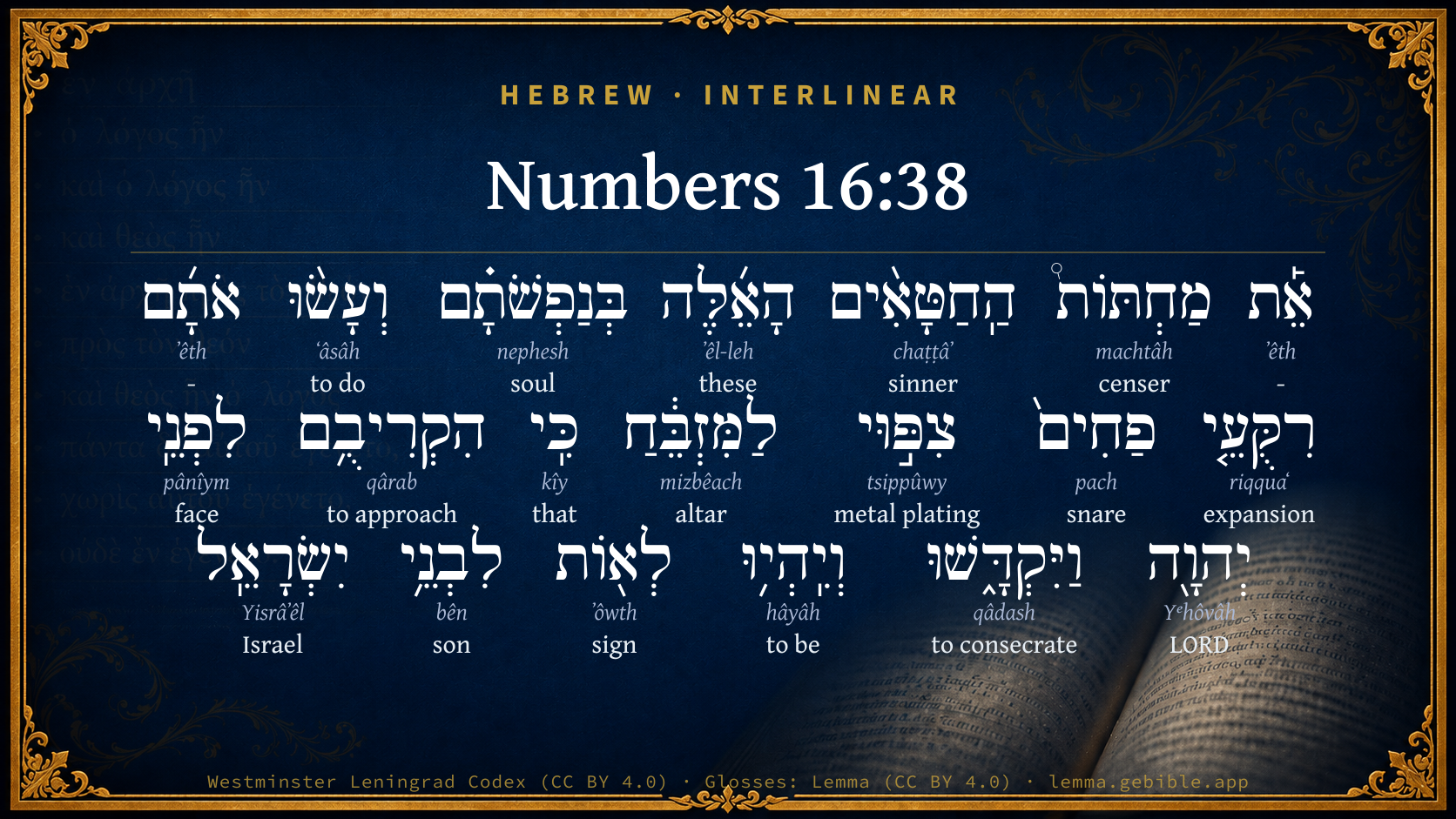
Numbers 16:38

Hebrew (Westminster Leningrad Codex) Numbers 16:38 appears in the Hebrew Old Testament. The text above is from the Westminster Leningrad Codex. Each word links to its Strong’s number, a concise gloss, and parsing drawn from the Open Scriptures Hebrew Bible morphology. Click any word for its full Brown-Driver-Briggs (BDB) entry.
Download image
Cite this verse

Numbers 16:38 (World English Bible). Public Domain. Lemma interlinear Bible study tool, https://lemma.gebible.app/v/numbers/16/38.

Show BibTeX & RIS
BibTeX
RIS
English Translation
even the censers of these sinners against their own lives; and let them be made beaten plates for a covering of the altar: for they offered them before Yahweh; therefore they are holy; and they shall be a sign to the children of Israel.
World English Bible · Public Domain
Highlights
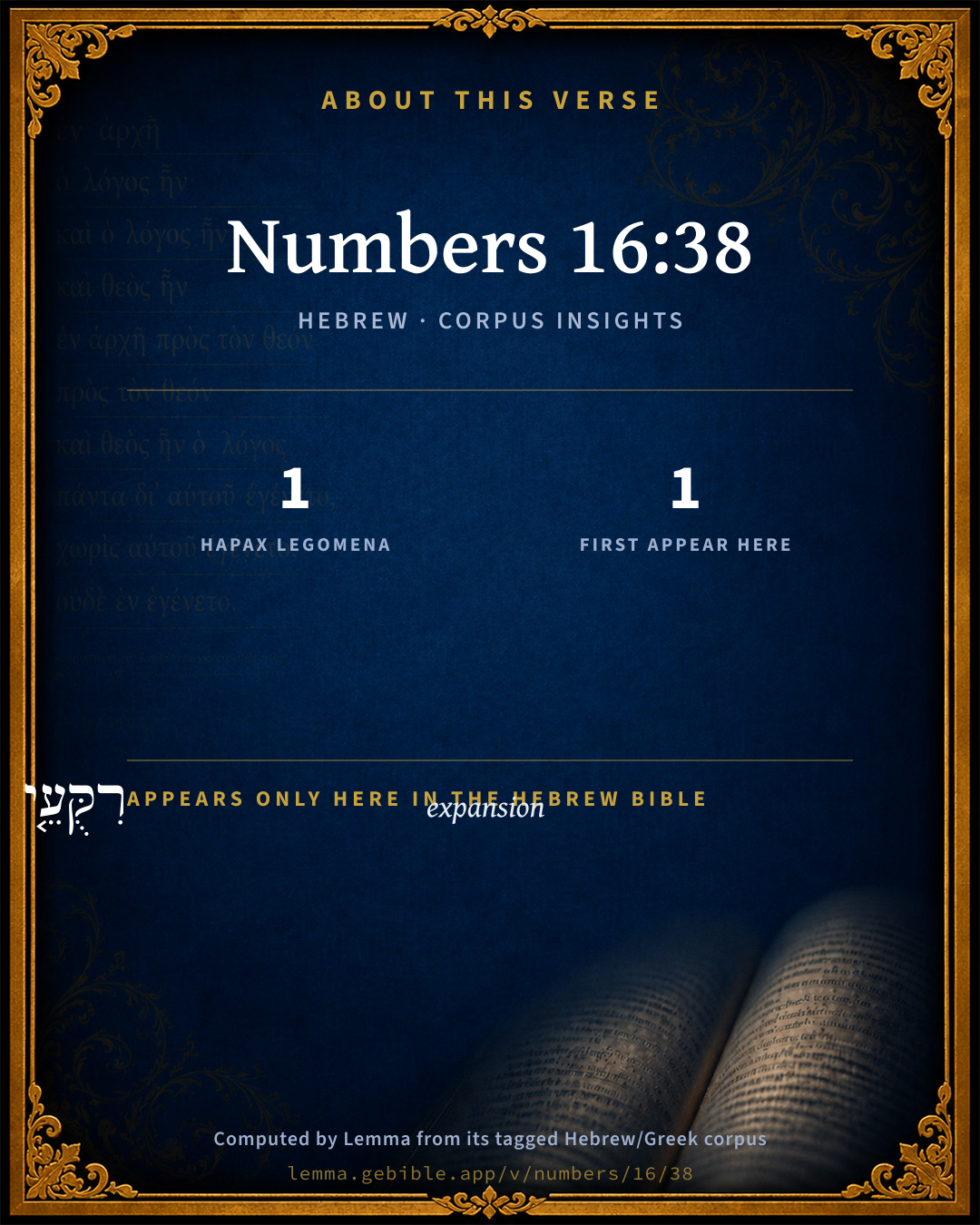
  • 1 hapax legomenon — only here in the Hebrew Bible
  • 1 first appearance in the Hebrew Bible
Full analysis ↓
Download a study sheet

One document with this verse’s original text, its word-by-word gloss line, the meaning frame, cross-references with their text, attributed commentary, and full source and license credits — printable, and it pastes into notes with its structure intact.

This verse Autodidact and up

Study sheet (.html) Plain text (.txt)

A passage Seminary Student

Up to 50 verses in one chapter. A passage sheet keeps up to 6 commentary sources and 12 cross-references per verse, in the order this page ranks them, and says so on the sheet whenever that leaves anything out. Ask for a single verse and you get the Autodidact verse sheet above.

Everything on this page stays free to read, with no account — the sheet is a download of what is already on screen, not access to it.

Want to remove ads? Support Godless Engineer
Compare translations 3

The same verse in 3 English versions, stacked beneath the original-language interlinear above. Click any original word for its lexicon entry.

Each is an independent rendering of the whole verse — the interlinear is not word-aligned to these translations.

Highlighted words mark where these versions differ — a whole-verse word diff, not a word-by-word alignment.

  • World English Bible Public Domain
    even the censers of these sinners against their own lives; and let them be made beaten plates for a covering of the altar: for they offered them before Yahweh; therefore they are holy; and they shall be a sign to the children of Israel.
  • King James Version Public Domain
    The censers of these sinners against their own souls, let them make them broad plates for a covering of the altar: for they offered them before the LORD, therefore they are hallowed: and they shall be a sign unto the children of Israel.
  • unfoldingWord Literal Text CC BY-SA 4.0
    The censers of these ones sinning against their lives, and they shall make them hammered sheets of thin plates, plating for the altar, for they presented them to the face of Yahweh, and they are holy, and they shall be for a sign for the sons of Israel.”

unfoldingWord Literal Text — © unfoldingWord, licensed CC BY-SA 4.0. Word-aligned USFM3 via Door43 (git.door43.org/unfoldingWord/en_ult).

Versions to compare (up to 4)

3 of 4 selected

Show all 18 translations

Every available English version of this verse, each an independent rendering of the whole verse.

  • World English Bible Public Domain
    even the censers of these sinners against their own lives; and let them be made beaten plates for a covering of the altar: for they offered them before Yahweh; therefore they are holy; and they shall be a sign to the children of Israel.
  • Berean Standard Bible Public Domain
    As for the censers of those who sinned at the cost of their own lives, hammer them into sheets to overlay the altar, for these were presented before the LORD, and so have become holy. They will serve as a sign to the Israelites.”
  • Majority Standard Bible Public Domain
    As for the censers of those who sinned at the cost of their own lives, hammer them into sheets to overlay the altar, for these were presented before the LORD, and so have become holy. They will serve as a sign to the Israelites.”
  • King James Version Public Domain
    The censers of these sinners against their own souls, let them make them broad plates for a covering of the altar: for they offered them before the LORD, therefore they are hallowed: and they shall be a sign unto the children of Israel.
  • American Standard Version (1901) Public Domain
    even the censers of these sinners against their own lives; and let them be made beaten plates for a covering of the altar: for they offered them before Jehovah; therefore they are holy; and they shall be a sign unto the children of Israel.
  • Revised Version (1885) Public Domain
    even the censers of these sinners against their own lives, and let them be made beaten plates for a covering of the altar: for they offered them before the LORD, therefore they are holy: and they shall be a sign unto the children of Israel.
  • Geneva Bible (1599) Public Domain
    The censers, I say, of these sinners, that destroyed themselues: and let them make of them broade plates for a couering of the Altar: for they offered them before the Lord, therefore they shalbe holy, and they shall be a signe vnto the children of Israel.
  • Douay-Rheims (1899) Public Domain
    In the deaths of the sinners: and let him beat them into plates, and fasten them to the altar, because incense hath been offered in them to the Lord, and they are sanctified, that the children of Israel may see them for a sign and a memorial.
  • Young's Literal Translation Public Domain
    `even' the censers of these sinners against their own souls; and they have made them spread-out plates, a covering for the altar, for they have brought them near before Jehovah, and they are hallowed; and they are become a sign to the sons of Israel.'
  • Literal Standard Version CC BY-SA 4.0
    [As for] the censers of these sinners against their own souls, indeed, they have made them [into] spread-out plates [for] a covering for the altar, for they have brought them near before YHWH, and they are hallowed; and they become a sign to the sons of Israel.”
  • Unlocked Literal Bible CC BY-SA 4.0
    Take the censers of those who lost their lives because of their sin. Let them be made into hammered plates as a covering over the altar. Those men did offer them before me, so they are set apart to me. They will be a sign of my presence to the people of Israel.”
  • unfoldingWord Literal Text CC BY-SA 4.0
    The censers of these ones sinning against their lives, and they shall make them hammered sheets of thin plates, plating for the altar, for they presented them to the face of Yahweh, and they are holy, and they shall be for a sign for the sons of Israel.”
  • Darby Bible Public Domain
    the censers of these sinners who have forfeited their life; and they shall make them into broad plates for the covering of the altar; for they presented them before Jehovah, therefore they are hallowed; and they shall be a sign unto the children of Israel.
  • World Messianic Bible Public Domain
    even the censers of those who sinned against their own lives. Let them be beaten into plates for a covering of the altar, for they offered them before the LORD. Therefore they are holy. They shall be a sign to the children of Israel.”
  • Webster's Bible Public Domain
    The censers of these sinners against their own souls, let them make them broad plates for a covering of the altar: for they offered them before the LORD, therefore they are hallowed: and they shall be a sign to the children of Israel.
  • Free Bible Version CC BY-SA 4.0
    Have the incense burners of those who sinned at the expense of their own lives hammered into metal sheets as a covering for the altar, because they were offered before the Lord, and so have become holy. They will be a reminder to Israelites of what happened.”
  • Bible in Basic English Public Domain
    And let the vessels of those men, who with their lives have made payment for their sin, be hammered out into plates as a cover for the altar; for they have been offered before the Lord and are holy; so that they may be a sign to the children of Israel.
  • JPS Tanakh (1917) Public Domain
    (17-3) even the fire-pans of these men who have sinned at the cost of their lives, and let them be made beaten plates for a covering of the altar — for they are become holy, because they were offered before the LORD — that they may be a sign unto the children of Israel.'

Literal Standard Version (2020), Covenant Press — licensed CC BY-SA 4.0. Text via the HelloAO Bible API (eBible.org). Unlocked Literal Bible (unfoldingWord) — licensed CC BY-SA 4.0. Text via the HelloAO Bible API (eBible.org). unfoldingWord Literal Text — © unfoldingWord, licensed CC BY-SA 4.0. Word-aligned USFM3 via Door43 (git.door43.org/unfoldingWord/en_ult). Free Bible Version, Dr. Jonathan Gallagher — licensed CC BY-SA 4.0. Text via the HelloAO Bible API (eBible.org).

Word by word

More ways to search: Search by grammar → Find every occurrence → Compare this word →

Practice this passage: Drill this verse → Learn its vocabulary →

רִקֻּעֵ֤י
riqquaʻ
H7555
“expansions of”
Noun, Common, Masculine, Plural, Construct
Part of Speech
Noun
Type
Common
Gender
Masculine
Number
Plural
State
Construct
Full BDB Definition

Origin: from H7554

TWOT: 2217b

expansion (of plates)
  1. אֵ֡ת ʼêth H853 “-” Particle, Direct Object
  2. מַחְתּוֹת֩ machtâh H4289 “censers of” Noun, Common, Feminine, Plural, Construct
  3. הַֽחַטָּאִ֨ים chaṭṭâʼ H2400 “the · sinner” Particle, Definite Article + Adjective, Adjective, Masculine, Plural, Absolute
  4. הָאֵ֜לֶּה ʼêl-leh H428 “the · these” Particle, Definite Article + Pronoun, Demonstrative, Common, Plural
  5. בְּנַפְשֹׁתָ֗ם nephesh H5315 “in/at · souls · their” Preposition + Noun, Common, Both, Plural, Construct + Suffix, Personal, 3rd Person, Masculine, Plural
  6. וְעָשׂ֨וּ ʻâsâh H6213 “and · do” Conjunction + Verb, Qal, Imperative, 2nd Person, Masculine, Plural
  7. אֹתָ֜ם ʼêth H853 “- · them” Particle, Direct Object + Suffix, Personal, 3rd Person, Masculine, Plural
  8. פַחִים֙ pach H6341 “snares” Noun, Common, Masculine, Plural, Absolute
  9. צִפּ֣וּי tsippûwy H6826 “metal plating” Noun, Common, Masculine, Singular, Absolute
  10. לַמִּזְבֵּ֔חַ mizbêach H4196 “to/for the · altar” Preposition, Determined + Noun, Common, Masculine, Singular, Absolute
  11. כִּֽי kîy H3588 “that” Conjunction
  12. הִקְרִיבֻ֥ם qârab H7126 “to approach · them” Verb, Hiphil, Perfect, 3rd Person, Common, Plural + Suffix, Personal, 3rd Person, Masculine, Plural
  13. לִפְנֵֽי pânîym H6440 “to/for · face(s) of” Preposition + Noun, Common, Both, Plural, Construct
  14. יְהוָ֖ה Yᵉhôvâh H3068 “LORD” Noun, Proper
  15. וַיִּקְדָּ֑שׁוּ qâdash H6942 “and · to consecrate” Conjunction + Verb, Qal, Sequential Imperfect, 3rd Person, Masculine, Plural
  16. וְיִֽהְי֥וּ hâyâh H1961 “and · to be” Conjunction + Verb, Qal, Imperfect, 3rd Person, Masculine, Plural
  17. לְא֖וֹת ʼôwth H226 “to/for · sign” Preposition + Noun, Common, Both, Singular, Absolute
  18. לִבְנֵ֥י bên H1121 “to/for · sons of” Preposition + Noun, Common, Masculine, Plural, Construct
  19. יִשְׂרָאֵֽל Yisrâʼêl H3478 “Israel” Noun, Proper

About this verse

These counts appear in no published source. They are computed here, from the morphology-tagged text and Lemma’s own curated glosses. What Lemma adds →

20
words
19
distinct lemmas
Pentateuch
section

Notable vocabulary

1 hapax legomenon — a word that appears only here in the entire Hebrew Bible:

  • רִקֻּעֵ֤י expansion H7555

First appearance in Scripture

This word makes its first canonical appearance in the Hebrew Bible here:

  • רִקֻּעֵ֤י expansion H7555

Shared distinctive vocabulary

צִפּ֣וּי metal plating H6826 occurs in 5 verses of the Hebrew Bible. Also found in:

Grammatical profile

  • 4 verbs
  • 11 nouns
  • 1 adjective
  • 1 pronoun
  • 1 conjunction
  • 2 particles

Verb forms

  • וְעָשׂ֨וּ Qal · Imperative
  • הִקְרִיבֻ֥ם Hiphil · Perfect
  • וַיִּקְדָּ֑שׁוּ Qal · Sequential Imperfect
  • וְיִֽהְי֥וּ Qal · Imperfect

Hebrew & Septuagint length

In English translation the verse runs 44 words from the Hebrew and 38 from the Septuagint (LXX English) — closely comparable.

A rough comparison of the two English renderings, which tokenize alike — not a word-level alignment.

Word counts can differ between the Hebrew and the Greek without any difference in meaning — e.g. the Hebrew direct-object marker אֵת has no separate Greek word, and Greek often adds the article ὁ.

Cross-references

11

Topical passages linked to Numbers 16:38 in the Treasury of Scripture Knowledge — connected by theme and wording, ordered by reader-vote popularity; previews shown in the World English Bible.

  • Numbers 26:10 and the earth opened its mouth, and swallowed them up together with Korah, when that company died; what time the fire devoured two hundred fifty men, and they became a sign.
  • Proverbs 20:2 The terror of a king is like the roaring of a lion: He who provokes him to anger forfeits his own life.
  • Ezekiel 14:8 and I will set my face against that man, and will make him an astonishment, for a sign and a proverb, and I will cut him off from the midst of my people; and you shall know that I am Yahweh.
  • 2 Peter 2:6 and turning the cities of Sodom and Gomorrah into ashes, condemned them to destruction, having made them an example to those who would live ungodly;
  • Numbers 17:10 Yahweh said to Moses, Put back the rod of Aaron before the testimony, to be kept for a token against the children of rebellion; that you may make an end of their murmurings against me, that they not die.
  • 1 Kings 2:23 Then king Solomon swore by Yahweh, saying, God do so to me, and more also, if Adonijah has not spoken this word against his own life.
  • Habakkuk 2:10 You have devised shame to your house, by cutting off many peoples, and have sinned against your soul.
  • Numbers 16:40 to be a memorial to the children of Israel, to the end that no stranger, who isn't of the seed of Aaron, comes near to burn incense before Yahweh; that he not be as Korah, and as his company: as Yahweh spoke to him by Moses.
  • Proverbs 1:18 But these lay wait for their own blood. They lurk secretly for their own lives.
  • Proverbs 8:36 But he who sins against me wrongs his own soul. All those who hate me love death."
  • 1 Corinthians 10:11 Now all these things happened to them by way of example, and they were written for our admonition, on whom the ends of the ages have come.

Cross-references courtesy of OpenBible.info (CC BY 4.0).

Hebrew and Greek witnesses Masoretic Hebrew ↔ Greek Septuagint

The same verse in the two great witnesses to the Old Testament, shown verse-for-verse.

These are two independent witnesses, not word-aligned to each other, and the Septuagint is shown in lemma (dictionary) form.

Hebrew Numbers 16:38 Masoretic · Westminster Leningrad Codex

אֵ֡ת מַחְתּוֹת֩ הַֽחַטָּאִ֨ים הָאֵ֜לֶּה בְּנַפְשֹׁתָ֗ם וְעָשׂ֨וּ אֹתָ֜ם רִקֻּעֵ֤י פַחִים֙ צִפּ֣וּי לַמִּזְבֵּ֔חַ כִּֽי הִקְרִיבֻ֥ם לִפְנֵֽי יְהוָ֖ה וַיִּקְדָּ֑שׁוּ וְיִֽהְי֥וּ לְא֖וֹת לִבְנֵ֥י יִשְׂרָאֵֽל

even the censers of these sinners against their own lives; and let them be made beaten plates for a covering of the altar: for they offered them before Yahweh; therefore they are holy; and they shall be a sign to the children of Israel.

World English Bible · Public Domain

Greek LXX Numbers 16:38 Septuagint · lemma form
of these sinners against their own souls, and do you make them beaten plates a covering to the altar, because they were brought before the Lord and hallowed; and they became a sign to the children of Israel.

LXX2012 (modern English Septuagint) · Public Domain

On this verse, The Cambridge Bible for Schools and Colleges discusses the Septuagint’s reading. Read the note in Commentary ↓

Hebrew: Westminster Leningrad Codex (CC BY 4.0). Greek: Septuagint (public domain); English from LXX2012 (modern English Septuagint) (Public Domain). How the Septuagint differs from the Hebrew →

Commentary

Notes on Numbers 16:38 from classic Christian and Jewish commentators (each source and its license shown beneath its notes). The classic Christian expositions comment on the surrounding passage and are grouped to its opening verse, so a note may address several verses; the Jewish commentaries on the Tanakh (Rashi and others) are per-verse, so they appear only where the commentator wrote on this verse.

Lemma curates 59 commentaries, every one of them public domain or Creative Commons licensed, each selected and text-cleaned for this edition rather than reprinted as found. About our sources →

Trapp's Complete Commentary

John Trapp

Num 16:38 The censers of these sinners against their own souls, let them make them broad plates [for] a covering of the altar: for they offered them before the LORD, therefore they are hallowed: and they shall be a sign unto the children of Israel.

Ver. 38. These sinners against their own souls.] So are all such as spend the span of this transitory life, after the ways of their own hearts, and thereby perish for ever. Sin is the soul’s poison; yet how heartily do men feed upon it, as Tartars do upon dead horses; as the maid in Pliny did upon spiders; as the Turkish galley slaves do upon opium, an ounce whereof they will eat at once as if it were bread!

John Trapp, A Commentary or Exposition upon All the Books of the Old and New Testament (1647–1656) — public domain. Text from a community e-Sword module.

Joseph Benson's Commentary

Num 16:38. Their own souls — That is, their own lives; who were the authors of their own destruction. The altar — Of burnt-offerings, which was made of wood, but covered with brass before this time, (Exo 27:1-2,) to which this other covering was added for further ornament, and security against the fire, continually burning upon it. A sign — A warning to all strangers to take heed of invading the priesthood.

Joseph Benson's Commentary on the Old and New Testaments (1811–1818) — public domain. Text from a community e-Sword module.

Tyndale Open Study Notes

Tyndale Open Resources

16:38-40 The bronze sheet made by Eleazar to cover the altar replaced or supplemented the one made previously (Exod 38:2). Like the simple blue tassels of Num 15:37-41, it reminded the people of Israel of their need to obey God.

Tyndale Open Study Notes — © Tyndale Open Resources, licensed CC BY-SA 4.0. Text via the HelloAO Bible API.

Geneva Bible (1599)

Geneva Bible translators

Of God’s judgments against rebels.

Which were the occasion of their own death.

Geneva Bible (1599) marginal notes — public domain. Text via Bolls.life.

Ellicott's Commentary for English Readers

(38) These sinners against their own souls.—i.e., men who have forfeited their lives by their sin.

Let them make them broad plates . . . —It was thus that the sacrilegious act of Korah and his company was made the occasion of a permanent warning against all similar profanation of holy things. The altar of burnt-offering had already a covering of brass; but, as the altar was made of wood, an additional covering afforded further security against the fire which was continually burning on it. The censers of Korah and his company were made of brass (Num_16:39). Those of Aaron and his sons are thought by some to have been made of silver, but there seems to be no sufficient authority for this supposition; and in Exo_38:3, where the same Hebrew word is used, but which in the English version is rendered “firepans,” it is said that all the vessels of the altar were made of brass. In the time of Solomon the censers were made of gold (1Ki_7:50). That used by Aaron on the great day of atonement was of gold. (Comp. Heb_9:4; Rev_8:3.)

A Bible Commentary for English Readers, edited by Charles John Ellicott (1878–1897) — public domain. Text from a community e-Sword module.

The Cambridge Bible for Schools and Colleges

gen. ed. J. J. S. Perowne

38. (om. even) the fire-pans of these sinners at the cost of their lives] R.V. marg. is an explanation of the R.V. But the latter is grammatically doubtful. LXX. has ὅτι ἡγίασαν τὰ πυρεῖα κ.τ.λ. (‘because they made holy the fire-pans’ &c.). Perhaps we should read ‘for the fire-pans of these sinners have become holy at the cost &c.’ Some have seen an allusion to these words in Heb_12:3, ‘such contradiction of sinners against themselves’ (Westcott and Hort’s text).

for a covering of the altar] This must be the altar of burnt-offering, since the altar of incense was covered with gold, not with brass or bronze (Exo_30:3; Exo_37:26). But according to Exo_27:2; Exo_38:2, the altar of burnt-offering was already covered with bronze at its original manufacture at Sinai. The passage is another indication that the priestly writings are not all from one pen, but contain divergent traditions and date from different periods.

The Cambridge Bible for Schools and Colleges (gen. ed. J. J. S. Perowne; Cambridge University Press, 1878–1918) — public domain. Text from a community e-Sword module.

John Gill's Exposition

The censers of these sinners against their own souls,.... Who by burning incense in them sinned, and by sinning hurt and ruined their souls:

let them make them broad plates for a covering of the altar; the altar of burnt offering, which, though it had a covering of brass, another made of these were to be over it, for the further security of it, being of from the fire continually burning on it; these censers were to be beaten into broad plates, by the workmen who understood how to do it:

for they offered them before the Lord, therefore they are hallowed; they offered them in his presence, they burned incense in them, and to him, though it was not their business, but the business of the priests; yet these being done, and by his orders, for an open trial who were his priests and who not, they were not to be put to common use:

and they shall be a sign unto the children of Israel; a memorial sign, a sign bringing this affair to remembrance, as it is explained in Num 16:40; this was a sign to the priests, that they only were to offer every kind of offerings, and to the Levites, who attended the priests at the altar continually, and so had every day a sight of it and of those plates upon it, which would remind them of this fact, and teach them not to usurp the priest's office; and to all the children of Israel, to learn from hence that none were to burn incense but the priests of the Lord, for doing which Uzziah, though a king, was punished, Ch2 26:18.

John Gill's Exposition of the Whole Bible (1746–1763) — public domain (CC PDM 1.0). Text via the HelloAO Bible API.

Albert Barnes' Notes on the Bible

These sinners against their own souls - That is, “against their own lives.” By their sin they had brought destruction upon themselves.

Albert Barnes' Notes on the Bible (1834–1885) — public domain. Text from a community e-Sword/MySword module.

Haydock's Catholic Bible Commentary

Sinners. These censers were sanctified or set apart for God’s altar: 1. By the intention of those who used them, though contrary to his will; 2. by the exemplary vengeance which he exercised upon the rash pretenders to the priesthood; 3. by being a monument of their folly, and therefore placed, by God’s order, upon the altar, to deter all others from imitating their conduct. Eleazar was commanded to take them up, and scatter the strange fire; that Aaron might not be defiled with touching the carcasses or ashes of the deceased, nor seem to exult in their death. (Calmet) --- God was thus also pleased to manifest that the children of Aaron, and not of the other Levites, should succeed him. (St. Augustine, q. 30.) (Worthington)

George Leo Haydock (1774–1849), Haydock's Catholic Family Bible and Commentary, 1859 edition — public domain. Excludes Psalms (Douay-Rheims chapter numbering differs from Protestant) and Deuterocanonical books (Catholic canon only).

Matthew Poole's English Annotations

Against their own souls, i.e. their own lives; who were the authors of their own death and destruction. Compare 1Ki 2:23; Pro 20:2. This he saith for the vindication of God’s justice and his own ministry in this severe dispensation.

The altar, to wit, of burnt-offerings, which was made of wood, but covered with brass before this time, Exo 27:1,2, to which this other covering was added for further ornament and security against the fire, which was continually burning upon it.

A sign; a monument or warning to all strangers to take heed of invading the priesthood, as it follows, Num 16:40.

Matthew Poole's English Annotations on the Holy Bible (1683–1685) — public domain. Text from a community e-Sword/MySword module.

Whedon's Commentary on the Bible

Daniel D. Whedon

38. Sinners against their own souls — Their sin had cost the forfeiture of their lives. For a covering of the great or brazen altar. Every thing offered before the Lord is holy. Hence every soul consecrated to God is to account itself henceforth as holy and accepted by him, for he receives all that is offered to him in faith. If a man believes that his vessel is impure he will not so carefully avoid pollution as he who knows that his vessel is holy.

Daniel D. Whedon (gen. ed.), Commentary on the Old and New Testaments (1874–1909) — public domain. Text from a community e-Sword module.

The Pulpit Commentary

These sinners against their own souls, "against their own lives." The thought is not that they had ruined their souls, but that they had forfeited their lives. The Pentateuch does not contemplate any consequences of sin beyond physical death. The same phrase occurs in Pro_20:2. For a covering of the altar. The altar of burnt incense.

The censers were no doubt brazen pans, and when beaten out would form plates which could be affixed to the boards of which the frame of the altar was composed.

The Pulpit Commentary (1880–1919), ed. H.D.M. Spence-Jones & Joseph S. Exell — public domain. Text from a community e-Sword module.

John Wesley's Explanatory Notes

Their own souls - That is, their own lives: who were the authors of their own destruction. The altar - Of burnt-offerings, which was made of wood, but covered with brass before this time, Exod. xxvii, 1, 2, to which this other covering was added for farther ornament, and security against the fire, continually burning upon it. A sign - A warning to all strangers to take heed of invading the priesthood.

John Wesley, Explanatory Notes Upon the Whole Bible (1754–1765) — public domain. Text via the GEBible commentary corpus.

Lesson kit

Teaching starters — assembled from the data on this page, not authored interpretation. Every prompt links to the verse data it draws on. Edit before teaching.

Numbers, in the Pentateuch, opens this verse with 20 words (19 distinct Hebrew lemmas). Its most distinctive word is riqquaʻ (“expansion”). A historical commentator’s framing appears above. Read the whole chapter for the surrounding context.

Discussion questions

  1. What does “expansion” (riqquaʻ) contribute to the verse as a whole?
  2. This verse holds 1 word here found nowhere else in the Hebrew Bible. What might the rare word draw attention to?
  3. The word “expansion” first appears here in Scripture. What is being introduced at this debut?
  4. Exodus 38:17 shares the word «metal plating» with this verse. How do the two illuminate each other?
  5. These translations render this verse differently; the difference is in the English rendering, not the original. What questions does that raise?
  6. The verb «וְעָשׂ֨וּ» is Qal Imperative. How does its form color the action?
  7. Reading how Trapp's Complete Commentary and Joseph Benson's Commentary read this verse, where do the two commentators agree and where do they part?

Things to notice

  • 1 word in this verse appears nowhere else in the Hebrew Bible.
  • 1 word makes its first canonical appearance in Scripture here.
  • These translations choose different wording for 28 words in this verse.
  • 19 distinct Hebrew lemmas span 20 words in this verse.

Reading settings

Reading text

Shown beneath each verse's original-language words.

Old Testament
Old Testament edition

Read the OT as the Masoretic Hebrew (MT) or the Greek Septuagint (LXX).

English shown for the Greek Septuagint (in the Hebrew ↔ Greek comparison).

Comparing translations? Open the Compare panel on any verse page to stack up to four side by side.