
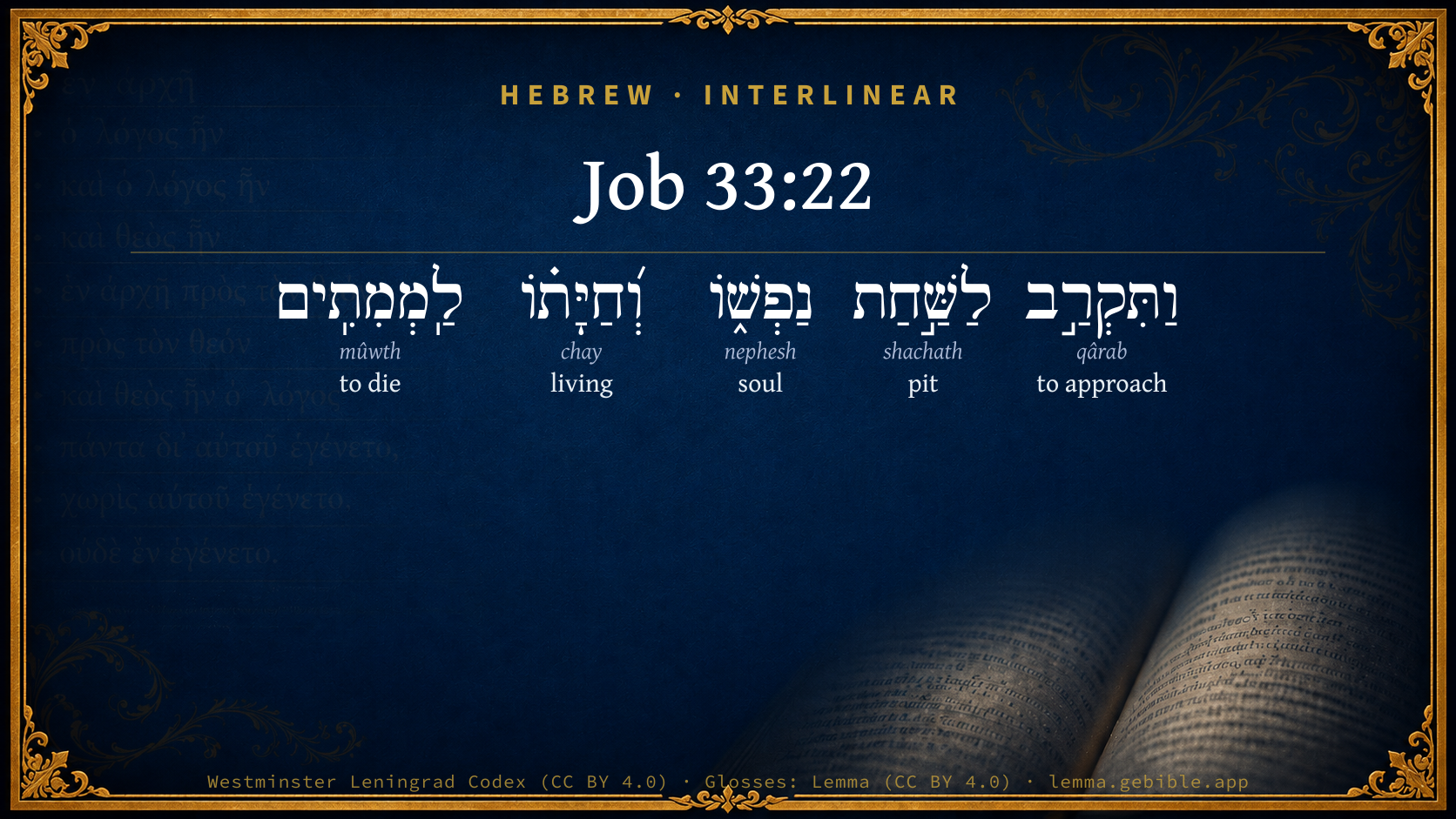
Job 33:22

Hebrew (Westminster Leningrad Codex) Job 33:22 appears in the Hebrew Old Testament. The text above is from the Westminster Leningrad Codex. Each word links to its Strong’s number, a concise gloss, and parsing drawn from the Open Scriptures Hebrew Bible morphology. Click any word for its full Brown-Driver-Briggs (BDB) entry.
Download image
Cite this verse

Job 33:22 (World English Bible). Public Domain. Lemma interlinear Bible study tool, https://lemma.gebible.app/v/job/33/22.

Show BibTeX & RIS
BibTeX
RIS
English Translation
Yes, his soul draws near to the pit, And his life to the destroyers.
World English Bible · Public Domain
Download a study sheet

One document with this verse’s original text, its word-by-word gloss line, the meaning frame, cross-references with their text, attributed commentary, and full source and license credits — printable, and it pastes into notes with its structure intact.

This verse Autodidact and up

Study sheet (.html) Plain text (.txt)

A passage Seminary Student

Up to 50 verses in one chapter. A passage sheet keeps up to 6 commentary sources and 12 cross-references per verse, in the order this page ranks them, and says so on the sheet whenever that leaves anything out. Ask for a single verse and you get the Autodidact verse sheet above.

Everything on this page stays free to read, with no account — the sheet is a download of what is already on screen, not access to it.

Want to remove ads? Support Godless Engineer
Compare translations 3

The same verse in 3 English versions, stacked beneath the original-language interlinear above. Click any original word for its lexicon entry.

Each is an independent rendering of the whole verse — the interlinear is not word-aligned to these translations.

Highlighted words mark where these versions differ — a whole-verse word diff, not a word-by-word alignment.

  • World English Bible Public Domain
    Yes, his soul draws near to the pit, And his life to the destroyers.
  • King James Version Public Domain
    Yea, his soul draweth near unto the grave, and his life to the destroyers.
  • unfoldingWord Literal Text CC BY-SA 4.0
    and his soul draws near to the pit, and his life to the ones causing death.

unfoldingWord Literal Text — © unfoldingWord, licensed CC BY-SA 4.0. Word-aligned USFM3 via Door43 (git.door43.org/unfoldingWord/en_ult).

Versions to compare (up to 4)

3 of 4 selected

Show all 18 translations

Every available English version of this verse, each an independent rendering of the whole verse.

  • World English Bible Public Domain
    Yes, his soul draws near to the pit, And his life to the destroyers.
  • Berean Standard Bible Public Domain
    He draws near to the Pit, and his life to the messengers of death.
  • Majority Standard Bible Public Domain
    He draws near to the Pit, and his life to the messengers of death.
  • King James Version Public Domain
    Yea, his soul draweth near unto the grave, and his life to the destroyers.
  • American Standard Version (1901) Public Domain
    Yea, his soul draweth near unto the pit, And his life to the destroyers.
  • Revised Version (1885) Public Domain
    Yea, his soul draweth near unto the pit, and his life to the destroyers.
  • Geneva Bible (1599) Public Domain
    So his soule draweth to the graue, and his life to the buriers.
  • Douay-Rheims (1899) Public Domain
    His soul hath drawn near to corruption, and his life to the destroyers.
  • Young's Literal Translation Public Domain
    And draw near to the pit doth his soul, And his life to those causing death.
  • Literal Standard Version CC BY-SA 4.0
    And his soul draws near to the pit, || And his life to those causing death.
  • Unlocked Literal Bible CC BY-SA 4.0
    Indeed, his soul draws close to the pit, his life to those who wish to destroy it.
  • unfoldingWord Literal Text CC BY-SA 4.0
    and his soul draws near to the pit, and his life to the ones causing death.
  • Darby Bible Public Domain
    And his soul draweth near to the pit, and his life to the destroyers.
  • World Messianic Bible Public Domain
    Yes, his soul draws near to the pit, and his life to the destroyers.
  • Webster's Bible Public Domain
    Yes, his soul draweth near to the grave, and his life to the destroyers.
  • Free Bible Version CC BY-SA 4.0
    They are close to death; their lives approaching the executioner.
  • Bible in Basic English Public Domain
    And his soul comes near to the underworld, and his life to the angels of death.
  • JPS Tanakh (1917) Public Domain
    Yea, his soul draweth near unto the pit, and his life to the destroyers.

Literal Standard Version (2020), Covenant Press — licensed CC BY-SA 4.0. Text via the HelloAO Bible API (eBible.org). Unlocked Literal Bible (unfoldingWord) — licensed CC BY-SA 4.0. Text via the HelloAO Bible API (eBible.org). unfoldingWord Literal Text — © unfoldingWord, licensed CC BY-SA 4.0. Word-aligned USFM3 via Door43 (git.door43.org/unfoldingWord/en_ult). Free Bible Version, Dr. Jonathan Gallagher — licensed CC BY-SA 4.0. Text via the HelloAO Bible API (eBible.org).

Word by word

More ways to search: Search by grammar → Find every occurrence → Compare this word →

Practice this passage: Drill this verse → Learn its vocabulary →

About this verse

These counts appear in no published source. They are computed here, from the morphology-tagged text and Lemma’s own curated glosses. What Lemma adds →

5
words
5
distinct lemmas
Wisdom
section

Notable vocabulary

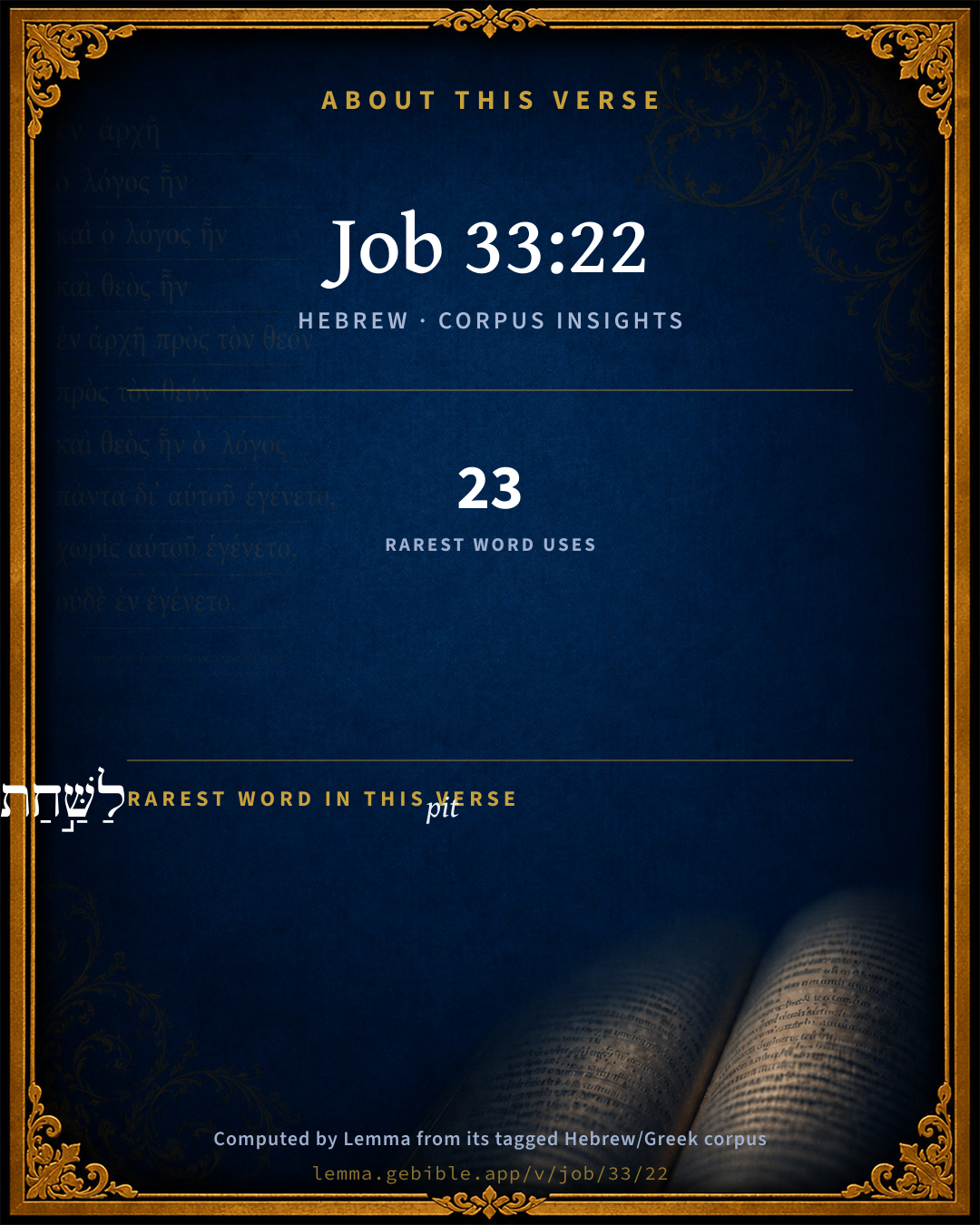
The rarest word here is לַשַּׁ֣חַת pit H7845 — appearing just 23 times in the whole Hebrew Bible.

Shared distinctive vocabulary

לַשַּׁ֣חַת pit H7845 occurs in 23 verses of the Hebrew Bible. Also found in:

Grammatical profile

  • 2 verbs
  • 3 nouns

Verb forms

  • וַתִּקְרַ֣ב Qal · Sequential Imperfect
  • לַֽמְמִתִֽים Hiphil · Participle Active

Hebrew & Septuagint length

In English translation the verse runs 14 words from the Hebrew and 13 from the Septuagint (LXX English) — closely comparable.

A rough comparison of the two English renderings, which tokenize alike — not a word-level alignment.

Word counts can differ between the Hebrew and the Greek without any difference in meaning — e.g. the Hebrew direct-object marker אֵת has no separate Greek word, and Greek often adds the article ὁ.

Cross-references

15

Topical passages linked to Job 33:22 in the Treasury of Scripture Knowledge — connected by theme and wording, ordered by reader-vote popularity; previews shown in the World English Bible.

  • 2 Samuel 24:16 When the angel stretched out his hand toward Jerusalem to destroy it, Yahweh repented him of the evil, and said to the angel who destroyed the people, It is enough; now stay your hand. The angel of Yahweh was by the threshing floor of Araunah the Jebusite.
  • Job 33:28 He has redeemed my soul from going into the pit, My life shall see the light.'
  • Exodus 12:23 For Yahweh will pass through to strike the Egyptians; and when he sees the blood on the lintel, and on the two side-posts, Yahweh will pass over the door, and will not allow the destroyer to come in to your houses to strike you.
  • 1 Samuel 2:6 Yahweh kills, and makes alive: He brings down to Sheol, and brings up.
  • Job 7:7 Oh remember that my life is a breath. My eye shall no more see good.
  • Job 15:21 A sound of terrors is in his ears; In prosperity the destroyer shall come on him.
  • Job 17:1 "My spirit is consumed, my days are extinct, And the grave is ready for me.
  • Job 17:13–16 If I look for Sheol as my house, If I have spread my couch in the darkness,
  • Psalms 17:4 As for the works of men, by the word of your lips I have kept myself from the ways of the violent.
  • Psalms 30:3 Yahweh, you have brought up my soul from Sheol. You have kept me alive, that I should not go down to the pit.
  • Psalms 88:3–5 For my soul is full of troubles. My life draws near to Sheol.
  • Isaiah 38:10 I said, In the noontide of my days I shall go into the gates of Sheol: I am deprived of the residue of my years.
  • Acts 12:23 Immediately an angel of the Lord struck him, because he didn't give God the glory, and he was eaten by worms and died.
  • 1 Corinthians 10:10 Neither grumble, as some of them also grumbled, and perished by the destroyer.
  • Revelation 9:11 They have over them as king the angel of the abyss. His name in Hebrew is "Abaddon," but in Greek, he has the name "Apollyon."

Cross-references courtesy of OpenBible.info (CC BY 4.0).

Hebrew and Greek witnesses Masoretic Hebrew ↔ Greek Septuagint

The same verse in the two great witnesses to the Old Testament, shown verse-for-verse.

These are two independent witnesses, not word-aligned to each other, and the Septuagint is shown in lemma (dictionary) form.

Hebrew Job 33:22 Masoretic · Westminster Leningrad Codex

וַתִּקְרַ֣ב לַשַּׁ֣חַת נַפְשׁ֑וֹ וְ֝חַיָּת֗וֹ לַֽמְמִתִֽים

Yes, his soul draws near to the pit, And his life to the destroyers.

World English Bible · Public Domain

Greek LXX Job 33:22 Septuagint · lemma form

ἐγγίζω δέ εἰς θάνατος ὁ ψυχή αὐτός ὁ δέ ζωή αὐτός ἐν ᾅδης

His soul also draws near to death, and his life is in Hades.

LXX2012 (modern English Septuagint) · Public Domain

On this verse, John Gill's Exposition discusses the Septuagint’s reading. Read the note in Commentary ↓

Hebrew: Westminster Leningrad Codex (CC BY 4.0). Greek: Septuagint (public domain); English from LXX2012 (modern English Septuagint) (Public Domain). How the Septuagint differs from the Hebrew →

Commentary

Notes on Job 33:22 from classic Christian and Jewish commentators (each source and its license shown beneath its notes). The classic Christian expositions comment on the surrounding passage and are grouped to its opening verse, so a note may address several verses; the Jewish commentaries on the Tanakh (Rashi and others) are per-verse, so they appear only where the commentator wrote on this verse.

Lemma curates 59 commentaries, every one of them public domain or Creative Commons licensed, each selected and text-cleaned for this edition rather than reprinted as found. About our sources →

Trapp's Complete Commentary

John Trapp

Job 33:22 Yea, his soul draweth near unto the grave, and his life to the destroyers.

Ver. 22. Yea, his soul draweth near unto the grave] His soul, that is, his body, as Job 33:18, for Elihu was no mortalist, neither dreamed he of a psychopannychia. {All-night sleep of the soul; a state in which (according to some) the soul sleeps between death and the day of judgement.} He is in the very confines of death, and no ways likely to recover; he is free among the dead, as the psalmist hath it.

And his life to the destroyers] Lethalibus malis, to deadly evils, saith Tremellius. Mortiferis, i.e. Morbis, to those messengers of death, deadly diseases, saith Vatablus, Gentiles multa de Parcis fabulati sunt. To those that kill; viz. to the angels, by whom God sometimes destroyeth men, as 2Sa 24:16-17, saith Piscator. To enemies, say other. Pollinctoribus, to the bier carriers, say the Tigurines, and so Beza paraphraseth; so that he stands not in need of any remedy or help of anything more than of those who should carry his carcass unto the grave.

John Trapp, A Commentary or Exposition upon All the Books of the Old and New Testament (1647–1656) — public domain. Text from a community e-Sword module.

Tyndale Open Study Notes

Tyndale Open Resources

33:22 angels of death wait for them: Cp. Exod 12:23; 2 Sam 24:16; 1 Cor 10:10.

Tyndale Open Study Notes — © Tyndale Open Resources, licensed CC BY-SA 4.0. Text via the HelloAO Bible API.

Geneva Bible (1599)

Geneva Bible translators

To them that shall bury him.

Geneva Bible (1599) marginal notes — public domain. Text via Bolls.life.

Jamieson, Fausset & Brown

Robert Jamieson, A. R. Fausset & David Brown

destroyers--angels of death commissioned by God to end man's life (Sa2 24:16; Psa 78:49). The death pains personified may, however, be meant; so "gnawers" (see on Job 30:17).

Jamieson, Fausset & Brown — Commentary Critical and Explanatory on the Whole Bible (1871) — public domain (CC PDM 1.0). Text via the HelloAO Bible API.

Adam Clarke's Commentary

Verse 22. His soul draweth near unto the grave] נפש nephesh, soul, is here taken for the immortal spirit, as it is distinguished from חיה chaiyah, the animal life. The former draws near to the pit, שחת shachath, corruption; perhaps he meant dissipation, considering it merely as the breath. The latter draws near לממתים lamemithim, to the dead; i.e., to those who are already buried. Mr. Good translates it the Destinies; and supposes the same is meant among the HEBREWS by the Memithim, as among the GREEKS by their Μοιραι; the LATINS, by their Parcae; the GOTHS, by their Fatal Sisters; the SCANDINAVIANS, by their goddess Hela; and the ARABIANS, by Azrael, or the angel of death. I think, however, the signification given above is more natural.

Adam Clarke's Commentary on the Bible (1810–1826) — public domain. Text from a community e-Sword/MySword module.

The Cambridge Bible for Schools and Colleges

gen. ed. J. J. S. Perowne

22. the destroyers] that is, perhaps, the angels that bring death; 2Sa_24:16; 1Ch_21:15; Psa_78:49.

The Cambridge Bible for Schools and Colleges (gen. ed. J. J. S. Perowne; Cambridge University Press, 1878–1918) — public domain. Text from a community e-Sword module.

John Gill's Exposition

Yea, his soul draweth near unto the grave,.... Not the soul, strictly and properly speaking, for that does not, nor is it laid in the grave at death, but returns to God that gave it; rather the body, for which it is sometimes put, and of which what is here said is true, see Psa 16:10; or the person of the sick man, whose disease being so threatening, all hope is gone, and he is given up by his physicians and friends, and seemingly is at the grave's mouth, and that is ready for him, and he on the brink of that; which were the apprehensions Job had of himself, Job 17:1; see Psa 88:3;

and his life to the destroyers; the destroying angels, as Aben Ezra, and so the Septuagint version: or destroying diseases, and so Mr. Broughton renders it, "to killing maladies"; or it may be to worms, which destroy the body in the grave, and which Job was sensible of would quickly be his case, Job 19:26; though some interpret it of those that kill, or of those that are dead, with whom they are laid that die; or of deaths corporeal and eternal, and the horrors and terrors of both, with which persons in such circumstances are sometimes distressed.

John Gill's Exposition of the Whole Bible (1746–1763) — public domain (CC PDM 1.0). Text via the HelloAO Bible API.

Albert Barnes' Notes on the Bible

Yea, his soul draweth near unto the grave - That is, he himself does, for the word soul is often used to denote self.

And his life to the destroyers - - לממתים lammitiym. literally, “to those causing death.” The interpretation commonly given of this is, “the angels of death” who were supposed to come to close human life; compare 2Sa 24:16-17. But it probably refers to diseases and pangs as having power to terminate life, and being the cause of the close of life. The meaning is, that the afflicted man comes very near to those acute sufferings which terminate life, and which by personification are here represented as the authors of death.

Albert Barnes' Notes on the Bible (1834–1885) — public domain. Text from a community e-Sword/MySword module.

Haydock's Catholic Bible Commentary

CHAPTER XXXIII.

Destroyers; the worms in the grave, (Haydock) or to sickness, (Menochius) "which bring on death." Pagnin mortiferis.

George Leo Haydock (1774–1849), Haydock's Catholic Family Bible and Commentary, 1859 edition — public domain. Excludes Psalms (Douay-Rheims chapter numbering differs from Protestant) and Deuterocanonical books (Catholic canon only).

Matthew Poole's English Annotations

He seems to himself and others to be lost, and past all hopes of recovery; which he adds for Job’s comfort in his desperate condition.

To the destroyers; to the instruments of death or destruction, whether it be angels, whom God sometimes useth in those cases; or devils, who have the power of death. Heb 2:14; or diseases, which by God’s appointment are ready to give the fatal blow.

Matthew Poole's English Annotations on the Holy Bible (1683–1685) — public domain. Text from a community e-Sword/MySword module.

Whedon's Commentary on the Bible

Daniel D. Whedon

22. The destroyers — Many commentators understand them to be angelic powers, to whom is intrusted the work of death. Aben Ezra and Ewald call them “angels of death.” The Septuagint renders the clause, “his life [is] in hades.” Compare Psa_78:49; 2Sa_24:16. Others (Rosenmuller, Schlottman, etc.) understand simply mortal pains; but this explanation, as Delitzsch well says, “does not commend itself, because the Elihu section has a strong angelogical colouring in common with the book of Job.” True penitence may stay the execution of the decree of death. Comp. 1Ch_21:15 and Luk_13:9.

Daniel D. Whedon (gen. ed.), Commentary on the Old and New Testaments (1874–1909) — public domain. Text from a community e-Sword module.

The Pulpit Commentary

Yea, his soul draweth near unto the grave, and his life to the destroyers. "The destroyers" are probably the angels to whom the task is assigned of ultimately inflicting death, if minor chastisements prove insufficient. (comp. 2Sa_24:16, 17 Psa_78:49, etc.)

The Pulpit Commentary (1880–1919), ed. H.D.M. Spence-Jones & Joseph S. Exell — public domain. Text from a community e-Sword module.

John Wesley's Explanatory Notes

The destroyers - The pangs of death, here called the destroyers, are just ready to seize him.

John Wesley, Explanatory Notes Upon the Whole Bible (1754–1765) — public domain. Text via the GEBible commentary corpus.

Lesson kit

Teaching starters — assembled from the data on this page, not authored interpretation. Every prompt links to the verse data it draws on. Edit before teaching.

Job, in the Wisdom, opens this verse with 5 words (5 distinct Hebrew lemmas). Its most distinctive word is shachath (“pit”). A historical commentator’s framing appears above. Read the whole chapter for the surrounding context.

Discussion questions

  1. What does “pit” (shachath) contribute to the verse as a whole?
  2. How does Job 9:31, which shares the word «pit», read alongside this verse?
  3. These translations render this verse differently. What is at stake in choosing one wording over another?
  4. «וַתִּקְרַ֣ב» is a Qal Sequential Imperfect verb. How does that grammatical form shape the action described?
  5. Compare how Trapp's Complete Commentary and Tyndale Open Study Notes read this verse. Where do they agree or differ?

Things to notice

Reading settings

Reading text

Shown beneath each verse's original-language words.

Old Testament
Old Testament edition

Read the OT as the Masoretic Hebrew (MT) or the Greek Septuagint (LXX).

English shown for the Greek Septuagint (in the Hebrew ↔ Greek comparison).

Comparing translations? Open the Compare panel on any verse page to stack up to four side by side.