
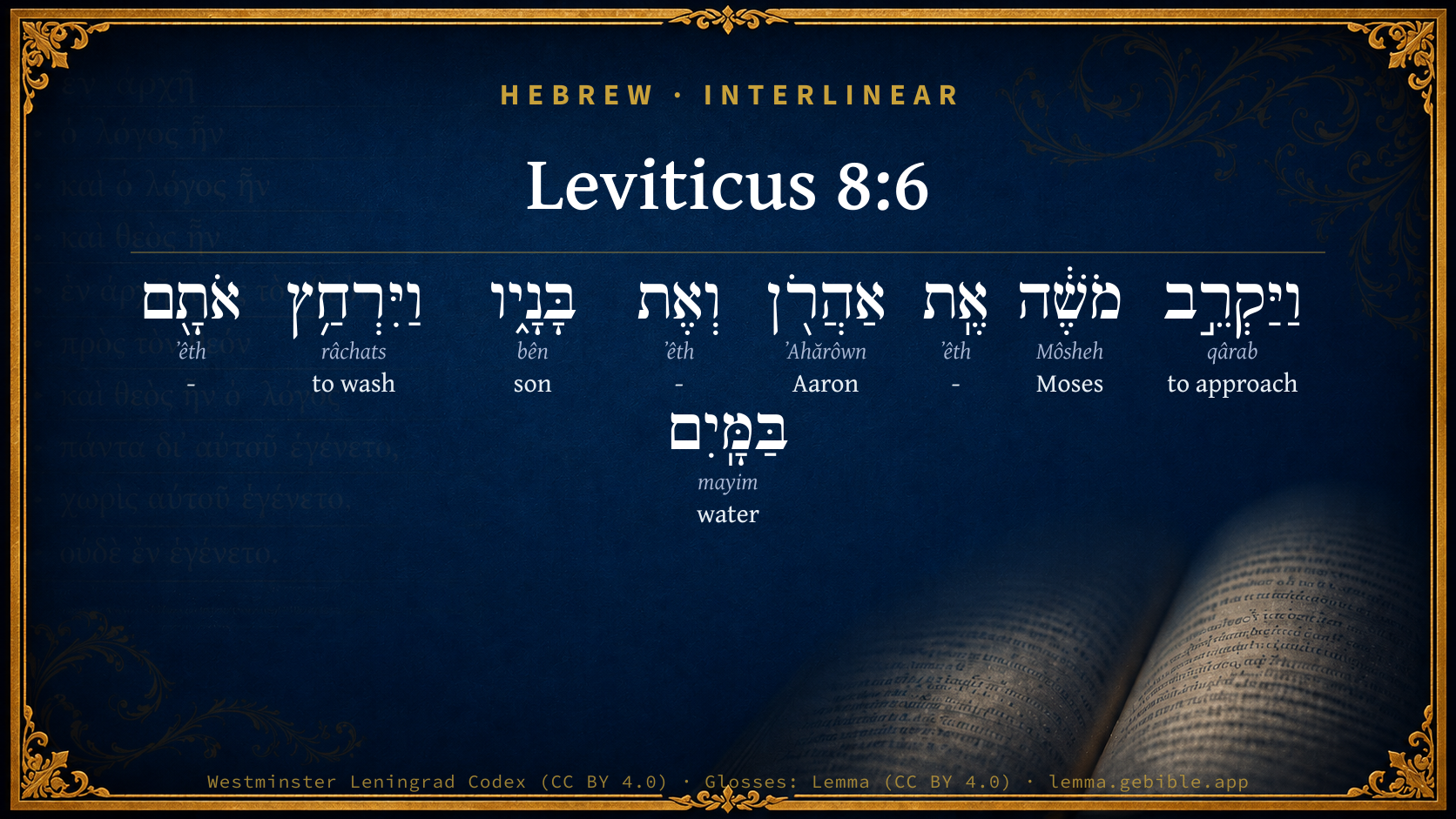
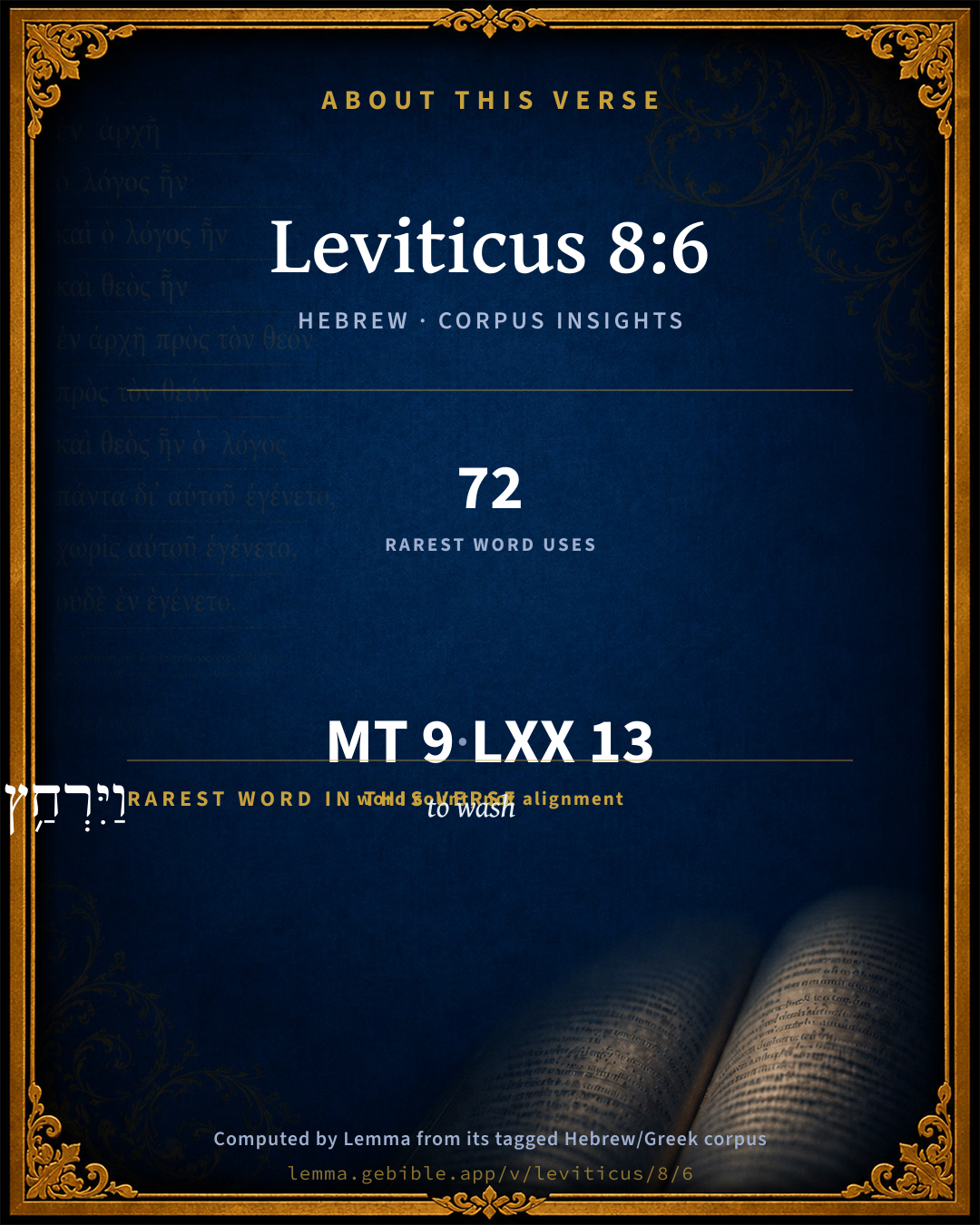
Leviticus 8:6

Hebrew (Westminster Leningrad Codex) Leviticus 8:6 appears in the Hebrew Old Testament. The text above is from the Westminster Leningrad Codex. Each word links to its Strong’s number, a concise gloss, and parsing drawn from the Open Scriptures Hebrew Bible morphology. Click any word for its full Brown-Driver-Briggs (BDB) entry.
Download image
Cite this verse

Leviticus 8:6 (World English Bible). Public Domain. Lemma interlinear Bible study tool, https://lemma.gebible.app/v/leviticus/8/6.

Show BibTeX & RIS
BibTeX
RIS
English Translation
Moses brought Aaron and his sons, and washed them with water.
World English Bible · Public Domain
Download a study sheet

One document with this verse’s original text, its word-by-word gloss line, the meaning frame, cross-references with their text, attributed commentary, and full source and license credits — printable, and it pastes into notes with its structure intact.

This verse Autodidact and up

Study sheet (.html) Plain text (.txt)

A passage Seminary Student

Up to 50 verses in one chapter. A passage sheet keeps up to 6 commentary sources and 12 cross-references per verse, in the order this page ranks them, and says so on the sheet whenever that leaves anything out. Ask for a single verse and you get the Autodidact verse sheet above.

Everything on this page stays free to read, with no account — the sheet is a download of what is already on screen, not access to it.

Want to remove ads? Support Godless Engineer
Compare translations 3

The same verse in 3 English versions, stacked beneath the original-language interlinear above. Click any original word for its lexicon entry.

Each is an independent rendering of the whole verse — the interlinear is not word-aligned to these translations.

Highlighted words mark where these versions differ — a whole-verse word diff, not a word-by-word alignment.

  • World English Bible Public Domain
    Moses brought Aaron and his sons, and washed them with water.
  • King James Version Public Domain
    And Moses brought Aaron and his sons, and washed them with water.
  • unfoldingWord Literal Text CC BY-SA 4.0
    Moses presented Aaron and his sons, and he washed them with water.

unfoldingWord Literal Text — © unfoldingWord, licensed CC BY-SA 4.0. Word-aligned USFM3 via Door43 (git.door43.org/unfoldingWord/en_ult).

Versions to compare (up to 4)

3 of 4 selected

Show all 18 translations

Every available English version of this verse, each an independent rendering of the whole verse.

  • World English Bible Public Domain
    Moses brought Aaron and his sons, and washed them with water.
  • Berean Standard Bible Public Domain
    Then Moses presented Aaron and his sons and washed them with water.
  • Majority Standard Bible Public Domain
    Then Moses presented Aaron and his sons and washed them with water.
  • King James Version Public Domain
    And Moses brought Aaron and his sons, and washed them with water.
  • American Standard Version (1901) Public Domain
    And Moses brought Aaron and his sons, and washed them with water.
  • Revised Version (1885) Public Domain
    And Moses brought Aaron and his sons, and washed them with water.
  • Geneva Bible (1599) Public Domain
    And Moses brought Aaron and his sonnes, and washed them with water,
  • Douay-Rheims (1899) Public Domain
    And immediately he offered Aaron and his sons: and when he had washed them,
  • Young's Literal Translation Public Domain
    And Moses bringeth near Aaron and his sons, and doth bathe them with water,
  • Literal Standard Version CC BY-SA 4.0
    And Moses brings Aaron and his sons near, and bathes them with water,
  • Unlocked Literal Bible CC BY-SA 4.0
    Moses brought Aaron and his sons and washed them with water.
  • unfoldingWord Literal Text CC BY-SA 4.0
    Moses presented Aaron and his sons, and he washed them with water.
  • Darby Bible Public Domain
    And Moses brought Aaron near, and his sons, and bathed them with water.
  • World Messianic Bible Public Domain
    Moses brought Aaron and his sons, and washed them with water.
  • Webster's Bible Public Domain
    And Moses brought Aaron and his sons, and washed them with water.
  • Free Bible Version CC BY-SA 4.0
    Moses had Aaron and his sons come forward, and he washed them with water.
  • Bible in Basic English Public Domain
    Then Moses took Aaron and his sons; and after washing them with water,
  • JPS Tanakh (1917) Public Domain
    And Moses brought Aaron and his sons, and washed them with water.

Literal Standard Version (2020), Covenant Press — licensed CC BY-SA 4.0. Text via the HelloAO Bible API (eBible.org). Unlocked Literal Bible (unfoldingWord) — licensed CC BY-SA 4.0. Text via the HelloAO Bible API (eBible.org). unfoldingWord Literal Text — © unfoldingWord, licensed CC BY-SA 4.0. Word-aligned USFM3 via Door43 (git.door43.org/unfoldingWord/en_ult). Free Bible Version, Dr. Jonathan Gallagher — licensed CC BY-SA 4.0. Text via the HelloAO Bible API (eBible.org).

Word by word

More ways to search: Search by grammar → Find every occurrence → Compare this word →

Practice this passage: Drill this verse → Learn its vocabulary →

וַיִּרְחַ֥ץ
râchats
H7364
“and · to wash”
Conjunction + Verb, Qal, Sequential Imperfect, 3rd Person, Masculine, Singular
Part of Speech
Conjunction + Verb
Stem
Qal
Form
Sequential Imperfect
Person
3rd Person
Gender
Masculine
Number
Singular
Full BDB Definition

Origin: a primitive root

TWOT: 2150

to wash, wash off, wash away, bathe - (Qal) - to wash, wash off, wash away - to wash, bathe (oneself) - (Pual) to be washed - (Hithpael) to wash oneself
  1. וַיַּקְרֵ֣ב qârab H7126 “and · to approach” Conjunction + Verb, Hiphil, Sequential Imperfect, 3rd Person, Masculine, Singular
  2. מֹשֶׁ֔ה Môsheh H4872 “Moses” Noun, Proper
  3. אֶֽת ʼêth H853 “-” Particle, Direct Object
  4. אַהֲרֹ֖ן ʼAhărôwn H175 “Aaron” Noun, Proper
  5. וְאֶת ʼêth H853 “and · -” Conjunction + Particle, Direct Object
  6. בָּנָ֑יו bên H1121 “sons · his” Noun, Common, Masculine, Plural, Construct + Suffix, Personal, 3rd Person, Masculine, Singular
  7. אֹתָ֖ם ʼêth H853 “- · them” Particle, Direct Object + Suffix, Personal, 3rd Person, Masculine, Plural
  8. בַּמָּֽיִם mayim H4325 “in/at the · water(s)” Preposition, Determined + Noun, Common, Masculine, Plural, Absolute

About this verse

These counts appear in no published source. They are computed here, from the morphology-tagged text and Lemma’s own curated glosses. What Lemma adds →

9
words
7
distinct lemmas
Pentateuch
section

Grammatical profile

  • 2 verbs
  • 4 nouns
  • 3 particles

Verb forms

  • וַיַּקְרֵ֣ב Hiphil · Sequential Imperfect
  • וַיִּרְחַ֥ץ Qal · Sequential Imperfect

Hebrew & Septuagint length

In English translation the verse runs 11 words from the Hebrew and 13 from the Septuagint (LXX English) — closely comparable.

A rough comparison of the two English renderings, which tokenize alike — not a word-level alignment.

Word counts can differ between the Hebrew and the Greek without any difference in meaning — e.g. the Hebrew direct-object marker אֵת has no separate Greek word, and Greek often adds the article ὁ.

In the original languages it is 9 Hebrew tokens and 13 Greek tokens — but the two are counted differently (Hebrew bundles its prefixes and suffixes into one token; the Greek is in lemma form), so that isn’t a like-for-like length.

Cross-references

16

Topical passages linked to Leviticus 8:6 in the Treasury of Scripture Knowledge — connected by theme and wording, ordered by reader-vote popularity; previews shown in the World English Bible.

  • Exodus 29:4 You shall bring Aaron and his sons to the door of the tent of meeting, and shall wash them with water.
  • 1 Corinthians 6:11 Such were some of you, but you were washed. But you were sanctified. But you were justified in the name of the Lord Jesus, and in the Spirit of our God.
  • Ephesians 5:26 that he might sanctify it, having cleansed it by the washing of water with the word,
  • Exodus 30:19 Aaron and his sons shall wash their hands and their feet in it.
  • Exodus 40:12 You shall bring Aaron and his sons to the door of the tent of meeting, and shall wash them with water.
  • Psalms 26:6 I will wash my hands in innocence, So I will go about your altar, Yahweh;
  • Psalms 51:2 Wash me thoroughly from my iniquity. Cleanse me from my sin.
  • Psalms 51:7 Purify me with hyssop, and I will be clean. Wash me, and I will be whiter than snow.
  • Isaiah 1:16 Wash yourselves, make yourself clean. Put away the evil of your doings from before my eyes; Cease to do evil.
  • Ezekiel 36:25 I will sprinkle clean water on you, and you shall be clean: from all your filthiness, and from all your idols, will I cleanse you.
  • Zechariah 13:1 "In that day there will be a spring opened to the house of David and to the inhabitants of Jerusalem, for sin and for uncleanness.
  • John 13:8–10 Peter said to him, "You will never wash my feet!" Jesus answered him, "If I don't wash you, you have no part with me."
  • Hebrews 9:10 being only (with meats and drinks and various washings) fleshly ordinances, imposed until a time of reformation.
  • Hebrews 10:22 let's draw near with a true heart in fullness of faith, having our hearts sprinkled from an evil conscience, and having our body washed with pure water,
  • Revelation 1:5–6 and from Jesus Christ, the faithful witness, the firstborn of the dead, and the ruler of the kings of the earth. To him who loves us, and washed us from our sins by his blood;
  • Revelation 7:14 I told him, "My lord, you know." He said to me, "These are those who came out of the great tribulation. They washed their robes, and made them white in the Lamb's blood.

Cross-references courtesy of OpenBible.info (CC BY 4.0).

Hebrew and Greek witnesses Masoretic Hebrew ↔ Greek Septuagint

The same verse in the two great witnesses to the Old Testament, shown verse-for-verse.

These are two independent witnesses, not word-aligned to each other, and the Septuagint is shown in lemma (dictionary) form.

Hebrew Leviticus 8:6 Masoretic · Westminster Leningrad Codex

וַיַּקְרֵ֣ב מֹשֶׁ֔ה אֶֽת אַהֲרֹ֖ן וְאֶת בָּנָ֑יו וַיִּרְחַ֥ץ אֹתָ֖ם בַּמָּֽיִם

Moses brought Aaron and his sons, and washed them with water.

World English Bible · Public Domain

Greek LXX Leviticus 8:6 Septuagint · lemma form

καί προςφέρω μωυσῆς ὁ ἀαρών καί ὁ υἱός αὐτός καί λούω αὐτός ὕδωρ

And Moses brought near Aaron and his sons, and washed them with water,

LXX2012 (modern English Septuagint) · Public Domain

Hebrew: Westminster Leningrad Codex (CC BY 4.0). Greek: Septuagint (public domain); English from LXX2012 (modern English Septuagint) (Public Domain). How the Septuagint differs from the Hebrew →

Targum (Aramaic paraphrase)

2

The Targum is the ancient Jewish Aramaic paraphrase of the Hebrew Scriptures — an interpretive translation, not the Hebrew text itself. Onkelos (literal) and Pseudo-Jonathan (expansive) render the Torah, and Jonathan the Prophets. Coverage is partial: where no permissively-licensed English translation exists for a verse, only the Aramaic is shown. This is verse-level text, not a word-by-word alignment to the Hebrew.

  1. Targum Onkelos Torah (Genesis–Deuteronomy)
    וְקָרִיב מֹשֶׁה יָת אַהֲרֹן וְיָת בְּנוֹהִי וְאַסְחֵי יָתְהוֹן בְּמַיָא

    (no public-domain English translation for this verse)

    Targum Onkelos — Aramaic: “Onkelos Genesis” (public domain); “Onkelos Exodus” (public domain); “Onkelos Leviticus” (public domain); “Onkelos Numbers” (public domain); “Onkelos Deuteronomy” (public domain). English: “Sefaria Community Translation” (CC0 1.0 (public-domain dedication)); “J.W. Etheridge. The Targums of Onkelos and Jonathan Ben Uzziel on the Pentateuch. London: Longmans, Green, 1862” (public domain). Text via Sefaria.

  2. Targum Pseudo-Jonathan Torah (Genesis–Deuteronomy)
    וְקָרֵיב משֶׁה יַת אַהֲרן וְיַת בְּנוֹי וְאַסְחֵי יַתְהוֹן בְּמוֹי

    And Mosheh took Aharon and his sons, and washed them with water.

    Targum Pseudo-Jonathan — Aramaic: “Targum Jonathan on Genesis” (public domain); “Targum Jonathan on Exodus” (public domain); “Targum Jonathan on Leviticus” (public domain); “Targum Jonathan on Numbers” (public domain); “Targum Jonathan on Deuteronomy” (public domain). English: “The Targum of Jonathan ben Uzziel, trans. J. W. Etheridge, London, 1862” (public domain). Text via Sefaria.

Commentary

Notes on Leviticus 8:6 from classic Christian and Jewish commentators (each source and its license shown beneath its notes). The classic Christian expositions comment on the surrounding passage and are grouped to its opening verse, so a note may address several verses; the Jewish commentaries on the Tanakh (Rashi and others) are per-verse, so they appear only where the commentator wrote on this verse.

Lemma curates 59 commentaries, every one of them public domain or Creative Commons licensed, each selected and text-cleaned for this edition rather than reprinted as found. About our sources →

Trapp's Complete Commentary

John Trapp

Lev 8:6 And Moses brought Aaron and his sons, and washed them with water.

Ver. 6. And Moses brought Aaron.] They did not intrude themselves. {See Trapp on "Heb 5:4"}

John Trapp, A Commentary or Exposition upon All the Books of the Old and New Testament (1647–1656) — public domain. Text from a community e-Sword module.

Keil & Delitzsch

C. F. Keil & F. Delitzsch

After this the act of consecration commenced. It consisted of two parts: first, the consecration of the persons themselves to the office of the priesthood, by washing, clothing, and anointing (Lev 8:6-13); and secondly, the sacrificial rites, by which the persons appointed to the priestly office were inducted into the functions and prerogatives of priests (vv. 16-36).

Lev 8:6-13

The washing, clothing, and anointing. - Lev 8:6. "Moses brought Aaron and his sons, and washed them with water;" i.e., directed them to wash themselves, no doubt all over, and not merely their hands and feet. This cleansing from bodily uncleanness was a symbol of the putting away of the filth of sin; the washing of the body, therefore, was a symbol of spiritual cleansing, without which no one could draw near to God, and least of all those who were to perform the duties of reconciliation.

Lev 8:7-9

Then followed the clothing of Aaron. Moses put upon him the body-coat (Exo 28:39) and girdle (Exo 28:39 and Exo 39:22), then clothes him with the mel (Exo 28:31-35) and ephod (Exo 28:6-14), and the choshen with the Urim and Thummim (Ex 28:15-30), and put the cap (Exo 28:39) upon his head, with the golden diadem over his forehead (Exo 28:36-38). This investiture, regarded as the putting on of an important official dress, was a symbol of his endowment with the character required for the discharge of the duties of his office, the official costume being the outward sign of installation in the office which he was to fill.

Lev 8:10-13

According to the directions in Exo 30:26-30 (cf. Lev Exo 40:9-11), the anointing was performed first of all upon "the tabernacle and everything in it," i.e., the ark of the covenant, the altar of incense, the candlestick, and table of shew-bread, and their furniture; and then upon the altar of burnt-offering and its furniture, and upon the laver and its pedestal; and after this, upon Aaron himself, by the pouring of the holy oil upon his head. This was followed by the robing and anointing of Aaron's sons, the former only of which is recorded in Lev 8:13 (according to Exo 28:40), the anointing not being expressly mentioned, although it had not only been commanded, in Exo 28:41 and Exo 40:15, but the performance of it is taken for granted in Lev 7:36; Lev 10:7, and Num 3:3. According to the Jewish tradition, the anointing of Aaron (the high priest) was different from that of the sons of Aaron (the ordinary priests), the oil being poured upon the head of the former, whilst it was merely smeared with the finger upon the forehead in the case of the latter (cf. Relandi Antiqq. ss. ii. 1, 5, and 7, and Selden, de succ. in pontif. ii. 2). There appears to be some foundation for this, as a distinction is assumed between the anointing of the high priest and that of the ordinary priests, not only in the expression, "he poured of the anointing oil upon Aaron's head" (Lev 8:12, cf. Exo 29:7; Psa 133:2), which is applied to Aaron only, but also in Lev 21:10, Lev 21:12; although the further statement of the later Talmudists and Rabbins, that Aaron was also marked upon the forehead with the sign of a Hebrew כ (the initial letter of כהן), has no support in the law (vid., Selden, ii. 9; Vitringa, observv. ss. ii. c. 15, 9). - On the mode in which the tabernacle and its furniture were anointed, all that is stated is, that the altar of burnt-offering was anointed by being sprinkled seven times with the anointing oil; from which we may safely conclude, that the other portions and vessels of the sanctuary were anointed in the same way, but that the sprinkling was not performed more than once in their case. The reason why the altar was sprinkled seven times with the holy anointing oil, is to be sought for in its signification as the place of worship. The anointing, both of the sacred things and also of the priests, is called קדּשׁ "to sanctify," in Lev 8:10-12, as well as in Exo 40:9-11 and Exo 40:13; and in Exo 40:10 the following stipulation is added with regard to the altar of burnt-offering: "and it shall be most holy," - a stipulation which is not extended to the dwelling and its furniture, although those portions of the sanctuary were most holy also, that the altar of burnt-offering, which was the holiest object in the court by virtue of its appointment as the place of expiation, might be specially guarded from being touched by unholy hands (see at Exo 40:16). To impress upon it this highest grade of holiness, it was sprinkled even times with anointing oil; and in the number seven, the covenant number, the seal of the holiness of the covenant of reconciliation, to which it was to be subservient, was impressed upon it. To sanctify is not merely to separate to holy purposes, but to endow or fill with the powers of the sanctifying Spirit of God. Oil was a fitting symbol of the Spirit, or spiritual principle of life, by virtue of its power to sustain and fortify the vital energy; and the anointing oil, which was prepared according to divine instructions, was therefore a symbol of the Spirit of God, as the principle of spiritual life which proceeds from God and fills the natural being of the creature with the powers of divine life. The anointing with oil, therefore, was a symbol of endowment with the Spirit of God (Sa1 10:1, Sa1 10:6; Sa1 16:13-14; Isa 61:1) for the duties of the office to which a person was consecrated. The holy vessels also were not only consecrated, through the anointing, for the holy purposes to which they were to be devoted (Knobel), but were also furnished in a symbolical sense with powers of the divine Spirit, which were to pass from them to the people who came to the sanctuary. The anointing was not only to sanctify the priests as organs and mediators of the Spirit of God, but the vessels of the sanctuary also, as channels and vessels of the blessings of grace and salvation, which God as the Holy One would bestow upon His people, through the service of His priests, and in the holy vessels appointed by Him. On these grounds the consecration of the holy things was associated with the consecration of the priests. The notion that even vessels, and in fact inanimate things in general, can be endowed with divine and spiritual powers, was very widely spread in antiquity. We meet with it in the anointing of memorial stones (Gen 28:17; Gen 35:14), and it occurs again in the instructions concerning the expiation of the sanctuary on the annual day of atonement (ch. 16). It contains more truth than some modern views of the universe, which refuse to admit that any influence is exerted by the divine Spirit except upon animated beings, and thus leave a hopeless abyss between spirit and matter. According to Exo 29:9, the clothing and anointing of Aaron and his sons were to be "a priesthood to them for a perpetual statute," i.e., to secure the priesthood to them for all ages; for the same thought is expressed thus in Exo 40:15 : "their anointing shall surely be an everlasting priesthood throughout their generations." When the Talmudists refer these words to the sons of Aaron or the ordinary priests, to the exclusion of Aaron or the high priest, this is opposed to the distinct context, according to which the sons of Aaron were to be anointed like their father Aaron. The utter want of foundation for the rabbinical assumption, that the anointing of the sons of Aaron, performed by Moses, availed not only for themselves, but for their successors also, and therefore for the priests of every age, is also the more indisputable, because the Talmudists themselves infer from Lev 6:15 (cf. Exo 29:29), where the installation of Aaron's successor in his office is expressly designated an anointing, the necessity for every successor of Aaron in the high-priesthood to be anointed. The meaning of the words in question is no doubt the following: the anointing of Aaron and his sons was to stand as a perpetual statute for the priesthood, and to guarantee it to the sons of Aaron for all time; it being assumed as self-evident, according to Lev 6:15, that as every fresh generation entered upon office, the anointing would be repeated or renewed.

Keil & Delitzsch — Biblical Commentary on the Old Testament (1861–1891) — public domain (CC PDM 1.0). Text via the HelloAO Bible API. (Old Testament only.)

The Expositor's Bible

THE WASHING WITH WATER

Lev_8:6

"And Moses brought Aaron and his sons, and washed them with water."

The consecration ceremonies consisted of four parts, namely, the Washing, the Investiture, the Anointing, and the Sacrifices. Of these, first in order was the Washing. We read that "Moses"-acting throughout, we must remember, as Mediator, representing God-"brought Aaron and his sons, and washed them with water." The meaning of this act is so evident as not to have been called in question. Washing ever signifies cleansing; the ceremonial cleansing of the body, therefore, in symbol ever represents the inward purification of the spirit.

Of this usage the Biblical illustrations are very numerous. Thus, the spiritual purification of Israel in the latter day is described {Isa_4:4} by the same word as is used here, as a washing away of a the "filth of the daughters of Zion" by the Lord. So, again, in the New Testament, we read that Christ declared unto Nicodemus that in order to see the kingdom of God a man must be born again, "of water and the Spirit," and in the Epistle to Titus {Tit_3:5} we read of a cleansing of the Church "with the washing (marg., laver) of water, by the Word," even the "washing of regeneration." The symbolism in this case, therefore, points to cleansing from the defilement of sin as a fundamental condition of priesthood. As regards our Lord indeed, such cleansing was no more needed for His high priesthood than was the sin offering for Himself; for in His holy incarnation, though He took our nature indeed with all the consequences and infirmities consequent on sin, He was yet "without sin." But all the more it was necessary in the symbolism that if Aaron was to typify the sinless Christ of God he must be cleansed with water, in type of the cleansing of human nature, without which no man can approach to God. And in that not only Aaron, but also his sons, the ordinary priests, were thus cleansed, we are in the ordinance significantly pointed to the deep spiritual truth that they who are called to be priests to God must be qualified for this office, first of all, by the cleansing of their human nature through the washing of regeneration, by the power of the Holy Ghost.

William Robertson Nicoll, ed., The Expositor's Bible (London: Hodder & Stoughton, 1887–1910) — public domain. 65 of 66 books (1 Corinthians is not separately keyed, as that volume carries no machine-parseable verse references); section-level commentary keyed to the opening verse. Introductory and overview sections not keyed to a specific passage are excluded.

Tyndale Open Study Notes

Tyndale Open Resources

8:6 Being washed . . . with water was the first step for cleansing from impurity. The priests had to be ceremonially clean before they could serve the Lord in holiness (Exod 29:4; see Ps 24:4).

Tyndale Open Study Notes — © Tyndale Open Resources, licensed CC BY-SA 4.0. Text via the HelloAO Bible API.

Jamieson, Fausset & Brown

Robert Jamieson, A. R. Fausset & David Brown

Moses . . . washed them with water--At consecration they were subjected to entire ablution, though on ordinary occasions they were required, before entering on their duties, only to wash their hands and feet. This symbolical ablution was designed to teach them the necessity of inward purity, and the imperative obligation on those who bore the vessels and conducted the services of the sanctuary to be holy.

Jamieson, Fausset & Brown — Commentary Critical and Explanatory on the Whole Bible (1871) — public domain (CC PDM 1.0). Text via the HelloAO Bible API.

Ellicott's Commentary for English Readers

(6) And washed them with water.—As the first initiatory rite of the consecration, Moses caused Aaron and his sons to bathe (see Lev_16:4), thus symbolising their purification from sin. Where the phrase “to wash with water” is used without specifying any particular part or parts of the body, as in Gen_19:2; Gen_24:32, Exo_30:19; Exo_30:21, Deu_21:6, it denotes the washing or bathing of the entire body. This was not done in the presence of the people, but in a baptistry, behind a curtain. During the second Temple the sacerdotal immersion could not be effected in a vessel, but had to take place in a hollow made in the ground, containing at least twenty-four cubic feet of water. The installation of the priest, which is here conducted by Moses, as the giver and representative of the Divine law, was during the second Temple performed by the Sanhedrin, who “sat in Moses’ seat.”

A Bible Commentary for English Readers, edited by Charles John Ellicott (1878–1897) — public domain. Text from a community e-Sword module.

The Cambridge Bible for Schools and Colleges

gen. ed. J. J. S. Perowne

6. (a) washing; cp. Exo_29:4.

The Cambridge Bible for Schools and Colleges (gen. ed. J. J. S. Perowne; Cambridge University Press, 1878–1918) — public domain. Text from a community e-Sword module.

John Gill's Exposition

And Moses brought Aaron and his sons,.... To the laver which was in the court of the tabernacle

and washed them with water; to show that they should be clean that bear the vessels of the Lord, and offer the sacrifices of the people; all that are in public office in the house of God ought to have both clean hands and a pure heart, to hold the mystery of the faith in a pure conscience, and to be of a pure and holy conversation; and indeed all that are made kings and priests to God, as all the saints are, they are washed from their sins in the blood of Jesus, Rev 1:5.

John Gill's Exposition of the Whole Bible (1746–1763) — public domain (CC PDM 1.0). Text via the HelloAO Bible API.

Albert Barnes' Notes on the Bible

Washed them with water - Moses caused them to bathe entirely (compare Lev 16:4), not merely to wash their hands and feet, as they were to do in their daily ministrations. See the marginal reference. This bathing, which the high priest had also to go through on the day of atonement, was symbolic of the spiritual cleansing required of all 2Co 7:1, but especially of those who had to draw near to God to make reconciliation for the sins of the people Heb 7:26; Mat 3:15.

Albert Barnes' Notes on the Bible (1834–1885) — public domain. Text from a community e-Sword/MySword module.

Whedon's Commentary on the Bible

Daniel D. Whedon

6. Washed them with water — Physical purity is desirable in itself. Cleanliness is next to godliness. But this washing of the outer man symbolizes the purgation of the inner man from all filthiness of the spirit, by the washing of regeneration and the renewing of the Holy Ghost. Nearly all pagan nations employ water as an indication of a moral cleansing, either borrowing the practice from the Hebrews or because the symbolism is naturally suggested to the mind. The Egyptian priests bathed in cold water twice each day and twice each night. Exo_2:5, note. The supposition that this washing of the priests in the wilderness was by the immersion of the entire person is too violent to be entertained. Nevertheless the Hebrew word רחצhere used is the same as that found in 2Ki_5:10, “Go wash in Jordan.” For its bearing on the meaning of βαπτω see Methodist Quarterly, January, 1874, and January, 1875, p. 67.

Daniel D. Whedon (gen. ed.), Commentary on the Old and New Testaments (1874–1909) — public domain. Text from a community e-Sword module.

The Pulpit Commentary

Washing, robing, anointing, sacrificing, are the four means by the joint operation of which the consecration is effected. The washing, or bathing, took place in the sight of the people. The whole of the person, except so much as was covered by the linen drawers, (Exo_28:42) was washed. The symbolical significance is clear. Cleansing from sin precedes clothing in righteousness and spiritual unction.

Vers. 6-12. The High Priesthood of Christ.

To direct the thoughts of a congregation to Jesus Christ is never unseasonable. The Epistle to the Hebrews warrants the assumption that in the rites here described are symbolized the characteristics of our Great High Priest. The consecration consists of two parts the anointing and clothing of the person of Aaron, and his offering of sacrifices; and it is on the former we are now to dwell, reminding us of that Person in whom "all beauties shine, all wonders meet, all glories dwell.

I See typified THE PURITY OF CHRIST in the washing of the priest from head to foot. As an Eastern climate demands thorough ablution for cleanliness, so was this a lesson man needed to learn, that only purity is tit to come into contact with God. Priesthood bridged the gulf between sinful man and a Being unsullied by admixture of evil. Like all God"s dealings, it humbled and exalted man. Taught plainly that he was too polluted to approach his Maker, with equal distinctness he was shown a way in which he might draw near with clean hands and a pure heart. The material and ceremonial purity of Aaron was eclipsed by the total freedom from taint of Christ. He bathed, indeed, in the crystal waters of Jordan at his entrance upon his public ministry, but those waters were stained compared with the purity of his soul.

II Observe THE SPLENDOUR OF HIS ENDOWMENTS. For every post a certain character is requisite. The putting on of garments represented the bestowment upon Aaron of the qualities essential to the proper discharge of his duties. This was the apparel respecting which the Lord said unto Moses, "Thou shalt make holy garments for Aaron thy brother, for glory and for beauty." Looking at the high priest thus arrayed, we see symbols of the ornaments and graces of Jesus Christ. Note the choice quality of the attire. Everything of the best, fine linen, gold unalloyed, stones precious and rare. The oil is "costly ointment." Search out all that is best in human nature, all that challenges admiration and excites esteem, and an example of all is found in Jesus Christ. Possessed of every gift, power, and skill, loveliness and majesty, perfect in intellect, emotion, and will, he was victorious over every temptation, and unscathed by every trial. This dress of Aaron emblematized positive virtue; so Christ was upright, not only like Adam as he left the hands of God, but as acquiring and exhibiting every grace that can adorn humanity. There was virtue in exercise, virtue visible and potent. The tree put forth its leaves, its blossoms, and its fruit.

III The high priest maintained A CONSTANT REMEMBRANCE OF THE PEOPLE. Hence the breast-plate bearing the names of the twelve tribes, which were also inscribed upon the onyx stones of the shoulder. The people were borne in the positions that indicated power and sympathy.

What the bosom desires the arms accomplish. Let others write their names upon lofty pillars or granite rocks; let statesmen, warriors, nobles, inscribe themselves upon the roll of fame; "Give me," says the Christian, "a place upon the Saviour"s breast; for there on the heart of Christ, under the glance of infinite mercy, where the love of God delights to rest, are the names of all his followers graven for ever.

IV In the breast-plate were put the Urim and Thummim, by means of which was ascertained and made known the will of God. REVELATION OF GOD was thus part of the high priest"s functions. The priestly and prophetic offices were intertwined. Though we may single out an office of Christ for distinct consideration, as we may distinguish one of the hues of the rainbow, yet let us not forget that it is the combination which is of such surpassing excellence and glory. It has been well said that Christ is called the Wisdom of God in the Old Testament, and the Word in the New. Full vocal expression was reserved for the time when he could joy to say, "I have declared unto them thy Name, and will declare it." It is by the priesthood of Christ that we learn in particular the grace of God. It is written on all creation, but to our blurred vision the letters are oft obscure. On the cross of Christ, where he becomes at once the Offerer and Victim; these words glisten with heavenly radiance, luminous not only in noontide prosperity, but in the dark midnight of affliction, "God is love.

V The high priesthood is AN OFFICE OF AUTHORITY, and this authority is THE SUPREMACY OF HOLINESS. Upon the head is placed the mitre, a cap or turban, and upon the mitre is fastened a golden plate or diadem, inscribed "Holiness unto the Lord." Christ"s is a royal priesthood, and his sway is the result of his consecration to God. He rules by right of character, by right of rank, by right of work. The "holy crown" is the guarantee for the acknowledgment of his claims to hearty, unreserved obedience. If today men demand authority as priests, at least let the holiness of their lives support their pretensions.

VI By the pouring of the oil upon Aaron"s head we see intimated ENTIRE DEDICATION TO GOD"S SERVICE. This holy unction set apart the high priest for hallowed toil, and became an emblem of the fortifying, sustaining, vitalizing presence of the Spirit of God. "The Spirit of the Lord God is upon me, because he hath anointed me." It is the oil of gladness, the dew of the blessing of the Lord. It is a token of perpetuity. The brightest pageant fades, the show of today is forgotten ere the morrow dawns, but the priesthood of Christ knows neither ebb nor flow. S.R.A.

Vers. 6-9, 14. The human and Divine priesthood contrast.

The setting apart of Aaron for his life-work, the high priesthood of Israel, naturally suggests to us the entrance of our Great High Priest on the work which his Father gave him to do. Between Aaron and Christ there are many points of resemblance (see below); there are also significant contrasts. Respecting "the High Priest of our profession", (Heb_3:2) it is not the case that there was

I APPOINTMENT TO OFFICE IN VIRTUE OF HUMAN BIRTH. Aaron was chosen to the office of high priest, partly in virtue of his descent from Levi (perhaps partly in virtue of his brotherhood to Moses). His personal qualities were not such as to make him the most suitable man for the office, independently of considerations of lineal descent and human relationship. Jesus Christ did not owe his position as our High Priest to his human birth. He was not, indeed, of the tribe of Levi, but of Judah, "after the flesh." And though, through his mother, he was a son of David, in the matter of human descent, this was not in any way material to his ascent to royal power. His right of office came not thence.

II IMPOSING INAUGURAL CEREMONY. The scene described in this chapter was striking, imposing, memorable; it would long be borne in mind, never, indeed, forgotten by those who witnessed it. It formed part of the national history. Imagination on our part readily places before us the solemn and suggestive ceremonies which riveted the eyes of the congregation of Israel. Through no such solemnities did One greater than Aaron think well to pass as he entered on his work. It is said that his contemporaries expected the Messiah to descend amongst them from the heavens while they were worshipping in the temple. This he distinctly refused to do. (Mat_4:5-7) The ceremony of the baptism by John was simple in the extreme. Long chapters of Old Testament Scripture (Exodus and Leviticus) are occupied in narrating the inaugural ceremonies of the human priesthood; five verses suffice to chronicle those of the Divine. (Mat_3:13-17) The profounder work of the Lord from heaven was more fittingly commenced by that quiet scene on the banks of Jordan.

III OUTWARD AND VISIBLE DISTINCTION. (Verses 7-9) The appearance of Aaron and of his successors in their pontifical attire, as described in this chapter, with rich and coloured garments about them, and the mitre on their head glittering with golden diadem, must have been impressive and imposing enough in the eyes of the people. How striking the contrast with him who was the carpenter"s Son of Nazareth, who shunned all ostentation and parade, (Mat_12:19) who had "no beauty" (of outward appearance) "that we should desire him", (Isa_53:2) who attracted disciples to his feet, and sinners to his side, only by the wisdom of his words, and the grace of his spirit and the beauty of his life!

IV NEED OF PURIFICATION. "Moses brought Aaron and his sons, and washed them with water" (verse 6). It was needful that they should go through a ceremony which signified the putting away of "all filthiness of the flesh and spirit". (2Co_7:1) No need of this in the case of the holy Saviour. Whatever his baptism signified, it did not mean this. He was "a High Priest, holy, harmless, undefiled," requiring no cleansing streams whatever. (Heb_7:26; see Joh_14:30)

V NEED OF PARDON. "And he brought the bullock for the sin offering: and Aaron," etc. (verse 14). Before the human high priest could be admitted to the altar, his own sin must be forgiven. Christ entered on his work, not needing to present any oblation. With him, as he was, the Divine Father was "well pleased". (Mat_3:17)

In entering on any work to which we may be called of God, we must remember that

(1) we have need to purify ourselves of the sin-stains that are left on the soul;

(2) we have need to seek for pardon for a faulty past before we go forth to a new future;

(3) we may be careless of outward distinctions, considering the lowliness of our Lord. C.

Vers. 6, 8, 23, 24, 30. Equipment for special work.

There was a sense in which the whole congregation of Israel constituted a priesthood. It was an early promise that they should be a "kingdom of priests and a holy nation". (Exo_19:6) And such, indeed, they were, so far as they entered into and fulfilled the purposes of God. They were:

1. Separate from surrounding people (holy unto the Lord).

2. Permitted to draw near to God.

3. Allowed to bring the sacrificial victim to the holy place and slay it; indeed, in the case of the paschal lamb, they acted as priests without aid from any other hand.

But there were those who were:

1. Separated from them, and were thus holier than they.

2. Allowed to draw nearer to the Divine presence.

3. Designated to be continually offering up sacrifices to Jehovah. These were the priests and the high priests of the Lord in an especial sense, and they needed special equipment for their special work.

From this chapter we select four principal points

I SPECIAL CLEANSING OF SOUL. (Verse 6.)

II SPECIAL CONSECRATION OF SPIRIT. (Verses 23, 24) One of the most significant rites in the entire ceremony of consecration was the taking by Moses of the blood of the "ram of consecration" (verse 22), and putting it "upon the tip of Aaron"s right car, and upon the thumb of his right hand, and upon the great toe of his right foot." The interpretation of this symbolism hardly admits of error. What other truth could it import but that Aaron was thus set apart, not only generally for the service of the Lord, but specially in every member of his frame, in every faculty of his mind? He was to have:

1. An open ear, to welcome every word of the Lord.

2. A ready hand, to discharge diligently and conscientiously his daily duties.

3. A quick foot, to run in the way of God"s commandments.

III SPECIAL SYMPATHY WITH MEN. (Verse 8) The plate on which were inscribed the names of the twelve tribes was, as the word indicates, a breast-plate: so that the high priest symbolically bore the children of Israel on his heart. He carried their burden into the presence of God.

IV SPECIAL ENDOWMENT. (Verse 30) The precious ointment, the anointing oil, upon the head that ran down upon Aaron"s beard, that went down to the skirts of his garments, (Psa_133:2) probably symbolized the grace of the Spirit of God outpoured upon the heart, affecting the whole nature, diffusing the delightful fragrance of piety and virtue.

We learn from these particulars

1. That we must not covet posts of special difficulty except we are equipped with peculiar qualifications. Not every good or every earnest Christian man is fitted to take high office in the kingdom of God.

2. That if we feel ourselves summoned to special work, we must seek all possible spiritual equipment. The conditions of successful service are those indicated above:

(1) The full cleansing of our souls and lives from impurity. (Psa_51:7, Psa_51:10, Psa_51:11, 13 Isa_52:11 1Jn_3:3)

(2) The dedication of our whole selves to the service of Christ; heart and life; soul and body; having every faculty of the mind, every organ of our frame (ear, hand, foot), ready for sacred work.

(3) Tender sympathy with men; "a heart at leisure from itself to soothe and sympathize." We shall do but little for men except we acquire the blessed art of sympathizing with them. A sympathetic spirit is a helpful, influential, winning spirit.

(4) Endowment of all needful grace from on high. This must be gained from God, who, in answer to believing prayer, "giveth liberally." Purity, consecration, sympathy, grace, these are the qualifications for high office, the sources of power, the assurance of success. C.

"And Moses brought Aaron and his sons, and washed them with water.

Not hands and feet only, as in daily ministrations, but the whole body, symbolizing entire spiritual cleansing.

I Take this cleansing as MAN"S OBEDIENCE. It set forth:

1. Confession of sin and dependence on Divine grace.

2. Personal consecration entire devotion to the service of God.

3. As performed by priests, the acceptance of a place in the priestly office and before the altar demanded conspicuous holiness and purity.

II Thus was typified THE DIVINE PROMISE.

1. That man should be cleansed really by the Spirit.

2. That a perfect high priesthood should be provided.

3. That the necessary imperfection and impurity of an earthly service should be swallowed up hereafter in the holy perfection of the heavenly service, when all that approach God shall be like him. R.

The Pulpit Commentary (1880–1919), ed. H.D.M. Spence-Jones & Joseph S. Exell — public domain. Text from a community e-Sword module.

unfoldingWord translationNotes

Door43 World Missions Community

washed them with water

This is a symbolic action. It is a ritually cleaning that prepares them to become priests. (See: Symbolic Action)

the tunic ... the sash ... the robe ... the ephod ... the finely-woven waistband

These are special garments that Yahweh commanded the people to make for the priests. (See: Assumed Knowledge and Implicit Information)

sash

a long piece of cloth that is tied around the waist or chest

bound it to him

"tied it around him"

translationWords

Moses

Aaron

son

tunic

robe

ephod

bind

unfoldingWord translationNotes — © Distant Shores Media and the Door43 World Missions Community, licensed CC BY-SA 4.0. Source: git.door43.org/Door43/en_tn.

Ramban (Nachmanides)

Rabbi Moshe ben Nachman (Ramban / Nachmanides)

AND HE WASHED THEM WITH WATER. It appears likely to me that Scripture tells that he [Moses] washed all of them, but nonetheless it was not done to all of them together. Rather, he washed Aaron and clothed him with his garments and anointed him, and afterwards he washed his sons and anointed them.

Ramban (Nachmanides) on the Tanakh — English translation: “Commentary on the Torah by Ramban (Nachmanides). Translated and annotated by Charles B. Chavel. New York, Shilo Pub. House, 1971-1976” (CC BY 4.0). Text via Sefaria.

Lesson kit

Teaching starters — assembled from the data on this page, not authored interpretation. Every prompt links to the verse data it draws on. Edit before teaching.

Leviticus, in the Pentateuch, opens this verse with 9 words (7 distinct Hebrew lemmas). Its most distinctive word is râchats (“to wash”). A historical commentator’s framing appears above. Read the whole chapter for the surrounding context.

Discussion questions

  1. How does “to wash” (râchats) shape what this verse is saying?
  2. Exodus 29:4 shares this passage’s theme. How do the two illuminate each other?
  3. These translations render this verse differently; the difference is in the English rendering, not the original. What questions does that raise?
  4. The verb «וַיַּקְרֵ֣ב» is Hiphil Sequential Imperfect. How does its form color the action?
  5. Reading how Trapp's Complete Commentary and Keil & Delitzsch read this verse, where do the two commentators agree and where do they part?

Things to notice

Reading settings

Reading text

Shown beneath each verse's original-language words.

Old Testament
Old Testament edition

Read the OT as the Masoretic Hebrew (MT) or the Greek Septuagint (LXX).

English shown for the Greek Septuagint (in the Hebrew ↔ Greek comparison).

Comparing translations? Open the Compare panel on any verse page to stack up to four side by side.