
Deuteronomy 25:11

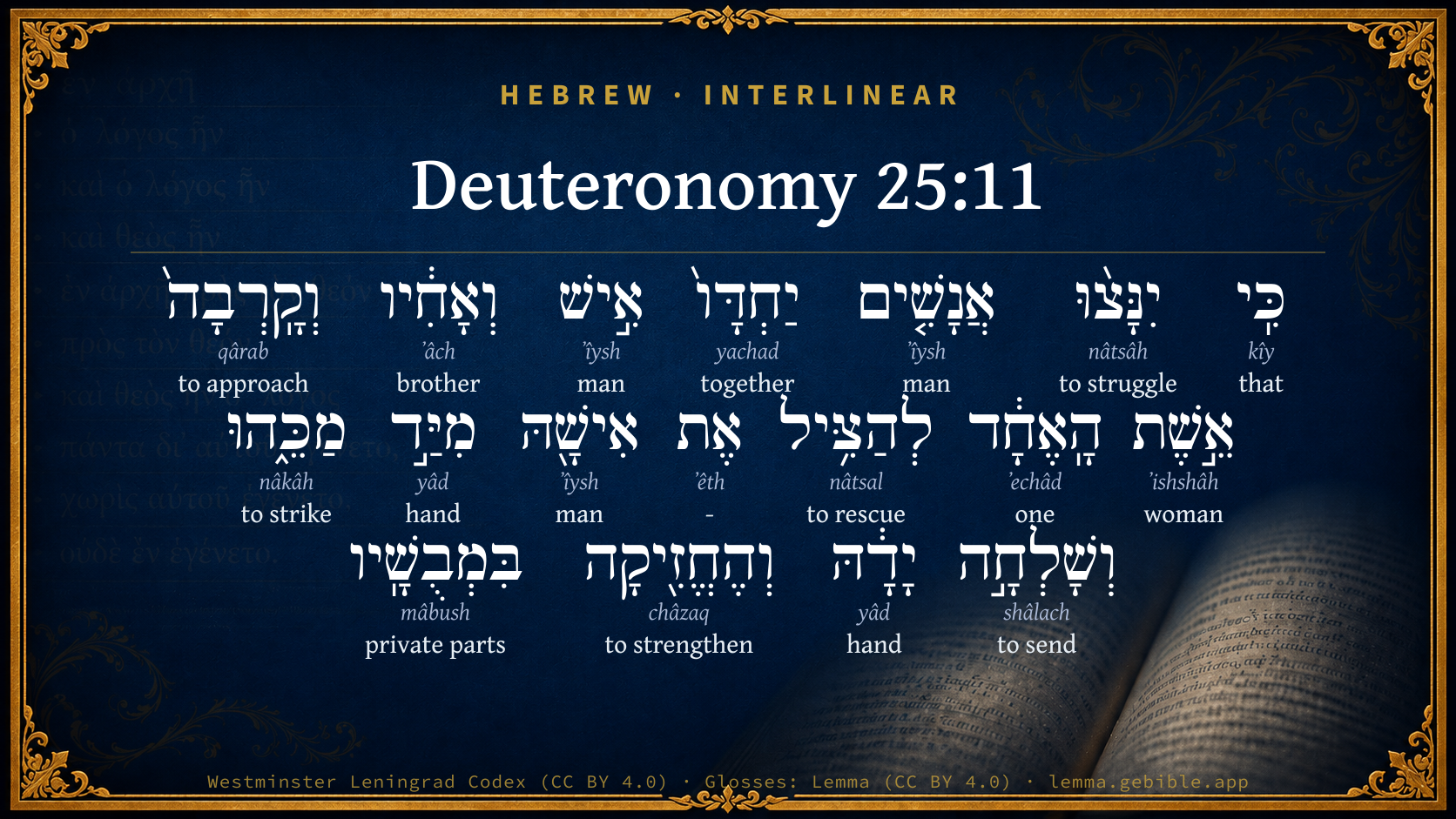
Hebrew (Westminster Leningrad Codex) Deuteronomy 25:11 appears in the Hebrew Old Testament. The text above is from the Westminster Leningrad Codex. Each word links to its Strong’s number, a concise gloss, and parsing drawn from the Open Scriptures Hebrew Bible morphology. Click any word for its full Brown-Driver-Briggs (BDB) entry.
Download image
Cite this verse

Deuteronomy 25:11 (World English Bible). Public Domain. Lemma interlinear Bible study tool, https://lemma.gebible.app/v/deuteronomy/25/11.

Show BibTeX & RIS
BibTeX
RIS
English Translation
When men strive together one with another, and the wife of the one draws near to deliver her husband out of the hand of him who strikes him, and puts forth her hand, and takes him by the secrets;
World English Bible · Public Domain
Highlights
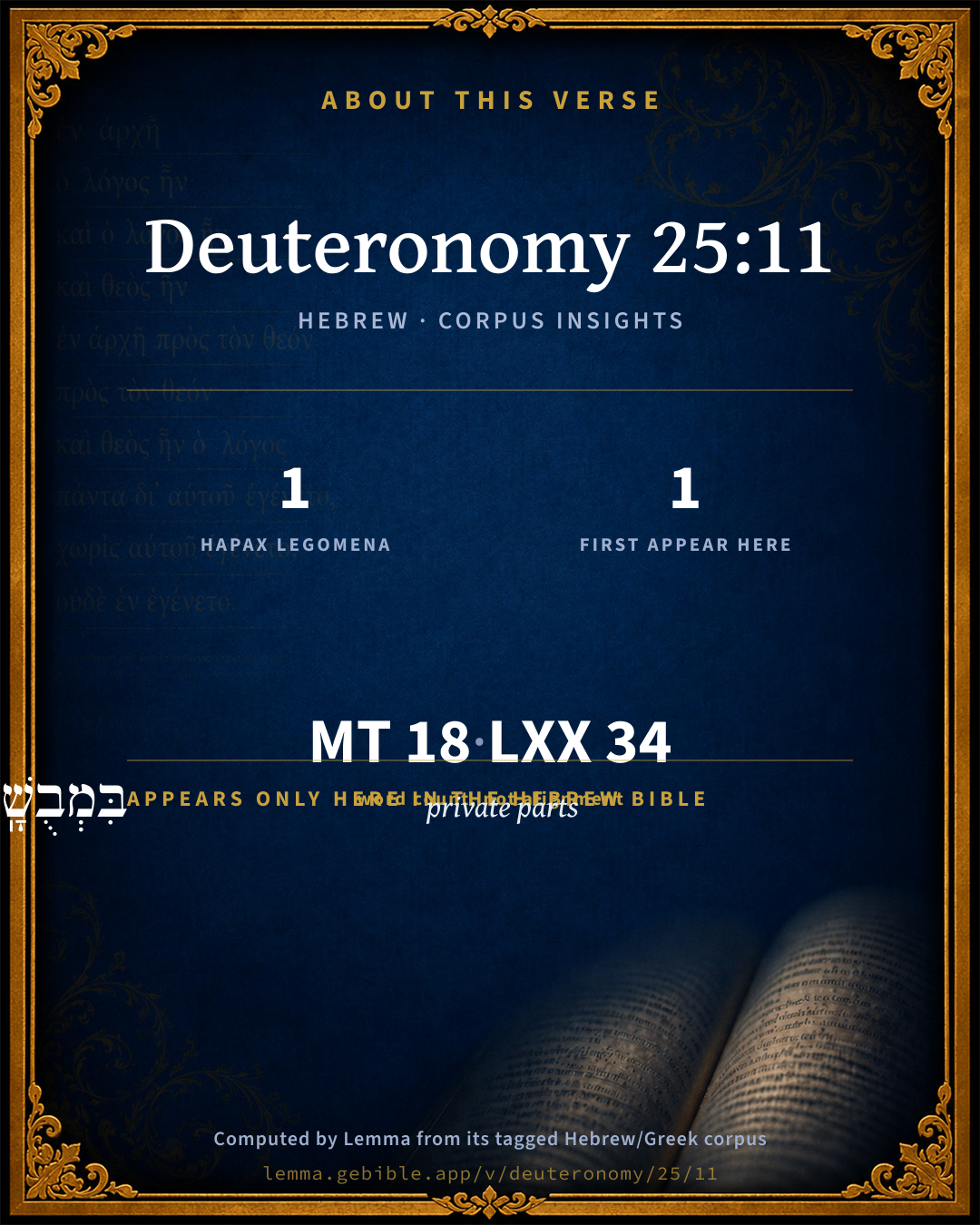
  • 1 hapax legomenon — only here in the Hebrew Bible
  • 1 first appearance in the Hebrew Bible
Full analysis ↓
Download a study sheet

One document with this verse’s original text, its word-by-word gloss line, the meaning frame, cross-references with their text, attributed commentary, and full source and license credits — printable, and it pastes into notes with its structure intact.

This verse Autodidact and up

Study sheet (.html) Plain text (.txt)

A passage Seminary Student

Up to 50 verses in one chapter. A passage sheet keeps up to 6 commentary sources and 12 cross-references per verse, in the order this page ranks them, and says so on the sheet whenever that leaves anything out. Ask for a single verse and you get the Autodidact verse sheet above.

Everything on this page stays free to read, with no account — the sheet is a download of what is already on screen, not access to it.

Want to remove ads? Support Godless Engineer
Compare translations 3

The same verse in 3 English versions, stacked beneath the original-language interlinear above. Click any original word for its lexicon entry.

Each is an independent rendering of the whole verse — the interlinear is not word-aligned to these translations.

Highlighted words mark where these versions differ — a whole-verse word diff, not a word-by-word alignment.

  • World English Bible Public Domain
    When men strive together one with another, and the wife of the one draws near to deliver her husband out of the hand of him who strikes him, and puts forth her hand, and takes him by the secrets;
  • King James Version Public Domain
    When men strive together one with another, and the wife of the one draweth near for to deliver her husband out of the hand of him that smiteth him, and putteth forth her hand, and taketh him by the secrets:
  • unfoldingWord Literal Text CC BY-SA 4.0
    If men fight with each other, a man and his brother, and the wife of one comes to rescue her husband from the hand of his attacker, and she stretches out her hand and seizes him by his genitals,

unfoldingWord Literal Text — © unfoldingWord, licensed CC BY-SA 4.0. Word-aligned USFM3 via Door43 (git.door43.org/unfoldingWord/en_ult).

Versions to compare (up to 4)

3 of 4 selected

Show all 18 translations

Every available English version of this verse, each an independent rendering of the whole verse.

  • World English Bible Public Domain
    When men strive together one with another, and the wife of the one draws near to deliver her husband out of the hand of him who strikes him, and puts forth her hand, and takes him by the secrets;
  • Berean Standard Bible Public Domain
    If two men are fighting, and the wife of one steps in to rescue her husband from the one striking him, and she reaches out her hand and grabs his genitals,
  • Majority Standard Bible Public Domain
    If two men are fighting, and the wife of one comes to rescue her husband from the one striking him, and she reaches out her hand and grabs his genitals,
  • King James Version Public Domain
    When men strive together one with another, and the wife of the one draweth near for to deliver her husband out of the hand of him that smiteth him, and putteth forth her hand, and taketh him by the secrets:
  • American Standard Version (1901) Public Domain
    When men strive together one with another, and the wife of the one draweth near to deliver her husband out of the hand of him that smiteth him, and putteth forth her hand, and taketh him by the secrets;
  • Revised Version (1885) Public Domain
    When men strive together one with another, and the wife of the one draweth near for to deliver her husband out of the hand of him that smiteth him, and putteth forth her hand, and taketh him by the secrets:
  • Geneva Bible (1599) Public Domain
    When men striue together, one with another, if the wife of the one come neere, for to ridde her husband out of the handes of him that smiteth him, and put foorth her hand, and take him by his priuities,
  • Douay-Rheims (1899) Public Domain
    If two men have words together, and one begin to fight against the other, and the other's wife willing to deliver her husband out of the hand of the stronger, shall put forth her hand, and take him by the secrets,
  • Young's Literal Translation Public Domain
    `When men strive together, one with another, and the wife of the one hath drawn near to deliver her husband out of the hand of his smiter, and hath put forth her hand, and laid hold on his secrets,
  • Literal Standard Version CC BY-SA 4.0
    When men strive together with one another, and the wife of one has drawn near to deliver her husband out of the hand of his striker, and has put forth her hand, and laid hold on his private parts,
  • Unlocked Literal Bible CC BY-SA 4.0
    If men fight with each other, and the wife of one comes to rescue her husband out of the hand of him who struck him, and if she stretches out her hand and takes him by the private parts,
  • unfoldingWord Literal Text CC BY-SA 4.0
    If men fight with each other, a man and his brother, and the wife of one comes to rescue her husband from the hand of his attacker, and she stretches out her hand and seizes him by his genitals,
  • Darby Bible Public Domain
    When men fight together one with another, and the wife of the one come near to rescue her husband out of the hand of him that smiteth him, and stretch out her hand, and seize him by his secret parts,
  • World Messianic Bible Public Domain
    When men strive against each other, and the wife of one draws near to deliver her husband out of the hand of him who strikes him, and puts out her hand, and grabs him by his private parts,
  • Webster's Bible Public Domain
    When men strive together one with another, and the wife of the one draweth near to deliver her husband from the hand of him that smiteth him, and putteth forth her hand, and taketh him by the secrets:
  • Free Bible Version CC BY-SA 4.0
    If two men are fighting, and one of their wives intervenes to save her husband from being beaten, and she grabs hold of the attacker's genitals,
  • Bible in Basic English Public Domain
    If two men are fighting, and the wife of one of them, coming to the help of her husband, takes the other by the private parts;
  • JPS Tanakh (1917) Public Domain
    When men strive together one with another, and the wife of the one draweth near to deliver her husband out of the hand of him that smiteth him, and putteth forth her hand, and taketh him by the secrets;

Literal Standard Version (2020), Covenant Press — licensed CC BY-SA 4.0. Text via the HelloAO Bible API (eBible.org). Unlocked Literal Bible (unfoldingWord) — licensed CC BY-SA 4.0. Text via the HelloAO Bible API (eBible.org). unfoldingWord Literal Text — © unfoldingWord, licensed CC BY-SA 4.0. Word-aligned USFM3 via Door43 (git.door43.org/unfoldingWord/en_ult). Free Bible Version, Dr. Jonathan Gallagher — licensed CC BY-SA 4.0. Text via the HelloAO Bible API (eBible.org).

Word by word

More ways to search: Search by grammar → Find every occurrence → Compare this word →

Practice this passage: Drill this verse → Learn its vocabulary →

בִּמְבֻשָֽׁיו
mâbush
H4016
“in/at · private parts · his”
Preposition + Noun, Common, Masculine, Plural, Construct + Suffix, Personal, 3rd Person, Masculine, Singular
Part of Speech
Preposition + Noun
Type
Common
Gender
Masculine
Number
Plural
State
Construct
Full BDB Definition

Origin: from H954

TWOT: 222d

private parts, his privates, male genitals - literally - 'that excites shame'
  1. כִּֽי kîy H3588 “that” Conjunction
  2. יִנָּצ֨וּ nâtsâh H5327 “to struggle” Verb, Niphal, Imperfect, 3rd Person, Masculine, Plural
  3. אֲנָשִׁ֤ים ʼîysh H376 “men” Noun, Common, Masculine, Plural, Absolute
  4. יַחְדָּו֙ yachad H3162 “together” Adverb
  5. אִ֣ישׁ ʼîysh H376 “man” Noun, Common, Masculine, Singular, Absolute
  6. וְאָחִ֔יו ʼâch H251 “and · brother · his” Conjunction + Noun, Common, Masculine, Singular, Construct + Suffix, Personal, 3rd Person, Masculine, Singular
  7. וְקָֽרְבָה֙ qârab H7126 “and · to approach” Conjunction + Verb, Qal, Sequential Perfect, 3rd Person, Feminine, Singular
  8. אֵ֣שֶׁת ʼishshâh H802 “woman of” Noun, Common, Feminine, Singular, Construct
  9. הָֽאֶחָ֔ד ʼechâd H259 “the · one” Particle, Definite Article + Adjective, Cardinal number, Masculine, Singular, Absolute
  10. לְהַצִּ֥יל nâtsal H5337 “to rescue” Preposition + Verb, Hiphil, Infinitive Construct
  11. אֶת ʼêth H853 “-” Particle, Direct Object
  12. אִישָׁ֖הּ ʼîysh H376 “man · her” Noun, Common, Masculine, Singular, Construct + Suffix, Personal, 3rd Person, Feminine, Singular
  13. מִיַּ֣ד yâd H3027 “from · hand of” Preposition + Noun, Common, Both, Singular, Construct
  14. מַכֵּ֑הוּ nâkâh H5221 “striking · him” Verb, Hiphil, Participle Active, Masculine, Singular, Construct + Suffix, Personal, 3rd Person, Masculine, Singular
  15. וְשָׁלְחָ֣ה shâlach H7971 “and · to send” Conjunction + Verb, Qal, Sequential Perfect, 3rd Person, Feminine, Singular
  16. יָדָ֔הּ yâd H3027 “hand · her” Noun, Common, Both, Singular, Construct + Suffix, Personal, 3rd Person, Feminine, Singular
  17. וְהֶחֱזִ֖יקָה châzaq H2388 “and · to strengthen” Conjunction + Verb, Hiphil, Sequential Perfect, 3rd Person, Feminine, Singular

About this verse

These counts appear in no published source. They are computed here, from the morphology-tagged text and Lemma’s own curated glosses. What Lemma adds →

18
words
15
distinct lemmas
Pentateuch
section

Notable vocabulary

1 hapax legomenon — a word that appears only here in the entire Hebrew Bible:

  • בִּמְבֻשָֽׁיו private parts H4016

First appearance in Scripture

This word makes its first canonical appearance in the Hebrew Bible here:

  • בִּמְבֻשָֽׁיו private parts H4016

Shared distinctive vocabulary

יִנָּצ֨וּ to struggle H5327 occurs in 10 verses of the Hebrew Bible. Also found in:

Grammatical profile

  • 6 verbs
  • 8 nouns
  • 1 adjective
  • 1 conjunction
  • 1 adverb
  • 1 particle

Verb forms

  • יִנָּצ֨וּ Niphal · Imperfect
  • וְקָֽרְבָה֙ Qal · Sequential Perfect
  • לְהַצִּ֥יל Hiphil · Infinitive Construct
  • מַכֵּ֑הוּ Hiphil · Participle Active
  • וְשָׁלְחָ֣ה Qal · Sequential Perfect
  • וְהֶחֱזִ֖יקָה Hiphil · Sequential Perfect

Repetition

Words recur within this verse — often emphatic in Hebrew:

  • אֲנָשִׁ֤ים man H376 ×3
  • מִיַּ֣ד hand H3027 ×2

Hebrew & Septuagint length

In English translation the verse runs 39 words from the Hebrew and 47 from the Septuagint (LXX English) — closely comparable.

A rough comparison of the two English renderings, which tokenize alike — not a word-level alignment.

Word counts can differ between the Hebrew and the Greek without any difference in meaning — e.g. the Hebrew direct-object marker אֵת has no separate Greek word, and Greek often adds the article ὁ.

In the original languages it is 18 Hebrew tokens and 34 Greek tokens — but the two are counted differently (Hebrew bundles its prefixes and suffixes into one token; the Greek is in lemma form), so that isn’t a like-for-like length.

Hebrew and Greek witnesses Masoretic Hebrew ↔ Greek Septuagint

The same verse in the two great witnesses to the Old Testament, shown verse-for-verse.

These are two independent witnesses, not word-aligned to each other, and the Septuagint is shown in lemma (dictionary) form.

Hebrew Deuteronomy 25:11 Masoretic · Westminster Leningrad Codex

כִּֽי יִנָּצ֨וּ אֲנָשִׁ֤ים יַחְדָּו֙ אִ֣ישׁ וְאָחִ֔יו וְקָֽרְבָה֙ אֵ֣שֶׁת הָֽאֶחָ֔ד לְהַצִּ֥יל אֶת אִישָׁ֖הּ מִיַּ֣ד מַכֵּ֑הוּ וְשָׁלְחָ֣ה יָדָ֔הּ וְהֶחֱזִ֖יקָה בִּמְבֻשָֽׁיו

When men strive together one with another, and the wife of the one draws near to deliver her husband out of the hand of him who strikes him, and puts forth her hand, and takes him by the secrets;

World English Bible · Public Domain

Greek LXX Deuteronomy 25:11 Septuagint · lemma form

ἐάν δέ μάχομαι ἄνθρωπος ἐπί ὁ αὐτός ἄνθρωπος μετά ὁ ἀδελφός αὐτός καί προςἔρχομαι γυνή εἷς αὐτός ἐκαἱρέω ὁ ἀνήρ αὐτός ἐκ χείρ ὁ τύπτω αὐτός καί ἐκτείνω ὁ χείρ ἐπιλαμβάνω ὁ δίδυμος αὐτός

And if men should strive together, a man with his brother, and the wife of one of them should advance to rescue her husband out of the hand of him that smites him, and she should stretch forth her hand, and take hold of his private parts;

LXX2012 (modern English Septuagint) · Public Domain

Hebrew: Westminster Leningrad Codex (CC BY 4.0). Greek: Septuagint (public domain); English from LXX2012 (modern English Septuagint) (Public Domain). How the Septuagint differs from the Hebrew →

Targum (Aramaic paraphrase)

2

The Targum is the ancient Jewish Aramaic paraphrase of the Hebrew Scriptures — an interpretive translation, not the Hebrew text itself. Onkelos (literal) and Pseudo-Jonathan (expansive) render the Torah, and Jonathan the Prophets. Coverage is partial: where no permissively-licensed English translation exists for a verse, only the Aramaic is shown. This is verse-level text, not a word-by-word alignment to the Hebrew.

  1. Targum Onkelos Torah (Genesis–Deuteronomy)
    אֲרֵי יִנְצוּן גֻבְרִין כַּחֲדָא גְבַר וַאֲחוּהִי וְתִתְקְרֵב אִתַּת חַד לְשֵׁזָבָא יָת בַּעֲלַהּ מִיַד מָחוּהִי וְתוֹשֵׁט יְדַהּ וְתִתְקֵף בְּבֵית בַּהֲתְּתֵהּ

    (no public-domain English translation for this verse)

    Targum Onkelos — Aramaic: “Onkelos Genesis” (public domain); “Onkelos Exodus” (public domain); “Onkelos Leviticus” (public domain); “Onkelos Numbers” (public domain); “Onkelos Deuteronomy” (public domain). English: “Sefaria Community Translation” (CC0 1.0 (public-domain dedication)); “J.W. Etheridge. The Targums of Onkelos and Jonathan Ben Uzziel on the Pentateuch. London: Longmans, Green, 1862” (public domain). Text via Sefaria.

  2. Targum Pseudo-Jonathan Torah (Genesis–Deuteronomy)
    אֲרוּם מִתְגַּרְיָין בְּנֵי אֱנָשָׁא כַּחֲדָא גְּבַר וְחַבְרֵיהּ וְתִתְקָרֵב אִתַּת חַד מִנְהוֹן לְשֵׁיזָבָא יַת בַּעֲלָהּ מִיַּד מְחָהִי וְתוֹשִׁיט יְדָהּ וְתִתְקֵיף בְּבֵית בְּהַתְתֵיהּ

    While men are striving together, if the wife of one of them approach to rescue her husband from the hand of him who smiteth him, and putting forth her hand layeth hold of the place of his shame,

    Targum Pseudo-Jonathan — Aramaic: “Targum Jonathan on Genesis” (public domain); “Targum Jonathan on Exodus” (public domain); “Targum Jonathan on Leviticus” (public domain); “Targum Jonathan on Numbers” (public domain); “Targum Jonathan on Deuteronomy” (public domain). English: “The Targum of Jonathan ben Uzziel, trans. J. W. Etheridge, London, 1862” (public domain). Text via Sefaria.

Commentary

Notes on Deuteronomy 25:11 from classic Christian and Jewish commentators (each source and its license shown beneath its notes). The classic Christian expositions comment on the surrounding passage and are grouped to its opening verse, so a note may address several verses; the Jewish commentaries on the Tanakh (Rashi and others) are per-verse, so they appear only where the commentator wrote on this verse.

Lemma curates 59 commentaries, every one of them public domain or Creative Commons licensed, each selected and text-cleaned for this edition rather than reprinted as found. About our sources →

The Cambridge Bible for Schools and Colleges

gen. ed. J. J. S. Perowne

11, 12. Of Reckless Assault

The woman who, even to help her husband, grasps the secrets of another Israelite wrestling with him shall have her hand cut off.—Peculiar to D, and in the Sg. address with brother as in other Sg. passages; but with an opening, and an accumulation of conditions similar to those in other laws probably borrowed by D. The additions may be the superfluous a man and his brother (Deu_25:11, R.V. one with another) and thine eye shall not pity (Deu_25:12, cp. Deu_7:16). Strive, rather are wrestling (as in E, Exo_21:22; cp. Exo_2:13, Lev_24:10, 2Sa_14:6). Secrets, lit. pudenda, only here. The position of the law just here may be due to the catchword his brother, cp. Deu_25:9.

This very special case is probably meant to be typical of others (cp. Deu_19:5). The punishment is the only mutilation prescribed by D apart from the jus talionis (Deu_19:21). It is usually supposed to have had its origin at a time when such an act was the violation of a very sacred taboo. In Ḫammurabi, §§ 202–205, there are (if the translation can be relied on) parallel crimes. Mutilation is also decreed there for other crimes.

The Cambridge Bible for Schools and Colleges (gen. ed. J. J. S. Perowne; Cambridge University Press, 1878–1918) — public domain. Text from a community e-Sword module.

Tyndale Open Study Notes

Tyndale Open Resources

25:11-12 cut off her hand: The woman’s act would emasculate the man, depriving him of (or cutting off from him) any offspring. As with the previous law (25:9), the punishment fits the crime (lex talionis; see study note on 19:21).

Tyndale Open Study Notes — © Tyndale Open Resources, licensed CC BY-SA 4.0. Text via the HelloAO Bible API.

Geneva Bible (1599)

Geneva Bible translators

This law importeth that godly shamefastness be preserved: for it is an horrible thing to see a woman past shame.

Geneva Bible (1599) marginal notes — public domain. Text via Bolls.life.

John Gill's Exposition

When men strive together, one with another,.... Quarrel with one another, and come to blows, and strive for mastery, which shall beat, and be the best man:

and the wife of the one draweth near for to deliver her husband out of the hand of him that smiteth him; perceiving that his antagonist has more skill or strength, or both, for fighting, and is an more than a match for her husband, who is like to be much bruised and hurt; wherefore, to save him out of the hands of the smiter, she goes up to them to part them, or take her husband's side:

and putteth forth her hand, and taketh him by the secrets; or privy parts; in Hebrew his "shameful" parts (x), which through shame are hidden, and modesty forbids to express in proper terms; and such is the purity of the Hebrew language, that no obscene words are used in it; for which reason, among others, it is called the holy tongue. This immodest action was done partly out of affection to her husband, to oblige his antagonist to let go his hold of him; and partly out of malice and revenge to him, to spoil him, and make him unfit for generation, and therefore was to be severely punished, as follows.

(x) "verenda ejus", V. L. Pagninus, Montanus, Tigurine version; "pudenda ejus", Piscator.

John Gill's Exposition of the Whole Bible (1746–1763) — public domain (CC PDM 1.0). Text via the HelloAO Bible API.

Whedon's Commentary on the Bible

Daniel D. Whedon

11, 12. When men strive — According to Van Lennep (Bible Lands, p. 630, note) this is “explained by the fact that wrestlers are habitually on the alert to avail themselves of the chance to disable an antagonist by the means interdicted in this passage. The prohibition implies that the practice was common.”

Daniel D. Whedon (gen. ed.), Commentary on the Old and New Testaments (1874–1909) — public domain. Text from a community e-Sword module.

The Pulpit Commentary

Vers. 11, 12. But though the childless widow might thus approach and lay hold on the man, no license was thus granted to women to pass beyond the bounds of decency in their approaches to the other sex. Hence the prohibition in these verses. The severe sentence here prescribed was by the rabbins commuted into a fine of the value of the hand.

Vers. 11, 12. An offending hand.

This maybe compared with Mat_5:30.

1. Any member of the body may become an instrument of sin.

2. Where there is in any case special danger there should a special watch be kept.

3. Favorite, yet sinful lusts must be crucified, whatever the cost may be.

Vers. 11-16. Honesty the best policy.

We have first a law of purity, which needs no exposition, but in its holy severity (vers. 11, 12) was fitted to check all tendency to lewd practices among the women of Israel. Then Moses passes on to speak of the crime of having divers weights and measures, and the effort to make money by dishonest practices. No blessing from God can rest upon such willfully dishonest ones; if his blessing is to be experienced, it must be by a policy of honesty all round.

I IT IS APPARENTLY EASY TO MAKE MONEY BY LIGHT WEIGHTS AND SHORT MEASURES. It is not only securing the ordinary profits, but gaining by the deficiency palmed off for the perfect measure. It is a gain by quantity as well as by price. And plenty of people who look only at the surface imagine that they can easily enrich themselves by a little dishonesty, which will never be detected. Inspectors of weights and measures are the embodiment of the suspicions of society.

II IT IS A SYSTEM OF BUSINESS UPON WHICH NO DIVINE BLESSING CAN BE ASKED. NO better test of the propriety of our procedure can be found than this. Will it stand the test of prayer? Can God, the All-holy One, be expected to bless it? Now, his whole Word shows that such practices are abominations to him. The stars of heaven will at length fight against such a policy.

III NO TEMPORARY SUCCESS CAN COMPENSATE FOR AN UNEASY CONSCIENCE. Suppose that success waited on dishonesty invariably and proved lasting, life would be made miserable by the uneasy conscience. Stifled for a time, it rises like the furies at last, and makes life a lasting misery. No man ever trifled with conscience anal did not suffer for it. Success becomes in such a case but a whited sepulcher; the experience within is but the rottenness of the tomb.

IV HONESTY IS THE BEST POLICY FOR PERSONAL PEACE AND FOR DIVINE BLESSING. We say that no man should so far outrage his conscience as to be dishonest. Honesty is a policy to be pursued for its own sake, as the only condition of personal peace. Were there no Divine blessing in question at all, conscientious men would be as honest as they are now.

At the same time, it makes the honesty all the happier that it lies in the sunshine of the Infinite Presence, and that his radiant smile is on it. There is no danger of a mercenary spirit entering into such a relation with God. He so wraps us round that in his circle of love it would be most ungrateful and most dissonant to practice dishonesty.

With people under a theocracy, or reign of God, we should expect to find just weights and full measures. The visits of the inspectors should prove superfluous with all those whose life lies open as the day to the inspection of their King. R.M.E.

The Pulpit Commentary (1880–1919), ed. H.D.M. Spence-Jones & Joseph S. Exell — public domain. Text from a community e-Sword module.

Keil & Delitzsch

C. F. Keil & F. Delitzsch

"But in order that the great independence which is here accorded to a childless widow in relation to her brother-in-law, might not be interpreted as a false freedom granted to the female sex" (Baumgarten), the law is added immediately afterwards, that a woman whose husband was quarrelling with another, and who should come to his assistance by laying hold of the secret parts of the man who was striking her husband, should have her hand cut off.

Keil & Delitzsch — Biblical Commentary on the Old Testament (1861–1891) — public domain (CC PDM 1.0). Text via the HelloAO Bible API. (Old Testament only.)

Kretzmann's Popular Commentary

Paul E. Kretzmann

Correct Weights and Measures

v. 11. when men strive together one with another, become engaged in fisticuffs, and the wife of the one draweth near for to deliver her husband out of the hand of him that smiteth him, and putteth forth her hand, and taketh him by the secrets,

v. 12. then thou, the constituted authority, shalt cut off her hand, thine eye shall not pity her. This precept was here inserted in order to guard against a false freedom and familiarity of the female sex toward those of the opposite sex.

v. 13. Thou shalt not have in thy bag, usually a large leather sack or purse, divers weights, a great and a small, a set of large stones for purchases, a set of small ones for sales. This could be done both where stones and where scraps of iron were used by the merchants.

v. 14. Thou shalt not have in thine house divers measures, a great and a small, a large ephah or dry measure for purchases, a small ephah for sales.

v. 15. But thou shalt have a perfect and just weight, each one, whether in the shop or in the house, complete, whole, holding just the amount which it was supposed to hold, a perfect and just measure shalt thou have, that thy days may be lengthened in the land which the Lord, thy God, giveth thee, in the matter of receiving temporal blessings, Deu 4:26; Deu 5:16.

v. 16. For all that do such things, in making use of dishonesty in any form, and all that do unrighteously, any one guilty of deliberate wrong-doing, are an abomination unto the Lord, thy God. But this consideration shown the neighbor at home was not to degenerate into a false weakness and indulgence toward enemies whose extermination the Lord had decided upon.

v. 17. Remember what Amalek did unto thee by the way, when ye were come forth out of Egypt, Exo 17:8;

v. 18. how he met thee by the way, namely, at Rephidim near Horeb, and smote the hindmost of thee, even all that were feeble behind thee, when thou wast faint and weary; and he feared not God. The inhumanity practiced by the Amalekites in thus injuring and destroying the stragglers of the Israelitish army showed that there was no fear of God in their ranks.

v. 19. Therefore it shall be when the Lord, thy God, hath given thee rest from all thine enemies round about, in the land which the Lord, thy God, giveth thee for an in heritance to possess it, that thou shalt blot out the remembrance of Amalek from under heaven; thou shalt not forget it. Cf 12:10; Exo 17:14; Deu 9:7. Israel, acting as God’s agent, carried out this command at the time of Saul, 1 Samuel 15.

Paul E. Kretzmann, Popular Commentary of the Bible (1921–1924) — public domain. Text from a community e-Sword module.

unfoldingWord translationNotes

Door43 World Missions Community

General Information:

Moses speaks to the Israelites as if they were one man, so the words "you" and "your" here are singular. (See: Forms of You)

out of the hand of him who struck him

Here "hand" refers to power or control. AT: "so the one who struck him will not strike him again" or "from the man who hit him" (See: Metonymy)

your eye must have no pity

Here "eye" means the whole person. AT: "you should not feel sorry for her" or "you must not show her mercy" (See: Synecdoche)

unfoldingWord translationNotes — © Distant Shores Media and the Door43 World Missions Community, licensed CC BY-SA 4.0. Source: git.door43.org/Door43/en_tn.

Rashi

Rabbi Shlomo Yitzchaki (Rashi)

כי ינצו אנשים WHEN MEN STRIVE TOGETHER, they will in the end come to blows, as it goes on to state “[and the wife approacheth to deliver her husband]” out of the hand of him who smiteth him: No good can come out of a quarrel (Sifrei Devarim 292:1; cf. Rashi on v. 1).

Rashi on the Tanakh — English translations: “The Judaica Press complete Tanach with Rashi, translated by A. J. Rosenberg” (CC BY 4.0); “Pentateuch with Rashi's commentary by M. Rosenbaum and A.M. Silbermann, 1929-1934” (public domain); “The Metsudah Tanach series, Lakewood, N.J” (CC BY 4.0); and “The Book of Joshua, Metsudah Publications, 1997” (CC BY 4.0). Text via Sefaria.

Lesson kit

Teaching starters — assembled from the data on this page, not authored interpretation. Every prompt links to the verse data it draws on. Edit before teaching.

Deuteronomy, in the Pentateuch, opens this verse with 18 words (15 distinct Hebrew lemmas). Its most distinctive word is mâbush (“private parts”). A historical commentator’s framing appears above. Read the whole chapter for the surrounding context.

Discussion questions

  1. What does “private parts” (mâbush) contribute to the verse as a whole?
  2. This verse holds 1 word here found nowhere else in the Hebrew Bible. What might the rare word draw attention to?
  3. The word “private parts” first appears here in Scripture. What is being introduced at this debut?
  4. Exodus 2:13 shares the word «to struggle» with this verse. How do the two illuminate each other?
  5. “man” occurs 3× in this one verse. What is the effect of the repetition?
  6. The translations on this page render this verse differently — a whole-verse word diff, not a word-by-word alignment. What might account for the different wordings?
  7. The verb «יִנָּצ֨וּ» is Niphal Imperfect. How does its form color the action?
  8. Reading how The Cambridge Bible for Schools and Colleges and Tyndale Open Study Notes read this verse, where do the two commentators agree and where do they part?

Things to notice

  • 1 word in this verse appears nowhere else in the Hebrew Bible.
  • 1 word makes its first canonical appearance in Scripture here.
  • This verse counts 18 Hebrew ↔ 34 Greek words.
  • These translations choose different wording for 28 words in this verse.
  • “man” occurs 3× in this single verse.

Reading settings

Reading text

Shown beneath each verse's original-language words.

Old Testament
Old Testament edition

Read the OT as the Masoretic Hebrew (MT) or the Greek Septuagint (LXX).

English shown for the Greek Septuagint (in the Hebrew ↔ Greek comparison).

Comparing translations? Open the Compare panel on any verse page to stack up to four side by side.