Numbers 15:13

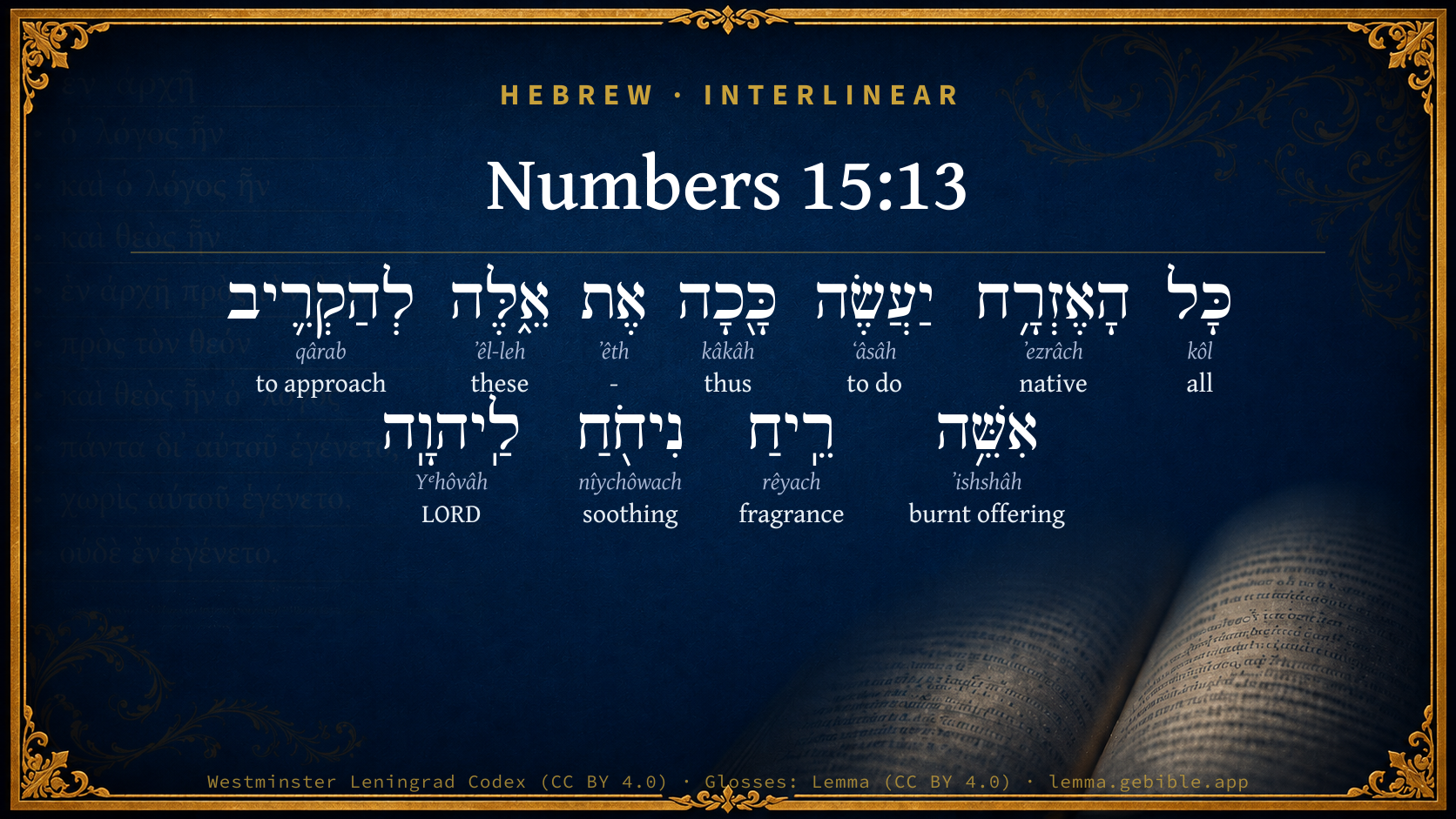
Hebrew (Westminster Leningrad Codex) Numbers 15:13 appears in the Hebrew Old Testament. The text above is from the Westminster Leningrad Codex. Each word links to its Strong’s number, a concise gloss, and parsing drawn from the Open Scriptures Hebrew Bible morphology. Click any word for its full Brown-Driver-Briggs (BDB) entry.
Download image
Cite this verse

Numbers 15:13 (World English Bible). Public Domain. Lemma interlinear Bible study tool, https://lemma.gebible.app/v/numbers/15/13.

Show BibTeX & RIS
BibTeX
RIS
English Translation
All who are home-born shall do these things after this manner, in offering an offering made by fire, of a sweet savor to Yahweh.
World English Bible · Public Domain
Download a study sheet

One document with this verse’s original text, its word-by-word gloss line, the meaning frame, cross-references with their text, attributed commentary, and full source and license credits — printable, and it pastes into notes with its structure intact.

This verse Autodidact and up

Study sheet (.html) Plain text (.txt)

A passage Seminary Student

Up to 50 verses in one chapter. A passage sheet keeps up to 6 commentary sources and 12 cross-references per verse, in the order this page ranks them, and says so on the sheet whenever that leaves anything out. Ask for a single verse and you get the Autodidact verse sheet above.

Everything on this page stays free to read, with no account — the sheet is a download of what is already on screen, not access to it.

Want to remove ads? Support Godless Engineer
Compare translations 3

The same verse in 3 English versions, stacked beneath the original-language interlinear above. Click any original word for its lexicon entry.

Each is an independent rendering of the whole verse — the interlinear is not word-aligned to these translations.

Highlighted words mark where these versions differ — a whole-verse word diff, not a word-by-word alignment.

  • World English Bible Public Domain
    All who are home-born shall do these things after this manner, in offering an offering made by fire, of a sweet savor to Yahweh.
  • King James Version Public Domain
    All that are born of the country shall do these things after this manner, in offering an offering made by fire, of a sweet savor unto the LORD.
  • unfoldingWord Literal Text CC BY-SA 4.0
    Every native shall do these thus to present a gift, a scent of pleasing for Yahweh.

unfoldingWord Literal Text — © unfoldingWord, licensed CC BY-SA 4.0. Word-aligned USFM3 via Door43 (git.door43.org/unfoldingWord/en_ult).

Versions to compare (up to 4)

3 of 4 selected

Show all 18 translations

Every available English version of this verse, each an independent rendering of the whole verse.

  • World English Bible Public Domain
    All who are home-born shall do these things after this manner, in offering an offering made by fire, of a sweet savor to Yahweh.
  • Berean Standard Bible Public Domain
    Everyone who is native-born shall prepare these things in this way when he presents an offering made by fire as a pleasing aroma to the LORD.
  • Majority Standard Bible Public Domain
    Everyone who is native-born shall prepare these things in this way when he presents a food offering as a pleasing aroma to the LORD.
  • King James Version Public Domain
    All that are born of the country shall do these things after this manner, in offering an offering made by fire, of a sweet savor unto the LORD.
  • American Standard Version (1901) Public Domain
    All that are home-born shall do these things after this manner, in offering an offering made by fire, of a sweet savor unto Jehovah.
  • Revised Version (1885) Public Domain
    All that are homeborn shall do these things after this manner, in offering an offering made by fire, of a sweet savour unto the LORD.
  • Geneva Bible (1599) Public Domain
    All that are borne of the countrey, shall do these things thus, to offer an offring made by fire of sweete sauour vnto the Lord.
  • Douay-Rheims (1899) Public Domain
    Both they that are born in the land, and the strangers
  • Young's Literal Translation Public Domain
    every native doth thus with these, at bringing near a fire-offering of sweet fragrance to Jehovah;
  • Literal Standard Version CC BY-SA 4.0
    every native does thus with these, for bringing a fire-offering near of refreshing fragrance to YHWH;
  • Unlocked Literal Bible CC BY-SA 4.0
    All who are native-born Israelites must do these things in this way, when anyone brings an offering made by fire, to produce an aroma that is pleasing to Yahweh.
  • unfoldingWord Literal Text CC BY-SA 4.0
    Every native shall do these thus to present a gift, a scent of pleasing for Yahweh.
  • Darby Bible Public Domain
    And all that are born in the land shall do these things thus, in presenting an offering by fire of a sweet odour to Jehovah.
  • World Messianic Bible Public Domain
    “‘All who are native-born shall do these things in this way, in offering an offering made by fire, of a pleasant aroma to the LORD.
  • Webster's Bible Public Domain
    All that are born in the country shall do these things after this manner, in offering an offering made by fire, of a sweet savor to the LORD.
  • Free Bible Version CC BY-SA 4.0
    Every Israelite is to follow these instructions when they present an offering that is accepted by the Lord.
  • Bible in Basic English Public Domain
    All those who are Israelites by birth are to do these things in this way, when giving an offering made by fire of a sweet smell to the Lord.
  • JPS Tanakh (1917) Public Domain
    All that are home-born shall do these things after this manner, in presenting an offering made by fire, of a sweet savour unto the LORD.

Literal Standard Version (2020), Covenant Press — licensed CC BY-SA 4.0. Text via the HelloAO Bible API (eBible.org). Unlocked Literal Bible (unfoldingWord) — licensed CC BY-SA 4.0. Text via the HelloAO Bible API (eBible.org). unfoldingWord Literal Text — © unfoldingWord, licensed CC BY-SA 4.0. Word-aligned USFM3 via Door43 (git.door43.org/unfoldingWord/en_ult). Free Bible Version, Dr. Jonathan Gallagher — licensed CC BY-SA 4.0. Text via the HelloAO Bible API (eBible.org).

Word by word

More ways to search: Search by grammar → Find every occurrence → Compare this word →

Practice this passage: Drill this verse → Learn its vocabulary →

הָאֶזְרָ֥ח
ʼezrâch
H249
“the · native”
Particle, Definite Article + Noun, Common, Masculine, Singular, Absolute
Part of Speech
Particle + Noun
Type
Common
Gender
Masculine
Number
Singular
State
Absolute
Full BDB Definition

Origin: from H2224 (in the sense of springing up)

TWOT: 580b

a native (one rising from the soil) - of man, native Israelites - of tree, native (to Israel)
  1. כָּל kôl H3605 “all of” Noun, Common, Masculine, Singular, Construct
  2. יַעֲשֶׂה ʻâsâh H6213 “to do” Verb, Qal, Imperfect, 3rd Person, Masculine, Singular
  3. כָּ֖כָה kâkâh H3602 “thus” Adverb
  4. אֶת ʼêth H853 “-” Particle, Direct Object
  5. אֵ֑לֶּה ʼêl-leh H428 “these” Pronoun, Demonstrative, Common, Plural
  6. לְהַקְרִ֛יב qârab H7126 “to approach” Preposition + Verb, Hiphil, Infinitive Construct
  7. אִשֵּׁ֥ה ʼishshâh H801 “burnt offering of” Noun, Common, Masculine, Singular, Construct
  8. רֵֽיחַ rêyach H7381 “fragrance of” Noun, Common, Masculine, Singular, Construct
  9. נִיחֹ֖חַ nîychôwach H5207 “soothing” Noun, Common, Masculine, Singular, Absolute
  10. לַֽיהוָֽה Yᵉhôvâh H3068 “to/for · LORD” Preposition + Noun, Proper

About this verse

These counts appear in no published source. They are computed here, from the morphology-tagged text and Lemma’s own curated glosses. What Lemma adds →

11
words
11
distinct lemmas
Pentateuch
section

Notable vocabulary

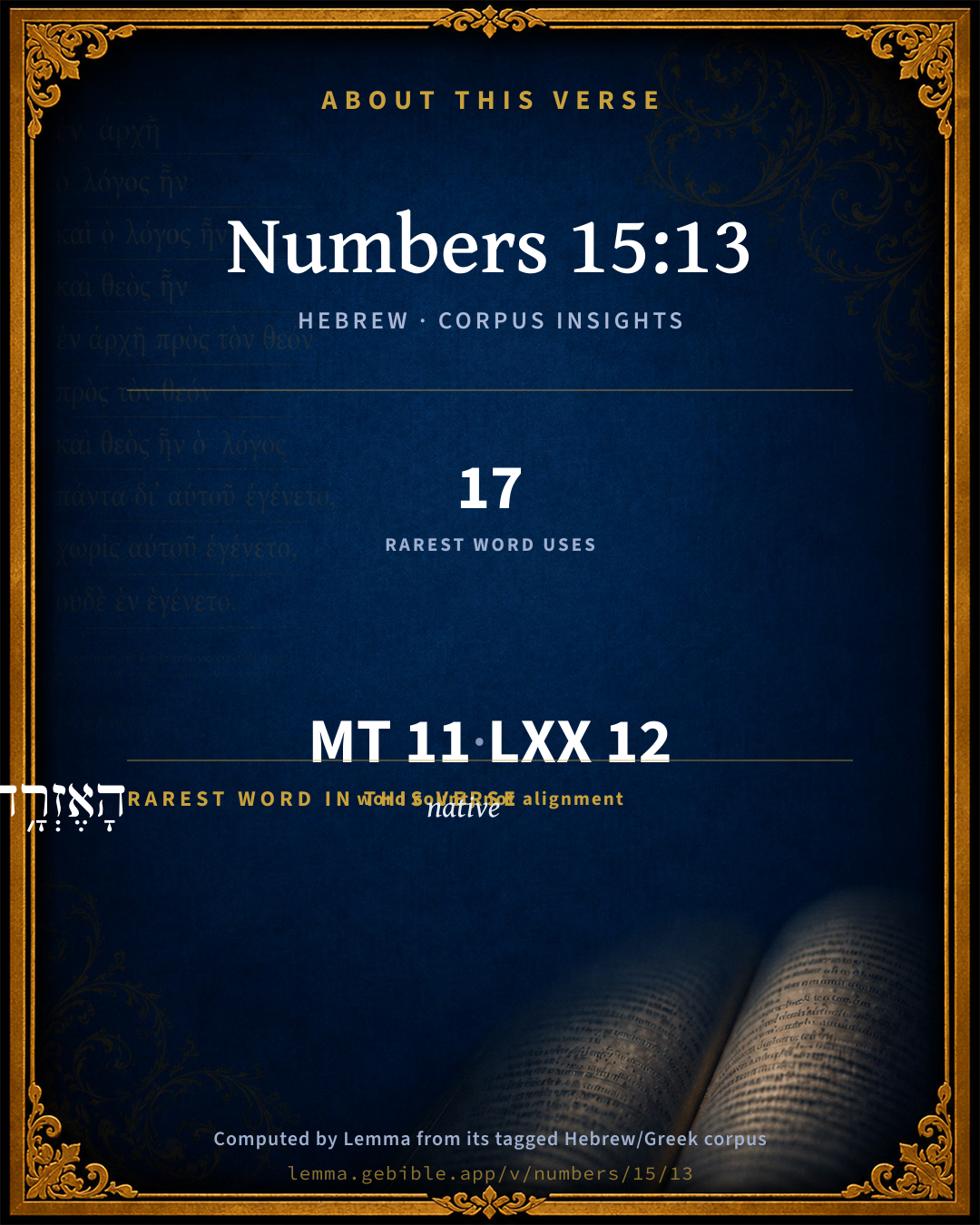
The rarest word here is הָאֶזְרָ֥ח native H249 — appearing just 17 times in the whole Hebrew Bible.

Shared distinctive vocabulary

הָאֶזְרָ֥ח native H249 occurs in 17 verses of the Hebrew Bible. Also found in:

Grammatical profile

  • 2 verbs
  • 6 nouns
  • 1 pronoun
  • 1 adverb
  • 1 particle

Verb forms

  • יַעֲשֶׂה Qal · Imperfect
  • לְהַקְרִ֛יב Hiphil · Infinitive Construct

Hebrew & Septuagint length

In English translation the verse runs 24 words from the Hebrew and 23 from the Septuagint (LXX English) — closely comparable.

A rough comparison of the two English renderings, which tokenize alike — not a word-level alignment.

Word counts can differ between the Hebrew and the Greek without any difference in meaning — e.g. the Hebrew direct-object marker אֵת has no separate Greek word, and Greek often adds the article ὁ.

In the original languages it is 11 Hebrew tokens and 12 Greek tokens — but the two are counted differently (Hebrew bundles its prefixes and suffixes into one token; the Greek is in lemma form), so that isn’t a like-for-like length.

Hebrew and Greek witnesses Masoretic Hebrew ↔ Greek Septuagint

The same verse in the two great witnesses to the Old Testament, shown verse-for-verse.

These are two independent witnesses, not word-aligned to each other, and the Septuagint is shown in lemma (dictionary) form.

Hebrew Numbers 15:13 Masoretic · Westminster Leningrad Codex

כָּל הָאֶזְרָ֥ח יַעֲשֶׂה כָּ֖כָה אֶת אֵ֑לֶּה לְהַקְרִ֛יב אִשֵּׁ֥ה רֵֽיחַ נִיחֹ֖חַ לַֽיהוָֽה

All who are home-born shall do these things after this manner, in offering an offering made by fire, of a sweet savor to Yahweh.

World English Bible · Public Domain

Greek LXX Numbers 15:13 Septuagint · lemma form

πᾶς ὁ αὐτόχθων ποιέω οὕτως τοιοῦτος προςφέρω κάρπωμα εἰς ὀσμή εὐωδία κύριος

Every native of the country shall do thus to offer such things as sacrifices for a smell of sweet savor to the Lord.

LXX2012 (modern English Septuagint) · Public Domain

On this verse, Whedon's Commentary on the Bible discusses the Septuagint’s reading. Read the note in Commentary ↓

Hebrew: Westminster Leningrad Codex (CC BY 4.0). Greek: Septuagint (public domain); English from LXX2012 (modern English Septuagint) (Public Domain). How the Septuagint differs from the Hebrew →

Targum (Aramaic paraphrase)

2

The Targum is the ancient Jewish Aramaic paraphrase of the Hebrew Scriptures — an interpretive translation, not the Hebrew text itself. Onkelos (literal) and Pseudo-Jonathan (expansive) render the Torah, and Jonathan the Prophets. Coverage is partial: where no permissively-licensed English translation exists for a verse, only the Aramaic is shown. This is verse-level text, not a word-by-word alignment to the Hebrew.

  1. Targum Onkelos Torah (Genesis–Deuteronomy)
    כָּל יַצִיבָא יַעְבֵּד כְדֵין יָת אִלֵין לְקָרָבָא קֻרְבַּן דְמִתְקַבֵּל בְּרַעֲוָא קֳדָם יְיָ

    (no public-domain English translation for this verse)

    Targum Onkelos — Aramaic: “Onkelos Genesis” (public domain); “Onkelos Exodus” (public domain); “Onkelos Leviticus” (public domain); “Onkelos Numbers” (public domain); “Onkelos Deuteronomy” (public domain). English: “Sefaria Community Translation” (CC0 1.0 (public-domain dedication)); “J.W. Etheridge. The Targums of Onkelos and Jonathan Ben Uzziel on the Pentateuch. London: Longmans, Green, 1862” (public domain). Text via Sefaria.

  2. Targum Pseudo-Jonathan Torah (Genesis–Deuteronomy)
    כָּל יַצִיבַיָא בְּיִשְרָאֵל וְלָא בְבַר עַמְמִין יַעֲבֵיד הֵיכְדֵין יַת אִלֵין נְסוּכְיָיא לְקָרָבָא קוּרְבָּנָא דְמִתְקַבֵּיל בְּרַעֲוָא קֳדָם יְיָ

    All who are native born in Israel, and not of the sons of the Gentiles, shall so make these libations in offering an oblation to be received with acceptance before the Lord.

    Targum Pseudo-Jonathan — Aramaic: “Targum Jonathan on Genesis” (public domain); “Targum Jonathan on Exodus” (public domain); “Targum Jonathan on Leviticus” (public domain); “Targum Jonathan on Numbers” (public domain); “Targum Jonathan on Deuteronomy” (public domain). English: “The Targum of Jonathan ben Uzziel, trans. J. W. Etheridge, London, 1862” (public domain). Text via Sefaria.

Commentary

Notes on Numbers 15:13 from classic Christian and Jewish commentators (each source and its license shown beneath its notes). The classic Christian expositions comment on the surrounding passage and are grouped to its opening verse, so a note may address several verses; the Jewish commentaries on the Tanakh (Rashi and others) are per-verse, so they appear only where the commentator wrote on this verse.

Lemma curates 59 commentaries, every one of them public domain or Creative Commons licensed, each selected and text-cleaned for this edition rather than reprinted as found. About our sources →

Jamieson, Fausset & Brown

Robert Jamieson, A. R. Fausset & David Brown

a stranger--one who had become a proselyte. There were scarcely any of the national privileges of the Israelites, in which the Gentile stranger might not, on conforming to certain conditions, fully participate.

Jamieson, Fausset & Brown — Commentary Critical and Explanatory on the Whole Bible (1871) — public domain (CC PDM 1.0). Text via the HelloAO Bible API.

Ellicott's Commentary for English Readers

(13) All that are born of the country.—The Targum of Jonathan is, “all that are born in Israel, and not among the people.” It seems clear, however, from Num_15:14 that the reference in this verse is to the indigenous Israelites.

A Bible Commentary for English Readers, edited by Charles John Ellicott (1878–1897) — public domain. Text from a community e-Sword module.

The Cambridge Bible for Schools and Colleges

gen. ed. J. J. S. Perowne

13. homeborn] i.e. native Israelites.

The Cambridge Bible for Schools and Colleges (gen. ed. J. J. S. Perowne; Cambridge University Press, 1878–1918) — public domain. Text from a community e-Sword module.

John Gill's Exposition

And if a stranger sojourn with you,.... A stranger, or proselyte, not of the gate, but of righteousness, as Ben Gersom and the Jewish, writers in general interpret it:

or whatsoever be among you in your generations; whether such a proselyte settled and continued among them, or only stayed with them awhile:

and will offer an offering made by fire of a sweet savour unto the Lord; is desirous of offering a burnt offering or a peace offering to the Lord in an acceptable manner:

as ye do, so shall he do; bring the same meat offering and drink offering, according to the nature and number of the cattle he brings for sacrifice.

John Gill's Exposition of the Whole Bible (1746–1763) — public domain (CC PDM 1.0). Text via the HelloAO Bible API.

Whedon's Commentary on the Bible

Daniel D. Whedon

13-16. These rules apply to the sacrifices of aliens living in the Holy Land as well as to the native-born Israelite.

These things — The meat and drink offerings.

A stranger — Septuagint, proselyte. The position of the Israelites as a distinct nation under special divine protection powerfully attracted the neighbouring peoples. Hence the law provides for their incorporation into Israel. Circumcision was the condition of any fellowship with the proselyte or stranger, as rendered in the Authorized Version. He is required to keep the sabbath, to be present at the passover, the feast of weeks, of tabernacles, and the day of atonement, to observe the laws of prohibited marriages, to abstain from blood, from Molech worship, and blasphemy. But he could not hold land (see Lev_25:23, note) nor intermarry with the descendants of Aaron. See Lev_21:14, note. The instances of wholesale proselytism are the Shechemites, Kenites, Gibeonites, Cherethites, Pelethites, and Nethenim. Instances of individuals are Doeg, the Edomite; Uriah, the Hittite; Araunah, the Jebusite; and two in the face of an express prohibition — Zelek, the Ammonite, and Ithmah, the Moabite. Deuteronomy 23, 3. Later rabbins regarded the following classes unfit for admission within the covenant: (1.) Love-proselytes, drawn by the hope of gaining the beloved one; (2.) Man-for-woman or woman-for-man proselytes, where either follows the religion of the other as a matter of convenience; (3.) Esther-proselytes, to escape danger; (4.) King’s-table-proselytes, mere office-seekers; (5.) Lion-proselytes, persons impelled by a superstitious dread of some divine judgment, as were the Samaritans. 2Ki_17:26. See Lev_23:22, note.

Before the Lord — Equal in religious privileges.

Daniel D. Whedon (gen. ed.), Commentary on the Old and New Testaments (1874–1909) — public domain. Text from a community e-Sword module.

The Pulpit Commentary

All that are born of the country. jrzahAlK, all the native born. Septuagint, pav o autocywn . The phrase is used no doubt from the point of view of a resident in Canaan; but it was only to such residents that these ordinances applied. Those things. The regulations just mentioned.

The Pulpit Commentary (1880–1919), ed. H.D.M. Spence-Jones & Joseph S. Exell — public domain. Text from a community e-Sword module.

Lesson kit

Teaching starters — assembled from the data on this page, not authored interpretation. Every prompt links to the verse data it draws on. Edit before teaching.

Numbers, in the Pentateuch, opens this verse with 11 words (11 distinct Hebrew lemmas). Its most distinctive word is ʼezrâch (“native”). A historical commentator’s framing appears above. Read the whole chapter for the surrounding context.

Discussion questions

  1. How does “native” (ʼezrâch) shape what this verse is saying?
  2. Exodus 12:19 shares the word «native» with this verse. How do the two illuminate each other?
  3. These translations render this verse differently. What is at stake in choosing one wording over another?
  4. The verb «יַעֲשֶׂה» is Qal Imperfect. How does its form color the action?
  5. Reading how Jamieson, Fausset & Brown and Ellicott's Commentary for English Readers read this verse, where do the two commentators agree and where do they part?

Things to notice

Reading settings

Reading text

Shown beneath each verse's original-language words.

Old Testament
Old Testament edition

Read the OT as the Masoretic Hebrew (MT) or the Greek Septuagint (LXX).

English shown for the Greek Septuagint (in the Hebrew ↔ Greek comparison).

Comparing translations? Open the Compare panel on any verse page to stack up to four side by side.