
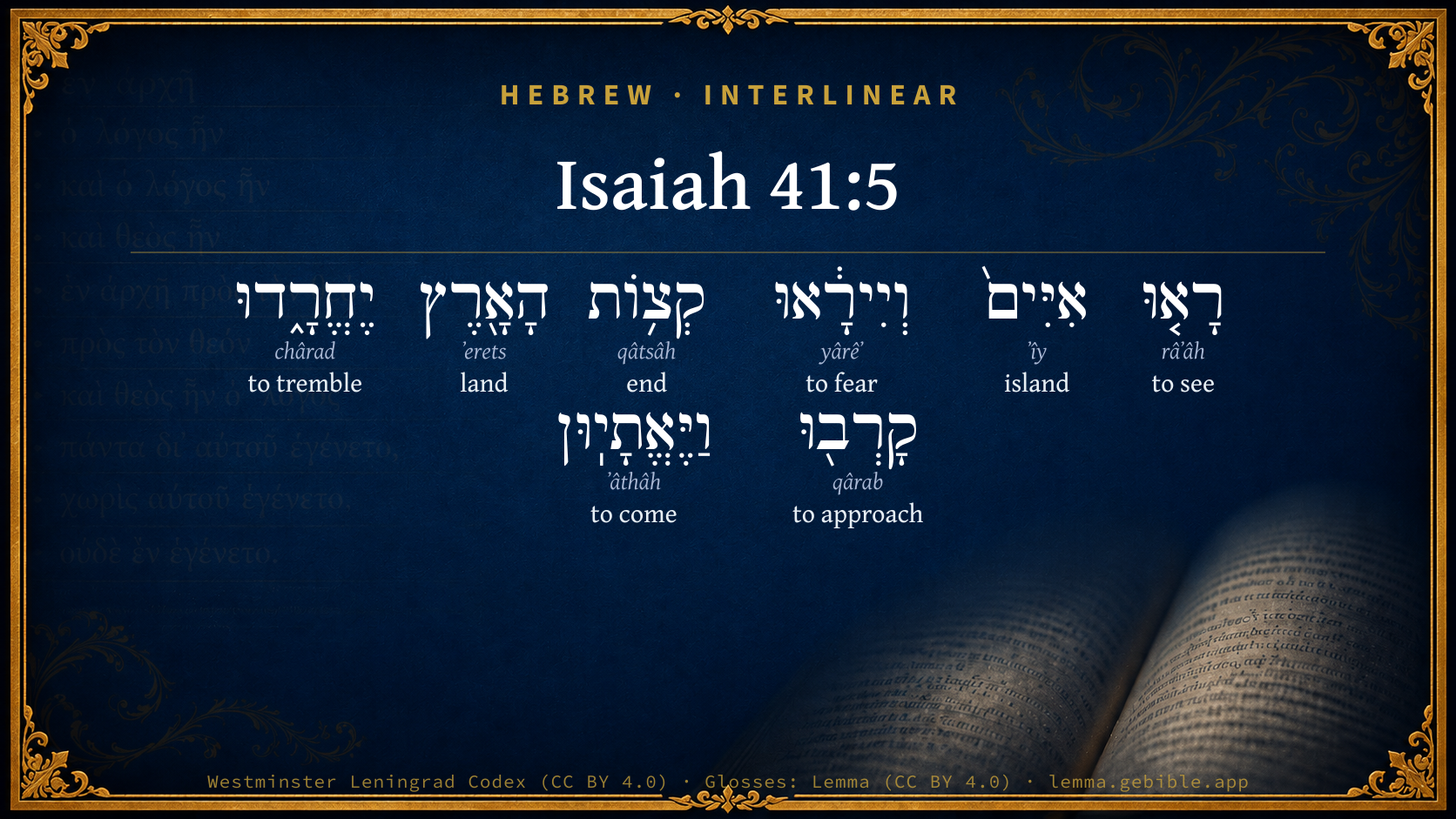
Isaiah 41:5

Hebrew (Westminster Leningrad Codex) Isaiah 41:5 appears in the Hebrew Old Testament. The text above is from the Westminster Leningrad Codex. Each word links to its Strong’s number, a concise gloss, and parsing drawn from the Open Scriptures Hebrew Bible morphology. Click any word for its full Brown-Driver-Briggs (BDB) entry.
Download image
Cite this verse

Isaiah 41:5 (World English Bible). Public Domain. Lemma interlinear Bible study tool, https://lemma.gebible.app/v/isaiah/41/5.

Show BibTeX & RIS
BibTeX
RIS
English Translation
The isles have seen, and fear; the ends of the earth tremble; they draw near, and come.
World English Bible · Public Domain
Download a study sheet

One document with this verse’s original text, its word-by-word gloss line, the meaning frame, cross-references with their text, attributed commentary, and full source and license credits — printable, and it pastes into notes with its structure intact.

This verse Autodidact and up

Study sheet (.html) Plain text (.txt)

A passage Seminary Student

Up to 50 verses in one chapter. A passage sheet keeps up to 6 commentary sources and 12 cross-references per verse, in the order this page ranks them, and says so on the sheet whenever that leaves anything out. Ask for a single verse and you get the Autodidact verse sheet above.

Everything on this page stays free to read, with no account — the sheet is a download of what is already on screen, not access to it.

Want to remove ads? Support Godless Engineer
Compare translations 3

The same verse in 3 English versions, stacked beneath the original-language interlinear above. Click any original word for its lexicon entry.

Each is an independent rendering of the whole verse — the interlinear is not word-aligned to these translations.

Highlighted words mark where these versions differ — a whole-verse word diff, not a word-by-word alignment.

  • World English Bible Public Domain
    The isles have seen, and fear; the ends of the earth tremble; they draw near, and come.
  • King James Version Public Domain
    The isles saw it, and feared; the ends of the earth were afraid, drew near, and came.
  • unfoldingWord Literal Text CC BY-SA 4.0
    The coastlands have seen and are afraid; the ends of the earth tremble; they approach and come.

unfoldingWord Literal Text — © unfoldingWord, licensed CC BY-SA 4.0. Word-aligned USFM3 via Door43 (git.door43.org/unfoldingWord/en_ult).

Versions to compare (up to 4)

3 of 4 selected

Show all 18 translations

Every available English version of this verse, each an independent rendering of the whole verse.

  • World English Bible Public Domain
    The isles have seen, and fear; the ends of the earth tremble; they draw near, and come.
  • Berean Standard Bible Public Domain
    The islands see and fear; the ends of the earth tremble. They approach and come forward.
  • Majority Standard Bible Public Domain
    The islands see and fear; the ends of the earth tremble. They approach and come forward.
  • King James Version Public Domain
    The isles saw it, and feared; the ends of the earth were afraid, drew near, and came.
  • American Standard Version (1901) Public Domain
    The isles have seen, and fear; the ends of the earth tremble; they draw near, and come.
  • Revised Version (1885) Public Domain
    The isles saw, and feared; the ends of the earth trembled: they drew near, and came.
  • Geneva Bible (1599) Public Domain
    The yles sawe it, and did feare, and the ends of the earth were abashed, drew neere, and came.
  • Douay-Rheims (1899) Public Domain
    The islands saw it, and feared, the ends of the earth were astonished, they drew near, and came.
  • Young's Literal Translation Public Domain
    Seen have isles and fear, ends of the earth tremble, They have drawn near, yea, they come.
  • Literal Standard Version CC BY-SA 4.0
    Islands have seen and fear, || The ends of the earth tremble, || They have drawn near, indeed, they come.
  • Unlocked Literal Bible CC BY-SA 4.0
    The isles have seen and are afraid; the ends of the earth tremble; they approach and come.
  • unfoldingWord Literal Text CC BY-SA 4.0
    The coastlands have seen and are afraid; the ends of the earth tremble; they approach and come.
  • Darby Bible Public Domain
    The isles saw [it], and feared; the ends of the earth trembled: they drew near, and came.
  • World Messianic Bible Public Domain
    The islands have seen, and fear. The ends of the earth tremble. They approach, and come.
  • Webster's Bible Public Domain
    The isles saw it, and feared; the ends of the earth were afraid, drew near, and came.
  • Free Bible Version CC BY-SA 4.0
    The islands watch in fear, the distant lands tremble. They get together and consult.
  • Bible in Basic English Public Domain
    The sea-lands saw it, and were in fear; the ends of the earth were shaking: they came near.
  • JPS Tanakh (1917) Public Domain
    The isles saw, and feared; the ends of the earth trembled; they drew near, and came.

Literal Standard Version (2020), Covenant Press — licensed CC BY-SA 4.0. Text via the HelloAO Bible API (eBible.org). Unlocked Literal Bible (unfoldingWord) — licensed CC BY-SA 4.0. Text via the HelloAO Bible API (eBible.org). unfoldingWord Literal Text — © unfoldingWord, licensed CC BY-SA 4.0. Word-aligned USFM3 via Door43 (git.door43.org/unfoldingWord/en_ult). Free Bible Version, Dr. Jonathan Gallagher — licensed CC BY-SA 4.0. Text via the HelloAO Bible API (eBible.org).

Word by word

More ways to search: Search by grammar → Find every occurrence → Compare this word →

Practice this passage: Drill this verse → Learn its vocabulary →

וַיֶּאֱתָיֽוּן
ʼâthâh
H857
“and · to come”
Conjunction + Verb, Qal, Sequential Imperfect, 3rd Person, Masculine, Plural + Suffix, n
Part of Speech
Conjunction + Verb
Stem
Qal
Form
Sequential Imperfect
Person
3rd Person
Gender
Masculine
Number
Plural
Full BDB Definition

Origin: a primitive root [collateral to H225 contraction]

TWOT: 188

to come, arrive - (Qal) to come (of men, time, beasts, calamity) - (Hiphil) to bring
  1. רָא֤וּ râʼâh H7200 “to see” Verb, Qal, Perfect, 3rd Person, Common, Plural
  2. אִיִּים֙ ʼîy H339 “islands” Noun, Common, Masculine, Plural, Absolute
  3. וְיִירָ֔אוּ yârêʼ H3372 “and · to fear” Conjunction + Verb, Qal, Imperfect, 3rd Person, Masculine, Plural
  4. קְצ֥וֹת qâtsâh H7098 “ends of” Noun, Common, Both, Plural, Construct
  5. הָאָ֖רֶץ ʼerets H776 “the · land” Particle, Definite Article + Noun, Common, Both, Singular, Absolute
  6. יֶחֱרָ֑דוּ chârad H2729 “to tremble” Verb, Qal, Imperfect, 3rd Person, Masculine, Plural
  7. קָרְב֖וּ qârab H7126 “to approach” Verb, Qal, Perfect, 3rd Person, Common, Plural

About this verse

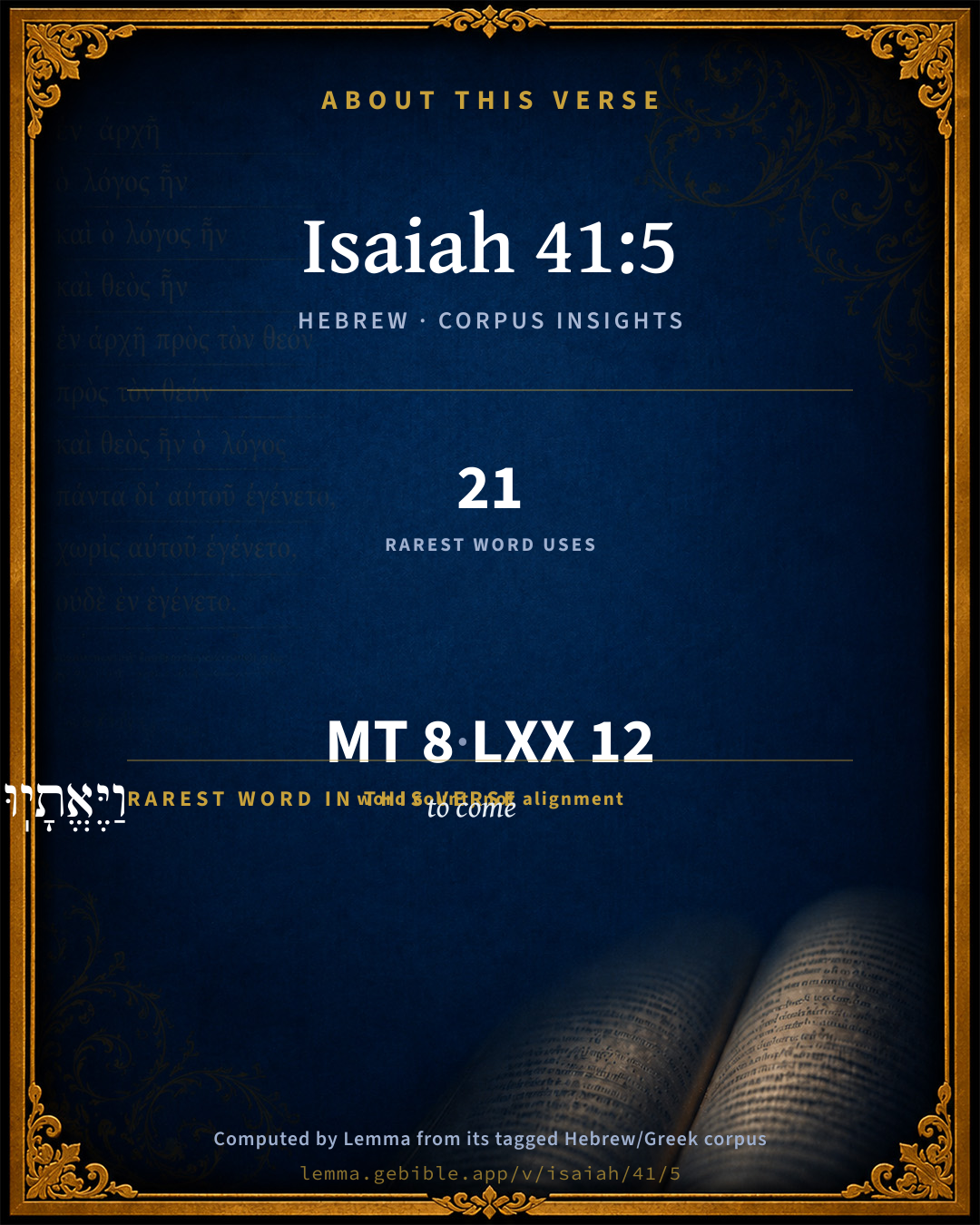
These counts appear in no published source. They are computed here, from the morphology-tagged text and Lemma’s own curated glosses. What Lemma adds →

8
words
8
distinct lemmas
Prophets
section

Notable vocabulary

The rarest word here is וַיֶּאֱתָיֽוּן to come H857 — appearing just 21 times in the whole Hebrew Bible.

Shared distinctive vocabulary

וַיֶּאֱתָיֽוּן to come H857 occurs in 20 verses of the Hebrew Bible. Also found in:

Grammatical profile

  • 5 verbs
  • 3 nouns

Verb forms

  • רָא֤וּ Qal · Perfect
  • וְיִירָ֔אוּ Qal · Imperfect
  • יֶחֱרָ֑דוּ Qal · Imperfect
  • קָרְב֖וּ Qal · Perfect
  • וַיֶּאֱתָיֽוּן Qal · Sequential Imperfect

Hebrew & Septuagint length

In English translation the verse runs 17 words from the Hebrew and 15 from the Septuagint (LXX English) — closely comparable.

A rough comparison of the two English renderings, which tokenize alike — not a word-level alignment.

Word counts can differ between the Hebrew and the Greek without any difference in meaning — e.g. the Hebrew direct-object marker אֵת has no separate Greek word, and Greek often adds the article ὁ.

In the original languages it is 8 Hebrew tokens and 12 Greek tokens — but the two are counted differently (Hebrew bundles its prefixes and suffixes into one token; the Greek is in lemma form), so that isn’t a like-for-like length.

Cross-references

8

Topical passages linked to Isaiah 41:5 in the Treasury of Scripture Knowledge — connected by theme and wording, ordered by reader-vote popularity; previews shown in the World English Bible.

  • Ezekiel 26:15–16 Thus says the Lord Yahweh to Tyre: shall not the isles shake at the sound of your fall, when the wounded groan, when the slaughter is made in the midst of you?
  • Joshua 5:1 It happened, when all the kings of the Amorites, who were beyond the Jordan westward, and all the kings of the Canaanites, who were by the sea, heard how that Yahweh had dried up the waters of the Jordan from before the children of Israel, until we were passed over, that their heart melted, neither was there spirit in them any more, because of the children of Israel.
  • Psalms 65:8 They also who dwell in far-away places are afraid at your wonders. You call the morning's dawn and the evening with songs of joy.
  • Psalms 66:3 Tell God, "How awesome are your deeds! Through the greatness of your power, your enemies submit themselves to you.
  • Psalms 67:7 God will bless us. All the ends of the earth shall fear him.
  • Genesis 10:5 Of these were the isles of the nations divided in their lands, everyone after his language, after their families, in their nations.
  • Exodus 15:14 The peoples have heard. They tremble. Pangs have taken hold on the inhabitants of Philistia.
  • Joshua 2:10 For we have heard how Yahweh dried up the water of the Red Sea before you, when you came out of Egypt; and what you did to the two kings of the Amorites, who were beyond the Jordan, to Sihon and to Og, whom you utterly destroyed.

Cross-references courtesy of OpenBible.info (CC BY 4.0).

Hebrew and Greek witnesses Masoretic Hebrew ↔ Greek Septuagint

The same verse in the two great witnesses to the Old Testament, shown verse-for-verse.

These are two independent witnesses, not word-aligned to each other, and the Septuagint is shown in lemma (dictionary) form.

Hebrew Isaiah 41:5 Masoretic · Westminster Leningrad Codex

רָא֤וּ אִיִּים֙ וְיִירָ֔אוּ קְצ֥וֹת הָאָ֖רֶץ יֶחֱרָ֑דוּ קָרְב֖וּ וַיֶּאֱתָיֽוּן

The isles have seen, and fear; the ends of the earth tremble; they draw near, and come.

World English Bible · Public Domain

Greek LXX Isaiah 41:5 Septuagint · lemma form

ὁράω ἔθνος καί φοβέω ὁ ἄκρος ὁ γῆ ἐγγίζω καί ἔρχομαι ἅμα

The nations saw, and feared; the ends of the earth drew near, and came together,

LXX2012 (modern English Septuagint) · Public Domain

On this verse, The Cambridge Bible for Schools and Colleges discusses the Septuagint’s reading. Read the note in Commentary ↓

Hebrew: Westminster Leningrad Codex (CC BY 4.0). Greek: Septuagint (public domain); English from LXX2012 (modern English Septuagint) (Public Domain). How the Septuagint differs from the Hebrew →

Targum (Aramaic paraphrase)

1

The Targum is the ancient Jewish Aramaic paraphrase of the Hebrew Scriptures — an interpretive translation, not the Hebrew text itself. Onkelos (literal) and Pseudo-Jonathan (expansive) render the Torah, and Jonathan the Prophets. Coverage is partial: where no permissively-licensed English translation exists for a verse, only the Aramaic is shown. This is verse-level text, not a word-by-word alignment to the Hebrew.

  1. Targum Jonathan Prophets (Joshua–Malachi)
    חֲזוֹ נַגְוָתָא וִידַחֲלוּן דְבִסְיָפֵי אַרְעָא יְזוּעוּן יִתְקַרְבוּן וְיֵיתוּן:

    The isles shall see and be afraid; they that are at the ends of the earth shall tremble; they shall draw nigh, they shall come.

    Targum Jonathan — Aramaic: “Mikraot Gedolot” (public domain). English: “Sefaria Community Translation” (CC0 1.0 (public-domain dedication)); “London "Chaldee Paraphrase," 1871” (public domain). Text via Sefaria.

Commentary

Notes on Isaiah 41:5 from classic Christian and Jewish commentators (each source and its license shown beneath its notes). The classic Christian expositions comment on the surrounding passage and are grouped to its opening verse, so a note may address several verses; the Jewish commentaries on the Tanakh (Rashi and others) are per-verse, so they appear only where the commentator wrote on this verse.

Lemma curates 59 commentaries, every one of them public domain or Creative Commons licensed, each selected and text-cleaned for this edition rather than reprinted as found. About our sources →

The Cambridge Bible for Schools and Colleges

gen. ed. J. J. S. Perowne

5. At the end of the verse LXX. seems to have read “and came together to judgment” (in accordance with Isa_41:1).

5–7. The alarm of the nations leads to the production of fresh images. The view that Isa_41:6-7 form part of ch. Isa_40:18-20 has already been mentioned. With regard to the suitability of the verses in their present connexion, opinions differ. While some consider the scene an appropriate sequel to Isa_41:1-4, and its irony exquisite and well-timed, others find the irony overstrained, and doubt if even the most benighted idolaters could be represented as seeking to arrest the advance of Cyrus by making “a particularly good and strong set of gods.” And it must be admitted that the transition from an assembly of peoples to the inside of an idol factory is extremely abrupt. The view in question gives a somewhat different turn to Isa_41:6 and probably necessitates the excision of Isa_41:5.

The Cambridge Bible for Schools and Colleges (gen. ed. J. J. S. Perowne; Cambridge University Press, 1878–1918) — public domain. Text from a community e-Sword module.

Trapp's Complete Commentary

John Trapp

Isa 41:5 The isles saw [it], and feared; the ends of the earth were afraid, drew near, and came.

Ver. 5. The isles saw it.] The heathens were convinced by the former arguments, yet not converted; they were afraid, and yet they came together to confirm themselves mutually in their abominable idolatries.

Yea, they drew near.] As it were, to justify their idolatries before the Lord. Such is the desperate obstinace of obdurate sinners. Pharaoh menaced Moses, even during that palpable darkness. The Philistines were afraid when they saw the ark of the covenant brought into the field, and yet they encourage one another to fight against Israel. {1Sa 4:8-9} The thief on the cross was under the arrest of death, and yet railed. Felix trembled, and yet expected a bribe from St Paul. There is a cold sweat sitteth on all the limbs of Antichrist at this day, and yet they repent not of their idolatries, nor murders, nor sorceries, nor fornication, nor thefts, {Rev 9:20-21} but defend them all they can.

John Trapp, A Commentary or Exposition upon All the Books of the Old and New Testament (1647–1656) — public domain. Text from a community e-Sword module.

The Preacher's Complete Homiletical Commentary

Joseph S. Exell (gen. ed.)

LESSONS FROM THE HEATHEN WORKERS

Isa_41:5-7. The isles saw it, and feared. &c.

These verses indicate the state of feeling which was created among the heathen nations by the rapid and victorious career of Cyrus. They remind us—

1. That a sense of common danger promotes fraternal feeling and activity (Isa_41:5-6). This has been often witnessed in the history of communities. Persecution, oppression, danger, will frequently unite them in one great movement for defence and safety, and thus call forth and develop principles that are too little cultivated in times of prosperity and security.

2. Mutual help is best rendered when each man does his best in his own way (Isa_41:7). In the building of a house, in the rendering of a performance, in the manufacture of an article, in the ruling of a state, the general interest is secured, not by all doing the same things, but by each doing his own individual part in honesty and fidelity. Even when an idol was to be made, the carpenter may encourage the goldsmith, &c. A fine lesson is here taught to Christian Churches. See it fully reasoned out in 1 Corinthians 12.

3. Even the superstitions of heathendom are a witness to the spiritual cravings of men. We have here a pathetic example of the perversions amongst which idolatry grovels. In their panic-stricken state the people betake themselves for safety to gods that first their own fingers must fashion. Think of a human soul bowing down to an image that a few moments ago was “fastened with nails that it should not be moved!” Yet we do injustice to heathenism, and do not rightly interpret it, if we suppose its significance lies wholly in these material objects. In reality we see here the human soul crying out for Another, an Unseen, an Unknown. The very groping of heathenism is so far a testimony to God, that it proclaims God to be in the worshipper before the worshipper seeks Him elsewhere. Amongst all our modern idolatries, too, idolatries of wealth, pleasure, fashion, power, &c., we see the uneasiness of souls who can find no settled rest in the things that are touched, and tasted, and handled. Though not definitely expressed, the yearning is for God Himself, of whom, and through whom, and to whom are all things.—William Manning.

Thus the heathen helped each other (Isa_41:6). There are many seasons in which encouragement from our fellow-Christians is peculiarly soothing and grateful to the mind; for as “ointment and perfume rejoice the heart, so doth a man his friend by hearty counsel” (Pro_27:9). This is true—

1. In the wintry day of adversity.

2. In the dreary night of affliction and bereavement. It is one of the privileges as well as the duties of religion to “feel a brother’s care,” to “weep with them that weep,” and to pour the balm of consolation into the bleeding hearts of our suffering friends.

3. In the stormy day of persecution. It was a saying of Martin Luther, that “the plough of persecution was yoked as early as the days of Cain; and it has been going upon the back of the Church ever since” (Gal_4:29; 2Ti_3:12).

4. In the time of fierce conflict and strong temptation.

5. When entering the vale of death. The help we can thus afford we are bound to render.—R. Bond: The Christian’s Remembrancer, p. 162, &c.

Passages in the history of idolatrous worship may be turned to account. Here certain idolaters were alarmed, and ran to seek relief of their gods. They are making a shrine or an idol; they are all in earnest. This suggests what we shall always see whenever we find a model Church. Such a Church is—

I. A scene of activity. Every one is at work. Life is a scene of activity in the physical universe, in the business world. We rejoice that intellectual activity has disturbed the darkness and torpor of the Middle Ages; the printing-press does a nobler work than the old feudal castle; brute force, exclusiveness, have had their day. It is still more encouraging when spiritual life comes into a Church. Then a happy activity reigns.

II. A scene of cheerful, courageous toil. The carpenter encourages the goldsmith. Many Churches are scenes of recriminating discouragement. How much the minister is helped by a little encouragement now and then! It need not be flattery. Let every man do his own but let there be mutual encouragement.

III. A scene of prompt industry and thorough work. There are few worse things for the development of any kind of life than dilatoriness. Promptitude in Church worship and work is much needed. And thoroughness no less. “He fastened it with nails, that it should not be moved.” We want cloths that will not rip; bridges that will bear; characters that will stand temptation; friendships that will last. The model Church does its work thoroughly.

IV. All are working—actively, cheerfully, courageously, promptly, thoroughly—for one common end (Jer_7:18). They are all building a shrine or an altar. So the Church has one end. It is a unity, not a uniformity—a unity in spirit, in aim, in end.

V. Special marks of a model Church.

1. A common-sense sanctuary: central, easy of access, constructed so as to be a house of worship and instruction,—not of worship only, still less for spectacular effect.

2. Kindness to strangers.

3. Well-organised charities.

4. Truly sanctified, truly consecrated by the indwelling Spirit of God. This is the crown of all.—E. P. Thwing, Ph.D.: Christian World Pulpit, xxii. pp. 136–137.

The Preacher's Complete Homiletical Commentary (gen. ed. Joseph S. Exell; Funk & Wagnalls, c. 1892) — public domain (pre-1929). A full-Bible homiletical/sermon-outline anthology covering 65 of 66 books (2 John is absent from the source module). Text from a community e-Sword module.

Keil & Delitzsch

C. F. Keil & F. Delitzsch

In the following v. we have not a description of the impression made upon the heathen by the argument of Jehovah, but the argument itself is continued. Isa 41:5 "Islands have seen it, and shuddered; the ends of the earth trembled; they have approached, and drawn near." We have here a description of the effects which the victorious course of Cyrus had begun to produce in the heathen world. The perfects denote the past, and the futures a simultaneous past; so that we have not to compare Isa 41:5 with Hab 3:10 so much as with Psa 77:17. The play upon the words וייראּוּ ... ראּוּ pairs together both seeing and fearing. The Cumaeans, when consulting the oracle, commenced thus: ἡμεῖς δὲ δειμαίνοντες τὴν Περσέων δύναμιν. The perfect with the aorist following in Isa 41:5 places the following picture upon the stage: They have approached and drawn near (from all directions) to meet the threatening danger; and how? Isa 41:6, Isa 41:7 "One helped his companion, and he said to his brother, Only firm! The caster put firmness into the melter, the hammer-smoother into the anvil-smiter, saying of the soldering, It is good; and made him firm with nails, that he should not shake." Him, viz., the idol. Everything is in confusion, from the terror that prevails; and the gods from which they expect deliverance are not made till now, the workmen stimulating one another to work. The chârâsh, who casts the image, encourages the tsōrēph, whose task it is to provide it with the plating of gold and silver chains (Isa 40:19), to work more bravely; and the man who smooths with the hammer (pattish, instrumentalis) does the same to the man who smites the anvil (הולם with seghol, whereas in other cases, e.g., Eze 22:25, the tone generally gives way without any change in the vowel-pointing). The latter finds the soldering all right, by which the gold plates of the covering are fastened together, so as to give to the golden idol a massive appearance. He is the last into whose hands it comes; and nothing more is wanting, than that he should forge upon the anvil the nails with which it is fastened, to prevent it from falling. To such foolish, fruitless proceedings have the nations resorted when threatened with subjugation by Cyrus.

Keil & Delitzsch — Biblical Commentary on the Old Testament (1861–1891) — public domain (CC PDM 1.0). Text via the HelloAO Bible API. (Old Testament only.)

Tyndale Open Study Notes

Tyndale Open Resources

41:5-7 This taunt against idolatry was a response to God’s raising up of Cyrus; the nations hope to find protection in their idols.

Tyndale Open Study Notes — © Tyndale Open Resources, licensed CC BY-SA 4.0. Text via the HelloAO Bible API.

Geneva Bible (1599)

Geneva Bible translators

Considering mine excellent works among my people.

They assembled themselves and conspired against me to maintain their idolatry.

Geneva Bible (1599) marginal notes — public domain. Text via Bolls.life.

Jamieson, Fausset & Brown

Robert Jamieson, A. R. Fausset & David Brown

feared--that they would be subdued.

drew near, and came--together, for mutual defense.

Jamieson, Fausset & Brown — Commentary Critical and Explanatory on the Whole Bible (1871) — public domain (CC PDM 1.0). Text via the HelloAO Bible API.

Adam Clarke's Commentary

Verse 5. Were afraid - "And they were terrified"] Three MSS. have ויחרדו vaiyecheridu, adding the conjunction ו vau, which restores the second member of the sentence to its true poetical form.

Adam Clarke's Commentary on the Bible (1810–1826) — public domain. Text from a community e-Sword/MySword module.

Ellicott's Commentary for English Readers

(5) The isles saw it, and feared . . .—The words paint the terror caused by the rapid conquests of Cyrus, but the terror led, as the following verses show, to something very different from the acknowledgment of the Eternal. As the sailors in the ship of Tarshish called each man on his God (Jon_1:5), so each nation turned to its oracles and its shrines. The gods had to be propitiated by new statues, and a fresh impetus was given to the manufacture of idols, probably for the purpose of being carried forth to battle as a protection. (Comp. 1Sa_4:5-7; Herod. i. 26.)

A Bible Commentary for English Readers, edited by Charles John Ellicott (1878–1897) — public domain. Text from a community e-Sword module.

John Gill's Exposition

The isles saw it, and feared,.... Not the victory which Abraham got over the kings; nor Cyrus's expedition against Babylon, and other nations, and his deliverance of the Jews; but the progress of the Gospel, through the ministry of the Apostle Paul: the idolatrous inhabitants of the Gentile nations saw great multitudes embracing and professing the Gospel; they saw their idols neglected, and their temples abandoned; they feared what would be the consequence of all this, that their old religion their fathers retained, and they were brought up in, would be abolished; and especially a panic seized the priests on this account, whose livelihood depended upon it:

the ends of the earth were afraid; for the sound of the Gospel by him, and other apostles, went into all the earth, and their words to the end of the world, Rom 10:18 meaning the inhabitants that dwelt in the furthest parts of the earth, where ignorance and idolatry wholly reigned: they drew near, and came: not to God, nor to Abraham, or Cyrus; rather to their gods, to exert themselves in the defence of their religion; or, which is best, they got together to consult what was proper to be done on such an emergency.

John Gill's Exposition of the Whole Bible (1746–1763) — public domain (CC PDM 1.0). Text via the HelloAO Bible API.

Albert Barnes' Notes on the Bible

The isles saw it - The distant nations (see the note at Isa 41:1). They saw what was done in the conquests of the man whom God in this remarkable manner had raised up; and they had had demonstration, therefore, of the mighty power of Yahweh above the power of idols.

And feared - Were alarmed, and trembled. All were apprehensive that they would be subdued, and driven away as with the tempest.

The ends of the earth - Distant nations occupying the extremities of the globe (see the note at Isa 40:28).

Drew near, and came - Came together for the purpose of mutual alliance, and self-defense. The prophet evidently refers to what he says in the following verses, that they formed treaties; endeavored to prepare for self-defense; looked to their idol-gods, and encouraged each other in their attempts to offer a successful resistance to the victorious arms of Cyrus.

Albert Barnes' Notes on the Bible (1834–1885) — public domain. Text from a community e-Sword/MySword module.

Haydock's Catholic Bible Commentary

Islands. People of Asia Minor, Genesis x. 5. (Calmet) --- The Babylonians made a league with the most potent king Crœsus, to oppose the young conqueror. (Xenophon B. i.)

George Leo Haydock (1774–1849), Haydock's Catholic Family Bible and Commentary, 1859 edition — public domain. Excludes Psalms (Douay-Rheims chapter numbering differs from Protestant) and Deuterocanonical books (Catholic canon only).

Matthew Poole's English Annotations

The isles, even remote countries, as Isa 41:1, saw it; discerned the mighty work of God in delivering his people, and overthrowing their enemies, in so wonderful a manner.

Feared, lest they should be involved in the same calamity, as being conscious to themselves that they also were enemies to God’s people.

Drew near, and came; they gathered themselves together to consult for their common safety, and to maintain the cause of their idols, whom by this instance they perceived in great jeopardy.

Matthew Poole's English Annotations on the Holy Bible (1683–1685) — public domain. Text from a community e-Sword/MySword module.

Whedon's Commentary on the Bible

Daniel D. Whedon

5-7. Some suppose the idolatrous party of the heathen world respond at this point. But it seems more suitable to consider Jehovah’s argument not yet ended.

Isles saw it, and feared — Still speaking, Jehovah says the preceding facts affect heathendom with consternation. Yet the idolaters run to each other with the rallying cry: Be of good courage. The prophet puts the case with keenest sarcasm. The craft of idol-makers confusedly appeal to each other to rush up the work; caster, melter, anvil-smiter, solderer, all bustling to finish the idol till it shall be able to stand complete and firm. Such is the picture.

Daniel D. Whedon (gen. ed.), Commentary on the Old and New Testaments (1874–1909) — public domain. Text from a community e-Sword module.

The Pulpit Commentary

The isles saw it, and feared. A general terror seized the nations on the conquest of the Medes by Cyrus. Croesus of Lydia, Nabonidus of Babylon, and Amasis of Egypt, were at once drawn together by the common danger, and made alliance offensive and defensive (Herod., 1:77). The weaker tribes and peoples gave themselves up for lost. Scarcely any resistance seems to have been offered to the Persian arms by the tribes between the Halys and Indus, the Jaxartes and the Indian Ocean. Lydia and Babylon alone made a stout fight; but even these were conquered without very much difficulty. The ends of the earth... drew near; i.e. distant nations held (will hold) consultation together on the danger which threatens them. The league of Lydia, Babylon, and Egypt is the only known instance of such "drawing near" (see the preceding note). Isaiah anticipates marked consultations and exhortations with respect to the idol-gods, in which trust should be put; but perhaps he is scarcely serious in vers. 6, 7. Rather he is indulging his sarcastic humour at the expense of the idols and of those who put their trust in them. (For instances, however, of actual trust in particular idols, see "Records of the Past," vol. 4. p. 58; Herod., 5:67; 8:64,)

HOMILIES BY W.M. STATHAM Ver. 6. Mutual help.

"They helped every one his neighbour; and every one said to his brother, Be of good courage." The subject is Helpfulness. Not mere help, but fulness of help. There may be a help that is tardy, that is somewhat sparse and niggardly; and there may be help which is not helpful in the best sense. This help to which our text refers was accompanied by encouragement that truest and wisest of all help, which, by giving courage, gives strength. Buildings cannot be built by an architect alone. The inferior hand is as needful as the superior. Read the description: "So the carpenter encouraged the goldsmith, and he that smootheth with the hammer him that smote the anvil, saying, It is ready for the soldering." Each man in his place, and fit for his place. So it must be in human life; and, as civilization develops, each man must attend more and more upon one thing. It will not do to play at art, or architecture, or merchandise, or ministry. Each in his place. So it must be in the Church there must be mutual help, mutual encouragement. We ought to feel indebted to each other. We ought to be inspirational to each other.

I HELP IS TO BE UNIVERSAL. They helped "every one." It will not do to evade our own share of toil. Work cannot be done by command or contrivance, but by the constraint of a ready mind. Socialism seems to be disturbing the Continent. It may be a destructive power, but never can be a constructive one. If human beings were machines to be set in order by one hand, it might be so; but they are not. See how Proudhon and Fourier adjust all the social arrangements to a nicety; the Phalange, or the body of associated labourers; the Phalanstere, or the habitation assigned to each, where the four great departments of nature the material, the organic, the animal, and the social are provided for. What a scheme! How philosophic it looks on paper! But what madness to try and make it work, when the derangement of one part would be the derangement of the complicated whole! Who is to restrain the leaders and organizers from craft and selfishness and guile? Difficult as it is to secure good government in general functions in society, who could secure it in a ramified system? Then one will not work, and another will drink, and another will laugh, and another will sleep, and in one brief day some will be better off than others, and the perfect arrangements will fly to pieces before the touchstone of actual life. No; God meant diversity. God meant diligence to be rewarded. Riches and honour come of the Lord, and if there were no incentives to progress and culture and invention, there would be no advancing civilization. Socialism cannot make men work; it would want an army to compel them. The right way is Christ"s way. Look every man also on the things of another. Use ability, genius, education, wealth, honour, well, so as to bless others. None are more despicable than those who look alone to being helped. Everything must be ready for them. The way they speak to servants is detestable. They complain if the physician does not come at once if they are not the first considered by others. Don"t they pay? Terrible neglect; they are not helped. Money does not satisfy their indebtedness. Let us see whom they help if they are swift to speak the generous word, to perform the brave and noble deed. There are, however, some lives and they must be dread histories which are spent in fashionable gossip and superficial pleasure-seeking, with no care for others. We see, then,

(1) there must be mutuality;

(2) there must be energy.

Not the help which is mere gift, perhaps easy and costless, but the help which costs service and sacrifice.

II HELP IS TO BEGIN AT THE NEAREST POINT. "His neighbour the nearest person to him. The gospel teaching is to begin at Jerusalem. Home, for instance, is to be a scene of help. There are occasions every day in which we can help each other"s comfort, growth, education, freedom from anxiety, and increase in the pleasure of life as life. A man"s character is judged of in his home, his Church, his village, his town, his neighbourhood. The eloquent assailer of public wrongs may be other than a patriot at home.

1. This is the help which only he can render; being the neighbour, he is the nearest.

2. This does not bind him by religious "views" or party spirit. He is to helpin the great temple of humanity as well as the temple of the Lord God. "Behold, the tabernacle of God is with men, and he will dwell with them." There are charities, I find, which, not content with being Christian, wish to know what people"s "views" are! What an atmosphere! No. Christ did not ask who were Samaritans, Syro-phoenicians, Greeks, or Jews. "He went about doing good.

III HELP IS TO BE INSPIRATIONAL, That is to say, it is not to assist laziness or to excuse mere incompetence. "Every one said to his brother, Be of good courage.

1. Courage; for fear is weakness. Those who expect failure court failure. I am wonderstruck at Stanley"s courage at the Falls, especially after Pocock was dead. It is marvellous! Think of that poor native who rushed from the presence of the dreadful roaring river into the wilderness.

2. Courage; for God is your Helper. Man is weak! Yes; but read the tenth verse: "Fear thou not; for I am with thee: be not dismayed; for I am thy God: I will strengthen thee; yea, I will help thee." That is an inspiration indeed God in Christ working in us and with us. He who gave himself" for us, now working in and with us. What courage this inspires! "In me is thine help found." "Woe to them that go down to Egypt for help!" We shall find all worldliness to be weakness in the end.

3. Courage; for no work is so hard as it looks. There are creative times. What is the dreamer worth when difficult duties have to be done?

4. Courage; for co w ards make cowards. Live with persons constantly afraid of fire, of midnight marauders, of infection, of disease, and you will become nervous yourself. If children grow up amid the timorous, they become timorous. But born in the fishing-cove on the beach, how they pull out the boat into the wild sea! accustomed to scenes of courage, they learn courage. Never dispirit others. Say not, "This sum will never be raised. These schools can never be built. This class will never prosper." But say rather, "Be of good courage.

5. Courage; for hindrances will flee before faith. Say to the mountain, "Be thou cast into the sea." Strange that it should obey thee! But it does, for it was a mountain of the mind. Courage is not quixotic; it is founded on faith on the Word, and cross, and throne of the Lord Jesus Christ. Mutual hell) is what we want. Not the sentimental grievance from some that they are not the subjects of perennial attention and ever-delicate consideration, but the help which is the spirit of all Christian life, because it was the law of his life" who came, not to be ministered unto, but to minister. W.M.S.

The Pulpit Commentary (1880–1919), ed. H.D.M. Spence-Jones & Joseph S. Exell — public domain. Text from a community e-Sword module.

John Wesley's Explanatory Notes

The isles - Even remote countries. Saw - Discerned the mighty work of God in delivering his people, and overthrowing their enemies. Feared - Lest they should be involved in the same calamity. Came - They gathered themselves together.

John Wesley, Explanatory Notes Upon the Whole Bible (1754–1765) — public domain. Text via the GEBible commentary corpus.

J. A. Alexander on Isaiah

Joseph Addison Alexander

“The isles have seen it and are afraid, the ends of the earth tremble; they have approached and come. Some regard this as a description of the effect produced by the foregoing argument, but others as a part of the argument itself, drawn from the effect of the appearance of the person mentioned in v. 2.

Joseph Addison Alexander, The Prophecies of Isaiah (1846–1847; New York: Scribner, 1870–1878) — public domain. Text from a community e-Sword module.

unfoldingWord translationNotes

Door43 World Missions Community

General Information:

Yahweh continues speaking.

The isles ... the ends of the earth

These phrases represent the people who live in those places. AT: "People who live on the isles ... people who live at the ends of the earth" (See: Metonymy)

The isles

You can translate "isles" the same way you translated "coastlands" in Isaiah 41:1.

the ends of the earth

The places on the earth that are very far away are spoken of as if they were the places where the earth ends. AT "the farthest places of the earth" (See: Metaphor)

they approach and come

This doublet means that the people gather together. AT: "they come together" (See: Doublet)

anvil

an iron block on which a person shapes metal with a hammer

saying of the welding

Here the word "welding" refers to the process of fastening the gold to the wood as the workers finish making the idol.

They fasten it with nails so it will not topple over.

Here "it" refers to the idol that they have made.

translationWords

fear

earth

neighbor

works

unfoldingWord translationNotes — © Distant Shores Media and the Door43 World Missions Community, licensed CC BY-SA 4.0. Source: git.door43.org/Door43/en_tn.

Rashi

Rabbi Shlomo Yitzchaki (Rashi)

The islands shall see [lit. saw.] The heathens shall see the mighty deeds that I will perform, and they shall fear.

they have approached and come One to another they will gather to war when they see the redemption.

Rashi on the Tanakh — English translations: “The Judaica Press complete Tanach with Rashi, translated by A. J. Rosenberg” (CC BY 4.0); “Pentateuch with Rashi's commentary by M. Rosenbaum and A.M. Silbermann, 1929-1934” (public domain); “The Metsudah Tanach series, Lakewood, N.J” (CC BY 4.0); and “The Book of Joshua, Metsudah Publications, 1997” (CC BY 4.0). Text via Sefaria.

Ibn Ezra

Rabbi Abraham ibn Ezra

The isles saw the victory of Cyrus.

They drew near. Those events drew near.

ויאתיון And came. It is here written like a perfect verb; the third radical ה is replaced by י.

Ibn Ezra on the Tanakh — English translations: “Sefaria Community Translation” (CC0 1.0 (public-domain dedication)); “Yalkut, Sifsei Chachomim Chumash, Metsudah Publications, 2009” (CC BY 4.0); and “Commentary of Ibn Ezra on Isaiah - trans. by M. Friedlander, 1873” (public domain). Text via Sefaria.

Lesson kit

Teaching starters — assembled from the data on this page, not authored interpretation. Every prompt links to the verse data it draws on. Edit before teaching.

Isaiah, in the Prophets, opens this verse with 8 words (8 distinct Hebrew lemmas). Its most distinctive word is ʼâthâh (“to come”). A historical commentator’s framing appears above. Read the whole chapter for the surrounding context.

Discussion questions

  1. What does “to come” (ʼâthâh) contribute to the verse as a whole?
  2. How does Deuteronomy 33:2, which shares the word «to come», read alongside this verse?
  3. These translations render this verse differently; the difference is in the English rendering, not the original. What questions does that raise?
  4. «רָא֤וּ» is a Qal Perfect verb. How does that grammatical form shape the action described?
  5. Compare how The Cambridge Bible for Schools and Colleges and Trapp's Complete Commentary read this verse. Where do they agree or differ?

Things to notice

Reading settings

Reading text

Shown beneath each verse's original-language words.

Old Testament
Old Testament edition

Read the OT as the Masoretic Hebrew (MT) or the Greek Septuagint (LXX).

English shown for the Greek Septuagint (in the Hebrew ↔ Greek comparison).

Comparing translations? Open the Compare panel on any verse page to stack up to four side by side.