
Leviticus 7:29

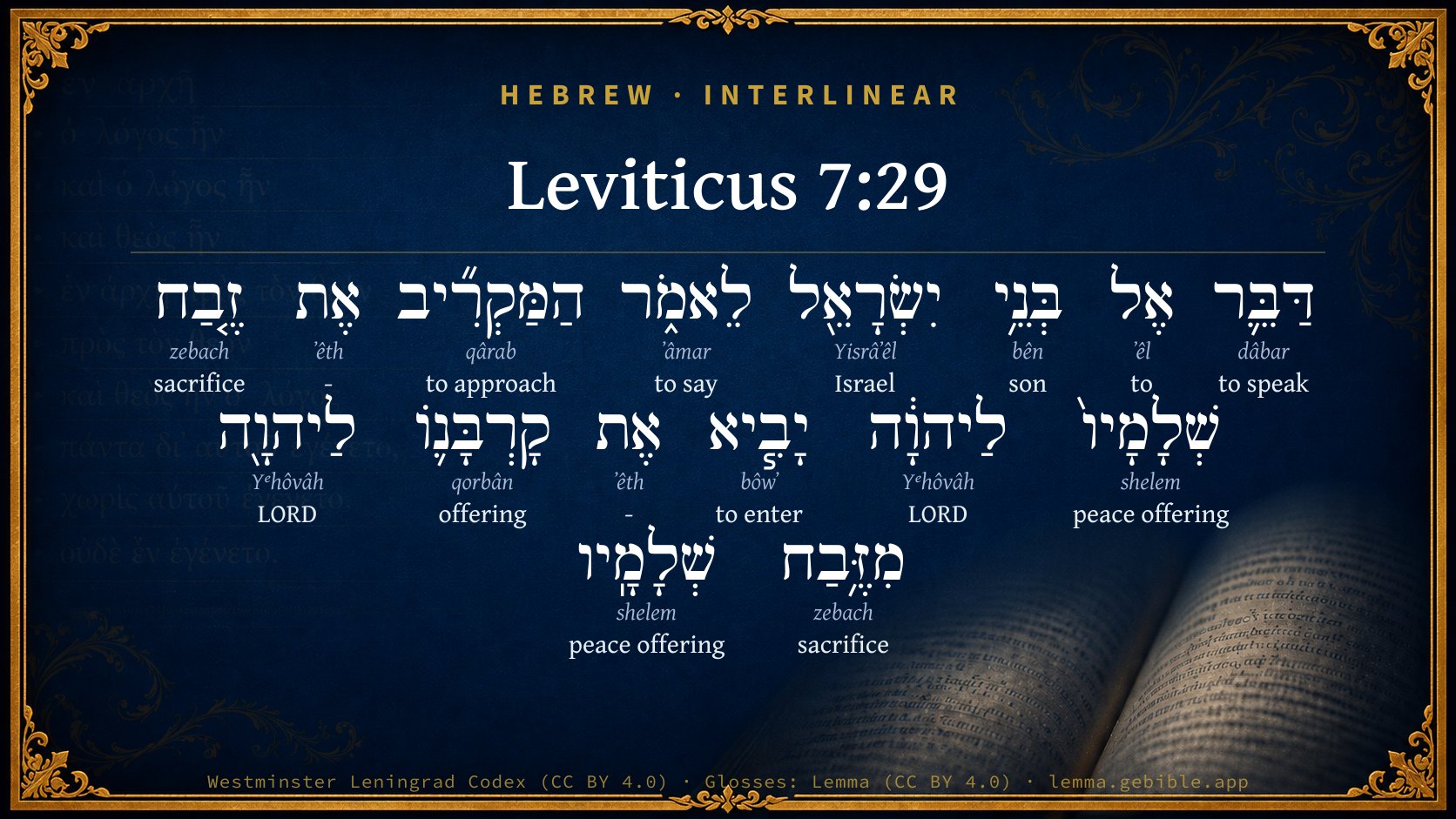
Hebrew (Westminster Leningrad Codex) Leviticus 7:29 appears in the Hebrew Old Testament. The text above is from the Westminster Leningrad Codex. Each word links to its Strong’s number, a concise gloss, and parsing drawn from the Open Scriptures Hebrew Bible morphology. Click any word for its full Brown-Driver-Briggs (BDB) entry.
Download image
Cite this verse

Leviticus 7:29 (World English Bible). Public Domain. Lemma interlinear Bible study tool, https://lemma.gebible.app/v/leviticus/7/29.

Show BibTeX & RIS
BibTeX
RIS
English Translation
"Speak to the children of Israel, saying, 'He who offers the sacrifice of his peace offerings to Yahweh shall bring his offering to Yahweh out of the sacrifice of his peace offerings.
World English Bible · Public Domain
Download a study sheet

One document with this verse’s original text, its word-by-word gloss line, the meaning frame, cross-references with their text, attributed commentary, and full source and license credits — printable, and it pastes into notes with its structure intact.

This verse Autodidact and up

Study sheet (.html) Plain text (.txt)

A passage Seminary Student

Up to 50 verses in one chapter. A passage sheet keeps up to 6 commentary sources and 12 cross-references per verse, in the order this page ranks them, and says so on the sheet whenever that leaves anything out. Ask for a single verse and you get the Autodidact verse sheet above.

Everything on this page stays free to read, with no account — the sheet is a download of what is already on screen, not access to it.

Want to remove ads? Support Godless Engineer
Compare translations 3

The same verse in 3 English versions, stacked beneath the original-language interlinear above. Click any original word for its lexicon entry.

Each is an independent rendering of the whole verse — the interlinear is not word-aligned to these translations.

Highlighted words mark where these versions differ — a whole-verse word diff, not a word-by-word alignment.

  • World English Bible Public Domain
    "Speak to the children of Israel, saying, 'He who offers the sacrifice of his peace offerings to Yahweh shall bring his offering to Yahweh out of the sacrifice of his peace offerings.
  • King James Version Public Domain
    Speak unto the children of Israel, saying, He that offereth the sacrifice of his peace offerings unto the LORD shall bring his oblation unto the LORD of the sacrifice of his peace offerings.
  • unfoldingWord Literal Text CC BY-SA 4.0
    “Speak to the sons of Israel, saying, ‘The person presenting the sacrifice of his peace offerings to Yahweh shall bring his offering to Yahweh from the sacrifice of his peace offerings.

unfoldingWord Literal Text — © unfoldingWord, licensed CC BY-SA 4.0. Word-aligned USFM3 via Door43 (git.door43.org/unfoldingWord/en_ult).

Versions to compare (up to 4)

3 of 4 selected

Show all 18 translations

Every available English version of this verse, each an independent rendering of the whole verse.

  • World English Bible Public Domain
    "Speak to the children of Israel, saying, 'He who offers the sacrifice of his peace offerings to Yahweh shall bring his offering to Yahweh out of the sacrifice of his peace offerings.
  • Berean Standard Bible Public Domain
    “Speak to the Israelites and say, ‘Anyone who presents a peace offering to the LORD must bring it as his sacrifice to the LORD.
  • Majority Standard Bible Public Domain
    “Speak to the Israelites and say, ‘Anyone who presents a peace offering to the LORD must bring it as his sacrifice to the LORD.
  • King James Version Public Domain
    Speak unto the children of Israel, saying, He that offereth the sacrifice of his peace offerings unto the LORD shall bring his oblation unto the LORD of the sacrifice of his peace offerings.
  • American Standard Version (1901) Public Domain
    Speak unto the children of Israel, saying, He that offereth the sacrifice of his peace-offerings unto Jehovah shall bring his oblation unto Jehovah out of the sacrifice of his peace-offerings:
  • Revised Version (1885) Public Domain
    Speak unto the children of Israel, saying, He that offereth the sacrifice of his peace offerings unto the LORD shall bring his oblation unto the LORD out of the sacrifice of his peace offerings:
  • Geneva Bible (1599) Public Domain
    Speake vnto the children of Israel, and say, Hee that offereth his peace offerings vnto the Lord, shall bring his gifte vnto the Lord of his peace offerings:
  • Douay-Rheims (1899) Public Domain
    Speak to the children of Israel, saying: He that offereth a victim of peace offerings to the Lord, let him offer therewith a sacrifice also, that is, the libations thereof.
  • Young's Literal Translation Public Domain
    `Speak unto the sons of Israel, saying, He who is bringing near the sacrifice of his peace-offerings to Jehovah doth bring in his offering to Jehovah from the sacrifice of his peace-offerings;
  • Literal Standard Version CC BY-SA 4.0
    “Speak to the sons of Israel, saying, He who is bringing the sacrifice of his peace-offerings near to YHWH brings in his offering to YHWH from the sacrifice of his peace-offerings;
  • Unlocked Literal Bible CC BY-SA 4.0
    “Speak to the people of Israel and say, 'He who offers the sacrifice of a peace offering to Yahweh must bring part of his sacrifice to Yahweh.
  • unfoldingWord Literal Text CC BY-SA 4.0
    “Speak to the sons of Israel, saying, ‘The person presenting the sacrifice of his peace offerings to Yahweh shall bring his offering to Yahweh from the sacrifice of his peace offerings.
  • Darby Bible Public Domain
    Speak unto the children of Israel, saying, He that presenteth the sacrifice of his peace-offering to Jehovah shall bring his offering to Jehovah of the sacrifice of his peace-offering.
  • World Messianic Bible Public Domain
    “Speak to the children of Israel, saying, ‘He who offers the sacrifice of his peace offerings to the LORD shall bring his offering to the LORD out of the sacrifice of his peace offerings.
  • Webster's Bible Public Domain
    Speak to the children of Israel, saying, He that offereth the sacrifice of his peace-offerings to the LORD, shall bring his oblation to the LORD of the sacrifice of his peace-offerings.
  • Free Bible Version CC BY-SA 4.0
    “Give these instructions to the Israelites. Tell them that if you present a peace offering to the Lord you must bring part of it as a special gift to the Lord.
  • Bible in Basic English Public Domain
    Say to the children of Israel: He who makes a peace-offering to the Lord, is to give an offering to the Lord out of his peace-offering:
  • JPS Tanakh (1917) Public Domain
    Speak unto the children of Israel, saying: He that offereth his sacrifice of peace-offerings unto the LORD shall bring his offering unto the LORD out of his sacrifice of peace-offerings.

Literal Standard Version (2020), Covenant Press — licensed CC BY-SA 4.0. Text via the HelloAO Bible API (eBible.org). Unlocked Literal Bible (unfoldingWord) — licensed CC BY-SA 4.0. Text via the HelloAO Bible API (eBible.org). unfoldingWord Literal Text — © unfoldingWord, licensed CC BY-SA 4.0. Word-aligned USFM3 via Door43 (git.door43.org/unfoldingWord/en_ult). Free Bible Version, Dr. Jonathan Gallagher — licensed CC BY-SA 4.0. Text via the HelloAO Bible API (eBible.org).

Word by word

More ways to search: Search by grammar → Find every occurrence → Compare this word →

Practice this passage: Drill this verse → Learn its vocabulary →

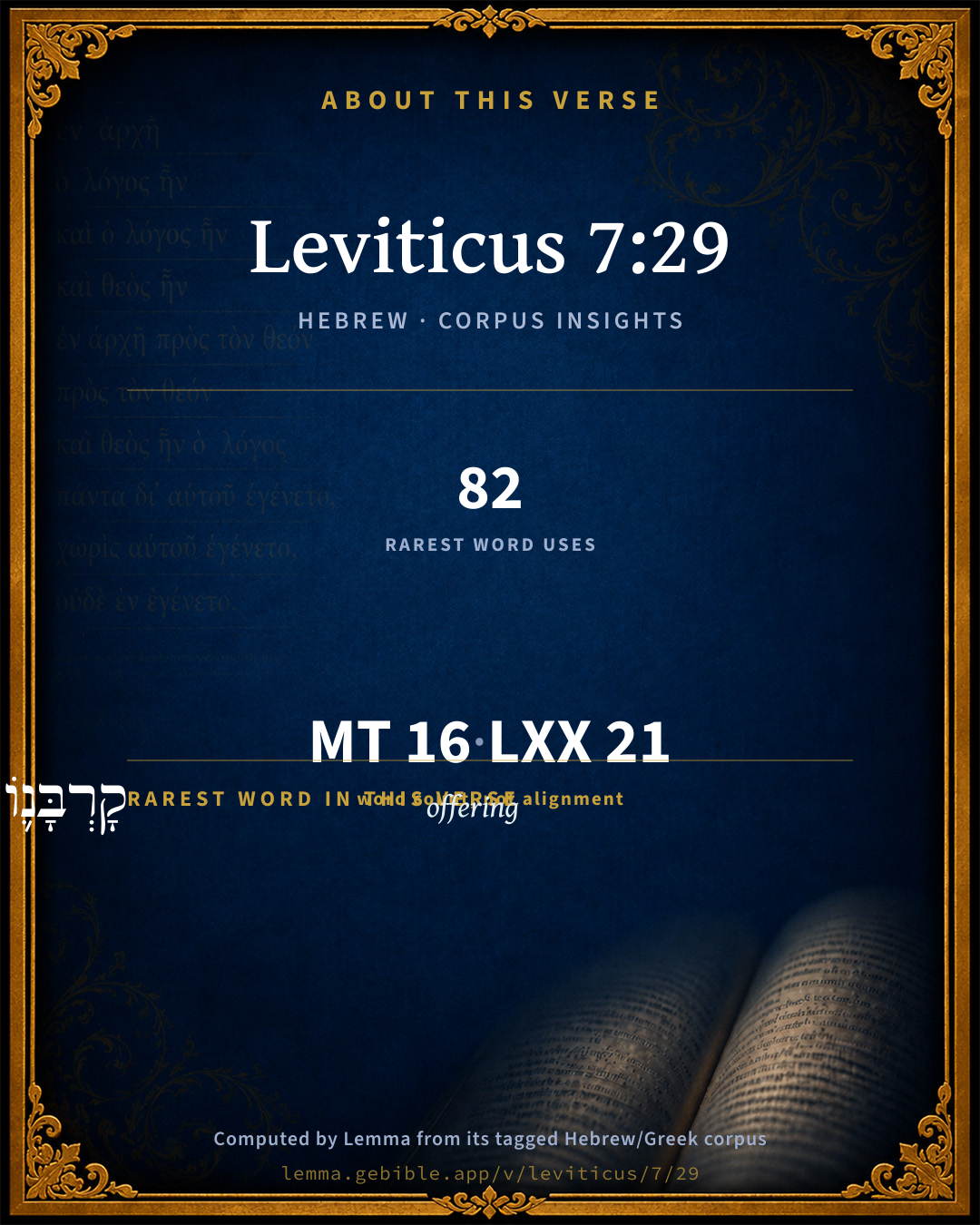
קָרְבָּנ֛וֹ
qorbân
H7133
“offering · his”
Noun, Common, Masculine, Singular, Construct + Suffix, Personal, 3rd Person, Masculine, Singular
Part of Speech
Noun
Type
Common
Gender
Masculine
Number
Singular
State
Construct
Full BDB Definition

Origin: from H7126

TWOT: 2065e

offering, oblation
  1. דַּבֵּ֛ר dâbar H1696 “speak” Verb, Piel, Imperative, 2nd Person, Masculine, Singular
  2. אֶל ʼêl H413 “to” Preposition
  3. בְּנֵ֥י bên H1121 “sons of” Noun, Common, Masculine, Plural, Construct
  4. יִשְׂרָאֵ֖ל Yisrâʼêl H3478 “Israel” Noun, Proper
  5. לֵאמֹ֑ר ʼâmar H559 “to say” Preposition + Verb, Qal, Infinitive Construct
  6. הַמַּקְרִ֞יב qârab H7126 “the · approaching” Particle, Definite Article + Verb, Hiphil, Participle Active, Masculine, Singular, Absolute
  7. אֶת ʼêth H853 “-” Particle, Direct Object
  8. זֶ֤בַח zebach H2077 “sacrifice of” Noun, Common, Masculine, Singular, Construct
  9. שְׁלָמָיו֙ shelem H8002 “peace offerings · his” Noun, Common, Masculine, Plural, Construct + Suffix, Personal, 3rd Person, Masculine, Singular
  10. לַיהוָ֔ה Yᵉhôvâh H3068 “to/for · LORD” Preposition + Noun, Proper
  11. יָבִ֧יא bôwʼ H935 “to enter” Verb, Hiphil, Imperfect, 3rd Person, Masculine, Singular
  12. אֶת ʼêth H853 “-” Particle, Direct Object
  13. לַיהוָ֖ה Yᵉhôvâh H3068 “to/for · LORD” Preposition + Noun, Proper
  14. מִזֶּ֥בַח zebach H2077 “from · sacrifice of” Preposition + Noun, Common, Masculine, Singular, Construct
  15. שְׁלָמָֽיו shelem H8002 “peace offerings · his” Noun, Common, Masculine, Plural, Construct + Suffix, Personal, 3rd Person, Masculine, Singular

About this verse

These counts appear in no published source. They are computed here, from the morphology-tagged text and Lemma’s own curated glosses. What Lemma adds →

16
words
12
distinct lemmas
Pentateuch
section

Grammatical profile

  • 4 verbs
  • 9 nouns
  • 1 preposition
  • 2 particles

Verb forms

  • דַּבֵּ֛ר Piel · Imperative
  • לֵאמֹ֑ר Qal · Infinitive Construct
  • הַמַּקְרִ֞יב Hiphil · Participle Active
  • יָבִ֧יא Hiphil · Imperfect

Repetition

Words recur within this verse — often emphatic in Hebrew:

  • זֶ֤בַח sacrifice H2077 ×2
  • שְׁלָמָיו֙ peace offering H8002 ×2
  • לַיהוָ֔ה LORD H3068 ×2

Hebrew & Septuagint length

In the original languages it is 16 Hebrew tokens and 21 Greek tokens — but the two are counted differently (Hebrew bundles its prefixes and suffixes into one token; the Greek is in lemma form), so that isn’t a like-for-like length.

Cross-references

3

Topical passages linked to Leviticus 7:29 in the Treasury of Scripture Knowledge — connected by theme and wording, ordered by reader-vote popularity; previews shown in the World English Bible.

  • Leviticus 3:1–17 "'If his offering is a sacrifice of peace offerings; if he offers it from the herd, whether male or female, he shall offer it without blemish before Yahweh.
  • Colossians 1:20 and through him to reconcile all things to himself, by him, whether things on the earth, or things in the heavens, having made peace through the blood of his cross.
  • 1 John 1:7 But if we walk in the light, as he is in the light, we have fellowship with one another, and the blood of Jesus Christ, his Son, cleanses us from all sin.

Cross-references courtesy of OpenBible.info (CC BY 4.0).

Hebrew and Greek witnesses Masoretic Hebrew ↔ Greek Septuagint

The same verse in the two great witnesses to the Old Testament, shown verse-for-verse.

These are two independent witnesses, not word-aligned to each other, and the Septuagint is shown in lemma (dictionary) form.

Hebrew Leviticus 7:29 Masoretic · Westminster Leningrad Codex

דַּבֵּ֛ר אֶל בְּנֵ֥י יִשְׂרָאֵ֖ל לֵאמֹ֑ר הַמַּקְרִ֞יב אֶת זֶ֤בַח שְׁלָמָיו֙ לַיהוָ֔ה יָבִ֧יא אֶת קָרְבָּנ֛וֹ לַיהוָ֖ה מִזֶּ֥בַח שְׁלָמָֽיו

"Speak to the children of Israel, saying, 'He who offers the sacrifice of his peace offerings to Yahweh shall bring his offering to Yahweh out of the sacrifice of his peace offerings.

World English Bible · Public Domain

Greek LXX Leviticus 7:29 Septuagint · lemma form

καί ὁ υἱός ἰσραήλ λαλέω λέγω ὁ προςφέρω θυσία σωτήριον κύριος φέρω ὁ δῶρον αὐτός κύριος ἀπό ὁ θυσία ὁ σωτήριον

No English rendering of this Greek verse — the small residue in the structurally divergent books.

Hebrew: Westminster Leningrad Codex (CC BY 4.0). Greek: Septuagint (public domain); English from a public-domain English Septuagint. How the Septuagint differs from the Hebrew →

Targum (Aramaic paraphrase)

2

The Targum is the ancient Jewish Aramaic paraphrase of the Hebrew Scriptures — an interpretive translation, not the Hebrew text itself. Onkelos (literal) and Pseudo-Jonathan (expansive) render the Torah, and Jonathan the Prophets. Coverage is partial: where no permissively-licensed English translation exists for a verse, only the Aramaic is shown. This is verse-level text, not a word-by-word alignment to the Hebrew.

  1. Targum Onkelos Torah (Genesis–Deuteronomy)
    מַלֵל עִם בְּנֵי יִשְׂרָאֵל לְמֵימָר דִמְקָרֵב יָת נִכְסַת קוּדְשׁוֹהִי קֳדָם יְיָ יַיְתִי יָת קֻרְבָּנֵהּ לָקֳדָם יְיָ מִנִכְסַת קוּדְשׁוֹהִי

    (no public-domain English translation for this verse)

    Targum Onkelos — Aramaic: “Onkelos Genesis” (public domain); “Onkelos Exodus” (public domain); “Onkelos Leviticus” (public domain); “Onkelos Numbers” (public domain); “Onkelos Deuteronomy” (public domain). English: “Sefaria Community Translation” (CC0 1.0 (public-domain dedication)); “J.W. Etheridge. The Targums of Onkelos and Jonathan Ben Uzziel on the Pentateuch. London: Longmans, Green, 1862” (public domain). Text via Sefaria.

  2. Targum Pseudo-Jonathan Torah (Genesis–Deuteronomy)
    מַלֵיל עִם בְּנֵי יִשְרָאֵל לְמֵימָר כָּל מַאן דְמִקְרַב יַת נִכְסַת קוּדְשׁוֹי קֳדָם יְיָ יַיְתֵי בְּגַרְמֵיהּ יַת קוּרְבָּנֵיהּ לִקְדָם יְיָ מִן נִכְסַת קוּדְשׁוֹי

    Speak with the sons of Israel, saying: Whosoever presenteth his hallowed sacrifice before the Lord, shall himself bring the oblation of his hallowed sacrifice unto the presence of the Lord.

    Targum Pseudo-Jonathan — Aramaic: “Targum Jonathan on Genesis” (public domain); “Targum Jonathan on Exodus” (public domain); “Targum Jonathan on Leviticus” (public domain); “Targum Jonathan on Numbers” (public domain); “Targum Jonathan on Deuteronomy” (public domain). English: “The Targum of Jonathan ben Uzziel, trans. J. W. Etheridge, London, 1862” (public domain). Text via Sefaria.

Commentary

Notes on Leviticus 7:29 from classic Christian and Jewish commentators (each source and its license shown beneath its notes). The classic Christian expositions comment on the surrounding passage and are grouped to its opening verse, so a note may address several verses; the Jewish commentaries on the Tanakh (Rashi and others) are per-verse, so they appear only where the commentator wrote on this verse.

Lemma curates 59 commentaries, every one of them public domain or Creative Commons licensed, each selected and text-cleaned for this edition rather than reprinted as found. About our sources →

Trapp's Complete Commentary

John Trapp

Lev 7:29 Speak unto the children of Israel, saying, He that offereth the sacrifice of his peace offerings unto the LORD shall bring his oblation unto the LORD of the sacrifice of his peace offerings.

Ver. 29. Unto the Lord.] Not kill it in the camp, though there they might eat it.

John Trapp, A Commentary or Exposition upon All the Books of the Old and New Testament (1647–1656) — public domain. Text from a community e-Sword module.

The Biblical Illustrator

Joseph S. Exell

Lev_7:29-34

Peace-offerings.

The believers peace and portion

I. To have God is to have peace: for He is the God of peace; especially as revealed and given us in Christ. But what is given may be enjoyed, as what is offered may be received. Then let the gift be accepted, and the peace you desire will keep your, heart and mind, and this in all circumstances. The winds of adversity may smite you, and the waters of affliction overwhelm you; but as God is greater than these, He keeps in the perfectness of peace the minds that are stayed upon Him.

II. Such peace is found is Christ alone; not in anything done by Him, or given by Him, but in His personal indwelling. He is our peace? The knowledge of Him will illuminate, and the faith of Him will impart security; but you must have Himself to have the portion that will satisfy, and the peace you need.

III. But not only is Christ our peace, but from being the atoner, our peace-offering, He gives Himself to God an offering and a sweet-smelling savour, and then to us who trust in Him for deliverance and satisfaction. The ancient Jewish sacrifice of the peace-offering illustrates this--

1. The material of which it consisted was either a bullock, heifer, lamb, or goat; but in all cases it was to be without blemish. God is entitled to the best, and will receive nothing less. Yet how often is less than what He asks offered Him! That they who so act by Him should have few answers to their prayers, and little satisfaction in their religion, can be wondered at by no one.

2. Peace-offerings were offered by persons who, having obtained forgiveness of sins, and given themselves to God, were at peace with Him. Friendship with God was the principal idea represented therein.

3. Only a part of the peace-offering was given to God; but that was the best, the part to which He was entitled, and which He claimed. And it was accepted, as was shown by its consumption by fire. Offer Him your best, and, though in itself small and poor, He will receive it, and make liberal acknowledgment of His approval of it.

4. The Israelite was not at liberty to lay the fat of his offering at random, any way, or anywhere, on the altar. He had to lay it upon the sacrifice that was upon the wood on the altar fire. But that sacrifice was the lamb of the daily offering, which typified atonement in its fulness. There, Gods portion of the peace-offering was laid, and accepted according to the value of that on which it was offered.

5. Apart from Christ nothing is acceptable to Him. What you bring to Him may be your best, that which He asks for, and what is in itself valuable; but unless offered on the ground of atonement it is not received by Him.

6. But that is the ground within every ones reach, and on which everything that is offered to God may be presented. There is no one by whom the name of Jesus may not be used as a plea, and His sacrifice urged as a reason for acceptance.

IV. The peace-offering expressed the thought of communion and satisfaction. It supplied God with a portion, and man also. It furnished a table at which both met, and where they had fellowship with one another. God fed on the fat, and man on the shoulder and breast (Lev_7:31); and both were satisfied.

1. But we have Christ here; and we know what the Father ever found in Him; with what pleasure He ever regarded Him, in His righteousness of walk, perfection of obedience, and beauty of character. God was supremely pleased with all that Jesus was and did, as the representative of Himself to men, and the ideal man to the world, the indicator of holiness and the honourer of the law. Christ was, and is still, His well-beloved and His joy.

2. But not God alone fed on the peace-offering, man did that also; he ate of the breast and the shoulder. In the antitype these typified love and strength. These, believer, are your portion in Christ. You have His heart of love and His shoulder of might--His unchanging affection and His all-sustaining power. Enfolded in His embrace and enthroned on His shoulder of strength, you occupy a position where evil cannot harm you, nor want remain unmet.

V. No Israelite who was ceremonially unclean was permitted to partake of the peace-offering, or share with God in the provision it supplied. And without holiness no man is now allowed to see God. But provision is made both for mans expiation and for his sanctifying from all impurity. The Cross that separates from the guilt of sin also separates from its defilement. Christ is thus Sanctifier as well as Justifier. He gave Himself for us, that He might redeem us from all iniquity, and purify unto Himself a peculiar people (Tit_2:14). Thus beautified with His salvation, you will find a place in His banqueting-house of love, a guest at the Lords table, and satisfied with the food of which you partake (Joh_6:57; Joh_6:55; Joh_6:35). Are you satisfied with Christ? Does He appease all your yearnings, fulfil your every desire, give you rest, and prove your peace? My beloved is mine, and I am His (Son_2:16). His resources are inexhaustible, His communications are continuous, and His glory is Divine. (James Fleming, D. D.)

The peace-offerings

In regard to the peace-offerings, the waving was peculiarly connected with the breast, which is thence called the wave-breast; and the heaving with the shoulder, for this reason called the heave-shoulder. When those parts were thus presented to God and set apart to the priesthood, the rest of the flesh was given up to the offerer to be partaken of by himself and those he might call to share and rejoice with him. Among these he was instructed to invite, beside his own friends, the Levite, the widow, and the fatherless. This participation by the offerer and his friends, this family feast upon the sacrifice, may be regarded as the most distinctive characteristic of the peace-offerings. It denoted that the offerer was admitted to a state of near fellowship and enjoyment with God, shared part and part with Jehovah and His priests, had a standing in His house, and a seat at His table. It was therefore the symbol of established friendship with God, and near communion with Him in the blessings of His kingdom; and was associated in the minds of the worshippers with feelings of peculiar joy and gladness--but these always of a sacred character. And in the way by which the worshipper attained to a fitness for enjoying these privileges--viz., through the life-blood of atonement--how impressive a testimony was borne to the necessity of seeking the road to all dignity and blessing in the kingdom of God through faith in a crucified Redeemer. (P. Fairbairn, D. D.)

No offering by proxy

The worshipper could not do the work by proxy. The man had to go for himself, and present the sacrifice himself, and lay his hand upon its head, and confess, and eat, all for himself. There can be no transfer of religious obligations--no substitution in the performance of religious duties. Of all things, piety is one of the most intensely personal. It is the intercourse of the individual soul with its Maker; just as much as if there were no other beings in existence. As each must eat, and die, and be judged for him or herself, so each must repent, and believe, and be religious for him or herself. I do not depreciate the importance of social relations, compacts and organisations. I believe that religion is very greatly dependent upon them. Had we never been placed in a Christian land, or been related to Christian parents and friends, or been brought into contact with the Christian Church, we never could have become Christians. But when it comes to the real activities and experiences of piety, they relate as directly to ourselves as individuals as if we alone existed. It is a great thing to have pious friends. The prayers of a godly mother are like soft silken cords around the heart of her son, which draw upon and check him in his wildest wanderings and his maddest passion. The rude sailor on the deck, or the hardened culprit in his cell, is melted and subdued at the mere remembrance of a sainted mother. But, though that mother be as good as the Virgin Mother of our Lord--though she nightly bathe her pillow with tears of supplication for her boy--it shall avail nothing to the salvation of her erring child, unless he himself shall move to turn from his follies, to bend in penitence, and to submit himself to God. True religion demands ones personal and individual action--the putting forth of ones own hand. No man or angel can do it for us. Preachers and pious friends may prompt, direct, encourage, and pray for us, but that is all. They can do nothing more. We must individually and for ourselves believe on the Lord Jesus Christ, or be lost. There is no other alternative. A very expressive gesture was required of the Jew to signify all this. He had to put his hand upon the head of his sacrifice when he presented it. He thereby acknowledged his sin, and expressed his personal dependence upon that sacrifice. The Hebrew word is still more suggestive. He shall lean his hand upon the head of the offering. It is the same word used by the Psalmist, where he says, Thy wrath leaneth hard upon me. Sin is a burden. It is ready to crush him upon whom it is. And with this burden the sinner is to lean upon his sacrifice for ease. He could not lean with another mans hand; he must use his own hand. The ceremonial worshipper used the outward hand; we are to use the hand of the soul, which is faith. (J. A. Seiss, D. D.)

The Biblical Illustrator, edited by Joseph S. Exell (c. 1880s–1900s) — public domain. Text from a community e-Sword module.

Joseph Benson's Commentary

Lev 7:29-30. Shall bring — Not by another, but by himself, that is, those parts of the peace-offering which are in a special manner offered to God. His oblation unto the Lord — That is, to the tabernacle, where the Lord was present in a special manner His own hands — After the beast was killed, and the parts of it divided, the priest was to put the parts mentioned into the hands of the offerer. Offerings made by fire — So called, not strictly, as burnt-offerings are, because some parts of these were left for the priests, but more largely, because even these peace-offerings were in part, though not wholly, burned. Waved — To and fro, by his hands, which were supported and directed by the hands of the priest.

Joseph Benson's Commentary on the Old and New Testaments (1811–1818) — public domain. Text from a community e-Sword module.

Jamieson, Fausset & Brown

Robert Jamieson, A. R. Fausset & David Brown

THE PRIESTS' PORTION. (Lev 7:28-38)

He that offereth the sacrifice of his peace offerings unto the Lord--In order to show that the sacrifice was voluntary, the offerer was required to bring it with his own hands to the priest. The breast having been waved to and fro in a solemn manner as devoted to God, was given to the priests; it was assigned to the use of their order generally, but the right shoulder was the perquisite of the officiating priest.

Jamieson, Fausset & Brown — Commentary Critical and Explanatory on the Whole Bible (1871) — public domain (CC PDM 1.0). Text via the HelloAO Bible API.

Adam Clarke's Commentary

Verse 29. Shall bring his oblation] Meaning those things which were given out of the peace-offerings to the Lord and to the priest. - Ainsworth.

Adam Clarke's Commentary on the Bible (1810–1826) — public domain. Text from a community e-Sword/MySword module.

Ellicott's Commentary for English Readers

(29) He that offereth the sacrifice of his peace offerings.—That is, if his peace offering is one of the three aforementioned classes. (See Lev_7:11.)

Shall bring his oblation.—That is, those portions of the peace offering which the offerer devoted to the Lord and to the officiating priest.

A Bible Commentary for English Readers, edited by Charles John Ellicott (1878–1897) — public domain. Text from a community e-Sword module.

The Cambridge Bible for Schools and Colleges

gen. ed. J. J. S. Perowne

Priestly Portions of the Peace-Offering (28–34)

29. his oblation] The word does not refer to the whole sacrifice as in other places, but to that portion which was offered by fire, i.e. the fat portions specially reserved for the Lord as (Lev_7:30) ‘the offerings of the Lord made by fire’ (described in Lev_3:3-5; Lev_3:9-10; Lev_3:14-15), together with the breast to be waved as a Wave-Offering before the Lord, which is not burned with the fat (i.e. the fat portions of Lev_3:3-5, etc.) but reserved as a portion for ‘Aaron and his sons.’

The Cambridge Bible for Schools and Colleges (gen. ed. J. J. S. Perowne; Cambridge University Press, 1878–1918) — public domain. Text from a community e-Sword module.

John Gill's Exposition

His own hands shall bring the offerings of the Lord made by fire,.... That is, such parts of the peace offerings as were to be burnt with fire, as the fat on several parts described in Lev 3:3 the owners of the offerings were to bring them in the manner as will be presently observed:

the fat with the breast, it shall he bring; the fat to be burnt, and the breast for the priest and his sons, as in the following verse Lev 7:31,

that the breast may be waved for a wave offering before the Lord; how this waving was performed; see Gill on Exo 29:24 particularly with respect to these peace offerings it was thus; if a thank offering, the priest takes of the bread brought with it one (cake) out of ten, and lays it with the breast, the shoulder, and the inwards, and waves all upon the hands of the owners; on which he puts the fat, then the breast and the shoulder above (i.e. upon the fat), then the two kidneys, and the caul, and the liver above them; and if there was any bread, he put it over them, and waved all, putting his hand under the hands of the owner (s).

(s) Maimon. Maaseh Hakorbanot, c. 9. sect. 6, 7. so Ben Gersom in loc.

John Gill's Exposition of the Whole Bible (1746–1763) — public domain (CC PDM 1.0). Text via the HelloAO Bible API.

Haydock's Catholic Bible Commentary

Sacrifice....Libations, flour, wine, and oil. (Lyranus)

George Leo Haydock (1774–1849), Haydock's Catholic Family Bible and Commentary, 1859 edition — public domain. Excludes Psalms (Douay-Rheims chapter numbering differs from Protestant) and Deuterocanonical books (Catholic canon only).

Matthew Poole's English Annotations

Not by another, but by himself, as it is explained Lev 7:30. His oblation, i.e. those parts of the peace-offering which are in a special manner offered to God, to wit, the fat, and breast, and shoulder, as it follows. Unto the Lord, i.e. to the tabernacle, where the Lord was present in a special manner. He shows, that though part of such offerings might be eaten in any clean place, Lev 10:14, yet not till they had been killed, and part of them offered to the Lord in the place appointed by him for that purpose.

Matthew Poole's English Annotations on the Holy Bible (1683–1685) — public domain. Text from a community e-Sword/MySword module.

The Pulpit Commentary

Vers. 29-34. The threefold participation.

In the case of the peace offerings, there was a recognition of rights due to God, to his priests, and to the people presenting the victims.

I THE PORTION RESERVED FOR GOD. The fat parts and the bleed were not to be eaten by man; the former must be burnt upon the altar, the latter poured out at its foot. There are claims God will not waive. The homage man owes to his Maker can never be remitted. Full trust and unfaltering obedience can be demanded only by an Infinite Being. Life must be acknowledged as dependent upon him. "The blood is the life," and for the Israelite to drink it is to be cut off from the congregation. The choicest portions belong to God. He will not put up with inferior parts. They mock him who fancy that a remnant of time and money and strength will suffice for his service.

II THE SHARE ALLOTTED TO THE PRIESTS. God takes care of his chosen servants, provides amply for their wants. The priests devoted wholly to the work of the tabernacle shall not be forgotten, but considered as one with their Master, so that whenever he is honoured they shall be likewise thought of. To wear God"s uniform is to be well eared for, to receive good wages, to be sure of a pension. Once taken into his employ, our future comfort is assured. And those who preach the gospel may claim to live by it. See this principle enunciated and inculcated in 1Co_9:7-14. Variety is secured. Food to cat, skins to wear. The atonement of the priest "covered" the sinner, and the covering of the animal was naturally appropriated to the use of the officiating priest. Both flour and flesh fell to the lot of the priests. The quality shall not be inferior. Portions are selected, the breast and the shoulder, which were counted as most delicate in flavour and nutritious in substance. Why should God"s messengers yield to fear lest they should be neglected? He feedeth the ravens, clothes the lilies in splendour, and will not forsake those whom he has called to do his work in the world.

III THE REMAINDER HANDED BACK TO THE PEOPLE. We have not to do with an avaricious, unreasonable God. He might justly have claimed the absolute disposal of all brought to his shrine as an offering, but he graciously received a "memorial" for himself and a portion for his ministers, and the rest was returned to the worshippers, consecrated, and for their festal enjoyment, Let us but acknowledge God"s requirements, and we shall find that we are not debarred from the innocent pleasures of life, but can enter upon them with sacred enhancing zest. By spending money in the purchase of ointment for the Saviour, Mary did not deprive herself of all her store, but rather increased the satisfaction with which she indulged in the customary household expenses. We are sure that the widow who cast her all into the treasury was not allowed to remain utterly destitute. She had really made a profitable investment of her little capital. Emptying her hands was only preparatory to having them filled.

How ennobling the thought of being sharers with God and his servants!

We all partake of the same food, and are made "one bread and one body". (1Co_10:17) There is better sauce than hunger! It consists in previous dedication to God. Selfish exclusion of the rights of God diminishes the intensity and narrows the sphere of our delights. Not the miser, but the Christian donor, knows the joys of property. S.R.A.

The Pulpit Commentary (1880–1919), ed. H.D.M. Spence-Jones & Joseph S. Exell — public domain. Text from a community e-Sword module.

John Wesley's Explanatory Notes

Shall bring - Not by another, but by himself, that is, those parts of the peace-offering, which are in a special manner offered to God. His oblation unto the Lord - That is, to the tabernacle, where the Lord was present in a special manner. Though part of such offerings might be eaten in any clean place, chap. x, 14, yet not till they had been killed, and part of them offered to the Lord in the place appointed by him for that purpose.

John Wesley, Explanatory Notes Upon the Whole Bible (1754–1765) — public domain. Text via the GEBible commentary corpus.

Lesson kit

Teaching starters — assembled from the data on this page, not authored interpretation. Every prompt links to the verse data it draws on. Edit before teaching.

Leviticus, in the Pentateuch, opens this verse with 16 words (12 distinct Hebrew lemmas). Its most distinctive word is qorbân (“offering”). A historical commentator’s framing appears above. Read the whole chapter for the surrounding context.

Discussion questions

  1. How does “offering” (qorbân) shape what this verse is saying?
  2. Leviticus 3:1–17 shares this passage’s theme. How do the two illuminate each other?
  3. “sacrifice” occurs 2× in this one verse. What is the effect of the repetition?
  4. The translations on this page render this verse differently — a whole-verse word diff, not a word-by-word alignment. What might account for the different wordings?
  5. The verb «דַּבֵּ֛ר» is Piel Imperative. How does its form color the action?
  6. Reading how Trapp's Complete Commentary and The Biblical Illustrator read this verse, where do the two commentators agree and where do they part?

Things to notice

Reading settings

Reading text

Shown beneath each verse's original-language words.

Old Testament
Old Testament edition

Read the OT as the Masoretic Hebrew (MT) or the Greek Septuagint (LXX).

English shown for the Greek Septuagint (in the Hebrew ↔ Greek comparison).

Comparing translations? Open the Compare panel on any verse page to stack up to four side by side.