Isaiah 46:13

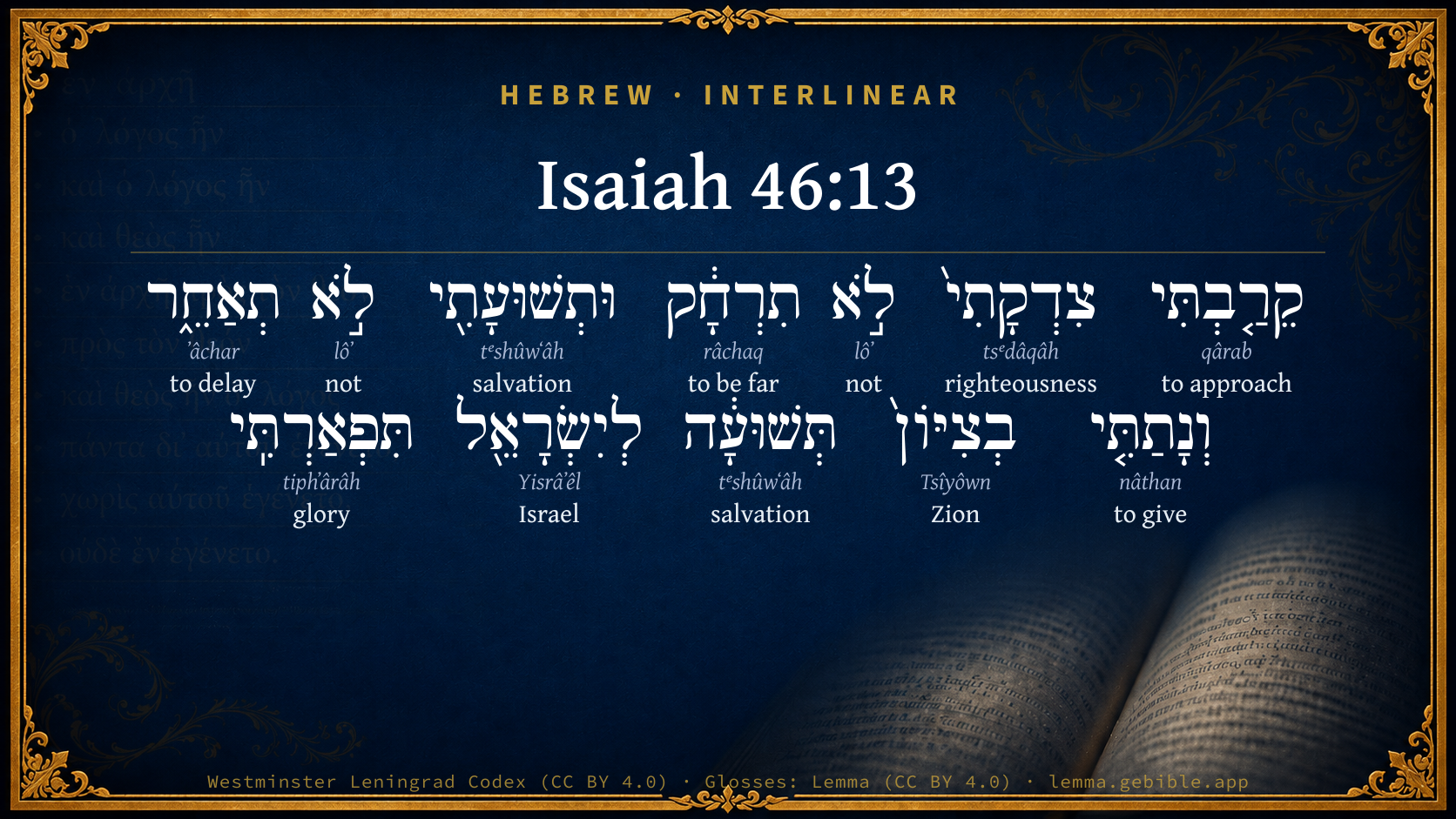
Hebrew (Westminster Leningrad Codex) Isaiah 46:13 appears in the Hebrew Old Testament. The text above is from the Westminster Leningrad Codex. Each word links to its Strong’s number, a concise gloss, and parsing drawn from the Open Scriptures Hebrew Bible morphology. Click any word for its full Brown-Driver-Briggs (BDB) entry.
Download image
Cite this verse

Isaiah 46:13 (World English Bible). Public Domain. Lemma interlinear Bible study tool, https://lemma.gebible.app/v/isaiah/46/13.

Show BibTeX & RIS
BibTeX
RIS
English Translation
I bring near my righteousness, it shall not be far off, and my salvation shall not wait; and I will place salvation in Zion for Israel my glory.
World English Bible · Public Domain
Download a study sheet

One document with this verse’s original text, its word-by-word gloss line, the meaning frame, cross-references with their text, attributed commentary, and full source and license credits — printable, and it pastes into notes with its structure intact.

This verse Autodidact and up

Study sheet (.html) Plain text (.txt)

A passage Seminary Student

Up to 50 verses in one chapter. A passage sheet keeps up to 6 commentary sources and 12 cross-references per verse, in the order this page ranks them, and says so on the sheet whenever that leaves anything out. Ask for a single verse and you get the Autodidact verse sheet above.

Everything on this page stays free to read, with no account — the sheet is a download of what is already on screen, not access to it.

Want to remove ads? Support Godless Engineer
Compare translations 3

The same verse in 3 English versions, stacked beneath the original-language interlinear above. Click any original word for its lexicon entry.

Each is an independent rendering of the whole verse — the interlinear is not word-aligned to these translations.

Highlighted words mark where these versions differ — a whole-verse word diff, not a word-by-word alignment.

  • World English Bible Public Domain
    I bring near my righteousness, it shall not be far off, and my salvation shall not wait; and I will place salvation in Zion for Israel my glory.
  • King James Version Public Domain
    I bring near my righteousness; it shall not be far off, and my salvation shall not tarry: and I will place salvation in Zion for Israel my glory.
  • unfoldingWord Literal Text CC BY-SA 4.0
    I am bringing near my righteousness; it will not be far, and my salvation will not linger. And I will give salvation in Zion, my splendor to Israel.”

unfoldingWord Literal Text — © unfoldingWord, licensed CC BY-SA 4.0. Word-aligned USFM3 via Door43 (git.door43.org/unfoldingWord/en_ult).

Versions to compare (up to 4)

3 of 4 selected

Show all 17 translations

Every available English version of this verse, each an independent rendering of the whole verse.

  • World English Bible Public Domain
    I bring near my righteousness, it shall not be far off, and my salvation shall not wait; and I will place salvation in Zion for Israel my glory.
  • Berean Standard Bible Public Domain
    I am bringing My righteousness near; it is not far away, and My salvation will not be delayed. I will grant salvation to Zion and adorn Israel with My splendor.
  • Majority Standard Bible Public Domain
    I am bringing My righteousness near; it is not far away, and My salvation will not be delayed. I will grant salvation to Zion and adorn Israel with My splendor.
  • King James Version Public Domain
    I bring near my righteousness; it shall not be far off, and my salvation shall not tarry: and I will place salvation in Zion for Israel my glory.
  • American Standard Version (1901) Public Domain
    I bring near my righteousness, it shall not be far off, and my salvation shall not tarry; and I will place salvation in Zion for Israel my glory.
  • Revised Version (1885) Public Domain
    I bring near my righteousness, it shall not be far off, and my salvation shall not tarry; and I will place salvation in Zion for Israel my glory,
  • Geneva Bible (1599) Public Domain
    I bring neere my iustice: it shall not be farre off, and my saluation shall not tarie: for I wil giue saluation in Zion, and my glory vnto Israel.
  • Young's Literal Translation Public Domain
    I have brought near My righteousness, It is not far off, And My salvation -- it doth not tarry, And I have given in Zion salvation, To Israel My glory!
  • Literal Standard Version CC BY-SA 4.0
    I have brought My righteousness near, || It is not far off, || And My salvation—it does not linger, || And I have given salvation in Zion, || For Israel My glory!”
  • Unlocked Literal Bible CC BY-SA 4.0
    I am bringing my righteousness near; it is not far away, and my salvation does not wait; and I will give salvation to Zion and my beauty to Israel.
  • unfoldingWord Literal Text CC BY-SA 4.0
    I am bringing near my righteousness; it will not be far, and my salvation will not linger. And I will give salvation in Zion, my splendor to Israel.”
  • Darby Bible Public Domain
    I bring near my righteousness; it shall not be far off, and my salvation shall not delay; and I will give salvation in Zion, [and] unto Israel my glory.
  • World Messianic Bible Public Domain
    I bring my righteousness near. It is not far off, and my salvation will not wait. I will grant salvation to Zion, my glory to Israel.
  • Webster's Bible Public Domain
    I bring near my righteousness; it shall not be far off, and my salvation shall not delay: and I will place salvation in Zion for Israel my glory.
  • Free Bible Version CC BY-SA 4.0
    Very shortly I am going to make things right—it won't be long. I will come with my salvation without delay—I will save Zion to demonstrate my glory to Israel.
  • Bible in Basic English Public Domain
    My righteousness is near, it is not far off; salvation will come quickly; and I will make Zion free, and give Israel my glory.
  • JPS Tanakh (1917) Public Domain
    I bring near My righteousness, it shall not be far off, and My salvation shall not tarry; and I will place salvation in Zion for Israel My glory.

Literal Standard Version (2020), Covenant Press — licensed CC BY-SA 4.0. Text via the HelloAO Bible API (eBible.org). Unlocked Literal Bible (unfoldingWord) — licensed CC BY-SA 4.0. Text via the HelloAO Bible API (eBible.org). unfoldingWord Literal Text — © unfoldingWord, licensed CC BY-SA 4.0. Word-aligned USFM3 via Door43 (git.door43.org/unfoldingWord/en_ult). Free Bible Version, Dr. Jonathan Gallagher — licensed CC BY-SA 4.0. Text via the HelloAO Bible API (eBible.org).

Word by word

More ways to search: Search by grammar → Find every occurrence → Compare this word →

Practice this passage: Drill this verse → Learn its vocabulary →

תְאַחֵ֑ר
ʼâchar
H309
“to delay”
Verb, Piel, Imperfect, 3rd Person, Feminine, Singular
Part of Speech
Verb
Stem
Piel
Form
Imperfect
Person
3rd Person
Gender
Feminine
Number
Singular
Full BDB Definition

Origin: a primitive root

TWOT: 68

to delay, hesitate, tarry, defer, remain behind - (Qal) - to delay, tarry (intensive) - to cause one to delay, hinder, keep back - (Piel) to delay, wait, stay behind (but not in hope)
  1. קֵרַ֤בְתִּי qârab H7126 “to approach” Verb, Piel, Perfect, 1st Person, Common, Singular
  2. צִדְקָתִי֙ tsᵉdâqâh H6666 “righteousness · my” Noun, Common, Feminine, Singular, Construct + Suffix, Personal, 1st Person, Common, Singular
  3. לֹ֣א lôʼ H3808 “not” Particle, Negative
  4. תִרְחָ֔ק râchaq H7368 “to be far” Verb, Qal, Imperfect, 3rd Person, Feminine, Singular
  5. וּתְשׁוּעָתִ֖י tᵉshûwʻâh H8668 “and · salvation · my” Conjunction + Noun, Common, Feminine, Singular, Construct + Suffix, Personal, 1st Person, Common, Singular
  6. לֹ֣א lôʼ H3808 “not” Particle, Negative
  7. וְנָתַתִּ֤י nâthan H5414 “and · to give” Conjunction + Verb, Qal, Sequential Perfect, 1st Person, Common, Singular
  8. בְצִיּוֹן֙ Tsîyôwn H6726 “in/at · Zion” Preposition + Noun, Proper
  9. תְּשׁוּעָ֔ה tᵉshûwʻâh H8668 “salvation” Noun, Common, Feminine, Singular, Absolute
  10. לְיִשְׂרָאֵ֖ל Yisrâʼêl H3478 “to/for · Israel” Preposition + Noun, Proper
  11. תִּפְאַרְתִּֽי tiphʼârâh H8597 “glory · my” Noun, Common, Feminine, Singular, Construct + Suffix, Personal, 1st Person, Common, Singular

About this verse

These counts appear in no published source. They are computed here, from the morphology-tagged text and Lemma’s own curated glosses. What Lemma adds →

12
words
10
distinct lemmas
Prophets
section

Notable vocabulary

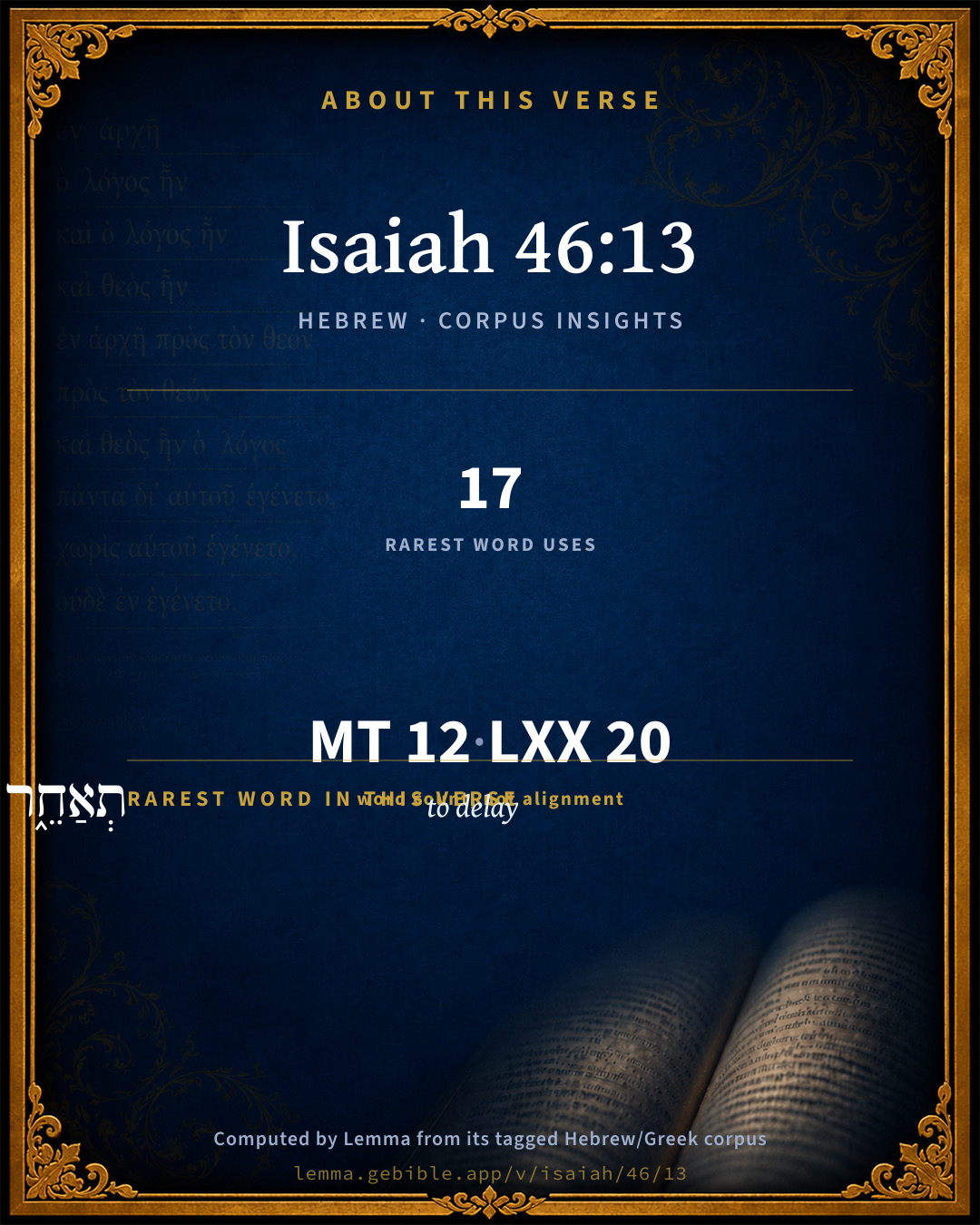
The rarest word here is תְאַחֵ֑ר to delay H309 — appearing just 17 times in the whole Hebrew Bible.

Shared distinctive vocabulary

תְאַחֵ֑ר to delay H309 occurs in 17 verses of the Hebrew Bible. Also found in:

Grammatical profile

  • 4 verbs
  • 6 nouns
  • 2 particles

Verb forms

  • קֵרַ֤בְתִּי Piel · Perfect
  • תִרְחָ֔ק Qal · Imperfect
  • תְאַחֵ֑ר Piel · Imperfect
  • וְנָתַתִּ֤י Qal · Sequential Perfect

Repetition

Words recur within this verse — often emphatic in Hebrew:

  • וּתְשׁוּעָתִ֖י salvation H8668 ×2
  • לֹ֣א not H3808 ×2

Hebrew & Septuagint length

In English translation the verse runs 28 words from the Hebrew and 29 from the Septuagint (LXX English) — closely comparable.

A rough comparison of the two English renderings, which tokenize alike — not a word-level alignment.

Word counts can differ between the Hebrew and the Greek without any difference in meaning — e.g. the Hebrew direct-object marker אֵת has no separate Greek word, and Greek often adds the article ὁ.

In the original languages it is 12 Hebrew tokens and 20 Greek tokens — but the two are counted differently (Hebrew bundles its prefixes and suffixes into one token; the Greek is in lemma form), so that isn’t a like-for-like length.

Cross-references

25

Topical passages linked to Isaiah 46:13 in the Treasury of Scripture Knowledge — connected by theme and wording, ordered by reader-vote popularity; previews shown in the World English Bible.

  • Isaiah 12:2 Behold, God is my salvation. I will trust, and will not be afraid; for Yah, Yahweh, is my strength and song; and he has become my salvation."
  • Isaiah 61:3 to appoint to those who mourn in Zion, to give to them a garland for ashes, the oil of joy for mourning, the garment of praise for the spirit of heaviness; that they may be called trees of righteousness, the planting of Yahweh, that he may be glorified.
  • Isaiah 62:11 Behold, Yahweh has proclaimed to the end of the earth, Say you to the daughter of Zion, Behold, your salvation comes; behold, his reward is with him, and his recompense before him.
  • Isaiah 51:5 My righteousness is near, my salvation is gone forth, and my arms shall judge the peoples; the isles shall wait for me, and on my arm shall they trust.
  • Isaiah 43:7 everyone who is called by my name, and whom I have created for my glory, whom I have formed, yes, whom I have made.
  • Isaiah 44:23 Sing, you heavens, for Yahweh has done it; shout, you lower parts of the earth; break forth into singing, you mountains, O forest, and every tree therein: for Yahweh has redeemed Jacob, and will glorify himself in Israel.
  • Isaiah 61:11 For as the earth brings forth its bud, and as the garden causes the things that are sown in it to spring forth; so the Lord Yahweh will cause righteousness and praise to spring forth before all the nations.
  • Joel 3:17 "So you will know that I am Yahweh, your God, Dwelling in Zion, my holy mountain. Then Jerusalem will be holy, And no strangers will pass through her any more.
  • Habakkuk 2:3 For the vision is yet for the appointed time, and it hurries toward the end, and won't prove false. Though it takes time, wait for it; because it will surely come. It won't delay.
  • 2 Thessalonians 1:10 when he comes to be glorified in his saints, and to be admired among all those who have believed (because our testimony to you was believed) in that day.
  • 1 Peter 2:6 Because it is contained in Scripture, "Behold, I lay in Zion a chief cornerstone, chosen, and precious: He who believes in him will not be disappointed."
  • Psalms 14:7 Oh that the salvation of Israel would come out of Zion! When Yahweh restores the fortunes of his people, Then Jacob shall rejoice, and Israel shall be glad.
  • Psalms 46:1 God is our refuge and strength, A very present help in trouble.
  • Psalms 46:5 God is in her midst. She shall not be moved. God will help her at dawn.
  • Isaiah 28:16 therefore thus says the Lord Yahweh, Behold, I lay in Zion for a foundation a stone, a tried stone, a precious corner -[stone] of sure foundation: he who believes shall not be in haste.
  • Isaiah 60:21 Your people also shall be all righteous; they shall inherit the land forever, the branch of my planting, the work of my hands, that I may be glorified.
  • Jeremiah 33:9 [This city] shall be to me for a name of joy, for a praise and for a glory, before all the nations of the earth, which shall hear all the good that I do to them, and shall fear and tremble for all the good and for all the peace that I procure to it.
  • Haggai 1:8 Go up to the mountain, bring wood, and build the house. I will take pleasure in it, and I will be glorified," says Yahweh.
  • Romans 1:17 For in it is revealed God's righteousness from faith to faith. As it is written, "But the righteous shall live by faith."
  • Romans 3:21–26 But now apart from the law, a righteousness of God has been revealed, being testified by the law and the prophets;
  • Romans 10:3–15 For being ignorant of God's righteousness, and seeking to establish their own righteousness, they didn't subject themselves to the righteousness of God.
  • Ephesians 1:6 to the praise of the glory of his grace, by which he freely bestowed favor on us in the Beloved,
  • 2 Thessalonians 1:12 that the name of our Lord Jesus may be glorified in you, and you in him, according to the grace of our God and the Lord Jesus Christ.
  • Hebrews 10:37 "In a very little while, He who comes will come, and will not wait.
  • John 17:10 All things that are mine are yours, and yours are mine, and I am glorified in them.

Cross-references courtesy of OpenBible.info (CC BY 4.0).

Hebrew and Greek witnesses Masoretic Hebrew ↔ Greek Septuagint

The same verse in the two great witnesses to the Old Testament, shown verse-for-verse.

These are two independent witnesses, not word-aligned to each other, and the Septuagint is shown in lemma (dictionary) form.

Hebrew Isaiah 46:13 Masoretic · Westminster Leningrad Codex

קֵרַ֤בְתִּי צִדְקָתִי֙ לֹ֣א תִרְחָ֔ק וּתְשׁוּעָתִ֖י לֹ֣א תְאַחֵ֑ר וְנָתַתִּ֤י בְצִיּוֹן֙ תְּשׁוּעָ֔ה לְיִשְׂרָאֵ֖ל תִּפְאַרְתִּֽי

I bring near my righteousness, it shall not be far off, and my salvation shall not wait; and I will place salvation in Zion for Israel my glory.

World English Bible · Public Domain

Greek LXX Isaiah 46:13 Septuagint · lemma form

ἐγγίζω ὁ δικαιοσύνη ἐγώ καί ὁ σωτηρία ὁ παρά ἐγώ οὐ βραδύνω δίδωμι ἐν σιων σωτηρία ὁ ἰσραήλ εἰς δόξασμα

I have brought near my righteousness, and I will not be slow with the salvation that is from me: I have given salvation in Sion to Israel for glory.

LXX2012 (modern English Septuagint) · Public Domain

Hebrew: Westminster Leningrad Codex (CC BY 4.0). Greek: Septuagint (public domain); English from LXX2012 (modern English Septuagint) (Public Domain). How the Septuagint differs from the Hebrew →

Targum (Aramaic paraphrase)

1

The Targum is the ancient Jewish Aramaic paraphrase of the Hebrew Scriptures — an interpretive translation, not the Hebrew text itself. Onkelos (literal) and Pseudo-Jonathan (expansive) render the Torah, and Jonathan the Prophets. Coverage is partial: where no permissively-licensed English translation exists for a verse, only the Aramaic is shown. This is verse-level text, not a word-by-word alignment to the Hebrew.

  1. Targum Jonathan Prophets (Joshua–Malachi)
    קְרִיבָא זַכְוָתִי לָא תִתְרַחֵק וּפוּרְקָנִי לָא יִתְעַכֵּב וְאֶתֵּן בְּצִיוֹן פָּרִיק לְיִשְׂרָאֵל תּוּשְׁבַּחְתִּי:

    My righteousness is nigh, it is not far off, and my salvation shall not tarry: and I will place salvation in Zion, and my glory in Israel.

    Targum Jonathan — Aramaic: “Mikraot Gedolot” (public domain). English: “Sefaria Community Translation” (CC0 1.0 (public-domain dedication)); “London "Chaldee Paraphrase," 1871” (public domain). Text via Sefaria.

Commentary

Notes on Isaiah 46:13 from classic Christian and Jewish commentators (each source and its license shown beneath its notes). The classic Christian expositions comment on the surrounding passage and are grouped to its opening verse, so a note may address several verses; the Jewish commentaries on the Tanakh (Rashi and others) are per-verse, so they appear only where the commentator wrote on this verse.

Lemma curates 59 commentaries, every one of them public domain or Creative Commons licensed, each selected and text-cleaned for this edition rather than reprinted as found. About our sources →

Trapp's Complete Commentary

John Trapp

Isa 46:13 I bring near my righteousness; it shall not be far off, and my salvation shall not tarry: and I will place salvation in Zion for Israel my glory.

Ver. 13. I will bring near my righteousness.] I will suddenly right my wronged people, by Cyrus my servant, but especially by Christ my Son. Therefore it followeth,

I will place salvation in Zion for Israel, my glory.] Or, In Israel, my magnificence - i.e., Now which of your idols can do thus for their worshippers?

John Trapp, A Commentary or Exposition upon All the Books of the Old and New Testament (1647–1656) — public domain. Text from a community e-Sword module.

The Biblical Illustrator

Joseph S. Exell

Isa_46:13

I bring near My righteousness

Justifying righteousness brought near

It appears from a comparison of many texts of Scripture, that when the word righteousness is connected, as in this passage, with salvation, it does not mean the Divine attribute of justice or rectitude, but the work of righteousness wrought out by the Lord Jesus Christ, and which it is the grand design of the Gospel to reveal and make offer of to sinners of mankind for their justification--their salvation.

I. Let us inquire with reference to THE RIGHTEOUSNESS SPOKEN OF, why it is termed, in this and so many other parts of Scripture, the righteousness of God? The Lord terms the work of His Son Jesus Christ--His obedience unto death--His whole endurance of the curse, and fulfilment of the precept of the law, His own, Gods righteousness. There is no difficulty in seeing why it should be called Christs, because He wrought it out. Our question is, Why the obedience unto death of the Lord Jesus Christ is termed the righteousness of God?

1. It is so called, in marked contrast and opposition to mans own fancied righteousness (Rom_10:3).

2. Because it is that which God has, for the sinners justification, devised, provided, and stamped with the seal of His approabation and acceptance.

3. Because it was wrought out by God in the person of His eternal Son--Emmanuel, God manifest in the flesh.

II. WHERE, HOW, AND TO WHAT PARTIES OR PERSONS THE LORD BRINGS THIS RIGHTEOUSNESS NEAR?

1. Where? In the Gospel (Rom_1:16).

2. How? In the free and earnest character of the offers and invitations of the Gospel.

3. To whom? Ye stouthearted that are far from righteousness. Ye that not only have no righteousness but are living at ease,--stout-hearted, careless, and indifferent, for the present, at least, about finding one--I bring near My righteousness to you.

While ye despise it, stout-hearted, I offer it to you; while ye are far from righteousness, righteousness is brought near to you--it is pressed and urged upon you. Improvement--

1. It may occur to some as an objection, What use in bringing near, and freely offering, a salvation to men wholly indifferent about it? There can be no doubt, that so long as men are stout-hearted, and far from righteousness, they cannot, in the very nature of the thing, embrace this righteousness; and the offer of it to them is thus, in one sense, to no purpose. But only in one sense. For, not to speak of believers, who often find their hearts so hard, that till they see invitations to the stout-hearted, they cannot perceive their warrant at all to trust in Christ--the very freeness and universality of the offer, coming with overwhelming grace upon the stout-hearted sinner, may just be among the most powerful means blessed of the Holy Ghost for awakening him to deep and serious concern and thought.

2. That you may see how little weight there is in the objection to the doctrine of Christs righteousness as the ground of justification, observe that we read comparatively seldom in Scripture of the righteousness of Christ--generally of the righteousness of God.

3. We might have remarked, on the question, how the righteousness is brought near, that, besides the freeness and urgency of Gospel offers, the Lord comes specially near at particular seasons, in the events and dealings of His providence. (C. J. Brown.)

Two aspects of salvation

The two verses express a paradox which enters deeply into the thought of the prophet. While salvation is near in point of time, yet Israel is spiritually far from it. Hence the work of salvation or righteousness has two aspects; along with the providential deliverance of which the agent is Cyrus, there is an inward and spiritual salvation which consists in bringing the nation to right thoughts about itself and God. And in this spiritual transformation the instrument is the servant of Jehovah. (Prof. J. Skinner, D. D.)

Jehovahs righteousness and Israels salvation

(with Isa_51:5):--

I. What are these two things--JEHOVAHS RIGHTEOUSNESS AND ISRAELS SALVATION? How are they related to one another and connected with one another? And what in particular is the meaning of the precedence or priority assigned to the one as coming before the other--My righteousness, My salvation?

1. It is very evident that the Lords righteousness must mean, not a Divine attribute, but a Divine work, or effect or manifestation of some kind.

2. A judicial dealing with His enemies, on the part of God, precedes and prepares the way for the deliverance or salvation of His people; and when He brings near the one, the other will not tarry.

3. God must first consult for His own righteous name before He can consult for His peoples complete safety; He must first right Himself before He can consistently and conclusively deliver them. Only in the train of the righteousness of God can His salvation go forth.

II. It may be said that THE LORD BRINGS HIS RIGHTEOUSNESS NEAR, or that it is near, in three senses.

1. In the Gospel offer as a free gift, wholly of grace, not of works at all.

2. In the powerful striving and working of His Spirit.

3. In the believing appropriation of it which His Spirit enables you to make. (R. S.Candlish, D. D.)

I will place salvation in Zion, for Israel My glory

The connection between the use of means and the accomplishment of Divine purposes

I. THE DIVINE PURPOSES WHICH THE SACRED SCRIPTURES REVEAL. They have respect--

1. To the exhibition of Gods glory in the development of His perfections.

2. To the deliverance of mankind from the consequences of sin.

3. To the establishment of Messiahs kingdom in the earth.

4. To the total overthrow of the empire of darkness.

5. To the everlasting happiness of believers in the realms of glory.

II. WHAT MEANS ARE EMPLOYED FOR THE ACCOMPLISHMENT OF THESE PURPOSES.

1. The means which are primary.

(1) The mediatorial character of Christ.

(2) The agency of the Holy Spirit.

(3) The energy of Divine providence.

2. Those means which are subordinate.

(1) The revelation of Gods will in the inspired volume.

(2) The preaching of the Gospel.

(3) The constitution of the Christian Church.

III. THE CONNECTION WHICH EXISTS BETWEEN THE USE OF DIVINELY APPOINTED MEANS AND THE ACCOMPLISHMENT OF THE DIVINE PURPOSES. That such a connection exists we may argue--

1. On the principle of analogy. Through all the works of God there is an evident connection between the means and the end.

2. There is a peculiar fitness in the means to accomplish the end.

3. From Divine authority. That the means shall accomplish the end is the frequent subject of the Divine promise.

4. The evidence of fact further establishes this connection.

5. To deny this connection involves the greatest absurdity.

IV. THE PRACTICAL INFLUENCE OF THE DOCTRINE.

1. Ought we not to consider our personal interest in the subject? We are within the precincts of the Divine purposes, and the means of their accomplishment.

2. This subject strongly inculcates holiness in the disciples of Christ. Both the means and the end seem encircled with a halo of sanctity.

3. We learn our obligation and encouragement in the use of appointed means.

4. Let us be careful that the means we employ are those only of Divine appointment.

5. How dreadful the condition, and dangerous the conduct, of those who oppose the Divine purposes, and despise Divinely appointed means! (J. R. Cooper.)

.

The Biblical Illustrator, edited by Joseph S. Exell (c. 1880s–1900s) — public domain. Text from a community e-Sword module.

Tyndale Open Study Notes

Tyndale Open Resources

46:13 The good news for Israel was that God was coming to set things right (literally I will bring my righteousness near; see 40:9; 51:5). • show my glory to Israel: Unlike a craftsman who bestows material splendor on an idol (44:13), the Lord bestows true dignity on his people.

Tyndale Open Study Notes — © Tyndale Open Resources, licensed CC BY-SA 4.0. Text via the HelloAO Bible API.

Geneva Bible (1599)

Geneva Bible translators

He showeth that man’s incredulity cannot abolish the promise of God, Rom. 3:3.

Geneva Bible (1599) marginal notes — public domain. Text via Bolls.life.

Jamieson, Fausset & Brown

Robert Jamieson, A. R. Fausset & David Brown

near--antithetical to "far" (Isa 46:12; Isa 51:5; Isa 56:1; Isa 61:10-11; Rom 10:6-8).

righteousness--answering to "salvation" in the parallel clause; therefore it means here, "my righteous deliverance"; righteous, because proving the truth of God's promises, and so contrived as to not compromise, but vindicate, His righteousness (Isa 42:21; Rom 3:26).

Zion . . . my glory--rather, "I will give salvation in Zion; to Israel (I will give) my glory" [HORSLEY]. (Isa 63:11; Psa 14:7; Luk 2:32).

Next: Isaiah Chapter 47

Jamieson, Fausset & Brown — Commentary Critical and Explanatory on the Whole Bible (1871) — public domain (CC PDM 1.0). Text via the HelloAO Bible API.

The Cambridge Bible for Schools and Colleges

gen. ed. J. J. S. Perowne

13. for Israel my glory] Cf. Isa_49:3. But another possible translation is “I will give … my glory unto Israel” (R.V. marg.).

The two verses express a paradox which enters deeply into the thought of the prophet. While salvation is near in point of time, yet Israel is spiritually far from it. Hence the work of salvation or righteousness has two aspects; along with the providential deliverance of which the agent is Cyrus, there is an inward and spiritual salvation which consists in bringing the nation to right thoughts about itself and God. And in this spiritual transformation the instrument is the Servant of Jehovah.

The Cambridge Bible for Schools and Colleges (gen. ed. J. J. S. Perowne; Cambridge University Press, 1878–1918) — public domain. Text from a community e-Sword module.

John Gill's Exposition

I bring near my righteousness, it shall not be far off,.... Meaning either the faithfulness of God, in fulfilling his promises; or the justice of God displayed, in redemption by Christ; or Christ himself, God's righteous One, and the Lord our righteousness; or rather the righteousness of Christ itself, which Jehovah the Father may call his, because he sent his Son to work it out, approved of it, accepted it, and imputes it to his people, and justifies them by it; and which was near to be wrought out by Christ, and revealed in the Gospel; and which is brought near and applied by the Spirit of God to a sensible sinner, to a sinner convinced of the insufficiency of his own righteousness, and of the suitableness and excellency of Christ's, and of his need of it; and which is near in Christ, and in the Gospel, for faith to come at, at any time; nor is it ever far off from the believer, to whom it is imputed, and on whom it is put:

and my salvation shall not tarry; either Christ, who is God's salvation, provided and appointed by him, who was to come as a Saviour, and should not tarry; nor did he tarry beyond the appointed time, Hab 2:3 or the salvation itself wrought out by him; this work is done by Christ, and is published in the Gospel, and is brought nigh and applied by the Spirit of God in conversion, in due and proper time, and shortly will be fully enjoyed in heaven:

and I will place salvation in Zion for Israel my glory: the Saviour himself was to come to Zion; near to Zion was salvation wrought out; here the Gospel of salvation was first published, and out of it the word of it was sent into all the world; and in Zion, the church of God, Christ the Saviour is to be met with; and his salvation is the safety of it, it is placed about it instead of walls and bulwarks; and all this is for the Israel of God, the spiritual Israel, chosen, redeemed, and called, and who shall be saved with an everlasting salvation; and who are the glory of God, have the glory of God, the grace of God in them, and the righteousness of God upon them, by which they are glorious; who enjoy the presence of the glorious God, and who is glorified in them, and by them; whose glory, even the glory of all his perfections, wisdom, grace, mercy, justice, holiness, truth, and faithfulness, is great in their salvation. So Kimchi gives the sense of the words,

"the salvation I will give to them shall be glory to me,''

Or Israel may be called his glory, because he gives glory to them; not only grace here, but glory hereafter, when their salvation wilt be complete, that is, completely enjoyed.

Next: Isaiah Chapter 47

John Gill's Exposition of the Whole Bible (1746–1763) — public domain (CC PDM 1.0). Text via the HelloAO Bible API.

Albert Barnes' Notes on the Bible

I bring near my righteousness - The word ‘righteousness’ here evidently denotes his truth; the fulfillment of his promises. His righteous and true character would be manifested to them so plainly and clearly that they would be able no longer to doubt. It would not be remote in time, or in place, but it would be so near that they could see it, and so plain that they could no longer doubt or misunderstand it.

And my salvation shall not tarry - The people shall be delivered from their bondage at the exact time which has been predicted.

I will place salvation in Zion - Zion or Jerusalem shall be rebuilt, and salvation shall emanate from that as from a center to the whole world.

Israel my glory - The people whom he had chosen, and who reflected his glory. God’s honor and glory on earth are seen in, and by the church, and he designs that the church shall be the means of making his glory known among people. Or it may mean I will give my glory to Israel. I will show to them my perfections, and will make their nation the place of the manifestations of my glorious attributes.

Albert Barnes' Notes on the Bible (1834–1885) — public domain. Text from a community e-Sword/MySword module.

Matthew Poole's English Annotations

I bring near my righteousness: though you are most unrighteous persons, and have given me just cause to make you to know my breach of promise, as I threatened in the like case, Num 14:34; yet I will show myself to be a righteous and faithful God, making good my promise of delivering you out of Babylon after seventy years; and though you think the time long, and are apt to distrust the thing itself, yet it shall come, and that speedily, I will bring it near, or cause it to approach or come unto you, and, as it follows, it shall not tarry beyond the appointed time. It shall not be far off; my work of saving you from the Babylonish captivity.

I will place salvation in Zion; I will bring my people from Babylon to Zion, and there I will save them from all their enemies.

For Israel my glory; in whom I will once again glory as my people, and the illustrious monuments of my glorious wisdom, and power, and truth, and goodness; whom I will make a great and glorious people, though now they are mean and contemptible, and in whom I will once more settle my glorious presence and ordinances.

Matthew Poole's English Annotations on the Holy Bible (1683–1685) — public domain. Text from a community e-Sword/MySword module.

The Pulpit Commentary

I bring near my righteousness; i.e. "my righteous judgment is approaching that judgment which involves vengeance on my enemies, mercy and deliverance to my people." This latter is the salvation that shall not tarry. In Zion. The headquarters of the "salvation" shall once more be Mount Zion, or Jerusalem, where God"s people shall once more take up their abode, and which shall be "the centre of the renovated nation" (Delitzsch).

God"s people are God"s glory.

"For Israel my glory." He glories in them. He is glorified in them. He ought to be glorified in them. Some read the clauses from which the text is taken so as to throw out a different meaning: "And I appoint in Zion salvation, unto Israel (I give) my glory." God"s glory is thus represented as connected with his salvation and his righteousness. God"s glory is his faithfulness and his redemption. As we have so often the declaration of God"s interest in Israel, his joy in her, and the honour he expects her to be to him, we take the simpler thought suggested by the English Version, and suggest such a homily as may be suitable for a week-night service or prayer-meeting. God"s people are God"s glory; they bring honour to him, as we see

I WHAT HE DOES FOR THEM. Illustrate from God"s moving away all obstacles, and constraining unlikely agents to serve him in the restoring of the exiles to their loved city and country.

II WHAT HE DOES IN THEM By the very delay of his promise, and by his gracious sanctifyings, preparing them to get the very best moral and spiritual blessings out of their deliverance.

III WHAT HE DOES WITH THEM. Making them a spectacle and a witness for himself, to their own age and the surrounding nations; and making the marvel of their story a testimony to his faithfulness and mercy to all ages, until the end of the world shall come. R.T.

The Pulpit Commentary (1880–1919), ed. H.D.M. Spence-Jones & Joseph S. Exell — public domain. Text from a community e-Sword module.

John Wesley's Explanatory Notes

I bring - Tho' you are unrighteous, I will shew myself a righteous and faithful God, making good my promise of delivering you out of Babylon after seventy years. It - My work of saving you from the Babylonish captivity. Will place - I will bring my people to Zion, and save them from all their enemies. My glory - In whom I will once again glory as my people.

John Wesley, Explanatory Notes Upon the Whole Bible (1754–1765) — public domain. Text via the GEBible commentary corpus.

J. A. Alexander on Isaiah

Joseph Addison Alexander

“I have brought near my righteousness, it shall not be far off; and my salvation, it shall not tarry; and I will give (or place) in Zion my salvation, to Israel my glory.” Because righteousness and salvation frequently occur as parallel expressions, most of the modern German writers treat them as synonymous, whereas one denotes the cause and the other the effect, one relates to God and the other to man. The sense in which salvation can be referred to the righteousness of God is clear from Isa 1:27. The exhibition of God’s righteousness consists in the salvation of His people and the simultaneous destruction of His enemies. To these two classes it was therefore at the same time an object of desire and dread. The stouthearted mentioned in v. 12 were not prepared for it, and, unless they were changed, must perish when God’s righteousness came near. The last words admit of two constructions, one of which repeats the verb and makes it govern the last noun (I will give my glory unto Israel); the other makes the clause a supplement to what precedes, “I will give salvation in Zion unto Israel (who is) my glory.” For illustration of the latter, see Isa 44:23; Isa 62:3; Jer 33:9. The other construction has more of the parallel or balanced form which is commonly considered characteristic of Hebrew composition. In sense they ultimately coincide, since Israel could become Jehovah’s glory only by Jehovah’s glory being bestowed upon him.

Joseph Addison Alexander, The Prophecies of Isaiah (1846–1847; New York: Scribner, 1870–1878) — public domain. Text from a community e-Sword module.

Rashi

Rabbi Shlomo Yitzchaki (Rashi)

I have brought near My righteousness from now on, and it will not be far off.

Rashi on the Tanakh — English translations: “The Judaica Press complete Tanach with Rashi, translated by A. J. Rosenberg” (CC BY 4.0); “Pentateuch with Rashi's commentary by M. Rosenbaum and A.M. Silbermann, 1929-1934” (public domain); “The Metsudah Tanach series, Lakewood, N.J” (CC BY 4.0); and “The Book of Joshua, Metsudah Publications, 1997” (CC BY 4.0). Text via Sefaria.

Ibn Ezra

Rabbi Abraham ibn Ezra

I bring near my righteousness, to show it, and therefore It shall not be, etc.

לא תאחר Shall not tarry. Literally: shall not stay itself with me too long before coming, for תאחר is a transitive verb. It is a figurative expression.

ונתתי And I will place is to be repeated before לישראל. The phrase תפארתי לישראל is therefore to be rendered thus: And I will place my glory in Israel. It may also be explained thus: to Israel, who is my glory; comp. in whom I will be glorified (49:3); the latter explanation is the better.

Ibn Ezra on the Tanakh — English translations: “Sefaria Community Translation” (CC0 1.0 (public-domain dedication)); “Yalkut, Sifsei Chachomim Chumash, Metsudah Publications, 2009” (CC BY 4.0); and “Commentary of Ibn Ezra on Isaiah - trans. by M. Friedlander, 1873” (public domain). Text via Sefaria.

Lesson kit

Teaching starters — assembled from the data on this page, not authored interpretation. Every prompt links to the verse data it draws on. Edit before teaching.

Isaiah, in the Prophets, opens this verse with 12 words (10 distinct Hebrew lemmas). Its most distinctive word is ʼâchar (“to delay”). A historical commentator’s framing appears above. Read the whole chapter for the surrounding context.

Discussion questions

  1. How does “to delay” (ʼâchar) shape what this verse is saying?
  2. How does Genesis 24:56, which shares the word «to delay», read alongside this verse?
  3. What does the repetition of “salvation” (2× in this one verse) do in this verse?
  4. These translations render this verse differently; the difference is in the English rendering, not the original. What questions does that raise?
  5. «קֵרַ֤בְתִּי» is a Piel Perfect verb. How does that grammatical form shape the action described?
  6. Compare how Trapp's Complete Commentary and The Biblical Illustrator read this verse. Where do they agree or differ?

Things to notice

Reading settings

Reading text

Shown beneath each verse's original-language words.

Old Testament
Old Testament edition

Read the OT as the Masoretic Hebrew (MT) or the Greek Septuagint (LXX).

English shown for the Greek Septuagint (in the Hebrew ↔ Greek comparison).

Comparing translations? Open the Compare panel on any verse page to stack up to four side by side.