
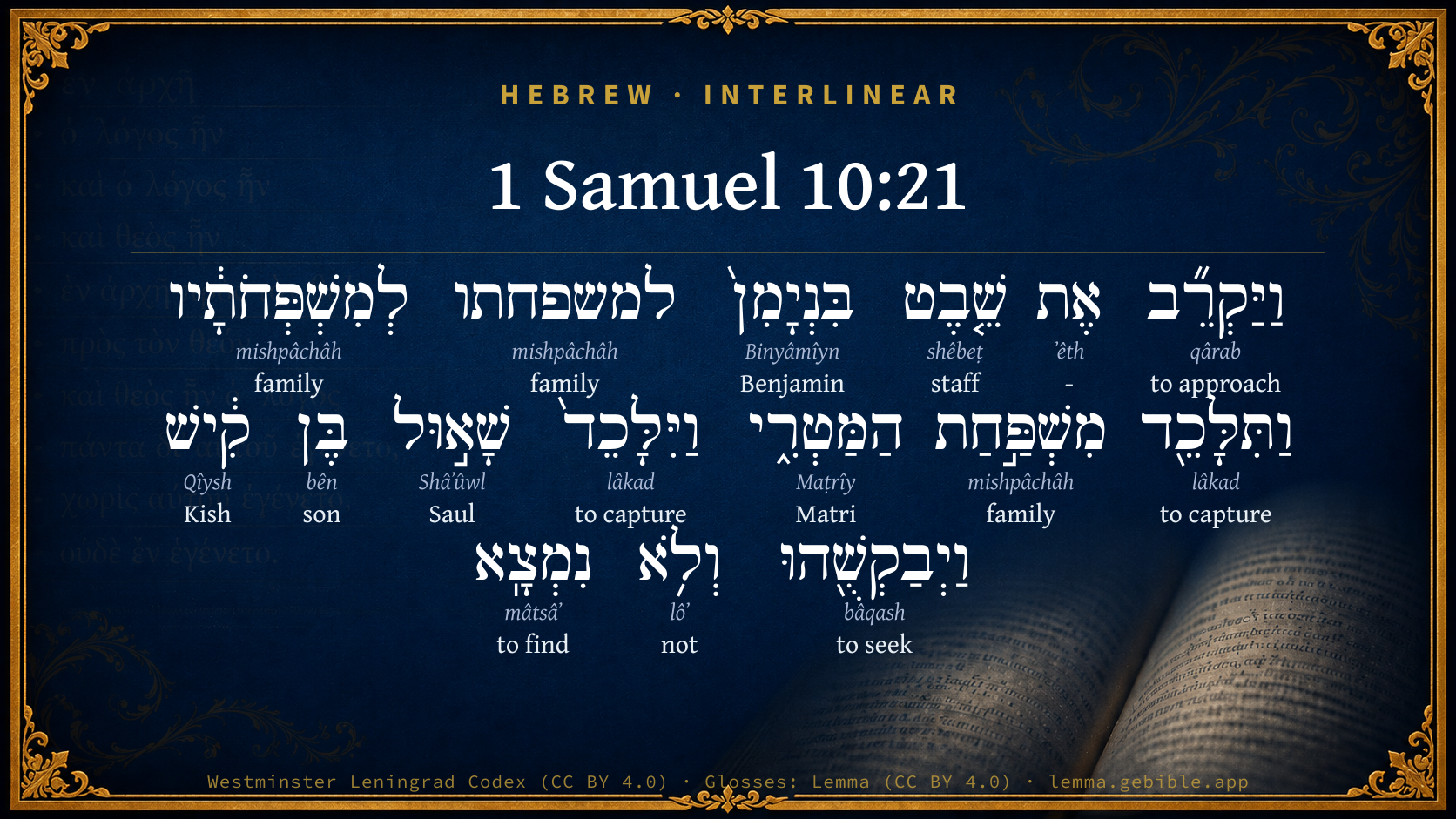
1 Samuel 10:21

Hebrew (Westminster Leningrad Codex) 1 Samuel 10:21 appears in the Hebrew Old Testament. The text above is from the Westminster Leningrad Codex. Each word links to its Strong’s number, a concise gloss, and parsing drawn from the Open Scriptures Hebrew Bible morphology. Click any word for its full Brown-Driver-Briggs (BDB) entry.
Download image
Cite this verse

1 Samuel 10:21 (World English Bible). Public Domain. Lemma interlinear Bible study tool, https://lemma.gebible.app/v/1-samuel/10/21.

Show BibTeX & RIS
BibTeX
RIS
English Translation
He brought the tribe of Benjamin near by their families; and the family of the Matrites was taken; and Saul the son of Kish was taken: but when they sought him, he could not be found.
World English Bible · Public Domain
Highlights
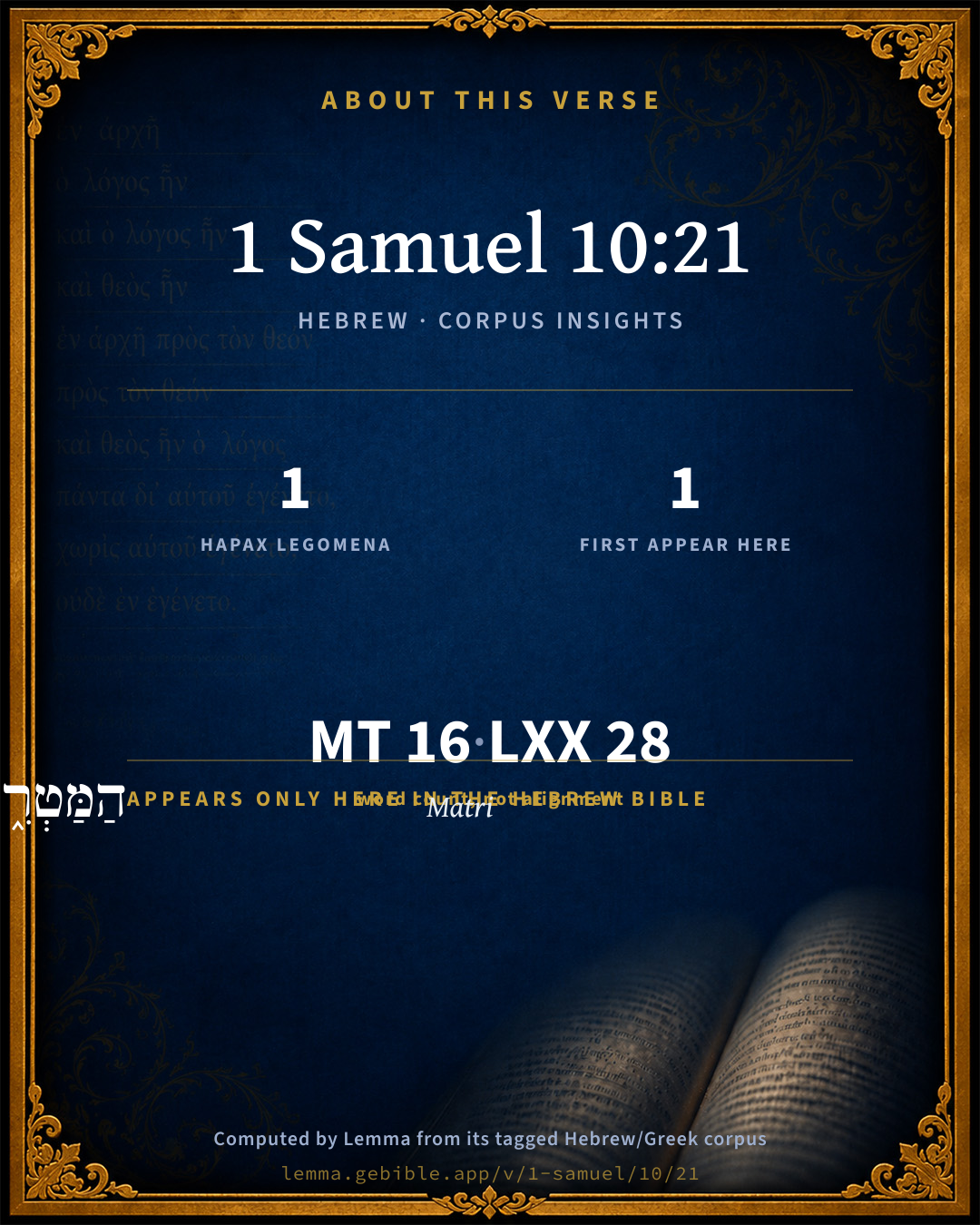
  • 1 hapax legomenon — only here in the Hebrew Bible
  • 1 first appearance in the Hebrew Bible
Full analysis ↓
Download a study sheet

One document with this verse’s original text, its word-by-word gloss line, the meaning frame, cross-references with their text, attributed commentary, and full source and license credits — printable, and it pastes into notes with its structure intact.

This verse Autodidact and up

Study sheet (.html) Plain text (.txt)

A passage Seminary Student

Up to 50 verses in one chapter. A passage sheet keeps up to 6 commentary sources and 12 cross-references per verse, in the order this page ranks them, and says so on the sheet whenever that leaves anything out. Ask for a single verse and you get the Autodidact verse sheet above.

Everything on this page stays free to read, with no account — the sheet is a download of what is already on screen, not access to it.

Want to remove ads? Support Godless Engineer
Compare translations 3

The same verse in 3 English versions, stacked beneath the original-language interlinear above. Click any original word for its lexicon entry.

Each is an independent rendering of the whole verse — the interlinear is not word-aligned to these translations.

Highlighted words mark where these versions differ — a whole-verse word diff, not a word-by-word alignment.

  • World English Bible Public Domain
    He brought the tribe of Benjamin near by their families; and the family of the Matrites was taken; and Saul the son of Kish was taken: but when they sought him, he could not be found.
  • King James Version Public Domain
    When he had caused the tribe of Benjamin to come near by their families, the family of Matri was taken, and Saul the son of Kish was taken: and when they sought him, he could not be found.
  • unfoldingWord Literal Text CC BY-SA 4.0
    And he brought near the tribe of Benjamin according to its clans, and the clan of the Matrite was taken. And Saul, the son of Kish, was taken, so they sought him, but he was not found.

unfoldingWord Literal Text — © unfoldingWord, licensed CC BY-SA 4.0. Word-aligned USFM3 via Door43 (git.door43.org/unfoldingWord/en_ult).

Versions to compare (up to 4)

3 of 4 selected

Show all 18 translations

Every available English version of this verse, each an independent rendering of the whole verse.

  • World English Bible Public Domain
    He brought the tribe of Benjamin near by their families; and the family of the Matrites was taken; and Saul the son of Kish was taken: but when they sought him, he could not be found.
  • Berean Standard Bible Public Domain
    Then he had the tribe of Benjamin come forward by its clans, and the clan of Matri was selected. Finally, Saul son of Kish was selected. But when they looked for him, they could not find him.
  • Majority Standard Bible Public Domain
    Then he had the tribe of Benjamin come forward by its clans, and the clan of Matri was selected. Finally, Saul son of Kish was selected. But when they looked for him, they could not find him.
  • King James Version Public Domain
    When he had caused the tribe of Benjamin to come near by their families, the family of Matri was taken, and Saul the son of Kish was taken: and when they sought him, he could not be found.
  • American Standard Version (1901) Public Domain
    And he brought the tribe of Benjamin near by their families; and the family of the Matrites was taken; and Saul the son of Kish was taken: but when they sought him, he could not be found.
  • Revised Version (1885) Public Domain
    And he brought the tribe of Benjamin near by their families, and the family of the Matrites was taken: and Saul the son of Kish was taken; but when they sought him, he could not be found.
  • Geneva Bible (1599) Public Domain
    Afterwarde he assembled the tribe of Beniamin according to their families, and the familie of Matri was taken. So Saul the sonne of Kish was taken, and when they sought him, he coulde not be found.
  • Douay-Rheims (1899) Public Domain
    And he brought the tribe of Benjamin and the kindreds thereof, and the lot fell Upon the kindred of Metri, and it came to Saul the son of Cis. They sought him therefore and he was not found.
  • Young's Literal Translation Public Domain
    and he bringeth near the tribe of Benjamin by its families, and the family of Matri is captured, and Saul son of Kish is captured, and they seek him, and he hath not been found.
  • Literal Standard Version CC BY-SA 4.0
    and he brings the tribe of Benjamin near by its families, and the family of Matri is captured, and Saul son of Kish is captured, and they seek him, and he has not been found.
  • Unlocked Literal Bible CC BY-SA 4.0
    Then he brought the tribe of Benjamin near by their clans; and the clan of the Matrites was chosen; and Saul son of Kish was chosen. But when they went looking for him, he could not be found.
  • unfoldingWord Literal Text CC BY-SA 4.0
    And he brought near the tribe of Benjamin according to its clans, and the clan of the Matrite was taken. And Saul, the son of Kish, was taken, so they sought him, but he was not found.
  • Darby Bible Public Domain
    And he caused the tribe of Benjamin to come near by their families, and the family of Matri was taken; and Saul the son of Kish was taken. And they sought him, but he was not to be found.
  • World Messianic Bible Public Domain
    He brought the tribe of Benjamin near by their families and the family of the Matrites was chosen. Then Saul the son of Kish was chosen; but when they looked for him, he could not be found.
  • Webster's Bible Public Domain
    When he had caused the tribe of Benjamin to come near by their families, the family of Matri was taken, and Saul the son of Kish was taken: and when they sought him, he could not be found.
  • Free Bible Version CC BY-SA 4.0
    Then he had the tribe of Benjamin come forward by its family groups, and the family group of Matri was chosen. Lastly, Saul, son of Kish, was chosen. But when they looked for him, he couldn't be found.
  • Bible in Basic English Public Domain
    Then he made the tribe of Benjamin come near by families, and the family of the Matrites was taken: and from them, Saul, the son of Kish, was taken: but when they went in search of him he was nowhere to be seen.
  • JPS Tanakh (1917) Public Domain
    And he brought the tribe of Benjamin near by their families, and the family of the Matrites was taken; and Saul the son of Kish was taken; but when they sought him, he could not be found.

Literal Standard Version (2020), Covenant Press — licensed CC BY-SA 4.0. Text via the HelloAO Bible API (eBible.org). Unlocked Literal Bible (unfoldingWord) — licensed CC BY-SA 4.0. Text via the HelloAO Bible API (eBible.org). unfoldingWord Literal Text — © unfoldingWord, licensed CC BY-SA 4.0. Word-aligned USFM3 via Door43 (git.door43.org/unfoldingWord/en_ult). Free Bible Version, Dr. Jonathan Gallagher — licensed CC BY-SA 4.0. Text via the HelloAO Bible API (eBible.org).

Word by word

More ways to search: Search by grammar → Find every occurrence → Compare this word →

Practice this passage: Drill this verse → Learn its vocabulary →

הַמַּטְרִ֑י
Maṭrîy
H4309
“the · Matri”
Particle, Definite Article + Noun, Gentilic, Masculine, Singular, Absolute
Part of Speech
Particle + Noun
Type
Gentilic
Gender
Masculine
Number
Singular
State
Absolute
Full BDB Definition

Origin: from H4305

TWOT: None

Matri = "rain of Jehovah" - a family of the tribe of Benjamin to which king Saul belonged
  1. וַיַּקְרֵ֞ב qârab H7126 “and · to approach” Conjunction + Verb, Hiphil, Sequential Imperfect, 3rd Person, Masculine, Singular
  2. אֶת ʼêth H853 “-” Particle, Direct Object
  3. שֵׁ֤בֶט shêbeṭ H7626 “staff of” Noun, Common, Masculine, Singular, Construct
  4. בִּנְיָמִן֙ Binyâmîyn H1144 “Benjamin” Noun, Proper
  5. למשפחתו mishpâchâh H4940 “to/for · families · his” Preposition + Noun, Common, Feminine, Plural, Construct + Suffix, Personal, 3rd Person, Masculine, Singular
  6. לְמִשְׁפְּחֹתָ֔יו mishpâchâh H4940 “to/for · families · his” Preposition + Noun, Common, Feminine, Plural, Construct + Suffix, Personal, 3rd Person, Masculine, Singular
  7. וַתִּלָּכֵ֖ד lâkad H3920 “and · to capture” Conjunction + Verb, Niphal, Sequential Imperfect, 3rd Person, Feminine, Singular
  8. מִשְׁפַּ֣חַת mishpâchâh H4940 “family of” Noun, Common, Feminine, Singular, Construct
  9. וַיִּלָּכֵד֙ lâkad H3920 “and · to capture” Conjunction + Verb, Niphal, Sequential Imperfect, 3rd Person, Masculine, Singular
  10. שָׁא֣וּל Shâʼûwl H7586 “Saul” Noun, Proper
  11. בֶּן bên H1121 “son of” Noun, Common, Masculine, Singular, Construct
  12. קִ֔ישׁ Qîysh H7027 “Kish” Noun, Proper
  13. וַיְבַקְשֻׁ֖הוּ bâqash H1245 “and · to seek · him” Conjunction + Verb, Piel, Sequential Imperfect, 3rd Person, Masculine, Plural + Suffix, Personal, 3rd Person, Masculine, Singular
  14. וְלֹ֥א lôʼ H3808 “and · not” Conjunction + Particle, Negative
  15. נִמְצָֽא mâtsâʼ H4672 “to find” Verb, Niphal, Perfect, 3rd Person, Masculine, Singular

About this verse

These counts appear in no published source. They are computed here, from the morphology-tagged text and Lemma’s own curated glosses. What Lemma adds →

16
words
13
distinct lemmas
Historical
section

Notable vocabulary

1 hapax legomenon — a word that appears only here in the entire Hebrew Bible:

  • הַמַּטְרִ֑י Matri H4309

First appearance in Scripture

This word makes its first canonical appearance in the Hebrew Bible here:

  • הַמַּטְרִ֑י Matri H4309

Shared distinctive vocabulary

קִ֔ישׁ Kish H7027 occurs in 17 verses of the Hebrew Bible. Also found in:

Grammatical profile

  • 5 verbs
  • 9 nouns
  • 2 particles

Verb forms

  • וַיַּקְרֵ֞ב Hiphil · Sequential Imperfect
  • וַתִּלָּכֵ֖ד Niphal · Sequential Imperfect
  • וַיִּלָּכֵד֙ Niphal · Sequential Imperfect
  • וַיְבַקְשֻׁ֖הוּ Piel · Sequential Imperfect
  • נִמְצָֽא Niphal · Perfect

Repetition

Words recur within this verse — often emphatic in Hebrew:

  • למשפחתו family H4940 ×3
  • וַתִּלָּכֵ֖ד to capture H3920 ×2

Hebrew & Septuagint length

In English translation the verse runs 36 words from the Hebrew and 47 from the Septuagint (LXX English) — closely comparable.

A rough comparison of the two English renderings, which tokenize alike — not a word-level alignment.

Word counts can differ between the Hebrew and the Greek without any difference in meaning — e.g. the Hebrew direct-object marker אֵת has no separate Greek word, and Greek often adds the article ὁ.

In the original languages it is 16 Hebrew tokens and 28 Greek tokens — but the two are counted differently (Hebrew bundles its prefixes and suffixes into one token; the Greek is in lemma form), so that isn’t a like-for-like length.

Hebrew and Greek witnesses Masoretic Hebrew ↔ Greek Septuagint

The same verse in the two great witnesses to the Old Testament, shown verse-for-verse.

These are two independent witnesses, not word-aligned to each other, and the Septuagint is shown in lemma (dictionary) form.

Hebrew 1 Samuel 10:21 Masoretic · Westminster Leningrad Codex

וַיַּקְרֵ֞ב אֶת שֵׁ֤בֶט בִּנְיָמִן֙ למשפחתו לְמִשְׁפְּחֹתָ֔יו וַתִּלָּכֵ֖ד מִשְׁפַּ֣חַת הַמַּטְרִ֑י וַיִּלָּכֵד֙ שָׁא֣וּל בֶּן קִ֔ישׁ וַיְבַקְשֻׁ֖הוּ וְלֹ֥א נִמְצָֽא

He brought the tribe of Benjamin near by their families; and the family of the Matrites was taken; and Saul the son of Kish was taken: but when they sought him, he could not be found.

World English Bible · Public Domain

Greek LXX 1 Samuel 10:21 Septuagint · lemma form

καί προςἄγω σκῆπτρον βενιαμίν εἰς φυλή καί κατακληρόω φυλή ματταρι καί προςἄγω ὁ φυλή ματταρι εἰς ἀνήρ καί κατακληρόω σαούλ υἱός κις καί ζητέω αὐτός καί οὐ εὑρίσκω

And he brings near the tribe of Benjamin by families, and the family of Mattari is taken by lot: and they bring near the family of Mattari, man by man, and Saul the son of Kis is taken; and he sought him, but he was not found.

LXX2012 (modern English Septuagint) · Public Domain

Hebrew: Westminster Leningrad Codex (CC BY 4.0). Greek: Septuagint (public domain); English from LXX2012 (modern English Septuagint) (Public Domain). How the Septuagint differs from the Hebrew →

Targum (Aramaic paraphrase)

1

The Targum is the ancient Jewish Aramaic paraphrase of the Hebrew Scriptures — an interpretive translation, not the Hebrew text itself. Onkelos (literal) and Pseudo-Jonathan (expansive) render the Torah, and Jonathan the Prophets. Coverage is partial: where no permissively-licensed English translation exists for a verse, only the Aramaic is shown. This is verse-level text, not a word-by-word alignment to the Hebrew.

  1. Targum Jonathan Prophets (Joshua–Malachi)
    וְקָרֵיב יַת שִׁבְטָא דְבִנְיָמִין לְזַרְעֲיָתֵהּ וְאִתְאֲחָדַת זַרְעִית מַטְרִי וְאִתְאֲחַד שָׁאוּל בַּר קִישׁ וּבָעוּהִי וְלָא אִשְׁתְּכַח:

    (no public-domain English translation for this verse)

    Targum Jonathan — Aramaic: “Mikraot Gedolot” (public domain). English: “Sefaria Community Translation” (CC0 1.0 (public-domain dedication)); “London "Chaldee Paraphrase," 1871” (public domain). Text via Sefaria.

Commentary

Notes on 1 Samuel 10:21 from classic Christian and Jewish commentators (each source and its license shown beneath its notes). The classic Christian expositions comment on the surrounding passage and are grouped to its opening verse, so a note may address several verses; the Jewish commentaries on the Tanakh (Rashi and others) are per-verse, so they appear only where the commentator wrote on this verse.

Lemma curates 59 commentaries, every one of them public domain or Creative Commons licensed, each selected and text-cleaned for this edition rather than reprinted as found. About our sources →

Trapp's Complete Commentary

John Trapp

1Sa 10:21 When he had caused the tribe of Benjamin to come near by their families, the family of Matri was taken, and Saul the son of Kish was taken: and when they sought him, he could not be found.

Ver. 21. The family of Matri was taken.] Which is not the name of a man - see 1Ch 8:30; but signifieth a mark, saith one out of Lyra; whence he eoncludeth that the family of Matri was of those that could shoot at a mark so excellently. {Jdg 20:16} Fides sit penes Authorem.

John Trapp, A Commentary or Exposition upon All the Books of the Old and New Testament (1647–1656) — public domain. Text from a community e-Sword module.

Joseph Benson's Commentary

1Sa 10:21. When they sought him, he could not be found — Having withdrawn himself, either out of feebleness of spirit, as some think, or rather out of modesty, he declined so high an authority unless imposed upon him. Or perhaps he was discouraged, and even affrighted, when he heard Samuel still representing God as offended with them for asking a king; which he might think was to reject his government.

Joseph Benson's Commentary on the Old and New Testaments (1811–1818) — public domain. Text from a community e-Sword module.

Adam Clarke's Commentary

Verse 21. When they sought him, he could not be found.] Through modesty or fear he had secreted himself.

Adam Clarke's Commentary on the Bible (1810–1826) — public domain. Text from a community e-Sword/MySword module.

Ellicott's Commentary for English Readers

(21) The family of Matri was taken.—In none of the Benjamite genealogies connected with the royal house of Saul does this name occur. We cannot account for the omission. Ewald conjectures that the name Matri is a corruption from “Bikri” (see 1Ch_7:8).

A Bible Commentary for English Readers, edited by Charles John Ellicott (1878–1897) — public domain. Text from a community e-Sword module.

The Cambridge Bible for Schools and Colleges

gen. ed. J. J. S. Perowne

21. the family of Matri] The family of the Matrites is nowhere else mentioned. It has therefore been conjectured that we should read Bikrites, or descendants of Becher the son of Benjamin (1Ch_7:6).

Saul the son of Kish was taken] The description of the process of casting lots is abridged. The family taken would be brought by houses, and the house taken then brought by persons. The Sept. inserts “and they bring the family of Mattari man by man,” which must be understood, as in Jos_7:17, to mean the heads of houses only, not all the individuals of the family, which would be far too long a process. In this way Kish would be taken, and finally, when he brought his household forward man by man, Saul was taken.

he could not be found] Natural feelings of modesty and humility prompted Saul to hide himself. He knew already that he was the object of God’s choice, but he would not appear to court advancement, or in any way put himself forward for the royal dignity.

The Cambridge Bible for Schools and Colleges (gen. ed. J. J. S. Perowne; Cambridge University Press, 1878–1918) — public domain. Text from a community e-Sword module.

John Gill's Exposition

Therefore they inquired of the Lord further,.... Or again, by lot, by which they knew who the person was the was chosen king, but they did not know where he was, and therefore inquire further how they must come at him; and this inquiry was made either before the high priest by Urim and Thummim, or by Samuel the prophet of the Lord: and the inquiry was:

if the man should yet come thither; whether he was already come, or would come there, and if not, what methods they must take to find him:

and the Lord answered, behold, he hath hid himself among the stuff the word signifies household stuff, vessels, utensils, arms, &c. which the people had brought along with them for their use, and were laid up in some one place; and among these baggages Saul hid himself, hoping that if he was not found they would proceed to another choice, so free from ambition was he, and such was his modesty; nor does this seem to be affected and dissembled, but real; though afterwards, when he was settled in the kingdom, he did not care to part with it, and sought to kill David, whom he looked upon as his rival: there were many things which now concurred, that made him uneasy and unwilling to assume the government of the people; partly the envy and ill will of some of them, which he must expect; chiefly the sense he had of his own unfitness for such an office, being of a mean family, and having had so mean an education, and so little knowledge of the maxims of government; and besides, must at once, as soon as on the throne, enter into a war with the Ammonites; but what might most of all distress him, he perceived by Samuel's speech to the people, that the affair of a king was displeasing to the Lord, though he condescended to grant the people's request; and therefore what comfort and happiness could he expect in such a situation?

John Gill's Exposition of the Whole Bible (1746–1763) — public domain (CC PDM 1.0). Text via the HelloAO Bible API.

Albert Barnes' Notes on the Bible

The family of Matri - This name occurs nowhere else among the families of Benjamin, or in the genealogy of Saul. (See 1Sa 9:1 note.)

Albert Barnes' Notes on the Bible (1834–1885) — public domain. Text from a community e-Sword/MySword module.

Haydock's Catholic Bible Commentary

Metri. We find none of this name, 1 Paralipomenon viii. 1. It is probably a title which some of the great patriarchs of Benjamin had acquired by shooting, as Metri means "an archer or bowman." (Calmet)

George Leo Haydock (1774–1849), Haydock's Catholic Family Bible and Commentary, 1859 edition — public domain. Excludes Psalms (Douay-Rheims chapter numbering differs from Protestant) and Deuterocanonical books (Catholic canon only).

Whedon's Commentary on the Bible

Daniel D. Whedon

21. Family of Matri — Not mentioned among the families of Benjamin in Num_26:38-41; but probably a new family that arose in Benjamin after the tribal war. See note on 1Sa_9:1.

He could not be found — Saul knew from his former interview with Samuel, what the result of this casting of lots would be, and probably a feeling of mingled reserve, timidity, and embarrassment led him to hide himself.

Daniel D. Whedon (gen. ed.), Commentary on the Old and New Testaments (1874–1909) — public domain. Text from a community e-Sword module.

The Pulpit Commentary

The family of Matri, or of the Matrites. Matri is not mentioned anywhere else; and numerous as are the omissions in the genealogies, we can scarcely suppose that the name of the head of one of the main subdivisions of a tribe could be passed over. The conjecture, therefore, is probable that Matri is a corruption of Bikri, i.e. a descendant of Becher, for whom see 1Ch_7:8. After the lot had fallen upon this family they would next cast lots upon its smaller subdivisions, as in Jos_7:17, Jos_7:18, until at last they came to households, when first Kish, and finally Saul was taken. The latter, foreseeing that this would happen, had concealed himself. For though a noble change had taken place in him (ver. 9), yet no really worthy man was ever promoted to high office without having to overcome his own unwillingness, and no one probably ever worthily discharged solemn duties without having felt oppressed and humbled with the consciousness of his own unfitness to undertake them. As a matter of fact, Saul was now called to a most weighty responsibility, and he failed and was rejected, though not without proving that he was a man of extraordinary genius and power. And it never can be said of him that presumption was the cause of his fall, or that he hastily undertook serious duties in the spirit of light-hearted levity.

The Pulpit Commentary (1880–1919), ed. H.D.M. Spence-Jones & Joseph S. Exell — public domain. Text from a community e-Sword module.

The Preacher's Complete Homiletical Commentary

Joseph S. Exell (gen. ed.)

1Sa_10:22. “They inquired of the Lord … and the Lord answered.” “The inquiry was made through the high priest, by means of the Urim and Thummim. There can be no doubt that in a gathering of the people for so important a purpose, the high priest would also be present, even though this is not expressly stated.” (Keil). “The high-priest’s office was vacant, some other, not Samuel, who presided over the assembly and the election, but a priest, in the high priestly robes, conducted the solemn inquiry, which was exclusively the privilege of the priests.” (Erdmann). “If the man should yet come hither;” rather, has any one else come hither? i.e., besides those here present among whom Saul was not to be found.” (Erdmann). “Among the stuff.” “Rather, the baggage. The assembly was like a camp, and the baggage of the whole congregation was probably collected in one place, where the waggons were arranged for protection.” (Biblical Commentary). “The ground was his diffidence and shyness in respect to appearing publicly before the whole people. Nagelsbach rightly remarks that his hiding behind the baggage during the election is not in conflict with the account of his change of mind. At so decisive a moment, which turns the eyes of all on one with the most diverse feelings, the heart of the most courageous man may well beat.” (Erdmann).

1Sa_10:23. “He was higher than any of the people,” etc. “When in battle much less depended on military skill than upon the bodily prowess of the chief in single combats, or in the partial actions with which most battles commenced, it was natural that the people should take pride in the gigantic proportions of their leader, as calculated to strike terror into the enemy, and confidence into his followers; besides, it was no mean advantage that the crest of the leader should, from his tallness, be seen from afar by his people. The prevalence of this feeling of regard for personal bulk and stature is seen in the sculptures of ancient Egypt, Assyria, and Persia, and even in the modern paintings of the last-named nation, in which the sovereign is invested with gigantic proportions in comparison with the persons around him.” (Kitto).

1Sa_10:24. “God save the king,” Rather, let the king live. The Hebrew is equivalent to the French Vive le Roi.

1Sa_10:25. “Samuel told the people the manner of the kingdom.” On the first establishment of the kingdom it was possible to make conditions and to impose restrictions, to which any future king, royal by birth, and on whom the crown devolved by hereditary right, would not very willingly submit. There can be no doubt that the people, under the infatuation which now possessed them, would have put themselves under the monarchy without any conditions whatever, and it is entirely owing to the wise forethought of Samuel, acting under the Divine direction, that this evil was averted, and the kings of Israel did not become absolute and irresponsible masters of the lives and properties of their subjects.” (Kitto). “This law of the kingdom is not identical with the manner of the king described by Samuel in 1Sa_8:11-18. The Hebrew word rendered manner in both places is mishpat, which properly means judgment, right, law, that which is strictly de jure; but it also signifies usage, manner, custom, that which is de facto, and the mishpat of the kingdom here expresses the former, but the mishpat of the king in chap. 8 comprehends also the latter.” (Wordsworth). “In content it was no doubt essentially the same with the law of the king in Deu_17:14-20, especially 1Sa_10:19-20, and therefore related to the divinely-established rights and duties of the theocratic king, the fulfilment of which the people were authorised to demand from him.” (Erdmann). “Wrote it in a book.” “We find here the first trace, after the written records of Moses, of writing among the prophets, long before the literary activity to which we owe what we have now.” (Erdmann). “Laid it up before the Lord.” “It was, no doubt, placed in the tabernacle, where the law of Moses was also deposited.” (Keil).

1Sa_10:26. “A band of men,” etc.; rather, the host; but “here it does not signify a large military force, but a crowd of brave men whose hearts God had touched to give him a royal escort, and show their readiness to serve him.” (Keil).

1Sa_10:27. “Children of Belial” (see on 1Sa_2:12). “Presents,” Minchah. “The token of homage and acknowledgment from the subject to the sovereign, and from the tributary nation to their suzerain” (see 2Sa_8:2; 2Sa_8:6; Jdg_3:17-18; 1Ki_4:21, etc.). (Biblical Commentary). “But he held his peace.” Literally, “He was as being deaf,” i.e., he acted as if he had not heard.

The Preacher's Complete Homiletical Commentary (gen. ed. Joseph S. Exell; Funk & Wagnalls, c. 1892) — public domain (pre-1929). A full-Bible homiletical/sermon-outline anthology covering 65 of 66 books (2 John is absent from the source module). Text from a community e-Sword module.

Rashi

Rabbi Shlomo Yitzchaki (Rashi)

And Shaul… was singled out. Even though he was not there, the lot fell upon him, for their names were written on pieces of parchment and placed in a box. The prophet would insert his hand and take one piece of parchment.

Rashi on the Tanakh — English translations: “The Judaica Press complete Tanach with Rashi, translated by A. J. Rosenberg” (CC BY 4.0); “Pentateuch with Rashi's commentary by M. Rosenbaum and A.M. Silbermann, 1929-1934” (public domain); “The Metsudah Tanach series, Lakewood, N.J” (CC BY 4.0); and “The Book of Joshua, Metsudah Publications, 1997” (CC BY 4.0). Text via Sefaria.

Lesson kit

Teaching starters — assembled from the data on this page, not authored interpretation. Every prompt links to the verse data it draws on. Edit before teaching.

1 Samuel, in the Historical, opens this verse with 16 words (13 distinct Hebrew lemmas). Its most distinctive word is Maṭrîy (“Matri”). A historical commentator’s framing appears above. Read the whole chapter for the surrounding context.

Discussion questions

  1. The word Maṭrîy carries the sense “Matri.” How does it shape the verse?
  2. This verse holds 1 word here found nowhere else in the Hebrew Bible. What might the rare word draw attention to?
  3. The word “Matri” first appears here in Scripture. What is being introduced at this debut?
  4. 1 Samuel 9:1 shares the word «Kish» with this verse. How do the two illuminate each other?
  5. “family” occurs 3× in this one verse. What is the effect of the repetition?
  6. These translations render this verse differently. What is at stake in choosing one wording over another?
  7. The verb «וַיַּקְרֵ֞ב» is Hiphil Sequential Imperfect. How does its form color the action?
  8. Reading how Trapp's Complete Commentary and Joseph Benson's Commentary read this verse, where do the two commentators agree and where do they part?

Things to notice

  • 1 word in this verse appears nowhere else in the Hebrew Bible.
  • 1 word makes its first canonical appearance in Scripture here.
  • This verse counts 16 Hebrew ↔ 28 Greek words.
  • These translations choose different wording for 14 words in this verse.
  • “family” occurs 3× in this single verse.

Reading settings

Reading text

Shown beneath each verse's original-language words.

Old Testament
Old Testament edition

Read the OT as the Masoretic Hebrew (MT) or the Greek Septuagint (LXX).

English shown for the Greek Septuagint (in the Hebrew ↔ Greek comparison).

Comparing translations? Open the Compare panel on any verse page to stack up to four side by side.