
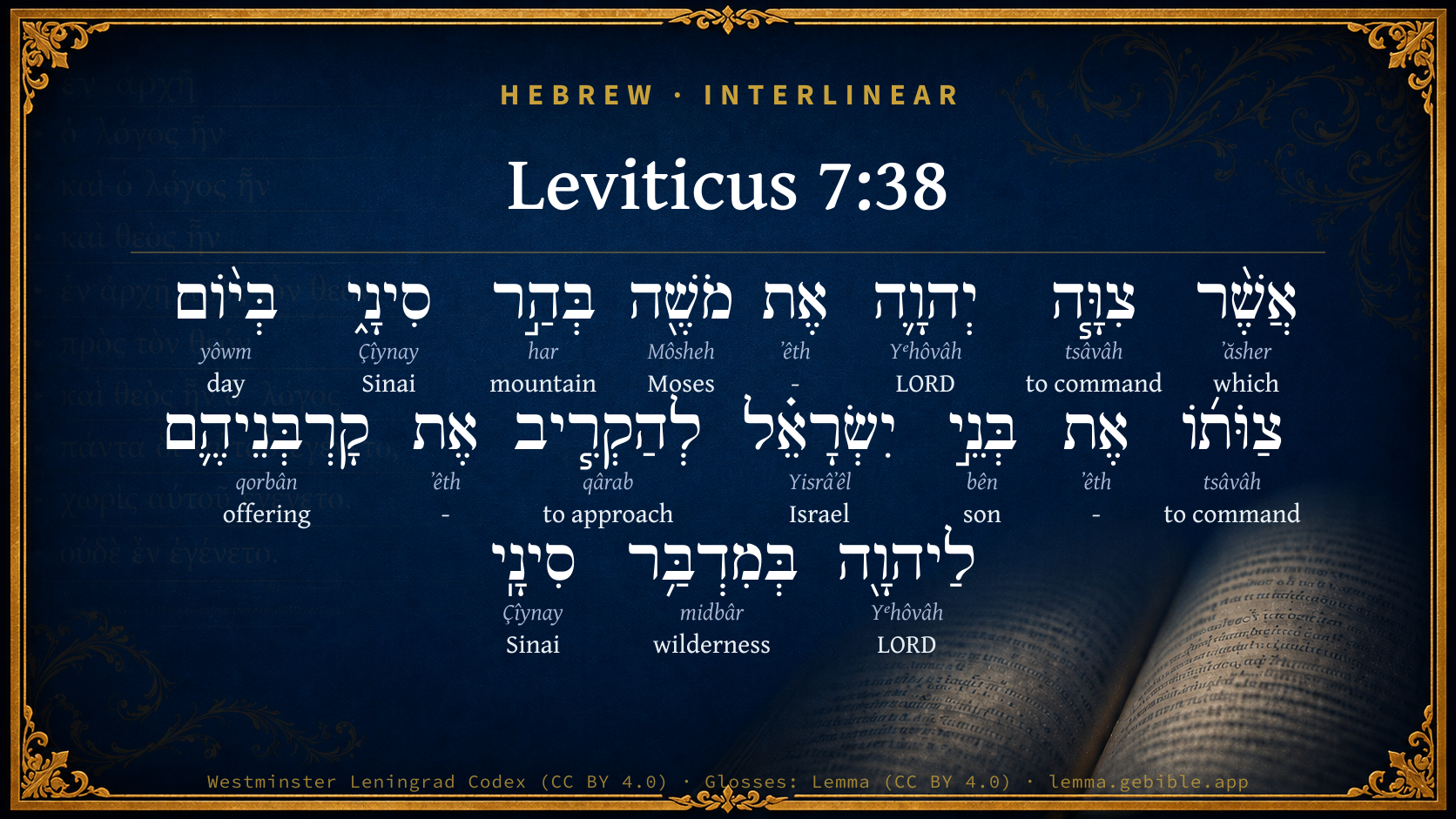
Leviticus 7:38

Hebrew (Westminster Leningrad Codex) Leviticus 7:38 appears in the Hebrew Old Testament. The text above is from the Westminster Leningrad Codex. Each word links to its Strong’s number, a concise gloss, and parsing drawn from the Open Scriptures Hebrew Bible morphology. Click any word for its full Brown-Driver-Briggs (BDB) entry.
Download image
Cite this verse

Leviticus 7:38 (World English Bible). Public Domain. Lemma interlinear Bible study tool, https://lemma.gebible.app/v/leviticus/7/38.

Show BibTeX & RIS
BibTeX
RIS
English Translation
which Yahweh commanded Moses in Mount Sinai, in the day that he commanded the children of Israel to offer their offerings to Yahweh, in the wilderness of Sinai.
World English Bible · Public Domain
Download a study sheet

One document with this verse’s original text, its word-by-word gloss line, the meaning frame, cross-references with their text, attributed commentary, and full source and license credits — printable, and it pastes into notes with its structure intact.

This verse Autodidact and up

Study sheet (.html) Plain text (.txt)

A passage Seminary Student

Up to 50 verses in one chapter. A passage sheet keeps up to 6 commentary sources and 12 cross-references per verse, in the order this page ranks them, and says so on the sheet whenever that leaves anything out. Ask for a single verse and you get the Autodidact verse sheet above.

Everything on this page stays free to read, with no account — the sheet is a download of what is already on screen, not access to it.

Want to remove ads? Support Godless Engineer
Compare translations 3

The same verse in 3 English versions, stacked beneath the original-language interlinear above. Click any original word for its lexicon entry.

Each is an independent rendering of the whole verse — the interlinear is not word-aligned to these translations.

Highlighted words mark where these versions differ — a whole-verse word diff, not a word-by-word alignment.

  • World English Bible Public Domain
    which Yahweh commanded Moses in Mount Sinai, in the day that he commanded the children of Israel to offer their offerings to Yahweh, in the wilderness of Sinai.
  • King James Version Public Domain
    Which the LORD commanded Moses in mount Sinai, in the day that he commanded the children of Israel to offer their oblations unto the LORD, in the wilderness of Sinai.
  • unfoldingWord Literal Text CC BY-SA 4.0
    which Yahweh commanded Moses on Mount Sinai on the day of his commanding the sons of Israel to present their offerings to Yahweh in the wilderness of Sinai.

unfoldingWord Literal Text — © unfoldingWord, licensed CC BY-SA 4.0. Word-aligned USFM3 via Door43 (git.door43.org/unfoldingWord/en_ult).

Versions to compare (up to 4)

3 of 4 selected

Show all 18 translations

Every available English version of this verse, each an independent rendering of the whole verse.

  • World English Bible Public Domain
    which Yahweh commanded Moses in Mount Sinai, in the day that he commanded the children of Israel to offer their offerings to Yahweh, in the wilderness of Sinai.
  • Berean Standard Bible Public Domain
    which the LORD gave Moses on Mount Sinai on the day He commanded the Israelites to present their offerings to the LORD in the Wilderness of Sinai.
  • Majority Standard Bible Public Domain
    which the LORD gave Moses on Mount Sinai on the day He commanded the Israelites to present their offerings to the LORD in the Wilderness of Sinai.
  • King James Version Public Domain
    Which the LORD commanded Moses in mount Sinai, in the day that he commanded the children of Israel to offer their oblations unto the LORD, in the wilderness of Sinai.
  • American Standard Version (1901) Public Domain
    which Jehovah commanded Moses in mount Sinai, in the day that he commanded the children of Israel to offer their oblations unto Jehovah, in the wilderness of Sinai.
  • Revised Version (1885) Public Domain
    which the LORD commanded Moses in mount Sinai, in the day that he commanded the children of Israel to offer their oblations unto the LORD, in the wilderness of Sinai.
  • Geneva Bible (1599) Public Domain
    Which the Lord commanded Moses in the mount Sinai, when he commanded the children of Israel to offer their giftes vnto the Lord in the wildernesse of Sinai.
  • Douay-Rheims (1899) Public Domain
    Which the Lord appointed to Moses in mount Sinai, when he commanded the children of Israel, that they should offer their oblations to the Lord in the desert of Sinai.
  • Young's Literal Translation Public Domain
    which Jehovah hath commanded Moses in Mount Sinai, in the day of his commanding the sons of Israel to bring near their offerings to Jehovah, in the wilderness of Sinai.
  • Literal Standard Version CC BY-SA 4.0
    which YHWH has commanded Moses in Mount Sinai, in the day of His commanding the sons of Israel to bring their offerings near to YHWH, in the wilderness of Sinai.
  • Unlocked Literal Bible CC BY-SA 4.0
    about which Yahweh gave commands to Moses on Mount Sinai on the day that he commanded the people of Israel to offer their sacrifices to Yahweh in the wilderness of Sinai.'”
  • unfoldingWord Literal Text CC BY-SA 4.0
    which Yahweh commanded Moses on Mount Sinai on the day of his commanding the sons of Israel to present their offerings to Yahweh in the wilderness of Sinai.
  • Darby Bible Public Domain
    which Jehovah commanded Moses in mount Sinai, in the day that he commanded the children of Israel to present their offerings to Jehovah, in the wilderness of Sinai.
  • World Messianic Bible Public Domain
    which the LORD commanded Moses in Mount Sinai in the day that he commanded the children of Israel to offer their offerings to the LORD, in the wilderness of Sinai.
  • Webster's Bible Public Domain
    Which the LORD commanded Moses in mount Sinai, in the day that he commanded the children of Israel to offer their oblations to the LORD, in the wilderness of Sinai.
  • Free Bible Version CC BY-SA 4.0
    The Lord gave these to Moses on Mount Sinai at the time he ordered the Israelites to give their offerings to him in the Wilderness of Sinai.
  • Bible in Basic English Public Domain
    As they were given by the Lord to Moses on Mount Sinai, on the day when the Lord gave orders to the children of Israel to make their offerings to the Lord, in the waste land of Sinai.
  • JPS Tanakh (1917) Public Domain
    which the LORD commanded Moses in mount Sinai, in the day that he commanded the children of Israel to present their offerings unto the LORD, in the wilderness of Sinai.

Literal Standard Version (2020), Covenant Press — licensed CC BY-SA 4.0. Text via the HelloAO Bible API (eBible.org). Unlocked Literal Bible (unfoldingWord) — licensed CC BY-SA 4.0. Text via the HelloAO Bible API (eBible.org). unfoldingWord Literal Text — © unfoldingWord, licensed CC BY-SA 4.0. Word-aligned USFM3 via Door43 (git.door43.org/unfoldingWord/en_ult). Free Bible Version, Dr. Jonathan Gallagher — licensed CC BY-SA 4.0. Text via the HelloAO Bible API (eBible.org).

Word by word

More ways to search: Search by grammar → Find every occurrence → Compare this word →

Practice this passage: Drill this verse → Learn its vocabulary →

סִינָ֑י
Çîynay
H5514
“Sinai”
Noun, Proper
Part of Speech
Noun
Type
Proper
Full BDB Definition

Origin: of uncertain derivation

TWOT: 1488

Sinai = "thorny" - the mountain where Moses received the Law from Jehovah; located at the southern end of the Sinai peninsula between the horns of the Red Sea; exact site unknown
  1. אֲשֶׁ֨ר ʼăsher H834 “which” Particle, Relative
  2. צִוָּ֧ה tsâvâh H6680 “to command” Verb, Piel, Perfect, 3rd Person, Masculine, Singular
  3. יְהוָ֛ה Yᵉhôvâh H3068 “LORD” Noun, Proper
  4. אֶת ʼêth H853 “-” Particle, Direct Object
  5. מֹשֶׁ֖ה Môsheh H4872 “Moses” Noun, Proper
  6. בְּהַ֣ר har H2022 “in/at · mountain of” Preposition + Noun, Common, Masculine, Singular, Construct
  7. בְּי֨וֹם yôwm H3117 “in/at · day of” Preposition + Noun, Common, Masculine, Singular, Construct
  8. צַוֺּת֜וֹ tsâvâh H6680 “to command · him” Verb, Piel, Infinitive Construct + Suffix, Personal, 3rd Person, Masculine, Singular
  9. אֶת ʼêth H853 “-” Particle, Direct Object
  10. בְּנֵ֣י bên H1121 “sons of” Noun, Common, Masculine, Plural, Construct
  11. יִשְׂרָאֵ֗ל Yisrâʼêl H3478 “Israel” Noun, Proper
  12. לְהַקְרִ֧יב qârab H7126 “to approach” Preposition + Verb, Hiphil, Infinitive Construct
  13. אֶת ʼêth H853 “-” Particle, Direct Object
  14. קָרְבְּנֵיהֶ֛ם qorbân H7133 “offerings · their” Noun, Common, Masculine, Plural, Construct + Suffix, Personal, 3rd Person, Masculine, Plural
  15. לַיהוָ֖ה Yᵉhôvâh H3068 “to/for · LORD” Preposition + Noun, Proper
  16. בְּמִדְבַּ֥ר midbâr H4057 “in/at · wilderness of” Preposition + Noun, Common, Masculine, Singular, Construct
  17. סִינָֽי Çîynay H5514 “Sinai” Noun, Proper

About this verse

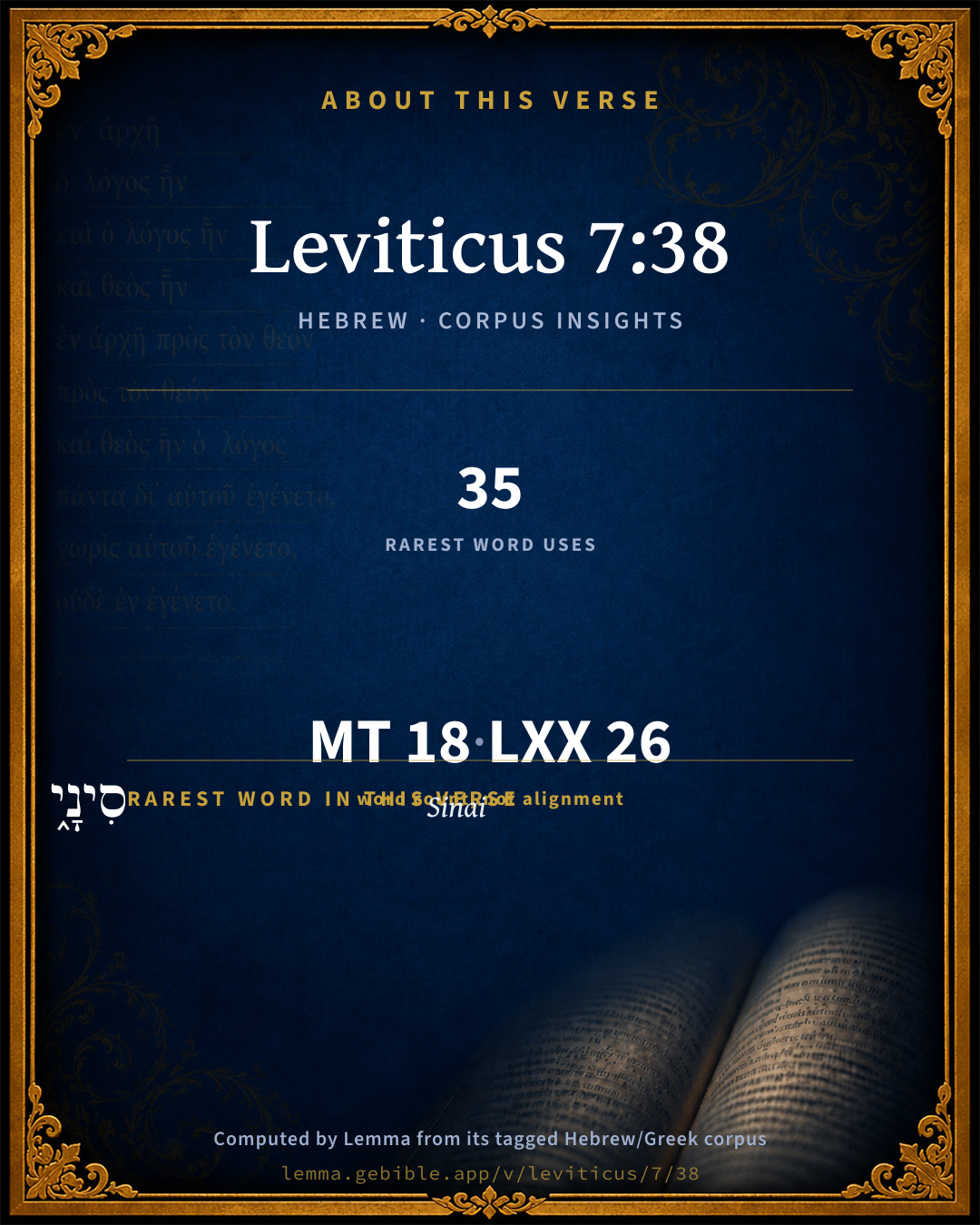
These counts appear in no published source. They are computed here, from the morphology-tagged text and Lemma’s own curated glosses. What Lemma adds →

18
words
13
distinct lemmas
Pentateuch
section

Shared distinctive vocabulary

סִינָ֑י Sinai H5514 occurs in 34 verses of the Hebrew Bible. Also found in:

Grammatical profile

  • 3 verbs
  • 11 nouns
  • 4 particles

Verb forms

  • צִוָּ֧ה Piel · Perfect
  • צַוֺּת֜וֹ Piel · Infinitive Construct
  • לְהַקְרִ֧יב Hiphil · Infinitive Construct

Repetition

Words recur within this verse — often emphatic in Hebrew:

  • צִוָּ֧ה to command H6680 ×2
  • יְהוָ֛ה LORD H3068 ×2
  • סִינָ֑י Sinai H5514 ×2

Hebrew & Septuagint length

In the original languages it is 18 Hebrew tokens and 26 Greek tokens — but the two are counted differently (Hebrew bundles its prefixes and suffixes into one token; the Greek is in lemma form), so that isn’t a like-for-like length.

Cross-references

1

Topical passages linked to Leviticus 7:38 in the Treasury of Scripture Knowledge — connected by theme and wording, ordered by reader-vote popularity; previews shown in the World English Bible.

  • Leviticus 1:1–2 Yahweh called to Moses, and spoke to him out of the Tent of Meeting, saying,

Cross-references courtesy of OpenBible.info (CC BY 4.0).

Hebrew and Greek witnesses Masoretic Hebrew ↔ Greek Septuagint

The same verse in the two great witnesses to the Old Testament, shown verse-for-verse.

These are two independent witnesses, not word-aligned to each other, and the Septuagint is shown in lemma (dictionary) form.

Hebrew Leviticus 7:38 Masoretic · Westminster Leningrad Codex

אֲשֶׁ֨ר צִוָּ֧ה יְהוָ֛ה אֶת מֹשֶׁ֖ה בְּהַ֣ר סִינָ֑י בְּי֨וֹם צַוֺּת֜וֹ אֶת בְּנֵ֣י יִשְׂרָאֵ֗ל לְהַקְרִ֧יב אֶת קָרְבְּנֵיהֶ֛ם לַיהוָ֖ה בְּמִדְבַּ֥ר סִינָֽי

which Yahweh commanded Moses in Mount Sinai, in the day that he commanded the children of Israel to offer their offerings to Yahweh, in the wilderness of Sinai.

World English Bible · Public Domain

Greek LXX Leviticus 7:38 Septuagint · lemma form

ὅς τρόπος ἐντέλλομαι κύριος ὁ μωυσῆς ἐν ὁ ὄρος σινα ὅς ἡμέρα ἐντέλλομαι ὁ υἱός ἰσραήλ προςφέρω ὁ δῶρον αὐτός ἔναντι κύριος ἐν ὁ ἔρημος σινα

No English rendering of this Greek verse — the small residue in the structurally divergent books.

On this verse, Adam Clarke's Commentary discusses the Septuagint’s reading. Read the note in Commentary ↓

Hebrew: Westminster Leningrad Codex (CC BY 4.0). Greek: Septuagint (public domain); English from a public-domain English Septuagint. How the Septuagint differs from the Hebrew →

Targum (Aramaic paraphrase)

2

The Targum is the ancient Jewish Aramaic paraphrase of the Hebrew Scriptures — an interpretive translation, not the Hebrew text itself. Onkelos (literal) and Pseudo-Jonathan (expansive) render the Torah, and Jonathan the Prophets. Coverage is partial: where no permissively-licensed English translation exists for a verse, only the Aramaic is shown. This is verse-level text, not a word-by-word alignment to the Hebrew.

  1. Targum Onkelos Torah (Genesis–Deuteronomy)
    דִי פַקִיד יְיָ יָת מֹשֶׁה בְּטוּרָא דְסִינָי בְּיוֹמָא דְפַקְדֵהּ יָת בְּנֵי יִשְׂרָאֵל לְקָרָבָא יָת קֻרְבָּנְהוֹן קֳדָם יְיָ בְּמַדְבְּרָא דְסִינָי

    (no public-domain English translation for this verse)

    Targum Onkelos — Aramaic: “Onkelos Genesis” (public domain); “Onkelos Exodus” (public domain); “Onkelos Leviticus” (public domain); “Onkelos Numbers” (public domain); “Onkelos Deuteronomy” (public domain). English: “Sefaria Community Translation” (CC0 1.0 (public-domain dedication)); “J.W. Etheridge. The Targums of Onkelos and Jonathan Ben Uzziel on the Pentateuch. London: Longmans, Green, 1862” (public domain). Text via Sefaria.

  2. Targum Pseudo-Jonathan Torah (Genesis–Deuteronomy)
    דְפַקֵיד יְיָ יַת משֶׁה בְּטַוְורָא דְסִינַי בְּיוֹמָא דְפַקֵיד יַת בְּנֵי יִשְרָאֵל לְקָרָבָא קוּרְבָּנֵיהוֹן קֳדָם יְיָ בְּמַשְׁכְּנָא דְעָבָדוּ לֵיהּ בְּמַדְבְּרָא דְסִינָי

    which the Lord commanded Mosheh in Mount Sinai, in the day that he commanded the sons of Israel to offer their oblations before the Lord in the tabernacle that he made unto him in the wilderness of Sinai.

    Targum Pseudo-Jonathan — Aramaic: “Targum Jonathan on Genesis” (public domain); “Targum Jonathan on Exodus” (public domain); “Targum Jonathan on Leviticus” (public domain); “Targum Jonathan on Numbers” (public domain); “Targum Jonathan on Deuteronomy” (public domain). English: “The Targum of Jonathan ben Uzziel, trans. J. W. Etheridge, London, 1862” (public domain). Text via Sefaria.

Commentary

Notes on Leviticus 7:38 from classic Christian and Jewish commentators (each source and its license shown beneath its notes). The classic Christian expositions comment on the surrounding passage and are grouped to its opening verse, so a note may address several verses; the Jewish commentaries on the Tanakh (Rashi and others) are per-verse, so they appear only where the commentator wrote on this verse.

Lemma curates 59 commentaries, every one of them public domain or Creative Commons licensed, each selected and text-cleaned for this edition rather than reprinted as found. About our sources →

Joseph Benson's Commentary

Lev 7:38. In mount Sinai — Rather, by mount Sinai; for Moses had been some time come down from the mount, and these commands were given him from the tabernacle, Lev 1:1. He and the people, however, were still in the wilderness of Sinai, or in that tract of land adjoining to the mount, which, being desert and thinly inhabited, is termed a wilderness.

Joseph Benson's Commentary on the Old and New Testaments (1811–1818) — public domain. Text from a community e-Sword module.

Adam Clarke's Commentary

Verse 38. In the wilderness of Sinai.] These laws were probably given to Moses while he was on the mount with God; the time was quite sufficient, as he was there with God not less than fourscore days in all; forty days at the giving, and forty days at the renewing of the law.

As in the course of this book the different kinds of sacrifices commanded to be offered are repeatedly occurring, I think it best, once for all, to give a general account of them, and a definition of the original terms, as well as of all others relative to this subject which are used in the Old Testament, and the reference in which they all stood to the great sacrifice offered by Christ.

1. אשם ASHAM, TRESPASS-offering, from אשם asham, to be guilty, or liable to punishment; for in this sacrifice the guilt was considered as being transferred to the animal offered up to God, and the offerer redeemed from the penalty of his sin, Le 7:37. Christ is said to have made his soul an offering for sin, (אשם), Isa 53:10.

2. אשה ISHSHEH, FIRE-offering, probably from אשש ashash, to be grieved, angered, inflamed; either pointing out the distressing nature of sin, or its property of incensing Divine justice against the offender, who, in consequence, deserving burning for his offence, made use of this sacrifice to be freed from the punishment due to his transgression. It occurs Ex 29:18, and in many places of this book.

3. הבהבים HABHABIM, ITERATED OR REPEATED offerings, from יהב yahab, to supply. The word occurs only in Ho 8:13, and probably means no more than the continual repetition of the accustomed offerings, or continuation of each part of the sacred service.

4. זבח ZEBACH, a SACRIFICE, (in Chaldee, דבח debach, the ז zain being changed into ד daleth,) a creature slain in sacrifice, from זבח zabach, to slay; hence the altar on which such sacrifices were offered was termed מזבח mizbeach, the place of sacrifice. See Clarke on Ge 8:20. Zebach is a common name for sacrifices in general.

5. חג CHAG, a festival, especially such as had a periodical return, from חגג chagag, to celebrate a festival, to dance round and round in circles. See Ex 5:1; Ex 12:24. The circular dance was probably intended to point out the revolution of the heavenly bodies, and the exact return of the different seasons. See Parkhurst.

6. חטאת CHATTATH and חטאה CHATTAAH, SIN-offering, from חטא chata, to miss the mark; it also signifies sin in general, and is a very apt term to express its nature by. A sinner is continually aiming at and seeking happiness; but as he does not seek it in God, hence the Scripture represents him as missing his aim, or missing the mark. This is precisely the meaning of the Greek word ἁμαρτια, translated sin and sin-offering in our version; and this is the term by which the Hebrew word is translated both by the Septuagint and the inspired writers of the New Testament. The sin-offering was at once an acknowledgment of guilt, in having forsaken the fountain of living waters, and hewed out cisterns that could hold none; and also of the firm purpose of the offerer to return to God, the true and pure fountain of blessedness. This word often occurs. See Clarke on Ge 4:7; and "Ge 13:13".

7. כפר COPHER, the EXPIATION or ATONEMENT, from כפר caphar, to cover, to smear over, or obliterate, or annul a contract. Used often to signify the atonement or expiation made for the pardon or cancelling of iniquity. See Clark's note on "Ex 25:17".

8. מועד MOED, an APPOINTED annual festival, from יעד yaad, to appoint or constitute, signifying such feasts as were instituted in commemoration of some great event or deliverance, such as the deliverance from Egypt. See Ex 13:10, and thus differing from the chag mentioned above. See Clarke on Ge 1:14.

9. מלאים MILLUIM, CONSECRATIONS or consecration-offerings, from מלא mala, to fill; those offerings made in consecrations, of which the priests partook, or, in the Hebrew phrase, had their hands filled, or which had filled the hands of them that offered them. See Clarke on Ex 29:19; and see 2Ch 13:9.

10. מנחה MINCHAH, MEAT-offering, from נח nach, to rest, settle after toil. It generally consisted of things without life, such as green ears of corn, full ears of corn, flour, oil, and frankincense; (see on Le 2:1, c.) and may be considered as having its name from that rest from labour and toil which a man had when the fruits of the autumn were brought in, or when, in consequence of obtaining any rest, ease, c., a significant offering or sacrifice was made to God. It often occurs. See Clarke on Ge 4:3. The jealousy-offering (Nu 5:15) was a simple minchah, consisting of barley-meal only.

11. מסך MESECH and ממסך MIMSACH, a MIXTURE-offering, or MIXED LIBATION, called a DRINK-offering, Isa 55:11, from מסך masach, to mingle it seems in general to mean old wine mixed with the less, which made it extremely intoxicating. This offering does not appear to have had any place in the worship of the true God; but from Isa 65:11, and Pr 23:30, it seems to have been used for idolatrous purposes, such as the Bacchanalia among the Greeks and Romans, "when all got drunk in honour of the god."

12. משאת MASSEETH, an OBLATION, things carried to the temple to be presented to God, from נשא nasa, to bear or carry, to bear sin; typically, Ex 28:38; Le 10:17; Le 16:21; really, Isa 53:4; Isa 53:12. The sufferings and death of Christ were the true masseeth or vicarious bearing of the sins of mankind, as the passage in Isaiah above referred to sufficiently proves. See this alluded to by the Evangelist John, Joh 1:29; and see the root in Parkhurst.

13. נדבה NEDABAH, FREE-WILL, or voluntary offering; from נדב nadab, to be free, liberal, princely. An offering not commanded, but given as a particular proof of extraordinary gratitude to God for especial mercies, or on account of some vow or engagement voluntarily taken, Le 7:16.

14. נסך NESECH, LIBATION, OR DRINK-offering, from נסך nasach, to diffuse or pour out. Water or wine poured out at the conclusion or confirmation of a treaty or covenant. To this kind of offering there is frequent allusion and reference in the New Testament, as it typified the blood of Christ poured out for the sin of the world; and to this our Lord himself alludes in the institution of the holy eucharist. The whole Gospel economy is represented as a covenant or treaty between God and man, Jesus Christ being not only the mediator, but the covenant sacrifice, whose blood was poured out for the ratification and confirmation of this covenant or agreement between God and man.

15. עלה and עולה OLAH, BURNT-offering, from עלה alah, to ascend, because this offering, as being wholly consumed, ascended as it were to God in smoke and vapour. It was a very expressive type of the sacrifice of Christ, as nothing less than his complete and full sacrifice could make atonement for the sin of the world. In most other offerings the priest, and often the offerer, had a share, but in the whole burnt-offering all was given to God.

16. קטרת KETORETH, INCENSE or PERFUME-offering, from קטר katar, to burn, i. e., the frankincense, and other aromatics used as a perfume in different parts of the Divine service. To this St. Paul compares the agreeableness of the sacrifice of Christ to God, Eph 5:2: Christ hath given himself for us, an offering - to God for a SWEET-SMELLING savour. From Re 5:8 we learn that it was intended also to represent the prayers of the saints, which, offered up on the altar, Christ Jesus, that sanctifies every gift, are highly pleasing in the sight of God.

17. קרבן KORBAN, the GIFT-offering, from קרב karab to draw nigh or approach. See this explained on Le 1:2. Korban was a general name for any kind of offering, because through these it was supposed a man had access to his Maker.

18. שלמים SHELAMIM, PEACE-offering, from שלם shalam, to complete, make whole; for by these offerings that which was lacking was considered as being now made up, and that which was broken, viz., the covenant of God, by his creatures' transgression, was supposed to be made whole; so that after such an offering, the sincere and conscientious mind had a right to consider that the breach was made up between God and it, and that it might lay confident hold on this covenant of peace. To this the apostle evidently alludes, Eph 2:14-19: He is our peace, (i. e. our shalam or peace-offering,) who has made both one, and broken down the middle wall; having abolished in his flesh the enmity, c. See the whole passage, and See Clarke on Ge 14:18.

19. תודה TODAH, THANK-offering, from ידה yadah, to confess offerings made to God with public confession of his power, goodness, mercy, c.

20. תנופה TENUPHAH, WAVE-offering, from נף naph, to stretch out an offering of the first-fruits stretched out before God, in acknowledgment of his providential goodness. This offering was moved from the right hand to the left. See Clarke on Ex 29:27.

21. תרומה TERUMAH, HEAVE-offering, from רם ram, to lift up, because the offering was lifted up towards heaven, as the wave-offering, in token of the kindness of God in granting rain and fruitful seasons, and filling the heart with food and gladness. As the wave-offering was moved from right to left, so the heave-offering was moved up and down; and in both cases this was done several times. These offerings had a blessed tendency to keep alive in the breasts of the people a due sense of their dependence on the Divine providence and bounty, and of their obligation to God for his continual and liberal supply of all their wants. See Clarke on Ex 29:27.

In the above collection are comprised, as far as I can recollect, an explanation of all the terms used in the Hebrew Scriptures which signify sacrifice, oblation, atonement, offering, &c., &c., as well as the reference they bear to the great and only sufficient atonement, sacrifice, oblation, and satisfaction made by Christ Jesus for the sins of mankind. Larger accounts must be sought in authors who treat professedly on these subjects.

Adam Clarke's Commentary on the Bible (1810–1826) — public domain. Text from a community e-Sword/MySword module.

Albert Barnes' Notes on the Bible

wilderness of Sinai - Compare Exo 19:1.

Albert Barnes' Notes on the Bible (1834–1885) — public domain. Text from a community e-Sword/MySword module.

Haydock's Catholic Bible Commentary

In, or at the foot of Mount Sinai. (Haydock)

George Leo Haydock (1774–1849), Haydock's Catholic Family Bible and Commentary, 1859 edition — public domain. Excludes Psalms (Douay-Rheims chapter numbering differs from Protestant) and Deuterocanonical books (Catholic canon only).

Ramban (Nachmanides)

Rabbi Moshe ben Nachman (Ramban / Nachmanides)

WHICH THE ETERNAL COMMANDED MOSES IN MOUNT SINAI. According to our Rabbis all the commandments were expressly told to Moses on Mount Sinai, in their general rules, their specific regulations and their minute details, and some of them were repeated in the Tent of Meeting. Thus [all] the commandments in the Book of Vayikra (Leviticus) [which is prefaced by the verse stating it was made known in the Tent of Meeting], are repetitions [of those said on Sinai, which is the sense of the verse before us]. By way of the plain meaning of Scripture, the meaning of the verse is:. Now according to the interpretation of the Rabbis mentioned above, the sense of the verse is that the laws of the offerings were commanded to Moses “in Mount Sinai,” and were repeated to him in the Tent of Meeting “in the wilderness of Sinai.” Ramban will now explain that according to the plain meaning of Scripture this verse speaks of two separate occasions: the offerings of the seven-day consecration of the priests were commanded to Moses “in Mount Sinai,” whilst the laws of the other offerings were given to Moses “in the wilderness of Sinai,” that is, in the Tabernacle. “Which the Eternal commanded Moses in Mount Sinai, and in the day that he commanded the children of Israel in the wilderness of Sinai to present their offerings unto the Eternal,” for He gave the commandment about the consecration-offerings [of the priests] in Mount Sinai, as also in the case of the burnt-offering and sin-offering [which were part of the consecration], and He commanded concerning the meal-offering, guilt-offering, and peace-offerings, in the wilderness of Sinai, in the Tent of Meeting.It is possible that the expression in Mount Sinai means “in this place in front of Mount Sinai,” which is in the Tent of Meeting. Similarly, It is a continual burnt-offering, which was offered in Mount Sinai, does not mean on the mountain itself, for the continual burnt-offering [i.e., the Daily Whole-offering brought for all Israel] began only in the Tent of Meeting, as it is written, Now this is that which thou shalt offer upon the altar: two lambs of the first year day by day continually. So also: And they set forward from the Mount of the Eternal [which means “from before the Mount of the Eternal”]; ye have dwelt long enough in this mountain [which means “in front of this mountain”]. The sense of all these verses is that Israel had encamped before Mount Sinai nearby, as it is written, and there Israel encamped before the Mount. There [in the wilderness of Sinai] they stayed until they journeyed from there to the wilderness of Paran.. Thus they made the Tent of Meeting and erected it before the Mount on its east side, and it was there that they began offering the Daily Whole-offering. In the second year [after the exodus] they were commanded concerning the standards, 1:1; 2:1-31. and they set the Tent of Meeting in the midst of the camps, 2:17. when they journeyed. It is for this reason that Scripture says here that this is the law of the burnt-offering and of all the offerings which G-d commanded [Moses] in Mount Sinai, in the day that he commanded [the children of Israel] … in the wilderness of Sinai. Scripture thus states that it was in Mount Sinai and in the desert of Sinai, in order to inform us that it was not on the mountain itself, in the place of the Glory where G-d told to Moses the Ten Commandments, nor in the desert of Sinai after they had journeyed from before the Mount. Rather, it was in the wilderness of Sinai, in front of the mountain within its environs and nearby, and there was the Tent of Meeting, as He said at the beginning of the subject of the offerings, And He called unto Moses, and the Eternal spoke unto him out of the Tent of Meeting, and now He informed us of the place of the Tent of Meeting.

Ramban (Nachmanides) on the Tanakh — English translation: “Commentary on the Torah by Ramban (Nachmanides). Translated and annotated by Charles B. Chavel. New York, Shilo Pub. House, 1971-1976” (CC BY 4.0). Text via Sefaria.

Ibn Ezra

Rabbi Abraham ibn Ezra

To bring their offerings to Adonoy in the desert of Sinai. They did not bring any offerings before they arrived at Mount Sinai; I have already demonstrated that Moshe’s altar upon the defeat of Amalek was in Horeb, which is Mount Sinai. There, the children of Israel dwelt for one year less ten days, as Scripture indicates. They did not bring burnt-offerings in the desert, as the prophet said (Amos 5:25): “Did you offer Me sacrifices and meal-offerings in the desert forty years, O house of Israel?” Additionally, they did not bring the Pesach-offering, except for once in Egypt and again at Mount Sinai, because they had no flocks in the desert. Furthermore, after they left Mount Sinai they did not circumcise themselves during their travels, until Yehoshua circumcised them for the sake of eating the Pesach-offering.

Ibn Ezra on the Tanakh — English translations: “Sefaria Community Translation” (CC0 1.0 (public-domain dedication)); “Yalkut, Sifsei Chachomim Chumash, Metsudah Publications, 2009” (CC BY 4.0); and “Commentary of Ibn Ezra on Isaiah - trans. by M. Friedlander, 1873” (public domain). Text via Sefaria.

Lesson kit

Teaching starters — assembled from the data on this page, not authored interpretation. Every prompt links to the verse data it draws on. Edit before teaching.

Leviticus, in the Pentateuch, opens this verse with 18 words (13 distinct Hebrew lemmas). Its most distinctive word is Çîynay (“Sinai”). A historical commentator’s framing appears above. Read the whole chapter for the surrounding context.

Discussion questions

  1. How does “Sinai” (Çîynay) shape what this verse is saying?
  2. Exodus 16:1 shares the word «Sinai» with this verse. How do the two illuminate each other?
  3. “to command” occurs 2× in this one verse. What is the effect of the repetition?
  4. These translations render this verse differently. What is at stake in choosing one wording over another?
  5. The verb «צִוָּ֧ה» is Piel Perfect. How does its form color the action?
  6. Reading how Joseph Benson's Commentary and Adam Clarke's Commentary read this verse, where do the two commentators agree and where do they part?

Things to notice

Reading settings

Reading text

Shown beneath each verse's original-language words.

Old Testament
Old Testament edition

Read the OT as the Masoretic Hebrew (MT) or the Greek Septuagint (LXX).

English shown for the Greek Septuagint (in the Hebrew ↔ Greek comparison).

Comparing translations? Open the Compare panel on any verse page to stack up to four side by side.