
Leviticus 6:20

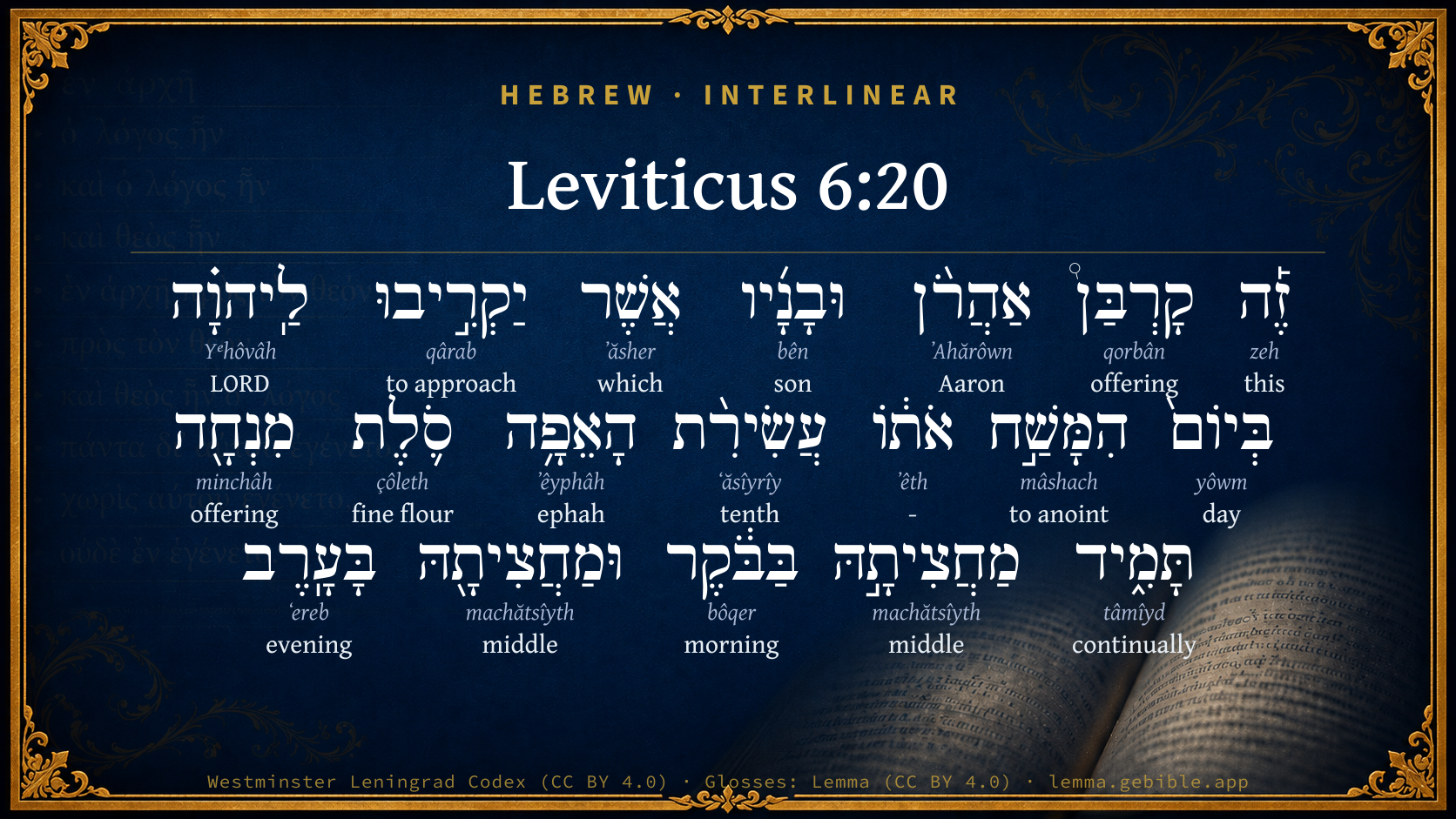
Hebrew (Westminster Leningrad Codex) Leviticus 6:20 appears in the Hebrew Old Testament. The text above is from the Westminster Leningrad Codex. Each word links to its Strong’s number, a concise gloss, and parsing drawn from the Open Scriptures Hebrew Bible morphology. Click any word for its full Brown-Driver-Briggs (BDB) entry.
Download image
Cite this verse

Leviticus 6:20 (World English Bible). Public Domain. Lemma interlinear Bible study tool, https://lemma.gebible.app/v/leviticus/6/20.

Show BibTeX & RIS
BibTeX
RIS
English Translation
"This is the offering of Aaron and of his sons, which they shall offer to Yahweh in the day when he is anointed: the tenth part of an ephah of fine flour for a meal offering perpetually, half of it in the morning, and half of it in the evening.
World English Bible · Public Domain
Download a study sheet

One document with this verse’s original text, its word-by-word gloss line, the meaning frame, cross-references with their text, attributed commentary, and full source and license credits — printable, and it pastes into notes with its structure intact.

This verse Autodidact and up

Study sheet (.html) Plain text (.txt)

A passage Seminary Student

Up to 50 verses in one chapter. A passage sheet keeps up to 6 commentary sources and 12 cross-references per verse, in the order this page ranks them, and says so on the sheet whenever that leaves anything out. Ask for a single verse and you get the Autodidact verse sheet above.

Everything on this page stays free to read, with no account — the sheet is a download of what is already on screen, not access to it.

Want to remove ads? Support Godless Engineer
Compare translations 3

The same verse in 3 English versions, stacked beneath the original-language interlinear above. Click any original word for its lexicon entry.

Each is an independent rendering of the whole verse — the interlinear is not word-aligned to these translations.

Highlighted words mark where these versions differ — a whole-verse word diff, not a word-by-word alignment.

  • World English Bible Public Domain
    "This is the offering of Aaron and of his sons, which they shall offer to Yahweh in the day when he is anointed: the tenth part of an ephah of fine flour for a meal offering perpetually, half of it in the morning, and half of it in the evening.
  • King James Version Public Domain
    This is the offering of Aaron and of his sons, which they shall offer unto the LORD in the day when he is anointed; the tenth part of an ephah of fine flour for a meat offering perpetual, half of it in the morning, and half thereof at night.
  • unfoldingWord Literal Text CC BY-SA 4.0
    “This the offering of Aaron and his sons, which they shall present to Yahweh on the day of his being anointed: a tenth of an ephah of flour, a continual grain offering, half of it in the morning and half of it in the evening.

unfoldingWord Literal Text — © unfoldingWord, licensed CC BY-SA 4.0. Word-aligned USFM3 via Door43 (git.door43.org/unfoldingWord/en_ult).

Versions to compare (up to 4)

3 of 4 selected

Show all 18 translations

Every available English version of this verse, each an independent rendering of the whole verse.

  • World English Bible Public Domain
    "This is the offering of Aaron and of his sons, which they shall offer to Yahweh in the day when he is anointed: the tenth part of an ephah of fine flour for a meal offering perpetually, half of it in the morning, and half of it in the evening.
  • Berean Standard Bible Public Domain
    “This is the offering that Aaron and his sons must present to the LORD on the day he is anointed: a tenth of an ephah of fine flour as a regular grain offering, half of it in the morning and half in the evening.
  • Majority Standard Bible Public Domain
    “This is the offering that Aaron and his sons must present to the LORD on the day he is anointed: a tenth of an ephah of fine flour as a regular grain offering, half of it in the morning and half in the evening.
  • King James Version Public Domain
    This is the offering of Aaron and of his sons, which they shall offer unto the LORD in the day when he is anointed; the tenth part of an ephah of fine flour for a meat offering perpetual, half of it in the morning, and half thereof at night.
  • American Standard Version (1901) Public Domain
    This is the oblation of Aaron and of his sons, which they shall offer unto Jehovah in the day when he is anointed: the tenth part of an ephah of fine flour for a meal-offering perpetually, half of it in the morning, and half thereof in the evening.
  • Revised Version (1885) Public Domain
    This is the oblation of Aaron and of his sons, which they shall offer unto the LORD in the day when he is anointed; the tenth part of an ephah of fine flour for a meal offering perpetually, half of it in the morning, and half thereof in the evening.
  • Geneva Bible (1599) Public Domain
    This is the offering of Aaron and his sonnes, which they shall offer vnto the Lord in the day when he is anointed: the tenth part of an Ephah of fine floure, for a meate offering perpetuall: halfe of it in ye morning, and halfe thereof at night.
  • Douay-Rheims (1899) Public Domain
    This is the oblation of Aaron, and of his sons, which they must offer to the Lord, in the day of their anointing: They shall offer the tenth part of an ephi of flour for a perpetual sacrifice, half of it in the morning, and half of it in the evening:
  • Young's Literal Translation Public Domain
    `This `is' an offering of Aaron and of his sons, which they bring near to Jehovah in the day of his being anointed; a tenth of the ephah of flour `for' a continual present, half of it in the morning, and half of it in the evening;
  • Literal Standard Version CC BY-SA 4.0
    “This [is] an offering of Aaron and of his sons, which they bring near to YHWH in the day of his being anointed: a tenth of the ephah of flour [for] a continual present, half of it in the morning, and half of it in the evening;
  • Unlocked Literal Bible CC BY-SA 4.0
    “This is the offering of Aaron and of his sons, which they will offer to Yahweh on the day when each son is anointed: a tenth part of an ephah of fine flour as a regular grain offering, half of it in the morning and half of it in the evening.
  • unfoldingWord Literal Text CC BY-SA 4.0
    “This the offering of Aaron and his sons, which they shall present to Yahweh on the day of his being anointed: a tenth of an ephah of flour, a continual grain offering, half of it in the morning and half of it in the evening.
  • Darby Bible Public Domain
    This is the offering of Aaron and of his sons, which they shall present to Jehovah on the day when he is anointed: the tenth part of an ephah of fine flour as a continual oblation, half of it in the morning, and half thereof at night.
  • World Messianic Bible Public Domain
    “This is the offering of Aaron and of his sons, which they shall offer to the LORD in the day when he is anointed: one tenth of an efah of fine flour for a meal offering perpetually, half of it in the morning, and half of it in the evening.
  • Webster's Bible Public Domain
    \\6:27\\Whatever shall touch the flesh of it shall be holy: and when there is sprinkled of its blood upon any garment, thou shalt wash that on which it was sprinkled in the holy place.
  • Free Bible Version CC BY-SA 4.0
    “This is the offering that Aaron and his sons are to present to the Lord when they're anointed: a tenth of an ephah of the best flour as a usual grain offering, half in the morning and half in the evening.
  • Bible in Basic English Public Domain
    Anyone touching the flesh of it will be holy: and if any of the blood is dropped on any clothing, the thing on which the blood has been dropped is to be washed in a holy place.
  • JPS Tanakh (1917) Public Domain
    (6-13) This is the offering of Aaron and of his sons, which they shall offer unto the LORD in the day when he is anointed: the tenth part of an ephah of fine flour for a meal-offering perpetually, half of it in the morning, and half thereof in the evening.

Literal Standard Version (2020), Covenant Press — licensed CC BY-SA 4.0. Text via the HelloAO Bible API (eBible.org). Unlocked Literal Bible (unfoldingWord) — licensed CC BY-SA 4.0. Text via the HelloAO Bible API (eBible.org). unfoldingWord Literal Text — © unfoldingWord, licensed CC BY-SA 4.0. Word-aligned USFM3 via Door43 (git.door43.org/unfoldingWord/en_ult). Free Bible Version, Dr. Jonathan Gallagher — licensed CC BY-SA 4.0. Text via the HelloAO Bible API (eBible.org).

Word by word

More ways to search: Search by grammar → Find every occurrence → Compare this word →

Practice this passage: Drill this verse → Learn its vocabulary →

מַחֲצִיתָ֣הּ
machătsîyth
H4276
“middle · her”
Noun, Common, Feminine, Singular, Construct + Suffix, Personal, 3rd Person, Feminine, Singular
Part of Speech
Noun
Type
Common
Gender
Feminine
Number
Singular
State
Construct
Full BDB Definition

Origin: from H2673

TWOT: 719e

half, middle - half - middle, midday, noon
  1. זֶ֡ה zeh H2088 “this” Pronoun, Demonstrative, Masculine, Singular
  2. קָרְבַּן֩ qorbân H7133 “offering of” Noun, Common, Masculine, Singular, Construct
  3. אַהֲרֹ֨ן ʼAhărôwn H175 “Aaron” Noun, Proper
  4. וּבָנָ֜יו bên H1121 “and · sons · his” Conjunction + Noun, Common, Masculine, Plural, Construct + Suffix, Personal, 3rd Person, Masculine, Singular
  5. אֲשֶׁר ʼăsher H834 “which” Particle, Relative
  6. יַקְרִ֣יבוּ qârab H7126 “to approach” Verb, Hiphil, Imperfect, 3rd Person, Masculine, Plural
  7. לַֽיהוָ֗ה Yᵉhôvâh H3068 “to/for · LORD” Preposition + Noun, Proper
  8. בְּיוֹם֙ yôwm H3117 “in/at · day of” Preposition + Noun, Common, Masculine, Singular, Construct
  9. הִמָּשַׁ֣ח mâshach H4886 “to anoint” Verb, Niphal, Infinitive Construct
  10. אֹת֔וֹ ʼêth H853 “- · him” Particle, Direct Object + Suffix, Personal, 3rd Person, Masculine, Singular
  11. עֲשִׂירִ֨ת ʻăsîyrîy H6224 “tenth” Adjective, Ordinal number, Feminine, Singular, Construct
  12. הָאֵפָ֥ה ʼêyphâh H374 “the · ephah” Particle, Definite Article + Noun, Common, Feminine, Singular, Absolute
  13. סֹ֛לֶת çôleth H5560 “fine flour” Noun, Common, Feminine, Singular, Absolute
  14. מִנְחָ֖ה minchâh H4503 “offering” Noun, Common, Feminine, Singular, Absolute
  15. תָּמִ֑יד tâmîyd H8548 “continually” Noun, Common, Masculine, Singular, Absolute
  16. בַּבֹּ֔קֶר bôqer H1242 “in/at the · morning” Preposition, Determined + Noun, Common, Masculine, Singular, Absolute
  17. וּמַחֲצִיתָ֖הּ machătsîyth H4276 “and · middle · her” Conjunction + Noun, Common, Feminine, Singular, Construct + Suffix, Personal, 3rd Person, Feminine, Singular
  18. בָּעָֽרֶב ʻereb H6153 “in/at the · evening” Preposition, Determined + Noun, Common, Masculine, Singular, Absolute

About this verse

These counts appear in no published source. They are computed here, from the morphology-tagged text and Lemma’s own curated glosses. What Lemma adds →

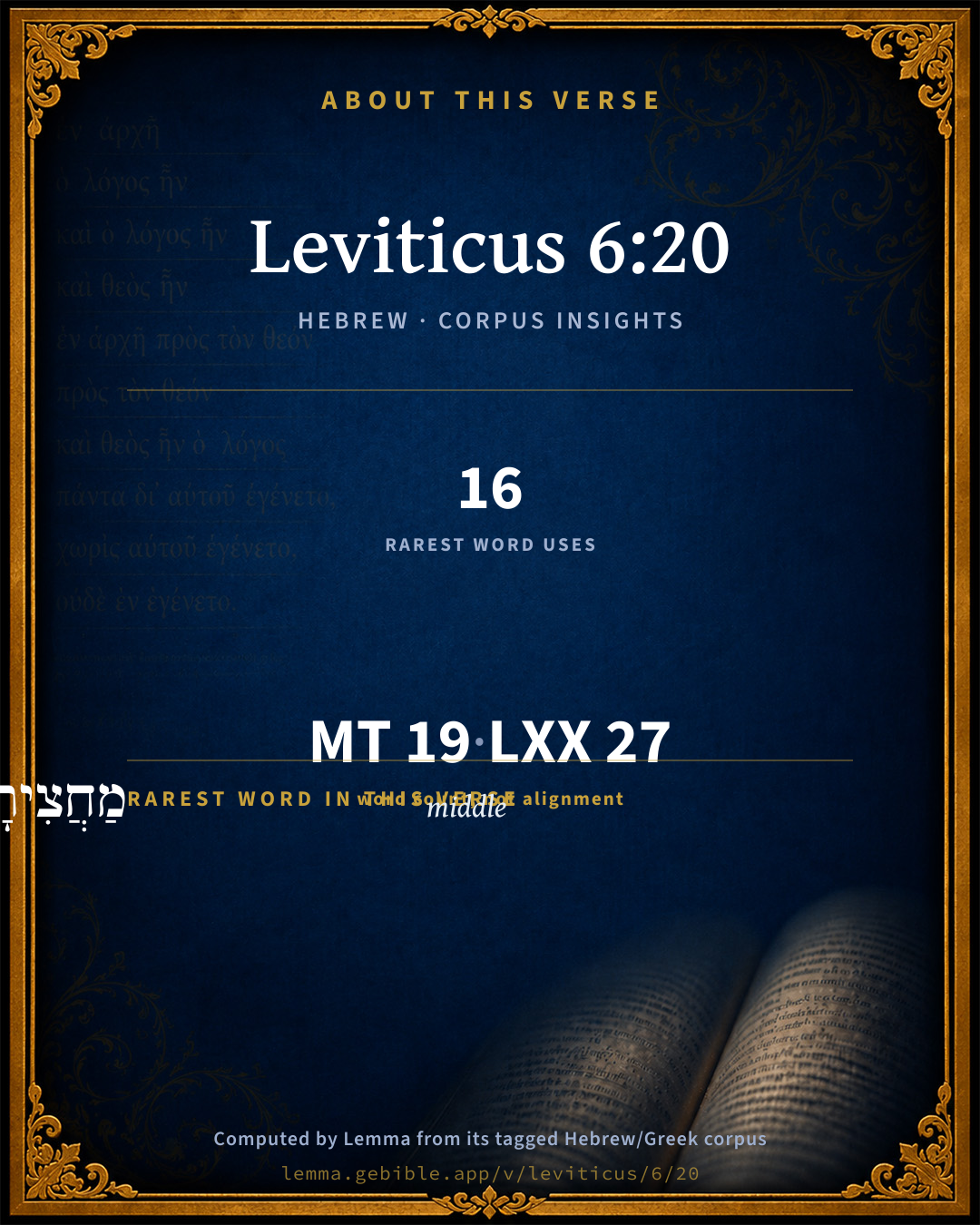
19
words
18
distinct lemmas
Pentateuch
section

Notable vocabulary

The rarest word here is מַחֲצִיתָ֣הּ middle H4276 — appearing just 16 times in the whole Hebrew Bible.

Shared distinctive vocabulary

מַחֲצִיתָ֣הּ middle H4276 occurs in 14 verses of the Hebrew Bible. Also found in:

Grammatical profile

  • 2 verbs
  • 13 nouns
  • 1 adjective
  • 1 pronoun
  • 2 particles

Verb forms

  • יַקְרִ֣יבוּ Hiphil · Imperfect
  • הִמָּשַׁ֣ח Niphal · Infinitive Construct

Repetition

A word recurs within this verse — often emphatic in Hebrew:

  • מַחֲצִיתָ֣הּ middle H4276 ×2

Hebrew & Septuagint length

In English translation the verse runs 50 words from the Hebrew and 53 from the Septuagint (LXX English) — closely comparable.

A rough comparison of the two English renderings, which tokenize alike — not a word-level alignment.

Word counts can differ between the Hebrew and the Greek without any difference in meaning — e.g. the Hebrew direct-object marker אֵת has no separate Greek word, and Greek often adds the article ὁ.

In the original languages it is 19 Hebrew tokens and 27 Greek tokens — but the two are counted differently (Hebrew bundles its prefixes and suffixes into one token; the Greek is in lemma form), so that isn’t a like-for-like length.

Cross-references

12

Topical passages linked to Leviticus 6:20 in the Treasury of Scripture Knowledge — connected by theme and wording, ordered by reader-vote popularity; previews shown in the World English Bible.

  • Exodus 16:36 Now an omer is the tenth part of an ephah.
  • Exodus 29:2 unleavened bread, unleavened cakes mixed with oil, and unleavened wafers anointed with oil: you shall make them of fine wheat flour.
  • Exodus 29:35–42 "Thus shall you do to Aaron, and to his sons, according to all that I have commanded you. Seven days shall you consecrate them.
  • Leviticus 2:1–16 "'When anyone offers an offering of a meal offering to Yahweh, his offering shall be of fine flour; and he shall pour oil on it, and put frankincense on it.
  • Leviticus 5:1 "'If anyone sins, in that he hears the voice of adjuration, he being a witness, whether he has seen or known, if he doesn't report it, then he shall bear his iniquity.
  • Leviticus 5:11 "'But if he can't afford two turtledoves, or two young pigeons, then he shall bring his offering for that in which he has sinned, the tenth part of an ephah of fine flour for a sin offering. He shall put no oil on it, neither shall he put any frankincense on it, for it is a sin offering.
  • Numbers 18:26–32 Moreover you shall speak to the Levites, and tell them, When you take of the children of Israel the tithe which I have given you from them for your inheritance, then you shall offer up a heave-offering of it for Yahweh, a tithe of the tithe.
  • Numbers 28:3 You shall tell them, This is the offering made by fire which you shall offer to Yahweh: he-lambs a year old without blemish, two day by day, for a continual burnt offering.
  • Numbers 28:10 this is the burnt offering of every Sabbath, besides the continual burnt-offering, and the drink-offering of it.
  • Hebrews 5:1 For every high priest, being taken from among men, is appointed for men in things pertaining to God, that he may offer both gifts and sacrifices for sins.
  • Hebrews 7:27 who doesn't need, like those high priests, to daily offer up sacrifices, first for his own sins, and then for the sins of the people. For this he did once for all, when he offered up himself.
  • Hebrews 8:3–4 For every high priest is appointed to offer both gifts and sacrifices. Therefore it is necessary that this high priest also have something to offer.

Cross-references courtesy of OpenBible.info (CC BY 4.0).

Hebrew and Greek witnesses Masoretic Hebrew ↔ Greek Septuagint

The same verse in the two great witnesses to the Old Testament, shown verse-for-verse.

These are two independent witnesses, not word-aligned to each other, and the Septuagint is shown in lemma (dictionary) form.

Hebrew Leviticus 6:20 Masoretic · Westminster Leningrad Codex

זֶ֡ה קָרְבַּן֩ אַהֲרֹ֨ן וּבָנָ֜יו אֲשֶׁר יַקְרִ֣יבוּ לַֽיהוָ֗ה בְּיוֹם֙ הִמָּשַׁ֣ח אֹת֔וֹ עֲשִׂירִ֨ת הָאֵפָ֥ה סֹ֛לֶת מִנְחָ֖ה תָּמִ֑יד מַחֲצִיתָ֣הּ בַּבֹּ֔קֶר וּמַחֲצִיתָ֖הּ בָּעָֽרֶב

"This is the offering of Aaron and of his sons, which they shall offer to Yahweh in the day when he is anointed: the tenth part of an ephah of fine flour for a meal offering perpetually, half of it in the morning, and half of it in the evening.

World English Bible · Public Domain

Greek LXX Leviticus 6:20 Septuagint · lemma form

πᾶς ὁ ἅπτομαι ὁ κρέας αὐτός ἁγιάζω καί ὅς ἐάν ἐπιῥαντίζω ἀπό ὁ αἷμα αὐτός ἐπί ὁ ἱμάτιον ὅς ἐάν ῥαντίζω ἐπί αὐτός πλύνω ἐν τόπος ἅγιος

This is the gift of Aaron and of his sons, which they shall offer to the Lord in the day in which you shall anoint him; the tenth of an ephah of fine flour for a sacrifice continually, the half of it in the morning, and the half of it in the evening.

LXX2012 (modern English Septuagint) · Public Domain

Hebrew: Westminster Leningrad Codex (CC BY 4.0). Greek: Septuagint (public domain); English from LXX2012 (modern English Septuagint) (Public Domain). How the Septuagint differs from the Hebrew →

Targum (Aramaic paraphrase)

2

The Targum is the ancient Jewish Aramaic paraphrase of the Hebrew Scriptures — an interpretive translation, not the Hebrew text itself. Onkelos (literal) and Pseudo-Jonathan (expansive) render the Torah, and Jonathan the Prophets. Coverage is partial: where no permissively-licensed English translation exists for a verse, only the Aramaic is shown. This is verse-level text, not a word-by-word alignment to the Hebrew.

  1. Targum Onkelos Torah (Genesis–Deuteronomy)
    כֹּל דִי יִקְרַב בְּבִסְרַהּ יִתְקַדַשׁ וְדִי יַדִי מִדְמַהּ עַל לְבוּשׁ דִי יַדִי עֲלַהּ תִּתְחַוָר בַּאֲתַר קַדִישׁ

    (no public-domain English translation for this verse)

    Targum Onkelos — Aramaic: “Onkelos Genesis” (public domain); “Onkelos Exodus” (public domain); “Onkelos Leviticus” (public domain); “Onkelos Numbers” (public domain); “Onkelos Deuteronomy” (public domain). English: “Sefaria Community Translation” (CC0 1.0 (public-domain dedication)); “J.W. Etheridge. The Targums of Onkelos and Jonathan Ben Uzziel on the Pentateuch. London: Longmans, Green, 1862” (public domain). Text via Sefaria.

  2. Targum Pseudo-Jonathan Torah (Genesis–Deuteronomy)
    כָּל דִימְקַרֵב בְּבִישְרָהּ יִתְקַדֵשׁ וּדְיַדֵי מִן אַדְמָהּ עַל לְבוּשָׁא דְיַדִי עֲלָהּ תִּתְחַוָור בַּאֲתַר קַדִישׁ

    whosoever toucheth the flesh of it must be sanctified. And if any one let some of its blood fall upon a garment, (the garment so) bedropped shall be washed in the holy place.

    Targum Pseudo-Jonathan — Aramaic: “Targum Jonathan on Genesis” (public domain); “Targum Jonathan on Exodus” (public domain); “Targum Jonathan on Leviticus” (public domain); “Targum Jonathan on Numbers” (public domain); “Targum Jonathan on Deuteronomy” (public domain). English: “The Targum of Jonathan ben Uzziel, trans. J. W. Etheridge, London, 1862” (public domain). Text via Sefaria.

Commentary

Notes on Leviticus 6:20 from classic Christian and Jewish commentators (each source and its license shown beneath its notes). The classic Christian expositions comment on the surrounding passage and are grouped to its opening verse, so a note may address several verses; the Jewish commentaries on the Tanakh (Rashi and others) are per-verse, so they appear only where the commentator wrote on this verse.

Lemma curates 59 commentaries, every one of them public domain or Creative Commons licensed, each selected and text-cleaned for this edition rather than reprinted as found. About our sources →

Trapp's Complete Commentary

John Trapp

Lev 6:20 This [is] the offering of Aaron and of his sons, which they shall offer unto the LORD in the day when he is anointed; the tenth part of an ephah of fine flour for a meat offering perpetual, half of it in the morning, and half thereof at night.

Ver. 20. When he is anointed,] i.e., When any high priest: for he only was anointed, {Exo 29:7} on the head at least.

John Trapp, A Commentary or Exposition upon All the Books of the Old and New Testament (1647–1656) — public domain. Text from a community e-Sword module.

Joseph Benson's Commentary

Lev 6:20-21. When he is anointed — To be high-priest; for he only of all the priests was to be anointed in future ages. This law of his consecration was delivered before, and is here repeated because of some additions made to it. Perpetual — Whensoever any of them shall be so anointed. At night — Or, in the evening; the one to be annexed to the morning sacrifice, the other to the evening sacrifice, over and besides that offering of things inanimate, which every day was to be added to the daily morning and evening sacrifice. Thou shalt bring it in — Who art so anointed and consecrated.

Joseph Benson's Commentary on the Old and New Testaments (1811–1818) — public domain. Text from a community e-Sword module.

Geneva Bible (1599)

Geneva Bible translators

So oft as the high Priest shall be elected and anointed.

Geneva Bible (1599) marginal notes — public domain. Text via Bolls.life.

Jamieson, Fausset & Brown

Robert Jamieson, A. R. Fausset & David Brown

THE HIGH PRIEST'S MEAT OFFERING. (Lev 6:19-23)

This is the offering of Aaron, and of his sons--the daily meat offering of the high priest; for though his sons are mentioned along with him, it was probably only those of his descendants who succeeded him in that high office that are meant. It was to be offered, one half of it in the morning and the other half in the evening--being daily laid by the ministering priest on the altar of burnt offering, where, being dedicated to God, it was wholly consumed. This was designed to keep him and the other attendant priests in constant remembrance, that though they were typically expiating the sins of the people, their own persons and services could meet with acceptance only through faith, which required to be daily nourished and strengthened from above.

Jamieson, Fausset & Brown — Commentary Critical and Explanatory on the Whole Bible (1871) — public domain (CC PDM 1.0). Text via the HelloAO Bible API.

Adam Clarke's Commentary

Verse 20. In the day when he is anointed] Not only in that day, but from that day forward, for this was to them and their successors a statute for ever. See Le 6:22.

Adam Clarke's Commentary on the Bible (1810–1826) — public domain. Text from a community e-Sword/MySword module.

Ellicott's Commentary for English Readers

(20) This is the offering of Aaron and of his sons.—This offering, which is called the oblation of initiation, was, according to the practice which obtained during the second Temple, the mincha “of Aaron and his sons,” as the text before us declares; that is, of the high priest and of every common priest. The ordinary priest, however, only offered it once on the day of his consecration, whilst the high priest was bound to offer it every day after the regular holocaust, with its meat offering and before the drink offering (Sir_45:14, with Josephus, Antiq. III. 10 § 7). It is to this practice that the apostle refers when he says, “For such a high priest became us . . . who needeth not daily, like those high priests, to offer up sacrifices first for his own sins, &c.” (Heb_7:27).

In the day when he is anointed.—That is, when he is anointed (comp. Gen_2:4) or when his anointing ceremony is completed, and he entered upon the duties of his office, which was on the eighth day. (See Lev_8:35; Lev_9:1.)

A meat offering perpetual.—That is, in the case of the high priest this oblation is to be offered every day as long as he lived or held the pontifical office. This perpetual meat offering is to consist of a tenth part of an ephah, which is an omer, half of which he is to offer in the morning and half in the evening.

In a pan it shall be made.—Better, upon a flat plate. (See Lev_2:5.)

And when it is baken thou shalt bring it in.—Better, thou shalt bring it well soaked. That is, thoroughly saturated with oil.

And the baken pieces of the meat offering shalt thou offer.—That is, a meat offering consisted of small roasted cakes. After the flour was put into the pan, and was soaked in oil, it was divided into and baked in small pieces, apparently to represent the limbs into which the victim of the burnt offering was divided before it was burnt. (See Lev_1:8.) During the second Temple the following practice obtained. The high priest brought the whole tenth part of flour every morning. After sanctifying the whole, he divided it into halves with the measure kept in the sanctuary. He likewise brought three logs of oil, which he mingled with the flour, and kneaded six cakes of each half. After baking the cakes a little, he fried them upon the pan with some of the oil, taking care not to bake them too much, but that they should be between baked and raw, in accordance with the expression, tuphinei, which the authorities of those days explained in this manner but which is rendered here in the Authorised Version by baked, and by us roasted cakes. Hereupon the high priest divided the six cakes into twelve cakes being the same number as those of the shewbread, and offered six subdivided in two in the morning and six in the evening.

A Bible Commentary for English Readers, edited by Charles John Ellicott (1878–1897) — public domain. Text from a community e-Sword module.

The Cambridge Bible for Schools and Colleges

gen. ed. J. J. S. Perowne

20. the oblation of Aaron and of his sons, which they shall offer] Heb. bring near as in Lev_1:2; not a priestly action, for that is assigned to Moses in the next verse.

in the day when he is anointed] See above, and in the additional note on Lev_6:19-23.

the tenth part of an ephah] See Lev_5:11. An ephah was about a bushel.

fine flour] See introd. note on ch. 2.

perpetually] Heb. tâmîd, a term applied to the daily Burnt-Offering (Exo_29:38-42 where it is translated continually in Exo_29:38, continual in Exo_29:42) and to the lamp (Lev_24:2-3 continually), though how the epithet is suitable for an offering brought on one occasion is not made clear. Accordingly Dillm. suggests that either ‘in the day when he is anointed’ or ‘perpetually’ is a later addition. Cp. add. note, p. 31.

The Cambridge Bible for Schools and Colleges (gen. ed. J. J. S. Perowne; Cambridge University Press, 1878–1918) — public domain. Text from a community e-Sword module.

John Gill's Exposition

In a pan it shall be made with oil,.... With oil olive, as the Targum of Jonathan; the pan in which it was made was a vessel that had no covering, nor hollow in the middle, nor any lip or edge, but was a plane, and extended, and the dough made on it was hard and stiff, that it might not run off (r). In the temple was a chamber of those that made the cakes (s), where, as Bartenora (t) observes, was prepared the meat offering, which the high priest offered, one half in the morning, and the other half in the evening:

and when it is baked, thou shalt bring it in; not thoroughly baked, but very little, as says Josephus, hastily, so that it swells, and rises up in bubbles. Jarchi says, the flour was first mixed in hot water, and after that it was baked in an oven, and then fried in a pan:

and the baked pieces of the meat offering shalt thou offer for a sweet savour unto the Lord; or the meat offering cut in pieces shalt thou offer, as both the Targums of Jonathan and Jerusalem; the twelve cakes were broken each into two, and twelve halves were offered in the morning, and twelve at evening: the manner in which it was done was, the priest divided every cake into two by measure, so that he might offer half in the morning, and half in the evening; and he took the halves and doubled everyone of them into two, and broke them, until he found every broken piece doubled into two, and he offered the halves with half the handful of frankincense in the morning, and in like manner in the evening (u): this may have respect to the body of Christ being broken for us, whereby he became fit food for faith, and an offering of a sweet smelling savour to God.

(r) Misn. Menachot, c. 5. sect. 8. & Maimon. & Bartenora in ib. Maimon. Maasch Hakorbanot, c. 13. sect. 7. (s) Misn. Middot, c. 1. sect. 4. (t) In ib. (u) Maimon. Misn. Middot. sect. 4.

John Gill's Exposition of the Whole Bible (1746–1763) — public domain (CC PDM 1.0). Text via the HelloAO Bible API.

Albert Barnes' Notes on the Bible

See Lev 4:3. Aaron’s sons here spoken of (as in Lev 6:22) must be the succession of high priests who succeeded him. The day of this offering was probably the eighth day of the ceremony of consecration Lev 8:35; Lev 9:1, when the high priest appears to have entered upon the duties of his office.

A meat offering perpetual - Jewish tradition is in favor of these words implying that this מנחה mı̂nchāh was offered by the high priest as a daily rite from the time of his consecration.

Albert Barnes' Notes on the Bible (1834–1885) — public domain. Text from a community e-Sword/MySword module.

Haydock's Catholic Bible Commentary

Evening. And this shall continue as long as they are high priests, from the day of their consecration, (Josephus, [Antiquities?] iii. 20.; Cajetan,) a perpetual sacrifice. (Calmet)

George Leo Haydock (1774–1849), Haydock's Catholic Family Bible and Commentary, 1859 edition — public domain. Excludes Psalms (Douay-Rheims chapter numbering differs from Protestant) and Deuterocanonical books (Catholic canon only).

Matthew Poole's English Annotations

When he is anointed; when any of them are anointed for high priest; for he only of all the priests was to be anointed in future ages. This law of his consecration was delivered before, Exo 29:2,24,25, and is here repeated because of some additions made to it. A meat-offering perpetual, to wit, whensoever any of them shall be so anointed. At night, or, in the evening; the one to be annexed to the morning sacrifice, the other to the evening sacrifice, over and besides that meat-offering which every day was to be added to the daily morning and evening sacrifices, Exo 29:40.

Matthew Poole's English Annotations on the Holy Bible (1683–1685) — public domain. Text from a community e-Sword/MySword module.

Whedon's Commentary on the Bible

Daniel D. Whedon

20. The offering of Aaron — Aaron, at his induction into the high priest’s office, and, according to Josephus, on every day of his continuance therein, and his successors, as we here interpret the words his sons, must offer three quarts of fine flour, half in the morning and half at night, as an oblation appropriate to the high priesthood.

In the day — Some understand this to be only a consecratory oblation limited to one day; but those who credit the testimony of Josephus construe these words to signify from the day, or day by day.

Daniel D. Whedon (gen. ed.), Commentary on the Old and New Testaments (1874–1909) — public domain. Text from a community e-Sword module.

John Wesley's Explanatory Notes

When he is anointed - For high-priest for he only of all the priests was to be anointed in future ages. This law of his consecration was delivered before, and is here repeated because of some additions made to it. Perpetual - Whensoever any of them shall be so anointed. At night - Or, in the evening; the one to be annexed to the morning-sacrifice, the other to the evening- sacrifice, over and besides that meal-offering which every day was to be added to the daily morning and evening sacrifices.

John Wesley, Explanatory Notes Upon the Whole Bible (1754–1765) — public domain. Text via the GEBible commentary corpus.

Rashi

Rabbi Shlomo Yitzchaki (Rashi)

כל אשר יגע בבשרה WHATSOEVER SHALL TOUCH THE FLESH THEREOF [SHALL BECOME HOLY] — any article of food that shall touch it and absorb anything of it (cf. Sifra, Tzav, Section 4 5; Zevachim 97a and Rashi on v. 11),

יקדש SHALL BE HOLY, so as to become exactly like itself: if it (the sin-offering) has become invalid, it (the food touching it) also becomes disqualified, and if that be fit for eating this may be eaten only under the same stringency applying to it (the sin-offering).

ואשר יזה מדמה על הבגד means, and if there is splashed of the blood thereof on a garment, that blood-stained spot in the garment whereon it was splashed shalt thou wash in the forecourt (Sifra, Tzav, Chapter 6 3).

אשר יזה means, shall be splashed. It is the same as the verb in (Job. 15:29) “and their substance shall not be spread (יטה) on earth” (cf. Rashi on that verse).

Rashi on the Tanakh — English translations: “The Judaica Press complete Tanach with Rashi, translated by A. J. Rosenberg” (CC BY 4.0); “Pentateuch with Rashi's commentary by M. Rosenbaum and A.M. Silbermann, 1929-1934” (public domain); “The Metsudah Tanach series, Lakewood, N.J” (CC BY 4.0); and “The Book of Joshua, Metsudah Publications, 1997” (CC BY 4.0). Text via Sefaria.

Ramban (Nachmanides)

Rabbi Moshe ben Nachman (Ramban / Nachmanides)

THOU SHALT WASH IT IN A HOLY PLACE. Scripture laid down a strict law in connection with the blood [of a sin-offering] which became absorbed by a garment, giving it the law it [the blood] had before it was sprinkled [on the garment, namely] that it may not be taken outside the curtains [and therefore it must be washed within the Court]. He states, and the earthen vessel wherein it is sodden shall be broken. This too is to be broken in the holy place [i.e., within the Court], and the pieces of pottery are swallowed up in the place [where they are broken], and there does not have to be any scouring and rinsing at all [as required if it was boiled in a copper pot]. Similarly, the scouring and rinsing required if [the meat of the sin-offering] was boiled in a copper pot have to be done in a holy place, for all the verses [i.e., Verses 20-21] are connected with “the holy place” mentioned [above in Verse 19: in ‘a holy place’ shall it be eaten, in the Court of the Tent of Meeting].

Ramban (Nachmanides) on the Tanakh — English translation: “Commentary on the Torah by Ramban (Nachmanides). Translated and annotated by Charles B. Chavel. New York, Shilo Pub. House, 1971-1976” (CC BY 4.0). Text via Sefaria.

Lesson kit

Teaching starters — assembled from the data on this page, not authored interpretation. Every prompt links to the verse data it draws on. Edit before teaching.

Leviticus, in the Pentateuch, opens this verse with 19 words (18 distinct Hebrew lemmas). Its most distinctive word is machătsîyth (“middle”). A historical commentator’s framing appears above. Read the whole chapter for the surrounding context.

Discussion questions

  1. What does “middle” (machătsîyth) contribute to the verse as a whole?
  2. Exodus 30:13 shares the word «middle» with this verse. How do the two illuminate each other?
  3. “middle” occurs 2× in this one verse. What is the effect of the repetition?
  4. These translations render this verse differently; the difference is in the English rendering, not the original. What questions does that raise?
  5. The verb «יַקְרִ֣יבוּ» is Hiphil Imperfect. How does its form color the action?
  6. Reading how Trapp's Complete Commentary and Joseph Benson's Commentary read this verse, where do the two commentators agree and where do they part?

Things to notice

Reading settings

Reading text

Shown beneath each verse's original-language words.

Old Testament
Old Testament edition

Read the OT as the Masoretic Hebrew (MT) or the Greek Septuagint (LXX).

English shown for the Greek Septuagint (in the Hebrew ↔ Greek comparison).

Comparing translations? Open the Compare panel on any verse page to stack up to four side by side.