
Deuteronomy 20:10

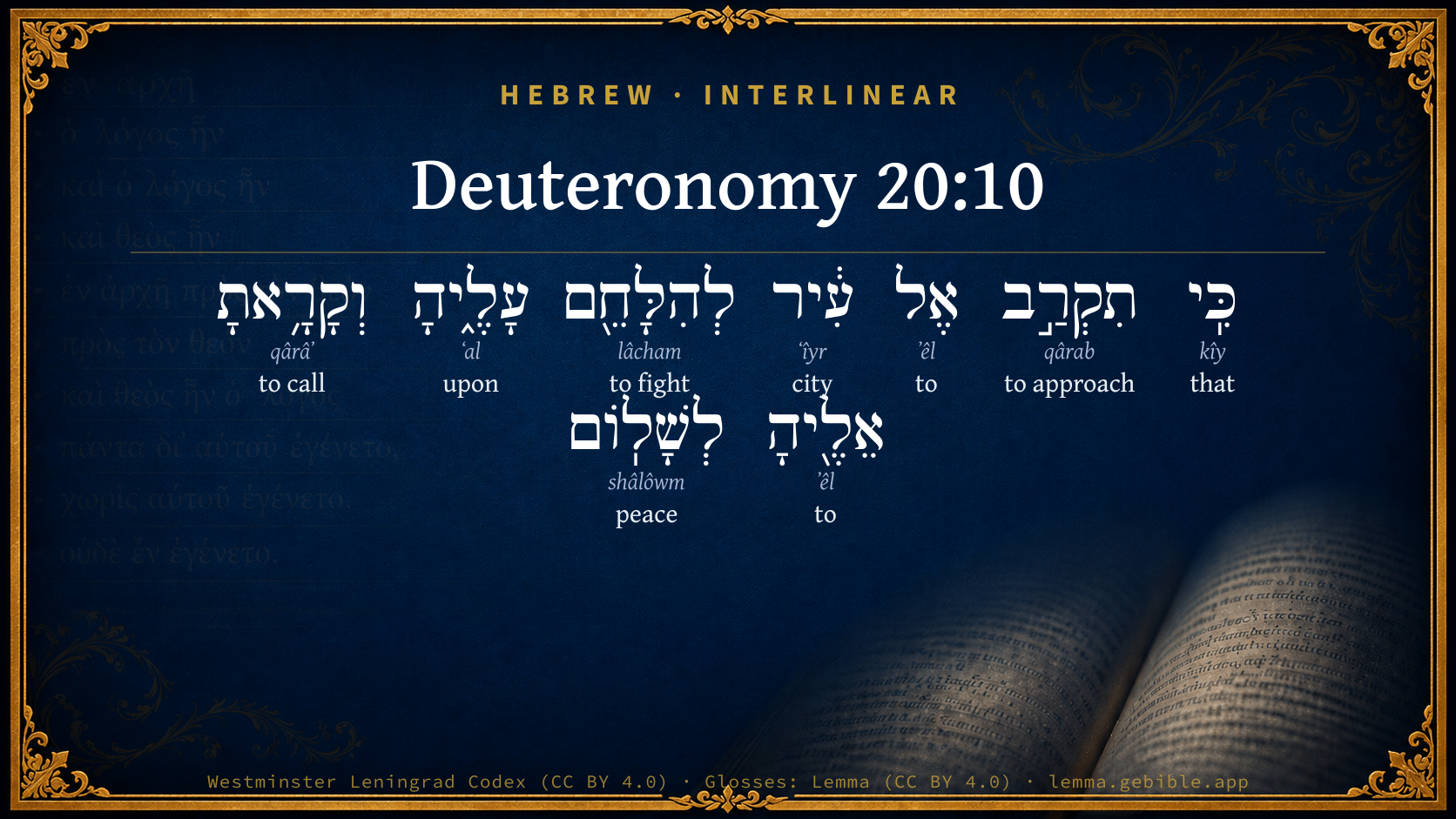
Hebrew (Westminster Leningrad Codex) Deuteronomy 20:10 appears in the Hebrew Old Testament. The text above is from the Westminster Leningrad Codex. Each word links to its Strong’s number, a concise gloss, and parsing drawn from the Open Scriptures Hebrew Bible morphology. Click any word for its full Brown-Driver-Briggs (BDB) entry.
Download image
Cite this verse

Deuteronomy 20:10 (World English Bible). Public Domain. Lemma interlinear Bible study tool, https://lemma.gebible.app/v/deuteronomy/20/10.

Show BibTeX & RIS
BibTeX
RIS
English Translation
When you draw near to a city to fight against it, then proclaim peace to it.
World English Bible · Public Domain
Download a study sheet

One document with this verse’s original text, its word-by-word gloss line, the meaning frame, cross-references with their text, attributed commentary, and full source and license credits — printable, and it pastes into notes with its structure intact.

This verse Autodidact and up

Study sheet (.html) Plain text (.txt)

A passage Seminary Student

Up to 50 verses in one chapter. A passage sheet keeps up to 6 commentary sources and 12 cross-references per verse, in the order this page ranks them, and says so on the sheet whenever that leaves anything out. Ask for a single verse and you get the Autodidact verse sheet above.

Everything on this page stays free to read, with no account — the sheet is a download of what is already on screen, not access to it.

Want to remove ads? Support Godless Engineer
Compare translations 3

The same verse in 3 English versions, stacked beneath the original-language interlinear above. Click any original word for its lexicon entry.

Each is an independent rendering of the whole verse — the interlinear is not word-aligned to these translations.

Highlighted words mark where these versions differ — a whole-verse word diff, not a word-by-word alignment.

  • World English Bible Public Domain
    When you draw near to a city to fight against it, then proclaim peace to it.
  • King James Version Public Domain
    When thou comest nigh unto a city to fight against it, then proclaim peace unto it.
  • unfoldingWord Literal Text CC BY-SA 4.0
    When you draw near to a city to fight against it, then you shall call to it for peace.

unfoldingWord Literal Text — © unfoldingWord, licensed CC BY-SA 4.0. Word-aligned USFM3 via Door43 (git.door43.org/unfoldingWord/en_ult).

Versions to compare (up to 4)

3 of 4 selected

Show all 18 translations

Every available English version of this verse, each an independent rendering of the whole verse.

  • World English Bible Public Domain
    When you draw near to a city to fight against it, then proclaim peace to it.
  • Berean Standard Bible Public Domain
    When you approach a city to fight against it, you are to make an offer of peace.
  • Majority Standard Bible Public Domain
    When you approach a city to fight against it, you are to make an offer of peace.
  • King James Version Public Domain
    When thou comest nigh unto a city to fight against it, then proclaim peace unto it.
  • American Standard Version (1901) Public Domain
    When thou drawest nigh unto a city to fight against it, then proclaim peace unto it.
  • Revised Version (1885) Public Domain
    When thou drawest nigh unto a city to fight against it, then proclaim peace unto it.
  • Geneva Bible (1599) Public Domain
    When thou commest neere vnto a citie to fight against it, thou shalt offer it peace.
  • Douay-Rheims (1899) Public Domain
    If at any time thou come to fight against a city, thou shalt first offer it peace.
  • Young's Literal Translation Public Domain
    `When thou drawest near unto a city to fight against it, then thou hast called unto it for Peace,
  • Literal Standard Version CC BY-SA 4.0
    When you draw near to a city to fight against it, then you have called to it for peace,
  • Unlocked Literal Bible CC BY-SA 4.0
    When you march up to attack a city, make those people an offer of peace.
  • unfoldingWord Literal Text CC BY-SA 4.0
    When you draw near to a city to fight against it, then you shall call to it for peace.
  • Darby Bible Public Domain
    When thou approachest unto a city to fight against it, thou shalt proclaim peace unto it.
  • World Messianic Bible Public Domain
    When you draw near to a city to fight against it, then proclaim peace to it.
  • Webster's Bible Public Domain
    When thou comest nigh to a city to fight against it, then proclaim peace to it.
  • Free Bible Version CC BY-SA 4.0
    When you arrive at a town, ready to attack it, you must first make an offer of peace to the people living there.
  • Bible in Basic English Public Domain
    When you come to a town, before attacking it, make an offer of peace.
  • JPS Tanakh (1917) Public Domain
    When thou drawest nigh unto a city to fight against it, then proclaim peace unto it.

Literal Standard Version (2020), Covenant Press — licensed CC BY-SA 4.0. Text via the HelloAO Bible API (eBible.org). Unlocked Literal Bible (unfoldingWord) — licensed CC BY-SA 4.0. Text via the HelloAO Bible API (eBible.org). unfoldingWord Literal Text — © unfoldingWord, licensed CC BY-SA 4.0. Word-aligned USFM3 via Door43 (git.door43.org/unfoldingWord/en_ult). Free Bible Version, Dr. Jonathan Gallagher — licensed CC BY-SA 4.0. Text via the HelloAO Bible API (eBible.org).

Word by word

More ways to search: Search by grammar → Find every occurrence → Compare this word →

Practice this passage: Drill this verse → Learn its vocabulary →

About this verse

These counts appear in no published source. They are computed here, from the morphology-tagged text and Lemma’s own curated glosses. What Lemma adds →

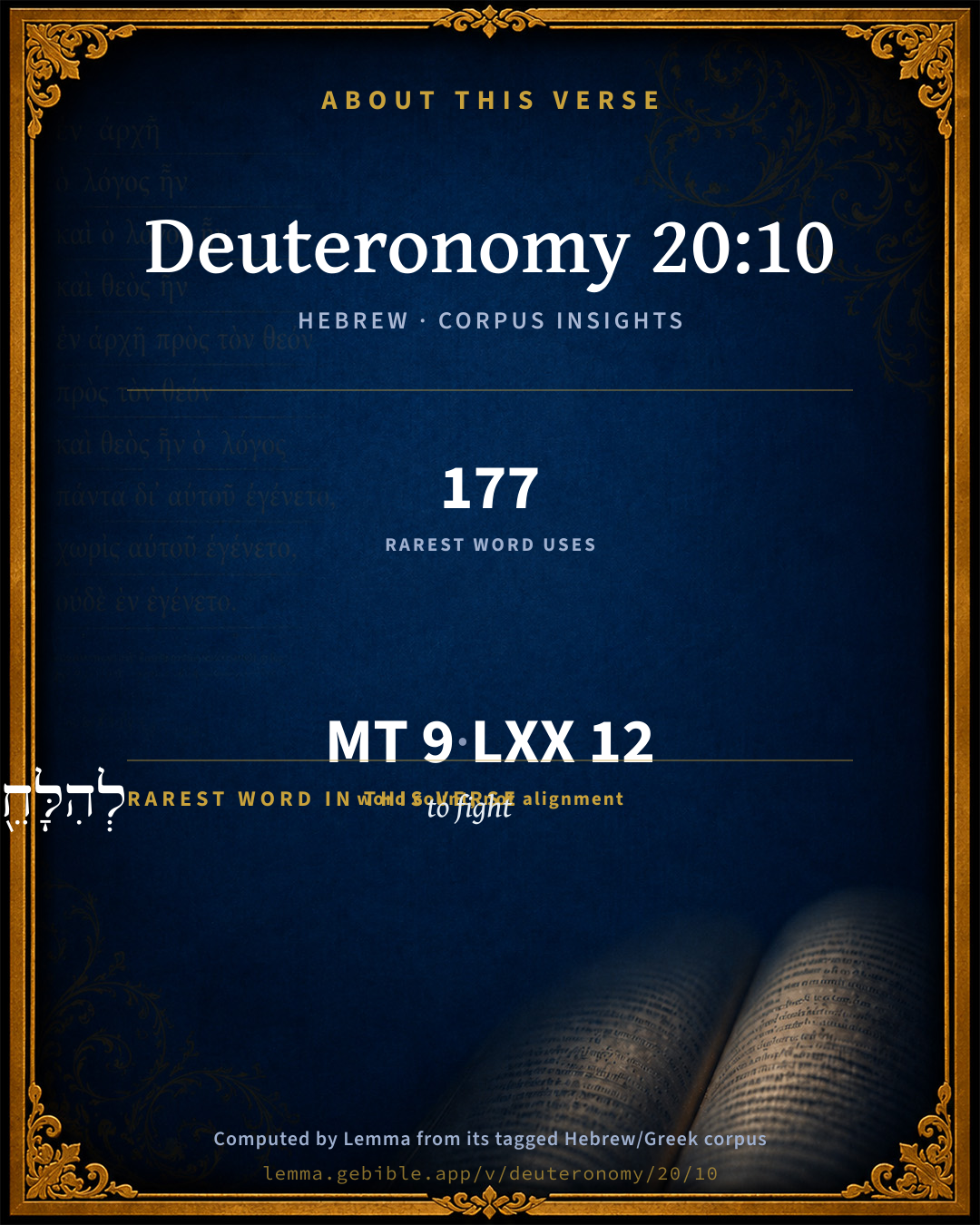
9
words
8
distinct lemmas
Pentateuch
section

Grammatical profile

  • 3 verbs
  • 2 nouns
  • 3 prepositions
  • 1 conjunction

Verb forms

  • תִקְרַ֣ב Qal · Imperfect
  • לְהִלָּחֵ֖ם Niphal · Infinitive Construct
  • וְקָרָ֥אתָ Qal · Sequential Perfect

Repetition

A word recurs within this verse — often emphatic in Hebrew:

  • אֶל to H413 ×2

Hebrew & Septuagint length

In English translation the verse runs 16 words from the Hebrew and 19 from the Septuagint (LXX English) — closely comparable.

A rough comparison of the two English renderings, which tokenize alike — not a word-level alignment.

Word counts can differ between the Hebrew and the Greek without any difference in meaning — e.g. the Hebrew direct-object marker אֵת has no separate Greek word, and Greek often adds the article ὁ.

In the original languages it is 9 Hebrew tokens and 12 Greek tokens — but the two are counted differently (Hebrew bundles its prefixes and suffixes into one token; the Greek is in lemma form), so that isn’t a like-for-like length.

Cross-references

7

Topical passages linked to Deuteronomy 20:10 in the Treasury of Scripture Knowledge — connected by theme and wording, ordered by reader-vote popularity; previews shown in the World English Bible.

  • Luke 10:5–6 Into whatever house you enter, first say, 'Peace be to this house.'
  • 2 Corinthians 5:18–6:1 But all things are of God, who reconciled us to himself through Jesus Christ, and gave to us the ministry of reconciliation;
  • Ephesians 2:17 He came and preached peace to you who were far off and to those who were near.
  • 2 Samuel 20:18–22 Then she spoke, saying, They were wont to speak in old time, saying, They shall surely ask [counsel] at Abel: and so they ended [the matter].
  • Isaiah 57:19 I create the fruit of the lips: Peace, peace, to him who is far off and to him who is near, says Yahweh; and I will heal him.
  • Zechariah 9:10 I will cut off the chariot from Ephraim, And the horse from Jerusalem; And the battle bow will be cut off; And he will speak peace to the nations: And his dominion will be from sea to sea, And from the River to the ends of the earth.
  • Acts 10:36 The word which he sent to the children of Israel, preaching good news of peace by Jesus Christ--he is Lord of all--

Cross-references courtesy of OpenBible.info (CC BY 4.0).

Hebrew and Greek witnesses Masoretic Hebrew ↔ Greek Septuagint

The same verse in the two great witnesses to the Old Testament, shown verse-for-verse.

These are two independent witnesses, not word-aligned to each other, and the Septuagint is shown in lemma (dictionary) form.

Hebrew Deuteronomy 20:10 Masoretic · Westminster Leningrad Codex

כִּֽי תִקְרַ֣ב אֶל עִ֔יר לְהִלָּחֵ֖ם עָלֶ֑יהָ וְקָרָ֥אתָ אֵלֶ֖יהָ לְשָׁלֽוֹם

When you draw near to a city to fight against it, then proclaim peace to it.

World English Bible · Public Domain

Greek LXX Deuteronomy 20:10 Septuagint · lemma form

ἐάν δέ προςἔρχομαι πρός πόλις ἐκπολεμέω αὐτός καί ἐκκαλέω αὐτός μετά εἰρήνη

And if you shall draw near to a city to overcome them by war, then call them out peaceably.

LXX2012 (modern English Septuagint) · Public Domain

On this verse, Matthew Henry's Commentary discusses the Septuagint’s reading. Read the note in Commentary ↓

Hebrew: Westminster Leningrad Codex (CC BY 4.0). Greek: Septuagint (public domain); English from LXX2012 (modern English Septuagint) (Public Domain). How the Septuagint differs from the Hebrew →

Targum (Aramaic paraphrase)

2

The Targum is the ancient Jewish Aramaic paraphrase of the Hebrew Scriptures — an interpretive translation, not the Hebrew text itself. Onkelos (literal) and Pseudo-Jonathan (expansive) render the Torah, and Jonathan the Prophets. Coverage is partial: where no permissively-licensed English translation exists for a verse, only the Aramaic is shown. This is verse-level text, not a word-by-word alignment to the Hebrew.

  1. Targum Onkelos Torah (Genesis–Deuteronomy)
    אֲרֵי תִקְרַב לְקַרְתָּא לַאֲגָחָא (קְרָבָא) עֲלַהּ וְתִקְרֵי לַהּ מִלִין דִשְׁלָם

    (no public-domain English translation for this verse)

    Targum Onkelos — Aramaic: “Onkelos Genesis” (public domain); “Onkelos Exodus” (public domain); “Onkelos Leviticus” (public domain); “Onkelos Numbers” (public domain); “Onkelos Deuteronomy” (public domain). English: “Sefaria Community Translation” (CC0 1.0 (public-domain dedication)); “J.W. Etheridge. The Targums of Onkelos and Jonathan Ben Uzziel on the Pentateuch. London: Longmans, Green, 1862” (public domain). Text via Sefaria.

  2. Targum Pseudo-Jonathan Torah (Genesis–Deuteronomy)
    אֲרוּם תִּקְרְבוּן לְקַרְתָּא לְסַדְרָא עֲלָהּ סִדְרֵי קְרָבָא וּתְשַׁדְּרוּן לְוָותָהּ פּוּלִין לְמִקְרֵי לָהּ לִשְׁלָם

    When you come nigh to a city to make war against it, then you shall send to it certain to invite it to peace;

    Targum Pseudo-Jonathan — Aramaic: “Targum Jonathan on Genesis” (public domain); “Targum Jonathan on Exodus” (public domain); “Targum Jonathan on Leviticus” (public domain); “Targum Jonathan on Numbers” (public domain); “Targum Jonathan on Deuteronomy” (public domain). English: “The Targum of Jonathan ben Uzziel, trans. J. W. Etheridge, London, 1862” (public domain). Text via Sefaria.

Commentary

Notes on Deuteronomy 20:10 from classic Christian and Jewish commentators (each source and its license shown beneath its notes). The classic Christian expositions comment on the surrounding passage and are grouped to its opening verse, so a note may address several verses; the Jewish commentaries on the Tanakh (Rashi and others) are per-verse, so they appear only where the commentator wrote on this verse.

Lemma curates 59 commentaries, every one of them public domain or Creative Commons licensed, each selected and text-cleaned for this edition rather than reprinted as found. About our sources →

Matthew Henry's Commentary

They are here directed what method to take in dealing with the cities (these only are mentioned, Deu 20:10, but doubtless the armies in the field, and the nations they had occasion to deal with, are likewise intended) upon which they made war. They must not make a descent upon any of their neighbours till they had first given them fair notice, by a public manifesto, or remonstrance, stating the ground of their quarrel with them. In dealing with the worst of enemies, the laws of justice and honour must be observed; and, as the sword must never be taken in hand without cause, so not without cause shown. War is an appeal, in which the merits of the cause must be set forth.

I. Even to the proclamation of war must be subjoined a tender of peace, if they would accept of it upon reasonable terms. That is (say the Jewish writers), "upon condition that they renounce idolatry, worship the God of Israel, as proselytes of the gate that were not circumcised, pay to their new masters a yearly tribute, and submit to their government:" on these terms the process of war should be stayed, and their conquerors, upon this submission, were to be their protectors, Deu 20:10, Deu 20:11. Some think that even the seven nations of Canaan were to have this offer of peace made to them; and the offer was no jest or mockery, though it was of the Lord to harden their hearts that they should not accept it, Jos 11:20. Others think that they are excluded (Deu 20:16) not only from the benefit of that law (Deu 20:13) which confines military execution to the males only, but from the benefit of this also, which allows not to make war till peace was refused. And I see not how they could proclaim peace to those who by the law were to be utterly rooted out, and to whom they were to show no mercy, Deu 7:2. But for any other nation which they made war upon, for the enlarging of their coast, the avenging of any wrong done, or the recovery of any right denied, they must first proclaim peace to the. Let this show, 1. God's grace in dealing with sinners: though he might most justly and easily destroy them, yet, having no pleasure in their ruin, he proclaims peace, and beseeches them to be reconciled; so that those who lie most obnoxious to his justice, and ready to fall as sacrifices to it, if they make him an answer of peace, and open to him, upon condition that they will be tributaries and servants to him, shall not only be saved from ruin, but incorporated with his Israel, as fellow-citizens with the saints. 2. Let it show us our duty in dealing with our brethren: if any quarrel happen, let us not only be ready to hearken to the proposals of peace, but forward to make such proposals. We should never make use of the law till we have first tried to accommodate matters in variance amicably, and without expense and vexation. We must be for peace, whoever are for war.

II. If the offers of peace were not accepted, then they must proceed to push on the war. And let those to whom God offers peace know that if they reject the offer, and take not the benefit of it within the time limited, judgment will rejoice against mercy in the execution as much as now mercy rejoices against judgment in the reprieve. In this case, 1. There is a promise implied that they should be victorious. It is taken for granted that the Lord their God would deliver it into their hands, Deu 20:13. Note, Those enterprises which we undertake by a divine warrant, and prosecute by divine direction, we may expect to succeed in. If we take God's method, we shall have his blessing. 2. They are ordered, in honour to the public justice, to put all the soldiers to the sword, for them I understand by every male (Deu 20:13), all that bore arms (as all then did that were able); but the spoil they are allowed to take to themselves (Deu 20:14), in which were reckoned the women and children. Note, A justifiable property is acquired in that which is won in lawful war. God himself owns the title: The Lord thy God gives it thee; and therefore he must be owned in it, Psa 44:3.

III. The nations of Canaan are excepted from the merciful provisions made by this law. Remnants might be left of the cities that were very far off (Deu 20:15), because by them they were not in so much danger of being infected with idolatry, nor was their country so directly and immediately intended in the promise; but of the cities which were given to Israel for an inheritance no remnants must be left of their inhabitants (Deu 20:16), for it put a slight upon the promise to admit Canaanites to share with them in the peculiar land of promise; and for another reason they must be utterly destroyed (Deu 20:17), because, since it could not be expected that they should be cured of their idolatry, if they were left with that plague-sore upon them they would be in danger of infecting God's Israel, who were too apt to take the infection: They will teach you to do after their abominations (Deu 20:18), to introduce their customs into the worship of the God of Israel, and by degrees to forsake him and to worship false gods; for those that dare violate the second commandment will not long keep to the first. Strange worships open the door to strange deities.

IV. Care is here taken that in the besieging of cities there should not be any destruction made of fruit-trees, Deu 20:19-20. In those times, when besiegers forced their way, not as now with bombs and cannon-ball, but with battering rams, they had occasion for much timber in carrying on their sieges: now because, in the heat of war, men are not apt to consider, as they ought, the public good, it is expressly provided that fruit-trees should not be used as timber-trees. That reason, for the tree of the field is man's (the word life we supply), all the ancient versions, the Septuagint, Targums, etc., read, For is the tree of the field a man? Or the tree of the field is not a man, that it should come against thee in the siege, or retire from thee into the bulwark. "Do not brutishly vent thy rage against the trees that can do thee no harm." But our translation seems most agreeable to the intent of the law, and it teaches us, 1. That God is a better friend to man than man is to himself; and God's law, which we are apt to complain of as a heavy yoke, consults our interest and comfort, while our own appetites and passions, of which we are so indulgent, are really enemies to our welfare. The intent of many of the divine precepts is to restrain us from destroying that which is our life and food. 2. That armies and their commanders are not allowed to make what desolation they please in the countries that are the seat of war. Military rage must always be checked and ruled with reason. War, though carried on with ever so much caution, is destructive enough, and should not be made more so than is absolutely necessary. Generous spirits will show themselves tender, not only of men's lives, but of their livelihoods; for, though the life is more than meat, yet it will soon be nothing without meat. 3. The Jews understand this as a prohibition of all wilful waste upon any account whatsoever. No fruit-tree is to be destroyed unless it be barren, and cumber the ground. "Nay," they maintain, "whoso wilfully breaks vessels, tears clothes, stops wells, pulls down buildings, or destroys meat, transgresses this law: Thou shalt not destroy." Christ took care that the broken meat should be gathered up, that nothing might be lost. Every creature of God is good, and, as nothing is to be refused, so nothing is to be abused. We may live to want what we carelessly waste.

Matthew Henry's Commentary on the Whole Bible (1708–1710) — public domain (CC PDM 1.0). Text via the HelloAO Bible API.

Ellicott's Commentary for English Readers

Deu_20:10-20. SIEGES.

(10) When thou comest nigh . . . proclaim peace.—Not as the children of Dan did, who massacred the inhabitants of Laish without warning (Jdg_18:27-28). Even in the wars of Joshua, the cities that “stood still in their strength” were generally spared (Jos_11:13).

(15) Thus—i.e., sparing the women and the little ones.

(16-18) But of the cities of these people . . . thou shalt save alive nothing that breatheth . . . that they teach you not to do after all their abominations.—Upon the inhabitants of these cities the Israelites executed the sentence of Jehovah. Their abominations are sufficiently indicated in Lev_18:24-28; Lev_20:23.

These verses (16-18) are parenthetical; Deu_20:19 returns to the previous subject.

(19) And thou shalt not cut them down (for the tree of the field is man’s life).—Literally, the passage seems rather to mean this, Is the tree of the field a man, that it should escape thee and enter into the siege? It will not run away and fight in the trenches as a man might do. What need is there to cut it down? This seems to be the view of the Targums, the LXX., and the Jewish commentators, besides modern authorities cited in the Variorum Bible. The destruction of the trees around Jerusalem was a notable feature of the Roman war.

A Bible Commentary for English Readers, edited by Charles John Ellicott (1878–1897) — public domain. Text from a community e-Sword module.

The Cambridge Bible for Schools and Colleges

gen. ed. J. J. S. Perowne

10. When thou drawest nigh] Cp. Deu_20:2.

to fight against it] With another preposition the same vb is used of attacking or besieging a city, Jdg_9:45, 1Sa_23:1, etc.

proclaim peace unto it] Jdg_21:13. Negotiations between enemies on the eve of battle were frequent (e.g. Jdg_11:12-18, 1Ki_20:2 ff.) and it cannot have been unusual for besiegers to offer to the besieged their lives on condition of surrender (2Ki_18:28 ff.). For a case among the Arabs see Doughty Ar. Des. II. 429.

The humanity here enjoined by D must be estimated in the light of the ḥerem, according to which for religious reasons heathen enemies were never to be spared. The injunction therefore is not so much a mitigation of the rigours common in Semitic warfare as a qualification of the religious zeal with which Israel (like Islam) fought their foes. For an instance in which after a siege had begun a Jewish besieger listened favourably to the petitions of the besieged see 1Ma_13:43 ff. (Simon at Gezer).

10–18. Of the Capture of Heathen Cities

Before besieging a city Israel shall offer peace, and if it surrenders its people shall be subject to service (Deu_20:10 f.). But if it will not, Israel shall lay siege, and having taken it, shall slay every male, but reserve women, children, cattle and spoil for booty (Deu_20:12-14), a milder form of the ḥerem; so in the case of distant cities. But of the cities of the land, nothing that breathes is to be saved; to this severest form of the ḥerem must all the seven nations be put (Deu_20:15-17), so that they teach not Israel their abominations (Deu_20:18).—In the Sg. address except for Deu_20:18, possibly an addition from Deu_7:4; Deu_7:25, etc.

Cornill’s opinion (Einl.3 26) that all of 15–18 is secondary is too drastic: it is a fundamental principle of D not to allow mercy where there is any risk thereby to the purity of Israel’s religion. Steuern.’s milder suggestion, that the formulas in 14 which Jehovah thy God has given thee and 16 which … is to give thee for an inheritance and the list of nations in 17 (so too Meyer, ZATW i. 135) are editorial, is possible. On the question whether the law implies the survival of Canaanites when it was written see Introd. § 11.

Characteristically D enjoins less rigorous measures in war than were usual at the time, but only when there is no danger of Israel being tempted by them to the worship of other gods. In modern Arab raids women and children are never touched and no prisoners are made. The men are killed if they defend their property or are left unharmed if they have nothing or are defenceless (Jennings-Bramley PEFQ 1908, 33; confirmed by other travellers). But Islam, like Israel, when waging war against peoples of another faith has not observed these equities.

The Cambridge Bible for Schools and Colleges (gen. ed. J. J. S. Perowne; Cambridge University Press, 1878–1918) — public domain. Text from a community e-Sword module.

Trapp's Complete Commentary

John Trapp

Deu 20:10 When thou comest nigh unto a city to fight against it, then proclaim peace unto it.

Ver. 10. Then proclaim peace unto it.] Heb., Shall call unto it for peace. This hath been the practice of most nations. The Romans sent their caduceum et hastam. The herald was commanded to throw his weapons on the enemy’s ground, with this speech: Ego populusque Rom. hominibus Hermundulis bellum dico facioque: I and the people of Rome bid battle to the Hermunduli. {a} Alexander the Great, when he besieged any city, would send his herald into it with a burning torch in his hand, to proclaim, that if any man would repair and submit himself unto him while that torch continued burning, he should be safe; otherwise they should expect nothing but fire and sword. Tamerlane, when he came against any place, first he hung out a white flag of grace, then a red, and lastly a black flag, to show that now there was no hope of mercy for them. {b} φιλει ο Yεος προσημαινειν; God loves to give warning, saith Herodotus, a heathen. And the Turks are of opinion that God would not prosper them in their assaults, except they first make to their enemies some offer of peace, how unreasonable soever, it forceth not. So they did at the last fatal siege of Constantinople. {c}

{a} Gel., lib. xvi. cap. 4.

{b} Turk. Hist.

{c} Ibid., 344.

John Trapp, A Commentary or Exposition upon All the Books of the Old and New Testament (1647–1656) — public domain. Text from a community e-Sword module.

Keil & Delitzsch

C. F. Keil & F. Delitzsch

Instructions Concerning Sieges. - Deu 20:10, Deu 20:11. On advancing against a town to attack it, they were "to call to it for peace," i.e., to summon it to make a peaceable surrender and submission (cf. Jdg 21:13). "If it answered peace," i.e., returned an answer conducing to peace, and "opened" (sc., its gates), the whole of its inhabitants were to become tributary to Israel, and serve it; consequently even those who were armed were not to be put to death, for Israel was not to shed blood unnecessarily. מס does not mean feudal service, but a feudal slave (see at Exo 1:11).

Keil & Delitzsch — Biblical Commentary on the Old Testament (1861–1891) — public domain (CC PDM 1.0). Text via the HelloAO Bible API. (Old Testament only.)

Tyndale Open Study Notes

Tyndale Open Resources

20:10-15 The people in the land had already been placed under the ban (7:1-6), so this instruction refers to those whom Israel would engage outside the land (20:15).

Tyndale Open Study Notes — © Tyndale Open Resources, licensed CC BY-SA 4.0. Text via the HelloAO Bible API.

Jamieson, Fausset & Brown

Robert Jamieson, A. R. Fausset & David Brown

When thou comest nigh unto a city to fight against it, then proclaim peace unto it--An important principle is here introduced into the war law of Israel regarding the people they fought against and the cities they besieged. With "the cities of those people which God doth give thee" in Canaan, it was to be a war of utter extermination (Deu 20:17-18). But when on a just occasion, they went against other nations, they were first to make a proclamation of peace, which if allowed by a surrender, the people would become dependent [Deu 20:11], and in the relation of tributaries the conquered nations would receive the highest blessings from alliance with the chosen people; they would be brought to the knowledge of Israel's God and of Israel's worship, as well as a participation of Israel's privileges. But if the besieged city refused to capitulate and be taken, a universal massacre was to be made of the males while the women and children were to be preserved and kindly treated (Deu 20:13-14). By this means a provision was made for a friendly and useful connection being established between the captors and the captives; and Israel, even through her conquests, would prove a blessing to the nations.

Jamieson, Fausset & Brown — Commentary Critical and Explanatory on the Whole Bible (1871) — public domain (CC PDM 1.0). Text via the HelloAO Bible API.

Adam Clarke's Commentary

Verse 10. Proclaim peace unto it.] Interpreters are greatly divided concerning the objects of this law. The text, taken in connection with the context, (see De 20:15-18), appears to state that this proclamation or offer of peace to a city is only to be understood of those cities which were situated beyond the limits of the seven anathematized nations, because these latter are commanded to be totally destroyed. Nothing can be clearer than this from the bare letter of the text, unless some of the words, taken separately, can be shown to have a different meaning. For the common interpretation, the following reasons are given.

God, who knows all things, saw that they were incurable in their idolatry; that the cup of their iniquity was full; and as their Creator, Sovereign, and Judge, he determined to destroy them from off the face of the earth, "lest they should teach the Israelites to do after all their abominations," De 20:18. After all, many plausible arguments have been brought to prove that even these seven Canaanitish nations might be received into mercy, provided they,

1. Renounced their idolatry;

2. Became subject to the Jews; and,

3. Paid annual tribute: and that it was only in case these terms were rejected, that they were not to leave alive in such a city any thing that breathed, De 20:16.

Adam Clarke's Commentary on the Bible (1810–1826) — public domain. Text from a community e-Sword/MySword module.

John Gill's Exposition

When thou comest nigh unto a city to fight against it,.... This is to be understood of an arbitrary war, as Jarchi observes; which they engaged in of themselves, or were provoked to by their enemies; which was their own choice, and according to their own will and pleasure; and their conduct towards their enemies in it was different from that in a war with the seven nations, commanded by the Lord, and distinguished from it, Deu 20:15.

then proclaim peace unto it; that is, offer them terms of peace; which were, that the inhabitants of it should renounce idolatry, and become their tributaries and servants.

John Gill's Exposition of the Whole Bible (1746–1763) — public domain (CC PDM 1.0). Text via the HelloAO Bible API.

Albert Barnes' Notes on the Bible

Directions intended to prevent wanton destruction of life and property in sieges.

Deu 20:16

Forbearance, however, was not to be shown toward the Canaanite nations, which were to be utterly exterminated (compare Deu 7:1-4). The command did not apply to beasts as well as men (compare Jos 11:11, Jos 11:14).

Deu 20:19

The parenthesis may he more literally rendered “for man is a tree of the field,” i. e., has his life from the tree of the field, is supported in life by it (compare Deu 24:6). The Egyptians seem invariably to have cut down the fruit-trees in war.

Albert Barnes' Notes on the Bible (1834–1885) — public domain. Text from a community e-Sword/MySword module.

Haydock's Catholic Bible Commentary

Peace. Interpreters are not agreed whether this law was general, and included the nations whom God had ordered the Hebrews to exterminate, or not. They were nothing but the executioners of his decree. They were commanded not to marry any of their daughters, but to put all to fire and sword, Exodus xxxiv. 15, 16. The cities which were not assigned to them for a possession, were to be treated in a different manner; (ver. 15,) and hence the Gabaonites, being convinced that they were comprised in the number of the devoted cities, pretended that they came from a great distance. Josue, (ix. 4, 7,) and the heads of the people, acknowledge that they could not make a league with those nations whose land they were to possess. Yet the Gemarra of Jerusalem asserts, that Josue proposed to the Chanaanites, "flight, peace, or war." The Gergesites hereupon fled into Africa, the Gabaonites accepted peace, and 31 kings declared for war. (Selden, Jur. vi. 13.) --- Maimonides and Grotius (Jur. ii. 13,) maintain, that no war can be lawful, unless an offer of peace be made. The latter undertakes to prove, that the commands respecting the Chanaanites were conditional, and presupposed that they would not yield to the terms which were offered. Hence Rahab was saved, the league with the Gabaonites was kept, even after it was known who they really were. Solomon, who conquered some of the surviving Chanaanites, did not think himself bound to destroy them, 3 Kings ix. 2., and 2 Paralipomenon viii. 7. The reason why they seem to be consigned to death without pity, is because God foresaw their evil disposition, as Josue (xi. 20,) insinuates, and the Israelites under his eye gave quarter to some Chanaanites. "War, says St. Augustine, (ep. 189. ad Bonif.) is waged only that peace may be obtained." But these arguments do not seem so convincing, as to take away the opposition which God has established between these devoted nations and others, ver. 15. What he commands cannot be unjust, and the army only executes his sentence. (St. Augustine in Jos. q. 10.) Grotius allows that he foresaw the obstinacy of the Chanaanites, so that it would have been useless to offer them any terms; and if effect, we find no vestiges of any being offered in the books of Moses or of Josue. (Calmet) --- Yet see chap. xxi. 10. (Haydock) --- The Israelites might have many reasons for going to war either with their brethren, or with foreign nations, as to punish a heinous crime, a rebellion, &c.; (see Judges xx., 2 Kings x. 4, and xx. 15,) on which occasions they were bound to offer terms. (Calmet) --- "A wise man ought to try every expedient before he takes up arms." (Terence.)

George Leo Haydock (1774–1849), Haydock's Catholic Family Bible and Commentary, 1859 edition — public domain. Excludes Psalms (Douay-Rheims chapter numbering differs from Protestant) and Deuterocanonical books (Catholic canon only).

Matthew Poole's English Annotations

This seems to be understood not of the cities of the Canaanites, as is manifest from Deu 20:16-18, who were under an absolute sentence of utter destruction, Exo 23:32,33; Deu 7:1,2; whence they are blamed that made any league or peace with them, Jdg 2:2; but of the cities either of other nations who injured or disturbed them, or commenced war against them, or aided their enemies, or oppressed their friends and allies; or of the Hebrews themselves, if they were guilty or abettors of idolatry or apostacy from God, or of sedition or rebellion against authority, or of giving protection and defence to capital offenders. See Ge 15; Jdg 20; 2Sa 20, &c.

Matthew Poole's English Annotations on the Holy Bible (1683–1685) — public domain. Text from a community e-Sword/MySword module.

Whedon's Commentary on the Bible

Daniel D. Whedon

10-20. In these verses are given directions designed to prevent unnecessary destruction of life and property.

10. Proclaim peace unto it — The meaning of the passage seems to be, summon it to surrender without contest.

Daniel D. Whedon (gen. ed.), Commentary on the Old and New Testaments (1874–1909) — public domain. Text from a community e-Sword module.

The Pulpit Commentary

Vers. 10-20. Directions concerning the besieging of towns. In the case of a town at a distance, not belonging to any of the Canaanitish tribes, on advancing against it they were first of all to summon the inhabitants to a peaceable surrender and submission (cf. Jud_1:21:13) If this was complied with, the inhabitants were to become tributary to the Israelites and serve them; but if this was refused, the town was to be besieged, and, when taken, all the males were to be slain, and the women and children, as well as all the booty that was in the place, were to be taken as the prey of the conquerors, who were to appropriate the spoil to their own use.

Then proclaim peace unto it; i.e. invite it peaceably to surrender.

Vers. 10-20. Forbearance and severity.

If these rules embody a severity happily rare in modern warfare, they also exhibit a forbearance which many modern nations might well learn from. We have here

I WAR"S HORRORS MITIGATED.

1. Peace was invariably to be offered before attack to a foreign city (vers. 10, 11). It is presumed that the war was just, and undertaken with the sanction of Jehovah. If peace was accepted, no one was to be injured, but only tribute imposed. The peacemaking spirit is pleasing to God (Mat_5:9; Rom_12:18)

1. In the case of a city taken by storm, no women, children, or cattle were to be destroyed (ver. 14). The amount of self-restraint which this implies can only be appreciated after reading the accounts of warfare as anciently conducted. But we may get some light upon it by studying the horrors of the sack of a city, even in modern times, and under European, or even British, generalship (see histories of the Peninsular wars).

2. In the sparing of trees useful for food (ver. 19). War conducted on these principles, however severe in certain of its aspects, cannot be described as barbarous.

II WAR"S SEVERITIES EXEMPLIFIED.

1. The resisting city, if foreign, was to be punished by the slaughter of its adult males (ver. 13). This, which sounds so harsh, was perhaps a necessity from the circumstances of the nation. It certainly typifies the "utter destruction" which shall fall on all resisting God"s will, and placing themselves in an attitude of hostility to his kingdom on the earth.

2. The Canaanites were to be completely exterminated (vers. 16-18). This case differs from the other in being the execution of a judicial sentence, as well as an indispensable means to their own preservation against corruption (ver. 18). A general type of the fate which shall overtake the ungodly. J.O.

Vers. 10-20. The terrible side of human duty.

Sin has made such fatal havoc in our world, that the most severe remedies have to be applied. In the administration of these remedies God has chosen to employ men. Thus he allies himself with us and makes us partners with him in the administration of his kingdom. "Such honor have all his saints.

I THE AIMS OF THE DIVINE GOVERNMENT MUST BE ACCOMPLISHED. Every aim which is formed in God"s mind is a seed of righteousness. Therefore it must grow and come to perfection. Necessity enters into its very essence. No power on earth or in hell is able to hinder its accomplishment. Who shall withstand the will of Omnipotence? Righteousness shall, sooner or later, be triumphant. All opposition to Jehovah"s will shall eventually be crushed out. He who created is able also to destroy. For the present his patient love provides other remedies; and if remedial measures fail, then fell destruction shall sweep into eternal darkness all opposition to his supreme will.

II THE ENDS OF RIGHTEOUSNESS MAY BE ATTAINED BY PEACEABLE MEANS IF MEN WILL SUBMIT TO GOD"S TERMS. (Ver. 10.) Terms of peace were to be offered by the Hebrews in their wars with outlying nations. The main condition of peace and friendship was the relinquishment of idolatry. If men will fear and serve God, they shall live. To know God as our God is life eternal. If men will turn their backs upon the sun, they must dwell in shadow; so if men will sever themselves from the Source of life, they inevitably die. Not once, but often, does God offer to us reconciliation, blessing, peace. By every method of persuasion and entreaty the Father of our spirits has endeavored to win us to paths of righteous obedience. His will is our sanctification; purity or perdition here is the alternative!

III THE EXECUTORS OF JEHOVAH"S WILL, SHALL BE AMPLY REWARDED. "All the spoil thereof shalt thou take unto thyself" (ver. 14). The harder the work, the more abundant shall be the reward. God"s remuneration is ever ample and munificent. Most carefully does he weigh every hardship we endure for him. Our every tear he puts into his bottle. Blind unbelief may count him an "austere Master," who requires irksome and painful work; but the man of filial temper will run on most difficult errands, and his language is uniformly this, I do always the things that please him;" "They who suffer with their Lord now shall be glorified by-and-by together.

IV EXCESSIVE WICKEDNESS INVOLVES MEN IN COMPLETE DESTRUCTION. Terms of peace were offered to less guilty nations lying in Israel"s vicinity, but for the inhabitants of Canaan such was their moral rottenness there was no alternative but destruction. "Thou shalt save alive nothing that breatheth" (ver. 16). It is well for us to learn that there is a stage in our moral disease when the remedy of mercy ceases to take effect. It becomes "a savor of death unto death." "With the breath of his mouth shall he slay the wicked." When the heart has become identified with rebellion, when all feeling is averse from God, when total depravity has set in, then God abandons the man to his inevitable doom. "Israel would have none of him... so he gave them up to their own hearts" lust." This is man"s blackest doom. Yet this is mercy for others.

V THE WORK OF DESTRUCTION SHOULD BE BLENDED WITH PRUDENT KINDNESS. In laying siege against a city, not an axe was to be laid upon any fruit tree. Here we have a sample of" God"s thoughtful and generous love for men! Whatever can minister to the need and comfort of his servants shall be secured to them. Though engaged in the awful work of destruction, he does not forget mercy; he is planning all the while for his servants" good. Though a frown is upon his face, tenderest love is active within his heart. More careful is he for us than we are for ourselves. Not a want, however minute, is by him overlooked. The desolating flood is upon the earth, but an ark is provided for Noah. The rain of fire is consuming Sodom, but Lot is safe in Zoar. "Even the hairs of your head are all numbered. D.

The Pulpit Commentary (1880–1919), ed. H.D.M. Spence-Jones & Joseph S. Exell — public domain. Text from a community e-Sword module.

Kretzmann's Popular Commentary

Paul E. Kretzmann

Manner of Dealing With a Besieged City

v. 10. When thou, in the course of a campaign during a war, comest nigh unto a city to fight against it, then proclaim peace unto it, by inviting the people of the city to submit peacefully, to surrender without resistance.

v. 11. And it shall be, if it, the city, make thee answer of peace, agree to the conditions as offered, and open (its gates) unto thee, then it shall be that all the people that is found there in shall be tributaries unto thee, and they shall serve thee, being held in vassalage and obliged to pay tribute, also in personal service, as a return for the sparing of their lives. The purpose of this ordinance was, of course, to avoid unnecessary bloodshed.

v. 12. And if it, the city in question, will make no peace with thee, refusing to consider the conditions as proposed, but will make war against thee, then thou shalt besiege it;

v. 13. and when the Lord, thy God, hath delivered it into thine hands, thou shalt smite every male thereof with the edge of the sword, Num 31:7;

v. 14. but the women, and the little ones, and the cattle, and all that is in the city, even all the spoil thereof, shalt thou take unto thyself, as well-earned booty; and thou shalt eat the spoil of thine enemies, use it for the maintenance of life, which the Lord, thy God, hath given thee.

v. 15. Thus shalt thou do unto all the cities which are very far off from thee, which are not of the cities of these nations, of the people living in Canaan proper.

v. 16. But of the cities of these people which the Lord, thy God, doth give thee for an inheritance, thou shalt save alive nothing that breatheth, neither man nor beast, for it was to be a war of extermination.

v. 17. But thou shalt utterly destroy them; namely, the Hittites, and the Amorites, the Canaanites, and the Perizzites, the Hivites, and the Jebusites, as the Lord, thy God, hath commanded thee;

v. 18. that they teach you not to do after all their abominations which they have done unto their gods, the idolatrous and immoral customs connected with their worship; so should ye sin against the Lord, your God, as later history abundantly shows.

v. 19. When thou shalt besiege a city a long time, in making war against it to take it, thou shalt not destroy the trees thereof, the various trees bearing fruits and nuts, by forcing an ax against them, by chopping them down with the customary swinging motion; for thou mayest eat of them, their fruit is able to sustain life, and thou shalt not cut them down (for the tree of the field is man’s life), he depends upon it for food, to employ them in the siege, in the building of breastworks and trenches. The children of Israel were to remember that war should be waged with men only, not with trees whose fruit served for food. They were not to practice vandalism and ruthlessness.

v. 20. Only the trees which thou knowest that they be not trees for meat, whose fruit could not be used for food, thou shalt destroy and cut them down; and thou shalt build bulwarks against the city that maketh war with thee until it be subdued, literally, until it (the walls) falls down from its fortified height and is thus overthrown. With the Lord on their side, the children of Israel were always sure of victory.

Paul E. Kretzmann, Popular Commentary of the Bible (1921–1924) — public domain. Text from a community e-Sword module.

unfoldingWord translationNotes

Door43 World Missions Community

General Information:

Moses continues speaking to the people of Israel.

When you march up to attack a city

Here "city" represents the people. AT: "When you go to attack the people of a city" (See: Metonymy)

make those people an offer of peace

"give the people in the city a chance to surrender"

open their gates to you

Here "gates" refers to the city gates. The phrase "open their gates to you" represents the people surrendering and allowing the Israelites to enter their city. AT: "let you enter their city peacefully" (See: Metonymy)

all the people who are found in it

This can be stated in active form. AT: "all the people in the city" (See: Active or Passive)

must become forced labor for you

"must become your slaves"

translationWords

peace

gate

labor

servant

unfoldingWord translationNotes — © Distant Shores Media and the Door43 World Missions Community, licensed CC BY-SA 4.0. Source: git.door43.org/Door43/en_tn.

Rashi

Rabbi Shlomo Yitzchaki (Rashi)

כי תקרב אל עיר WHEN THOU APPROACHEST UNTO A CITY [TO FIGHT AGAINST IT] — Scripture is speaking of a war which is not obligatory upon them (as was the war against the seven nations of Canaan, referred to in v. 16), as it is distinctly stated in this section (v. 15) “Thus thou shalt do unto all the cities which are very far [from thee]” etc. (Sifrei Devarim 199:1).

Rashi on the Tanakh — English translations: “The Judaica Press complete Tanach with Rashi, translated by A. J. Rosenberg” (CC BY 4.0); “Pentateuch with Rashi's commentary by M. Rosenbaum and A.M. Silbermann, 1929-1934” (public domain); “The Metsudah Tanach series, Lakewood, N.J” (CC BY 4.0); and “The Book of Joshua, Metsudah Publications, 1997” (CC BY 4.0). Text via Sefaria.

Ramban (Nachmanides)

Rabbi Moshe ben Nachman (Ramban / Nachmanides)

WHEN THOU DRAWEST NEAR UNTO A CITY TO FIGHT AGAINST IT, THEN PROCLAIM PEACE UNTO IT. “Scripture is speaking of a permissible war [rather than a war required by the Torah, such as the invasion of the seven nations of Canaan], as it is expressly stated in this section, Thus shalt thou do unto all the cities which are very far off from thee.” This is Rashi’s language. The Rabbi [Rashi] wrote this based on the Sifre where a similar text is taught: 199. “Scripture is speaking of a battle waged of free choice.” But the intent of our Rabbis with reference to this verse [before us, was not to say that the requirement of proclaiming peace applies exclusively to permissible, but not to obligatory, wars; rather, their teaching in the Sifre] refers only to the later section wherein there is a differentiation between the two kinds of wars [i.e., in Verses 13-14 declaring that if the enemy insists on war, then only the men are to be killed, but the women and children are to be spared — that law applies only to a permissible but not to an obligatory war]. But the call for peace applies even to an obligatory war. It requires us to offer peace-terms even to the seven nations [of Canaan], for Moses proclaimed peace to Sihon, king of the Amorites, and he would not have transgressed both the positive and negative commandments in this section: but thou shalt utterly destroy them, and thou shalt save alive nothing that breatheth! Rather, the difference between them [i.e., obligatory and permissible wars] is when the enemy does not make peace and continues to make war. Then, in the case of the cities which are very far off, Scripture commanded us to smite every male thereof and keep alive the women and male children, but in the cities of these peoples [i.e., the seven nations of Canaan in the event they refuse the call to peace], it commanded us to destroy even the women and children. And so did our Rabbis say in the Midrash of Eileh Hadevarim Rabbah, and it is found also in Tanchuma 18. and in the Gemara Yerushalmi: “Rabbi Shmuel the son of Rabbi Nachmani said: Joshua the son of Nun fulfilled the laws of this section. What did Joshua do? Wherever he went to conquer, he would send a proclamation in which he wrote: ‘He who wishes to make peace let him come forward and make peace; he who wishes to leave, let him leave, and he who wishes to make war, let him make war.’ The Girgashite left. With the Gibeonites who made peace, Joshua made peace. The thirty-one kings who came to wage war — the Holy One, blessed be He, cast them down etc.” And so indeed Scripture states with reference to all cities [including those of the seven nations], There was not a city that made peace with the children of Israel, save the Hivites the inhabitants of Gibeon; they took all in battle. For it was of the Eternal to harden their hearts, to come against Israel in battle, that they might be utterly destroyed., 11:19-20. Obviously, if they had wanted to make peace, the Israelites would have made peace with them.It appears that regarding the terms of peace, there were differences [between what was offered the very far off cities and what was offered the seven nations], for, with reference to the distant cities, we ask that they make peace and become tributary to us and serve, but, regarding the cities of these peoples [the seven nations] we request of them peace, tribute and service, on the condition that they agree not to worship idols. Scripture does not mention it in this section, because concerning idolators, it has already given the prohibition, They shall not dwell in thy Land, lest they make thee sin against Me, for thou wilt serve their gods. It is possible that we must inform them only of the peace offer, tribute and service; after they are subject to us, we tell them that we execute judgment upon idols and their worshippers, whether individuals or the community. Similarly, that which is stated here, That they teach you not to do after all their abominations, and with reference to it the Rabbis said in the Sifre, 202. “But if they repent [of their idol-worship] they are not to be killed” — this refers to the seven nations. The “repentance” is that they accept upon themselves the seven commandments in which “the sons of Noah”, Note 147. were commanded, but not that they must convert to become righteous proselytes.Now, in Tractate Sotah the Rabbis have said that “they [i.e., the Israelites upon coming into the Land] inscribed the Torah upon stones in seventy languages, 32 a. and that, below, they wrote, That they teach you not to do. However, [we deduce,] if the peoples were to repent, the Israelites would accept them.” Rashi explained this text as follows: “[This verse was written upon the stones below] to inform the nations that dwelled outside the border of the Land of Israel that they [i.e., the Israelites] were not commanded to destroy [populations] except for those [the seven nations] that dwell within the borders in order that they [the Canaanites] should not teach them their perverted practices. But as to those who dwell outside [the boundaries] we tell them, ‘If you repent, we accept you.’ Those who dwell within the Land we do not accept because their repentance was due to fear.” This is the language of the Rabbi [Rashi]. But it is not correct, for it was with reference to the cities of these peoples, that the Eternal thy G-d giveth thee for an inheritance — it was of them that he said that they teach you not thus indicating that if they do repent [thereby negating the fear that they may teach you] they are not to be slain. Similarly He said of them, They shall not dwell in thy Land, lest they make thee sin against Me, for thou wilt serve their gods, which indicates that if they abandon their gods they are permitted to dwell there.This is the project of Solomon concerning which it is written, And this is the account of the levy which King Solomon raised; to build the House of the Eternal, and his own house, and Millo, and the wall of Jerusalem etc. All the people that were left of the Amorites, the Hittites, the Perizzites, the Hivites, and the Jebusites, who were not of the children of Israel; even their children that were left after them in the Land, whom the children of Israel were not able utterly to destroy, of them did Solomon raise a levy of bondservants, unto this day. But of the children of Israel did Solomon make no bondservants., Verses 20-22. This project he did in accordance with the Law, for they accepted the observance of the seven commandments upon themselves. Now it is clear that since Solomon was able to draft them as his laborers, he had power over them and he could have destroyed them, except that it was permissible to let them live, as we have written.

Ramban (Nachmanides) on the Tanakh — English translation: “Commentary on the Torah by Ramban (Nachmanides). Translated and annotated by Charles B. Chavel. New York, Shilo Pub. House, 1971-1976” (CC BY 4.0). Text via Sefaria.

Lesson kit

Teaching starters — assembled from the data on this page, not authored interpretation. Every prompt links to the verse data it draws on. Edit before teaching.

Deuteronomy, in the Pentateuch, opens this verse with 9 words (8 distinct Hebrew lemmas). Its most distinctive word is lâcham (“to fight”). A historical commentator’s framing appears above. Read the whole chapter for the surrounding context.

Discussion questions

  1. What does “to fight” (lâcham) contribute to the verse as a whole?
  2. Luke 10:5–6 shares this passage’s theme. How do the two illuminate each other?
  3. “to” occurs 2× in this one verse. What is the effect of the repetition?
  4. These translations render this verse differently; the difference is in the English rendering, not the original. What questions does that raise?
  5. The verb «תִקְרַ֣ב» is Qal Imperfect. How does its form color the action?
  6. Reading how Matthew Henry's Commentary and Ellicott's Commentary for English Readers read this verse, where do the two commentators agree and where do they part?

Things to notice

Reading settings

Reading text

Shown beneath each verse's original-language words.

Old Testament
Old Testament edition

Read the OT as the Masoretic Hebrew (MT) or the Greek Septuagint (LXX).

English shown for the Greek Septuagint (in the Hebrew ↔ Greek comparison).

Comparing translations? Open the Compare panel on any verse page to stack up to four side by side.