
Leviticus 18:19

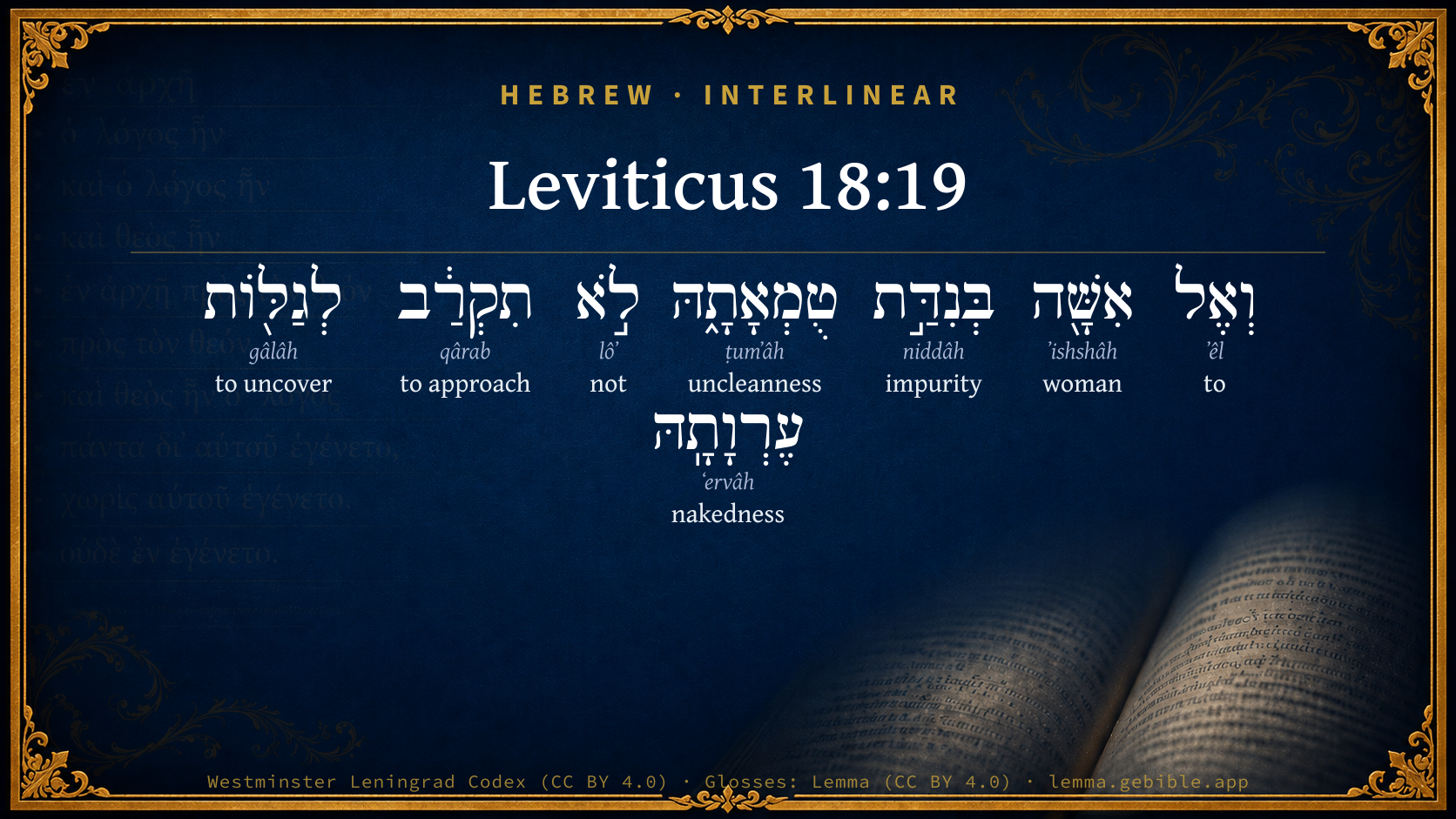
Hebrew (Westminster Leningrad Codex) Leviticus 18:19 appears in the Hebrew Old Testament. The text above is from the Westminster Leningrad Codex. Each word links to its Strong’s number, a concise gloss, and parsing drawn from the Open Scriptures Hebrew Bible morphology. Click any word for its full Brown-Driver-Briggs (BDB) entry.
Download image
Cite this verse

Leviticus 18:19 (World English Bible). Public Domain. Lemma interlinear Bible study tool, https://lemma.gebible.app/v/leviticus/18/19.

Show BibTeX & RIS
BibTeX
RIS
English Translation
"'You shall not approach a woman to uncover her nakedness, as long as she is impure by her uncleanness.
World English Bible · Public Domain
Download a study sheet

One document with this verse’s original text, its word-by-word gloss line, the meaning frame, cross-references with their text, attributed commentary, and full source and license credits — printable, and it pastes into notes with its structure intact.

This verse Autodidact and up

Study sheet (.html) Plain text (.txt)

A passage Seminary Student

Up to 50 verses in one chapter. A passage sheet keeps up to 6 commentary sources and 12 cross-references per verse, in the order this page ranks them, and says so on the sheet whenever that leaves anything out. Ask for a single verse and you get the Autodidact verse sheet above.

Everything on this page stays free to read, with no account — the sheet is a download of what is already on screen, not access to it.

Want to remove ads? Support Godless Engineer
Compare translations 3

The same verse in 3 English versions, stacked beneath the original-language interlinear above. Click any original word for its lexicon entry.

Each is an independent rendering of the whole verse — the interlinear is not word-aligned to these translations.

Highlighted words mark where these versions differ — a whole-verse word diff, not a word-by-word alignment.

  • World English Bible Public Domain
    "'You shall not approach a woman to uncover her nakedness, as long as she is impure by her uncleanness.
  • King James Version Public Domain
    Also thou shalt not approach unto a woman to uncover her nakedness, as long as she is put apart for her uncleanness.
  • unfoldingWord Literal Text CC BY-SA 4.0
    And to a woman in the menstruation of her uncleanness, you shall not draw near to uncover her nakedness.

unfoldingWord Literal Text — © unfoldingWord, licensed CC BY-SA 4.0. Word-aligned USFM3 via Door43 (git.door43.org/unfoldingWord/en_ult).

Versions to compare (up to 4)

3 of 4 selected

Show all 18 translations

Every available English version of this verse, each an independent rendering of the whole verse.

  • World English Bible Public Domain
    "'You shall not approach a woman to uncover her nakedness, as long as she is impure by her uncleanness.
  • Berean Standard Bible Public Domain
    You must not approach a woman to have sexual relations with her during her menstrual period.
  • Majority Standard Bible Public Domain
    You must not approach a woman to have sexual relations with her during her menstrual period.
  • King James Version Public Domain
    Also thou shalt not approach unto a woman to uncover her nakedness, as long as she is put apart for her uncleanness.
  • American Standard Version (1901) Public Domain
    And thou shalt not approach unto a woman to uncover her nakedness, as long as she is impure by her uncleanness.
  • Revised Version (1885) Public Domain
    And thou shalt not approach unto a woman to uncover her nakedness, as long as she is impure by her uncleanness.
  • Geneva Bible (1599) Public Domain
    Thou shalt not also go vnto a woman to vncouer her shame, as long as she is put apart for her disease.
  • Douay-Rheims (1899) Public Domain
    Thou shalt not approach to a woman having her flowers, neither shalt thou uncover her nakedness.
  • Young's Literal Translation Public Domain
    `And unto a woman in the separation of her uncleanness thou dost not draw near to uncover her nakedness.
  • Literal Standard Version CC BY-SA 4.0
    And you do not draw near to a woman in the separation of her uncleanness to uncover her nakedness.
  • Unlocked Literal Bible CC BY-SA 4.0
    Do not sleep with a woman during her menstruation. She is unclean during that time.
  • unfoldingWord Literal Text CC BY-SA 4.0
    And to a woman in the menstruation of her uncleanness, you shall not draw near to uncover her nakedness.
  • Darby Bible Public Domain
    And thou shalt not approach a woman in the separation of her uncleanness to uncover her nakedness.
  • World Messianic Bible Public Domain
    “‘You shall not approach a woman to uncover her nakedness, as long as she is impure by her uncleanness.
  • Webster's Bible Public Domain
    Also thou shalt not approach to a woman to uncover her nakedness, as long as she is put apart for her uncleanness.
  • Free Bible Version CC BY-SA 4.0
    Don't have sex with a woman during the time she is unclean because of her period.
  • Bible in Basic English Public Domain
    And you may not go near a woman or have sex relations with her when she is unclean, at her regular time.
  • JPS Tanakh (1917) Public Domain
    And thou shalt not approach unto a woman to uncover her nakedness, as long as she is impure by her uncleanness.

Literal Standard Version (2020), Covenant Press — licensed CC BY-SA 4.0. Text via the HelloAO Bible API (eBible.org). Unlocked Literal Bible (unfoldingWord) — licensed CC BY-SA 4.0. Text via the HelloAO Bible API (eBible.org). unfoldingWord Literal Text — © unfoldingWord, licensed CC BY-SA 4.0. Word-aligned USFM3 via Door43 (git.door43.org/unfoldingWord/en_ult). Free Bible Version, Dr. Jonathan Gallagher — licensed CC BY-SA 4.0. Text via the HelloAO Bible API (eBible.org).

Word by word

More ways to search: Search by grammar → Find every occurrence → Compare this word →

Practice this passage: Drill this verse → Learn its vocabulary →

בְּנִדַּ֣ת
niddâh
H5079
“in/at · impurity of”
Preposition + Noun, Common, Feminine, Singular, Construct
Part of Speech
Preposition + Noun
Type
Common
Gender
Feminine
Number
Singular
State
Construct
Full BDB Definition

Origin: from H5074

TWOT: 1302a

impurity, filthiness, menstruous, set apart - impurity - of ceremonial impurity - of menstruation - impure thing (figuratively) - of idolatry, immorality
  1. וְאֶל ʼêl H413 “and · to” Conjunction + Preposition
  2. אִשָּׁ֖ה ʼishshâh H802 “woman” Noun, Common, Feminine, Singular, Absolute
  3. טֻמְאָתָ֑הּ ṭumʼâh H2932 “uncleanness · her” Noun, Common, Feminine, Singular, Construct + Suffix, Personal, 3rd Person, Feminine, Singular
  4. לֹ֣א lôʼ H3808 “not” Particle, Negative
  5. תִקְרַ֔ב qârab H7126 “to approach” Verb, Qal, Imperfect, 2nd Person, Masculine, Singular
  6. לְגַלּ֖וֹת gâlâh H1540 “to uncover” Preposition + Verb, Piel, Infinitive Construct
  7. עֶרְוָתָֽהּ ʻervâh H6172 “nakedness · her” Noun, Common, Feminine, Singular, Construct + Suffix, Personal, 3rd Person, Feminine, Singular

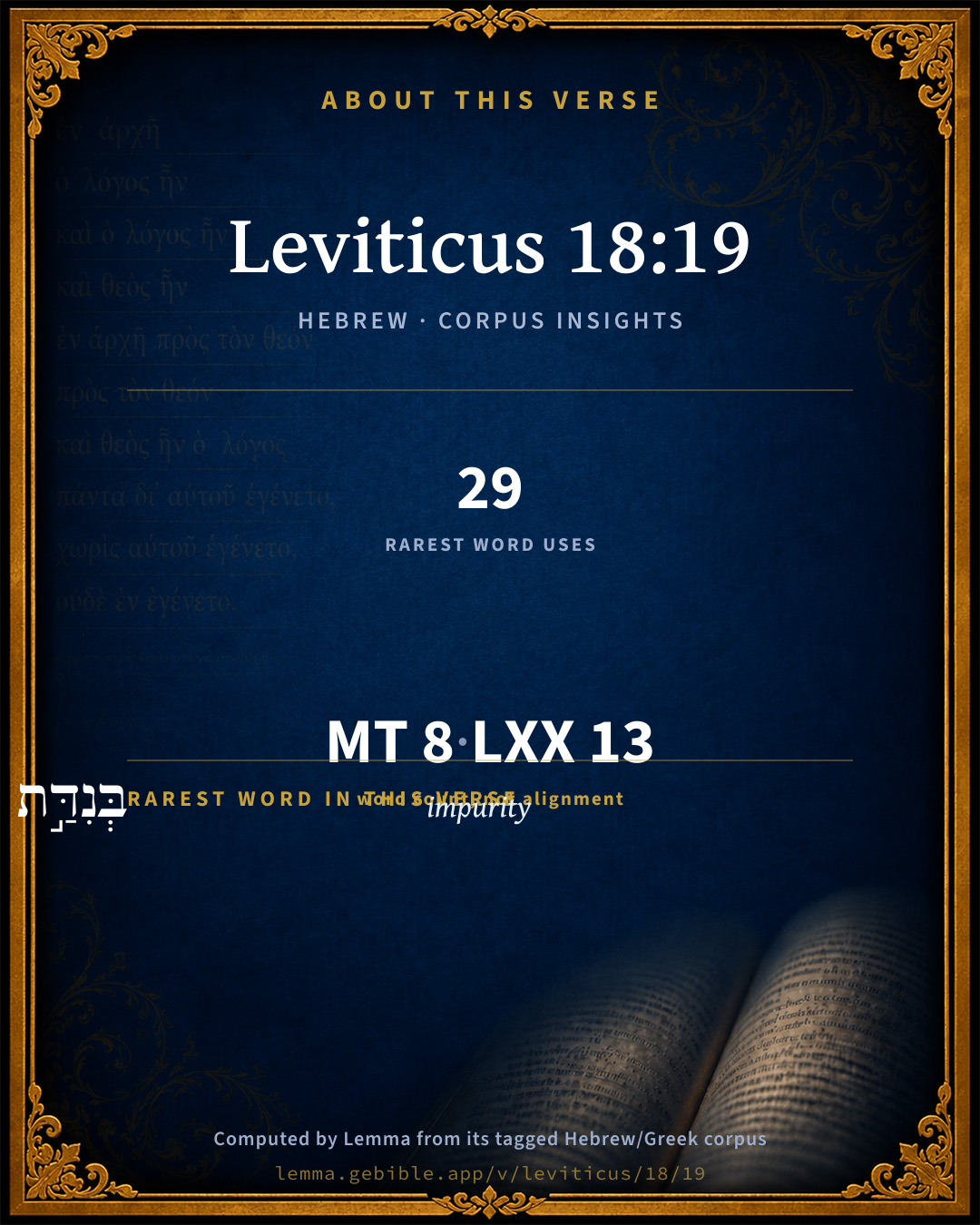
About this verse

These counts appear in no published source. They are computed here, from the morphology-tagged text and Lemma’s own curated glosses. What Lemma adds →

8
words
8
distinct lemmas
Pentateuch
section

Shared distinctive vocabulary

בְּנִדַּ֣ת impurity H5079 occurs in 24 verses of the Hebrew Bible. Also found in:

Grammatical profile

  • 2 verbs
  • 4 nouns
  • 1 preposition
  • 1 particle

Verb forms

  • תִקְרַ֔ב Qal · Imperfect
  • לְגַלּ֖וֹת Piel · Infinitive Construct

Hebrew & Septuagint length

In English translation the verse runs 19 words from the Hebrew and 18 from the Septuagint (LXX English) — closely comparable.

A rough comparison of the two English renderings, which tokenize alike — not a word-level alignment.

Word counts can differ between the Hebrew and the Greek without any difference in meaning — e.g. the Hebrew direct-object marker אֵת has no separate Greek word, and Greek often adds the article ὁ.

In the original languages it is 8 Hebrew tokens and 13 Greek tokens — but the two are counted differently (Hebrew bundles its prefixes and suffixes into one token; the Greek is in lemma form), so that isn’t a like-for-like length.

Cross-references

6

Topical passages linked to Leviticus 18:19 in the Treasury of Scripture Knowledge — connected by theme and wording, ordered by reader-vote popularity; previews shown in the World English Bible.

  • Leviticus 15:24 "'If any man lies with her, and her monthly flow is on him, he shall be unclean seven days; and every bed whereon he lies shall be unclean.
  • Leviticus 20:18 "'If a man lies with a woman having her monthly period, and uncovers her nakedness; he has made naked her fountain, and she has uncovered the fountain of her blood: and both of them shall be cut off from among their people.
  • Ezekiel 22:10 In you have they uncovered their fathers' nakedness; in you have they humbled her who was unclean in her impurity.
  • Leviticus 15:19 "'If a woman has a discharge, and her discharge in her flesh is blood, she shall be in her impurity seven days: and whoever touches her shall be unclean until the evening.
  • Ezekiel 18:6 and has not eaten on the mountains, neither has lifted up his eyes to the idols of the house of Israel, neither has defiled his neighbor's wife, neither has come near to a woman in her impurity,
  • Leviticus 12:2 "Speak to the children of Israel, saying, 'If a woman conceives, and bears a male child, then she shall be unclean seven days; as in the days of her monthly period she shall be unclean.

Cross-references courtesy of OpenBible.info (CC BY 4.0).

Hebrew and Greek witnesses Masoretic Hebrew ↔ Greek Septuagint

The same verse in the two great witnesses to the Old Testament, shown verse-for-verse.

These are two independent witnesses, not word-aligned to each other, and the Septuagint is shown in lemma (dictionary) form.

Hebrew Leviticus 18:19 Masoretic · Westminster Leningrad Codex

וְאֶל אִשָּׁ֖ה בְּנִדַּ֣ת טֻמְאָתָ֑הּ לֹ֣א תִקְרַ֔ב לְגַלּ֖וֹת עֶרְוָתָֽהּ

"'You shall not approach a woman to uncover her nakedness, as long as she is impure by her uncleanness.

World English Bible · Public Domain

Greek LXX Leviticus 18:19 Septuagint · lemma form

καί πρός γυνή ἐν χωρίσμος ἀκαθαρσία αὐτός οὐ προςἔρχομαι ἀποκαλύπτω ὁ ἀσχημοσύνη αὐτός

And you shall not go in to a woman under separation for her uncleanness, to uncover her nakedness.

LXX2012 (modern English Septuagint) · Public Domain

On this verse, Keil & Delitzsch discusses the Septuagint’s reading. Read the note in Commentary ↓

Hebrew: Westminster Leningrad Codex (CC BY 4.0). Greek: Septuagint (public domain); English from LXX2012 (modern English Septuagint) (Public Domain). How the Septuagint differs from the Hebrew →

Targum (Aramaic paraphrase)

2

The Targum is the ancient Jewish Aramaic paraphrase of the Hebrew Scriptures — an interpretive translation, not the Hebrew text itself. Onkelos (literal) and Pseudo-Jonathan (expansive) render the Torah, and Jonathan the Prophets. Coverage is partial: where no permissively-licensed English translation exists for a verse, only the Aramaic is shown. This is verse-level text, not a word-by-word alignment to the Hebrew.

  1. Targum Onkelos Torah (Genesis–Deuteronomy)
    וּלְאִתְּתָא בְּרִחוּק סוֹבְתַהּ לָא תִקְרַב לְגַלָאָה עֶרְיְתָהּ

    (no public-domain English translation for this verse)

    Targum Onkelos — Aramaic: “Onkelos Genesis” (public domain); “Onkelos Exodus” (public domain); “Onkelos Leviticus” (public domain); “Onkelos Numbers” (public domain); “Onkelos Deuteronomy” (public domain). English: “Sefaria Community Translation” (CC0 1.0 (public-domain dedication)); “J.W. Etheridge. The Targums of Onkelos and Jonathan Ben Uzziel on the Pentateuch. London: Longmans, Green, 1862” (public domain). Text via Sefaria.

  2. Targum Pseudo-Jonathan Torah (Genesis–Deuteronomy)
    וּלְצֵיד אִתְּתָא בִּזְמַן רִיחוּק סְאוּבְתָּהּ לָא תִקְרַב לְבַזָּאָה עֶרְיְיתָהּ

    And unto the side of a woman in the time of the separation of her uncleanness thou shalt not draw nigh to dishonour her nakedness.

    Targum Pseudo-Jonathan — Aramaic: “Targum Jonathan on Genesis” (public domain); “Targum Jonathan on Exodus” (public domain); “Targum Jonathan on Leviticus” (public domain); “Targum Jonathan on Numbers” (public domain); “Targum Jonathan on Deuteronomy” (public domain). English: “The Targum of Jonathan ben Uzziel, trans. J. W. Etheridge, London, 1862” (public domain). Text via Sefaria.

Commentary

Notes on Leviticus 18:19 from classic Christian and Jewish commentators (each source and its license shown beneath its notes). The classic Christian expositions comment on the surrounding passage and are grouped to its opening verse, so a note may address several verses; the Jewish commentaries on the Tanakh (Rashi and others) are per-verse, so they appear only where the commentator wrote on this verse.

Lemma curates 59 commentaries, every one of them public domain or Creative Commons licensed, each selected and text-cleaned for this edition rather than reprinted as found. About our sources →

Matthew Henry's Commentary

Here is, I. A law to preserve the honour of the marriage-bed, that it should not be unseasonably used (Lev 18:19), nor invaded by an adulterer, Lev 18:20.

II. A law against that which was the most unnatural idolatry, causing their children to pass through the fire to Moloch, Lev 18:21. Moloch (as some think) was the idol in and by which they worshipped the sun, that great fire of the world; and therefore in the worship of it they made their own children either sacrifices to this idol, burning them to death before it, or devotees to it, causing them to pass between two fires, as some think, or to be thrown through one, to the honour of this pretended deity, imagining that the consecrating of but one of their children in this manner to Moloch would procure good fortune for all the rest of their children. Did idolaters thus give their own children to false gods, and shall we think any thing too dear to be dedicated to, or to be parted with for, the true God? See how this sin of Israel (which they were afterwards guilty of, notwithstanding this law) is aggravated by the relation which they and their children stood in to God. Eze 16:20, Thou hast taken thy sons and thy daughters, whom thou hast borne unto me, and these thou hast sacrificed. Therefore it is here called profaning the name of their God; for it looked as if they thought they were under greater obligations to Moloch than to Jehovah; for to him they offered their cattle only, but to Moloch their children.

III. A law against unnatural lusts, sodomy and bestiality, sins not to be named nor thought of without the utmost abhorrence imaginable, Lev 18:22, Lev 18:23. Other sins level men with the beasts, but these sink them much lower. That ever there should have been occasion for the making of these laws, and that since they are published they should ever have been broken, is the perpetual reproach and scandal of human nature; and the giving of men up to these vile affections was frequently the punishment of their idolatries; so the apostle shows, Rom 1:24.

IV. Arguments against these and the like abominable wickednesses. He that has an indisputable right to command us, yet because he will deal with us as men, and draw with the cords of a man, condescends to reason with us. 1. Sinners defile themselves with these abominations: Defile not yourselves in any of these things, Lev 18:24. All sin is defiling to the conscience, but these are sins that have a peculiar turpitude in them. Our heavenly Father, in kindness to us, requires of us that we keep ourselves clean, and do not wallow in the dirt. 2. The souls that commit them shall be cut off, Lev 18:29. And justly; for, if any man defile the temple of God, him shall God destroy, Co1 3:17. Fleshly lusts war against the soul, and will certainly be the ruin of it if God's mercy and grace prevent not. 3. The land is defiled, Lev 18:25. If such wickednesses as these be practised and connived at, the land is thereby made unfit to have God's tabernacle in it, and the pure and holy God will withdraw the tokens of his gracious presence from it. It is also rendered unwholesome to the inhabitants, who are hereby infected with sin and exposed to plagues and it is really nauseous and loathsome to all good men in it, as the wickedness of Sodom was to the soul of righteous Lot. 4. These have been the abominations of the former inhabitants, v, 24, 27. Therefore it was necessary that these laws should be made, as antidotes and preservatives from the plague are necessary when we go into an infected place. And therefore they should not practise any such things, because the nations that had practised them now lay under the curse of God, and were shortly to fall by the sword of Israel. They could not but be sensible how odious those people had made themselves who wallowed in this mire, and how they stank in the nostrils of all good men; and shall a people sanctified and dignified as Israel was make themselves thus vile? When we observe how ill sin looks in others we should use this as an argument with ourselves with the utmost care and caution to preserve our purity. 5. For these and the like sins the Canaanites were to be destroyed; these filled the measure of the Amorites' iniquity (Gen 15:16), and brought down that destruction of so many populous kingdoms which the Israelites were now shortly to be not only the spectators, but the instruments of: Therefore I do visit the iniquity thereof upon it, Lev 18:25. Note, The tremendous judgments of God, executed on those that are daringly profane and atheistical, are intended as warnings to those who profess religion to take heed of every thing that has the least appearance of, or tendency towards, profaneness or atheism. Even the ruin of the Canaanites is an admonition to the Israelites not to do like them. Nay, to show that not only the Creator is provoked, but the creation burdened, by such abominations as these, it is added (Lev 18:25), The land itself vomiteth out her inhabitants. The very ground they went upon did, as it were, groan under them, and was sick of them, and not easy till it had discharged itself of these enemies of the Lord, Isa 1:24. This bespeaks the extreme loathsomeness of sin; sinful man indeed drinks in iniquity like water, but the harmless part of the creation even heaves at it, and rises against it. Many a house and many a town have spued out the wicked inhabitants, as it were, with abhorrence, Rev 3:16. Therefore take heed, saith God, that the land spue not you out also, Lev 18:28. It was secured to them, and entailed upon them, and yet they must expect that, if they made the vices of the Canaanites their own, with their land their fate would be the same. Note, Wicked Israelites are as abominable to God as wicked Canaanites, and more so, and will be as soon spued out, or sooner. Such a warning as was here given to the Israelites is given by the apostle to the Gentile converts, with reference to the rejected Jews, in whose room they were substituted (Rom 11:19, etc.); they must take heed of falling after the same example of unbelief, Heb 4:11. Apply it more generally; and let it deter us effectually from all sinful courses to consider how many they have been the ruin of. Lay the ear of faith to the gates of the bottomless pit, and hear the doleful shrieks and outcries of damned sinners, whom earth has spued out and hell has swallowed, that find themselves undone, for ever undone, by sin; and tremble lest this be your portion at last. God's threatenings and judgments should frighten us from sin.

V. The chapter concludes with a sovereign antidote against this infection: Therefore you shall keep my ordinance that you commit not any one of these abominable customs, Lev 18:30. This is the remedy prescribed. Note, 1. Sinful customs are abominable customs, and their being common and fashionable does not make them at all the less abominable nor should we the less abominate them, but the more; because the more customary they are the more dangerous they are. 2. It is of pernicious consequence to admit and allow of any one sinful custom, because one will make way for many, Uno absurdo dato, mille sequuntur - Admit but a single absurdity, you invite a thousand. The way of sin is downhill. 3. A close and constant adherence to God's ordinances is the most effectual preservative from the infection of gross sin. The more we taste of the sweetness and feel of the power of holy ordinances the less inclination we shall have to the forbidden pleasures of sinners' abominable customs. It is the grace of God only that will secure us, and that grace is to be expected only in the use of the means of grace. Nor does God ever leave any to their own hearts' lusts till they have first left him and his institutions.

Matthew Henry's Commentary on the Whole Bible (1708–1710) — public domain (CC PDM 1.0). Text via the HelloAO Bible API.

Trapp's Complete Commentary

John Trapp

Lev 18:19 Also thou shalt not approach unto a woman to uncover her nakedness, as long as she is put apart for her uncleanness.

Ver. 19. Unto a woman.] {See Trapp on "Lev 15:24"}

John Trapp, A Commentary or Exposition upon All the Books of the Old and New Testament (1647–1656) — public domain. Text from a community e-Sword module.

Joseph Benson's Commentary

Lev 18:19. As long as she is set apart — No, not to thy own wife. This was not only a ceremonial pollution, but an immorality also, whence it is put among gross sins, Eze 18:6. And therefore it is now unlawful under the gospel.

Joseph Benson's Commentary on the Old and New Testaments (1811–1818) — public domain. Text from a community e-Sword module.

Whedon's Commentary on the Bible

Daniel D. Whedon

UNNATURAL LUSTS PROHIBITED, Lev_18:19-30.

19. Thou shalt not approach — This verse forbids contracting the ceremonial impurity specified in Lev_15:19; Lev_15:25. See notes. In Lev_20:18, the penalty of death is denounced against both parties to the offence. See note.

Daniel D. Whedon (gen. ed.), Commentary on the Old and New Testaments (1874–1909) — public domain. Text from a community e-Sword module.

Keil & Delitzsch

C. F. Keil & F. Delitzsch

Prohibition of other kinds of unchastity and of unnatural crimes. - Lev 18:19 prohibits intercourse with a woman during her uncleanness. טמאה נדּת signifies the uncleanness of a woman's hemorrhage, whether menstruation or after childbirth, which is called in Lev 12:7; Lev 20:18, the fountain of bleeding. The guilty persons were both of them to be cut off from their nation according to Lev 20:18, i.e., to be punished with death.

Lev 18:20

"To a neighbour's wife thou shalt not give שׁכבתּך thy pouring as seed" (i.e., make her pregnant), "to defile thyself with her," viz., by the emissio seminis (Lev 15:16-17), a defilement which was to be punished as adultery by the stoning to death of both parties (Lev 20:10; Deu 22:22, cf. Joh 9:5).

Lev 18:21

To bodily unchastity there is appended a prohibition of spiritual whoredom. "Thou shalt not give of thy seed to cause to pass through (sc., the fire; Deu 18:10) for Moloch." המּלך is constantly written with the article: it is rendered by the lxx ἄρχων both here and in Lev 20:2., but ὁ Μολόχ βασιλεύς in other places (Kg2 23:10; Jer 32:35). Moloch was an old Canaanitish idol, called by the Phoenicians and Carthaginians Melkarth, Baal-melech, Malcom, and other such names, and related to Baal, a sun-god worshipped, like Kronos and Saturn, by the sacrifice of children. It was represented by a brazen statue, which was hollow and capable of being heated, and formed with a bull's head, and arms stretched out to receive the children to be sacrificed. From the time of Ahaz children were slain at Jerusalem in the valley of Ben-hinnom, and then sacrificed by being laid in the heated arms and burned (Eze 16:20-21; Eze 20:31; Jer 32:35; Kg2 23:10; Kg2 16:3; Kg2 17:17; Kg2 21:6, cf. Psa 106:37-38). Now although this offering of children in the valley of Ben-hinnom is called a "slaughtering" by Ezekiel (Eze 16:21), and a "burning through (in the) fire" by Jeremiah (Jer 7:31), and although, in the times of the later kings, children were actually given up to Moloch and burned as slain-offerings, even among the Israelites; it by no means follows from this, that "passing through to Moloch," or "passing through the fire," or "passing through the fire to Moloch" (Kg2 23:10), signified slaughtering and burning with fire, though this has been almost unanimously assumed since the time of Clericus. But according to the unanimous explanation of the Rabbins, fathers, and earlier theologians, "causing to pass through the fire" denoted primarily going through the fire without burning, a februation, or purification through fire, by which the children were consecrated to Moloch; a kind of fire-baptism, which preceded the sacrificing, and was performed, particularly in olden time, without actual sacrificing, or slaying and burning. For februation was practised among the most different nations without being connected with human sacrifices; and, like most of the idolatrous rites of the heathen, no doubt the worship of Moloch assumed different forms at different times and among different nations. If the Israelites had really sacrificed their children to Moloch, i.e., had slain and burned them, before the time of Ahaz, the burning would certainly have been mentioned before; for Solomon had built a high place upon the mountain to the east of Jerusalem for Moloch, the abomination of the children of Ammon, to please his foreign wives (Kg1 11:7 : see the Art. Moloch in Herzog's Cycl.). This idolatrous worship was to be punished with death by stoning, as a desecration of the name of Jehovah, and a defiling of His sanctuary (Lev 20:3), i.e., as a practical contempt of the manifestations of the grace of the living God (Lev 20:2-3).

Lev 18:22-23

Lastly, it was forbidden to "lie with mankind as with womankind," i.e., to commit the crime of paederastia, that sin of Sodom (Gen 19:5), to which the whole of the heathen were more or less addicted (Rom 1:27), and from which even the Israelites did not keep themselves free (Jdg 19:22.); or to "lie with any beast." "Into no beast shalt thou give thine emission of seed,...and a woman shall not place herself before a beast to lie down thereto." רבע = רבץ "to lie," is the term used particularly to denote a crime of this description (Lev 20:13 and Lev 20:15, Lev 20:16, cf. Exo 22:18). Lying with animals was connected in Egypt with the worship of the goat; at Mendes especially, where the women lay down before he-goats (Herodotus, 2, 46; Strabo, 17, p. 802). Aelian (nat. an. vii. 19) relates an account of the crime being also committed with a dog in Rome; and according to Sonnini, R. 11, p. 330, in modern Egypt men are said to lie even with female crocodiles.

Keil & Delitzsch — Biblical Commentary on the Old Testament (1861–1891) — public domain (CC PDM 1.0). Text via the HelloAO Bible API. (Old Testament only.)

Geneva Bible (1599)

Geneva Bible translators

Or while she hath her flowers.

Geneva Bible (1599) marginal notes — public domain. Text via Bolls.life.

Adam Clarke's Commentary

Verse 19. As long as she is put apart] See Clarke on Le 15:24.

Adam Clarke's Commentary on the Bible (1810–1826) — public domain. Text from a community e-Sword/MySword module.

Ellicott's Commentary for English Readers

(19) Also thou shalt not approach.—Literally, thou shalt not approach. The marriage laws are now followed by sexual impurities, which to some extent are suggested by the subjects that had necessarily to be discussed or hinted at in regulating the alliance in question.

As long as she is put apart.—Put apart, i.e., seven days. (See Lev_15:19.) For consorting with her without being aware of her condition the man contracted defilement for seven days (see Lev_15:24), and for committing this gross act presumptuously, both parties to it were visited with death. (See Lev_20:18.) Ezekiel refers to the transgression of this law as one of the heinous sins perpetrated by the people of Israel (Eze_18:16; Eze_22:10).

A Bible Commentary for English Readers, edited by Charles John Ellicott (1878–1897) — public domain. Text from a community e-Sword module.

John Gill's Exposition

Also thou shall not approach unto a woman,.... Not even a man to his own wife, and much less to another woman:

to uncover her nakedness, as long as she is put apart for her uncleanness; in her monthly courses; and the time of her separation from her husband on that account was seven days, Lev 15:19; if a man lay with a woman when in such circumstances, they were both to be cut off from their people, Lev 20:18; and such an action is reckoned among sins, and uncleanness of the worst sort, Eze 22:10.

John Gill's Exposition of the Whole Bible (1746–1763) — public domain (CC PDM 1.0). Text via the HelloAO Bible API.

Haydock's Catholic Bible Commentary

Thus, &c. The refractory were to be slain, chap xx. 18. It was thought that the infant would be in danger; and hence the Jews punished with death the man whose child was born lame. St. Augustine (q. 64,) believes that this law is still in force; and some accuse the person who neglects it, as guilty of a venial sin. (Bonfrere)

George Leo Haydock (1774–1849), Haydock's Catholic Family Bible and Commentary, 1859 edition — public domain. Excludes Psalms (Douay-Rheims chapter numbering differs from Protestant) and Deuterocanonical books (Catholic canon only).

Matthew Poole's English Annotations

No, not to thy own wife. See Exo 12:2; 15:24,25. This was not only a ceremonial pollution, but an immorality also, whence it is put amongst gross sins, Eze 18:6. There is also a natural turpitude in this action. And therefore it is now unlawful under the gospel.

Matthew Poole's English Annotations on the Holy Bible (1683–1685) — public domain. Text from a community e-Sword/MySword module.

The Pulpit Commentary

The marriage restrictions having been laid down, there follows in the five next verses the prohibition of five sexual impurities unconnected with marriage except by their subject-matter. The first is to approach unto a woman to uncover her nakedness, as long as she is put apart for her uncleanness, that is, either for seven days at the time of her ordinary illnesses, (Lev_15:19) or any longer time that her illness might last, (Lev_15:25) or for forty days after the birth of a man child, (Lev_12:2-4) or for eighty days after the birth of a girl. (Lev_12:5) The penalty for the offense within the seven days is death if committed willfully; (Lev_20:18) if fallen into unknowingly, a ceremonial penalty of seven days" uncleanness is incurred. (Lev_15:24) It is twice referred to by Ezekiel as a gross sin. (Eze_18:6 Eze_22:10)

Vers. 19-23. The preservation of the marriage relationship in its purity is the safeguard against sins of lust, which will be sure to invade a society wherever licentiousness or asceticism has dishonoured marriage.

The Pulpit Commentary (1880–1919), ed. H.D.M. Spence-Jones & Joseph S. Exell — public domain. Text from a community e-Sword module.

John Wesley's Explanatory Notes

As long as she is set apart - No not to thy own wife. This was not only a ceremonial pollution, but an immorality also, whence it is put amongst gross sins, Ezek. xviii, 6. And therefore it is now unlawful under the gospel.

John Wesley, Explanatory Notes Upon the Whole Bible (1754–1765) — public domain. Text via the GEBible commentary corpus.

unfoldingWord translationNotes

Door43 World Missions Community

menstruation

This is the period of time when a woman bleeds from her womb.

She is unclean

The woman whom other people may not touch is spoken of as if he were physically unclean. (See: Metaphor)

your neighbor's wife

"any man's wife"

translationWords

clean

neighbor

defile

unfoldingWord translationNotes — © Distant Shores Media and the Door43 World Missions Community, licensed CC BY-SA 4.0. Source: git.door43.org/Door43/en_tn.

Ramban (Nachmanides)

Rabbi Moshe ben Nachman (Ramban / Nachmanides)

AND UNTO A WOMAN DURING HER SEPARATION FOR HER UNCLEANNESS, THOU SHALT NOT APPROACH TO UNCOVER HER NAKEDNESS. Scripture prohibited [having intercourse with] a menstruant woman for the reason I have mentioned, that the Torah permitted sexual intercourse only for the sake of raising children, and since the whole child or the greater part thereof is created out of the woman’s blood, as I have already mentioned,. and from the blood of menstruation it is not created at all [therefore the Torah prohibited intercourse with her during the period of her impurity]. Indeed, how could a child be formed out of this blood, since it is deadly poisonous, capable of causing the death of any creature that drinks or eats it! Now when the womb contains a large amount of this blood of menstruation, the woman cannot become pregnant, as this blood is not endowed at all with the capacity for forming [a child]. Even if she were to become pregnant from other blood, and then derive nourishment from this blood, the child would die. Physicians have also mentioned already that if the foetus derives nourishment from the best of blood, and all its nutriment be of the best quality, but some of this blood of menstruation is mixed with it, it will cause it to go bad, and produce in the child inflammatory swellings and sores of all kinds. And in the opinion of our Rabbis, 1. even if a small part of this [blood of menstruation] remains, in the foetus, the child will be a leper. By virtue, then, of all these reasons it was fitting that the Torah prohibit intercourse with a menstruant. The doctors have also told us in connection with it, a true experience, which is one of the wondrous works of Him Who is perfect in knowledge in creation, that if a menstruant woman at the beginning of her issue were to concentrate her gaze for some time upon a polished iron mirror, there would appear in the mirror red spots resembling drops of blood, for the bad part therein [i.e., in the issue] that is by its nature harmful, causes a certain odium, and the unhealthy condition of the air attaches to the mirror, just as a viper kills with its gaze. And surely it is harmful to have intercourse with her then, since physically and mentally she is attached to the man’s body and mind. Therefore Scripture prohibited it by saying, and her impurity will be upon him, meaning that her condition is a contagious one. It is with reference to this that it states, the uncleanness of a woman in her impurity, always mentioning in connection with her the term “impurity,” which is like that used in speaking of a creeping thing and of a leper, in which cases their impurity is within their bodies. It is possible that this is the sense of the expression, he hath bared her fountain, and she hath uncovered the fountain of her blood, for that blemished fountain should be covered, and not bared in order to draw its bad and extremely harmful waters. Thus intercourse has been prohibited to the holy seed all the days of her impurity, until she immerses herself in water [i.e., in a ritual pool], for then she will be purified also in her thoughts, on the significance of immersion, that it is not merely a matter of removing mud or dirt which may be removed by water, but “it is a Scriptural decree, the validity of the act depending upon the disposition of the heart. It is for this reason that the Sages have said: ‘If he immersed himself without intention, it is as though he had not immersed himself at all’ (Chagigah 18 b) … Thus he whose heart intends to purify himself, becomes purified as soon as the [actual] immersion is accomplished.” It is clear, then, that since both body and soul must participate in the act of immersion, the effect and potency of the purification applies to both body and soul as Ramban here states, “for then she will be purified also in her thoughts, and become completely clean.” See “The Commandments,” Vol. I, pp. 117-119. and become completely clean [in body and mind].

Ramban (Nachmanides) on the Tanakh — English translation: “Commentary on the Torah by Ramban (Nachmanides). Translated and annotated by Charles B. Chavel. New York, Shilo Pub. House, 1971-1976” (CC BY 4.0). Text via Sefaria.

Lesson kit

Teaching starters — assembled from the data on this page, not authored interpretation. Every prompt links to the verse data it draws on. Edit before teaching.

Leviticus, in the Pentateuch, opens this verse with 8 words (8 distinct Hebrew lemmas). Its most distinctive word is niddâh (“impurity”). A historical commentator’s framing appears above. Read the whole chapter for the surrounding context.

Discussion questions

  1. What does “impurity” (niddâh) contribute to the verse as a whole?
  2. How does Leviticus 12:2, which shares the word «impurity», read alongside this verse?
  3. The translations on this page render this verse differently — a whole-verse word diff, not a word-by-word alignment. What might account for the different wordings?
  4. «תִקְרַ֔ב» is a Qal Imperfect verb. How does that grammatical form shape the action described?
  5. Compare how Matthew Henry's Commentary and Trapp's Complete Commentary read this verse. Where do they agree or differ?

Things to notice

Reading settings

Reading text

Shown beneath each verse's original-language words.

Old Testament
Old Testament edition

Read the OT as the Masoretic Hebrew (MT) or the Greek Septuagint (LXX).

English shown for the Greek Septuagint (in the Hebrew ↔ Greek comparison).

Comparing translations? Open the Compare panel on any verse page to stack up to four side by side.