
Joshua 7:14

Hebrew (Westminster Leningrad Codex) Joshua 7:14 appears in the Hebrew Old Testament. The text above is from the Westminster Leningrad Codex. Each word links to its Strong’s number, a concise gloss, and parsing drawn from the Open Scriptures Hebrew Bible morphology. Click any word for its full Brown-Driver-Briggs (BDB) entry.
Download image
Cite this verse

Joshua 7:14 (World English Bible). Public Domain. Lemma interlinear Bible study tool, https://lemma.gebible.app/v/joshua/7/14.

Show BibTeX & RIS
BibTeX
RIS
English Translation
In the morning therefore you shall be brought near by your tribes: and it shall be, that the tribe which Yahweh takes shall come near by families; and the family which Yahweh shall take shall come near by households; and the household which Yahweh shall take shall come near man by man.
World English Bible · Public Domain
Download a study sheet

One document with this verse’s original text, its word-by-word gloss line, the meaning frame, cross-references with their text, attributed commentary, and full source and license credits — printable, and it pastes into notes with its structure intact.

This verse Autodidact and up

Study sheet (.html) Plain text (.txt)

A passage Seminary Student

Up to 50 verses in one chapter. A passage sheet keeps up to 6 commentary sources and 12 cross-references per verse, in the order this page ranks them, and says so on the sheet whenever that leaves anything out. Ask for a single verse and you get the Autodidact verse sheet above.

Everything on this page stays free to read, with no account — the sheet is a download of what is already on screen, not access to it.

Want to remove ads? Support Godless Engineer
Compare translations 3

The same verse in 3 English versions, stacked beneath the original-language interlinear above. Click any original word for its lexicon entry.

Each is an independent rendering of the whole verse — the interlinear is not word-aligned to these translations.

Highlighted words mark where these versions differ — a whole-verse word diff, not a word-by-word alignment.

  • World English Bible Public Domain
    In the morning therefore you shall be brought near by your tribes: and it shall be, that the tribe which Yahweh takes shall come near by families; and the family which Yahweh shall take shall come near by households; and the household which Yahweh shall take shall come near man by man.
  • King James Version Public Domain
    In the morning therefore ye shall be brought according to your tribes: and it shall be, that the tribe which the LORD taketh shall come according to the families thereof; and the family which the LORD shall take shall come by households; and the household which the LORD shall take shall come man by man.
  • unfoldingWord Literal Text CC BY-SA 4.0
    And you shall be brought near in the morning by your tribes. And it will happen, the tribe that Yahweh takes shall come near by clans, and the clan that Yahweh takes shall come near by houses, and the house that Yahweh takes shall come near by men.

unfoldingWord Literal Text — © unfoldingWord, licensed CC BY-SA 4.0. Word-aligned USFM3 via Door43 (git.door43.org/unfoldingWord/en_ult).

Versions to compare (up to 4)

3 of 4 selected

Show all 18 translations

Every available English version of this verse, each an independent rendering of the whole verse.

  • World English Bible Public Domain
    In the morning therefore you shall be brought near by your tribes: and it shall be, that the tribe which Yahweh takes shall come near by families; and the family which Yahweh shall take shall come near by households; and the household which Yahweh shall take shall come near man by man.
  • Berean Standard Bible Public Domain
    In the morning you must present yourselves tribe by tribe. The tribe that the LORD selects shall come forward clan by clan, and the clan that the LORD selects shall come forward family by family, and the family that the LORD selects shall come forward man by man.
  • Majority Standard Bible Public Domain
    In the morning you must present yourselves tribe by tribe. The tribe that the LORD selects shall come forward clan by clan, and the clan that the LORD selects shall come forward family by family, and the family that the LORD selects shall come forward man by man.
  • King James Version Public Domain
    In the morning therefore ye shall be brought according to your tribes: and it shall be, that the tribe which the LORD taketh shall come according to the families thereof; and the family which the LORD shall take shall come by households; and the household which the LORD shall take shall come man by man.
  • American Standard Version (1901) Public Domain
    In the morning therefore ye shall be brought near by your tribes: and it shall be, that the tribe which Jehovah taketh shall come near by families; and the family which Jehovah shall take shall come near by households; and the household which Jehovah shall take shall come near man by man.
  • Revised Version (1885) Public Domain
    In the morning therefore ye shall be brought near by your tribes: and it shall be, that the tribe which the LORD taketh shall come near by families; and the family which the LORD shall take shall come near by households; and the household which the LORD shall take shall come near man by man.
  • Geneva Bible (1599) Public Domain
    In the morning therefore ye shall come according to your tribes, and the tribe which the Lord taketh, shall come according to the families: and the familie which the Lord shall take, shall come by the housholds: and the houshold which the Lord shall take, shall come man by man.
  • Douay-Rheims (1899) Public Domain
    And you shall come in the morning every one by your tribes: and what tribe soever the lot shall find, it shall come by its kindreds and the kindred by its houses, and the house by the men.
  • Young's Literal Translation Public Domain
    and ye have been brought near in the morning by your tribes, and it hath been, the tribe which Jehovah doth capture doth draw near by families, and the family which Jehovah doth capture doth draw near by households, and the household which Jehovah doth capture doth draw near by men;
  • Literal Standard Version CC BY-SA 4.0
    and you have been brought near in the morning by your tribes, and it has been [that] the tribe which YHWH captures draws near by families, and the family which YHWH captures draws near by households, and the household which YHWH captures draws near by men;
  • Unlocked Literal Bible CC BY-SA 4.0
    In the morning, you must present yourselves by your tribes. The tribe that Yahweh selects will come near by their clans. The clan that Yahweh selects must come near by each household. The household that Yahweh selects must come near one by one.
  • unfoldingWord Literal Text CC BY-SA 4.0
    And you shall be brought near in the morning by your tribes. And it will happen, the tribe that Yahweh takes shall come near by clans, and the clan that Yahweh takes shall come near by houses, and the house that Yahweh takes shall come near by men.
  • Darby Bible Public Domain
    And ye shall be brought near in the morning according to your tribes; and it shall be, that the tribe which Jehovah taketh shall come forward by families, and the family which Jehovah taketh shall come forward by households; and the household which Jehovah taketh shall come forward man by man.
  • World Messianic Bible Public Domain
    In the morning therefore you shall be brought near by your tribes. It shall be that the tribe which the LORD selects shall come near by families. The family which the LORD selects shall come near by households. The household which the LORD selects shall come near man by man.
  • Webster's Bible Public Domain
    In the morning therefore ye shall be brought according to your tribes: and it shall be, that the tribe which the LORD taketh shall come according to their families: and the family which the LORD shall take shall come by households; and the household which the LORD shall take shall come man by man.
  • Free Bible Version CC BY-SA 4.0
    In the morning, you will come forward, tribe by tribe. Whichever tribe the Lord chooses will come forward clan by clan. The clan that the Lord chooses will come forward family by family. The family that the Lord chooses will come forward man by man.
  • Bible in Basic English Public Domain
    So in the morning you are to come near, tribe by tribe; and the tribe marked out by the Lord is to come near, family by family; and the family marked out by the Lord is to come near, house by house; and the house marked out by the Lord is to come near, man by man.
  • JPS Tanakh (1917) Public Domain
    In the morning therefore ye shall draw near by your tribes; and it shall be, that the tribe which the LORD taketh shall come near by families; and the family which the LORD shall take shall come near by households; and the household which the LORD shall take shall come near man by man.

Literal Standard Version (2020), Covenant Press — licensed CC BY-SA 4.0. Text via the HelloAO Bible API (eBible.org). Unlocked Literal Bible (unfoldingWord) — licensed CC BY-SA 4.0. Text via the HelloAO Bible API (eBible.org). unfoldingWord Literal Text — © unfoldingWord, licensed CC BY-SA 4.0. Word-aligned USFM3 via Door43 (git.door43.org/unfoldingWord/en_ult). Free Bible Version, Dr. Jonathan Gallagher — licensed CC BY-SA 4.0. Text via the HelloAO Bible API (eBible.org).

Word by word

More ways to search: Search by grammar → Find every occurrence → Compare this word →

Practice this passage: Drill this verse → Learn its vocabulary →

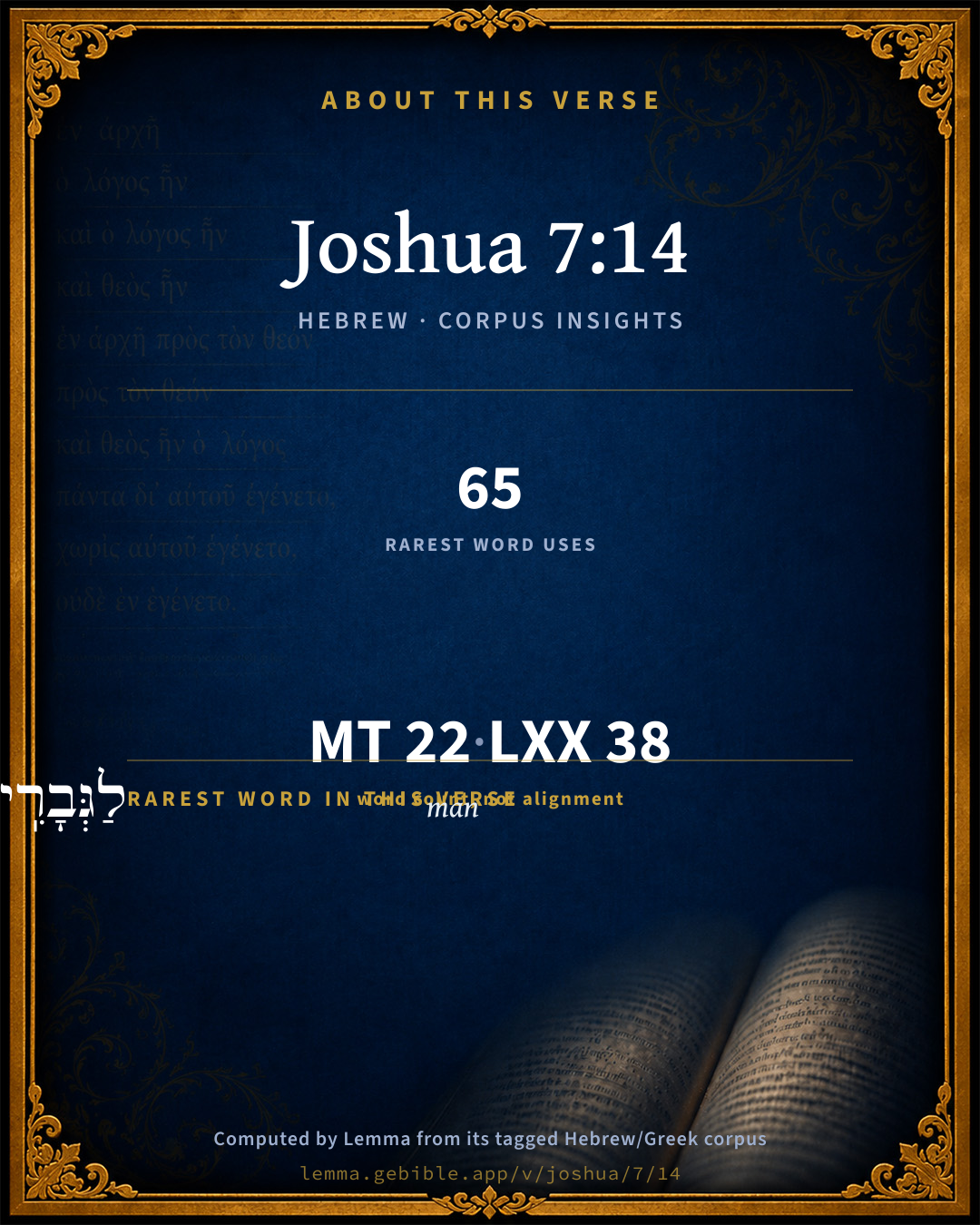
לַגְּבָרִֽים
geber
H1397
“to/for the · men”
Preposition, Determined + Noun, Common, Masculine, Plural, Absolute
Part of Speech
Preposition + Noun
Type
Common
Gender
Masculine
Number
Plural
State
Absolute
Full BDB Definition

Origin: from H1396

TWOT: 310a

man, strong man, warrior (emphasizing strength or ability to fight)
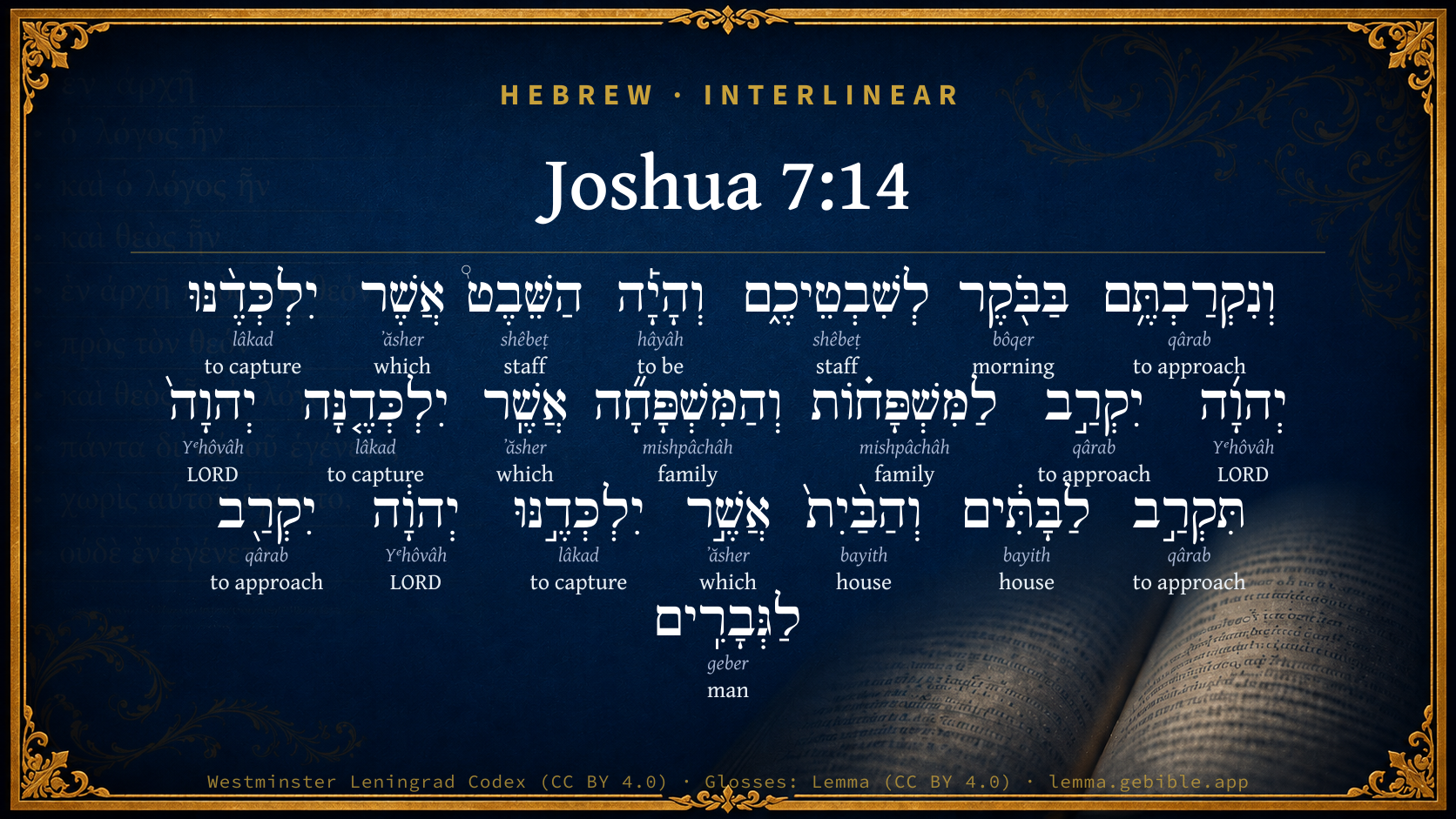
  1. וְנִקְרַבְתֶּ֥ם qârab H7126 “and · to approach” Conjunction + Verb, Niphal, Sequential Perfect, 2nd Person, Masculine, Plural
  2. בַּבֹּ֖קֶר bôqer H1242 “in/at the · morning” Preposition, Determined + Noun, Common, Masculine, Singular, Absolute
  3. לְשִׁבְטֵיכֶ֑ם shêbeṭ H7626 “to/for · staffs · your” Preposition + Noun, Common, Masculine, Plural, Construct + Suffix, Personal, 2nd Person, Masculine, Plural
  4. וְהָיָ֡ה hâyâh H1961 “and · to be” Conjunction + Verb, Qal, Sequential Perfect, 3rd Person, Masculine, Singular
  5. הַשֵּׁבֶט֩ shêbeṭ H7626 “the · staff” Particle, Definite Article + Noun, Common, Masculine, Singular, Absolute
  6. אֲשֶׁר ʼăsher H834 “which” Particle, Relative
  7. יִלְכְּדֶ֨נּוּ lâkad H3920 “to capture · him” Verb, Qal, Imperfect, 3rd Person, Masculine, Singular + Suffix, Personal, 3rd Person, Masculine, Singular
  8. יְהוָ֜ה Yᵉhôvâh H3068 “LORD” Noun, Proper
  9. יִקְרַ֣ב qârab H7126 “to approach” Verb, Qal, Imperfect, 3rd Person, Masculine, Singular
  10. לַמִּשְׁפָּח֗וֹת mishpâchâh H4940 “to/for the · families” Preposition, Determined + Noun, Common, Feminine, Plural, Absolute
  11. וְהַמִּשְׁפָּחָ֞ה mishpâchâh H4940 “and · the · family” Conjunction + Particle, Definite Article + Noun, Common, Feminine, Singular, Absolute
  12. אֲשֶֽׁר ʼăsher H834 “which” Particle, Relative
  13. יִלְכְּדֶ֤נָּה lâkad H3920 “to capture · her” Verb, Qal, Imperfect, 3rd Person, Masculine, Singular + Suffix, Personal, 3rd Person, Feminine, Singular
  14. יְהוָה֙ Yᵉhôvâh H3068 “LORD” Noun, Proper
  15. תִּקְרַ֣ב qârab H7126 “to approach” Verb, Qal, Imperfect, 3rd Person, Feminine, Singular
  16. לַבָּתִּ֔ים bayith H1004 “to/for the · houses” Preposition, Determined + Noun, Common, Masculine, Plural, Absolute
  17. וְהַבַּ֨יִת֙ bayith H1004 “and · the · house” Conjunction + Particle, Definite Article + Noun, Common, Masculine, Singular, Absolute
  18. אֲשֶׁ֣ר ʼăsher H834 “which” Particle, Relative
  19. יִלְכְּדֶ֣נּוּ lâkad H3920 “to capture · him” Verb, Qal, Imperfect, 3rd Person, Masculine, Singular + Suffix, Personal, 3rd Person, Masculine, Singular
  20. יְהוָ֔ה Yᵉhôvâh H3068 “LORD” Noun, Proper
  21. יִקְרַ֖ב qârab H7126 “to approach” Verb, Qal, Imperfect, 3rd Person, Masculine, Singular

About this verse

These counts appear in no published source. They are computed here, from the morphology-tagged text and Lemma’s own curated glosses. What Lemma adds →

22
words
10
distinct lemmas
Historical
section

Grammatical profile

  • 8 verbs
  • 11 nouns
  • 3 particles

Verb forms

  • וְנִקְרַבְתֶּ֥ם Niphal · Sequential Perfect
  • וְהָיָ֡ה Qal · Sequential Perfect
  • יִלְכְּדֶ֨נּוּ Qal · Imperfect
  • יִקְרַ֣ב Qal · Imperfect
  • יִלְכְּדֶ֤נָּה Qal · Imperfect
  • תִּקְרַ֣ב Qal · Imperfect
  • יִלְכְּדֶ֣נּוּ Qal · Imperfect
  • יִקְרַ֖ב Qal · Imperfect

Repetition

Words recur within this verse — often emphatic in Hebrew:

  • וְנִקְרַבְתֶּ֥ם to approach H7126 ×4
  • יִלְכְּדֶ֨נּוּ to capture H3920 ×3
  • יְהוָ֜ה LORD H3068 ×3
  • לְשִׁבְטֵיכֶ֑ם staff H7626 ×2
  • לַמִּשְׁפָּח֗וֹת family H4940 ×2
  • לַבָּתִּ֔ים house H1004 ×2
  • אֲשֶׁר which H834 ×3

Hebrew & Septuagint length

In English translation the verse runs 52 words from the Hebrew and 59 from the Septuagint (LXX English) — closely comparable.

A rough comparison of the two English renderings, which tokenize alike — not a word-level alignment.

Word counts can differ between the Hebrew and the Greek without any difference in meaning — e.g. the Hebrew direct-object marker אֵת has no separate Greek word, and Greek often adds the article ὁ.

In the original languages it is 22 Hebrew tokens and 38 Greek tokens — but the two are counted differently (Hebrew bundles its prefixes and suffixes into one token; the Greek is in lemma form), so that isn’t a like-for-like length.

Cross-references

6

Topical passages linked to Joshua 7:14 in the Treasury of Scripture Knowledge — connected by theme and wording, ordered by reader-vote popularity; previews shown in the World English Bible.

  • Proverbs 16:33 The lot is cast into the lap, But its every decision is from Yahweh.
  • Joshua 7:17–18 and he brought near the family of Judah; and he took the family of the Zerahites: and he brought near the family of the Zerahites man by man; and Zabdi was taken:
  • Jonah 1:7 They all said to each other, "Come, let us cast lots, that we may know for whose cause this evil is on us." So they cast lots, and the lot fell on Jonah.
  • 1 Samuel 10:19–21 but you have this day rejected your God, who himself saves you out of all your calamities and your distresses; and you have said to him, [No], but set a king over us. Now therefore present yourselves before Yahweh by your tribes, and by your thousands.
  • 1 Samuel 14:38–42 Saul said, Draw near here, all you chiefs of the people; and know and see in which this sin has been this day.
  • Acts 1:24–26 They prayed, and said, "You, Lord, who know the hearts of all men, show which one of these two you have chosen

Cross-references courtesy of OpenBible.info (CC BY 4.0).

Hebrew and Greek witnesses Masoretic Hebrew ↔ Greek Septuagint

The same verse in the two great witnesses to the Old Testament, shown verse-for-verse.

These are two independent witnesses, not word-aligned to each other, and the Septuagint is shown in lemma (dictionary) form.

Hebrew Joshua 7:14 Masoretic · Westminster Leningrad Codex

וְנִקְרַבְתֶּ֥ם בַּבֹּ֖קֶר לְשִׁבְטֵיכֶ֑ם וְהָיָ֡ה הַשֵּׁבֶט֩ אֲשֶׁר יִלְכְּדֶ֨נּוּ יְהוָ֜ה יִקְרַ֣ב לַמִּשְׁפָּח֗וֹת וְהַמִּשְׁפָּחָ֞ה אֲשֶֽׁר יִלְכְּדֶ֤נָּה יְהוָה֙ תִּקְרַ֣ב לַבָּתִּ֔ים וְהַבַּ֨יִת֙ אֲשֶׁ֣ר יִלְכְּדֶ֣נּוּ יְהוָ֔ה יִקְרַ֖ב לַגְּבָרִֽים

In the morning therefore you shall be brought near by your tribes: and it shall be, that the tribe which Yahweh takes shall come near by families; and the family which Yahweh shall take shall come near by households; and the household which Yahweh shall take shall come near man by man.

World English Bible · Public Domain

Greek LXX Joshua 7:14 Septuagint · lemma form

καί συνἄγω πᾶς ὁ πρωΐ κατά φυλή καί εἰμί ὁ φυλή ὅς ἄν δεικνύω κύριος προςἄγω κατά δῆμος καί ὁ δῆμος ὅς ἐάν δεικνύω κύριος προςἄγω κατά οἶκος καί ὁ οἶκος ὅς ἐάν δεικνύω κύριος προςἄγω κατά ἀνήρ

And you⌃ shall all be gathered together by your tribes in the morning, and it shall come to pass that the tribe which the Lord shall show, you⌃ shall bring by families; and the family which the Lord shall show, you⌃ shall bring by households; and the household which the Lord shall show, you⌃ shall bring man by man.

LXX2012 (modern English Septuagint) · Public Domain

On this verse, The Pulpit Commentary discusses the Septuagint’s reading. Read the note in Commentary ↓

Hebrew: Westminster Leningrad Codex (CC BY 4.0). Greek: Septuagint (public domain); English from LXX2012 (modern English Septuagint) (Public Domain). How the Septuagint differs from the Hebrew →

Targum (Aramaic paraphrase)

1

The Targum is the ancient Jewish Aramaic paraphrase of the Hebrew Scriptures — an interpretive translation, not the Hebrew text itself. Onkelos (literal) and Pseudo-Jonathan (expansive) render the Torah, and Jonathan the Prophets. Coverage is partial: where no permissively-licensed English translation exists for a verse, only the Aramaic is shown. This is verse-level text, not a word-by-word alignment to the Hebrew.

  1. Targum Jonathan Prophets (Joshua–Malachi)
    וְתִתְקַרְבוּן בְּצַפְרָא לְשִׁבְטֵיכוֹן וִיהֵי שִׁבְטָא דְיִתְאַחַד מִן קֳדָם יָיָ יִקְרַב לְזַרְעֲיָן וְזַרְעִיתָא דְיִתְאַחַד מִן קֳדָם יְיָ תִּקְרַב לְבָתִּין וּבֵיתָא דְיִתְאַחַד מִן קֳדָם יָיָ יִתְקַרַב לְגַבְרַיָא:

    (no public-domain English translation for this verse)

    Targum Jonathan — Aramaic: “Mikraot Gedolot” (public domain). English: “Sefaria Community Translation” (CC0 1.0 (public-domain dedication)); “London "Chaldee Paraphrase," 1871” (public domain). Text via Sefaria.

Commentary

Notes on Joshua 7:14 from classic Christian and Jewish commentators (each source and its license shown beneath its notes). The classic Christian expositions comment on the surrounding passage and are grouped to its opening verse, so a note may address several verses; the Jewish commentaries on the Tanakh (Rashi and others) are per-verse, so they appear only where the commentator wrote on this verse.

Lemma curates 59 commentaries, every one of them public domain or Creative Commons licensed, each selected and text-cleaned for this edition rather than reprinted as found. About our sources →

Trapp's Complete Commentary

John Trapp

Jos 7:14 In the morning therefore ye shall be brought according to your tribes: and it shall be, [that] the tribe which the LORD taketh shall come according to the families [thereof]; and the family which the LORD shall take shall come by households; and the household which the LORD shall take shall come man by man.

Ver. 14. The tribe which the Lord taketh shall come according to their families.] Christ, at last day, will do, saith a divine, as Joshua here did: there were many brought together, and all to find out one. So shall all then appear: out of them a small number deducted that have heard of Christ; out of them, those that have professed him; and out of them, those that have professed in sincerity; a small few.

John Trapp, A Commentary or Exposition upon All the Books of the Old and New Testament (1647–1656) — public domain. Text from a community e-Sword module.

Joseph Benson's Commentary

Jos 7:14-15. The tribe which the Lord taketh — Which shall be declared guilty by the lot, which is disposed by the Lord, (Pro 16:33,) and which was to be cast in the Lord’s presence before the ark. Of such use of lots, see 1Sa 14:41; 1Sa 14:52; Jon 1:7; Act 1:26. Shall be burnt with fire — As persons and things accursed were to be. All that he hath — His cattle and goods, as is noted Jos 7:24, according to the law, Deu 13:16. Wrought folly — So sin is often called in Scripture, in opposition to the idle opinion of sinners, who commonly esteem it to be their wisdom. In Israel — That is, among the church and people of God, who had such excellent laws to direct them, and such an all-sufficient and gracious God to provide for them, without any such unworthy practices. It was sacrilege, it was invading God’s rights, and converting to a private use that which was devoted to his glory, which was to be thus severely punished, for a warning to all people in all ages to take heed how they rob God.

Joseph Benson's Commentary on the Old and New Testaments (1811–1818) — public domain. Text from a community e-Sword module.

Tyndale Open Study Notes

Tyndale Open Resources

7:14 Israel’s twelve tribes were descendants of Jacob’s sons. A clan represented a smaller unit within the tribes; later, as Israel’s allotments in the land were distributed, a clan usually received possession of a town and its surrounding fields, forest, and pastureland. A man’s family included his sons and their dependents.

Tyndale Open Study Notes — © Tyndale Open Resources, licensed CC BY-SA 4.0. Text via the HelloAO Bible API.

Adam Clarke's Commentary

Verse 14. Ye shall be brought according to your tribes] It has been a subject of serious inquiry in what manner and by what means the culpable tribe, family, household, and individual, were discovered. The Jews have many conceits on the subject; the most rational is, that the tribes being, in their representatives, brought before the high priest, the stone on the breastplate gave immediate intimation by suddenly losing its lustre. According to them, this is what is termed consulting God by Urim and Thummim. It is however most probable that the whole was determined by the lot; and that God chose this method to detect the guilty tribe, next the family, thirdly the household, and lastly the individual. This was nearly the plan pursued in the election of Saul by Samuel. "Now therefore," says he, "present yourselves before the Lord by your tribes, and by your thousands. And when Samuel had caused all the tribes of Israel to come near, the tribe of Benjamin was taken. When he had caused the tribe of Benjamin to come near by their families, the family of Matri was taken, and Saul the son of Kish was taken," 1Sa 10:19-20. If the lot was used in the one case it was doubtless used in the other also, as the procedure in the main was entirely similar. The same mode was used to find out who it was that transgressed the king's command, when it was found that Jonathan had eaten a little honey, 1Sa 14:40-43. It is well known that the promised land was divided by lot among the Israelites; (see Nu 26:55; Nu 33:54; De 1:38, c.); and that the courses of the priests were regulated by lot in the days of David, 1Ch 24:5, c. That this was a frequent mode of determining difficult questions, and appointed by God himself, is evident from Le 16:8; Ps 51:18; Pr 16:33; Pr 18:18; Ac 1:26.

Adam Clarke's Commentary on the Bible (1810–1826) — public domain. Text from a community e-Sword/MySword module.

Ellicott's Commentary for English Readers

(14) The tribe which the Lord taketh.—There is nothing in the language of the passage, when closely considered, which would lead us to suppose that the discovery of the criminal was by casting lots. The parallel passage—viz., the selection of King Saul from the tribes of Israel (1Sa_10:20-21)—shows that the oracle of God was consulted. “They inquired,” and “the Lord answered.” So it was, perhaps, in the case of Achan. We seem to see the High Priest of Israel “asking counsel for Joshua after the judgment of Urim before the Lord,” as it had been foretold in Num_27:21; and the elders of Israel standing by, at the door of the tabernacle of the congregation. The representatives of the tribes enter the sacred enclosure in succession, and pass before the High Priest, in awful silence, broken only by the voice of Jehovah, who pronounces it intervals the names of Judah, Zarhite, Zabdi, Carmi, Achan. It must have been a terrible ordeal. But all present must have felt that no human partiality, or private animosity, was seeking its victim. The Judge of all the earth was doing judgment. And when the accusation of Jehovah was followed by the explicit confession of the criminal, and this again by the discovery of the stolen spoil of Jericho, which was brought in by the messengers, and “poured out before the Lord,” and when this discovery was followed by the execution of the awful sentence, all who were present must have received a lesson, which it was impossible to forget, as to the reality of the covenant of God. And if, as seems most probable, the voice of the oracle was uttered from the inner sanctuary, from between the cherubim, but “heard even to the outer court, as the voice of the Almighty God, when He speaketh” (Eze_10:5), we learn once more the majesty of the law given to Israel. The arrest of Jordan, the overthrow of Jericho, and the discovery of Achan, are all manifestations of power proceeding from the same source.

(14-18) In the morning therefore ye shall be brought.—That is, brought near, or presented. The word used here, and throughout the passage, is the same that is commonly used for the presentation of an offering.

A Bible Commentary for English Readers, edited by Charles John Ellicott (1878–1897) — public domain. Text from a community e-Sword module.

The Cambridge Bible for Schools and Colleges

gen. ed. J. J. S. Perowne

14. according to your tribes] Each tribe was divided into families; each family into houses; each house into persons.

the tribe which the Lord taketh] i.e. by the sacred lot. We find the lots used (a) for the detection of a criminal here, and in the case of Jonathan (1Sa_14:42, and Jon_1:7); (b) in the choice of men for an invading force (Jdg_1:1; Jdg_20:10); (c) in the partition of land (Num_26:55; Jos_18:10; 1Ma_3:36); (d) in the assignment to foreigners or captors of spoils or prisoners (Joe_3:3; Nah_3:10); (e) in the selection of the scapegoat on the day of Atonement (Lev_16:8); (f) in the settlement of doubtful questions (Pro_16:33; Pro_18:18). The custom was of great antiquity and widely spread, and “recommended itself as a sort of appeal to the Almighty, secure from all influence of passion or bias.” In Homer we find it employed by the gods themselves (Il. 22:209; Cic. de Div. 1. 34, 11. 41), and the Romans had their lots in divisions (sortes divisoriœ) and elections (sors urbana and peregrina) in the choice of a prætor.

The Cambridge Bible for Schools and Colleges (gen. ed. J. J. S. Perowne; Cambridge University Press, 1878–1918) — public domain. Text from a community e-Sword module.

John Gill's Exposition

In the morning therefore ye shall be brought according to your tribes,.... One or more of every tribe, according to the number of them, were to be brought the next morning before Joshua and the elders of Israel, the sanhedrim and council of the nation, and very probably the tabernacle, where they assembled for this purpose:

and it shall be, that the tribe which the Lord taketh; how a tribe and so a family or household were taken is differently understood; what some of the Jewish writers say deserves no regard, as the detention of persons by the ark, or of the dulness of the stones in the Urim and Thummim: it seems best to understand the whole affair as done by casting lots (x); so Josephus (y) and Ben Gersom; and they might in this way be said to be taken by the Lord, because the disposition of the lot is by him, Pro 16:33; now it is said, that the tribe that should be taken, as Judah was, from what follows:

shall come according to the families thereof; that is, the families in that tribe, meaning the heads of them, as Kimchi well observes; these were to come to the place where the lots were cast:

and the family which the Lord shall take shall come by households; on whatsoever family in the tribe the lot should fall, the heads of households in that family should appear and have lots cast on them: and the household which the Lord shall take shall come man by man; that household that should be taken by lot, the men thereof, the heads of the house, should come each of them and have lots east on them, that the particular man that sinned might be discovered.

(x) Pirke Eliezer, c. 38. Samaritan. Chronic. apud Hottinger. Smegma. Oriental. l. 1. c. 8. p. 505. Jarchi in loc. (y) Antiqu. l. 5. c. 1. sect. 10.

John Gill's Exposition of the Whole Bible (1746–1763) — public domain (CC PDM 1.0). Text via the HelloAO Bible API.

Albert Barnes' Notes on the Bible

The Lord taketh - i. e. by lot. The Hebrew word for lot suggests that small stones, probably white and black ones, were used. These were probably drawn from a chest (compare the expressions in Jos 18:11; Jos 19:1). The lot was regarded as directed in its result by God (margin reference); and hence, was used on many important occasions by the Jews and by other nations in ancient times. For example:

(1), for apportionment, as of Canaan among the twelve tribes Num 26:55; of the Levitical cities (Jos 21:4 ff); of spoil or captives taken in war Joe 3:3.

(2) for detection of the guilty, as in the case if Achan, Jonathan 1Sa 14:42, and Jonah Jon 1:7.

(3) for determining the persons to undertake a dangerous or warlike enterprise Jdg 20:10.

(4) for making appointment to important functions (Lev 16:8 ff; Act 1:26); or for sharing the duties or privileges of an office among those concerned 1Ch 24:31; Luk 1:9.

The casting of lots before Haman Est 3:7 seems to have been with a view of determining the lucky day for his undertaking against the Jews. One passage Pro 18:18 perhaps points also to the employment of the lot to decide litigation.

Albert Barnes' Notes on the Bible (1834–1885) — public domain. Text from a community e-Sword/MySword module.

Haydock's Catholic Bible Commentary

Find. Hebrew, "it shall be the tribe which the Lord taketh." (Haydock) --- This was done by lots, as on similar occasions, 1 Kings x. 20., and xiv. 41. When God authorized this method, there could be no danger in it. But to have recourse to lots without such authority, would be often tempting God. The apostles chose an apostle by lot: but they had first taken every precaution (Calmet) to select two persons, both fit for the important charge. (Haydock) --- To commit the choice of sacred ministers to chance would be extremely improper. "We forbid the use of lots in the elections," said Honorius. (Calmet)

George Leo Haydock (1774–1849), Haydock's Catholic Family Bible and Commentary, 1859 edition — public domain. Excludes Psalms (Douay-Rheims chapter numbering differs from Protestant) and Deuterocanonical books (Catholic canon only).

Matthew Poole's English Annotations

Which the Lord taketh; which shall be discovered or declared guilty by the lot, which is disposed by the Lord, Pro 16:33, and which was to be cast in the Lord’s presence before the ark. Of such use of lots, see 1Sa 14:41,42; Jon 1:7; Act 1:26.

Matthew Poole's English Annotations on the Holy Bible (1683–1685) — public domain. Text from a community e-Sword/MySword module.

Whedon's Commentary on the Bible

Daniel D. Whedon

14. Ye shall be brought according to your tribes — God could have disclosed to Joshua the sinner as well as the sin. by direct revelation, without this review of the whole camp. But he chose the latter method as far more impressive, since it awakened the interest of all the people, exhibited the magnitude of the crime, and clearly set forth the omniscience of Jehovah, and their personal amenability to him. Representatives of each tribe were to come to the tabernacle, or to pass in review before the ark.

The tribe which the Lord taketh — The word taketh, as we may see from 1Sa_14:42, is the technical term used for decision by lot. “The lot is cast into the lap, but the whole disposing thereof is of the Lord.” Pro_16:33. White pebbles and one black one may have been cast into a sack or urn, and some man from each tribe appointed to draw them out — the black pebble indicating the tribe, clan, family, or individual whom the Lord designated. Decision by lot is mentioned frequently in the Old Testament, and once in the New. Act_1:24-26. It recommends itself as a sort of appeal to the Almighty, free from all influence of passion or bias.

Families… households — The tribes, says Keil, were founded by the twelve sons of Jacob and the two sons of Joseph, who were placed on an equality with them by adoption. Whenever Levi was reckoned, Joseph was counted as one tribe; whenever Levi was omitted, Joseph was counted as two. The tribes were divided into clans, of which the sons, grandsons, or great grandsons of the twelve were the heads. The clans were again divided into groups of families — Heb, fathers’ houses — taking their name from the sons, grandsons, etc., of the heads of the clans. This last division was subdivided into households, composed of individuals. The distinction between the clans and fathers’ houses was not very definitely preserved.

Daniel D. Whedon (gen. ed.), Commentary on the Old and New Testaments (1874–1909) — public domain. Text from a community e-Sword module.

The Pulpit Commentary

Taketh, i.e., by lot, as in 1Sa_14:42. (Wlypih make it fall; cf. 1Sa_10:20) (cf. Jon_1:7; also Pro_18:18) According to the families. The gradual centering of the suspicion upon the offender is one of the most striking features of the history. The genealogies of the children of Israel were very strictly kept, as the Books of Chronicles, Ezra, and Nehemiah show. Achan"s name is carefully given in the genealogy of Judah in 1 Chronicles if. 7. The subdivision of the tribes into families (or clans, Keil) and households (or, as we should perhaps say, families) was for convenience of enumeration, military organisation, and perhaps of assessment. Oehler, "Theologie des Allen Testaments," Sec. 101, takes the same view as Keil. The tribes, he says, were divided into twOhpvmi or i.e., Geschlechter (LXX dhmoi , for which the best English equivalent is clans, as above); these into families or houses ( or fathers" hours (twOba tBe); and these again into single heads of a house ( The principle, he adds of a Mosaic family, is as follows: Every "family forms a distinct whole, which as far as possible must be maintained in its integrity. Each tribe, says Jahn ("Hebrew Commonwealth," Book II), acknowledged a prince (aycik) as its ruler. As its numbers increased, there arose a subdivision of the tribe into collections of families. Such a collection was called a house of fathers, a hjpvmi or clan, or a thousand, rut this explanation is not so satisfactory as that given above. Kurz remarks on the important part family life played among the Hebrews, with whom, in consequence of their descent from Abraham, and the importance they attached to it, the nation was developed out of the family. See Introduction.

HOMILIES BY S.R. ALDRIDGE Ver. 14. Sin discovered.

This leads us to remark that

I EVERY SIN IS KNOWN TO GOD. Joshua was ignorant that Achan had secreted spoil, but the searching glances of God reached further than the most watchful oversight of the leader. As afterwards, when the disciples did not suspect the character and intents of Judas, the Lord discerned the sinister proposes of his heart. The omniscience and omnipresence of the Almighty have been strangely disregarded even by His own servants. Witness the curious flight of Jonah, as if he could really "flee from the presence of the Lord." "I know thy works" is the heading to the practical address in nearly each of the seven letters to the Churches of Asia. "Thou God seest me.

II SIN REVEALED BY FAILURE IN AN UNDERTAKING. The overthrow of Jericho inspired the Israelites with such confidence that they disdained to employ all their forces in assaulting Ai. To their surprise, their attack was repulsed with loss. The greater the previous security, the more intense the subsequent alarm. They were unconscious of the presence of a traitor in the comp. The theft of Achan was a stronger opponent than the men of the city. Sin destroys our power. As one has quaintly observed, "In running a race, an inward pain hinders more than if a dozen men jostled you." When men have taken cold, they immediately reflect where they could have been exposed to draught, and non success in any enterprise causes us to inquire. What have we done amiss? Trouble leads us to scrutinise our past life, conscience accuses of sins which have deserved, if they have not actually drawn upon us, this proof of Divine displeasure. Self examination is healthful if not carried to excessive lengths; it may produce "carefulness, clearing of ourselves," etc.. (2Co_7:11) The effect of sin is not confined to the particular guilty member. Sin taints the community, or often involves it in its suffering. As a drop of ink discolours a whole glass of water, so thousands of innocent persons may be affected by the neighbourhood of one sinner. This concerns us individually, for if one limb offends, the body is defiled; and collectively, as members of Churches, and as belonging to a nation.

III THE OFFENCE MADE KNOWN IN ANSWER TO PRAYER. Deep was Joshua"s solicitude. With the elders of Israel he rent his clothes and fell prostrate before the ark all day. To a lover of God, the belief that His favour is withdrawn is the most overwhelming sorrow. Nor is the grief merely selfish in its origin. Joshua lamented the dishonour which would be affixed to the glorious name of Jehovah when the news of Israel"s defeat was bruited abroad. Prayer is the believer"s unfailing resource. Receiving any woeful tidings, he "spreads the letter," like Hezekiah, before the Lord. He ventures to plead, to expostulate, to argue. And the answer surely arrives though it appear long to tarry. In this narrative we find Joshua reproved for imagining that God would arbitrarily desert His people. He might have known that something was wrong in the conduct of the nation, and his inquiry should have been, Wherein have we offended? We must not at once rush to the conclusion that the events which befall us are "judgments," for when we think God"s smile is absent, it may be flint the clouds of our marshy land interrupt the heavenly rays. Nevertheless the advice of the preceding paragraph holds good, and the rebuke administered to Joshua may be often seasonably applied to ourselves.

IV THE OFFENDER MANIFESTED. The drawing of a lot was the means resorted to on all important occasions for appointment to positions of honour or shame. Picture the gradual contraction of the circle of fire till it enwrapped only "the troubler of Israel," and he stood before all the people as the cause of a national disgrace. The slow and stately discovery, as well as the proceedings of the day before, afforded time to the criminal to reveal himself, if he would. What must have been his feelings as he saw detection drawing nearer and nearer till it pointed its finger to his breast, saying, "Thou art the man!" The method of manifestation also afforded time for the spectators to be thoroughly aroused, so that they might appreciate more deeply the awfulness of the sin committed, and be ready with one shout to inflict the penalty due thereto. God may advance slowly, but His step is sure. Delay is no presumption of final impunity.

V We see lastly, THE FOLLY OF SIN. Achan "wrought folly in Israel" (ver. 15). The word means stupidity as Abigail uncomplimentarily remarked of her husband, "Nabal is his name and folly is with him." Sin is certain of detection. Known to the Almighty, He often brings it into the light of day here, and will surely manifest it hereafter. Sin imperils real, enduring bliss for the sake of transitory gratifications. A little pleasure, and severest pain; for brief fame, lasting infamy; for temporary wealth, eternal loss. A

The Pulpit Commentary (1880–1919), ed. H.D.M. Spence-Jones & Joseph S. Exell — public domain. Text from a community e-Sword module.

John Wesley's Explanatory Notes

The Lord taketh - Which shall be declared guilty by the lot, which is disposed by the Lord, Prov. xvi, 33, and which was to be cast in the Lord's presence before the ark. Of such use of lots, see 1 Sam. xiv, 41, 42 Jonah i, 7 Acts i, 26.

John Wesley, Explanatory Notes Upon the Whole Bible (1754–1765) — public domain. Text via the GEBible commentary corpus.

unfoldingWord translationNotes

Door43 World Missions Community

Connecting Statement:

Yahweh continues telling Joshua what he must tell the people.

you must present yourselves by your tribes

There were twelve tribes that made up the people of Israel. The phrase "by your tribes" means "each tribe." AT: "each of your tribes must present themselves to Yahweh" (See: Idiom)

The tribe that Yahweh selects will come near by their clans

The tribe was made up of multiple clans. AT: "From the tribe that Yahweh selects, each clan will come near" (See: Idiom)

The tribe that Yahweh selects

The leaders of Israel would toss lots, and by doing this, they would learn which tribe Yahweh had selected. This can be stated clearly. AT: "The tribe that Yahweh selects by lot" or "The tribe that Yahweh selects when we toss lots"

The clan that Yahweh selects must come near by each household

The clan was made up of multiple households. AT: "From the clan that Yahweh selects, each household must come near" (See: Idiom)

The household that Yahweh selects must come near one by one

The household was made up of multiple people. AT: "From the household that Yahweh selects, each person must come near" (See: Idiom)

the one who is selected

This can be stated with an active form. AT: "the one whom Yahweh selects" (See: Active or Passive)

he has broken the covenant of Yahweh

Breaking the covenant represents disobeying it. AT: "he has disobeyed the covenant of Yahweh" (See: Metaphor)

translationWords

tribe

Yahweh

clan

household

covenant

disgrace

Israel

unfoldingWord translationNotes — © Distant Shores Media and the Door43 World Missions Community, licensed CC BY-SA 4.0. Source: git.door43.org/Door43/en_tn.

Rashi

Rabbi Shlomo Yitzchaki (Rashi)

Households. In one family grouping there can be many individual households.

Men Individualy, man by man. Each man of the household was to come to the choosing of lots.

Rashi on the Tanakh — English translations: “The Judaica Press complete Tanach with Rashi, translated by A. J. Rosenberg” (CC BY 4.0); “Pentateuch with Rashi's commentary by M. Rosenbaum and A.M. Silbermann, 1929-1934” (public domain); “The Metsudah Tanach series, Lakewood, N.J” (CC BY 4.0); and “The Book of Joshua, Metsudah Publications, 1997” (CC BY 4.0). Text via Sefaria.

Lesson kit

Teaching starters — assembled from the data on this page, not authored interpretation. Every prompt links to the verse data it draws on. Edit before teaching.

Joshua, in the Historical, opens this verse with 22 words (10 distinct Hebrew lemmas). Its most distinctive word is geber (“man”). A historical commentator’s framing appears above. Read the whole chapter for the surrounding context.

Discussion questions

  1. How does “man” (geber) shape what this verse is saying?
  2. Proverbs 16:33 shares this passage’s theme. How do the two illuminate each other?
  3. “to approach” occurs 4× in this one verse. What is the effect of the repetition?
  4. These translations render this verse differently. What is at stake in choosing one wording over another?
  5. The verb «וְנִקְרַבְתֶּ֥ם» is Niphal Sequential Perfect. How does its form color the action?
  6. Reading how Trapp's Complete Commentary and Joseph Benson's Commentary read this verse, where do the two commentators agree and where do they part?

Things to notice

Reading settings

Reading text

Shown beneath each verse's original-language words.

Old Testament
Old Testament edition

Read the OT as the Masoretic Hebrew (MT) or the Greek Septuagint (LXX).

English shown for the Greek Septuagint (in the Hebrew ↔ Greek comparison).

Comparing translations? Open the Compare panel on any verse page to stack up to four side by side.