2 Samuel 15:5

Hebrew (Westminster Leningrad Codex) 2 Samuel 15:5 appears in the Hebrew Old Testament. The text above is from the Westminster Leningrad Codex. Each word links to its Strong’s number, a concise gloss, and parsing drawn from the Open Scriptures Hebrew Bible morphology. Click any word for its full Brown-Driver-Briggs (BDB) entry.
Download image
Cite this verse

2 Samuel 15:5 (World English Bible). Public Domain. Lemma interlinear Bible study tool, https://lemma.gebible.app/v/2-samuel/15/5.

Show BibTeX & RIS
BibTeX
RIS
English Translation
It was so, that when any man came near to do him obeisance, he put forth his hand, and took hold of him, and kissed him.
World English Bible · Public Domain
Download a study sheet

One document with this verse’s original text, its word-by-word gloss line, the meaning frame, cross-references with their text, attributed commentary, and full source and license credits — printable, and it pastes into notes with its structure intact.

This verse Autodidact and up

Study sheet (.html) Plain text (.txt)

A passage Seminary Student

Up to 50 verses in one chapter. A passage sheet keeps up to 6 commentary sources and 12 cross-references per verse, in the order this page ranks them, and says so on the sheet whenever that leaves anything out. Ask for a single verse and you get the Autodidact verse sheet above.

Everything on this page stays free to read, with no account — the sheet is a download of what is already on screen, not access to it.

Want to remove ads? Support Godless Engineer
Compare translations 3

The same verse in 3 English versions, stacked beneath the original-language interlinear above. Click any original word for its lexicon entry.

Each is an independent rendering of the whole verse — the interlinear is not word-aligned to these translations.

Highlighted words mark where these versions differ — a whole-verse word diff, not a word-by-word alignment.

  • World English Bible Public Domain
    It was so, that when any man came near to do him obeisance, he put forth his hand, and took hold of him, and kissed him.
  • King James Version Public Domain
    And it was so, that when any man came nigh to him to do him obeisance, he put forth his hand, and took him, and kissed him.
  • unfoldingWord Literal Text CC BY-SA 4.0
    And it happened, when a man approached to prostrate himself to him, that he would stretch out his hand and take hold of him and kiss him.

unfoldingWord Literal Text — © unfoldingWord, licensed CC BY-SA 4.0. Word-aligned USFM3 via Door43 (git.door43.org/unfoldingWord/en_ult).

Versions to compare (up to 4)

3 of 4 selected

Show all 18 translations

Every available English version of this verse, each an independent rendering of the whole verse.

  • World English Bible Public Domain
    It was so, that when any man came near to do him obeisance, he put forth his hand, and took hold of him, and kissed him.
  • Berean Standard Bible Public Domain
    Also, when anyone approached to bow down to him, Absalom would reach out his hand, take hold of him, and kiss him.
  • Majority Standard Bible Public Domain
    Also, when anyone approached to bow down to him, Absalom would reach out his hand, take hold of him, and kiss him.
  • King James Version Public Domain
    And it was so, that when any man came nigh to him to do him obeisance, he put forth his hand, and took him, and kissed him.
  • American Standard Version (1901) Public Domain
    And it was so, that, when any man came nigh to do him obeisance, he put forth his hand, and took hold of him, and kissed him.
  • Revised Version (1885) Public Domain
    And it was so, that when any man came nigh to do him obeisance, he put forth his hand, and took hold of him, and kissed him.
  • Geneva Bible (1599) Public Domain
    And when any man came neere to him, and did him obeisance, he put forth his hand, and tooke him, and kissed him.
  • Douay-Rheims (1899) Public Domain
    Moreover when any man came to him to salute him, he put forth his hand, and took him, and kissed him.
  • Young's Literal Translation Public Domain
    And it hath come to pass, in the drawing nearing of any one to bow himself to him, that he hath put forth his hand, and laid hold on him, and given a kiss to him;
  • Literal Standard Version CC BY-SA 4.0
    And it has come to pass, in the drawing near of anyone to bow himself to him, that he has put forth his hand, and laid hold on him, and given a kiss to him;
  • Unlocked Literal Bible CC BY-SA 4.0
    So it came about that when any man came to Absalom to honor him, Absalom would put out his hand and take hold of him and kiss him.
  • unfoldingWord Literal Text CC BY-SA 4.0
    And it happened, when a man approached to prostrate himself to him, that he would stretch out his hand and take hold of him and kiss him.
  • Darby Bible Public Domain
    And it was so, that when any man came near to do him obeisance, he put forth his hand, and took him, and kissed him.
  • World Messianic Bible Public Domain
    It was so, that when any man came near to bow down to him, he stretched out his hand, took hold of him, and kissed him.
  • Webster's Bible Public Domain
    And it was so, that when any man came nigh to him to do him obeisance, he put forth his hand, and took him, and kissed him.
  • Free Bible Version CC BY-SA 4.0
    When anyone came to bow down before him, Absalom would stop them by reaching out his hand, taking hold of him, and kissing him.
  • Bible in Basic English Public Domain
    And if any man came near to give him honour, he took him by the hand and gave him a kiss.
  • JPS Tanakh (1917) Public Domain
    And it was so, that when any man came nigh to prostrate himself before him, he put forth his hand, and took hold of him, and kissed him.

Literal Standard Version (2020), Covenant Press — licensed CC BY-SA 4.0. Text via the HelloAO Bible API (eBible.org). Unlocked Literal Bible (unfoldingWord) — licensed CC BY-SA 4.0. Text via the HelloAO Bible API (eBible.org). unfoldingWord Literal Text — © unfoldingWord, licensed CC BY-SA 4.0. Word-aligned USFM3 via Door43 (git.door43.org/unfoldingWord/en_ult). Free Bible Version, Dr. Jonathan Gallagher — licensed CC BY-SA 4.0. Text via the HelloAO Bible API (eBible.org).

Word by word

More ways to search: Search by grammar → Find every occurrence → Compare this word →

Practice this passage: Drill this verse → Learn its vocabulary →

וְנָ֥שַׁק
nâshaq
H5401
“and · to kiss”
Conjunction + Verb, Qal, Perfect, 3rd Person, Masculine, Singular
Part of Speech
Conjunction + Verb
Stem
Qal
Form
Perfect
Person
3rd Person
Gender
Masculine
Number
Singular
Full BDB Definition

Origin: a primitive root [identical with H5400 , through the idea of fastening up

TWOT: 1435 , 1436

to put together, kiss - (Qal) to kiss - (Piel) to kiss - (Hiphil) to touch gently - to handle, be equipped with - (Qal) to be equipped
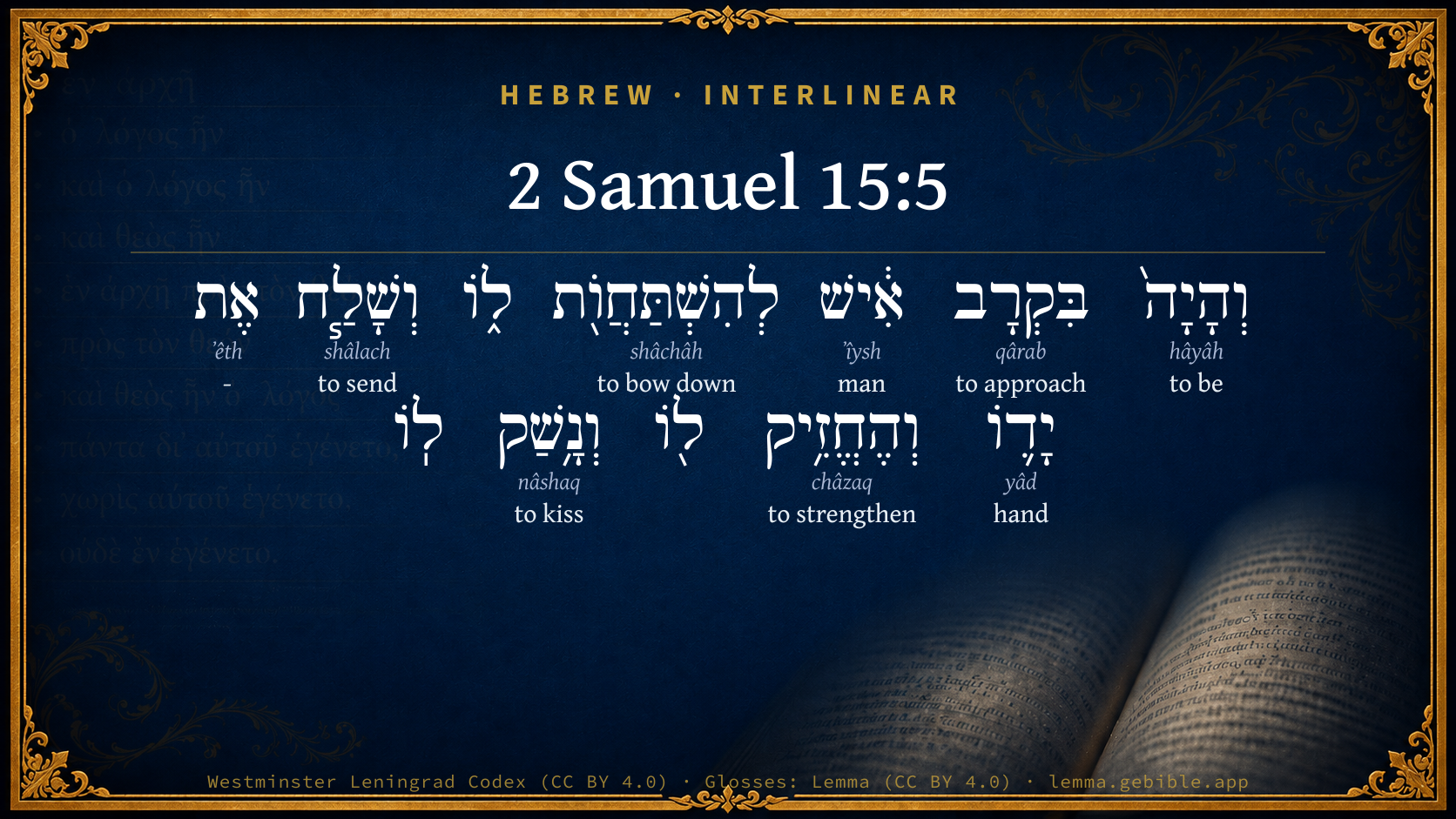
  1. וְהָיָה֙ hâyâh H1961 “and · to be” Conjunction + Verb, Qal, Perfect, 3rd Person, Masculine, Singular
  2. בִּקְרָב qârab H7126 “in/at · to approach” Preposition + Verb, Qal, Infinitive Construct
  3. אִ֔ישׁ ʼîysh H376 “man” Noun, Common, Masculine, Singular, Absolute
  4. לְהִשְׁתַּחֲוֺ֖ת shâchâh H7812 “to bow down” Preposition + Verb, Hithpael, Infinitive Construct
  5. וְשָׁלַ֧ח shâlach H7971 “and · to send” Conjunction + Verb, Qal, Sequential Perfect, 3rd Person, Masculine, Singular
  6. אֶת ʼêth H853 “-” Particle, Direct Object
  7. יָד֛וֹ yâd H3027 “hand · his” Noun, Common, Both, Singular, Construct + Suffix, Personal, 3rd Person, Masculine, Singular
  8. וְהֶחֱזִ֥יק châzaq H2388 “and · to strengthen” Conjunction + Verb, Hiphil, Sequential Perfect, 3rd Person, Masculine, Singular

About this verse

These counts appear in no published source. They are computed here, from the morphology-tagged text and Lemma’s own curated glosses. What Lemma adds →

12
words
9
distinct lemmas
Historical
section

Shared distinctive vocabulary

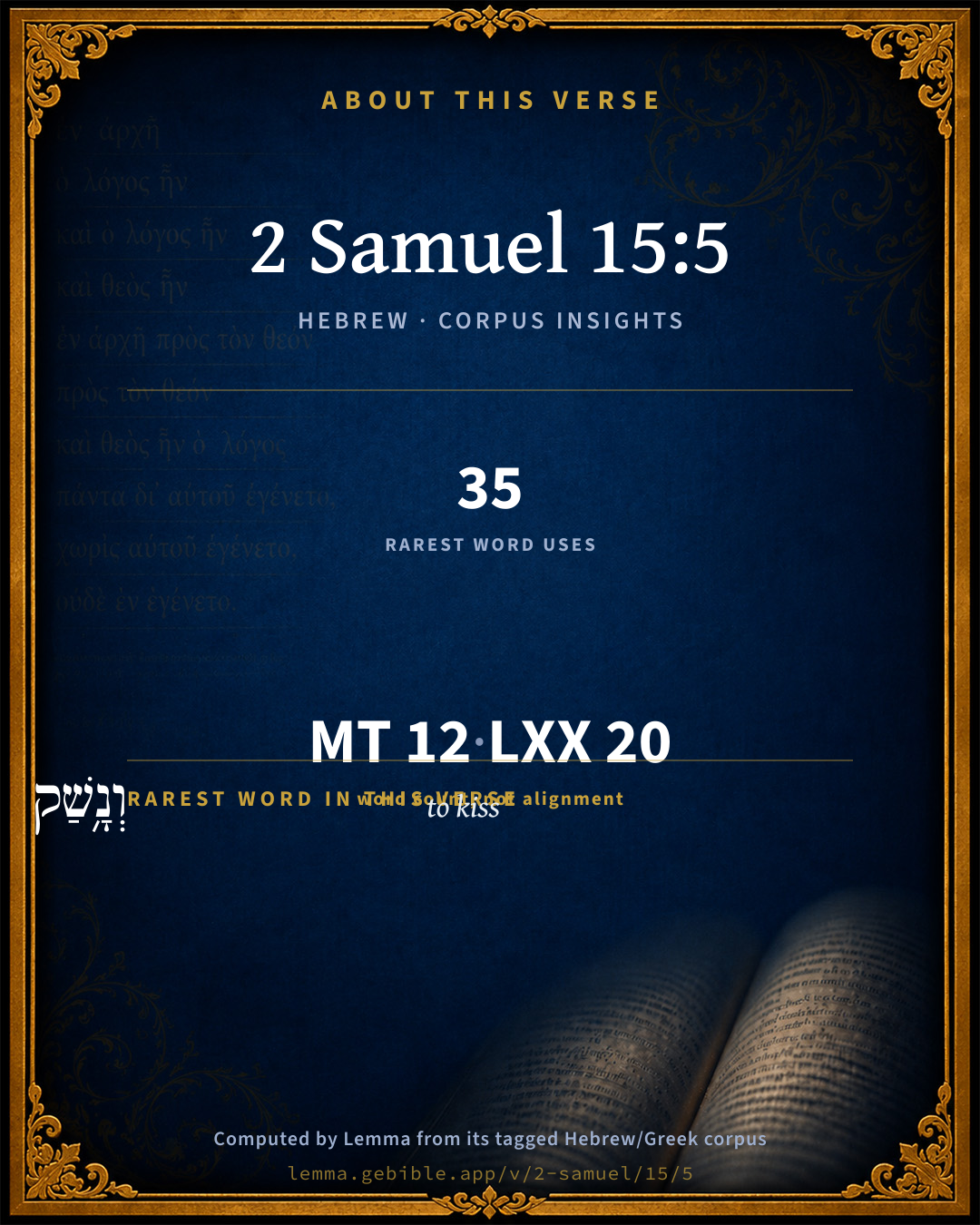
וְנָ֥שַׁק to kiss H5401 occurs in 35 verses of the Hebrew Bible. Also found in:

Grammatical profile

  • 6 verbs
  • 2 nouns
  • 3 prepositions
  • 1 particle

Verb forms

  • וְהָיָה֙ Qal · Perfect
  • בִּקְרָב Qal · Infinitive Construct
  • לְהִשְׁתַּחֲוֺ֖ת Hithpael · Infinitive Construct
  • וְשָׁלַ֧ח Qal · Sequential Perfect
  • וְהֶחֱזִ֥יק Hiphil · Sequential Perfect
  • וְנָ֥שַׁק Qal · Perfect

Hebrew & Septuagint length

In English translation the verse runs 26 words from the Hebrew and 28 from the Septuagint (LXX English) — closely comparable.

A rough comparison of the two English renderings, which tokenize alike — not a word-level alignment.

Word counts can differ between the Hebrew and the Greek without any difference in meaning — e.g. the Hebrew direct-object marker אֵת has no separate Greek word, and Greek often adds the article ὁ.

In the original languages it is 12 Hebrew tokens and 20 Greek tokens — but the two are counted differently (Hebrew bundles its prefixes and suffixes into one token; the Greek is in lemma form), so that isn’t a like-for-like length.

Cross-references

4

Topical passages linked to 2 Samuel 15:5 in the Treasury of Scripture Knowledge — connected by theme and wording, ordered by reader-vote popularity; previews shown in the World English Bible.

  • 2 Samuel 14:33 So Joab came to the king, and told him; and when he had called for Absalom, he came to the king, and bowed himself on his face to the ground before the king: and the king kissed Absalom.
  • Psalms 10:9–10 He lurks in secret as a lion in his ambush. He lies in wait to catch the helpless. He catches the helpless, when he draws him in his net.
  • Psalms 55:21 His mouth was smooth as butter, But his heart was war. His words were softer than oil, Yet they were drawn swords.
  • Proverbs 26:25 When his speech is charming, don't believe him; For there are seven abominations in his heart:

Cross-references courtesy of OpenBible.info (CC BY 4.0).

Hebrew and Greek witnesses Masoretic Hebrew ↔ Greek Septuagint

The same verse in the two great witnesses to the Old Testament, shown verse-for-verse.

These are two independent witnesses, not word-aligned to each other, and the Septuagint is shown in lemma (dictionary) form.

Hebrew 2 Samuel 15:5 Masoretic · Westminster Leningrad Codex

וְהָיָה֙ בִּקְרָב אִ֔ישׁ לְהִשְׁתַּחֲוֺ֖ת ל֑וֹ וְשָׁלַ֧ח אֶת יָד֛וֹ וְהֶחֱזִ֥יק ל֖וֹ וְנָ֥שַׁק לֽוֹ

It was so, that when any man came near to do him obeisance, he put forth his hand, and took hold of him, and kissed him.

World English Bible · Public Domain

Greek LXX 2 Samuel 15:5 Septuagint · lemma form

καί γίγνομαι ἐν ὁ ἐγγίζω ἀνήρ ὁ προςκυνέω αὐτός καί ἐκτείνω ὁ χείρ αὐτός καί ἐπιλαμβάνω αὐτός καί καταφιλέω αὐτός

And it came to pass when a man came near to do him obeisance, that he stretched out his hand, and took hold of him, and kissed him.

LXX2012 (modern English Septuagint) · Public Domain

Hebrew: Westminster Leningrad Codex (CC BY 4.0). Greek: Septuagint (public domain); English from LXX2012 (modern English Septuagint) (Public Domain). How the Septuagint differs from the Hebrew →

Targum (Aramaic paraphrase)

1

The Targum is the ancient Jewish Aramaic paraphrase of the Hebrew Scriptures — an interpretive translation, not the Hebrew text itself. Onkelos (literal) and Pseudo-Jonathan (expansive) render the Torah, and Jonathan the Prophets. Coverage is partial: where no permissively-licensed English translation exists for a verse, only the Aramaic is shown. This is verse-level text, not a word-by-word alignment to the Hebrew.

  1. Targum Jonathan Prophets (Joshua–Malachi)
    וַהֲוָה כַּד קְרַב גַבְרָא לְמִסְגַד לֵיהּ וּמוֹשִׁיט יַת יְדֵיהּ וּמַתְקֵיף בֵּיהּ וּנְשִׁיק לֵיהּ:

    (no public-domain English translation for this verse)

    Targum Jonathan — Aramaic: “Mikraot Gedolot” (public domain). English: “Sefaria Community Translation” (CC0 1.0 (public-domain dedication)); “London "Chaldee Paraphrase," 1871” (public domain). Text via Sefaria.

Commentary

Notes on 2 Samuel 15:5 from classic Christian and Jewish commentators (each source and its license shown beneath its notes). The classic Christian expositions comment on the surrounding passage and are grouped to its opening verse, so a note may address several verses; the Jewish commentaries on the Tanakh (Rashi and others) are per-verse, so they appear only where the commentator wrote on this verse.

Lemma curates 59 commentaries, every one of them public domain or Creative Commons licensed, each selected and text-cleaned for this edition rather than reprinted as found. About our sources →

Trapp's Complete Commentary

John Trapp

2Sa 15:5 And it was [so], that when any man came nigh [to him] to do him obeisance, he put forth his hand, and took him, and kissed him.

Ver. 5. To do him obeisance.] But should men bow to a molten calf, because made of golden earrings?

And took him, and kissed him.] By a counterfeit courtesy, which, in high degree, easily ailureth men’s minds, as do fair flowers, in the spring, the passengers’ eyes.

John Trapp, A Commentary or Exposition upon All the Books of the Old and New Testament (1647–1656) — public domain. Text from a community e-Sword module.

Tyndale Open Study Notes

Tyndale Open Resources

15:5 To bow before . . . Absalom was, in effect, to honor him as king (see 14:33).

Tyndale Open Study Notes — © Tyndale Open Resources, licensed CC BY-SA 4.0. Text via the HelloAO Bible API.

The Cambridge Bible for Schools and Colleges

gen. ed. J. J. S. Perowne

5. put forth his hand] Instead of allowing the people to do him homage as the king’s son, he took them by the hand, and saluted them familiarly with a kiss. Cp. ch. 2Sa_20:9.

Compare the description of Bolingbroke’s behaviour which Shakespeare puts into the mouth of Richard II.:

Ourself and Bushy, Bagot here and Green

Observed his courtship to the common people;

How he did seem to dive into their hearts

With humble and familiar courtesy,

What reverence he did throw away on slaves,

Wooing poor craftsmen with the craft of smiles,

King Richard II., Acts 1. Sc. 4:23.

The Cambridge Bible for Schools and Colleges (gen. ed. J. J. S. Perowne; Cambridge University Press, 1878–1918) — public domain. Text from a community e-Sword module.

John Gill's Exposition

And it was so, that when any man came nigh to him to do him obeisance,.... To pay his respects, and bow to him, as being the king's son, a prince of the blood, and heir to the crown, as was supposed:

he put forth his hand, and took him, and kissed him; he put out his hand and shook hands with him, or took him about the neck and kissed him, and by this free, familiar, affable, and courteous manner, strangely won upon and gained the affections of the people, as follows. Fortunatus Schacchus (e) thinks he put forth his hand to be kissed by them, and then kissed them, which was more than was usual.

(e) Eloeochrism. Myrothec. l. 3. c. 34. col. 964.

John Gill's Exposition of the Whole Bible (1746–1763) — public domain (CC PDM 1.0). Text via the HelloAO Bible API.

Haydock's Catholic Bible Commentary

Kissed him. Engaging affability! How often abused by the ambitious, for similar purposes! (Haydock) --- Thus acted Otho. Protendens manum, adorare vulgus, jacere oscula et omnia serviliter pro dominatione. (Tacitus, Hist. i.) --- "Stretching out his hand, he bowed to the common people, dispensing his kisses at random, and performed all the acts of servility to obtain the throne." (Haydock)

George Leo Haydock (1774–1849), Haydock's Catholic Family Bible and Commentary, 1859 edition — public domain. Excludes Psalms (Douay-Rheims chapter numbering differs from Protestant) and Deuterocanonical books (Catholic canon only).

Matthew Poole's English Annotations

Putting on the garb of singular humanity and good will to all men; for that seems to have been a ceremony in frequent use in those times of showing respect, as pulling off the hat, and bowing, or embracing, is at this day with us.

Matthew Poole's English Annotations on the Holy Bible (1683–1685) — public domain. Text from a community e-Sword/MySword module.

unfoldingWord translationNotes

Door43 World Missions Community

put out his hand and take hold of him and kiss him

This action is a friendly greeting. AT: "greet him as a friend by embracing him and kissing him" (See: Symbolic Action)

for judgment

This means that they can for the king to decide their disputes. AT: "to judge over their disputes" (See: Assumed Knowledge and Implicit Information)

So Absalom stole the hearts of the men of Israel

This sentence means Absalom convinced the men to be loyal to him rather than to David. Here the author speaks of how the people became loyal to Absalom by saying that he stole their hearts. AT: "In this way, Absalom convinced the men of Israel to be loyal to him" (See: Metaphor)

translationWords

honor

kiss

Israel

judge

heart

unfoldingWord translationNotes — © Distant Shores Media and the Door43 World Missions Community, licensed CC BY-SA 4.0. Source: git.door43.org/Door43/en_tn.

Lesson kit

Teaching starters — assembled from the data on this page, not authored interpretation. Every prompt links to the verse data it draws on. Edit before teaching.

2 Samuel, in the Historical, opens this verse with 12 words (9 distinct Hebrew lemmas). Its most distinctive word is nâshaq (“to kiss”). A historical commentator’s framing appears above. Read the whole chapter for the surrounding context.

Discussion questions

  1. What does “to kiss” (nâshaq) contribute to the verse as a whole?
  2. Genesis 27:26 shares the word «to kiss» with this verse. How do the two illuminate each other?
  3. These translations render this verse differently; the difference is in the English rendering, not the original. What questions does that raise?
  4. The verb «וְהָיָה֙» is Qal Perfect. How does its form color the action?
  5. Reading how Trapp's Complete Commentary and Tyndale Open Study Notes read this verse, where do the two commentators agree and where do they part?

Things to notice

Reading settings

Reading text

Shown beneath each verse's original-language words.

Old Testament
Old Testament edition

Read the OT as the Masoretic Hebrew (MT) or the Greek Septuagint (LXX).

English shown for the Greek Septuagint (in the Hebrew ↔ Greek comparison).

Comparing translations? Open the Compare panel on any verse page to stack up to four side by side.