Numbers 16:39

Hebrew (Westminster Leningrad Codex) Numbers 16:39 appears in the Hebrew Old Testament. The text above is from the Westminster Leningrad Codex. Each word links to its Strong’s number, a concise gloss, and parsing drawn from the Open Scriptures Hebrew Bible morphology. Click any word for its full Brown-Driver-Briggs (BDB) entry.
Download image
Cite this verse

Numbers 16:39 (World English Bible). Public Domain. Lemma interlinear Bible study tool, https://lemma.gebible.app/v/numbers/16/39.

Show BibTeX & RIS
BibTeX
RIS
English Translation
Eleazar the priest took the brazen censers, which those who were burnt had offered; and they beat them out for a covering of the altar,
World English Bible · Public Domain
Download a study sheet

One document with this verse’s original text, its word-by-word gloss line, the meaning frame, cross-references with their text, attributed commentary, and full source and license credits — printable, and it pastes into notes with its structure intact.

This verse Autodidact and up

Study sheet (.html) Plain text (.txt)

A passage Seminary Student

Up to 50 verses in one chapter. A passage sheet keeps up to 6 commentary sources and 12 cross-references per verse, in the order this page ranks them, and says so on the sheet whenever that leaves anything out. Ask for a single verse and you get the Autodidact verse sheet above.

Everything on this page stays free to read, with no account — the sheet is a download of what is already on screen, not access to it.

Want to remove ads? Support Godless Engineer
Compare translations 3

The same verse in 3 English versions, stacked beneath the original-language interlinear above. Click any original word for its lexicon entry.

Each is an independent rendering of the whole verse — the interlinear is not word-aligned to these translations.

Highlighted words mark where these versions differ — a whole-verse word diff, not a word-by-word alignment.

  • World English Bible Public Domain
    Eleazar the priest took the brazen censers, which those who were burnt had offered; and they beat them out for a covering of the altar,
  • King James Version Public Domain
    And Eleazar the priest took the brazen censers, wherewith they that were burnt had offered; and they were made broad plates for a covering of the altar:
  • unfoldingWord Literal Text CC BY-SA 4.0
    And Eleazar the priest took the censers of bronze that the ones being burned had presented, and they hammered them plating for the altar,

unfoldingWord Literal Text — © unfoldingWord, licensed CC BY-SA 4.0. Word-aligned USFM3 via Door43 (git.door43.org/unfoldingWord/en_ult).

Versions to compare (up to 4)

3 of 4 selected

Show all 18 translations

Every available English version of this verse, each an independent rendering of the whole verse.

  • World English Bible Public Domain
    Eleazar the priest took the brazen censers, which those who were burnt had offered; and they beat them out for a covering of the altar,
  • Berean Standard Bible Public Domain
    So Eleazar the priest took the bronze censers brought by those who had been burned up, and he had them hammered out to overlay the altar,
  • Majority Standard Bible Public Domain
    So Eleazar the priest took the bronze censers brought by those who had been burned up, and he had them hammered out to overlay the altar,
  • King James Version Public Domain
    And Eleazar the priest took the brazen censers, wherewith they that were burnt had offered; and they were made broad plates for a covering of the altar:
  • American Standard Version (1901) Public Domain
    And Eleazar the priest took the brazen censers, which they that were burnt had offered; and they beat them out for a covering of the altar,
  • Revised Version (1885) Public Domain
    And Eleazar the priest took the brasen censers, which they that were burnt had offered; and they beat them out for a covering of the altar:
  • Geneva Bible (1599) Public Domain
    Then Eleazar the Priest tooke the brasen censers, which they, that were burnt, had offred, and made broade plates of them for a couering of the Altar.
  • Douay-Rheims (1899) Public Domain
    Then Eleazar the priest took the brazen censers, wherein they had offered, whom the burning fire had devoured, and beat them into plates, fastening them to the altar:
  • Young's Literal Translation Public Domain
    And Eleazar the priest taketh the brazen censers which they who are burnt had brought near, and they spread them out, a covering for the altar --
  • Literal Standard Version CC BY-SA 4.0
    And Eleazar the priest takes the bronze censers which they who are burned had brought near, and they spread them out [for] a covering for the altar—
  • Unlocked Literal Bible CC BY-SA 4.0
    Eleazar the priest took the bronze censers that had been used by the men who were burned up, and they were hammered out into a covering for the altar,
  • unfoldingWord Literal Text CC BY-SA 4.0
    And Eleazar the priest took the censers of bronze that the ones being burned had presented, and they hammered them plating for the altar,
  • Darby Bible Public Domain
    And Eleazar the priest took the copper censers, which they that were burnt had presented; and they were made broad plates for a covering of the altar:
  • World Messianic Bible Public Domain
    Eleazar the priest took the bronze censers which those who were burned had offered; and they beat them out for a covering of the altar,
  • Webster's Bible Public Domain
    And Eleazar the priest took the brazen censers, with which they that were burnt had offered; and they were made broad plates for a covering of the altar:
  • Free Bible Version CC BY-SA 4.0
    So Eleazar the priest collected the bronze incense burners used by those who had been burned up, and had them hammered out as a covering for the altar,
  • Bible in Basic English Public Domain
    So Eleazar the priest took the brass vessels which had been offered by those who were burned up, and they were hammered out to make a cover for the altar:
  • JPS Tanakh (1917) Public Domain
    (17-4) And Eleazar the priest took the brazen fire-pans, which they that were burnt had offered; and they beat them out for a covering of the altar,

Literal Standard Version (2020), Covenant Press — licensed CC BY-SA 4.0. Text via the HelloAO Bible API (eBible.org). Unlocked Literal Bible (unfoldingWord) — licensed CC BY-SA 4.0. Text via the HelloAO Bible API (eBible.org). unfoldingWord Literal Text — © unfoldingWord, licensed CC BY-SA 4.0. Word-aligned USFM3 via Door43 (git.door43.org/unfoldingWord/en_ult). Free Bible Version, Dr. Jonathan Gallagher — licensed CC BY-SA 4.0. Text via the HelloAO Bible API (eBible.org).

Word by word

More ways to search: Search by grammar → Find every occurrence → Compare this word →

Practice this passage: Drill this verse → Learn its vocabulary →

צִפּ֥וּי
tsippûwy
H6826
“metal plating”
Noun, Common, Masculine, Singular, Absolute
Part of Speech
Noun
Type
Common
Gender
Masculine
Number
Singular
State
Absolute
Full BDB Definition

Origin: from H6823

TWOT: 1951a

plating (of metal), metal plating
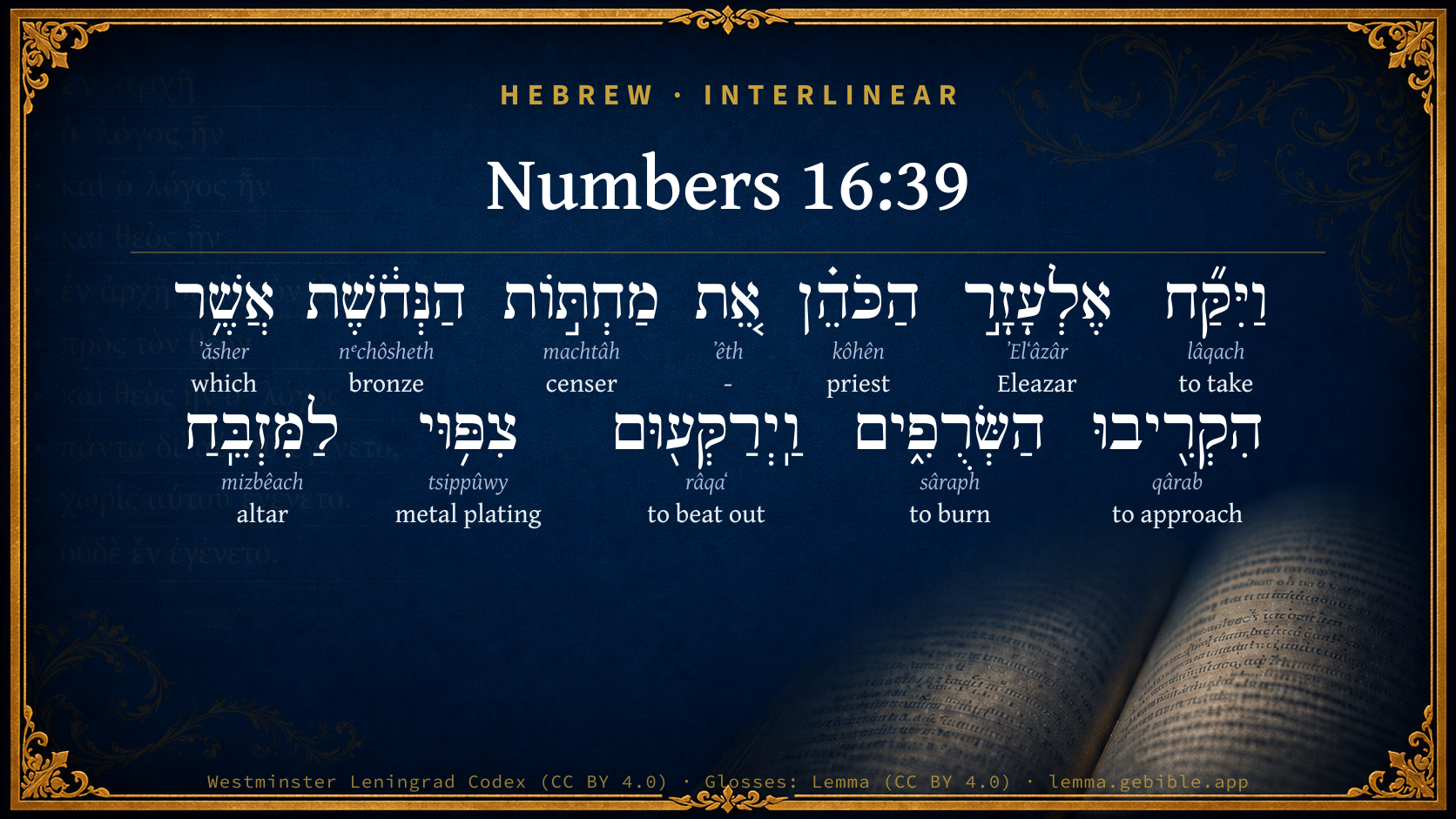
  1. וַיִּקַּ֞ח lâqach H3947 “and · to take” Conjunction + Verb, Qal, Sequential Imperfect, 3rd Person, Masculine, Singular
  2. אֶלְעָזָ֣ר ʼElʻâzâr H499 “Eleazar” Noun, Proper
  3. הַכֹּהֵ֗ן kôhên H3548 “the · priest” Particle, Definite Article + Noun, Common, Masculine, Singular, Absolute
  4. אֵ֚ת ʼêth H853 “-” Particle, Direct Object
  5. מַחְתּ֣וֹת machtâh H4289 “censers of” Noun, Common, Feminine, Plural, Construct
  6. הַנְּחֹ֔שֶׁת nᵉchôsheth H5178 “the · bronze” Particle, Definite Article + Noun, Common, Feminine, Singular, Absolute
  7. אֲשֶׁ֥ר ʼăsher H834 “which” Particle, Relative
  8. הִקְרִ֖יבוּ qârab H7126 “to approach” Verb, Hiphil, Perfect, 3rd Person, Common, Plural
  9. הַשְּׂרֻפִ֑ים sâraph H8313 “the · burnt” Particle, Definite Article + Verb, Qal, Participle Passive, Masculine, Plural, Absolute
  10. וַֽיְרַקְּע֖וּם râqaʻ H7554 “and · to beat out · them” Conjunction + Verb, Piel, Sequential Imperfect, 3rd Person, Masculine, Plural + Suffix, Personal, 3rd Person, Masculine, Plural
  11. לַמִּזְבֵּֽחַ mizbêach H4196 “to/for the · altar” Preposition, Determined + Noun, Common, Masculine, Singular, Absolute

About this verse

These counts appear in no published source. They are computed here, from the morphology-tagged text and Lemma’s own curated glosses. What Lemma adds →

12
words
12
distinct lemmas
Pentateuch
section

Notable vocabulary

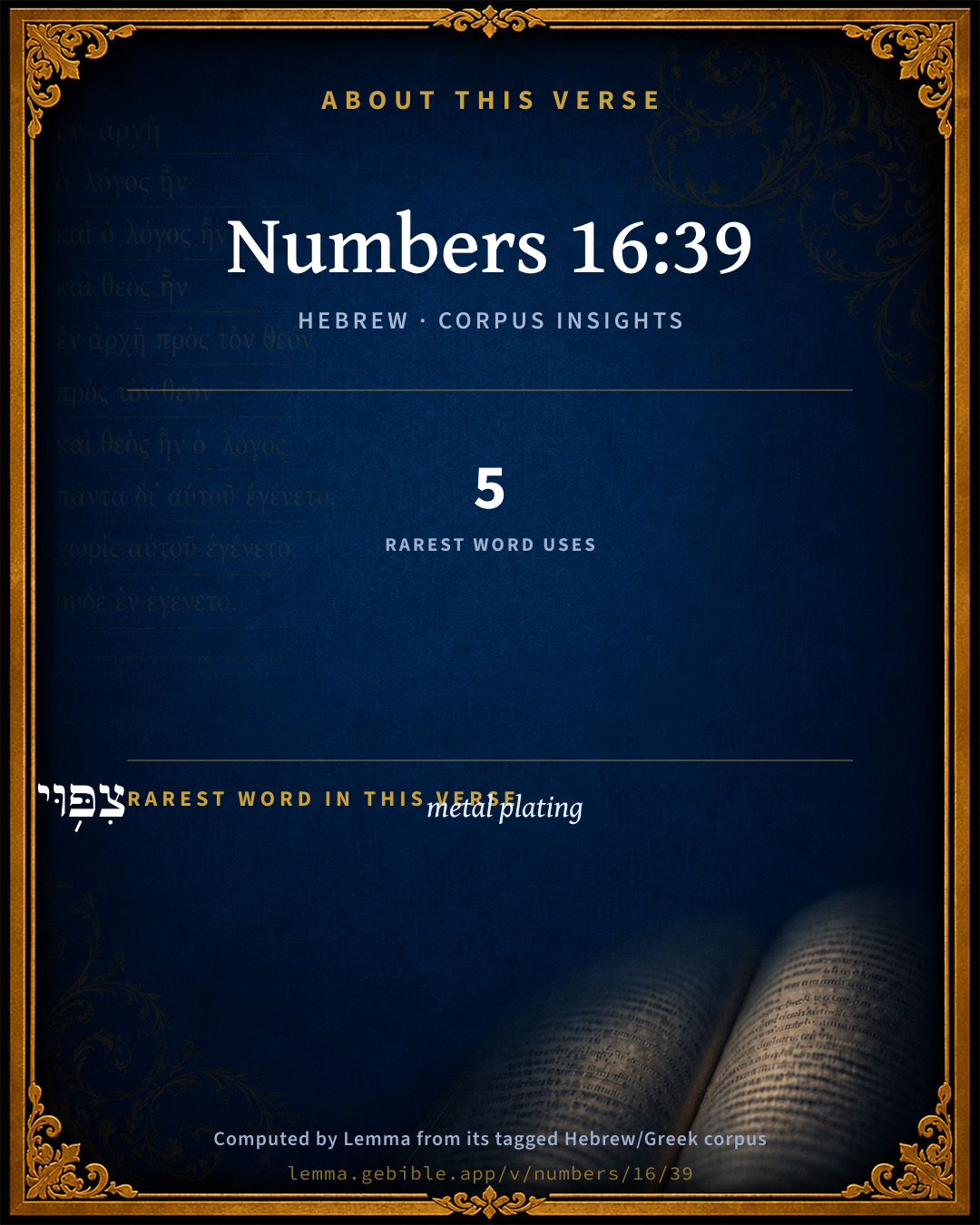
The rarest word here is צִפּ֥וּי metal plating H6826 — appearing just 5 times in the whole Hebrew Bible.

Shared distinctive vocabulary

צִפּ֥וּי metal plating H6826 occurs in 5 verses of the Hebrew Bible. Also found in:

Grammatical profile

  • 4 verbs
  • 6 nouns
  • 2 particles

Verb forms

  • וַיִּקַּ֞ח Qal · Sequential Imperfect
  • הִקְרִ֖יבוּ Hiphil · Perfect
  • הַשְּׂרֻפִ֑ים Qal · Participle Passive
  • וַֽיְרַקְּע֖וּם Piel · Sequential Imperfect

Hebrew & Septuagint length

In English translation the verse runs 25 words from the Hebrew and 31 from the Septuagint (LXX English) — closely comparable.

A rough comparison of the two English renderings, which tokenize alike — not a word-level alignment.

Word counts can differ between the Hebrew and the Greek without any difference in meaning — e.g. the Hebrew direct-object marker אֵת has no separate Greek word, and Greek often adds the article ὁ.

Hebrew and Greek witnesses Masoretic Hebrew ↔ Greek Septuagint

The same verse in the two great witnesses to the Old Testament, shown verse-for-verse.

These are two independent witnesses, not word-aligned to each other, and the Septuagint is shown in lemma (dictionary) form.

Hebrew Numbers 16:39 Masoretic · Westminster Leningrad Codex

וַיִּקַּ֞ח אֶלְעָזָ֣ר הַכֹּהֵ֗ן אֵ֚ת מַחְתּ֣וֹת הַנְּחֹ֔שֶׁת אֲשֶׁ֥ר הִקְרִ֖יבוּ הַשְּׂרֻפִ֑ים וַֽיְרַקְּע֖וּם צִפּ֥וּי לַמִּזְבֵּֽחַ

Eleazar the priest took the brazen censers, which those who were burnt had offered; and they beat them out for a covering of the altar,

World English Bible · Public Domain

Greek LXX Numbers 16:39 Septuagint · lemma form
And Eleazar the son of Aaron the priest took the brazen censers, which the men who had been burnt brought near, and they put them as a covering on the altar:

LXX2012 (modern English Septuagint) · Public Domain

Hebrew: Westminster Leningrad Codex (CC BY 4.0). Greek: Septuagint (public domain); English from LXX2012 (modern English Septuagint) (Public Domain). How the Septuagint differs from the Hebrew →

Commentary

Notes on Numbers 16:39 from classic Christian and Jewish commentators (each source and its license shown beneath its notes). The classic Christian expositions comment on the surrounding passage and are grouped to its opening verse, so a note may address several verses; the Jewish commentaries on the Tanakh (Rashi and others) are per-verse, so they appear only where the commentator wrote on this verse.

Lemma curates 59 commentaries, every one of them public domain or Creative Commons licensed, each selected and text-cleaned for this edition rather than reprinted as found. About our sources →

Jamieson, Fausset & Brown

Robert Jamieson, A. R. Fausset & David Brown

the brazen censers . . . made broad plates to be a memorial--The altar of burnt offerings, being made of wood and covered with brass, this additional covering of broad plates not only rendered it doubly secure against the fire, but served as a warning beacon to deter all from future invasions of the priesthood.

Jamieson, Fausset & Brown — Commentary Critical and Explanatory on the Whole Bible (1871) — public domain (CC PDM 1.0). Text via the HelloAO Bible API.

Ellicott's Commentary for English Readers

(39) Wherewith they that were burnt had offered.—Or, which they who were burnt had brought nigh (i.e. unto the Lord).

A Bible Commentary for English Readers, edited by Charles John Ellicott (1878–1897) — public domain. Text from a community e-Sword module.

John Gill's Exposition

And Eleazar the priest took the brazen censers,.... The metal of which these censers were made is particularly observed, to show that they were fit for the use they were ordered to be put unto, namely, for a covering of the altar of burnt offering, which was covered with brass, that being very suitable, since fire was continually burning on it; and by this it appears that these censers were different from those of Aaron and his sons, for theirs were silver ones; the high priest on the day of atonement indeed made use of golden one, but at all other times he used a silver one (b); and so did the common priests every day, morning and night, when they offered incense (c):

wherewith they that were burnt had offered; the two hundred fifty men burnt with fire from the Lord, having offered incense to him with the brazen censers:

and they were made broad plates for a covering of the altar; not by Eleazar, but by workmen skilled in the art of drawing or beating any kind of metal into thin plates, by the direction and order of Eleazar.

(b) Misn. Yoma, c. 4. sect. 4. (c) Misn. Tamid, c. 5. sect. 5.

John Gill's Exposition of the Whole Bible (1746–1763) — public domain (CC PDM 1.0). Text via the HelloAO Bible API.

Haydock's Catholic Bible Commentary

CHAPTER XVI.

Altar of holocausts, which was already covered with plates of brass. (Calmet)

George Leo Haydock (1774–1849), Haydock's Catholic Family Bible and Commentary, 1859 edition — public domain. Excludes Psalms (Douay-Rheims chapter numbering differs from Protestant) and Deuterocanonical books (Catholic canon only).

unfoldingWord translationNotes

Door43 World Missions Community

that had been used by the men who were burned up

This can be stated in active form. AT: "that the men whom the fire had burned up had used" (See: Active or Passive)

become like Korah and his group

How they might become like them can be stated clearly. AT "die as Korah and his group had died" (See: Assumed Knowledge and Implicit Information)

translationWords

bronze

descend

Korah

unfoldingWord translationNotes — © Distant Shores Media and the Door43 World Missions Community, licensed CC BY-SA 4.0. Source: git.door43.org/Door43/en_tn.

Lesson kit

Teaching starters — assembled from the data on this page, not authored interpretation. Every prompt links to the verse data it draws on. Edit before teaching.

Numbers, in the Pentateuch, opens this verse with 12 words (12 distinct Hebrew lemmas). Its most distinctive word is tsippûwy (“metal plating”). A historical commentator’s framing appears above. Read the whole chapter for the surrounding context.

Discussion questions

  1. The word tsippûwy carries the sense “metal plating.” How does it shape the verse?
  2. How does Exodus 38:17, which shares the word «metal plating», read alongside this verse?
  3. These translations render this verse differently; the difference is in the English rendering, not the original. What questions does that raise?
  4. «וַיִּקַּ֞ח» is a Qal Sequential Imperfect verb. How does that grammatical form shape the action described?
  5. Compare how Jamieson, Fausset & Brown and Ellicott's Commentary for English Readers read this verse. Where do they agree or differ?

Things to notice

Reading settings

Reading text

Shown beneath each verse's original-language words.

Old Testament
Old Testament edition

Read the OT as the Masoretic Hebrew (MT) or the Greek Septuagint (LXX).

English shown for the Greek Septuagint (in the Hebrew ↔ Greek comparison).

Comparing translations? Open the Compare panel on any verse page to stack up to four side by side.