
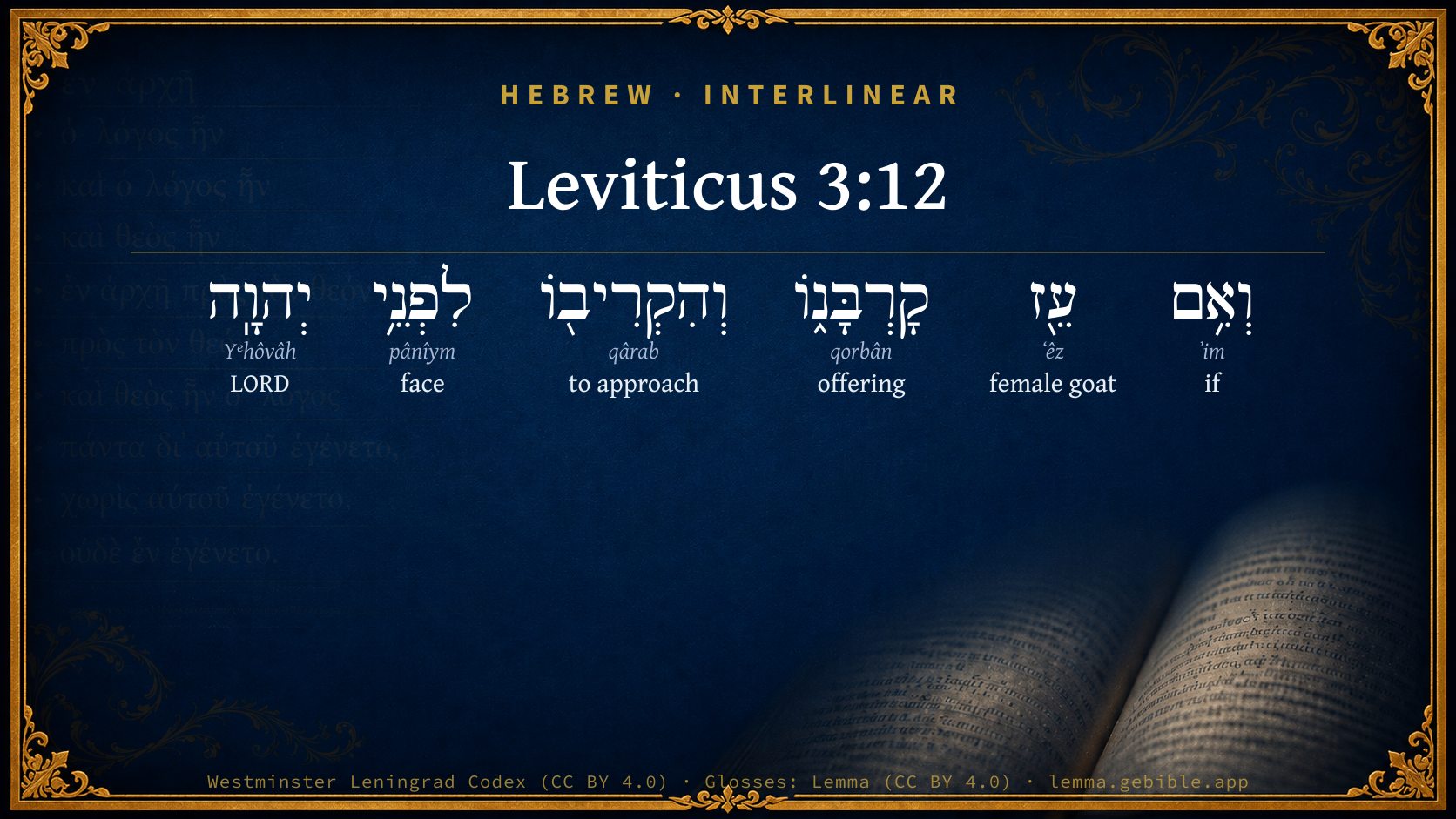
Leviticus 3:12

Hebrew (Westminster Leningrad Codex) Leviticus 3:12 appears in the Hebrew Old Testament. The text above is from the Westminster Leningrad Codex. Each word links to its Strong’s number, a concise gloss, and parsing drawn from the Open Scriptures Hebrew Bible morphology. Click any word for its full Brown-Driver-Briggs (BDB) entry.
Download image
Cite this verse

Leviticus 3:12 (World English Bible). Public Domain. Lemma interlinear Bible study tool, https://lemma.gebible.app/v/leviticus/3/12.

Show BibTeX & RIS
BibTeX
RIS
English Translation
"'If his offering is a goat, then he shall offer it before Yahweh:
World English Bible · Public Domain
Download a study sheet

One document with this verse’s original text, its word-by-word gloss line, the meaning frame, cross-references with their text, attributed commentary, and full source and license credits — printable, and it pastes into notes with its structure intact.

This verse Autodidact and up

Study sheet (.html) Plain text (.txt)

A passage Seminary Student

Up to 50 verses in one chapter. A passage sheet keeps up to 6 commentary sources and 12 cross-references per verse, in the order this page ranks them, and says so on the sheet whenever that leaves anything out. Ask for a single verse and you get the Autodidact verse sheet above.

Everything on this page stays free to read, with no account — the sheet is a download of what is already on screen, not access to it.

Want to remove ads? Support Godless Engineer
Compare translations 3

The same verse in 3 English versions, stacked beneath the original-language interlinear above. Click any original word for its lexicon entry.

Each is an independent rendering of the whole verse — the interlinear is not word-aligned to these translations.

Highlighted words mark where these versions differ — a whole-verse word diff, not a word-by-word alignment.

  • World English Bible Public Domain
    "'If his offering is a goat, then he shall offer it before Yahweh:
  • King James Version Public Domain
    And if his offering be a goat, then he shall offer it before the LORD.
  • unfoldingWord Literal Text CC BY-SA 4.0
    And if his offering a goat, then he shall present it to the face of Yahweh.

unfoldingWord Literal Text — © unfoldingWord, licensed CC BY-SA 4.0. Word-aligned USFM3 via Door43 (git.door43.org/unfoldingWord/en_ult).

Versions to compare (up to 4)

3 of 4 selected

Show all 18 translations

Every available English version of this verse, each an independent rendering of the whole verse.

  • World English Bible Public Domain
    "'If his offering is a goat, then he shall offer it before Yahweh:
  • Berean Standard Bible Public Domain
    If one’s offering is a goat, he is to present it before the LORD.
  • Majority Standard Bible Public Domain
    If one’s offering is a goat, he is to present it before the LORD.
  • King James Version Public Domain
    And if his offering be a goat, then he shall offer it before the LORD.
  • American Standard Version (1901) Public Domain
    And if his oblation be a goat, then he shall offer it before Jehovah:
  • Revised Version (1885) Public Domain
    And if his oblation be a goat, then he shall offer it before the LORD:
  • Geneva Bible (1599) Public Domain
    Also if his offring be a goate, then shall he offer it before the Lord,
  • Douay-Rheims (1899) Public Domain
    If his offering be a goat, and he offer it to the Lord,
  • Young's Literal Translation Public Domain
    `And if his offering `is' a goat, then he hath brought it near before Jehovah,
  • Literal Standard Version CC BY-SA 4.0
    And if his offering [is] a goat, then he has brought it near before YHWH,
  • Unlocked Literal Bible CC BY-SA 4.0
    If the man's offering is a goat, then he will offer it before Yahweh.
  • unfoldingWord Literal Text CC BY-SA 4.0
    And if his offering a goat, then he shall present it to the face of Yahweh.
  • Darby Bible Public Domain
    And if his offering be a goat, then he shall present it before Jehovah.
  • World Messianic Bible Public Domain
    “‘If his offering is a goat, then he shall offer it before the LORD.
  • Webster's Bible Public Domain
    And if his offering shall be a goat, then he shall offer it before the LORD.
  • Free Bible Version CC BY-SA 4.0
    If your offering is a goat, you are to present it before the Lord.
  • Bible in Basic English Public Domain
    And if his offering is a goat, then let it be placed before the Lord,
  • JPS Tanakh (1917) Public Domain
    And if his offering be a goat, then he shall present it before the LORD.

Literal Standard Version (2020), Covenant Press — licensed CC BY-SA 4.0. Text via the HelloAO Bible API (eBible.org). Unlocked Literal Bible (unfoldingWord) — licensed CC BY-SA 4.0. Text via the HelloAO Bible API (eBible.org). unfoldingWord Literal Text — © unfoldingWord, licensed CC BY-SA 4.0. Word-aligned USFM3 via Door43 (git.door43.org/unfoldingWord/en_ult). Free Bible Version, Dr. Jonathan Gallagher — licensed CC BY-SA 4.0. Text via the HelloAO Bible API (eBible.org).

Word by word

More ways to search: Search by grammar → Find every occurrence → Compare this word →

Practice this passage: Drill this verse → Learn its vocabulary →

About this verse

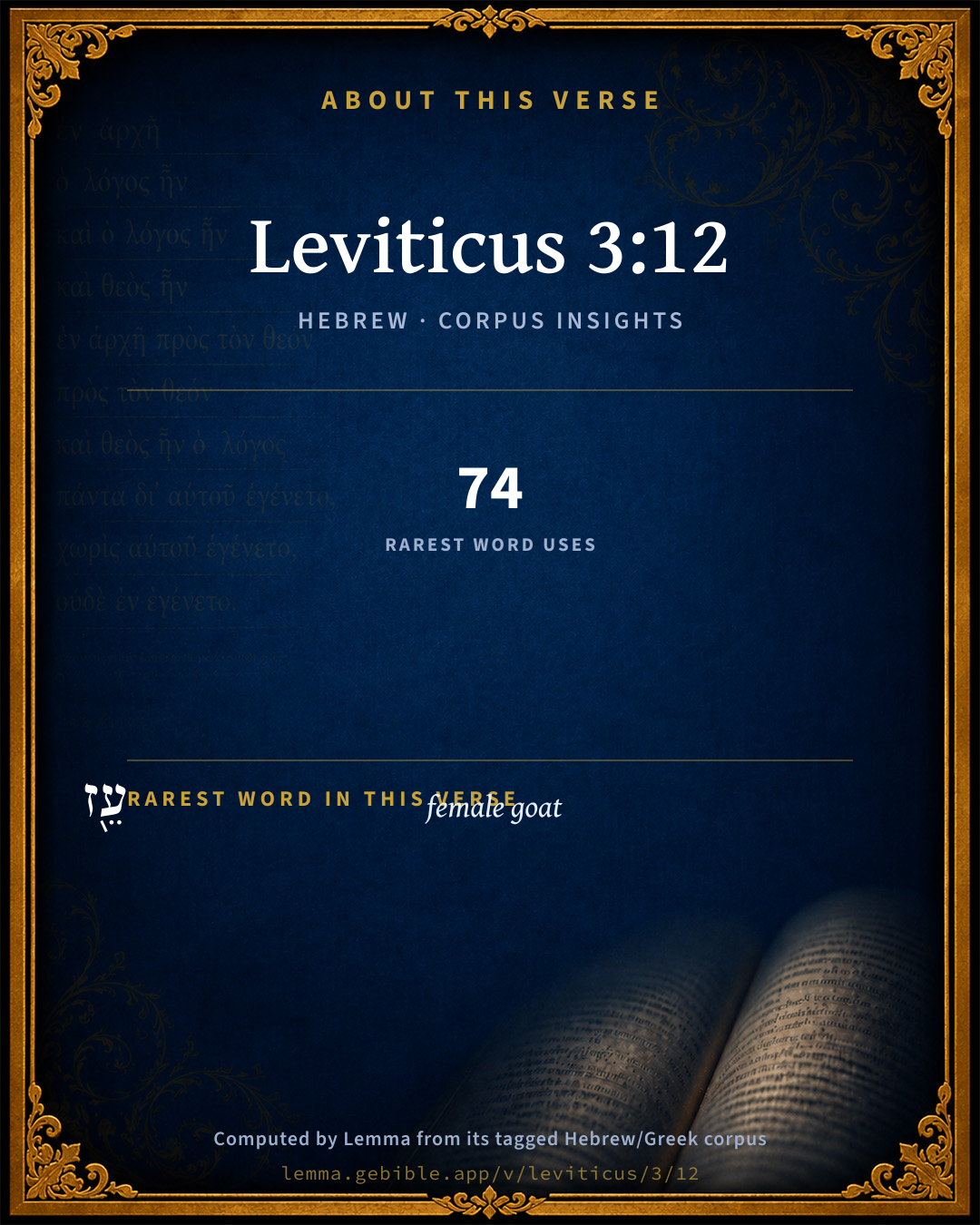
These counts appear in no published source. They are computed here, from the morphology-tagged text and Lemma’s own curated glosses. What Lemma adds →

6
words
6
distinct lemmas
Pentateuch
section

Grammatical profile

  • 1 verb
  • 4 nouns
  • 1 conjunction

Verb forms

  • וְהִקְרִיב֖וֹ Hiphil · Sequential Perfect

Hebrew & Septuagint length

In English translation the verse runs 13 words from the Hebrew and 16 from the Septuagint (LXX English) — closely comparable.

A rough comparison of the two English renderings, which tokenize alike — not a word-level alignment.

Word counts can differ between the Hebrew and the Greek without any difference in meaning — e.g. the Hebrew direct-object marker אֵת has no separate Greek word, and Greek often adds the article ὁ.

Cross-references

14

Topical passages linked to Leviticus 3:12 in the Treasury of Scripture Knowledge — connected by theme and wording, ordered by reader-vote popularity; previews shown in the World English Bible.

  • Leviticus 1:2 "Speak to the children of Israel, and tell them, 'When anyone of you offers an offering to Yahweh, you shall offer your offering of the cattle, from the herd and from the flock.
  • Leviticus 1:6 He shall flay the burnt offering, and cut it into pieces.
  • Leviticus 1:10 "'If his offering is from the flock, from the sheep, or from the goats, for a burnt offering, he shall offer a male without blemish.
  • Leviticus 3:1 "'If his offering is a sacrifice of peace offerings; if he offers it from the herd, whether male or female, he shall offer it without blemish before Yahweh.
  • Leviticus 3:7–17 If he offers a lamb for his offering, then he shall offer it before Yahweh;
  • Leviticus 9:3 You shall speak to the children of Israel, saying, 'Take a male goat for a sin offering; and a calf and a lamb, both a year old, without blemish, for a burnt offering;
  • Leviticus 9:15 He presented the people's offering, and took the goat of the sin offering which was for the people, and killed it, and offered it for sin, like the first.
  • Leviticus 10:16 Moses diligently inquired about the goat of the sin offering, and, behold, it was burned: and he was angry with Eleazar and with Ithamar, the sons of Aaron who were left, saying,
  • Leviticus 22:19–27 that you may be accepted, you shall offer a male without blemish, of the bulls, of the sheep, or of the goats.
  • Isaiah 53:2 For he grew up before him as a tender plant, and as a root out of a dry ground: he has no form nor comeliness; and when we see him, there is no beauty that we should desire him.
  • Isaiah 53:6 All we like sheep have gone astray; everyone has turned to his own way; and Yahweh has laid on him the iniquity of us all.
  • Matthew 25:32–33 Before him all the nations will be gathered, and he will separate them one from another, as a shepherd separates the sheep from the goats.
  • Romans 8:3 For what the law couldn't do, in that it was weak through the flesh, God did, sending his own Son in the likeness of sinful flesh and for sin, he condemned sin in the flesh;
  • 2 Corinthians 5:21 For him who knew no sin he made to be sin on our behalf; so that in him we might become the righteousness of God.

Cross-references courtesy of OpenBible.info (CC BY 4.0).

Hebrew and Greek witnesses Masoretic Hebrew ↔ Greek Septuagint

The same verse in the two great witnesses to the Old Testament, shown verse-for-verse.

These are two independent witnesses, not word-aligned to each other, and the Septuagint is shown in lemma (dictionary) form.

Hebrew Leviticus 3:12 Masoretic · Westminster Leningrad Codex

וְאִ֥ם עֵ֖ז קָרְבָּנ֑וֹ וְהִקְרִיב֖וֹ לִפְנֵ֥י יְהוָֽה

"'If his offering is a goat, then he shall offer it before Yahweh:

World English Bible · Public Domain

Greek LXX Leviticus 3:12 Septuagint · lemma form

ἐάν δέ ἀπό ὁ αἴξ ὁ δῶρον αὐτός καί προςἄγω ἔναντι κύριος

And if his offering be of the goats, then shall he bring it before the Lord.

LXX2012 (modern English Septuagint) · Public Domain

Hebrew: Westminster Leningrad Codex (CC BY 4.0). Greek: Septuagint (public domain); English from LXX2012 (modern English Septuagint) (Public Domain). How the Septuagint differs from the Hebrew →

Targum (Aramaic paraphrase)

2

The Targum is the ancient Jewish Aramaic paraphrase of the Hebrew Scriptures — an interpretive translation, not the Hebrew text itself. Onkelos (literal) and Pseudo-Jonathan (expansive) render the Torah, and Jonathan the Prophets. Coverage is partial: where no permissively-licensed English translation exists for a verse, only the Aramaic is shown. This is verse-level text, not a word-by-word alignment to the Hebrew.

  1. Targum Onkelos Torah (Genesis–Deuteronomy)
    וְאִם מִן בְּנֵי עִזַיָא קֻרְבָּנֵהּ וִיקָרְבִנֵהּ קֳדָם יְיָ

    (no public-domain English translation for this verse)

    Targum Onkelos — Aramaic: “Onkelos Genesis” (public domain); “Onkelos Exodus” (public domain); “Onkelos Leviticus” (public domain); “Onkelos Numbers” (public domain); “Onkelos Deuteronomy” (public domain). English: “Sefaria Community Translation” (CC0 1.0 (public-domain dedication)); “J.W. Etheridge. The Targums of Onkelos and Jonathan Ben Uzziel on the Pentateuch. London: Longmans, Green, 1862” (public domain). Text via Sefaria.

  2. Targum Pseudo-Jonathan Torah (Genesis–Deuteronomy)
    וְאִין מִן בְּנֵי עִיזָא קוּרְבָּנֵיהּ וְיַקְרִיבִינֵיהּ קֳדָם יְיָ

    And if his oblation be from the young goats, he shall bring it before the Lord,

    Targum Pseudo-Jonathan — Aramaic: “Targum Jonathan on Genesis” (public domain); “Targum Jonathan on Exodus” (public domain); “Targum Jonathan on Leviticus” (public domain); “Targum Jonathan on Numbers” (public domain); “Targum Jonathan on Deuteronomy” (public domain). English: “The Targum of Jonathan ben Uzziel, trans. J. W. Etheridge, London, 1862” (public domain). Text via Sefaria.

Commentary

Notes on Leviticus 3:12 from classic Christian and Jewish commentators (each source and its license shown beneath its notes). The classic Christian expositions comment on the surrounding passage and are grouped to its opening verse, so a note may address several verses; the Jewish commentaries on the Tanakh (Rashi and others) are per-verse, so they appear only where the commentator wrote on this verse.

Lemma curates 59 commentaries, every one of them public domain or Creative Commons licensed, each selected and text-cleaned for this edition rather than reprinted as found. About our sources →

Tyndale Open Study Notes

Tyndale Open Resources

3:12-16 The offering of goats followed a similar pattern as for cattle and sheep. Both goats and sheep were considered offerings from the flock (see 3:6).

Tyndale Open Study Notes — © Tyndale Open Resources, licensed CC BY-SA 4.0. Text via the HelloAO Bible API.

Jamieson, Fausset & Brown

Robert Jamieson, A. R. Fausset & David Brown

if his offering be a goat--Whether this or any of the other two animals were chosen, the same general directions were to be followed in the ceremony of offering.

Jamieson, Fausset & Brown — Commentary Critical and Explanatory on the Whole Bible (1871) — public domain (CC PDM 1.0). Text via the HelloAO Bible API.

Adam Clarke's Commentary

Verse 12. A goat] Implying the whole species, he-goat, she-goat, and kid, as we have already seen.

Adam Clarke's Commentary on the Bible (1810–1826) — public domain. Text from a community e-Sword/MySword module.

Ellicott's Commentary for English Readers

(12-15) And if his offering be a goat.—The directions about the goat as a peace offering are the same as those about an ox. No mention of male or female is here made, because this point is already stated in Lev_3:6. Unlike the burnt offering (Lev_1:10), the goat is here separated from the sheep because of the difference in the oblation, arising from the

broad tail of the sheep, which does not exist in the goat.

A Bible Commentary for English Readers, edited by Charles John Ellicott (1878–1897) — public domain. Text from a community e-Sword module.

John Gill's Exposition

And he shall lay his hand upon the head of it,.... His right hand, according to the Targum of Jonathan, as before; the same directions are given for the killing of it, and for the sprinkling of its blood, as in the offerings of the bullock and lamb.

And he shall lay his hand upon the head of it,.... His right hand, according to the Targum of Jonathan, as before; the same directions are given for the killing of it, and for the sprinkling of its blood, as in the offerings of the bullock and lamb.

Leviticus 3:14

lev 3:14

lev 3:14

lev 3:14And he shall offer thereof his offering,.... The same rules are laid down about taking the fat off of several parts as in the sacrifice of the bullock; but nothing is said of the fat of the rump and tail, as is said of the lamb.

John Gill's Exposition of the Whole Bible (1746–1763) — public domain (CC PDM 1.0). Text via the HelloAO Bible API.

Albert Barnes' Notes on the Bible

See Lev 1:10 note. Birds were not accepted as peace-offerings, most probably because they were, by themselves, insufficient to make up a sacrificial meal.

Albert Barnes' Notes on the Bible (1834–1885) — public domain. Text from a community e-Sword/MySword module.

Kretzmann's Popular Commentary

Paul E. Kretzmann

Of Goats

v. 12. And if his offering be a goat, then he shall offer it before the Lord.

v. 13. And he shall lay his hand upon the head of it, and kill it before the Tabernacle of the Congregation; and the sons of Aaron shall sprinkle the blood thereof, as it was caught when the animal was slaughtered, upon the altar round about.

v. 14. And he shall offer thereof his offering, even an offering made by fire unto the Lord; the fat that covereth the inwards, and all the fat that is upon the inwards,

v. 15. and the two kidneys, and the fat that is upon them, which is by the flanks, and the caul above the liver, with the kidneys, it shall he take away.

v. 16. And the priest shall burn them upon the altar; it is the food of the offering made by fire for a sweet savor; all the fat is the Lord’s, that is, all the loose fatty parts that were enumerated in these three cases were to be the Lord’s portion.

v. 17. It shall be a perpetual statute for your generations throughout all your dwellings that ye eat neither fat nor blood. As long as the children of Israel were in the wilderness, all the animals slaughtered for food had to be brought to the Sanctuary, Lev 17:3-7; in the land of Canaan, they were permitted to slaughter such animals in their own cities. Deu 12:15, but all the sacrifices had to be made at the place of the Sanctuary. The prohibition, however, concerning the loose fat mentioned in this Chapter and that regarding blood remained in force for the Jewish people. In the case of all peace-offerings the wave-breast and the heave-shoulder belonged to the priests, Lev 7:30 ff. and the rest of the meat was to be eaten by the worshiper and his family in the court of the Tabernacle. This joyous sacrificial meal was to express the happiness which the believers felt because of their covenant with the God of their salvation, just as we Christians enjoy the blessings of God’s covenant in the Sacrament of the Altar.

Paul E. Kretzmann, Popular Commentary of the Bible (1921–1924) — public domain. Text from a community e-Sword module.

unfoldingWord translationNotes

Door43 World Missions Community

before Yahweh

"in the presence of Yahweh" or "to Yahweh"

lay his hand on the head

This is a symbolic action that identifies the person with the animal he is offering. In this way the person is offering himself to Yahweh through the animal. See how you translated this in Leviticus 1:4. (See: Symbolic Action)

the sons of Aaron will sprinkle its blood

It is implied that before they sprinkle the blood, they catch the blood in a bowl as it drains from the animal. (See: Assumed Knowledge and Implicit Information)

will offer his sacrifice made by fire

This can be stated in active form. AT: "will offer his sacrifice by fire" or "will burn his sacrifice" (See: Active or Passive)

translationWords

sacrifice

goat

Yahweh

tent of meeting

Aaron

altar

unfoldingWord translationNotes — © Distant Shores Media and the Door43 World Missions Community, licensed CC BY-SA 4.0. Source: git.door43.org/Door43/en_tn.

Ramban (Nachmanides)

Rabbi Moshe ben Nachman (Ramban / Nachmanides)

AND IF HIS OFFERING BE A GOAT. He mentions here the species, thus meaning, “if of the species of goats is his offering,” [and thus includes male and female]. This is like the opinion of Onkelos who translated: “and if of the ‘bnei’ (species of) the goats is his offering.” Similarly, that which He said in connection with the burnt-offering, whether of the sheep, or of the goats, also means of their species [for since the male of the goats is called tayish, the verse there which speaks of a burnt-offering which can be only a male, must perforce mean “the species of the goats,” which automatically includes the males].In my opinion the Sacred Language is not particular as to the names of animals, for the majority of them have the same name for both male and female, such as camel, ass, rock-badger, hare, and swine, and among the birds the young pigeon and the turtle-dove. Even among the species which do have different names for the male and female — such as shor and parah (ox and cow), kesev, kisbah (he-lamb, ewe-lamb), tayish and eiz (he-goat and she-goat) — Scripture is not particular, and will sometimes say seh and shor of the female, similar to that which is written, ‘V’shor o seh’ [literally: “and ox or lamb] ye shall not kill it and its young both in one day, which applies only to the dam and the lamb [it being permissible to slaughter the male parent and its young in one day], in accordance with the opinion of the Sage who says that [in animals] one does not take into consideration the seed of the male parent. Similarly, of ‘ha’izim’ (the goats) for a burnt-offering, he shall offer it a male without blemish, means of the t’yashim (the he-goats). And if his offering be an ‘eiz’ (a goat) means a male or female [since a peace-offering, which is the subject of this verse, can be brought either from the male or the femals]. So also, And if his means suffice not for a ‘seh’ (lamb) means a ewe-lamb or a she-goat [as is expressly stated there in the preceding verse]., Verse 6. The section there deals with the offering of higher or lower value, Scripture first stating that where the offender can afford it he should bring as a sin-offering a ewe-lamb or a she-goat. Then follows the verse: And if his means suffice not for a ‘seh’ (lamb). The word seh in this case must perforce mean a ewe-lamb or she-goat. Thus it is proven that Scripture uses the term seh also for the female.

Ramban (Nachmanides) on the Tanakh — English translation: “Commentary on the Torah by Ramban (Nachmanides). Translated and annotated by Charles B. Chavel. New York, Shilo Pub. House, 1971-1976” (CC BY 4.0). Text via Sefaria.

Lesson kit

Teaching starters — assembled from the data on this page, not authored interpretation. Every prompt links to the verse data it draws on. Edit before teaching.

Leviticus, in the Pentateuch, opens this verse with 6 words (6 distinct Hebrew lemmas). Its most distinctive word is ʻêz (“female goat”). A historical commentator’s framing appears above. Read the whole chapter for the surrounding context.

Discussion questions

  1. The word ʻêz carries the sense “female goat.” How does it shape the verse?
  2. Leviticus 1:2 shares this passage’s theme. How do the two illuminate each other?
  3. These translations render this verse differently; the difference is in the English rendering, not the original. What questions does that raise?
  4. The verb «וְהִקְרִיב֖וֹ» is Hiphil Sequential Perfect. How does its form color the action?
  5. Reading how Tyndale Open Study Notes and Jamieson, Fausset & Brown read this verse, where do the two commentators agree and where do they part?

Things to notice

Reading settings

Reading text

Shown beneath each verse's original-language words.

Old Testament
Old Testament edition

Read the OT as the Masoretic Hebrew (MT) or the Greek Septuagint (LXX).

English shown for the Greek Septuagint (in the Hebrew ↔ Greek comparison).

Comparing translations? Open the Compare panel on any verse page to stack up to four side by side.