
Joshua 10:24

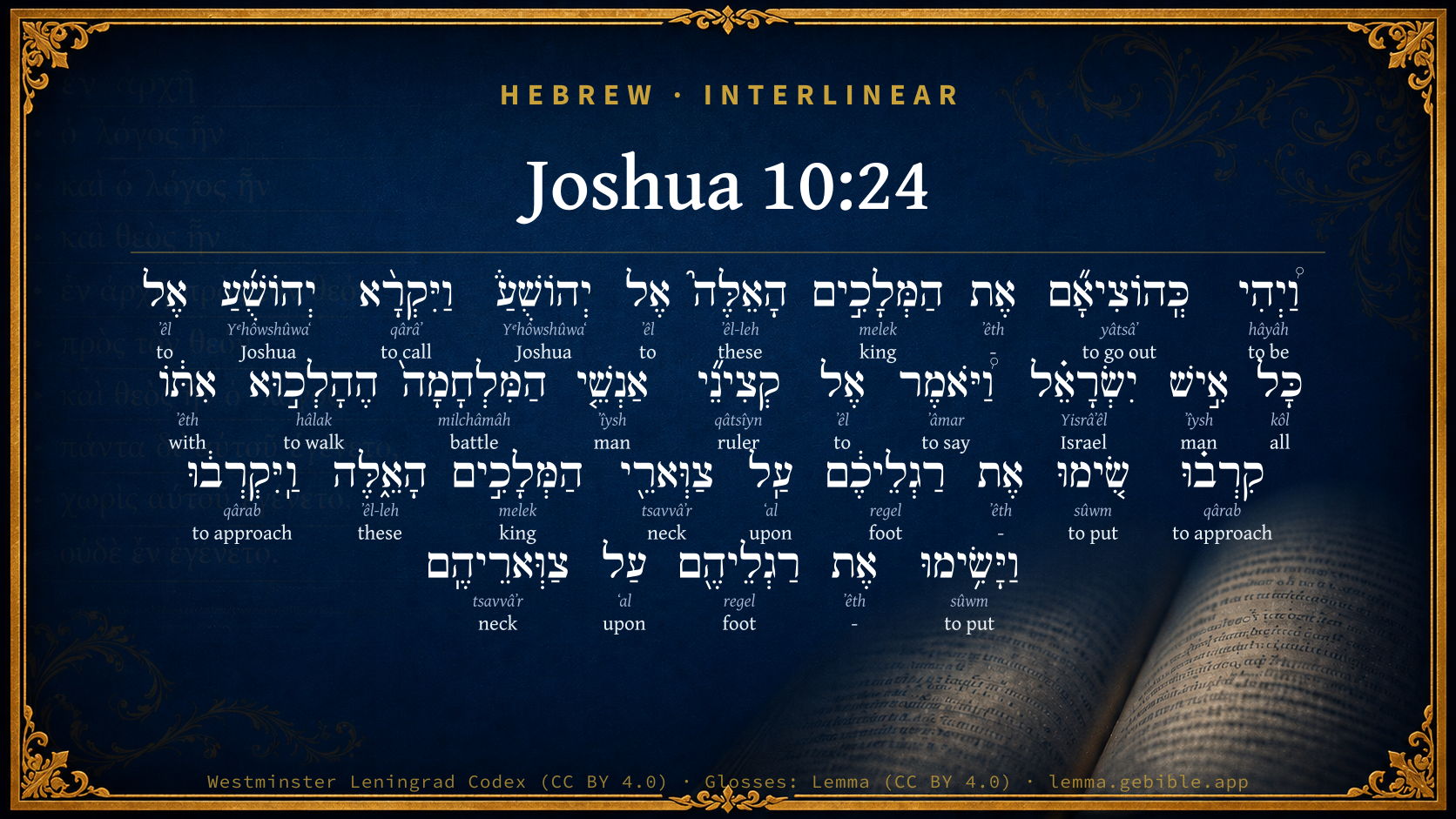
Hebrew (Westminster Leningrad Codex) Joshua 10:24 appears in the Hebrew Old Testament. The text above is from the Westminster Leningrad Codex. Each word links to its Strong’s number, a concise gloss, and parsing drawn from the Open Scriptures Hebrew Bible morphology. Click any word for its full Brown-Driver-Briggs (BDB) entry.
Download image
Cite this verse

Joshua 10:24 (World English Bible). Public Domain. Lemma interlinear Bible study tool, https://lemma.gebible.app/v/joshua/10/24.

Show BibTeX & RIS
BibTeX
RIS
English Translation
It happened, when they brought forth those kings to Joshua, that Joshua called for all the men of Israel, and said to the chiefs of the men of war who went with him, Come near, put your feet on the necks of these kings. They came near, and put their feet on the necks of them.
World English Bible · Public Domain
Highlights
  • 1 first appearance in the Hebrew Bible
Full analysis ↓
Download a study sheet

One document with this verse’s original text, its word-by-word gloss line, the meaning frame, cross-references with their text, attributed commentary, and full source and license credits — printable, and it pastes into notes with its structure intact.

This verse Autodidact and up

Study sheet (.html) Plain text (.txt)

A passage Seminary Student

Up to 50 verses in one chapter. A passage sheet keeps up to 6 commentary sources and 12 cross-references per verse, in the order this page ranks them, and says so on the sheet whenever that leaves anything out. Ask for a single verse and you get the Autodidact verse sheet above.

Everything on this page stays free to read, with no account — the sheet is a download of what is already on screen, not access to it.

Want to remove ads? Support Godless Engineer
Compare translations 3

The same verse in 3 English versions, stacked beneath the original-language interlinear above. Click any original word for its lexicon entry.

Each is an independent rendering of the whole verse — the interlinear is not word-aligned to these translations.

Highlighted words mark where these versions differ — a whole-verse word diff, not a word-by-word alignment.

  • World English Bible Public Domain
    It happened, when they brought forth those kings to Joshua, that Joshua called for all the men of Israel, and said to the chiefs of the men of war who went with him, Come near, put your feet on the necks of these kings. They came near, and put their feet on the necks of them.
  • King James Version Public Domain
    And it came to pass, when they brought out those kings unto Joshua, that Joshua called for all the men of Israel, and said unto the captains of the men of war which went with him, Come near, put your feet upon the necks of these kings. And they came near, and put their feet upon the necks of them.
  • unfoldingWord Literal Text CC BY-SA 4.0
    And it happened, when they brought out these kings to Joshua, that Joshua called to every man of Israel and said to the commanders of the men of war, the ones going with him, “Come near, put your feet on the necks of these kings.” So they came near and put their feet on their necks.

unfoldingWord Literal Text — © unfoldingWord, licensed CC BY-SA 4.0. Word-aligned USFM3 via Door43 (git.door43.org/unfoldingWord/en_ult).

Versions to compare (up to 4)

3 of 4 selected

Show all 18 translations

Every available English version of this verse, each an independent rendering of the whole verse.

  • World English Bible Public Domain
    It happened, when they brought forth those kings to Joshua, that Joshua called for all the men of Israel, and said to the chiefs of the men of war who went with him, Come near, put your feet on the necks of these kings. They came near, and put their feet on the necks of them.
  • Berean Standard Bible Public Domain
    When they had brought the kings to Joshua, he summoned all the men of Israel and said to the army commanders who had accompanied him, “Come here and put your feet on the necks of these kings.” So the commanders came forward and put their feet on their necks.
  • Majority Standard Bible Public Domain
    When they had brought the kings to Joshua, he summoned all the men of Israel and said to the army commanders who had accompanied him, “Come here and put your feet on the necks of these kings.” So the commanders came forward and put their feet on their necks.
  • King James Version Public Domain
    And it came to pass, when they brought out those kings unto Joshua, that Joshua called for all the men of Israel, and said unto the captains of the men of war which went with him, Come near, put your feet upon the necks of these kings. And they came near, and put their feet upon the necks of them.
  • American Standard Version (1901) Public Domain
    And it came to pass, when they brought forth those kings unto Joshua, that Joshua called for all the men of Israel, and said unto the chiefs of the men of war that went with him, Come near, put your feet upon the necks of these kings. And they came near, and put their feet upon the necks of them.
  • Revised Version (1885) Public Domain
    And it came to pass, when they brought forth those kings unto Joshua, that Joshua called for all the men of Israel, and said unto the chiefs of the men of war which went with him, Come near, put your feet upon the necks of these kings. And they came near, and put their feet upon the necks of them.
  • Geneva Bible (1599) Public Domain
    And when they had brought out those Kings vnto Ioshua, Ioshua called for all the men of Israel, and sayd vnto the chiefe of the men of warre, which went with him, Come neere, set your feete vpon the necks of these Kings: and they came neere and set their feete vpon their necks.
  • Douay-Rheims (1899) Public Domain
    And when they were Drought out to him, he called all the men of Israel, and said to the chiefs of the army that were with him: Go, and set your feet on the necks of these kings. And when they had gone, and put their feet upon the necks of them lying under them,
  • Young's Literal Translation Public Domain
    And it cometh to pass, when they bring out these kings unto Joshua, that Joshua calleth unto every man of Israel, and saith unto the captains of the men of war, who have gone with him, `Draw near, set your feet on the necks of these kings;' and they draw near, and set their feet on their necks.
  • Literal Standard Version CC BY-SA 4.0
    And it comes to pass, when they bring out these kings to Joshua, that Joshua calls to every man of Israel, and says to the captains of the men of war, who have gone with him, “Draw near, set your feet on the necks of these kings”; and they draw near, and set their feet on their necks.
  • Unlocked Literal Bible CC BY-SA 4.0
    When they brought the kings to Joshua, he summoned every man of Israel. He said to the commanders of the soldiers who had gone into battle with him, “Put your feet on their necks.” So they came up and put their feet on their necks.
  • unfoldingWord Literal Text CC BY-SA 4.0
    And it happened, when they brought out these kings to Joshua, that Joshua called to every man of Israel and said to the commanders of the men of war, the ones going with him, “Come near, put your feet on the necks of these kings.” So they came near and put their feet on their necks.
  • Darby Bible Public Domain
    And it came to pass when they had brought forth those kings to Joshua, that Joshua called to all the men of Israel, and said to the captains of the men of war who went with him, Come forward, put your feet on the necks of these kings. And they came forward and put their feet on their necks.
  • World Messianic Bible Public Domain
    When they brought those kings out to Joshua, Joshua called for all the men of Israel, and said to the chiefs of the men of war who went with him, “Come near. Put your feet on the necks of these kings.” They came near, and put their feet on their necks.
  • Webster's Bible Public Domain
    And it came to pass, when they brought out those kings to Joshua, that Joshua called for all the men of Israel, and said to the captains of the men of war who went with him, Come near, put your feet upon the necks of these kings. And they came near, and put their feet upon the necks of them.
  • Free Bible Version CC BY-SA 4.0
    When they had brought the kings to Joshua, he summoned all the fighting men, and said to the commanders who had gone with him, “Come here, and put your feet on the necks of these kings.” So they came over and put their feet on their necks.
  • Bible in Basic English Public Domain
    And when they had made those kings come out to Joshua, Joshua sent for all the men of Israel, and said to the chiefs of the men of war who had gone with him, Come near and put your feet on the necks of these kings. So they came near and put their feet on their necks.
  • JPS Tanakh (1917) Public Domain
    And it came to pass, when they brought forth those kings unto Joshua, that Joshua called for all the men of Israel, and said unto the chiefs of the men of war that went with him: 'Come near, put your feet upon the necks of these kings.' And they came near, and put their feet upon the necks of them.

Literal Standard Version (2020), Covenant Press — licensed CC BY-SA 4.0. Text via the HelloAO Bible API (eBible.org). Unlocked Literal Bible (unfoldingWord) — licensed CC BY-SA 4.0. Text via the HelloAO Bible API (eBible.org). unfoldingWord Literal Text — © unfoldingWord, licensed CC BY-SA 4.0. Word-aligned USFM3 via Door43 (git.door43.org/unfoldingWord/en_ult). Free Bible Version, Dr. Jonathan Gallagher — licensed CC BY-SA 4.0. Text via the HelloAO Bible API (eBible.org).

Word by word

More ways to search: Search by grammar → Find every occurrence → Compare this word →

Practice this passage: Drill this verse → Learn its vocabulary →

קְצִינֵ֞י
qâtsîyn
H7101
“rulers of”
Noun, Common, Masculine, Plural, Construct
Part of Speech
Noun
Type
Common
Gender
Masculine
Number
Plural
State
Construct
Full BDB Definition

Origin: from H7096 in the sense of determining

TWOT: 2054a

chief, ruler, commander - chief, commander (in war) - dictator - ruler (of one in authority)
  1. וַ֠יְהִי hâyâh H1961 “and · to be” Conjunction + Verb, Qal, Sequential Imperfect, 3rd Person, Masculine, Singular
  2. כְּֽהוֹצִיאָ֞ם yâtsâʼ H3318 “like/as · to go out · them” Preposition + Verb, Hiphil, Infinitive Construct + Suffix, Personal, 3rd Person, Masculine, Plural
  3. אֶת ʼêth H853 “-” Particle, Direct Object
  4. הַמְּלָכִ֣ים melek H4428 “the · kings” Particle, Definite Article + Noun, Common, Masculine, Plural, Absolute
  5. הָאֵלֶּה֮ ʼêl-leh H428 “the · these” Particle, Definite Article + Pronoun, Demonstrative, Common, Plural
  6. אֶל ʼêl H413 “to” Preposition
  7. יְהוֹשֻׁעַ֒ Yᵉhôwshûwaʻ H3091 “Joshua” Noun, Proper
  8. וַיִּקְרָ֨א qârâʼ H7121 “and · to call” Conjunction + Verb, Qal, Sequential Imperfect, 3rd Person, Masculine, Singular
  9. יְהוֹשֻׁ֜עַ Yᵉhôwshûwaʻ H3091 “Joshua” Noun, Proper
  10. אֶל ʼêl H413 “to” Preposition
  11. כָּל kôl H3605 “all of” Noun, Common, Masculine, Singular, Construct
  12. אִ֣ישׁ ʼîysh H376 “man of” Noun, Common, Masculine, Singular, Construct
  13. יִשְׂרָאֵ֗ל Yisrâʼêl H3478 “Israel” Noun, Proper
  14. וַ֠יֹּאמֶר ʼâmar H559 “and · to say” Conjunction + Verb, Qal, Sequential Imperfect, 3rd Person, Masculine, Singular
  15. אֶל ʼêl H413 “to” Preposition
  16. אַנְשֵׁ֤י ʼîysh H376 “men of” Noun, Common, Masculine, Plural, Construct
  17. הַמִּלְחָמָה֙ milchâmâh H4421 “the · battle” Particle, Definite Article + Noun, Common, Feminine, Singular, Absolute
  18. הֶהָלְכ֣וּא hâlak H1980 “the · to walk” Particle, Definite Article + Verb, Qal, Perfect, 3rd Person, Common, Plural
  19. אִתּ֔וֹ ʼêth H854 “with · him” Preposition + Suffix, Personal, 3rd Person, Masculine, Singular
  20. קִרְב֗וּ qârab H7126 “approach” Verb, Qal, Imperative, 2nd Person, Masculine, Plural
  21. שִׂ֚ימוּ sûwm H7760 “put” Verb, Qal, Imperative, 2nd Person, Masculine, Plural
  22. אֶת ʼêth H853 “-” Particle, Direct Object
  23. רַגְלֵיכֶ֔ם regel H7272 “feet · your” Noun, Common, Feminine, Dual, Construct + Suffix, Personal, 2nd Person, Masculine, Plural
  24. עַֽל ʻal H5921 “upon” Preposition
  25. צַוְּארֵ֖י tsavvâʼr H6677 “necks of” Noun, Common, Masculine, Plural, Construct
  26. הַמְּלָכִ֣ים melek H4428 “the · kings” Particle, Definite Article + Noun, Common, Masculine, Plural, Absolute
  27. הָאֵ֑לֶּה ʼêl-leh H428 “the · these” Particle, Definite Article + Pronoun, Demonstrative, Common, Plural
  28. וַֽיִּקְרְב֔וּ qârab H7126 “and · to approach” Conjunction + Verb, Qal, Sequential Imperfect, 3rd Person, Masculine, Plural
  29. וַיָּשִׂ֥ימוּ sûwm H7760 “and · to put” Conjunction + Verb, Qal, Sequential Imperfect, 3rd Person, Masculine, Plural
  30. אֶת ʼêth H853 “-” Particle, Direct Object
  31. רַגְלֵיהֶ֖ם regel H7272 “feet · their” Noun, Common, Feminine, Dual, Construct + Suffix, Personal, 3rd Person, Masculine, Plural
  32. עַל ʻal H5921 “upon” Preposition
  33. צַוְּארֵיהֶֽם tsavvâʼr H6677 “necks · their” Noun, Common, Masculine, Plural, Construct + Suffix, Personal, 3rd Person, Masculine, Plural

About this verse

These counts appear in no published source. They are computed here, from the morphology-tagged text and Lemma’s own curated glosses. What Lemma adds →

34
words
21
distinct lemmas
Historical
section

Notable vocabulary

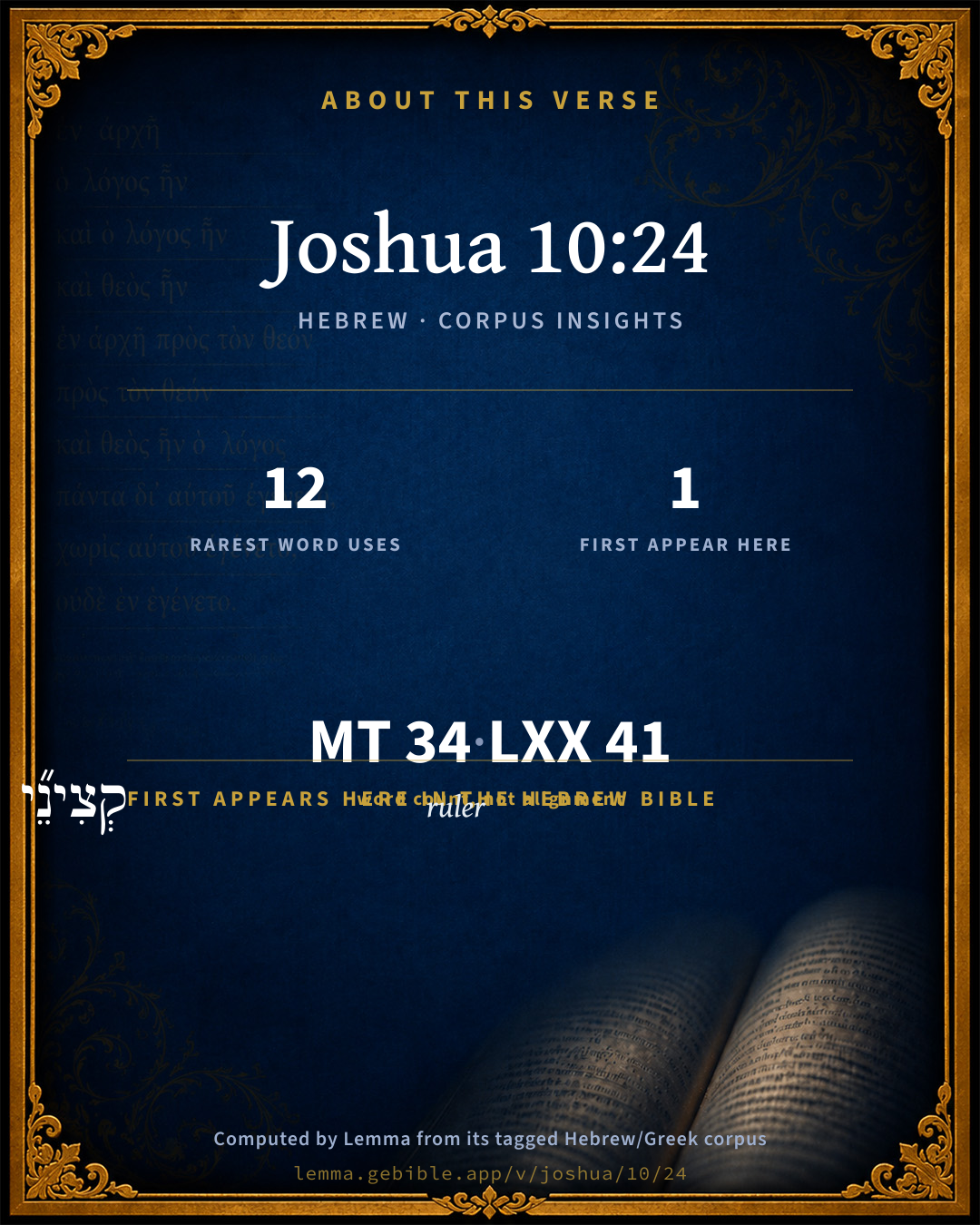
The rarest word here is קְצִינֵ֞י ruler H7101 — appearing just 12 times in the whole Hebrew Bible.

First appearance in Scripture

This word makes its first canonical appearance in the Hebrew Bible here:

  • קְצִינֵ֞י ruler H7101

Shared distinctive vocabulary

קְצִינֵ֞י ruler H7101 occurs in 12 verses of the Hebrew Bible. Also found in:

Grammatical profile

  • 9 verbs
  • 14 nouns
  • 2 pronouns
  • 6 prepositions
  • 3 particles

Verb forms

  • וַ֠יְהִי Qal · Sequential Imperfect
  • כְּֽהוֹצִיאָ֞ם Hiphil · Infinitive Construct
  • וַיִּקְרָ֨א Qal · Sequential Imperfect
  • וַ֠יֹּאמֶר Qal · Sequential Imperfect
  • הֶהָלְכ֣וּא Qal · Perfect
  • קִרְב֗וּ Qal · Imperative
  • שִׂ֚ימוּ Qal · Imperative
  • וַֽיִּקְרְב֔וּ Qal · Sequential Imperfect
  • וַיָּשִׂ֥ימוּ Qal · Sequential Imperfect

Repetition

Words recur within this verse — often emphatic in Hebrew:

  • הַמְּלָכִ֣ים king H4428 ×2
  • יְהוֹשֻׁעַ֒ Joshua H3091 ×2
  • אִ֣ישׁ man H376 ×2
  • קִרְב֗וּ to approach H7126 ×2
  • שִׂ֚ימוּ to put H7760 ×2
  • רַגְלֵיכֶ֔ם foot H7272 ×2
  • עַֽל upon H5921 ×2
  • צַוְּארֵ֖י neck H6677 ×2
  • אֶל to H413 ×3
  • הָאֵלֶּה֮ these H428 ×2

Hebrew & Septuagint length

In English translation the verse runs 56 words from the Hebrew and 46 from the Septuagint (LXX English) — closely comparable.

A rough comparison of the two English renderings, which tokenize alike — not a word-level alignment.

Word counts can differ between the Hebrew and the Greek without any difference in meaning — e.g. the Hebrew direct-object marker אֵת has no separate Greek word, and Greek often adds the article ὁ.

In the original languages it is 34 Hebrew tokens and 41 Greek tokens — but the two are counted differently (Hebrew bundles its prefixes and suffixes into one token; the Greek is in lemma form), so that isn’t a like-for-like length.

Cross-references

14

Topical passages linked to Joshua 10:24 in the Treasury of Scripture Knowledge — connected by theme and wording, ordered by reader-vote popularity; previews shown in the World English Bible.

  • Malachi 4:3 You shall tread down the wicked; for they will be ashes under the soles of your feet in the day that I make," says Yahweh of Hosts.
  • Romans 16:20 And the God of peace will quickly crush Satan under your feet. The grace of our Lord Jesus Christ be with you.
  • Revelation 2:26–27 He who overcomes, and he who keeps my works to the end, to him I will give authority over the nations.
  • Deuteronomy 33:29 Happy are you, Israel: Who is like you, a people saved by Yahweh, The shield of your help, The sword of your excellency! Your enemies shall submit themselves to you; You shall tread on their high places.
  • Psalms 107:40 He pours contempt on princes, And causes them to wander in a trackless waste.
  • Psalms 110:1 Yahweh says to my Lord, "Sit at my right hand, Until I make your enemies your footstool for your feet."
  • Psalms 110:5 The Lord is at your right hand. He will crush kings in the day of his wrath.
  • Psalms 149:8–9 To bind their kings with chains, And their nobles with fetters of iron;
  • Isaiah 26:5–6 For he has brought down those who dwell on high, the lofty city: he lays it low, he lays it low even to the ground; he brings it even to the dust.
  • Isaiah 60:11–12 Your gates also shall be open continually; they shall not be shut day nor night; that men may bring to you the wealth of the nations, and their kings led captive.
  • Judges 8:20 He said to Jether his firstborn, Up, and kill them. But the youth didn't draw his sword; for he feared, because he was yet a youth.
  • Psalms 2:8–12 Ask of me, and I will give the nations for your inheritance, The uttermost parts of the earth for your possession.
  • Psalms 18:40 You have also made my enemies turn their backs to me, That I might cut off those who hate me.
  • Psalms 91:13 You will tread on the lion and cobra. You will trample the young lion and the serpent underfoot.

Cross-references courtesy of OpenBible.info (CC BY 4.0).

Hebrew and Greek witnesses Masoretic Hebrew ↔ Greek Septuagint

The same verse in the two great witnesses to the Old Testament, shown verse-for-verse.

These are two independent witnesses, not word-aligned to each other, and the Septuagint is shown in lemma (dictionary) form.

Hebrew Joshua 10:24 Masoretic · Westminster Leningrad Codex

וַ֠יְהִי כְּֽהוֹצִיאָ֞ם אֶת הַמְּלָכִ֣ים הָאֵלֶּה֮ אֶל יְהוֹשֻׁעַ֒ וַיִּקְרָ֨א יְהוֹשֻׁ֜עַ אֶל כָּל אִ֣ישׁ יִשְׂרָאֵ֗ל וַ֠יֹּאמֶר אֶל קְצִינֵ֞י אַנְשֵׁ֤י הַמִּלְחָמָה֙ הֶהָלְכ֣וּא אִתּ֔וֹ קִרְב֗וּ שִׂ֚ימוּ אֶת רַגְלֵיכֶ֔ם עַֽל צַוְּארֵ֖י הַמְּלָכִ֣ים הָאֵ֑לֶּה וַֽיִּקְרְב֔וּ וַיָּשִׂ֥ימוּ אֶת רַגְלֵיהֶ֖ם עַל צַוְּארֵיהֶֽם

It happened, when they brought forth those kings to Joshua, that Joshua called for all the men of Israel, and said to the chiefs of the men of war who went with him, Come near, put your feet on the necks of these kings. They came near, and put their feet on the necks of them.

World English Bible · Public Domain

Greek LXX Joshua 10:24 Septuagint · lemma form

καί ἐπεί ἐκἄγω αὐτός πρός ἰησοῦς καί συνκαλέω ἰησοῦς πᾶς ἰσραήλ καί ὁ ἐνἄρχω ὁ πόλεμος ὁ συνπορεύομαι αὐτός λέγω αὐτός προπορεύομαι καί ἐπιτίθημι ὁ πούς σύ ἐπί ὁ τράχηλος αὐτός καί προςἔρχομαι ἐπιτίθημι ὁ πούς αὐτός ἐπί ὁ τράχηλος αὐτός

And when they brought them out to Joshua, then Joshua called together all Israel, and the chiefs of the army that went with him, saying to them, Come forward and set your feet on their necks; and they came and set their feet on their necks.

LXX2012 (modern English Septuagint) · Public Domain

Hebrew: Westminster Leningrad Codex (CC BY 4.0). Greek: Septuagint (public domain); English from LXX2012 (modern English Septuagint) (Public Domain). How the Septuagint differs from the Hebrew →

Targum (Aramaic paraphrase)

1

The Targum is the ancient Jewish Aramaic paraphrase of the Hebrew Scriptures — an interpretive translation, not the Hebrew text itself. Onkelos (literal) and Pseudo-Jonathan (expansive) render the Torah, and Jonathan the Prophets. Coverage is partial: where no permissively-licensed English translation exists for a verse, only the Aramaic is shown. This is verse-level text, not a word-by-word alignment to the Hebrew.

  1. Targum Jonathan Prophets (Joshua–Malachi)
    וַהֲוָה כַּד אַפִּיקוּ יַת מַלְכַיָא הָאִלֵין לְוַת יְהוֹשֻׁעַ וּקְרָא יְהוֹשֻׁעַ לְכָל אֱנָשׁ יִשְׂרָאֵל וַאֲמַר לְשִׁלְטוֹנֵי גַבְרֵי מְגִיחֵי קְרָבָא דַאֲזַלוּ עִמֵיהּ קִרְבוּ שַׁווּ יַת רִגְלֵיכוֹן עַל צַוְארֵי מַלְכַיָא הָאִלֵין וּקְרִיבוּ וְשַׁוִיאוּ יַת רִגְלֵיהוֹן עַל צַוְארֵיהוֹן:

    (no public-domain English translation for this verse)

    Targum Jonathan — Aramaic: “Mikraot Gedolot” (public domain). English: “Sefaria Community Translation” (CC0 1.0 (public-domain dedication)); “London "Chaldee Paraphrase," 1871” (public domain). Text via Sefaria.

Commentary

Notes on Joshua 10:24 from classic Christian and Jewish commentators (each source and its license shown beneath its notes). The classic Christian expositions comment on the surrounding passage and are grouped to its opening verse, so a note may address several verses; the Jewish commentaries on the Tanakh (Rashi and others) are per-verse, so they appear only where the commentator wrote on this verse.

Lemma curates 59 commentaries, every one of them public domain or Creative Commons licensed, each selected and text-cleaned for this edition rather than reprinted as found. About our sources →

Trapp's Complete Commentary

John Trapp

Jos 10:24 And it came to pass, when they brought out those kings unto Joshua, that Joshua called for all the men of Israel, and said unto the captains of the men of war which went with him, Come near, put your feet upon the necks of these kings. And they came near, and put their feet upon the necks of them.

Ver. 24. Put your feet upon the necks of these kings.] Not as proudly insulting over them, as that pope did over the emperor at Venice; but to show that he had quite subdued them, as Christ also hath all our spiritual enemies, {Rom 8:37} and will tread Satan himself under our feet shortly. {Rom 16:20} What, then, though that old serpent shoot his sting into our heel, and make us halt, as that martyr said? yet let us go on, though halting, to heaven, whence the devil is cast down. {Rev 12:9}

John Trapp, A Commentary or Exposition upon All the Books of the Old and New Testament (1647–1656) — public domain. Text from a community e-Sword module.

Joseph Benson's Commentary

Jos 10:24. Put your feet on the necks, &c. — This he commanded, not in insolence and pride, but in token that these kings and their countries were brought into an absolute subjection to the Israelites, that God had fulfilled his promise in part, (Deu 33:29,) and to assure his captains that he would completely fulfil it, and subdue the proudest of their enemies under their feet.

Joseph Benson's Commentary on the Old and New Testaments (1811–1818) — public domain. Text from a community e-Sword module.

Tyndale Open Study Notes

Tyndale Open Resources

10:24 Victorious commanders in the ancient Near East would commonly put their feet on defeated kings’ necks to symbolize their subjugation.

Tyndale Open Study Notes — © Tyndale Open Resources, licensed CC BY-SA 4.0. Text via the HelloAO Bible API.

Geneva Bible (1599)

Geneva Bible translators

Signifying what should become of the rest of God’s enemies, seeing that kings themselves were not spared.

Geneva Bible (1599) marginal notes — public domain. Text via Bolls.life.

Jamieson, Fausset & Brown

Robert Jamieson, A. R. Fausset & David Brown

put your feet upon the necks of these kings--not as a barbarous insult, but a symbolical action, expressive of a complete victory (Deu 33:29; Psa 110:5; Mal 4:3).

Jamieson, Fausset & Brown — Commentary Critical and Explanatory on the Whole Bible (1871) — public domain (CC PDM 1.0). Text via the HelloAO Bible API.

Adam Clarke's Commentary

Verse 24. Put your feet upon the necks of these kings.] This act was done symbolically, as a token, not only of the present complete victory, but of their approaching triumph over all their adversaries, which is the interpretation given of it by Joshua in the succeeding verse.

Adam Clarke's Commentary on the Bible (1810–1826) — public domain. Text from a community e-Sword/MySword module.

Ellicott's Commentary for English Readers

(24) The captains.—The original word occurs here for the first time (see Jdg_11:6; Jdg_11:11), and seems to mean the actual leaders, not merely the official heads, of the people, who had borne the brunt of the battle. These men having laboured, deserved to see the fruits of their labour; and the action of Joshua was well calculated to inspirit them, and to fire them with courage to lead their followers to the charge in battles that were yet to come.

Put your feet upon the necks of these kings.—Comp. 2Sa_22:41, “Thou hast also given me the necks of mine enemies;” and Gen_49:8.

A Bible Commentary for English Readers, edited by Charles John Ellicott (1878–1897) — public domain. Text from a community e-Sword module.

The Cambridge Bible for Schools and Colleges

gen. ed. J. J. S. Perowne

24. put your feet upon the necks] According to the usage portrayed on the monuments of Assyria and Egypt, which seems also to have been practised by the Byzantine emperors long after the Christian era. For this symbol of complete subjection comp. Psa_110:1; 1Co_15:25.

The Cambridge Bible for Schools and Colleges (gen. ed. J. J. S. Perowne; Cambridge University Press, 1878–1918) — public domain. Text from a community e-Sword module.

John Gill's Exposition

And Joshua said, rest not, nor be dismayed,.... Not meaning at the kings, who perhaps lay bound upon the ground, or however were not in a condition to make any resistance, so that they had nothing to fear from them; but this respects future time, and what other enemies they should meet with; who would be brought into subjection to them as these were, and therefore from hence should take heart:

be strong, and of good courage; and go on valiantly in subduing the rest of their enemies, and not be afraid of them:

for thus shall the Lord do to all your enemies against whom ye fight; put them into their hands, and give them power to tread on their necks: this shows that what Joshua did, or ordered to be done, was of the Lord.

John Gill's Exposition of the Whole Bible (1746–1763) — public domain (CC PDM 1.0). Text via the HelloAO Bible API.

Albert Barnes' Notes on the Bible

Put your feet upon the necks of these kings - A symbol of complete subjugation (compare the marginal references and 1Co 15:25).

Albert Barnes' Notes on the Bible (1834–1885) — public domain. Text from a community e-Sword/MySword module.

Haydock's Catholic Bible Commentary

Feet, as Moses had foretold, Deuteronomy xxxiii. 29. The conduct of Josue would appear cruel, if we did not reflect that he was only the executioner of the divine justice, which was pleased thus to punish these proud and impious princes, that others might not imitate their example.

George Leo Haydock (1774–1849), Haydock's Catholic Family Bible and Commentary, 1859 edition — public domain. Excludes Psalms (Douay-Rheims chapter numbering differs from Protestant) and Deuterocanonical books (Catholic canon only).

Matthew Poole's English Annotations

Put your feet upon the necks of these kings: this he did not from pride and contempt of their dignity in itself; but, partly, as a punishment of their impious rebellion against their sovereign Lord; partly, in pursuance of that curse of servility due to all this people, Gen 9:25; partly, as a token to assure his captains that God would subdue the proudest of them all under their feet; and partly, to oblige and teach his people severely to execute the judgment of God upon them, and not to spare any of them, either out of a foolish pity, or out of respect to their dignity, as Saul afterwards spared Agag to his own ruin.

Matthew Poole's English Annotations on the Holy Bible (1683–1685) — public domain. Text from a community e-Sword/MySword module.

The Pulpit Commentary

Which went with him. There is a very unusual Hebrew phrase here. Not only is the article used instead of the relative pronoun rva which occasionally occurs, as in 1Ch_29:17, but the form of the verb is Arabic. None of the commentators give a satisfactory explanation of this fact, and perhaps the suggestion of Houbigant is to be adopted, that the a which follows Wklh has been accidentally doubled by the transcriber. Kennicott thinks that some Arabic transcriber has inadvertently given the verb an Arabic form, which is very improbable. Keil thinks that it is a sort of intermediate step between the more ancient termination W and the more modern one in W. But if so, it is strange that we should only meet with it twice in Holy Scripture. Haverniek (Introduction, B) regards it as an archaic form. Put your feet on the necks of these kings. This was a most common Oriental practice, as the Assyrian and Egyptian monuments prove. Calvin explains the otherwise "boundless arrogance" of the act by the Divine command. But, as Keil remarks, it was a "symbolical act, intended to inspirit the people." See also Psa_110:1 1Co_15:25. The fact that this was done, not by Joshua, but by the captains (yxiq from hxq to cut off), i.e., the inferior officers of the Israelitish army, makes a wide distinction between this and the usual arrogance of Oriental conquerors, and marks the very great moral superiority of Joshua over any other leader known to history either in his own time or in subsequent ages. For whereas the act was usually an act of arrogant triumph on the part of the leader himself, here the leader modestly disclaims any such superiority, and calls upon his subordinates to assume it, as a sign that the Israelitish people, whose representatives they were, should triumph over all their enemies. The next verse explains the reason of the injunction. To the kings themselves no insolence was displayed, for it was but the well known and perfectly understood symbol of their undeniable condition of subjection at that moment. But, of course, we are not to look for that gentleness and humanity in so far distant an age, which would at the present day be shown by a Christian general, or even for the moderation and clemency displayed in the hour of victory by an Alexander, a Scipio, a Caesar, trained under the maxims of Latin and Greek philosophy. See a fuller discussion of the subject in the Introduction. Origen remarks here, "Atque utinam Dominus meus Jesus filius Dei mihi istud concedat, et jubeat me pedibus meis conculcare spiritum fornicationis, et caleare super cervices spiritus iracundise et furoris, calcare avaritise daemonem, caicare jactantiam, conterere pedibus superbiae spiritum.

Vers. 24, 25. The conquered kings.

The fate of those kings has its moral analogies. We may regard them as typical of the principles and powers of spiritual evil, and their end as suggestive of the certain issue of God"s conflict with those evil powers. Observe

I THE DECEITFULNESS OF SIN. It deludes the transgressor, and leads him blindfold to ruin. It moves men to seek false refuges, inspires them with a vain hope. They think to hide themselves, but God"s laws and retributions always find them out. Jonah would fain "flee from the presence of the Lord," but God"s "strong wind" was swifter than his flight, and the sea, by which he thought to escape, only brought him face to face with his Judge. The subterfuges to which men resort in any guilty way often become the very means of their detection and punishment. The kings dream of safety in their cave; it turns out to be the very thing that shuts them up hopelessly to Joshua"s vengeance. As Matthew Henry puts it: "That which they thought would have been their shelter, was made their prison first, and then their grave." So do sinful purposes often defeat themselves. "The wicked is snared in the work of his own hands". (Psa_9:16)

II THE HUMILIATION THAT, SOONER OR LATER, BEFALLS A PROUD DEFIANCE OF DIVINE AUTHORITY. See here an illustration of high handed rebellion against God. Its overthrow in the end is sure. "The wheel of fortune turns and lowers the proud." Kings are as helplessly subject to the Divine power by which that wheel revolves as other men. (Psa_76:12 Isa_41:25) Into what abject misery have they sometimes fallen, under the mighty hand of God, who once, in the career of their ambition, set all Divine and human law at defiance, and made the earth to tremble! Let not the wicked exalt themselves; there is a power that can easily lay them low.

III THE VICTORY THAT REWARDS FAITHFUL AND PATIENT MORAL CONFLICT. The captains are called, in the presence of all the men of Israel, to "put their feet upon the necks" of these doomed kings. So shall it be the honour and joy of all earnest warrior souls to see their enemies at last subdued under them. "The God of peace shall bruise Satan under your feet shortly". (Rom_16:20) "Tis hard work to be continually fighting against some form of evil in the world without or the world within; to have continually to confront some new foe, or "old foes with new faces;" to be compelled often to drag forth some lurking iniquity from its hiding place in our own hearts that it may be slain. But let us be resolute and patient and we shall "come off more than conquerors through him who hath loved us," and at last plant our feet proudly on the necks of all our adversaries.

IV THE FINAL GLORIOUS VICTORY OF CHRIST. It is the eternal purpose of God that every stronghold of evil should fall before Him and all His enemies be put beneath His feet, and the events of time are all helping in some way or other to bring about that issue. W. (Psa_110:1 1Co_15:25 Php_2:9-11)

The Pulpit Commentary (1880–1919), ed. H.D.M. Spence-Jones & Joseph S. Exell — public domain. Text from a community e-Sword module.

John Wesley's Explanatory Notes

Put your feet on the necks - This he did not from pride and contempt; but as a punishment of their impious rebellion against their Sovereign Lord; in pursuance of that curse of servitude due to all this people, and as a token to assure his captains, that God would subdue the proudest of them under their feet.

John Wesley, Explanatory Notes Upon the Whole Bible (1754–1765) — public domain. Text via the GEBible commentary corpus.

unfoldingWord translationNotes

Door43 World Missions Community

every man of Israel

Here the men of Israel represent only those who were soldiers. (See: Synecdoche)

translationWords

king

Joshua

Israel

commander

Yahweh

unfoldingWord translationNotes — © Distant Shores Media and the Door43 World Missions Community, licensed CC BY-SA 4.0. Source: git.door43.org/Door43/en_tn.

Lesson kit

Teaching starters — assembled from the data on this page, not authored interpretation. Every prompt links to the verse data it draws on. Edit before teaching.

Joshua, in the Historical, opens this verse with 34 words (21 distinct Hebrew lemmas). Its most distinctive word is qâtsîyn (“ruler”). A historical commentator’s framing appears above. Read the whole chapter for the surrounding context.

Discussion questions

  1. What does “ruler” (qâtsîyn) contribute to the verse as a whole?
  2. This is the first place “ruler” appears in Scripture (first appears here). What does its debut here establish?
  3. How does Judges 11:6, which shares the word «ruler», read alongside this verse?
  4. What does the repetition of “king” (2× in this one verse) do in this verse?
  5. The translations on this page render this verse differently — a whole-verse word diff, not a word-by-word alignment. What might account for the different wordings?
  6. «וַ֠יְהִי» is a Qal Sequential Imperfect verb. How does that grammatical form shape the action described?
  7. Compare how Trapp's Complete Commentary and Joseph Benson's Commentary read this verse. Where do they agree or differ?

Things to notice

Reading settings

Reading text

Shown beneath each verse's original-language words.

Old Testament
Old Testament edition

Read the OT as the Masoretic Hebrew (MT) or the Greek Septuagint (LXX).

English shown for the Greek Septuagint (in the Hebrew ↔ Greek comparison).

Comparing translations? Open the Compare panel on any verse page to stack up to four side by side.