Joshua 7:18

Hebrew (Westminster Leningrad Codex) Joshua 7:18 appears in the Hebrew Old Testament. The text above is from the Westminster Leningrad Codex. Each word links to its Strong’s number, a concise gloss, and parsing drawn from the Open Scriptures Hebrew Bible morphology. Click any word for its full Brown-Driver-Briggs (BDB) entry.
Download image
Cite this verse

Joshua 7:18 (World English Bible). Public Domain. Lemma interlinear Bible study tool, https://lemma.gebible.app/v/joshua/7/18.

Show BibTeX & RIS
BibTeX
RIS
English Translation
and he brought near his household man by man; and Achan, the son of Carmi, the son of Zabdi, the son of Zerah, of the tribe of Judah, was taken.
World English Bible · Public Domain
Download a study sheet

One document with this verse’s original text, its word-by-word gloss line, the meaning frame, cross-references with their text, attributed commentary, and full source and license credits — printable, and it pastes into notes with its structure intact.

This verse Autodidact and up

Study sheet (.html) Plain text (.txt)

A passage Seminary Student

Up to 50 verses in one chapter. A passage sheet keeps up to 6 commentary sources and 12 cross-references per verse, in the order this page ranks them, and says so on the sheet whenever that leaves anything out. Ask for a single verse and you get the Autodidact verse sheet above.

Everything on this page stays free to read, with no account — the sheet is a download of what is already on screen, not access to it.

Want to remove ads? Support Godless Engineer
Compare translations 3

The same verse in 3 English versions, stacked beneath the original-language interlinear above. Click any original word for its lexicon entry.

Each is an independent rendering of the whole verse — the interlinear is not word-aligned to these translations.

Highlighted words mark where these versions differ — a whole-verse word diff, not a word-by-word alignment.

  • World English Bible Public Domain
    and he brought near his household man by man; and Achan, the son of Carmi, the son of Zabdi, the son of Zerah, of the tribe of Judah, was taken.
  • King James Version Public Domain
    And he brought his household man by man; and Achan, the son of Carmi, the son of Zabdi, the son of Zerah, of the tribe of Judah, was taken.
  • unfoldingWord Literal Text CC BY-SA 4.0
    And he brought near his house by men, and Achan, the son of Carmi, the son of Zabdi, the son of Zerah, from the tribe of Judah, was taken.

unfoldingWord Literal Text — © unfoldingWord, licensed CC BY-SA 4.0. Word-aligned USFM3 via Door43 (git.door43.org/unfoldingWord/en_ult).

Versions to compare (up to 4)

3 of 4 selected

Show all 18 translations

Every available English version of this verse, each an independent rendering of the whole verse.

  • World English Bible Public Domain
    and he brought near his household man by man; and Achan, the son of Carmi, the son of Zabdi, the son of Zerah, of the tribe of Judah, was taken.
  • Berean Standard Bible Public Domain
    And he had the family of Zabdi come forward man by man, and Achan son of Carmi, the son of Zabdi, the son of Zerah, of the tribe of Judah, was selected.
  • Majority Standard Bible Public Domain
    And he had the family of Zabdi come forward man by man, and Achan son of Carmi, the son of Zabdi, the son of Zerah, of the tribe of Judah, was selected.
  • King James Version Public Domain
    And he brought his household man by man; and Achan, the son of Carmi, the son of Zabdi, the son of Zerah, of the tribe of Judah, was taken.
  • American Standard Version (1901) Public Domain
    and he brought near his household man by man; and Achan, the son of Carmi, the son of Zabdi, the son of Zerah, of the tribe of Judah, was taken.
  • Revised Version (1885) Public Domain
    and he brought near his household man by man; and Achan, the son of Carmi, the son of Zabdi, the son of Zerah, of the tribe of Judah, was taken.
  • Geneva Bible (1599) Public Domain
    And he brought his houshold, man by man, and Achan ye sonne of Carmi, the sonne of Zabdi, the sonne of Zerah of the tribe of Iudah was take.
  • Douay-Rheims (1899) Public Domain
    And bringing his house man by man, he found Achan the son of Charmi, the son of Zabdi, the son of Zare of the tribe of Juda.
  • Young's Literal Translation Public Domain
    and he bringeth near his household by men, and Achan -- son of Carmi, son of Zabdi, son of Zerah, of the tribe of Judah -- is captured.
  • Literal Standard Version CC BY-SA 4.0
    and he brings his household near by men, and Achan—son of Carmi, son of Zabdi, son of Zerah, of the tribe of Judah—is captured.
  • Unlocked Literal Bible CC BY-SA 4.0
    He brought Zabdi's household near, person by person, and Achan son of Karmi, son of Zabdi, son of Zerah, from the tribe of Judah, was selected.
  • unfoldingWord Literal Text CC BY-SA 4.0
    And he brought near his house by men, and Achan, the son of Carmi, the son of Zabdi, the son of Zerah, from the tribe of Judah, was taken.
  • Darby Bible Public Domain
    And he caused his household to come forward man by man, and Achan, the son of Carmi, the son of Zabdi, the son of Zerah, of the tribe of Judah, was taken.
  • World Messianic Bible Public Domain
    He brought near his household man by man, and Achan, the son of Carmi, the son of Zabdi, the son of Zerah, of the tribe of Judah, was selected.
  • Webster's Bible Public Domain
    And he brought his household man by man; and Achan the son of Carmi, the son of Zabdi, the son of Zerah, of the tribe of Judah, was taken.
  • Free Bible Version CC BY-SA 4.0
    The family of Zabdi came forward, and Achan, son of Carmi, son of Zabdi, son of Zerah, of the tribe of Judah, was chosen.
  • Bible in Basic English Public Domain
    Then the house of Zabdi came forward man by man, and Achan, the son of Carmi, the son of Zabdi, the son of Zerah, of the tribe of Judah, was taken.
  • JPS Tanakh (1917) Public Domain
    And he brought near his household man by man; and Achan, the son of Carmi, the son of Zabdi, the son of Zerah, of the tribe of Judah, was taken.

Literal Standard Version (2020), Covenant Press — licensed CC BY-SA 4.0. Text via the HelloAO Bible API (eBible.org). Unlocked Literal Bible (unfoldingWord) — licensed CC BY-SA 4.0. Text via the HelloAO Bible API (eBible.org). unfoldingWord Literal Text — © unfoldingWord, licensed CC BY-SA 4.0. Word-aligned USFM3 via Door43 (git.door43.org/unfoldingWord/en_ult). Free Bible Version, Dr. Jonathan Gallagher — licensed CC BY-SA 4.0. Text via the HelloAO Bible API (eBible.org).

Word by word

More ways to search: Search by grammar → Find every occurrence → Compare this word →

Practice this passage: Drill this verse → Learn its vocabulary →

עָכָ֞ן
ʻÂkân
H5912
“Achan”
Noun, Proper
Part of Speech
Noun
Type
Proper
Full BDB Definition

Origin: from an unused root meaning to trouble

TWOT: None

Achan = "troubler" - a Judaite who violated God's specific ban on taking any loot from the captured city of Jericho and was stoned to death along with his family for this violation
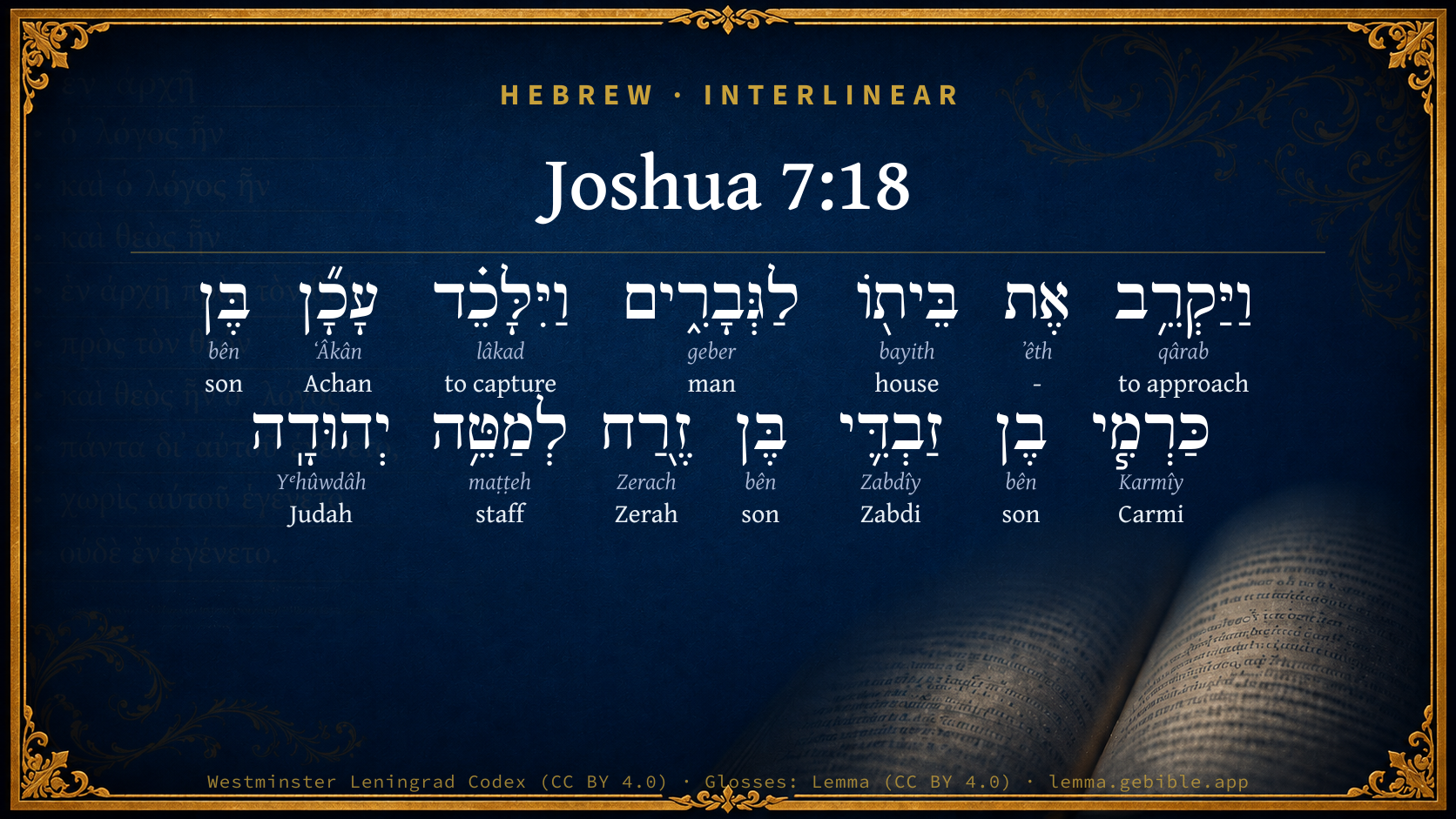
  1. וַיַּקְרֵ֥ב qârab H7126 “and · to approach” Conjunction + Verb, Hiphil, Sequential Imperfect, 3rd Person, Masculine, Singular
  2. אֶת ʼêth H853 “-” Particle, Direct Object
  3. בֵּית֖וֹ bayith H1004 “house · his” Noun, Common, Masculine, Singular, Construct + Suffix, Personal, 3rd Person, Masculine, Singular
  4. לַגְּבָרִ֑ים geber H1397 “to/for the · men” Preposition, Determined + Noun, Common, Masculine, Plural, Absolute
  5. וַיִּלָּכֵ֗ד lâkad H3920 “and · to capture” Conjunction + Verb, Niphal, Sequential Imperfect, 3rd Person, Masculine, Singular
  6. בֶּן bên H1121 “son of” Noun, Common, Masculine, Singular, Construct
  7. כַּרְמִ֧י Karmîy H3756 “Carmi” Noun, Proper
  8. בֶן bên H1121 “son of” Noun, Common, Masculine, Singular, Construct
  9. זַבְדִּ֛י Zabdîy H2067 “Zabdi” Noun, Proper
  10. בֶּן bên H1121 “son of” Noun, Common, Masculine, Singular, Construct
  11. זֶ֖רַח Zerach H2226 “Zerah” Noun, Proper
  12. לְמַטֵּ֥ה maṭṭeh H4294 “to/for · staff of” Preposition + Noun, Common, Masculine, Singular, Construct
  13. יְהוּדָֽה Yᵉhûwdâh H3063 “Judah” Noun, Proper

About this verse

These counts appear in no published source. They are computed here, from the morphology-tagged text and Lemma’s own curated glosses. What Lemma adds →

14
words
12
distinct lemmas
Historical
section

Notable vocabulary

The rarest word here is עָכָ֞ן Achan H5912 — appearing just 6 times in the whole Hebrew Bible.

Shared distinctive vocabulary

עָכָ֞ן Achan H5912 occurs in 6 verses of the Hebrew Bible. Also found in:

Grammatical profile

  • 2 verbs
  • 11 nouns
  • 1 particle

Verb forms

  • וַיַּקְרֵ֥ב Hiphil · Sequential Imperfect
  • וַיִּלָּכֵ֗ד Niphal · Sequential Imperfect

Repetition

A word recurs within this verse — often emphatic in Hebrew:

Hebrew & Septuagint length

In English translation the verse runs 30 words from the Hebrew and 20 from the Septuagint (LXX English) — the Septuagint runs noticeably shorter here. See the side-by-side →

A rough comparison of the two English renderings, which tokenize alike — not a word-level alignment.

Word counts can differ between the Hebrew and the Greek without any difference in meaning — e.g. the Hebrew direct-object marker אֵת has no separate Greek word, and Greek often adds the article ὁ.

Cross-references

5

Topical passages linked to Joshua 7:18 in the Treasury of Scripture Knowledge — connected by theme and wording, ordered by reader-vote popularity; previews shown in the World English Bible.

  • Numbers 32:23 But if you will not do so, behold, you have sinned against Yahweh; and be sure your sin will find you out.
  • Acts 5:1–10 But a certain man named Ananias, with Sapphira, his wife, sold a possession,
  • 1 Samuel 14:42 Saul said, Cast [lots] between me and Jonathan my son. Jonathan was taken.
  • Proverbs 13:21 Misfortune pursues sinners, But prosperity rewards the righteous.
  • Jeremiah 2:26 As the thief is ashamed when he is found, so is the house of Israel ashamed; they, their kings, their princes, and their priests, and their prophets;

Cross-references courtesy of OpenBible.info (CC BY 4.0).

Hebrew and Greek witnesses Masoretic Hebrew ↔ Greek Septuagint

The same verse in the two great witnesses to the Old Testament, shown verse-for-verse.

Here the Septuagint runs noticeably shorter than the Hebrew — LXX2012 (modern English Septuagint) 20 words vs World English Bible 30. A rough length comparison of the two English translations, not a word-level alignment — read both below.

These are two independent witnesses, not word-aligned to each other, and the Septuagint is shown in lemma (dictionary) form.

Hebrew Joshua 7:18 Masoretic · Westminster Leningrad Codex

וַיַּקְרֵ֥ב אֶת בֵּית֖וֹ לַגְּבָרִ֑ים וַיִּלָּכֵ֗ד עָכָ֞ן בֶּן כַּרְמִ֧י בֶן זַבְדִּ֛י בֶּן זֶ֖רַח לְמַטֵּ֥ה יְהוּדָֽה

and he brought near his household man by man; and Achan, the son of Carmi, the son of Zabdi, the son of Zerah, of the tribe of Judah, was taken.

World English Bible · Public Domain

Greek LXX Joshua 7:18 Septuagint · lemma form

καί ἐνδεικνύω αχαρ υἱός ζαμβρι υἱός ζαρα

And it was brought man by man, and Achar the son of Zambri the son of Zara was pointed out.

LXX2012 (modern English Septuagint) · Public Domain

Hebrew: Westminster Leningrad Codex (CC BY 4.0). Greek: Septuagint (public domain); English from LXX2012 (modern English Septuagint) (Public Domain). How the Septuagint differs from the Hebrew →

Targum (Aramaic paraphrase)

1

The Targum is the ancient Jewish Aramaic paraphrase of the Hebrew Scriptures — an interpretive translation, not the Hebrew text itself. Onkelos (literal) and Pseudo-Jonathan (expansive) render the Torah, and Jonathan the Prophets. Coverage is partial: where no permissively-licensed English translation exists for a verse, only the Aramaic is shown. This is verse-level text, not a word-by-word alignment to the Hebrew.

  1. Targum Jonathan Prophets (Joshua–Malachi)
    וְקָרֵיב יַת בֵּיתֵיהּ לְגַבְרַיָא וְאִתְאַחַד עָכָן בַּר כַּרְמִי בַּר זַבְדִי בַּר זֶרַח לְשִׁבְטָא דִיהוּדָא:

    (no public-domain English translation for this verse)

    Targum Jonathan — Aramaic: “Mikraot Gedolot” (public domain). English: “Sefaria Community Translation” (CC0 1.0 (public-domain dedication)); “London "Chaldee Paraphrase," 1871” (public domain). Text via Sefaria.

Commentary

Notes on Joshua 7:18 from classic Christian and Jewish commentators (each source and its license shown beneath its notes). The classic Christian expositions comment on the surrounding passage and are grouped to its opening verse, so a note may address several verses; the Jewish commentaries on the Tanakh (Rashi and others) are per-verse, so they appear only where the commentator wrote on this verse.

Lemma curates 59 commentaries, every one of them public domain or Creative Commons licensed, each selected and text-cleaned for this edition rather than reprinted as found. About our sources →

Trapp's Complete Commentary

John Trapp

Jos 7:18 And he brought his household man by man; and Achan, the son of Carmi, the son of Zabdi, the son of Zerah, of the tribe of Judah, was taken.

Ver. 18. And Achan, the son of Carmi.] Secret sinners are loath to be discovered, but their sin shall find them out, and iniquity, if unrepented of, be their ruin. "He that hideth his sins shall not prosper," {Pro 28:13} because he putteth God to his proofs, as Achan, and as those in Jeremiah did. {Jer 2:35}

John Trapp, A Commentary or Exposition upon All the Books of the Old and New Testament (1647–1656) — public domain. Text from a community e-Sword module.

Joseph Benson's Commentary

Jos 7:18. Achan was taken — Here we learn that, however secretly we may conceal our wickedness, yet God knoweth it, and sooner or later will bring it to light and due condemnation. There is nothing secret which shall not be made manifest, neither any thing hid that shall not be known. God will bring to light the hidden things of darkness, and make manifest the counsels of the heart. Reader, remember this; revere the all-seeing eye of God; stand in awe and sin not.

Joseph Benson's Commentary on the Old and New Testaments (1811–1818) — public domain. Text from a community e-Sword module.

The Cambridge Bible for Schools and Colleges

gen. ed. J. J. S. Perowne

18. and Achan … was taken] (a) Sometimes in taking the sacred lot dice were thrown; comp. the expression “to cast lots” (Jos_18:10); to “throw” them (Jos_18:6); “the lot falls” (Jon_1:7; Eze_24:6); (b) sometimes tesseræ were flung into a vessel and then drawn out; comp. the expressions “the lot came forth” Num_33:54; “came up” Lev_16:9.

The Cambridge Bible for Schools and Colleges (gen. ed. J. J. S. Perowne; Cambridge University Press, 1878–1918) — public domain. Text from a community e-Sword module.

John Gill's Exposition

And he brought his household man by man,.... The household of Zabdi, the heads of each house therein:

and Achan, the son of Carmi, the son of Zabdi, the son of Zerah, of the tribe of Judah, was taken; the lot fell upon him, and he was laid hold on, and detained.

John Gill's Exposition of the Whole Bible (1746–1763) — public domain (CC PDM 1.0). Text via the HelloAO Bible API.

Haydock's Catholic Bible Commentary

Juda. The dignity of this tribe enhanced the fault of Achan. (Menochius)

George Leo Haydock (1774–1849), Haydock's Catholic Family Bible and Commentary, 1859 edition — public domain. Excludes Psalms (Douay-Rheims chapter numbering differs from Protestant) and Deuterocanonical books (Catholic canon only).

Matthew Poole's English Annotations

He; either Joshua, or Zabdi by Joshua’s appointment.

Matthew Poole's English Annotations on the Holy Bible (1683–1685) — public domain. Text from a community e-Sword/MySword module.

Whedon's Commentary on the Bible

Daniel D. Whedon

18. Achan… was taken — God might have instantaneously revealed the sinner, but he chose to sift the nation thus gradually in order that the moral sense of every man might be awakened, and that the conscience of Achan, when he saw the network of conviction and punishment closing in upon him, might prompt him to confession. But he remained impenitent till he found himself within the grasp of the Divine arrest.

Daniel D. Whedon (gen. ed.), Commentary on the Old and New Testaments (1874–1909) — public domain. Text from a community e-Sword module.

Lesson kit

Teaching starters — assembled from the data on this page, not authored interpretation. Every prompt links to the verse data it draws on. Edit before teaching.

Joshua, in the Historical, opens this verse with 14 words (12 distinct Hebrew lemmas). Its most distinctive word is ʻÂkân (“Achan”). The Greek Septuagint runs shorter here. A historical commentator’s framing appears above. Read the whole chapter for the surrounding context.

Discussion questions

  1. The word ʻÂkân carries the sense “Achan.” How does it shape the verse?
  2. Joshua 7:1 shares the word «Achan» with this verse. How do the two illuminate each other?
  3. “son” occurs 3× in this one verse. What is the effect of the repetition?
  4. Compared with the Hebrew, the Septuagint runs shorter here. What questions does that raise?
  5. These translations render this verse differently. What is at stake in choosing one wording over another?
  6. The verb «וַיַּקְרֵ֥ב» is Hiphil Sequential Imperfect. How does its form color the action?
  7. Reading how Trapp's Complete Commentary and Joseph Benson's Commentary read this verse, where do the two commentators agree and where do they part?

Things to notice

Reading settings

Reading text

Shown beneath each verse's original-language words.

Old Testament
Old Testament edition

Read the OT as the Masoretic Hebrew (MT) or the Greek Septuagint (LXX).

English shown for the Greek Septuagint (in the Hebrew ↔ Greek comparison).

Comparing translations? Open the Compare panel on any verse page to stack up to four side by side.