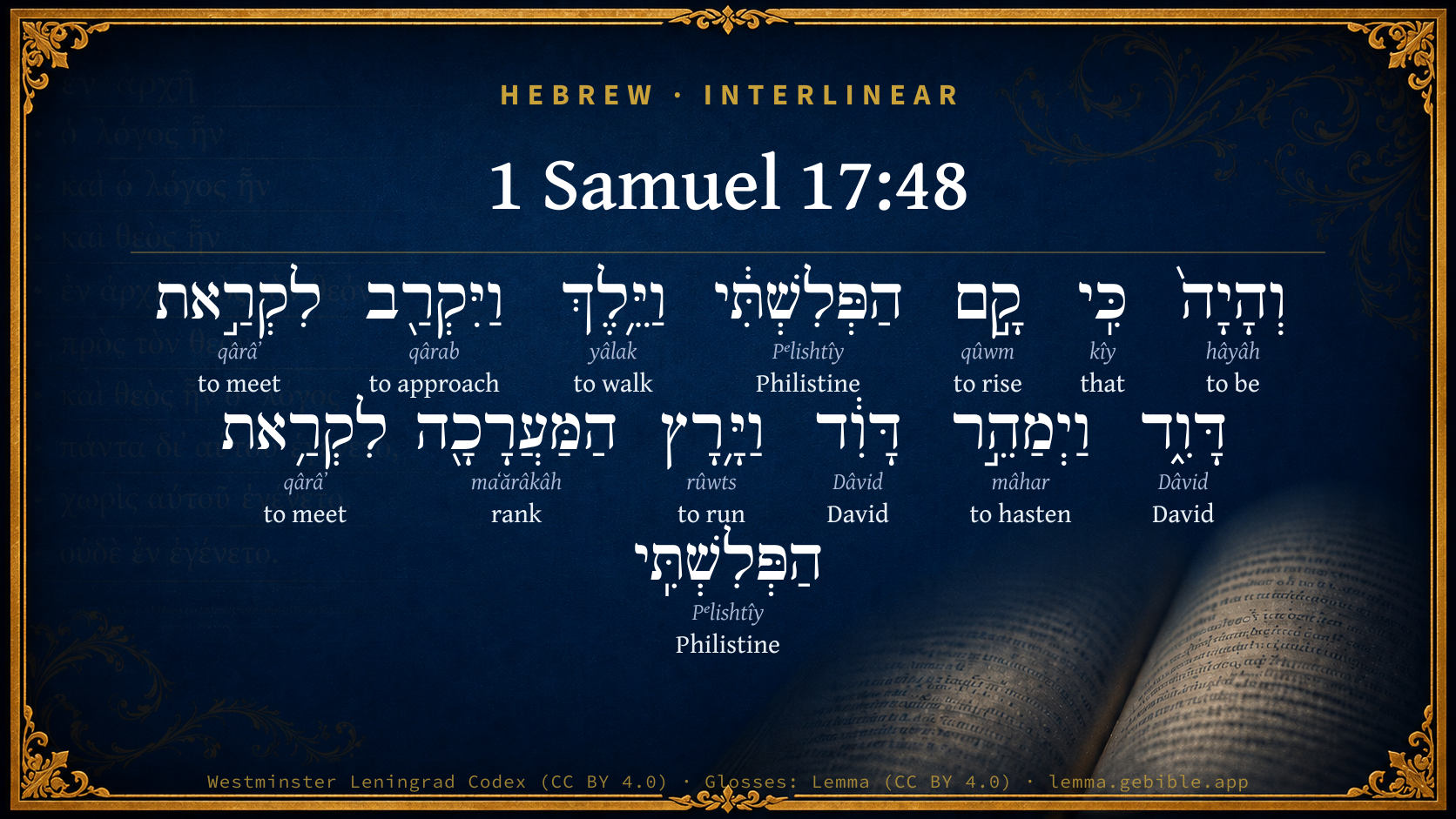
1 Samuel 17:48

Hebrew (Westminster Leningrad Codex) 1 Samuel 17:48 appears in the Hebrew Old Testament. The text above is from the Westminster Leningrad Codex. Each word links to its Strong’s number, a concise gloss, and parsing drawn from the Open Scriptures Hebrew Bible morphology. Click any word for its full Brown-Driver-Briggs (BDB) entry.
Download image
Cite this verse

1 Samuel 17:48 (World English Bible). Public Domain. Lemma interlinear Bible study tool, https://lemma.gebible.app/v/1-samuel/17/48.

Show BibTeX & RIS
BibTeX
RIS
English Translation
It happened, when the Philistine arose, and came and drew near to meet David, that David hurried, and ran toward the army to meet the Philistine.
World English Bible · Public Domain
Download a study sheet

One document with this verse’s original text, its word-by-word gloss line, the meaning frame, cross-references with their text, attributed commentary, and full source and license credits — printable, and it pastes into notes with its structure intact.

This verse Autodidact and up

Study sheet (.html) Plain text (.txt)

A passage Seminary Student

Up to 50 verses in one chapter. A passage sheet keeps up to 6 commentary sources and 12 cross-references per verse, in the order this page ranks them, and says so on the sheet whenever that leaves anything out. Ask for a single verse and you get the Autodidact verse sheet above.

Everything on this page stays free to read, with no account — the sheet is a download of what is already on screen, not access to it.

Want to remove ads? Support Godless Engineer
Compare translations 3

The same verse in 3 English versions, stacked beneath the original-language interlinear above. Click any original word for its lexicon entry.

Each is an independent rendering of the whole verse — the interlinear is not word-aligned to these translations.

Highlighted words mark where these versions differ — a whole-verse word diff, not a word-by-word alignment.

  • World English Bible Public Domain
    It happened, when the Philistine arose, and came and drew near to meet David, that David hurried, and ran toward the army to meet the Philistine.
  • King James Version Public Domain
    And it came to pass, when the Philistine arose, and came, and drew nigh to meet David, that David hastened, and ran toward the army to meet the Philistine.
  • unfoldingWord Literal Text CC BY-SA 4.0
    And it happened, when the Philistine arose and went and approached to meet David, that David hurried and ran the array to meet the Philistine.

unfoldingWord Literal Text — © unfoldingWord, licensed CC BY-SA 4.0. Word-aligned USFM3 via Door43 (git.door43.org/unfoldingWord/en_ult).

Versions to compare (up to 4)

3 of 4 selected

Show all 18 translations

Every available English version of this verse, each an independent rendering of the whole verse.

  • World English Bible Public Domain
    It happened, when the Philistine arose, and came and drew near to meet David, that David hurried, and ran toward the army to meet the Philistine.
  • Berean Standard Bible Public Domain
    As the Philistine started forward to attack him, David ran quickly toward the battle line to meet him.
  • Majority Standard Bible Public Domain
    As the Philistine started forward to attack him, David ran quickly toward the battle line to meet him.
  • King James Version Public Domain
    And it came to pass, when the Philistine arose, and came, and drew nigh to meet David, that David hastened, and ran toward the army to meet the Philistine.
  • American Standard Version (1901) Public Domain
    And it came to pass, when the Philistine arose, and came and drew nigh to meet David, that David hastened, and ran toward the army to meet the Philistine.
  • Revised Version (1885) Public Domain
    And it came to pass, when the Philistine arose, and came and drew nigh to meet David, that David hastened, and ran toward the army to meet the Philistine.
  • Geneva Bible (1599) Public Domain
    And when the Philistim arose to come and drawe neere vnto Dauid, Dauid hasted and ran to fight against the Philistim.
  • Douay-Rheims (1899) Public Domain
    And when the Philistine arose and was coming, and drew nigh to meet David, David made haste, and ran to the fight to meet the Philistine.
  • Young's Literal Translation Public Domain
    And it hath come to pass, that the Philistine hath risen, and goeth, and draweth near to meet David, and David hasteth and runneth to the rank to meet the Philistine,
  • Literal Standard Version CC BY-SA 4.0
    And it has come to pass, that the Philistine has risen, and goes, and draws near to meet David, and David hurries and runs to the rank to meet the Philistine,
  • Unlocked Literal Bible CC BY-SA 4.0
    When the Philistine rose and approached David, then David ran quickly toward the enemy army to meet him.
  • unfoldingWord Literal Text CC BY-SA 4.0
    And it happened, when the Philistine arose and went and approached to meet David, that David hurried and ran the array to meet the Philistine.
  • Darby Bible Public Domain
    And it came to pass, when the Philistine arose, and came and advanced to meet David, that David hasted, and ran towards the ranks to meet the Philistine.
  • World Messianic Bible Public Domain
    When the Philistine arose, and walked and came near to meet David, David hurried and ran toward the army to meet the Philistine.
  • Webster's Bible Public Domain
    And it came to pass, when the Philistine arose, and came and drew nigh to meet David, that David hasted, and ran towards the army to meet the Philistine.
  • Free Bible Version CC BY-SA 4.0
    As the Philistine moved forward to attack him, David raced toward the battle line to confront him.
  • Bible in Basic English Public Domain
    Now when the Philistine made a move and came near to David, David quickly went at a run in the direction of the army, meeting the Philistine face to face.
  • JPS Tanakh (1917) Public Domain
    And it came to pass, when the Philistine arose, and came and drew nigh to meet David, that David hastened, and ran toward the army to meet the Philistine.

Literal Standard Version (2020), Covenant Press — licensed CC BY-SA 4.0. Text via the HelloAO Bible API (eBible.org). Unlocked Literal Bible (unfoldingWord) — licensed CC BY-SA 4.0. Text via the HelloAO Bible API (eBible.org). unfoldingWord Literal Text — © unfoldingWord, licensed CC BY-SA 4.0. Word-aligned USFM3 via Door43 (git.door43.org/unfoldingWord/en_ult). Free Bible Version, Dr. Jonathan Gallagher — licensed CC BY-SA 4.0. Text via the HelloAO Bible API (eBible.org).

Word by word

More ways to search: Search by grammar → Find every occurrence → Compare this word →

Practice this passage: Drill this verse → Learn its vocabulary →

הַמַּעֲרָכָ֖ה
maʻărâkâh
H4634
“the · rank”
Particle, Definite Article + Noun, Common, Feminine, Singular, Absolute
Part of Speech
Particle + Noun
Type
Common
Gender
Feminine
Number
Singular
State
Absolute
Full BDB Definition

Origin: from H4633

TWOT: 1694d

row, rank, battle-line - battle-line - rank - row
  1. וְהָיָה֙ hâyâh H1961 “and · to be” Conjunction + Verb, Qal, Perfect, 3rd Person, Masculine, Singular
  2. כִּֽי kîy H3588 “that” Conjunction
  3. קָ֣ם qûwm H6965 “to rise” Verb, Qal, Perfect, 3rd Person, Masculine, Singular
  4. הַפְּלִשְׁתִּ֔י Pᵉlishtîy H6430 “the · Philistine” Particle, Definite Article + Noun, Gentilic, Masculine, Singular, Absolute
  5. וַיֵּ֥לֶךְ yâlak H3212 “and · to walk” Conjunction + Verb, Qal, Sequential Imperfect, 3rd Person, Masculine, Singular
  6. וַיִּקְרַ֖ב qârab H7126 “and · to approach” Conjunction + Verb, Qal, Sequential Imperfect, 3rd Person, Masculine, Singular
  7. לִקְרַ֣את qârâʼ H7122 “to meet” Preposition + Verb, Qal, Infinitive Construct
  8. דָּוִ֑ד Dâvid H1732 “David” Noun, Proper
  9. וַיְמַהֵ֣ר mâhar H4116 “and · to hasten” Conjunction + Verb, Piel, Sequential Imperfect, 3rd Person, Masculine, Singular
  10. דָּוִ֔ד Dâvid H1732 “David” Noun, Proper
  11. וַיָּ֥רָץ rûwts H7323 “and · to run” Conjunction + Verb, Qal, Sequential Imperfect, 3rd Person, Masculine, Singular
  12. לִקְרַ֥את qârâʼ H7122 “to meet” Preposition + Verb, Qal, Infinitive Construct
  13. הַפְּלִשְׁתִּֽי Pᵉlishtîy H6430 “the · Philistine” Particle, Definite Article + Noun, Gentilic, Masculine, Singular, Absolute

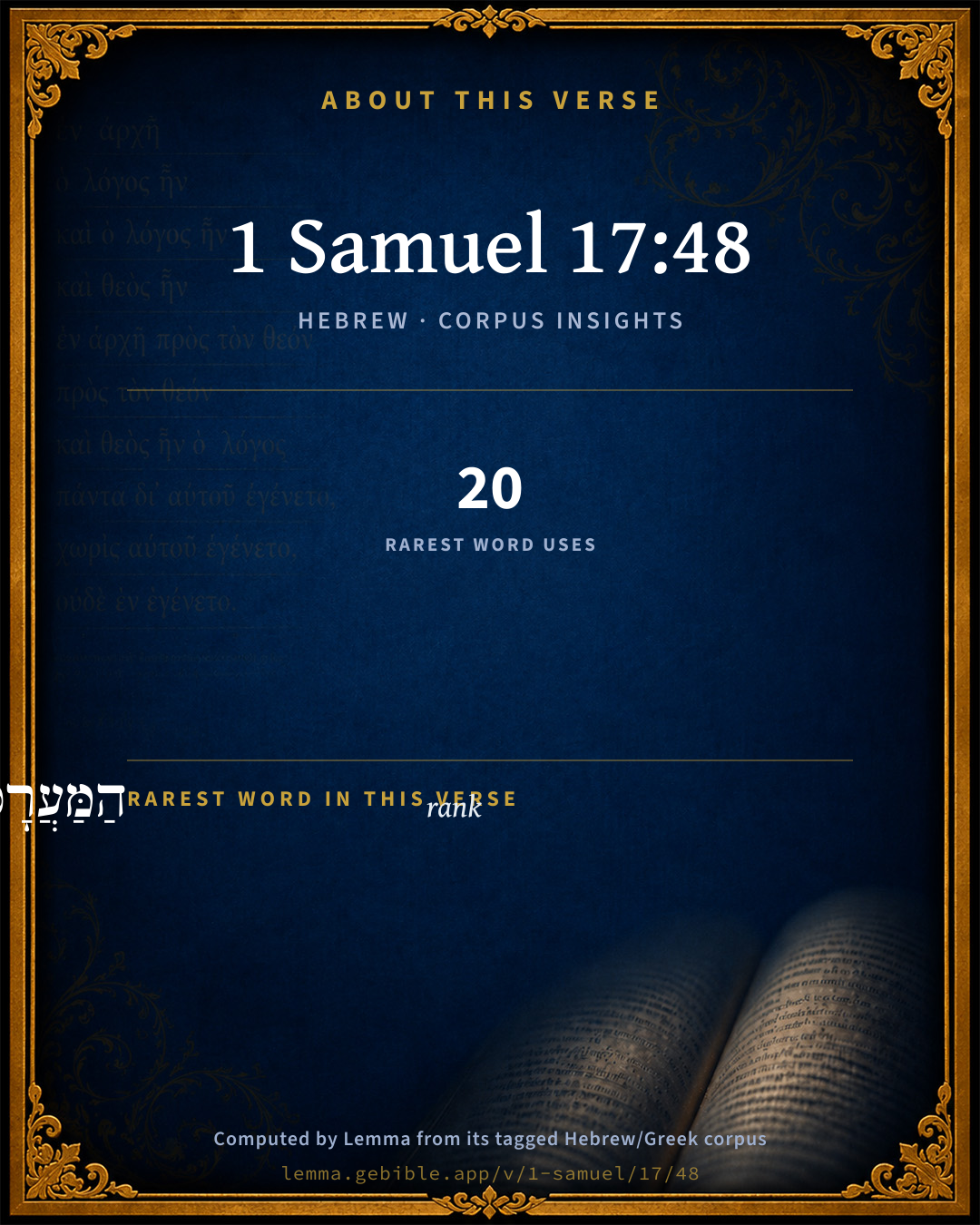
About this verse

These counts appear in no published source. They are computed here, from the morphology-tagged text and Lemma’s own curated glosses. What Lemma adds →

14
words
11
distinct lemmas
Historical
section

Notable vocabulary

The rarest word here is הַמַּעֲרָכָ֖ה rank H4634 — appearing just 20 times in the whole Hebrew Bible.

Shared distinctive vocabulary

הַמַּעֲרָכָ֖ה rank H4634 occurs in 18 verses of the Hebrew Bible. Also found in:

Grammatical profile

  • 8 verbs
  • 5 nouns
  • 1 conjunction

Verb forms

  • וְהָיָה֙ Qal · Perfect
  • קָ֣ם Qal · Perfect
  • וַיֵּ֥לֶךְ Qal · Sequential Imperfect
  • וַיִּקְרַ֖ב Qal · Sequential Imperfect
  • לִקְרַ֣את Qal · Infinitive Construct
  • וַיְמַהֵ֣ר Piel · Sequential Imperfect
  • וַיָּ֥רָץ Qal · Sequential Imperfect
  • לִקְרַ֥את Qal · Infinitive Construct

Repetition

Words recur within this verse — often emphatic in Hebrew:

  • הַפְּלִשְׁתִּ֔י Philistine H6430 ×2
  • לִקְרַ֣את to meet H7122 ×2
  • דָּוִ֑ד David H1732 ×2

Hebrew & Septuagint length

In English translation the verse runs 26 words from the Hebrew and 9 from the Septuagint (LXX English) — the Septuagint runs noticeably shorter here. See the side-by-side →

A rough comparison of the two English renderings, which tokenize alike — not a word-level alignment.

Word counts can differ between the Hebrew and the Greek without any difference in meaning — e.g. the Hebrew direct-object marker אֵת has no separate Greek word, and Greek often adds the article ὁ.

Cross-references

2

Topical passages linked to 1 Samuel 17:48 in the Treasury of Scripture Knowledge — connected by theme and wording, ordered by reader-vote popularity; previews shown in the World English Bible.

  • Psalms 27:1 Yahweh is my light and my salvation. Whom shall I fear? Yahweh is the strength of my life. Of whom shall I be afraid?
  • Proverbs 28:1 The wicked flee when no one pursues; But the righteous are as bold as a lion.

Cross-references courtesy of OpenBible.info (CC BY 4.0).

Hebrew and Greek witnesses Masoretic Hebrew ↔ Greek Septuagint

The same verse in the two great witnesses to the Old Testament, shown verse-for-verse.

Here the Septuagint runs noticeably shorter than the Hebrew — LXX2012 (modern English Septuagint) 9 words vs World English Bible 26. A rough length comparison of the two English translations, not a word-level alignment — read both below.

These are two independent witnesses, not word-aligned to each other, and the Septuagint is shown in lemma (dictionary) form.

Hebrew 1 Samuel 17:48 Masoretic · Westminster Leningrad Codex

וְהָיָה֙ כִּֽי קָ֣ם הַפְּלִשְׁתִּ֔י וַיֵּ֥לֶךְ וַיִּקְרַ֖ב לִקְרַ֣את דָּוִ֑ד וַיְמַהֵ֣ר דָּוִ֔ד וַיָּ֥רָץ הַמַּעֲרָכָ֖ה לִקְרַ֥את הַפְּלִשְׁתִּֽי

It happened, when the Philistine arose, and came and drew near to meet David, that David hurried, and ran toward the army to meet the Philistine.

World English Bible · Public Domain

Greek LXX 1 Samuel 17:48 Septuagint · lemma form
And the Philistine arose and went to meet David.

LXX2012 (modern English Septuagint) · Public Domain

Hebrew: Westminster Leningrad Codex (CC BY 4.0). Greek: Septuagint (public domain); English from LXX2012 (modern English Septuagint) (Public Domain). How the Septuagint differs from the Hebrew →

Targum (Aramaic paraphrase)

1

The Targum is the ancient Jewish Aramaic paraphrase of the Hebrew Scriptures — an interpretive translation, not the Hebrew text itself. Onkelos (literal) and Pseudo-Jonathan (expansive) render the Torah, and Jonathan the Prophets. Coverage is partial: where no permissively-licensed English translation exists for a verse, only the Aramaic is shown. This is verse-level text, not a word-by-word alignment to the Hebrew.

  1. Targum Jonathan Prophets (Joshua–Malachi)
    וַהֲוָה כַּד קָם פְּלִשְׁתָּאָה וַאֲזַל וּקְרַב לִקֳדָמוּת דָוִד וְאוֹחֵי דָוִד וּרְהַט לְסִדְרָא לָקֳדָמוּת פְּלִשְׁתָּאָה:

    (no public-domain English translation for this verse)

    Targum Jonathan — Aramaic: “Mikraot Gedolot” (public domain). English: “Sefaria Community Translation” (CC0 1.0 (public-domain dedication)); “London "Chaldee Paraphrase," 1871” (public domain). Text via Sefaria.

Commentary

Notes on 1 Samuel 17:48 from classic Christian and Jewish commentators (each source and its license shown beneath its notes). The classic Christian expositions comment on the surrounding passage and are grouped to its opening verse, so a note may address several verses; the Jewish commentaries on the Tanakh (Rashi and others) are per-verse, so they appear only where the commentator wrote on this verse.

Lemma curates 59 commentaries, every one of them public domain or Creative Commons licensed, each selected and text-cleaned for this edition rather than reprinted as found. About our sources →

Matthew Henry's Commentary

Here is 1. The engagement between the two champions, Sa1 17:48. To this engagement the Philistine advanced with a great deal of state and gravity; if he must encounter a pigmy, yet it shall be with the magnificence of a giant and a grandee. This is intimated in the manner of expression: He arose, and came, and drew nigh, like a stalking mountain, overlaid with brass and iron, to meet David. David advanced with no less activity and cheerfulness, as one that aimed more to do execution than to make a figure: He hasted, and ran, being lightly clad, to meet the Philistine. We may imagine with what tenderness and compassion the Israelites saw such a pleasing youth as this throwing himself into the mouth of destruction, but he knew whom he had believed and for whom he acted. 2. The fall of Goliath in this engagement. He was in no haste, because in no fear, but confident that he should soon at one stroke cleave his adversary's head; but, while he was preparing to do it solemnly, David did his business effectually, without any parade: he slang a stone which hit him in the forehead, and, in the twinkling of an eye, fetched him to the ground, Sa1 17:49. Goliath knew there were famous slingers in Israel (Jdg 20:16), yet was either so forgetful or presumptuous as to go with the beaver of his helmet open, and thither, to the only part left exposed, not so much David's art as God's providence directed the stone, and brought it with such force that it sunk into his head, notwithstanding the impudence with which his forehead was brazened. See how frail and uncertain life is, even when it thinks itself best fortified, and how quickly, how easily, and with how small a matter, the passage may be opened for life to go out and death to enter. Goliath himself has not power over the spirit to retain the spirit, Ecc 8:8. Let not the strong man glory in his strength, nor the armed man in his armour. See how God resists the proud and pours contempt upon those that bid defiance to him and his people. None ever hardened his heart against God and prospered. One of the Rabbin thinks that when Goliath said to David, Come, and I will give thy flesh to the fowls of the air, he threw up his head so hastily that his helmet fell off, and so left his broad forehead a fair mark for David. To complete the execution, David drew Goliath's own sword, a two-handed weapon for David, and with it cut off his head, Sa1 17:51. What need had David to take a sword of his own? his enemy's sword shall serve his purpose, when he has occasion for one. God is greatly glorified when his proud enemies are cut off with their own sword and he makes their own tongues to fall upon them, Psa 64:8. David's victory over Goliath was typical of the triumphs of the son of David over Satan and all the powers of darkness, whom he spoiled, and made a show of them openly (Col 2:15), and we through him are more than conquerors. 3. The defeat of the Philistines' army hereupon. They relied wholly upon the strength of their champion, and therefore, when they saw him slain, they did not, as Goliath had offered, throw down their arms and surrender themselves servants to Israel (Sa1 17:9), but took to their heels, being wholly dispirited, and thinking it to no purpose to oppose one before whom such a mighty man had fallen: They fled (Sa1 17:51), and this put life into the Israelites, who shouted and pursued them (David, it is probable, leading them on in the pursuit) even to the gates of their own cities, Sa1 17:52. In their return from the chase they seized all the baggage, plundered the tents (Sa1 17:53), and enriched themselves with the spoil. 4. David's disposal of his trophies, Sa1 17:54. He brought the head of the Philistine to Jerusalem, to be a terror to the Jebusites, who held the strong-hold of Sion: it is probable that he carried it in triumph to other cities. His armour he laid up in his tent; only the sword was preserved behind the ephod in the tabernacle, as consecrated to God, and a memorial of the victory to his honour, Sa1 21:9. 5. The notice that was taken of David. Though he had been at court formerly, yet, having been for some time absent (Sa1 17:15), Saul had forgotten him, being melancholy and mindless, and little thinking that his musician would have spirit enough to be his champion; and therefore, as if he had never seen him before, he asked whose son he was. Abner was a stranger to him, but brought him to Saul (Sa1 17:57), and he gave a modest account of himself, Sa1 17:58. And now he was introduced to the court with much greater advantages than before, in which he owned God's hand performing all things for him.

Matthew Henry's Commentary on the Whole Bible (1708–1710) — public domain (CC PDM 1.0). Text via the HelloAO Bible API.

Trapp's Complete Commentary

John Trapp

1Sa 17:48 And it came to pass, when the Philistine arose, and came and drew nigh to meet David, that David hasted, and ran toward the army to meet the Philistine.

Ver. 48. David hasted.] That he might sling at Goliath before he came too near him, saith Lyra, because a distance is necessary in slinging of a stone, to make it the more forcible.

John Trapp, A Commentary or Exposition upon All the Books of the Old and New Testament (1647–1656) — public domain. Text from a community e-Sword module.

Joseph Benson's Commentary

1Sa 17:48-49. The Philistine arose, and came and drew nigh — Like a stalking mountain. Having nothing but victory in his thoughts, he marched in a stately manner, pompously covered over with armour, and fearing nothing. But David, being loaded with no armour, ran nimbly toward him, so far was he from fear! David smote the Philistine in his forehead — Which was bare, perhaps the proud giant contemning David so much as to neglect to pull down his helmet over his face, lifting up that part of it which covered his forehead; or else the stone was thrown with such force that it pierced the helmet first, and then the forehead, or went in at the place that was left open for his eyes. However it was, the divine hand directed it. And he fell upon his face to the earth — “See,” says Henry, “how frail and uncertain life is, even then when it thinks itself best fortified, and how quickly, how easily, and with how small a matter, the passage may be opened for life to go out and death to enter. Goliath himself has not power over the spirit to retain the spirit, Ecc 8:8 : let not the strong man glory in his strength, nor the armed man in his armour. See how God resists the proud, and pours contempt upon those that bid defiance to him and his people! None ever hardened his heart against God and prospered.”

Joseph Benson's Commentary on the Old and New Testaments (1811–1818) — public domain. Text from a community e-Sword module.

Geneva Bible (1599)

Geneva Bible translators

Being moved with a fervent zeal to be revenged upon this blasphemer of God’s name.

Geneva Bible (1599) marginal notes — public domain. Text via Bolls.life.

Adam Clarke's Commentary

Verse 48. The Philistine arose] This was an end of the parley; the Philistine came forward to meet David, and David on his part ran forward to meet the Philistine.

Adam Clarke's Commentary on the Bible (1810–1826) — public domain. Text from a community e-Sword/MySword module.

The Cambridge Bible for Schools and Colleges

gen. ed. J. J. S. Perowne

48. ran toward the army] The battle array of the Philistines. He showed his courage by not waiting for Goliath to approach. The Sept. however has simply: “And the Philistine arose and went to meet David.”

The Cambridge Bible for Schools and Colleges (gen. ed. J. J. S. Perowne; Cambridge University Press, 1878–1918) — public domain. Text from a community e-Sword module.

John Gill's Exposition

And it came to pass, when the Philistine arose,.... Or prepared for the encounter, and was in all probability in great wrath and fury at hearing what David said, and which hastened him to it:

and came and drew nigh to meet David; as fast as his unwieldy body, and heavy load of armour on him, would admit of:

that David hasted and ran toward the army; the army of the Philistines, from whence this champion came:

to meet the Philistine; to get up to him before he could draw his sword, or put himself in a posture to make use of any weapon to strike at David with.

John Gill's Exposition of the Whole Bible (1746–1763) — public domain (CC PDM 1.0). Text via the HelloAO Bible API.

Haydock's Catholic Bible Commentary

Arose. The Roman Triarii and the Gauls expected the hour of battle sitting. (Calmet)

George Leo Haydock (1774–1849), Haydock's Catholic Family Bible and Commentary, 1859 edition — public domain. Excludes Psalms (Douay-Rheims chapter numbering differs from Protestant) and Deuterocanonical books (Catholic canon only).

The Pulpit Commentary

Vers. 48, 49. When the Philistine arose. Apparently he was seated, as was the rule with armies in ancient times when not engaged in conflict (comp. ver. 52). When, then, he saw David emerge from the ravine, he rose, and, carrying his vast load of armour, moved slowly towards his enemy, trying to frighten him by his curses. David, meanwhile, in his light equipment, ran towards the army, Hebrew, "the rank," i.e. the Philistine line, in front of which Goliath had been sitting. As the giant"s helmet had no visor, that protection not having as yet been invented, and his shield was still carried by his armour bearer, his face was exposed to David"s missiles. And in those days, before firearms were invented, men by constant practice "could sling stones at a hair-breadth, and not miss". (Jud_1:20:16) And even if David were not quite as skilful as those Benjamites, yet, as the giant could move only very slowly, the chances were that he would hit him with one or more of his five pebbles. As it was, he struck him at his first attempt upon the forehead with such force that Goliath was stunned, and fell down upon his face to the ground.

The Pulpit Commentary (1880–1919), ed. H.D.M. Spence-Jones & Joseph S. Exell — public domain. Text from a community e-Sword module.

John Wesley's Explanatory Notes

Drew nigh - Like a stalking mountain. Ran - So far was he from fear!

John Wesley, Explanatory Notes Upon the Whole Bible (1754–1765) — public domain. Text via the GEBible commentary corpus.

unfoldingWord translationNotes

Door43 World Missions Community

translationWords

Philistines

David

unfoldingWord translationNotes — © Distant Shores Media and the Door43 World Missions Community, licensed CC BY-SA 4.0. Source: git.door43.org/Door43/en_tn.

Lesson kit

Teaching starters — assembled from the data on this page, not authored interpretation. Every prompt links to the verse data it draws on. Edit before teaching.

1 Samuel, in the Historical, opens this verse with 14 words (11 distinct Hebrew lemmas). Its most distinctive word is maʻărâkâh (“rank”). The Greek Septuagint runs shorter here. A historical commentator’s framing appears above. Read the whole chapter for the surrounding context.

Discussion questions

  1. The word maʻărâkâh carries the sense “rank.” How does it shape the verse?
  2. Exodus 39:37 shares the word «rank» with this verse. How do the two illuminate each other?
  3. “Philistine” occurs 2× in this one verse. What is the effect of the repetition?
  4. Compared with the Hebrew, the Septuagint runs shorter here. What questions does that raise?
  5. The translations on this page render this verse differently — a whole-verse word diff, not a word-by-word alignment. What might account for the different wordings?
  6. The verb «וְהָיָה֙» is Qal Perfect. How does its form color the action?
  7. Reading how Matthew Henry's Commentary and Trapp's Complete Commentary read this verse, where do the two commentators agree and where do they part?

Things to notice

Reading settings

Reading text

Shown beneath each verse's original-language words.

Old Testament
Old Testament edition

Read the OT as the Masoretic Hebrew (MT) or the Greek Septuagint (LXX).

English shown for the Greek Septuagint (in the Hebrew ↔ Greek comparison).

Comparing translations? Open the Compare panel on any verse page to stack up to four side by side.