Leviticus 21:18

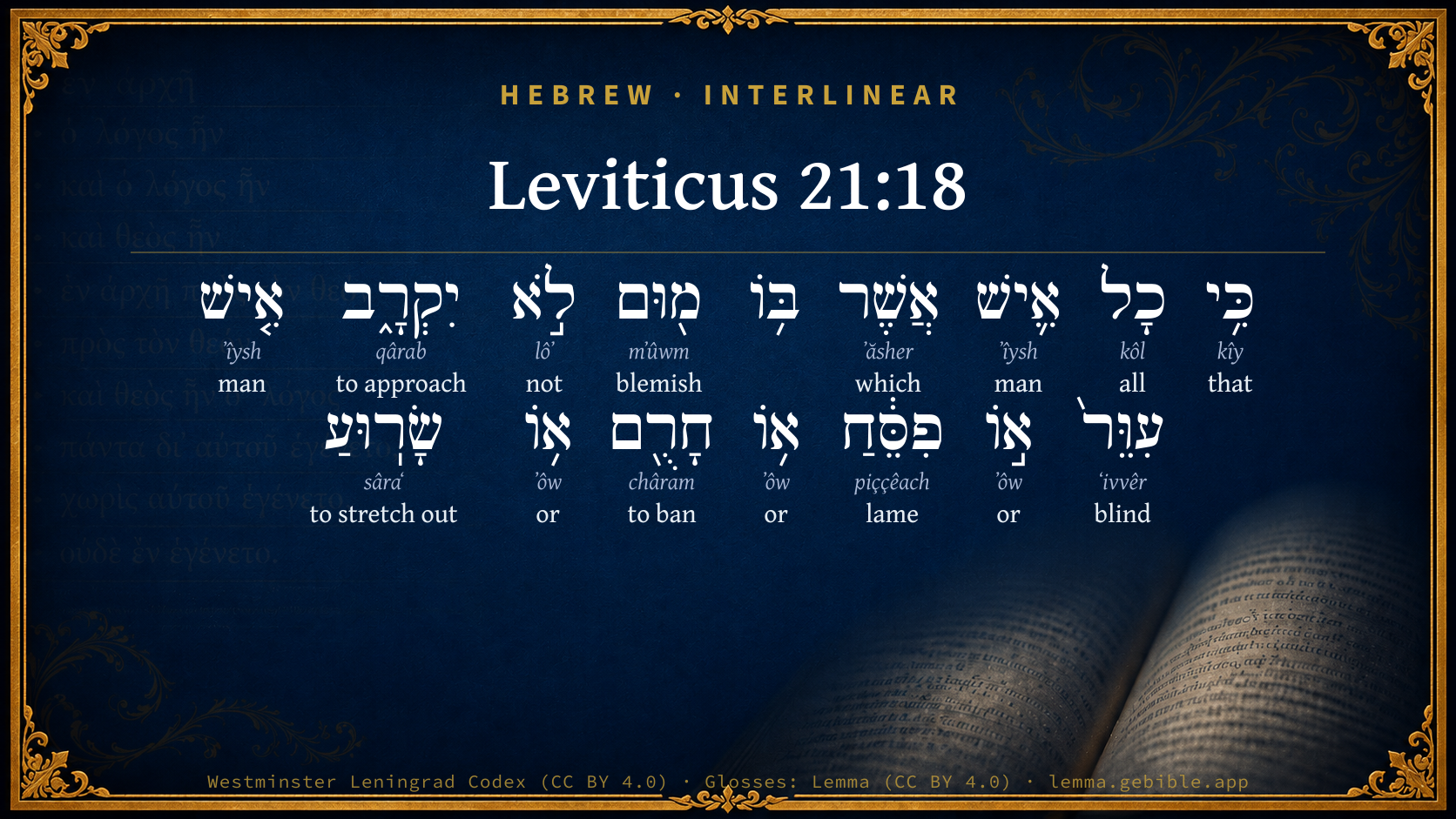
Hebrew (Westminster Leningrad Codex) Leviticus 21:18 appears in the Hebrew Old Testament. The text above is from the Westminster Leningrad Codex. Each word links to its Strong’s number, a concise gloss, and parsing drawn from the Open Scriptures Hebrew Bible morphology. Click any word for its full Brown-Driver-Briggs (BDB) entry.
Download image
Cite this verse

Leviticus 21:18 (World English Bible). Public Domain. Lemma interlinear Bible study tool, https://lemma.gebible.app/v/leviticus/21/18.

Show BibTeX & RIS
BibTeX
RIS
English Translation
For whatever man he is that has a blemish, he shall not draw near: a blind man, or a lame, or he who has a flat nose, or any deformity,
World English Bible · Public Domain
Highlights
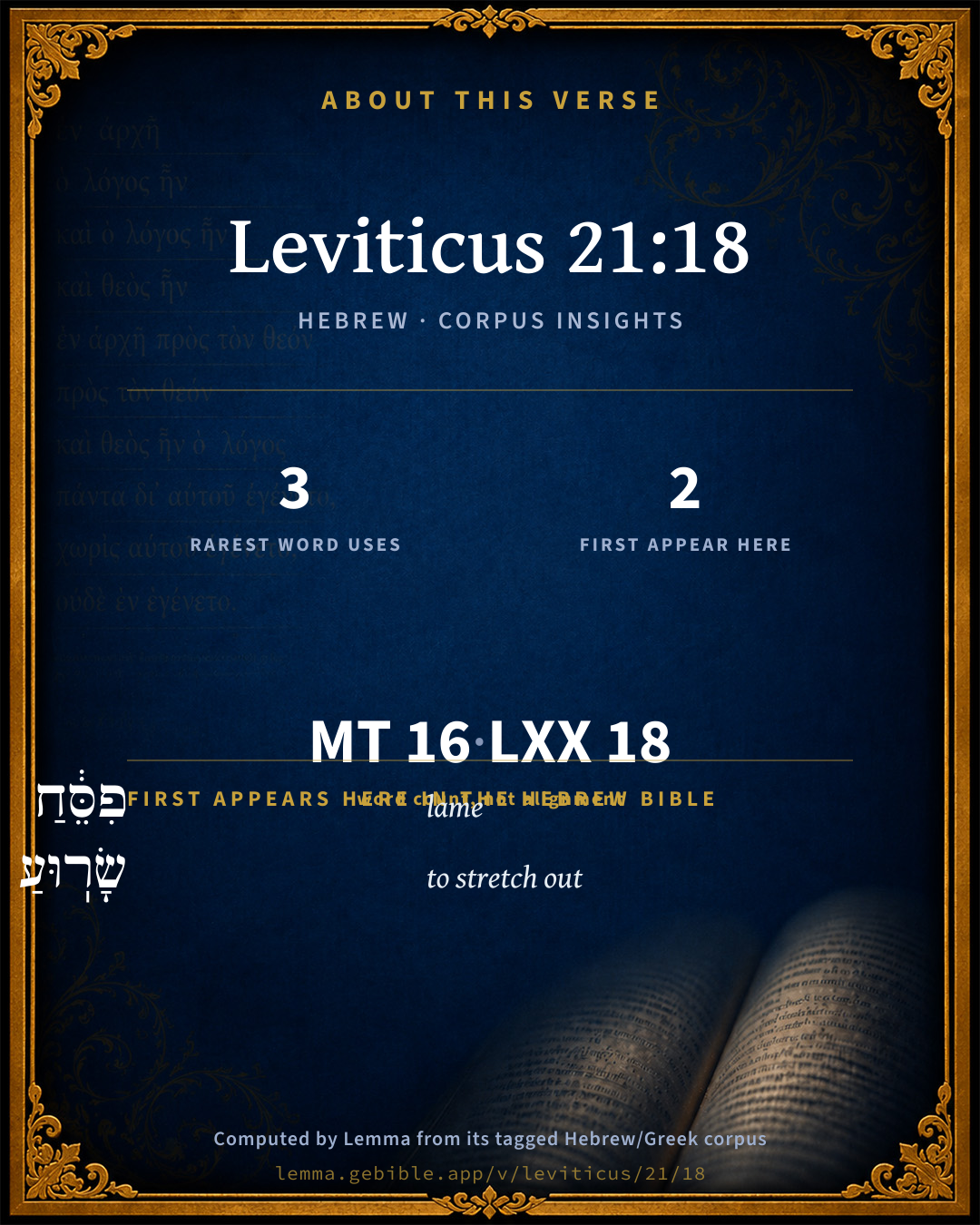
  • 2 first appearances in the Hebrew Bible
Full analysis ↓
Download a study sheet

One document with this verse’s original text, its word-by-word gloss line, the meaning frame, cross-references with their text, attributed commentary, and full source and license credits — printable, and it pastes into notes with its structure intact.

This verse Autodidact and up

Study sheet (.html) Plain text (.txt)

A passage Seminary Student

Up to 50 verses in one chapter. A passage sheet keeps up to 6 commentary sources and 12 cross-references per verse, in the order this page ranks them, and says so on the sheet whenever that leaves anything out. Ask for a single verse and you get the Autodidact verse sheet above.

Everything on this page stays free to read, with no account — the sheet is a download of what is already on screen, not access to it.

Want to remove ads? Support Godless Engineer
Compare translations 3

The same verse in 3 English versions, stacked beneath the original-language interlinear above. Click any original word for its lexicon entry.

Each is an independent rendering of the whole verse — the interlinear is not word-aligned to these translations.

Highlighted words mark where these versions differ — a whole-verse word diff, not a word-by-word alignment.

  • World English Bible Public Domain
    For whatever man he is that has a blemish, he shall not draw near: a blind man, or a lame, or he who has a flat nose, or any deformity,
  • King James Version Public Domain
    For whatsoever man he be that hath a blemish, he shall not approach: a blind man, or a lame, or he that hath a flat nose, or any thing superfluous,
  • unfoldingWord Literal Text CC BY-SA 4.0
    For any man on whom a blemish shall not draw near: a man blind or lame or mutilated or extended

unfoldingWord Literal Text — © unfoldingWord, licensed CC BY-SA 4.0. Word-aligned USFM3 via Door43 (git.door43.org/unfoldingWord/en_ult).

Versions to compare (up to 4)

3 of 4 selected

Show all 18 translations

Every available English version of this verse, each an independent rendering of the whole verse.

  • World English Bible Public Domain
    For whatever man he is that has a blemish, he shall not draw near: a blind man, or a lame, or he who has a flat nose, or any deformity,
  • Berean Standard Bible Public Domain
    No man who has any defect may approach—no man who is blind, lame, disfigured, or deformed;
  • Majority Standard Bible Public Domain
    No man who has any defect may approach—no man who is blind, lame, disfigured, or deformed;
  • King James Version Public Domain
    For whatsoever man he be that hath a blemish, he shall not approach: a blind man, or a lame, or he that hath a flat nose, or any thing superfluous,
  • American Standard Version (1901) Public Domain
    For whatsoever man he be that hath a blemish, he shall not approach: a blind man, or a lame, or he that hath a flat nose, or anything superfluous,
  • Revised Version (1885) Public Domain
    For whatsoever man he be that hath a blemish, he shall not approach: a blind man, or a lame, or he that hath a flat nose, or any thing superfluous,
  • Geneva Bible (1599) Public Domain
    For whosoeuer hath any blemish, shall not come neere: as a man blinde or lame, or that hath a flat nose, or that hath any misshapen member,
  • Douay-Rheims (1899) Public Domain
    Neither shall he approach to minister to him: If he be blind, if he be lame, if he have a little, or a great, or a crooked nose,
  • Young's Literal Translation Public Domain
    for no man in whom `is' blemish doth draw near -- a man blind, or lame or dwarfed, or enlarged,
  • Literal Standard Version CC BY-SA 4.0
    for no man in whom [is] a blemish draws near: a man blind, or lame, or disfigured, or deformed,
  • Unlocked Literal Bible CC BY-SA 4.0
    Any man who has a bodily defect must not approach Yahweh, such as a blind man or a man who is unable to walk, one who is disfigured or deformed,
  • unfoldingWord Literal Text CC BY-SA 4.0
    For any man on whom a blemish shall not draw near: a man blind or lame or mutilated or extended
  • Darby Bible Public Domain
    for whatever man hath a defect, he shall not approach: a blind man, or a lame, or he that hath a flat nose, or one limb longer than the other,
  • World Messianic Bible Public Domain
    For whatever man he is that has a defect, he shall not draw near: a blind man, or a lame, or he who has a flat nose, or any deformity,
  • Webster's Bible Public Domain
    For whatever man he may be that hath a blemish, he shall not approach: a blind man, or a lame, or he that hath a flat nose, or any thing superfluous,
  • Free Bible Version CC BY-SA 4.0
    No man is allowed to do this if he has any defects, including anyone who is blind, crippled, facially disfigured, or has deformities,
  • Bible in Basic English Public Domain
    For any man whose body is damaged may not come near: one who is blind, or has not the use of his legs, or one who has a broken nose or any unnatural growth,
  • JPS Tanakh (1917) Public Domain
    For whatsoever man he be that hath a blemish, he shall not approach: a blind man, or a lame, or he that hath any thing maimed, or anything too long,

Literal Standard Version (2020), Covenant Press — licensed CC BY-SA 4.0. Text via the HelloAO Bible API (eBible.org). Unlocked Literal Bible (unfoldingWord) — licensed CC BY-SA 4.0. Text via the HelloAO Bible API (eBible.org). unfoldingWord Literal Text — © unfoldingWord, licensed CC BY-SA 4.0. Word-aligned USFM3 via Door43 (git.door43.org/unfoldingWord/en_ult). Free Bible Version, Dr. Jonathan Gallagher — licensed CC BY-SA 4.0. Text via the HelloAO Bible API (eBible.org).

Word by word

More ways to search: Search by grammar → Find every occurrence → Compare this word →

Practice this passage: Drill this verse → Learn its vocabulary →

שָׂרֽוּעַ
sâraʻ
H8311
“stretched out”
Verb, Qal, Participle Passive, Masculine, Singular, Absolute
Part of Speech
Verb
Stem
Qal
Form
Participle Passive
Gender
Masculine
Number
Singular
State
Absolute
Full BDB Definition

Origin: a primitive root

TWOT: 2291

to extend, stretch out - (Qal) extended (participle) - (Hithpael) to stretch oneself
  1. כִּ֥י kîy H3588 “that” Conjunction
  2. כָל kôl H3605 “all of” Noun, Common, Masculine, Singular, Construct
  3. אִ֛ישׁ ʼîysh H376 “man” Noun, Common, Masculine, Singular, Absolute
  4. אֲשֶׁר ʼăsher H834 “which” Particle, Relative
  5. מ֖וּם mʼûwm H3971 “blemish” Noun, Common, Masculine, Singular, Absolute
  6. לֹ֣א lôʼ H3808 “not” Particle, Negative
  7. יִקְרָ֑ב qârab H7126 “to approach” Verb, Qal, Imperfect, 3rd Person, Masculine, Singular
  8. אִ֤ישׁ ʼîysh H376 “man” Noun, Common, Masculine, Singular, Absolute
  9. עִוֵּר֙ ʻivvêr H5787 “blind” Adjective, Adjective, Masculine, Singular, Absolute
  10. א֣וֹ ʼôw H176 “or” Conjunction
  11. פִסֵּ֔חַ piççêach H6455 “lame” Adjective, Adjective, Masculine, Singular, Absolute
  12. א֥וֹ ʼôw H176 “or” Conjunction
  13. חָרֻ֖ם châram H2763 “banned” Verb, Qal, Participle Passive, Masculine, Singular, Absolute
  14. א֥וֹ ʼôw H176 “or” Conjunction

About this verse

These counts appear in no published source. They are computed here, from the morphology-tagged text and Lemma’s own curated glosses. What Lemma adds →

16
words
12
distinct lemmas
Pentateuch
section

Notable vocabulary

The rarest word here is שָׂרֽוּעַ to stretch out H8311 — appearing just 3 times in the whole Hebrew Bible.

First appearance in Scripture

These words make their first canonical appearance in the Hebrew Bible here:

  • פִסֵּ֔חַ lame H6455
  • שָׂרֽוּעַ to stretch out H8311

Shared distinctive vocabulary

שָׂרֽוּעַ to stretch out H8311 occurs in 3 verses of the Hebrew Bible. Also found in:

Grammatical profile

  • 3 verbs
  • 4 nouns
  • 2 adjectives
  • 1 preposition
  • 4 conjunctions
  • 2 particles

Verb forms

  • יִקְרָ֑ב Qal · Imperfect
  • חָרֻ֖ם Qal · Participle Passive
  • שָׂרֽוּעַ Qal · Participle Passive

Repetition

Words recur within this verse — often emphatic in Hebrew:

  • אִ֛ישׁ man H376 ×2
  • א֣וֹ or H176 ×3

Hebrew & Septuagint length

In English translation the verse runs 30 words from the Hebrew and 23 from the Septuagint (LXX English) — closely comparable.

A rough comparison of the two English renderings, which tokenize alike — not a word-level alignment.

Word counts can differ between the Hebrew and the Greek without any difference in meaning — e.g. the Hebrew direct-object marker אֵת has no separate Greek word, and Greek often adds the article ὁ.

In the original languages it is 16 Hebrew tokens and 18 Greek tokens — but the two are counted differently (Hebrew bundles its prefixes and suffixes into one token; the Greek is in lemma form), so that isn’t a like-for-like length.

Cross-references

8

Topical passages linked to Leviticus 21:18 in the Treasury of Scripture Knowledge — connected by theme and wording, ordered by reader-vote popularity; previews shown in the World English Bible.

  • 1 Timothy 3:2–3 The overseer therefore must be without reproach, the husband of one wife, temperate, sensible, modest, hospitable, good at teaching;
  • Leviticus 22:19–25 that you may be accepted, you shall offer a male without blemish, of the bulls, of the sheep, or of the goats.
  • Isaiah 56:10 His watchmen are blind, they are all without knowledge; they are all mute dogs, they can't bark; dreaming, lying down, loving to slumber.
  • Matthew 23:16–17 "Woe to you, you blind guides, who say, 'Whoever swears by the temple, it is nothing; but whoever swears by the gold of the temple, he is obligated.'
  • Matthew 23:19 You blind fools! For which is greater, the gift, or the altar that sanctifies the gift?
  • 1 Timothy 3:7 Moreover he must have good testimony from those who are outside, to avoid falling into reproach and the snare of the devil.
  • Titus 1:7 For the overseer must be blameless, as God's steward; not self-pleasing, not easily angered, not given to wine, not violent, not greedy for dishonest gain;
  • Titus 1:10 For there are also many unruly men, vain talkers and deceivers, especially those of the circumcision,

Cross-references courtesy of OpenBible.info (CC BY 4.0).

Hebrew and Greek witnesses Masoretic Hebrew ↔ Greek Septuagint

The same verse in the two great witnesses to the Old Testament, shown verse-for-verse.

These are two independent witnesses, not word-aligned to each other, and the Septuagint is shown in lemma (dictionary) form.

Hebrew Leviticus 21:18 Masoretic · Westminster Leningrad Codex

כִּ֥י כָל אִ֛ישׁ אֲשֶׁר בּ֥וֹ מ֖וּם לֹ֣א יִקְרָ֑ב אִ֤ישׁ עִוֵּר֙ א֣וֹ פִסֵּ֔חַ א֥וֹ חָרֻ֖ם א֥וֹ שָׂרֽוּעַ

For whatever man he is that has a blemish, he shall not draw near: a blind man, or a lame, or he who has a flat nose, or any deformity,

World English Bible · Public Domain

Greek LXX Leviticus 21:18 Septuagint · lemma form

πᾶς ἄνθρωπος ὅς ἄν εἰμί ἐν αὐτός μῶμος οὐ προςἔρχομαι ἄνθρωπος χωλός ἤ τυφλός ἤ κολοβόριν ἤ ὠτότμητος

No man who has a blemish on him shall draw near; a man blind, lame, with his nose disfigured, or his ears cut,

LXX2012 (modern English Septuagint) · Public Domain

On this verse, The Cambridge Bible for Schools and Colleges discusses the Septuagint’s reading. Read the note in Commentary ↓

Hebrew: Westminster Leningrad Codex (CC BY 4.0). Greek: Septuagint (public domain); English from LXX2012 (modern English Septuagint) (Public Domain). How the Septuagint differs from the Hebrew →

Targum (Aramaic paraphrase)

2

The Targum is the ancient Jewish Aramaic paraphrase of the Hebrew Scriptures — an interpretive translation, not the Hebrew text itself. Onkelos (literal) and Pseudo-Jonathan (expansive) render the Torah, and Jonathan the Prophets. Coverage is partial: where no permissively-licensed English translation exists for a verse, only the Aramaic is shown. This is verse-level text, not a word-by-word alignment to the Hebrew.

  1. Targum Onkelos Torah (Genesis–Deuteronomy)
    אֲרֵי כָל גְבַר דִּי בֵהּ מוּמָא לָא יִקְרַב גְבַר עַוִיר אוֹ חֲגִיר אוֹ חָרִים אוֹ שָׂרִיע

    (no public-domain English translation for this verse)

    Targum Onkelos — Aramaic: “Onkelos Genesis” (public domain); “Onkelos Exodus” (public domain); “Onkelos Leviticus” (public domain); “Onkelos Numbers” (public domain); “Onkelos Deuteronomy” (public domain). English: “Sefaria Community Translation” (CC0 1.0 (public-domain dedication)); “J.W. Etheridge. The Targums of Onkelos and Jonathan Ben Uzziel on the Pentateuch. London: Longmans, Green, 1862” (public domain). Text via Sefaria.

  2. Targum Pseudo-Jonathan Torah (Genesis–Deuteronomy)
    אֲרוּם כָּל גְבַר דְבֵיהּ מוּמָא לָא יִקְרַב גְבַר דְסָמֵי אוֹ דְחָגִיר אוֹ דְלָקִי בְּחוּטְמֵיהּ אוֹ דְמִישְׁתְּמִיט יְרֵיכֵיהּ

    for no man who hath a blemish in him shall offer. A man who is blind or lame, or stricken in his nostrils, or mutilated in his thigh,

    Targum Pseudo-Jonathan — Aramaic: “Targum Jonathan on Genesis” (public domain); “Targum Jonathan on Exodus” (public domain); “Targum Jonathan on Leviticus” (public domain); “Targum Jonathan on Numbers” (public domain); “Targum Jonathan on Deuteronomy” (public domain). English: “The Targum of Jonathan ben Uzziel, trans. J. W. Etheridge, London, 1862” (public domain). Text via Sefaria.

Commentary

Notes on Leviticus 21:18 from classic Christian and Jewish commentators (each source and its license shown beneath its notes). The classic Christian expositions comment on the surrounding passage and are grouped to its opening verse, so a note may address several verses; the Jewish commentaries on the Tanakh (Rashi and others) are per-verse, so they appear only where the commentator wrote on this verse.

Lemma curates 59 commentaries, every one of them public domain or Creative Commons licensed, each selected and text-cleaned for this edition rather than reprinted as found. About our sources →

Trapp's Complete Commentary

John Trapp

Lev 21:18 For whatsoever man [he be] that hath a blemish, he shall not approach: a blind man, or a lame, or he that hath a flat nose, or any thing superfluous,

Ver. 18. He shall not approach.] Lest his ministry be slighted for his personal defects and deformities: how much more for his ignorance, envy, indirect aims, uneven walking, injudiciousness, unheavenly mindedness, &c., purported by these bodily imperfections?

John Trapp, A Commentary or Exposition upon All the Books of the Old and New Testament (1647–1656) — public domain. Text from a community e-Sword module.

Joseph Benson's Commentary

Lev 21:18. A flat nose — Most restrain this word to the nose, and to some great deformity relating to it. But according to others it signifies, more generally, a person that wants some member or members, because the next word, to which it is opposed, signifies one that hath more members than he should.

Joseph Benson's Commentary on the Old and New Testaments (1811–1818) — public domain. Text from a community e-Sword module.

Geneva Bible (1599)

Geneva Bible translators

Which is deformed or bruised.

As not of equal proportion, or having in number more or less.

Geneva Bible (1599) marginal notes — public domain. Text via Bolls.life.

Adam Clarke's Commentary

Verse 18. A blind man] That is, in one eye; for he that was utterly blind could not possibly be employed in such a service. A flat nose, like that of an ape; so the best versions. Any thing superfluous, such as six fingers, six toes, &c.

Adam Clarke's Commentary on the Bible (1810–1826) — public domain. Text from a community e-Sword/MySword module.

Ellicott's Commentary for English Readers

(18) For whatsoever man . . . —This part of the verse is simply an emphatic repetition of the same declaration at the end of the last verse to introduce the examples of the bodily blemishes which disqualified the priests for the service at the altar. A similar law obtained among the Greeks and Romans, that a priest should be perfect in all his parts; and according to the Hindoo law, Brahmins born with a bodily defect, or who received one before their sixteenth year, are excluded from the rites of consecration.

A blind man.—During the second Temple, this was not only interpreted to be partial blindness on both eyes, or on one eye, but was taken to include any blemish in the eye or in the eyelid, of which the administrators of the Law enumerate twenty-six cases, nineteen in the eye and seven in the eyelid.

Or a lame.—This was understood during the second Temple to refer to any imperfection in the gait of the priest, which might show itself in twenty different ways.

Or he that hath a flat nose.—Of the nasal deformity no less than nine different illustrations are given.

Or any thing superfluous.—That is, one member of the body more stretched out or longer than the others, or out of proportion, as an eye, shoulder, thigh, leg, &c.

A Bible Commentary for English Readers, edited by Charles John Ellicott (1878–1897) — public domain. Text from a community e-Sword module.

The Cambridge Bible for Schools and Colleges

gen. ed. J. J. S. Perowne

18. a flat nose] slit, as R.V. mg., rather than ‘flat.’ The Heb. word does not occur elsewhere in O.T. But the cognate root in Arabic, having the sense perforate, pierce, admits of the sense of perforation of the lip, or the lobe of the ear, as well as a slit in the partition between the nostrils.

any thing superfluous] The rendering of the EVV is too vague. The Heb. root denotes extension, and is applied to an extended (i.e. abnormally long) limb or other member, in this case of a man, in its only other occurrence (Lev_22:23) of a beast. The LXX. ὠτότμητος, having the ear split, following the Aram. rendering mutilated, is wrong.

The Cambridge Bible for Schools and Colleges (gen. ed. J. J. S. Perowne; Cambridge University Press, 1878–1918) — public domain. Text from a community e-Sword module.

John Gill's Exposition

For whatsoever man he be that hath a blemish,.... Let him be otherwise ever so well qualified for his office, as with respect to his parentage, against which no objection lies; or, as to his character and abilities, being a man of knowledge and of good manners; and whether these blemishes be, as the Jews (z) call them, fixed, settled ones, which have attended them ever since they were born, and are likely to attend them as long as they live; or are transient ones, only for the present, and perhaps, in a short time, wilt be removed; yet it matters not, while these blemishes are on them:

he shall not approach; to the altar to offer sacrifice, or do any part of the priestly office, for this phrase is expressive of a sacerdotal act: the particular blemishes unfitting a man for such service follow:

a blind man, or a lame; that is blind of one eye, or of both; and is lame of one leg, or of both:

or he that hath a flat nose; which Jarchi explains, whose nose is sunk between his two eyes, whose nose is short, and crooked, or mutilated:

or anything superfluous; more members than usual, as six fingers on an hand, or two gristles in an ear, as Ben Gersom; or whose members are not proportionate, as one eye large and the other small, or one thigh or leg longer than the other, so Jarchi; the Targum of Jonathan is,"whose thigh (or thigh bone) is out of joint;''and so a man draws his foot after him, which is the sense of the Rabbins, as observed by Kimchi (a), and Ben Melech from him; and so such are not fit to be called the priests of the Lord, and much less ministers of his word, who are blind as to the knowledge of divine and spiritual things, and walk not as becomes the Gospel of Christ; or halt between two opinions, or savour not the things of God, and lay not aside all superfluity of naughtiness.

(z) Misn. Zebachim, c. 12. sect 1. & Becorot, c. 7. sect. 1. (a) Sepher Shorash. rad.

John Gill's Exposition of the Whole Bible (1746–1763) — public domain (CC PDM 1.0). Text via the HelloAO Bible API.

Haydock's Catholic Bible Commentary

Nose. Hebrew, "a flat nose, or any thing superfluous." Septuagint, "the nose, (hand) or ears slit." This verse rejects those whose members are too large, as the next does those who have them too small.

George Leo Haydock (1774–1849), Haydock's Catholic Family Bible and Commentary, 1859 edition — public domain. Excludes Psalms (Douay-Rheims chapter numbering differs from Protestant) and Deuterocanonical books (Catholic canon only).

Matthew Poole's English Annotations

He shall not approach unto God, or to serve him in his sanctuary.

A flat nose: most restrain this word to the nose and to some great deformity relating to it, either the want of it wholly or in part, or the shortness, flatness, or crookedness of it. But according to others, it signifies more generally a person that wants some member or members, because the next word, to which it is opposed, signifies one that hath more members than he should.

Matthew Poole's English Annotations on the Holy Bible (1683–1685) — public domain. Text from a community e-Sword/MySword module.

Whedon's Commentary on the Bible

Daniel D. Whedon

18. Blemish — The blemishes may be classified as 1.) essential physical defects, rendering the adequate performance of the service impossible, and 2.) aesthetical defects, where the powers may be unimpaired but the appearance is repulsive. Of the former are the blind, the lame, and various kinds of maimed.

A flat nose — Furst, following the Seventy, renders it snub-nosed. The Vulgate has three nasal blemishes, si parvo, vel grandi, vel torto naso, “if he has a small, or a huge, or a twisted nose.”

Superfluous — The original occurs elsewhere only in Lev_22:23, and Isa_28:20, and seems to signify limbs disproportioned in length. The Vulgate limits it to the nose. The Seventy translates it “with the ears cropped or slit.” The Targum of Palestine says, “mutilated in the thigh.”

Keil inclines to our English rendering — any thing superfluous, as more than ten fingers or toes, or any thing beyond what is normal, such as an ill-formed bodily member.

Daniel D. Whedon (gen. ed.), Commentary on the Old and New Testaments (1874–1909) — public domain. Text from a community e-Sword module.

John Wesley's Explanatory Notes

A flat nose - Most restrain this word to the nose, and to some great deformity relating to it. But according to others, it signifies more generally, a person that wants some member or members, because the next word, to which it is opposed, signifies one that hath more members than he should.

John Wesley, Explanatory Notes Upon the Whole Bible (1754–1765) — public domain. Text via the GEBible commentary corpus.

unfoldingWord translationNotes

Door43 World Missions Community

must not approach Yahweh

A priest had to meet specific physical standards in order to approach Yahweh. This does not imply that physical defects were the result of immorality or that all people with physical defects are unable to approach Yahweh.

one who is disfigured or deformed

"one whose body or face is deformed"

to offer the bread of his God

Here "bread" represents food in general. AT: "to make burnt offering of food on God's altar" (See: Synecdoche)

translationWords

sacrifice

bread

unfoldingWord translationNotes — © Distant Shores Media and the Door43 World Missions Community, licensed CC BY-SA 4.0. Source: git.door43.org/Door43/en_tn.

Rashi

Rabbi Shlomo Yitzchaki (Rashi)

כי כל איש אשר בו מום לא יקרב FOR ANY MAN THAT HATH A BLEMISH SHALL NOT APPROACH — This means: it is not right that he should approach; It expresses the same idea as (Malachi 1:8) “[And if ye offer the blind for sacrifice, is it not evil? and if ye offer the lame or sick, is it not evil?] offer it now unto thy governor! [will he be pleased with thee?]”.

חרם A FLAT-NOSED MAN — one whose nose is sunk between his two eyes so that he is able to paint both his eyes (for medical or cosmetic purposes) with one stroke (Sifra, Emor, Section 3 7; Mishna Bekhorot 7:3).

שרוע HE THAT HATH A LIMB TOO LARGE — i.e. one of whose limbs forming a pair is larger than the other, e. g. one of his eyes is large and the other small, or, one of his legs is longer than the other (Bekhorot 40b; cf. Sifra, Emor, Section 3 9).

Rashi on the Tanakh — English translations: “The Judaica Press complete Tanach with Rashi, translated by A. J. Rosenberg” (CC BY 4.0); “Pentateuch with Rashi's commentary by M. Rosenbaum and A.M. Silbermann, 1929-1934” (public domain); “The Metsudah Tanach series, Lakewood, N.J” (CC BY 4.0); and “The Book of Joshua, Metsudah Publications, 1997” (CC BY 4.0). Text via Sefaria.

Ramban (Nachmanides)

Rabbi Moshe ben Nachman (Ramban / Nachmanides)

O (OR) CHARUM O (OR) SARU’A.’ “[Charum] is anyone whose nose is sunk between his two eyes, so that he is able to paint both his eyes [for cosmetic purposes] with one stroke.” This is Rashi’s language. And in the Torath Kohanim 3:7. and in the Gemara of Tractate Bechoroth we have been taught: “Charum is one whose nose is sunk. [How do I know about] one whose nose is obstructed? or one whose nose is turned up? or whose nose overhangs his lips? From the expression o charum, [the word ‘o’ (or) includes these blemishes]. Aba Yosei says: The word charum means only one who can paint both his eyes with one stroke. But the Rabbis said to him: ‘You have overstated it. Even though he cannot paint both his eyes with one stroke’” [because his nose is not so deeply sunken, he may nonetheless come within the term charum]. is one whose nose is so far sunk that he is able to paint both his eyes with one stroke. But, as pointed out by Ramban, this is only the opinion of a single Sage, Aba Yosei, while all the other Sages differ with him, as explained in the text. Mizrachi too, writes that he does not know what prompted Rashi to follow the opinion of a single Sage. See also Gur Aryeh.The term charum is of the expressions: None ‘cheirem’ (doomed) who shall be ‘yachoram’ (doomed of man); ‘v’hacharamti’(and I shall utterly destroy) their cities, the meaning thereof being destruction. Now [a man with a sunken nose] is called charum because the nose determines the beauty of the face, just as the Rabbis have said: “Evidence [as to the identity of a corpse] may not be given unless [from proof afforded by recognition] of the face together with the nose,” and if someone’s nose is unlike that of the appearance of normal people, the shape [of his face] is deemed “destroyed.”‘O gibein o dak o t’valul b’eino.’ The expression ‘o gibein’ is connected with the word ‘b’eino’ (in his eye), meaning that he is either a gibein in his eye, or has a dak (membrane) or a t’valul (a speck) in his eye, gibein meaning that the hair of his eyebrows are so long that they lie over his eyes, of the expressions: ‘gav’ (the side of) the altar; upon ‘gabi’ (my back) plowed the plowers. Now Scripture mentioned first [in Verse 18 before us] blemishes of missing limbs: a blind man, or a lame, and afterwards [itmentioned blemishes which are a result of] the smallness of the limbs, such as the charum [whose nose is sunk into his face, and consequently is shorter than the normal nose], or a result of the largeness of the limbs, such as the saru’a [meaning “anything too long,” as where one eye is larger than the other, or one leg longer]. Then in the following verse [19] it cites blemishes because of the breaking of bones even though he has all his limbs with him, nonetheless, if the bone is broken, he is disqualified [from ministering the Service]. Then [in Verse 20] He disqualified [a priest from performing the Service] even on account of a hideous appearance, such as one whose eyebrows overhang his eyes, or who has kernel-like growths in his eyes [like a membrane or a speck], and then it mentioned blemishes on the flesh of the body [such as scabs or scurvy], because he [the priest] must be clean and smooth [in flesh]. And afterwards He added [o m’roach ashech, which means] one who has wind [and as a result of which] his testicles are swollen, even though it is a sickness common amongst older people, and is not a blemish in the bone or flesh. Now our Rabbis have explained many other blemishes which are deduced from these, for those mentioned in the Torah are merely the primary [categories of those] blemishes [deduced by the Rabbis].

Ramban (Nachmanides) on the Tanakh — English translation: “Commentary on the Torah by Ramban (Nachmanides). Translated and annotated by Charles B. Chavel. New York, Shilo Pub. House, 1971-1976” (CC BY 4.0). Text via Sefaria.

Lesson kit

Teaching starters — assembled from the data on this page, not authored interpretation. Every prompt links to the verse data it draws on. Edit before teaching.

Leviticus, in the Pentateuch, opens this verse with 16 words (12 distinct Hebrew lemmas). Its most distinctive word is sâraʻ (“to stretch out”). A historical commentator’s framing appears above. Read the whole chapter for the surrounding context.

Discussion questions

  1. The word sâraʻ carries the sense “to stretch out.” How does it shape the verse?
  2. 2 words here appear for the first time in Scripture. What is being introduced at this debut?
  3. Leviticus 22:23 shares the word «to stretch out» with this verse. How do the two illuminate each other?
  4. “man” occurs 2× in this one verse. What is the effect of the repetition?
  5. The translations on this page render this verse differently — a whole-verse word diff, not a word-by-word alignment. What might account for the different wordings?
  6. The verb «יִקְרָ֑ב» is Qal Imperfect. How does its form color the action?
  7. Reading how Trapp's Complete Commentary and Joseph Benson's Commentary read this verse, where do the two commentators agree and where do they part?

Things to notice

Reading settings

Reading text

Shown beneath each verse's original-language words.

Old Testament
Old Testament edition

Read the OT as the Masoretic Hebrew (MT) or the Greek Septuagint (LXX).

English shown for the Greek Septuagint (in the Hebrew ↔ Greek comparison).

Comparing translations? Open the Compare panel on any verse page to stack up to four side by side.