Leviticus 16:6

Hebrew (Westminster Leningrad Codex) Leviticus 16:6 appears in the Hebrew Old Testament. The text above is from the Westminster Leningrad Codex. Each word links to its Strong’s number, a concise gloss, and parsing drawn from the Open Scriptures Hebrew Bible morphology. Click any word for its full Brown-Driver-Briggs (BDB) entry.
Download image
Cite this verse

Leviticus 16:6 (World English Bible). Public Domain. Lemma interlinear Bible study tool, https://lemma.gebible.app/v/leviticus/16/6.

Show BibTeX & RIS
BibTeX
RIS
English Translation
"Aaron shall offer the bull of the sin offering, which is for himself, and make atonement for himself and for his house.
World English Bible · Public Domain
Download a study sheet

One document with this verse’s original text, its word-by-word gloss line, the meaning frame, cross-references with their text, attributed commentary, and full source and license credits — printable, and it pastes into notes with its structure intact.

This verse Autodidact and up

Study sheet (.html) Plain text (.txt)

A passage Seminary Student

Up to 50 verses in one chapter. A passage sheet keeps up to 6 commentary sources and 12 cross-references per verse, in the order this page ranks them, and says so on the sheet whenever that leaves anything out. Ask for a single verse and you get the Autodidact verse sheet above.

Everything on this page stays free to read, with no account — the sheet is a download of what is already on screen, not access to it.

Want to remove ads? Support Godless Engineer
Compare translations 3

The same verse in 3 English versions, stacked beneath the original-language interlinear above. Click any original word for its lexicon entry.

Each is an independent rendering of the whole verse — the interlinear is not word-aligned to these translations.

Highlighted words mark where these versions differ — a whole-verse word diff, not a word-by-word alignment.

  • World English Bible Public Domain
    "Aaron shall offer the bull of the sin offering, which is for himself, and make atonement for himself and for his house.
  • King James Version Public Domain
    And Aaron shall offer his bullock of the sin offering, which is for himself, and make an atonement for himself, and for his house.
  • unfoldingWord Literal Text CC BY-SA 4.0
    And Aaron shall present the bull of the sin offering, which for himself. And he shall make atonement on his behalf and on behalf of his house.

unfoldingWord Literal Text — © unfoldingWord, licensed CC BY-SA 4.0. Word-aligned USFM3 via Door43 (git.door43.org/unfoldingWord/en_ult).

Versions to compare (up to 4)

3 of 4 selected

Show all 18 translations

Every available English version of this verse, each an independent rendering of the whole verse.

  • World English Bible Public Domain
    "Aaron shall offer the bull of the sin offering, which is for himself, and make atonement for himself and for his house.
  • Berean Standard Bible Public Domain
    Aaron is to present the bull for his sin offering and make atonement for himself and his household.
  • Majority Standard Bible Public Domain
    Aaron is to present the bull for his sin offering and make atonement for himself and his household.
  • King James Version Public Domain
    And Aaron shall offer his bullock of the sin offering, which is for himself, and make an atonement for himself, and for his house.
  • American Standard Version (1901) Public Domain
    And Aaron shall present the bullock of the sin-offering, which is for himself, and make atonement for himself, and for his house.
  • Revised Version (1885) Public Domain
    And Aaron shall present the bullock of the sin offering, which is for himself, and make atonement for himself, and for his house.
  • Geneva Bible (1599) Public Domain
    Then Aaron shall offer the bullocke for his sinne offring, and make an atonement for himselfe, and for his house.
  • Douay-Rheims (1899) Public Domain
    And when he hath offered the calf and prayed for himself, and for his own house,
  • Young's Literal Translation Public Domain
    and Aaron hath brought near the bullock of the sin-offering which is his own, and hath made atonement for himself, and for his house;
  • Literal Standard Version CC BY-SA 4.0
    and Aaron has brought the bullock of the sin-offering near, which is his own, and has made atonement for himself and for his house;
  • Unlocked Literal Bible CC BY-SA 4.0
    Then Aaron must present the bull as the sin offering, which will be for himself, to make atonement for himself and his family.
  • unfoldingWord Literal Text CC BY-SA 4.0
    And Aaron shall present the bull of the sin offering, which for himself. And he shall make atonement on his behalf and on behalf of his house.
  • Darby Bible Public Domain
    And Aaron shall present the bullock of the sin-offering, which is for himself, and make atonement for himself, and for his house.
  • World Messianic Bible Public Domain
    “Aaron shall offer the bull of the sin offering, which is for himself, and make atonement for himself and for his house.
  • Webster's Bible Public Domain
    And Aaron shall offer his bullock of the sin-offering, which is for himself, and make an atonement for himself, and for his house.
  • Free Bible Version CC BY-SA 4.0
    Aaron will present the bull as his own sin offering to make himself and his household right.
  • Bible in Basic English Public Domain
    And Aaron is to give the ox of the sin-offering for himself, to make himself and his house free from sin.
  • JPS Tanakh (1917) Public Domain
    And Aaron shall present the bullock of the sin-offering, which is for himself, and make atonement for himself, and for his house.

Literal Standard Version (2020), Covenant Press — licensed CC BY-SA 4.0. Text via the HelloAO Bible API (eBible.org). Unlocked Literal Bible (unfoldingWord) — licensed CC BY-SA 4.0. Text via the HelloAO Bible API (eBible.org). unfoldingWord Literal Text — © unfoldingWord, licensed CC BY-SA 4.0. Word-aligned USFM3 via Door43 (git.door43.org/unfoldingWord/en_ult). Free Bible Version, Dr. Jonathan Gallagher — licensed CC BY-SA 4.0. Text via the HelloAO Bible API (eBible.org).

Word by word

More ways to search: Search by grammar → Find every occurrence → Compare this word →

Practice this passage: Drill this verse → Learn its vocabulary →

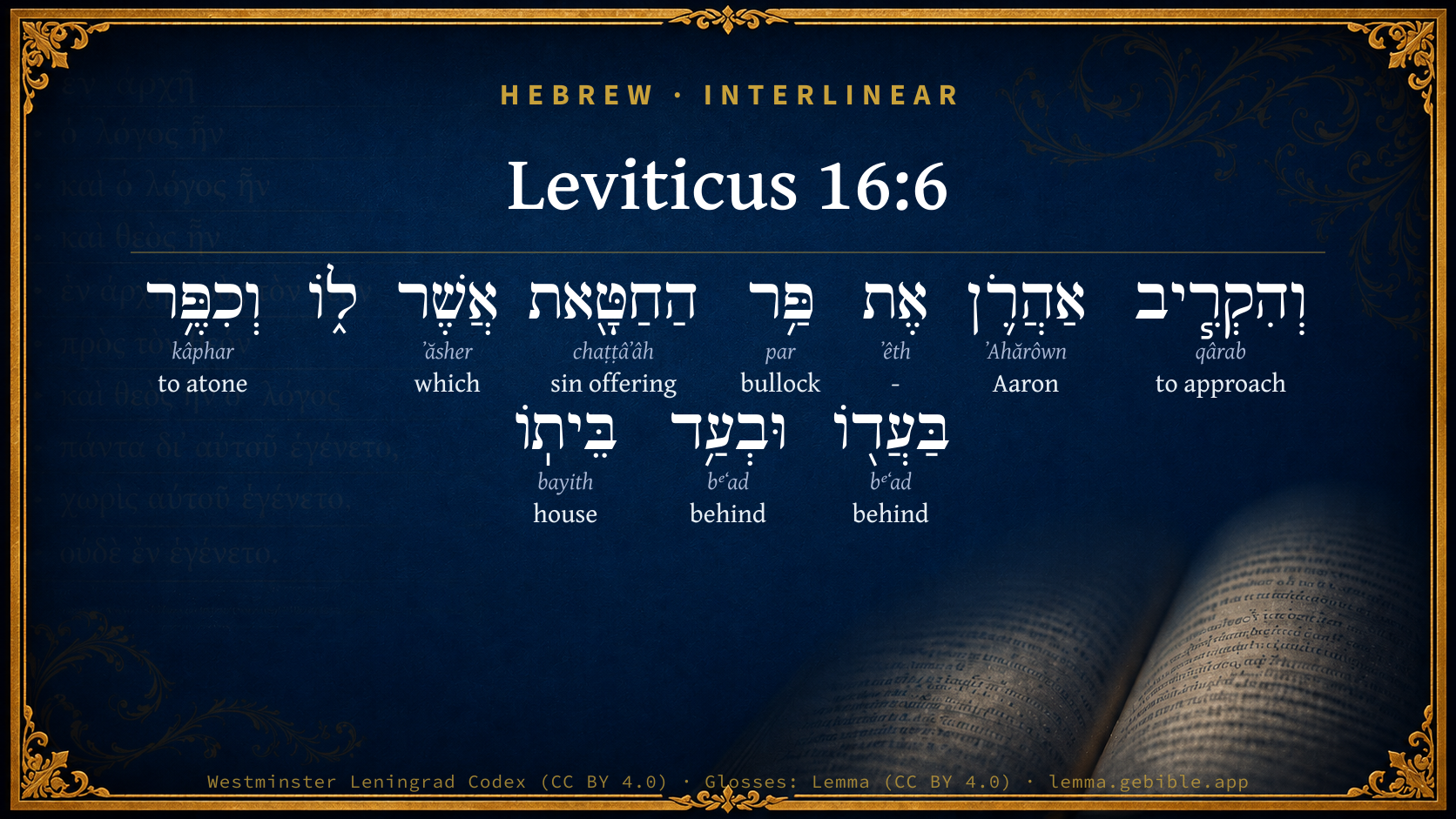
וְכִפֶּ֥ר
kâphar
H3722
“and · to atone”
Conjunction + Verb, Piel, Sequential Perfect, 3rd Person, Masculine, Singular
Part of Speech
Conjunction + Verb
Stem
Piel
Form
Sequential Perfect
Person
3rd Person
Gender
Masculine
Number
Singular
Full BDB Definition

Origin: a primitive root

TWOT: 1023 , 1024 , 1025 , 1026

to cover, purge, make an atonement, make reconciliation, cover over with pitch - (Qal) to coat or cover with pitch - (Piel) - to cover over, pacify, propitiate - to cover over, atone for sin, make atonement for - to cover over, atone for sin and persons by legal rites - (Pual) - to be covered over - to make atonement for - (Hithpael) to be covered
  1. וְהִקְרִ֧יב qârab H7126 “and · to approach” Conjunction + Verb, Hiphil, Sequential Perfect, 3rd Person, Masculine, Singular
  2. אַהֲרֹ֛ן ʼAhărôwn H175 “Aaron” Noun, Proper
  3. אֶת ʼêth H853 “-” Particle, Direct Object
  4. פַּ֥ר par H6499 “bullock of” Noun, Common, Masculine, Singular, Construct
  5. הַחַטָּ֖את chaṭṭâʼâh H2403 “the · sin offering” Particle, Definite Article + Noun, Common, Feminine, Singular, Absolute
  6. אֲשֶׁר ʼăsher H834 “which” Particle, Relative
  7. בַּעֲד֖וֹ bᵉʻad H1157 “behind · him” Preposition + Suffix, Personal, 3rd Person, Masculine, Singular
  8. וּבְעַ֥ד bᵉʻad H1157 “and · behind” Conjunction + Preposition
  9. בֵּיתֽוֹ bayith H1004 “house · his” Noun, Common, Masculine, Singular, Construct + Suffix, Personal, 3rd Person, Masculine, Singular

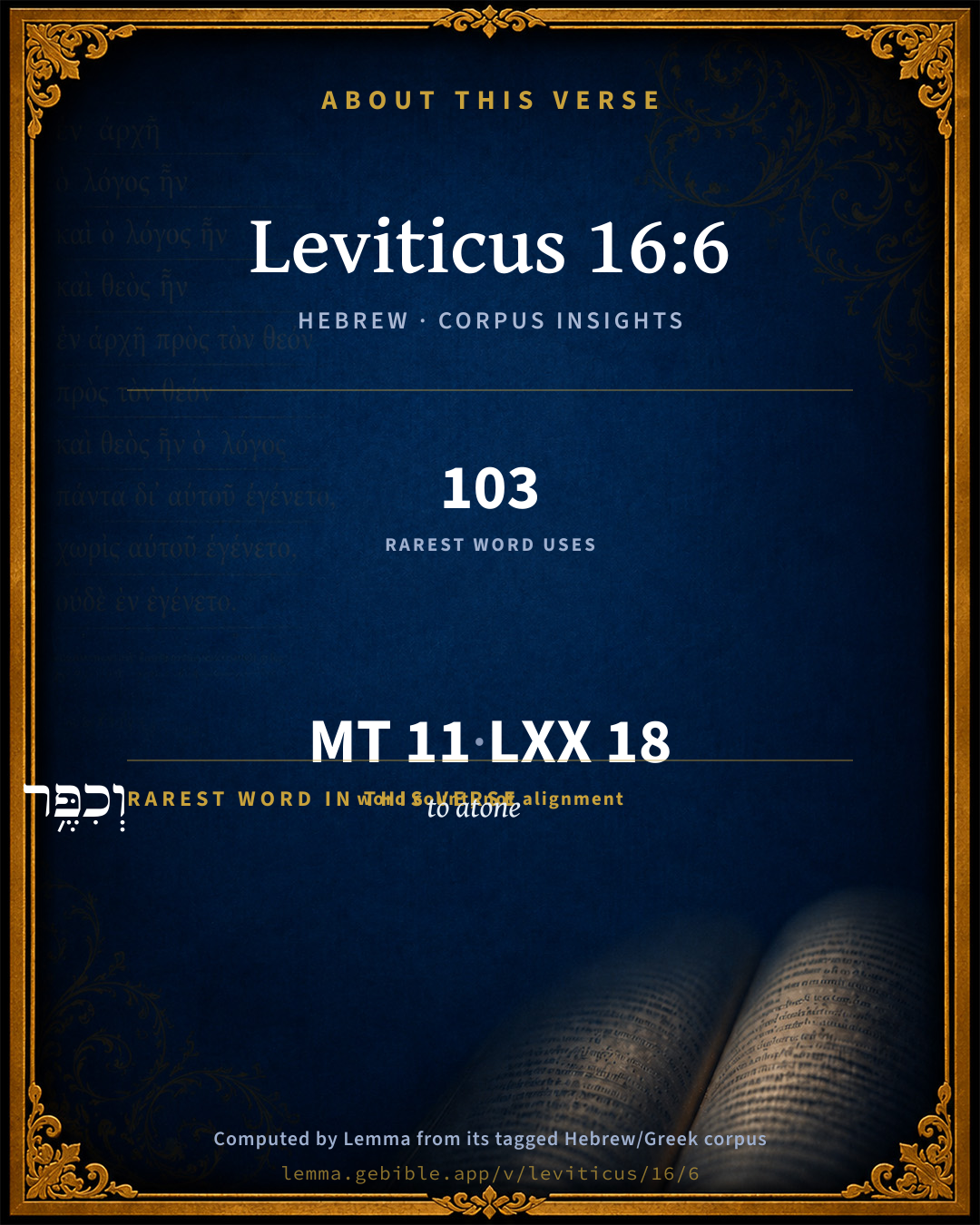
About this verse

These counts appear in no published source. They are computed here, from the morphology-tagged text and Lemma’s own curated glosses. What Lemma adds →

11
words
9
distinct lemmas
Pentateuch
section

Grammatical profile

  • 2 verbs
  • 4 nouns
  • 3 prepositions
  • 2 particles

Verb forms

  • וְהִקְרִ֧יב Hiphil · Sequential Perfect
  • וְכִפֶּ֥ר Piel · Sequential Perfect

Repetition

A word recurs within this verse — often emphatic in Hebrew:

  • בַּעֲד֖וֹ behind H1157 ×2

Hebrew & Septuagint length

In English translation the verse runs 22 words from the Hebrew and 20 from the Septuagint (LXX English) — closely comparable.

A rough comparison of the two English renderings, which tokenize alike — not a word-level alignment.

Word counts can differ between the Hebrew and the Greek without any difference in meaning — e.g. the Hebrew direct-object marker אֵת has no separate Greek word, and Greek often adds the article ὁ.

In the original languages it is 11 Hebrew tokens and 18 Greek tokens — but the two are counted differently (Hebrew bundles its prefixes and suffixes into one token; the Greek is in lemma form), so that isn’t a like-for-like length.

Cross-references

9

Topical passages linked to Leviticus 16:6 in the Treasury of Scripture Knowledge — connected by theme and wording, ordered by reader-vote popularity; previews shown in the World English Bible.

  • Leviticus 9:7 Moses said to Aaron, "Draw near to the altar, and offer your sin offering, and your burnt offering, and make atonement for yourself, and for the people; and offer the offering of the people, and make atonement for them; as Yahweh commanded."
  • Hebrews 9:7 but into the second the high priest alone, once in the year, not without blood, which he offers for himself, and for the errors of the people.
  • Leviticus 8:14–17 He brought the bull of the sin offering, and Aaron and his sons laid their hands on the head of the bull of the sin offering.
  • Ezra 10:18–19 Among the sons of the priests there were found who had married foreign women: [namely], of the sons of Jeshua, the son of Jozadak, and his brothers, Maaseiah, and Eliezer, and Jarib, and Gedaliah.
  • Job 1:5 It was so, when the days of their feasting had run their course, that Job sent and sanctified them, and rose up early in the morning, and offered burnt offerings according to the number of them all. For Job said, "It may be that my sons have sinned, and renounced God in their hearts." Thus did Job continually.
  • Ezekiel 43:19 You shall give to the priests the Levites who are of the seed of Zadok, who are near to me, to minister to me, says the Lord Yahweh, a young bull for a sin-offering.
  • Ezekiel 43:27 When they have accomplished the days, it shall be that on the eighth day, and forward, the priests shall make your burnt offerings on the altar, and your peace-offerings; and I will accept you, says the Lord Yahweh.
  • Hebrews 5:2–3 The high priest can deal gently with those who are ignorant and going astray, because he himself is also surrounded with weakness.
  • Hebrews 7:27 who doesn't need, like those high priests, to daily offer up sacrifices, first for his own sins, and then for the sins of the people. For this he did once for all, when he offered up himself.

Cross-references courtesy of OpenBible.info (CC BY 4.0).

Hebrew and Greek witnesses Masoretic Hebrew ↔ Greek Septuagint

The same verse in the two great witnesses to the Old Testament, shown verse-for-verse.

These are two independent witnesses, not word-aligned to each other, and the Septuagint is shown in lemma (dictionary) form.

Hebrew Leviticus 16:6 Masoretic · Westminster Leningrad Codex

וְהִקְרִ֧יב אַהֲרֹ֛ן אֶת פַּ֥ר הַחַטָּ֖את אֲשֶׁר ל֑וֹ וְכִפֶּ֥ר בַּעֲד֖וֹ וּבְעַ֥ד בֵּיתֽוֹ

"Aaron shall offer the bull of the sin offering, which is for himself, and make atonement for himself and for his house.

World English Bible · Public Domain

Greek LXX Leviticus 16:6 Septuagint · lemma form

καί προςἄγω ἀαρών ὁ μόσχος ὁ περί ὁ ἁμαρτία αὐτός καί ἐκἱλάσκομαι περί αὐτός καί ὁ οἶκος αὐτός

And Aaron shall bring the calf for his own sin-offering, and shall make atonement for himself and for his house.

LXX2012 (modern English Septuagint) · Public Domain

On this verse, Keil & Delitzsch discusses the Septuagint’s reading. Read the note in Commentary ↓

Hebrew: Westminster Leningrad Codex (CC BY 4.0). Greek: Septuagint (public domain); English from LXX2012 (modern English Septuagint) (Public Domain). How the Septuagint differs from the Hebrew →

Targum (Aramaic paraphrase)

2

The Targum is the ancient Jewish Aramaic paraphrase of the Hebrew Scriptures — an interpretive translation, not the Hebrew text itself. Onkelos (literal) and Pseudo-Jonathan (expansive) render the Torah, and Jonathan the Prophets. Coverage is partial: where no permissively-licensed English translation exists for a verse, only the Aramaic is shown. This is verse-level text, not a word-by-word alignment to the Hebrew.

  1. Targum Onkelos Torah (Genesis–Deuteronomy)
    וִיקָרֵב אַהֲרֹן יָת תּוֹרָא דְחַטָּאתָא דִי לֵהּ וִיכַפֵּר עֲלוֹהִי וְעַל אֱנַשׁ בֵּיתֵהּ

    (no public-domain English translation for this verse)

    Targum Onkelos — Aramaic: “Onkelos Genesis” (public domain); “Onkelos Exodus” (public domain); “Onkelos Leviticus” (public domain); “Onkelos Numbers” (public domain); “Onkelos Deuteronomy” (public domain). English: “Sefaria Community Translation” (CC0 1.0 (public-domain dedication)); “J.W. Etheridge. The Targums of Onkelos and Jonathan Ben Uzziel on the Pentateuch. London: Longmans, Green, 1862” (public domain). Text via Sefaria.

  2. Targum Pseudo-Jonathan Torah (Genesis–Deuteronomy)
    וְיַקְרֵיב אַהֲרן יַת תּוֹרָא דְחַטָאתָא דְהוּא מִן מָמוֹנֵיהּ וִיכַפֵּר בְּאִשְׁתְּעוּת מִילַיָא עֲלוֹי וְעַל אֵינַשׁ בֵּיתֵיהּ

    And Aharon shall offer the bullock of the sin offering which (hath been purchased) with his own money, and make an atonement with words of confession for himself and for the men of his house.

    Targum Pseudo-Jonathan — Aramaic: “Targum Jonathan on Genesis” (public domain); “Targum Jonathan on Exodus” (public domain); “Targum Jonathan on Leviticus” (public domain); “Targum Jonathan on Numbers” (public domain); “Targum Jonathan on Deuteronomy” (public domain). English: “The Targum of Jonathan ben Uzziel, trans. J. W. Etheridge, London, 1862” (public domain). Text via Sefaria.

Commentary

Notes on Leviticus 16:6 from classic Christian and Jewish commentators (each source and its license shown beneath its notes). The classic Christian expositions comment on the surrounding passage and are grouped to its opening verse, so a note may address several verses; the Jewish commentaries on the Tanakh (Rashi and others) are per-verse, so they appear only where the commentator wrote on this verse.

Lemma curates 59 commentaries, every one of them public domain or Creative Commons licensed, each selected and text-cleaned for this edition rather than reprinted as found. About our sources →

The Cambridge Bible for Schools and Colleges

gen. ed. J. J. S. Perowne

6, 7. The animals for the Sin-Offerings are presented ‘before the Lord.’ The verb in Lev_16:7, ‘and set them,’ is different from that in Lev_16:6, ‘and Aaron shall present’; after the lots are cast, Aaron ‘presents’ the goat ‘upon which the lot fell for the Lord’ (Lev_16:9). No distinction is made in A.V.

The Cambridge Bible for Schools and Colleges (gen. ed. J. J. S. Perowne; Cambridge University Press, 1878–1918) — public domain. Text from a community e-Sword module.

Trapp's Complete Commentary

John Trapp

Lev 16:6 And Aaron shall offer his bullock of the sin offering, which [is] for himself, and make an atonement for himself, and for his house.

Ver. 6. And for his house.] Whereof a minister must be mainly careful, {1Ti 3:4} lest, as Augustus doing justice on others, he be hit in the teeth with his own disordered family. Aaron had lately smarted in his two eldest.

John Trapp, A Commentary or Exposition upon All the Books of the Old and New Testament (1647–1656) — public domain. Text from a community e-Sword module.

Tyndale Open Study Notes

Tyndale Open Resources

16:6 The writer of the Epistle to the Hebrews makes a clear analogy between Aaron’s work for Israel and Christ’s work for the believer. Both brought atonement to their people. Before Aaron could offer a sin offering for the people, he had to offer a sacrifice for himself to make certain his own sins were forgiven (Heb 5:1-3). However, although Christ was tempted, he did not sin (Heb 4:15). Therefore, in his role as high priest for all Christians, he had no need to make a similar sacrifice (Heb 7:26-28).

Tyndale Open Study Notes — © Tyndale Open Resources, licensed CC BY-SA 4.0. Text via the HelloAO Bible API.

Ellicott's Commentary for English Readers

(6) And Aaron shall offer.—Better, And Aaron shall present, or bring near, as the word literally denotes (comp, Lev_16:9; Lev_16:11, &c.), since the actual offering or killing took place afterwards, when the lots for the goats had been cast, as described in Lev_16:11.

For himself, and for his house.—By this is meant that the atonement was for his own sins, for those of his family and for all the priests, the sons of Aaron. The ritual at this pontifical sacrifice during the second Temple was most solemn and impressive.

By the side of the victim, which was placed between the porch and the altar towards the east, stood the high priest, arrayed in his white robes, with his face towards the west. In this attitude of a penitent sinner, the pontiff laid both his hands upon the sacrifice and confessed his sins in an audible voice in the sight of God and the assembled congregation as follows: “O Lord, I have sinned, I have committed iniquity, I have transgressed before thee, I and my house. O Lord, I beseech thee cover over my sins, iniquities, and transgressions which I have committed before thee, I and my house, even as it is written in the Law of Moses thy servant—For on that day He will cover over for you and cleanse you from all your sins,” &c. To this the congregation replied: “Blessed be the name of His glorious kingdom for ever and ever.” Whereupon the high priest repeated this confession a second time, including in it the children of Aaron, God’s holy people. (See Lev_16:11.)

A Bible Commentary for English Readers, edited by Charles John Ellicott (1878–1897) — public domain. Text from a community e-Sword module.

John Gill's Exposition

And Aaron shall offer his bullock of the sin offering, which is for himself,.... That is, bring it into the court, and present it before the Lord in order to its being slain and sacrificed; for as yet it was not killed, and so could not be offered on the altar, see Lev 16:11; the place where the bullock was set was between the porch and the altar, his head in the south, and his face to the west, and the priest stood in the east, and his face to the west, and laid both his hands upon him, and confessed his sins, and his family's (x): and this is said to be "for himself"; not to atone for him, which is afterwards expressed, but which should come of him or from him, and not from the congregation, as Jarchi explains it; or as the Targum of Jonathan more clearly, which is of his own money, wholly at his own expense, and not the people's:

and make atonement for himself, and for his house; for himself, for his own personal sins and for his family's sins, those of his wife and children; and it may be extended to all the priests of the house of Aaron; and some say to the Levites also, as Aben Ezra notes, though he disapproves of it: by this it appears, that Christ, the antitype of Aaron, is a more perfect and excellent priest than he, who needed not to offer up sacrifice, first for his own sins, and then for his people's, for this he did once, when he offered up himself, Heb 7:27; and which was for his whole family, and them only, the elect of God, consisting of Jews and Gentiles; part of which is in heaven, and part on earth, and both were reconciled, or atonement made for them, by the blood of Christ; whose house and family men appear to be, when they believe and hope in him, and hold fast their faith and hope; and who are made by him priests as well as kings to God; see Eph 3:15 Rev 1:6.

(x) Misn. Yoma, c. 3. sect. 8.

John Gill's Exposition of the Whole Bible (1746–1763) — public domain (CC PDM 1.0). Text via the HelloAO Bible API.

Albert Barnes' Notes on the Bible

Shall offer - Rather, shall present, as in Lev 16:7, Lev 16:10, etc. The word expresses the formal act of placing the victims in front of the entrance of the tabernacle.

For himself, and for his house - i. e. for himself as the high priest and all the common priests. Compare Lev 9:7-14 note.

Albert Barnes' Notes on the Bible (1834–1885) — public domain. Text from a community e-Sword/MySword module.

Haydock's Catholic Bible Commentary

Calf, or young bull, which Aaron offered for himself and all the family of Levi, to expiate the sins which they might have committed during the year. If their sins were voluntary, they were obliged also to have perfect charity and contrition. The ram was offered for the sins of the people. Moses speaks of the red heifer, (Numbers xix.) which was also offered, out of the camp, for the people. This solemn day was to be kept by all as a rigid "fast from meat, drink, washing, anointing, wearing shoes, or using marriage." This is the idea which the Oriental nations generally have of a fast. They commence at midnight, and end with the following sun-set; after which they eat what they think proper. (Calmet) --- On the day of expiation, the Jews made a tenfold confession of their sins. (Morinus, pœnit. ii. 22.)

George Leo Haydock (1774–1849), Haydock's Catholic Family Bible and Commentary, 1859 edition — public domain. Excludes Psalms (Douay-Rheims chapter numbering differs from Protestant) and Deuterocanonical books (Catholic canon only).

Matthew Poole's English Annotations

i.e. His family, as Gen 7:1, to wit, the priests and Levites. See Num 1:49.

Matthew Poole's English Annotations on the Holy Bible (1683–1685) — public domain. Text from a community e-Sword/MySword module.

Whedon's Commentary on the Bible

Daniel D. Whedon

6. Shall offer — R.V., “present.” The actual offering does not take place until Lev_16:11.

An atonement for himself — “An innocent man,” says Van der Waegen, “must come and make atonement for the guilty; but the guilty may not come and make atonement for the innocent.” Since innocence is not inherent in fallen man by nature or practice, only as one who had himself been atoned could the high priest make atonement for others. “Every reconciling and sanctifying effect of the sacrifices is dependent on the existence of a personally reconciling mediatorship before God; and here the old covenant proclaims its inadequacy to institute a real reconciliation, in the fact that even the high priest himself, through whose intercessions the defect which attaches to the offering is made good, himself in turn has need of reconciliation and purification, as one subject to sin and weakness.” Comp. Heb_5:3. — Oehler. Here the Antitype, Jesus, differs from his types. His priesthood was unique in its sinlessness, and his piety unique in its impenitence. When God acknowledges a high priest as well-pleasing in his sight, this is a real declaration that he graciously accepts the whole people. On the contrary, his error is the inculpation of the people. Lev_4:3, note. That this required atonement is for involuntary defects and inadvertencies arising from fallen nature, rather than for special cases of transgression, is evident not only from the provision made for the latter in Lev_4:3-12, but also from the presumption of sinfulness referred to in Lev_16:3, note. Aaron’s confession of sin was in these words: “O, for Jehovah’s sake, do Thou expiate the misdeeds, the crimes, and the sins wherewith I have done evil, and have sinned before thee, I and my house, as is written in the law of Moses thy servant,” concluding with quoting Lev_16:30. — Delitzsch on the Hebrews, Appendix.

And for his house — Hence only a married high priest was permitted to officiate on the day of atonement.

Daniel D. Whedon (gen. ed.), Commentary on the Old and New Testaments (1874–1909) — public domain. Text from a community e-Sword module.

The Pulpit Commentary

And Aaron shall offer his bullock... and make an atonement for himself, and for his house. The first step is an expiatory offering to reconcile the officiating priest and the remainder of the priestly house to God. This was necessary before his offerings for the people could be accepted. It indicates the defects inherent in a priest whose nature was only that of man, which is compassed about with infirmities. The offering here commanded is not the slaying, but the solemn presentation, of the bullock to the Lord. In after times the following form of confession was used by the high priest when he laid his hand upon the bullock: Lord, I have committed iniquity; I have transgressed; I have sinned, I and my house. O Lord, I entreat thee, cover over the iniquities, the transgressions, and the sins which I have committed, transgressed, and sinned before thee, I and my house; even as it is written in the Law of Moses thy servant, "For on that day will he cover over for you, to make you clean; from all your transgressions before the Lord ye shall be cleansed" (Edersheim, "Temple Service").

HOMILIES BY S.R. ALDRIDGE Ver. 6. A solemn ceremony.

There was risk involved in drawing nigh to the manifested presence of the Deity. God desired not that the judgment upon Nadab and Abihu should be repeated; rather would he be "sanctified" by reverent approach at appointed seasons in appointed ways. The Almighty can cause the wrath of man to praise him, but he prefers to be honoured by the affection that seeks diligently to observe his precepts. Hence the directions issued concerning the great Day of Atonement, on which the high priest was to come into closest contact with Jehovah. Let us consider those directions so far as they related to the purging away of the uncleanness of the priests.

I THE FACT THAT THE HIGH PRIEST WAS TO MAKE ATONEMENT FOR HIMSELF AND HIS HOUSE.

1. It prevented pride, keeping alive in his breast a sense of infirmity. The expression, "for his house," means his sons, and afterwards all who were of the priestly order. The pomp of office requires some guarantee against undue exaltation. A lofty position is apt to turn a weak man"s head, and his fall becomes the more calamitous. It is certain that the highest in the Church of Christ cannot claim exemption from sin.

2. It enkindled sympathy with those for whom he had to exercise his sacred functions. (see this beautifully insisted on in the Epistle to Heb_5:2, Heb_5:3) Note likewise the superiority of Christ"s sympathy because of exquisite holy tenderness of spirit, un-blunted by passion. Jesus Christ acquired a fellow-feeling by his humiliation in becoming man, and in being tempted in all points like as we are, whereas Aaron was exalted to be a high priest, and needed to remember his humanity. If Aaron forgot this, and treated the worshippers gruffly, not only would their feelings be wounded, but his intercession would be so much the less efficacious, for even under the Law sentiment was requisite as well as symbol.

3. Its priority to the atonement made for the people emphasized the truth that only the cleansed can make others clean, only the sinless can rightly intercede for the sinful. Because Jesus Christ is holy, he sanctifies his followers. He who was eminently forgiving could pray to his Father to forgive his murderers. None but believers saved through grace should preach the gospel.

4. It prophesied the eventual supersession of Aaron"s order by a perfect priesthood. There was evidence of defect in its very face. Not always could God be satisfied with or man rejoice in imperfect mediation. An intercessor needing forgiveness for himself, a purifier who had constantly to cleanse himself, pointed to the advent of One who should have no need to offer up yearly sacrifice on his own account, whose purity should be real, not merely ceremonial and symbolical.

II THE CEREMONY ENJOINED.

1. The attire, The gorgeous clothing of colour, gold, hells, and pomegranates, was laid aside, the whole body washed in water, and a garb of white linen donned. It was a day in which the fact of sin was prominent, and splendour ill befitted such an occasion. Besides, the high priest was not to look upon himself this day as representing God to the people, but as presenting the people to God, and a humble demeanour, indicated by plain attire, was appropriate to this function. Then, too, the white linen spoke of the holiness which the day"s services were to secure. It was the garment of salvation, in which God manifested his willingness to be the Saviour of the people from their sins.

2. The sacrifices, a sin offering and a burnt offering. Leaving consideration for the present of what was peculiar to the day in the former, here note

(1) that a harmony is observable in all God"s laws. Whilst this sin offering had its special rites, in other respects it was to be treated according to the general rules a portion consumed on the altar, and the carcass burnt outside the comp. A likeness is traceable in the dealings of God, whether ordinary or extraordinary. Underlying features are discerned similar to those ascertained in other departments. Miracles have their customary analogies and laws; the operations of the Spirit proceed on familiar lines and principles; the worship and service of heaven will present some of the aspects that have marked the gatherings in the sanctuaries of earth.

(2) Again we observe how purification precedes consecration. The burnt offering followed the sin offering. After fresh ablution, the high priest arrayed himself in his usual vestments, and proceeded to place the holocaust upon the altar, to be the emblem of unreserved surrender to God"s glory. Having been bought with the precious blood of Christ, and thus redeemed from sin, we are enabled to dedicate ourselves to the service of God. It is in vain that men attempt the latter without the former.

3. The entrance into the holy of holies. How solemn and full of awe the moment in which the priest drew aside the vail and came near to the Divine presence! He was alone with God! It was dark but for the mysterious light that appeared between the cherubim, and the glowing coals on which he put the incense. Not too clearly might man contemplate even "the cloud" that was the enwrapment of Jehovah; the cloud of incense must cast an additional covering over the mercy-seat. Not lingering to indulge profane curiosity, the high priest sprinkled the blood of the sin offering upon the front of the mercy-seat, and upon the floor of the holy place. What a view was thus obtained of the majesty of God! what thoughts of his condescension in permitting a sinful creature to have such access to him! May not we learn the impiety of seeking to pry too closely into the mysteries of the Divine existence? Prayer becomes us in appearing before him; then do we know most of God, and protect ourselves from death. And the prayer is made efficacious through the atoning blood. The ark containing the commandments which we have transgressed is covered by the golden plate of Divine mercy, and that mercy is everlastingly secured by the atonement wherewith it is honoured and appealed to.

CONCLUSION. The privilege of the high priest was nothing to what we enjoy. What boldness we may use in entering into the holiest by the blood of Jesus! What remission of sins, what freedom from guilt, what liberty and gladness are ours! Our High Priest has ordered as our Forerunner, not for us merely, into heaven itself. (Heb_9:8) As Aaron came forth from the sanctuary to the Israelites, so shall Christ appear, apart from sin, to them that wait for him unto salvation. He shall "receive us unto himself. S.R.A.

The Pulpit Commentary (1880–1919), ed. H.D.M. Spence-Jones & Joseph S. Exell — public domain. Text from a community e-Sword module.

Keil & Delitzsch

C. F. Keil & F. Delitzsch

With the bullock Aaron was to make atonement for himself and his house. The two he-goats he was to place before Jehovah (see Lev 1:5), and "give lots over them," i.e., have lots cast upon them, one lot for Jehovah, the other for Azazel. The one upon which the lot for Jehovah fell (עלה, from the coming up of the lot out of the urn, Jos 18:11; Jos 19:10), he was to prepare as a sin-offering for Jehovah, and to present the one upon which the lot for Azazel fell alive before Jehovah, עליו לכפּר, "to expiate it," i.e., to make it the object of expiation (see at Lev 16:21), to send it (them) into the desert to Azazel. עזאזל, which only occurs in this chapter, signifies neither "a remote solitude," nor any locality in the desert whatever (as Jonathan, Rashi, etc., suppose); nor the "he-goat" (from עז goat, and עזל to turn off, "the goat departing or sent away," as Symm., Theodot., the Vulgate, Luther, and others render it); nor "complete removal" (Bhr, Winer, Tholuck, etc.). The words, one lot for Jehovah and one for Azazel, require unconditionally that Azazel should be regarded as a personal being, in opposition to Jehovah. The word is a more intense form of עזל removit, dimovit, and comes from עזלזל by absorbing the liquid, like Babel from balbel (Gen 11:9), and Golgotha from gulgalta (Ewald, 158c). The Septuagint rendering is correct, ὁ ἀποπομπαῖος; although in Lev 16:10 the rendering ἀποπομπή is also adopted, i.e., "averruncus, a fiend, or demon whom one drives away" (Ewald). We have not to think, however, of any demon whatever, who seduces men to wickedness in the form of an evil spirit, as the fallen angel Azazel is represented as doing in the Jewish writings (Book of Enoch 8:1; 10:10; 13:1ff.), like the terrible field Shibe, whom the Arabs of the peninsula of Sinai so much dread (Seetzen, i. pp. 273-4), but of the devil himself, the head of the fallen angels, who was afterwards called Satan; for no subordinate evil spirit could have been placed in antithesis to Jehovah as Azazel is here, but only the ruler or head of the kingdom of demons. The desert and desolate places are mentioned elsewhere as the abode of evil spirits (Isa 13:21; Isa 34:14; Mat 12:43; Luk 11:24; Rev 18:2). The desert, regarded as an image of death and desolation, corresponds to the nature of evil spirits, who fell away from the primary source of life, and in their hostility to God devastated the world, which was created good, and brought death and destruction in their train.

Keil & Delitzsch — Biblical Commentary on the Old Testament (1861–1891) — public domain (CC PDM 1.0). Text via the HelloAO Bible API. (Old Testament only.)

Scofield Reference Notes

C. I. Scofield

Atonement

Atonement. The biblical use and meaning of the word must be sharply distinguished from its use in theology. In theology it is term which covers the whole sacrificial and redemptive work of Christ. In the O.T. atonement is the English word used to translate the Hebrew words which mean "cover," "coverings," or "to cover." Atonement (at-one-ment) is, therefore, not a translation of the hebrew, but a purely theologic concept. The Levitical offerings "covered" the sins of Israel until, and in anticipation of the Cross, but did not "take away" Heb 10:4 those sins. These were the "sins done aforetime" ("covered" meantime by the Levitical sacrifices), which God "passed over" Rom 3:25 for which "passing over" God’s righteousness was never vindicated until, in the Cross, Jesus Christ was "set forth a propitiation." See "Propitiation," (See Scofield "Rom 3:25"). It was the Cross, not the Levitical sacrifices which made "at-one-ment." The O.T. sacrifices enabled God to go on with a guilty people because they typified the Cross. To the offerer they were the confession of his desert of death, and the expression of his faith; to God they were the "shadows" Heb 10:1 of which Christ was the reality.

atonement (See Scofield "Exo 29:33").

The Scofield Reference Bible (1917 edition), notes by C. I. Scofield — public domain. Text from a community e-Sword module.

unfoldingWord translationNotes

Door43 World Missions Community

the sin offering, which will be for himself

"the sin offering for himself"

translationWords

atonement

tent of meeting

unfoldingWord translationNotes — © Distant Shores Media and the Door43 World Missions Community, licensed CC BY-SA 4.0. Source: git.door43.org/Door43/en_tn.

Rashi

Rabbi Shlomo Yitzchaki (Rashi)

את פרי החטאת אשר לו [AND AARON SHALL OFFER] THE BULL OF SIN OFFERING WHICH IS HIS — i. e. that mentioned above (v. 3). It teaches you here, by adding the words אשר לו, that it came (had to be purchased) from his own and not from the money of the community (Sifra, Acharei Mot, Section 2 2; Yoma 3b).

וכפר בעדו ובעד ביתו means, he shall make confession over it of his own sins and of the sins of his house (Sifra, Acharei Mot, Section 2 2; Yoma 36b).

Rashi on the Tanakh — English translations: “The Judaica Press complete Tanach with Rashi, translated by A. J. Rosenberg” (CC BY 4.0); “Pentateuch with Rashi's commentary by M. Rosenbaum and A.M. Silbermann, 1929-1934” (public domain); “The Metsudah Tanach series, Lakewood, N.J” (CC BY 4.0); and “The Book of Joshua, Metsudah Publications, 1997” (CC BY 4.0). Text via Sefaria.

Lesson kit

Teaching starters — assembled from the data on this page, not authored interpretation. Every prompt links to the verse data it draws on. Edit before teaching.

Leviticus, in the Pentateuch, opens this verse with 11 words (9 distinct Hebrew lemmas). Its most distinctive word is kâphar (“to atone”). A historical commentator’s framing appears above. Read the whole chapter for the surrounding context.

Discussion questions

  1. What does “to atone” (kâphar) contribute to the verse as a whole?
  2. How does Leviticus 9:7, which shares this passage’s theme, read alongside this verse?
  3. What does the repetition of “behind” (2× in this one verse) do in this verse?
  4. These translations render this verse differently. What is at stake in choosing one wording over another?
  5. «וְהִקְרִ֧יב» is a Hiphil Sequential Perfect verb. How does that grammatical form shape the action described?
  6. Compare how The Cambridge Bible for Schools and Colleges and Trapp's Complete Commentary read this verse. Where do they agree or differ?

Things to notice

Reading settings

Reading text

Shown beneath each verse's original-language words.

Old Testament
Old Testament edition

Read the OT as the Masoretic Hebrew (MT) or the Greek Septuagint (LXX).

English shown for the Greek Septuagint (in the Hebrew ↔ Greek comparison).

Comparing translations? Open the Compare panel on any verse page to stack up to four side by side.