Leviticus 9:15

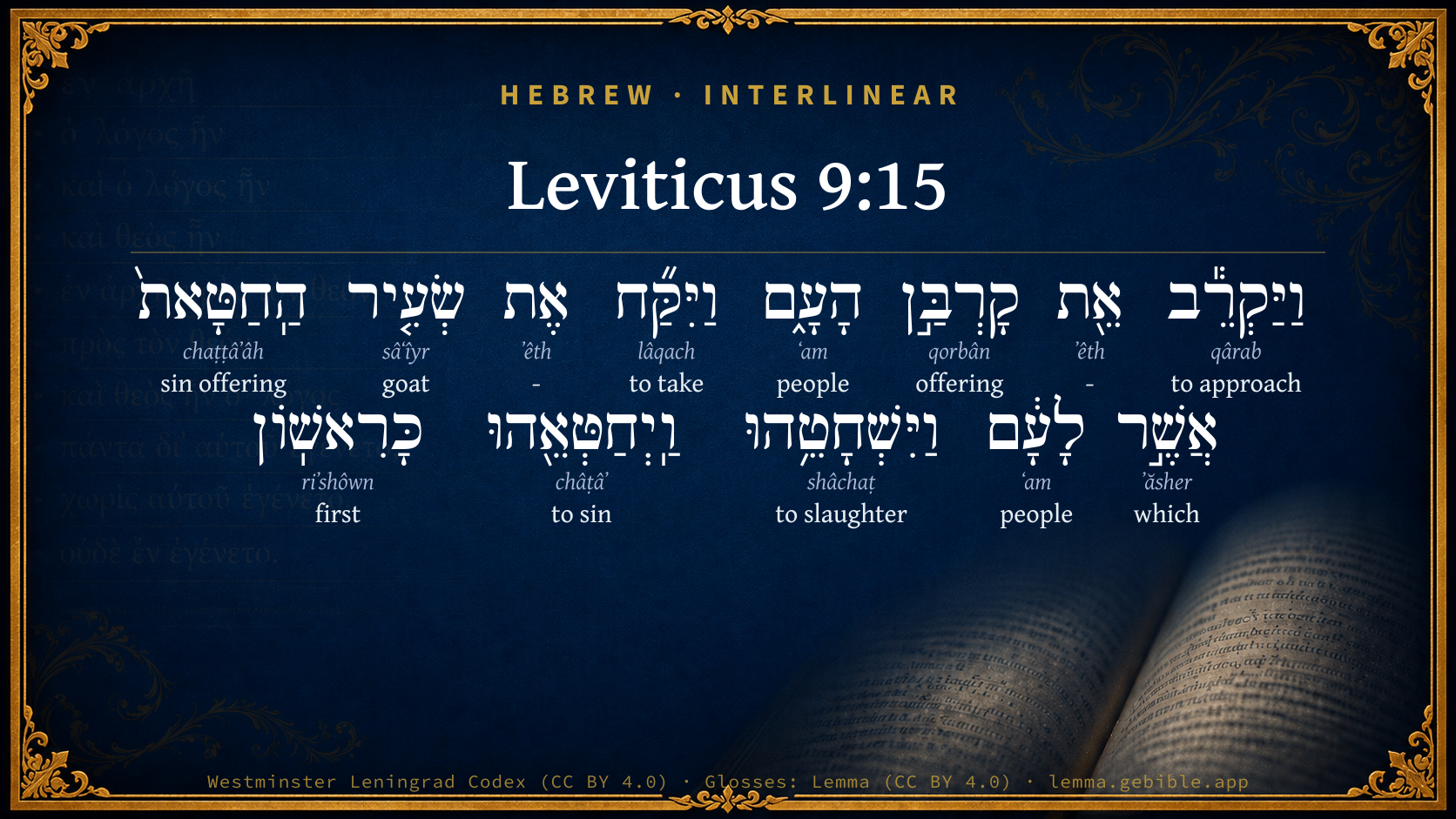
Hebrew (Westminster Leningrad Codex) Leviticus 9:15 appears in the Hebrew Old Testament. The text above is from the Westminster Leningrad Codex. Each word links to its Strong’s number, a concise gloss, and parsing drawn from the Open Scriptures Hebrew Bible morphology. Click any word for its full Brown-Driver-Briggs (BDB) entry.
Download image
Cite this verse

Leviticus 9:15 (World English Bible). Public Domain. Lemma interlinear Bible study tool, https://lemma.gebible.app/v/leviticus/9/15.

Show BibTeX & RIS
BibTeX
RIS
English Translation
He presented the people's offering, and took the goat of the sin offering which was for the people, and killed it, and offered it for sin, like the first.
World English Bible · Public Domain
Download a study sheet

One document with this verse’s original text, its word-by-word gloss line, the meaning frame, cross-references with their text, attributed commentary, and full source and license credits — printable, and it pastes into notes with its structure intact.

This verse Autodidact and up

Study sheet (.html) Plain text (.txt)

A passage Seminary Student

Up to 50 verses in one chapter. A passage sheet keeps up to 6 commentary sources and 12 cross-references per verse, in the order this page ranks them, and says so on the sheet whenever that leaves anything out. Ask for a single verse and you get the Autodidact verse sheet above.

Everything on this page stays free to read, with no account — the sheet is a download of what is already on screen, not access to it.

Want to remove ads? Support Godless Engineer
Compare translations 3

The same verse in 3 English versions, stacked beneath the original-language interlinear above. Click any original word for its lexicon entry.

Each is an independent rendering of the whole verse — the interlinear is not word-aligned to these translations.

Highlighted words mark where these versions differ — a whole-verse word diff, not a word-by-word alignment.

  • World English Bible Public Domain
    He presented the people's offering, and took the goat of the sin offering which was for the people, and killed it, and offered it for sin, like the first.
  • King James Version Public Domain
    And he brought the people's offering, and took the goat, which was the sin offering for the people, and slew it, and offered it for sin, as the first.
  • unfoldingWord Literal Text CC BY-SA 4.0
    And he presented the offering of the people. And he took the goat of the sin offering that for the people and he slaughtered it and he offered it as a sin offering, like the first.

unfoldingWord Literal Text — © unfoldingWord, licensed CC BY-SA 4.0. Word-aligned USFM3 via Door43 (git.door43.org/unfoldingWord/en_ult).

Versions to compare (up to 4)

3 of 4 selected

Show all 18 translations

Every available English version of this verse, each an independent rendering of the whole verse.

  • World English Bible Public Domain
    He presented the people's offering, and took the goat of the sin offering which was for the people, and killed it, and offered it for sin, like the first.
  • Berean Standard Bible Public Domain
    Aaron then presented the people’s offering. He took the male goat for the people’s sin offering, slaughtered it, and offered it for sin like the first one.
  • Majority Standard Bible Public Domain
    Aaron then presented the people’s offering. He took the male goat for the people’s sin offering, slaughtered it, and offered it for sin like the first one.
  • King James Version Public Domain
    And he brought the people's offering, and took the goat, which was the sin offering for the people, and slew it, and offered it for sin, as the first.
  • American Standard Version (1901) Public Domain
    And he presented the people's oblation, and took the goat of the sin-offering which was for the people, and slew it, and offered it for sin, as the first.
  • Revised Version (1885) Public Domain
    And he presented the people’s oblation, and took the goat of the sin offering which was for the people, and slew it, and offered it for sin, as the first.
  • Geneva Bible (1599) Public Domain
    Then he offred the peoples offring, and tooke a goate, which was the sinne offring for the people, and slewe it: and offred it for sinne, as the first:
  • Douay-Rheims (1899) Public Domain
    Then offering for the sin of the people, he slew the he goat: and expiating the altar,
  • Young's Literal Translation Public Domain
    And he bringeth near the offering of the people, and taketh the goat of the sin-offering which `is' for the people, and slaughtered it, and maketh it a sin-offering, like the first;
  • Literal Standard Version CC BY-SA 4.0
    And he brings the offering of the people near, and takes the goat of the sin-offering which [is] for the people, and slaughters it, and makes it a sin-offering, like the first;
  • Unlocked Literal Bible CC BY-SA 4.0
    Aaron presented the people's sacrifice—a goat, then took it as the sacrifice for their sin and killed it; he sacrificed it for sin, as he had done with the first goat.
  • unfoldingWord Literal Text CC BY-SA 4.0
    And he presented the offering of the people. And he took the goat of the sin offering that for the people and he slaughtered it and he offered it as a sin offering, like the first.
  • Darby Bible Public Domain
    And he presented the people's offering, and took the goat of the sin-offering which was for the people and slaughtered it, and offered it for sin, as the first.
  • World Messianic Bible Public Domain
    He presented the people’s offering, and took the goat of the sin offering which was for the people, and killed it, and offered it for sin, like the first.
  • Webster's Bible Public Domain
    And he brought the people's offering, and took the goat, which was the sin-offering for the people, and slew it, and offered it for sin, as the first.
  • Free Bible Version CC BY-SA 4.0
    Then Aaron presented the offerings of the people. He killed the male goat as the sin offering for the people, and offered it in the same way as his own sin offering.
  • Bible in Basic English Public Domain
    And he made an offering for the people and took the goat of the sin-offering for the people and put it to death, offering it for sin, in the same way as the first.
  • JPS Tanakh (1917) Public Domain
    And the people's offering was presented; and he took the goat of the sin-offering which was for the people, and slew it, and offered it for sin, as the first.

Literal Standard Version (2020), Covenant Press — licensed CC BY-SA 4.0. Text via the HelloAO Bible API (eBible.org). Unlocked Literal Bible (unfoldingWord) — licensed CC BY-SA 4.0. Text via the HelloAO Bible API (eBible.org). unfoldingWord Literal Text — © unfoldingWord, licensed CC BY-SA 4.0. Word-aligned USFM3 via Door43 (git.door43.org/unfoldingWord/en_ult). Free Bible Version, Dr. Jonathan Gallagher — licensed CC BY-SA 4.0. Text via the HelloAO Bible API (eBible.org).

Word by word

More ways to search: Search by grammar → Find every occurrence → Compare this word →

Practice this passage: Drill this verse → Learn its vocabulary →

שְׂעִ֤יר
sâʻîyr
H8163
“goat of”
Noun, Common, Masculine, Singular, Construct
Part of Speech
Noun
Type
Common
Gender
Masculine
Number
Singular
State
Construct
Full BDB Definition

Origin: from H8175

TWOT: 2274c , 2274e

hairy (adjective) - he-goat, buck (noun masculine) - as sacrificial animal - satyr, may refer to a demon possessed goat like the swine of Gadara ( Mat 8:30-32 )
  1. וַיַּקְרֵ֕ב qârab H7126 “and · to approach” Conjunction + Verb, Hiphil, Sequential Imperfect, 3rd Person, Masculine, Singular
  2. אֵ֖ת ʼêth H853 “-” Particle, Direct Object
  3. קָרְבַּ֣ן qorbân H7133 “offering of” Noun, Common, Masculine, Singular, Construct
  4. הָעָ֑ם ʻam H5971 “the · people” Particle, Definite Article + Noun, Common, Masculine, Singular, Absolute
  5. וַיִּקַּ֞ח lâqach H3947 “and · to take” Conjunction + Verb, Qal, Sequential Imperfect, 3rd Person, Masculine, Singular
  6. אֶת ʼêth H853 “-” Particle, Direct Object
  7. הַֽחַטָּאת֙ chaṭṭâʼâh H2403 “the · sin offering” Particle, Definite Article + Noun, Common, Feminine, Singular, Absolute
  8. אֲשֶׁ֣ר ʼăsher H834 “which” Particle, Relative
  9. לָעָ֔ם ʻam H5971 “to/for the · people” Preposition, Determined + Noun, Common, Masculine, Singular, Absolute
  10. וַיִּשְׁחָטֵ֥הוּ shâchaṭ H7819 “and · to slaughter · him” Conjunction + Verb, Qal, Sequential Imperfect, 3rd Person, Masculine, Singular + Suffix, Personal, 3rd Person, Masculine, Singular
  11. וַֽיְחַטְּאֵ֖הוּ châṭâʼ H2398 “and · to sin · him” Conjunction + Verb, Piel, Sequential Imperfect, 3rd Person, Masculine, Singular + Suffix, Personal, 3rd Person, Masculine, Singular
  12. כָּרִאשֽׁוֹן riʼshôwn H7223 “like/as the · first” Preposition, Determined + Adjective, Adjective, Masculine, Singular, Absolute

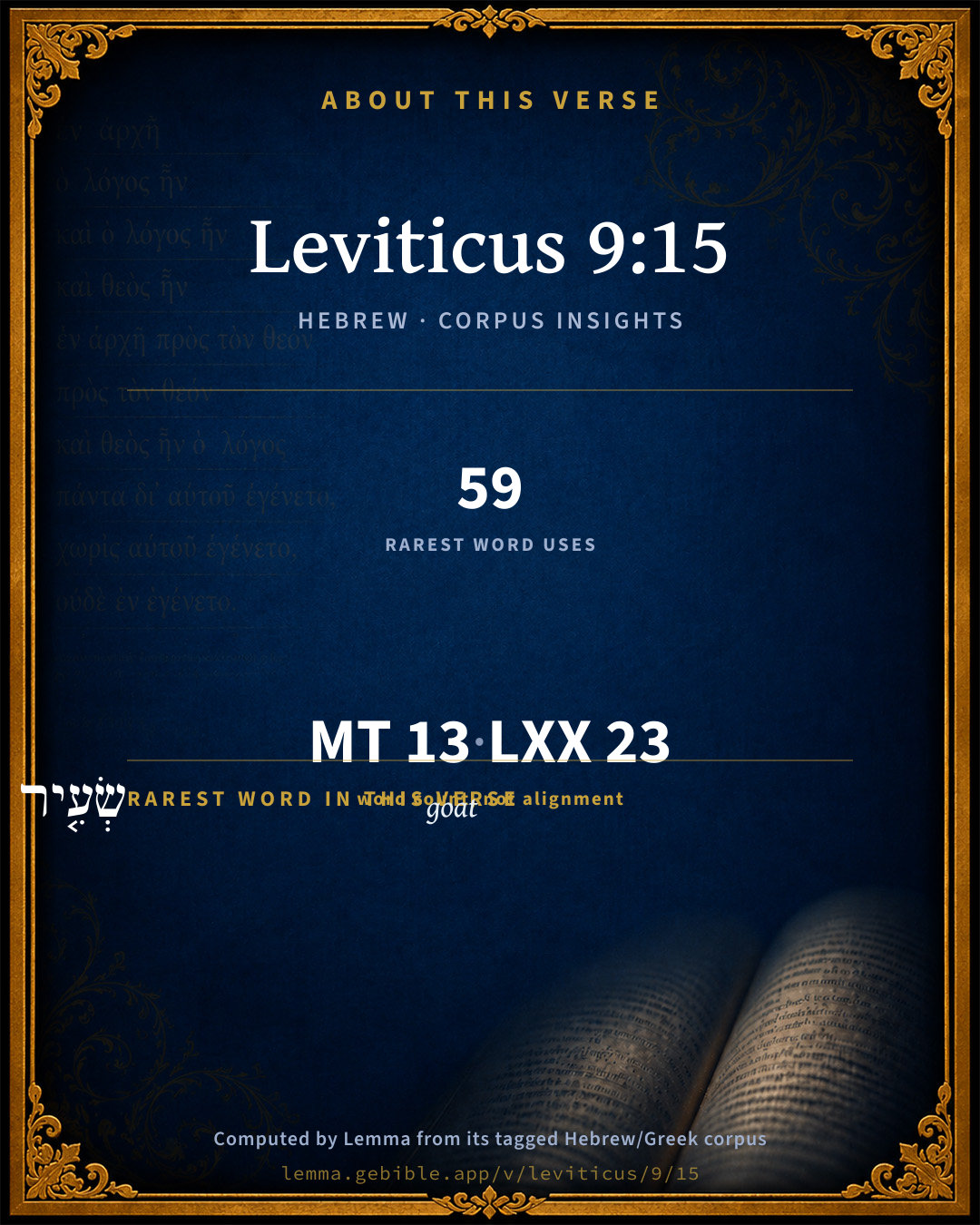
About this verse

These counts appear in no published source. They are computed here, from the morphology-tagged text and Lemma’s own curated glosses. What Lemma adds →

13
words
11
distinct lemmas
Pentateuch
section

Shared distinctive vocabulary

שְׂעִ֤יר goat H8163 occurs in 57 verses of the Hebrew Bible. Also found in:

Grammatical profile

  • 4 verbs
  • 5 nouns
  • 1 adjective
  • 3 particles

Verb forms

  • וַיַּקְרֵ֕ב Hiphil · Sequential Imperfect
  • וַיִּקַּ֞ח Qal · Sequential Imperfect
  • וַיִּשְׁחָטֵ֥הוּ Qal · Sequential Imperfect
  • וַֽיְחַטְּאֵ֖הוּ Piel · Sequential Imperfect

Repetition

A word recurs within this verse — often emphatic in Hebrew:

  • הָעָ֑ם people H5971 ×2

Hebrew & Septuagint length

In English translation the verse runs 29 words from the Hebrew and 28 from the Septuagint (LXX English) — closely comparable.

A rough comparison of the two English renderings, which tokenize alike — not a word-level alignment.

Word counts can differ between the Hebrew and the Greek without any difference in meaning — e.g. the Hebrew direct-object marker אֵת has no separate Greek word, and Greek often adds the article ὁ.

In the original languages it is 13 Hebrew tokens and 23 Greek tokens — but the two are counted differently (Hebrew bundles its prefixes and suffixes into one token; the Greek is in lemma form), so that isn’t a like-for-like length.

Cross-references

8

Topical passages linked to Leviticus 9:15 in the Treasury of Scripture Knowledge — connected by theme and wording, ordered by reader-vote popularity; previews shown in the World English Bible.

  • Leviticus 4:27–31 "'If anyone of the common people sins unwittingly, in doing any of the things which Yahweh has commanded not to be done, and is guilty;
  • Leviticus 9:3 You shall speak to the children of Israel, saying, 'Take a male goat for a sin offering; and a calf and a lamb, both a year old, without blemish, for a burnt offering;
  • Hebrews 2:17 Therefore he was obligated in all things to be made like his brothers, that he might become a merciful and faithful high priest in things pertaining to God, to make atonement for the sins of the people.
  • Hebrews 5:3 Because of this, he must offer sacrifices for sins for the people, as well as for himself.
  • Numbers 28:1–29 Yahweh spoke to Moses, saying,
  • Isaiah 53:10 Yet it pleased Yahweh to bruise him; he has put him to grief: when you shall make his soul an offering for sin, he shall see [his] seed, he shall prolong his days, and the pleasure of Yahweh shall prosper in his hand.
  • 2 Corinthians 5:21 For him who knew no sin he made to be sin on our behalf; so that in him we might become the righteousness of God.
  • Titus 2:14 who gave himself for us, that he might redeem us from all iniquity, and purify for himself a people for his own possession, zealous for good works.

Cross-references courtesy of OpenBible.info (CC BY 4.0).

Hebrew and Greek witnesses Masoretic Hebrew ↔ Greek Septuagint

The same verse in the two great witnesses to the Old Testament, shown verse-for-verse.

These are two independent witnesses, not word-aligned to each other, and the Septuagint is shown in lemma (dictionary) form.

Hebrew Leviticus 9:15 Masoretic · Westminster Leningrad Codex

וַיַּקְרֵ֕ב אֵ֖ת קָרְבַּ֣ן הָעָ֑ם וַיִּקַּ֞ח אֶת שְׂעִ֤יר הַֽחַטָּאת֙ אֲשֶׁ֣ר לָעָ֔ם וַיִּשְׁחָטֵ֥הוּ וַֽיְחַטְּאֵ֖הוּ כָּרִאשֽׁוֹן

He presented the people's offering, and took the goat of the sin offering which was for the people, and killed it, and offered it for sin, like the first.

World English Bible · Public Domain

Greek LXX Leviticus 9:15 Septuagint · lemma form

καί προςφέρω ὁ δῶρον ὁ λαός καί λαμβάνω ὁ χίμαρος ὁ περί ὁ ἁμαρτία ὁ λαός καί σφάζω αὐτός καθά καί ὁ πρῶτος

And he brought the gift of the people, and took the goat of the sin-offering of the people, and killed it, and purified it as also the first.

LXX2012 (modern English Septuagint) · Public Domain

Hebrew: Westminster Leningrad Codex (CC BY 4.0). Greek: Septuagint (public domain); English from LXX2012 (modern English Septuagint) (Public Domain). How the Septuagint differs from the Hebrew →

Targum (Aramaic paraphrase)

2

The Targum is the ancient Jewish Aramaic paraphrase of the Hebrew Scriptures — an interpretive translation, not the Hebrew text itself. Onkelos (literal) and Pseudo-Jonathan (expansive) render the Torah, and Jonathan the Prophets. Coverage is partial: where no permissively-licensed English translation exists for a verse, only the Aramaic is shown. This is verse-level text, not a word-by-word alignment to the Hebrew.

  1. Targum Onkelos Torah (Genesis–Deuteronomy)
    וְקָרֵב יָת קֻרְבַּן עַמָא וּנְסִב יָת צְפִירָא דְחַטָאתָא דִי לְעַמָא וְנָכְסֵהּ וְכַפֵּר בִּדְמֵהּ כְּקַדְמָאָה

    (no public-domain English translation for this verse)

    Targum Onkelos — Aramaic: “Onkelos Genesis” (public domain); “Onkelos Exodus” (public domain); “Onkelos Leviticus” (public domain); “Onkelos Numbers” (public domain); “Onkelos Deuteronomy” (public domain). English: “Sefaria Community Translation” (CC0 1.0 (public-domain dedication)); “J.W. Etheridge. The Targums of Onkelos and Jonathan Ben Uzziel on the Pentateuch. London: Longmans, Green, 1862” (public domain). Text via Sefaria.

  2. Targum Pseudo-Jonathan Torah (Genesis–Deuteronomy)
    וּקְרֵיב יַת קָרְבַּן עַמָא וּנְסֵיב יַת צְפִירָא דְחַטָאתָא דִי לְעַמָא וְנַכְסֵיהּ וְכַפֵּר בְּאַדְמֵיהּ דִצְפִירָא הֵי כְמָא דִכְפַּר בַּאֲדַם עֵיגְלָא דְחַטָאתָא דִילֵיהּ דְקָרֵב בְּשֵׁירוּיָא

    And they brought the oblation of the people. And he took the goat for the people's sin offering and killed it, and made atonement with the blood of the goat, as he had made atonement with the blood of the calf of the sin offering for himself, which he had offered before.

    Targum Pseudo-Jonathan — Aramaic: “Targum Jonathan on Genesis” (public domain); “Targum Jonathan on Exodus” (public domain); “Targum Jonathan on Leviticus” (public domain); “Targum Jonathan on Numbers” (public domain); “Targum Jonathan on Deuteronomy” (public domain). English: “The Targum of Jonathan ben Uzziel, trans. J. W. Etheridge, London, 1862” (public domain). Text via Sefaria.

Commentary

Notes on Leviticus 9:15 from classic Christian and Jewish commentators (each source and its license shown beneath its notes). The classic Christian expositions comment on the surrounding passage and are grouped to its opening verse, so a note may address several verses; the Jewish commentaries on the Tanakh (Rashi and others) are per-verse, so they appear only where the commentator wrote on this verse.

Lemma curates 59 commentaries, every one of them public domain or Creative Commons licensed, each selected and text-cleaned for this edition rather than reprinted as found. About our sources →

Whedon's Commentary on the Bible

Daniel D. Whedon

THE OFFERINGS FOR ISRAEL, Lev_9:15-21.

15. The people’s offering — This was offered in the proper order; first, the sin offering for the expiation of their sins, then the burnt offering, by which the people dedicated themselves to God, followed by the meat offering as a medium of communion, and the peace offering as the vehicle of their thanksgivings.

Offered it for sin — Literally, as noted by various critics, He sinned it, or, He made it to sin. The sin offering was so identified with the sin for which it was to atone as to become itself the sinner, not actually but by imputation. The animal thus figuratively received upon its head the guilt of him who substituted its life for his own, and it was viewed and treated as a creature which was nothing but sin. 2Co_5:21, note.

Daniel D. Whedon (gen. ed.), Commentary on the Old and New Testaments (1874–1909) — public domain. Text from a community e-Sword module.

Ellicott's Commentary for English Readers

(15) And he brought the people’s offering.—Being reconciled to God by the atoning sacrifice which he offered for his own share in the sin, Aaron was now qualified to offer the sin offering of the people.

As the first.—The ritual in this sacrifice Aaron conducted in the same manner as in the foregoing one offered for himself. (See Lev_9:8.) He accordingly burnt the flesh without the camp, for which he was reproved by Moses.

A Bible Commentary for English Readers, edited by Charles John Ellicott (1878–1897) — public domain. Text from a community e-Sword module.

The Cambridge Bible for Schools and Colleges

gen. ed. J. J. S. Perowne

(2) The offerings for the people (15–21)

15. The Sin-Offering for the people is offered ‘as the first’ i.e. in the same way as Aaron’s Sin-Offering; the blood is not brought into the tabernacle, and the sacrifice is wholly consumed. This treatment gives rise to the question of Lev_10:16.

The Cambridge Bible for Schools and Colleges (gen. ed. J. J. S. Perowne; Cambridge University Press, 1878–1918) — public domain. Text from a community e-Sword module.

John Gill's Exposition

And he brought the burnt offering,.... The calf and the lamb, Lev 9:3.

and offered it according to the manner; judgment, ordinance, and appointment of God respecting that sort of offerings; see Lev 1:1.

John Gill's Exposition of the Whole Bible (1746–1763) — public domain (CC PDM 1.0). Text via the HelloAO Bible API.

Albert Barnes' Notes on the Bible

In this first complete series of offerings made by the high priest, the sacrifices take their appointed order; first, the sin-offering to make atonement; then the burnt-offering, to signify the surrender of the body, soul and spirit to Yahweh in heaven; and lastly the peace-offering, to show forth the communion vouchsafed to those who are justified and sanctified. See Lev 8:14 note.

Albert Barnes' Notes on the Bible (1834–1885) — public domain. Text from a community e-Sword/MySword module.

Haydock's Catholic Bible Commentary

And expiating the altar. Hebrew, "he offered it (the goat) for sin, as the first," for himself, placing the parts of the victim upon his own holocaust. (Haydock) --- The Chaldean says, "he expiated the altar with the blood of the he-goat, as he did before."

George Leo Haydock (1774–1849), Haydock's Catholic Family Bible and Commentary, 1859 edition — public domain. Excludes Psalms (Douay-Rheims chapter numbering differs from Protestant) and Deuterocanonical books (Catholic canon only).

Matthew Poole's English Annotations

This was to be offered for the people, as the former was for himself, Lev 9:7.

As the first, to wit, in like manner as he did that for the priest, Lev 9:8, and consequently burnt this, as he did the other, Lev 9:11, for which Moses reproves him, Lev 10:17.

Matthew Poole's English Annotations on the Holy Bible (1683–1685) — public domain. Text from a community e-Sword/MySword module.

The Pulpit Commentary

Vers. 15-21. The people"s sin offering, burnt off, ring, meat offering, and peace offerings follow. The meat offering is said to have been burnt upon the altar, beside the burnt sacrifice of the morning. It is probable that, on this occasion, the people"s burnt offering, which consisted of a calf and a lamb, took the place of the ordinary morning sacrifice of a lamb. (Exo_29:38) Aaron is said to have offered the burnt offering according to the manner, or, as it is given in the margin, ordinance, that is, he burnt the flesh on the altar; (Lev_1:7-9) he also burnt the handful of the meat offering, and he burnt the fat of the peace offering, upon the altar. He had previously burnt the fat of his own sin offering, and the flesh of his burnt offering. Fire, therefore, was present upon the altar, and was used by Aaron, as by Moses, for sacrificial purposes before the fire came out from the Lord as described in verse 24.

The Pulpit Commentary (1880–1919), ed. H.D.M. Spence-Jones & Joseph S. Exell — public domain. Text from a community e-Sword module.

Keil & Delitzsch

C. F. Keil & F. Delitzsch

Of the sacrifices of the nation, Aaron presented the sin-offering in the same manner as the first, i.e., the one offered for himself (Lev 9:8.). The blood of this sin-offering, which was presented for the congregation, was not brought into the holy place according to the rule laid down in Lev 7:16., but only applied to the horns of the altar of burnt-offering; for the same reason as in the previous case (Lev 9:8.), viz., because the object was not to expiate any particular sin, or the sins of the congregation that had been committed in the course of time and remained unatoned for, but simply to place the sacrificial service of the congregation in its proper relation to the Lord. Aaron was reproved by Moses, however, for having burned the flesh (Lev 10:16.), but was able to justify it (see at Lev 10:16-20). The sin-offering (Lev 9:16) was also offered "according to the right" (as in Lev 5:10). Then followed the meat-offering (Lev 9:17), of which Aaron burned a handful upon the altar (according to the rule in Lev 2:1-2). He offered this in addition to the morning burnt-offering (Exo 29:39), to which a meat-offering also belonged (Exo 29:40), and with which, according to Lev 6:12., the special meat-offering of the priests was associated. Last of all (Lev 9:18-21) there followed the peace-offering, which was also carried out according to the general rule. In המכסּה, "the covering" (Lev 9:19), the two fat portions mentioned in Lev 3:3 are included. The fat portions were laid upon the breast-pieces by the sons of Aaron, and then handed by them to Aaron, the fat to be burned upon the altar, the breast to be waved along with the right leg, according to the instructions in Lev 7:30-36. The meat-offering of pastry, which belonged to the peace-offering according to Lev 7:12-13, is not specially mentioned.

Keil & Delitzsch — Biblical Commentary on the Old Testament (1861–1891) — public domain (CC PDM 1.0). Text via the HelloAO Bible API. (Old Testament only.)

unfoldingWord translationNotes

Door43 World Missions Community

the first goat

The word "first" is the ordinal number for one. AT: "the goat for his own offering" (See: Ordinal Numbers)

along with the morning's burnt offering

This refers to the first sacrifice of each day. The priests would offer this burnt sacrifice in the morning before any other sacrifice. The full meaning of this statement can be made explicit. (See: Assumed Knowledge and Implicit Information)

translationWords

Aaron

people group

sacrifice

goat

sin

burnt offering

Yahweh

command

grain offering

altar

unfoldingWord translationNotes — © Distant Shores Media and the Door43 World Missions Community, licensed CC BY-SA 4.0. Source: git.door43.org/Door43/en_tn.

Rashi

Rabbi Shlomo Yitzchaki (Rashi)

ויחטאהו means: he treated it according to the regulation regarding the חטאת, “sin-offering”.

כראשון AS THE FIRST — as his own calf (as is described in v. 8).

Rashi on the Tanakh — English translations: “The Judaica Press complete Tanach with Rashi, translated by A. J. Rosenberg” (CC BY 4.0); “Pentateuch with Rashi's commentary by M. Rosenbaum and A.M. Silbermann, 1929-1934” (public domain); “The Metsudah Tanach series, Lakewood, N.J” (CC BY 4.0); and “The Book of Joshua, Metsudah Publications, 1997” (CC BY 4.0). Text via Sefaria.

Lesson kit

Teaching starters — assembled from the data on this page, not authored interpretation. Every prompt links to the verse data it draws on. Edit before teaching.

Leviticus, in the Pentateuch, opens this verse with 13 words (11 distinct Hebrew lemmas). Its most distinctive word is sâʻîyr (“goat”). A historical commentator’s framing appears above. Read the whole chapter for the surrounding context.

Discussion questions

  1. How does “goat” (sâʻîyr) shape what this verse is saying?
  2. How does Genesis 27:11, which shares the word «goat», read alongside this verse?
  3. What does the repetition of “people” (2× in this one verse) do in this verse?
  4. The translations on this page render this verse differently — a whole-verse word diff, not a word-by-word alignment. What might account for the different wordings?
  5. «וַיַּקְרֵ֕ב» is a Hiphil Sequential Imperfect verb. How does that grammatical form shape the action described?
  6. Compare how Whedon's Commentary on the Bible and Ellicott's Commentary for English Readers read this verse. Where do they agree or differ?

Things to notice

Reading settings

Reading text

Shown beneath each verse's original-language words.

Old Testament
Old Testament edition

Read the OT as the Masoretic Hebrew (MT) or the Greek Septuagint (LXX).

English shown for the Greek Septuagint (in the Hebrew ↔ Greek comparison).

Comparing translations? Open the Compare panel on any verse page to stack up to four side by side.