
Leviticus 7:12

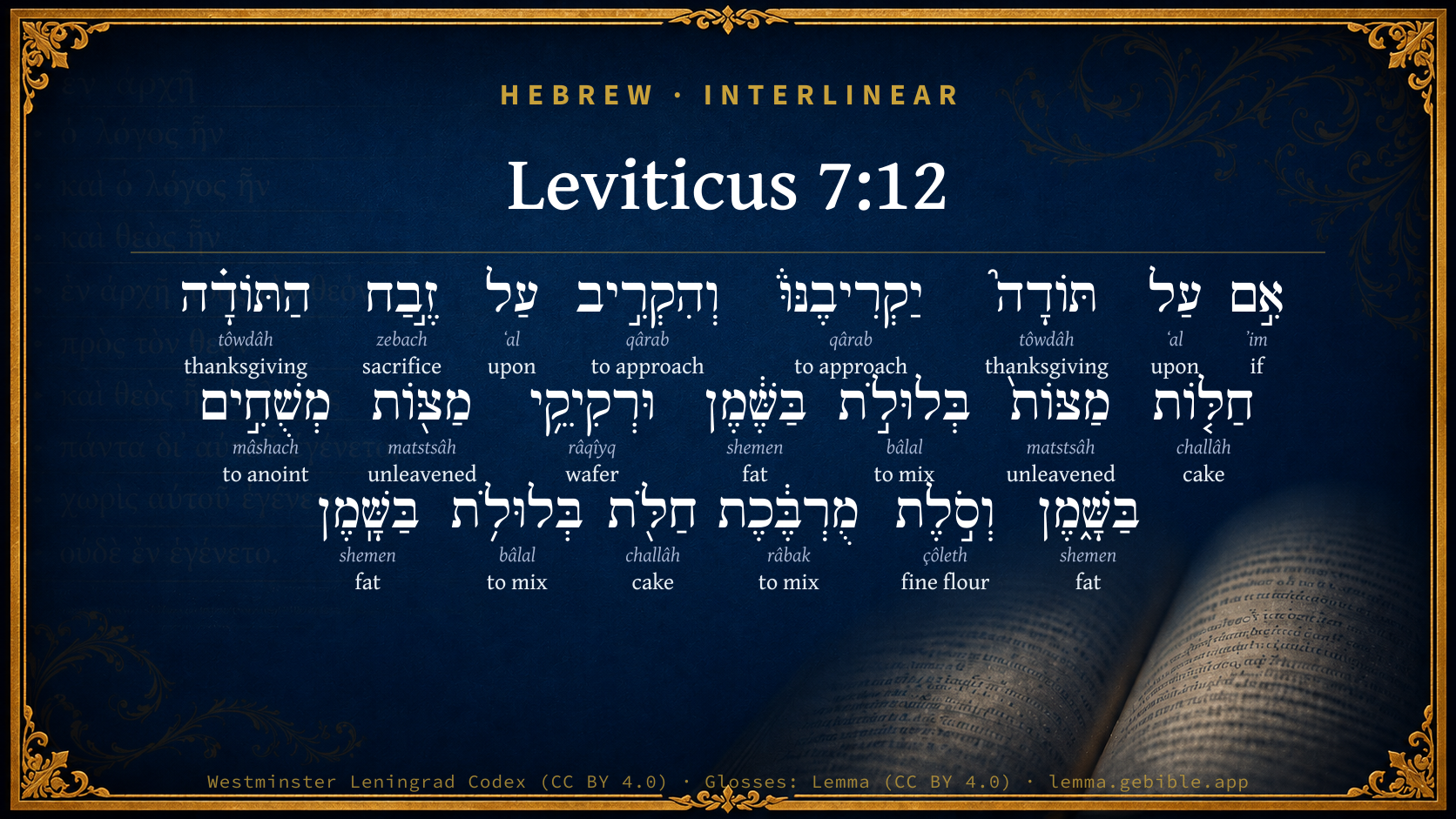
Hebrew (Westminster Leningrad Codex) Leviticus 7:12 appears in the Hebrew Old Testament. The text above is from the Westminster Leningrad Codex. Each word links to its Strong’s number, a concise gloss, and parsing drawn from the Open Scriptures Hebrew Bible morphology. Click any word for its full Brown-Driver-Briggs (BDB) entry.
Download image
Cite this verse

Leviticus 7:12 (World English Bible). Public Domain. Lemma interlinear Bible study tool, https://lemma.gebible.app/v/leviticus/7/12.

Show BibTeX & RIS
BibTeX
RIS
English Translation
If he offers it for a thanksgiving, then he shall offer with the sacrifice of thanksgiving unleavened cakes mixed with oil, and unleavened wafers anointed with oil, and cakes mixed with oil.
World English Bible · Public Domain
Highlights Full analysis ↓
Download a study sheet

One document with this verse’s original text, its word-by-word gloss line, the meaning frame, cross-references with their text, attributed commentary, and full source and license credits — printable, and it pastes into notes with its structure intact.

This verse Autodidact and up

Study sheet (.html) Plain text (.txt)

A passage Seminary Student

Up to 50 verses in one chapter. A passage sheet keeps up to 6 commentary sources and 12 cross-references per verse, in the order this page ranks them, and says so on the sheet whenever that leaves anything out. Ask for a single verse and you get the Autodidact verse sheet above.

Everything on this page stays free to read, with no account — the sheet is a download of what is already on screen, not access to it.

Want to remove ads? Support Godless Engineer
Compare translations 3

The same verse in 3 English versions, stacked beneath the original-language interlinear above. Click any original word for its lexicon entry.

Each is an independent rendering of the whole verse — the interlinear is not word-aligned to these translations.

Highlighted words mark where these versions differ — a whole-verse word diff, not a word-by-word alignment.

  • World English Bible Public Domain
    If he offers it for a thanksgiving, then he shall offer with the sacrifice of thanksgiving unleavened cakes mixed with oil, and unleavened wafers anointed with oil, and cakes mixed with oil.
  • King James Version Public Domain
    If he offer it for a thanksgiving, then he shall offer with the sacrifice of thanksgiving unleavened cakes mingled with oil, and unleavened wafers anointed with oil, and cakes mingled with oil, of fine flour, fried.
  • unfoldingWord Literal Text CC BY-SA 4.0
    If he will present it for thanksgiving, then he shall present with the sacrifice of thanksgiving loaves of unleavened bread mixed with oil, and biscuits of unleavened bread anointed with oil, and mixed flour loaves mixed with oil.

unfoldingWord Literal Text — © unfoldingWord, licensed CC BY-SA 4.0. Word-aligned USFM3 via Door43 (git.door43.org/unfoldingWord/en_ult).

Versions to compare (up to 4)

3 of 4 selected

Show all 18 translations

Every available English version of this verse, each an independent rendering of the whole verse.

  • World English Bible Public Domain
    If he offers it for a thanksgiving, then he shall offer with the sacrifice of thanksgiving unleavened cakes mixed with oil, and unleavened wafers anointed with oil, and cakes mixed with oil.
  • Berean Standard Bible Public Domain
    If he offers it in thanksgiving, then along with the sacrifice of thanksgiving he shall offer unleavened cakes mixed with olive oil, unleavened wafers coated with oil, and well-kneaded cakes of fine flour mixed with oil.
  • Majority Standard Bible Public Domain
    If he offers it in thanksgiving, then along with the sacrifice of thanksgiving he shall offer unleavened cakes mixed with olive oil, unleavened wafers coated with oil, and well-kneaded cakes of fine flour mixed with oil.
  • King James Version Public Domain
    If he offer it for a thanksgiving, then he shall offer with the sacrifice of thanksgiving unleavened cakes mingled with oil, and unleavened wafers anointed with oil, and cakes mingled with oil, of fine flour, fried.
  • American Standard Version (1901) Public Domain
    If he offer it for a thanksgiving, then he shall offer with the sacrifice of thanksgiving unleavened cakes mingled with oil, and unleavened wafers anointed with oil, and cakes mingled with oil, of fine flour soaked.
  • Revised Version (1885) Public Domain
    If he offer it for a thanksgiving, then he shall offer with the sacrifice of thanksgiving unleavened cakes mingled with oil, and unleavened wafers anointed with oil, and cakes mingled with oil, of fine flour soaked.
  • Geneva Bible (1599) Public Domain
    If he offer it to giue thankes, then he shall offer for his thankes offering, vnleauened cakes mingled with oyle, and vnleauened wafers anointed with oyle, and fine floure fryed with the cakes mingled with oyle.
  • Douay-Rheims (1899) Public Domain
    If the oblation be for thanksgiving, they shall offer leaves without leaven tempered with oil, and unleavened wafers anointed with oil, and fine flour fried, and cakes tempered and mingled with oil:
  • Young's Literal Translation Public Domain
    if for a thank-offering he bring it near, then he hath brought near with the sacrifice of thank-offering unleavened cakes mixed with oil, and thin unleavened cakes anointed with oil, and of fried flour cakes mixed with oil;
  • Literal Standard Version CC BY-SA 4.0
    if he brings it near for a thank-offering, then he has brought near with the sacrifice of thank-offering unleavened cakes mixed with oil, and thin unleavened cakes anointed with oil, and of stirred flour cakes mixed with oil;
  • Unlocked Literal Bible CC BY-SA 4.0
    If anyone offers it in order to give thanks, then he must offer it with a sacrifice of cakes made without yeast, but mixed with oil, of cakes made without yeast, but spread with oil, and of cakes made with fine flour that is mixed with oil.
  • unfoldingWord Literal Text CC BY-SA 4.0
    If he will present it for thanksgiving, then he shall present with the sacrifice of thanksgiving loaves of unleavened bread mixed with oil, and biscuits of unleavened bread anointed with oil, and mixed flour loaves mixed with oil.
  • Darby Bible Public Domain
    If he present it for a thanksgiving, then he shall present with the sacrifice of thanksgiving unleavened cakes mingled with oil, and unleavened wafers anointed with oil, and fine flour saturated with oil, cakes mingled with oil.
  • World Messianic Bible Public Domain
    If he offers it for a thanksgiving, then he shall offer with the sacrifice of thanksgiving unleavened cakes mixed with oil, and unleavened wafers anointed with oil, and cakes mixed with oil.
  • Webster's Bible Public Domain
    If he shall offer it for a thanksgiving, then he shall offer with the sacrifice of thanksgiving unleavened cakes mingled with oil, and unleavened wafers anointed with oil, and cakes mingled with oil, of fine flour, fried.
  • Free Bible Version CC BY-SA 4.0
    If you offer it in a spirit of thanks, then along with the sacrifice of thanksgiving, you must offer bread, wafers, and well-kneaded cakes of the best flour all made without yeast and mixed or coated with olive oil.
  • Bible in Basic English Public Domain
    If any man gives his offering as a praise-offering, then let him give with the offering, unleavened cakes mixed with oil and thin unleavened cakes covered with oil and cakes of the best meal well mixed with oil.
  • JPS Tanakh (1917) Public Domain
    If he offer it for a thanksgiving, then he shall offer with the sacrifice of thanksgiving unleavened cakes mingled with oil, and unleavened wafers spread with oil, and cakes mingled with oil, of fine flour soaked.

Literal Standard Version (2020), Covenant Press — licensed CC BY-SA 4.0. Text via the HelloAO Bible API (eBible.org). Unlocked Literal Bible (unfoldingWord) — licensed CC BY-SA 4.0. Text via the HelloAO Bible API (eBible.org). unfoldingWord Literal Text — © unfoldingWord, licensed CC BY-SA 4.0. Word-aligned USFM3 via Door43 (git.door43.org/unfoldingWord/en_ult). Free Bible Version, Dr. Jonathan Gallagher — licensed CC BY-SA 4.0. Text via the HelloAO Bible API (eBible.org).

Word by word

More ways to search: Search by grammar → Find every occurrence → Compare this word →

Practice this passage: Drill this verse → Learn its vocabulary →

מֻרְבֶּ֔כֶת
râbak
H7246
“mixed”
Verb, Hophal, Participle Passive, Feminine, Singular, Absolute
Part of Speech
Verb
Stem
Hophal
Form
Participle Passive
Gender
Feminine
Number
Singular
State
Absolute
Full BDB Definition

Origin: a primitive root

TWOT: 2105

to mix, stir - (Hophal) to be mixed
  1. אִ֣ם ʼim H518 “if” Conjunction
  2. עַל ʻal H5921 “upon” Preposition
  3. תּוֹדָה֮ tôwdâh H8426 “thanksgiving” Noun, Common, Feminine, Singular, Absolute
  4. יַקְרִיבֶנּוּ֒ qârab H7126 “to approach · him” Verb, Hiphil, Imperfect, 3rd Person, Masculine, Singular + Suffix, Personal, 3rd Person, Masculine, Singular
  5. וְהִקְרִ֣יב qârab H7126 “and · to approach” Conjunction + Verb, Hiphil, Sequential Perfect, 3rd Person, Masculine, Singular
  6. עַל ʻal H5921 “upon” Preposition
  7. זֶ֣בַח zebach H2077 “sacrifice of” Noun, Common, Masculine, Singular, Construct
  8. הַתּוֹדָ֗ה tôwdâh H8426 “the · thanksgiving” Particle, Definite Article + Noun, Common, Feminine, Singular, Absolute
  9. חַלּ֤וֹת challâh H2471 “cakes” Noun, Common, Feminine, Plural, Absolute
  10. מַצּוֹת֙ matstsâh H4682 “unleavened bread” Noun, Common, Feminine, Plural, Absolute
  11. בְּלוּלֹ֣ת bâlal H1101 “mixed” Verb, Qal, Participle Passive, Feminine, Plural, Absolute
  12. בַּשֶּׁ֔מֶן shemen H8081 “in/at the · fat” Preposition, Determined + Noun, Common, Masculine, Singular, Absolute
  13. וּרְקִיקֵ֥י râqîyq H7550 “and · wafers of” Conjunction + Noun, Common, Masculine, Plural, Construct
  14. מַצּ֖וֹת matstsâh H4682 “unleavened bread” Noun, Common, Feminine, Plural, Absolute
  15. מְשֻׁחִ֣ים mâshach H4886 “anointed” Verb, Qal, Participle Passive, Masculine, Plural, Absolute
  16. בַּשָּׁ֑מֶן shemen H8081 “in/at the · fat” Preposition, Determined + Noun, Common, Masculine, Singular, Absolute
  17. וְסֹ֣לֶת çôleth H5560 “and · fine flour” Conjunction + Noun, Common, Feminine, Singular, Absolute
  18. חַלֹּ֖ת challâh H2471 “cakes” Noun, Common, Feminine, Plural, Absolute
  19. בְּלוּלֹ֥ת bâlal H1101 “mixed” Verb, Qal, Participle Passive, Feminine, Plural, Absolute
  20. בַּשָּֽׁמֶן shemen H8081 “in/at the · fat” Preposition, Determined + Noun, Common, Masculine, Singular, Absolute

About this verse

These counts appear in no published source. They are computed here, from the morphology-tagged text and Lemma’s own curated glosses. What Lemma adds →

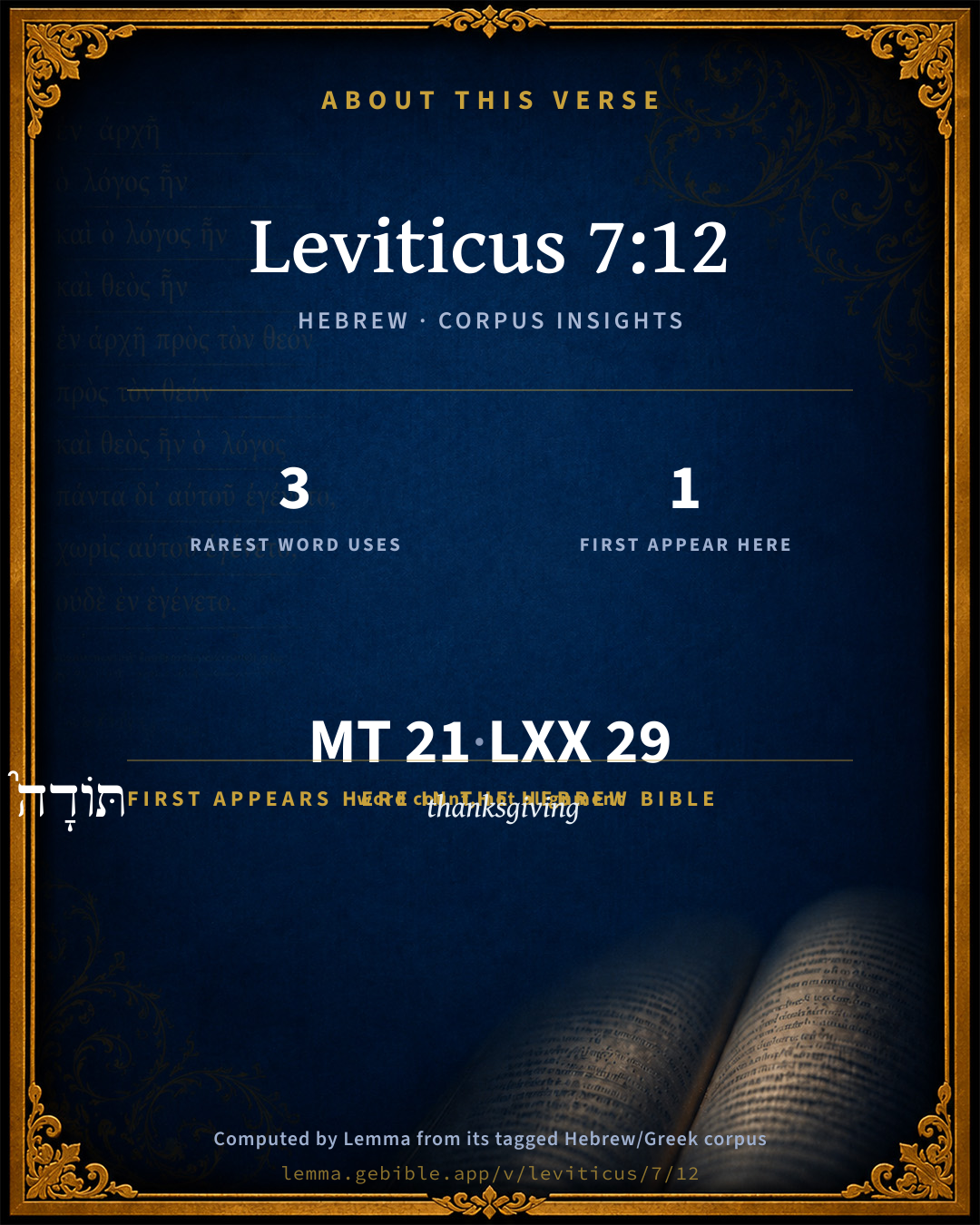
21
words
13
distinct lemmas
Pentateuch
section

Notable vocabulary

The rarest word here is מֻרְבֶּ֔כֶת to mix H7246 — appearing just 3 times in the whole Hebrew Bible.

First appearance in Scripture

This word makes its first canonical appearance in the Hebrew Bible here:

  • תּוֹדָה֮ thanksgiving H8426

Shared distinctive vocabulary

מֻרְבֶּ֔כֶת to mix H7246 occurs in 3 verses of the Hebrew Bible. Also found in:

Grammatical profile

  • 6 verbs
  • 12 nouns
  • 2 prepositions
  • 1 conjunction

Verb forms

  • יַקְרִיבֶנּוּ֒ Hiphil · Imperfect
  • וְהִקְרִ֣יב Hiphil · Sequential Perfect
  • בְּלוּלֹ֣ת Qal · Participle Passive
  • מְשֻׁחִ֣ים Qal · Participle Passive
  • מֻרְבֶּ֔כֶת Hophal · Participle Passive
  • בְּלוּלֹ֥ת Qal · Participle Passive

Repetition

Words recur within this verse — often emphatic in Hebrew:

  • בַּשֶּׁ֔מֶן fat H8081 ×3
  • עַל upon H5921 ×2
  • תּוֹדָה֮ thanksgiving H8426 ×2
  • יַקְרִיבֶנּוּ֒ to approach H7126 ×2
  • חַלּ֤וֹת cake H2471 ×2
  • מַצּוֹת֙ unleavened H4682 ×2
  • בְּלוּלֹ֣ת to mix H1101 ×2

Hebrew & Septuagint length

In English translation the verse runs 32 words from the Hebrew and 7 from the Septuagint (LXX English) — the Septuagint runs noticeably shorter here. See the side-by-side →

A rough comparison of the two English renderings, which tokenize alike — not a word-level alignment.

Word counts can differ between the Hebrew and the Greek without any difference in meaning — e.g. the Hebrew direct-object marker אֵת has no separate Greek word, and Greek often adds the article ὁ.

In the original languages it is 21 Hebrew tokens and 29 Greek tokens — but the two are counted differently (Hebrew bundles its prefixes and suffixes into one token; the Greek is in lemma form), so that isn’t a like-for-like length.

Cross-references

23

Topical passages linked to Leviticus 7:12 in the Treasury of Scripture Knowledge — connected by theme and wording, ordered by reader-vote popularity; previews shown in the World English Bible.

  • Leviticus 2:4 "'When you offer an offering of a meal offering baked in the oven, it shall be unleavened cakes of fine flour mixed with oil, or unleavened wafers anointed with oil.
  • Numbers 6:15 and a basket of unleavened bread, cakes of fine flour mixed with oil, and unleavened wafers anointed with oil, and their meal offering, and their drink offerings.
  • 1 Peter 2:5 You also, as living stones, are built up as a spiritual house, to be a holy priesthood, to offer up spiritual sacrifices, acceptable to God through Jesus Christ.
  • Psalms 107:8 Let them praise Yahweh for his loving kindness, For his wonderful works to the children of men!
  • Psalms 107:21–22 Let them praise Yahweh for his loving kindness, For his wonderful works to the children of men!
  • Psalms 116:17 I will offer to you the sacrifice of thanksgiving, And will call on the name of Yahweh.
  • Hosea 14:2 Take words with you, and return to Yahweh. Tell him, "Forgive all our sins, And accept that which is good: So we offer like bulls our lips.
  • Luke 17:16 He fell on his face at Jesus' feet, giving him thanks; and he was a Samaritan.
  • Luke 17:18 Were there none found who returned to give glory to God, except this stranger?"
  • Romans 1:21 Because, knowing God, they didn't glorify him as God, neither gave thanks, but became vain in their reasoning, and their senseless heart was darkened.
  • 2 Corinthians 9:11–15 you being enriched in everything to all liberality, which works through us thanksgiving to God.
  • Ephesians 5:20 giving thanks always concerning all things in the name of our Lord Jesus Christ, to God, even the Father;
  • Hebrews 13:15 Through him, then, let us offer up a sacrifice of praise to God continually, that is, the fruit of lips which make confession to his name.
  • Leviticus 6:16 That which is left of it Aaron and his sons shall eat. It shall be eaten without yeast in a holy place. They shall eat it in the court of the Tent of Meeting
  • Leviticus 7:15 The flesh of the sacrifice of his peace offerings for thanksgiving shall be eaten on the day of his offering. He shall not leave any of it until the morning.
  • Leviticus 22:29 "When you sacrifice a sacrifice of thanksgiving to Yahweh, you shall sacrifice it so that you may be accepted.
  • 2 Chronicles 29:31 Then Hezekiah answered, Now you have consecrated yourselves to Yahweh; come near and bring sacrifices and thank-offerings into the house of Yahweh. The assembly brought in sacrifices and thank-offerings; and as many as were of a willing heart [brought] burnt offerings.
  • 2 Chronicles 33:16 He built up the altar of Yahweh, and offered thereon sacrifices of peace-offerings and of thanksgiving, and commanded Judah to serve Yahweh, the God of Israel.
  • Nehemiah 12:43 They offered great sacrifices that day, and rejoiced; for God had made them rejoice with great joy; and the women also and the children rejoiced: so that the joy of Jerusalem was heard even afar off.
  • Psalms 50:13–14 Will I eat the flesh of bulls, Or drink the blood of goats?
  • Psalms 50:23 Whoever offers the sacrifice of thanksgiving glorifies me, And prepares his way so that I will show God's salvation to him."
  • Psalms 103:1–2 Praise Yahweh, my soul! All that is within me, praise his holy name!
  • Jeremiah 33:11 the voice of joy and the voice of gladness, the voice of the bridegroom and the voice of the bride, the voice of those who say, Give thanks to Yahweh of Hosts, for Yahweh is good, for his loving kindness endures forever; [and of them] who bring [sacrifices of] thanksgiving into the house of Yahweh. For I will cause the captivity of the land to return as at the first, says Yahweh.

Cross-references courtesy of OpenBible.info (CC BY 4.0).

Hebrew and Greek witnesses Masoretic Hebrew ↔ Greek Septuagint

The same verse in the two great witnesses to the Old Testament, shown verse-for-verse.

Here the Septuagint runs noticeably shorter than the Hebrew — LXX2012 (modern English Septuagint) 7 words vs World English Bible 32. A rough length comparison of the two English translations, not a word-level alignment — read both below.

These are two independent witnesses, not word-aligned to each other, and the Septuagint is shown in lemma (dictionary) form.

Hebrew Leviticus 7:12 Masoretic · Westminster Leningrad Codex

אִ֣ם עַל תּוֹדָה֮ יַקְרִיבֶנּוּ֒ וְהִקְרִ֣יב עַל זֶ֣בַח הַתּוֹדָ֗ה חַלּ֤וֹת מַצּוֹת֙ בְּלוּלֹ֣ת בַּשֶּׁ֔מֶן וּרְקִיקֵ֥י מַצּ֖וֹת מְשֻׁחִ֣ים בַּשָּׁ֑מֶן וְסֹ֣לֶת מֻרְבֶּ֔כֶת חַלֹּ֖ת בְּלוּלֹ֥ת בַּשָּֽׁמֶן

If he offers it for a thanksgiving, then he shall offer with the sacrifice of thanksgiving unleavened cakes mixed with oil, and unleavened wafers anointed with oil, and cakes mixed with oil.

World English Bible · Public Domain

Greek LXX Leviticus 7:12 Septuagint · lemma form

ἐάν μέν περί αἴνεσις προςφέρω αὐτός καί προςφέρω ἐπί ὁ θυσία ὁ αἴνεσις ἄρτος ἐκ σεμίδαλις ἀναποιέω ἐν ἔλαιον λάγανον ἄζυμος διαχρίω ἐν ἔλαιον καί σεμίδαλις φυράω ἐν ἔλαιον

And the Lord spoke to Moses, saying,

LXX2012 (modern English Septuagint) · Public Domain

On this verse, The Cambridge Bible for Schools and Colleges discusses the Septuagint’s reading. Read the note in Commentary ↓

Hebrew: Westminster Leningrad Codex (CC BY 4.0). Greek: Septuagint (public domain); English from LXX2012 (modern English Septuagint) (Public Domain). How the Septuagint differs from the Hebrew →

Targum (Aramaic paraphrase)

2

The Targum is the ancient Jewish Aramaic paraphrase of the Hebrew Scriptures — an interpretive translation, not the Hebrew text itself. Onkelos (literal) and Pseudo-Jonathan (expansive) render the Torah, and Jonathan the Prophets. Coverage is partial: where no permissively-licensed English translation exists for a verse, only the Aramaic is shown. This is verse-level text, not a word-by-word alignment to the Hebrew.

  1. Targum Onkelos Torah (Genesis–Deuteronomy)
    אִם עַל תּוֹדְתָא יְקָרְבִנֵהּ וִיקָרֵב עַל נִכְסַת תּוֹדְתָא גְרִיצָן פַּטִירָן דְפִילָן בִּמְשַׁח וְאֶסְפּוֹגִין פַּטִירִין דִּמְשִׁיחִין בִּמְשָׁח וְסוּלְתָּא רְבִיכָא גְרִיצָן דְפִילָן בִּמְשָׁח

    (no public-domain English translation for this verse)

    Targum Onkelos — Aramaic: “Onkelos Genesis” (public domain); “Onkelos Exodus” (public domain); “Onkelos Leviticus” (public domain); “Onkelos Numbers” (public domain); “Onkelos Deuteronomy” (public domain). English: “Sefaria Community Translation” (CC0 1.0 (public-domain dedication)); “J.W. Etheridge. The Targums of Onkelos and Jonathan Ben Uzziel on the Pentateuch. London: Longmans, Green, 1862” (public domain). Text via Sefaria.

  2. Targum Pseudo-Jonathan Torah (Genesis–Deuteronomy)
    אִין עַל תּוֹדָתָא יְקַרְבִינֵיהּ וְיִקְרַב עַל נִכְסַת תּוֹדָתָא גְרִיצִין פַּטִירַן פְּתִיכַן בִּמְשַׁח זֵיתָא וְעַרוּכִין פְּטִירִין מְשִׁיחִין בִּמְשַׁח זֵיתָא וְקִמְחָא מְטַגְנָא פְּתִיכָא בִּמְשַׁח זֵיתָא

    If he offer it for a thanksgiving let him offer with the oblation of thanks unleavened cakes mingled with olive oil, and unleavened wafers anointed with olive oil, and flour fried with a mixture of olive oil.

    Targum Pseudo-Jonathan — Aramaic: “Targum Jonathan on Genesis” (public domain); “Targum Jonathan on Exodus” (public domain); “Targum Jonathan on Leviticus” (public domain); “Targum Jonathan on Numbers” (public domain); “Targum Jonathan on Deuteronomy” (public domain). English: “The Targum of Jonathan ben Uzziel, trans. J. W. Etheridge, London, 1862” (public domain). Text via Sefaria.

Commentary

Notes on Leviticus 7:12 from classic Christian and Jewish commentators (each source and its license shown beneath its notes). The classic Christian expositions comment on the surrounding passage and are grouped to its opening verse, so a note may address several verses; the Jewish commentaries on the Tanakh (Rashi and others) are per-verse, so they appear only where the commentator wrote on this verse.

Lemma curates 59 commentaries, every one of them public domain or Creative Commons licensed, each selected and text-cleaned for this edition rather than reprinted as found. About our sources →

The Cambridge Bible for Schools and Colleges

gen. ed. J. J. S. Perowne

12. If the Peace-Offering be for thanksgiving, three kinds of cakes are to be brought with it; the difference between the first and third is not clearly indicated. On the consecration of Aaron and his sons (Exo_29:2; Exo_29:23; Lev_8:26) three kinds of cakes are ordered to be brought with the ram of consecration; the second and third of these are identical with the first and second of those here prescribed. This is shewn below in tabular form:

Lev_7:12Exo_29:2; Exo_29:23 and Lev_8:26.unleavened bread(1) [49] one unleavened cake,(a) unleavened cakesmingled with oil(2) one cake of oiled bread,(b) unleavened wafersanointed with oil(3) one wafer,(c) fine flour mixed [Into cakes mingled] with oil.of fine wheaten flour shalt thou make them.[49] Exo_29:23 has ‘one loaf of bread’ but as it is further described as ‘taken out of the basket of unleavened bread’ it is clear that the loaf is unleavened.

Now if the three kinds of cakes are the same on both occasions (which seems probable and is the traditional interpretation) then (c) will be equivalent to (1) of Exodus 29 and Leviticus 8. Cp. the offering of the Nazirite (Num_6:15; Num_6:19).

The Heb. word murbeketh (here, Lev_6:21 and 1Ch_23:29 only) is rendered ‘soaked’ (‘fried’ A.V.), but probably means that the flour is well stirred together, as is done in making bread or pastry. The words which are in brackets in (c) are not found in the LXX., and it may be that they have been accidentally repeated from (a). The description of (c) does not clearly distinguish it from (a) whether the words be retained in the text or not.

The Cambridge Bible for Schools and Colleges (gen. ed. J. J. S. Perowne; Cambridge University Press, 1878–1918) — public domain. Text from a community e-Sword module.

Trapp's Complete Commentary

John Trapp

Lev 7:12 If he offer it for a thanksgiving, then he shall offer with the sacrifice of thanksgiving unleavened cakes mingled with oil, and unleavened wafers anointed with oil, and cakes mingled with oil, of fine flour, fried.

Ver. 12. Unleavened cakes.] There must be sincerity in all our services; for else God will not once look at them.

John Trapp, A Commentary or Exposition upon All the Books of the Old and New Testament (1647–1656) — public domain. Text from a community e-Sword module.

Joseph Benson's Commentary

Lev 7:12. If he offer it for a thanksgiving — Hebrew, על תודה, gnal todah, for confession, it being accompanied with a public confession or acknowledgment of the mercies and deliverances which the offerer had received from God. And to this the apostle alludes, (Heb 13:15,) exhorting Christians to offer to God continually, through Christ, the sacrifice of praise; that is, says he, the fruit of our lips, giving thanks, ομολογουντων, confessing to his name.

Joseph Benson's Commentary on the Old and New Testaments (1811–1818) — public domain. Text from a community e-Sword module.

Tyndale Open Study Notes

Tyndale Open Resources

7:12-15 The peace offering could be presented as an expression of thanks (as here), as payment of a vow (7:16), or as a voluntary offering (see 3:1-7). A worshiper made it an expression of thanksgiving by presenting a grain offering along with the peace offering (2:1-16). A grain offering consisted of unleavened cakes, wafers, or cakes of fine flour, all mixed or spread with olive oil. A representative portion was set aside to be burned (2:9). The grain offering was to be accompanied by loaves of yeast bread (7:13).

Tyndale Open Study Notes — © Tyndale Open Resources, licensed CC BY-SA 4.0. Text via the HelloAO Bible API.

Geneva Bible (1599)

Geneva Bible translators

Peace offerings contain a confession and thanksgiving for a benefit received, and also a vow, and free offering to receive a benefit.

Geneva Bible (1599) marginal notes — public domain. Text via Bolls.life.

Adam Clarke's Commentary

Verse 12. If he offer it for a thanksgiving] See the notes at the end of this chapter. See Clarke on Le 7:38.

Adam Clarke's Commentary on the Bible (1810–1826) — public domain. Text from a community e-Sword/MySword module.

Ellicott's Commentary for English Readers

(12) If he offer it for a thanksgiving.—That is, acknowledgment of special mercies received from God, such as deliverance in travels, by land or sea, redemption from captivity, restoration to health, &c., enumerated in Psalms 107. It is to this sacrifice that the apostle alludes when he says, “By him therefore let us offer the sacrifice of praise to God continually.”

Then he shall offer with the sacrifice.—That is, with the bullock or cow if it be from the herd, or a lamb or goat if it be from the flock (Lev_3:1).

Unleavened cakes mingled with oil.—From the fact that no mention is here made of the number of cakes or the quantity of oil, it is evident that this was left to the decision of the administrators of the laws and the spiritual guides of the people. The rule which obtained during the second Temple with regard to this offering was as follows :—The offerer brought twenty tenths or pottles of fine flour; ten of them he made leavened and ten he left unleavened. He made the leavened into ten cakes, and of the ten that were unleavened he made thirty cakes. These thirty unleavened cakes, which were made with half a log of oil, were divided into three tens, and each ten was prepared in a different manner; that is, ten with an eighth of the oil were baked in the oven, ten with another eighth of the oil were made into wafers, and ten with a fourth of the oil were hastily fried. Of the forty cakes the priest received four, one of each sort, thus obtaining a tenth part.

A Bible Commentary for English Readers, edited by Charles John Ellicott (1878–1897) — public domain. Text from a community e-Sword module.

John Gill's Exposition

Besides the cakes,.... The unleavened cakes, and the unleavened wafers, and the fried cakes; or with these, as Aben Ezra and Abendana interpret it:

he shall offer for his offering leavened bread, with the sacrifice of thanksgiving of his peace offerings; not that this was offered upon the altar, for all leaven was forbidden there, Lev 2:11 but it was given to the priest, that he might have change of bread, and such as was agreeable to him, to eat with the flesh of the peace offerings he had a share of, and to the owners also; and the whole of this consisted of ten cakes likewise, as will appear by what Maimonides (g) says; he (the offerer) takes twenty tenths of fine flour, and makes ten leavened, and ten unleavened; the ten leavened he makes into ten cakes, and the ten unleavened he makes of them eighty cakes alike, ten cakes of every sort, ten cakes baked in an oven, ten cakes wafers, and ten cakes slightly baked.

(g) Maaseh Hakorbanot, c. 9. sect. 17, 18, 21.

John Gill's Exposition of the Whole Bible (1746–1763) — public domain (CC PDM 1.0). Text via the HelloAO Bible API.

Albert Barnes' Notes on the Bible

For a thanksgiving - i. e., a thank-offering for mercies received.

Albert Barnes' Notes on the Bible (1834–1885) — public domain. Text from a community e-Sword/MySword module.

Haydock's Catholic Bible Commentary

Oil. Any of these sorts of bread would suffice. Jacob and Jethro had formerly offered sacrifices of praise, and the Greeks had some which they termed Soteria. (Calmet)

George Leo Haydock (1774–1849), Haydock's Catholic Family Bible and Commentary, 1859 edition — public domain. Excludes Psalms (Douay-Rheims chapter numbering differs from Protestant) and Deuterocanonical books (Catholic canon only).

Matthew Poole's English Annotations

For a thanksgiving; for mercies received. See Lev 22:29; 2Ch 29:31; 33:16.

Matthew Poole's English Annotations on the Holy Bible (1683–1685) — public domain. Text from a community e-Sword/MySword module.

Rashi

Rabbi Shlomo Yitzchaki (Rashi)

אם על תודה יקריבנו IF HE OFFER IT FOR A THANKSGIVING — i.e., if he brings it on account of (על) a matter that requires thanksgiving (תודה): on account of a miraculous deliverance that was wrought for him, as being, for instance, one of those who have made a sea-voyage. or travelled in the wilderness, or had been kept in prison, or if he had been sick and was now healed, all of whom are bound to offer thanks-giving, since it is written with reference to them, (Psalms 107:8, 15, 21, 31) “Let them offer thanksgiving to the Lord for His goodness, and for His wonderful works to the children of men!” (cf. Rashi on those vv. and on vv. 4, 10, 17 and 23 of that chapter; see also Berakhot 54b) — if it is on account of one of these things that he vowed those peace offerings, they are “peace offerings for acknowledgement” and require the offering of bread that is mentioned in the section, and may not be eaten beyond a period of one day and one night as it is here set forth (v. 15) [whilst other שלמים may be eaten at any time during two days and the intervening night].

והקריב על זבח התודה [IF HE OFFER IT FOR AN ACKNOWLEDGEMENT] THEN HE SHALL OFFER WITH THE SACRIFICE OF ACKNOWLEDGEMENT four sorts of bread: cakes, wafers and cakes of flour saturated with oil — these being three kinds of unleavened bread; it further states (v. 13), “together with cakes of leavened bread [he shall offer his offering etc.]”, thus making four. Each kind consisted of ten cakes; thus is it explained in Treatise Menachoth 77a. And their total measure was five Seahs according to the Jerusalem standard, these being equal to six Seahs of the “wilderness” standard (i.e. in force at the period when the Israelites were in the wilderness) comprising 20 tenths of an ephah) (Menachot 76b).

מרבכת — bread scalded with oil, as much as is needed to saturate it.

Rashi on the Tanakh — English translations: “The Judaica Press complete Tanach with Rashi, translated by A. J. Rosenberg” (CC BY 4.0); “Pentateuch with Rashi's commentary by M. Rosenbaum and A.M. Silbermann, 1929-1934” (public domain); “The Metsudah Tanach series, Lakewood, N.J” (CC BY 4.0); and “The Book of Joshua, Metsudah Publications, 1997” (CC BY 4.0). Text via Sefaria.

Ramban (Nachmanides)

Rabbi Moshe ben Nachman (Ramban / Nachmanides)

THEN HE SHALL OFFER ‘AL’ THE OFFERING OF THANKSGIVING. The commentators have explained the word al as meaning “with” — with the offering of thanksgiving. Similarly, ‘al’ the cakes of leavened bread means “with them.” The correct interpretation appears to me that the word al is here to be understood in its ordinary sense [i.e., “upon”], meaning that he should add bread “upon” the offering. Similarly, ‘al’ the cakes of leavened bread he shall present his offering, means that he is to bring cakes of leavened bread, and adding “upon” them he is to bring his offering, which is the unleavened bread mentioned [in Verse 12 before us] — all these breads [thirty unleavened cakes and ten leavened ones] he is to bring upon the offering [of thanksgiving]. Scripture thus made the leavened bread the chief part of the offering, “adding” upon it the rest of the bread [i.e., the unleavened bread, by stating “upon the cakes of leavened bread he shall present his offering,” which means “his unleavened bread”], because the unleavened breads are more than all the other kinds. Scripture changed the expression, stating, [he shall present his offering] of his peace-offerings for thanksgiving [while here in Verse 12 it merely says, the offering of thanksgiving], in order to allude to the Rabbis’ interpretation regarding it, namely that the bread does not become holy in itself [in the sense that it cannot be redeemed, or that it becomes invalid if carried outside the wall of the city, etc.] until the offering is slaughtered, and [also] that it should be slaughtered “upon” it [the bread], that is to say, with the intention that the bread should become holy with it [the offering].Now Rashi wrote: “Then he shall bring with the offering of thanksgiving four sorts of bread: cakes, wafers, and cakes mingled with oil — these three kinds being of unleavened bread. And it further states, with cakes of leavened bread, [thus making four kinds], and each kind consisted of ten cakes. Thus it is explained in Tractate Menachoth. And their total measure was five Jerusalem seahs, which are six measures according to the Wilderness measure, or twenty tenths [of the ephah].” Now the Rabbi [Rashi] did not mention in connection with these twenty tenths [of flour] that ten of them were for the leavened cakes, a tenth for each one, and the other ten tenths for the unleavened ones, thus making three unleavened cakes to each tenth of flour. The Rabbis interpreted that this is so on the basis of the verse, ‘al’ cakes of leavened bread, [which they explained as meaning]: “‘Corresponding to’ [the amount of flour used in the preparation of the ten] leavened cakes, use the same amount to bring therefrom [the thirty] unleavened cakes. Thus there were twenty tenths [of an ephah of flour], ten for the leavened cakes and ten for the unleavened. Ten tenths were used for the leavened ones, thus making one tenth of flour for each of [the ten] leavened cakes, and ten tenths for the unleavened ones, thus making three cakes to one tenth of flour. Thus there were forty cakes altogether.”

Ramban (Nachmanides) on the Tanakh — English translation: “Commentary on the Torah by Ramban (Nachmanides). Translated and annotated by Charles B. Chavel. New York, Shilo Pub. House, 1971-1976” (CC BY 4.0). Text via Sefaria.

Lesson kit

Teaching starters — assembled from the data on this page, not authored interpretation. Every prompt links to the verse data it draws on. Edit before teaching.

Leviticus, in the Pentateuch, opens this verse with 21 words (13 distinct Hebrew lemmas). Its most distinctive word is râbak (“to mix”). The Greek Septuagint runs shorter here. A historical commentator’s framing appears above. Read the whole chapter for the surrounding context.

Discussion questions

  1. How does “to mix” (râbak) shape what this verse is saying?
  2. The word “thanksgiving” first appears here in Scripture. What is being introduced at this debut?
  3. Leviticus 6:21 shares the word «to mix» with this verse. How do the two illuminate each other?
  4. “fat” occurs 3× in this one verse. What is the effect of the repetition?
  5. Compared with the Hebrew, the Septuagint runs shorter here. What questions does that raise?
  6. These translations render this verse differently; the difference is in the English rendering, not the original. What questions does that raise?
  7. The verb «יַקְרִיבֶנּוּ֒» is Hiphil Imperfect. How does its form color the action?
  8. Reading how The Cambridge Bible for Schools and Colleges and Trapp's Complete Commentary read this verse, where do the two commentators agree and where do they part?

Things to notice

Reading settings

Reading text

Shown beneath each verse's original-language words.

Old Testament
Old Testament edition

Read the OT as the Masoretic Hebrew (MT) or the Greek Septuagint (LXX).

English shown for the Greek Septuagint (in the Hebrew ↔ Greek comparison).

Comparing translations? Open the Compare panel on any verse page to stack up to four side by side.