
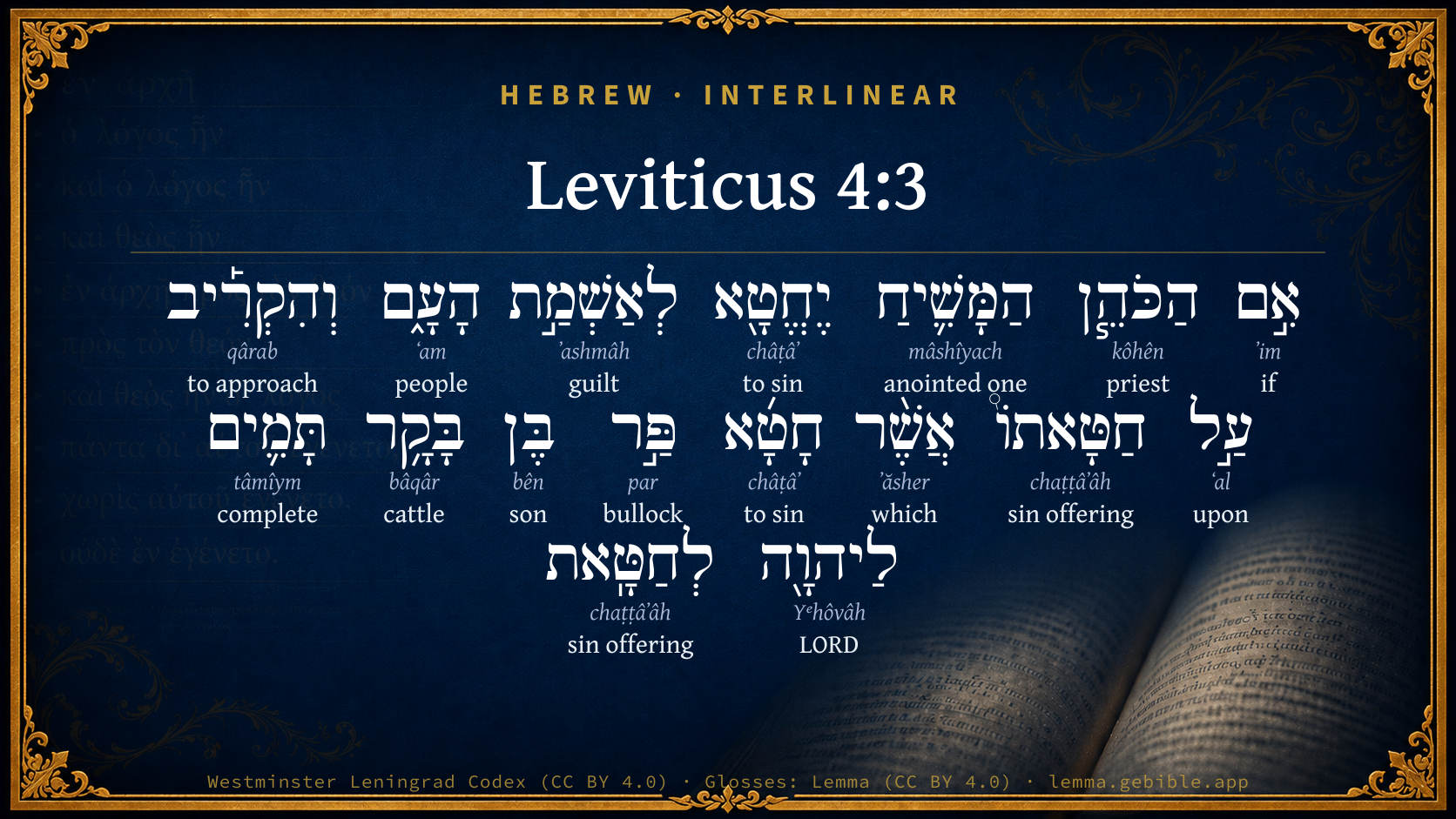
Leviticus 4:3

Hebrew (Westminster Leningrad Codex) Leviticus 4:3 appears in the Hebrew Old Testament. The text above is from the Westminster Leningrad Codex. Each word links to its Strong’s number, a concise gloss, and parsing drawn from the Open Scriptures Hebrew Bible morphology. Click any word for its full Brown-Driver-Briggs (BDB) entry.
Download image
Cite this verse

Leviticus 4:3 (World English Bible). Public Domain. Lemma interlinear Bible study tool, https://lemma.gebible.app/v/leviticus/4/3.

Show BibTeX & RIS
BibTeX
RIS
English Translation
if the anointed priest sins so as to bring guilt on the people, then let him offer for his sin, which he has sinned, a young bull without blemish to Yahweh for a sin offering.
World English Bible · Public Domain
Highlights
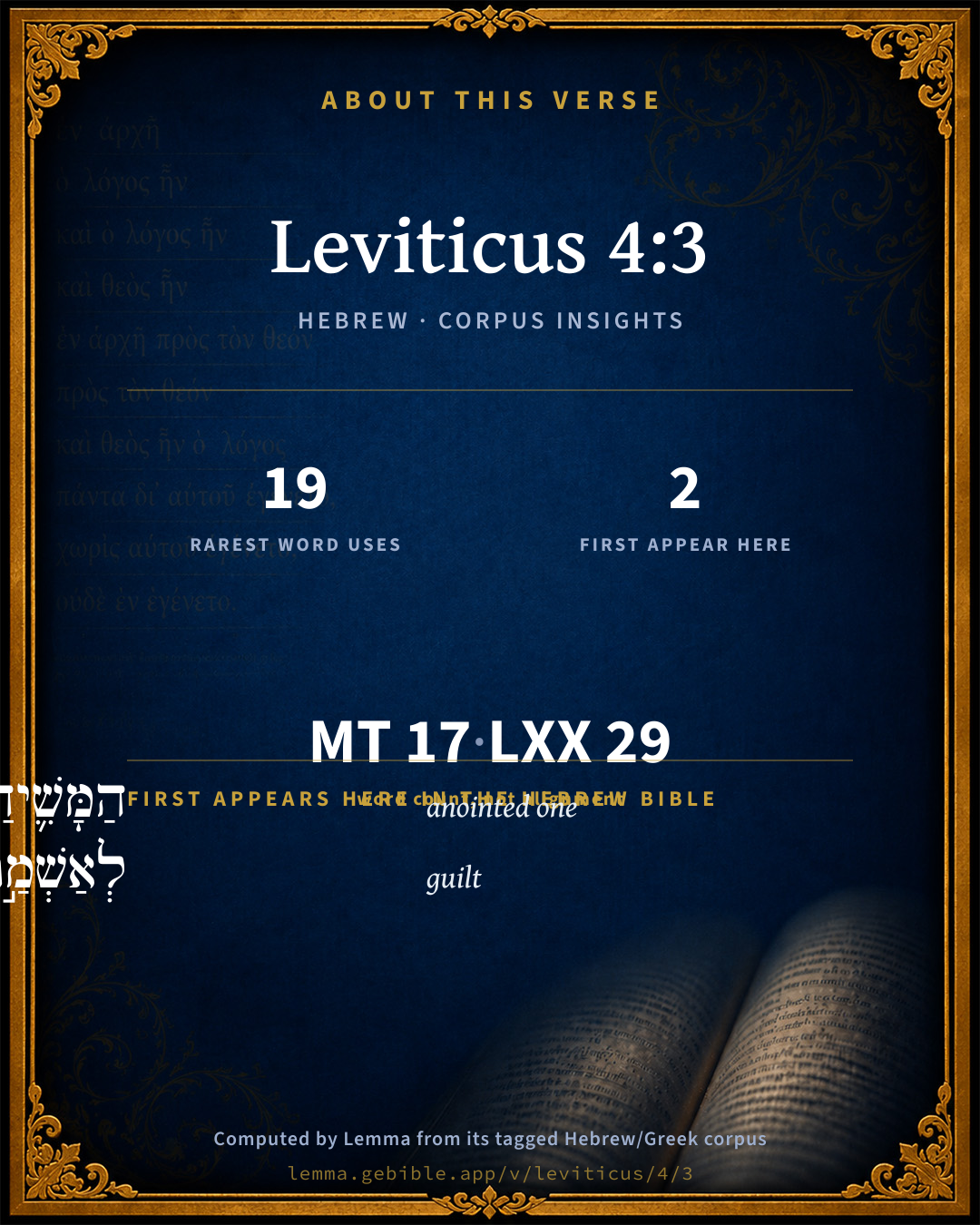
  • 2 first appearances in the Hebrew Bible
Full analysis ↓
Download a study sheet

One document with this verse’s original text, its word-by-word gloss line, the meaning frame, cross-references with their text, attributed commentary, and full source and license credits — printable, and it pastes into notes with its structure intact.

This verse Autodidact and up

Study sheet (.html) Plain text (.txt)

A passage Seminary Student

Up to 50 verses in one chapter. A passage sheet keeps up to 6 commentary sources and 12 cross-references per verse, in the order this page ranks them, and says so on the sheet whenever that leaves anything out. Ask for a single verse and you get the Autodidact verse sheet above.

Everything on this page stays free to read, with no account — the sheet is a download of what is already on screen, not access to it.

Want to remove ads? Support Godless Engineer
Compare translations 3

The same verse in 3 English versions, stacked beneath the original-language interlinear above. Click any original word for its lexicon entry.

Each is an independent rendering of the whole verse — the interlinear is not word-aligned to these translations.

Highlighted words mark where these versions differ — a whole-verse word diff, not a word-by-word alignment.

  • World English Bible Public Domain
    if the anointed priest sins so as to bring guilt on the people, then let him offer for his sin, which he has sinned, a young bull without blemish to Yahweh for a sin offering.
  • King James Version Public Domain
    If the priest that is anointed do sin according to the sin of the people; then let him bring for his sin, which he hath sinned, a young bullock without blemish unto the LORD for a sin offering.
  • unfoldingWord Literal Text CC BY-SA 4.0
    if the anointed priest sins to the guilt of the people, then he shall present for his sin that he sinned a bull, a perfect son of the cattle, to Yahweh as a sin offering.

unfoldingWord Literal Text — © unfoldingWord, licensed CC BY-SA 4.0. Word-aligned USFM3 via Door43 (git.door43.org/unfoldingWord/en_ult).

Versions to compare (up to 4)

3 of 4 selected

Show all 18 translations

Every available English version of this verse, each an independent rendering of the whole verse.

  • World English Bible Public Domain
    if the anointed priest sins so as to bring guilt on the people, then let him offer for his sin, which he has sinned, a young bull without blemish to Yahweh for a sin offering.
  • Berean Standard Bible Public Domain
    If the anointed priest sins, bringing guilt on the people, he must bring to the LORD a young bull without blemish as a sin offering for the sin he has committed.
  • Majority Standard Bible Public Domain
    If the anointed priest sins, bringing guilt on the people, he must bring to the LORD a young bull without blemish as a sin offering for the sin he has committed.
  • King James Version Public Domain
    If the priest that is anointed do sin according to the sin of the people; then let him bring for his sin, which he hath sinned, a young bullock without blemish unto the LORD for a sin offering.
  • American Standard Version (1901) Public Domain
    if the anointed priest shall sin so as to bring guilt on the people, then let him offer for his sin, which he hath sinned, a young bullock without blemish unto Jehovah for a sin-offering.
  • Revised Version (1885) Public Domain
    if the anointed priest shall sin so as to bring guilt on the people; then let him offer for his sin, which he hath sinned, a young bullock without blemish unto the LORD for a sin offering.
  • Geneva Bible (1599) Public Domain
    If the Priest that is anointed doe sinne (according to the sinne of the people) then shall he offer, for his sinne which hee hath sinned, a yong bullocke without blemish vnto the Lord for a sinne offring,
  • Douay-Rheims (1899) Public Domain
    If the priest that is anointed shall sin, making the people to offend, he shall offer to the Lord for his sin a calf without blemish.
  • Young's Literal Translation Public Domain
    `If the priest who is anointed doth sin according to the guilt of the people, then he hath brought near for his sin which he hath sinned a bullock, a son of the herd, a perfect one, to Jehovah, for a sin-offering,
  • Literal Standard Version CC BY-SA 4.0
    if the priest who is anointed sins according to the guilt of the people, then he has brought near for his sin which he has sinned a bullock, a son of the herd, a perfect one, to YHWH, for a sin-offering,
  • Unlocked Literal Bible CC BY-SA 4.0
    If it is the high priest who sins so as to bring guilt on the people, then let him offer for his sin which he has committed a young bull without blemish to Yahweh as a sin offering.
  • unfoldingWord Literal Text CC BY-SA 4.0
    if the anointed priest sins to the guilt of the people, then he shall present for his sin that he sinned a bull, a perfect son of the cattle, to Yahweh as a sin offering.
  • Darby Bible Public Domain
    if the priest that is anointed sin according to the trespass of the people; then for his sin which he hath sinned shall he present a young bullock without blemish to Jehovah for a sin-offering.
  • World Messianic Bible Public Domain
    if the anointed priest sins so as to bring guilt on the people, then let him offer for his sin which he has sinned a young bull without defect to the LORD for a sin offering.
  • Webster's Bible Public Domain
    If the priest that is anointed shall sin according to the sin of the people; then let him bring, for his sin which he hath sinned, a young bullock without blemish to the LORD for a sin-offering.
  • Free Bible Version CC BY-SA 4.0
    If it is the high priest who sins and brings guilt on everyone, he must present to the Lord a young bull without defects as a sin offering for his sin.
  • Bible in Basic English Public Domain
    If the chief priest by doing wrong becomes a cause of sin to the people, then let him give to the Lord for the sin which he has done, an ox, without any mark, for a sin-offering.
  • JPS Tanakh (1917) Public Domain
    if the anointed priest shall sin so as to bring guilt on the people, then let him offer for his sin, which he hath sinned, a young bullock without blemish unto the LORD for a sin-offering.

Literal Standard Version (2020), Covenant Press — licensed CC BY-SA 4.0. Text via the HelloAO Bible API (eBible.org). Unlocked Literal Bible (unfoldingWord) — licensed CC BY-SA 4.0. Text via the HelloAO Bible API (eBible.org). unfoldingWord Literal Text — © unfoldingWord, licensed CC BY-SA 4.0. Word-aligned USFM3 via Door43 (git.door43.org/unfoldingWord/en_ult). Free Bible Version, Dr. Jonathan Gallagher — licensed CC BY-SA 4.0. Text via the HelloAO Bible API (eBible.org).

Word by word

More ways to search: Search by grammar → Find every occurrence → Compare this word →

Practice this passage: Drill this verse → Learn its vocabulary →

לְאַשְׁמַ֣ת
ʼashmâh
H819
“to/for · guilt of”
Preposition + Noun, Common, Feminine, Singular, Construct
Part of Speech
Preposition + Noun
Type
Common
Gender
Feminine
Number
Singular
State
Construct
Full BDB Definition

Origin: from H817

TWOT: 180c

guiltiness, guilt, offense, sin, wrong-doing - doing wrong, committing a trespass or offense - becoming guilty, guilt - bringing a guilt-offering
  1. אִ֣ם ʼim H518 “if” Conjunction
  2. הַכֹּהֵ֧ן kôhên H3548 “the · priest” Particle, Definite Article + Noun, Common, Masculine, Singular, Absolute
  3. הַמָּשִׁ֛יחַ mâshîyach H4899 “the · anointed one” Particle, Definite Article + Noun, Common, Masculine, Singular, Absolute
  4. יֶחֱטָ֖א châṭâʼ H2398 “to sin” Verb, Qal, Imperfect, 3rd Person, Masculine, Singular
  5. הָעָ֑ם ʻam H5971 “the · people” Particle, Definite Article + Noun, Common, Masculine, Singular, Absolute
  6. וְהִקְרִ֡יב qârab H7126 “and · to approach” Conjunction + Verb, Hiphil, Sequential Perfect, 3rd Person, Masculine, Singular
  7. עַ֣ל ʻal H5921 “upon” Preposition
  8. חַטָּאתוֹ֩ chaṭṭâʼâh H2403 “sin offering · his” Noun, Common, Feminine, Singular, Construct + Suffix, Personal, 3rd Person, Masculine, Singular
  9. אֲשֶׁ֨ר ʼăsher H834 “which” Particle, Relative
  10. חָטָ֜א châṭâʼ H2398 “to sin” Verb, Qal, Perfect, 3rd Person, Masculine, Singular
  11. פַּ֣ר par H6499 “bullock” Noun, Common, Masculine, Singular, Absolute
  12. בֶּן bên H1121 “son of” Noun, Common, Masculine, Singular, Construct
  13. בָּקָ֥ר bâqâr H1241 “cattle” Noun, Common, Both, Singular, Absolute
  14. תָּמִ֛ים tâmîym H8549 “complete” Adjective, Adjective, Masculine, Singular, Absolute
  15. לַיהוָ֖ה Yᵉhôvâh H3068 “to/for · LORD” Preposition + Noun, Proper
  16. לְחַטָּֽאת chaṭṭâʼâh H2403 “to/for · sin offering” Preposition + Noun, Common, Feminine, Singular, Absolute

About this verse

These counts appear in no published source. They are computed here, from the morphology-tagged text and Lemma’s own curated glosses. What Lemma adds →

17
words
15
distinct lemmas
Pentateuch
section

Notable vocabulary

The rarest word here is לְאַשְׁמַ֣ת guilt H819 — appearing just 19 times in the whole Hebrew Bible.

First appearance in Scripture

These words make their first canonical appearance in the Hebrew Bible here:

  • הַמָּשִׁ֛יחַ anointed one H4899
  • לְאַשְׁמַ֣ת guilt H819

Shared distinctive vocabulary

לְאַשְׁמַ֣ת guilt H819 occurs in 17 verses of the Hebrew Bible. Also found in:

Grammatical profile

  • 3 verbs
  • 10 nouns
  • 1 adjective
  • 1 preposition
  • 1 conjunction
  • 1 particle

Verb forms

  • יֶחֱטָ֖א Qal · Imperfect
  • וְהִקְרִ֡יב Hiphil · Sequential Perfect
  • חָטָ֜א Qal · Perfect

Repetition

Words recur within this verse — often emphatic in Hebrew:

  • יֶחֱטָ֖א to sin H2398 ×2
  • חַטָּאתוֹ֩ sin offering H2403 ×2

Hebrew & Septuagint length

In English translation the verse runs 35 words from the Hebrew and 36 from the Septuagint (LXX English) — closely comparable.

A rough comparison of the two English renderings, which tokenize alike — not a word-level alignment.

Word counts can differ between the Hebrew and the Greek without any difference in meaning — e.g. the Hebrew direct-object marker אֵת has no separate Greek word, and Greek often adds the article ὁ.

In the original languages it is 17 Hebrew tokens and 29 Greek tokens — but the two are counted differently (Hebrew bundles its prefixes and suffixes into one token; the Greek is in lemma form), so that isn’t a like-for-like length.

Cross-references

18

Topical passages linked to Leviticus 4:3 in the Treasury of Scripture Knowledge — connected by theme and wording, ordered by reader-vote popularity; previews shown in the World English Bible.

  • Hebrews 7:27–28 who doesn't need, like those high priests, to daily offer up sacrifices, first for his own sins, and then for the sins of the people. For this he did once for all, when he offered up himself.
  • Leviticus 4:14 when the sin in which they have sinned is known, then the assembly shall offer a young bull for a sin offering, and bring it before the Tent of Meeting.
  • Leviticus 9:2 and he said to Aaron, "Take a calf from the herd for a sin offering, and a ram for a burnt offering, without blemish, and offer them before Yahweh.
  • 2 Corinthians 5:21 For him who knew no sin he made to be sin on our behalf; so that in him we might become the righteousness of God.
  • Ezra 8:35 The children of the captivity, who had come out of exile, offered burnt offerings to the God of Israel, twelve bulls for all Israel, ninety-six rams, seventy-seven lambs, and twelve male goats for a sin-offering: all this was a burnt offering to Yahweh.
  • Hebrews 5:3 Because of this, he must offer sacrifices for sins for the people, as well as for himself.
  • Exodus 29:7 Then you shall take the anointing oil, and pour it on his head, and anoint him.
  • Exodus 29:14 But the flesh of the bull, and its skin, and its dung, you shall burn with fire outside of the camp: it is a sin-offering.
  • Exodus 29:21 You shall take of the blood that is on the altar, and of the anointing oil, and sprinkle it on Aaron, and on his garments, and on his sons, and on the garments of his sons with him: and he shall be made holy, and his garments, and his sons, and his sons' garments with him.
  • Leviticus 21:10–12 "'He who is the high priest among his brothers, upon whose head the anointing oil is poured, and that is consecrated to put on the garments, shall not let the hair of his head hang loose, nor tear his clothes;
  • Ezekiel 43:19 You shall give to the priests the Levites who are of the seed of Zadok, who are near to me, to minister to me, says the Lord Yahweh, a young bull for a sin-offering.
  • Romans 8:3 For what the law couldn't do, in that it was weak through the flesh, God did, sending his own Son in the likeness of sinful flesh and for sin, he condemned sin in the flesh;
  • Exodus 30:10 Aaron shall make atonement on its horns once in the year; with the blood of the sin offering of atonement once in the year he shall make atonement for it throughout your generations. It is most holy to Yahweh."
  • Leviticus 5:6 and he shall bring his trespass offering to Yahweh for his sin which he has sinned, a female from the flock, a lamb or a goat, for a sin offering; and the priest shall make atonement for him concerning his sin.
  • Leviticus 8:12 He poured some of the anointing oil on Aaron's head, and anointed him, to sanctify him.
  • Leviticus 16:6 "Aaron shall offer the bull of the sin offering, which is for himself, and make atonement for himself and for his house.
  • Leviticus 16:11 "Aaron shall present the bull of the sin offering, which is for himself, and shall make atonement for himself and for his house, and shall kill the bull of the sin offering which is for himself.
  • Numbers 8:8 Then let them take a young bull, and its meal offering, fine flour mixed with oil; and another young bull you shall take for a sin offering.

Cross-references courtesy of OpenBible.info (CC BY 4.0).

Hebrew and Greek witnesses Masoretic Hebrew ↔ Greek Septuagint

The same verse in the two great witnesses to the Old Testament, shown verse-for-verse.

These are two independent witnesses, not word-aligned to each other, and the Septuagint is shown in lemma (dictionary) form.

Hebrew Leviticus 4:3 Masoretic · Westminster Leningrad Codex

אִ֣ם הַכֹּהֵ֧ן הַמָּשִׁ֛יחַ יֶחֱטָ֖א לְאַשְׁמַ֣ת הָעָ֑ם וְהִקְרִ֡יב עַ֣ל חַטָּאתוֹ֩ אֲשֶׁ֨ר חָטָ֜א פַּ֣ר בֶּן בָּקָ֥ר תָּמִ֛ים לַיהוָ֖ה לְחַטָּֽאת

if the anointed priest sins so as to bring guilt on the people, then let him offer for his sin, which he has sinned, a young bull without blemish to Yahweh for a sin offering.

World English Bible · Public Domain

Greek LXX Leviticus 4:3 Septuagint · lemma form

ἐάν μέν ὁ ἀρχιερεύς ὁ χρίω ἁμαρτάνω ὁ ὁ λαός ἁμαρτάνω καί προςἄγω περί ὁ ἁμαρτία αὐτός ὅς ἁμαρτάνω μόσχος ἐκ βοῦς ἄμωμος ὁ κύριος περί ὁ ἁμαρτία αὐτός

if the anointed priest sin so as to cause the people to sin, then shall he bring for his sin, which he has sinned, an unblemished calf of the herd to the Lord for his sin.

LXX2012 (modern English Septuagint) · Public Domain

On this verse, Haydock's Catholic Bible Commentary discusses the Septuagint’s reading. Read the note in Commentary ↓

Hebrew: Westminster Leningrad Codex (CC BY 4.0). Greek: Septuagint (public domain); English from LXX2012 (modern English Septuagint) (Public Domain). How the Septuagint differs from the Hebrew →

Targum (Aramaic paraphrase)

2

The Targum is the ancient Jewish Aramaic paraphrase of the Hebrew Scriptures — an interpretive translation, not the Hebrew text itself. Onkelos (literal) and Pseudo-Jonathan (expansive) render the Torah, and Jonathan the Prophets. Coverage is partial: where no permissively-licensed English translation exists for a verse, only the Aramaic is shown. This is verse-level text, not a word-by-word alignment to the Hebrew.

  1. Targum Onkelos Torah (Genesis–Deuteronomy)
    אִם כַּהֲנָא רַבָּא יֵיחוֹב לְחוֹבַת עַמָא וִיקָרֵב עַל חוֹבְתֵהּ דִי חָב תּוֹר בַּר תּוֹרֵי שְׁלִים קֳדָם יְיָ לְחַטָאתָא

    (no public-domain English translation for this verse)

    Targum Onkelos — Aramaic: “Onkelos Genesis” (public domain); “Onkelos Exodus” (public domain); “Onkelos Leviticus” (public domain); “Onkelos Numbers” (public domain); “Onkelos Deuteronomy” (public domain). English: “Sefaria Community Translation” (CC0 1.0 (public-domain dedication)); “J.W. Etheridge. The Targums of Onkelos and Jonathan Ben Uzziel on the Pentateuch. London: Longmans, Green, 1862” (public domain). Text via Sefaria.

  2. Targum Pseudo-Jonathan Torah (Genesis–Deuteronomy)
    אִין כַּהֲנָא רַבָּא דְמִתְרַבֵּי בְּמִשְׁחָא יֵיחוּב בְּמִקְרְבֵיהּ קָרְבַּן חוֹבַת עַמָא דְלָא כְּהִילְכְתֵיהּ וְיִקְרַב בְּגִין חוֹבְתֵיהּ תּוֹר בַּר תּוֹרֵי שְׁלִים קֳדָם יְיָ לְחַטָאתָא

    if the high priest who is consecrated with oil hath sinned,-as when he hath offered a sin offering for the people not according to the rite, he shall bring for his sin a young bullock unblemished before the Lord for a sin offering.

    Targum Pseudo-Jonathan — Aramaic: “Targum Jonathan on Genesis” (public domain); “Targum Jonathan on Exodus” (public domain); “Targum Jonathan on Leviticus” (public domain); “Targum Jonathan on Numbers” (public domain); “Targum Jonathan on Deuteronomy” (public domain). English: “The Targum of Jonathan ben Uzziel, trans. J. W. Etheridge, London, 1862” (public domain). Text via Sefaria.

Commentary

Notes on Leviticus 4:3 from classic Christian and Jewish commentators (each source and its license shown beneath its notes). The classic Christian expositions comment on the surrounding passage and are grouped to its opening verse, so a note may address several verses; the Jewish commentaries on the Tanakh (Rashi and others) are per-verse, so they appear only where the commentator wrote on this verse.

Lemma curates 59 commentaries, every one of them public domain or Creative Commons licensed, each selected and text-cleaned for this edition rather than reprinted as found. About our sources →

Jamieson, Fausset & Brown

Robert Jamieson, A. R. Fausset & David Brown

SIN OFFERING FOR THE PRIEST. (Lev. 4:3-35)

If the priest that is anointed do sin--that is, the high priest, in whom, considering his character as typical mediator, and his exalted office, the people had the deepest interest; and whose transgression of any part of the divine law, therefore, whether done unconsciously or heedlessly, was a very serious offense, both as regarded himself individually, and the influence of his example. He is the person principally meant, though the common order of the priesthood was included.

according to the sin of the people--that is, bring guilt on the people. He was to take a young bullock (the age and sex being expressly mentioned), and having killed it according to the form prescribed for the burnt offerings, he was to take it into the holy place and sprinkle the atoning blood seven times before the veil, and tip with the crimson fluid the horns of the golden altar of incense, on his way to the court of the priests,--a solemn ceremonial appointed only for very grave and heinous offenses, and which betokened that his sin, though done in ignorance, had vitiated all his services; nor could any official duty he engaged in be beneficial either to himself or the people, unless it were atoned for by blood.

Jamieson, Fausset & Brown — Commentary Critical and Explanatory on the Whole Bible (1871) — public domain (CC PDM 1.0). Text via the HelloAO Bible API.

Ellicott's Commentary for English Readers

(3) The priest that is anointed.—To illustrate this law, the conduct of the high priest is adduced as the first instance, to show when and how this exalted functionary is to bring the sin offering in question. By this the Levitical law indicates that even the chief of the priesthood was but a frail being like the rest of the people, and was exposed to the same infirmities as the laity, thus precluding the assumption of spiritual superiority. Hence the remark of the Apostle, “the law made those high priests who had infirmity, and who needed daily to offer up sacrifices, first for their own sins, and then for the people’s; but our high priest, Christ Jesus, was holy, harmless, undefiled, and separate from sinners, and made higher than the heavens” (Heb_7:27-28). The phrase “the priest that is anointed” for “the high priest” is restricted to this book, where it occurs four times (Lev_4:3; Lev_4:5; Lev_4:16; Lev_6:15 in Heb.; 22 in the English). “The great priest,” or high priest, is the appellation used in the other portions of the Pentateuch (Lev_21:10; Num_35:25; Num_35:28), and in Joshua (Jos_20:6); whilst in the later books of the Old Testament this functionary is called chief priest (2Ki_25:18; 2Ch_19:11; 2Ch_24:11; 2Ch_26:20; 2Ch_31:10; Ezr_7:5). He is called “the anointed priest,” because, like Aaron, he alone was anointed when he succeeded to the high office, whilst the ordinary priests were simply consecrated. Their anointing descended with them to all futurity by virtue of being the descendants of Aaron. (See Lev_8:12.)

According to the sin of the people.—That is, he having in ignorance committed the same sin as the common people, to which he is as liable as they. From the phrase “against any commandments of the Lord” in the preceding verse, as well as from Lev_10:6; Lev_21:10-15, it is evident that the sin of ignorance here alluded to does not refer to the inadvertent neglect of his official duty, which devolves upon the high priest as the spiritual head of the people, but to any offence whatsoever ignorantly committed. According to the marginal reading, to make the people guilty, or more literally, to the guilt of the people, which is equally admissible, the meaning of the passage is, that he by committing a sin causes the people to transgress, inasmuch as his example is followed by them; or that, in virtue of the intimate connection which subsisted between the representative of the nation and the people, the sin of the one was the sin of the other. (Comp. Lev_10:6; 1Ch_21:3.)

A young bullock.—Literally, a steer, the son of a bull. The sacrificial rules which obtained at the time of Christ minutely defined the respective ages of the bullock: the steer, the son of a bull, and the calf. The bullock or ox which was brought as a sacrifice had to be three years old: “the steer the son of a bull” rendered in the passage before us, and in the Authorised Version generally, by “a young bullock” (Exo_29:1; Lev_4:14; Lev_16:3; Lev_23:8, &c.), had to be two years old; whilst the calf had to be of the first year.

A Bible Commentary for English Readers, edited by Charles John Ellicott (1878–1897) — public domain. Text from a community e-Sword module.

The Cambridge Bible for Schools and Colleges

gen. ed. J. J. S. Perowne

3. the anointed priest] So called here and in Lev_4:5; Lev_4:16, Lev_6:22; ‘the high priest’ in Lev_21:10; Num_35:25; Num_35:28; ‘the chief priest’ 2Ki_25:18; 2Ch_19:11; 2Ch_24:11; 2Ch_26:20; 2Ch_31:10; Ezr_7:5.

shall sin so as to bring guilt on the people] If the anointed priest, as the representative of the community towards God, bring guilt on the people, his offering must be the same as that for the community (Lev_4:13-21), ‘a young bullock without blemish’ (Lev_4:3, cp. Lev_4:14). ‘Young’ is interpreted traditionally ‘in his third year,’ or, according to some, older.

3–12. The high priest’s Sin-Offering, a bullock

The Cambridge Bible for Schools and Colleges (gen. ed. J. J. S. Perowne; Cambridge University Press, 1878–1918) — public domain. Text from a community e-Sword module.

Trapp's Complete Commentary

John Trapp

Lev 4:3 If the priest that is anointed do sin according to the sin of the people; then let him bring for his sin, which he hath sinned, a young bullock without blemish unto the LORD for a sin offering.

Ver. 3. A young bullock.] The same sacrifice that should be offered for the sin of the whole people, {Lev 4:14} to note the heinousness of the priest’s sin above others. The sins of teachers are the teachers of sins.

John Trapp, A Commentary or Exposition upon All the Books of the Old and New Testament (1647–1656) — public domain. Text from a community e-Sword module.

The Biblical Illustrator

Joseph S. Exell

Lev_4:3

If the priest that is anointed do sin.

The eminent sinfulness of error in the priest

I. From the superior position he occupied.

II. From the superior privileges he enjoyed. Exempt from many secular anxieties and temptations. Constantly in contact with sacred influences.

III. From the superior knowledge he possessed. Intimately acquainted with requirements of law. Possessing ample means and opportunities for ascertaining purpose of precepts enjoined.

IV. From the superior influence he exerted. Looked up to as an example. (F. W. Brown.)

Defiled sanctities

1. Christians occupying exalted positions, enjoying elevated privileges, rendering distinguished service for God, may fall into sin.

2. They know that the dishonour done to God is commensurate with the dignity of their position and the holiness of their profession.

3. So acutely is their guilt felt by them when thus brought under consciousness of sin, that its burden and bitterness would overwhelm them were there not adequate grace in the sin-offering for even such sin as theirs. Here, therefore, it is clearly shown--

I. That however far sin may have penetrated, and whatever solemn and sacred things it may have defiled, thither the atoning blood follows, carrying full expiation where sin has carried defilement.

II. That the dishonour done to God, to the sanctities of a godly life, and to the solemnities of sanctuary ministries, was compensated for in offering upon the altar of incense the symbols of the inherent and intrinsic excellency of christ. (W. H. Jellie.)

Sin in the priesthood

I. A holy office does not ensure infallibility.

II. Occupants of a holy office are specially called to sanctity.

III. Eminently privileged and enlightened, they who minister before God should be most vigilant lest they sin.

IV. Sin in Gods priests had to be purged by a great sacrificial expiation. Expressing--

1. The peculiar magnitude of sin in them.

2. The boundless sufficiency of redemption, even for them. (W. H. Jellie.)

The priests sin

This man is a priest; the holy anointing oil of the Lord his God is upon him, and therefore, of course, he cannot sin! The fact of the matter is that none of us are beyond the reach of temptation, beyond the possibility of a fall. Well, what then? I know what the mocking world will say: If the priest that is anointed do sin, I will have nothing to do with religion at all; it is all hypocrisy; he is no better than other men. I know quite well what uncharitable professors will say: Turn him out; he is a hypocrite. If the priest that is anointed do sin, he has disgraced himself. I know what your own heart will say: It is no good; I have tried; I have fallen; I may as well give it all up, there is no hope at all. But what does God say? If the priest that is anointed do sin, let him bring his sacrifice; let him bring . . . a young bullock without blemish . . . for a sin-offering. Is it not marvellous! I do not so much wonder at the 27th verse where God says: If any one of the common people sin, but if the priest that is anointed do sin, let him bring his sacrifice. And yet, if you read that verse carefully all through, you will see that there is no minimising of the priests sin. God, in the terms that He uses, says that it is a very heinous thing for a priest to sin. If one of His own children goes astray it is a very serious thing. He has been anointed; that anointing not only implies separation to God, but enduing with power. That anointing of the Holy Spirit is upon him, he ought not to have sinned. No temptation came upon him more than he was able to bear. And if you read on you will see, in the Revised Version, If the priest that is anointed do sin, so as to cause the people to sin. Yes, if the priest sin, he causes the people to sin, and if the Christian sin he is a stumblingblock to others, therefore an ungodly man will go still further into the depths of sin. And yet, if the priest that is anointed do sin, let him bring his sacrifice. What does he do when he sacrifices? There are seven points you ought to consider. The first thing he has to do (Lev_4:4), He shall bring the bullock unto the door of the Tabernacle of the congregation before the Lord, and shall lay his hand upon the bullocks head. The bullock is to be without spot or blemish. The priest comes there conscious of his own sin, and lays his hand upon the bullocks head. And that is the first thing you must do. You must find a spotless victim. The Lord Jesus Christ is that Lamb without sin, without spot. The first thing to do is to put our hand upon the victim. And the moment the man laid his hand upon the victim that moment a transference took place. All the sinners sin was placed upon the victim. The victim was slain and east outside the camp, and the sinner goes into the Temple of God and takes his place in the Holy Place of Jehovah. And directly you lay the hand of faith upon Christ, directly you grasp Christ as your great Substitute, the same thing takes place. And if you arc a child of God, you have felt that the burden of sin is intolerable, it has weighed you down, and all that sin has been made to meet upon Him. Another reason why he was to lay his hand hard, was to show that all his trust was in that victim alone. He was to lean hard with all his weight upon him. If the victim did not support him the man fell prostrate to the ground. So we must lean entirely upon Christ, all our confidence must be in Him and Him alone. The second point is this--He shall kill the bullock before the Lord. There is no doubt about it, the wages of sin is death. Look at it! look priest! and see what your sin has brought about--the death of that pure and spotless victim. Now there were three things to be done with the blood of the bullock. The blood of the bullock was to be taken and sprinkled in three different places. First of all you read in Lev_4:6, the priest was to take the blood and sprinkle it seven times before the Lord, before the veil of the sanctuary. Seven times he was to sprinkle it there at the Holy of Holies. Why? Because within that Holy of Holies dwell the Shechinah glory of God. Christian, is this not the first result of your sin? You lose your communion with God. The first thing to be done is to restore that communion with God. The next thing to be done is this--he was to take some of the blood (Lev_4:7) and put it upon the altar of sweet incense. What was that? The place where the priest prayed for the people. When the people were praying outside the priest went into the Holy Place, and his offering went up as incense before God. Is not this the second result of sin--you lose the power of prayer; you say your prayers but you no longer pray; you lose all that joy and spontaneity of service; there is no fragrance about your prayers, it is mere routine, and there is no reality about them at all. If you want to have communion with God in prayer, and to be able to pray as you ought to pray, there must be the sprinkling of the blood there. The third thing to be done was to take the rest of the blood and pour it out on the altar of burnt-offering. What was that? The place where the daily burnt-offering was offered up. God will not accept your burnt-offering if there is sin in the heart. There is a controversy between me and God, and though I may try and bring Him offerings, God will not accept them. There was another thing to be done. And the skin of the bullock, and all his flesh, with his head, and with his legs, and his inwards, and his dung, even the whole bullock shall he carry forth without the camp unto a clean place, where the ashes are poured out, and burn him on the wood with fire: where the ashes are poured out shall he be burnt. Now we have never had that word for burnt before. That word means to thoroughly consume with burning. Very different to another word for burning I shall notice presently. It is no use your saying you cannot get peace and joy as long as you are keeping your bullock within the camp. You must take it out and burn it. There will be no peace until you do. Inside the camp a very different scene was taking place. There, upon the altar, we read in the eighth and following verses, all the fat of the bullock, all the inwards of the bullock, he is to offer it up upon the altar of the burnt-offering for a sweet savour to God. That is a very different word from burnt--the word in Lev_4:10, is ktour; it means to burn as fragrance--not with consuming burning, but as sweet incense to God. And there is a sweet incense ascending from that altar. The priest may almost hear that whisper from the open heavens, and it is forgiven him. It is all forgiven; the sacrifice is accepted, and the sin is blotted out. (E. A. Stuart, M. A.)

Sin in ministers

The high priest, although a single individual, if he sin, must bring as large and valuable an offering as is required from the whole congregation. For this law there are two evident reasons. The first is found in the fact that in Israel the high priest represented before God the entire nation. When he sinned it was as if the whole nation sinned in him. So it is said that by his sin he brings guilt on the people--a very weighty matter. And this suggests a second reason for the costly offering that was required from him. The consequences of the sin of one in such a high position of religious authority must, in the nature of the case, be much more serious and far-reaching than in the case of any other person. And here we have a lesson as pertinent to our time as to those days. ,As the high priest, so, in modern time, the bishop, minister, or elder, is ordained as an officer in matters of religion, to act for and with men in the things of God. For the proper administration of this high trust, how indispensable that such a one shall take heed to maintain unbroken fellowship with God! Any shortcoming here is sure to impair by so much the spiritual value of his own ministrations for the people to whom he ministers. And this evil consequence of any unfaithfulness of his is the more certain to follow, because, of all the members of the community, his example has the widest and most effective influence; in whatever that example be bad or defective, it is sure to do mischief in exact proportion to his exalted station. If, then, such a one sin, the case is very grave, and his guilt proportionately heavy. (S. H. Kellogg, D. D.)

Sin not excused by ignorance

One would wonder whether it is possible that sin can be committed in ignorance--that is to say, whether the ignorance does not do away with the sinful character of the deed. Is not sin a wilful action? Is not its wilfulness the very essence of its guilt? So we would think; yet again and again in the ritual we find that ignorance is never made into a sufficient excuse for sin. The sense of mystery which we may feel in regard to this matter can only be relieved by looking for analogous instances in the field of nature. There is no law written on all the dominion of nature with a broader and clearer hated than that all sin is followed by penalty. Exclude the air, and you exclude vitality; shut out the light, and you impoverish the life; doom yourself to solitude, and you doom yourself by the same fiat to extinction. It is in vain to plead that we did not know the nature of air, or the utility of light, or the influence of high things upon things that are low; we must be taught the depth of our ignorance and its guilt by the intensity and continuance of our personal suffering. Leaving the region of nature and coming into the region of civilisation, we find that even in legal affairs violations of law are not excused on the ground of ignorance. The judge upon the bench does not hesitate to inform the trespasser that he ought to have known the law of which he pleaded ignorance. Turning from purely legal criticism of this kind, we find the same law in operation in social affairs. A man is not excused from the consequences of ill-behaviour on the ground that he did not know the customs of society or the technicalities of etiquette. He may be pitied, he may be held in a kind of mild contempt, his name may be used to point a moral; but at the root of all this criticism lies the law that the man is a trespasser, and that ignorance cannot be pleaded as a complete excuse. This canon of judgment has a very wide bearing upon human affairs. Were it to be justly and completely applied, it would alter many arrangements and relations of life. There are many things which we ought to know, and which we ought to be; and instead of excusing ourselves by our ignorance, we should be stimulated by its effects to keener inquiry and more diligent culture. That sense of ignorance will possibly show us in what critical conditions our life is being spent. What watchfulness is imposed upon us by the fact that it is possible to sin through ignorance! If sin were a mere act of violence, we could easily become aware of it, and with comparatively little difficulty we might avoid its repetition. But it is more and other than this. It is committed when we little think of its commission; we inflict wounds when we think our hands are free of all weapons and instruments; we dishonour God when we suppose we are merely silent about Him. Neglect may be sin as well as violence. There is a negative criminality as well as a positive blasphemy. All this makes life most critical and most profoundly solemn. The commandment of God is exceeding broad. Being a Divine commandment it comes of continual and minute exactions covering all life with the spirit and obligation of discipline. The mercy is shown that a special offering was provided for the sin of ignorance Let every soul, then, boldly say, as if in solemn monologue, Whatever my sin may be, it is provided for in the great Offering established as the way of access to the Father; I will invent no excuses; I wilt seek for no new methods of payment or compensation; I will bring no price in my hand, no excuse on my tongue, nor will I hide even in the depths of my consciousness any hope that I can vindicate my position before God; I will simply fall into the hands of the Living One, and look upon the Lamb of God which taketh away the sin of the world. In that spirit I will go forward to judgment, and in that spirit I will encounter the mysteries of destiny. (J. Parker, D. D.)

The Biblical Illustrator, edited by Joseph S. Exell (c. 1880s–1900s) — public domain. Text from a community e-Sword module.

Joseph Benson's Commentary

Lev 4:3. If the priest — The high-priest, who only was anointed. His anointing is mentioned, because he was not complete high-priest till he was anointed. Do sin — Either in doctrine or practice, which it is here supposed he might do. And this is noted as a character of imperfection in the priesthood of the law, Whereby the Israelites were directed to expect another and better high-priest, even one who is “holy, harmless, and separate from sinners,” Heb 7:26. According to the sin of the people — In the same manner as any of the people do; which implies that God expected more circumspection from him than from the people. But the words may be rendered, to the sin or guilt of the people, which may be mentioned as an aggravation of his sin, that by it he commonly brings sin, and guilt, and punishment upon the people, who are infected or scandalized by his example. A young bullock — The same sacrifice which was offered for all the people, to show how much his sin was aggravated by his quality. Sin-offering — Hebrew, sin, which word is often taken in that sense.

Joseph Benson's Commentary on the Old and New Testaments (1811–1818) — public domain. Text from a community e-Sword module.

Whedon's Commentary on the Bible

Daniel D. Whedon

SIN OF A PRIEST, Lev_4:3-12.

3. The priest — The term priest in the original signifies a performer of the offices of worship. In the English it is derived from presbyter, referring more to the order than to the duties.

That is anointed — The anointing at the consecration of the Aaronic priest symbolized his setting apart to a sacred office, and prefigured the inward unction of the Holy Ghost, which, after Jesus was glorified, should be poured upon all perfect believers in Christ, making them “kings and priests unto God.” Rev_1:6. The original is the word messiah, adumbrating the only Priest who mediates between the believer and the Father in the Gospel dispensation. The high priest is here intended, because he had the anointing in a pre-eminent sense. Lev_16:32; note on Lev_6:22; Psa_133:2. The anointing oil was composed of pure myrrh, sweet cinnamon, calamus, cassia, and olive oil, (Exo_30:23,) emblematic of the gifts and graces of the Holy Spirit. St. Chrysostom never opened his “golden mouth” for a more terse and truthful sentence than this: “The Law was the Gospel in anticipation; the Gospel is the Law in fulfilment.”

Do sin — The radical notion of sin, in both the Hebrew and Greek mind, is that of missing the mark. The priest “taken from among men is compassed with infirmities,” and is so liable to miss the mark by any involuntary unsteadiness of aim that he is regarded as a presumptive sinner, (Lev_8:14,) and provision is made for the expiation of his offences before he can acceptably officiate at the altar in behalf of others, who, like himself, are unwittingly “out of the way.”

According to the sin of the people — Rather, to the fault of the people, so that they incur guilt. If the high priest sins, the propitiation which he attempts to make is null and void, and the people are left in a state of guilt exposed to the penalty of the law. Hence provision is made to secure an atonement for the atoner. At no point does the superiority of our great High Priest to the frail and sinning head of the Levitical hierarchy shine forth with greater brightness. He is not obliged to present an offering first for himself and then for us. “We have an advocate with the Father, Jesus Christ the righteous.”

Without blemish — See note on Lev_1:3.

Sin offering — The Hebrew chattath signifies sin, sinner, sacrifice for sin, repentance, or punishment. This explains 2Co_5:21. The idea of rendering satisfaction for the transgression of the law lies on the very surface of the sin offering. The blood of the bullock is the life. The life of the animal must be substituted for the forfeited life of the sinner. See Introduction, (6.)

Daniel D. Whedon (gen. ed.), Commentary on the Old and New Testaments (1874–1909) — public domain. Text from a community e-Sword module.

Keil & Delitzsch

C. F. Keil & F. Delitzsch

The sin of the high priest. - The high priest is here called the "anointed priest" (Lev 4:3, Lev 4:5, Lev 4:16, Lev 6:15) on account of the completeness of the anointing with which he was consecrated to his office (Lev 8:12); in other places he is called the great (or high) priest (Lev 21:10; Num 35:25, etc.), and by later writers הראשׁ כּהן, the priest the head, or head priest (Kg2 25:18; Ch2 19:11). If he sinned העם לאשׁמת, "to the sinning of the nation," i.e., in his official position as representative of the nation before the Lord, and not merely in his own personal relation to God, he was to offer for a sin-offering because of his sin an ox without blemish, the largest of all the sacrificial animals, because he filled the highest post in Israel.

Lev 4:4-7

The presentation, laying on of hands, and slaughtering, were the same as in the case of the other sacrifices (Lev 1:3-5). The first peculiarity occurs in connection with the blood (Lev 4:5-7). The anointed priest was to take (a part) of the blood and carry it into the tabernacle, and having dipped his finger in it, to sprinkle some of it seven times before Jehovah "in the face of the vail of the Holy" (Exo 26:31), i.e., in the direction towards the curtain; after that, he was to put (נתן) some of the blood upon the horns of the altar of incense, and then to pour out the great mass of the blood, of which only a small portion had been used for sprinkling and smearing upon the horns of the altar, at the bottom of the altar of burnt-offering. A sevenfold sprinkling "in the face of the vail" also took place in connection with the sin-offering for the whole congregation, as well as with the ox and he-goat which the high priest offered as sin-offerings on the day of atonement for himself, the priesthood, and the congregation, when the blood was sprinkled seven times before (לפני) the capporeth (Lev 16:14), and seven times upon the horns of the altar (Lev 16:18-19). So too the blood of the red cow, that was slaughtered as a sin-offering outside the camp, was sprinkled seven times in the direction towards the tabernacle (Num 19:4). The sevenfold sprinkling at the feast of atonement had respect to the purification of the sanctuary from the blemishes caused by the sins of the people, with which they had been defiled in the course of the year (see at ch. 16), and did not take place till after the blood had been sprinkled once "against (? upon) the capporeth in front" for the expiation of the sin of the priesthood and people, and the horns of the altar had been smeared with the blood (Lev 16:14, Lev 16:18); whereas in the sin-offerings mentioned in this chapter, the sevenfold sprinkling preceded the application of the blood to the horns of the altar. This difference in the order of succession of the two manipulations with the blood leads to the conclusion, that in the case before us the sevenfold sprinkling had a different signification from that which it had on the day atonement, and served as a preliminary and introduction to the expiation. The blood also was not sprinkled upon the altar of the holy place, but only before Jehovah, against the curtain behind which Jehovah was enthroned, that is to say, only into the neighbourhood of the gracious presence of God; and this act was repeated seven times, that in the number seven, as the stamp of the covenant, the covenant relation, which sin had loosened, might be restored. It was not till after this had been done, that the expiatory blood of the sacrifice was put upon the horns of the altar, - not merely sprinkled or swung against the wall of the altar, but smeared upon the horns of the altar; not, however, that the blood might thereby be brought more prominently before the eyes of God, or lifted up into His more immediate presence, as Hoffmann and Knobel suppose, but because the significance of the altar, as the scene of the manifestation of the divine grace and salvation, culminated in the horns, as the symbols of power and might. In the case of the sin-offerings for the high priest and the congregation, the altar upon which this took place was not the altar of burnt-offering in the court, but the altar of incense in the holy place; because both the anointed priest, by virtue of his calling and consecration as the mediator between the nation and the Lord, and the whole congregation, by virtue of its election as a kingdom of priests (Exo 19:6), were to maintain communion with the covenant God in the holy place, the front division of the dwelling-place of Jehovah, and were thus received into a closer relation of fellowship with Jehovah than the individual members of the nation, for whom the court with its altar was the divinely appointed place of communion with the covenant God. The remainder of the blood, which had not been used in the act of expiation, was poured out at the bottom of the altar of burnt-offering, as the holy place to which all the sacrificial blood was to be brought, that it might be received into the earth.

Lev 4:8-10

The priest was to lift off "all the fat" from the sacrificial animal, i.e., the same fat portions as in the peace-offering (Lev 3:3-4, כּל־חלב is the subject to יוּרם in Lev 3:10), and burn it upon the altar of burnt-offering.

Lev 4:11-12

The skin of the bullock, and all the flesh, together with the head and the shank and the entrails (Lev 1:9) and the foeces, in fact the whole bullock, was to be carried out by him (the sacrificing priest) to a clean place before the camp, to which the ashes of the sacrifices were carried from the ash-heap (Lev 1:16), and there burnt on the wood with fire. (On the construction of Lev 4:11 and Lev 4:12 see Ges. 145, 2).

The different course, adopted with the blood and flesh of the sin-offerings, from that prescribed in the ritual of the other sacrifices, was founded upon the special signification of these offerings. As they were presented to effect the expiation of sins, the offerer transferred the consciousness of sin and the desire for forgiveness to the head of the animal that had been brought in his stead, by the laying on of his hand; and after this the animal was slaughtered, and suffered death for him as the wages of sin. But as sin is not wiped out by the death of the sinner, unless it be forgiven by the grace of God, so devoting to death an animal laden with sin rendered neither a real nor symbolical satisfaction or payment for sin, by which the guilt of it could be wiped away; but the death which it endured in the sinner's stead represented merely the fruit and effect of sin. To cover the sinner from the holiness of God because of his sin, some of the blood of the sacrifice was sprinkled seven times before Jehovah in the holy place; and the covenant fellowship, which had been endangered, was thereby restored. After this, however, the soul, which was covered in the sacrificial blood, was given up to the grace of God that prevailed in the altar, by means of the sprinkling of the blood upon the horns of the altar of incense, that it might receive the forgiveness of sins and reconciliation with God, and the full enjoyment of the blessings of the covenant be ensured to it once more. But the sin, that had been laid upon the animal of the sin-offering, lay upon it still. The next thing done, therefore, was to burn the fat portions of its inside upon the altar of burnt-offering. Now, if the flesh of the victim represented the body of the offerer as the organ of his soul, the fat portions inside the body, together with the kidneys, which were regarded as the seat of the tenderest and deepest emotions, can only have set forth the better part or inmost kernel of the man, the ἔσω ἄνθρωπος (Rom 7:22; Eph 3:16). By burning the fat portions upon the altar, the better part of human nature was given up in symbol to the purifying fire of the Holy Spirit of God, that it might be purified from the dross of sin, and ascend in its glorified essence to heaven, for a sweet savour unto the Lord (Lev 4:31). The flesh of the sin-offering, however, or "the whole bullock," was then burned in a clean place outside the camp, though not merely that it might be thereby destroyed in a clean way, like the flesh provided for the sacrificial meals, which had not been consumed at the time fixed by the law (Lev 7:17; Lev 8:32; Lev 19:6; Exo 12:10; Exo 29:34), or the flesh of the sacrifices, which had been defiled by contact with unclean objects (Lev 7:19); for if the disposal of the flesh formed an integral part of the sacrificial ceremony in the case of all the other sacrifices, and if, in the case of the sin-offerings, the blood of which was not brought into the interior of the sanctuary, the priests were to eat the flesh in a holy place, and that not "as a portion assigned to them by God as an honourable payment," but, according to the express declaration of Moses, "to bear and take away (לשׂאת) the iniquity of the congregation, to make atonement for them" (Lev 10:17), the burning of the flesh of the sin-offerings, i.e., of the animal itself, the blood of which was not brought into the holy place, cannot have been without significance, or simply the means adopted to dispose of it in a fitting manner, but must also have formed one factor in the ceremony of expiation. The burning outside the camp was rendered necessary, because the sacrifice had respect to the expiation of the priesthood, and the flesh or body of the bullock, which had been made חטּאת by the laying on of the hand, could not be eaten by the priests as the body of sin, that by the holiness of their official character they might bear and expiate the sin imputed to the sacrifice (see at Lev 10:17). In this case it was necessary that it should be given up to the effect of sin, viz., to death or destruction by fire, and that outside the camp; in other words, outside the kingdom of God, from which everything dead was removed. But, inasmuch as it was sacrificial flesh, and therefore most holy by virtue of its destination; in order that it might not be made an abomination, it was not to be burned in an unclean place, where carrion and other abominations were thrown (Lev 14:40, Lev 14:45), but in the clean place, outside the camp, to which the ashes of the altar of burnt-offering were removed, as being the earthly sediment and remains of the sacrifices that had ascended to God in the purifying flames of the altar-fire.

(Note: The most holy character of the flesh of the sin-offering (Lev 6:18.) furnishes no valid argument against the correctness of this explanation of the burning; for, in the first place, there is an essential difference between real or inherent sin, and sin imputed or merely transferred; and secondly, the flesh of the sin-offering was called most holy, not in a moral, but only in a liturgical or ritual sense, as subservient to the most holy purpose of wiping away sin; on which account it was to be entirely removed from all appropriation to earthly objects. Moreover, the idea that sin was imputed to the sin-offering, that it was made sin by the laying on of the hand, has a firm basis in the sacrifice of the red cow (Num 19), and also occurs among the Greeks (see Oehler in Herzog's Cycl.).)

Keil & Delitzsch — Biblical Commentary on the Old Testament (1861–1891) — public domain (CC PDM 1.0). Text via the HelloAO Bible API. (Old Testament only.)

The Expositor's Bible

GRADED RESPONSIBILITY

Lev_4:3; Lev_4:13-14; Lev_4:22-23; Lev_4:27-28

"If the anointed priest shall sin so as to bring guilt on the people; then let him offer for his sin, which he hath sinned, a young bullock without blemish unto the Lord for a sin offering And if the whole congregation of Israel shall err, and the thing be hid from the eyes of the assembly, and they have done any of the things which the Lord hath commanded not to be done, and are guilty; when the sin wherein they have sinned is known, then the assembly shall offer a young bullock for a sin offering, and bring it before the tent of meeting When a ruler sinneth, and doeth unwittingly any one of all the things which the Lord his God hath commanded not to be done. and is guilty; if his sin, wherein he hath sinned, be made known to him, he shall bring for his oblation a goat, a male without blemish And if any one of the common people sin unwittingly, in doing any of the things which the Lord hath commanded not to be done, and be guilty; if this sin, which he hath sinned, be made known to him, then he shall bring for his oblation a goat, a female without blemish, for his sin which he hath sinned."

The law concerning the sin offering is given in four sections, of which the last, again, is divided into two parts, separated by the division of the chapter. These four sections respectively treat of-first, the law of the sin offering for the "anointed priest" (Lev_4:3-12); secondly, the law for the offering for the whole congregation (Lev_4:13-21); thirdly, that for a ruler (Lev_4:22-26); and lastly, the law for an offering made by a private person, one of "the common people". {Lev_4:27-35; Lev_5:1-16} In this last section we have, first, the general law, {Lev_4:27-35} and then are added {Lev_5:1-16} special prescriptions having reference to various circumstances under which a sin offering should be offered by one of the people. Under this last head are mentioned first, as requiring a sin offering, in addition to sins of ignorance or inadvertence, which only were mentioned in the preceding chapter, also sins due to rashness or weakness (Lev_4:1-4): and then are appointed, in the second place, certain variations in the material of the offering, allowed out of regard to the various ability of different offerers (Lev_4:5-16).

In the law as given in chapter 4, it is to be observed that the selection of the victim prescribed is determined by the position of the persons who might have occasion to present the offering.

For the whole congregation, the victim must be a bullock, the most valuable of all; for the high priest, as the highest religious official of the nation, and appointed also to represent them before God, it must also be a bullock. For the civil ruler, the offering must be a he-goat-an offering of a value less than that of the victim ordered for the high priest, but greater than that of those which were prescribed for the common people. For these, a variety of offerings were appointed, according to their several ability. If possible, it must be a female goat or lamb, or, if the worshipper could not bring that, then two turtledoves, or two young pigeons. If too poor to bring even this small offering, then it was appointed that, as a substitute for the bloody, offering, he might bring an offering of fine flour, without oil or frankincense, to be burnt upon the altar.

Evidently, then, the choice of the victim was determined by two considerations: first, the rank of the person who sinned, and, secondly, his ability. As regards the former point, the law as to the victim for the sin offering was this: the higher the theocratic rank of the sinning person might be, the more costly offering he must bring. No one can well miss of perceiving the meaning of this. The guilt of any sin in Gods sight is proportioned to the rank and station of the offender. What truth could be of more practical and personal concern to all than this?

In applying this principle, the law of the sin offering teaches, first, that the guilt of any sin is the heaviest, when it is committed by one who is placed in a position of religious authority. For this graded law is headed by the case of the sin of the anointed priest, that is, the high priest, the highest functionary in the nation.

We read (Lev_4:3): "If the anointed priest shall sin so as to bring guilt on the people, then let him offer for his sin which he hath committed, a young bullock without blemish, unto the Lord, for a sin offering."

That is, the high priest, although a single individual, if he sin, must bring as large and valuable an offering as is required from the whole congregation. For this law there are two evident reasons. The first is found in the fact that in Israel the high priest represented before God the entire nation. When he sinned it was as if the whole nation sinned in him. So it is said that by his sin he "brings guilt on the people"-a very weighty matter. And this suggests a second reason for the costly offering that was required from him. The consequences of the sin of one in such a high position of religious authority must, in the nature of the case, be much more serious and far-reaching than in the case of any other person.

And here we have another lesson as pertinent to our time as to those days. As the high priest, so, in modern time, the bishop, minister, or elder, is ordained as an officer in matters of religion, to act for and with men in the things of God. For the proper administration of this high trust, how indispensable that such a one shall take heed to maintain unbroken fellowship with God! Any shortcoming here is sure to impair by so much the spiritual value of his own ministrations for the people to whom he ministers. And this evil consequence of any unfaithfulness of his is the more certain to follow, because, of all the members of the community, his example has the widest and most effective influence; in whatever that example be bad or defective, it is sure to do mischief in exact proportion to his exalted station. If then such a one sin, the case is very grave, and his guilt proportionately heavy.

This very momentous fact is brought before us in an impressive way in the New Testament, where, in the epistles to the Seven Churches of Asia {Revelation 2,3} it is "the angel of the church," the presiding officer of the church in each city, who is held responsible for the spiritual state of those committed to his charge. No wonder that the Apostle James wrote: {Jam_3:1} "Be not many teachers, my brethren, knowing that we shall receive heavier judgment." Well may every true-hearted minister of Christs Church tremble, as here in the law of the sin offering he reads how the sin of the officer of religion may bring guilt, not only on himself, but also "on the whole people"! Well may he cry out with the Apostle Paul: {2Co_2:16} "Who is sufficient for these things?" and, like him, beseech those to whom he ministers, "Brethren, pray for us!"

With the sin of the high priest is ranked that of the congregation, or the collective nation. It is written (Lev_4:13-14): "If the whole congregation of Israel shall err, and the thing be hid from the eyes of the assembly, and they have done any one of the things which the Lord hath commanded not to be done, and are guilty, then the assembly shall offer a young bullock for a sin offering."

Thus Israel was taught by this law, as we are, that responsibility attaches not only to each individual person, but also to associations of individuals in their corporate character, as nations, communities, and-we may add-all Societies and Corporations, whether secular or religious. Let us emphasise it to our own consciences, as another of the fundamental lessons of this law: there is individual sin; there is also such a thing as a sin by "the whole congregation." In other words, God holds nations, communities-in a word, all associations and combinations of men for whatever purpose, no less under obligation in their corporate capacity to keep His law than as individuals, and will count them guilty if they break it, even through ignorance.

Never has a generation needed this reminder more than our own. The political and social principles which, since the French Revolution in the end of the last century, have been, year by year, more and more generally accepted among the nations of Christendom, are everywhere tending to the avowed or practical denial of this most important truth. It is a maxim ever more and more extensively accepted as almost axiomatic in our modern democratic communities, that religion is wholly a concern of the individual; and that a nation or community, as such, should make no distinction between various religions as false or true, but maintain an absolute neutrality, even between Christianity and idolatry, or theism and atheism. It should take little thought to see that this modern maxim stands in direct opposition to the principle assumed in this law of the sin offering; namely, that a community or nation is as truly and directly responsible to God as the individual in the nation. But this corporate responsibility the spirit of the age squarely denies.

Not that all, indeed, in our modern so-called Christian nations have come to this. But no one will deny that this is the mind of the vanguard of nineteenth century liberalism in religion and politics. Many of our political leaders in all lands make no secret of their views on the subject. A purely secular state is everywhere held up, and that with great plausibility and persuasiveness, as the ideal of political government; the goal to the attainment of which all good citizens should unite their efforts. And, indeed, in some parts of Christendom the complete attainment of this evil ideal seems not far away.

It is not strange, indeed, to see atheists, agnostics, and others who deny the Christian faith, maintaining this position; but when we hear men who call themselves Christians-in many cases, even Christian ministers-advocating, in one form or another, governmental neutrality in religion as the only right basis of government, one may well be amazed. For Christians are supposed to accept the Holy Scriptures as the law of faith and of morals, private and public; and where in all the Scripture will anyone find such an attitude of any nation or people mentioned, but to be condemned and threatened with the judgment of God?

Will anyone venture to say that this teaching of the law of the sin offering was only intended, like the offering itself, for the old Hebrews? Is it not rather the constant and most emphatic teaching of the whole Scriptures, that God dealt with all the ancient Gentile nations on the same principle? The history which records the overthrow of those old nations and empires does so, even professedly, for the express purpose of calling the attention of men in all ages to this principle, that God deals with all nations as under obligations to recognise Himself as King of nations, and submit in all things to His authority. So it was in the case of Moab, of Ammon, of Nineveh, and Babylon; in regard to each of which we are told, in so many words, that it was because they refused to recognise this principle of national responsibility to the one true God, which was brought before Israel in this part of the law of the sin offering, that the Divine judgment came upon them in their utter national overthrow. How awfully plain, again, is the language of the second Psalm on this same subject, where it is precisely this national repudiation of the supreme authority of God and of His Christ, so increasingly common in our day, which is named as the ground of the derisive judgment of God, and is made the occasion of exhorting all nations, not merely to belief in God, but also to the obedient recognition of His only-begotten Son, the Messiah, as the only possible means of escaping the future kindling of His wrath.

No graver sign of our times could perhaps be named than just this universal tendency in Christendom, in one way or another, to repudiate that corporate responsibility to God which is assumed as the basis of this part of the law of the sin offering. There can be no worse omen for the future of an individual than the denial of his obligations to God and to His Son, our Saviour; and there can be no worse sign for the future of Christendom, or of any nation in Christendom, than the partial or entire denial of national obligation to God and to His Christ. What it shall mean in the end, what is the future toward which these popular modern principles are conducting the nations, is revealed in Scripture with startling clearness, in the warning that the world is yet to see one who shall be in a peculiar and eminent sense "the Antichrist"; {1Jn_2:18} who shall deny both the Father and Son, and be "the Lawless One," and the "Man of Sin," in that He shall "set Himself forth as God"; {2Th_2:3-8} to whom authority will be given "over every tribe, and people, and tongue, and nation." {Rev_13:7}

The nation, then, as such, is held responsible to God! So stands the law. And, therefore, in Israel, if the nation should sin, it was ordained that they also, like the high priest, should bring a bullock for a sin offering, the most costly victim that was ever prescribed. This was so ordained, no doubt, in part because of Israels own priestly station as a "kingdom of priests and a holy nation," exalted to a position of peculiar dignity and privilege before God, that they might mediate the blessings of redemption to all nations. It was because of this fact that, if they sinned, their guilt was peculiarly heavy.

The principle, however, is of present day application. Privilege is the measure of responsibility, no less now than then, for nations as well as for individuals. Thus national sin, on the part of the British or American nation, or indeed with any of the so-called Christian nations, is certainly judged by God to be a much more evil thing than the same sin if committed, for example, by the Chinese or Turkish nation, who have had no such degree of Gospel light and knowledge.

And the law in this case evidently also implies that sin is aggravated in proportion to its universality. It is bad, for example, if in a community one man commit adultery, forsaking his own wife; but it argues a condition of things far worse when the violation of the marriage relation becomes common; when the question can actually be held open for discussion whether marriage, as a permanent union between one man and one woman, be not "a failure," as debated not long ago in a leading London paper; and when, as in many of the United States of America and other countries of modern Christendom, laws are enacted for the express purpose of legalising the violation of Christs law of marriage, and thus shielding adulterers and adulteresses from the condign punishment their crime deserves. It is bad, again, when individuals in a State teach doctrines subversive of morality; but it evidently argues a far deeper depravation of morals when a whole community unite in accepting, endowing, and upholding such in their work.

Next in order comes the case of the civil ruler. For him it was ordered: "When a ruler sinneth, and doeth unwittingly any of the things which the Lord his God hath commanded not to be done, and is guilty: if his sin, wherein he hath sinned, be made known to him, he shall bring for his oblation a goat, a male without blemish" (Lev_4:22). Thus, the ruler was to bring a victim of less value than the high priest or the collective congregation; but it must still be of more value than that of a private person; for his responsibility, if less than that of the officer of religion, is distinctly greater than that of a man in private life.

And here is a lesson for modern politicians, no less than for rulers of the olden time in Israel. While there are many in our Parliaments and like governing bodies in Christendom who cast their every vote with the fear of God before their eyes, yet, if there be any truth in the general opinion of men upon this subject, there are many in such places who, in their voting, have before their eyes the fear of party more than the fear of God; and who, when a question comes before them, first of all consider, not what would the law of absolute righteousness, the law of God, require, but how will a vote, one way or the other, in this matter, be likely to affect their party? Such certainly need to be emphatically reminded of this part of the law of the sin offering, which held the civil ruler specially responsible to God for the execution of his trust. For so it is still; God has not abdicated His throne in favour of the people, nor will He waive His crown rights out of deference to the political necessities of a party.

Nor is it only those who sin in this particular way who need the reminder of their personal responsibility to God. All need it who either are or may be called to places of greater or less governmental responsibility; and it is those who are the most worthy of such trust who will be the first to acknowledge their need of this warning. For in all times those who have been lifted to positions of political power have been under peculiar temptation to forget God, and become reckless of their obligation to Him as His ministers. But under the conditions of modern life, in many countries of Christendom, this is true as perhaps never before. For now it has come to pass that, in most modern communities, those who make and execute laws hold their tenure of office at the pleasure of a motley army of voters, Protestants and Romanists, Jews, atheists, and what not, a large part of whom care not the least for the will of God in civil government, as revealed in Holy Scripture. Under such conditions, the place of the civil ruler becomes one of such special trial and temptation that we do well to remember in our intercessions, with peculiar sympathy, all who in such positions are seeking to serve supremely, not their party, but their God, and so best serve their country. It is no wonder that the temptation too often to many becomes overpowering, to silence conscience with plausible sophistries, and to use their office to carry out in legislation, instead of the will of God, the will of the people, or rather, of that particular party which put them in power.

Yet the great principle affirmed in this law of the sin offering stands, and will stand forever, and to it all will do well to take heed; namely, that God will hold the civil ruler responsible, and more heavily responsible than any private person, for any sin he may commit, and especially for any violation of law in any matter committed to his trust. And there is abundant reason for this. For the powers that be are ordained of God, and in His providence are placed in authority; not as the modern notion is, for the purpose of executing the will of their constituents, whatever that will may be, but rather the unchangeable will of the Most Holy God, the Ruler of all nations, so far as revealed, concerning the civil and social relations of men. Nor must it be forgotten that this eminent responsibility attaches to them, not only in their official acts, but in all their acts as individuals. No distinction is made as to the sin for which the ruler must bring his sin offering, whether public and official, or private and personal. Of whatsoever kind the sin may be, if committed by a ruler, God holds him specially responsible, as being a ruler; and reckons the guilt of that sin, even if a private offence, to be heavier than if it had been committed by one of the common people. And this, for the evident reason that, as in the case of the high priest, his exalted position gives his example double influence and effect. Thus, in all ages and all lands, a corrupt king or nobility have made a corrupt court; and a corrupt court or corrupt legislators are sure to demoralise all the lower ranks of society. But however it may be under the governments of men, under the equitable government of the Most Holy God, high station can give no immunity to sin. And in the day to come, when the Great Assize is set, there will be many who in this world stood high in authority, who will learn, in the tremendous decisions of that day, if not before, that a just God reckoned the guilt of their sins and crimes in exact proportion to their rank and station.

Last of all, in this chapter, comes the law of the sin offering for one of the common people, of which the first part is given Lev_4:27-35. The victim which is appointed for those who are best able to give, a female goat, is yet of less value than those ordered in the cases before given; for the responsibility and guilt in the case of such is less. The first prescription for a sin offering by one of the common people is introduced by these words: -" If any one of the common people sin unwittingly, in doing any of thethings which the Lord hath commanded not to be done, and be guilty; if his sin, which he hath sinned, be made known to him, then he shall bring for his oblation a goat, a female without blemish, for his sin which he hath sinned" (Lev_4:27-28).

In case of his inability to bring so much as this, offerings of lesser value are authorised in the section following, {Lev_5:5-13} to which we shall attend hereafter.

Meanwhile it is suggestive to observe that this part of the law is expanded more fully than any other part of the law of the sin offering. We are hereby reminded that if none are so high as to he above the reach of the judgment of God, but are held in that proportion strictly responsible for their sin; so, on the other hand, none are of station so low that their sins shall therefore be overlooked. The common people, in all lands, are the great majority of the population; but no one is to imagine that, because he is a single individual, of no importance in a multitude, he shall therefore, if he sin, escape the Divine eye, as it were, in a crowd. Not so. We may be of the very lowest social station; the provision in Lev_5:11 regards the case of such as might be so poor as that they could not even buy two doves. Men may judge the doings of such poor folk of little or no consequence; but not so God. With Him is no respect of persons, either of rich or poor. From all alike, from the anointed high priest, who ministers in the Holy of Holies, down to the common people, and among these, again, from the highest down to the very lowest, poorest, and meanest in rank, is demanded, even for a sin of ignorance, a sin offering for atonement.

What a solemn lesson we have herein concerning the character of God! His omniscience, which not only notes the sin of those who are in some conspicuous position, but also each individual sin of the lowest of the people! His absolute equity, exactly and accurately grading responsibility for sin committed, in each case, according to the rank and influence of him who commits it! His infinite holiness, which cannot pass by without expiation even the transient act or word of rash hands or lips, not even the sin not known as sin by the sinner; a holiness which, in a word, unchangeably and unalterably requires from every human being, nothing less than absolute moral perfection like His own!

William Robertson Nicoll, ed., The Expositor's Bible (London: Hodder & Stoughton, 1887–1910) — public domain. 65 of 66 books (1 Corinthians is not separately keyed, as that volume carries no machine-parseable verse references); section-level commentary keyed to the opening verse. Introductory and overview sections not keyed to a specific passage are excluded.

Tyndale Open Study Notes

Tyndale Open Resources

4:3-21 These verses distinguish two types of sin offerings: (1) the offering given for the sin of the high priest (4:3, 20) and the entire Israelite community (4:13), and (2) the offering given for one of Israel’s leaders (4:22) and any of the common people (4:27). The former case required offering a bull, a large, expensive animal. It was not to be eaten (6:30) but was completely burned (4:12, 21), and some of its blood was presented in the Holy Place (4:6-7, 17-18). The latter case required a lesser animal—a male goat for a lay leader or a female sheep or goat for a common person. The priest ate a portion of the layperson’s offering (6:24-29), and the blood was presented at the bronze altar in the courtyard (4:25, 30). The distinction stresses the responsibilities of leaders. The offering was the same for the priest as for the entire people, and the lay leader’s offering was more than that of a common person. The New Testament also emphasizes the responsibility of religious leaders; those who teach (Jas 3:1) and those who serve as religious leaders (Matt 23:1-33; Luke 20:47) are judged more severely than those who follow them.

4:3 The high priest was designated by God and “anointed” (Hebrew mashiakh, “set apart by the ritual of anointing”) for a particular service. In 1 Sam 1:1—2 Kgs 25:30, anointing most often refers to Israel’s king (see 1 Sam 24:6; 2 Sam 1:14; 19:21). While all priests were anointed (Exod 40:13-15), here the term probably refers to the high priest because he was specially anointed for service in the Tabernacle (Lev 6:20; 8:12). Since the high priest was mediator for all of Israel, including lesser priests, his sin would bring guilt on the entire assembly (see “Community Identity” Theme Note). • Guilt results from violating God’s will; it is not just perceived or psychological guilt (see study note on 5:17-19).

Tyndale Open Study Notes — © Tyndale Open Resources, licensed CC BY-SA 4.0. Text via the HelloAO Bible API.

Geneva Bible (1599)

Geneva Bible translators

Meaning, the high Priest.

Geneva Bible (1599) marginal notes — public domain. Text via Bolls.life.

Adam Clarke's Commentary

Verse 3. If the priest that is anointed] Meaning, most probably, the high priest. According to the sin of the people; for although he had greater advantages than the people could have, in being more conversant with the law of God, and his lips should understand and preserve knowledge, yet it was possible even for him, in that time in which the word of God had not been fully revealed, to transgress through ignorance; and his transgression might have the very worst tendency, because the people might be thereby led into sin. Hence several critics understand this passage in this way, and translate it thus: If the anointed priest shall lead the people to sin; or, literally, if the anointed priest shall sin to the sin of the people; that is, so as to cause the people to transgress, the shepherd going astray, and the sheep following after him.

Adam Clarke's Commentary on the Bible (1810–1826) — public domain. Text from a community e-Sword/MySword module.

John Gill's Exposition

And he shall bring the bullock unto the door of the tabernacle of the congregation before the Lord,.... As the bullock of the burnt offering; See Gill on Lev 1:3,

and shall lay his hand on the bullock's head; the Targum of Jonathan says his right hand; See Gill on Lev 1:4,

and kill the bullock before the Lord; at the door of the tabernacle, that is, in the court, as Gersom observes; according to the above Targum, the butcher killed it, and not the priest: See Gill on Lev 1:5 all this is typical of the imputation of sin to Christ, and of his death.

John Gill's Exposition of the Whole Bible (1746–1763) — public domain (CC PDM 1.0). Text via the HelloAO Bible API.

Albert Barnes' Notes on the Bible

The priest that is anointed - i. e. the high priest. (Compare Lev 8:12; Lev 21:10; Exo 29:7). On the anointing of the other priests see the note at Lev 8:13.

The graduation of the sin-offerings is remarkable. It might seem that the distinction addressed itself more pointedly to each individual according to his rank and consequent responsibility (see Lev 4:32).

According to the sin of the people - Rather, to bring guilt on the people. The whole nation is concerned in every transgression of its representative.

Albert Barnes' Notes on the Bible (1834–1885) — public domain. Text from a community e-Sword/MySword module.

Haydock's Catholic Bible Commentary

Anointed. That is, "the high priest," Septuagint. Inferior priests were not anointed, except the sons of Aaron, at the beginning. (Calmet) --- Ignorance in such a one is greatly to be avoided, as it tends to scandalize the people. (Haydock) --- The same ceremonies are prescribed, as on the day of expiation; only the priest did not enter the most holy place. --- Offend, in some smaller matter. If he engaged his brethren in the crime of idolatry, he should die. Deuteronomy xiii. 15. (Calmet) --- Before the solemn unction, he might be expiated, like one of the princes. (Menochius)

Calf. Hebrew par, does not specify the age. (Calmet)

George Leo Haydock (1774–1849), Haydock's Catholic Family Bible and Commentary, 1859 edition — public domain. Excludes Psalms (Douay-Rheims chapter numbering differs from Protestant) and Deuterocanonical books (Catholic canon only).

Matthew Poole's English Annotations

The priest that is anointed, i.e. the high priest, who only was anointed after the first time. See Exo 29:7; 30:30; 40:15; Lev 10:7; Num 3:3. His anointing is mentioned, because he was not complete high priest till he was anointed.

Do sin, either in doctrine or practice, which it is here supposed he may do. And this is noted as a blot and character of imperfection in the priesthood of the law, whereby the Israelites were directed to expect another and better High Priest, even one who is holy, harmless, and separate from sinners, Heb 7:26.

According to the sin of the people; in the same manner as any of the people do, which implies that God expected more circumspection and care from him than from the people. But the words may be rendered, to the sin or guilt of the people, which may be mentioned as a reason of the law, and an aggravation of his sin, that by it he commonly brings sin, and guilt, and punishment upon the people, who are infected or scandalized by his example.

A young bullock; the same sacrifice which was offered for all the people, to show how much his sin was aggravated by his quality.

For a sin-offering, Heb. sin, which word is oft taken in that sense, as Exo 29:14.

Matthew Poole's English Annotations on the Holy Bible (1683–1685) — public domain. Text from a community e-Sword/MySword module.

The Pulpit Commentary

Vers. 3-12. The case of the high priest. He is designated the priest that is anointed, in respect to which title, see notes on chapter 8. In case he sins in his representative character, his sin is such as to bring guilt on the people (this is the meaning of the words translated according to the sin of the people), and a special sin offering must therefore be made. He is to take of the blood of the animal sacrificed, and bring it to the tabernacle of the congregation:... and sprinkle of the blood seven times before the Lord, before the vail of the sanctuary. And put some of the blood on the horns of the altar of sweet incense. This was a more solemn method of presenting the blood to the Lord than that used in the burnt offering; the offering of the blood, which was the vehicle of life, being the chief feature in the sin offering, as the consumption of the whole animal by the altar fire was in the burnt offering. In the burnt offerings and peace offerings the blood was thrown once on the altar of burnt sacrifice (see chapter 1:5); now it is sprinkled, in a smaller quantity each time, but as often as seven times (the number seven symbolically representing completeness), before the vail which shrouded the ark. The altar of sweet incense is the golden altar, which stood within the tabernacle, in front of the vail. Perhaps the reason why the horns of the altar are specially appointed to have the blood placed on them is that they were regarded as the most sacred part of the altar, because they were its highest points, in which its elevation towards heaven culminated. The remainder of the victim"s blood is to be poured at the bottom of the altar of the burnt offering, in the court of the tabernacle, to sink into the ground, because no more of it was wanted for ceremonial use. The internal fat is to be burnt upon the altar of the burnt offering, but not actually upon the smoldering burnt sacrifice, as in the case of the peace offerings; the sin offering preceding the burnt offering in order of time, while the peace offering followed it. The remainder of the animal is to be carried without the comp... and be burnt, because its flesh was at once accursed and most holy. It was accursed, as having been symbolically the vehicle of the sins laid upon it by the offerer; therefore it must not be consumed upon the altar of God, but be destroyed with fire outside the camp, typifying the removal from God"s kingdom, and the final destruction of all that is sinful. But yet it was most holy, as its blood had been taken into the tabernacle, and had served as a propitiation; therefore, if it had to be burnt, it yet had to be burnt solemnly, reverently, and as a ceremonial act, in a place appointed for the purpose. The writer of the Epistle to the Hebrews notices that one of the points in which our Lord was the antitype of the sin offering was that he "suffered without the gate," "that he might sanctify the people with his own blood", (Heb_13:12) which was thus indicated to have been carried within the sanctuary, that is, into heaven.

"Let him bring for his sin, which he hath sinned.

The atonement for involuntary transgression. The Book of Leviticus well repays careful perusal in days when there are many attempts made to lessen men"s sense of the enormity of sin and of the necessity of a propitiatory offering. Its teachings are impressive, its pictures vivid.

I SIN INFLICTS AN INJURY UPON THE HOLINESS OF GOD, AND EXPOSES MAN TO PENAL CONSEQUENCES. The words used to denote sin imply a turning aside from the path marked out, a deviation from rectitude. Man misses his way, goes astray like a lost sheep. He does what he ought not to do (verse 2), and thereby the precepts of God are slighted and God"s honour is wounded. This cannot be permitted with impunity. The wrath of God, not a base but holy passion, is aroused, and vengeance or holy indignation threatens to visit the transgressor. We think wrongly of our sinful acts if we minimize their awful importance, or pay regard simply to the injury done to ourselves. This is the least part. The Supreme Being is concerned, and it is his displeasure we have to fear. Sin cuts at the root of government, assails the foundations of the eternal throne.

II EVERY TRANSGRESSION IS RECOGNIZED AS SINFUL, whether arising from ignorance or willfulness, whether an act of omission or commission. An atonement is insisted on even for what we deem the least flagrant derelictions. Man is so ready to extenuate his crimes, that God strips off the veil, and exposes sin in all its guiltiness, a thing to be loathed and shunned wherever met, requiring purification on our part, however accidentally we may have come in contact with it. That without intention we trod upon a venomous serpent, does not protect us from its fangs. We shall need the remedy, however the poison may have been injected.

III PENITENCE AND CONFESSION ARE INSUFFICIENT TO OBLITERATE THE MEMORY OF THE SIN. To regret the act and to express sorrow and to determine not to offend again, are good as far as they go, but, to wipe out the stain, blood must be shed. This only con whiten the defiled robes. Sinner, behold the Lamb of God, which taketh away the sin of the world! To have the sin brought to your knowledge, so that you take a more adequate view of its sinfulness, to pour forth agonizing cries and floods of tears, will not obtain forgiveness, unless accompanied with the presentation to the Father of the righteousness of his Son.

IV SIN BECOMES MORE CONSPICUOUS AND FAR-REACHING WHEN COMMITTED BY THE OCCUPANTS OF A FORTY POSITION. The high priest was the representative of the nation, and hence his offering must equal in value that presented by the whole congregation. So likewise the sin of a ruler was more visible than that of a subject, and wronged God the more, and whilst a she-goat sufficed for one of the people, for him only a he-goat was allowed. Not without reason did the apostle exhort that intercession be made "for kings, and all that are in authority." Iniquity in high places in the Church and in society causes the greatest scandal, becomes most hurtful in its effects, and is most offensive to God. Both the animal offered and the ritual observed testified to the relative enormity of transgressions by different classes. Between the sins of each order in themselves no distinction was made.

V BY THE APPOINTED VICTIM RECONCILIATION IS POSSIBLE TO ALL INADVERTENT OFFENDERS. We reserve this to the last, in order that the cheeriest aspect may be uppermost. Divest honour of its consequent responsibility we cannot, but we point to the ample provision for forgiveness afforded to comfort the prince and the peasant, the priest and the layman, the individual and the nation. Our Redeemer, Jesus Christ, has given his life a ransom for the many. He satisfies all claims, reconciles us unto God, so that our trespasses are not imputed unto us. S.R.A.

Vers. 3-12. Rites essential to an atonement.

Who could stand in the tabernacle court without having imprinted on his mind the view God takes of the guilt of sin, and the necessity for the sinner"s deliverance from its results? The victims brought for sacrifice, the priests devoted to the sacrificial work, the altars of burnt offering and incense, the vail that separated the holy from the holiest place all these were eminently calculated to deepen the Israelites" conviction of the holiness of the Almighty, and the awfulness of violating his injunctions. Neglecting the distinctions enumerated in this chapter according to the rank occupied by the transgressor, let us take a general survey of the conditions enforced in a proper offering for sin.

I THE DEATH OF AN APPOINTED VICTIM. The hand of the offerer is placed on the animal"s head, and the animal"s life is surrendered to the will of God. "Without shedding of blood is no remission." This tragic spectacle attests forcibly the rigour of God"s requirements. Christ died as our representative, so that in him we all died, (2Co 5) and those who rejoice in the thought of his salvation place their hands by faith upon him, believing that he was "made a curse" for them. Holiness demands an unblemished victim in each case. Hence the impossibility of man becoming his own atonement. Sin cannot expiate sin.

II THE SPRINKLING OF THE BLOOD BY THE HIGH PRIEST UPON THE HORNS OF the ALTAR. "The blood is the life," and is in this manner brought into the immediate presence of God, symbolized by the altar of burnt offering in the court or incense in the sanctuary. The horns represent the might of the altar, so that to smear them with blood was to carry the offering to the place where the acceptance by God of offerings or praise culminated. Sin dishonours God, and therefore the significance of the offering for sin depends chiefly upon its presentation where God was pleased to vouchsafe his favour to man. Where sin was most dishonouring, as in the event of transgression by the anointed priest, the blood had to be sprinkled before the vail that covered the Shechinah. By his death Christ entered into heaven, presenting his own precious blood to the Father, and now makes intercession as the appointed Mediator.

III THE POURING OUT OF THE BLOOD AT THE FOOT OF THE ALTAR OF BURNT OFFERING. It is said that, at the building of the temple, conduits were constructed to drain the blood into the valley of Kedron; in the wilderness it sufficed to lot it flow into the earth. The life of the animal was thus completely surrendered to God. Jesus gave himself up to do the will of God. His self-sacrifice is the basis of ours. We must live, not to ourselves, but to him. He considered not his time, words, works, as his own, and we must regard ourselves as devoted to the Father.

IV THE BURNING OF THE FAT. Thus God would be glorified by the choicest portions, analogous to the ceremony enacted in connection with peace offerings. This resemblance seems designed to teach:

1. That by this sin offering agreement was re-established between God and man.

2. And that God"s portion of the victim might be treated in the usual way,the transgression not being on God"s side, but on that of man, who therefore is not permitted, as in the peace offering, to eat his part in the enjoyment of a feast. There is thus:

3. A reminder that but for sin man too might have shared in the sacrificial meal with God, but transgression had interrupted the communion, and deprived him of his former privilege. By the obedience unto death of Jesus Christ, God was glorified, and Christ became the "propitiation for our sins.

V THE CONSUMPTION OF THE CARCASE BY FIRE OUTSIDE THE comp. No part of the animal was food for man, but the remainder was to be carried to a clean place, and there burnt. Every detail of the ceremony speaks of God"s hatred of sin, and the blessings which man thereby loses, and the need for entire devotion of the victim that is to atone for sin. Nothing must be left, lest it should defile. The Epistle to the Hebrews alludes to the fact that Christ suffered without the gates of the holy city; to such a death of shame was he exposed in order to bear our sins.

CONCLUSION. Beware of transgression! Behold the sternness of God in dealing with it. Admire his grace in furnishing an expiation, and with grateful love avail yourselves of the sacrifice of the Saviour. S.R.A.

Vers. 3, 13, 22, 27. Access for all: comparison and contrast.

In the statutes of the Law given in this chapter we are reminded, by comparison and by contrast, of two of the main features of the gospel of Christ. We are reminded by comparison of

I THE ACCESS THAT WAS PERMITTED TO EVERY ISRAELITE, AND IS NOW GRANTED TO US. No single individual in the whole congregation of Israel could feel that he was forbidden to go with his offering "before the Lord," to seek forgiveness of his sin. The priest could not think his office stood in his way (verse 3); nor the ruler his function (verse 22); nor could any humble son of Abraham suppose himself too obscure to find attention at the door of the tabernacle (verse 27). Special and explicit legislation provided for each case, and there could not have been one Hebrew family which did not know that the tabernacle of the Lord was open to all, and that on the altar of sacrifice every offender might have his offering presented and come "down to his house justified." Thus broad, and indeed broader still, is the permission to approach which is granted in the gospel. For not only is the Christian sanctuary open to prince and people, to minister and member, to every class and rank, but in Christ Jesus there is neither circumcision nor uncircumcision, neither Greek nor Jew, neither male nor female; every distinction of every kind has disappeared, and is utterly unknown. We are reminded by contrast of

II THAT ACCESS WHICH WAS DENIED TO THEM, BUT WHICH IS OFFERED TO US. The ordinary Jew, one of the "common people," could go no further than the "door of the tabernacle:" there his entrance was barred. At that point he had to leave everything to the officiating priest; it was not permitted to him to enter the holy place, to sprinkle the blood upon the altar, to present any part of the victim in sacrifice; another must do that in his stead. But in Christ Jesus we have:

1. Access to God our Father in every place. (Eph_2:18 Eph_3:12 Heb_13:15)

2. Right to plead, ourselves, the one Great Propitiation for sin.

3. Right to present ourselves and our gifts on his altar to God and his service. (Rom_12:1 Heb_13:16)

4. Access to the table of the Lord. (1Co_11:28) Let us try to realize the height of our Christian privilege, and the corresponding weight of the responsibility we bear.

From us to whom such full and close access is given will much fruit be required to the glory of his Name, in the growth of our own souls and the salvation of others. C.

Vers. 3-12. The high priest"s burnt offering.

The difference between the high priest"s offering and that for the whole congregation on the one hand, and the offering for an offending ruler or any of the common people on the other, lay in the sprinkling of the blood of the victim seven times before the Lord, before the vail of the sanctuary. This betokened the purifying by this sacrifice of the public worship of the people as distinguished from their private and individual life. The different modes of sprinkling the blood marked successive degrees of consecration, from the altar of burnt offering without to the vail in the sanctuary, which especially represented Jehovah"s presence. The high priest was an embodiment of the people"s sanctity as a worshipping people. The great truth taught is the necessity of connecting together worship with the revelation of Divine righteousness and grace. The only true religion is that which rests on the twofold basis God"s provided atonement for sin; man"s faith and obedience towards God.

SHOW THAT THERE IS "INIQUITY IN OUR HOLY THINGS." This was recognized by the Apostle Paul at Athens. "Whom therefore ye ignorantly worship, him declare I unto you." The want of true knowledge renders the worship unacceptable. But not ignorance only; indifference, heedlessness, the superstition which proceeds from a corrupt heart, the falsehood which has grown up from the root of sin in human nature and which the individual man may adopt from tradition without perceiving its falsity. The religious leaders of a people may be especially guilty of defiling the popular worship. The priest, by his false theology, or his corrupt ritual, or his lack of spirituality, may involve the congregation in sin. In the house of God itself there may be sinful defect of reverence, sinful disorder, sinful coldness and dullness, sinful pride and worldliness, sinful wanderings of thought and self-assertion. Our worship needs to be sprinkled with the blood of our Great Sacrifice before it can be accepted. It is especially incumbent on the religious teachers and ministers of the sanctuary that they be prominent in confessing sin, in urging the necessity of more sanctification, in exalting the merit of Christ that worship be presented through him. R.

The Pulpit Commentary (1880–1919), ed. H.D.M. Spence-Jones & Joseph S. Exell — public domain. Text from a community e-Sword module.

John Wesley's Explanatory Notes

If the priest - That is, the high-priest, who only was anointed after the first time. His anointing is mentioned, because he was not compleat high-priest 'till he was anointed. Do sin - Either in doctrine or practice, which it is here supposed he may do. And this is noted as a character of imperfection in the priesthood of the law, whereby the Israelites were directed to expect another and better high-priest, even one who is holy, harmless, and separate from sinners, Heb. vii, 26. According to the sin of the people - In the same manner as any of the people do; which implies that God expected more circumspection from him, than from the people. But the words may be rendered, to the sin or guilt of the people, which may be mentioned as an aggrevation of his sin, that by it he commonly brings sin, and guilt, and punishment upon the people, who are infected or scandalized by his example. A young bullock - The same sacrifice which was offered for all the people, to shew how much his sin was aggravated by his quality. Sin-offering - Hebrew. sin, which word is oft taken in that sense.

John Wesley, Explanatory Notes Upon the Whole Bible (1754–1765) — public domain. Text via the GEBible commentary corpus.

Scofield Reference Notes

C. I. Scofield

sin-offering

The sin-offering, though still Christ, is Christ seen laden with the believer’s sin, absolutely in the sinner’s place and stead, and not, as in the sweet savour offerings, in His own perfections. It is Christ’s death as viewed in Isa 53:1-12; Psa 22:1-31; Mat 26:28; 1Pe 2:24; 1Pe 3:18.

But note Lev 6:24-30 how the essential holiness of Him who was "made sin for us" 2Co 5:21 is guarded. The sin-offerings are expiatory, substitutional, efficacious Lev 4:12; Lev 4:29; Lev 4:35 and have in view the vindication of the law through substitutional sacrifice.

The Scofield Reference Bible (1917 edition), notes by C. I. Scofield — public domain. Text from a community e-Sword module.

Rashi

Rabbi Shlomo Yitzchaki (Rashi)

אם הכהן המשיח יחטא לאשמת העם IF THE PRIEST THAT IS ANOINTED DO SIN לאשמת העם — The Halachic explanation is that he is liable to bring a sin-offering only when there was ignorance of the real matter (of the law in question; i. e. after having considered the case in question he came to a wrong decision) together with a mistaken action (i. e. where he erred in a Halachic decision and as a result of this error acted against the true law), just as it is stated with reference to the guilt of the whole people): (v. 13) “[And if the whole congregation of Israel err] and the thing be hid from the eyes of the assembly and they have done [somewhat against the commandments of the Lord]" (Sifra, Vayikra Dibbura d'Chovah, Chapter 2 1; Horayot 7a; Rashi on v. 13). Its literal sense is according to the Agadic explanation: When the High-priest sins this is the guilt of the people (i. e. it results in the people remaining under a load of guilt), because they are dependent on him to effect atonement for them and to pray on their behalf, and now he himself has become degenerate and can thus not expiate for them, wherefor they remain under guilt.

פר A BULLOCK — One might think that it may be an old one! Scripture, however, adds בן, a young animal. If, then, it must be בן, a young one, I might think a very young animal is fitted too (this being also implied in the term בן)! Scripture, however, states פר! How is this to be reconciled? By explaining פר בן בקר to be a bullock of three years (which is neither too old nor too young) (Sifra, Vayikra Dibbura d'Chovah, Chapter 3 1; cf. Rashi on Leviticus 9:7 and Note thereon).

Rashi on the Tanakh — English translations: “The Judaica Press complete Tanach with Rashi, translated by A. J. Rosenberg” (CC BY 4.0); “Pentateuch with Rashi's commentary by M. Rosenbaum and A.M. Silbermann, 1929-1934” (public domain); “The Metsudah Tanach series, Lakewood, N.J” (CC BY 4.0); and “The Book of Joshua, Metsudah Publications, 1997” (CC BY 4.0). Text via Sefaria.

Ibn Ezra

Rabbi Abraham ibn Ezra

To bring guilt on the people. He ruled improperly and caused the people to be guilty, however, all of them are unintentional. Alternatively, it means in the guilt of all the people, because the kohein bears the Torah; he himself is protected and holy to God.

For his sin. Since he is a great person he brings a bullock which is the largest of all the sacrifices brought to the altar.

Ibn Ezra on the Tanakh — English translations: “Sefaria Community Translation” (CC0 1.0 (public-domain dedication)); “Yalkut, Sifsei Chachomim Chumash, Metsudah Publications, 2009” (CC BY 4.0); and “Commentary of Ibn Ezra on Isaiah - trans. by M. Friedlander, 1873” (public domain). Text via Sefaria.

Lesson kit

Teaching starters — assembled from the data on this page, not authored interpretation. Every prompt links to the verse data it draws on. Edit before teaching.

Leviticus, in the Pentateuch, opens this verse with 17 words (15 distinct Hebrew lemmas). Its most distinctive word is ʼashmâh (“guilt”). A historical commentator’s framing appears above. Read the whole chapter for the surrounding context.

Discussion questions

  1. What does “guilt” (ʼashmâh) contribute to the verse as a whole?
  2. 2 words make their first appearance in Scripture here. What does this debut establish?
  3. How does Leviticus 6:5, which shares the word «guilt», read alongside this verse?
  4. What does the repetition of “to sin” (2× in this one verse) do in this verse?
  5. The translations on this page render this verse differently — a whole-verse word diff, not a word-by-word alignment. What might account for the different wordings?
  6. «יֶחֱטָ֖א» is a Qal Imperfect verb. How does that grammatical form shape the action described?
  7. Compare how Jamieson, Fausset & Brown and Ellicott's Commentary for English Readers read this verse. Where do they agree or differ?

Things to notice

Reading settings

Reading text

Shown beneath each verse's original-language words.

Old Testament
Old Testament edition

Read the OT as the Masoretic Hebrew (MT) or the Greek Septuagint (LXX).

English shown for the Greek Septuagint (in the Hebrew ↔ Greek comparison).

Comparing translations? Open the Compare panel on any verse page to stack up to four side by side.