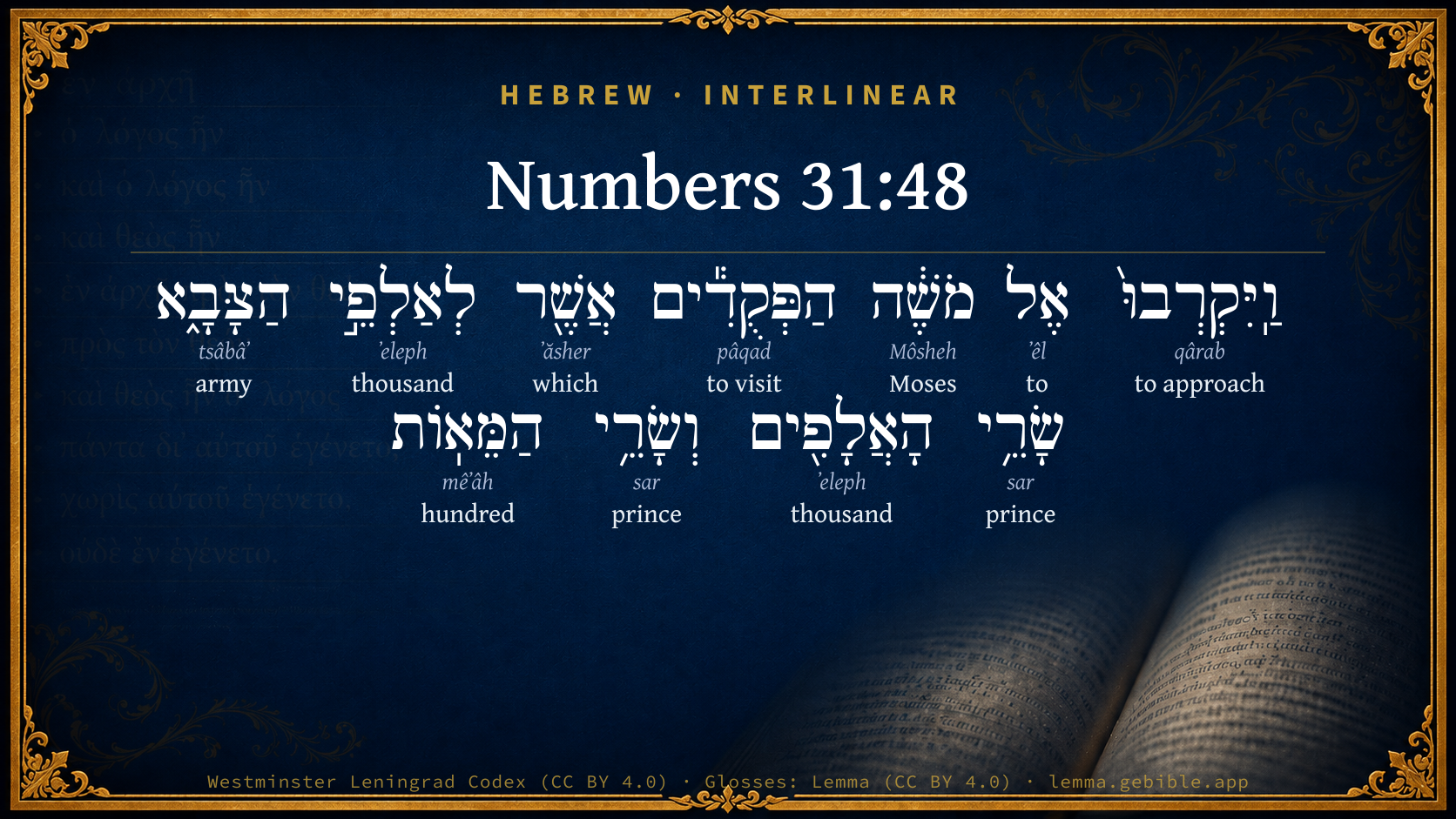
Numbers 31:48

Hebrew (Westminster Leningrad Codex) Numbers 31:48 appears in the Hebrew Old Testament. The text above is from the Westminster Leningrad Codex. Each word links to its Strong’s number, a concise gloss, and parsing drawn from the Open Scriptures Hebrew Bible morphology. Click any word for its full Brown-Driver-Briggs (BDB) entry.
Download image
Cite this verse

Numbers 31:48 (World English Bible). Public Domain. Lemma interlinear Bible study tool, https://lemma.gebible.app/v/numbers/31/48.

Show BibTeX & RIS
BibTeX
RIS
English Translation
The officers who were over the thousands of the host, the captains of thousands, and the captains of hundreds, came near to Moses;
World English Bible · Public Domain
Download a study sheet

One document with this verse’s original text, its word-by-word gloss line, the meaning frame, cross-references with their text, attributed commentary, and full source and license credits — printable, and it pastes into notes with its structure intact.

This verse Autodidact and up

Study sheet (.html) Plain text (.txt)

A passage Seminary Student

Up to 50 verses in one chapter. A passage sheet keeps up to 6 commentary sources and 12 cross-references per verse, in the order this page ranks them, and says so on the sheet whenever that leaves anything out. Ask for a single verse and you get the Autodidact verse sheet above.

Everything on this page stays free to read, with no account — the sheet is a download of what is already on screen, not access to it.

Want to remove ads? Support Godless Engineer
Compare translations 3

The same verse in 3 English versions, stacked beneath the original-language interlinear above. Click any original word for its lexicon entry.

Each is an independent rendering of the whole verse — the interlinear is not word-aligned to these translations.

Highlighted words mark where these versions differ — a whole-verse word diff, not a word-by-word alignment.

  • World English Bible Public Domain
    The officers who were over the thousands of the host, the captains of thousands, and the captains of hundreds, came near to Moses;
  • King James Version Public Domain
    And the officers which were over thousands of the host, the captains of thousands, and captains of hundreds, came near unto Moses:
  • unfoldingWord Literal Text CC BY-SA 4.0
    And the appointed ones who were for the thousands of the army, the leaders of the thousands and the leaders of the hundreds, came near to Moses.

unfoldingWord Literal Text — © unfoldingWord, licensed CC BY-SA 4.0. Word-aligned USFM3 via Door43 (git.door43.org/unfoldingWord/en_ult).

Versions to compare (up to 4)

3 of 4 selected

Show all 18 translations

Every available English version of this verse, each an independent rendering of the whole verse.

  • World English Bible Public Domain
    The officers who were over the thousands of the host, the captains of thousands, and the captains of hundreds, came near to Moses;
  • Berean Standard Bible Public Domain
    Then the officers who were over the units of the army—the commanders of thousands and of hundreds—approached Moses
  • Majority Standard Bible Public Domain
    Then the officers who were over the units of the army—the commanders of thousands and of hundreds—approached Moses
  • King James Version Public Domain
    And the officers which were over thousands of the host, the captains of thousands, and captains of hundreds, came near unto Moses:
  • American Standard Version (1901) Public Domain
    And the officers that were over the thousands of the host, the captains of thousands, and the captains of hundreds, came near unto Moses;
  • Revised Version (1885) Public Domain
    And the officers which were over the thousands of the host, the captains of thousands, and the captains of hundreds, came near unto Moses:
  • Geneva Bible (1599) Public Domain
    Then the captaines which were ouer thousandes of the hoste, the captaines ouer the thousandes, and the captaines ouer the hundreds came vnto Moses:
  • Douay-Rheims (1899) Public Domain
    And when the commanders of the army, and the tribunes and centurions were come to Moses, they said:
  • Young's Literal Translation Public Domain
    And the inspectors whom the thousands of the host hath, (heads of the thousands and heads of the hundreds), draw near unto Moses,
  • Literal Standard Version CC BY-SA 4.0
    And the inspectors whom the thousands of the host have (heads of the thousands and heads of the hundreds), draw near to Moses,
  • Unlocked Literal Bible CC BY-SA 4.0
    Then the officers of the army, the commanders over thousands and the captains over hundreds, came to Moses.
  • unfoldingWord Literal Text CC BY-SA 4.0
    And the appointed ones who were for the thousands of the army, the leaders of the thousands and the leaders of the hundreds, came near to Moses.
  • Darby Bible Public Domain
    And the officers who were over the thousands of the host, the captains of thousands, and captains of hundreds, came near to Moses,
  • World Messianic Bible Public Domain
    The officers who were over the thousands of the army, the captains of thousands, and the captains of hundreds, came near to Moses.
  • Webster's Bible Public Domain
    And the officers who were over thousands of the hosts, the captains of thousands, and captains of hundreds, came near to Moses:
  • Free Bible Version CC BY-SA 4.0
    The army officers, the commanders of thousands and commanders of hundreds, came to Moses
  • Bible in Basic English Public Domain
    Then the men in authority over the thousands of the army, the captains of thousands and captains of hundreds, came to Moses,
  • JPS Tanakh (1917) Public Domain
    And the officers that were over the thousands of the host, the captains of thousands, and the captains of hundreds, came near unto Moses;

Literal Standard Version (2020), Covenant Press — licensed CC BY-SA 4.0. Text via the HelloAO Bible API (eBible.org). Unlocked Literal Bible (unfoldingWord) — licensed CC BY-SA 4.0. Text via the HelloAO Bible API (eBible.org). unfoldingWord Literal Text — © unfoldingWord, licensed CC BY-SA 4.0. Word-aligned USFM3 via Door43 (git.door43.org/unfoldingWord/en_ult). Free Bible Version, Dr. Jonathan Gallagher — licensed CC BY-SA 4.0. Text via the HelloAO Bible API (eBible.org).

Word by word

More ways to search: Search by grammar → Find every occurrence → Compare this word →

Practice this passage: Drill this verse → Learn its vocabulary →

וַֽיִּקְרְבוּ֙
qârab
H7126
“and · to approach”
Conjunction + Verb, Qal, Sequential Imperfect, 3rd Person, Masculine, Plural
Part of Speech
Conjunction + Verb
Stem
Qal
Form
Sequential Imperfect
Person
3rd Person
Gender
Masculine
Number
Plural
Full BDB Definition

Origin: a primitive root

TWOT: 2065

to come near, approach, enter into, draw near - (Qal) to approach, draw near - (Niphal) to be brought near - (Piel) to cause to approach, bring near, cause to draw near - (Hiphil) to bring near, bring, present
  1. אֶל ʼêl H413 “to” Preposition
  2. מֹשֶׁ֔ה Môsheh H4872 “Moses” Noun, Proper
  3. הַפְּקֻדִ֕ים pâqad H6485 “the · visited” Particle, Definite Article + Verb, Qal, Participle Passive, Masculine, Plural, Absolute
  4. אֲשֶׁ֖ר ʼăsher H834 “which” Particle, Relative
  5. לְאַלְפֵ֣י ʼeleph H505 “to/for · thousand” Preposition + Adjective, Cardinal number, Both, Plural, Construct
  6. הַצָּבָ֑א tsâbâʼ H6635 “the · army” Particle, Definite Article + Noun, Common, Both, Singular, Absolute
  7. שָׂרֵ֥י sar H8269 “princes of” Noun, Common, Masculine, Plural, Construct
  8. הָאֲלָפִ֖ים ʼeleph H505 “the · thousand” Particle, Definite Article + Adjective, Cardinal number, Both, Plural, Absolute
  9. וְשָׂרֵ֥י sar H8269 “and · princes of” Conjunction + Noun, Common, Masculine, Plural, Construct
  10. הַמֵּאֽוֹת mêʼâh H3967 “the · hundred” Particle, Definite Article + Adjective, Cardinal number, Both, Plural, Absolute

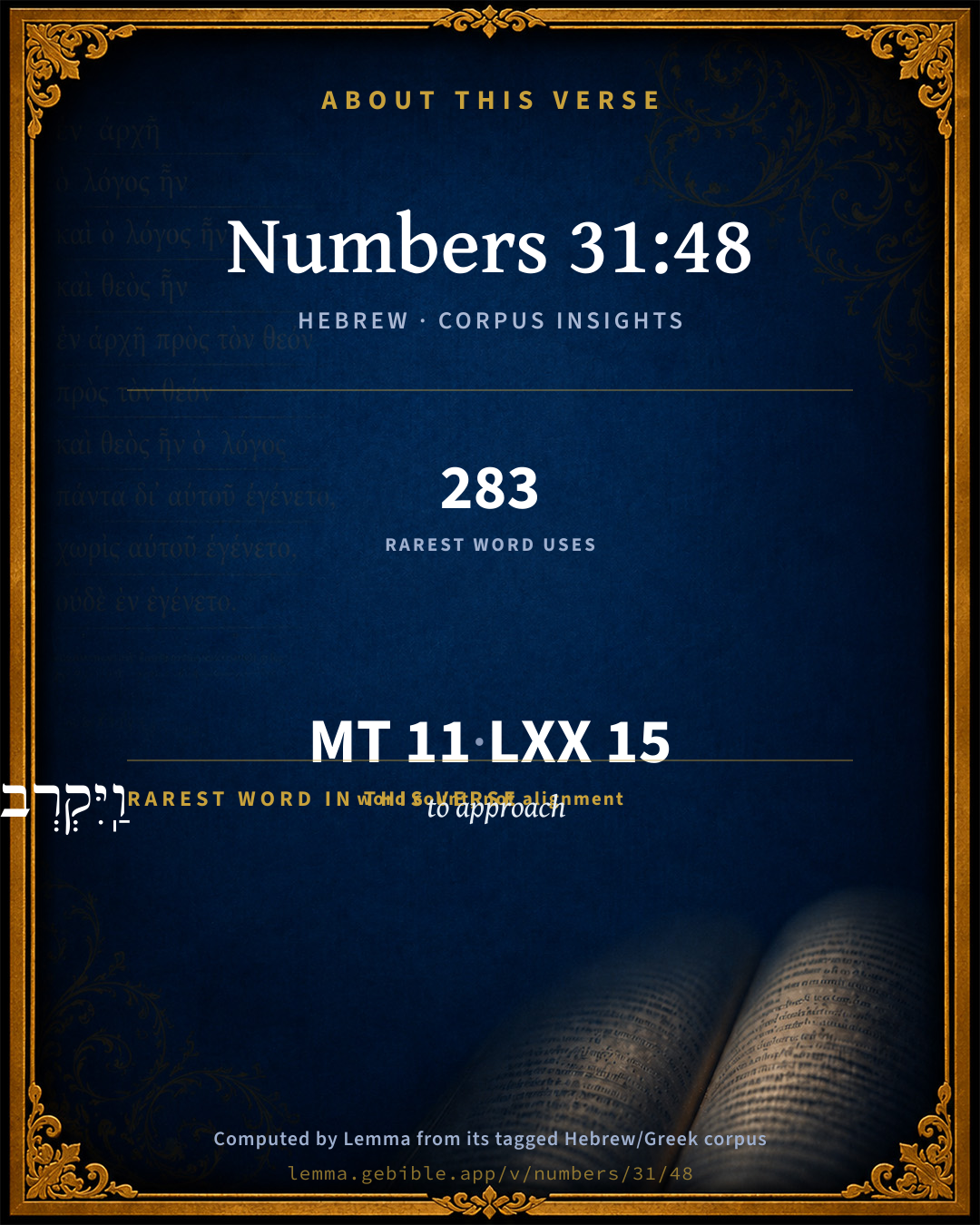
About this verse

These counts appear in no published source. They are computed here, from the morphology-tagged text and Lemma’s own curated glosses. What Lemma adds →

11
words
9
distinct lemmas
Pentateuch
section

Grammatical profile

  • 2 verbs
  • 4 nouns
  • 3 adjectives
  • 1 preposition
  • 1 particle

Verb forms

  • וַֽיִּקְרְבוּ֙ Qal · Sequential Imperfect
  • הַפְּקֻדִ֕ים Qal · Participle Passive

Repetition

Words recur within this verse — often emphatic in Hebrew:

  • לְאַלְפֵ֣י thousand H505 ×2
  • שָׂרֵ֥י prince H8269 ×2

Hebrew & Septuagint length

In English translation the verse runs 23 words from the Hebrew and 27 from the Septuagint (LXX English) — closely comparable.

A rough comparison of the two English renderings, which tokenize alike — not a word-level alignment.

Word counts can differ between the Hebrew and the Greek without any difference in meaning — e.g. the Hebrew direct-object marker אֵת has no separate Greek word, and Greek often adds the article ὁ.

In the original languages it is 11 Hebrew tokens and 15 Greek tokens — but the two are counted differently (Hebrew bundles its prefixes and suffixes into one token; the Greek is in lemma form), so that isn’t a like-for-like length.

Hebrew and Greek witnesses Masoretic Hebrew ↔ Greek Septuagint

The same verse in the two great witnesses to the Old Testament, shown verse-for-verse.

These are two independent witnesses, not word-aligned to each other, and the Septuagint is shown in lemma (dictionary) form.

Hebrew Numbers 31:48 Masoretic · Westminster Leningrad Codex

וַֽיִּקְרְבוּ֙ אֶל מֹשֶׁ֔ה הַפְּקֻדִ֕ים אֲשֶׁ֖ר לְאַלְפֵ֣י הַצָּבָ֑א שָׂרֵ֥י הָאֲלָפִ֖ים וְשָׂרֵ֥י הַמֵּאֽוֹת

The officers who were over the thousands of the host, the captains of thousands, and the captains of hundreds, came near to Moses;

World English Bible · Public Domain

Greek LXX Numbers 31:48 Septuagint · lemma form

καί προςἔρχομαι πρός μωυσῆς πᾶς ὁ καταἵστημι εἰς ὁ χιλιαρχία ὁ δύναμις χιλίαρχος καί ἑκατόνταρχος

And all those who were appointed to be officers of thousands of the host, captains of thousands and captains of hundreds, approached Moses, and said to Moses,

LXX2012 (modern English Septuagint) · Public Domain

On this verse, Keil & Delitzsch discusses the Septuagint’s reading. Read the note in Commentary ↓

Hebrew: Westminster Leningrad Codex (CC BY 4.0). Greek: Septuagint (public domain); English from LXX2012 (modern English Septuagint) (Public Domain). How the Septuagint differs from the Hebrew →

Targum (Aramaic paraphrase)

2

The Targum is the ancient Jewish Aramaic paraphrase of the Hebrew Scriptures — an interpretive translation, not the Hebrew text itself. Onkelos (literal) and Pseudo-Jonathan (expansive) render the Torah, and Jonathan the Prophets. Coverage is partial: where no permissively-licensed English translation exists for a verse, only the Aramaic is shown. This is verse-level text, not a word-by-word alignment to the Hebrew.

  1. Targum Onkelos Torah (Genesis–Deuteronomy)
    וּקְרִיבוּ לְוָת משֶׁה דִמְמַנָן עַל אַלְפֵי חֵילָא רַבָּנֵי אַלְפִין וְרַבָּנֵי מַאֲוָתָא

    (no public-domain English translation for this verse)

    Targum Onkelos — Aramaic: “Onkelos Genesis” (public domain); “Onkelos Exodus” (public domain); “Onkelos Leviticus” (public domain); “Onkelos Numbers” (public domain); “Onkelos Deuteronomy” (public domain). English: “Sefaria Community Translation” (CC0 1.0 (public-domain dedication)); “J.W. Etheridge. The Targums of Onkelos and Jonathan Ben Uzziel on the Pentateuch. London: Longmans, Green, 1862” (public domain). Text via Sefaria.

  2. Targum Pseudo-Jonathan Torah (Genesis–Deuteronomy)
    וְקָרִיבוּ לְוַת משֶׁה אִסְטַרְטִיגִין דִמְמַנָן עַל אַלְפֵי חֵילָא רַבָּנֵי אַלְפִין וְרַבָּנֵי מַאֲוָתָא

    And the officers who had been appointed over the thousands of the host, the captains of thousands and of hundreds, drew near to Mosheh,

    Targum Pseudo-Jonathan — Aramaic: “Targum Jonathan on Genesis” (public domain); “Targum Jonathan on Exodus” (public domain); “Targum Jonathan on Leviticus” (public domain); “Targum Jonathan on Numbers” (public domain); “Targum Jonathan on Deuteronomy” (public domain). English: “The Targum of Jonathan ben Uzziel, trans. J. W. Etheridge, London, 1862” (public domain). Text via Sefaria.

Commentary

Notes on Numbers 31:48 from classic Christian and Jewish commentators (each source and its license shown beneath its notes). The classic Christian expositions comment on the surrounding passage and are grouped to its opening verse, so a note may address several verses; the Jewish commentaries on the Tanakh (Rashi and others) are per-verse, so they appear only where the commentator wrote on this verse.

Lemma curates 59 commentaries, every one of them public domain or Creative Commons licensed, each selected and text-cleaned for this edition rather than reprinted as found. About our sources →

Tyndale Open Study Notes

Tyndale Open Resources

31:48-49 Though it is unusual for no soldiers from an army to be killed in battle, it is not impossible. Classical authors also reported battles in which few or no Roman soldiers were killed. If the Israelites had the advantages of preparation, surprise, and overwhelming force, they could have defeated the Midianites and lost no troops, especially in light of God’s blessing.

Tyndale Open Study Notes — © Tyndale Open Resources, licensed CC BY-SA 4.0. Text via the HelloAO Bible API.

Jamieson, Fausset & Brown

Robert Jamieson, A. R. Fausset & David Brown

officers . . . said . . . there lacketh not one man of us--A victory so signal, and the glory of which was untarnished by the loss of a single Israelitish soldier, was an astonishing miracle. So clearly betokening the direct interposition of Heaven, it might well awaken the liveliest feelings of grateful acknowledgment to God (Psa 44:2-3). The oblation they brought for the Lord "was partly an atonement" or reparation for their error (Num 31:14-16), for it could not possess any expiatory virtue, and partly a tribute of gratitude for the stupendous service rendered them. It consisted of the "spoil," which, being the acquisition of individual valor, was not divided like the "prey," or livestock, each soldier retaining it in lieu of pay; it was offered by the "captains" alone, whose pious feelings were evinced by the dedication of the spoil which fell to their share. There were jewels to the amount of 16,750 shekels, equal to £87,869 16s. 5d. sterling.

Next: Numbers Chapter 32

Jamieson, Fausset & Brown — Commentary Critical and Explanatory on the Whole Bible (1871) — public domain (CC PDM 1.0). Text via the HelloAO Bible API.

John Gill's Exposition

For the men of war had taken spoil, every man for himself. And which he kept for himself, and did not deliver in with the prey or booty, which was brought to Moses and Eleazar, the sum of which was taken by them; and this seems to confirm what has been hinted, that, as each soldier had taken spoil for himself, so everyone contributed his quota towards this freewill offering to the Lord.

Numbers 31:54

John Gill's Exposition of the Whole Bible (1746–1763) — public domain (CC PDM 1.0). Text via the HelloAO Bible API.

Keil & Delitzsch

C. F. Keil & F. Delitzsch

Sacred Oblations of the Officers. - When the officers reviewed the men of war who were "in their hand," i.e., who had fought the battle under their command, and found not a single man missing, they felt constrained to give a practical expression to their gratitude for this miraculous preservation of the whole of the men, by presenting a sacrificial gift to Jehovah; they therefore brought all the golden articles that they had received as booty, and offered them to the Lord "for the expiation of their souls" (see at Lev 1:4), namely, with the feeling that they were not worthy of any such grace, and not "because they had done wrong in failing to destroy all the enemies of Jehovah" (Knobel). This gift, which was offered as a heave-offering for Jehovah, consisted of the following articles of gold: אצעדה, "arm-rings," according to Sa2 1:10 (lxx χελιδῶνα; Suidas: χελιδόναι κοσμοὶ περὶ τοὺς βραχιόνας, καλοῦνται δὲ βραχιάλια); צמיד, bands, generally armlets (Gen 24:22, etc.); טבּעת, signet-rings; עגיל, hoops, - according to Eze 16:12, ear-rings; and כּוּמז, gold balls (Exo 35:22). They amounted in all to 16,750 shekels; and the men of war had received their own booty in addition to this. This gift, presented on the part of the officers, was brought into the tabernacle "as a memorial of the children of Israel before Jehovah" (cf. Exo 30:16); that is to say, it was placed in the treasury of the sanctuary.

The fact that the Israelites did not lose a single man in the battle, is certainly a striking proof of the protection of God; but it is not so marvellous as to furnish any good ground for calling in question the correctness of the narrative.

(Note: Rosenmller has cited an example from Tacitus (Ann. xiii. 39), of the Romans having slaughtered all the foe without losing a single man on the capture of a Parthian castle; and another from Strabo (xvi. 1128), of a battle in which 1000 Arabs were slain, and only 2 Romans. And Hvernick mentions a similar account from the life of Saladin in his Introduction (i. 2, p. 452).)

The Midianites were a nomad tribe, who lived by rearing flocks and herds, and therefore were not a warlike people. Moreover, they were probably attacked quite unawares, and being unprepared, were completely routed and cut down without quarter. The quantity of booty brought home is also not so great as to appear incredible. Judging from the 32,000 females who had never lain with a man, the tribes governed by the five kings may have numbered about 130,000 or 150,000, and therefore not have contained much more than 35,000 fighting men, who might easily have been surprised by 12,000 brave warriors, and entirely destroyed. And again, there is nothing in the statement that 675,000 sheep and goats, 72,000 oxen, and 61,000 asses were taken as booty from these tribes, to astonish any one who has formed correct notions of the wealth of nomad tribes in flocks and herds. The only thing that could appear surprising is, that there are no camels mentioned.

But it is questionable, in the first place, whether the Midianites were in the habit of rearing camels; and, in the second place, if they did possess them, it is still questionable whether the Israelitish army took them away, and did not rather put to death all that they found, as being of no value to the Israelites in their existing circumstances. Lastly, the quantity of jewellery seized as booty is quite in harmony with the well-known love of nomads, and even of barbarous tribes, for ornaments of this kind; and the peculiar liking of the Midianites for such things is confirmed by the account in Jdg 8:26, according to which Gideon took as much as 1700 shekels in weight of golden rings from the Midianites alone, beside ornaments of other kinds. If we take the golden shekel at 10 thalers (30 shillings), the value of the ornaments taken by the officers under Moses would be about 167,500 thalers (L.25,125). It is quite possible that the kings and other chiefs, together with their wives, may have possessed as much as this.

Keil & Delitzsch — Biblical Commentary on the Old Testament (1861–1891) — public domain (CC PDM 1.0). Text via the HelloAO Bible API. (Old Testament only.)

Kretzmann's Popular Commentary

Paul E. Kretzmann

The Gifts Consecrated to the Lord

v. 48. And the officers which were over thousands of the host, (namely,) the captains of thousands and captains of hundreds, came near unto Moses;

v. 49. and they said unto Moses, Thy servants have taken the sum of the men of war which are under our charge, and there lacketh not one man of us. "This is one of the features of this narrative which shows that we are dealing here with the execution of a divine sentence. It implies an extraordinary divine protection, which is in accordance with the view that they were in a peculiar sense the Lord’s instruments. " (Gosman. )

v. 50. We have therefore brought an oblation for the Lord, what every man hath gotten, of the individual plunder which they had made, of jewels of gold, chains, armbands, and bracelets, seal-rings, rings, such as were fastened in the noses, earrings, and tablets, small golden spheres which were used for personal adornment, to make an atonement for our souls before the Lord, for the blessing of their safe return, since they felt that they were not worthy of such divine goodness.

v. 51. And Moses and Eleazar, the priest, took the gold of them, even all wrought jewels, gold that had been fashioned into jewelry.

v. 52. And all the gold of the offering that they offered up, to the Lord, of the captains of thousands and of the captains of hundreds, was sixteen thousand seven hundred and fifty shekels (16,750), or more than $160,000, not too large a sum, by any means; for the nomadic tribes were rich in jewelry as well as in herds and flocks.

v. 53. (For the men of war had taken spoil, every man for himself. )

v. 54. And Moses and Eleazar, the priest, took the gold of the captains of thousands and of hundreds, and brought it into the Tabernacle of the Congregation, into the treasury of the Sanctuary, for a memorial for the children of Israel before the Lord. It pleases the Lord, even now, if believers, for special manifestations of God’s goodness and mercy, show their appreciation in special gifts of gratitude, for the work of the Lord.

Paul E. Kretzmann, Popular Commentary of the Bible (1921–1924) — public domain. Text from a community e-Sword module.

unfoldingWord translationNotes

Door43 World Missions Community

the commanders over thousands and the captains over hundreds

Possible meanings are 1) these numbers represent the exact amount of soldiers that these commanders and captains led. AT: "the commanders over 1,000 soldiers and the captains over 100 soldiers" or 2) the words translated as "thousands" and "hundreds" do not represent exact numbers, but are the names of larger and smaller military divisions. AT: "the commanders over large military divisions and the captains over smaller military divisions" See how you translated a similar phrase in Numbers 31:14. (See: Numbers)

Your servants have counted

The commanders refer to themselves as "your servants." This is a polite way to speak to someone with greater authority.

not one man is missing

This can be stated in a positive statement. "we know for certain that every man is here" (See: Litotes)

translationWords

commander

servant

unfoldingWord translationNotes — © Distant Shores Media and the Door43 World Missions Community, licensed CC BY-SA 4.0. Source: git.door43.org/Door43/en_tn.

Rashi

Rabbi Shlomo Yitzchaki (Rashi)

הפקדים means THOSE WHO WERE APPOINTED (not those who were counted, as e.g. in Numbers 3:39).

Rashi on the Tanakh — English translations: “The Judaica Press complete Tanach with Rashi, translated by A. J. Rosenberg” (CC BY 4.0); “Pentateuch with Rashi's commentary by M. Rosenbaum and A.M. Silbermann, 1929-1934” (public domain); “The Metsudah Tanach series, Lakewood, N.J” (CC BY 4.0); and “The Book of Joshua, Metsudah Publications, 1997” (CC BY 4.0). Text via Sefaria.

Lesson kit

Teaching starters — assembled from the data on this page, not authored interpretation. Every prompt links to the verse data it draws on. Edit before teaching.

Numbers, in the Pentateuch, opens this verse with 11 words (9 distinct Hebrew lemmas). Its most distinctive word is qârab (“to approach”). A historical commentator’s framing appears above. Read the whole chapter for the surrounding context.

Discussion questions

  1. How does “to approach” (qârab) shape what this verse is saying?
  2. “thousand” occurs 2× in this one verse. What is the effect of the repetition?
  3. These translations render this verse differently. What is at stake in choosing one wording over another?
  4. The verb «וַֽיִּקְרְבוּ֙» is Qal Sequential Imperfect. How does its form color the action?
  5. Reading how Tyndale Open Study Notes and Jamieson, Fausset & Brown read this verse, where do the two commentators agree and where do they part?

Things to notice

Reading settings

Reading text

Shown beneath each verse's original-language words.

Old Testament
Old Testament edition

Read the OT as the Masoretic Hebrew (MT) or the Greek Septuagint (LXX).

English shown for the Greek Septuagint (in the Hebrew ↔ Greek comparison).

Comparing translations? Open the Compare panel on any verse page to stack up to four side by side.