
Numbers 9:6

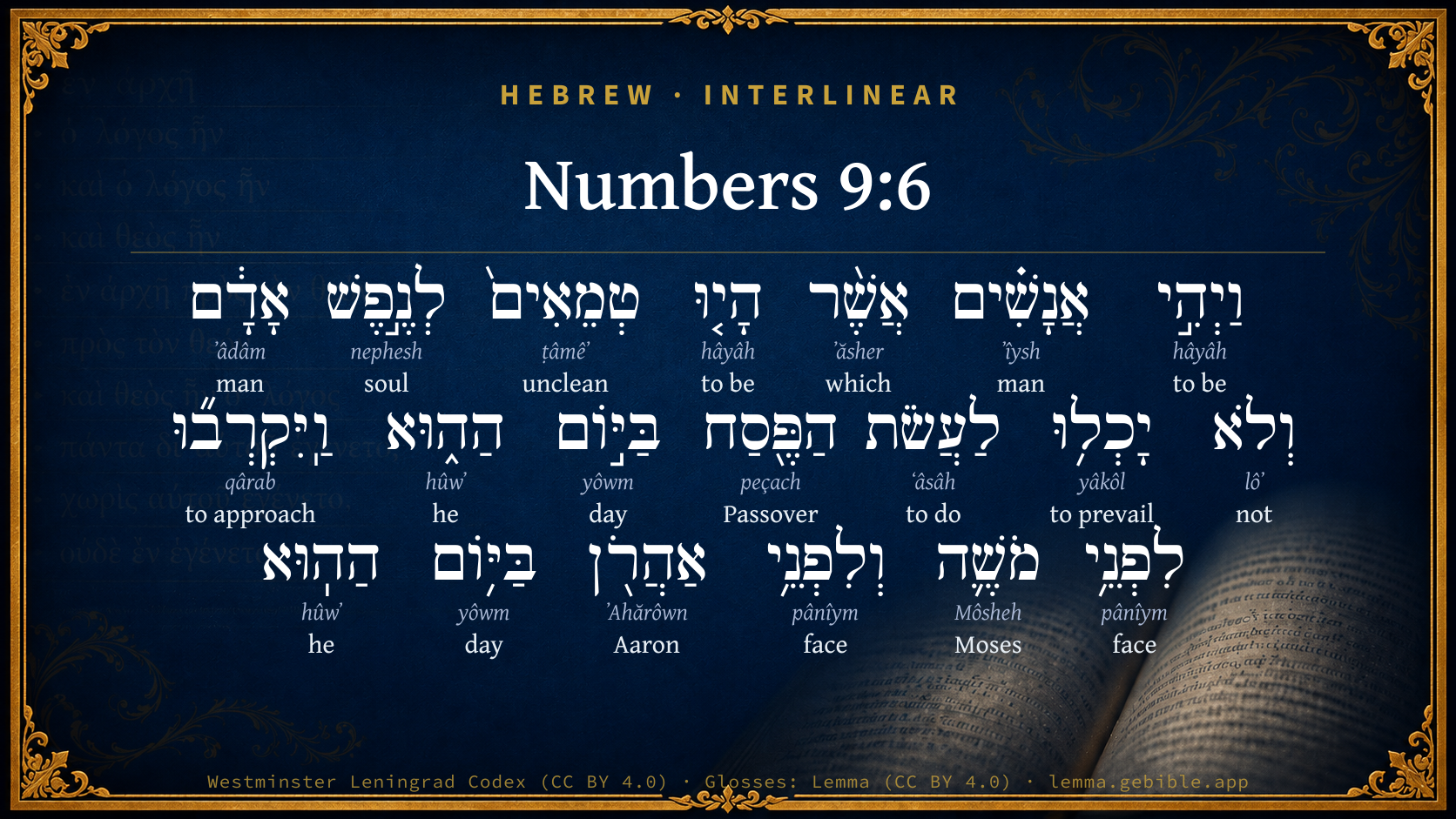
Hebrew (Westminster Leningrad Codex) Numbers 9:6 appears in the Hebrew Old Testament. The text above is from the Westminster Leningrad Codex. Each word links to its Strong’s number, a concise gloss, and parsing drawn from the Open Scriptures Hebrew Bible morphology. Click any word for its full Brown-Driver-Briggs (BDB) entry.
Download image
Cite this verse

Numbers 9:6 (World English Bible). Public Domain. Lemma interlinear Bible study tool, https://lemma.gebible.app/v/numbers/9/6.

Show BibTeX & RIS
BibTeX
RIS
English Translation
There were certain men, who were unclean because of the dead body of a man, so that they could not keep the Passover on that day, and they came before Moses and before Aaron on that day.
World English Bible · Public Domain
Download a study sheet

One document with this verse’s original text, its word-by-word gloss line, the meaning frame, cross-references with their text, attributed commentary, and full source and license credits — printable, and it pastes into notes with its structure intact.

This verse Autodidact and up

Study sheet (.html) Plain text (.txt)

A passage Seminary Student

Up to 50 verses in one chapter. A passage sheet keeps up to 6 commentary sources and 12 cross-references per verse, in the order this page ranks them, and says so on the sheet whenever that leaves anything out. Ask for a single verse and you get the Autodidact verse sheet above.

Everything on this page stays free to read, with no account — the sheet is a download of what is already on screen, not access to it.

Want to remove ads? Support Godless Engineer
Compare translations 3

The same verse in 3 English versions, stacked beneath the original-language interlinear above. Click any original word for its lexicon entry.

Each is an independent rendering of the whole verse — the interlinear is not word-aligned to these translations.

Highlighted words mark where these versions differ — a whole-verse word diff, not a word-by-word alignment.

  • World English Bible Public Domain
    There were certain men, who were unclean because of the dead body of a man, so that they could not keep the Passover on that day, and they came before Moses and before Aaron on that day.
  • King James Version Public Domain
    And there were certain men, who were defiled by the dead body of a man, that they could not keep the passover on that day: and they came before Moses and before Aaron on that day:
  • unfoldingWord Literal Text CC BY-SA 4.0
    And there were men who were unclean to a person of a man, and they were not able to do the Passover on that day. And they came near to the face of Moses and to the face of Aaron on that day.

unfoldingWord Literal Text — © unfoldingWord, licensed CC BY-SA 4.0. Word-aligned USFM3 via Door43 (git.door43.org/unfoldingWord/en_ult).

Versions to compare (up to 4)

3 of 4 selected

Show all 18 translations

Every available English version of this verse, each an independent rendering of the whole verse.

  • World English Bible Public Domain
    There were certain men, who were unclean because of the dead body of a man, so that they could not keep the Passover on that day, and they came before Moses and before Aaron on that day.
  • Berean Standard Bible Public Domain
    But there were some men who were unclean due to a dead body, so they could not observe the Passover on that day. And they came before Moses and Aaron that same day
  • Majority Standard Bible Public Domain
    But there were some men who were unclean due to a dead body, so they could not observe the Passover on that day. And they came before Moses and Aaron that same day
  • King James Version Public Domain
    And there were certain men, who were defiled by the dead body of a man, that they could not keep the passover on that day: and they came before Moses and before Aaron on that day:
  • American Standard Version (1901) Public Domain
    And there were certain men, who were unclean by reason of the dead body of a man, so that they could not keep the passover on that day: and they came before Moses and before Aaron on that day:
  • Revised Version (1885) Public Domain
    And there were certain men, who were unclean by the dead body of a man, so that they could not keep the passover on that day: and they came before Moses and before Aaron on that day:
  • Geneva Bible (1599) Public Domain
    And certaine men were defiled by a dead man, that they might not keepe the Passeouer the same day: and they came before Moses and before Aaron the same day.
  • Douay-Rheims (1899) Public Domain
    But behold some who were unclean by occasion of the soul of a men, who could not make the phase on that day, coming to Moses and Aaron,
  • Young's Literal Translation Public Domain
    And there are men who have been defiled by the body of a man, and they have not been able to prepare the passover on that day, and they come near before Moses, and before Aaron, on that day,
  • Literal Standard Version CC BY-SA 4.0
    And there are men who have been defiled by the body of a man, and they have not been able to prepare the Passover on that day, and they come near before Moses and before Aaron on that day,
  • Unlocked Literal Bible CC BY-SA 4.0
    There were certain men who became unclean by the body of a dead man. They could not keep the Passover on that day. They went before Moses and Aaron on that same day.
  • unfoldingWord Literal Text CC BY-SA 4.0
    And there were men who were unclean to a person of a man, and they were not able to do the Passover on that day. And they came near to the face of Moses and to the face of Aaron on that day.
  • Darby Bible Public Domain
    And there were men, who were unclean through the dead body of a man, and could not hold the passover on that day; and they came before Moses and before Aaron on that day.
  • World Messianic Bible Public Domain
    There were certain men who were unclean because of the dead body of a man, so that they could not keep the Passover on that day, and they came before Moses and Aaron on that day.
  • Webster's Bible Public Domain
    And there were certain men, who were defiled by the dead body of a man, that they could not keep the passover on that day: and they came before Moses and before Aaron on that day:
  • Free Bible Version CC BY-SA 4.0
    However, there were some men who were unclean because they had been in contact with a dead body, so they could not keep the Passover on that day. They went to see Moses and Aaron the same day,
  • Bible in Basic English Public Domain
    And there were certain men who were unclean because of a dead body, so that they were not able to keep the Passover on that day; and they came before Moses and before Aaron on that day:
  • JPS Tanakh (1917) Public Domain
    But there were certain men, who were unclean by the dead body of a man, so that they could not keep the passover on that day; and they came before Moses and before Aaron on that day.

Literal Standard Version (2020), Covenant Press — licensed CC BY-SA 4.0. Text via the HelloAO Bible API (eBible.org). Unlocked Literal Bible (unfoldingWord) — licensed CC BY-SA 4.0. Text via the HelloAO Bible API (eBible.org). unfoldingWord Literal Text — © unfoldingWord, licensed CC BY-SA 4.0. Word-aligned USFM3 via Door43 (git.door43.org/unfoldingWord/en_ult). Free Bible Version, Dr. Jonathan Gallagher — licensed CC BY-SA 4.0. Text via the HelloAO Bible API (eBible.org).

Word by word

More ways to search: Search by grammar → Find every occurrence → Compare this word →

Practice this passage: Drill this verse → Learn its vocabulary →

הַפֶּ֖סַח
peçach
H6453
“the · Passover”
Particle, Definite Article + Noun, Common, Masculine, Singular, Absolute
Part of Speech
Particle + Noun
Type
Common
Gender
Masculine
Number
Singular
State
Absolute
Full BDB Definition

Origin: from H6452

TWOT: 1786a

passover - sacrifice of passover - animal victim of the passover - festival of the passover
  1. וַיְהִ֣י hâyâh H1961 “and · to be” Conjunction + Verb, Qal, Sequential Imperfect, 3rd Person, Masculine, Singular
  2. אֲנָשִׁ֗ים ʼîysh H376 “men” Noun, Common, Masculine, Plural, Absolute
  3. אֲשֶׁ֨ר ʼăsher H834 “which” Particle, Relative
  4. הָי֤וּ hâyâh H1961 “to be” Verb, Qal, Perfect, 3rd Person, Common, Plural
  5. טְמֵאִים֙ ṭâmêʼ H2931 “unclean” Adjective, Adjective, Masculine, Plural, Absolute
  6. לְנֶ֣פֶשׁ nephesh H5315 “to/for · soul of” Preposition + Noun, Common, Both, Singular, Construct
  7. אָדָ֔ם ʼâdâm H120 “man” Noun, Common, Masculine, Singular, Absolute
  8. וְלֹא lôʼ H3808 “and · not” Conjunction + Particle, Negative
  9. יָכְל֥וּ yâkôl H3201 “to prevail” Verb, Qal, Perfect, 3rd Person, Common, Plural
  10. לַעֲשֹׂת ʻâsâh H6213 “to do” Preposition + Verb, Qal, Infinitive Construct
  11. בַּיּ֣וֹם yôwm H3117 “in/at the · day” Preposition, Determined + Noun, Common, Masculine, Singular, Absolute
  12. הַה֑וּא hûwʼ H1931 “the · he” Particle, Definite Article + Pronoun, Personal, 3rd Person, Masculine, Singular
  13. וַֽיִּקְרְב֞וּ qârab H7126 “and · to approach” Conjunction + Verb, Qal, Sequential Imperfect, 3rd Person, Masculine, Plural
  14. לִפְנֵ֥י pânîym H6440 “to/for · face(s) of” Preposition + Noun, Common, Both, Plural, Construct
  15. מֹשֶׁ֛ה Môsheh H4872 “Moses” Noun, Proper
  16. וְלִפְנֵ֥י pânîym H6440 “and · to/for · face(s) of” Conjunction + Preposition + Noun, Common, Both, Plural, Construct
  17. אַהֲרֹ֖ן ʼAhărôwn H175 “Aaron” Noun, Proper
  18. בַּיּ֥וֹם yôwm H3117 “in/at the · day” Preposition, Determined + Noun, Common, Masculine, Singular, Absolute
  19. הַהֽוּא hûwʼ H1931 “the · he” Particle, Definite Article + Pronoun, Personal, 3rd Person, Masculine, Singular

About this verse

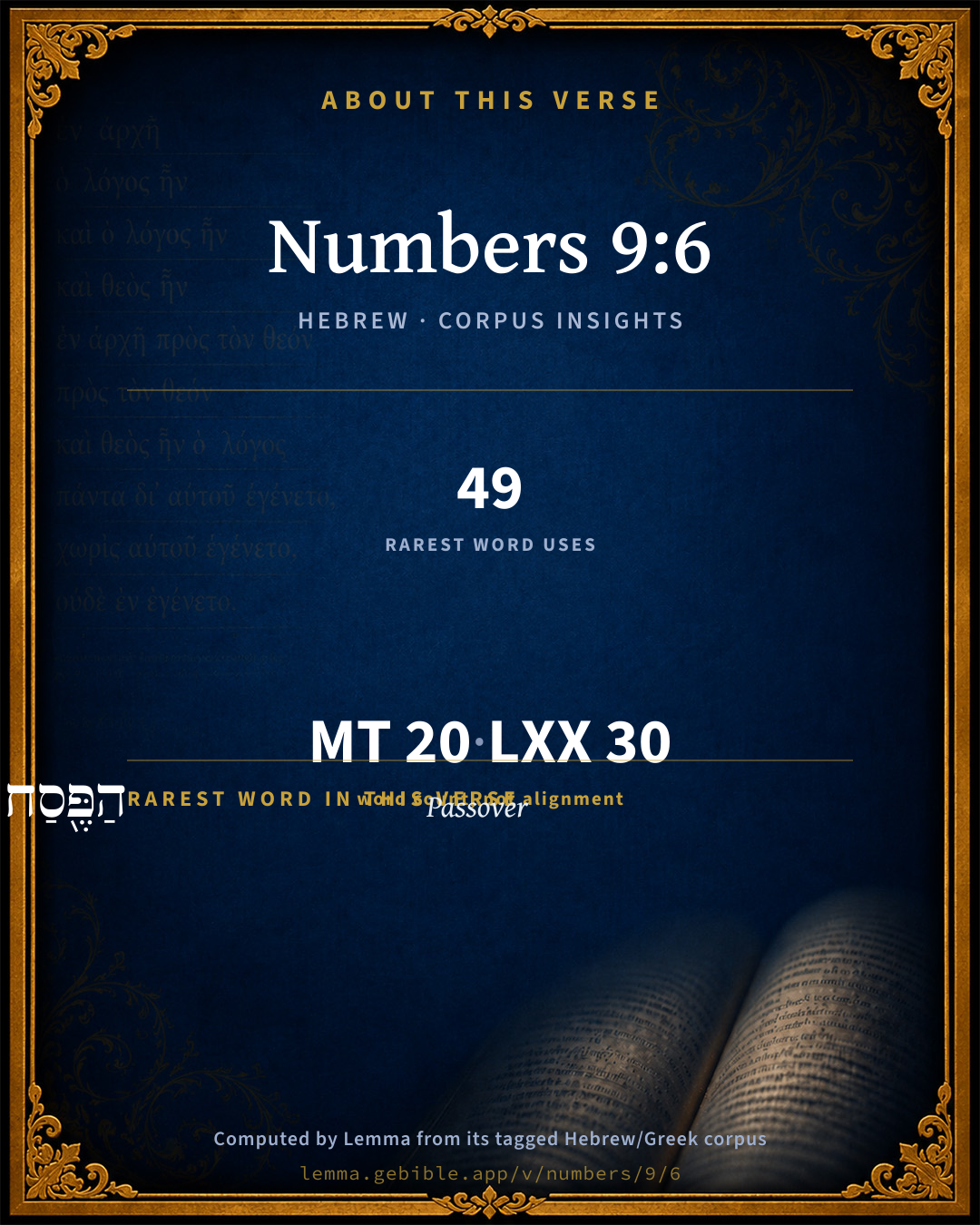
These counts appear in no published source. They are computed here, from the morphology-tagged text and Lemma’s own curated glosses. What Lemma adds →

20
words
16
distinct lemmas
Pentateuch
section

Shared distinctive vocabulary

הַפֶּ֖סַח Passover H6453 occurs in 46 verses of the Hebrew Bible. Also found in:

Grammatical profile

  • 5 verbs
  • 10 nouns
  • 1 adjective
  • 2 pronouns
  • 2 particles

Verb forms

  • וַיְהִ֣י Qal · Sequential Imperfect
  • הָי֤וּ Qal · Perfect
  • יָכְל֥וּ Qal · Perfect
  • לַעֲשֹׂת Qal · Infinitive Construct
  • וַֽיִּקְרְב֞וּ Qal · Sequential Imperfect

Repetition

Words recur within this verse — often emphatic in Hebrew:

  • וַיְהִ֣י to be H1961 ×2
  • בַּיּ֣וֹם day H3117 ×2
  • לִפְנֵ֥י face H6440 ×2
  • הַה֑וּא he H1931 ×2

Hebrew & Septuagint length

In English translation the verse runs 37 words from the Hebrew and 35 from the Septuagint (LXX English) — closely comparable.

A rough comparison of the two English renderings, which tokenize alike — not a word-level alignment.

Word counts can differ between the Hebrew and the Greek without any difference in meaning — e.g. the Hebrew direct-object marker אֵת has no separate Greek word, and Greek often adds the article ὁ.

In the original languages it is 20 Hebrew tokens and 30 Greek tokens — but the two are counted differently (Hebrew bundles its prefixes and suffixes into one token; the Greek is in lemma form), so that isn’t a like-for-like length.

Cross-references

14

Topical passages linked to Numbers 9:6 in the Treasury of Scripture Knowledge — connected by theme and wording, ordered by reader-vote popularity; previews shown in the World English Bible.

  • Exodus 18:15 Moses said to his father-in-law, "Because the people come to me to inquire of God.
  • Numbers 27:2 They stood before Moses, and before Eleazar the priest, and before the princes and all the congregation, at the door of the tent of meeting, saying,
  • Exodus 18:19 Listen now to my voice. I will give you counsel, and God be with you. You represent the people before God, and bring the causes to God.
  • Numbers 5:2 "Command the children of Israel that they put out of the camp every leper, and everyone who has an issue, and whoever is unclean by the dead.
  • Numbers 19:11 He who touches the dead body of any man shall be unclean seven days:
  • Numbers 19:16 Whoever in the open field touches one who is slain with a sword, or a dead body, or a bone of a man, or a grave, shall be unclean seven days.
  • Exodus 18:26 They judged the people at all times. They brought the hard causes to Moses, but every small matter they judged themselves.
  • Numbers 19:18 and a clean person shall take hyssop, and dip it in the water, and sprinkle it on the tent, and on all the vessels, and on the persons who were there, and on him who touched the bone, or the slain, or the dead, or the grave:
  • Numbers 27:5 Moses brought their cause before Yahweh.
  • John 18:28 They led Jesus therefore from Caiaphas into the Praetorium. It was early, and they themselves didn't enter into the Praetorium, that they might not be defiled, but might eat the Passover.
  • Leviticus 21:11 neither shall he go in to any dead body, nor defile himself for his father, or for his mother;
  • Leviticus 24:11 The son of the Israelite woman blasphemed the Name, and cursed; and they brought him to Moses. His mother's name was Shelomith, the daughter of Dibri, of the tribe of Dan.
  • Numbers 6:6–7 "All the days that he separates himself to Yahweh he shall not go near a dead body.
  • Numbers 15:33 Those who found him gathering sticks brought him to Moses and Aaron, and to all the congregation.

Cross-references courtesy of OpenBible.info (CC BY 4.0).

Hebrew and Greek witnesses Masoretic Hebrew ↔ Greek Septuagint

The same verse in the two great witnesses to the Old Testament, shown verse-for-verse.

These are two independent witnesses, not word-aligned to each other, and the Septuagint is shown in lemma (dictionary) form.

Hebrew Numbers 9:6 Masoretic · Westminster Leningrad Codex

וַיְהִ֣י אֲנָשִׁ֗ים אֲשֶׁ֨ר הָי֤וּ טְמֵאִים֙ לְנֶ֣פֶשׁ אָדָ֔ם וְלֹא יָכְל֥וּ לַעֲשֹׂת הַפֶּ֖סַח בַּיּ֣וֹם הַה֑וּא וַֽיִּקְרְב֞וּ לִפְנֵ֥י מֹשֶׁ֛ה וְלִפְנֵ֥י אַהֲרֹ֖ן בַּיּ֥וֹם הַהֽוּא

There were certain men, who were unclean because of the dead body of a man, so that they could not keep the Passover on that day, and they came before Moses and before Aaron on that day.

World English Bible · Public Domain

Greek LXX Numbers 9:6 Septuagint · lemma form

καί παραγίγνομαι ὁ ἀνήρ ὅς εἰμί ἀκάθαρτος ἐπί ψυχή ἄνθρωπος καί οὐ δύναμαι ποιέω ὁ πασχα ἐν ὁ ἡμέρα ἐκεῖνος καί προςἔρχομαι ἐναντίον μωυσῆς καί ἀαρών ἐν ἐκεῖνος ὁ ἡμέρα

And there came men who were unclean by reason of a dead body, and they were not able to keep the passover on that day; and they came before Moses and Aaron on that day.

LXX2012 (modern English Septuagint) · Public Domain

On this verse, The Pulpit Commentary discusses the Septuagint’s reading. Read the note in Commentary ↓

Hebrew: Westminster Leningrad Codex (CC BY 4.0). Greek: Septuagint (public domain); English from LXX2012 (modern English Septuagint) (Public Domain). How the Septuagint differs from the Hebrew →

Targum (Aramaic paraphrase)

2

The Targum is the ancient Jewish Aramaic paraphrase of the Hebrew Scriptures — an interpretive translation, not the Hebrew text itself. Onkelos (literal) and Pseudo-Jonathan (expansive) render the Torah, and Jonathan the Prophets. Coverage is partial: where no permissively-licensed English translation exists for a verse, only the Aramaic is shown. This is verse-level text, not a word-by-word alignment to the Hebrew.

  1. Targum Onkelos Torah (Genesis–Deuteronomy)
    וַהֲווֹ גֻבְרַיָא דִי הֲווֹ מְסָאֲבִין לִטְמֵי נַפְשָׁא דֶאֱנָשָׁא וְלָא יְכִילוּ לְמֶעְבַּד פִּסְחָא בְּיוֹמָא הַהוּא וּקְרִיבוּ קֳדָם משֶׁה וְקָדָם אַהֲרֹן בְּיוֹמָא הַהוּא

    (no public-domain English translation for this verse)

    Targum Onkelos — Aramaic: “Onkelos Genesis” (public domain); “Onkelos Exodus” (public domain); “Onkelos Leviticus” (public domain); “Onkelos Numbers” (public domain); “Onkelos Deuteronomy” (public domain). English: “Sefaria Community Translation” (CC0 1.0 (public-domain dedication)); “J.W. Etheridge. The Targums of Onkelos and Jonathan Ben Uzziel on the Pentateuch. London: Longmans, Green, 1862” (public domain). Text via Sefaria.

  2. Targum Pseudo-Jonathan Torah (Genesis–Deuteronomy)
    וַהֲווֹ גוּבְרַיָא דְהַווּ מְסָאֲבִין לִטְמֵי נְפַשׁ בַּר נַשׁ דְמִית עֲלֵיהוֹן בִּתְכֵּף דְפוּקְדָנֵיהּ רַמְיָא עֲלֵיהוֹן וְלָא יְכִילוּ לְמֶעֱבַד פִּסְחָא בְּיוֹמָא הַהוּא דְהַוָה יוֹם שְׁבִיעָאָה לְסוֹאֲבוּתְהוֹן וּקְרִיבוּ לִקֳדָם משֶׁה וְקָדָם אַהֲרן בְּיוֹמָא הַהוּא

    But certain men, who were unclean, having been defiled by the body of a man who had died near them suddenly; as the commandment (of the Pascha) came upon them, could not perform it on that day, which was the seventh of their uncleanness. And they came before Mosheh and Aharon on that day;

    Targum Pseudo-Jonathan — Aramaic: “Targum Jonathan on Genesis” (public domain); “Targum Jonathan on Exodus” (public domain); “Targum Jonathan on Leviticus” (public domain); “Targum Jonathan on Numbers” (public domain); “Targum Jonathan on Deuteronomy” (public domain). English: “The Targum of Jonathan ben Uzziel, trans. J. W. Etheridge, London, 1862” (public domain). Text via Sefaria.

Commentary

Notes on Numbers 9:6 from classic Christian and Jewish commentators (each source and its license shown beneath its notes). The classic Christian expositions comment on the surrounding passage and are grouped to its opening verse, so a note may address several verses; the Jewish commentaries on the Tanakh (Rashi and others) are per-verse, so they appear only where the commentator wrote on this verse.

Lemma curates 59 commentaries, every one of them public domain or Creative Commons licensed, each selected and text-cleaned for this edition rather than reprinted as found. About our sources →

Jamieson, Fausset & Brown

Robert Jamieson, A. R. Fausset & David Brown

A SECOND PASSOVER ALLOWED. (Num 9:6-14)

there were certain men, who were defiled by the dead body of a man--To discharge the last offices to the remains of deceased relatives was imperative; and yet attendance on a funeral entailed ceremonial defilement, which led to exclusion from all society and from the camp for seven days. Some persons who were in this situation at the arrival of the first paschal anniversary, being painfully perplexed about the course of duty because they were temporarily disqualified at the proper season, and having no opportunity of supplying their want were liable to a total privation of all their privileges, laid their case before Moses. Jewish writers assert that these men were the persons who had carried out the dead bodies of Nadab and Abihu [Lev 10:4-5].

Jamieson, Fausset & Brown — Commentary Critical and Explanatory on the Whole Bible (1871) — public domain (CC PDM 1.0). Text via the HelloAO Bible API.

Trapp's Complete Commentary

John Trapp

Num 9:6 And there were certain men, who were defiled by the dead body of a man, that they could not keep the passover on that day: and they came before Moses and before Aaron on that day:

Ver. 6. They could not keep the passover.] Because they were to be unclean seven days. {Num 19:11} Now, among the very heathen, the sacrificers were to purify themselves some days before; they had their caena pura the night before, &c., {a} and having expiated the company, they cried, τις τηδε; who is here? to which they made reply, πολλοι κα γαθοι γε παρεισιν, Many and good are here. {b}

{a} Demosth.

{b} Aristoph.

John Trapp, A Commentary or Exposition upon All the Books of the Old and New Testament (1647–1656) — public domain. Text from a community e-Sword module.

Joseph Benson's Commentary

Num 9:6. They came before Moses — For resolution of their difficulty. The law, mentioned Num 5:2, commanding such persons to be put out of the camp, was not yet made.

Joseph Benson's Commentary on the Old and New Testaments (1811–1818) — public domain. Text from a community e-Sword module.

Whedon's Commentary on the Bible

Daniel D. Whedon

THE SUPPLEMENTAL PASSOVER, Num_9:6-14.

Only ceremonially clean persons could share in this sacrificial meal. Since there were many sources of defilement during seven days, and some during longer terms, it follows that there would naturally be a large number of persons at any given time disqualified. Out of so large a population some would naturally be absent at the regular passover. For these two classes an extra passover one month later is now authorized by Jehovah. But, as a safeguard against the perversion of this permission into an excuse for postponing it unnecessarily and merely from indifference, on the ground that he could make it up afterward, the threat of excision is held up to deter from any such abuse of this supplementary passover. The requirement that all Israel should partake of this sacrifice — especially this provision for its repetition — indicates that it is of vital importance to each, and symbolizes some act indispensable to his salvation. Christ is our passover. 1Co_5:7. No one can be saved who wilfully neglects to appropriate the known Lamb of God which taketh away the sin of the world. Heb_2:3.

6. Certain men… were defiled — It is a principle of the Mosaic legislation to give supplementary statutes only when an emergency actually arose in which the strict application of the general law would be a hardship. See Introduction, (1.)

Defiled by the dead — See Lev_21:1; Lev_21:11; Num_5:2, notes.

Daniel D. Whedon (gen. ed.), Commentary on the Old and New Testaments (1874–1909) — public domain. Text from a community e-Sword module.

Geneva Bible (1599)

Geneva Bible translators

By touching a corpse, or being at the burial.

Geneva Bible (1599) marginal notes — public domain. Text via Bolls.life.

Ellicott's Commentary for English Readers

(6) And there were certain men . . . —It has been supposed that the reference is to Mishael and Elzaphan, who appear to have buried their cousins, Nadab and Abihu, about this time (Blunt’s “Script. Coincidences,” pp. 66, 67,1850). If the consecration of Aaron and his sons began on the first day of the first month (Exo_40:2; Exo_40:12), and the death of Nadab and Abihu could not have taken place until the eighth day (Lev_9:1; Lev_9:12; Lev_10:19), inasmuch as the defilement caused by contact with the dead lasted for seven days (Num_19:11), it will follow, if this law was already in force, that those who buried Nadab and Abihu must have been unclean on the fourteenth day of the first month. Independently, then, of the doubtful inference which Professor Blunt draws from the identity of the numbers of the other tribes at the two numberings taken, the one before and the other after this time, from which he concludes that the deaths must have occurred amongst those who belonged to the tribe of Levi, which was not included in the census, this circumstance may fairly be adduced as one of the numerous undesigned coincidences with which Holy Scripture abounds. It may be observed further that, whilst reference would naturally be made to Moses on all doubtful occasions, none would be so likely to have recourse to him with the inquiry contained in Num_9:7 as those who had been employed by his direction (Lev_10:4) in the burial of Nadab and Abihu. The law contained in Lev_7:21 appears to have been understood to refer to all sacrificial meals. The legal uncleanness which disqualified the Israelites for participation in the Passover may be regarded as typical of the moral and spiritual disqualifications which render men unfit for participation in the Lord’s Supper.

A Bible Commentary for English Readers, edited by Charles John Ellicott (1878–1897) — public domain. Text from a community e-Sword module.

The Cambridge Bible for Schools and Colleges

gen. ed. J. J. S. Perowne

6. Uncleanness prevented any share in a sacrificial feast on pain of death (Lev_7:20), and contact with a dead body was a source of uncleanness (Num_19:11).

The Cambridge Bible for Schools and Colleges (gen. ed. J. J. S. Perowne; Cambridge University Press, 1878–1918) — public domain. Text from a community e-Sword module.

John Gill's Exposition

And those men said unto him,.... To Moses, who was the chief magistrate, though Aaron was the high priest. Jarchi says, they were both sitting together when the men came, and put the question to them, but it was not proper to speak to one after another; for if Moses knew not, how should Aaron know? says he; the more difficult matters were brought to Moses, and he gave answers to them:

we are defiled by the dead body of a man; they had touched it, or had been where it was, or at the funeral of it, and so were defiled: this they knew was their case by a law before mentioned, and which they speak of, not as a sin purposely committed by them, but as what had unhappily befallen them, and they could not avoid; and express their concern, that upon this account they should be deprived of the ordinance of the passover and as this confession shows an ingenuous disposition, so what follows, a pious, religious, and devotional frame of mind:

wherefore are we kept back, that we may not offer an offering of the Lord in his appointed season among the children of Israel? they speak very honourably of the ordinance of the passover, they call it "an offering of the Lord", the passover lamb being a slain sacrifice; and this offered to the Lord, by way of thanksgiving, for, and in commemoration of, their wonderful deliverance out of Egypt, and done in faith of Christ the passover, to be sacrificed for them; and it gave them much uneasiness that they were debarred by this occasional and unavoidable uncleanness, that was upon them, from keeping it; and what added to it was, that they could not observe it on the day which the Lord had appointed, and when the whole body of the children of Israel were employed in it; for it is no small pleasure to a good man to observe every ordinance of God in the manner and at the time he directs to, and his people in general are attending to the same; and the rather they were urgent in their expostulations, because it is said (a), this was the seventh and last day of their pollution, when they should be clean at evening, and the passover was not to be eaten until the evening, and therefore so earnestly expostulate why they should be kept back from it.

(a) Maimon. in Misn. Pesachim, c. 7. sect. 6.

John Gill's Exposition of the Whole Bible (1746–1763) — public domain (CC PDM 1.0). Text via the HelloAO Bible API.

Albert Barnes' Notes on the Bible

Certain men - Probably Mishael and Elizaphan, who buried their cousins, Nadab and Abihu, within a week of this Passover Lev 10:4-5.

Albert Barnes' Notes on the Bible (1834–1885) — public domain. Text from a community e-Sword/MySword module.

Haydock's Catholic Bible Commentary

Some. Hebrew, "and there was men," a solecism, rejected by the Samaritan and Arabic copies. (Houbigant) --- Man. That is, by having touched, or come near, a dead body, out of which the soul was departed. (Challoner) --- Such were forbidden to offer any sacrifice, Leviticus xxii. 4. Yet they could not refrain from burying the dead. (Philo, de vita Mos. 3.) As, therefore, the action was far from being criminal, and they had partaken of the paschal lamb without restriction in Egypt, and heard that God required all to offer this sacrifice, under pain of excision, (ver. 13,) they reasonably wished to know how they were to act, particularly as the 14th of Nisan alone was appointed for this sacrifice, and they could not be purified in less than seven days. If the law, by which they were excluded from the camp, (chap. v. 2,) were already published, they consulted Moses by some friend. The Rabbins suppose, that those who buried Nadab and Abiu, are meant. (Calmet) --- The common people did not properly offer a sacrifice, though they might kill the victim. (Du Hamel)

George Leo Haydock (1774–1849), Haydock's Catholic Family Bible and Commentary, 1859 edition — public domain. Excludes Psalms (Douay-Rheims chapter numbering differs from Protestant) and Deuterocanonical books (Catholic canon only).

Matthew Poole's English Annotations

By the dead body of a man; by the touch of a dead body, or something belonging to it; (see Num 19:11) because unclean persons were prohibited to eat of holy things. See Lev 8:20; 22:3.

They came before Moses, for resolution of their difficulty.

Matthew Poole's English Annotations on the Holy Bible (1683–1685) — public domain. Text from a community e-Sword/MySword module.

The Pulpit Commentary

There were certain men. It has been supposed by many that these men must have been Mishael and Elizaphan, who had recently (cf. Exo_40:17 Lev_9:1 Lev_10:4) been defiled by burying their cousins Nadab and Abihu. This, however, is based upon the assumption that the totals given in Exo_38:26 and in Num_1:46 are really independent, and that therefore no one belonging to any other tribe than that of Levi had died in the interval. As that assumption is untenable, (see above on Num_1:46) , so this "coincidence" falls to the ground. We know indeed that Mishael and Elizaphan were defiled at this time, and we do not know that any one else was; but, on the other hand, the words "the dead body of a man" seem to point to a single corpse only. Dead body. Hebrew, nephesh, as in Num_5:2 Num_6:11, and other places. It is inexplicable how this word, which properly means "soul," should have come to be used of a corpse; perhaps it is an additional testimony to the complete absence from Jewish teaching of any doctrine of an immortal spirit. The Septuagint uses quch here.

HOMILIES BY W. BINNIE Vers. 6-14. A communicant in Israel, disabled by some mischance from eating the passover on the right day, may eat it a month after.

The law here laid down is supplementary to the law of the passover set forth at large in Exodus 12. The supplement, beside being of some interest in itself, is specially important on account of certain general principles relative to God"s worship which come into view in it.

I THE OCCASION WHICH LED TO THIS SUPPLEMENTARY DIRECTION. From Exo_12:25 and Exo_13:5 it may be inferred that the passover was not intended to be statedly observed till the tribes should have received their inheritance in Canaan; and the inference is confirmed by the circumstance that there seems to have been no celebration of the passover during the thirty-eight years between the departure from Sinai and the crossing of the Jordan. For reasons not difficult to understand, the first anniversary of the night of deliverance, since it found the people still encamped at Sinai, was commanded to be observed. Hence the charge verses 1-5. This, since it was, in some sense, the first of all the regular passovers, was ordained to be kept with great solemnity. All the greater was the chagrin felt by certain men of Israel who, on account of a mischance which had befallen them, were disabled from taking part in the general solemnity. A relative or neighbour had died on the eve of the feast. They had not shirked the duty of laying out and burying the dead. Thus they were ceremonially unclean, and might not eat the passover. It seemed hard to be debarred from the joyous rite, especially since no blame attached to themselves in the matter. Was there no remedy? They brought the matter before Moses and Aaron; Moses brought it before the Lord, with the result to be presently described.

II THE LAW FOR THOSE DISABLED IN PROVIDENCE FROM EATING THE PASSOVER IN THE APPOINTED SEASON (verses 10, 11).

1. The person disabled by uncleanness at the full moon of the first month might keep the feast at the full moon of the second. This was not a perfect remedy. The passover was a national solemnity. It was a witness to the religious unity of the tribes. It was designed at once to express and to foster the communion of the whole people in the faith and worship of the God of Abraham. These very attractive aspects of the ordinance failed to come into view when the passover was observed only by a few individuals, and on another than the appointed day. However, there were other and more private aspects of the ordinance to which this did not apply, so that the permission to keep the passover in the second month was a valuable concession.

2. The concession was extended not only to persons defiled by the dead, but to all who might be defiled from any cause beyond their own control For example, if a man happened unavoidably to be on a distant journey on the fourteenth day of the first month, he might keep the passover at the next full moon.

3. The concession was expressly extended to the foreigner as well as to the born Israelite. It ought never to be forgotten that, although the passover was so emphatically a national feast, provision was carefully made, from the first, for the admission of foreigners to it. (Exo_12:48, Exo_12:49) Let the foreigner accept circumcision, "he and all his," and he is entitled to sit down at the paschal table, as a communicant in the Hebrew Church, just as if he had been born in the land. The Old Testament Church was not a missionary Church. It was not enjoined to preach to the Gentiles and compel them to come in. But if a Gentile desired to come in, he was to be made welcome. The law before us, besides presupposing the right of the proselyte to be admitted, emphatically declares the parity of right which was to be accorded him on his admission.

4. Care was to be taken not to abuse the concession. Liberty is one thing; license is another and very different thing; yet history and daily experience bear witness that the two are apt to be confounded. Many, when they hear liberty proclaimed, think that license is to reign. See how carefully this is guarded against in the present instance. In two ways:

(1) Willful neglect to observe the passover in its appointed season was still to be deemed presumptuous sift (verse 13) a warning which the habitual neglecters of the Lord"s Supper would do well to lay to heart. We, as evangelical Protestants, believe that participation in the Lord"s Supper is not the indispensable means of communion in the body and blood of the Lord; nevertheless, we hold that no man can habitually withdraw himself from the Lord"s Supper without sin and loss.

(2) The supplementary passover was not, because supplementary, to be a passover of maimed rites (verses 11, 12). It was to be observed with all the rites ordained for the great festival of the first month. With this law compare the history of Hezekiah"s passover in 2Ch 30.

III THE PRINCIPLE WHICH LIES AT THE BOOT OF THIS LAW is this, namely, that rigid exactness in points of external order ought to be waived when adherence to it would hinder the edification of souls. The same principle was laid down by our Lord in reference to the observance of the day of rest when he said, "The sabbath was made for man, and not man for the sabbath." The principle must, of course, be used with discretion. It was dutiful and expedient that the passover should be observed, not by every man when he pleased, but on the anniversary of the exodus, and by the whole congregation at once. Nevertheless, this good rule was not to defraud of the passover those disabled from keeping it on the right day. If this principle was so carefully recognized under the comparatively servile dispensation, much more ought it to prevail under the dispensation of evangelical liberty. Points of external order are not to be despised, especially when they are such as have express warrant of Holy Scripture. The willful contempt of them may amount to presumptuous sin. Nevertheless, the edification of souls must ever be treated as the paramount consideration to which all else must yield. B.

Vers. 6-13. A difficulty removed.

I THE DIFFICULTY STATED. Certain men, ceremonially unclean, could not partake of the passover. (Num_5:1-4) One ceremonial observance, therefore, might clash with another. No one could with certainty be clean at the passover time. Hence we see how all ceremonial is purely subordinate to higher considerations. If one ceremonial obligation could interfere with another, how clear that the claims of justice, mercy, and necessity, rise above ceremony altogether. (Mat_12:1-8 Mat_15:1-6) The very existence of such a difficulty showed that rites and ceremonies were only for a time. The distinction of clean and unclean is gone now. There is no more uncleanness in the leper, in the mother with her newborn offspring, in the attendant on the dead. We have to guard against a deeper than ceremonial uncleanness. "Let a man examine himself, and so Jet him eat of that bread and drink of that cup". (Mat_15:18-20 1Co_11:28 2Co_7:1)

II HOW THE DIFFICULTY WAS REMOVED. Moses is consulted, and he consults God. The example of Moses in this matter needs our study and imitation. God will leave none of his servants in doubt if they only truly seek to him, and lean not to their own understanding. In God"s answer notice

1. His appreciation of the difficulty. Ceremonial uncleanness was a very serious thing, as being the type of the unclean heart. To keep these men back from the passover was not the act of ecclesiastical martinets, God himself being witness.

2. The duty that cannot be done today may be done tomorrow. We should take care that what has to be deferred is only deferred. Just because the passover was too sacred to be touched by unclean hands, it was too sacred to be passed over altogether.

3. The removal of one difficulty gives an opportunity for removing another. Ceremonial observances were regulated with regard to the claims of ordinary life. "If a man be in a journey afar off." He did not say that every man was bound to be home that day, at whatever cost. God makes allowance for the urgency of a man"s private affairs.

4. God"s consideration for these real difficulties made the observance all the more important where such difficulties did not exist. God listens to reasons; he will see them, even when they are not expressed; but mere excuses, in which men"s lips are so fruitful, he cannot tolerate. If we are prevented from joining" the assembly for worship, or approaching the Lord"s table, let us be quite sure that our reason is sound, based in conscience and not in self-will, not a mere pretext for indolence and unspirituality. Where the heart is right towards God, and an obedient spirit towards all his commandments, he will take every difficulty away. Y.

The Pulpit Commentary (1880–1919), ed. H.D.M. Spence-Jones & Joseph S. Exell — public domain. Text from a community e-Sword module.

John Wesley's Explanatory Notes

They came - For resolution of their difficulty.

John Wesley, Explanatory Notes Upon the Whole Bible (1754–1765) — public domain. Text via the GEBible commentary corpus.

Keil & Delitzsch

C. F. Keil & F. Delitzsch

There were certain men who were defiled by human corpses (see Lev 19:28), and could not eat the Passover on the day appointed. These men came to Moses, and asked, "Why are we diminished (prevented) from offering the sacrificial gift of Jehovah at its season in the midst of the children of Israel (i.e., in common with the rest of the Israelites)?" The exclusion of persons defiled from offering the Passover followed from the law, that only clean persons were to participate in a sacrificial meal (Lev 7:21), and that no one could offer any sacrifice in an unclean state.

Keil & Delitzsch — Biblical Commentary on the Old Testament (1861–1891) — public domain (CC PDM 1.0). Text via the HelloAO Bible API. (Old Testament only.)

Kretzmann's Popular Commentary

Paul E. Kretzmann

The Substitute Festival, or Little Passover

v. 6. And there were certain men, probably Mishael and. Elizaphan, Lev 10:4-5, who were defiled by the dead body of a man, that they could not keep the Passover on that day, Lev 19:28; and they came before Moses and before Aaron on that day;

v. 7. and those men said unto him, We are defiled, Levitically unclean, by the dead body of a man; wherefore are we kept back, literally, "shortened," not given our full rights and privileges, that we may not offer an offering of the Lord in his appointed season among the children of Israel? They had reference to the precept which excluded the Levitically unclean from offering a sacrifice and from partaking in a sacrificial meal, Lev 7:21.

v. 8. And Moses aid unto them, Stand still, have patience, and I will hear what the Lord will command concerning you. He made use of careful prudence in dealing with these men and with the situation in which they found themselves, lest hasty advice should meet with the Lord’s disapproval.

v. 9. And the Lord spake unto Moses, in answer to his inquiry, saying,

v. 10. Speak unto the children of Israel, saying, If any man of you or of your posterity, for this was to be a standing rule, shall be unclean by reason of a dead body, or be in a journey afar off, the former possibility, of course, including every form of temporary Levitical uncleanness, yet he shall keep the Passover unto the Lord, not merely as a privilege, but as a duty.

v. 11. The fourteenth day of the second month at even they shall keep it, just one month later than the Passover proper, and eat it with unleavened bread and bitter herbs, Exo 12:8.

v. 12. They shall leave none of it unto the morning, nor break any bone of it, Exo 12:10-46; according to all the ordinances of the Passover they shall keep it. Since the celebration of the Passover was a sign of Israel’s close fellowship with God, its solemnity had to be insisted upon, also in the Little Passover.

v. 13. But the man that is clean, and is not in a journey, and forbeareth to keep the Passover, deliberately neglects this solemn religious duty, even the same soul shall be cut off from among his people, not only by excommunication, but by death, because he brought not the offering of the Lord in his appointed season; that man shall bear his sin. This provision effectually hindered all indifference with regard to the celebration of the Passover.

v. 14. And if a stranger shall sojourn among you and will keep the Passover unto the Lord, after submitting to the rite of circumcision, Exo 12:48-49, according to the ordinance of the Passover and according to the manner thereof, so shall he do, be put on equal terms with, and treated exactly like, a born Jew; ye shall have one ordinance, both for the stranger, and for him that was born in the land. Note that it is not a sign of weakness, but of faithfulness, in a pastor if he asks for time to consult Scriptures before rendering an opinion in a difficult matter.

Paul E. Kretzmann, Popular Commentary of the Bible (1921–1924) — public domain. Text from a community e-Sword module.

unfoldingWord translationNotes

Door43 World Missions Community

became unclean by the body of a dead man

This implies that they touched the dead man, which made them unclean. You can make clear the full meaning of this statement. AT: "became unclean because they touched the body of a dead man" (See: Assumed Knowledge and Implicit Information)

unclean

A person who God considers spiritually unacceptable or defiled is spoken of as if the person were physically unclean. (See: Metaphor)

keep the Passover

Here the word "keep" means to observe. AT: "observe the Passover" or "celebrate the Passover" (See: Idiom)

because of the dead body of a man

This means that they had touched a dead man's body. You can make the full meaning of this statement clear. AT: "because we have touched the body of a dead man" (See: Assumed Knowledge and Implicit Information)

Why do you keep us from offering the sacrifice ... among the people of Israel?

The men ask this question in order to complain that they are not allowed to participate in celebrating the Passover. This rhetorical question can be translated as a statement. AT: "It is not fair that you keep us away from offering the sacrifice ... among the people of Israel." (See: Rhetorical Question)

fixed

set or predetermined

translationWords

clean

body

die

Aaron

sacrifice

unfoldingWord translationNotes — © Distant Shores Media and the Door43 World Missions Community, licensed CC BY-SA 4.0. Source: git.door43.org/Door43/en_tn.

Rashi

Rabbi Shlomo Yitzchaki (Rashi)

לפני משה ולפני אהרן [AND THERE WERE CERTAIN MEN, WHO … COULD NOT KEEP THE PASSOVER AND THEY CAME] BEFORE MOSES AND BEFORE AARON — At a time when both were sitting together in the House of Study they came and put this question to them. It would not be correct to say — as the words “”before Moses and before Aaron” might suggest — that they came to them one after the other, because if Moses did not know the reply whence could Aaron know it? (cf. Sifrei Bamidbar 68; Bava Batra 119b).

Rashi on the Tanakh — English translations: “The Judaica Press complete Tanach with Rashi, translated by A. J. Rosenberg” (CC BY 4.0); “Pentateuch with Rashi's commentary by M. Rosenbaum and A.M. Silbermann, 1929-1934” (public domain); “The Metsudah Tanach series, Lakewood, N.J” (CC BY 4.0); and “The Book of Joshua, Metsudah Publications, 1997” (CC BY 4.0). Text via Sefaria.

Lesson kit

Teaching starters — assembled from the data on this page, not authored interpretation. Every prompt links to the verse data it draws on. Edit before teaching.

Numbers, in the Pentateuch, opens this verse with 20 words (16 distinct Hebrew lemmas). Its most distinctive word is peçach (“Passover”). A historical commentator’s framing appears above. Read the whole chapter for the surrounding context.

Discussion questions

  1. What does “Passover” (peçach) contribute to the verse as a whole?
  2. How does Exodus 12:11, which shares the word «Passover», read alongside this verse?
  3. What does the repetition of “to be” (2× in this one verse) do in this verse?
  4. These translations render this verse differently; the difference is in the English rendering, not the original. What questions does that raise?
  5. «וַיְהִ֣י» is a Qal Sequential Imperfect verb. How does that grammatical form shape the action described?
  6. Compare how Jamieson, Fausset & Brown and Trapp's Complete Commentary read this verse. Where do they agree or differ?

Things to notice

Reading settings

Reading text

Shown beneath each verse's original-language words.

Old Testament
Old Testament edition

Read the OT as the Masoretic Hebrew (MT) or the Greek Septuagint (LXX).

English shown for the Greek Septuagint (in the Hebrew ↔ Greek comparison).

Comparing translations? Open the Compare panel on any verse page to stack up to four side by side.