
Leviticus 3:9

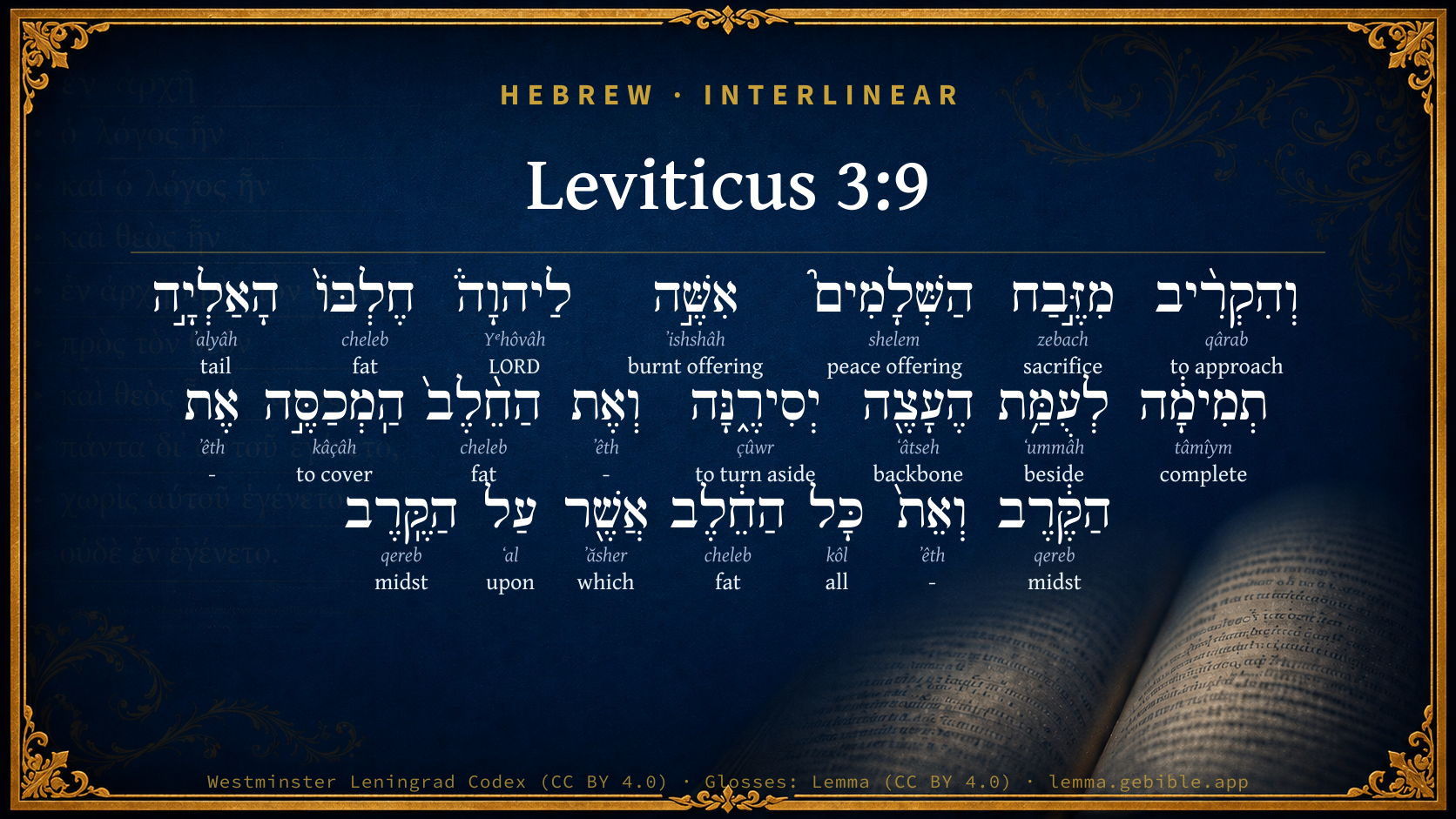
Hebrew (Westminster Leningrad Codex) Leviticus 3:9 appears in the Hebrew Old Testament. The text above is from the Westminster Leningrad Codex. Each word links to its Strong’s number, a concise gloss, and parsing drawn from the Open Scriptures Hebrew Bible morphology. Click any word for its full Brown-Driver-Briggs (BDB) entry.
Download image
Cite this verse

Leviticus 3:9 (World English Bible). Public Domain. Lemma interlinear Bible study tool, https://lemma.gebible.app/v/leviticus/3/9.

Show BibTeX & RIS
BibTeX
RIS
English Translation
He shall offer from the sacrifice of peace offerings an offering made by fire to Yahweh; its fat, the entire tail fat, he shall take away close to the backbone; and the fat that covers the inwards, and all the fat that is on the inwards,
World English Bible · Public Domain
Highlights
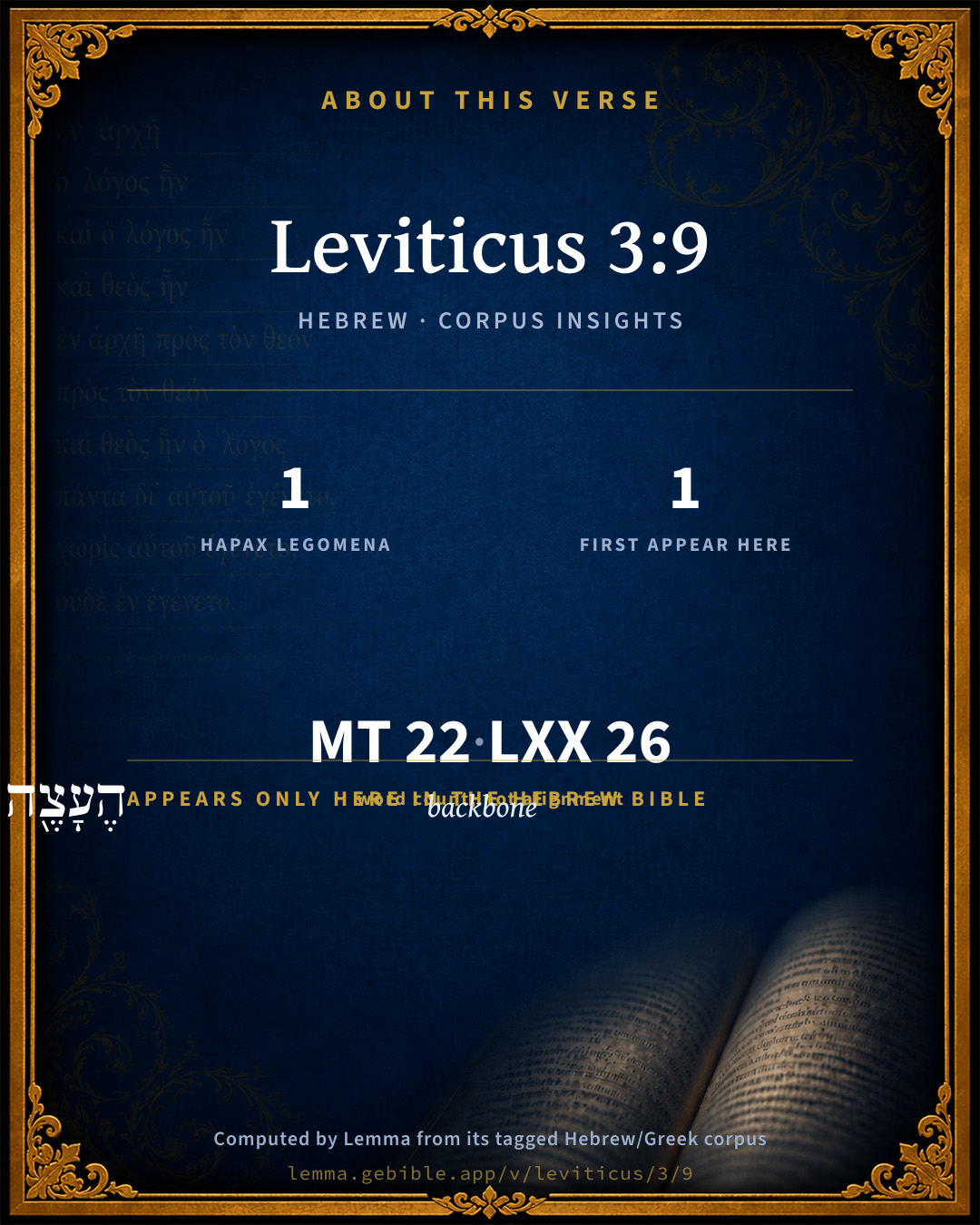
  • 1 hapax legomenon — only here in the Hebrew Bible
  • 1 first appearance in the Hebrew Bible
Full analysis ↓
Download a study sheet

One document with this verse’s original text, its word-by-word gloss line, the meaning frame, cross-references with their text, attributed commentary, and full source and license credits — printable, and it pastes into notes with its structure intact.

This verse Autodidact and up

Study sheet (.html) Plain text (.txt)

A passage Seminary Student

Up to 50 verses in one chapter. A passage sheet keeps up to 6 commentary sources and 12 cross-references per verse, in the order this page ranks them, and says so on the sheet whenever that leaves anything out. Ask for a single verse and you get the Autodidact verse sheet above.

Everything on this page stays free to read, with no account — the sheet is a download of what is already on screen, not access to it.

Want to remove ads? Support Godless Engineer
Compare translations 3

The same verse in 3 English versions, stacked beneath the original-language interlinear above. Click any original word for its lexicon entry.

Each is an independent rendering of the whole verse — the interlinear is not word-aligned to these translations.

Highlighted words mark where these versions differ — a whole-verse word diff, not a word-by-word alignment.

  • World English Bible Public Domain
    He shall offer from the sacrifice of peace offerings an offering made by fire to Yahweh; its fat, the entire tail fat, he shall take away close to the backbone; and the fat that covers the inwards, and all the fat that is on the inwards,
  • King James Version Public Domain
    And he shall offer of the sacrifice of the peace offering an offering made by fire unto the LORD; the fat thereof, and the whole rump, it shall he take off hard by the backbone; and the fat that covereth the inwards, and all the fat that is upon the inwards,
  • unfoldingWord Literal Text CC BY-SA 4.0
    And from the sacrifice of the peace offerings he shall present a gift to Yahweh: its fat, the entire fatty tail (he shall remove it near the backbone) and the fat covering the innards and all the fat that on the innards

unfoldingWord Literal Text — © unfoldingWord, licensed CC BY-SA 4.0. Word-aligned USFM3 via Door43 (git.door43.org/unfoldingWord/en_ult).

Versions to compare (up to 4)

3 of 4 selected

Show all 18 translations

Every available English version of this verse, each an independent rendering of the whole verse.

  • World English Bible Public Domain
    He shall offer from the sacrifice of peace offerings an offering made by fire to Yahweh; its fat, the entire tail fat, he shall take away close to the backbone; and the fat that covers the inwards, and all the fat that is on the inwards,
  • Berean Standard Bible Public Domain
    And from the peace offering he shall bring an offering made by fire to the LORD consisting of its fat: the entire fat tail cut off close to the backbone, the fat that covers the entrails, all the fat that is on them,
  • Majority Standard Bible Public Domain
    And from the peace offering he shall bring a food offering to the LORD consisting of its fat: the entire fat tail cut off close to the backbone, the fat that covers the entrails, all the fat that is on them,
  • King James Version Public Domain
    And he shall offer of the sacrifice of the peace offering an offering made by fire unto the LORD; the fat thereof, and the whole rump, it shall he take off hard by the backbone; and the fat that covereth the inwards, and all the fat that is upon the inwards,
  • American Standard Version (1901) Public Domain
    And he shall offer of the sacrifice of peace-offerings an offering made by fire unto Jehovah; the fat thereof, the fat tail entire, he shall take away hard by the backbone; and the fat that covereth the inwards, and all the fat that is upon the inwards,
  • Revised Version (1885) Public Domain
    And he shall offer of the sacrifice of peace offerings an offering made by fire unto the LORD; the fat thereof, the fat tail entire, he shall take it away hard by the backbone; and the fat that covereth the inwards, and all the fat that is upon the inwards,
  • Geneva Bible (1599) Public Domain
    After, of the peace offrings he shall offer an offring made by fire vnto the Lord: he shall take away the fat therof, and the rump altogether, hard by the backe bone, and the fat that couereth the inwardes, and all the fat that is vpon the inwards.
  • Douay-Rheims (1899) Public Domain
    And they shall offer of the victim of peace offerings a sacrifice to the Lord: the fat and the whole rump,
  • Young's Literal Translation Public Domain
    `And he hath brought near from the sacrifice of the peace-offerings a fire-offering to Jehovah, its fat, the whole fat tail (over-against the bone he doth turn it aside), and the fat which is covering the inwards, and all the fat which `is' on the inwards,
  • Literal Standard Version CC BY-SA 4.0
    And he has brought near from the sacrifice of the peace-offerings a fire-offering to YHWH, its fat, the whole fat tail close by the bone—he turns it aside, and the fat which is covering the innards, and all the fat which [is] on the innards,
  • Unlocked Literal Bible CC BY-SA 4.0
    The man will offer the sacrifice of fellowship offerings as an offering made by fire to Yahweh. The fat, the entire fat tail cut away close to the backbone, and the fat that covers the inner parts and all the fat that is near the inner parts,
  • unfoldingWord Literal Text CC BY-SA 4.0
    And from the sacrifice of the peace offerings he shall present a gift to Yahweh: its fat, the entire fatty tail (he shall remove it near the backbone) and the fat covering the innards and all the fat that on the innards
  • Darby Bible Public Domain
    And he shall present of the sacrifice of peace-offering an offering by fire to Jehovah; the fat thereof, the whole fat tail, which he shall take off close by the backbone, and the fat that covereth the inwards, and all the fat that is on the inwards,
  • World Messianic Bible Public Domain
    He shall offer from the sacrifice of peace offerings an offering made by fire to the LORD; its fat, the entire tail fat, he shall take away close to the backbone; and the fat that covers the entrails, and all the fat that is on the entrails,
  • Webster's Bible Public Domain
    And he shall offer of the sacrifice of the peace-offering an offering made by fire to the LORD: its fat, and the whole rump, that shall he take off hard by the back-bone; and the fat that covereth the inwards, and all the fat that is upon the inwards,
  • Free Bible Version CC BY-SA 4.0
    From the peace offering you are to bring a food offering to the Lord made up of its fat: the whole fat tail removed from close to the tailbone, all the fat that covers the insides,
  • Bible in Basic English Public Domain
    And of the peace-offering, let him give an offering made by fire to the Lord; the fat of it, all the fat tail, he is to take away near the backbone; and the fat covering the inside parts and all the fat on the inside parts,
  • JPS Tanakh (1917) Public Domain
    And he shall present of the sacrifice of peace-offerings an offering made by fire unto the LORD: the fat thereof, the fat tail entire, which he shall take away hard by the rump-bone; and the fat that covereth the inwards, and all the fat that is upon the inwards,

Literal Standard Version (2020), Covenant Press — licensed CC BY-SA 4.0. Text via the HelloAO Bible API (eBible.org). Unlocked Literal Bible (unfoldingWord) — licensed CC BY-SA 4.0. Text via the HelloAO Bible API (eBible.org). unfoldingWord Literal Text — © unfoldingWord, licensed CC BY-SA 4.0. Word-aligned USFM3 via Door43 (git.door43.org/unfoldingWord/en_ult). Free Bible Version, Dr. Jonathan Gallagher — licensed CC BY-SA 4.0. Text via the HelloAO Bible API (eBible.org).

Word by word

More ways to search: Search by grammar → Find every occurrence → Compare this word →

Practice this passage: Drill this verse → Learn its vocabulary →

הֶעָצֶ֖ה
ʻâtseh
H6096
“the · backbone”
Particle, Definite Article + Noun, Common, Masculine, Singular, Absolute
Part of Speech
Particle + Noun
Type
Common
Gender
Masculine
Number
Singular
State
Absolute
Full BDB Definition

Origin: from H6095

TWOT: 1671a

spine, backbone, os sacrum - either spine or os sacrum - bone close to fat-tail
  1. וְהִקְרִ֨יב qârab H7126 “and · to approach” Conjunction + Verb, Hiphil, Sequential Perfect, 3rd Person, Masculine, Singular
  2. מִזֶּ֣בַח zebach H2077 “from · sacrifice of” Preposition + Noun, Common, Masculine, Singular, Construct
  3. הַשְּׁלָמִים֮ shelem H8002 “the · peace offerings” Particle, Definite Article + Noun, Common, Masculine, Plural, Absolute
  4. אִשֶּׁ֣ה ʼishshâh H801 “burnt offering” Noun, Common, Masculine, Singular, Absolute
  5. לַיהוָה֒ Yᵉhôvâh H3068 “to/for · LORD” Preposition + Noun, Proper
  6. חֶלְבּוֹ֙ cheleb H2459 “fat · his” Noun, Common, Masculine, Singular, Construct + Suffix, Personal, 3rd Person, Masculine, Singular
  7. הָאַלְיָ֣ה ʼalyâh H451 “the · tail” Particle, Definite Article + Noun, Common, Feminine, Singular, Absolute
  8. תְמִימָ֔ה tâmîym H8549 “complete” Adjective, Adjective, Feminine, Singular, Absolute
  9. לְעֻמַּ֥ת ʻummâh H5980 “to/for · beside of” Preposition + Noun, Common, Feminine, Singular, Construct
  10. יְסִירֶ֑נָּה çûwr H5493 “to turn aside · her” Verb, Hiphil, Imperfect, 3rd Person, Masculine, Singular + Suffix, Personal, 3rd Person, Feminine, Singular
  11. וְאֶת ʼêth H853 “and · -” Conjunction + Particle, Direct Object
  12. הַחֵ֨לֶב֙ cheleb H2459 “the · fat” Particle, Definite Article + Noun, Common, Masculine, Singular, Absolute
  13. הַֽמְכַסֶּ֣ה kâçâh H3680 “the · covering” Particle, Definite Article + Verb, Piel, Participle Active, Masculine, Singular, Absolute
  14. אֶת ʼêth H853 “-” Particle, Direct Object
  15. הַקֶּ֔רֶב qereb H7130 “the · midst” Particle, Definite Article + Noun, Common, Masculine, Singular, Absolute
  16. וְאֵת֙ ʼêth H853 “and · -” Conjunction + Particle, Direct Object
  17. כָּל kôl H3605 “all of” Noun, Common, Masculine, Singular, Construct
  18. הַחֵ֔לֶב cheleb H2459 “the · fat” Particle, Definite Article + Noun, Common, Masculine, Singular, Absolute
  19. אֲשֶׁ֖ר ʼăsher H834 “which” Particle, Relative
  20. עַל ʻal H5921 “upon” Preposition
  21. הַקֶּֽרֶב qereb H7130 “the · midst” Particle, Definite Article + Noun, Common, Masculine, Singular, Absolute

About this verse

These counts appear in no published source. They are computed here, from the morphology-tagged text and Lemma’s own curated glosses. What Lemma adds →

22
words
17
distinct lemmas
Pentateuch
section

Notable vocabulary

1 hapax legomenon — a word that appears only here in the entire Hebrew Bible:

  • הֶעָצֶ֖ה backbone H6096

First appearance in Scripture

This word makes its first canonical appearance in the Hebrew Bible here:

  • הֶעָצֶ֖ה backbone H6096

Shared distinctive vocabulary

הָאַלְיָ֣ה tail H451 occurs in 5 verses of the Hebrew Bible. Also found in:

Grammatical profile

  • 3 verbs
  • 13 nouns
  • 1 adjective
  • 1 preposition
  • 4 particles

Verb forms

  • וְהִקְרִ֨יב Hiphil · Sequential Perfect
  • יְסִירֶ֑נָּה Hiphil · Imperfect
  • הַֽמְכַסֶּ֣ה Piel · Participle Active

Repetition

Words recur within this verse — often emphatic in Hebrew:

  • חֶלְבּוֹ֙ fat H2459 ×3
  • הַקֶּ֔רֶב midst H7130 ×2

Hebrew & Septuagint length

In English translation the verse runs 46 words from the Hebrew and 47 from the Septuagint (LXX English) — closely comparable.

A rough comparison of the two English renderings, which tokenize alike — not a word-level alignment.

Word counts can differ between the Hebrew and the Greek without any difference in meaning — e.g. the Hebrew direct-object marker אֵת has no separate Greek word, and Greek often adds the article ὁ.

In the original languages it is 22 Hebrew tokens and 26 Greek tokens — but the two are counted differently (Hebrew bundles its prefixes and suffixes into one token; the Greek is in lemma form), so that isn’t a like-for-like length.

Cross-references

7

Topical passages linked to Leviticus 3:9 in the Treasury of Scripture Knowledge — connected by theme and wording, ordered by reader-vote popularity; previews shown in the World English Bible.

  • Exodus 29:22 Also you shall take some of the ram's fat, the fat tail, the fat that covers the innards, the cover of the liver, the two kidneys, the fat that is on them, and the right thigh (for it is a ram of consecration),
  • Leviticus 9:19 and the fat of the ox and of the ram, the fat tail, and that which covers the innards, and the kidneys, and the cover of the liver:
  • Leviticus 3:3–4 He shall offer of the sacrifice of peace offerings an offering made by fire to Yahweh; the fat that covers the innards, and all the fat that is on the innards,
  • Leviticus 7:3 He shall offer all of its fat: the fat tail, and the fat that covers the innards,
  • Leviticus 8:25 He took the fat, and the fat tail, and all the fat that was on the innards, and the cover of the liver, and the two kidneys, and their fat, and the right thigh;
  • Proverbs 23:26 My son, give me your heart; And let your eyes keep in my ways.
  • Isaiah 53:10 Yet it pleased Yahweh to bruise him; he has put him to grief: when you shall make his soul an offering for sin, he shall see [his] seed, he shall prolong his days, and the pleasure of Yahweh shall prosper in his hand.

Cross-references courtesy of OpenBible.info (CC BY 4.0).

Hebrew and Greek witnesses Masoretic Hebrew ↔ Greek Septuagint

The same verse in the two great witnesses to the Old Testament, shown verse-for-verse.

These are two independent witnesses, not word-aligned to each other, and the Septuagint is shown in lemma (dictionary) form.

Hebrew Leviticus 3:9 Masoretic · Westminster Leningrad Codex

וְהִקְרִ֨יב מִזֶּ֣בַח הַשְּׁלָמִים֮ אִשֶּׁ֣ה לַיהוָה֒ חֶלְבּוֹ֙ הָאַלְיָ֣ה תְמִימָ֔ה לְעֻמַּ֥ת הֶעָצֶ֖ה יְסִירֶ֑נָּה וְאֶת הַחֵ֨לֶב֙ הַֽמְכַסֶּ֣ה אֶת הַקֶּ֔רֶב וְאֵת֙ כָּל הַחֵ֔לֶב אֲשֶׁ֖ר עַל הַקֶּֽרֶב

He shall offer from the sacrifice of peace offerings an offering made by fire to Yahweh; its fat, the entire tail fat, he shall take away close to the backbone; and the fat that covers the inwards, and all the fat that is on the inwards,

World English Bible · Public Domain

Greek LXX Leviticus 3:9 Septuagint · lemma form

καί προςφέρω ἀπό ὁ θυσία ὁ σωτήριον κάρπωμα ὁ θεός ὁ στέαρ καί ὁ ὀσφύς ἄμωμος σύν ὁ ψόα περιαἱρέω αὐτός καί ὁ στέαρ ὁ κοιλία

And he shall bring of the peace-offering a burnt sacrifice to the Lord: the fat and the hinder part unblemished he shall take away with the loins, and having taken away all the fat that covers the belly, and all the fat that is on the belly,

LXX2012 (modern English Septuagint) · Public Domain

On this verse, Haydock's Catholic Bible Commentary discusses the Septuagint’s reading. Read the note in Commentary ↓

Hebrew: Westminster Leningrad Codex (CC BY 4.0). Greek: Septuagint (public domain); English from LXX2012 (modern English Septuagint) (Public Domain). How the Septuagint differs from the Hebrew →

Targum (Aramaic paraphrase)

2

The Targum is the ancient Jewish Aramaic paraphrase of the Hebrew Scriptures — an interpretive translation, not the Hebrew text itself. Onkelos (literal) and Pseudo-Jonathan (expansive) render the Torah, and Jonathan the Prophets. Coverage is partial: where no permissively-licensed English translation exists for a verse, only the Aramaic is shown. This is verse-level text, not a word-by-word alignment to the Hebrew.

  1. Targum Onkelos Torah (Genesis–Deuteronomy)
    וִיקָרֵב מִנִכְסַת קוּדְשַׁיָא קֻרְבָּנָא קֳדָם יְיָ תַּרְבֵּיהּ אֲלִיתָא שְׁלִמְתָּא לָקֳבֵל שֵׁזַרְתָּא יֶעְדִנַהּ וְיָת תַּרְבָּא דְחָפֵי יָת גַוָא וְיָת כָּל תַּרְבָּא דִי עַל גַוָא

    (no public-domain English translation for this verse)

    Targum Onkelos — Aramaic: “Onkelos Genesis” (public domain); “Onkelos Exodus” (public domain); “Onkelos Leviticus” (public domain); “Onkelos Numbers” (public domain); “Onkelos Deuteronomy” (public domain). English: “Sefaria Community Translation” (CC0 1.0 (public-domain dedication)); “J.W. Etheridge. The Targums of Onkelos and Jonathan Ben Uzziel on the Pentateuch. London: Longmans, Green, 1862” (public domain). Text via Sefaria.

  2. Targum Pseudo-Jonathan Torah (Genesis–Deuteronomy)
    וְיַקְרֵב מִנִכְסַת קוּדְשַׁיָא קָרְבָּנָא קֳדָם יְיָ טוּב שׁוּמְנֵיהּ אֱלִיתָא שְׁלִימְתָּא כָּל קְבֵיל דְקִיתָא יַעֲבֵיד יָתֵיהּ וְיַת פְרֵיסוּתָא דְתַרְבָּא דְחָפֵי יַת כְּרֵיסָא וְיַת כָּל תַּרְבָּא דְעַל כְּרֵיסָא

    And of the offering of his consecrated oblation he shall offer the best of its fat, and remove the whole of the tail, close to the spine, the covering of fat which covereth the inwards, even all the fat that is upon the inwards.

    Targum Pseudo-Jonathan — Aramaic: “Targum Jonathan on Genesis” (public domain); “Targum Jonathan on Exodus” (public domain); “Targum Jonathan on Leviticus” (public domain); “Targum Jonathan on Numbers” (public domain); “Targum Jonathan on Deuteronomy” (public domain). English: “The Targum of Jonathan ben Uzziel, trans. J. W. Etheridge, London, 1862” (public domain). Text via Sefaria.

Commentary

Notes on Leviticus 3:9 from classic Christian and Jewish commentators (each source and its license shown beneath its notes). The classic Christian expositions comment on the surrounding passage and are grouped to its opening verse, so a note may address several verses; the Jewish commentaries on the Tanakh (Rashi and others) are per-verse, so they appear only where the commentator wrote on this verse.

Lemma curates 59 commentaries, every one of them public domain or Creative Commons licensed, each selected and text-cleaned for this edition rather than reprinted as found. About our sources →

Trapp's Complete Commentary

John Trapp

Lev 3:9 And he shall offer of the sacrifice of the peace offering an offering made by fire unto the LORD; the fat thereof, [and] the whole rump, it shall he take off hard by the backbone; and the fat that covereth the inwards, and all the fat that [is] upon the inwards,

Ver. 9. The whole rump.] Which in those country sheep is very large: yet not so large as those in America, mentioned by Sir Francis Drake, {a} as large as cattle, and supplying in the stead of horses for burden or travel.

{a} The World Encompassed.

John Trapp, A Commentary or Exposition upon All the Books of the Old and New Testament (1647–1656) — public domain. Text from a community e-Sword module.

Joseph Benson's Commentary

Lev 3:9; Lev 3:11. The rump — Which in sheep is fat and sweet, and in these countries was much larger and better than in ours. The food of the offering — So called, to denote God’s acceptance of it, and delight in it; as men delight in their food.

Joseph Benson's Commentary on the Old and New Testaments (1811–1818) — public domain. Text from a community e-Sword module.

Tyndale Open Study Notes

Tyndale Open Resources

3:9 broad tail: Sheep in this part of the ancient Near East had broad, fatty tails that were burned on the altar with the rest of the fat.

Tyndale Open Study Notes — © Tyndale Open Resources, licensed CC BY-SA 4.0. Text via the HelloAO Bible API.

Geneva Bible (1599)

Geneva Bible translators

The burnt offering was wholly consumed, and of the offering made by fire only the inwards, etc. were burnt: the shoulder and breast, with the two jaws and the maw were the Priest’s, and the rest his that offered.

Geneva Bible (1599) marginal notes — public domain. Text via Bolls.life.

Adam Clarke's Commentary

Verse 9. The whole rump, it shall he take off hard by the backbone] To what has already been said on the tails of the eastern sheep, in the note on Ex 29:22, we may add the following observation from Dr. Russel concerning the sheep at Aleppo. "Their tails," says he, "are of a substance between fat and marrow, and are not eaten separately, but mixed with the lean meat in many of their dishes, and also often used instead of butter." He states also that a common sheep of this kind, without the head, fat, skin, and entrails, weighs from sixty to seventy English pounds, of which the tail usually weighs fifteen pounds and upwards; but that those of the largest breed, when fattened will weigh one hundred and fifty pounds, and their tails fifty, which corresponds with the account given by Ludolf in the note referred to above. The sheep about Jerusalem are the same with those in Abyssinia mentioned by Ludolf, and those of Syria mentioned by Dr. Russel.

Adam Clarke's Commentary on the Bible (1810–1826) — public domain. Text from a community e-Sword/MySword module.

Ellicott's Commentary for English Readers

(9) The whole rump.—Better, the whole fat tail (so also Exo_29:22; Lev_7:3; Lev_8:25; Lev_9:19). The sheep of Syria and Palestine were, and still are, the bread-tailed species, the broad part often weighing fifteen pounds and upwards. In young animals, the substance of the tail, which consists of marrow and fat, tastes like marrow, and it is used by the Arabs for cooking instead of butter. It is often so large that it trails on the ground, and to save the animal from the pain occasioned by dragging it on the ground, a small wheeled truck is attached to it, on which it draws it along. It is only the tail of sheep which is here included among the fat parts that are to be offered upon the altar. It is, however, not regarded as the ordinary fat of other quadrupeds (Lev_9:19), and hence, according to Jewish tradition, is not included in the prohibition of Lev_3:3.

A Bible Commentary for English Readers, edited by Charles John Ellicott (1878–1897) — public domain. Text from a community e-Sword module.

The Cambridge Bible for Schools and Colleges

gen. ed. J. J. S. Perowne

9. The fat tail here reserved for sacrifice was regarded as a delicacy, and set before Saul. In 1Sa_9:24 for ‘that which was upon it’ should be read ‘the fat tail’; see Driver in loc., and note on Exo_29:22.

the backbone] The Heb. word occurs here only.

The Cambridge Bible for Schools and Colleges (gen. ed. J. J. S. Perowne; Cambridge University Press, 1878–1918) — public domain. Text from a community e-Sword module.

John Gill's Exposition

And he shall offer of the sacrifice of the peace offering,.... That is, the priest, Aaron, or one of his two sons:

an offering made by fire unto the Lord; that part of it which was to be burnt with fire; and in the peace offering of the lamb there was something more than in the peace offering of the bullock, or of the goat, which follows:

the fat thereof, and the whole rump, it shall he take off hard by the backbone; not the rump or tail, but the fat of it; the copulative "and" is not in the text; wherefore Aben Ezra says, that Gaon was mistaken in reading it as we do, "the fat there of", and "the whole rump"; but it should be rendered, "its fat of the whole rump", or "tail": in the eastern countries (k), some sheep and lambs had very large tails, and very fat ones, the least weighing ten or twelve pounds, the largest above forty, and were put in little carts for ease and safety; see Gill on Exo 29:22 now such as were "whole", entire, perfect, and without blemish, as the word signifies, the fat of them that was next to the backbone was to be taken off of such as were brought for peace offerings:

and the fat that covereth the inwards, and all the fat that is upon the inwards; as before; See Gill on Lev 3:3.

(k) Vid. Ludolf. Hist. Ethiop. l. 1. c. 10. sect. 14.

John Gill's Exposition of the Whole Bible (1746–1763) — public domain (CC PDM 1.0). Text via the HelloAO Bible API.

Albert Barnes' Notes on the Bible

The whole rump - The whole fat tail: i. e., the tail of the kind of sheep well known in the East, and often weighing 15 lbs. and even as much as 50 lbs., when the sheep has been increased by artificial fattening.

Albert Barnes' Notes on the Bible (1834–1885) — public domain. Text from a community e-Sword/MySword module.

Haydock's Catholic Bible Commentary

Whole rump. Septuagint, "the loin without blemish." The tail of the Arabian sheep is extremely large and fat, weighing eight or ten pounds; so that it is necessary to support it on a vehicle. (Busbecq. ep. 3.) The tail was not sacrificed in any other species. (Menochius)

George Leo Haydock (1774–1849), Haydock's Catholic Family Bible and Commentary, 1859 edition — public domain. Excludes Psalms (Douay-Rheims chapter numbering differs from Protestant) and Deuterocanonical books (Catholic canon only).

Matthew Poole's English Annotations

The fat thereof, and the whole rump, which in sheep is fat and sweet, and in these parts was; cry much larger and better than ours, as is agreed both by ancient and modern writers, and therefore was fitly offered to God.

Matthew Poole's English Annotations on the Holy Bible (1683–1685) — public domain. Text from a community e-Sword/MySword module.

Whedon's Commentary on the Bible

Daniel D. Whedon

9. The whole rump — We know of no more unfortunate translation than this. Instead of rump, it should have been rendered fat tail. In the East there is a species of sheep whose tails are so large that they weigh from twelve to fourteen pounds, and the owners are obliged to fix a thin board or cart beneath the tail to ease the sheep, and to preserve the wool and fat from being torn among the bushes and stones. See Ludolph, History of Ethiopia, p. 53, and Dr. Russell, Natural History of Aleppo, p. 51. The cooks of Syria use this mass of fat instead of Arab butter.

Daniel D. Whedon (gen. ed.), Commentary on the Old and New Testaments (1874–1909) — public domain. Text from a community e-Sword module.

The Pulpit Commentary

The whole rump should no doubt be the whole tail, consisting chiefly of fat, and always regarded as a great delicacy in the East (see Herod., 3:113; Thompson, "Land and the Book," page 97). The burning of the fat tail upon the altar, together with the internal fat, is the only point in which the ritual to be used when offering a sheep (verses 6-11) differs from that used in offering a bull or cow (verses 1-5), or a goat (verses 12-16).

The Pulpit Commentary (1880–1919), ed. H.D.M. Spence-Jones & Joseph S. Exell — public domain. Text from a community e-Sword module.

John Wesley's Explanatory Notes

The rump - Which in sheep is fat, and sweet, and in these parts was very much larger and better than ours.

John Wesley, Explanatory Notes Upon the Whole Bible (1754–1765) — public domain. Text via the GEBible commentary corpus.

unfoldingWord translationNotes

Door43 World Missions Community

as an offering made by fire

This can be stated in active form. AT: "as a burnt offering" (See: Active or Passive)

The fat, the entire fat ... the kidneys—he will remove all of this

The statement "he will remove all of this" can be placed at the beginning of the sentence. AT: "He will remove the fat, the entire fat ... the kidneys"

inner parts

This is the stomach and intestines.

that is near the inner parts, and the two kidneys

A new sentence can start here. AT: "that is near the inner parts. He must remove the kidneys"

by the loins

This is the part of the body on the sides of the backbone between the ribs and hipbone.

the lobe of the liver

This is the curved or rounded part of the liver. This is considered the best part of the liver to eat. AT: "the best part of the liver"

will burn it all on the altar as a burnt offering of food to Yahweh

Translate this in a way that makes it clear that Yahweh does not actually eat the food. AT: "will burn those things on the altar as an offering to Yahweh. Those things will come from your food supplies"

translationWords

fellowship offering

burnt offering

Yahweh

priest

altar

unfoldingWord translationNotes — © Distant Shores Media and the Door43 World Missions Community, licensed CC BY-SA 4.0. Source: git.door43.org/Door43/en_tn.

Rashi

Rabbi Shlomo Yitzchaki (Rashi)

חלבו means: the choicest part in it; and what is this? The whole fat-tail.

לעמת הָעֶצָה — i. e. above the kidneys which give counsel (עֵצָה) (cf. Rashi on Exodus 29:22 and Note thereon).

Rashi on the Tanakh — English translations: “The Judaica Press complete Tanach with Rashi, translated by A. J. Rosenberg” (CC BY 4.0); “Pentateuch with Rashi's commentary by M. Rosenbaum and A.M. Silbermann, 1929-1934” (public domain); “The Metsudah Tanach series, Lakewood, N.J” (CC BY 4.0); and “The Book of Joshua, Metsudah Publications, 1997” (CC BY 4.0). Text via Sefaria.

Ramban (Nachmanides)

Rabbi Moshe ben Nachman (Ramban / Nachmanides)

CHELBO’ (THE FAT THEREOF) ‘HA’ALYAH TH’MIMAH’ (THE FAT TAIL ENTIRE). The term cheilev (fat) in the Sacred Language indicates that part of the fat which is separate from the meat and not joined to it. Shuman, on the other hand, is that fat which is intertwined with the meat and cannot be separated from it, something like that which Scripture states: ‘Vayishman Yeshurun’ (But Jeshurun waxed fat); so they did eat, and were filled ‘vayashminu’ (and became fat); ‘hashmein’ (make fat) the heart of this people; and my flesh is lean ‘mishamen’ (and hath no fatness); and it shall be rich ‘v’shamein’ (and fat); my soul is satisfied as with marrow ‘vadeshen’ (and fatness), but deshen. We must assume then that Ramban considered them equivalent terms. This is strengthened by an examination of the Hebrew wording of the verse: ‘k’mo cheilev vadeshen tisba nafshi.’ Now deshen is thus in parallelism to cheilev; hence deshen must here be understood as shuman, as explained above. and similarly in all places. But cheilev is the fat which is separate from the meat and covered by a membrane, and is easily peeled off. The Hebrew language never interchanges these terms [cheilev and shuman] in any place. Thus we say, basar shamen (fat meat), but not basar cheilev [since cheilev, as explained, is the fat which is separate and distinguished from the meat]. Similarly in languages of other nations these terms are separate. The term cheilev is sometimes used metaphorically, as is written, when ye set apart ‘chelbo’ (the best thereof) from it, since the good part of the produce which is taken up [to be given to the priest], Scripture figuratively calls cheilev, just as the cheilev is set apart in the offerings. ‘Cheilev kilyoth’ (the kidney-fat) of wheat — Scripture here compares wheat to the kidneys and the fat therein, just as it states, and of the blood of the grape thou drankest foaming wine, although wine is not blood [hence we must conclude that Scripture only uses these terms figuratively]. And ye shall eat the ‘cheilev’ (fat) of the land means that they shall eat the best of the bullocks, sheep, and goats and all animals. Such is the usage of this figure of speech.Now the tail does not contain any cheilev at all, has a figurative meaning, Ramban now proceeds to his main theme here: that the tail of the animal contains no cheilev [which is the term for the fat which is forbidden to be eaten] at all, but rather it contains shuman [which is the fatty substance contained in the meat which cannot be separated from it, and is permitted to be eaten]. At the end of this lengthy discussion it will be made clear that Ramban’s intention is to refute a major contention of the Karaites, who prohibited the eating of the fat of the tail, while the true tradition of the Rabbis permits it to be eaten. See further, Note 277. but rather has in it shuman (fat) which is not separate from the meat thereof, just as there is in every good piece, the thigh and the shoulder. This is confirmed by doctors who in their studies of nature have established the fact that cheilev [fat which is separate from the meat], is never to be found [in the animal] near the hide, nor in a limb which is always in movement [such as the tail]. The doctors have further said that the nature of shuman found in the ribs, sides and tail, which is not separate from the meat, is warm and moist, whilst that fat which can be separated from the meat, such as that which is upon the kidneys, is cold and moist, thick and coarse; it is difficult for the stomach to digest it fully, and it easily spoils; it also increases the white fluid increases the white fluid beyond the proper proportion, it affects the health of the person adversely. and constipates.If so, the verse stating, Eat ye not any ‘cheilev’ (fat) nor blood, does not include the shuman (fat) which is upon the tail, for that is not cheilev by name or nature. If all fat were to come under the term cheilev, then all fat in an animal — on the shoulders and sides — would not be allowed to be eaten! For Scripture does not say: “All fat which is offered unto G-d ye shall not eat” [so that you would include in this prohibition the fat of the tail, since it is offered as a fire-offering on the altar]. Rather, He states that “the cheilev (fat) of all cattle which are brought as offerings upon the altar, must not be eaten.” (further, 7:25). Now the verse does not state “For whosoever eateth the fat which men present as an offering …” [so that you could argue, since the tail and the fat thereon are offered upon the altar, therefore they may not be eaten]. Rather, the verse states, For whosoever eateth the fat ‘of the beast’ of which men present an offering …, thus teaching that the cheilev of any animal which can be brought as an offering — whether it is actually brought as a hallowed offering or is eaten as common food — is forbidden to be eaten. Thus the verse establishes that cheilev of the ox, sheep, and goat [from which offerings can be brought] is forbidden to be eaten, whether it be an offering or common food. See further, Note 277. It is indeed impossible to say that He prohibited all these fats of the animal which are offered on the altar, for if so the kidneys and the lobe above the liver would be forbidden to be eaten [since they are offered on the altar]! Rather, whatever fat comes under the term cheilev [as explained above], is forbidden to be eaten, even though it is not brought on the altar, such as the fat on the spleen; and that which is not called cheilev may be eaten even though it is offered on the altar, such as the [fat of the] kidneys and the lobe above the liver, and similarly also that of the tail [which even though it is brought on the altar, may be eaten because it is shuman and not cheilev]. Similarly, Scripture states in connection with the command of the installation of the priests, And thou shalt take of the ram ‘ha’cheilev’ (the fat) and the tail;. and at the performance thereof it is written, And he took the fat, and the tail, for the tail is not cheilev. Now this verse [before us] which states ‘chelbo ha’alyah th’mimah’, means that he shall offer up [from the peace-offerings] the fat thereof, together with the entire fat tail, meaning that when he removes the “entire fat tail” until the rump-bone, he must take with it much fat that is attached to it on the inside. Thus the Rabbis have said in Torath Kohanim: 19:2. “This tells us that he must also take the fat near the tail, which is the fat between the sinews [in the loins].”In my opinion the purport of this verse is also like that of the other verse: And he shall offer of it all ‘chelbo’ (the fat thereof): ‘ha’alyah’ (the fat tail), and the fat that covereth the inwards. So here likewise He says, And he shall offer of the sacrifice of peace-offerings all the fat thereof. In these two verses [just quoted], He first makes a general statement, that [the priest] should offer all the fat thereof, and then He mentions in detail all the parts that he should offer [namely, the fat tail entire … and the fat that covereth the inwards … and the two kidneys, and the fat upon them … and the lobe above the liver …]. Now not everything that is mentioned here is cheilev [fat forbidden to be eaten], for the two kidneys [themselves] and the lobe above the liver are not at all included in the term cheilev. Thus He stated in the section of Bayom Ha’shemini:. And ‘ha’cheilev’ (the fat), and the kidneys, and the lobe of the liver, hence we may also say that the alyah mentioned is not cheilev. mentioning the cheilev by itself and then the other inwards by themselves, even as He said, And thou shalt take of the ram ‘ha’cheilev’ and the tail.. If so, the reason why the tail is offered [on the altar] is not because it is included here in Verse 9] in the term chelbo. Rather, He states here that the priest should burn [on the altar] from the peace-offerings all the fat thereof, and then He proceeds to explain all the inwards [which he should offer], some being cheilev and some not. The meaning of the verse in the case of the sin-offering stating, And all the fat thereof he shall take away, as ‘cheilev’ (the fat) is taken away from off the sacrifice of peace-offerings, 4:31. is not to refer only to that which is strictly speaking cheilev, for if that were so, the kidneys and the lobe on the liver [which are not cheilev] would not be offered up in the case of the sin-offering. Rather, the intention of the verse is that he is to take away the cheilev together with all the things that are removed from the peace-offerings. Similarly, [the verse stating in the case of the she-lamb brought as a sin-offering], And all the fat thereof shall he take away, as the fat of the lamb is taken away from the sacrifice of the peace-offerings, Verse 35. means that he is to take away as he had done in the case of the peace-offerings, meaning everything that he had taken away there, including the tail with its fat. Similarly, And they put the ‘chalavim’ (fats) upon the breasts, and he caused the fats to ascend in fumes, 9:20. means [the cheilev] together with all that is removed from them.I have had to discuss this point at length in order to shut up the mouths of the Sadducees,. See also Maimonides who writes: “the heretics who here in the Orient are called Karaites” (“The Commandments,” Vol. I, p. 160). may their name be erased [from memory], for in matters of Torah it has been said, Answer a fool according to his folly, … “] is to a point the Sages have made regarding an obvious contradiction in the Book of Proverbs. In Verse 4 there it states, Answer not a fool according to his folly, lest thou also be like unto him, and immediately in the following verse it states, Answer a fool according to his folly, lest he be wise in his own eyes. The Sages explained that there is no contradiction: “in matters of Torah answer him, but in other matters do not” (Shabbath 30b). It is to this principle that Ramban alludes in writing, “for in matters of Torah it has been said … ” and the Rabbis have also said, “Be diligent in learning Torah, in order to be able to answer the unbeliever.”The Gaon Rav Saadia explained it to them, by saying that chelbo ha’alyah is missing a connective vav, which would make it: chelbo veha’alyah — (its fat “and” the tail) [thus clearly meaning that the tail is not included in the cheilev]. But Rabbi Abraham ibn Ezra refuted Rav Saadia Gaon by saying [that “from a grammatical point of view this could not be possible, for if so] it should have said chelbo elyato comes with the pronominal suffix [meaning “its fat”], the word ha’alyah (the tail) should likewise have come in that form: elyato (“its tail”). or hacheilev ha’alyah.” (according to Saadia Gaon’s interpretation) comes without the pronominal suffix, the word chelbo should also not have it, making it — hacheilev v’ha’alyah. Thus Ibn Ezra is saying that the Karaite interpretation still stands, for since it is written chelbo ha’alyah it would appear that ha’alyah is in apposition to chelbo, thus explaining: “What is chelbo? Ha’alyah.” — Ramban, however, will refute this argument of Ibn Ezra, bringing proof from another verse in Scripture which mentions two nouns together, and yet one is written with a pronominal suffix and the other without. Thus Saadia Gaon’s refutation of the Karaite interpretation is valid, and the tradition that the tail is not cheilev is confirmed. See, however, further in text where Ramban comments on the Gaon’s interpretation. But Ibn Ezra’s refutation is not valid, for we find [Scripture stating], And all Israel and their elders, and officers, and their judges! (and their elders) comes with a pronominal suffix, and v’shotrim (and officers) does not. In our case too it is therefore correct to say, as Saadia Gaon does, that chelbo ha’alyah means chelbo v’ha’alyah, and the two nouns do not stand in apposition to each other, thus proving that the alyah is not cheilev. I will yet mention a great mistake which Rabbi Abraham ibn Ezra made in his arguments with them [i.e., the Karaites], in which he spoke more wrongly than they. of a cattle slaughtered as common food is not forbidden to be eaten (see above Note 266). That opinion is more harmful than what the Karaite have said. For in abstaining from eating the fat of the tail no infringement of the Torah is incurred, whilst in eating of the cheilev of cattle slaughtered as common food, one violates a prohibition of the Torah! However, the Gaon’s interpretation is not correct, making the word ha’alyah — v’ha’alyah (“and” the tail). Such an interpretation is not sufficiently convincing to base thereon the permission to eat the tail. and surely it is not an argument sufficiently persuasive to permit the eating [of the tail because of it]. But the interpretation which our Rabbis advanced on the verse, Ye shall eat no fat, of ox, or sheep, or goat, that He prohibited only [that kind of fat like] the fat of the ox which is common to all [i.e., the sheep and the goat, thus excepting the fat of the tail of the sheep, which is not found in the ox], that is a proper interpretation [from which we may clearly know that the tail is permitted to be eaten]! But in order not to give contestants an occasion to dispute [the tradition of the Rabbis], we have had to bring the [other] proofs and arguments which we have written.

Ramban (Nachmanides) on the Tanakh — English translation: “Commentary on the Torah by Ramban (Nachmanides). Translated and annotated by Charles B. Chavel. New York, Shilo Pub. House, 1971-1976” (CC BY 4.0). Text via Sefaria.

Lesson kit

Teaching starters — assembled from the data on this page, not authored interpretation. Every prompt links to the verse data it draws on. Edit before teaching.

Leviticus, in the Pentateuch, opens this verse with 22 words (17 distinct Hebrew lemmas). Its most distinctive word is ʻâtseh (“backbone”). A historical commentator’s framing appears above. Read the whole chapter for the surrounding context.

Discussion questions

  1. What does “backbone” (ʻâtseh) contribute to the verse as a whole?
  2. This verse holds 1 word here found nowhere else in the Hebrew Bible. What might the rare word draw attention to?
  3. The word “backbone” first appears here in Scripture. What is being introduced at this debut?
  4. Exodus 29:22 shares the word «tail» with this verse. How do the two illuminate each other?
  5. “fat” occurs 3× in this one verse. What is the effect of the repetition?
  6. These translations render this verse differently; the difference is in the English rendering, not the original. What questions does that raise?
  7. The verb «וְהִקְרִ֨יב» is Hiphil Sequential Perfect. How does its form color the action?
  8. Reading how Trapp's Complete Commentary and Joseph Benson's Commentary read this verse, where do the two commentators agree and where do they part?

Things to notice

  • 1 word in this verse appears nowhere else in the Hebrew Bible.
  • 1 word makes its first canonical appearance in Scripture here.
  • This verse counts 22 Hebrew ↔ 26 Greek words.
  • These translations choose different wording for 28 words in this verse.
  • “fat” occurs 3× in this single verse.

Reading settings

Reading text

Shown beneath each verse's original-language words.

Old Testament
Old Testament edition

Read the OT as the Masoretic Hebrew (MT) or the Greek Septuagint (LXX).

English shown for the Greek Septuagint (in the Hebrew ↔ Greek comparison).

Comparing translations? Open the Compare panel on any verse page to stack up to four side by side.