
Numbers 7:10

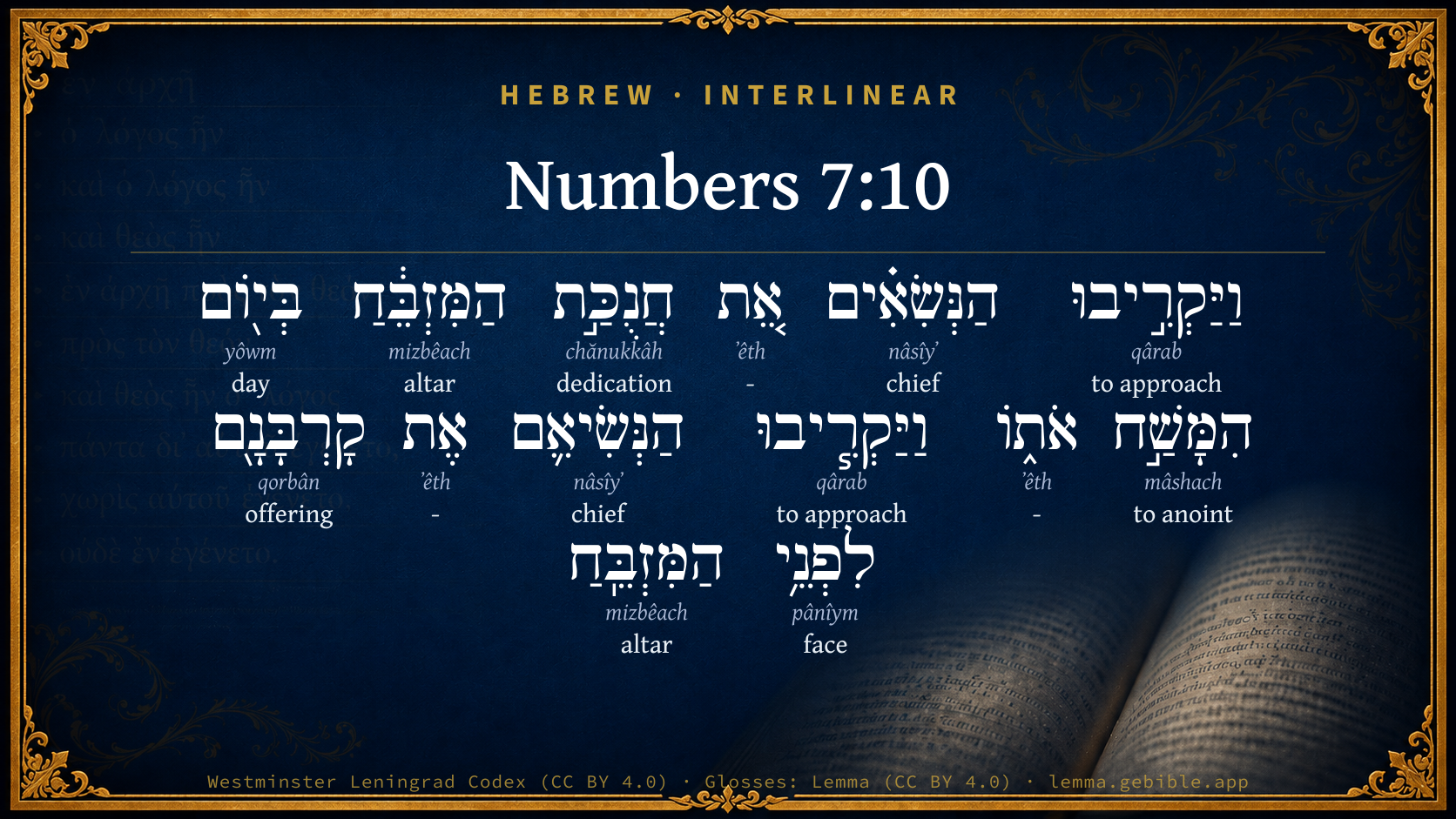
Hebrew (Westminster Leningrad Codex) Numbers 7:10 appears in the Hebrew Old Testament. The text above is from the Westminster Leningrad Codex. Each word links to its Strong’s number, a concise gloss, and parsing drawn from the Open Scriptures Hebrew Bible morphology. Click any word for its full Brown-Driver-Briggs (BDB) entry.
Download image
Cite this verse

Numbers 7:10 (World English Bible). Public Domain. Lemma interlinear Bible study tool, https://lemma.gebible.app/v/numbers/7/10.

Show BibTeX & RIS
BibTeX
RIS
English Translation
The princes gave offerings for the dedication of the altar in the day that it was anointed, even the princes gave their offerings before the altar.
World English Bible · Public Domain
Highlights
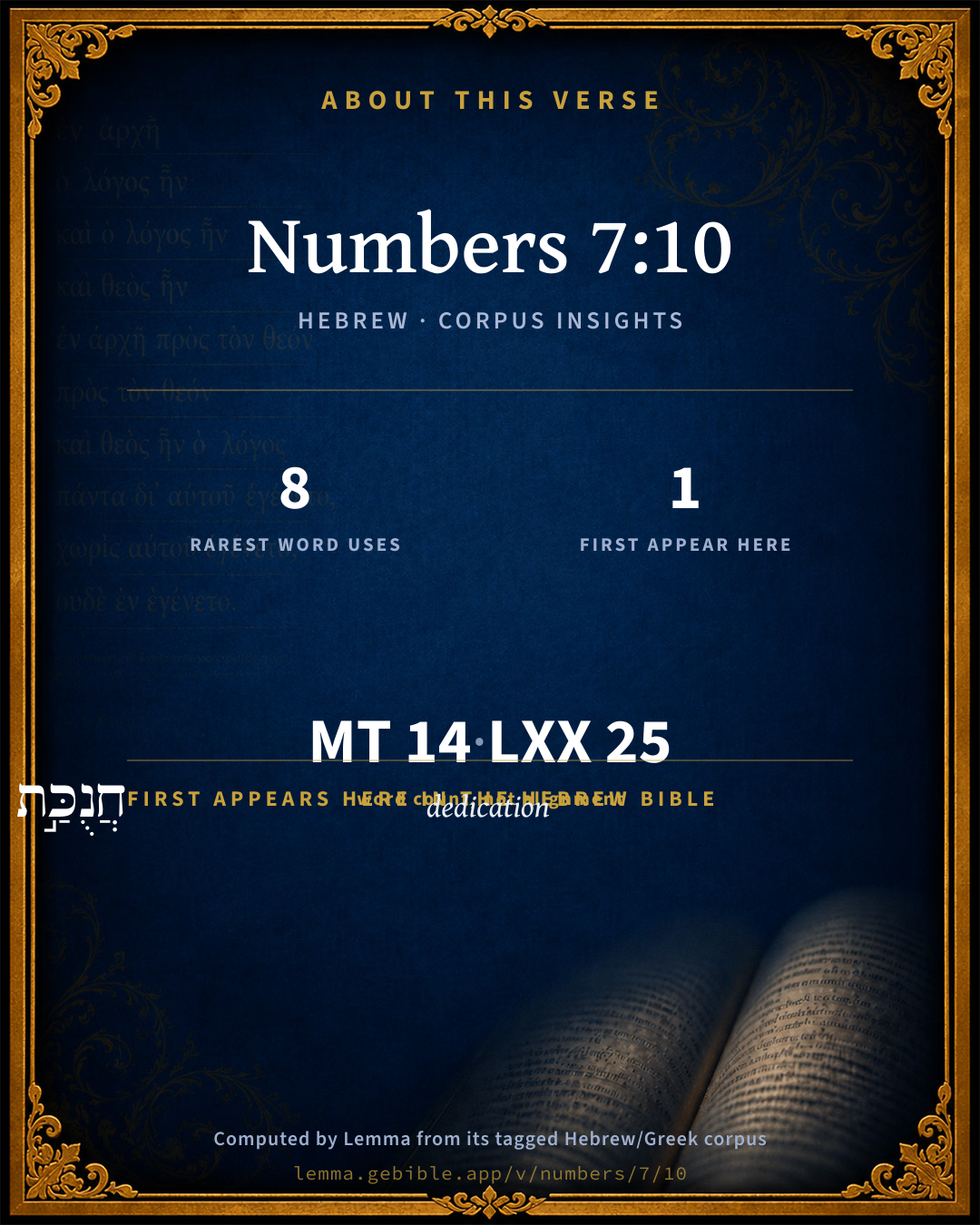
  • 1 first appearance in the Hebrew Bible
Full analysis ↓
Download a study sheet

One document with this verse’s original text, its word-by-word gloss line, the meaning frame, cross-references with their text, attributed commentary, and full source and license credits — printable, and it pastes into notes with its structure intact.

This verse Autodidact and up

Study sheet (.html) Plain text (.txt)

A passage Seminary Student

Up to 50 verses in one chapter. A passage sheet keeps up to 6 commentary sources and 12 cross-references per verse, in the order this page ranks them, and says so on the sheet whenever that leaves anything out. Ask for a single verse and you get the Autodidact verse sheet above.

Everything on this page stays free to read, with no account — the sheet is a download of what is already on screen, not access to it.

Want to remove ads? Support Godless Engineer
Compare translations 3

The same verse in 3 English versions, stacked beneath the original-language interlinear above. Click any original word for its lexicon entry.

Each is an independent rendering of the whole verse — the interlinear is not word-aligned to these translations.

Highlighted words mark where these versions differ — a whole-verse word diff, not a word-by-word alignment.

  • World English Bible Public Domain
    The princes gave offerings for the dedication of the altar in the day that it was anointed, even the princes gave their offerings before the altar.
  • King James Version Public Domain
    And the princes offered for dedicating of the altar in the day that it was anointed, even the princes offered their offering before the altar.
  • unfoldingWord Literal Text CC BY-SA 4.0
    And the leaders presented the dedication of the altar on the day of its being anointed. And the leaders presented their offering to the face of the altar.

unfoldingWord Literal Text — © unfoldingWord, licensed CC BY-SA 4.0. Word-aligned USFM3 via Door43 (git.door43.org/unfoldingWord/en_ult).

Versions to compare (up to 4)

3 of 4 selected

Show all 18 translations

Every available English version of this verse, each an independent rendering of the whole verse.

  • World English Bible Public Domain
    The princes gave offerings for the dedication of the altar in the day that it was anointed, even the princes gave their offerings before the altar.
  • Berean Standard Bible Public Domain
    When the altar was anointed, the leaders approached with their offerings for its dedication and presented them before the altar.
  • Majority Standard Bible Public Domain
    When the altar was anointed, the leaders approached with their offerings for its dedication and presented them before the altar.
  • King James Version Public Domain
    And the princes offered for dedicating of the altar in the day that it was anointed, even the princes offered their offering before the altar.
  • American Standard Version (1901) Public Domain
    And the princes offered for the dedication of the altar in the day that it was anointed, even the princes offered their oblation before the altar.
  • Revised Version (1885) Public Domain
    And the princes offered for the dedication of the altar in the day that it was anointed, even the princes offered their oblation before the altar.
  • Geneva Bible (1599) Public Domain
    The princes also offered in the dedication for the altar in the day that it was anoynted: then the princes offered their offering before the altar.
  • Douay-Rheims (1899) Public Domain
    Two wagons and four oxen he gave to the sons of Gerson, according to their necessity.
  • Young's Literal Translation Public Domain
    And the princes bring near the dedication of the altar in the day of its being anointed; yea, the princes bring near their offering before the altar.
  • Literal Standard Version CC BY-SA 4.0
    And the princes bring the dedication of the altar near in the day of its being anointed, indeed, the princes bring their offering near before the altar.
  • Unlocked Literal Bible CC BY-SA 4.0
    The leaders offered their goods for the dedication of the altar on the day that Moses anointed the altar. The leaders offered their sacrifices in front of the altar.
  • unfoldingWord Literal Text CC BY-SA 4.0
    And the leaders presented the dedication of the altar on the day of its being anointed. And the leaders presented their offering to the face of the altar.
  • Darby Bible Public Domain
    And the princes presented the dedication-gift of the altar on the day that it was anointed; and the princes presented their offering before the altar.
  • World Messianic Bible Public Domain
    The princes gave offerings for the dedication of the altar in the day that it was anointed. The princes gave their offerings before the altar.
  • Webster's Bible Public Domain
    And the princes offered for dedicating the altar in the day that it was anointed, even the princes offered their offering before the altar.
  • Free Bible Version CC BY-SA 4.0
    The day the altar was anointed, the leaders came forward with their dedicatory offerings, presenting them in front of it.
  • Bible in Basic English Public Domain
    And the chiefs gave an offering for the altar on the day when the holy oil was put on it; they made their offering before the altar.
  • JPS Tanakh (1917) Public Domain
    And the princes brought the dedication-offering of the altar in the day that it was anointed, even the princes brought their offering before the altar.

Literal Standard Version (2020), Covenant Press — licensed CC BY-SA 4.0. Text via the HelloAO Bible API (eBible.org). Unlocked Literal Bible (unfoldingWord) — licensed CC BY-SA 4.0. Text via the HelloAO Bible API (eBible.org). unfoldingWord Literal Text — © unfoldingWord, licensed CC BY-SA 4.0. Word-aligned USFM3 via Door43 (git.door43.org/unfoldingWord/en_ult). Free Bible Version, Dr. Jonathan Gallagher — licensed CC BY-SA 4.0. Text via the HelloAO Bible API (eBible.org).

Word by word

More ways to search: Search by grammar → Find every occurrence → Compare this word →

Practice this passage: Drill this verse → Learn its vocabulary →

חֲנֻכַּ֣ת
chănukkâh
H2598
“dedication of”
Noun, Common, Feminine, Singular, Construct
Part of Speech
Noun
Type
Common
Gender
Feminine
Number
Singular
State
Construct
Full BDB Definition

Origin: from H2596

TWOT: TWOT- 693b

dedication, consecration
  1. וַיַּקְרִ֣יבוּ qârab H7126 “and · to approach” Conjunction + Verb, Hiphil, Sequential Imperfect, 3rd Person, Masculine, Plural
  2. הַנְּשִׂאִ֗ים nâsîyʼ H5387 “the · chiefs” Particle, Definite Article + Noun, Common, Masculine, Plural, Absolute
  3. אֵ֚ת ʼêth H853 “-” Particle, Direct Object
  4. הַמִּזְבֵּ֔חַ mizbêach H4196 “the · altar” Particle, Definite Article + Noun, Common, Masculine, Singular, Absolute
  5. בְּי֖וֹם yôwm H3117 “in/at · day” Preposition + Noun, Common, Masculine, Singular, Absolute
  6. הִמָּשַׁ֣ח mâshach H4886 “to anoint” Verb, Niphal, Infinitive Construct
  7. אֹת֑וֹ ʼêth H853 “- · him” Particle, Direct Object + Suffix, Personal, 3rd Person, Masculine, Singular
  8. וַיַּקְרִ֧יבוּ qârab H7126 “and · to approach” Conjunction + Verb, Hiphil, Sequential Imperfect, 3rd Person, Masculine, Plural
  9. הַנְּשִׂיאִ֛ם nâsîyʼ H5387 “the · chiefs” Particle, Definite Article + Noun, Common, Masculine, Plural, Absolute
  10. אֶת ʼêth H853 “-” Particle, Direct Object
  11. קָרְבָּנָ֖ם qorbân H7133 “offering · their” Noun, Common, Masculine, Singular, Construct + Suffix, Personal, 3rd Person, Masculine, Plural
  12. לִפְנֵ֥י pânîym H6440 “to/for · face(s) of” Preposition + Noun, Common, Both, Plural, Construct
  13. הַמִּזְבֵּֽחַ mizbêach H4196 “the · altar” Particle, Definite Article + Noun, Common, Masculine, Singular, Absolute

About this verse

These counts appear in no published source. They are computed here, from the morphology-tagged text and Lemma’s own curated glosses. What Lemma adds →

14
words
9
distinct lemmas
Pentateuch
section

Notable vocabulary

The rarest word here is חֲנֻכַּ֣ת dedication H2598 — appearing just 8 times in the whole Hebrew Bible.

First appearance in Scripture

This word makes its first canonical appearance in the Hebrew Bible here:

  • חֲנֻכַּ֣ת dedication H2598

Shared distinctive vocabulary

חֲנֻכַּ֣ת dedication H2598 occurs in 7 verses of the Hebrew Bible. Also found in:

Grammatical profile

  • 3 verbs
  • 8 nouns
  • 3 particles

Verb forms

  • וַיַּקְרִ֣יבוּ Hiphil · Sequential Imperfect
  • הִמָּשַׁ֣ח Niphal · Infinitive Construct
  • וַיַּקְרִ֧יבוּ Hiphil · Sequential Imperfect

Repetition

Words recur within this verse — often emphatic in Hebrew:

  • וַיַּקְרִ֣יבוּ to approach H7126 ×2
  • הַנְּשִׂאִ֗ים chief H5387 ×2
  • הַמִּזְבֵּ֔חַ altar H4196 ×2

Hebrew & Septuagint length

In English translation the verse runs 26 words from the Hebrew and 28 from the Septuagint (LXX English) — closely comparable.

A rough comparison of the two English renderings, which tokenize alike — not a word-level alignment.

Word counts can differ between the Hebrew and the Greek without any difference in meaning — e.g. the Hebrew direct-object marker אֵת has no separate Greek word, and Greek often adds the article ὁ.

In the original languages it is 14 Hebrew tokens and 25 Greek tokens — but the two are counted differently (Hebrew bundles its prefixes and suffixes into one token; the Greek is in lemma form), so that isn’t a like-for-like length.

Cross-references

9

Topical passages linked to Numbers 7:10 in the Treasury of Scripture Knowledge — connected by theme and wording, ordered by reader-vote popularity; previews shown in the World English Bible.

  • 2 Chronicles 7:9 On the eighth day they held a solemn assembly: for they kept the dedication of the altar seven days, and the feast seven days.
  • Deuteronomy 20:5 The officers shall speak to the people, saying, What man is there who has built a new house, and has not dedicated it? let him go and return to his house, lest he die in the battle, and another man dedicate it.
  • 1 Kings 8:63 Solomon offered for the sacrifice of peace-offerings, which he offered to Yahweh, two and twenty thousand oxen, and one hundred twenty thousand sheep. So the king and all the children of Israel dedicated the house of Yahweh.
  • 2 Chronicles 7:5 King Solomon offered a sacrifice of twenty-two thousand oxen, and a hundred and twenty thousand sheep. So the king and all the people dedicated the house of God.
  • Nehemiah 12:27 At the dedication of the wall of Jerusalem they sought the Levites out of all their places, to bring them to Jerusalem, to keep the dedication with gladness, both with giving thanks, and with singing, with cymbals, psalteries, and with harps.
  • Numbers 7:1 It happened on the day that Moses had finished setting up the tabernacle, and had anointed it and sanctified it, with all its furniture, and the altar with all its vessels, and had anointed and sanctified them;
  • Ezra 6:16–17 The children of Israel, the priests, and the Levites, and the rest of the children of the captivity, kept the dedication of this house of God with joy.
  • Nehemiah 12:43 They offered great sacrifices that day, and rejoiced; for God had made them rejoice with great joy; and the women also and the children rejoiced: so that the joy of Jerusalem was heard even afar off.
  • Psalms 30:1 I will extol you, Yahweh, for you have raised me up, And have not made my foes to rejoice over me.

Cross-references courtesy of OpenBible.info (CC BY 4.0).

Hebrew and Greek witnesses Masoretic Hebrew ↔ Greek Septuagint

The same verse in the two great witnesses to the Old Testament, shown verse-for-verse.

These are two independent witnesses, not word-aligned to each other, and the Septuagint is shown in lemma (dictionary) form.

Hebrew Numbers 7:10 Masoretic · Westminster Leningrad Codex

וַיַּקְרִ֣יבוּ הַנְּשִׂאִ֗ים אֵ֚ת חֲנֻכַּ֣ת הַמִּזְבֵּ֔חַ בְּי֖וֹם הִמָּשַׁ֣ח אֹת֑וֹ וַיַּקְרִ֧יבוּ הַנְּשִׂיאִ֛ם אֶת קָרְבָּנָ֖ם לִפְנֵ֥י הַמִּזְבֵּֽחַ

The princes gave offerings for the dedication of the altar in the day that it was anointed, even the princes gave their offerings before the altar.

World English Bible · Public Domain

Greek LXX Numbers 7:10 Septuagint · lemma form

καί προςφέρω ὁ ἄρχων εἰς ὁ ἐγκαινισμός ὁ θυσιαστήριον ἐν ὁ ἡμέρα ὅς χρίω αὐτός καί προςφέρω ὁ ἄρχων ὁ δῶρον αὐτός ἀπέναντι ὁ θυσιαστήριον

And the rulers brought gifts for the dedication of the altar, in the day in which he anointed it, and the rulers brought their gifts before the altar.

LXX2012 (modern English Septuagint) · Public Domain

On this verse, The Pulpit Commentary discusses the Septuagint’s reading. Read the note in Commentary ↓

Hebrew: Westminster Leningrad Codex (CC BY 4.0). Greek: Septuagint (public domain); English from LXX2012 (modern English Septuagint) (Public Domain). How the Septuagint differs from the Hebrew →

Targum (Aramaic paraphrase)

2

The Targum is the ancient Jewish Aramaic paraphrase of the Hebrew Scriptures — an interpretive translation, not the Hebrew text itself. Onkelos (literal) and Pseudo-Jonathan (expansive) render the Torah, and Jonathan the Prophets. Coverage is partial: where no permissively-licensed English translation exists for a verse, only the Aramaic is shown. This is verse-level text, not a word-by-word alignment to the Hebrew.

  1. Targum Onkelos Torah (Genesis–Deuteronomy)
    וְקָרִיבוּ רַבְרְבַיָא יָת חֲנֻכַּת מַדְבְּחָא בְּיוֹמָא דְרַבִּיוּ יָתֵהּ וְקָרִיבוּ רַבְרְבַיָא יָת קֻרְבַּנְהוֹן לְּקֳדָם מַדְבְּחָא

    (no public-domain English translation for this verse)

    Targum Onkelos — Aramaic: “Onkelos Genesis” (public domain); “Onkelos Exodus” (public domain); “Onkelos Leviticus” (public domain); “Onkelos Numbers” (public domain); “Onkelos Deuteronomy” (public domain). English: “Sefaria Community Translation” (CC0 1.0 (public-domain dedication)); “J.W. Etheridge. The Targums of Onkelos and Jonathan Ben Uzziel on the Pentateuch. London: Longmans, Green, 1862” (public domain). Text via Sefaria.

  2. Targum Pseudo-Jonathan Torah (Genesis–Deuteronomy)
    וּקְרִיבוּ רַבְרְבַיָא יַת חֲנוּכַּת רְבוּתָא דְמַדְבְּחָא בְּיוֹמָא דְרַבֵּי יָתֵיהּ וּקְרִיבוּ רַבְרְבַיָא יַת קָרְבַּנְהוֹן לִקְדָם מַדְבְּחָא

    And the princes offered at the dedication of the altar by anointing, on the day that he anointed it did the princes present their oblations before the altar.

    Targum Pseudo-Jonathan — Aramaic: “Targum Jonathan on Genesis” (public domain); “Targum Jonathan on Exodus” (public domain); “Targum Jonathan on Leviticus” (public domain); “Targum Jonathan on Numbers” (public domain); “Targum Jonathan on Deuteronomy” (public domain). English: “The Targum of Jonathan ben Uzziel, trans. J. W. Etheridge, London, 1862” (public domain). Text via Sefaria.

Commentary

Notes on Numbers 7:10 from classic Christian and Jewish commentators (each source and its license shown beneath its notes). The classic Christian expositions comment on the surrounding passage and are grouped to its opening verse, so a note may address several verses; the Jewish commentaries on the Tanakh (Rashi and others) are per-verse, so they appear only where the commentator wrote on this verse.

Lemma curates 59 commentaries, every one of them public domain or Creative Commons licensed, each selected and text-cleaned for this edition rather than reprinted as found. About our sources →

The Biblical Illustrator

Joseph S. Exell

Num_7:10-89

The princes offered for dedicating of the altar.

Such as have greatest blessings and gifts, must be most forward in Gods service

We heard before of the offering performed jointly by the princes, now let us see the offerings which they brought severally. For besides the chariots and the oxen, each of these great commanders of the people offered unto God for His service in the tabernacle a charger of fine silver weighing 130 shekels, a silver bowl of 70 shekels, and one spoon of ten shekels of gold full of incense, all which they performed at the same time when the altar was dedicated to God by Aaron, and before they marched from Sinai toward their conquest of the promised land. The weight of all the 12 silver chargers and the 12 silver bowls amounted unto 2,400 shekels of silver, and the weight of gold in the incense spoons did amount to 120 shekels of gold, which maketh of shekels of silver 1,200, every shekel of gold valuing ten of silver, so that the whole sum which they offered at this time was about 420 pounds sterling. These princes offered before with men and women, yet now they come again and think they can never do enough toward the furtherance of the tabernacle and the worship of God.

1. The doctrine from hence is that they which have most outward blessings and greatest ability must be most forward in Gods worship and service. In Ezra it appeareth, they all gave according to their ability (Ezr_2:69). The chief of the fathers, when they came to the house of the Lord, offered freely for the house of God to set it up in his place. So in Nehemiah it appeareth how bountiful he and the princes and the people were. They gave much silver and gold to finish the work of the Lord. The examples of David and Solomon in this kind are very evident and apparent, for the which one of them prepared to the work, and the other employed and bestowed upon the work is exceeding great, as appeareth in the holy history (1Ch_18:11, &c.). And so much the rather we should employ our blessings and gifts to the service of God, and so give them after a sort to Him that gave them first unto us, because it is a sign that our affection is set upon the worship of God, and an assurance to our own hearts that we love Him and His house (1Ch_29:3-4).

2. Every one is bound to glorify God with his riches, knowing that they are but stewards and dispensers of them, of which they must give an account unto God (Luk_16:2). To this end hath God bestowed them, and to this end we have received them, and therefore to this end they should be employed.

3. This is a certain rule that To whomsoever much is given, of him shall much be required (Luk_12:48). He that hath little committed unto him hath the less account and shorter reckoning to make, but to whom men have committed much, of him they will require more; so is it with God, if He have left us five talents He will ask five of us again. First, this serveth to reprove the forgetfulness and thankfulness of such as never consider the end wherefore God hath blessed them, giving themselves wholly to carnal liberty and security, and so are more backward in good things than if they had never received so many and so great blessings from God. Secondly, it reproveth all idle and negligent teachers who have received many good gifts and graces profitable for the Church of God, and yet never use them, like the covetous person who hoardeth up great treasures, but suffereth no man to be the better for them: like the sluggish servant in the parable, or like unto those that cover the candle under a bushel that it can give no light unto them that are in the house. Wherefore hath God given greater gifts but that such should take greater pains? How many are there that desire great livings, but they do not desire to bestow great labour among them? Our reward shall not be according to our gifts, but according to our labours. Lastly, seeing such as have received outward blessings ought to be most forward to do good with them, we must know that thus also it ought to be in spiritual blessings. (W. Attersoll.)

The princes offerings for the dedication of the altar

I. The significance of the offerings for the dedication of the altar.

1. Their offerings express the sense of equality of obligation. Every tribe, by its prince, presents the same kind of offering, and in the same quantity as an expression of their equal indebtedness to God. There are certain mercies which all men have in common; certain Divine gifts bestowed upon all men; Christ died for all men; and there are certain obligations to God in which all men share.

2. Their offerings express symbolically the Divine calling of the nation to be holy unto the Lord. All the vessels presented were for sacrificial uses, all the animals were ceremonially clean and such as were proper for sacrifices; all the other gifts were of the best quality and were to be used in the worship of God. By these things it was indicated that the people were to be a separate people, entirely dedicated to God, and that God was to dwell in their midst. The lesson for us is that God is to be worshipped with our highest and best.

3. Their offerings express symbolically the great truths taught by the different sacrifices.

II. The significance of the record of the offerings for the dedication of the altar.

1. The pleasure of God in the gifts of His people. That everything is so particularly noted, says Babington, and the weight so precisely mentioned, may teach us to our comfort, what an observation there is in God of the gifts we bestow on Him in promoting His glory, advancing His service, maintaining His ministers in a liberal manner, relieving the poor and doing such good things as with God and man are praiseworthy. Surely the number, the measure, with all circumstances, are observed; and the Lord is a plenteous Rewarder of all love to Him.

2. The permanence of good works. The grateful heart will for ever cherish the memory of the kind service or generous gift. The righteous shall be in everlasting remembrance. The noble deed shall live and bring forth fruit. And the doer himself by his deed has gained somewhat of nobility and strength.

Conclusion: Our subject is most fruitful of encouragement to--

1. Liberality of giving to promote worthy objects.

2. Diligence in working to promote worthy objects. (W. Jones.)

Rich givers and rich gifts:

I. The princes and great men were first and foremost in the service of God. Those who are entitled to precedence should go before in good works.

II. The offerings they brought were very rich and valuable. In works of piety and charity we ought to be generous according to our ability. He that is the best should be served with the best we have.

III. They brought their offerings each on a several day, in the order that they had lately been put into, so that the solemnity lasted twelve days. God appointed that it should thus he done on several days.

1. That the solemnity might be prolonged, and so might be universally taken notice of by all Israel, and the remembrance of it more effectually preserved.

2. That an equal honour might thereby be put upon each several tribe. In Aarons breastplate each had his precious stone, so in this offering each had his day.

3. Thus it would be done more decently and in order. Gods work should not be done confusedly and in a hurry. Take time and we shall have done the sooner, or at least we shall have done the better.

4. God hereby signified how well pleased He is, and how well pleased we should be, with the exercises of piety and devotion. The repetition of them should be a continued pleasure to us, and we must not be weary of well-doing. If extraordinary services come to be done for twelve days together, we must not snuff at it, nor call it a task and a burden.

5. The priest and Levites having this occasion to offer the same sacrifices, and those some of every sort every day for so many days together, would have their hands well set in, and would be well versed in the laws concerning them.

6. The peace-offerings were all to be eaten the same day they were offered; and two oxen, five rams, five he-goats, and five lambs were enough for one days festival. Had there been more, especially if all had been brought of a day, there might have been danger of excess. The virtue of temperance must not be left under the pretence of the religion of feasting.

IV. All their offerings were exactly the same, without any variation, though it is probable the princes were not all alike rich, nor the tribes neither; but thus it was intimated that all the tribes of Israel had an equal share in the altar, and an equal interest in the sacrifices that were offered upon it.

V. Nashon the prince of the tribe of judah offered first because God had given that tribe the first post of honour in the camp, and the rest of the tribes acquiesced, and offered in the same order that God had appointed them to encamp. Judah, of which tribe Christ came, first; and then the rest. Thus, in the dedication of souls to God every man is presented in his own order, Christ the first-fruits (1Co_15:23).

VI. Though the offerings were all the same, yet the account of them is repeated at large for each tribe in the same words. We are sure there are no vain repetitions in Scripture, what then shall we make of these repetitions? Might it not have served to say of this noble jury, That the same offering which their foreman brought, each on his day brought likewise? No; God would have it specified for each tribe. And why so?

1. It was for the encouragement of all acts of piety and charity, by letting us know that what is so given is lent to the Lord, and He carefully books it with every ones name prefixed to his gift because what is so given He will pay it again, and even a cup of cold water shall have its reward. He is not unrighteous to forget either the cost or labour of love (Heb_6:10). We find Christ taking particular notice what was cast into the treasury (Mar_12:41). Though what is offered be but little, while it is according to our ability, though it be a contribution to the charity of others, yet it shall be recorded that it may be recompensed in the resurrection of the just.

VII. The sum total is added at the foot of the account (Num_7:84; Num_7:88) to show how well pleased God was with the mention of His free-will offerings, and what a great deal it amounted to in the whole, when every prince brought in his quota. How greatly would the sanctuary of God be enriched and beautified if all would in their places do their part towards it by exemplary purity and devotion, extensive charity, and universal usefulness? (Matthew Henry, D. D.)

The support of religious institutions

This dedication of the altar--

I. Suggests to us some of the responsibilities of the wealthy. Wealth is a talent. He holds the wealthy responsible--

1. To give of their wealth to carry on His work. God claims a share of all we get; how much that shall be He leaves to our conscience. He looks not so much at the amount as at the motive.

2. To take the lead in doing good--to be examples in giving. The wealthy are looked up to; if they fail to do their duty, not only do they fail to do good, but they also check others from doing so.

II. Is a striking illustration of the voluntary principle.

1. God has left His work to be carried on by His people.

2. The voluntary principle is the most effective for doing this.

(1) Because conscience is brought into action by it: giving becomes an act of worship.

(2) Because man is then on his honour.

(3) As a matter of fact it has never failed.

3. God is greatly pleased with it. Read Num_7:89 with the text. He approves--

(1) Because voluntary giving evinces real interest in His work-shows that it is done from love. The free-will offering is a good gauge of the peoples hearts and interest.

(2) He will accept nothing that is done from constraint.

(3) He testifies to His pleasure, in His Word and by blessing those who so help His work. (D. Lloyd.)

He heard the voice of One speaking unto him.

The condescension of God, and the privileges of man

I. The great condescension of God.

1. The sacred place in which He speaks. It was in the Holy of holies in the tabernacle of meeting. It was in this place that He had promised to meet with His servant. He specially manifests Himself to man in His house.

2. The grand medium through which He speaks. The mercy-seat: an illustration, perhaps a type, of the Lord Jesus Christ. He is the true Mercy-seat (Rom_3:25). By the shedding of His blood the great atonement for the sins of the world was made. In Him God draws near to man and communes with him. He is the true Divine Oracle; through Him the most precious revelations of God have been made; in Him we hear the voice of God most clearly and graciously (Heb_1:1-3).

3. The gracious purpose for which He speaks. In this instance, the voice from between the cherubim doubtless announced to Moses the gracious acceptance by Jehovah of the cheerful offerings of the princes of the tribes; and intimated that He had taken up His abode in their midst. All the utterances of God are for the benefit of man.

II. The great privileges of man.

1. We may speak unto God. In time of grief or gladness, of perplexity or penitence, of doubt or dread, of triumph or tribulation, we may speak unto God in praise or prayer, or in the silent language of the heart, which He perfectly comprehends, assured that He will hear us graciously, and bless us generously.

2. We may receive communications from God. We receive messages from Him through the sacred Scriptures, through the operations of His providence, and through the mysterious and gracious ministry of His Spirit. And how precious and helpful are His communications! Pardon to the guilty, peace to the penitent, joy to the sorrowful, direction to the perplexed, hope to the despondent, &c.

III. The consequent duty of man.

1. To wait upon God in His house.

2. To address God in His house.

3. To listen for the voice of God in His house. (W. Jones.)

Indications of the Incarnation

By this we may know that God hears and accepts our prayers, if He gives us grace to hear and receive His Word, for thus our communion with Him is maintained. I know not why we may not suppose that upon each of the days on which these offerings were brought, probably while the priests and offerers were feasting upon the peace-offerings, Moses was in the tabernacle receiving some of these laws and orders which we have already met with in this and the foregoing book. Bishop Patrick observes that Gods speaking to Moses thus by an audible articulate voice, as if He had been clothed with a body, might be looked upon as an earnest of the Incarnation of the Son of God in the fulness of time, when the Word should be made flesh and speak in the language of the sons of men. For however God at sundry times, and in divers manners, spake unto the fathers, He has in these last days spoken unto us by His Son. And that He that now spake to Moses, as the Shechinah or Divine majesty from between the cherubims, was the eternal Word, the second person in the Trinity, was the pious conjecture of many of the ancients. For all Gods communion with man is by His Son, by whom He made the world and rules the Church; and who is the same yesterday, to-day, and for ever. (Matthew Henry, D. D.)

The speech of the Divine Spirit:

It is told of Claus Harms, the preacher who was most blessed in the first half of our century, that he related to a Quaker how much daily he had to speak. The Quaker listened, and when Brother Harms had finished his narration, he asked, Brother Harms, if thou speakest so much, when art thou quiet? and when doth the Spirit of God speak to thee? Harms was so impressed, that from that day forward he passed a certain portion of each day in retirement. (Professor Gess.)

Communion with God

Standing by the telegraph wires one may often hear the mystic wailing and sighing of the winds among them, like the strains of an AEolian harp, but one knows nothing of the message which is flashing along them. Joyous may be the inner language of those wires, swift as the lightning, far reaching and full of meaning, but a stranger intermeddles not therewith. Fit emblem of the believers inner life; men hear our notes of outward sorrow wrung from us by external circumstances, but the message of celestial peace, the Divine communings with a better land, the swift heart-throbs of heaven-born desire, they cannot perceive; man sees but the outer manhood, but the life hidden with Christ in God flesh and blood cannot discern.

Communion with God

A converted heathen said, I open my Bible and God talks with me; I close my Bible and then I talk with God.

The ear of the heart

I talk to Him until I fall asleep, she (Madame Louise) said. I asked whether He answered her. Oh, yes, she replied; the ear of my heart hears His answer.

The Biblical Illustrator, edited by Joseph S. Exell (c. 1880s–1900s) — public domain. Text from a community e-Sword module.

Joseph Benson's Commentary

Num 7:10. For the dedicating of the altar — Both of burnt-offerings and of incense, as appears from the matter of the offerings here said to be made. This is not meant of the first dedication of them, for they had been dedicated or consecrated before this time by Moses and Aaron, with solemn ceremonies which lasted seven days; (Exo 29:37; Lev 8:11;) but for a further dedication of them, or the first application of them to their proper uses, these being the first offerings that were made for any particular persons or tribes. In the day — That is about the time when it was anointed.

Joseph Benson's Commentary on the Old and New Testaments (1811–1818) — public domain. Text from a community e-Sword module.

Whedon's Commentary on the Bible

Daniel D. Whedon

GIFTS FOR THE ALTAR, Num_7:10-88.

Each prince gave silver, gold, incense, fine flour, oil, specimens of all the sacrificial animals excepting birds, all the requisites, salt excepted, for all the kinds of offerings except the trespass offering. The aggregate was: silver, twenty-four hundred shekels; gold, one hundred and twenty shekels; twelve spoonfuls of incense; twenty-four vessels full of fine flour and oil; thirty-six bullocks and oxen; one hundred and forty-four sheep, and seventy-two goats. Considering the circumstances of the donors, these were truly princely offerings. Thus the princes testified their joy and faith in the coming Messiah, whom the altar prefigured, by whom they should offer the sacrifice of praise to God continually. Heb_13:10-15.

10, 11. In the day — This “anointing” of the altar extended over a period of twelve days; so Knobel supposes that one day was allowed to each prince for the purpose of a greater display. But Mosaism makes no provision for ostentatious giving and worship, any more than does Christianity, which explicitly forbids it. Mat_6:2-7, notes. A better reason is found in the nature and number of a portion of the gifts which were for immediate offering. Two hundred and fifty-two animals could not be slain and offered in one day by three priests, even if the altar had been sufficiently large, nor was it convenient to keep so large a drove at the door of the tabernacle till they could all be offered. Hence the extended time required for the presentation of these gifts, a few each day. Another reason is assigned in the following words, for the dedicating of the altar. By this protracted service and twelvefold offering the dedication of the altar was rendered impressive. See 1Ki_8:63, note. The order in which the princes came with their offerings is that of the tribes in the camp. Numbers 2. Their names are the same as those of the census board associated with Moses in the enumeration of Israel. Num_1:5-15, note.

Daniel D. Whedon (gen. ed.), Commentary on the Old and New Testaments (1874–1909) — public domain. Text from a community e-Sword module.

Keil & Delitzsch

C. F. Keil & F. Delitzsch

Presentation of dedicatory gifts for the altar. - Num 7:10. Every prince offered "the dedication of the altar," i.e., what served for the dedication of the altar, equivalent to his sacrificial gift for the consecration of the altar, "on the day," i.e., at the time, "that they anointed it." "Day:" as in Gen 2:4. Moses was directed by God to receive the gifts from the princes on separate days, one after another; so that the presentation extended over twelve days. The reason for this regulation was not to make a greater display, as Knobel supposes, or to avoid cutting short the important ceremony of consecration, but was involved in the very nature of the gifts presented. Each prince, for example, offered, (1) a silver dish (kearah, Exo 25:29) of 130 sacred shekels weight, i.e., about 4 1/2 lbs.; (2) a silver bowl (mizrak, a sacrificial bowl, not a sacrificial can, or wine-can, as in Exo 27:3) of 70 shekels weight, both filled with fine flour mixed with oil for a meat-offering; (3) a golden spoon (caph, as in Exo 25:29) filled with incense for an incense-offering; (4) a bullock, a ram, and a sheep of a year old for a burnt-offering; (5) a shaggy goat for a sin-offering; (5) two oxen, five rams, five he-goats, and five sheep of a year old for a peace-offering. Out of these gifts the fine flour, the incense, and the sacrificial animals were intended for sacrificing upon the altar, and that not as a provision for a lengthened period, but for immediate use in the way prescribed. This could not have been carried out if more than one prince had presented his gifts, and brought them to be sacrificed on any one day. For the limited space in the court of the tabernacle would not have allowed of 252 animals being received, slaughtered, and prepared for sacrificing all at once, or on the same day; and it would have been also impossible to burn 36 whole animals (oxen, rams, and sheep), and the fat portions of 216 animals, upon the altar.

Keil & Delitzsch — Biblical Commentary on the Old Testament (1861–1891) — public domain (CC PDM 1.0). Text via the HelloAO Bible API. (Old Testament only.)

Tyndale Open Study Notes

Tyndale Open Resources

7:10-11 In addition to the wagons and oxen, the tribal leaders also presented gifts of silver and gold vessels and other religious offerings for the altar at the time it was anointed. Beginning with the tribe of Judah, the tribal leaders brought these gifts to the Tabernacle on twelve consecutive days. The gifts came from items collected from the Egyptians when Israel departed from Egypt (cp. Exod 12:35-36; 25:3).

Tyndale Open Study Notes — © Tyndale Open Resources, licensed CC BY-SA 4.0. Text via the HelloAO Bible API.

Geneva Bible (1599)

Geneva Bible translators

That is, when the first sacrifice was offered thereupon by Aaron, Lev. 9:1.

Geneva Bible (1599) marginal notes — public domain. Text via Bolls.life.

Matthew Henry's Commentary

We have here an account of the great solemnity of dedicating the altars, both that of burnt-offerings and that of incense; they had been sanctified before, when they were anointed (Lev 8:10, Lev 8:11), but now they were handselled, as it were, by the princes, with their free-will offerings. They began the use of them with rich presents, great expressions of joy and gladness, and extraordinary respect to those tokens of God's presence with them. Now observe here,

I. That the princes and great men were first and forwardest in the service of God. Those that are entitled to precedency should go before in good works, and that is true honour. Here is an example to the nobility and gentry, those that are in authority and of the first rank in their country; they ought to improve their honour and power, their estate and interest, for the promoting of religion, and the service of God, in the places where they live. It is justly expected that those who have more than others should do more good than others with what they have, else they are unfaithful stewards, and will not make up their account with joy. Nay, great men must not only with their wealth and power assist and protect those that serve God, but they must make conscience of being devout and religious themselves, and employing themselves in the exercises of piety, which will greatly redound to the honour of God (Psa 138:4, Psa 138:5), and have a good influence upon others, who will be the more easily persuaded to acts of devotion when they see them thus brought into reputation. It is certain that the greatest of men is less than the least of the ordinances of God; nor are the meanest services of religion any disparagement to those that make the greatest figure in the world.

II. The offerings they brought were very rich and valuable, so rich that some think there was not so great a difference in estate between them and others as that they were able to bear the expense of them themselves, but that the heads of each tribe contributed to the offering which their prince brought.

1. They brought some things to remain for standing service, twelve large silver dishes, each about sixty ounces weight, as many large silver cups, or bowls, of about thirty-five ounces - the former to be used for the meat-offerings, the latter for the drink-offerings - the former for the flesh of the sacrifices, the latter for the blood. The latter was God's table (as it were), and it was fit that so great a King should be served in plate. The golden spoons being filled with incense were intended, it is probable, for the service of the golden altar, for both the altars were anointed at the same time. Note, In works of piety and charity we ought to be generous according as our ability is. He that is the best should be served with the best we have. The Israelites indeed might well afford to part with their gold and silver in abundance to the service of the sanctuary, for they needed it not to buy meat and victual their camp, being daily fed with bread from heaven; nor did they need it to buy land, or pay their army, for they were shortly to be put in possession of Canaan.

2. They brought some things to be used immediately, offerings of each sort, burnt-offerings, sin-offerings, and a great many peace-offerings (on part of which they were to feast with their friends), and the meat-offerings that were to be annexed to them. Hereby they signified their thankful acceptance of, and cheerful submission to, all those laws concerning the sacrifices which God had lately by Moses delivered to them. And, though it was a time of joy and rejoicing, yet it is observable that still in the midst of their sacrifices we find a sin-offering. Since in our best services we are conscious to ourselves that there is a mixture of sin, it is fit that there should be even in our most joyful services a mixture of repentance. In all our approaches to God, we must by faith have an eye to Christ as the great sin-offering, and make mention of him.

3. They brought their offerings each on a separate day, in the order that they had been lately put into, so that the solemnity lasted twelve days. So God appointed (Num 7:11): They shall bring their offering, each prince on his day, and so they did. One sabbath must needs fall within the twelve days, if not two, but it should seem they did not intermit on the sabbath, for it was holy work, proper enough for a holy day. God appointed that it should thus be done on several days, (1.) That solemnity might be prolonged, and so might be universally taken notice of by all Israel, and the remembrance of it more effectually preserved. (2.) That an equal honour might thereby be put upon each tribe respectively; in Aaron's breast-plate each had his precious stone, so in this offering each had his day. (3.) Thus it would be done more decently and in order; God's work should not be done confusedly, and in a hurry; take time, and we shall have done the sooner, or at least we shall have done the better. (4.) God hereby signified how much pleased he is, and how much pleased we should be, with the exercises of piety and devotion. The repetition of them should be a continual pleasure to us, and we must not be weary of well doing. If extraordinary service be required to be done for twelve days together, we must not shrink from it, nor call it a task and a burden. (5.) The priests and Levites, having this occasion to offer the same sacrifices, and those some of every sort, every day, for so many days together, would have their hands well set in, and would be well versed in the laws concerning them. (6.) The peace-offerings were all to be eaten the same day they were offered, and two oxen, five rams, five he-goats, and five lambs, were enough for one day's festival; had there been more, especially if all had been brought on one day, there might have been danger of excess. The virtue of temperance must not be left, under pretence of the religion of feasting.

4. All their offerings were exactly the same, without any variation, though it is probable that neither the princes nor the tribes were all alike rich; but thus it was intimated that all the tribes of Israel had an equal share in the altar, and an equal interest in the sacrifices that were offered upon it. Though one tribe was posted more honourably in the camp than another, yet they and their services were all alike acceptable to God. Nor must we have faith of our Lord Jesus Christ with respect to persons, Jam 2:1.

5. Nahshon, the prince of the tribe of Judah, offered first, because God had given that tribe the first post of honour in the camp; and the rest of the tribes acquiesced, and offered in the same order in which God had appointed them to encamp. Judah, of which tribe Christ came, first, and then the rest; thus, in the dedication of souls to God, every man is presented in his own order, Christ the first-fruits, Co1 15:23. Some observe that Nahshon is the only one that is not expressly called a prince (Num 7:12), which the Jews give this account of: he is not called a prince, that he might not be puffed up because he offered first; and all the others are called princes because they (though some of them of the elder house) submitted, and offered after him. Or, because the title of prince of Judah did more properly belong to Christ, for unto him shall the gathering of the people be.

6. Though the offerings were all the same, yet the account of them is repeated at large for each tribe, in the same words. We are sure there are no vain repetitions in scripture; what then shall we make of these repetitions? Might it not have served to say of this noble jury that the same offering which their foreman brought each on his day brought likewise? No, God would have it specified for each tribe: and why so? (1.) It was for the encouragement of these princes, and of their respective tribes, that each of their offerings being recorded at large no slight might seem to be put upon them; for rich and poor meet together before God. (2.) It was for the encouragement of all generous acts of piety and charity, by letting us know that what is so given is lent to the Lord, and he carefully records it, with every one's name prefixed to his gift, because what is so given he will pay again, and even a cup of cold water shall have its reward. He is not unrighteous, to forget either the cost or the labour of love, Heb 6:10. We find Christ taking particular notice of what was cast into the treasury, Mar 12:41. Though what is offered be but little, though it be a contribution to the charity of others, yet if it be according to our ability it shall be recorded, that it may be recompensed in the resurrection of the just.

7. The sum total is added at the foot of the account (Num 7:84-88), to show how much God was pleased with the mention of his freewill-offerings, and what a great deal they amounted to in the whole, when every prince brought in his quota! How greatly would the sanctuary of God be enriched and beautified if all would in their places do their part towards it, by exemplary purity and devotion, extensive charity, and universal usefulness!

8. God signified his gracious acceptance of these presents that were brought him, by speaking familiarly to Moses, as a man speaks to his friend, from off the mercy-seat (Num 7:89, Num 12:8); and in speaking to him he did in effect speak to all Israel, showing them this token for good, Psa 103:7. Note, By this we may know that God hears and accepts our prayers if he gives us grace to hear and receive his word, for thus our communion with him is maintained and kept up. I know not why we may not suppose that upon each of the days on which these offerings were brought (probably while the priests and offerers were feasting upon the peace-offerings) Moses was in the tabernacle, receiving some of those laws and orders which we have already met with in this and the foregoing book. And here the excellent bishop Patrick observes that God's speaking to Moses thus by an audible articulate voice, as if he had been clothed with a holy body, might be looked upon as an earnest of the incarnation of the Son of God in the fulness of time, when the Word should be made flesh, and speak in the language of the sons of men. For, however God at sundry times and in divers manners spoke unto the fathers, he has in these last days spoken unto us by his Son. And that he who now spoke to Moses, as the shechinah or divine Majesty, from between the cherubim, was the eternal Word, the second person in the Trinity, was the pious conjecture of many of the ancients; for all God's communion with man is by his Son, by whom he made the world, and rules the church, and who is the same yesterday, today, and for ever.

Matthew Henry's Commentary on the Whole Bible (1708–1710) — public domain (CC PDM 1.0). Text via the HelloAO Bible API.

Jamieson, Fausset & Brown

Robert Jamieson, A. R. Fausset & David Brown

the princes offered for dedicating of the altar, &c.--"Altar" is here used in the singular for the plural; for it is evident, from the kind of offerings, that the altars of burnt offering and incense are both referred to. This was not the first or proper dedication of those altars, which had been made by Moses and Aaron some time before [Lev 8:11]. But it might be considered an additional "dedication"--those offerings being the first that were made for particular persons or tribes.

Jamieson, Fausset & Brown — Commentary Critical and Explanatory on the Whole Bible (1871) — public domain (CC PDM 1.0). Text via the HelloAO Bible API.

Adam Clarke's Commentary

Verse 10. And the princes offered] Every prince or chief offered in the behalf, and doubtless at the expense, of his whole tribe.

Adam Clarke's Commentary on the Bible (1810–1826) — public domain. Text from a community e-Sword/MySword module.

The Cambridge Bible for Schools and Colleges

gen. ed. J. J. S. Perowne

10. The gifts which they brought after the wagons and oxen were such as to provide the first complete set of offerings upon the altar for all the different forms of sacrifice.

offered for the dedication] offered the dedication-gift (as R.V. marg.). The abstract word ‘dedication’ or ‘inauguration’ is employed with a concrete meaning.

The Cambridge Bible for Schools and Colleges (gen. ed. J. J. S. Perowne; Cambridge University Press, 1878–1918) — public domain. Text from a community e-Sword module.

John Gill's Exposition

And the princes offered for dedicating of the altar,.... For setting it apart to sacred use and service, even the altar of burnt offering; or rather after it had bean sanctified and set apart, when it began to be made use of for sacrifice:

in the day that it was anointed; with the anointing oil, whereby it was devoted to sacred service:

even the princes offered their offering before the altar; the altar of burnt offering; they brought their vessels for the service of it, and the creatures for sacrifice, and set them before it; signifying what they meant, thereby, that the silver and golden vessels were for the use of it, and the beasts for sacrifice to be offered up on it: and here Jarchi also observes, that Moses would not receive their offering until he knew the mind of God about it, and it was declared to him from himself.

John Gill's Exposition of the Whole Bible (1746–1763) — public domain (CC PDM 1.0). Text via the HelloAO Bible API.

Haydock's Catholic Bible Commentary

That day. About that time; the ceremony lasted at least twelve days, ver. 84. (Tirinus)

George Leo Haydock (1774–1849), Haydock's Catholic Family Bible and Commentary, 1859 edition — public domain. Excludes Psalms (Douay-Rheims chapter numbering differs from Protestant) and Deuterocanonical books (Catholic canon only).

Matthew Poole's English Annotations

The altar, to wit, of burnt-offerings, and incense too, as appears from the matter of their offerings. The singular number for the plural. Not for the first dedication of them, for it is apparent they were dedicated or consecrated before this time by Moses and Aaron for divers days together, Le 8; Le 9; but for a further dedication of them, these being the first offerings that were made for any particular persons or tribes.

In the day, i.e. about the time, as soon as it was anointed. See Poole Num 7:1.

Matthew Poole's English Annotations on the Holy Bible (1683–1685) — public domain. Text from a community e-Sword/MySword module.

The Pulpit Commentary

For dedicating of the altar. The altar was "dedicated" in the sense of being consecrated, by the anointing with the sacred oil and with the blood of the appointed sacrifices. (Lev_8:10, Lev_8:15) But it could still be "dedicated" in another sense by the sacrificial gifts, freely offered for the purpose, of the people. No rules appear to have been made as to dedications, but there is an allusion in Deu_20:5 to the dedication of houses, which may have been accompanied with religions rites, and we know that as a fact the temple was dedicated by Solomon, (2Ch_7:5) and re-dedicated by the Maccabees, (RAPC 1Ma 4:54, sq. ) and the wall of Jerusalem was dedicated by Nehemiah. (Neh_12:27, sq.) The Septuagint has here eiv ton , as in RAPC 1Ma 4:56, and cf. Joh_10:22. Offered their offering before the altar. This assuredly points to an offering made in common, and made at one time, via, on the day when the altar was anointed. It may be that the twelve princes all came for the purpose of making their offerings on that day, the day they would naturally choose for the purpose; but on account of the great number of other sacrifices, and the fewness of the priests, their offerings were postponed by the Divine command, and were actually received later. Thus in will and in meaning the offerings were made "on the day" of the consecration, but were publicly and solemnly received at some subsequent time.

The Pulpit Commentary (1880–1919), ed. H.D.M. Spence-Jones & Joseph S. Exell — public domain. Text from a community e-Sword module.

John Wesley's Explanatory Notes

The altar - Of burnt-offerings, and incense too, as appears from the matter of their offerings. Not for the first dedication of them, for it is apparent they were dedicated or consecrated before this time by Moses and Aaron: but for a farther dedication of them, these being the first offerings that were made for any particular persons or tribes. In the day - That is, about the time, as soon as it was anointed.

John Wesley, Explanatory Notes Upon the Whole Bible (1754–1765) — public domain. Text via the GEBible commentary corpus.

unfoldingWord translationNotes

Door43 World Missions Community

offered their goods

"offered gifts"

Each leader must offer on his own day his sacrifice

"Each day, one leader must offer his sacrifice"

translationWords

dedicate

altar

Moses

anoint

sacrifice

Yahweh

unfoldingWord translationNotes — © Distant Shores Media and the Door43 World Missions Community, licensed CC BY-SA 4.0. Source: git.door43.org/Door43/en_tn.

Rashi

Rabbi Shlomo Yitzchaki (Rashi)

ויקריבו הנשאים את חנכת המזבח AND THE PRINCES OFFERED FOR DEDICATING THE ALTAR — After they had presented the waggons and the oxen for carrying the Tabernacle, their heart prompted them to present offerings for the altar, in order to dedicate it (Here, ויקריבו denotes: they offered sacrifice).

ויקריבו הנשיאם את קרבנם לפני המזבח AND THE PRINCES BROUGHT THEIR OFFERING BEFORE THE ALTAR, because Moses would not accept them at their hands until he was so bidden by the mouth of the Almighty (Sifrei Bamidbar 47).

Rashi on the Tanakh — English translations: “The Judaica Press complete Tanach with Rashi, translated by A. J. Rosenberg” (CC BY 4.0); “Pentateuch with Rashi's commentary by M. Rosenbaum and A.M. Silbermann, 1929-1934” (public domain); “The Metsudah Tanach series, Lakewood, N.J” (CC BY 4.0); and “The Book of Joshua, Metsudah Publications, 1997” (CC BY 4.0). Text via Sefaria.

Lesson kit

Teaching starters — assembled from the data on this page, not authored interpretation. Every prompt links to the verse data it draws on. Edit before teaching.

Numbers, in the Pentateuch, opens this verse with 14 words (9 distinct Hebrew lemmas). Its most distinctive word is chănukkâh (“dedication”). A historical commentator’s framing appears above. Read the whole chapter for the surrounding context.

Discussion questions

  1. What does “dedication” (chănukkâh) contribute to the verse as a whole?
  2. The word “dedication” first appears here in Scripture. What is being introduced at this debut?
  3. Numbers 7:11 shares the word «dedication» with this verse. How do the two illuminate each other?
  4. “to approach” occurs 2× in this one verse. What is the effect of the repetition?
  5. The translations on this page render this verse differently — a whole-verse word diff, not a word-by-word alignment. What might account for the different wordings?
  6. The verb «וַיַּקְרִ֣יבוּ» is Hiphil Sequential Imperfect. How does its form color the action?
  7. Reading how The Biblical Illustrator and Joseph Benson's Commentary read this verse, where do the two commentators agree and where do they part?

Things to notice

Reading settings

Reading text

Shown beneath each verse's original-language words.

Old Testament
Old Testament edition

Read the OT as the Masoretic Hebrew (MT) or the Greek Septuagint (LXX).

English shown for the Greek Septuagint (in the Hebrew ↔ Greek comparison).

Comparing translations? Open the Compare panel on any verse page to stack up to four side by side.