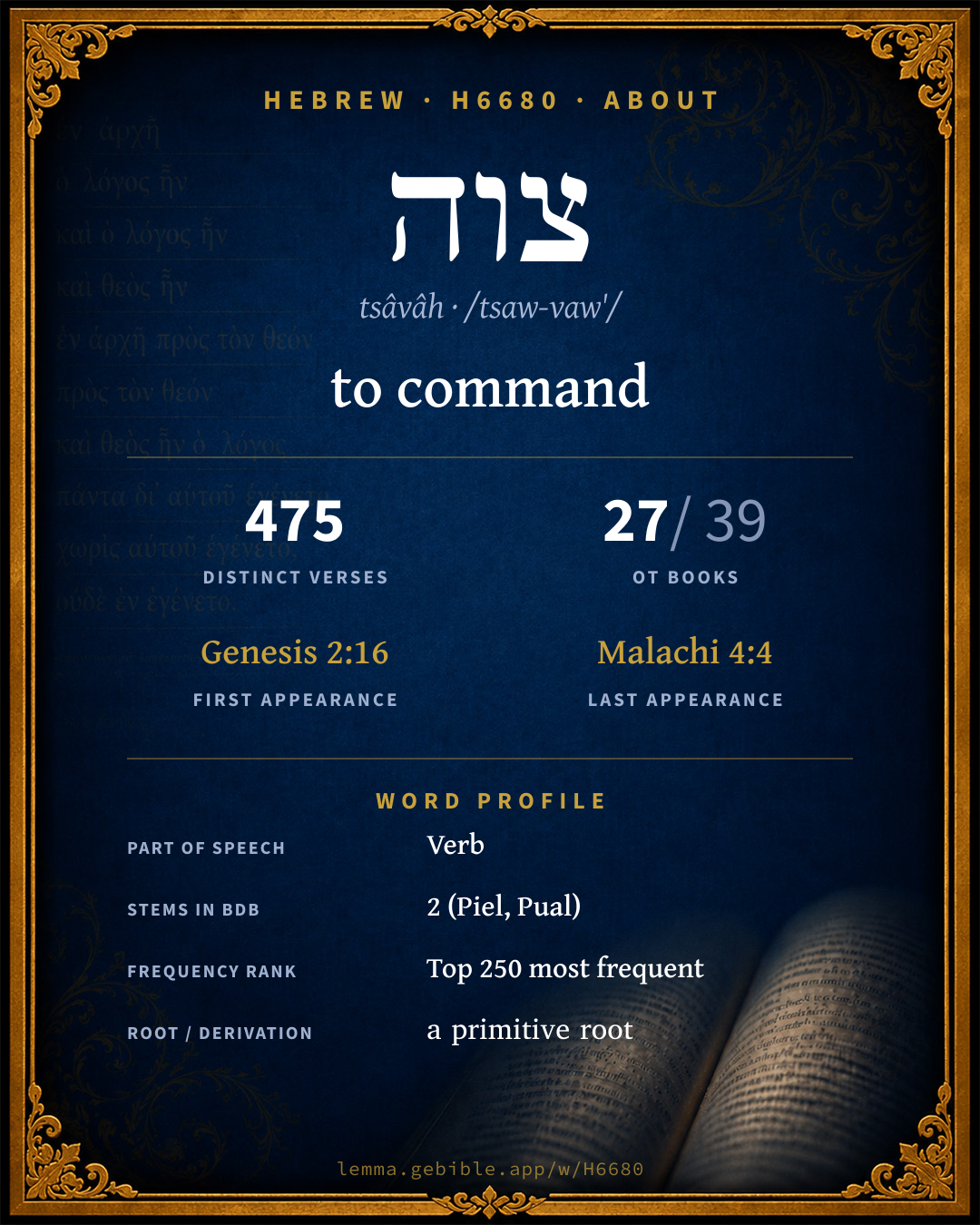
צָוָה
to command
also: charge, give orders, lay charge, give charge to fuller range ↓
Full lexicon entry — Brown-Driver-Briggs (BDB)
From Brown-Driver-Briggs (BDB)
Where this word appears
See every Piel verb in the Hebrew Bible →
Grammar key — what these labels mean
Part of speech
- Verb
- An action or state-of-being word.
Stem
- Piel
- An intensive or resultative active stem. Here: ‘lay charge’
- Pual
- The passive counterpart of the Piel.
Form
- Perfect
- A completed action or state — Hebrew marks aspect (completeness) more than strict tense (“he wrote”).
- Sequential Imperfect
- An imperfect with prefixed waw — the standard past-narrative form (waw-consecutive imperfect).
- Participle Active
- A verbal adjective expressing ongoing or characteristic action (“writing / one who writes”).
- Imperative
- A direct command (“write!”).
- Imperfect
- An incomplete, ongoing, or future action (“he will / would write”).
- Sequential Perfect
- A perfect with prefixed waw continuing a preceding imperfect or command (waw-consecutive perfect).
- Infinitive Construct
- A bound verbal noun, frequently with prepositions (“to write / in writing”).
State
- Construct
- A noun bound to a following noun in a possessive / “of” relationship (the construct chain).
- Absolute
- The independent form of a noun, not bound to a following word.
Person
- 3rd Person
- The one spoken about (“he / she / it / they”).
- 1st Person
- The speaker (“I / we”).
- 2nd Person
- The one addressed (“you”).
Gender
- Masculine
- Grammatically masculine.
- Common
- Either gender — not distinguished for this form.
- Feminine
- Grammatically feminine.
Number
- Singular
- One.
- Plural
- More than one (in Hebrew, generally three or more).
Grammatical forms 27 distinct
- Verb, Piel, Perfect, 3rd Person, Masculine, Singular 229 times (46%)
- Verb, Piel, Sequential Imperfect, 3rd Person, Masculine, Singular 62 times (13%)
- Verb, Piel, Perfect, 1st Person, Common, Singular 60 times (12%)
- Verb, Piel, Participle Active, Masculine, Singular, Construct 28 times (6%)
- Verb, Piel, Participle Active, Masculine, Singular, Absolute 16 times (3%)
- Verb, Piel, Perfect, 2nd Person, Masculine, Singular 15 times (3%)
- Verb, Piel, Imperfect, 1st Person, Common, Singular 14 times (3%)
- Verb, Piel, Imperative, 2nd Person, Masculine, Singular 13 times (3%)
+19 more forms (59 occurrences)
Parsed forms decoded from the imported morphology (morphhb / Westminster Leningrad Codex — WLC text public domain, morphhb tagging CC BY 4.0), counted across 496 parsed occurrences — not distinct verses.
Page 2 of 3 — showing verses 201–400 of 475 distinct verses where H6680 appears, across 27 books. Click any verse to open its interlinear word-by-word view. Verse text shown in the World English Bible for context — . Each verse’s Hebrew form is shown with its reference; the English is not keyword-highlighted, since the data carries no word-level English alignment. Use “Compare translations” on any verse to read it across multiple English versions. This concordance covers the Hebrew Bible; Septuagint (Greek Old Testament) occurrences are not indexed here.
Deuteronomy 86 verses
- Deuteronomy 12:14 מְצַוֶּֽ/ךָּ Piel ptcp.act ms cs + sfx pers 2ms but in the place which Yahweh shall choose in one of your tribes, there you shall offer your burnt offerings, and there you shall do all that I command you.
- Deuteronomy 12:21 צִוִּיתִ֑/ךָ Piel pf 1cs + sfx pers 2ms If the place which Yahweh your God shall choose, to put his name there, be too far from you, then you shall kill of your herd and of your flock, which Yahweh has given you, as I have commanded you; and you may eat within your gates, after all the desire of your soul.
- Deuteronomy 12:28 מְצַוֶּ֑/ךָּ Piel ptcp.act ms cs + sfx pers 2ms Observe and hear all these words which I command you, that it may go well with you, and with your children after you forever, when you do that which is good and right in the eyes of Yahweh your God.
- Deuteronomy 12:32 מְצַוֶּ֣ה Piel ptcp.act ms Whatever thing I command you, that shall you observe to do: you shall not add thereto, nor diminish from it.
- Deuteronomy 13:5 צִוְּ/ךָ֛ Piel pf 3ms + sfx pers 2ms That prophet, or that dreamer of dreams, shall be put to death, because he has spoken rebellion against Yahweh your God, who brought you out of the land of Egypt, and redeemed you out of the house of bondage, to draw you aside out of the way which Yahweh your God commanded you to walk in. So shall you put away the evil from the midst of you.
- Deuteronomy 13:18 מְצַוְּ/ךָ֖ Piel ptcp.act ms cs + sfx pers 2ms when you shall listen to the voice of Yahweh your God, to keep all his commandments which I command you this day, to do that which is right in the eyes of Yahweh your God.
- Deuteronomy 15:5 מְצַוְּ/ךָ֖ Piel ptcp.act ms cs + sfx pers 2ms if only you diligently listen to the voice of Yahweh your God, to observe to do all this commandment which I command you this day.
- Deuteronomy 15:11 מְצַוְּ/ךָ֙ Piel ptcp.act ms cs + sfx pers 2ms For the poor will never cease out of the land: therefore I command you, saying, You shall surely open your hand to your brother, to your needy, and to your poor, in your land.
- Deuteronomy 15:15 מְצַוְּ/ךָ֛ Piel ptcp.act ms cs + sfx pers 2ms You shall remember that you were a bondservant in the land of Egypt, and Yahweh your God redeemed you: therefore I command you this thing today.
- Deuteronomy 17:3 צִוִּֽיתִי Piel pf 1cs and has gone and served other gods, and worshiped them, or the sun, or the moon, or any of the host of the sky, which I have not commanded;
- Deuteronomy 18:18 אֲצַוֶּֽ/נּוּ Piel impf 1cs + sfx pers 3ms I will raise them up a prophet from among their brothers, like you; and I will put my words in his mouth, and he shall speak to them all that I shall command him.
- Deuteronomy 18:20 צִוִּיתִי/ו֙ Piel pf 1cs + sfx pers 3ms But the prophet, who shall speak a word presumptuously in my name, which I have not commanded him to speak, or who shall speak in the name of other gods, that same prophet shall die.
- Deuteronomy 19:7 מְצַוְּ/ךָ֖ Piel ptcp.act ms cs + sfx pers 2ms Therefore I command you, saying, You shall set apart three cities for you.
- Deuteronomy 19:9 מְצַוְּ/ךָ֮ Piel ptcp.act ms cs + sfx pers 2ms if you shall keep all this commandment to do it, which I command you this day, to love Yahweh your God, and to walk ever in his ways; then shall you add three cities more for you, besides these three:
- Deuteronomy 20:17 צִוְּ/ךָ֖ Piel pf 3ms + sfx pers 2ms but you shall utterly destroy them: the Hittite, and the Amorite, the Canaanite, and the Perizzite, the Hivite, and the Jebusite; as Yahweh your God has commanded you;
- Deuteronomy 24:8 צִוִּיתִ֖/ם Piel pf 1cs + sfx pers 3mp Take heed in the plague of leprosy, that you observe diligently, and do according to all that the priests the Levites shall teach you: as I commanded them, so you shall observe to do.
- Deuteronomy 24:18 מְצַוְּ/ךָ֙ Piel ptcp.act ms cs + sfx pers 2ms but you shall remember that you were a bondservant in Egypt, and Yahweh your God redeemed you there: therefore I command you to do this thing.
- Deuteronomy 24:22 מְצַוְּ/ךָ֙ Piel ptcp.act ms cs + sfx pers 2ms You shall remember that you were a bondservant in the land of Egypt: therefore I command you to do this thing.
- Deuteronomy 26:13 צִוִּיתָ֑/נִי Piel pf 2ms + sfx pers 1cs You shall say before Yahweh your God, I have put away the holy things out of my house, and also have given them to the Levite, and to the foreigner, to the fatherless, and to the widow, according to all your commandment which you have commanded me: I have not transgressed any of your commandments, neither have I forgotten them:
- Deuteronomy 26:14 צִוִּיתָֽ/נִי Piel pf 2ms + sfx pers 1cs I have not eaten of it in my mourning, neither have I put away of it, being unclean, nor given of it for the dead: I have listened to the voice of Yahweh my God; I have done according to all that you have commanded me.
- Deuteronomy 26:16 מְצַוְּ/ךָ֧ Piel ptcp.act ms cs + sfx pers 2ms This day Yahweh your God commands you to do these statutes and ordinances: you shall therefore keep and do them with all your heart, and with all your soul.
- Deuteronomy 27:1 וַ/יְצַ֤ו מְצַוֶּ֥ה conj + Piel wimpf 3ms Piel ptcp.act ms Moses and the elders of Israel commanded the people, saying, Keep all the commandment which I command you this day.
- Deuteronomy 27:4 מְצַוֶּ֥ה Piel ptcp.act ms It shall be, when you are passed over the Jordan, that you shall set up these stones, which I command you this day, in Mount Ebal, and you shall plaster them with plaster.
- Deuteronomy 27:10 מְצַוְּ/ךָ֖ Piel ptcp.act ms cs + sfx pers 2ms You shall therefore obey the voice of Yahweh your God, and do his commandments and his statutes, which I command you this day.
- Deuteronomy 27:11 וַ/יְצַ֤ו conj + Piel wimpf 3ms Moses charged the people the same day, saying,
- Deuteronomy 28:1 מְצַוְּ/ךָ֖ Piel ptcp.act ms cs + sfx pers 2ms It shall happen, if you shall listen diligently to the voice of Yahweh your God, to observe to do all his commandments which I command you this day, who Yahweh your God will set you on high above all the nations of the earth:
- Deuteronomy 28:8 יְצַ֨ו Piel impf 3ms Yahweh will command the blessing on you in your barns, and in all that you put your hand to; and he will bless you in the land which Yahweh your God gives you.
- Deuteronomy 28:13 מְצַוְּ/ךָ֛ Piel ptcp.act ms cs + sfx pers 2ms Yahweh will make you the head, and not the tail; and you shall be above only, and you shall not be beneath; if you shall listen to the commandments of Yahweh your God, which I command you this day, to observe and to do [them],
- Deuteronomy 28:14 מְצַוֶּ֥ה Piel ptcp.act ms and shall not turn aside from any of the words which I command you this day, to the right hand, or to the left, to go after other gods to serve them.
- Deuteronomy 28:15 מְצַוְּ/ךָ֖ Piel ptcp.act ms cs + sfx pers 2ms But it shall come to pass, if you will not listen to the voice of Yahweh your God, to observe to do all his commandments and his statutes which I command you this day, that all these curses shall come on you, and overtake you.
- Deuteronomy 28:45 צִוָּֽ/ךְ Piel pf 3ms + sfx pers 2fs All these curses shall come on you, and shall pursue you, and overtake you, until you are destroyed; because you didn't listen to the voice of Yahweh your God, to keep his commandments and his statutes which he commanded you:
- Deuteronomy 29:1 צִוָּ֧ה Piel pf 3ms These are the words of the covenant which Yahweh commanded Moses to make with the children of Israel in the land of Moab, besides the covenant which he made with them in Horeb.
- Deuteronomy 30:2 מְצַוְּ/ךָ֖ Piel ptcp.act ms cs + sfx pers 2ms and shall return to Yahweh your God, and shall obey his voice according to all that I command you this day, you and your children, with all your heart, and with all your soul;
- Deuteronomy 30:8 מְצַוְּ/ךָ֖ Piel ptcp.act ms cs + sfx pers 2ms You shall return and obey the voice of Yahweh, and do all his commandments which I command you this day.
- Deuteronomy 30:11 מְצַוְּ/ךָ֖ Piel ptcp.act ms cs + sfx pers 2ms For this commandment which I command you this day, it is not too hard for you, neither is it far off.
- Deuteronomy 30:16 מְצַוְּ/ךָ֮ Piel ptcp.act ms cs + sfx pers 2ms in that I command you this day to love Yahweh your God, to walk in his ways, and to keep his commandments and his statutes and his ordinances, that you may live and multiply, and that Yahweh your God may bless you in the land where you go in to possess it.
- Deuteronomy 31:5 צִוִּ֖יתִי Piel pf 1cs Yahweh will deliver them up before you, and you shall do to them according to all the commandment which I have commanded you.
- Deuteronomy 31:10 וַ/יְצַ֥ו conj + Piel wimpf 3ms Moses commanded them, saying, At the end of [every] seven years, in the set time of the year of release, in the feast of tents,
- Deuteronomy 31:14 וַ/אֲצַוֶּ֑/נּוּ conj + Piel wimpf 1cs + sfx pers 3ms Yahweh said to Moses, Behold, your days approach that you must die: call Joshua, and present yourselves in the tent of meeting, that I may give him a charge. Moses and Joshua went, and presented themselves in the tent of meeting.
- Deuteronomy 31:23 וַ/יְצַ֞ו conj + Piel wimpf 3ms He gave Joshua the son of Nun a charge, and said, Be strong and of good courage; for you shall bring the children of Israel into the land which I swore to them: and I will be with you.
- Deuteronomy 31:25 וַ/יְצַ֤ו conj + Piel wimpf 3ms that Moses commanded the Levites, who bore the ark of the covenant of Yahweh, saying,
- Deuteronomy 31:29 צִוִּ֖יתִי Piel pf 1cs For I know that after my death you will utterly corrupt yourselves, and turn aside from the way which I have commanded you; and evil will happen to you in the latter days; because you will do that which is evil in the sight of Yahweh, to provoke him to anger through the work of your hands.
- Deuteronomy 32:46 תְּצַוֻּ/ם֙ Piel impf 2mp + sfx pers 3mp He said to them, Set your heart to all the words which I testify to you this day, which you shall command your children to observe to do, [even] all the words of this law.
- Deuteronomy 33:4 צִוָּה Piel pf 3ms Moses commanded us a law, An inheritance for the assembly of Jacob.
- Deuteronomy 34:9 צִוָּ֥ה Piel pf 3ms Joshua the son of Nun was full of the spirit of wisdom; for Moses had laid his hands on him: and the children of Israel listened to him, and did as Yahweh commanded Moses.
Joshua 39 verses
- Joshua 1:7 צִוְּ/ךָ֙ Piel pf 3ms + sfx pers 2ms Only be strong and very courageous, to observe to do according to all the law, which Moses my servant commanded you: don't turn from it to the right hand or to the left, that you may have good success wherever you go.
- Joshua 1:9 צִוִּיתִ֨י/ךָ֙ Piel pf 1cs + sfx pers 2ms Haven't I commanded you? Be strong and of good courage; don't be afraid, neither be dismayed: for Yahweh your God is with you wherever you go.
- Joshua 1:10 וַ/יְצַ֣ו conj + Piel wimpf 3ms Then Joshua commanded the officers of the people, saying,
- Joshua 1:11 וְ/צַוּ֤וּ conj + Piel impv 2mp Pass through the midst of the camp, and command the people, saying, Prepare food; for within three days you are to pass over this Jordan, to go in to possess the land, which Yahweh your God gives you to possess it.
- Joshua 1:13 צִוָּ֥ה Piel pf 3ms Remember the word which Moses the servant of Yahweh commanded you, saying, Yahweh your God gives you rest, and will give you this land.
- Joshua 1:16 צִוִּיתָ֨/נוּ֙ Piel pf 2ms + sfx pers 1cp They answered Joshua, saying, All that you have commanded us we will do, and wherever you send us we will go.
- Joshua 1:18 תְּצַוֶּ֖/נּוּ Piel impf 2ms + sfx pers 3ms Whoever he be who shall rebel against your commandment, and shall not listen to your words in all that you command him, he shall be put to death: only be strong and of good courage.
- Joshua 3:3 וַ/יְצַוּוּ֮ conj + Piel wimpf 3mp and they commanded the people, saying, When you see the ark of the covenant of Yahweh your God, and the priests the Levites bearing it, then you shall remove from your place, and go after it.
- Joshua 3:8 תְּצַוֶּה֙ Piel impf 2ms You shall command the priests who bear the ark of the covenant, saying, When you are come to the brink of the waters of the Jordan, you shall stand still in the Jordan.
- Joshua 4:3 וְ/צַוּ֣וּ conj + Piel impv 2mp and command you them, saying, Take hence out of the midst of the Jordan, out of the place where the priests' feet stood firm, twelve stones, and carry them over with you, and lay them down in the lodging-place, where you shall lodge this night.
- Joshua 4:8 צִוָּ֣ה Piel pf 3ms The children of Israel did so as Joshua commanded, and took up twelve stones out of the midst of the Jordan, as Yahweh spoke to Joshua, according to the number of the tribes of the children of Israel; and they carried them over with them to the place where they lodged, and laid them down there.
- Joshua 4:10 צִוָּ֨ה צִוָּ֥ה Piel pf 3ms Piel pf 3ms For the priests who bore the ark stood in the midst of the Jordan, until everything was finished that Yahweh commanded Joshua to speak to the people, according to all that Moses commanded Joshua: and the people hurried and passed over.
- Joshua 4:16 צַוֵּה֙ Piel impv 2ms Command the priests who bear the ark of the testimony, that they come up out of the Jordan.
- Joshua 4:17 וַ/יְצַ֣ו conj + Piel wimpf 3ms Joshua therefore commanded the priests, saying, Come up out of the Jordan.
- Joshua 6:10 צִוָּ֨ה Piel pf 3ms Joshua commanded the people, saying, You shall not shout, nor let your voice be heard, neither shall any word proceed out of your mouth, until the day I bid you shout; then shall you shout.
- Joshua 7:11 צִוִּ֖יתִי Piel pf 1cs Israel has sinned; yes, they have even transgressed my covenant which I commanded them: yes, they have even taken of the devoted thing, and have also stolen, and dissembled also; and they have even put it among their own stuff.
- Joshua 8:4 וַ/יְצַ֨ו conj + Piel wimpf 3ms He commanded them, saying, Behold, you shall lie in ambush against the city, behind the city; don't go very far from the city, but be all ready:
- Joshua 8:8 צִוִּ֥יתִי Piel pf 1cs It shall be, when you have seized on the city, that you shall set the city on fire; according to the word of Yahweh shall you do: behold, I have commanded you.
- Joshua 8:27 צִוָּ֖ה Piel pf 3ms Only the cattle and the spoil of that city Israel took for prey to themselves, according to the word of Yahweh which he commanded Joshua.
- Joshua 8:29 צִוָּ֨ה Piel pf 3ms The king of Ai he hanged on a tree until the evening: and at the going down of the sun Joshua commanded, and they took his body down from the tree, and cast it at the entrance of the gate of the city, and raised thereon a great heap of stones, to this day.
- Joshua 8:31 צִוָּה֩ Piel pf 3ms as Moses the servant of Yahweh commanded the children of Israel, as it is written in the book of the law of Moses, an altar of uncut stones, on which no man had lifted up any iron: and they offered thereon burnt offerings to Yahweh, and sacrificed peace-offerings.
- Joshua 8:33 צִוָּ֜ה Piel pf 3ms All Israel, and their elders and officers, and their judges, stood on this side of the ark and on that side before the priests the Levites, who bore the ark of the covenant of Yahweh, as well the foreigner as the native; half of them in front of Mount Gerizim, and half of them in front of Mount Ebal; as Moses the servant of Yahweh had commanded at the first, that they should bless the people of Israel.
- Joshua 8:35 צִוָּ֣ה Piel pf 3ms There was not a word of all that Moses commanded, which Joshua didn't read before all the assembly of Israel, and the women, and the little ones, and the foreigners who were among them.
- Joshua 9:24 צִוָּ֜ה Piel pf 3ms They answered Joshua, and said, Because it was certainly told your servants, how that Yahweh your God commanded his servant Moses to give you all the land, and to destroy all the inhabitants of the land from before you; therefore we were sore afraid for our lives because of you, and have done this thing.
- Joshua 10:27 צִוָּ֤ה Piel pf 3ms It happened at the time of the going down of the sun, that Joshua commanded, and they took them down off the trees, and cast them into the cave in which they had hidden themselves, and laid great stones on the mouth of the cave, to this very day.
- Joshua 10:40 צִוָּ֔ה Piel pf 3ms So Joshua struck all the land, the hill-country, and the South, and the lowland, and the slopes, and all their kings: he left none remaining, but he utterly destroyed all that breathed, as Yahweh, the God of Israel, commanded.
- Joshua 11:12 צִוָּ֔ה Piel pf 3ms All the cities of those kings, and all the kings of them, did Joshua take, and he struck them with the edge of the sword, and utterly destroyed them; as Moses the servant of Yahweh commanded.
- Joshua 11:15 צִוָּ֤ה צִוָּ֥ה צִוָּ֥ה Piel pf 3ms Piel pf 3ms Piel pf 3ms As Yahweh commanded Moses his servant, so did Moses command Joshua: and so did Joshua; he left nothing undone of all that Yahweh commanded Moses.
- Joshua 11:20 צִוָּ֥ה Piel pf 3ms For it was of Yahweh to harden their hearts, to come against Israel in battle, that he might utterly destroy them, that they might have no favor, but that he might destroy them, as Yahweh commanded Moses.
- Joshua 13:6 צִוִּיתִֽי/ךָ Piel pf 1cs + sfx pers 2ms all the inhabitants of the hill-country from Lebanon to Misrephoth Maim, even all the Sidonians; them will I drive out from before the children of Israel: only allot you it to Israel for an inheritance, as I have commanded you.
- Joshua 14:2 צִוָּ֤ה Piel pf 3ms by the lot of their inheritance, as Yahweh commanded by Moses, for the nine tribes, and for the half-tribe.
- Joshua 14:5 צִוָּ֤ה Piel pf 3ms As Yahweh commanded Moses, so the children of Israel did; and they divided the land.
- Joshua 17:4 צִוָּ֣ה Piel pf 3ms They came near before Eleazar the priest, and before Joshua the son of Nun, and before the princes, saying, Yahweh commanded Moses to give us an inheritance among our brothers: therefore according to the commandment of Yahweh he gave them an inheritance among the brothers of their father.
- Joshua 18:8 וַ/יְצַ֣ו conj + Piel wimpf 3ms The men arose, and went: and Joshua charged those who went to describe the land, saying, Go and walk through the land, and describe it, and come again to me; and I will cast lots for you here before Yahweh in Shiloh.
- Joshua 21:2 צִוָּ֣ה Piel pf 3ms and they spoke to them at Shiloh in the land of Canaan, saying, Yahweh commanded Moses to give us cities to dwell in, with the suburbs of it for our cattle.
- Joshua 21:8 צִוָּ֧ה Piel pf 3ms The children of Israel gave by lot to the Levites these cities with their suburbs, as Yahweh commanded by Moses.
- Joshua 22:2 צִוָּ֣ה צִוִּ֖יתִי Piel pf 3ms Piel pf 1cs and said to them, You have kept all that Moses the servant of Yahweh commanded you, and have listened to my voice in all that I commanded you:
- Joshua 22:5 צִוָּ֣ה Piel pf 3ms Only take diligent heed to do the commandment and the law which Moses the servant of Yahweh commanded you, to love Yahweh your God, and to walk in all his ways, and to keep his commandments, and to cleave to him, and to serve him with all your heart and with all your soul.
- Joshua 23:16 צִוָּ֣ה Piel pf 3ms When you disobey the covenant of Yahweh your God, which he commanded you, and go and serve other gods, and bow down yourselves to them; then will the anger of Yahweh be kindled against you, and you shall perish quickly from off the good land which he has given to you.
Judges 6 verses
- Judges 2:20 צִוִּ֣יתִי Piel pf 1cs The anger of Yahweh was kindled against Israel; and he said, Because this nation have transgressed my covenant which I commanded their fathers, and have not listened to my voice;
- Judges 3:4 צִוָּ֥ה Piel pf 3ms They were [left], to prove Israel by them, to know whether they would listen to the commandments of Yahweh, which he commanded their fathers by Moses.
- Judges 4:6 צִוָּ֣ה Piel pf 3ms She sent and called Barak the son of Abinoam out of Kedesh-naphtali, and said to him, Hasn't Yahweh, the God of Israel, commanded, [saying], Go and draw to Mount Tabor, and take with you ten thousand men of the children of Naphtali and of the children of Zebulun?
- Judges 13:14 צִוִּיתִ֖י/הָ Piel pf 1cs + pron pers 3fs She may not eat of anything that comes of the vine, neither let her drink wine or strong drink, nor eat any unclean thing; all that I commanded her let her observe.
- Judges 21:10 וַ/יְצַוּ֨וּ conj + Piel wimpf 3mp The congregation sent there twelve thousand men of the most valiant, and commanded them, saying, Go and strike the inhabitants of Jabesh Gilead with the edge of the sword, with the women and the little ones.
- Judges 21:20 ו/יצו וַ/יְצַוּ֕וּ conj + Piel wimpf 3mp conj + Piel wimpf 3mp They commanded the children of Benjamin, saying, Go and lie in wait in the vineyards,
Ruth 3 verses
- Ruth 2:9 צִוִּ֛יתִי Piel pf 1cs Let your eyes be on the field that they reap, and go after them: haven't I charged the young men that they shall not touch you? and when you are thirsty, go to the vessels, and drink of that which the young men have drawn.
- Ruth 2:15 וַ/יְצַו֩ conj + Piel wimpf 3ms When she was risen up to glean, Boaz commanded his young men, saying, Let her glean even among the sheaves, and don't reproach her.
- Ruth 3:6 צִוַּ֖תָּ/ה Piel pf 3fs + sfx pers 3fs She went down to the threshing floor, and did according to all that her mother-in-law bade her.
1 Samuel 8 verses
- 1 Samuel 2:29 צִוִּ֖יתִי Piel pf 1cs Why kick you at my sacrifice and at my offering, which I have commanded in [my] habitation, and honor your sons above me, to make yourselves fat with the best of all the offerings of Israel my people?
- 1 Samuel 13:13 צִוָּ֔/ךְ Piel pf 3ms + sfx pers 2fs Samuel said to Saul, You have done foolishly; you have not kept the commandment of Yahweh your God, which he commanded you: for now would Yahweh have established your kingdom on Israel forever.
- 1 Samuel 13:14 וַ/יְצַוֵּ֨/הוּ צִוְּ/ךָ֖ conj + Piel wimpf 3ms + sfx pers 3ms Piel pf 3ms + sfx pers 2ms But now your kingdom shall not continue: Yahweh has sought him a man after his own heart, and Yahweh has appointed him to be prince over his people, because you have not kept that which Yahweh commanded you.
- 1 Samuel 17:20 צִוָּ֖/הוּ Piel pf 3ms + sfx pers 3ms David rose up early in the morning, and left the sheep with a keeper, and took, and went, as Jesse had commanded him; and he came to the place of the wagons, as the host which was going forth to the fight shouted for the battle.
- 1 Samuel 18:22 וַ/יְצַ֨ו conj + Piel wimpf 3ms Saul commanded his servants, [saying], Commune with David secretly, and say, Behold, the king has delight in you, and all his servants love you: now therefore be the king's son-in-law.
- 1 Samuel 20:29 צִוָּֽה Piel pf 3ms and he said, Please let me go, for our family has a sacrifice in the city; and my brother, he has commanded me [to be there]: and now, if I have found favor in your eyes, let me get away, I pray you, and see my brothers. Therefore he is not come to the king's table.
- 1 Samuel 21:2 צִוַּ֣/נִי צִוִּיתִ֑/ךָ Piel pf 3ms + sfx pers 1cs Piel pf 1cs + sfx pers 2ms David said to Ahimelech the priest, The king has commanded me a business, and has said to me, Let no man know anything of the business about which I send you, and what I have commanded you: and I have appointed the young men to such and such a place.
- 1 Samuel 25:30 וְ/צִוְּ/ךָ֥ conj + Piel wpf 3ms + sfx pers 2ms It shall come to pass, when Yahweh shall have done to my lord according to all the good that he has spoken concerning you, and shall have appointed you prince over Israel,
2 Samuel 17 verses
- 2 Samuel 4:12 וַ/יְצַו֩ conj + Piel wimpf 3ms David commanded his young men, and they killed them, and cut off their hands and their feet, and hanged them up beside the pool in Hebron. But they took the head of Ish-bosheth, and buried it in the grave of Abner in Hebron.
- 2 Samuel 5:25 צִוָּ֖/הוּ Piel pf 3ms + sfx pers 3ms David did so, as Yahweh commanded him, and struck the Philistines from Geba until you come to Gezer.
- 2 Samuel 6:21 לְ/צַוֺּ֨ת prep + Piel inf.cs David said to Michal, [It was] before Yahweh, who chose me above your father, and above all his house, to appoint me prince over the people of Yahweh, over Israel: therefore will I play before Yahweh.
- 2 Samuel 7:7 צִוִּ֗יתִי Piel pf 1cs In all places in which I have walked with all the children of Israel, spoke I a word with any of the tribes of Israel, whom I commanded to be shepherd of my people Israel, saying, Why have you not built me a house of cedar?
- 2 Samuel 7:11 צִוִּ֤יתִי Piel pf 1cs and [as] from the day that I commanded judges to be over my people Israel; and I will cause you to rest from all your enemies. Moreover Yahweh tells you that Yahweh will make you a house.
- 2 Samuel 9:11 יְצַוֶּ֜ה Piel impf 3ms Then said Ziba to the king, According to all that my lord the king commands his servant, so shall your servant do. As for Mephibosheth, [said the king], he shall eat at my table, as one of the king's sons.
- 2 Samuel 11:19 וַ/יְצַ֥ו conj + Piel wimpf 3ms and he charged the messenger, saying, "When you have made an end of telling all the things concerning the war to the king,
- 2 Samuel 13:28 וַ/יְצַו֩ צִוִּ֣יתִי conj + Piel wimpf 3ms Piel pf 1cs Absalom commanded his servants, saying, Mark you now, when Amnon's heart is merry with wine; and when I tell you, Smite Amnon, then kill him; don't be afraid; haven't I commanded you? be courageous, and be valiant.
- 2 Samuel 13:29 צִוָּ֖ה Piel pf 3ms The servants of Absalom did to Amnon as Absalom had commanded. Then all the king's sons arose, and every man got him up on his mule, and fled.
- 2 Samuel 14:8 אֲצַוֶּ֥ה Piel impf 1cs The king said to the woman, Go to your house, and I will give charge concerning you.
- 2 Samuel 14:19 צִוָּ֔/נִי Piel pf 3ms + sfx pers 1cs The king said, Is the hand of Joab with you in all this? The woman answered, As your soul lives, my lord the king, none can turn to the right hand or to the left from anything that my lord the king has spoken; for your servant Joab, he bade me, and he put all these words in the mouth of your handmaid;
- 2 Samuel 17:14 צִוָּ֗ה Piel pf 3ms Absalom and all the men of Israel said, The counsel of Hushai the Archite is better than the counsel of Ahithophel. For Yahweh had ordained to defeat the good counsel of Ahithophel, to the intent that Yahweh might bring evil on Absalom.
- 2 Samuel 17:23 וַ/יְצַ֥ו conj + Piel wimpf 3ms When Ahithophel saw that his counsel was not followed, he saddled his donkey, and arose, and got him home, to his city, and set his house in order, and hanged himself; and he died, and was buried in the tomb of his father.
- 2 Samuel 18:5 וַ/יְצַ֣ו בְּ/צַוֺּ֥ת conj + Piel wimpf 3ms prep + Piel inf.cs The king commanded Joab and Abishai and Ittai, saying, Deal gently for my sake with the young man, even with Absalom. All the people heard when the king gave all the captains charge concerning Absalom.
- 2 Samuel 18:12 צִוָּ֣ה Piel pf 3ms The man said to Joab, Though I should receive a thousand [pieces of] silver in my hand, I still wouldn't put forth my hand against the king's son; for in our hearing the king charged you and Abishai and Ittai, saying, Beware that none touch the young man Absalom.
- 2 Samuel 21:14 צִוָּ֖ה Piel pf 3ms They buried the bones of Saul and Jonathan his son in the country of Benjamin in Zela, in the tomb of Kish his father: and they performed all that the king commanded. After that God was entreated for the land.
- 2 Samuel 24:19 צִוָּ֥ה Piel pf 3ms David went up according to the saying of Gad, as Yahweh commanded.
1 Kings 17 verses
- 1 Kings 1:35 צִוִּ֨יתִי֙ Piel pf 1cs Then you shall come up after him, and he shall come and sit on my throne; for he shall be king in my place; and I have appointed him to be prince over Israel and over Judah.
- 1 Kings 2:1 וַ/יְצַ֛ו conj + Piel wimpf 3ms Now the days of David drew near that he should die; and he charged Solomon his son, saying,
- 1 Kings 2:43 צִוִּ֥יתִי Piel pf 1cs Why then have you not kept the oath of Yahweh, and the commandment that I have charged you with?
- 1 Kings 2:46 וַ/יְצַ֣ו conj + Piel wimpf 3ms So the king commanded Benaiah the son of Jehoiada; and he went out, and fell on him, so that he died. The kingdom was established in the hand of Solomon.
- 1 Kings 5:6 צַוֵּה֩ Piel impv 2ms Now therefore command you that they cut me cedar trees out of Lebanon; and my servants shall be with your servants; and I will give you hire for your servants according to all that you shall say: for you know that there is not among us any who knows how to cut timber like the Sidonians.
- 1 Kings 5:17 וַ/יְצַ֣ו conj + Piel wimpf 3ms The king commanded, and they hewed out great stones, costly stones, to lay the foundation of the house with worked stone.
- 1 Kings 8:58 צִוָּ֖ה Piel pf 3ms that he may incline our hearts to him, to walk in all his ways, and to keep his commandments, and his statutes, and his ordinances, which he commanded our fathers.
- 1 Kings 9:4 צִוִּיתִ֑י/ךָ Piel pf 1cs + sfx pers 2ms As for you, if you will walk before me, as David your father walked, in integrity of heart, and in uprightness, to do according to all that I have commanded you, and will keep my statutes and my ordinances;
- 1 Kings 11:10 וְ/צִוָּ֤ה צִוָּ֖ה conj + Piel pf 3ms Piel pf 3ms and had commanded him concerning this thing, that he should not go after other gods: but he didn't keep that which Yahweh commanded.
- 1 Kings 11:11 צִוִּ֖יתִי Piel pf 1cs Therefore Yahweh said to Solomon, Because this is done of you, and you have not kept my covenant and my statutes, which I have commanded you, I will surely tear the kingdom from you, and will give it to your servant.
- 1 Kings 11:38 אֲצַוֶּ/ךָ֒ Piel impf 1cs + sfx pers 2ms It shall be, if you will listen to all that I command you, and will walk in my ways, and do that which is right in my eyes, to keep my statutes and my commandments, as David my servant did; that I will be with you, and will build you a sure house, as I built for David, and will give Israel to you.
- 1 Kings 13:9 צִוָּ֣ה Piel pf 3ms for so was it charged me by the word of Yahweh, saying, You shall eat no bread, nor drink water, neither return by the way that you came.
- 1 Kings 13:21 צִוְּ/ךָ֖ Piel pf 3ms + sfx pers 2ms and he cried to the man of God who came from Judah, saying, Thus says Yahweh, Because you have been disobedient to the mouth of Yahweh, and have not kept the commandment which Yahweh your God commanded you,
- 1 Kings 15:5 צִוָּ֗/הוּ Piel pf 3ms + sfx pers 3ms because David did that which was right in the eyes of Yahweh, and didn't turn aside from anything that he commanded him all the days of his life, except only in the matter of Uriah the Hittite.
- 1 Kings 17:4 צִוִּ֔יתִי Piel pf 1cs It shall be, that you shall drink of the brook; and I have commanded the ravens to feed you there.
- 1 Kings 17:9 צִוִּ֥יתִי Piel pf 1cs Arise, get you to Zarephath, which belongs to Sidon, and dwell there: behold, I have commanded a widow there to sustain you.
- 1 Kings 22:31 צִוָּ֣ה Piel pf 3ms Now the king of Syria had commanded the thirty-two captains of his chariots, saying, Fight neither with small nor great, save only with the king of Israel.
2 Kings 18 verses
- 2 Kings 11:5 וַ/יְצַוֵּ֣/ם conj + Piel wimpf 3ms + sfx pers 3mp He commanded them, saying, This is the thing that you shall do: a third part of you, who come in on the Sabbath, shall be keepers of the watch of the king's house;
- 2 Kings 11:9 צִוָּה֮ Piel pf 3ms The captains over hundreds did according to all that Jehoiada the priest commanded; and they took every man his men, those who were to come in on the Sabbath, with those who were to go out on the Sabbath, and came to Jehoiada the priest.
- 2 Kings 11:15 וַ/יְצַו֩ conj + Piel wimpf 3ms Jehoiada the priest commanded the captains of hundreds who were set over the host, and said to them, Have her forth between the ranks; and him who follows her kill with the sword. For the priest said, Don't let her be slain in the house of Yahweh.
- 2 Kings 14:6 צִוָּ֨ה Piel pf 3ms but the children of the murderers he didn't put to death; according to that which is written in the book of the law of Moses, as Yahweh commanded, saying, The fathers shall not be put to death for the children, nor the children be put to death for the fathers; but every man shall die for his own sin.
- 2 Kings 16:15 ו/יצו/הו וַ/יְצַוֶּ֣ה conj + Piel wimpf 3ms + sfx pers 3ms conj + Piel wimpf 3ms King Ahaz commanded Urijah the priest, saying, On the great altar burn the morning burnt offering, and the evening meal-offering, and the king's burnt offering, and his meal-offering, with the burnt offering of all the people of the land, and their meal-offering, and their drink-offerings; and sprinkle on it all the blood of the burnt offering, and all the blood of the sacrifice: but the brazen altar shall be for me to inquire by.
- 2 Kings 16:16 צִוָּ֖ה Piel pf 3ms Thus did Urijah the priest, according to all that king Ahaz commanded.
- 2 Kings 17:13 צִוִּ֖יתִי Piel pf 1cs Yet Yahweh testified to Israel, and to Judah, by every prophet, and every seer, saying, Turn you from your evil ways, and keep my commandments and my statutes, according to all the law which I commanded your fathers, and which I sent to you by my servants the prophets.
- 2 Kings 17:15 צִוָּ֤ה Piel pf 3ms They rejected his statutes, and his covenant that he made with their fathers, and his testimonies which he testified to them; and they followed vanity, and became vain, and [went] after the nations that were round about them, concerning whom Yahweh had charged those who they should not do like them.
- 2 Kings 17:27 וַ/יְצַ֨ו conj + Piel wimpf 3ms Then the king of Assyria commanded, saying, Carry there one of the priests whom you brought from there; and let them go and dwell there, and let him teach them the law of the god of the land.
- 2 Kings 17:34 צִוָּ֤ה Piel pf 3ms To this day they do after the former manner: they don't fear Yahweh, neither do they after their statutes, or after their ordinances, or after the law or after the commandment which Yahweh commanded the children of Jacob, whom he named Israel;
- 2 Kings 17:35 וַ/יְצַוֵּ֣/ם conj + Piel wimpf 3ms + sfx pers 3mp with whom Yahweh had made a covenant, and charged them, saying, You shall not fear other gods, nor bow yourselves to them, nor serve them, nor sacrifice to them:
- 2 Kings 18:6 צִוָּ֥ה Piel pf 3ms For he joined with Yahweh; he didn't depart from following him, but kept his commandments, which Yahweh commanded Moses.
- 2 Kings 18:12 צִוָּ֔ה Piel pf 3ms because they didn't obey the voice of Yahweh their God, but transgressed his covenant, even all that Moses the servant of Yahweh commanded, and would not hear it, nor do it.
- 2 Kings 20:1 צַ֣ו Piel impv 2ms In those days was Hezekiah sick to death. Isaiah the prophet the son of Amoz came to him, and said to him, Thus says Yahweh, Set your house in order: for you shall die, and not live.
- 2 Kings 21:8 צִוִּיתִ֔י/ם צִוָּ֥ה Piel pf 1cs + sfx pers 3mp Piel pf 3ms neither will I cause the feet of Israel to wander any more out of the land which I gave their fathers, if only they will observe to do according to all that I have commanded them, and according to all the law that my servant Moses commanded them.
- 2 Kings 22:12 וַ/יְצַ֣ו conj + Piel wimpf 3ms The king commanded Hilkiah the priest, and Ahikam the son of Shaphan, and Achbor the son of Micaiah, and Shaphan the scribe, and Asaiah the king's servant, saying,
- 2 Kings 23:4 וַ/יְצַ֣ו conj + Piel wimpf 3ms The king commanded Hilkiah the high priest, and the priests of the second order, and the keepers of the threshold, to bring forth out of the temple of Yahweh all the vessels that were made for Baal, and for the Asherah, and for all the host of the sky, and he burned them outside of Jerusalem in the fields of the Kidron, and carried the ashes of them to Bethel.
- 2 Kings 23:21 וַ/יְצַ֤ו conj + Piel wimpf 3ms The king commanded all the people, saying, Keep the Passover to Yahweh your God, as it is written in this book of the covenant.
1 Chronicles 12 verses
- 1 Chronicles 6:49 צִוָּ֔ה Piel pf 3ms But Aaron and his sons offered on the altar of burnt offering, and on the altar of incense, for all the work of the most holy place, and to make atonement for Israel, according to all that Moses the servant of God had commanded.
- 1 Chronicles 14:16 צִוָּ֖/הוּ Piel pf 3ms + sfx pers 3ms David did as God commanded him: and they struck the host of the Philistines from Gibeon even to Gezer.
- 1 Chronicles 15:15 צִוָּ֥ה Piel pf 3ms The children of the Levites bore the ark of God on their shoulders with the poles thereon, as Moses commanded according to the word of Yahweh.
- 1 Chronicles 16:15 צִוָּ֖ה Piel pf 3ms Remember his covenant forever, The word which he commanded to a thousand generations,
- 1 Chronicles 16:40 צִוָּ֖ה Piel pf 3ms to offer burnt offerings to Yahweh on the altar of burnt offering continually morning and evening, even according to all that is written in the law of Yahweh, which he commanded to Israel;
- 1 Chronicles 17:6 צִוִּ֛יתִי Piel pf 1cs In all places in which I have walked with all Israel, spoke I a word with any of the judges of Israel, whom I commanded to be shepherd of my people, saying, Why have you not built me a house of cedar?
- 1 Chronicles 17:10 צִוִּ֤יתִי Piel pf 1cs and [as] from the day that I commanded judges to be over my people Israel; and I will subdue all your enemies. Moreover I tell you that Yahweh will build you a house.
- 1 Chronicles 22:6 וַ/יְצַוֵּ֨/הוּ֙ conj + Piel wimpf 3ms + sfx pers 3ms Then he called for Solomon his son, and charged him to build a house for Yahweh, the God of Israel.
- 1 Chronicles 22:12 וִֽ/יצַוְּ/ךָ֖ conj + Piel impf 3ms + sfx pers 2ms May Yahweh give you discretion and understanding, and put you in charge of Israel; that so you may keep the law of Yahweh your God.
- 1 Chronicles 22:13 צִוָּ֧ה Piel pf 3ms Then shall you prosper, if you observe to do the statutes and the ordinances which Yahweh gave Moses concerning Israel. Be strong, and of good courage. Don't be afraid, neither be dismayed.
- 1 Chronicles 22:17 וַ/יְצַ֤ו conj + Piel wimpf 3ms David also commanded all the princes of Israel to help Solomon his son, [saying],
- 1 Chronicles 24:19 צִוָּ֔/הוּ Piel pf 3ms + sfx pers 3ms This was the ordering of them in their service, to come into the house of Yahweh according to the ordinance [given] to them by Aaron their father, as Yahweh, the God of Israel, had commanded him.
2 Chronicles 8 verses
- 2 Chronicles 7:13 אֲצַוֶּ֥ה Piel impf 1cs If I shut up the sky so that there is no rain, or if I command the locust to devour the land, or if I send pestilence among my people;
- 2 Chronicles 7:17 צִוִּיתִ֑י/ךָ Piel pf 1cs + sfx pers 2ms As for you, if you will walk before me as David your father walked, and do according to all that I have commanded you, and will keep my statutes and my ordinances;
- 2 Chronicles 18:30 צִוָּה֩ Piel pf 3ms Now the king of Syria had commanded the captains of his chariots, saying, Fight neither with small nor great, save only with the king of Israel.
- 2 Chronicles 19:9 וַ/יְצַ֥ו conj + Piel wimpf 3ms He charged them, saying, Thus shall you do in the fear of Yahweh, faithfully, and with a perfect heart.
- 2 Chronicles 23:8 צִוָּה֮ Piel pf 3ms So the Levites and all Judah did according to all that Jehoiada the priest commanded: and they took every man his men, those who were to come in on the Sabbath; with those who were to go out on the Sabbath; for Jehoiada the priest didn't dismiss the shift.
- 2 Chronicles 25:4 צִוָּ֨ה Piel pf 3ms But he didn't put their children to death, but did according to that which is written in the law in the book of Moses, as Yahweh commanded, saying, The fathers shall not die for the children, neither shall the children die for the fathers; but every man shall die for his own sin.
- 2 Chronicles 33:8 צִוִּיתִ֔י/ם Piel pf 1cs + sfx pers 3mp neither will I any more remove the foot of Israel from off the land which I have appointed for your fathers, if only they will observe to do all that I have commanded them, even all the law and the statutes and the ordinances [given] by Moses.
- 2 Chronicles 34:20 וַ/יְצַ֣ו conj + Piel wimpf 3ms The king commanded Hilkiah, and Ahikam the son of Shaphan, and Abdon the son of Micah, and Shaphan the scribe, and Asaiah the king's servant, saying,
Ezra 3 verses
- Ezra 4:3 צִוָּ֔/נוּ Piel pf 3ms + sfx pers 1cp But Zerubbabel, and Jeshua, and the rest of the heads of fathers' [houses] of Israel, said to them, You have nothing to do with us in building a house to our God; but we ourselves together will build to Yahweh, the God of Israel, as king Cyrus the king of Persia has commanded us.
- Ezra 8:17 וָ/אֲצַוֶּ֤ה conj + Piel wimpf 1cs I sent them forth to Iddo the chief at the place Casiphia; and I told them what they should tell Iddo, [and] his brothers the Nethinim, at the place Casiphia, that they should bring to us ministers for the house of our God.
- Ezra 9:11 צִוִּ֗יתָ Piel pf 2ms which you have commanded by your servants the prophets, saying, The land, to which you go to possess it, is an unclean land through the uncleanness of the peoples of the lands, through their abominations, which have filled it from one end to another with their filthiness:
Nehemiah 7 verses
- Nehemiah 1:7 צִוִּ֖יתָ Piel pf 2ms we have dealt very corruptly against you, and have not kept the commandments, nor the statutes, nor the ordinances, which you commanded your servant Moses.
- Nehemiah 1:8 צִוִּ֛יתָ Piel pf 2ms Remember, I beg you, the word that you commanded your servant Moses, saying, If you trespass, I will scatter you abroad among the peoples:
- Nehemiah 5:14 צִוָּ֣ה Piel pf 3ms Moreover from the time that I was appointed to be their governor in the land of Judah, from the twentieth year even to the two and thirtieth year of Artaxerxes the king, [that is], twelve years, I and my brothers have not eaten the bread of the governor.
- Nehemiah 7:2 וָ/אֲצַוֶּ֞ה conj + Piel wimpf 1cs that I gave my brother Hanani, and Hananiah the governor of the castle, charge over Jerusalem; for he was a faithful man, and feared God above many.
- Nehemiah 8:1 צִוָּ֥ה Piel pf 3ms All the people gathered themselves together as one man into the broad place that was before the water gate; and they spoke to Ezra the scribe to bring the book of the law of Moses, which Yahweh had commanded to Israel.
- Nehemiah 8:14 צִוָּ֤ה Piel pf 3ms They found written in the law, how that Yahweh had commanded by Moses, that the children of Israel should dwell in booths in the feast of the seventh month;
- Nehemiah 9:14 צִוִּ֣יתָ Piel pf 2ms and made known to them your holy Sabbath, and commanded them commandments, and statutes, and a law, by Moses your servant,
Esther 9 verses
- Esther 2:10 צִוָּ֥ה Piel pf 3ms Esther had not made known her people nor her relatives; for Mordecai had charged her that she should not make it known.
- Esther 2:20 צִוָּ֥ה Piel pf 3ms Esther had not yet made known her relatives nor her people; as Mordecai had charged her: for Esther did the commandment of Mordecai, like as when she was brought up with him.
- Esther 3:2 צִוָּה Piel pf 3ms All the king's servants, who were in the king's gate, bowed down, and did reverence to Haman; for the king had so commanded concerning him. But Mordecai didn't bow down, nor did him reverence.
- Esther 3:12 צִוָּ֣ה Piel pf 3ms Then were the king's scribes called in the first month, on the thirteenth day of it; and there was written according to all that Haman commanded to the king's satraps, and to the governors who were over every province, and to the princes of every people, to every province according to the writing of it, and to every people after their language; in the name of king Ahasuerus was it written, and it was sealed with the king's ring.
- Esther 4:5 וַ/תְּצַוֵּ֖/הוּ conj + Piel wimpf 3fs + sfx pers 3ms Then called Esther for Hathach, one of the king's chamberlains, whom he had appointed to attend on her, and charged him to go to Mordecai, to know what this was, and why it was.
- Esther 4:8 וּ/לְ/צַוּ֣וֹת conj + prep + Piel inf.cs Also he gave him the copy of the writing of the decree that was given out in Shushan to destroy them, to show it to Esther, and to declare it to her, and to charge her that she should go in to the king, to make supplication to him, and to make request before him, for her people.
- Esther 4:10 וַ/תְּצַוֵּ֖/הוּ conj + Piel wimpf 3fs + sfx pers 3ms Then Esther spoke to Hathach, and gave him a message to Mordecai [saying]:
- Esther 4:17 צִוְּתָ֥ה Piel pf 3fs So Mordecai went his way, and did according to all that Esther had commanded him.
- Esther 8:9 צִוָּ֣ה Piel pf 3ms Then were the king's scribes called at that time, in the third month Sivan, on the three and twentieth [day] of it; and it was written according to all that Mordecai commanded to the Jews, and to the satraps, and the governors and princes of the provinces which are from India to Ethiopia, one hundred twenty-seven provinces, to every province according to the writing of it, and to every people after their language, and to the Jews according to their writing, and according to their language.
Job 3 verses
- Job 36:32 וַ/יְצַ֖ו conj + Piel wimpf 3ms He covers his hands with the lightning, And commands it to strike the mark.
- Job 37:12 יְצַוֵּ֓/ם Piel impf 3ms + sfx pers 3mp It is turned round about by his guidance, That they may do whatever he commands them On the surface of the habitable world,
- Job 38:12 צִוִּ֣יתָ Piel pf 2ms "Have you commanded the morning in your days, And caused the dawn to know its place;
Psalms 15 verses
- Psalms 7:6 צִוִּֽיתָ Piel pf 2ms Arise, Yahweh, in your anger. Lift up yourself against the rage of my adversaries. Awake for me. You have commanded judgment.
- Psalms 33:9 צִ֝וָּ֗ה Piel pf 3ms For he spoke, and it was done. He commanded, and it stood firm.
- Psalms 42:8 יְצַוֶּ֬ה Piel impf 3ms Yahweh will command his loving kindness in the daytime. In the night his song shall be with me: A prayer to the God of my life.
- Psalms 44:4 צַ֝וֵּ֗ה Piel impv 2ms You are my King, God. Command victories for Jacob!
- Psalms 68:28 צִוָּ֥ה Piel pf 3ms Your God has commanded your strength. Strengthen, God, that which you have done for us.
About this entry
At a glance — auto-summarized from this page’s data, not written by a person. Every figure links to its source below. This summary describes the numbers; it doesn’t interpret them.
צוה (tsâvâh) is a Hebrew verb most often rendered “to command.” Debuting at Genesis 2:16, it then recurs through the corpus. With 475 verses in 27 books, it is a common word in the Hebrew Bible. The verb spans 2 stems, from Piel to Pual. From the same root come מצוה, צו and צי. For the data behind this summary, explore the sense tree and the renderings breakdown below.
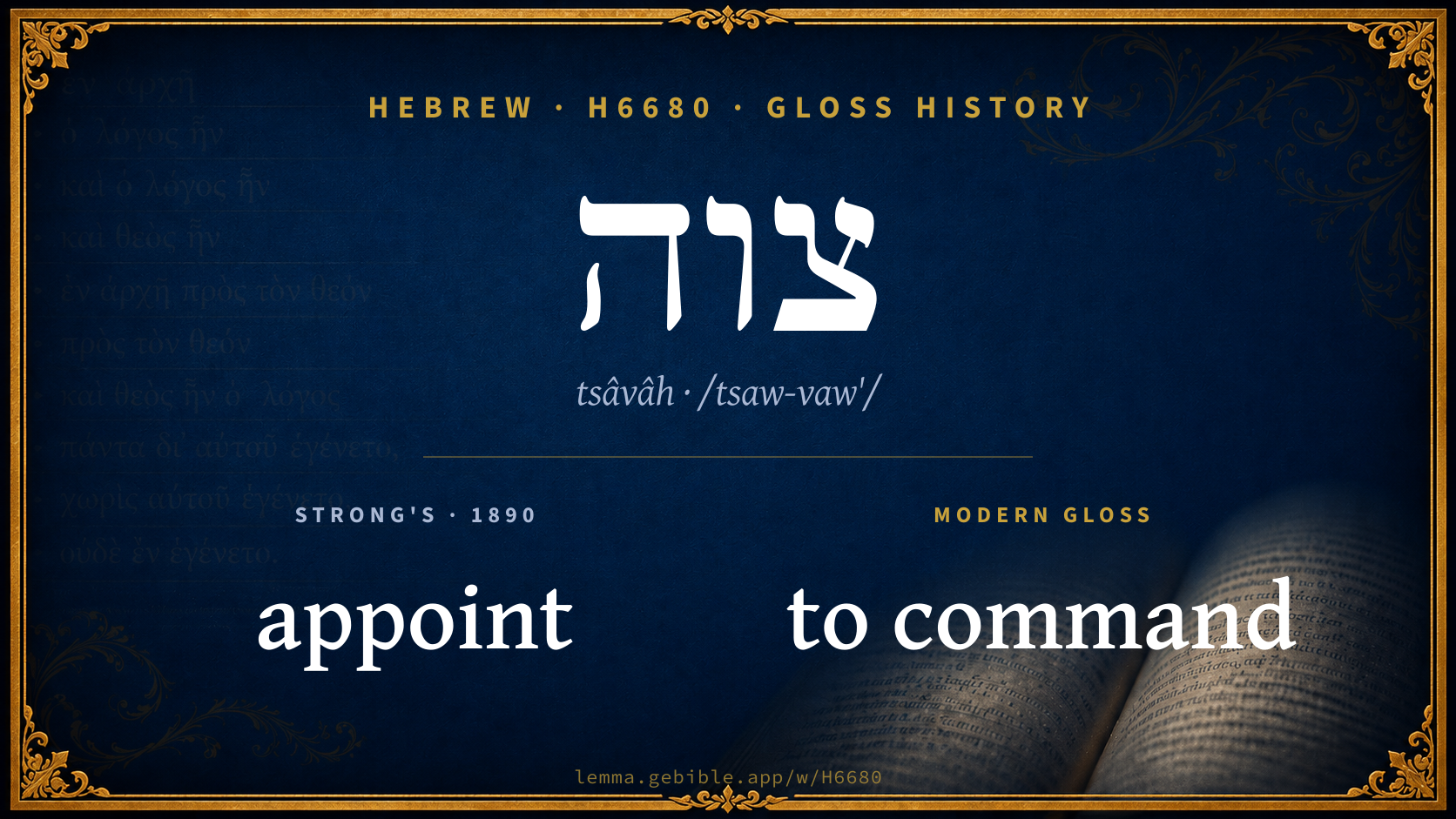
Gloss history
Strong's 1890 vs modern scholarship
About this word
Strong's H6680 catalogs a Hebrew word from the Hebrew Old Testament.
These counts are not copied from any lexicon or concordance. They are computed here, from the morphology-tagged Hebrew Old Testament. What Lemma adds →
- 475
- distinct verses
- The word appears in 475 distinct verses.
- 27 / 39
- OT books
- The word appears in 27 of 39 Old Testament books.
- #103
- by frequency
- Top 250 most frequent Hebrew words (rank 103 of 8,640 Hebrew words by occurrence).
View all 475 occurrences in the concordance →
Most concentrated in
- Deuteronomy 86 verses 18%
- Exodus 54 verses 11%
- Numbers 45 verses 9%
By section of the Old Testament
By traditional corpus
Conventional, traditional groupings — biblical authorship is debated, so this is a traditional corpus grouping, not an authorship claim. Each share is this word’s portion of its verses in that division of the Hebrew canon. Each figure is a share of the word’s 475 distinct verses.
- Torah (Pentateuch) 245 verses · 52%
- Prophets (Nevi'im) 166 verses · 35%
- Writings (Ketuvim) 64 verses · 13%
How translations render this word
Counts come from each version’s own published word-to-Strong’s tagging or interlinear alignment — an approximate guide to how each version renders this word, not a word-level alignment the data otherwise carries. Because each total is that version’s own tagged count, the per-version totals vary from one another and need not match the appearance or distinct-verse counts above. These counts may also differ from a printed concordance because Lemma counts each distinctly tagged rendering and does not collapse phrase taggings into a single head-word total. This is a fixed set of word-tagged versions (KJV, ASV, BSB, ULT) and does not change with the reading translation you choose elsewhere. Each version’s license is shown beside its name below (and on Sources).
- King James Version: Commanded 165×, Had commanded 30×, I command 30×
- American Standard Version: Commanded 148×, I command 28×, I commanded 26×
- Berean Standard Bible: Had commanded 85×, Commanded 50×, Has commanded 21×
- unfoldingWord Literal Text: Commanded 108×, Had commanded 74×, And 31×
King James Version Public Domain
Renders H6680 across 494 tagged occurrences — most commonly:
Plus other, less common renderings. Plus 82 renderings that appear only once — usually multi-word phrases or single function words the recovered tagging swept in, not distinct renderings.
American Standard Version Public Domain
Renders H6680 across 493 tagged occurrences — most commonly:
Plus other, less common renderings. Plus 114 renderings that appear only once — usually multi-word phrases or single function words the recovered tagging swept in, not distinct renderings.
Berean Standard Bible Public Domain
Renders H6680 across 491 tagged occurrences — most commonly:
Plus other, less common renderings. Plus 117 renderings that appear only once — usually multi-word phrases or single function words the recovered tagging swept in, not distinct renderings. Not rendered by a distinct English word in 2 further occurrences.
unfoldingWord Literal Text CC BY-SA 4.0
Renders H6680 across 538 tagged occurrences — most commonly:
Plus other, less common renderings. Plus 71 renderings that appear only once — usually multi-word phrases or single function words the recovered tagging swept in, not distinct renderings.
20 senses and sub-senses in the full BDB
Hebrew verbs can shift meaning by stem (binyan): Qal is the basic action, Niphal is often passive or reflexive, Piel often intensifies or makes it factitive, and Hiphil is typically causative. The senses below are grouped under the stem BDB assigns to each. This entry also uses Pual (the passive of Piel).
What do BDB’s symbols mean?
BDB uses these scholarly abbreviations:
| Symbol | Meaning |
|---|---|
| 𝔊 | the Septuagint (the ancient Greek translation, LXX) |
| 𝔙 | the Vulgate (the Latin translation) |
| 𝔖 | the Syriac version (the Peshitta) |
| 𝔗 | the Targum (the Aramaic translation) |
| ψ | the Psalms |
| √ | root (the underlying root or stem) |
| ‖ | parallel passage (a synonymous or contrasted parallel) |
| † | the dagger: every passage where the word occurs is cited |
The 20 senses and sub-senses the full Brown-Driver-Briggs lexicon distinguishes for this word, in lexicon order (not ranked by frequency), with BDB’s own verbatim wording and sub-sense lettering. Shown in Hebrew script with BDB’s own scholarly abbreviations. The condensed entry is in the Lexicon Entry tab. See also the Forms in the corpus table below.
Piel
- lay charge (upon), give charge (to), charge, command, order (BaZMG xli (1887), 641 Gerber 124 cp. Arabic وَصَى combine, ii. enjoin, iv. charge; وَصِيَّةٌ injunction, command; Syriac ܨܘܳܐ, head up stones, ܨܘܳܝܳܐ, stone-heap, Arabic صُوَّةٌ guide-stone, cf. Schulth 57; Gerber makes Heb. vb. denom. from מִצְוָה, but vb. is much earlier);—Pf. 3 ms. צִוָּה Gn 6:22 +; sf. צִוַּנִי Dt 4:5 +; צִוְּךָ Dt 4:23 +; צִוָּהוּ Gn 7:5 +, etc.; 1 s. צִוִּיתִי Ex 29:35 + 29 times, צִוֵּיתִי Lv 8:31 + 4 times, etc.; Impf. 3 ms. יְצַוֶּה Gn 18:19 + 8 times; יְצַו Dt 28:8; וַיְצַו Gn 2:16 +; sf. וִיצַוְּךָ 1 Ch 22:12, etc.; 1 s. וָאֲצַוֶּה Ezr 8:17 Qr (> Kt ואוצאה); 3 mpl. וַיְצַוּוּ Gn 50:16 +, etc.; Inf. cstr. צַוֹּת 2 S 18:5 +, etc.; Imv. ms. צַוֵּה Jos 4:16 + 2 times; צַו Lv 6:2 + 9 times; mpl. צַוּוּ Jos 1:11; 4:3; Pt. מְצַוֶּה Nu 32:25 +; cstr. מְצַוֵּה Is 55:4, etc.; f. מְצַוָּה Gn 27:8;— e.g. Genesis 6:22
- 1.
- a. lay charge upon, c. עַל pers., Gn 2:16 (J) 28:6 (P) 1 K 2:43; 11:11; Am 2:12; Je 35:6 + 6 times; עַל rei, עַל הֶעָבִים אֲצַוֶּה מֵהַמְטִיר Is 5:6, cf. Jb 36:32, צ׳ עַל־חָגָב 2 Ch 7:13. e.g. Genesis 2:16
- b. give charge to, command to c. לְ pers. Ex 1:22 (E) 1 S 20:29; 1 Ch 22:17; Is 13:3; Jer 32:23; ψ 105:8 תּוֹרָה צ׳ לָנוּ מֹשֶׁה Dt 33:4, cf. Ne 9:14; צַו לְבֵיתֶ֑ךָ 2 K 20:1 give charge to the household (in preparation for death) = Is 38:1 (cf. NH, B.Bath. 151 b, צַוָּאָה ‘verbal will’ Id 147a). e.g. Exodus 1:22
- c. give charge unto, c. אֶל pers. Ex 16:34 (P), 1 K 11:10; וַיְצַו אֶל־בֵּיתוֹ 2 S 17:23 (cf. b). e.g. Exodus 16:34
- d. give charge over, appoint, c. acc. pers. + עַל rei, Ne 7:2; 1 Ch 22:12, נָגִיד עַל (לִהְיוֹת) צ׳ appoint one (to be) ruler over 2 S 6:21; 1 K 1:35; c. לנגיד 1 S 13:14; 25:30; שׁפטים על 2 S 7:11 = 1 Ch 17:10; c. inf. (no על), לִרְעוֹת עמי 2 S 7:7 = 1 Ch 17:6; וְצִוִּיתָה אֹתוֹ לְעֵינֵיהֶם Nu 27:19 (P) and thou shalt install him in their sight, cf. v 23 (P). e.g. Nehemiah 7:2
- e. give one charge, command (often עַל concerning), Gn 12:20 (J), Nu 8:22 (P), 2 S 14:8; 18:5; Je 7:22; 39:11; Is 45:12 (AV RV Che RyKau; > Ges Ew Di Du al. as d), 10:6 (al. against), Na 1:14 (al. id.); c. לְ Nu 9:8; 32:28 (P), ψ 91:11 La 1:17 Est 3:2; c. אֶל Is 23:11 Je 47:7. e.g. Genesis 12:20
- 2. charge, command:
- a. c. acc. pers. + rei, often, especially of the law: Deut. phrases are אשׁר אנכי מצוךָ Ex 34:11 (J), Dt 4:40; 6:2, 6 + 18 times Dt, cf. 15:15; אשׁר אנכי מצוה אתכם Dt 4:2(×2) + 9 times Dt; †הַדֶּרֶךְ אשׁר ע׳ Dt 13:6; Ex 32:8 (E) Dt 5:30; 9:12, 16; 11:28; 31:29. e.g. Exodus 34:11
- b. c. acc. pers. + obj. clause, e.g., Inf. Gn 50:2 +; ו consec. Pf. 18:19 (J), Nu 35:2 (P); ו consec. Impf. 2 S 4:12; 1 K 2:46; weak ו c. Impf. Ex 27:20 (P) Jos 4:16; Imv. Jos 1:9; 1 S 18:22. e.g. Genesis 50:2
- c. acc. pers., acc. rei om., Ex 18:23 (E) Gn 49:33 (P) +; obj. given after לֵאמֹר Gn 26:11; 32:18, 20; Lv 6:2 +; וַיֹּאמֶר, etc., Gn 28:1; 49:29 +. e.g. Exodus 18:23
- d. acc. rei, acc. pers. om., צ׳ לעולם בריתוֹ ψ 111:9; †זֶה הַדָּבָר אֲשֶׁר צ׳ י׳, Ex 16:16, 32; 35:4; Lv 8:5; 9:6; 17:2; Nu 30:2; 36:6 (P); obj. cl., Lv 8:34 (P), 13:54 (P); Gn 42:25 (E), 1 K 5:20; Ju 4:6 e.g. Psalms 111:9
- e. abs. Gn 50:16 (E), La 3:37. e.g. Genesis 50:16
- 3. charge, command, acc. pers. in phr. כַּאֲשֶׁר צ׳ Ex 23:15 (E) Gn 7:9 (P) +; ככל אשׁר צ׳ Gn 7:5 (J) Ex 29:35 (P) +; כאשׁר צ׳ י׳ משֶׁה Ex 12:28, 50; 39:1, 5 + 37 times P; ככל אשׁר צ׳ י׳ משׁה 39:32, 42 + 5 times P; †לכל אשׁר צ׳ Jos 1:18; 22:2 Je 35:8; acc. pers. om. כאשׁר צ׳ Ex 7:10 Nu 32:25 (P) +; ככל אשׁר צ׳ 2 K 11:9 = 2 Ch 23:8 +; †לכל אשׁר צ׳ Ex 36:1 (P). e.g. Exodus 23:15
- 4. charge, with command to others, commission,
- a. acc. pers. + אֶל pers. (sometimes + acc. rei) Ex 6:13; 25:22; Lv 27:34 (P) Dt 1:3; Je 27:4 Est 4:10; acc. pers. om. Gn 50:16 (E) Est 3:12; 8:9. e.g. Exodus 6:13
- b. בְּיַד of agent, + אֶל, Nu 15:23; 36:13 (P); אֶל om. Lv 8:36 (P), Ezr 9:11; Ne 8:14. e.g. Numbers 15:23
- c. acc. pers. + עַל for אֶל Ezr 8:17; 1 Ch 22:13; Mal 3:22; Est 4:5. e.g. Ezra 8:17
- d. c. acc. rei, וצ׳ בִּרְכָתִי לְ Lv 25:21 (P) and I will command my blessing to you, c. אִתְּךָ Dt 28:8, cf. ψ 133:3; צ׳ חסדוֹ 42:9, בֹּקֶר Jb 38:12, נָחָשׁ, חֶרֶב Am 9:3, 4. e.g. Leviticus 25:21
- 5. command, appoint, ordain, of divine act: in creation Is 45:12 ψ 33:9; 148:5, providence 2 S 17:14; Am 6:11; 9:9; Jb 37:12 ψ 78:23; Is 34:16, redemption ψ 7:7; 44:5; 68:29; 71:3; so of idol Is 48:5 (‖ עשׂה). e.g. Isaiah 45:12
Pual
- Pf. 3 ms. צֻוָּה Nu 3:16; 36:2; 2 ms. צֻוֵּיתָה Gn 45:19, etc.; Impf. 3 ms. יְצֻוֶּה Ex 34:34;—be commanded, i.e. receive command, subj. pers., Gn 45:19 (E), c. בְּ by whom Nu 36:2 (P); אשׁר צ׳ Ex 34:34 (P), כִּי־כֵן צ׳ Lv 8:35; 10:13 (P), כאשׁר צ׳ Nu 3:16 (P) Ez 12:7; 24:18; 37:7. e.g. Numbers 3:16
Senses from the full Brown-Driver-Briggs lexicon (Brown, Driver, Briggs; Oxford 1906 — public domain), digitized via Sefaria, supplemented by the OpenScriptures HebrewLexicon (CC BY 4.0). Full attribution on Sources.
Word origin
Origin: a primitive root
Jastrow Dictionary
A second Hebrew/Aramaic lexicon for comparison, covering Aramaic and post-biblical (Talmudic, Targumic, Midrashic) usage that the biblical-Hebrew BDB does not. Matched by lemma rather than by Strong’s number, so a lemma may carry more than one Jastrow headword (shown separately below), and the entries cover usage well beyond the Bible.
צָוָה
- , v. צוי
צְוֵי II
- (v. S. Sm. 3370) [to contract,] to be hot, dry up, wither. Pes. 56ᵃ צָאוֵי לאלתר ed. (Ar. צָוֵוי) it will at once dry up. Ib. 110ᵇ פקע וצווא דיקלא Ar. (ed. צווח דיקלא ופקע הוא, Ms. M. צְוָה) the bark burst, and the palm dried up. Ib. 111ᵃ וצְווּ כרעיה his legs shrivelled.
- to burn, desiccate. B. Bath. 24ᵇ bot. דאזיל … ומְצַוֵּי ליה the dust penetrates its heart and desiccates it (the plant).
צוי
- 1. to join, attend. Ber. 6ᵇ; Sabb. 30ᵇ לִצְווֹת לזה ed. (perh. fr. צָוַת, v. צוּת; Ar. לצבות), v. צָבַת.—[
- 2. to arrange, pile; denom. צִיּוּן.]
- (b. h.) to order, command; to appoint. Men. 44ᵃ מצוה אחת צִיוָּנוּ וכ׳ the Lord gave us one command, its name is Tsitsith. Ib. צַוֵּה עלי ויעשוני וכ׳ give orders about me, that they make me a proselyte. Sabb. 23ᵃ, a. e. אשר קדשנו … וצִוָּנוּ וכ׳ (abbrev. אקב"ו who has sanctified us through his commandments, and commanded us to &c.; והיכן צִוָּנוּ and where did he command us (where in the Torah is it intimated)? B. Bath. 151ᵇ מְצַוֶּה מחמת מיתה one who disposes of his property, because he expects to die. Sifra Tsav, end כדי המְצַוֶּה למי שנצטוה the commander was worthy of him who was commanded; a. fr.—Part. pass. מְצוּוֶּה. Kidd. 31ᵃ גדול מצ׳ ועושה וכ׳ he who is commanded, and does (a good deed, because it is God’s will) stands higher than he that is not commanded and does (a good deed); a. e.
- to be ordered, commanded. Ib. 38ᵃ שלש מצות נִצְטַוּוּ וכ׳ three commands were given to the lsraelites on their entering the land. Ib. 38ᵇ כל מצוה שנצטוו וכ׳ whatever command was enjoined upon the Israelites before they entered the land. Y. Meg. I, 70ᵈ bot. אלו המצות שנִצְטַוִּינוּ וכ׳ these are the commandments which were given us through the mouth of Moses; a. fr.
A Dictionary of the Targumim, the Talmud Babli and Yerushalmi, and the Midrashic Literature (Marcus Jastrow; London, Luzac, 1903) — Public Domain. Digitized via Sefaria. Digitized via Sefaria. Full attribution on Sources.
Forms in the corpus
The 183 distinct written forms H6680 takes in the Hebrew Bible, most frequent first — each parse links to that stem’s occurrences in the concordance. Hebrew forms include their vowel points and cantillation, so a single lemma takes many written forms.
The 60 most common forms are shown; 123 rarer forms follow in the full concordance.
Same root — word family
Other BDB entries built from the same root as H6680, grouped by Strong’s listed origin. These share a root / origin per the lexicon — not necessarily a shared meaning. Each links to that word’s own entry.
Derived from this word
Compare all same-root words → They share a root, not necessarily a meaning.
Septuagint verse parallels
This word appears in 446 verses that also exist in the Greek Old Testament (Septuagint), out of the 475 Hebrew verses it occurs in. You can read those verses in Greek by switching the Old Testament edition to the Septuagint.
Read these verses in the Septuagint
- Genesis 2:16
- Exodus 1:22
- Leviticus 6:9
- Numbers 1:19
- Deuteronomy 1:3
- Joshua 1:7
- Judges 2:20
- Ruth 2:9
- 1 Samuel 2:29
- 2 Samuel 4:12
- 1 Kings 1:35
- 2 Kings 11:5
This is a verse-level parallel only — the same verses exist in both the Hebrew and Greek Old Testaments. No word-level Hebrew↔Greek correspondence is claimed: the data carries no such alignment, so no Greek word is shown as this Hebrew word’s translation. Coverage is not total — the Septuagint omits the deuterocanon and renumbers the Psalms, so some Hebrew verses have no direct Greek parallel.