
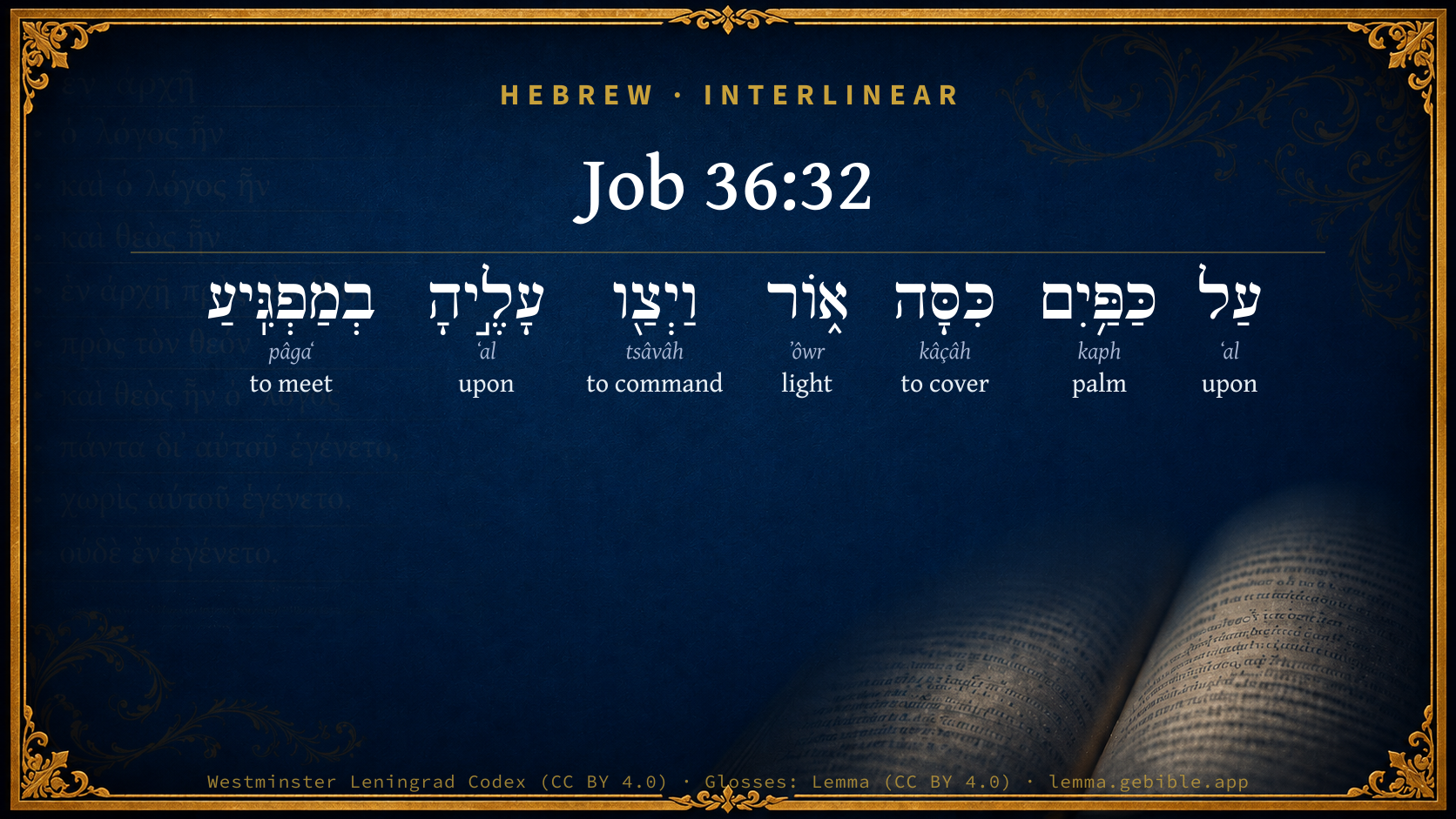
Job 36:32

Hebrew (Westminster Leningrad Codex) Job 36:32 appears in the Hebrew Old Testament. The text above is from the Westminster Leningrad Codex. Each word links to its Strong’s number, a concise gloss, and parsing drawn from the Open Scriptures Hebrew Bible morphology. Click any word for its full Brown-Driver-Briggs (BDB) entry.
Download image
Cite this verse

Job 36:32 (World English Bible). Public Domain. Lemma interlinear Bible study tool, https://lemma.gebible.app/v/job/36/32.

Show BibTeX & RIS
BibTeX
RIS
English Translation
He covers his hands with the lightning, And commands it to strike the mark.
World English Bible · Public Domain
Download a study sheet

One document with this verse’s original text, its word-by-word gloss line, the meaning frame, cross-references with their text, attributed commentary, and full source and license credits — printable, and it pastes into notes with its structure intact.

This verse Autodidact and up

Study sheet (.html) Plain text (.txt)

A passage Seminary Student

Up to 50 verses in one chapter. A passage sheet keeps up to 6 commentary sources and 12 cross-references per verse, in the order this page ranks them, and says so on the sheet whenever that leaves anything out. Ask for a single verse and you get the Autodidact verse sheet above.

Everything on this page stays free to read, with no account — the sheet is a download of what is already on screen, not access to it.

Want to remove ads? Support Godless Engineer
Compare translations 3

The same verse in 3 English versions, stacked beneath the original-language interlinear above. Click any original word for its lexicon entry.

Each is an independent rendering of the whole verse — the interlinear is not word-aligned to these translations.

Highlighted words mark where these versions differ — a whole-verse word diff, not a word-by-word alignment.

  • World English Bible Public Domain
    He covers his hands with the lightning, And commands it to strike the mark.
  • King James Version Public Domain
    With clouds he covereth the light; and commandeth it not to shine by the cloud that cometh betwixt.
  • unfoldingWord Literal Text CC BY-SA 4.0
    He covers over his hands lightning and he enjoins upon it against the mark.

unfoldingWord Literal Text — © unfoldingWord, licensed CC BY-SA 4.0. Word-aligned USFM3 via Door43 (git.door43.org/unfoldingWord/en_ult).

Versions to compare (up to 4)

3 of 4 selected

Show all 18 translations

Every available English version of this verse, each an independent rendering of the whole verse.

  • World English Bible Public Domain
    He covers his hands with the lightning, And commands it to strike the mark.
  • Berean Standard Bible Public Domain
    He fills His hands with lightning and commands it to strike its mark.
  • Majority Standard Bible Public Domain
    He fills His hands with lightning and commands it to strike its mark.
  • King James Version Public Domain
    With clouds he covereth the light; and commandeth it not to shine by the cloud that cometh betwixt.
  • American Standard Version (1901) Public Domain
    He covereth his hands with the lightning, And giveth it a charge that it strike the mark.
  • Revised Version (1885) Public Domain
    He covereth his hands with the lightning; and giveth it a charge that it strike the mark.
  • Geneva Bible (1599) Public Domain
    He couereth the light with the clouds, and commandeth them to go against it.
  • Douay-Rheims (1899) Public Domain
    In his hands he hideth the light, and commandeth it to come again.
  • Young's Literal Translation Public Domain
    By two palms He hath covered the light, And layeth a charge over it in meeting,
  • Literal Standard Version CC BY-SA 4.0
    By two palms He has covered the light, || And lays a charge over it in meeting,
  • Unlocked Literal Bible CC BY-SA 4.0
    He fills his hands with the lightning until he commands it to strike its mark.
  • unfoldingWord Literal Text CC BY-SA 4.0
    He covers over his hands lightning and he enjoins upon it against the mark.
  • Darby Bible Public Domain
    [His] hands he covereth with lightning, and commandeth it where it is to strike.
  • World Messianic Bible Public Domain
    He covers his hands with the lightning, and commands it to strike the mark.
  • Webster's Bible Public Domain
    With clouds he covereth the light; and commandeth it not to shine by the intervening cloud.
  • Free Bible Version CC BY-SA 4.0
    He holds lightning in his hands and commands where it should strike.
  • Bible in Basic English Public Domain
    He takes the light in his hands, sending it against the mark.
  • JPS Tanakh (1917) Public Domain
    He covereth His hands with the lightning, and giveth it a charge that it strike the mark.

Literal Standard Version (2020), Covenant Press — licensed CC BY-SA 4.0. Text via the HelloAO Bible API (eBible.org). Unlocked Literal Bible (unfoldingWord) — licensed CC BY-SA 4.0. Text via the HelloAO Bible API (eBible.org). unfoldingWord Literal Text — © unfoldingWord, licensed CC BY-SA 4.0. Word-aligned USFM3 via Door43 (git.door43.org/unfoldingWord/en_ult). Free Bible Version, Dr. Jonathan Gallagher — licensed CC BY-SA 4.0. Text via the HelloAO Bible API (eBible.org).

Word by word

More ways to search: Search by grammar → Find every occurrence → Compare this word →

Practice this passage: Drill this verse → Learn its vocabulary →

בְמַפְגִּֽיעַ
pâgaʻ
H6293
“in/at · meeting”
Preposition + Verb, Hiphil, Participle Active, Masculine, Singular, Absolute
Part of Speech
Preposition + Verb
Stem
Hiphil
Form
Participle Active
Gender
Masculine
Number
Singular
State
Absolute
Full BDB Definition

Origin: a primitive root

TWOT: 1731

to encounter, meet, reach, entreat, make intercession - (Qal) - to meet, light upon, join - to meet (of kindness) - to encounter, fall upon (of hostility) - to encounter, entreat (of request) - to strike, touch (of boundary) - (Hiphil) - to cause to light upon - to cause to entreat - to make entreaty, interpose - to make attack - to reach the mark
  1. עַל ʻal H5921 “upon” Preposition
  2. כַּפַּ֥יִם kaph H3709 “palms” Noun, Common, Feminine, Dual, Absolute
  3. כִּסָּה kâçâh H3680 “to cover” Verb, Piel, Perfect, 3rd Person, Masculine, Singular
  4. א֑וֹר ʼôwr H216 “light” Noun, Common, Both, Singular, Absolute
  5. וַיְצַ֖ו tsâvâh H6680 “and · to command” Conjunction + Verb, Piel, Sequential Imperfect, 3rd Person, Masculine, Singular
  6. עָלֶ֣יהָ ʻal H5921 “upon · her” Preposition + Suffix, Personal, 3rd Person, Feminine, Singular

About this verse

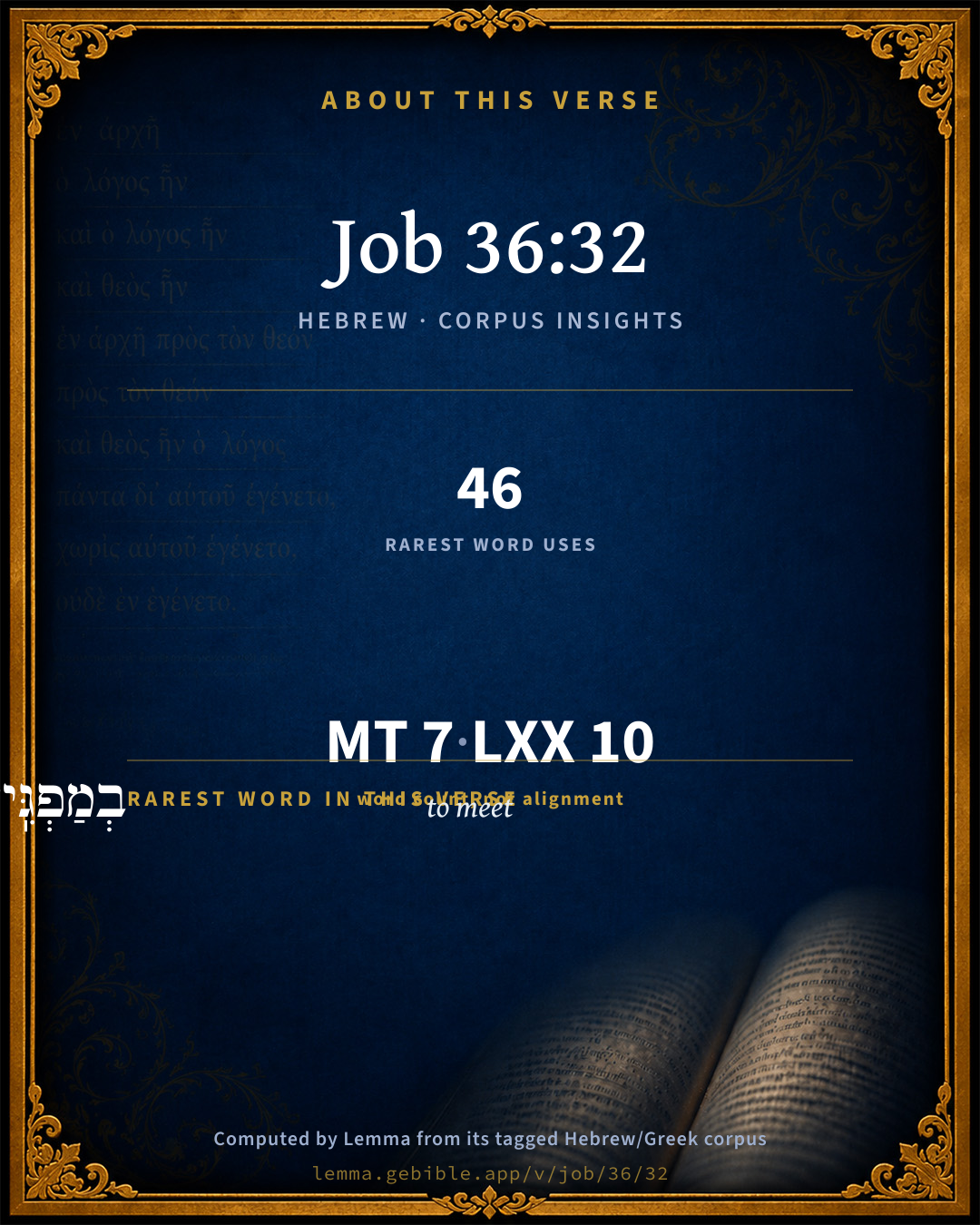
These counts appear in no published source. They are computed here, from the morphology-tagged text and Lemma’s own curated glosses. What Lemma adds →

7
words
6
distinct lemmas
Wisdom
section

Shared distinctive vocabulary

בְמַפְגִּֽיעַ to meet H6293 occurs in 43 verses of the Hebrew Bible. Also found in:

Grammatical profile

  • 3 verbs
  • 2 nouns
  • 2 prepositions

Verb forms

  • כִּסָּה Piel · Perfect
  • וַיְצַ֖ו Piel · Sequential Imperfect
  • בְמַפְגִּֽיעַ Hiphil · Participle Active

Repetition

A word recurs within this verse — often emphatic in Hebrew:

Hebrew & Septuagint length

In English translation the verse runs 14 words from the Hebrew and 17 from the Septuagint (LXX English) — closely comparable.

A rough comparison of the two English renderings, which tokenize alike — not a word-level alignment.

Word counts can differ between the Hebrew and the Greek without any difference in meaning — e.g. the Hebrew direct-object marker אֵת has no separate Greek word, and Greek often adds the article ὁ.

In the original languages it is 7 Hebrew tokens and 10 Greek tokens — but the two are counted differently (Hebrew bundles its prefixes and suffixes into one token; the Greek is in lemma form), so that isn’t a like-for-like length.

Cross-references

9

Topical passages linked to Job 36:32 in the Treasury of Scripture Knowledge — connected by theme and wording, ordered by reader-vote popularity; previews shown in the World English Bible.

  • Job 37:15 Do you know how God controls them, And causes the lightning of his cloud to shine?
  • Psalms 18:11 He made darkness his hiding-place, his pavilion around him, Darkness of waters, thick clouds of the skies.
  • Psalms 135:7 Who causes the clouds to rise from the ends of the earth; Who makes lightnings with the rain; Who brings forth the wind out of his treasuries;
  • Psalms 147:8–9 Who covers the sky with clouds, Who prepares rain for the earth, Who makes grass grow on the mountains.
  • Psalms 148:8 Lightning and hail, snow and clouds; Stormy wind, fulfilling his word;
  • Exodus 10:21–23 Yahweh said to Moses, "Stretch out your hand toward the sky, that there may be darkness over the land of Egypt, even darkness which may be felt."
  • Job 26:9 He encloses the face of his throne, And spreads his cloud on it.
  • Job 37:12 It is turned round about by his guidance, That they may do whatever he commands them On the surface of the habitable world,
  • Acts 27:20 When neither sun nor stars shone on us for many days, and no small tempest pressed on us, all hope that we would be saved was now taken away.

Cross-references courtesy of OpenBible.info (CC BY 4.0).

Hebrew and Greek witnesses Masoretic Hebrew ↔ Greek Septuagint

The same verse in the two great witnesses to the Old Testament, shown verse-for-verse.

These are two independent witnesses, not word-aligned to each other, and the Septuagint is shown in lemma (dictionary) form.

Hebrew Job 36:32 Masoretic · Westminster Leningrad Codex

עַל כַּפַּ֥יִם כִּסָּה א֑וֹר וַיְצַ֖ו עָלֶ֣יהָ בְמַפְגִּֽיעַ

He covers his hands with the lightning, And commands it to strike the mark.

World English Bible · Public Domain

Greek LXX Job 36:32 Septuagint · lemma form

ἐπί χείρ καλύπτω φῶς καί ἐντέλλομαι περί αὐτός ἐν ἀποἀντάω

He has hidden the light in his hands, and given charge concerning it to the interposing cloud.

LXX2012 (modern English Septuagint) · Public Domain

On this verse, Albert Barnes' Notes on the Bible discusses the Septuagint’s reading. Read the note in Commentary ↓

Hebrew: Westminster Leningrad Codex (CC BY 4.0). Greek: Septuagint (public domain); English from LXX2012 (modern English Septuagint) (Public Domain). How the Septuagint differs from the Hebrew →

Commentary

Notes on Job 36:32 from classic Christian and Jewish commentators (each source and its license shown beneath its notes). The classic Christian expositions comment on the surrounding passage and are grouped to its opening verse, so a note may address several verses; the Jewish commentaries on the Tanakh (Rashi and others) are per-verse, so they appear only where the commentator wrote on this verse.

Lemma curates 59 commentaries, every one of them public domain or Creative Commons licensed, each selected and text-cleaned for this edition rather than reprinted as found. About our sources →

Trapp's Complete Commentary

John Trapp

Job 36:32 With clouds he covereth the light; and commandeth it [not to shine] by [the cloud] that cometh betwixt.

Ver. 32. With clouds he covereth the light] Heb. With the palms of his hands (so the clouds are called, see 1Ki 18:44) he hideth light; that is, the sunbeams, viz. when he sendeth rain, the heavens are masked.

And commandeth it not to shine] Heb. And forbiddeth it (those words, not to shine, are not in the original), propter intercedentem, for the sake of those that intercede. He giveth rain or fair weather upon the prayers of his faithful people; who can thereby open and shut heaven, as did Elijah and the thundering legion. R. Levi interpreteth this and the following verse concerning thunder.

John Trapp, A Commentary or Exposition upon All the Books of the Old and New Testament (1647–1656) — public domain. Text from a community e-Sword module.

Albert Barnes' Notes on the Bible

With clouds he covereth the light - The Hebrew here is, על־כפים ‛al-kaphiym - “upon his hands.” Jerome, “In manibus abscondit lucem,” “he hideth the light in his hands.” Septuagint, Ἐπὶ χειρῶν ἐκάλυψε φῶς Epi cheirōn ekalupse fōs - “he covereth the light in his hands.” The allusion is, undoubtedly, to the lightning, and the image is, that God takes the lightning in his hands, and directs it as he pleases. There has been great variety however, in the exposition of this verse and the following. Schultens enumerates no less than “twenty-eight” different interpretations, and almost every commentator has had his own view of the passage. It is quite evident that our translators did not understand it, and were not able to make out of it any tolerable sense. What idea they attached to the two verses Job 36:32-33, it would be very difficult to imagine, for what is the meaning Job 36:33 of the phrase, “the cattle also concerning the vapor?”

The general sense of the Hebrew appears to be, that God controls the rapid lightnings which appear so vivid, so quick, and so awful; and that he executes his own purposes with them, and makes them, when he pleases, the instruments of inflicting punishment on his foes. The object of Elihu is to excite admiration of the greatness of God who is “able” thus to control the lightning’s flash, and to make it an obedient instrument in his hands. The particular expression before us, “By his hands he covereth the light,” seems to mean that he seizes or holds the lightning in his hands (Herder), or that he covers over his hands with the lightning (Umbreit), and has it under his control. Prof. Lee supposes that it means, that he holds the lightning in the palms of his hands, or between his two hands, as a man holds a furious wild animal which he is about to let loose for the purpose of destroying. With this he compares the expression of Shakespeare, “Cry havock, and let slip the dogs of war. There can be no doubt, I think, that the phrase means that God has the lightning under his control that it is in his hands, and that he directs it as he pleases. According to Umbreit (Note) the allusion is to the “double use” which God makes of light, in one hand holding the lightning to destroy his foes, and in the other the light of the sun to bless his friends, as he makes use of the rain either for purposes of destruction or mercy. But this idea is not conveyed in the Hebrew.

And commandeth it not to shine - The phrase “not to shine” is not in the Hebrew, and destroys the sense. The simple idea in the original is, “he commandeth it;” that is, he has it under his control, directs it as he pleases, makes use even of the forked lightning as an instrument to execute his pleasure.

By the cloud that cometh betwixt - The words “the cloud” are also inserted by our translators, and destroy the sense. There is no allusion to a cloud, and the idea that the light is intercepted by any object is not in the original. The Hebrew word (במפגיע bemapgiy‛) means “in occurring, in meeting, in striking upon,” (from פגע pâga‛ - to strike upon, to impinge to fall upon, to light upon), and the sense here would be well expressed’ by the phrase “in striking.” The idea is exactly that which we have when we apply the word “strike” or “struck” to lightning, and the meaning is, that he gives the lightning commandment “in striking,” or when “it strikes.” Nothing could better answer the purpose of an illustration for Elihu in exciting elevated views of God, for there is no exhibition of his power more wonderful than that by which he controls the lightning.

Albert Barnes' Notes on the Bible (1834–1885) — public domain. Text from a community e-Sword/MySword module.

Geneva Bible (1599)

Geneva Bible translators

That is, one cloud to dash against another.

Geneva Bible (1599) marginal notes — public domain. Text via Bolls.life.

Jamieson, Fausset & Brown

Robert Jamieson, A. R. Fausset & David Brown

Rather, "He covereth (both) His hands with light (lightning, Job 37:3, Margin), and giveth it a command against his adversary" (literally, the one "assailing" Him, Psa 8:2; Psa 139:20; Job 21:19). Thus, as in Job 36:31, the twofold effects of His waters are set forth, so here, of His light; in the one hand, destructive lightning against the wicked; in the other, the genial light for good to His friends, &c. (Job 36:33) [UMBREIT].

Jamieson, Fausset & Brown — Commentary Critical and Explanatory on the Whole Bible (1871) — public domain (CC PDM 1.0). Text via the HelloAO Bible API.

Adam Clarke's Commentary

Verse 32. With clouds he covereth the light.] This is all extraordinary saying, על כפים כמה אור al cappayim kissah or, which Mr. Good translates, "He brandisheth the blaze athwart the concave." The Vulgate, with which all the other versions less or more agree, has, In manibus abscondit lucem, "In his hands he hideth the light;" or, more literally, "By the hollow of his hands (כפים cappayim) he concealeth the light, (אור or,") the fountain of light, i.e., the SUN.

And commandeth it not to shine by the cloud that cometh betwixt.] I am afraid this is no translation of the original. Old Coverdale is better: - And at his commandement it commeth agayne; which is a near copy of the Vulgate. Here again Mr. Good departs from all the versions, both ancient and modern, by translating thus: - "And launcheth his penetrating bolt." Dr. Stock, in my opinion, comes nearer the original and the versions in his translation:-

"And giveth charge as to what it shall meet."

The mending of the text by conjecture, to which we should only recur in desperate necessity, has furnished Mr. Good and Reiske with the above translation. For my own part, I must acknowledge an extreme difficulty both here and in the concluding verse, on which I am unwilling to lay a correcting hand. I think something of the doctrine of eclipses is here referred to; the defect of the solar light, by the interposition of the moon. So in the time of an eclipse God is represented as covering the body of the sun with the hollow of his hand, and thus obscuring the solar light, and then removing his hand so as to permit it to re-illuminate the earth.

Mr. Good gets his translation by dividing the words in a different manner from the present text. I shall give both: -

Hebrew: ויצו עליה במפגיע

Vayetsav aleyha bemaphgia

Mr. Good: ויצוע ליהב מפגיע

Veyezvo liahbe mapegio.

Of which he learnedly contends, "And launcheth his penetrating bolt," is the literal sense. The change here made, to produce the above meaning, is not a violent one; and I must leave the reader to judge of its importance.

Adam Clarke's Commentary on the Bible (1810–1826) — public domain. Text from a community e-Sword/MySword module.

Ellicott's Commentary for English Readers

(32) With clouds.—The word here rendered “clouds” really means hands, and there seems to be no good reason why it should be otherwise understood. The verse will then read, “He covereth the lightning with His hands, and giveth it a charge that it strike the mark;” or, according to some, “giveth it a charge against the assailant.” The figure is that of a man hurling a stone or bolt, and taking aim; and a very fine one the image is. The Authorised Version cannot be right with its five inserted words.

A Bible Commentary for English Readers, edited by Charles John Ellicott (1878–1897) — public domain. Text from a community e-Sword module.

The Cambridge Bible for Schools and Colleges

gen. ed. J. J. S. Perowne

32–33. The verses read,

32. He covereth over his hands with light,

And giveth it commandment against the adversary;

33. His thundering telleth concerning him;

Unto the cattle, even concerning him that cometh up;

32. The “light” here is the lightning, which grasped in His hands illuminates them. Hitzig refers to Hor. Od. 1. 2,

et rubente

dextera sacras jaculatus arces

terruit urbem.

The Cambridge Bible for Schools and Colleges (gen. ed. J. J. S. Perowne; Cambridge University Press, 1878–1918) — public domain. Text from a community e-Sword module.

John Gill's Exposition

With clouds he covereth the light,.... Either the lightning, which is hid and covered in the black dark cloud until it bursts out of it; or the light of the sun, which is wonderful, that waters naturally clear and transparent, when formed into clouds, should obstruct the rays of the sun and darken it; see Eze 32:7; and thus it was in the storm and tempest the Apostle Paul was in many days, which was so thick and dark, that the sun and stars did not appear of a long time, Act 27:20;

and commandeth it not to shine, by the cloud that cometh betwixt; that is, commands the sun that it shines not, or hinders it from shining, by reason of the intervening clouds; this is an emblem of sin interposing between God and his people, which causes him to hide his face from them and not shine upon them: sins are comparable to clouds for numbers, being more than can be told; and for their nature and quality, like clouds they rise out of the earthly and carnal heart of man; and which is also like a troubled sea which cannot rest; and which reach up unto heaven and bring down wrath and vengeance from thence on wicked men; and in God's own people, like the clouds they intercept the light of his countenance, the bright shining of the sun of righteousness, the comfort, peace, and joy of the Holy Spirit: the words may be rendered, "with hands he covers the light, and commands that it shine not by reason of what comes between": and they are understood by some, as by Schmidt particularly, of the eclipses of the sun and moon, when God as it were covers them with hands, and suffers them not to shine by intervening bodies; so the eclipse of the sun is occasioned by the moon's coming between that and the earth, and the eclipse of the moon by the interposition of the earth between that and the sun; the Targum is,

"because of rapine of hands he restrains rain, and commands it to descend because of him that prays,''

who comes between and intercedes for a sinful people, as Elijah did; or, as others, he commands the lightning that it harms not because of him that comes between and intercedes with his prayers.

John Gill's Exposition of the Whole Bible (1746–1763) — public domain (CC PDM 1.0). Text via the HelloAO Bible API.

Haydock's Catholic Bible Commentary

Hands, or clouds, which are compared to a hand, 3 Kings xviii. 44. He opens his hand, and light appears. This expression denotes the utmost facility with which a very surprising thing is effected. --- To come. Hebrew, "by this obstacle." He alludes to the sun’s eclipse, as if God’s hand covered its disk. (Calmet) --- Protestants, "He....commandeth it not to shine, by the cloud thta cometh betwixt."

George Leo Haydock (1774–1849), Haydock's Catholic Family Bible and Commentary, 1859 edition — public domain. Excludes Psalms (Douay-Rheims chapter numbering differs from Protestant) and Deuterocanonical books (Catholic canon only).

Matthew Poole's English Annotations

With clouds; with thick and black clouds spread over the whole heavens, as it is in times of great thunders and lightnings. Heb. With hands; either the clouds are so called for their resemblance to hands, 1Ki 18:4,1, as being hollow and spread abroad; or the meaning is, that God covereth the light as it were by the hollow of his hand, as a man sometimes covers the light of a candle.

The light; either the lightning, or rather the sun, which is fitly called light, Job 31:26; Psa 136:7, as being the fountain of light.

Commandeth it not to shine; or, giveth a charge concerning it, to wit, that it shall be covered; or, forbiddeth it, as this Hebrew word, joined with this proposition, usually signifies, as Gen 2:17; 28:6; 1Ki 2:43; 11:11, and elsewhere, i.e. hindereth it, as it were by an express command or prohibition, from its usual and proper work, to wit, from shining.

That cometh betwixt; which God interposeth as a veil between the sun and earth; by which he doth, as it were, deliver his command or prohibition to the sun, that he should not shine.

Matthew Poole's English Annotations on the Holy Bible (1683–1685) — public domain. Text from a community e-Sword/MySword module.

Whedon's Commentary on the Bible

Daniel D. Whedon

32. With clouds… betwixt — Both hands he covereth over with light, and giveth it command against the adversary. According to Delitzsch, God appears here under a military figure as a slinger of lightnings, (light.) The lightning, like a slinger’s cord, he wraps around his hand that he may give it greater force against the enemy. “It scorches the world, but does not hurt him [God]; nay, rather, is the vesture and instrument of his power.” — Wordsworth.

Daniel D. Whedon (gen. ed.), Commentary on the Old and New Testaments (1874–1909) — public domain. Text from a community e-Sword module.

The Pulpit Commentary

With clouds he covereth the light; rather, he covereth both his hands with light, i.e. with the lightning. So Vul was represented in Assyrian and Zeus in Greek mythology, as filling their hands with thunderbolts, and hurling them upon their foes in their wrath. And commandeth it not to shine, etc. This rendering is wholly indefensible. Translate, And layeth command upon it that it strike the mark (compare the Revised Version).

The Pulpit Commentary (1880–1919), ed. H.D.M. Spence-Jones & Joseph S. Exell — public domain. Text from a community e-Sword module.

John Wesley's Explanatory Notes

Clouds - With thick and black clouds spread over the whole heavens. Light - The sun. The cloud - Which God interposes as a veil between the sun and earth.

John Wesley, Explanatory Notes Upon the Whole Bible (1754–1765) — public domain. Text via the GEBible commentary corpus.

unfoldingWord translationNotes

Door43 World Missions Community

He fills his hands with the lightning

Elihu speaks of the lightning that storms cause as if God were holding the lightning in his hand and directing it to strike where he wills. Possible meanings are 1) that God holds the lightning bolts in his hands in order to throw them, or 2) that God hides the lightning bolts in his hands until he is ready to use them. (See: Metaphor)

Its thunder

"The thunder caused by the lightning" or "The thunder"

hear it is coming

"hear that the storm is coming"

translationWords

command

cow

unfoldingWord translationNotes — © Distant Shores Media and the Door43 World Missions Community, licensed CC BY-SA 4.0. Source: git.door43.org/Door43/en_tn.

Rashi

Rabbi Shlomo Yitzchaki (Rashi)

Over the clouds Heb. כפים, over the clouds. Similarly (Lam. 3:41), “Let us lift our heart to the clouds (כפים),” based on (I Kings 18:44), “...a cloud as small as a man’s palm (ככף).” But our Rabbis said (Taanith 7b): Because of the sin of (the robbery of) the hands He covers the rain The rain is withheld.

and He commands it to come through one who entreats with prayer. (The beloved one of the generation, and the great man and sage thereof will relate to Him—before the Holy One, blessed be He—the straits of the generation and their necessities].

Rashi on the Tanakh — English translations: “The Judaica Press complete Tanach with Rashi, translated by A. J. Rosenberg” (CC BY 4.0); “Pentateuch with Rashi's commentary by M. Rosenbaum and A.M. Silbermann, 1929-1934” (public domain); “The Metsudah Tanach series, Lakewood, N.J” (CC BY 4.0); and “The Book of Joshua, Metsudah Publications, 1997” (CC BY 4.0). Text via Sefaria.

Lesson kit

Teaching starters — assembled from the data on this page, not authored interpretation. Every prompt links to the verse data it draws on. Edit before teaching.

Job, in the Wisdom, opens this verse with 7 words (6 distinct Hebrew lemmas). Its most distinctive word is pâgaʻ (“to meet”). A historical commentator’s framing appears above. Read the whole chapter for the surrounding context.

Discussion questions

  1. How does “to meet” (pâgaʻ) shape what this verse is saying?
  2. How does Genesis 23:8, which shares the word «to meet», read alongside this verse?
  3. What does the repetition of “upon” (2× in this one verse) do in this verse?
  4. These translations render this verse differently. What is at stake in choosing one wording over another?
  5. «כִּסָּה» is a Piel Perfect verb. How does that grammatical form shape the action described?
  6. Compare how Trapp's Complete Commentary and Albert Barnes' Notes on the Bible read this verse. Where do they agree or differ?

Things to notice

Reading settings

Reading text

Shown beneath each verse's original-language words.

Old Testament
Old Testament edition

Read the OT as the Masoretic Hebrew (MT) or the Greek Septuagint (LXX).

English shown for the Greek Septuagint (in the Hebrew ↔ Greek comparison).

Comparing translations? Open the Compare panel on any verse page to stack up to four side by side.