
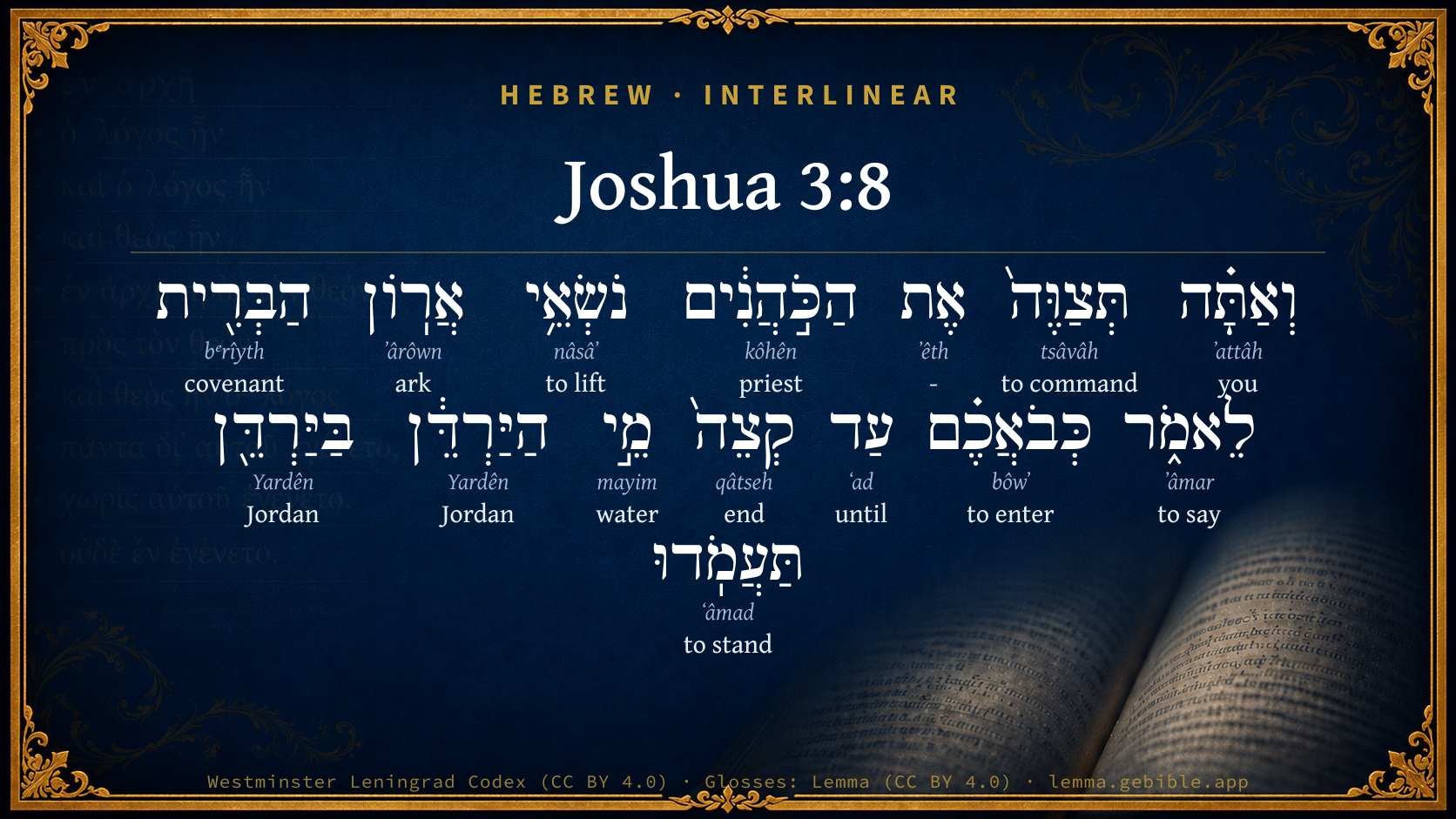
Joshua 3:8

Hebrew (Westminster Leningrad Codex) Joshua 3:8 appears in the Hebrew Old Testament. The text above is from the Westminster Leningrad Codex. Each word links to its Strong’s number, a concise gloss, and parsing drawn from the Open Scriptures Hebrew Bible morphology. Click any word for its full Brown-Driver-Briggs (BDB) entry.
Download image
Cite this verse

Joshua 3:8 (World English Bible). Public Domain. Lemma interlinear Bible study tool, https://lemma.gebible.app/v/joshua/3/8.

Show BibTeX & RIS
BibTeX
RIS
English Translation
You shall command the priests who bear the ark of the covenant, saying, When you are come to the brink of the waters of the Jordan, you shall stand still in the Jordan.
World English Bible · Public Domain
Download a study sheet

One document with this verse’s original text, its word-by-word gloss line, the meaning frame, cross-references with their text, attributed commentary, and full source and license credits — printable, and it pastes into notes with its structure intact.

This verse Autodidact and up

Study sheet (.html) Plain text (.txt)

A passage Seminary Student

Up to 50 verses in one chapter. A passage sheet keeps up to 6 commentary sources and 12 cross-references per verse, in the order this page ranks them, and says so on the sheet whenever that leaves anything out. Ask for a single verse and you get the Autodidact verse sheet above.

Everything on this page stays free to read, with no account — the sheet is a download of what is already on screen, not access to it.

Want to remove ads? Support Godless Engineer
Compare translations 3

The same verse in 3 English versions, stacked beneath the original-language interlinear above. Click any original word for its lexicon entry.

Each is an independent rendering of the whole verse — the interlinear is not word-aligned to these translations.

Highlighted words mark where these versions differ — a whole-verse word diff, not a word-by-word alignment.

  • World English Bible Public Domain
    You shall command the priests who bear the ark of the covenant, saying, When you are come to the brink of the waters of the Jordan, you shall stand still in the Jordan.
  • King James Version Public Domain
    And thou shalt command the priests that bear the ark of the covenant, saying, When ye are come to the brink of the water of Jordan, ye shall stand still in Jordan.
  • unfoldingWord Literal Text CC BY-SA 4.0
    And you, you shall command the priests, the carriers of the Box of the Covenant, saying, ‘As you come unto the edge of the waters of the Jordan, in the Jordan you shall stand.’”

unfoldingWord Literal Text — © unfoldingWord, licensed CC BY-SA 4.0. Word-aligned USFM3 via Door43 (git.door43.org/unfoldingWord/en_ult).

Versions to compare (up to 4)

3 of 4 selected

Show all 18 translations

Every available English version of this verse, each an independent rendering of the whole verse.

  • World English Bible Public Domain
    You shall command the priests who bear the ark of the covenant, saying, When you are come to the brink of the waters of the Jordan, you shall stand still in the Jordan.
  • Berean Standard Bible Public Domain
    Command the priests carrying the ark of the covenant: ‘When you reach the edge of the waters, stand in the Jordan.’”
  • Majority Standard Bible Public Domain
    Command the priests carrying the ark of the covenant: ‘When you reach the edge of the waters, stand in the Jordan.’”
  • King James Version Public Domain
    And thou shalt command the priests that bear the ark of the covenant, saying, When ye are come to the brink of the water of Jordan, ye shall stand still in Jordan.
  • American Standard Version (1901) Public Domain
    And thou shalt command the priests that bear the ark of the covenant, saying, When ye are come to the brink of the waters of the Jordan, ye shall stand still in the Jordan.
  • Revised Version (1885) Public Domain
    And thou shalt command the priests that bear the ark of the covenant, saying, When ye are come to the brink of the waters of Jordan, ye shall stand still in Jordan.
  • Geneva Bible (1599) Public Domain
    Thou shalt therefore command the Priests that beare the Arke of the Couenant, saying, When ye are come to the brinke of the waters of Iorden, ye shall stande still in Iorden.
  • Douay-Rheims (1899) Public Domain
    And do thou command the priests that carry the ark of the covenant, and say to them: When you shall have entered into part of the water of the Jordan, stand in it.
  • Young's Literal Translation Public Domain
    and thou, thou dost command the priests bearing the ark of the covenant, saying, When ye come unto the extremity of the waters of the Jordan -- in the Jordan ye stand.'
  • Literal Standard Version CC BY-SA 4.0
    and you, command the priests carrying the Ark of the Covenant, saying, When you come to the extremity of the waters of the Jordan, stand in the Jordan.”
  • Unlocked Literal Bible CC BY-SA 4.0
    You will command the priests who carry the ark of the covenant, 'When you have come to the edge of the waters of the Jordan, you must stand still in the Jordan River.'”
  • unfoldingWord Literal Text CC BY-SA 4.0
    And you, you shall command the priests, the carriers of the Box of the Covenant, saying, ‘As you come unto the edge of the waters of the Jordan, in the Jordan you shall stand.’”
  • Darby Bible Public Domain
    And thou shalt command the priests who bear the ark of the covenant, saying, When ye come to the edge of the waters of the Jordan, stand still in the Jordan.
  • World Messianic Bible Public Domain
    You shall command the priests who bear the ark of the covenant, saying, ‘When you come to the brink of the waters of the Jordan, you shall stand still in the Jordan.’”
  • Webster's Bible Public Domain
    And thou shalt command the priests that bear the ark of the covenant, saying, When ye have come to the brink of the water of Jordan, ye shall stand still in Jordan.
  • Free Bible Version CC BY-SA 4.0
    Tell the priests carrying the Ark of the Agreement, ‘When you get to the edge of the Jordan, take a few steps into the water and then stop.’”
  • Bible in Basic English Public Domain
    And you are to give orders to the priests who take up the ark of the agreement, and say, When you come to the edge of the waters of Jordan, go no further.
  • JPS Tanakh (1917) Public Domain
    And thou shalt command the priests that bear the ark of the covenant, saying: When ye are come to the brink of the waters of the Jordan, ye shall stand still in the Jordan.'

Literal Standard Version (2020), Covenant Press — licensed CC BY-SA 4.0. Text via the HelloAO Bible API (eBible.org). Unlocked Literal Bible (unfoldingWord) — licensed CC BY-SA 4.0. Text via the HelloAO Bible API (eBible.org). unfoldingWord Literal Text — © unfoldingWord, licensed CC BY-SA 4.0. Word-aligned USFM3 via Door43 (git.door43.org/unfoldingWord/en_ult). Free Bible Version, Dr. Jonathan Gallagher — licensed CC BY-SA 4.0. Text via the HelloAO Bible API (eBible.org).

Word by word

More ways to search: Search by grammar → Find every occurrence → Compare this word →

Practice this passage: Drill this verse → Learn its vocabulary →

קְצֵה֙
qâtseh
H7097
“end of”
Noun, Common, Both, Singular, Construct
Part of Speech
Noun
Type
Common
Gender
Both
Number
Singular
State
Construct
Full BDB Definition

Origin: from H7096

TWOT: 2053a , 2053c

end, extremity - end, mouth, extremity - border, outskirts - the whole (condensed term for what is included within extremities) - at the end of (a certain time)
  1. וְאַתָּ֗ה ʼattâh H859 “and · you” Conjunction + Pronoun, Personal, 2nd Person, Masculine, Singular
  2. תְּצַוֶּה֙ tsâvâh H6680 “to command” Verb, Piel, Imperfect, 2nd Person, Masculine, Singular
  3. אֶת ʼêth H853 “-” Particle, Direct Object
  4. הַכֹּ֣הֲנִ֔ים kôhên H3548 “the · priests” Particle, Definite Article + Noun, Common, Masculine, Plural, Absolute
  5. נֹשְׂאֵ֥י nâsâʼ H5375 “lifting” Verb, Qal, Participle Active, Masculine, Plural, Construct
  6. אֲרֽוֹן ʼârôwn H727 “ark of” Noun, Common, Both, Singular, Construct
  7. הַבְּרִ֖ית bᵉrîyth H1285 “the · covenant” Particle, Definite Article + Noun, Common, Feminine, Singular, Absolute
  8. לֵאמֹ֑ר ʼâmar H559 “to say” Preposition + Verb, Qal, Infinitive Construct
  9. כְּבֹאֲכֶ֗ם bôwʼ H935 “like/as · to enter · you” Preposition + Verb, Qal, Infinitive Construct + Suffix, Personal, 2nd Person, Masculine, Plural
  10. עַד ʻad H5704 “until” Preposition
  11. מֵ֣י mayim H4325 “water(s) of” Noun, Common, Masculine, Plural, Construct
  12. הַיַּרְדֵּ֔ן Yardên H3383 “the · Jordan” Particle, Definite Article + Noun, Proper
  13. בַּיַּרְדֵּ֖ן Yardên H3383 “in/at the · Jordan” Preposition, Determined + Noun, Proper
  14. תַּעֲמֹֽדוּ ʻâmad H5975 “to stand” Verb, Qal, Imperfect, 2nd Person, Masculine, Plural

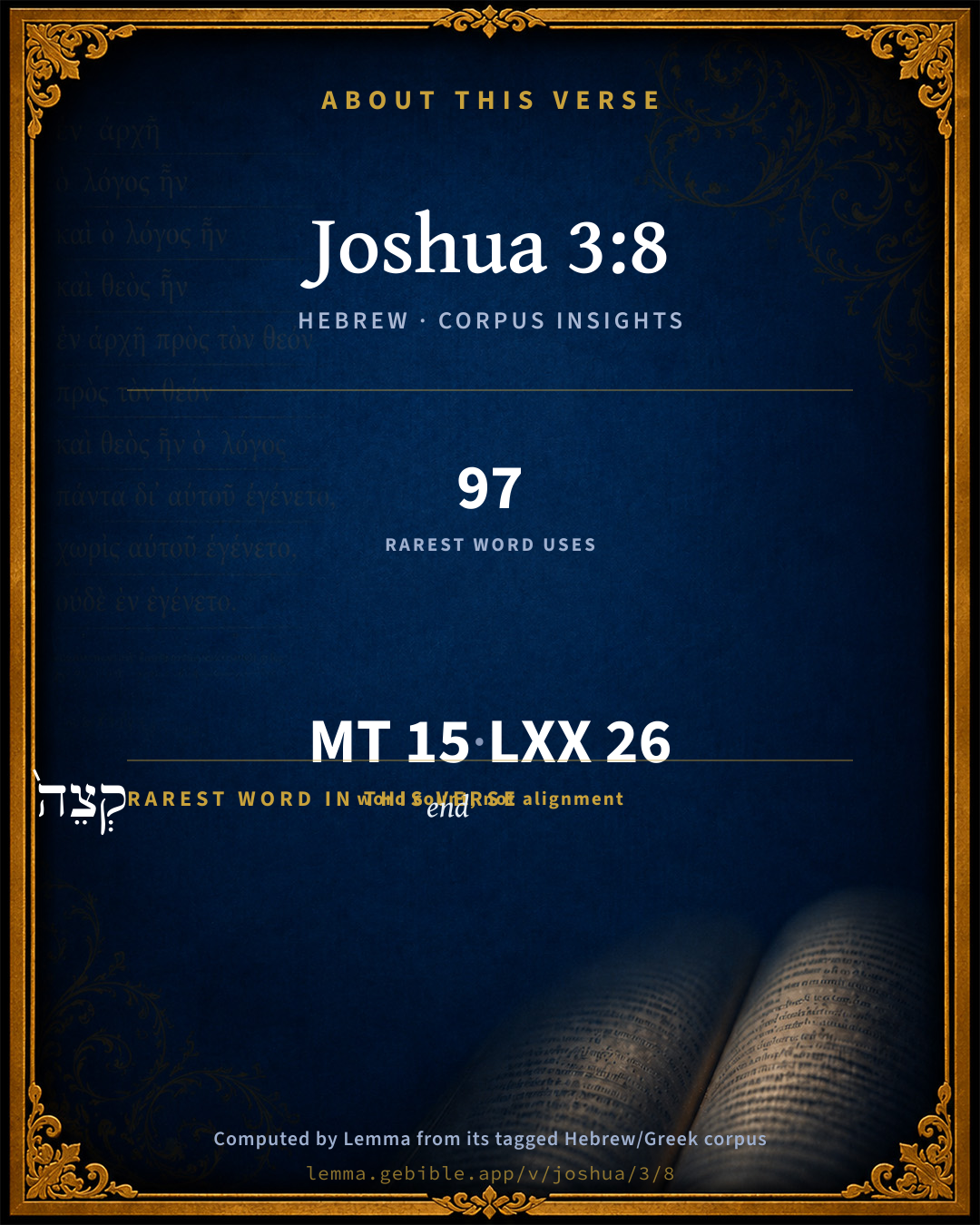
About this verse

These counts appear in no published source. They are computed here, from the morphology-tagged text and Lemma’s own curated glosses. What Lemma adds →

15
words
14
distinct lemmas
Historical
section

Grammatical profile

  • 5 verbs
  • 7 nouns
  • 1 pronoun
  • 1 preposition
  • 1 particle

Verb forms

  • תְּצַוֶּה֙ Piel · Imperfect
  • נֹשְׂאֵ֥י Qal · Participle Active
  • לֵאמֹ֑ר Qal · Infinitive Construct
  • כְּבֹאֲכֶ֗ם Qal · Infinitive Construct
  • תַּעֲמֹֽדוּ Qal · Imperfect

Repetition

A word recurs within this verse — often emphatic in Hebrew:

  • הַיַּרְדֵּ֔ן Jordan H3383 ×2

Hebrew & Septuagint length

In English translation the verse runs 33 words from the Hebrew and 33 from the Septuagint (LXX English) — the same length.

A rough comparison of the two English renderings, which tokenize alike — not a word-level alignment.

Word counts can differ between the Hebrew and the Greek without any difference in meaning — e.g. the Hebrew direct-object marker אֵת has no separate Greek word, and Greek often adds the article ὁ.

In the original languages it is 15 Hebrew tokens and 26 Greek tokens — but the two are counted differently (Hebrew bundles its prefixes and suffixes into one token; the Greek is in lemma form), so that isn’t a like-for-like length.

Cross-references

16

Topical passages linked to Joshua 3:8 in the Treasury of Scripture Knowledge — connected by theme and wording, ordered by reader-vote popularity; previews shown in the World English Bible.

  • Joshua 3:3 and they commanded the people, saying, When you see the ark of the covenant of Yahweh your God, and the priests the Levites bearing it, then you shall remove from your place, and go after it.
  • Joshua 3:17 The priests who bore the ark of the covenant of Yahweh stood firm on dry ground in the midst of the Jordan; and all Israel passed over on dry ground, until all the nation were passed clean over the Jordan.
  • Exodus 14:13 Moses said to the people, "Don't be afraid. Stand still, and see the salvation of Yahweh, which he will work for you today: for the Egyptians whom you have seen today, you shall never see them again.
  • 1 Chronicles 15:11–12 David called for Zadok and Abiathar the priests, and for the Levites, for Uriel, Asaiah, and Joel, Shemaiah, and Eliel, and Amminadab,
  • 2 Chronicles 17:8–9 and with them the Levites, even Shemaiah, and Nethaniah, and Zebadiah, and Asahel, and Shemiramoth, and Jehonathan, and Adonijah, and Tobijah, and Tob-adonijah, the Levites; and with them Elishama and Jehoram, the priests.
  • 2 Chronicles 29:4–11 He brought in the priests and the Levites, and gathered them together into the broad place on the east,
  • 2 Chronicles 29:15 They gathered their brothers, and sanctified themselves, and went in, according to the commandment of the king by the words of Yahweh, to cleanse the house of Yahweh.
  • 2 Chronicles 29:27 Hezekiah commanded to offer the burnt offering on the altar. When the burnt offering began, the song of Yahweh began also, and the trumpets, together with the instruments of David king of Israel.
  • 2 Chronicles 29:30 Moreover Hezekiah the king and the princes commanded the Levites to sing praises to Yahweh with the words of David, and of Asaph the seer. They sang praises with gladness, and they bowed their heads and worshiped.
  • 2 Chronicles 30:12 Also on Judah came the hand of God to give them one heart, to do the commandment of the king and of the princes by the word of Yahweh.
  • 2 Chronicles 31:9–10 Then Hezekiah questioned the priests and the Levites concerning the heaps.
  • 2 Chronicles 35:2–6 He set the priests in their offices, and encouraged them to the service of the house of Yahweh.
  • Nehemiah 12:24–28 The chiefs of the Levites: Hashabiah, Sherebiah, and Jeshua the son of Kadmiel, with their brothers over against them, to praise and give thanks, according to the commandment of David the man of God, watch next to watch.
  • Nehemiah 13:22 I commanded the Levites that they should purify themselves, and that they should come and keep the gates, to sanctify the Sabbath day. Remember to me, my God, this also, and spare me according to the greatness of your loving kindness.
  • Nehemiah 13:28 One of the sons of Joiada, the son of Eliashib the high priest, was son-in-law to Sanballat the Horonite: therefore I chased him from me.
  • Lamentations 3:26 It is good that a man should hope and quietly wait for the salvation of Yahweh.

Cross-references courtesy of OpenBible.info (CC BY 4.0).

Hebrew and Greek witnesses Masoretic Hebrew ↔ Greek Septuagint

The same verse in the two great witnesses to the Old Testament, shown verse-for-verse.

These are two independent witnesses, not word-aligned to each other, and the Septuagint is shown in lemma (dictionary) form.

Hebrew Joshua 3:8 Masoretic · Westminster Leningrad Codex

וְאַתָּ֗ה תְּצַוֶּה֙ אֶת הַכֹּ֣הֲנִ֔ים נֹשְׂאֵ֥י אֲרֽוֹן הַבְּרִ֖ית לֵאמֹ֑ר כְּבֹאֲכֶ֗ם עַד קְצֵה֙ מֵ֣י הַיַּרְדֵּ֔ן בַּיַּרְדֵּ֖ן תַּעֲמֹֽדוּ

You shall command the priests who bear the ark of the covenant, saying, When you are come to the brink of the waters of the Jordan, you shall stand still in the Jordan.

World English Bible · Public Domain

Greek LXX Joshua 3:8 Septuagint · lemma form

καί νῦν ἐντέλλομαι ὁ ἱερεύς ὁ αἴρω ὁ κιβωτός ὁ διαθήκη λέγω ὡς ἄν εἰςἔρχομαι ἐπί μέρος ὁ ὕδωρ ὁ ἰορδάνης καί ἐν ὁ ἰορδάνης ἵστημι

And now charge the priests that bear the ark of the covenant, saying, As soon as you⌃ shall enter on a part of the water of Jordan, then you⌃ shall stand in Jordan.

LXX2012 (modern English Septuagint) · Public Domain

Hebrew: Westminster Leningrad Codex (CC BY 4.0). Greek: Septuagint (public domain); English from LXX2012 (modern English Septuagint) (Public Domain). How the Septuagint differs from the Hebrew →

Targum (Aramaic paraphrase)

1

The Targum is the ancient Jewish Aramaic paraphrase of the Hebrew Scriptures — an interpretive translation, not the Hebrew text itself. Onkelos (literal) and Pseudo-Jonathan (expansive) render the Torah, and Jonathan the Prophets. Coverage is partial: where no permissively-licensed English translation exists for a verse, only the Aramaic is shown. This is verse-level text, not a word-by-word alignment to the Hebrew.

  1. Targum Jonathan Prophets (Joshua–Malachi)
    וְאַתְּ תְּפַקֵד יַת כַּהֲנַיָא נַטְלֵי אֲרוֹנָא דִקְיָמָא לְמֵימָר כְּמִמְטֵיכוֹן עַד קְצַת מֵי יַרְדְנָא בְּיַרְדְנָא תְּקוּמוּן:

    (no public-domain English translation for this verse)

    Targum Jonathan — Aramaic: “Mikraot Gedolot” (public domain). English: “Sefaria Community Translation” (CC0 1.0 (public-domain dedication)); “London "Chaldee Paraphrase," 1871” (public domain). Text via Sefaria.

Commentary

Notes on Joshua 3:8 from classic Christian and Jewish commentators (each source and its license shown beneath its notes). The classic Christian expositions comment on the surrounding passage and are grouped to its opening verse, so a note may address several verses; the Jewish commentaries on the Tanakh (Rashi and others) are per-verse, so they appear only where the commentator wrote on this verse.

Lemma curates 59 commentaries, every one of them public domain or Creative Commons licensed, each selected and text-cleaned for this edition rather than reprinted as found. About our sources →

Trapp's Complete Commentary

John Trapp

Jos 3:8 And thou shalt command the priests that bear the ark of the covenant, saying, When ye are come to the brink of the water of Jordan, ye shall stand still in Jordan.

Ver. 8. Ye shall stand still in Jordan.] "Fear ye not, stand still, and see the salvation of the Lord which he will show you today," as Exo 14:13. Believe and prosper: consent and obey, and ye shall eat the good things of the land.

John Trapp, A Commentary or Exposition upon All the Books of the Old and New Testament (1647–1656) — public domain. Text from a community e-Sword module.

Joseph Benson's Commentary

Jos 3:8. The brink of Jordan — Hebrew, to the extremity, so far as the river then spread itself, which was now more than ordinary, Jos 3:15. Ye shall stand still in Jordan — Within the waters of Jordan, in the first entrance into the river; where they stood for a season, till the river was divided, and then they went into the midst of it, and there abode till all the people were passed over.

Joseph Benson's Commentary on the Old and New Testaments (1811–1818) — public domain. Text from a community e-Sword module.

Tyndale Open Study Notes

Tyndale Open Resources

3:8 As they crossed the Jordan River, the Ark led the way until the feet of the priests entered the water; the priests were to stand in the Jordan, not on the dry land. By carrying the Ark into the water first, the obedient priests would show their faith (cp. Jas 2:18).

Tyndale Open Study Notes — © Tyndale Open Resources, licensed CC BY-SA 4.0. Text via the HelloAO Bible API.

Geneva Bible (1599)

Geneva Bible translators

Even in the channel where the stream had run, as verse 17.

Geneva Bible (1599) marginal notes — public domain. Text via Bolls.life.

Adam Clarke's Commentary

Verse 8. Ye shall stand still in Jordan.] The priests proceeded first with the ark, and entered into the bed of the river the course of which was immediately arrested, the waters collecting above the place where the priests stood, while the stream fell off towards the Dead Sea; so that the whole channel below where the priests were standing became dry. The whole camp, therefore, passed over below where the priests were standing, keeping at the distance of two thousand cubits from the ark; this they would readily do, as the whole bed of the river was dry for many miles below the place where the priests entered.

Adam Clarke's Commentary on the Bible (1810–1826) — public domain. Text from a community e-Sword/MySword module.

John Gill's Exposition

And thou shalt command the priests that bear the ark of the Lord,.... Who were subject to Joshua, the chief governor of the nation, and general of the army, as well as the common people; and whose commands they were to obey, and especially when they appeared to be from the Lord:

saying, when ye come to the brink of the water of Jordan; not of the bank of it, but of the water, which had now overflowed its bank; that is, the brink or extremity of it, which was nearest to them, and to which they first came; though it is a notion of some Jewish commentators (t), and which some Christian interpreters (u) have given into, and both of considerable note, that this was the further extremity, or the brink on the other side of the river; but, according to this notion, they must pass the river to the other side before the waters were divided, which is not credible; and must return again into the midst of the river, which is not probable; and besides, it is expressly said, that as soon as their feet dipped in the brim, or extremity of the water, the waters parted, which must be the first brim or extremity they came at, Jos 3:15,

ye shall stand still in Jordan; after the waters were parted; upon their coming to, and touching, the brink of them, they proceeded, and went into the middle of the river, where they were ordered to stop and stand still.

(t) Kimchi, Abarbinel. (u) Masius, Drusius.

John Gill's Exposition of the Whole Bible (1746–1763) — public domain (CC PDM 1.0). Text via the HelloAO Bible API.

Haydock's Catholic Bible Commentary

It. Hebrew, "when you shall have come to the brink (or extremity) of the water of the Jordan, you shall stand still in the Jordan," (Haydock) which some explain by saying that they were to stop on the eastern bank, as soon as they had wet their feet, (Serarius) while others say they crossed quite over, and stood at the other side. (Masius) --- But it is more probable, that as soon as they had touched the waters, the priests halted till the bed of the river was presently dried up, and then they placed themselves in the middle of it, close to the raging billows, which, rising up like mountains, were stopped in their career, (Haydock) and forced to retire backwards to their source, ver. 15, 17, and chap. iv. 9. (Bonfrere; Cornelius a Lapide) --- Some translate, "into the division," instead of part, or extremity. (Calmet)

George Leo Haydock (1774–1849), Haydock's Catholic Family Bible and Commentary, 1859 edition — public domain. Excludes Psalms (Douay-Rheims chapter numbering differs from Protestant) and Deuterocanonical books (Catholic canon only).

Matthew Poole's English Annotations

To the brink, Heb. to the extremity; so far as the river then spread itself, which was now more than ordinary, Jos 3:5.

In Jordan; within the waters of Jordan, in the first entrance into the river; where they stood for a season, till the river was divided, and then they went into the midst of it, as it is implied, Jos 3:17, and there abode till all the people were passed over, as it follows in the history.

Matthew Poole's English Annotations on the Holy Bible (1683–1685) — public domain. Text from a community e-Sword/MySword module.

Whedon's Commentary on the Bible

Daniel D. Whedon

8. The brink of the water — Hebrews end of the water, that is, the eastern margin of the river. It is evident from Joshua’s address to the people, which immediately follows, that all the Lord’s words to Joshua are not reported here. The abbreviation is to prevent repetition. The main point is to show that the whole order of the crossing was arranged by the Lord and not by Joshua.

Stand still in Jordan — As a solemn and impressive indication to the passing host that the miracle is wrought by Jehovah, whose chosen ministers are the priests, and the symbol of whose presence is the ark.

Daniel D. Whedon (gen. ed.), Commentary on the Old and New Testaments (1874–1909) — public domain. Text from a community e-Sword module.

The Pulpit Commentary

And thou shalt command the priests. We have not here the whole command. That is to be found in ver. 13. To the brink hxeqAd. Literally, to the end, i.e. , the end or brink of the waters at the eastern side. There they halted, and as long as the ark remained there, the waters of Jordan ceased to flow.

The Pulpit Commentary (1880–1919), ed. H.D.M. Spence-Jones & Joseph S. Exell — public domain. Text from a community e-Sword module.

John Wesley's Explanatory Notes

The brink - Hebrew. to the extremity, so far as the river then spread itself, which was now more than ordinary, ver. 15. In Jordan - Within the waters of Jordan, in the first entrance into the river; Where they stood for a season, 'till the river was divided, and then they went into the midst of it, and there abode 'till all the people were passed over. 9. Come hither - To the ark or tabernacle, the place of public assemblies. The Lord your God - Who is now about to give a proof that he is both the Lord, the omnipotent governor of heaven and earth, and all creatures; and your God, in covenant with you, having a tender care and affection for you.

John Wesley, Explanatory Notes Upon the Whole Bible (1754–1765) — public domain. Text via the GEBible commentary corpus.

Rashi

Rabbi Shlomo Yitzchaki (Rashi)

When you reach the edge of the waters of the Jordan. When you enter within its edge.

Remain standing in the Jordan. Until all the people cross over to the other side [of the river.]

Rashi on the Tanakh — English translations: “The Judaica Press complete Tanach with Rashi, translated by A. J. Rosenberg” (CC BY 4.0); “Pentateuch with Rashi's commentary by M. Rosenbaum and A.M. Silbermann, 1929-1934” (public domain); “The Metsudah Tanach series, Lakewood, N.J” (CC BY 4.0); and “The Book of Joshua, Metsudah Publications, 1997” (CC BY 4.0). Text via Sefaria.

Lesson kit

Teaching starters — assembled from the data on this page, not authored interpretation. Every prompt links to the verse data it draws on. Edit before teaching.

Joshua, in the Historical, opens this verse with 15 words (14 distinct Hebrew lemmas). Its most distinctive word is qâtseh (“end”). A historical commentator’s framing appears above. Read the whole chapter for the surrounding context.

Discussion questions

  1. The word qâtseh carries the sense “end.” How does it shape the verse?
  2. How does Joshua 3:3, which shares this passage’s theme, read alongside this verse?
  3. What does the repetition of “Jordan” (2× in this one verse) do in this verse?
  4. These translations render this verse differently; the difference is in the English rendering, not the original. What questions does that raise?
  5. «תְּצַוֶּה֙» is a Piel Imperfect verb. How does that grammatical form shape the action described?
  6. Compare how Trapp's Complete Commentary and Joseph Benson's Commentary read this verse. Where do they agree or differ?

Things to notice

Reading settings

Reading text

Shown beneath each verse's original-language words.

Old Testament
Old Testament edition

Read the OT as the Masoretic Hebrew (MT) or the Greek Septuagint (LXX).

English shown for the Greek Septuagint (in the Hebrew ↔ Greek comparison).

Comparing translations? Open the Compare panel on any verse page to stack up to four side by side.