
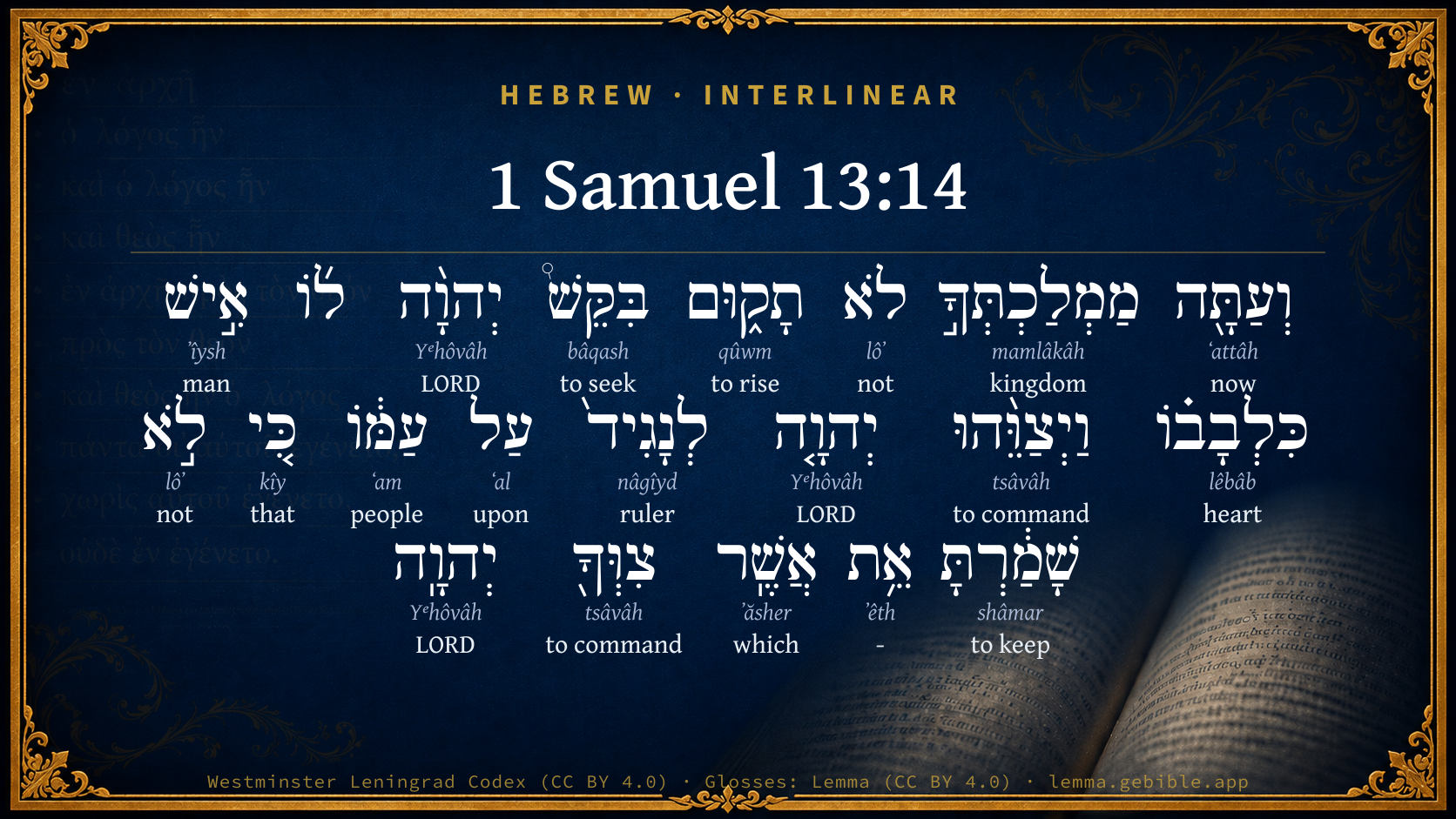
1 Samuel 13:14

Hebrew (Westminster Leningrad Codex) 1 Samuel 13:14 appears in the Hebrew Old Testament. The text above is from the Westminster Leningrad Codex. Each word links to its Strong’s number, a concise gloss, and parsing drawn from the Open Scriptures Hebrew Bible morphology. Click any word for its full Brown-Driver-Briggs (BDB) entry.
Download image
Cite this verse

1 Samuel 13:14 (World English Bible). Public Domain. Lemma interlinear Bible study tool, https://lemma.gebible.app/v/1-samuel/13/14.

Show BibTeX & RIS
BibTeX
RIS
English Translation
But now your kingdom shall not continue: Yahweh has sought him a man after his own heart, and Yahweh has appointed him to be prince over his people, because you have not kept that which Yahweh commanded you.
World English Bible · Public Domain
Download a study sheet

One document with this verse’s original text, its word-by-word gloss line, the meaning frame, cross-references with their text, attributed commentary, and full source and license credits — printable, and it pastes into notes with its structure intact.

This verse Autodidact and up

Study sheet (.html) Plain text (.txt)

A passage Seminary Student

Up to 50 verses in one chapter. A passage sheet keeps up to 6 commentary sources and 12 cross-references per verse, in the order this page ranks them, and says so on the sheet whenever that leaves anything out. Ask for a single verse and you get the Autodidact verse sheet above.

Everything on this page stays free to read, with no account — the sheet is a download of what is already on screen, not access to it.

Want to remove ads? Support Godless Engineer
Compare translations 3

The same verse in 3 English versions, stacked beneath the original-language interlinear above. Click any original word for its lexicon entry.

Each is an independent rendering of the whole verse — the interlinear is not word-aligned to these translations.

Highlighted words mark where these versions differ — a whole-verse word diff, not a word-by-word alignment.

  • World English Bible Public Domain
    But now your kingdom shall not continue: Yahweh has sought him a man after his own heart, and Yahweh has appointed him to be prince over his people, because you have not kept that which Yahweh commanded you.
  • King James Version Public Domain
    But now thy kingdom shall not continue: the LORD hath sought him a man after his own heart, and the LORD hath commanded him to be captain over his people, because thou hast not kept that which the LORD commanded thee.
  • unfoldingWord Literal Text CC BY-SA 4.0
    But now your kingdom will not stand. Yahweh has sought for himself a man according to his heart, and Yahweh has commanded him to ruler over his people, for you have not kept what Yahweh commanded you.”

unfoldingWord Literal Text — © unfoldingWord, licensed CC BY-SA 4.0. Word-aligned USFM3 via Door43 (git.door43.org/unfoldingWord/en_ult).

Versions to compare (up to 4)

3 of 4 selected

Show all 18 translations

Every available English version of this verse, each an independent rendering of the whole verse.

  • World English Bible Public Domain
    But now your kingdom shall not continue: Yahweh has sought him a man after his own heart, and Yahweh has appointed him to be prince over his people, because you have not kept that which Yahweh commanded you.
  • Berean Standard Bible Public Domain
    But now your kingdom will not endure; the LORD has sought a man after His own heart and appointed him ruler over His people, because you have not kept the command of the LORD.”
  • Majority Standard Bible Public Domain
    But now your kingdom will not endure; the LORD has sought a man after His own heart and appointed him ruler over His people, because you have not kept the command of the LORD.”
  • King James Version Public Domain
    But now thy kingdom shall not continue: the LORD hath sought him a man after his own heart, and the LORD hath commanded him to be captain over his people, because thou hast not kept that which the LORD commanded thee.
  • American Standard Version (1901) Public Domain
    But now thy kingdom shall not continue: Jehovah hath sought him a man after his own heart, and Jehovah hath appointed him to be prince over his people, because thou hast not kept that which Jehovah commanded thee.
  • Revised Version (1885) Public Domain
    But now thy kingdom shall not continue: the LORD hath sought him a man after his own heart, and the LORD hath appointed him to be prince over his people, because thou hast not kept that which the LORD commanded thee.
  • Geneva Bible (1599) Public Domain
    But nowe thy kingdom shall not continue: the Lord hath sought him a man after his owne heart, and the Lord hath commanded him to be gouernour ouer his people, because thou hast not kept that which the Lord had commanded thee.
  • Douay-Rheims (1899) Public Domain
    But thy kingdom shall not continue. The Lord hath sought him a man according to his own heart: and him hath the Lord commanded to be prince over his people, because thou hast not observed that which the Lord commanded.
  • Young's Literal Translation Public Domain
    and, now, thy kingdom doth not stand, Jehovah hath sought for Himself a man according to His own heart, and Jehovah chargeth him for leader over His people, for thou hast not kept that which Jehovah commanded thee.'
  • Literal Standard Version CC BY-SA 4.0
    and now, your kingdom does not stand, YHWH has sought [for] a man for Himself according to His own heart, and YHWH charges him for leader over His people, for you have not kept that which YHWH commanded you.”
  • Unlocked Literal Bible CC BY-SA 4.0
    But now your rule will not continue. Yahweh has sought out a man after his own heart, and Yahweh has appointed him to be prince over his people, because you have not obeyed what he commanded you.”
  • unfoldingWord Literal Text CC BY-SA 4.0
    But now your kingdom will not stand. Yahweh has sought for himself a man according to his heart, and Yahweh has commanded him to ruler over his people, for you have not kept what Yahweh commanded you.”
  • Darby Bible Public Domain
    But now thy kingdom shall not continue: Jehovah has sought him a man after his own heart, and Jehovah has appointed him ruler over his people; for thou hast not kept what Jehovah commanded thee.
  • World Messianic Bible Public Domain
    But now your kingdom will not continue. The LORD has sought for himself a man after his own heart, and the LORD has appointed him to be prince over his people, because you have not kept that which the LORD commanded you.”
  • Webster's Bible Public Domain
    But now thy kingdom shall not continue: the LORD hath sought him a man after his own heart, and the LORD hath commanded him to be captain over his people, because thou hast not kept that which the LORD commanded thee.
  • Free Bible Version CC BY-SA 4.0
    But now your kingdom won't last. The Lord has found for himself a man who thinks like him, and has chosen him as ruler over his people, because you haven't kept the commands of the Lord.”
  • Bible in Basic English Public Domain
    But now, your authority will not go on: the Lord, searching for a man who is pleasing to him in every way, has given him the place of ruler over his people, because you have not done what the Lord gave you orders to do.
  • JPS Tanakh (1917) Public Domain
    But now thy kingdom shall not continue; the LORD hath sought him a man after His own heart, and the LORD hath appointed him to be prince over His people, because thou hast not kept that which the LORD commanded thee.'

Literal Standard Version (2020), Covenant Press — licensed CC BY-SA 4.0. Text via the HelloAO Bible API (eBible.org). Unlocked Literal Bible (unfoldingWord) — licensed CC BY-SA 4.0. Text via the HelloAO Bible API (eBible.org). unfoldingWord Literal Text — © unfoldingWord, licensed CC BY-SA 4.0. Word-aligned USFM3 via Door43 (git.door43.org/unfoldingWord/en_ult). Free Bible Version, Dr. Jonathan Gallagher — licensed CC BY-SA 4.0. Text via the HelloAO Bible API (eBible.org).

Word by word

More ways to search: Search by grammar → Find every occurrence → Compare this word →

Practice this passage: Drill this verse → Learn its vocabulary →

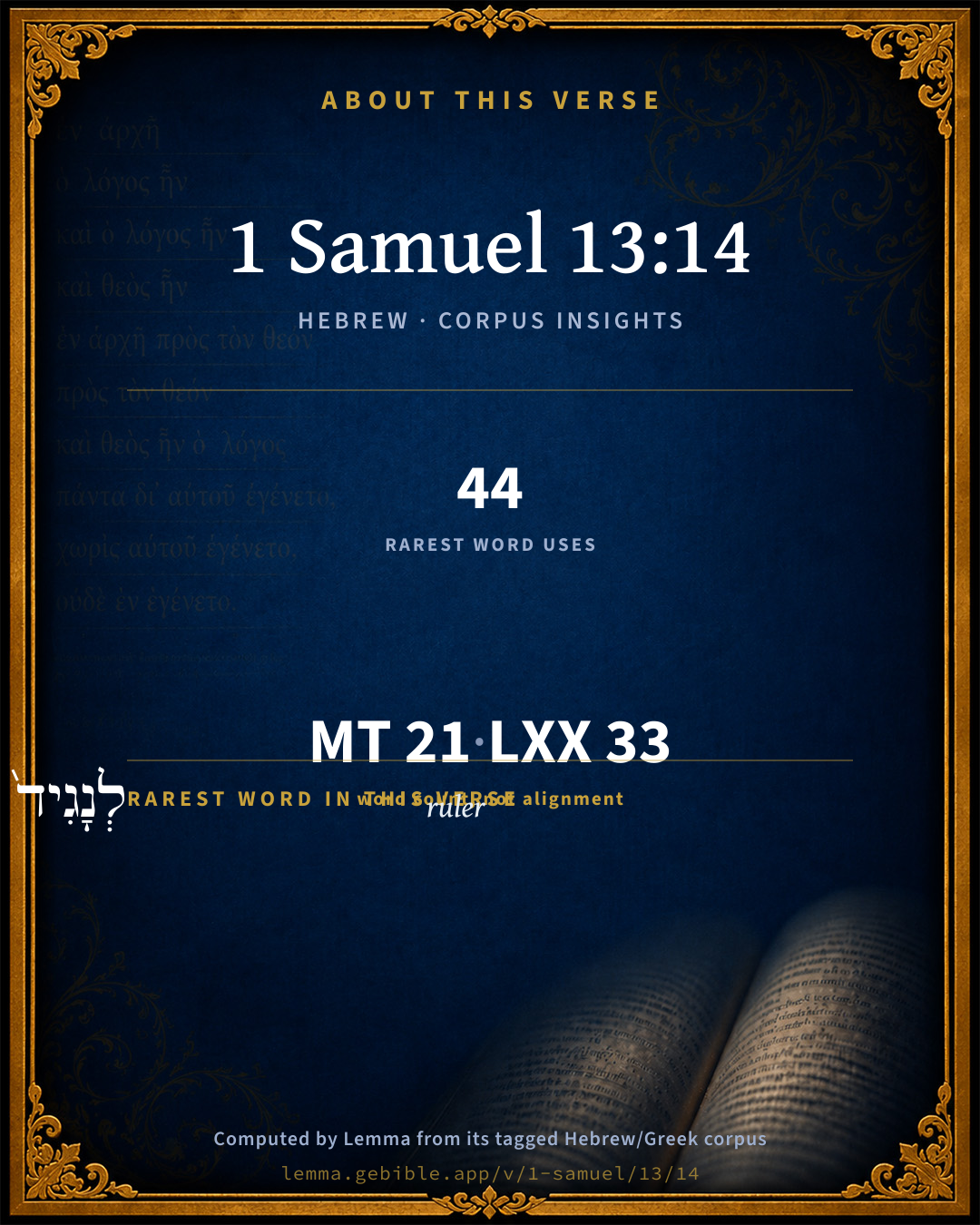
לְנָגִיד֙
nâgîyd
H5057
“to/for · ruler”
Preposition + Noun, Common, Masculine, Singular, Absolute
Part of Speech
Preposition + Noun
Type
Common
Gender
Masculine
Number
Singular
State
Absolute
Full BDB Definition

Origin: from H5046

TWOT: 1289b

leader, ruler, captain, prince - ruler, prince - prince-overseer - ruler (in other capacities) - princely things
  1. וְעַתָּ֖ה ʻattâh H6258 “and · now” Conjunction + Adverb
  2. מַמְלַכְתְּךָ֣ mamlâkâh H4467 “kingdom · your” Noun, Common, Feminine, Singular, Construct + Suffix, Personal, 2nd Person, Masculine, Singular
  3. לֹא lôʼ H3808 “not” Particle, Negative
  4. תָק֑וּם qûwm H6965 “to rise” Verb, Qal, Imperfect, 3rd Person, Feminine, Singular
  5. בִּקֵּשׁ֩ bâqash H1245 “to seek” Verb, Piel, Perfect, 3rd Person, Masculine, Singular
  6. יְהוָ֨ה Yᵉhôvâh H3068 “LORD” Noun, Proper
  7. אִ֣ישׁ ʼîysh H376 “man” Noun, Common, Masculine, Singular, Absolute
  8. כִּלְבָב֗וֹ lêbâb H3824 “like/as · heart · his” Preposition + Noun, Common, Masculine, Singular, Construct + Suffix, Personal, 3rd Person, Masculine, Singular
  9. וַיְצַוֵּ֨הוּ tsâvâh H6680 “and · to command · him” Conjunction + Verb, Piel, Sequential Imperfect, 3rd Person, Masculine, Singular + Suffix, Personal, 3rd Person, Masculine, Singular
  10. יְהוָ֤ה Yᵉhôvâh H3068 “LORD” Noun, Proper
  11. עַל ʻal H5921 “upon” Preposition
  12. עַמּ֔וֹ ʻam H5971 “people · his” Noun, Common, Masculine, Singular, Construct + Suffix, Personal, 3rd Person, Masculine, Singular
  13. כִּ֚י kîy H3588 “that” Conjunction
  14. לֹ֣א lôʼ H3808 “not” Particle, Negative
  15. שָׁמַ֔רְתָּ shâmar H8104 “to keep” Verb, Qal, Perfect, 2nd Person, Masculine, Singular
  16. אֵ֥ת ʼêth H853 “-” Particle, Direct Object
  17. אֲשֶֽׁר ʼăsher H834 “which” Particle, Relative
  18. צִוְּךָ֖ tsâvâh H6680 “to command · you” Verb, Piel, Perfect, 3rd Person, Masculine, Singular + Suffix, Personal, 2nd Person, Masculine, Singular
  19. יְהוָֽה Yᵉhôvâh H3068 “LORD” Noun, Proper

About this verse

These counts appear in no published source. They are computed here, from the morphology-tagged text and Lemma’s own curated glosses. What Lemma adds →

21
words
16
distinct lemmas
Historical
section

Shared distinctive vocabulary

לְנָגִיד֙ ruler H5057 occurs in 44 verses of the Hebrew Bible. Also found in:

Grammatical profile

  • 5 verbs
  • 8 nouns
  • 2 prepositions
  • 1 conjunction
  • 1 adverb
  • 4 particles

Verb forms

  • תָק֑וּם Qal · Imperfect
  • בִּקֵּשׁ֩ Piel · Perfect
  • וַיְצַוֵּ֨הוּ Piel · Sequential Imperfect
  • שָׁמַ֔רְתָּ Qal · Perfect
  • צִוְּךָ֖ Piel · Perfect

Repetition

Words recur within this verse — often emphatic in Hebrew:

  • יְהוָ֨ה LORD H3068 ×3
  • וַיְצַוֵּ֨הוּ to command H6680 ×2
  • לֹא not H3808 ×2

Hebrew & Septuagint length

In English translation the verse runs 38 words from the Hebrew and 46 from the Septuagint (LXX English) — closely comparable.

A rough comparison of the two English renderings, which tokenize alike — not a word-level alignment.

Word counts can differ between the Hebrew and the Greek without any difference in meaning — e.g. the Hebrew direct-object marker אֵת has no separate Greek word, and Greek often adds the article ὁ.

In the original languages it is 21 Hebrew tokens and 33 Greek tokens — but the two are counted differently (Hebrew bundles its prefixes and suffixes into one token; the Greek is in lemma form), so that isn’t a like-for-like length.

Cross-references

13

Topical passages linked to 1 Samuel 13:14 in the Treasury of Scripture Knowledge — connected by theme and wording, ordered by reader-vote popularity; previews shown in the World English Bible.

  • Acts 13:22 When he had removed him, he raised up David to be their king, to whom he also testified, 'I have found David the son of Jesse, a man after my heart, who will do all my will.'
  • 1 Samuel 15:28 Samuel said to him, Yahweh has torn the kingdom of Israel from you this day, and has given it to a neighbor of yours who is better than you.
  • Psalms 89:19–37 Then you spoke in vision to your saints, And said, "I have bestowed strength on the warrior. I have exalted a young man from the people.
  • Psalms 78:70 He also chose David his servant, And took him from the sheepfolds;
  • 1 Samuel 16:1 Yahweh said to Samuel, How long will you mourn for Saul, seeing I have rejected him from being king over Israel? fill your horn with oil, and go: I will send you to Jesse the Bethlehemite; for I have provided me a king among his sons.
  • Acts 7:46 who found favor in the sight of God, and asked to find a habitation for the God of Jacob.
  • 1 Samuel 16:12 He sent, and brought him in. Now he was ruddy, and withal of a beautiful face, and goodly to look on. Yahweh said, Arise, anoint him; for this is he.
  • 1 Samuel 2:30 Therefore Yahweh, the God of Israel, says, I said indeed that your house, and the house of your father, should walk before me forever: but now Yahweh says, Be it far from me; for those who honor me I will honor, and those who despise me shall be lightly esteemed.
  • 1 Samuel 9:16 Tomorrow about this time I will send you a man out of the land of Benjamin, and you shall anoint him to be prince over my people Israel; and he shall save my people out of the hand of the Philistines: for I have looked on my people, because their cry is come to me.
  • 2 Samuel 5:2 In times past, when Saul was king over us, it was you who led out and brought in Israel: and Yahweh said to you, You shall be shepherd of my people Israel, and you shall be prince over Israel.
  • 2 Samuel 7:15–16 but my loving kindness shall not depart from him, as I took it from Saul, whom I put away before you.
  • 2 Kings 20:5 Turn back, and tell Hezekiah the prince of my people, Thus says Yahweh, the God of David your father, I have heard your prayer, I have seen your tears: behold, I will heal you; on the third day you shall go up to the house of Yahweh.
  • Hebrews 2:10 For it became him, for whom are all things, and through whom are all things, in bringing many children to glory, to make the author of their salvation perfect through sufferings.

Cross-references courtesy of OpenBible.info (CC BY 4.0).

Hebrew and Greek witnesses Masoretic Hebrew ↔ Greek Septuagint

The same verse in the two great witnesses to the Old Testament, shown verse-for-verse.

These are two independent witnesses, not word-aligned to each other, and the Septuagint is shown in lemma (dictionary) form.

Hebrew 1 Samuel 13:14 Masoretic · Westminster Leningrad Codex

וְעַתָּ֖ה מַמְלַכְתְּךָ֣ לֹא תָק֑וּם בִּקֵּשׁ֩ יְהוָ֨ה ל֜וֹ אִ֣ישׁ כִּלְבָב֗וֹ וַיְצַוֵּ֨הוּ יְהוָ֤ה לְנָגִיד֙ עַל עַמּ֔וֹ כִּ֚י לֹ֣א שָׁמַ֔רְתָּ אֵ֥ת אֲשֶֽׁר צִוְּךָ֖ יְהוָֽה

But now your kingdom shall not continue: Yahweh has sought him a man after his own heart, and Yahweh has appointed him to be prince over his people, because you have not kept that which Yahweh commanded you.

World English Bible · Public Domain

Greek LXX 1 Samuel 13:14 Septuagint · lemma form

καί νῦν ὁ βασιλεία σύ οὐ ἵστημι καί ζητέω κύριος ἑαυτοῦ ἄνθρωπος κατά ὁ καρδία αὐτός καί ἐντέλλω κύριος αὐτός εἰς ἄρχων ἐπί ὁ λαός αὐτός ὅτι οὐ φυλάσσω ὅσος ἐντέλλομαι σύ κύριος

But now your kingdom shall not stand to you, and the Lord shall seek for himself a man after his own heart; and the Lord shall appoint him to be a ruler over his people, because you have not kept all that the Lord commanded you.

LXX2012 (modern English Septuagint) · Public Domain

Hebrew: Westminster Leningrad Codex (CC BY 4.0). Greek: Septuagint (public domain); English from LXX2012 (modern English Septuagint) (Public Domain). How the Septuagint differs from the Hebrew →

Targum (Aramaic paraphrase)

1

The Targum is the ancient Jewish Aramaic paraphrase of the Hebrew Scriptures — an interpretive translation, not the Hebrew text itself. Onkelos (literal) and Pseudo-Jonathan (expansive) render the Torah, and Jonathan the Prophets. Coverage is partial: where no permissively-licensed English translation exists for a verse, only the Aramaic is shown. This is verse-level text, not a word-by-word alignment to the Hebrew.

  1. Targum Jonathan Prophets (Joshua–Malachi)
    וּכְעַן מַלְכוּתָךְ לָא תִתְקַיֵם אַתְקֵין יְיָ קֳדָמוֹהִי גְבַר עָבֵיד רְעוּתֵהּ וּפַקְדֵיהּ יְיָ לְמֶהֱוֵי מַלְכָּא עַל עַמֵיהּ אֲרֵי לָא נְטַרְתָּא יַת דְפַקְדָךְ יְיָ:

    (no public-domain English translation for this verse)

    Targum Jonathan — Aramaic: “Mikraot Gedolot” (public domain). English: “Sefaria Community Translation” (CC0 1.0 (public-domain dedication)); “London "Chaldee Paraphrase," 1871” (public domain). Text via Sefaria.

Commentary

Notes on 1 Samuel 13:14 from classic Christian and Jewish commentators (each source and its license shown beneath its notes). The classic Christian expositions comment on the surrounding passage and are grouped to its opening verse, so a note may address several verses; the Jewish commentaries on the Tanakh (Rashi and others) are per-verse, so they appear only where the commentator wrote on this verse.

Lemma curates 59 commentaries, every one of them public domain or Creative Commons licensed, each selected and text-cleaned for this edition rather than reprinted as found. About our sources →

Trapp's Complete Commentary

John Trapp

1Sa 13:14 But now thy kingdom shall not continue: the LORD hath sought him a man after his own heart, and the LORD hath commanded him [to be] captain over his people, because thou hast not kept [that] which the LORD commanded thee.

Ver. 14. The Lord hath sought him a man after his own heart,] sc., Iuxta suum gustura et votum; one that would do all his wills, {Act 13:22} and was therefore his Corculum, the man of his desires and delight.

And the herd hath commanded him to be captain, &c.] He sought not this honour, but it was laid upon him, as Gregory observeth. The Venetians have magistrates they call Pregadi: because at first men were prayed to take the office, and to govern the state. As for David, though he was not without his failings, - and those foul ones too, some of them, - yet for the main, his heart was upright, {Psa 57:7} not rotten, as Saul’s was.

John Trapp, A Commentary or Exposition upon All the Books of the Old and New Testament (1647–1656) — public domain. Text from a community e-Sword module.

Joseph Benson's Commentary

1Sa 13:14. A man after his own heart — That is, such a man as will fulfil all the desires of his heart, and not oppose, them as thou dost. The Lord hath commanded — That is, hath appointed, as the word commanded is often used. But although God threatened Saul with the loss of his kingdom for his sin, yet, it is not improbable, there was a tacit condition implied, namely, if he did not repent of this, and of all his sins; for the full, and final, and peremptory sentence of Saul’s rejection is plainly ascribed to another cause, 1Sa 15:11; 1Sa 15:23-29; and, till that second offence, neither the Spirit of the Lord departed from him, nor was David anointed in his stead. But, “was not this a severe sentence now passed on Saul? Was it not hard to punish so little a sin with the loss of his kingdom?” Not to mention that no sin is little, because God, against whom all sin is committed, is a being of infinite majesty; and not to insist that what to men seems a small offence, to him, who knows the heart, may appear a heinous crime; this sin of Saul certainly can in no point of view be thought little, being an act of manifest disobedience to a known and express command of God; and disobedience to God, though in a small matter, is a great provocation. “Samuel expressly says, Thou hast not kept the commandment of the Lord thy God, which he commanded thee. What was this commandment? Why, not only to wait seven days till Samuel came to assist at the sacrifice, but to receive God’s direction, by the prophet, what he should do, or what measures he was to take upon the invasion of the Philistines, and not to act in so critical a conjuncture without his orders. Saul, under a pretence of piety, and making supplication to the Lord, absolutely contradicts the command, thinks himself above waiting for the prophet, takes upon himself the ordinance of an affair that no way belonged to him; and, as though God’s direction by the prophet was of no consequence to him, resolves to act for himself, and deal with the Philistines as well as he could. Let any inferior prince thus violate the orders of his sovereign, and act in any affair of importance directly contrary to his instructions and duty, and no one will scruple to pronounce him guilty of rebellion, or think he was too hardly treated by being removed from his dignity and government.” — Dodd and Chandler.

Joseph Benson's Commentary on the Old and New Testaments (1811–1818) — public domain. Text from a community e-Sword module.

Tyndale Open Study Notes

Tyndale Open Resources

13:14 a man after his own heart: This prophecy pertains to David (see also Acts 13:22) rather than to Saul’s son Jonathan. The rejection of Saul was also the rejection of his family dynasty.

Tyndale Open Study Notes — © Tyndale Open Resources, licensed CC BY-SA 4.0. Text via the HelloAO Bible API.

Geneva Bible (1599)

Geneva Bible translators

That is, David.

Geneva Bible (1599) marginal notes — public domain. Text via Bolls.life.

Adam Clarke's Commentary

Verse 14. The Lord hath sought him a man after his own heart] That this man was David is sufficiently clear from the sequel. But in what sense was he a man after God's own heart? Answer:

1. In his strict attention to the law and worship of God.

2. In his admitting, in the whole of his conduct, that God was King in Israel, and that he himself was but his vicegerent.

3. In never attempting to alter any of those laws, or in the least change the Israelitish constitution.

4. In all his public official conduct he acted according to the Divine mind, and fulfilled the will of his Maker: thus was he a man after God's own heart. In reference to his private or personal moral conduct, the word is never used. This is the sense alone in which the word is used here and elsewhere; and it is unfair and wicked to put another meaning on it in order to ridicule the revelation of God, as certain infidels have done.

Adam Clarke's Commentary on the Bible (1810–1826) — public domain. Text from a community e-Sword/MySword module.

Ellicott's Commentary for English Readers

(14) Now thy kingdom shall not continue.—The succession was thus formally transferred elsewhere; still, when the words of doom were spoken by the prophet, David, the son of Jesse, the man after God’s own heart, could at that time have been but a mere child. Had King Saul repented what he had done, he might have been forgiven, “for God’s threatenings, like His promises, are conditional. There is no fatalism in the Bible, but a loving discipline for man’s recovery. But behind it stands the Divine foreknowledge and omnipotence, and so to the prophetic view Saul’s refusal to repent, his repeated disobedience, and the succession of David were all revealed as accomplished facts.”—Dean Payne Smith.

A Bible Commentary for English Readers, edited by Charles John Ellicott (1878–1897) — public domain. Text from a community e-Sword module.

The Cambridge Bible for Schools and Colleges

gen. ed. J. J. S. Perowne

14. a man after his own heart] Quoted by St Paul in his discourse at Antioch (Act_13:22). Cp. Psa_89:20.

The Cambridge Bible for Schools and Colleges (gen. ed. J. J. S. Perowne; Cambridge University Press, 1878–1918) — public domain. Text from a community e-Sword module.

John Gill's Exposition

But now thy kingdom shall not continue,.... That is, in his family, nor in his tribe, but be removed to another:

the Lord hath sought him a man after his own heart: who was David; though as yet Samuel knew him not, he knew by divine revelation that there was another one chosen, to whom the kingdom would be given; a man every way agreeable to the will of God, and who would fulfil his will, though he knew not particularly who he was:

and the Lord hath commanded him to be captain over his people; that is, had appointed him to be king over Israel. God's decrees have the force of a law in them, and must be fulfilled; and cannot be resisted so as to be frustrated:

because thou hast not kept that which the Lord hath commanded thee; it matters not whether the thing commanded is greater or less, it is disobedience to the command that is the sin, and is resented: this might seem a small thing, since to offer the sacrifice was not criminal; but doing it before the time, a little before it should have been done, not waiting long enough for the prophet; yet it being against the command of God, or in neglect of it, it was sinful, and severely chastised; and the rather, that it might be an example to all succeeding kings how they offended, or broke the least of God's commandments; and this being the first king of Israel, he was made an example of to the rest.

John Gill's Exposition of the Whole Bible (1746–1763) — public domain (CC PDM 1.0). Text via the HelloAO Bible API.

Haydock's Catholic Bible Commentary

Continue long. This seems to have been a threat, which Saul might still have escaped, if he had not proved disobedient again. St. Gregory says, "he might have been loosed from the bonds of his former disobedience;" prioris inobedientiæ nexus enodaret. The second rebellion caused him to be entirely rejected, and the prophet was ordered to go and anoint David, chap. xv. (Salien)

George Leo Haydock (1774–1849), Haydock's Catholic Family Bible and Commentary, 1859 edition — public domain. Excludes Psalms (Douay-Rheims chapter numbering differs from Protestant) and Deuterocanonical books (Catholic canon only).

Matthew Poole's English Annotations

Hath sought, i.e. hath found or discovered, as men do by seeking, an anthropopathy.

A man after his own heart, i.e. such a man as he desires, one who will fulfil all the desires of his heart, and not oppose them, as thou dost.

Hath commanded, i.e. hath appointed or decreed, as the word command is sometimes used; for it was not yet actually done.

Because thou hast not kept that which the Lord commanded thee.

Quest. First, What was Saul’s sin?

Answ. Either, first, That Saul invaded the priest’s office, and offered the sacrifice himself; which is not probable, both because he had priests with him, and among others an eminent one, Ahiah, 1Sa 14:3, and therefore had no occasion nor pretence for that presumption. Or rather, secondly, That Saul did not wait the full time for Samuel’s coming; for that is the thing which God commanded, 1Sa 10:8, and the breach of this command is the only thing for which Saul makes an apology, 1Sa 13:11,12.

Quest. Secondly, Why did God so severely punish Saul for so small an offence, and that occasioned by great necessity, and done with an honest intention?

Answ. First, Men are very incompetent judges of God’s judgments, because they see but very little, either of the majesty of the offended God, or of the heinous nature and aggravations of the offence. For instance, men see nothing but Saul’s outward act, which seems small; but God saw with how wicked a mind and heart he did this; with what rebellion against the light of his own conscience, as his own words imply; with what gross infidelity and distrust of God’s providence; with what contempt of God’s authority, and justice, and many other wicked principles and motions of his heart, unknown to men. Besides, God clearly saw all that wickedness that yet lay hid in his heart, and foresaw all his other crimes; and therefore had far more grounds for his sentence against him than we can imagine. Secondly, God doth sometimes punish small sins severely, and that for divers weighty reasons, as that all men may see what the least sin deserves, and how much they owe to God’s free and rich mercy for passing by their great offences; and what need they have not to indulge themselves in any small sin, as men are very prone to do, upon vain presumptions of God’s mercy, whereby they are easily and commonly drawn on to heinous crimes; and for many other reasons: so that some such instances of God’s severity are necessary discipline and caution to all mankind in the present and future ages; and therefore there is far more of mercy and kindness in such actions, than of rigour and harshness, since this is but particular to one person, and the other is a universal good. Thirdly, It must be remembered that the kingdom of Saul and of Israel was now in its infancy, and that this was the first command which he received from God. And it hath been ever held a piece of wisdom in all lawgivers, severely to punish the first violations of their laws, to secure their honour and obedience, and to affright and caution offenders for the future. And accordingly God dealt with Cain the first murderer; with Israel, for their first idolatry with the calf; with the first miscarriage of the priests, Lev 10:1; with the first profaner of the sabbath, Num 15:35; with the first gross hypocrites in the Christian church, Act 5:5,10. And therefore it is neither strange nor unjust if he deal with Saul after the same manner, and upon the same grounds. Fourthly, Though God threaten Saul with the loss of his kingdom for this sin, yet it is not improbable that there was a tacit condition implied, as is usual in such cases, as Jon 3:4, to wit, if he did not heartily repent of this and of all his sins; for the full, and final, and peremptory sentence of Saul’s rejection is plainly ascribed to another cause, 1Sa 15:11,23,26,28,29; and till that second offence neither the Spirit of the Lord departed from him, nor was David anointed in his stead, 1Sa 16:13,14.

Matthew Poole's English Annotations on the Holy Bible (1683–1685) — public domain. Text from a community e-Sword/MySword module.

Whedon's Commentary on the Bible

Daniel D. Whedon

14. Thy kingdom shall not continue — This means, as the context and the sequel show, that his kingdom should not be transmitted to his posterity, but transferred to another person of a truer heart. Neither this passage, nor its parallel in 1Sa_15:28, means that Saul was to be personally deposed, and another succeed him during his lifetime. The words of Samuel are simply a prophecy of what was to be.

A man after his own heart — David, as we shall find in the subsequent history.

Daniel D. Whedon (gen. ed.), Commentary on the Old and New Testaments (1874–1909) — public domain. Text from a community e-Sword module.

The Pulpit Commentary

Jehovah hath sought him a man after his own heart. The language of prophecy constantly describes that as already done which is but just determined upon. As David was but twenty-three years of age at Saul"s death, he must now have been a mere child, even if he was born, (see ver. 1). But the Divine choice of Saul, which upon his obedience would that day have been confirmed, was now annulled, and the succession transferred elsewhere. Years might elapse before the first earthly step was taken to appoint his successor; (1Sa_16:13) nay, had Saul repented, we gather from 1Sa_15:26 that he might have been forgiven: for God"s threatenings, like his promises, are conditional. There is no fatalism in the Bible, but a loving discipline for man"s recovery. But behind it stands the Divine foreknowledge and omnipotence; and so to the prophetic view Saul"s refusal to repent, his repeated disobedience, and the succession of David were all revealed as accomplished facts.

Ver. 14. (GILGAL.)

A man after God"s own heart.

This expression occurs only here and in the quotation, (Act_13:22) "I have found David the son of Jesse, (Psa_89:20) a man after mine own heart, which shall fulfil all my will.

1. It was uttered by Samuel on the occasion of his reproving Saul for not obeying the commandment of the Lord (ver. 13).

2. It formed a part of the announcement of the purpose of God to appoint another man to be "captain over his people" in consequence thereof. The time of its fulfilment was not defined, nor was it known to the prophet who he should be; it is uncertain even whether David was yet born.

3. It was descriptive of his character in contrast to that of Saul, and it had respect to him in his public official capacity as theocratic sovereign rather than in his private moral life, although it is impossible wholly to separate the one from the other. He would obey the commandment of the Lord, and, as it was predicted of "a faithful priest", (1Sa_2:35 1Sa_3:10) "do according to that which was in his heart and in his mind;" he would "serve the will of God in his lifetime", (Act_13:36) and second and carry out his purposes concerning his people; (Isa_44:28) he would be truly "his servant," and therefore his throne would continue and (in the full realisation of the theocratic idea it represented) be established forever. (Psa_89:19-37) In "a man after God"s own heart" (such as David was) there is

I THE RECOGNITION OF THE WILL OF GOD as supreme. His will is above that of king and people; declared in manifold ways, it is the rule of human life; and he who perceives it most clearly and observes it most humbly and constantly approaches nearest to perfection. Saul paid but little regard to it, and, when it was opposed to his own inclination or judgment, set it aside and went his own way. With David it was otherwise. In his royal office especially he embodied the spirit of loyalty to the invisible King of Israel, and of zeal for his law and ordinances. "The vain cavils of infidels appear to have arisen from not considering that the phrase to which they object may be interpreted with equal propriety as referring to the Divine purpose, design, or intention as to designate peculiar favour and affection. The latter undoubtedly was true, yet the former is most clearly the meaning intended here" (Poole).

II THE CONVICTION OF THE CALL OF GOD to his service. Unlike Saul, he felt deeply and constantly that he was individually an object of Divine regard, and appointed to do a certain work from which he neither desired nor dared to shrink. And a similar feeling exists in every true servant of God. "The life of David is the life neither of a mere official fulfilling a purpose in which he has no interest, nor of a hero without fear and without reproach; but of a man inspired by a Divine purpose under the guidance of a Divine teacher" (Maurice).

III DEVOTION TO THE HONOUR OF GOD from the heart. Although Saul possessed many admirable qualities, he sought to honour God by outward sacrifices rather than real obedience, his noblest deeds were the offspring of sudden and transient impulses, and his predominant motive was his own honour and glory. "He had none of the work of Divine grace upon the heart, turning impulses into principles, ruling all actions by the law of an unseen Judge. He never experienced what the apostle calls the powers of the world to come, that is to say, the sense of God, of another world, smiting upon his soul through the veil of visible things, and making him feel the presence and the real, awful personality of his Maker. His soul was not like David"s, a harp touched by the hand of the Almighty, and attuned to celestial melodies. It was only an instrument over which the wind swept wildly, waking a fitful and irregular music which soon died away into the confused murmurs of a harsh and tuneless discord" (A. Blomfield).

IV DEPENDENCE ON THE HELP OF GOD for success. Saul was proud of his own strength, and both in ruling the people and contending against their enemies he relied on his own skill and prudence, and "an arm of flesh." David trusted in God foreverything. "He never represents himself as a compound of strength and weakness. He represents himself as weakness itself as incapacity utter and complete. The Lord is his strength. He has faith in God as his physical Inspirer or Protector. He has a deeper, a far deeper instinct than even that the instinct of a communion, personal, practical, loving, between God, the Fount of light and goodness, and his own soul, with its capacity of darkness as well as light, of evil as well as good. In one word, David is a man of faith and a man of prayer" (Kingsley, "Four Sermons").

V REPENTANCE AT THE REPROOF OF GOD on account of sin. The heart of Saul trembled not at the word of the Lord. When the prophet said, "What hast thou done?" he offered excuses for his conduct, and when on a subsequent occasion he was constrained to say, "I have sinned," his confession was insincere and hypocritical. How different was it with David when Nathan said to him, "Thou art the man." "Never was repentance more severe, or sorrow more sincere; so that he may justly be said (his repentance included, though not his fall) to be a man after God"s own heart" (Yonge).

VI SYMPATHY WITH THE PEOPLE OF GOD in their experience. He identified himself with them, made their varied joys and sorrows his own, and thereby (as well as by other means) promoted their highest good. His character "gathered into itself so far as might be all the various workings of the heart of man. This is the special attribute of the life and character of the son of Jesse. There is a hard, narrow separateness of soul marked in every line of the character of Saul. He is a wayward, wilful, self-determined man, well nigh incapable of any real sympathy with others. Such a one could learn little of the workings of the human heart, which is so immeasurable in the multitude and compassion of its tones. Deep as were his sorrows, he never knew the grace of contrition. Thus his dark heart is full of sullenness and suspicion, inviting the entrance of the evil one, who came at his bidding, and closed with yet sterner bars all the avenues of his soul. In every one of these particulars David is the most complete contrast to Saul" (Wilberforce, "Heroes of Heb. Hist.").

VII SINCERITY IN HIS WHOLE RELATION TO GOD and in the main course of his life. "What are faults what are the outward details of life, if the inner spirit of it, the remorse, temptations, true, often baffled, never ended struggle of it be forgotten? David"s life and history, as written for us in those Psalms of his, I consider to be the truest emblem ever given of a man"s moral progress and warfare here below. All earnest souls will ever discern in it the faithful struggle of an earnest human soul towards what is good and best; struggle often baffled, down as into entire wreck, yet a struggle never ended; ever with tears, repentance, true, unconquerable purpose begun anew" (Carlyle, "Heroes"). D.

The Pulpit Commentary (1880–1919), ed. H.D.M. Spence-Jones & Joseph S. Exell — public domain. Text from a community e-Sword module.

John Wesley's Explanatory Notes

A man - That is, such a man as will fulfil all the desires of his heart, and not oppose them, as thou dost. Commanded - That is, hath appointed, as the word command is sometimes used: but though God threatened but Saul with the loss of his kingdom for his sin; yet it is not improbable, there was a tacit condition implied, to wit, if he did not repent of this; and of all his sins; for the full, and final, and peremptory sentence of Saul's rejection, is plainly ascribed to another cause, chap. xv, 11, 23, 26, 28, 29, and 'till that second offense, neither the spirit of the Lord departed from him, nor was David anointed in his stead. "But was it not hard, to punish so little a sin so severely?" It was not little: disobedience to an express command, tho' in a small matter, is a great provocation. And indeed, there is no little sin, because there is no little God to sin against. In general, what to men seems a small offense, to him who knows the heart may appear a heinous crime. We are taught hereby, how necessary it is, that we wait on our God continually. For Saul is sentenced to lose his kingdom for want of two or three hours patience.

John Wesley, Explanatory Notes Upon the Whole Bible (1754–1765) — public domain. Text via the GEBible commentary corpus.

Rashi

Rabbi Shlomo Yitzchaki (Rashi)

But now, your kingship shall not endure. Because Moshe said so in the Torah, "[and] he does not stray from the commandment right or left, so that days of his reign are lengthy…." Hence, if he does stray, the days [of his reign] will not be lengthy. And if you will argue that this was not said in reference to a Prophet's commandment, but only in reference to a commandment of the Torah, [I will answer that] it was already stated, "[and] to guard every word of this Torah" and afterwards, "that his pride not increase… and he turn not stray from the commandment" [to include] even a prophet's commandment.

Rashi on the Tanakh — English translations: “The Judaica Press complete Tanach with Rashi, translated by A. J. Rosenberg” (CC BY 4.0); “Pentateuch with Rashi's commentary by M. Rosenbaum and A.M. Silbermann, 1929-1934” (public domain); “The Metsudah Tanach series, Lakewood, N.J” (CC BY 4.0); and “The Book of Joshua, Metsudah Publications, 1997” (CC BY 4.0). Text via Sefaria.

Lesson kit

Teaching starters — assembled from the data on this page, not authored interpretation. Every prompt links to the verse data it draws on. Edit before teaching.

1 Samuel, in the Historical, opens this verse with 21 words (16 distinct Hebrew lemmas). Its most distinctive word is nâgîyd (“ruler”). A historical commentator’s framing appears above. Read the whole chapter for the surrounding context.

Discussion questions

  1. How does “ruler” (nâgîyd) shape what this verse is saying?
  2. How does 1 Samuel 9:16, which shares the word «ruler», read alongside this verse?
  3. What does the repetition of “LORD” (3× in this one verse) do in this verse?
  4. The translations on this page render this verse differently — a whole-verse word diff, not a word-by-word alignment. What might account for the different wordings?
  5. «תָק֑וּם» is a Qal Imperfect verb. How does that grammatical form shape the action described?
  6. Compare how Trapp's Complete Commentary and Joseph Benson's Commentary read this verse. Where do they agree or differ?

Things to notice

Reading settings

Reading text

Shown beneath each verse's original-language words.

Old Testament
Old Testament edition

Read the OT as the Masoretic Hebrew (MT) or the Greek Septuagint (LXX).

English shown for the Greek Septuagint (in the Hebrew ↔ Greek comparison).

Comparing translations? Open the Compare panel on any verse page to stack up to four side by side.